13-07-1885: St David’s Mission Chapel, Campbell Street, Hobart, Tasmania.

In July 1885 the Ferguson & Urie stained glass company of North Melbourne created a stained glass window for the St David’s Mission Chapel in Hobart, Tasmania. It was erected in the chapel in late October the same year.

The ‘rose’ or ‘wheel’ shaped window is still extant in the original building in Campbell-street Hobart. The window was donated by a “Miss Parson’s” and comprises three trefoil shaped windows with the upper trefoil containing a Hexagram symbol representing the Star of David. The lower left trefoil contains the descending Dove and the lower right trefoil contains the Paschal Lamb carrying the St George Banner. Three curved triangular shaped windows appear on the outer edge between the trefoils to give the whole arrangement the appearance of a large round window. Each of the three triangular pieces contains the face of an angel with wings. The perimeter of each individual piece has the typical Ferguson & Urie stained glass border design of alternate red, blue and yellow separated by a small flower design.

Photos of stained glass courtesy of Ms Danielle Pacaud, 8th March 2012.

This slideshow requires JavaScript.

The foundation stone of St. David’s Mission chapel was laid on the 24th of November 1884 by the Bishop of Tasmania, Rev. Dr. Daniel Fox Sandford. The site chosen for the building was in the poorer working class district of Hobart in Lower Campbell-street, an area originally known as ‘Wapping.’[1]

Before laying the foundation stone of St. David’s, Bishop Sandford placed the usual casket or time capsule beneath the stone which contained the following items:

“…coins of the realm, from a farthing upwards, a twopenny stamp, copies of newspapers of that day’s date, and a document bearing the following inscription:- “St. David’s Mission Chapel, Lower Campbell-street. This stone was laid by the Right Reverend Daniel Fox Sandford, D. D., Bishop of Tasmania, on the 24th November, a.d., 1884. His Excellency Major Sir George Cumine Strahan, R. A., K.C.M.G., being Governor of Tasmania, the Ven. Archdeacon Davenport, B.A., Archdeacon of Hobart; Ven. Francis Hales, B.A., Archdeacon of Launceston; the Rev. H. C. Hancock, acting incumbent of St. David’s; Messrs. E. H. Butler, B. Travers Solly, J. G. Steele, churchwardens of St. David’s parish; H. Hunter, architect; Joseph Sharpe, Arthur Harrison, Adolphus Inches, contractors. The chapel has been erected by voluntary subscriptions to supply a want long felt in this portion of the parish of St. David’s.”[2]

The chapel was designed by architect Henry Hunter  and was underestimated to cost of £1,500. It was constructed by contractors Sharpe, Harrison, and Inches and opened by Bishop Sandford on the 12th of July 1885. At the opening ceremony a detailed account of the building and furnishings was published, amongst which was a description of the windows:

“…Above the altar in the eastern elevation is a “rose” window. It is to be filled in with stained glass by Miss Parson’s, Brown’s River, and when completed will have a pretty and effective appearance. The stained glass for the window is being prepared by Messrs. Ferguson and Ure [sic], Sydney [sic], and its arrival is shortly expected. There are six windows along one side of the church, and five on the other, while in the western end there is one on each side of the entrance. They are all filled in with ribbed glass, and the building is thus well-lighted…” [3]

Three months later the stained glass windows arrived from Melbourne and on the 15th of October 1885, the Rev Henry Charles Hancock, acting as chairman, reported to the committee:

“…The chairman stated the Mission Church was all finished, with the exception of putting in the stained glass windows, which had arrived, and would be in by the end of next week…” [4]

The St David’s Mission Chapel is no longer a consecrated church and its most recent commercial use from 2008 was the home of the “Detached” Art Gallery.

 “… Built in the Victorian Free Gothic style at the end of the nineteenth century, the former church lends itself to the creation of an artistic space. The high gothic roof trusses with the original dark timber purlins and rafters provide a dramatic contrast to the open space that appears below. Heritage Advisor with Heritage Tasmania, Danielle Pacaud, said the combination of clever design and retention of the features of the original church was impressive. “The space provides an ingenious arrangement of movable walls giving the flexibility the gallery needs, while protecting its heritage fabric,” Ms Pacaud said. An original stained glass window in vibrant blue, yellow, red and green at the rear of the building is highlighted against the white walls of the gallery. The window was the subject of a condition placed by the Heritage Council in the conversion of this church, which owner, Penny Clive, was more than happy to comply with…” [5]

Footnotes:

[5] Heritage Tasmania, place ID 2190. Tasmanian Heritage Council Report 2007-2008, page 12.

Note: The Church at 7 Campbell street Hobart was recently sold on the 4th Nov 2019.


Short link to this page: https://wp.me/p28nLD-24k
© Copyright

02-10-1871: St George’s Church, Battery Point, Hobart, Tasmania

The foundation stone of St George’s Anglican Church was laid by Governor George Arthur[1] on the 19th October 1836 on land at Battery Point, previously known as ‘Kermode’s Hill’ that was purchased from William Kermode[2] for a reported £250.

St George’s has a Georgian facade and three-tiered bell tower which is quite unusual amongst the predominantly Gothic Architecture of other Hobart Churches.  The main body of the church was designed by the Government architect John Lee Archer[3] and the later tower and porch by the convict architect James Blackburn[4].  The church was consecrated in 1838[5] by the Bishop, Rev William Grant Broughton[6]The unusual three tiered bell tower designed by Blackburn is supposedly a copy of the ‘Temple of the Winds[7]in Athens.

In late 1871, it was reported that a Ferguson & Urie stained glass window was erected in the chancel of St George’s, but the current chancel window, seen as at 2012, does not resemble anything like other known Ferguson & Urie windows. The obscure description given in the tabloids of the time only described it as “neat and un-ostentatious”. That description could easily apply to the window seen in the chancel now, but such an obscure description could broadly apply to anything.

Photos taken: 13th August 2012.

This slideshow requires JavaScript.

On the 4th February 2012, the Rev John Langloise from St George’s wrote:

“The only record I am aware of is in a booklet on the history of the church which records this: Sanctuary Windows: Obtained from Germany in 1871, and said to be unique. It is of very thin German glass with the colours burnt in. The Greek key design surrounds it, and we remember that St. George is the patron saint of Greece. It is 8½ feet (2.59 metres) across at the bottom, and is now backed with plate glass. Please note that all the windows are of the same shape. The window is still there in its original condition, though the colour seems to me to be painted on rather than burnt in, But I am no expert : -)…”

This throws some confusion into the windows origins. There isn’t any actual evidence to confirm the window as being of “German glass” other than the obscure mention of , “Obtained from Germany in 1871,”  in the church history booklet. There is no source reference given. The mention of the windows as being “the same shape” is probably not quite correct either, as the bottom of the window is probably a good 20cm wider than the top and each of the ten panes on the left and right edge are each slightly smaller as they reach the top of the window.

In two separate instances, in October 1871, the Hobart Mercury reported that a window by Ferguson & Urie “has just been placed in the chancel of St. George’s Church, Battery Point”. There maybe three likely possibilities that explain this:

  1. Option 1: Possibly the newspaper reports of the time were incorrect.. This has been known to happen, but it seems highly unlikely in this case considering that they actually got the company name correct. There are also no known “letters to the editor” of the time that refute the claim that the makers were not Ferguson & Urie.
  2. Option two: If this is actually German glass, then it must have been installed many years later to replace the 1871 Ferguson & Urie window. How much later is another matter to consider! Between 1871 and 1942 is a reasonable guide.
  3. Option three: I consider this scenario to be the most likely and in fact I’m absolutely convinced of it!
    The original newspaper articles were indeed correct and the window was, as reported, supplied by Ferguson & Urie. I’m sure that the window is a very, very rare example of one of the companies transfers or transparencies on glass[8], of which no others are known to still exist. The transfers were of a similar process to the “Glacier” or “Crystograph” patent window film of which Ferguson & Urie were known to have done en-masse during the 1867 Royal Visit to Melbourne .The likelihood of this is plausible, but its longevity to this point in time is questionable, as any prolonged exposure to light (especially in the case of over a century or more) causes this window film to degrade and ‘craze’ so it looks like thousands of cracks as the window film deteriorates on the surface of the glass. In this case it could be possible as the chancel window is completely internal and doesn’t have any direct exposure to light. The other unusual factor to consider is the complete lack of any lead lines. There are none whatsoever! One of the closeup photos is the best clue as to the windows composition which shows a very distinct trait of a dull greyish film on the glass. An article in 1882 referred to the window as “the mansion staircase window behind the communion table”?

On Christmas day in 1905 an article about the Christmas decorations in St George’s included a short description of the chancel window which describes the designs seen in the window today.

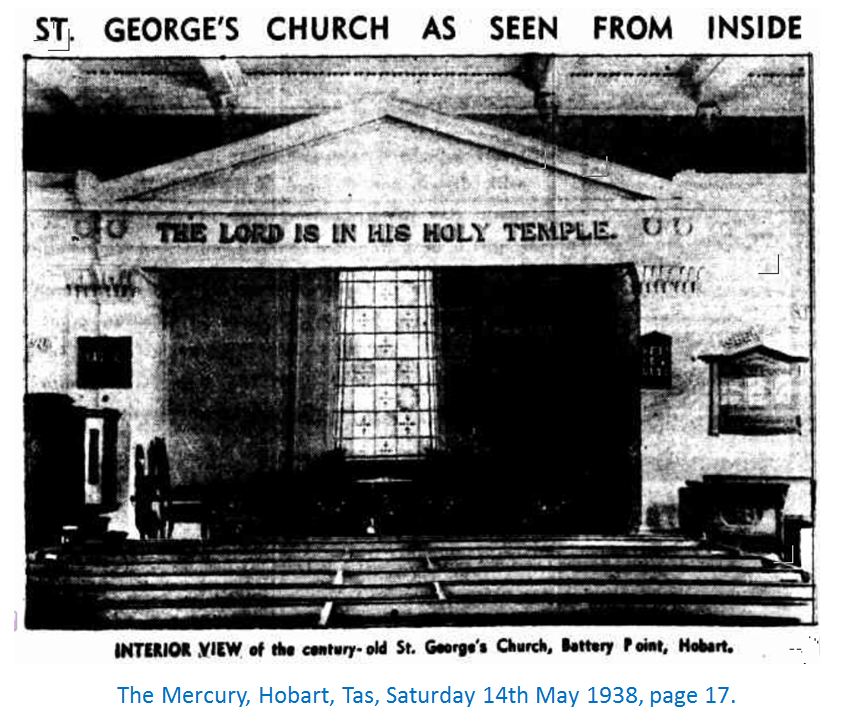
“…The principal decorative feature was the chancel, which, in its simplicity, resembles a tabernacle, across which runs the appropriate line, “The Lord is in this Holy Temple,” the effect being heightened by the lofty oblong window of pale white glass at the back, covered with differently coloured mathematical figures resembling crosses and stars…” [9]

Another unusual aspect of the window is its shape. The article from 1905 describes its shape correctly as an oblong. The frame gives the illusion that the window is a true rectangle but, it is wider at the bottom than at the top, which gives the impression that the window was possibly custom made to fit an opening that may have been the result of a building design flaw, or it was designed that way to give the illusion that it is taller than it really is!

In May 1938[10], the Hobart Mercury included a picture of the chancel of St George’s which, although black and white and poor quality, clearly shows the patterns in the window as seen in 2012.

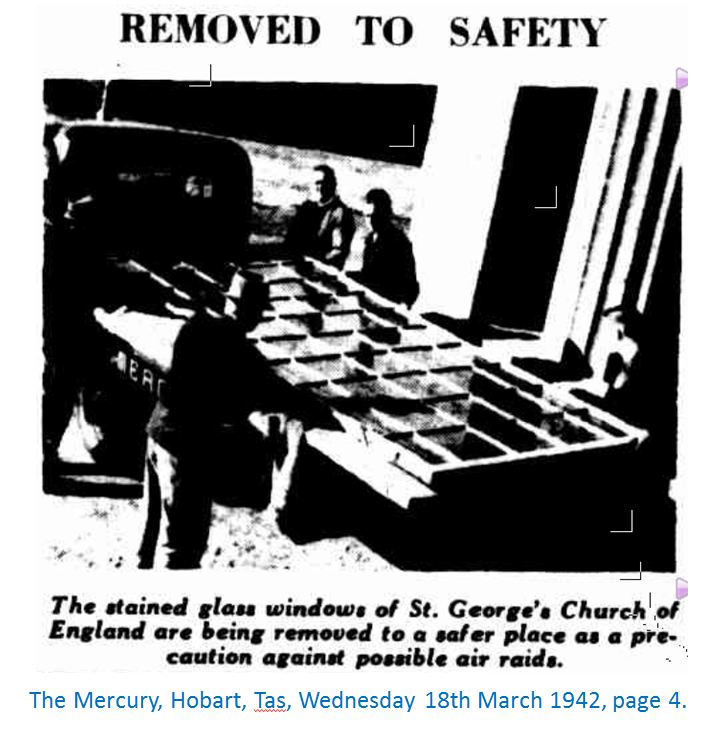
At the height of WWII, the civil defence regulations placed stringent rules on exposed plate glass windows. Whether these rules applied to the chancel window or not is not known but the church decided to remove the window as a precaution against air raids. In March 1942 the Hobart Mercury included a photo of workmen loading the entire window frame onto a truck with the caption:

“The stained glass windows of St. George’s Church of England are being removed to a safer place as a precaution against possible air raids”[11]

A close inspection of the newspaper picture shows that there are ten panes deep and five wide in the frame of the window, which exactly matches the number of panes seen in the chancel window as at 2012.

The Mercury, Hobart, Monday 2nd October 1871, page 2.

“ST. GEORGE’S, BATTERY POINT. – A neat and un-ostentatious stained glass window manufactured by Messrs. Ferguson, Urie, and Lyon, of Melbourne, has just been placed in the chancel of St. George’s Church, Battery Point. Most of the cost has been collected from the working classes by ladies of the congregation. Yesterday at both morning and evening services collections in aid of the same object were made. …”

The Mercury, Hobart, Tasmania, Saturday 7th October 1871, page 4.

“… Sermons were preached at St. George’s Church, Battery point, on the 21st inst., and collections made to supplement subscriptions (principally) by the working classes for a neat and unostentatious stained glass window, manufactured by Messrs. Ferguson, Urie, and Lyon, of Melbourne, and placed in the chancel of the church…”

The Mercury, Hobart, TAS, Friday 7th April 1882, page 3.

(About St Georges Church Hobart)

“…But the interior, elegant, well-arranged and admirably lighted, leaves little to be desired, except stained “ecclesiastical: glass to replace the “mansion staircase” window behind the communion table”

Foot notes:

1869: The Alfred Kennerley Mansion ‘Rouseville’, Davey Street, Hobart, Tasmania.

The two storey sandstone mansion named “Rouseville” was built in Davey Street Hobart in 1869 for Politician and Philanthropist Alfred Kennerley (1810-1897).

The 900 sq meter mansion was built by Tasmania’s famous architect Henry Hunter who also designed Hobart’s Town Hall. Rouseville cost of £3,400 and was named after Kennerley’s wife, Jane Rouse.

The mansion still stands on the corner of Davey and Elboden Streets in South Hobart and contains a large Ferguson & Urie stained glass window in the stairwell and a stained glass transom light  above the front entry door. The side lights either side of the door were vandalised many years ago but pieces of the sidelights are still in the possession of the current owner.

Photos taken: 13th August 2012.

This slideshow requires JavaScript.

In 1867 Alfred Kennerley had also donated a pair of, two light stained glass windows depicting the apostles ‘St Matthew & St Luke’ and ‘St Mark & St Peter’ to the All Saints Church at the same time as his friend and fellow parliamentarian, John Foster, had commissioned Ferguson & Urie to create a stained glass memorial to his seven year old son who died in December 1866 as a result of a coach accident.

The Mercury, Hobart Tasmania, Wednesday 7th August 1867, page 2
“…the firm [Ferguson & Urie] are in receipt of commissions from John Foster, Esq, for a memorial window to be placed in All Saints’ church, Hobart Town, in remembrance of the donor’s deceased son, and from A. Kennerley Esq, for other decorated windows for the same church…”

The Foster memorial window and those donated by Alfred Kennerley were all crafted by the Melbourne stained Glass firm Ferguson & Urie and are all located along the north side of All Saints Church in what is known as the “Kennerley Aisle”.

In late 2012 the Ferguson & Urie stained glass windows will be restored by Tasmania’s heritage stained glass conservator, Gavin Merrington. As at August 2012 restoration and conservation work has commenced on the three light west window of the church created in 1864 by the London stained glass firm of Charles Clutterbuck.

The Mercury, Hobart, TAS, Tuesday 16th November 1897, page 3.

“DEATH OF HON. ALFRED KENNERLEY”

“The Hon. Alfred Kennerley, on of the most philanthropic and high principled men of Hobart, died yesterday at his residence, Elboden-place[i], in his 88th year, of old age and general decay, accelerated to some extent by the results of a stroke of paralysis having for some years prevented him getting about. He had spent a long and exemplary life in seeking to promote the good of others. A man who used to like to give expression to Tennyson’s lines – “Howe’er it be, it seems to me Tis only noble to be good; Kind hearts are more than coronets, And simple faith than Norman blood.”

He was no ordinary man, and has done an immense amount of good in his time. Mr. Kennerley was an English gentleman of means, who came out in the early days to New South Wales, where he acquired some property and was soon made a magistrate. Finding that the climate there was very trying, he and Mrs. Kennerley removed to Hobart, and permanently took up their residence in this city. Mrs. Kennerley, to whom he was devotedly attached, died 28 ye; ars ago, and shortly afterwards everyone heard with deep regret that Mr. Kennerley had suffered a paralytic stroke. He rallied wonderfully, though the effects never wholly disappeared, and few expected that his life would have been spun out to the great age he has attained. Being a man of means and leisure, upright and shrewd, with a very active mind, his good counsel was soon sought in public affairs. He was elected an alderman of the city early in his sixties, and was Mayor of Hobart in 1862 and 1863, and again in 1871 and 1872. He was also returned to Parliament, and was Premier of the colony from August 4, 1873, to July 20, 1876, his Ministry being composed of: Mr. Chapman, Colonial Secretary, to April 1, 1876, when he resigned; Mr. G. Gilmore, Colonial Secretary, from April 10, 1876; Mr. P. O. Fysh, Colonial Treasurer, to March 12, 1875, then without office; Mr. F. M. Innes, Colonial Treasurer, from March 13, 1875; Mr. Giblin, Attorney-General; Mr. W. Moore, Minister of Lands and Works. The munificent acts of the deceased have been numerous; he has aided very many good objects in a very generous manner. Mr. Kennerley was first and foremost a staunch adherent of the Church of England, and has been a very liberal supporter of All Saints’ Church for many years, giving an annual sum towards the salary of the incumbent, another annual sum towards the offertory, and also contributing towards the improvements of the edifice. The poor of the parish he was also ever mindful of. He purchased the property, and founded and endowed the Boys’ Home at a cost of about £3,000. The deceased gentleman leaves no children, his nearest relatives being his two nephews, Messrs. R. R. and Edward Terry, who resides in New South Wales, but who are well-known to a large circle of friends in Hobart. They are now on their way here to attend their uncle’s funeral.”


External links:

Australian Dictionary of Biography: Alfred Kennerley (1810 – 1897)

Wiki: https://wikivisually.com/wiki/Alfred_Kennerley


Short link to this page: http://wp.me/p28nLD-1dP

© Copyright

13-08-2012: All Saints Anglican Church, Hobart, Tasmania, Australia.

All Saint’s Anglican Church at South Hobart is restoring the church and it’s historic stained glass windows. The restoration of the stained glass windows will be carried out by Tasmanias restoration and Conservation expert Gavin Merrington over a period of more than a year. The church contains stained glass by Ferguson & Urie of North Melbourne, William Wailes of Newcastle-upon-Tyne, London and Charles Clutterbuck, London.

ABC News, Monday 13th August 2012. Interviews include, Ray Brown, Gavin Merrington and Duncan Foster.

1. Ray Brown: 3xGreat Grandson of James Ferguson of the Colonial Victorian Stained Glass firm Ferguson & Urie. The church contains three two light stained glass windows by the firm.

2. Gavin Merrington: Tasmania’s own historical restoration and conservation expert with over 30 years experience in stained glass.

3. Duncan Foster: Tasmania’s expert heritage Stone Mason

Related posts:

1868: All Saints Anglican Church, South Hobart, Tasmania.


Short link to this page: http://wp.me/p28nLD-1dM

© Copyright


1868: All Saints Anglican Church, South Hobart, Tasmania.

The Colonial Victorian Stained Glass firm, Ferguson & Urie created the John Henry Foster Memorial Window, and the ‘St Matthew & St Luke’ and ‘St Mark & St Peter’ windows at All Saints Anglican Church, South Hobart, Tasmania.

The vast majority of our historical stained glass memorial windows have an element of tragedy and mystery surrounding them, but over the course of more than a century the story behind who they were memorials to has long faded from memory.

In August 1867, James Urie, a principal partner in the Colonial Victorian Stained Glass firm, Ferguson & Urie, was travelling Tasmania with a portfolio of the companies secular and ecclesiastical stained glass designs. Amongst the many commissions he had received for stained glass windows, was one for Mr John Foster Esq, to be erected as a memorial to his eldest son, John Henry Foster[1].

 “DECORATIVE ART– The admirers of art workmanship will be glad to hear that there has for the last couple of weeks been sojourning in Tasmania, a partner of the Victorian firm of Ferguson, Urie, and Lyon, to whom many ecclesiastical and private edifices in this and the neighbouring colonies are indebted for some of the finest specimens of pictorial decoration on glass, of which they have yet become the possessors…”[2]

“…the firm are in receipt of commissions from John Foster, Esq, for a memorial window to be placed in All Saints’ church, Hobart Town, in remembrance of the donor’s deceased son, and from A. Kennerley Esq[3], for other decorated windows for the same church…” 

Photos taken 8th October 2010.

This slideshow requires JavaScript.

The two light Foster memorial window for All Saints Anglican Church in Hobart was created by Ferguson & Urie and erected circa 1868.

A trefoil above both lights depicts the Lamb of God (Latin ‘Anus Dei”) carrying the Christian banner.

The central figures in each light depict beautifully coloured and intricately designed figures that correspond with verses from Mark 11:22, with the text below: “HAVE FAITH IN GOD” and Luke 18:16 with the text, “SUFFER LITTLE CHILDREN TO COME UNTO ME”.

Above each figure is an angel carrying a ribbon with text from Revelations 14:13 “Blessed are the dead” and “Which die in the lord”

The bottom edge of the window has the memorial text:

“ERECTED BY JOHN FOSTER ESQ. IN MEMORY OF HIS DEAR SON”.

The memorial text on the window doesn’t reveal much information, but the prominent Tasmanian newspapers of the time reveal the sad story of the boys demise.

On the evening of the 3rd of December 1866 a tragic accident occurred near the Foster family home at 94 Davey street Hobart. In the vicinity of the barrack gates in Davey street, the young John Henry Foster was knocked from his pony by a coach and subsequently run over by its wheels and he died shortly after.

“DISTRESSING AND FATAL ACCIDENT.- One of the most distressing and fatal accidents, which it has for some time past been our lot to record, occurred in Davey-street at about half past four o’clock yesterday afternoon. It appears that Master Foster, son of John Foster, Esq., of Davey-street, a promising little lad between six and seven years of age, was riding on his piebald pony along Barrack-street, being accompanied by Master Hinsby, who was also on horseback. When nearing the corner opposite the barrack gate a cab was observed coming down Davey-street at full speed. Master Hinsby kept his right side, taking a full sweep, and passing the cab. He was closely followed by Master Foster, but the cab took rather a wide sweep in turning the corner and ran right into the poor lad, who was struck it is believed by the pole, knocked off his pony and the wheels of the cab passing over him. He was at once picked up, and under the direction of the Hon. R. Q. Kermode, Esq., and Dr. Benson, who were passing at the time, he was conveyed into a cottage near the residence of Captain Clinch…”[4]

Young John Henry Foster was subsequently dispatched to hospital and Dr Bright was in attendance within half an hour but “…on his arrival the poor little fellow had breathed his last.”[5] Equally tragic was the fact that the boys parents were away in Melbourne at the time and it was left to the Hon R. Q. Kermode to contact them and advise of the tragedy.

“Mr. Kermode has, we believe, written to the bereaved gentleman informing him of his terrible loss.” [6]

An inquest was held in the absence of the boys parents, at the Greyhound Inn on Wednesday the 5th of December 1866 [7] before A. B. Jones, Esq,. and a jury of seven. The jury foreman was none other than the long time friend of John Foster, the Hon Alfred Kennerley, Esq.

The inquest found that the cab was not speeding as previously reported and that the pole brace attached to the collar of the cabs outside horse had bumped the rear of the boys pony causing the boy to fall off and go under the wheels. No blame was attributed to any anyone for the accident.

“…The jury would not call upon the coroner to go through the evidence, and returned a verdict that deceased had been accidentally killed, requesting that it might be noticed by the press that no blame was attached to John Newhey, the driver of the cab, nor did the jury attribute any blame to Mr. Hinsby, junior. The inquest was then closed.” [8]

The funeral of Master John Henry Foster didn’t occur until his parents had arrived back from Melbourne some twelve days later and was interred in the Foster family vault at Cornelian Bay Cemetery, Hobart, on the 15th of December 1866 [9].

 Over 144 years has passed since the tragic event and the windows creation by Ferguson & Urie. The newspaper article from 1867 also mentioned that Alfred Kennerley had also commissioned Ferguson & Urie for other decorative windows:

“…and from A. Kennerley Esq[10], for other decorated windows for the same church…”

The windows donated by Alfred Kennerly are the ‘St Matthew & St Luke’ and ‘St Mark & St Peter’ windows. None of these windows appear to be memorials as such and are likely to have been erected at the same time as the Foster memorial window.

Biographies:

John Foster (1792-1875)

Alfred Kennerley (1810-1897)

End Notes:

[1] John Henry Foster, born 27th January 1860. (date as per memorial at Cornelian Bay Cemetery, Hobart)

[2] The Mercury, Hobart Tasmania, Wednesday 7th August 1867, page 2.

[3] The Hon. Alfred Kennerley. Alfred Kennerley (1810-1897)

[4] The Mercury, Hobart, Tasmania, Tuesday 4th December 1866, page 2.

[5] ibid

[6] ibid

[7] The Mercury, Hobart, Tasmania, Thursday 6th December 1866, page 3.

[8] Ibid

[9] The Mercury, Hobart, Tasmania, Saturday 15th December 1866, page 1.

[10] The Hon. Alfred Kennerley.

Restoration/Conservation:

The Ferguson & Urie windows are undergoing restoration in 2013 by Gavin Merrington. The Foster memorial is the first in the series to be restored and has been removed as at May 2013.


Short link o this page: https://wp.me/p28nLD-1a3

© Copyright

06-01-1876: Holy Trinity (Greek Orthodox), Hobart, Tasmania.

The Mercury Hobart, Tasmania, Thursday 6th January 1876, page 2.
The Mercury Hobart, Tasmania, Monday 24th January 1876, page 2s.

“MEMORIAL WINDOW – A beautiful and richly coloured window (says the Church News) has lately been placed in Holy Trinity Church, Hobart Town, by a large number of the parishioners and friends of the Rev. Canon Davenport as a memorial of his eldest son. It is the work of Messrs. Ferguson and Urie, Melbourne, and the chief design is a Cross with the words, “Thou art my hope, O God. Jesu, Mercy”. The window also bears the following inscription:- “WALTER CHARLES DAVENPORT. Died 31st March, 1875. Aged 22 years. A tribute from Friends”. This mark of sympathy is deeply valued by Cannon Davenport and his family.”

Holy Trinity was designed in the Gothic Style by the convict architect James Blackburn. The Governor, Sir John Franklin, laid the foundation stone in October 1841 and the church was consecrated on the 27th December 1849.

Despite many attempts by the Anglican diocese to retain the church, it was found uneconomical  to pay the four million ongoing repair bill and it was eventually decided to sell it to the Greek Orthodox Church in 2009.

Apart from the Davenport memorial window, there are two other Ferguson & Urie windows in the church. The three windows are:

1. The Davenport memorial window has a blue cross with IHS above, floral and geometric designs with text : “THOU ART MY HOPE O GOD, JESU MERCY”, “WALTER CHARLES DAVENPORT. DIED 31st MARCH 1875 AGED 22 YEARS. A TRIBUTE FROM FRIENDS.”

2. Christ carrying the cross with text: “THE LORD HATH LAID ON HIM THE INIQUITY OF US ALL – ISAIAH 53 VER 6”.

3. A depiction of the Suffer little Children with the text, “OF SUCH IS THE KINGDOM OF HEAVEN”. The memorial text reads: “TO THE GLORY OF GOD AND IN MEMORY OF SARAH NOWELL , DIED 29th NOV 1880”

All three windows, with closeup detail, are depicted in the slideshow:

This slideshow requires JavaScript.

External links:

Short link to this page: http://wp.me/p28nLD-oL

10-07-1873: St. David’s Cathedral, Hobart, Tasmania.

St David’s Church Hobart Town is being built with the nave, aisles and transepts completed.

The Illustrated Sydney News, 10th June 1873 and  Illustrated Australian News for Home Readers, Melbourne, Friday 10th October 1873, page 170.

“NEW CATHEDRAL OF ST. DAVID, HOBART TOWN”

 “[…] The west elevation consists, in its lower stage, of a porch of no great projection, the front of which exhibits three arched openings. Above this is a noble Gothic window of five lights with decorated tracery in the head. This is filled with plain “cathedral glass” imported from Ferguson, Urie and Co., of Melbourne, as are the windows of the clerestory. Several of the windows of the aisles are filled with stained glass of English manufacture, presented in memoriam by friends of deceased persons.[…]”

The original plain five light west window has been replaced by a modern stained glass window by Joseph Stansfield (date unknown). The plain clerestory windows by Ferguson & Urie are all still original.

Photos taken: 7th Oct 2010 & 12th Aug 2012.

This slideshow requires JavaScript.

External links:

26-07-1872: Memorial Congregational, Elizabeth and Brisbane streets, Hobart, Tasmania.

The foundation stone of the Memorial Independent Church was laid on the corner of Elizabeth and Brisbane streets in Hobart by Henry Hopkins (1787-1870) on the 16th August 1870 [1] and was formally opened on Thursday 7th November 1872 [2].

In late July 1872 the stained glass windows for the church had arrived from the Ferguson, Urie, and Lyon stained glass company of Melbourne[3] and were promptly erected. A further two “variegated pattern” windows were expected to arrive by the Southern Cross from Victoria on the 4th of August 1872[4].

Photos taken 8th October 2010.

This slideshow requires JavaScript.

The Memorial Independent church was built in the decorated gothic style to the designs of the architect Francis Butler (1823-1916) and erected by the contractors ‘R & R Shield’ who tendered for the construction at a cost of £6,835.

The laying of the foundation stone by Henry Hopkins was one of his last public events. The 16th of August 1870 also marked his 83rd birthday and he died five weeks later on the 27th September 1870 [5].

Preceding his laying of the foundation stone of the church the usual affair of placing a time capsule beneath the stone occurred and;

“…A zinc box containing copies of The Mercury, Tasmanian Times, Tasmanian Independent, Friend, and other journals, various coins of the realm, photographs of the old and proposed new church, and cartes de viste of the Rev. F. Miller, H. Hopkins, Esq., the late Mrs. Hopkins, and the Rev. W. C. Robinson. The zinc box was hermetically sealed, and laid in the cist beneath the memorial stone…” [6]

Also included in the box was the speech read by the Rev. W. C. Robinson, after which the elderly Henry Hopkins was assisted to the platform from his nearby carriage and seated on a chair where he was then presented with;

“…A beautiful box made of Tasmanian light wood, by Mr. Wooley, of Macquarie-street, containing a handsome silver trowel, manufactured and presented by Mr. C. Gaylor, of Liverpool-street, and a mallet, made of coloured myrtle wood, with ivory handle, the work of Mr. Haywood, of Goulburn-street, was then presented to Mr. Hopkins. The silver trowel bore the following inscription: “Presented by Charles Gaylor to the congregation of the Memorial Church, Hobart Town, on the occasion of laying the foundation stone, by Henry Hopkins, August 16th, 1870.” On the lid of the box was a photograph of the proposed edifice. Mr. Shields, the contractor, having had the memorial stone raised about three feet, the mortar was spread, the box containing the records, deeds, &c., placed in the cist, and the stone was slowly lowered to its permanent position. Mr. Hopkins, after giving the stone two or three knocks with the trowel, said: “I declare this foundation stone laid in the name of the Father, Son, and Holy Ghost; and may the blessing of God attend the labours of all concerned in it. Forty years ago I had the privilege of introducing the first Independent minister to this colony, and thirty years since I was the means of the introduction of the first Independent minister into Victoria. Two months ago I had the privilege of laying the foundation stone of the new Wesleyan Church in Davey-street, and now I am called upon to lay the foundation stone of the Memorial Church, which stone bears the name of the Rev Frederick Miller, who arrived in this place forty years ago. He was a man of piety and energy and he felt a great love for the people, and for every cause that had for its object the glory of god and the good of his fellow man. I rejoice in having the opportunity of laying this stone; and may the blessing of God attend the labours of all those who shall be engaged in this building.” The following is the inscription engraved on the brass plate which is let into the stone:- “Memorial Congregational Church, the first Christian Church formed in the Australias upon Independent principles; the Rev. F. Miller, pastor, A.D. 1830 to the year 1862. This stone was laid by Henry Hopkins, Esq., 16th August 1870.” [7]

The church was to be known as the ‘Memorial Congregational Church’ in memory of the first Independent or Congregational minister, the Reverend Frederick Miller (1806-1862), who arrived in Van Diemen’s Land in 1830 and commenced his ministry on the 17th of October in the same year. The very first chapel on the site was funded solely by him at a cost of £500 and opened on the 20th April 1832[8]. He died on the 13th in October 1862 aged 56 [9].

Since 2006 the Memorial Congregational church has been the Seventh Day Adventist & Multicultural Church.

Significant tabloid transcriptions about the windows:

The Mercury, Hobart, Tasmania, Friday 26th July 1872, page 2,

 “THE MEMORIAL CHURCH – The whole of the windows for the Memorial Church having arrived from Melbourne, with the exception of the transept windows, the contractors are busy fitting them in, so that the internal work of the building may be proceeded with as soon as possible. The large front window is completed. It is of stained glass, beautifully designed and ornamented, bearing the inscription in the lower panes, “Christ Jesus came into the world to save sinners.” There will be four windows on each side, some of them with a quarter-foil over the two side lights, and others with cinque-foil and six-foil, while the borders will be of different colours, blue, yellow, purple, or green. There will be two vestry windows with blue borders, three apse windows with yellow borders, and a large number of small windows, the colours of the borders in each instance being varied. The whole of the windows, except the front and transept, which are stained, are of cathedral glass; and the makers, Messrs. Fergusson[sic], Urie, and Lyon, of Melbourne, have eminently sustained the name which they have already obtained in these colonies as stained glass manufacturers. The large window in the gable is a piece of work which shows the remarkable progress which has been made in this art during the last few years in Victoria.”

The Launceston Examiner, Saturday 3rd August 1872, page 5.

“…The stained glass windows, so far as they go, give the building a picturesque appearance; two more windows have to be supplied, and they are expected to arrive by the Southern Cross tomorrow, from the establishment of Messrs. Ferguson, Urie, and Lyon, Curzon-street, Melbourne. The pattern, variegated and blending colors of the glass are of an artistic description, and in due proportion with the general coup d’oeil of the interior of the building…”

The Mercury, Hobart, Tasmania, Saturday 10th August 1872, page 3.

 “The Memorial Church, at the corner of Elizabeth and Brisbane-streets, is in an advanced state toward completion, and some idea can now be realised of the very elegant appearance the church will present when it is entirely finished. While externally it will have the semblance of a magnificent building, internally its appearance will be fully compatible with the outside. The embellishments are of a rich chaste character, consistent with the beautiful design of the building. The roof and the gallery are finished. The windows are also in. The front and transept windows are of stained glass, beautifully designed and ornamented, while the remainder of the windows, which are of cathedral glass, are improved by borders of various colours. The makers, Messrs. Ferguson, Urie, and Lyon, of Melbourne, have eminently sustained the name which they have already obtained in these colonies as stained glass manufacturers. The church, it is anticipated, will be opened as soon after its completion as possible.”

External links:

Biography: Henry Hopkins (1787-1870)

State Library Vic: A Sermon occasioned by the death of Mr. Henry Hopkins, Rev George Clarke, 9 Oct 1870.

Biography: Rev Frederick Miller (1806-1862)

Biography: Rev George Clarke (1823-1913)

Footnotes:

Short link to this page: http://wp.me/p28nLD-hR

© Copyright

16-07-1868: Cook’s Tailoring Establishment, Elizabeth Street, Hobart, Tasmania.

Henry Cook’s new Tailoring establishment in Elizabeth Street Hobart, near “Lord’s Buildings”, was opened 1868 and contained a Ferguson & Urie stained glass window in the show room.

The Mercury Hobart, Tasmania, Thursday 16th July 1868, page 3.

“… Mr Cook’s new tailoring establishment in Elizabeth-street, near Lord’s Buildings, has also been opened; two large houses and shops are converted into one place of business, and a pile of buildings at the rear has been razed, and a mansion erected on the site. Mr. Wiggins was the contractor for the new building, and Messrs. Jackson, Nicol, Martin, and Roberts were employed for the joinering work, cabinet making, and embellishment of the new business premises. A stained glass window in the show room is from the warehouse of Messrs. Ferguson, Urie, and Co, Melbourne. The premises are lighted with forty gas burners”

Henry Cook was elected as Mayor of Hobart in 1860-61. In 1868 he was appointed as Tailor[1] to H.R.H. the Duke of Edinburgh. On the 13th August 1869 he was in the position of acting Mayor of Hobart and was on that day elected as Mayor[2] until the end of the year. He was as also a Justice of the Peace, Churchwarden of St David’s, and the first president of The Benevolent Society of Hobart. There is also a monument dedicated to him at the Fern Tree Pipeline development.

Henry Cooks Tailoring shop was advertised as at 45 Elizabeth Street Hobart in the late 1850’s. The Hobart Post office is now on the site formerly known as “Lord’s Buildings”.

Nothing further is known about what was depicted in the stained glass window or whether it still exists anywhere.

The Mercury, Hobart, TAS, Monday 26th May 1890, page 3.

DEATH OF MR. HY. COOK, J.P”

“…A few years after his arrival in Hobart, he commenced business as a tailor and woollen merchant, which line he has since followed with marked success. His first premises were at the corner of Collins and Elizabeth streets, the spot now occupied by the A.M.P. Society’s offices. Afterwards he removed higher up Elizabeth-street, between Liverpool and Bathurst streets, returning some 20 years ago to the premises in Elizabeth-street, now occupied by his firm.”

Henry Cook died on the 25th May 1890. His son, Henry Jnr, carried on the business “…in a shop which at one time stood on the present site of the Commonwealth Bank, and in 1912 the business was removed to 136 Collins-street, where it is presently conducted.” Henry Cook Jnr died aged 70 on the 17th July 1925.

External links:

Recollections of Old Hobart – The Post Office Block (The Mercury 28th July 1910)

Footnotes:


Short link to this page: https://wp.me/p28nLD-aP

© Copyright

07-08-1867: Decorative Art. James Urie sojourning in Tasmania.

The following historical tabloid transcriptions contain a wealth of clues for my research on Ferguson & Urie stained glass.

In 1867 James Urie has traveled to Tasmania on the quest to further the company’s interests. By all accounts it would seem that his business acumen was extremely successful and there have been quite a few tabloid articles written which trace his movements. For many years after his venture to Tasmania the company would receive commissions from all over the state.

Each of the obscure clues in the following articles has been researched in great depth and links to other detailed posts on the windows mentioned have been included.

The Mercury, Hobart Tasmania, Wednesday 7th August 1867, page 2.

“DECORATIVE ART – The admirers of art workmanship will be glad to hear that there has for the last couple of weeks been sojourning in Tasmania, a partner of the Victorian firm of Ferguson, Urie, and Lyon, to whom many ecclesiastical and private edifices in this and the neighboring colonies are indebted for some of the finest specimens of pictorial decoration on glass, of which they have yet become the possessors. The objects of the visit have been to fulfil some orders previously given and to obtain others, and it is satisfactory to know that in the latter design the gentleman referred to, Mr. Urie, has not been unsuccessful. The name of the firm of which Mr. Urie is a member will be familiar to all visitors to the late Intercolonial Exhibition in Melbourne, in which a court furnished by them to illustrate the ornamentation of churches constituted a very interesting and pleasing feature. Mr. Urie has brought with him a portfolio of designs prepared in his establishment for the embellishment of ecclesiastical windows, and inspection of which is quite sufficient to establish the claim of the house he represents to consideration at the hands of all persons of cultivated taste, who may have made this branch of the art a subject of special study. The appropriateness with which the conventional religious symbols of the ancient church are introduced, the fidelity with which scriptural incidents are treated, and the beauty of the drawing and colouring combine to render the collection at once suggestive to the mind, and pleasing to the eye; and a familiarity with it, on the part of the rising generation of Tasmanians, would do much towards engendering and fostering a healthy appreciation of one of the highest forms of art workmanship amongst the community. The decorations already supplied by Messrs. Ferguson, Urie, and Lyon to churches in Tasmania, include a stained window erected in St Luke’s Church, Launceston, and another which has been placed in the Episcopalian Church, New Norfolk. The former contains a representation of the “Ascension,” supplemented by groups of the apostles, the entire constituting a most ornate adjunct of the building, and being completed at a cost of £130. The latter has been contributed by Dr. Moor as a memorial of gratitude for his preservation from shipwreck in the City of Launceston, steamer. The central group of figures in the latter represents the baptism of Christ. In addition to these the firm are in receipt of commissions from John Foster, Esq, for a memorial window to be placed in All Saints’ church, Hobart Town, remembrance of the donor’s deceased son, and from A. Kennerley Esq, for other decorated windows for the same church. They have also executed commissions for hall and staircase windows, some of them of highly artistic design, for R. Q. Kermode Esq, of Mona Vale, which afford evidence of the attention paid by them to the profane as well as to the religious style of decoration in the branch of pictorial art to which they devote themselves.”

Geelong Advertiser, Vic, Thursday 15th August 1867, page 3.

“A Tasmanian paper thus refers to the success of an enterprising Melbourne firm: -“Mr Urie, of the firm of Ferguson, Urie and Lyon, of Melbourne, who, it will be remembered, designed and executed one of the stained-glass decorations in St. John’s Church, is now visiting Hobart Town, having fitted up a window in the Episcopalian Church, New Norfolk, which has been contributed by Dr Moore as a memorial of gratitude for his preservation from shipwreck in the City of Launceston steamer. The central group of figures represents the baptism of Christ. In addition to these the firm are in receipt of commissions from John Foster, Esq., for a memorial window to be placed in All Saints’ Church, Hobart Town, in remembrance of the donor’s deceased son, and from. A. Kennerley, Esq., for other decorated windows for the same church. They have also executed commissions for hall and staircase windows, some of them of highly artistic design, for R. Q. Kermode, Esq, of Mona Vale.”

All the windows mentioned in the historical articles are extant:

1. St John’s window Launceston (incorrectly mentioned as St Luke’s in the first article).

2. The Episcopalian Church, New Norfolk, is St Matthews and has the Moore window.

3. The Foster memorial window at All Saints Anglican Hobart.

4. The A. Kennerley windows are in the ‘Kennerley’ aisle in All Saints.

5. The Kermode window at Mona Vale is extant but only copyright photos exist.

Also see: 13-08-1867: James Urie visits Tasmania on Ferguson and Urie business.


Short link to this page: http://wp.me/p28nLD-95

© Copyright