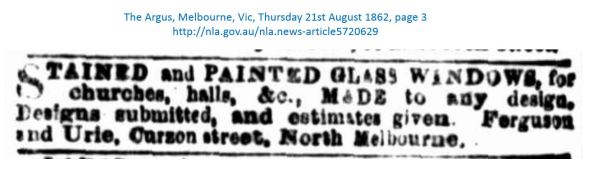
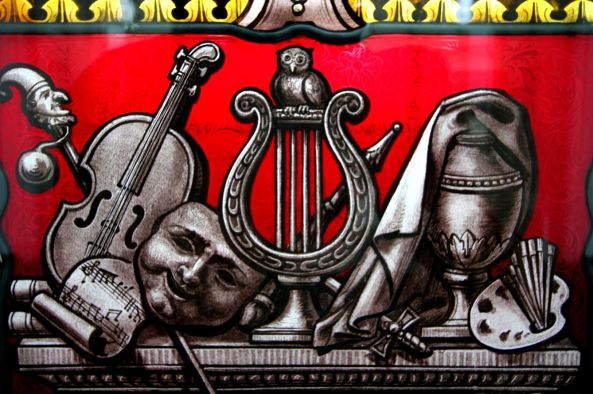
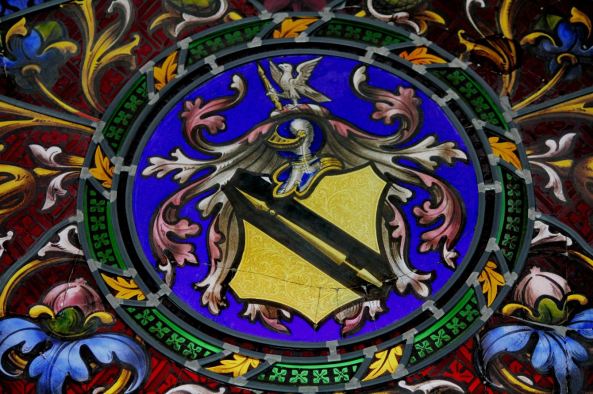
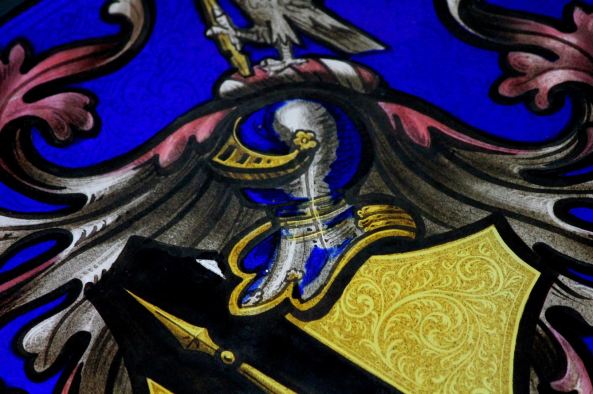
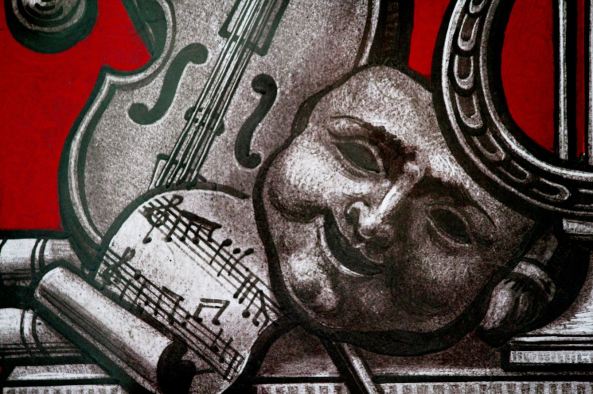
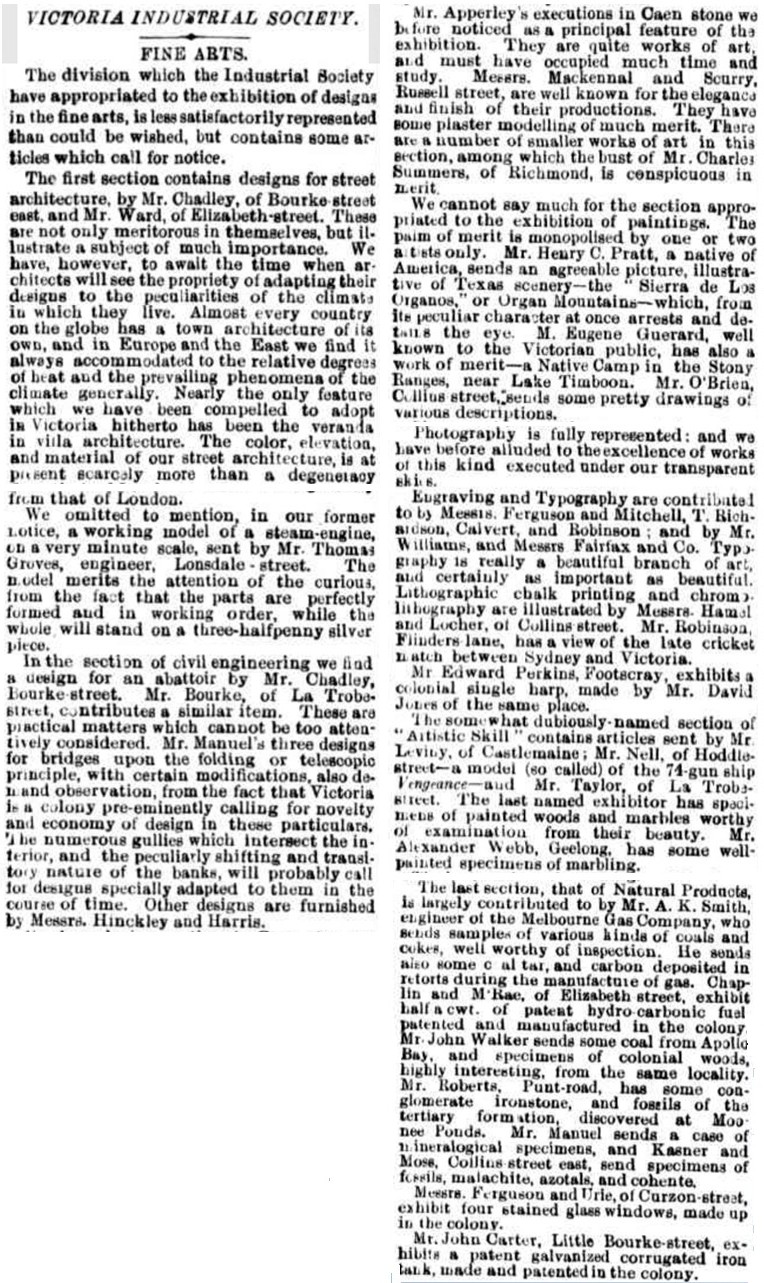
The foundation stone of the Victorian Deaf and Dumb Institution St Kilda was laid by the Governor of Victoria Sir Charles Henry Darling (1809-1870) on the 6th March 1866 and was formally opened ten months later by his successor, His Excellency Sir Henry Manners Sutton (1814-1877) on Saturday the 13th October 1866. The building still contains a stained glass window created by the Ferguson & Urie company of North Melbourne.
Photo of window courtesy of Mrs Noelle Nathan April 2011.
-

-
Photo courtesy of Mrs Noelle Nathan April 2011.
-

-

The general theme of the window is Faith, Hope, and Charity with appropriate scriptural texts from the King James Bible associated with those afflicted by speech and hearing impairments.
1. The left light depicts the Scotch Thistle at the top and below is a cherub holding a scroll with the text: “And in that day shall the deaf hear the words of the book“.
[From the King James Bible Isaiah 29:18 “And in that day shall the deaf hear the words of the book, and the eyes of the blind shall see out of obscurity, and out of darkness.”]
A roundel beneath depicts a crimson cross with a gold crown in the centre and the words ‘FAITH’ below.
2. The apex of the centre light depicts the English Rose. An Angel below it holds a scroll which reads: “The tongue of the dumb shall sing.”
[From King James Bible, Isaiah 35:6, “Then the lame man leap as an hart, and tongue of the dumb sing: for in the wilderness shall waters break out, and streams in the desert”].
Below is the stylised interwoven letters “IHS”, an abbreviation for “IHESUS,” the way Christ’s Name was spelled in the Middle Ages. The text in the outer ring of the roundel surrounding it “CHARITY”.
3. In the right light the Irish Shamrock appears at the top and central below it a cherub hold scrolls with the text: “He maketh both the deaf to hear, and the dumb to speak.“
[From the King James Bible Mark 7:37 – “And were beyond measure astonished, saying, He hath done all things well: he maketh both the deaf to hear, and the dumb to speak”]
The roundel below depicts the ships anchor with the word “Hope”.
The Telegraph, St Kilda, Prahran and South Yarra Guardian, Vic, Saturday 3rd March 1866, page 2.
“The memorial stone of the new Victorian Deaf and Dumb Institution will be laid by His Excellency Sir Charles H. Darling on Tuesday next, on the site recently granted by the Government at the junction of the St. Kilda-road and High-street, Prahran. A large number of ministers and other gentlemen have signified their intention of being present, some of whom will take part in the proceedings.”
The Argus, Melbourne, Monday 15th October 1866, page 5.
“…One of the staircase windows is of stained glass, by Ferguson and Urie. The central square is ten or eleven feet high and there is a figure on it and angel on a sphere proclaiming “The deaf shall hear…”
The Age, Monday 15th October 1866, page 11.
“…A very fine stained glass stair-case window has been erected by Ferguson and Urie, the central square of which is nearly eleven feet high, showing the figure of an angel on a sphere, proclaiming “?the deaf shall hear,” with other scriptural texts of an appropriate character in the other squares,,”
The Australian News for Home Readers, Vic, Saturday 27th October 1866, page 6.
“OPENING OF THE VICTORIAN DEAF AND DUMB INSTITUTION”
“The Victorian Deaf and Dumb Institution, the memorial stone of which was laid in March last by his Excellency Sir Charles Darling, was formally opened on the afternoon, of Saturday the 13th inst, by his Excellency Sir J. H. T. Manners-Sutton, in the presence of a numerous assemblage of ladies and gentlemen….”
“…A very fine stained glass stair-case window has been erected by Ferguson and Urie, the central square of which is nearly eleven feet high, showing the figure of an angel on a sphere, proclaiming “The deaf shall hear.” with other scriptural texts of an appropriate character in the other squares…”
The Australian New for Home Readers, VIC, Saturday 27th October 1866, page 6
“OPENING OF THE VICTORIAN DEAF AND DUMB INSTITUTION.
The Victorian Deaf and Dumb Institution, the memorial stone of which was laid in March last by his Excellency Sir Charles darling, was formally opened on the afternoon, of Saturday the 13th inst., by his Excellency Sir J. H. T. Manners-Sutton, in the presence of a numerous assemblage of ladies and gentlemen. The building is situate adjacent to the St. Kilda road, having a large frontage to High-street, and contiguous to the Wesleyan College, which was also opened during the present year. Its handsome and somewhat elaborate external appearance, surmounted by a lofty tower, entitles the building to rank as another ornament to the colony, and reflects honor upon its promoters; the Government and Parliament, who afforded them such substantial assistance, and the charitably disposed in our community, who have liberally aided the institution. The opening ceremonial was fixed to take place at two p.m., and to be followed by a banquet. His Excellency, Lady Manners-Sutton, together with the private secretary and aide-de-camp, were received at the entrance by the committee of management and the secretary, Mr Moss, and escorted to the dining room, which was temporarily decorated for the ceremonial and banquet. Amongst those present were Bishop Perry and Mrs Perry, his Honor Mr Justice Pohlman, the hon. The Minister of Mines, the hon. Mr Fellows, the Rev. Dr. Cairns, the Rev. J. S. Waugh, the Rev. Mr Macdonald, the Rev. Mr Dare, his Worship the Mayor of Melbourne, Messrs McBain, Balfour, Henty and Langton, M.L.A’s; the mayor of Emerald-hill, the mayor of Williamstown, and numerous other gentlemen connected with the municipal institutions of the suburbs, and many ladies and gentlemen well known for their philanthropic and charitable disposition. The proceedings were opened by his Honor Mr Justice Pohlman taking the chair.
The Rev. Mr MACDONALD invited all present to join in singing the 355th hymn in the Church psalter, commencing “Before Jehovah’s awful throne.”
Bishop PERRY delivered and extempore prayer, invoking the blessing of God upon the labors of those who had been instrumental in raising such an institution for the unfortunate children confided to their care.
Rev. Mr Moss, secretary to the institution, gave a brief report of its rise and progress. Six years ago, he said, Mr Rose went to England in order to ascertain the working of the deaf and dumb institutions in England and on his return to the colony submitted a project for the establishment of such an institution in Victoria, to the present secretary, (the Rev. Mr Moss) who advised him to prosecute it, and after some delay and difficulty a small cottage was obtained about a stone’s throw distant from the present building. The experience then derived established the painful fact that there was a large number of deaf and dumb children residing in the neighbourhood whose parents were unable to pay for their education. It was therefore deemed advisable to extend some assistance to such children, and a meeting was held at the Scots’ Church, at which a provisional committee was appointed for the purpose of establishing a deaf and dumb institution on a scale commensurate with the wants of the colony. Two gentlemen who attended that meeting, viz., the Rev. Mr Macdonald and himself, were now present rejoicing in the success which had attended their efforts. (Applause.) Many difficulties, at the outset, beset them. It was not supposed by many that any necessity existed for such an institution, but when sufficient information had been afforded the public, their sympathies were aroused, and in August, 1862, a public meeting was convened, over which his Excellency Sir Henry Barkly presided, when the project was fairly launched. Since then the efforts of he committee had prospered. They had received general support from the Government, the Parliament, the board of education and the charitable. At the beginning of last year arrangements were made for the erection of a permanent building. An application was made to the Government for a grant of land, and the present site, consisting of six acres, was given. Plans of a suitable building were prepared by Messrs Crouch and Wilson, architects; and Mr Ireland undertook the erection of the building, which had been completed to the satisfaction of the committee. The cost of the present building, including the fencing and outbuildings, was £6800. Towards the liquidation of that amount, the Parliament had voted £4000; a sum of £1800 had been received from private subscriptions; leaving £1000 still to be provided. Of this amount, £500 had been asked of the Government for next year, and the balance it was proposed to raise by private subscriptions. The number of children who had been under the institution since it was first initiated was 58. At present there were 46 children under training, and the number would shortly be increased to 50. It was hoped that the present building would be adequate to the requirements of the colony for many years. The committee, at one time, had hoped to be able to open the building free of debt; but this would have necessitated so serious a delay and it was thought advisable to forego that determination, and trust to the generosity of the public to liquidate the present liabilities. The institution was undenominational in its character and was intended to receive and educate the deaf and dumb without respect to creed. There were three classes of children under tuition: those whose parents only bore a portion of the expense, and those who were wholly educated and supported by the institution. The latter class had been the largest, and had perhaps the strongest claim upon the sympathies of a generous people. There were no means provided for their education apart from the institution, and he felt confident no appeal to the generosity of the public on their behalf would be made in vain. (Applause.)
The Rev. Dr. CAIRNS offered up a prayer.
At the request of the chairman his Excellency declared the building open with the following prefatory observations:- Mr Chairman, ladies and gentlemen, in performing the duty which it is my privilege now to perform, it is not my intention to detain you long. Even if I had a desire to enter at greater length than it is my intention to do into the history of the institution, I should feel that I was only weakening the force of that simple and most admirable statement which the secretary has just made. (Applause.) You will bear in mind that that statement, short as it was, gave you a full history of the progress of the institution hitherto, and closed with a most eloquent appeal to your sympathies. (Applause.) It informed you from what a small beginning the present noble institution has sprung, and the energy, perseverance and spirit which those interested in the development of the institution have shown. I avail myself of the privilege to express the sympathy which, individually, I feel with those who have aided in this benevolent object; and I think, ladies and gentlemen, by your presence to day, you have also shown your participation in that sympathy, and before I declare this building open, I hope you will authorise me, as your spokes-man, to carry to the committee your, as they have my warmest congratulations at the success which, by the blessing of God, has attended their efforts, and your continued support. (Loud applause.) Mr Chairman, ladies and gentlemen, I declare this building open. (Applause.)
An interval of a quarter of an hour followed, during which his Excellency and family, and the ladies and gentlemen present proceeded to examine the internal arrangements of the building. The present structure comprises the centre and the whole of the southern wing, and has a frontage of 200 feet to the St. Kilda-road. The southern wing, fronting High-street, is 94 feet in extent. The centre building consists of three stories surmounted by a tower and spire 100 feet high. The principal entrance is under the tower, ascended by a flight of stone steps. On the left of the doorway a memorial stone of grey granite, bearing the inscription of the institution, is sunk. The remaining portion of the building is only of two stories. On the basement are the kitchen, pantries, and store rooms. The ground floor is occupied by the rooms of the committee of management, the masters’ dining and sitting rooms, girls’ workrooms, measuring 18 feet and 20 feet by 16 feet each. The boys’ and girls’ school rooms are each 66 feet long by 22 feet wide, with lavatory and clothes rooms at the south-east angle. On the first floor above the school rooms will be the dormitories, &c., and in the master’s division, drawing room, bedroom, bath, &c. The girls’ lavatory and bath room is on the second floor, or third story, and over the grand stair-case. Great attention has been paid to the ventilation. A very fine stained glass stair-case window has been erected by Ferguson and Urie, the central square of which is nearly eleven feet high, showing the figure of an angel on a sphere, proclaiming “The deaf shall hear.” With other scriptural texts of an appropriate character in the other squares. Throughout the building gas and water has been laid on. The visitors were much pleased with their inspection and on returning to the schoolrooms, in which the banquet was laid out, the chair was resumed by his Honor Mr Justice Pohlman, and after grace by the Bishop, the substantial repast was partaken of by 200 ladies and gentlemen. The tables were profusely supplied with good things by the committee, under the superintendence of Mr Bauer, formerly cook to his Excellency Sir Henry Barkly. The head-quarters band played selections of music during the repast. The inner man being comforted, a few toasts were given.
His Excellency, family, and suite, were accompanied to the board by the officers of the institution, and on his departure the head-quarters band, which was in attendance, played the national Anthem”.
About some of the names mentioned in the above article:
Justice Pohlman:
Ferguson & Urie were commissioned to create a stained glass memorial window to Judge Pohlman circa 1867. This window has not been located to-date. It’s believed that it may have been erected in either the former St Paul’s Church (prior to the erection of the Cathedral in 1888) or in St Enoch’s, Collins Street (demolished on unknown date). Some other Ferguson & Urie windows that were in the St Paul’s Church prior to 1888 have been located in St John’s, Sorrento and St Paul’s at Warragul.
Mr. Fellows:
The Hon Thomas Howard Fellows MLC was a liberal benefactor of St George’s Church at Queesnscliff. He donated the three light chancel window of the church in 1866 and the twelve Apostle windows later. Christ Church in South Yarra has a memorial stained glass window to Thomas Howard Fellows who died 8th April 1878.
Scots’ Church:
The two largest windows in Scot’s Church, Collins Street, were created by Ferguson & Urie. The “Eight Episodes from the Gospels” window was installed in the west end in 1876 and was gifted by Sir Samuel Wilson. The “Last Supper” window was gifted by John Wilson. Esq, J. P of Woodlands (brother of Samuel) and was installed in the South Transept in 1879.
Crouch & Wilson:
A considerable number of buildings designed by Crouch & Wilson contain Secular & Ecclesiastical stained glass windows by Ferguson & Urie. Whether there was any formal agreement between the two companies is not known but similar agreements like this did exist between architects and stained glass companies in England. T. J. Crouch of the architectural firm had also designed Ferguson & Urie’s Collins street premises in 1884.
The Argus, Melbourne, Vic, Wednesday 7th March 1866, page 5.
“LAYING OF THE MEMORIAL STONE OF THE VICTORIAN DEAF AND DUMB INSTITUTION.
Among the many charitable institutions which do honour to the Victorian metropolis there are few more deserving of support than the Institution for the Deaf and Dumb. Its history, from the first attempt to set up a private school, at Windsor, a few years ago to the present time, is a very interesting one, and its career has been marked by great usefulness and success. For a long time past, the building has been found too small and incommodious for the increased number of inmates, and various efforts have been made to enlist private sympathy and secure Government aid, with the view of raising a more suitable structure. The result of the movement has been very satisfactory. Government granted a site of six acres for the erection of a new building, very prettily situated, at the junction of the St. Kilda-road and High-street, Prahran, besides a sum of £3,000. A sum of £1,300 has been raised by private subscription, and, as the estimated cost is £6,500, there remains a balance to meet of only £1,200. A considerable number of spectators assembled yesterday afternoon upon the site of the new building, to witness the laying of the memorial-stone by His Excellency Sir Charles darling. At three o’clock, His Excellency, accompanied only by his aide-de-camp, Captain Tyler, arrived. There were present the Rev. Messrs. J. S. Waugh, D. Macdonald, S. L. Chase, J. Eggleston, and M. H. Becher; Messrs. J. Balfour, M.L.A., H. Henty, M.L.A, and a large number of others gentlemen interested in the institution. The children of the institution were also on the ground.
The Rev. S. L. CHASE opened the proceedings with prayer.
The Rev. J. DARE having read a passage of Scripture suitable to the occasion.
The Rev. W M. MOSS delivered a long address, in which the early fortunes of the institution and its humble beginning of the year 1864. The number admitted into the institution since that time was fifty-two; the number at present residing in the institution was forty-two. The branches taught to the children were reading, writing, and arithmetic, with the rudiments of drawing, and the other elements of an English education suited to their condition. The rev. gentleman then gave a history of the rise and progress of the movement for procuring the erection of a new building. In concluding his remarks, he said that the institution was not organised to meet imaginary wants. From a calculation based on the returns for the mother country, there must be at least 200 persons among us who could neither hear nor speak. It must be borne in mind that a number of these unfortunates must annually increase, not only by the increase of the population, but through the agency of those diseases to which infancy in this colony is peculiarly subject. The majority of the children upon the platform were not born deaf and dumb, but became so either by disease of by accident.
Mr. H. HENTY, M.L.A., having, after a few brief remarks, presented the trowel. His EXCELLENCY said it gave him great pleasure to listen to the narrative of Mr. Moss. Mr. Henty only estimated his feelings aright in supposing that he had taken a great interest in the progress of the institution. He accepted the trowel, and would always retain it as a memento of that interesting occasion. (Cheers.) The memorial-stone, with an inscription commemorative of the occasion cut upon it, was then lowered, the whole audience joining, with heads uncovered, in singing the “national Anthem.” The stone having been lowered, a leaden box containing the following documents was placed within it:- Copies The Argus, Age, and Herald, 6th March, 1866; the Telegraph, 3rd march, 1866; Supplement Bendigo Advertiser, 28th January, 1865; annual reports of the institution for the years 1863, 1864, and 1865; and scroll containing and account of the ceremonial, and the names of the office-bearers of the institution. His Excellency then, with the usual ceremonies, declared the memorial-stone to be well and truly laid. He could not permit this ceremony to be performed altogether in silence. Not only as patron of the institution, and Governor of he colony, but as a Christian man desirous of promoting all true works of benevolence he rejoiced in the progress made by the institution, and which was indicated by the ceremony just concluded. It could not be laid to the charge of this colony that it was indifferent to the wants of suffering humanity. Already no less than twenty-four public hospitals, six benevolent asylums, four orphan asylums, and one lunatic asylum – intended very shortly to be supplemented by a second – attested the sense which had pervaded the Government of this colony of their great obligation to relieve the poor and afflicted. (Cheers.) These institutions gave relief to 17,000 people within their walls, and extended assistance to 30,000 or 40,000 people out of doors. The amount which the public contributed to the support of these and kindred objects could not be estimated at less than an annual sum of 100,000. He trusted that this institution would successfully accomplish the great object of encircling within its four walls all persons afflicted with the infirmities it was intended to relieve. Till it was established, one link was wanting in the series of necessary charitable institutions. There was no form in which human distress presented itself in a more pitiable aspect than in the case of the deaf mutes, for whose education this institution was intended. (Cheers.) Having expressed these sentiments, it only remained for him to hope that Almighty Providence would in all time come dispose the hearts of the people of this colony to the recognition of the duties incumbent upon them, in the way of charity. They had hitherto responded nobly to the calls of benevolence, and in the bosom of the community there had sprung up a large number of noble men, both clergy and laity, who devoted their best energies to the doing of good, and the promotion of works of a character kindred with the Deaf and Dumb Institution. (Loud applause.)
On the conclusion of His Excellency’s address, the Rev. Mr. MACKIE, of South Yarra, called for three cheers for the representative of Her Majesty, which were given with great good-will by those present.
The rev. Mr. MACDONALD having thanked His Excellency for his attendance, a verse of the hymn “Praise God from whom all blessings flow” was sung, and the proceedings were brought to a close by a short prayer by the rev. M. H. BECHER.
__________
As an account of the new building may not be without interest, the following sketch is appended:-
The building is in an advanced stage of progress, and is being erected from the designs prepared by Messrs. Crouch and Wilson, architects, I the style known as Early English. The portion already in hand comprises the centre and the whole of the southern wing, being fully two-thirds of the completed design. When finished, the edifice will present a façade of 200 feet in length to the St. Kilda-road. The southern wing, now to be erected, will have a frontage to High-street, Prahran, of ninety-four feet. The centre portion is three stories high, exclusive of rooms in the basement, and is surmounted by a tower and spire, rising to the height of 106 feet. Beneath the tower is the principal entrance, where also the memorial-stone is laid. The rest of the structure is only two stories high, exclusive of rooms in the basement.
The basement is devoted to stores, pantries, kitchen, and play-room. On the ground floor are the committee-room, master’s dining and sitting room, and girls’ workroom, measuring eighteen feet and twenty feet by sixteen feet each. In the wing now going up will be boy’s and girls’ school-rooms, each sixty-six feet long by twenty-two wide, with lavatory and clothes rooms at the south-east angle.
On the first floor above the school-rooms will be the dormitories, &c.; and in the master’s division, drawing room, bedroom, bath, &c. The girls’ lavatory and bath-room is on the second floor, or third storey, and over the grand staircase. Great attention has been given to the ventilation, and there is no lack of stairs to the several floors. The walls are being carried up with blue-stone, in a most substantial manner, in what is technically termed “snecked work,” with pressed brick and cement dressings; and judging from the present appearance, will present, when completed, a very bold and handsome exterior.
The trowel used on the occasion was made by Messrs. Brush and Macdonnell, of Collins-street. The blade is of silver, and is chased with a rich border encircling the following inscription:- “Presented to His Excellency Sir Charles Henry Darling, K.C.B, on the occasion of his laying the memorial-stone of the Victorian Deaf and Dumb Institution, on the 6th March, 1866.”
Short link to this page: https://wp.me/p28nLD-6s
© Copyright
0.000000
0.000000





 Ferguson and Urie