30-01-1857: David Ferguson returns to Scotland.

In April 1853 James and David Ferguson arrived in Australia aboard the “Tamerlane” from Greenock, Scoland, and immediately began establishing the Ferguson & Urie plumbing, slating, and glazing business with their partner James Urie from premises in Curzon street, North Melbourne.

Davids involvement in the business was short and in 1857 he decided to return to Scotland.

In late October 1856, he and his brother James had received ‘word from home.’ What that information was has never been ascertained. An advertisement was placed in the Victorian Government Gazette on Friday 30th of January 1857 indicating his partnership is “dissolved by mutual consent” and the partnership would continue under the same name of “Ferguson & Urie” between James Ferguson and James Urie. Witness to the document was James Urie’s brother in law Alexander Young.

David returned to Scotland and re-joined his father (James Ferguson Snr, 1777-1866) in the Plumbing, Slating and Glazing Business in River Street Wallacetown. In 1859 James Ferguson Snr was declared bankrupt, but this was not the demise of his business. When James Snr died in 1866 it would appear that David carried on the business as sole proprietor.

In 1871 or earlier David contracted “phthisis abdominalis” (An archaic medical term for a form of Tuberculosis) and so began his slow and painful demise. Probably fully aware of his imminent death, he sold the company to long time employee, John Meikle, on the 20th January 1872.

Nine weeks later David died a bachelor on the 26th March 1872, aged 48.

Some of the most important clues in the family history can be found in David’s last will & testament and his probate documents from 1872. He had left his two unmarried sisters Antonia & Margaret the contents of his house. He had two historic fob watches, the watch he had inherited from his father, James Ferguson Snr (1877-1866), was willed to his brother Robert who was living in Manchester. To his nephew, James Ferguson Jnr (1861-1945), the son of his elder brother James Ferguson (1818-1894) who he had come out to Australia with in 1853 to start the “Ferguson & Urie” business, he left his own fob watch with gold chain and gold nugget attached to the chain.

This slideshow requires JavaScript.

It should be noted, from a family history perspective, that Davids father, James Ferguson Snr’s age 89 at the time of death, was an extraordinary feat at that time in history. In the end he actually did not succumb to ‘old age’, he died of Typhoid fever. How much longer he may have lived if it were not for Typhoid will be a mystery forever. There are other recorded instances of different generations of his descendants in Australia living to an extraordinary age.


Short link to this page: https://wp.me/p28nLD-1R

© Copyright

29-09-1855: The ‘Sticking up’ – James Ferguson is held up at gunpoint.

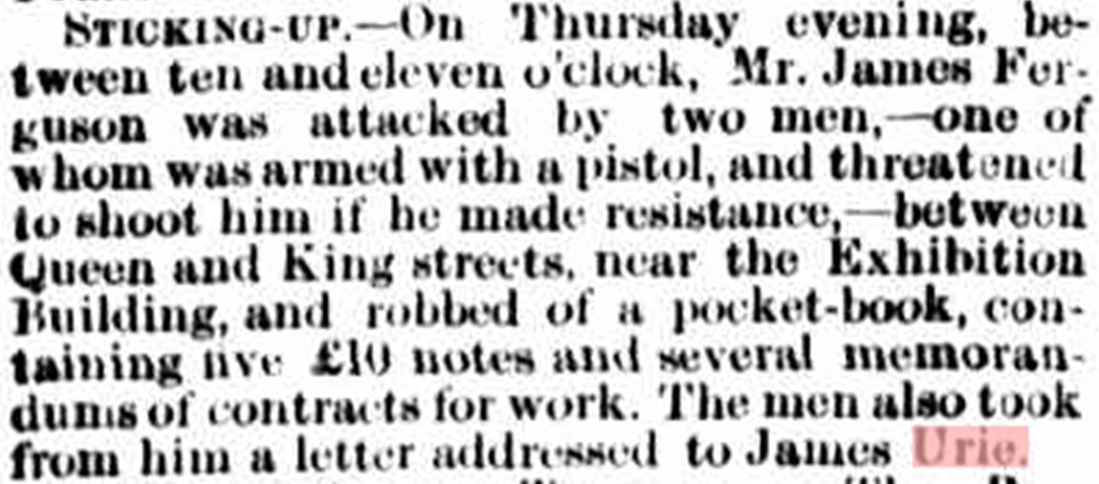
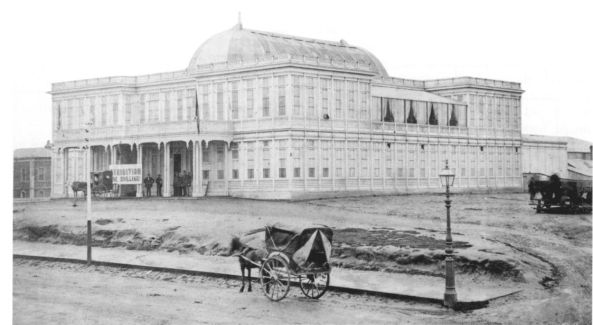
On Thursday evening, 27th September 1855, James Ferguson was held up at gun point in the vicinity of the Exhibition Building in Melbourne. The thieves threatened to shoot him if he resisted and stole  £50 pounds from him, a letter addressed to his business partner James Urie and some contracts for work. This event could have changed the course of history in many ways. If he had been shot I might not be here writing this history at all! The other thing that begs an answer is ‘what was he doing with five ten pound notes’? That was close to carrying around about $10,000 AU in your wallet [amount updated based on some great comments to this post].


The Argus, Melbourne, Saturday 29th September 1855, page 6.

STICKING UP – On Thursday evening, between ten and eleven o’clock, Mr. James Ferguson was attacked by two men, -one of whom was armed with a pistol, and threatened to shoot him if he made resistance, -between Queen and King streets, near the Exhibition Building, and robbed of a pocket-book, containing five £10 notes and several memorandums of contracts for work. The men also took from him a letter addressed to James Urie.”

No further information is known subsequent to this regarding the offence or perpetrators.

1855 The Sticking up 001a

Melbourne Exhibition Building in 1855

Melbourne Exhibition Building in 1855


Short link to this page: http://wp.me/p28nLD-X

©Copyright


28-02-1855: The 1855 Victorian Exhibition, Melbourne.

At the Victorian Exhibition in Melbourne in late 1854, the Ferguson & Urie company were awarded certificates for exhibit 69, Plumber’s work, and exhibit 455, for stained windows. This appears to be the earliest indication of the companies foray into the art of stained glass windows. The extraordinary rate of the erection of churches in the colony, and the Gothic revival in art and architecture, now becomes the driving force in the companies future direction and its part in the formation and history of the colony.

Unfortunately no further articles of significance appear in relation to the company dabbling in stained glass between 1855 and 1860. The gold rush was well under way and practically every able bodied builder and craftsman had left for the central Victorian Goldfields with a shovel over his shoulder.

The company’s next significant breakthrough and change of direction would begin in late 1861.

The Argus, Melbourne, Wednesday 28th February 1855, page 8.

© Copyright

19-08-1853: The first Ferguson & Urie advertisement in 1853.

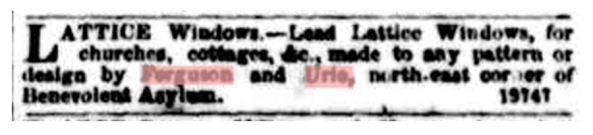
In August 1853 the first newspaper advertisement for the Ferguson & Urie business appeared in the Melbourne Argus newspaper.

The Scottish Brothers, James & David Ferguson from Wallace Town, and James Urie from Kilmarnock, were by trade Slaters, Glaziers & Plumbers from Ayr in Scotland and had arrived in Melbourne circa 29th April 1853 to seek their fortune in the Australian Colony.

Although the discovery of gold in Victoria was a temptation to many immigrants, the three men stuck to the business principals of making money via a demand for a commodity and advancing the likelihood of their success from the side economic effects of the gold rush. In the years 1853 to 1861 the company stuck to the skills of their trade, primarily as slaters, glaziers and plumbers, but in late 1861 this situation would change. The company’s new direction would see them cemented in history as Australia’s Pioneers in the medieval art of stained glass craftsmanship in Australia.

The Argus, Melbourne, Friday 19 August 1853, page 7.

“LATTICE Windows – Lead lattice Windows, for churches, cottages, etc, made to say pattern or design by Ferguson and Urie, north-east corner of Benevolent Asylum”.


Short link to this page: http://wp.me/p28nLD-Q

© Copyright