31-01-1888: The fire at the Ferguson & Urie Yarra Bank workshops.

In the early hours of the 31st of January 1888 a fire broke out at the rear of Glover & Co’s foundry in Normanby-road, Yarra Bank (now South Melbourne) which in turn destroyed the adjoining Ferguson & Urie glass store. Reports of the fire were published in the Brisbane Courier, Sydney Morning Herald and Hobart Mercury tabloids. Despite the building being insured the company decided not to re-build the workshop and no longer had any presence in South Melbourne.

The Argus, Melbourne, Tuesday 31st January 1888, page 7.

“FIRE AT YARRA BANK SOUTH”.

“A destructive fire broke out early this morning in the factory of Messrs. Ferguson and Urie, glass stainers and importers of plate and sheet window-glass, Normanby-road, Yarra-bank south, which resulted in the destruction of the greater part of the premises. The flames also extended to the premises of Messrs. Wm. Glover and Co, iron-founders, where a considerable amount of damage was caused. The boats were removed from the yard of Mr. James Cowan, shipwright, but no damage was done to the buildings. At two o’clock the fire had got a firm hold of Ferguson and Urie’s, and the rear portion of the premises was completely gutted. Several fire brigades had arrived on the scene, and were playing freely on the burning buildings. It is not at present known how the fire began. Shortly after half-past 2 o’clock a second fire engine was brought to the scene, and the fire, although still burning, was thought to be in no danger of spreading further”.

The image of the Yarra Bank workshop below is a subset taken from the June 1887 company dinner photos.

Ferguson & Urie Yarra Bank Store 1887

Ferguson & Urie Yarra Bank Store, June 1887

The Argus, Melbourne, 1st February 1888, page 8 & The Mercury, Hobart, Friday 3rd February 1888.

“SERIOUS FIRE ON YARRA BANK SOUTH, DAMAGE ESTIMATED AT £8,500.

“No explanation has yet been found for the origin of the fire which occurred early on Tuesday morning at the store of Messrs. Ferguson and Urie, Normanby-road, on Yarra bank, and a report of which appeared in a late edition of The Argus yesterday. It is believed by some persons, including members of the fire brigade, that it originated in the rear corner of Messrs. Glover and Co.’s foundry adjoining the glass store. But, on the other hand, Messrs. Glover and Co. state that a watchman was on their premises who declares that the fire was burning in Messrs. Ferguson and Urie’s store.”


Short link to this page: http://wp.me/p28nLD-F2

© Copyright

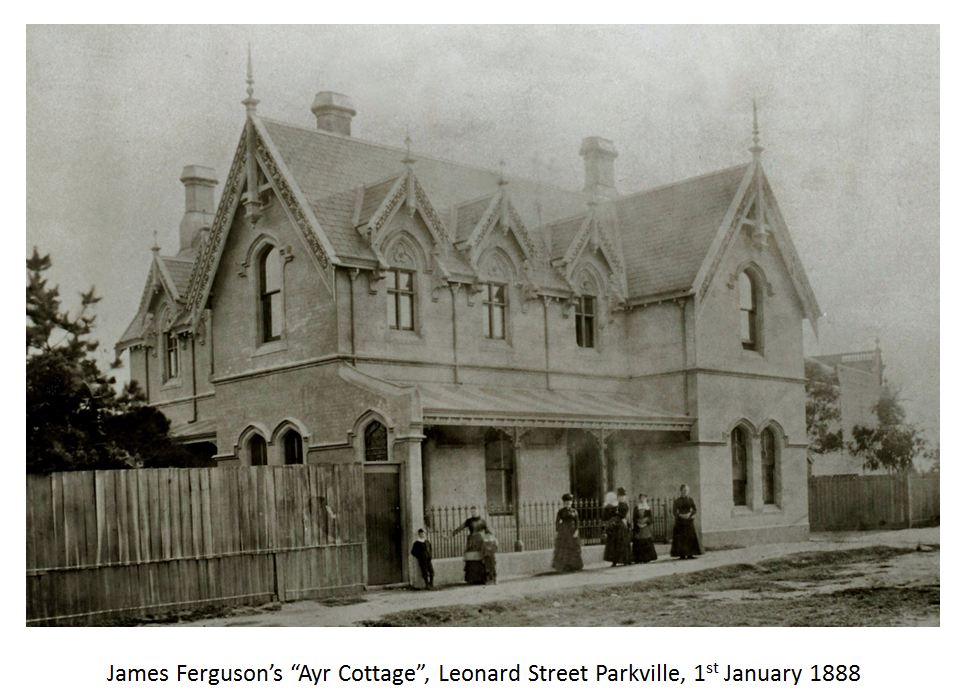
01-01-1888: The Ferguson Clan at Ayr Cottage, Parkville.

On the new years day in 1888 the Ferguson family clan assembled at James Ferguson’s ‘Ayr Cottage’ in Leonard street Royal Park (now Parkville) for festivities and a family photo.

The first photo shows the front of the house from Leonard street with eight of the family members out front and the second photos is of of the entire family on the east side of the house with James Ferguson in the centre with grey hair and bow tie.

The family photo was kindly contributed by Errol Vincent from New Zealand and he and his wife Ann also assisted with the extensive identification of all the family members in the photo.

This slideshow requires JavaScript.

Related posts:

1886: The History of ‘Ayr’ Cottage, 1 Leonard St. Parkville, Melbourne, Victoria.

08-10-1887: ‘Ayr Cottage’, 1 Leonard Street, Parkville, Melbourne, Victoria.

18-04-1894: James Ferguson (1818-1894)

04-07-1901: The sale of Ayr Cottage, Parkville, Melbourne.


Short link to this page: https://wp.me/p28nLD-EU

© Copyright

08-10-1887: ‘Ayr Cottage’, 1 Leonard Street, Parkville, Melbourne, Victoria.

The North Melbourne Advertiser, Saturday 8th October 1887, page 2.

“Mr. Harry Lording the well known local architect and builder, announces in our advertising columns that he has removed to a more central office at 18 Errol street near Victoria street. Mr. Lording’s works are characterized by good taste and boldness of design, one of his best efforts being the residence of Mr. James Ferguson at Royal Park. The Pavilion at the Recreation Reserve is another construction that will bear inspection, and proves the architect possesses considerable ability as a good designer and economical arranger.”

James Ferguson’s home “Ayr Cottage” at 1 Leonard Street Parkville (formerly Royal Park) still exists to this day. In 1901 it was purchased by the Victorian Children’s Aid Society and in 1966 changed into the hands of International House, the University of Melbourne, who still own it as at 2014.

Coincidentally, the architect/builder of ‘Ayr Cottage’, Harry Lording, had a son named Frank Clifford Lording (1860-1944) who was an apprentice of the Ferguson & Urie stained glass company.

Significant research detail on the history of Ayr Cottage can be seen via the links at the bottom of this page.

Ayr Cottage, 1st January 1888, Royal Park, Melbourne.

Ayr Cottage 2009

Related posts:

1886: The History of ‘Ayr’ Cottage, 1 Leonard St. Parkville, Melbourne, Victoria.

01-01-1888: The Ferguson Clan at Ayr Cottage, Parkville.

20-04-1894: James Ferguson (1818-1894)


Short link to this page: https://wp.me/p28nLD-EG

© Copyright

06-07-1887: CLARKE and Co, Brokers, Melbourne.

The Argus, Melbourne, Wednesday 6th July 1887, page 3.

“NOTICE of REMOVAL. From and after the 1st of July, And during the building of new premises, Our business will be carried on at Number 10 COLLINS-STREET EAST, In Messrs. Ferguson and Urie’s Buildings. CLARKE and Co, Brokers, 88 Elizabeth-street”.

Nothing known about Clarke  & Co as tenants of the Ferguson & Urie Building in 1887.

1887: The Royal Visit Illumunations – Portrait of Her Majesty Queen Victoria.

In preparation for the royal visit to Melbourne in 1887, many business premises in the streets of Melbourne decorated their shop fronts.

The Ferguson & Urie stained glass company had decorated their own Collins Street premises with an illuminated transparency on glass showing a full length portrait of Her Majesty Queen Victoria.

What’s ironic though, is that they were probably outdone in the illuminations by Scots Church near the top end of Collins Street who had decided on illuminating one of the companies earlier stained glass windows from inside.

In 1876  they had created the magnificent four light stained glass window for the Collins Street end of Scots Church at the expense of Sir Samuel Wilson and this window was illuminated from inside as part of the church’s contribution to the 1887 street decorations for the Royal visit.


References:

The Argus, Melbourne, Wednesday 22nd June 1887, page 3s.

The Argus, Melbourne, Vic, Wednesday 22nd June 1887, page 1s.

Related posts:

1867: The Royal Visit – The Illuminations and decorations throughout Melbourne.


28-01-1887: Yacht for Sale.

The Argus, Melbourne, Friday 28th January 1887, page 7.

YACHT, with ballast and gear, for SALE, cheap, FERGUSON and URIE, 10 Collins-street east”.

I have no idea what this is about. Was the company so successful that it could afford a yacht? Nothing has been found in family history mentioning anything to do with a Yacht to this date.

29-10-1886: James Urie’s house in Wellington Street, Flemington

North Melbourne Advertiser, Vic, Friday 29th October 1886, page 4.

“… a fine balcony house (Glencairn) with patent white stone front (very effective), built by Cr. James Urie in Wellington street. A grand view can be obtained from here as the house stands on one of the highest points of the suburbs…”

Photo of James Urie’s Wellington street, Flemington house “Glencairn”. Possibly circa 1900. Photo from Roslyn Hyde, December 2011.

Note: The lower half of the ground floor windows clearly show that there was original stained glass but this no longer exists (2012).

‘Glencairn’, now known as St Brendan’s Presbytery, as seen in 2012.

Related posts: 21-11-1865 >19-02-1874 > 18-09-1885  >  23-07-1890 > 25-07-1890 > 29-08-1890 > 20-07-1899


Short link to this page: https://wp.me/p28nLD-Ee

© Copyright


1886: The History of Ayr Cottage, Leonard Street, Parkville, Melbourne, Victoria.

In 1886 James Ferguson decided to build his family home, ‘Ayr Cottage’, on a block of land that he purchased some sixteen years earlier, on the 28th of June 1870, from a Mr Morton Moss.

James’s intention was to have the house built with the front facing Leonard Street, but this was objected to;

The Australasian, Melbourne, Vic, Saturday 13th February 1886, page 27.

Inquiries were recently made by the Minister of lands with regard to an alleged violation of the conditions under which the Royal-park frontages to the Sydney-road were sold by the department for building purposes. When the fee-simple of the land was parted with, it was stipulated that he allotments should not be subdivided, and that all buildings should be erected fronting the Sydney-road. It was reported to the Minister that Mr. Jas. Ferguson, of Messrs. Ferguson and Urie, was building a house on the back portion of one of the allotments, with the front to a side street leading from Sydney-road to the park. Mr. Tucker, on inspecting the plans, formed the opinion that the conditions of sale were being violated, and the Inspector-General of Public Works, to whom the matter was referred, endorsed this view. Mr. Ferguson has expressed his willingness to alter the plans so as to comply with the conditions, which he states, however, were not mentioned on the certificate of title received by him from the original purchaser of the allotment.”

Despite the objections by the Minister of Lands, Ayr Cottage was still built facing Leonard Street.

The construction of Ayr Cottage began in the latter half of 1886 and was completed in early 1887 by architect and builder Harry Lording. (Lording’s son, Frank Clifford, was also employed as a glass stainer with Ferguson & Urie).

The stained glass windows in Ayr Cottage reflect the personal preference of James Ferguson as  well as elements of his Scottish heritage. His obvious deep affection for the Scottish bard, Robbie Burns, is immortalised by a detailed depiction of his bust in the stairwell window.

Photos have been updated 19th June 2013. The older historical photos are from family history collections.

This slideshow requires JavaScript.

[View larger images]

Unfortunately James Ferguson’s wife, Jane (nee Lawson), never got to see the magnificent home. She died on the 19th of April 1886 at the former family home at 24 Little Curzon Street North Melbourne which James had purchased in 1853.

As far as I can gather, only James Ferguson Snr and his bachelor son James Jnr, and mentally disabled daughter Margaret had moved into Ayr Cottage when it was completed in early 1887. I suspect there was possibly a house-keeper but this is unconfirmed. At some point later, James’ sister in-law, Barbara Kennedy (nee Lawson 1821-1902), moved in after her husband had died circa 1890.

After James Ferguson’s death in 1894, Ayr Cottage was sold to the Lockington family who retained it for seven years. In 1901 the Victorian Neglected Children’s Aid Society purchased it and they retained it for the next 65 years.

In 1966 the Victorian Neglected Children’s Aid Society had considered the building no longer economical to continue repairs and tabled the options of either demolishing the house and rebuilding, or selling and buying elsewhere. Fortunately they opted to sell and it was subsequently purchased by the adjoining “International House”, the University of Melbourne, who still own it as at 2012. It is now known as Hilda Stevenson House.

Ayr Cottage still contains many original stained glass windows by Ferguson & Urie that were obviously of James Ferguson’s personal preference with the feature stairwell window containing a medallion of the Scottish poet, Robbie Burns which I suspect may have been the work of apprentice George James Coates. The fanlight window above the main Leonard street entrance, and the eastern entrance doorway, contain a depiction of the Scottish Thistle with a Bee hovering above which is the Ferguson Clan motto; Dulcius Ex Asperis” (Sweeter after difficulties).

The whole house contains an eclectic collection of stained glass which doesn’t seem to fit a particular theme in general. Some elements, such as the Robbie Burns window, and the bee hovering above the thistle have a right of way, but everything else appears random. Close inspection of various elements of the glass leads you to believe that James Ferguson’s windows comprise bits and pieces or leftovers from the workshops. There is practically every element of the company’s style depicted. Like the modern day Plumber who has his own house full of leaky pipes, the same principal seems to apply to the stained glass craftsman!

One of the photos in the slideshow of the stained glass windows depicts what appears to be a native bird, the ‘blue wren’. The background through my photo shows a modern 2013 city landscape and modern vehicles. What was the scene through that same window nearly 130 years ago?

Special thanks to Peter Cole, Deputy Head of College, International House, Parkville and Laurel Clark, Librarian/Archivist, International House, Parkville for the wealth of information and assistance they provided regards Ayr Cottage and it’s history.


Related posts:

08-10-1887: ‘Ayr Cottage’, 1 Leonard Street, Parkville, Melbourne, Victoria.

01-01-1888: The Ferguson Clan at Ayr Cottage, Parkville.

20-04-1894: James Ferguson (1818-1894)

04-07-1901: The sale of Ayr Cottage, Parkville, Melbourne.


Short link to this page: http://wp.me/p28nLD-DP

© Copyright

09-01-1886: Advertisement, 10 Collins Street.

The Argus, Melbourne, Saturday 9th Jan 1886, page 8.

An advertisement appeared in the Argus for about two weeks on January 1886:

“TO LET, for one or four years, from the 1st February next, MUNRO and BAILLIEU’S PREMISES, 10 Collins-street east. Part of Ferguson and Urie’s buildings, and next to the National Bank. Full particulars upon application.”

This particular family line of “Baillieu” has a long Victorian historical history and to the Victorian Parliamentary Premier, Ted Baillieu (as at 2011).

18-09-1885: James Urie’s house “Glencairn”, Wellington Street, Flemington.

By 1885 the Ferguson & Urie stained glass company had reached the pinnacle of their success and the founders, James Ferguson & James Urie were now in a position to build their substantial homes. In the case of James Urie, he was going to build on one of the most sought after blocks of land in the borough of Flemington & Kensington.

North Melbourne Advertiser, Vic, Friday 18th September 1885, page 3.

“Councillor Urie is erecting a new house in Wellington street, and when finished, it will be one of the finest in the borough. The front is composed of patent white stone, and it will contain thirteen rooms. Mr. Duguid is the architect”.

James Urie’s house was to be known as “Glencairn” and it is now owned by the St Brendan’s Catholic Presbytery in Flemington. The name for the house ‘Glencairn’ undoubtedly has its origins back in Kilmarnock where his family lived in close proximity to ‘Glencairn Square’ in the early 1800’s.

Originally the house did have some original Ferguson & Urie stained glass windows in the lower panes of the front windows on the bottom floor, but these no longer exist. Refurbishments by St Brendan’s in the early 1900’s replaced the stained glass and various internal windows are now frosted or etched plain glass and an art deco era lead-light panel appears to the side of the front entrance.

The historical old photo of the house was taken circa 1900 and kindly contributed by Roslyn Hyde in December 2011. I took the recent photo of St Brendan’s on the 31st Jan 2011.

This slideshow requires JavaScript.

Related posts:
21-11-1865 >19-02-1874 > 18-09-1885  >  29-10-188623-07-1890 > 25-07-1890 > 29-08-1890 > 20-07-1899

1890: DEATH OF AN AYRSHIRE MAN IN AUSTRALIA


Short link to this page: https://wp.me/p28nLD-Cg

© Copyright