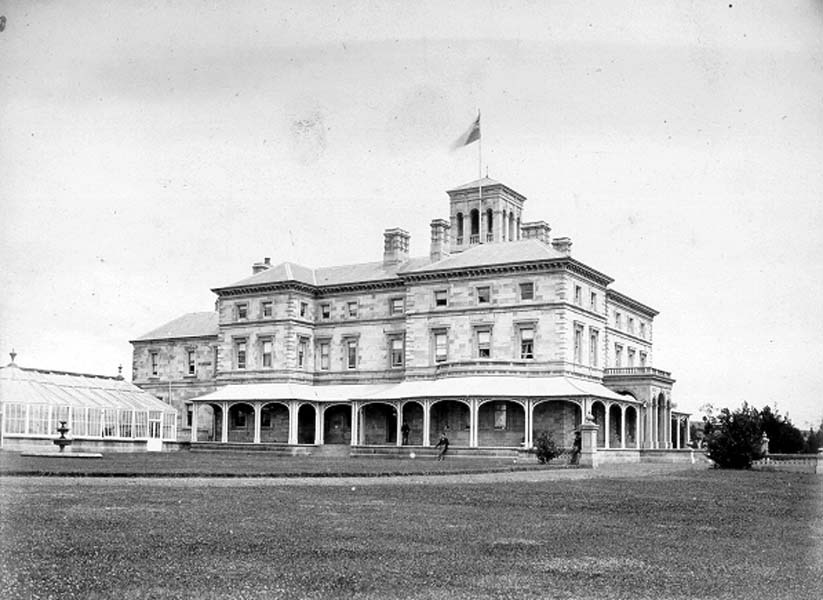
In 1863 Richard Grice of the firm “Grice, Sumner & Co” had his mansion named “Manyung” built at Mornington Peninsula on coastal land then locally known variably as “Schnapper Point” or “Snapper Point”. The most striking decoration to the mansion was a three light secular stained glass window of Gothic design crafted by the North Melbourne stained glass firm Ferguson & Urie circa September 1863[1].
Photos: Attribution to contributors are shown on each of the images. Acknowledgements appear at the bottom of the article.
This slideshow requires JavaScript.
The three light Gothic design window depicts Grice’s family crest in the centre light, showing a row of three wild boars on the background of a white shield. This shield is further surrounded by depictions of the Passion Flower on a deep purple background. The outer lights depict further floral emblems and the Passion Flower with predominant background colours of crimson and purple and intricate borders. At the apex is the Lion with the numeral years 18 and 63 flanking it in gold lettering on a crimson background. The base of the right light includes the rare occurrence of the company name “FERGUSON & URIE Nth MELBne” in yellow lettering on a red background.
Richard Grice was also a liberal benefactor to the building of St Mark’s Church at Collingwood (now zoned in Fitzroy), having contributed nearly £13000 towards it’s erection[2] as well as £1000 annually[3]. In 1863 it was contemplated to have a stained glass window erected in St Mark’s “…to perpetuate the recollection of his munificence…”[4] The designs for the window were prepared[5] by Ferguson & Urie but it was never created despite being mentioned again some fifteen years later, in 1878[6].
Richard Grice died of a stroke on the 4th of November 1882 and was buried in the Melbourne General Cemetery on the 6th[7]. After his death ‘Manyung’ changed hands a number of times and in 1947 was purchased by Norman Myer (1897-1956), of the now Coles Myer conglomerate. Myer renamed ‘Manyung’ to ‘Norman Lodge’ and made considerable changes as well as the addition of outbuildings. The property was primarily used for his staff as a holiday house and convalescence home.
As at 2013 Norman Lodge is owned by developer Chas Jacobsen who purchased the property in 2006.
The Argus, Melbourne, Saturday 19th September 1863, page 5.
“The staining of glass may now be included in our list of colonial industries. A specimen of this art, in the shape of a large window intended for the staircase of Mr. R. Grice’s mansion, at Schnapper Point, has just been completed by Messrs. Ferguson and Urie, of Curzon-street, North Melbourne. It is a three light window of Gothic design and it will occupy a space of something like eighty-four square feet. The centre light contains Mr. Grice’s armorial bearings, and the foliage of the passion flower; the outer lights have each a Gothic rose, with the foliage of the oak; while in the upper portion of the window is the figure of a lion surrounded by rose blossoms. The leading colours are ruby and blue, and in working out the details, these tints are so modified as to create a most harmonious whole. The articifers are entitled to great credit for the skilful way in which they have executed their commission. We understand that a colonial stained glass window can be supplied at thirty-three percent less than the market price of such an article imported from England. This intelligence will no doubt be received with satisfaction by churchwardens and others who take a delight in the decoration of ecclesiastical edifices. For some years past, in the mother country, the memorial window has been deemed a more becoming memento mori than the mural monument; and there is no reason why a similar taste should not be created and fostered in Victoria.”
The Argus, Melbourne, Vic Monday 6th November 1882, page 8.
“DEATH OF MR. RICHARD GRICE.
We regret to record the death of Mr. Richard Grice, senior partner in the well known firm of Messrs. Grice, Sumner, and Co., which took place at his town residence, Victoria-parade, Fitzroy, at an early hour on Saturday morning, from paralysis. About three months ago Mr. Grice had a slight attack of paralysis, but he had partly recovered from it, when six weeks ago he was again stricken down. This second attack was a very severe one, and from the first his medical attendants, Drs. Howitt and Williams, had no hope of his recovery. Mr. Grice was born at Bootle, Cumberland, England, England, on the 30th of October, 1813, and was consequently just turned 69 years of age. He was a colonist of 44 years standing, having arrived in Melbourne in 1838 in company with the late Mr. Benjamin Heape, a partnership having been entered into between them in England. They at once commenced business as merchants in Flinders-lane, under the title of Heape and Grice, and they were also interested in squatting properties at Mount Alexander. In 1847 Mr. Grice paid a visit to Europe, and was absent from the colony for about 12 months, when he returned, and he has resided there ever since. The partnership with Mr. Heape was dissolved in 1854, and Mr. T. J. Sumner joined the firm, the title being altered to that of Grice, Sumner, and Co. In 1856 Mr. John Benn was admitted as a partner, and the business of the firm as general merchants and free and bonded store proprietors was principally carried on by the junior partners, Mr. Grice not having taken an active part in the business for many years. The deceased gentleman had for a long period occupied a seat on the board of directors of the Union bank, and that was the only public position he ever accepted. He never took an active part in either politics or municipal affairs. He evinced great interest in our charitable and religious institutions, and was for some years one of the vice-presidents of the Melbourne Hospital. He however, took no active part in management, but contented himself by subscribing liberally. He also materially assisted, by his handsome contributions, in the completion of St. Mark’s Church of England, Fitzroy. Some years ago he purchased an estate at Mornington, and latterly he spent a good deal of his time there. The firm of Grice, Sumner, and Co. is one of the oldest, and ranks amongst the foremost, mercantile houses in the Australian colonies. The deceased leaves a widow, three sons, and four daughters, two of the former and one of the latter being married. The funeral will leave his late residence at 1 o’clock this afternoon for the Melbourne Cemetery. The Very Rev. the Dean of Melbourne will conduct the burial service”.
External links:
Biography – Richard Grice (1813-1882)
Biography – Norman Myer (1897-1956)
 Ferguson and Urie