“Stained glass window made for ‘Glenferrie’, Malvern, the residence of James Fergusson, a Melbourne manufacturing stationer and member of the Legislative Assembly, and Shire President 1871-72.’Glenferrie’ was a two-storey mansion with fourteen rooms and extensive grounds. Its land extended from Glenferrie Rd and Toorak Rds to the far side of the railway line. In 1903 the estate was subdivided, and the house was called Zeerust by a subsequent owner. The style of the window strongly indicates it was locally made by Ferguson & Urie, the main stained-glass manufacturers in Melbourne from the early 1860s to the 1890s. Following the demolition of Glenferrie in 1954, the window was purchased by a local resident, and subsequently installed in a modern home in the 1970s in Mernda Road, Kooyong”.
“A large leaded and stained glass window, 3.5 metres by 2 metres, attributed to Melbourne stained glass manufacturers Ferguson and Urie; dated c. 1872. Three tall panels, with three small panels above, which show a kangaroo and emu on either side of an early Australian coat of arms. Pride of place in the liddle [sic] window is given to the Fergusson Blazon of Arms, with three boars heads and a buckle. There are six hand-painted vignettes showing aspects of Victorian industry: shipping, farming, pastoral, printing, mining and railways. There are two female figures representing Agriculture and Commerce. Images of thistles, roses and the shamrock represent respectively Scotland, England and Ireland. All panels are bordered by a climbing floral pattern which is entwined around a gold covered rod”. – MUSEUM VICTORIA STAFF WRITER
Dr. Richard Gillespie, curator of the Melbourne Museum, talks about the ‘Glenferrie’ stained glass window.
(in-line link to Youtube video posted by the Melbourne Museum)
Photos taken 10 May 2011: (The window was extremely hard to photograph as it’s mounted in its own protective glass frame which causes a lot of reflection).
This slideshow requires JavaScript.
Related posts: 18-08-1951: Zeerust/Glenferrie Mansion, Malvern, Victoria.
The first building of Sylliot Hill began in 1862-3 by Judge Richard Annesley Billing and was extended in 1873 into a twenty room mansion by Crouch and Wilson. After Billing’s death it was leased to Alexander William Robertson who eventually purchased it in 1887 and renamed it “Ontario” and extended further into a thirty-five room mansion circa 1890. In 1904 it was sold to mining magnate John Boyd Watson who restored it and renamed the property “Labassa”. In 1980 the national Trust purchased the mansion and the immediate adjoining blocks and demolished the houses that surrounded it to reveal the mansion at 2 Manor Grove, Caulfield as it is seen today.
The Argus, Melbourne, 26th August 1882.
“FOR SALE or TO LET”. “FAMILY MANSION known as SYLLIOT HILL, BALACLAVA and ORRONG ROADS, EAST ST. KILDA …”
“… The Residence of the Late Judge Billing, Q.C. The house is most substantially built, and elegantly furnished …”
“… spacious hall, leading to a very handsome staircase with elegantly stained glass windows by Ferguson and Urie …”
The magnificent three light stained glass window appears above the landing of the first flight of stairs and has four roundels in the centre light that represent the four seasons. These were likely to be the work of Ferguson & Urie’s senior stained glass artist, David Relph Drape in 1873 during the Crouch & Wilson extensions to the building.
Mr. Richard Annesley Billing, the recently appointed County Court judge, expired at his residence, Balaclava-road, at 25 minutes past 10 last night, after a short but severe illness. Mr. Billing returned from the Western district circuit on Thursday, and though somewhat exhausted by lengthened sittings and continuous traveling, was in his usual health up to Friday. On that evening, while at dinner, he was seized with a fit of serous [sic] apoplexy, and though his medical attendants, Dr. Embling and Lampriere, were in constant attendance, he grew rapidly worse. The attack was followed by paralysis of the right side, which gradually extended to the left, and at the hour named he passed away very quietly. The deceased leaves a widow and one son. Mr. Richard Annesley Billing was born in the year 1814. He was called to the Irish bar in 1839, and practiced in Dublin for some years. In consequence of ill-health he left Ireland in the year 1856, and came to this country. In October of that year he was admitted as a member of the Victorian bar. He was appointed one of the lecturers in law at the Melbourne University, the subjects on which he treated being the law relating to real property and that relating to procedure. A few years ago there was an alteration in the course of law lectures at the university, and four lecturers were appointed instead of two, and Mr. Billing had therefore to deal with only one branch of the law. Mr. Billing’s classes at the University were always well attended, and he had an aptitude for imparting information to the students. For a number of years he gave a gold medal prize to the student who obtained the highest distinction in his classes. Mr. Billing took no part in the political world. He was asked several times to come forward as a candidate for Parliamentary honours, but always refused the proposals made to him. He had at one time a leading practice at the bar, and was usually retained in cases in which the Crown or the Board of land and Works was a party. As a barrister he showed that he could easily master the details of complicated transactions, although he was not one of those who could make an impassioned appeal to a jury. For the last three years Mr. Billing had retired from general practice. In 1878 he was appointed a Queen’s Counsel for Victoria. In April last he was appointed a judge of the County Court, and the western circuit was allotted to him. During his short career on the bench Mr. Billing displayed a courteous demeanor to the practitioners and suitors who frequented his court, and paid the greatest attention to every case that came before him”.
“THE Funeral of the late His Honour Judge BILLING, QC., is appointed to leave his late residence, Sylliott-hill, Balaclava road, this day, at 2.30, and will proceed to St. Mary’s Church, Caulfield, where a portion of the service for the burial of the dead will be read, after which the remains will be conducted to the place of interment in the St. Kilda Cemetery. ALF. AUG. SLEIGHT. undertaker, 53 Collins=street east, and High-street, St. Kilda.”
Richard Annesley Billing was buried in the St. Kilda Cemetery, Church of England, Compartment C, Grave 363.
Launceston Examiner, Tasmania, Friday 7th April 1882, page 3.
“A good story is told me of the late Judge Fellows. The deceased gentleman always took a warm interest in the Anglican Church at Queenscliff, and he sat there one Sunday listening to a long and prosy sermon. A gentleman sitting in a pew behind the great lawyer noted that His Honor was glancing round at the windows, after which he heard him mutter “Twelve, twelve, oh, twelve Apostles, by Jove!” Not long afterwards Mr. Fellows presented a dozen stained glass windows to the little church.”
Photos taken: 6th Jan 2012.
This slideshow requires JavaScript.
Photos of the twelve Apostles are shown first, being: ST BARTHOLEMEW, ST THOMAS, ST JAMES THE LESS, ST PHILIP, ST SIMON, ST JUDE, ST ANDREW, ST JAMES THE ELDER, ST PAUL, ST PETER, ST JOHN, ST MATTHEW. Then photos of all the other Ferguson & Urie windows are shown.
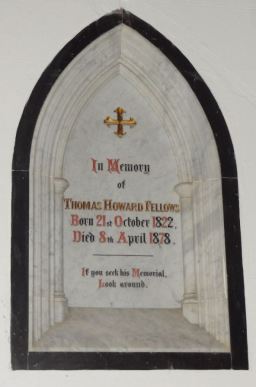
QUEENSCLIFF,- The tablet in memory of the late Mr. Justice Fellows has, during the last week, been erected in St. George’s Church, Queenscliff, to the left of the pulpit, and over the seat he formerly occupied. Mr. Clement Nash, of Geelong, is the sculptor. The tablet is of white marble, with St. George’s Cross in the apex of the arch, and has a margin of black slate 1-in. in width, and bears the following inscription:- “In memory of Thomas Howard Fellows, born October 21st. 1822; died April 8th, 1878. If you seek his memorial, look around.” The letters are black and red, with the exception of the name, which is in gold. The cost of the tablet is about £40, and has been defrayed by subscriptions from inhabitants of Queenscliff and visiting members of the church.”
“In Memory of Thomas Howard Fellows Born 21st October 1822, Died 8th April 1878. If you seek his Memorial, Look around”.
Despite Justice Fellows donating the great east window and the Twelve Apostle windows in the nave of St George’s, there is no stained glass window in the church as a memorial to him.
Conservation: The majority of the Ferguson & Urie windows at St George’s Church at Queenscliff were restored or have had conservation work by Bruce Hutton ofAlmond Glassbetween 2006-2012.
Below is my rudimentary YouTube video of St George’s windows taken with an iPhone 3GS on 6th January 2012.
 Ferguson and Urie