12-04-1875: Holy Trinity Anglican Church, Port Chalmers, New Zealand.

The foundation stone of Holy Trinity Anglican Church, at Port Chalmers, New Zealand, was laid on Wednesday the 7th of June 1871 [1] by Bishop Samuel Tarratt Nevill (1837-1921) [2] and was constructed of volcanic Breccia stone to the designs of architect Robert Arthur Lawson (1833-1902) [3].

The donor of the historic Ferguson & Urie stained glass window was John Elmer (1823-1874). Elmer was born in Barking, Essex, England, and was a Master Mariner by profession. He arrived aboard the ‘Thetis’ on the 1st of August 1854 with his wife Rosetta nee-Lovell, a son, and two daughters [4]. He became a landowner in Port Chalmers, Deborah, and Sawyers’ Bay areas and later became a councillor in Port Chalmers [5].

In early 1874 John Elmer commissioned a single light stained glass window depicting the crucifixion, from the North Melbourne stained glass firm Ferguson & Urie. Unfortunately he died at his residence ‘Wickliff Terrace’ at Port Chalmers on the 18th June 1874, aged 55 [6], before the window was to be erected. 

On the 12th April 1875, the New Zealand press reported that the window had been installed and that it was believed to be the first stained glass window erected anywhere in the Anglican Diocese of Dunedin [7].

Photos were taken 2nd April 2013 by Cindy Ballantyne on commission. Historical photos with permission Bill & Evelyn Lloyd & the Hocken Library, University of Otago, NZ.

This slideshow requires JavaScript.

Otago Daily Times, Issue 4102, 12 April 1875, Page 4

“A very beautifully-executed stained glass window has been placed in the Holy Trinity Church, Port Chalmers, and is, we believe the first introduced into any church of the diocese. It was presented to the church by the late Mr Elmer, of Port Chalmers, and was prepared in Melbourne. It is a choice work of art, and is illuminated with a central figure of the Crucifixion, surmounted by the Agnus Dei, with a lower staining of a pelican feeding its young, according to the once vulgarly-received idea, and which has been introduced as typical of Christ’s sacrifice. The illumination forms the central division of the chancel window, and adds greatly to the general effect of the interior of the church.” [8]

The window was erected in the centre of the three light chancel window of Holy Trinity. In March 2013 Mr Bill Lloyd from Port Chalmers provided the following detail from research conducted by his wife Evelyn for the book “Safe Harbour” [9], which was produced to mark the 120th Anniversary of Holy Trinity in 1994:

“Mr John Elmer, had donated a beautiful stained glass window to be placed in the east end of the church but he died in 1874 before this could be carried out. At a vestry meeting on 26th August a motion was passed “that, this vestry sanction the placing of the memorial window in the memory of the late Mr John Elmer as proposed by his executrix (possibly his wife) the said window to occupy the centre light of the three light window in the east end of the church” [10].

“…In 1946, two new pieces of stained glass were placed on either side of the Elmer Window and did not match. A benefactor gave a new matching centre light and the John Elmer window was transferred to the north side window of the chancel, I believe the pelican roundel was removed at this time. Literally nobody knew the window was there[11]. Evelyn the organist became aware of it one Easter morning when the sun shone through the window and cast coloured lights onto the organ as she played. About 2000, the Elmer window was releaded and moved to the north side of the nave at the same time as protective glass was placed over all of the stained glass in the church…”

 “…It would appear that there was no record of its origin, because, at a vestry meeting on 25th September, 1946 “Mr Brown stated that he felt sure that it was a memorial window.”  The lower part of the window (the pelican) was removed and replaced by the dedication “Given by Mr John Elmer, in memory of his mother 1870…” [12].

It’s not known what became of the original lower stained glass piece that depicted the Pelican feeding its young.

John Elmer’s wife, Rosetta, died aged 67 on the 10th August 1887.

Holy Trinity was eventually consecrated on the 6th October 1907 by Bishop Samuel Tarratt Nevill (1837-1921), who also laid the foundation stone of the church 36 years earlier in 1871[13].

Otago Daily Times , Issue 2913, 8 June 1871, Page 5

“PORT CHALMERS.

LAYING THE FOUNDATION STONE OF THE CHURCH OF ENGLAND”.

“The above ceremony took place at Port Chalmers yesterday, at 2 o’clock in the afternoon…”

The Bishop accepted the crown grant of the land and placed a bottle in the cavity of the foundation stone containing a manuscript with the following words:

“…The foundation stone of Holy Trinity Church, Port Chalmers, was solemnly laid on this 7th day of June, in the year of our Lord, 1871, by the Right Reverend Samuel Tarratt Neville, M.A., Lord Bishop of the Diocese of Dunedin…”

Otago Daily Times , Issue 3850, 19 June 1874, Page 2

“DEATHS…”

“On the 18th June, suddenly, at his residence, Wickliff Terrace, Port Chalmers, John Elmer, Esq., aged 55 years.”

Otago Daily Times , Issue 7946, 10 August 1887, Page 2

“ELMER.- On the 13th July, suddenly, at her residence, Wickliffe terrace, Port Chalmers, Mrs Rosetta Elmer, youngest daughter of the late George Lovell, Esq., late of the city of London, widow of the late John Elmer, Esq., and mother of John Elmer, J.P., of this colony; in her 67th year of her age. London papers please copy.”

Otago Witness , Issue 2300, 31 March 1898, Page 11

“Biographical Notes of Settlers of the First Decade…”

“Elmer, John, born Barking, Essex, 1823; was by profession master mariner; arrived by Thetis in 1854; became landowner in Port Chalmers, Deborah, and Sawyers’ Bays. Was councillor Port Chalmers Council. Mr Elmer died June 18, 1874. Elmer, John (son), well known at Port Chalmers (where he was in business for number of years), Waitati, and Dunedin. Mr Elmer died March 3, 1895”.

Otago Daily Times, Issue 14027, 7 October 1907, page 7.

“CONSECRATION SERVICE AT PORT CHALMERS”.

“The consecration of Holy Trinity Church, Port Chalmers, attracted a very large congregation yesterday, the church being crowded. The foundation of he church was laid in 1871 with masonic honours, and the service held yesterday was largely attended by Freemasons in full regalia. The church building having been cleared of debt, was duly consecrated by the primate, Bishop Neville…”

Footnotes:

[1] Otago Daily Times, NZ, Issue 2913, 8 June 1871, Page 5

[9] “Safe Harbour”; Evelyn E. Lloyd, Holy Trinity Church (Dunedin, N. Z.), 1994.

[10] “Safe Harbour”; Evelyn E. Lloyd, Holy Trinity Church (Dunedin, N. Z.), 1994.

[11] In reference to the lower ‘Pelican’ at the base of the window which had been hidden by the Reredos for many years.

[12] Email correspondence, Bill Lloyd & Ray Brown, 20 March 2013.

[13] Otago Daily Times, Issue 14027, 7 October 1907, page 7.

Thanks to:

  • Janice Ball for the follow up action in New Zealand.
  • Bill & Evelyn Lloyd, Holy Trinity Port Chalmers, for the correspondence, information, and permission to include the c.1900 interior photo from Evelyn’s 1994 book “Safe Harbour”, and for obtaining the additional photos with permission of the Hocken Library, University of Otago, (permission grant date 8 May 2013). The images included have the required citation.

Short link to this page: https://wp.me/p28nLD-1Ou

© Copyright

1875: St John the Baptist Church, Ouse, Tasmania.

The foundation stone of St John the Baptist church at Ouse, was laid in 1842 and opened for services in 1843. No newspaper records of the time have been found to corroborate these dates but a stained glass window, erected in the liturgical south wall of the nave in 1943 commemorates the centenary of the church. The text at the base of the window has the following inscription:

“To the glory of God and in commemoration of the centenary of this church of St. John the Baptist 1843 – 1943 Erected by the parishioners”

(The window was made by the Mathieson & Gibson stained glass company of Melbourne and depicts Jesus being Baptised by St John in the river Jordan)

The oldest and most historical stained glass window in the church is the three light liturgical east window behind the altar. The window was created by the Ferguson & Urie stained glass company of North Melbourne and was erected to the memory of Thomas Lloyd Gellibrand circa 1875.

Photos taken 7th October 2010.

This slideshow requires JavaScript.

Each of the three lancets in the window contains the unique Ferguson & Urie scrolling ribbon design with a piece of scripture from the the King James Bible.

Two ribbons either side of the apex of the centre light have the text “Ecce Agnus Dei ” (Behold the Lamb of God), also known as another title for Jesus. It appears in the Gospel of John 1:29, where John the Baptist sees Jesus and exclaims, “Behold the Lamb of God who takes away the sin of the world.”

The three pieces of scripture depicted in each of the three lights of the window are:

“BLESSED ARE THEY THAT MOURN FOR THEY SHALL BE COMFORTED”.
(Matthew 5-4)

“LIKE AS A FATHER PITIETH HIS CHILDREN SO THE LORD PITIETH THEM THAT FEAR HIM”.
(Psalms 103-13)

“DELIGHT THOU IN THE LORD AND HE SHALL GIVE THEE THY HEARTS DESIRE”.
(Psalms 37-4)

The Mercury, Hobart, TAS, Thursday 1st July 1943, page 5

“The centenary of the Church of St John the Baptist, Ouse, was celebrated by a service in the church on Sunday. Miss Bolland was organist. In the unavoidable absence of the rector (Rev L. L. Oldham) the service was taken by the Rev. J. W. Bethune, who preached the sermon and also spoke to the children. The preacher reminded all of their heritage and sacred associations with the church they loved, and urged them to be true to the faith of their fathers. The offerings for a special centenary commemoration exceeded £113. The following extract from “Church News” more than 50 years ago was written by the late Canon Adams, of Hagley, and authenticated by the late Mr. Bethune, of Dunrobin, the late Rev H. W. Adams, and others: “The Ouse Church was built entirely by the parishioners during the incumbency of Dr. Pogson. The land for the church and cemetery, on a gentle rise, in the midst of the township, was given by the late W. A. Bethune, Esq., of Dunrobin. The east window in St. John’s Church, Ouse, is in memory of T. L. Gellibrand, Esq., late of Lleintwardine, Ouse.”

Thomas Lloyd Gellibrand (1820-1874):

Thomas Lloyd Gellibrand, was the eldest son of Joseph Tice Gellibrand (1792-1836), the first Attorney-General of Tasmania (1825) and Isabella Kerby.
(Also see: 22-10-1864: All Saints Anglican Church, South Hobart, Tasmania, Australia).

Thomas was a grazier and landowner around Bothwell and Ouse in Tasmania and a parliamentarian. He married Isabella Brown, on the 1st of December 1860 at All Saints Anglican Church in South Hobart[1]. He was a member of the House of Assembly in 1856-61[2] and appointed as Captain in the ‘Third Rifles” Southern Tasmanian Volunteers in 1861[3]. He died at his house ‘Vaucluse’ in Macquarie street Hobart on the 9th November 1874 aged 53[4]. His funeral took place on the 12th:

“…The remains of the late Mr. T. L. Gellibrand were yesterday morning conveyed on board the steamer Enterprise, which vessel afterwards left for South Arm, where the family vault is situated. The relatives, and a large number of friends of the deceased proceeded by the steamer. Throughout the day the vessels in harbour lowered their flags to half mast, out of respect to the memory of the deceased gentleman.” [5]

His wife Isabella later married Dr. Edward Clayton Ling (1844-1882)[6] in Suffolk in December 1876. She died in Sussex, England, on the 11th March 1907 aged 67[7].

The Mercury, Hobart, TAS, Wednesday 11th November 1874, page 2.

“Thomas Lloyd Gellibrand, son of Joseph Tice Gellibrand, Attorney-General of Tasmania, in 1856,(sic:1825[8]) who was removed from office by Governor Arthur on charges made against him by persons who have been since convicted of swindling, robbery of the Government, and murder. Mr. Thomas Gellibrand was born in 1821 and educated at Thompsons Academy in Melville-street. In 1848 Sir H. Dennison placed the young colonist who had commenced farming on his own account in the Hamilton district, in the Commission of the Peace, and here on the banks of the Dee, Mr. Gellibrand formed an extensive sheep farm. In Sept. 1856 he was elected a Member of the first House of Assembly for the district of Cumberland, in which he resided and sat in the House an useful active member till the dissolution of the House in 1861. In I860 Session he saw the necessity of protecting the game of his native country, and brought in the first Bill which became law on the subject and which is still in force. He married a daughter of Mr. Thomas Brown the well-known merchant of the New Wharf, and has several children, the youngest being only a few weeks old. His wife’s brother’s death by accident occurred on tho 5th inst[9]., and whilst mourning the death of a favourite brother, Mrs. Gellibrand has now to mourn the death of a husband. To Mr. Thos. Gellibrand the inhabitants of the Bothwell and Hamilton Districts are indebted for the security of the water supply of the Clyde River, which it is well-known rises in the Lakes Crescent and Sorell and which in l856-7, he took great pains to legislate for. Useful colonists of this type, educated, active, zealous men, always eager to push on the latent resources of the colony are fast fading away. Day after day has the record of the loss of one after another; whilst their places, which should be filled by their sons or relatives, are either vacant, by the emigration of those who should fill them, to other lands, where they are more highly appreciated, and much more highly remunerated. An active magistrate – a good master – a kind father and husband – Mr. Thomas Gellibrand has gone to the fullness of repose.”

One of his sons was Sir John Gellibrand (1872-1945) (Major General Sir John Gellibrand, K.C.B., D.S.O) He was was highly decorated in WW1, promoted to Major General circa 1918, appointed as Chief Commissioner of Police in Victoria in 1920 to 1922, elected to the House of Representatives in 1925 and was a founding member of the organisation now known as ‘Legacy’. He died at his property at Murrindindi in 1945 and is buried in the Yea cemetery in Victoria.

Footnotes:

1876: Werribee Park Mansion, Werribee, Victoria.

Werribee Park Mansion was built for the Scottish brothers, Andrew (1818-1890) and Thomas Chirnside (1815-1887) [1] between 1874 and 1876 to the designs of Colquhoun and Fox [2].

“…the contractor for the building. Mr. P. Colquhoun – has been the chief designer, assisted by Mr. Fox, architect, and by the Messrs. Chirnside themselves… [3]

The most striking features of the mansion are the large acid etched picture windows, in, and surrounding the stairwell which was the work of the colonial Victorian stained glass firm, Ferguson & Urie (1853‐1899) of North Melbourne[4].

Photos taken: 20th October 2012.

This slideshow requires JavaScript.

[View larger images]

In October 1876 the Mansion was reported to be nearing completion and an extremely detailed account of the architecture, decorations and embellishments was reported in the Bacchus Marsh Express. On the windows it reported:

“…At the end of the staircase hall there is an immense window, for which Messrs. Fergusson [sic] & Urie are making a quantity of embossed glass, portions of which will contain large figures of St. Andrew and St. George…[5]

The St. Andrew and St. George windows appear on the bottom floor flanking the first flight of stairs. Beneath the St George window is the Latin Motto “HONI SOIT QUI MAL Y PENSE”, a French phrase meaning “Shamed be he who thinks evil of it”. On the opposite side of the stairs is the St. Andrew window, and beneath is the Motto “NEMO ME IMPUNE LACESSAT,” meaning ‘No one attacks me with impunity’ or ‘No one can harm me unpunished’. Interestingly, the exact same cartoon used for the St. George window was also used for the full colour stained glass stairwell window extant in the Tolarno Hotel in St Kilda.

The centrepiece window of the Chirnside’s mansion is in the stairwell. The window contains an intricate reproduction of the famous 1869 wildlife painting of “Red Deer at Chillingham” by Sir Edwin Landseer (1802‐1873). It depicts a majestic stag in full profile with a deer and faun in the foreground, intricately acid etched into a single pane of glass of nearly five feet in height. Surrounding the central picture are twelve smaller panels depicting game that can be hunted in each month of the year. “…each representing the class of game obtainable here and in the old country… [6]

These smaller panels make up the wide outer border with each class of game alternately separated by a panel of floral designs with birds. At the apex of the window appear the initials of Andrew and Thomas Chirnside as an interwoven logo of the letters “ATC”. Near the base of the window is the interwoven numbers of the year “1876”, the year the mansion was completed. Flanking the main window are two smaller arched windows. On the left is Britannia, wearing a medieval helmet and carrying the trident, and on the right side is depicted Victoria. Many other acid etched windows appear throughout the mansion.

“…the embossed glass, for instance, being extremely rich, and freely employed… [7]

Various designs appears in doorways and fanlights and the conservatory includes a large cycle of windows from floor to ceiling depicting flowers in vases adorned with birds and other floral designs and an intricate bowl of fruit in a roundel above.

The concept and designs for the windows at Werribee Park began circa mid‐1875, at the time when the Ferguson & Urie stained glass windows for Sir William Clarke’s mansion “Rupertswood” at Sunbury were in course of erection.

“…Messrs. Chirnside are also adopting stained glass decorations; and if the design submitted be approved of, they will have “The twelve months of the year,” each representing the class of game obtainable here and in the old country, have made an elegant border. Many sketches, all in colors, some lay, others ecclesiastical, are to be seen in the establishment of Messrs. Fergusson [sic] and Urie, the bulk of which have been accepted and executed.- Age [8]

It appears that Ferguson & Urie’s ideas and sketches were to be adopted as described in the historic newspaper articles, although not as expected in traditional full coloured stained glass. Although the company displayed full colour designs of the windows at their workshops in Curzon Street North Melbourne, the entire cycle of windows for the Chirnside’s mansion was eventually created in acid etched glass with no coloured stained glass whatsoever. This cycle of windows currently represents the single largest collection of acid etched windows known to have been created by the firm. Other smaller examples of the same kind of work by the company are extant at Mandeville Hall in Toorak (Flora & Pomona, in the doors to the conservatory, c.1878) and the entrance doors to the Deaf Children Australia building erected on St Kilda Road in 1866.

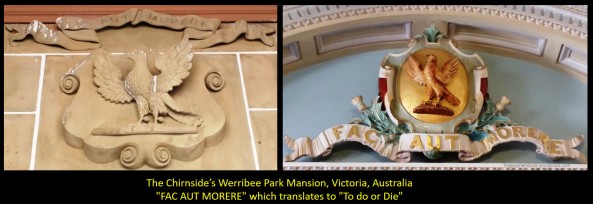
Above the sandstone eagle in a banner above the entrance to Werribee Mansion, and also in gold painted plaster in the vestibule, are the latin words “FAC AUT MORERE” which translates to “To do or Die”. The latter part of the saying dictated the next few years of Chirnside history.
WERRIBEE PARK MANSION 99d

After a long illness, and believing himself bankrupt, Thomas Chirnside shot himself in the laundry of the mansion on the 25th June 1887 [9]. After a lengthy illness, Andrew Chirnside died at his daughters residence at Irrewarra near Colac on the 30th of April 1890 [10].

Six years after Andrew’s death, his widow, Mary (nee Begby), commissioned Ferguson & Urie to create a memorial stained glass window for the Presbyterian Church at Werribee [11]. The Chirnside’s were liberal donors to the church and Thomas had originally donated the land for it. The three light chancel window was eventually erected in 1896 and depicts “The Last Supper” which, whether by design or coincidence, includes the characters St. Thomas and St. Andrew amongst the apostles portrayed in the window.

Mary Chirnside died at Colac aged 80 on the 4th of March 1908 [12]. A report published in the Bacchus Marsh Express [13] stated that she had died at Dr. Brown’s private hospital at Colac as a result of blood poisoning from an earlier knee injury.

By 1922 there was no Chirnside family involvement in the mansion and it was subsequently used as a Catholic Seminary until the Victorian Government acquired it in 1973 and is now managed as a tourist attraction by Parks Victoria.

The Bacchus Marsh Express, Vic, Saturday 14th October 1876, page 2.

“The mansion for Messrs. T. and A. Chirnside, which has been in course of erection for them upon their Werribee park estate, Wyndham, since February, 1874, is now nearly completed, the only work remaining to be done being the fixing of a few mantelpieces, a portion of the grand staircase, and some flagging of the arcade fronting the ground floor of the building. We have given occasional notices of this mansion during the course of its erection, and our readers may probably recollect that it is built of Barrabool freestone principally, so far as the ornamental work is concerned, and of bluestone in the rear portions. The quantity of dressed stonework is immense, an has added very much to the cost of the building and the time occupied in erecting it, and in this stonework lies the great beauty of the building, for nothing can equal the rich grandeur of cut stone, unless it be polished marble. The style of architecture adopted is Ionic, and the general appearance of he building is, so far as one word can convey an idea of it, stately. It will be a pity if an illustration of it is not given in one of the Melbourne illustrated papers, for, in our opinion, it is one of the few buildings in the colony which an architect can look upon with pleasure, especially one who prefers the solid beauties of the old orders of architecture to the more foreign-looking adaptions of the present day, known as Venetian-Gothic, &c. The house consists of a main building, facing the east, with about 100 feet frontage, by the same depth, and two stories high, with a basement beneath and a tower 80 feet high at the main entrance. All round the building and arcade is carried, composed of beautifully-proportioned freestone arches supporting a balcony fronted with the usual Ionic balustrade and cornices, and giving a promenade of 300 feet by 11 feet wide, a promenade of the same dimensions existing below, of course, in the arcade. The balcony is laid with Minton’s encaustic tiles, of elaborate pattern, showing seven colours. Ample and very ingenious provision is made for carrying off the rain water, which flows into a filter in the courtyard, whence it is taken to an immense 40,000 gallons tank, from which it can b pumped to five cisterns placed somewhere in the various roofs of the mansion, and possessing altogether a capacity of 5,000 gallons. Each cistern is provided with a gauge showing its contents, and visible from the central courtyard between the two wings which flank the main building. This courtyard is 40 feet by 80 feet, and could be used for a ballroom by laying down a floor in sections and covering it with an awning. The wings are about 80 feet by 30 feet, and in addition to these, and the main building, there are a billiard room 30 feet by 22 feet and a conservatory 30 feet by 14 feet, besides a number of substantial out-buildings. Returning to the arcade and balcony, it should be mentioned that the ceiling of the arcade is beautifully panelled and painted, and the floor or promenade is laid with Malmsbury rubbed flagging down the centre, with dove and white marble slabs at each side. The tower is of useful proportions, being 14 feet square as high as the roof of the mansion, and the two stories above are 12 feet square. This tower is a work of sculpture more than of masonry, and reflects very great credit indeed upon the artist (Mr. Samuel Peters) who has put so much beautiful work into it. One feature is specially noticeable – namely, the bunches of grapes and vine leave, which stand out from the stone as naturally as though hanging pendent from a vine. Over the main entrance the escutcheon of the Chirnsides is cut out, showing a hawk upon a shield, and the motto “Facaut Morere” (Do or Die!) beneath. This device also appears on each side of the entrance hall, in a portion of the cornice, and upon the centre of the very handsome white marble mantelpiece in the drawing room. From the principal doorway a hall 15 feet by 30 feet and 17 feet high is entered, profusely ornamented with cement work executed by Mr. Mackennal, and to be further embellished with stags’ heads, statues, and hall furniture. The whole of this hall, with a staircase hall beyond, 30 feet by 19 feet, is floored with Minton’s tiles of elaborate and handsomely illuminated pattern, which contrasts well with the snowy whiteness of the cement work of the walls. The doorways hereabout are all massively panelled in polished blackwood, with what are known as pyramid headings, supported on trusses. The staircase hall contains, of course, the grand staircase, which is of polished blackwood, 6 feet 6 inches wide in the central portion, and turning to the right and left to the first floor in 6 feet wide portions. The handrail, and iron-work beneath, are, as may be conjectured, a prominent feature in this part of he house. At the end of the staircase hall there is an immense window, for which Messrs. Fergusson [sic] & Urie are making a quantity of embossed glass, portions of which will contain large figures of St. Andrew and St. George. The portions of the building upon the first floor corresponding with the two halls below will form a picture gallery and museum, and are beautifully ornamented in cement work. In fact wherever the eye rests costly and yet severely chaste decorations are to be seen, and among them some exquisite Corinthian pillars and cornices. Niches have been left for statues, and nothing seems to have been overlooked to add a stately elegance to the general effect, without anything obtrusively gaudy, the embossed glass, for instance, being extremely rich, and freely employed. The domed ceiling to the tower at this floor is beautifully proportioned and embellished. Double doors from it give access to the balcony. To describe the 50 or 60 rooms in the house, exclusive of the basement cellars, would make these remarks too lengthy, although a description of each would show that all contain some special feature reflecting credit upon those who had the designing of them, and here we may say that the contractor for the building 0 Mr. P. Colquhoun – has been the chief designer, assisted by Mr. Fox, architect, and by the Messrs. Chirnside themselves. The dining room and the drawing room are both on the ground floor, and are each 30 feet by 22 feet, exclusive of bay windows 6 feet deep, and of grand proportions and decorations. These rooms have elaborately moulded cornices, and marble mantelpieces of special design. Next to the dining room, and forming part of it if need be, is the breakfast room, 24 feet by 18 feet 6 inches. The passages connecting these rooms with the butler’s department are very conveniently arranged, and several folding doors are provided to shut off the series of kitchen apartments (which are on a lower level) from the principal ground floor. In the same way separate suites of apartments are provided up-stairs for night and day nurseries. All the floors below stairs are laid with 3 inch Oregon boards, forming an exceedingly smooth and firm flooring. Upstairs 2 ½ inch Kauri boards have been used. In several of the principal rooms a 20 inch border has been laid down in polished rosewood and oak parquetry work, which has a noble appearance. All the passages in the house are 6 feet wide and 12 feet high, so that abundant ventilation is given even by this means and there is an appearance of roominess everywhere which is most gratifying, none of the rooms being less than 11 feet high, and the principal ones are 18 feet high. The baths in various parts of the house are most complete, and very numerous, the servants being provided with two. The principal baths are fitted with electric bells, of which there are thirty four altogether, and two speaking tubes. In one of the storeys of the tower there is a smoking room, and upon the top of the tower a 25 feet kauri pine flagstaff is erected, sheathed with copper, to act as a lightening conductor. The staircase in the tower, and the provision made for closing in the head of the stairway, are details which have been attended to with more than ordinary care for the comfort of persons ascending the tower, and for the protection of the building. From the top of the tower a fine view of Melbourne can be obtained, also of the bay, and the various ranges to the west and north. The grounds surrounding the building are at present being brought into cultivation as ornamental shrubbery, &c., by Mr. Webley, the gardener, who has a difficult task, as the soil is poor and the surface is almost dead level. Thirty acres have been laid off for present operations, and the design includes a small lake in the south-eastern corner. A sunk fence will divide the ornamental grounds from the rest of the estate, and a handsome lodge will be erected at the end of the principal carriage drive. Provision has been made for lighting the whole house with gas, which will have to be made somewhere adjacent. The cost of the building alone is estimated at £40,000, and of course a very large sum will be required for properly furnishing it, and improving the grounds surrounding it. We think the Messrs. Chirnside deserve commendation for having spent so much money and time in erecting a building which has given profitable employment for a long time to nearly every branch of he building industry in the colony, and the maintenance of which cannot fail to cause a large annual expenditure. They are frequently abused for being wealthy, as though it were a crime, but they have shown in a variety of ways that they desire to make their wealth of considerable benefit to individuals other than themselves, and to the colony at large, and especially to the neighbourhood in which they have made for themselves a home of such princely proportions”.

Conservation work:

Both sidelights to the front entry door at the mansion are the reproduction artwork of Bruce Hutton of Almond Glass based on the original  designs from the smashed originals in 2012 (The hydrofluoric immersion was conducted in Sydney).
(re: email, Bruce Hutton & Ray Brown 10th April 2013)

Related posts:

1875: Rupertswood Mansion, Sunbury, Victoria.
31-10-1878: Mandeville Hall, Toorak, Victoria.
23-05-1896: Presbyterian Church, Werribee, Victoria.

Other related links:

An album of my recent sepia photos of Werribee Mansion.

Footnotes:

[1] Biography: Andrew Spencer Chirnside (1818-1890) & Thomas Chirnside (1815-1887).

[2] London born and Hamilton based architect and designer, James Henry Fox. He also designed Holy Trinity Church at Coleraine which also has F&U windows.

30-11-1875: Closure of Melbourne Colonial Exhibition.

The Argus, Melbourne, Tuesday 30th November 1875, page 5.

On the closure of the Melbourne Colonial Exhibition, some of Ferguson & Urie’s stained glass were chosen by the committee to be included as exhibition examples to be shipped to New York on the “Skerryvore” on Saturday the 4th of December 1875 for participation in the Philadelphia exhibition.

14-11-1875: St. Mary’s Church, Kangaroo Point, Brisbane, Queensland.

The Brisbane Courier, QLD, Saturday 29th October 1904, page 12.

1904 ‘BRISBANE’S HISTORIC CHURCHES.—II.’, The Brisbane Courier (Qld. : 1864 – 1933), 29 October, p. 12, viewed 14 February, 2012, http://nla.gov.au/nla.news-article19329758

“BRISBANES HISTORIC CHURCHES. ST. MARY’S. KANGAROO POINT.”

“[…] The Rev. Mr. D. A. Court continued his able ministrations in the church, which had been so successfully built under his care, until death overtook him. During his ministry the church was presented with a handsome credence table by Mr. G. R. Suter; a stained glass window, representing the Crucifixion, presented by Bishop Tufnell; another representing the nativity, presented by Mr. C. C. Horrocks, in memory of his daughter Grace; and a third representing the Resurrection, presented by the Rev. D. A. Court, in memory of his father, who attained his 91st birthday on the day the church was consecrated. […]”

The Nativity, Crucifixion and Resurrection windows were made by Ferguson & Urie of Melbourne and were dedicated in the church on Sunday 14th November 1875.

The foundation stone for St Mary’s was laid by the Governor of Queensland, George Augustus Constantine, Marquis or Normanby, on the 29th of April 1872 and was consecrated on the 5th of November 1873. After significant storm damage in 1892, subsequent reconstruction included a two bay transept completed in 1893.

Photos courtesy of Mrs Noelle Nathan (taken 16th Oct 2011).

This slideshow requires JavaScript.


Short link to this page: https://wp.me/p28nLD-og

© Copyright

17-09-1875: The Victorian Exhibition awards of 1875.

The Argus, Melbourne, Friday 17th September 1875, page 3.

“JURY AWARDS AT THE EXHIBITION”

 “Lyon, Cottier, and Co, Sydney, 119, stained window, second prize”.

“Ferguson and Urie, Melbourne – 120, 121. stained windows, &c, first prize”.

02-09-1875: The 1875 Victorian Exhibition Catalogue.

Ferguson & Urie exhibited their stained glass work at the Victorian Intercolonial Exhibition which was opened on the 2nd of September 1875. The official catalogue of exhibits, page 47 Group 4, listed Ferguson & Urie as well as former business partner John Lamb Lyon as Lyon, Cottier & Co of Sydney, exhibiting along side each other. The articles make mention of “Mr Clarke’s mansion, Sunbury” known as Rupertswood, now operating as boutique accommodation and events venue. The Rupertswood windows, span two floors and contain scenes of hunting and countryside that were the work of the firms’ senior stained glass artist David Relph Drape, some of which have Drapes name hidden within the scenery.

The Victorian Intercolonial Exhibition Catalogue 1875, page 47.

– LYON, COTTIER & CO., Sydney, New South Wales. Stained Glass Stairwell Window. Subject – “Captain Cook”.
FERGUSON & URIE, 10 Collins-street East, Melbourne. Staircase on wall Window, “The Seasons”, Staircase on wall Window, “Rob Roy”, Portion of Staircase Window for Mr. Clarke’s mansion, Sunbury, Embossed Plate Glass for do, “Chillingworth Wild Cattle”, “The Maries at the Tomb”, “The Charge to Peter”, Samples of margins.

Notes on the above tabloid article:

1. “The Seasons” – unknown (possibly Mandeville Hall, Toorak).
2. “Rob Roy” – unknown.
3. Clarke’s Mansion Sunbury – This is ‘Rupertswood’ – All stained glass is extant.
4. “The Maries at the Tomb” – unknown.
5. “The Charge to Peter” – unknown.

The Argus, Melbourne, Friday 3rd September 1875, page 3s

“The exhibits of Messrs. Ferguson and Urie, Nos. 120-121, afford gratifying proof of the demand which exists amongst us for works of decNotes:orative art, and the designs for the works which have been executed by them give us some idea of the extent to which the local manufacturers of painted glass have drawn upon in the decoration of our churches and large dwellings. The designs of almost all these, as well as that in the specimens exhibited, are excellent – lacking, if anything, in boldness – the colours in almost all instances being rich, and at the same time harmonious. Messrs. Ferguson and Urie have, we suppose, to consult the taste of their patrons, which is, we do them the justice to believe, the reason why a picture on glass of Chillingham Cattle has been prepared. Nothing more contrary to the true principals which should have been kept steadily in view in this development of art could possibly be conceived. As an illustration of glass painting of quite a different, but at the same time more boldly artistic school, attention must be called to a staircase window, designed as a memorial of Cook, the navigator, the seated figure being designed by a thorough artist, and the patterns containing illustrations of the typical animals and birds of Australia being especially worthy of notice. The colour is, however, wanting in richness. This exhibit is from the workshops of Messrs. Lyon, Cottier, and Co., Sydney.”

Excerpt from Intercolonial exhibition 1875 – Official Catalogue Advertiser:

“FERGUSON & URIE, GLASS STAINERS, No. 10 Collins Street East. Memorial, Heraldic, and Grisaille; Stained Glass Windows for Churches and other Buildings, executed at the Stained Glass Works, Curzon-street, North Melbourne. Illuminated Commandments and Wall Decorations; Embossed Plate and Sheet Glass, any pattern; Lead Lights in Cathedral, Crown, Sheet and Ornamental Glass. Designs submitted with Estimate of Cost. Awarded two Medals, Melbourne Exhibition, 1867. Stained Glass Works, Curzon-street, North Melbourne”.

29-10-1875: Intercolonial Exhibition, Melbourne, 1875.

The Argus, Melbourne, Friday 29 October 1875, page 7.

INTERCOLONIAL EXHIBITION 1875 – Prize list:

“[…] GROUP IV – GLASS AND MANUFACTURES OF GLASS. Special Awards By Commissioners. Ferguson and Urie, 10 Collins-street east – Wall windows and staircase windows, silver medal. Lyon, Cottier, and Co, Sydney – Stained glass stair case window, medal.[…]”

An interesting article that shows former employee and partner, John Lamb Lyon, competing alongside Ferguson & Urie at the exhibition.