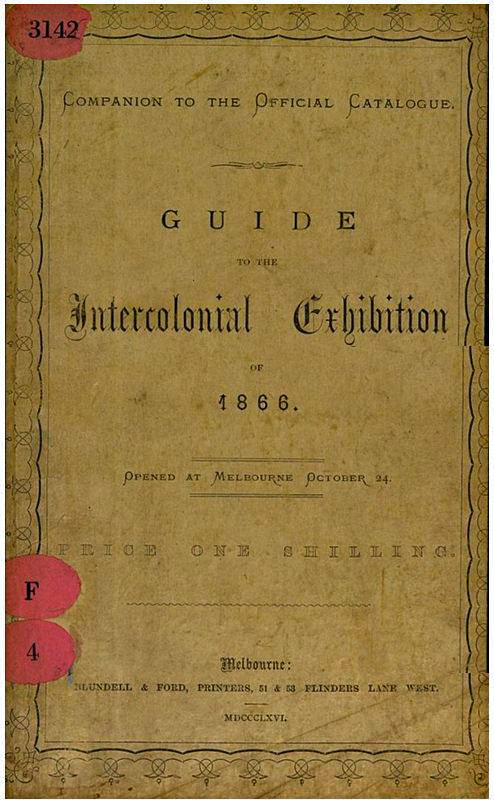
24-10-1866: Guide to the Intercolonial Exhibition of 1866, Melbourne, Victoria.

The Ferguson & Urie stained glass company displayed examples of their workmanship at many exhibitions over a forty year period from 1853.

The 1866 exhibition stands out as the most unique in the company history as being the one that gave them their greatest exposure on the eastern side of Australia and even into New Zealand.

An entire “Medieval Court” was constructed at the 1866 exhibition which included a detailed reconstruction of a church chancel decorated by Ferguson & Urie which was complete with stained glass windows. The idea for the medieval court was based on Augustus Welby Pugin’s Medieval Court, which was first shown at London’s International Exhibition of 1851 and then at the Crystal Palace, Sydenham, between 1852 and 1866. This medieval court reconstruction at the 1866 Melbourne exhibition was the first of its kind seen in the Australian colony and drew and extraordinary crowd.

The most remarkable of the historical artifacts in the medieval court were Ferguson & Urie’s set of five single light stained glass windows depicting the Nativity, Passion, Crucifixion, Resurrection and Ascension. After the exhibition these windows were installed in the chancel of Christ Church at Casterton in Western Victoria and are still in place to this day, although there is a small mysterious anomaly as the the order the windows were installed!

“GUIDE TO THE INTERCOLONIAL EXHIBITION OF 1866”.

“THE MAIN HALL”.

“ON entering this hall from Latrobe-street, visitors who put themselves under our guidance will find, by turning immediately to the left before arriving at the fur trophy, which faces them, that they have come upon perhaps the last thing one might expect to encounter in an exhibition of the products and manufactures of a new colony – to wit, a Mediaeval Court, the whole of the decorations and contents of which are the work of two Melbourne houses, the one that of Mr. John Young, contractor, and the other that of Messrs. Ferguson, Urie and Lyon, glass-stainers, &c. The excellence of this court consists not more in the beauty of the various articles it contains than in the admirable tone of all the decorations, giving to the place that “dim, religious light” befitting the character it assumes. The stained-glass windows let into the partitions surrounding the court are mainly instrumental in producing this effect. The court is filled with statuary, fonts, and elaborately-ornamented wrought-iron articles, suitable for mediaeval church purposes. One of the statues represents the Madonna and Child; others personify St. John, St. Thomas, and St. Theresa. Attached to the walls near the roof are several of the quaintly-carved figures which catch the eye in old churches. These are intended for St. Patrick’s Cathedral, now in course of erection on the Eastern Hill. To complete the ingenious effect of this court as a complete work of art, Messrs. Ferguson, Urie and Lyon have constructed at the side opposite the entrance a recess representing an early English chancel, the decorations of which are most complete. The furniture of the chancel consists of an altar table, an illuminated oil painting of the last Supper, and illuminated tablets of the commandments, creed, and Lord’s Prayer. The light admitted to the chancel pours through five stained-glass windows, representing respectively the nativity, Passion, Crucifixion, Resurrection, and Ascension. These are designed for the Episcopalian Church at Casterton. The walls are also artistically decorated, and altogether this chancel, with the court leading to it, make up one of the most remarkable objects of the Exhibition”.
Related posts: 10-06-1867 > 25-10-1865 > 03-11-1866 > 20-12-1866


Shortlink to this page: https://wp.me/p28nLD-1os

© Copyright

17-09-1875: The Victorian Exhibition awards of 1875.

The Argus, Melbourne, Friday 17th September 1875, page 3.

“JURY AWARDS AT THE EXHIBITION”

 “Lyon, Cottier, and Co, Sydney, 119, stained window, second prize”.

“Ferguson and Urie, Melbourne – 120, 121. stained windows, &c, first prize”.

02-09-1875: The 1875 Victorian Exhibition Catalogue.

Ferguson & Urie exhibited their stained glass work at the Victorian Intercolonial Exhibition which was opened on the 2nd of September 1875. The official catalogue of exhibits, page 47 Group 4, listed Ferguson & Urie as well as former business partner John Lamb Lyon as Lyon, Cottier & Co of Sydney, exhibiting along side each other. The articles make mention of “Mr Clarke’s mansion, Sunbury” known as Rupertswood, now operating as boutique accommodation and events venue. The Rupertswood windows, span two floors and contain scenes of hunting and countryside that were the work of the firms’ senior stained glass artist David Relph Drape, some of which have Drapes name hidden within the scenery.

The Victorian Intercolonial Exhibition Catalogue 1875, page 47.

– LYON, COTTIER & CO., Sydney, New South Wales. Stained Glass Stairwell Window. Subject – “Captain Cook”.
FERGUSON & URIE, 10 Collins-street East, Melbourne. Staircase on wall Window, “The Seasons”, Staircase on wall Window, “Rob Roy”, Portion of Staircase Window for Mr. Clarke’s mansion, Sunbury, Embossed Plate Glass for do, “Chillingworth Wild Cattle”, “The Maries at the Tomb”, “The Charge to Peter”, Samples of margins.

Notes on the above tabloid article:

1. “The Seasons” – unknown (possibly Mandeville Hall, Toorak).
2. “Rob Roy” – unknown.
3. Clarke’s Mansion Sunbury – This is ‘Rupertswood’ – All stained glass is extant.
4. “The Maries at the Tomb” – unknown.
5. “The Charge to Peter” – unknown.

The Argus, Melbourne, Friday 3rd September 1875, page 3s

“The exhibits of Messrs. Ferguson and Urie, Nos. 120-121, afford gratifying proof of the demand which exists amongst us for works of decNotes:orative art, and the designs for the works which have been executed by them give us some idea of the extent to which the local manufacturers of painted glass have drawn upon in the decoration of our churches and large dwellings. The designs of almost all these, as well as that in the specimens exhibited, are excellent – lacking, if anything, in boldness – the colours in almost all instances being rich, and at the same time harmonious. Messrs. Ferguson and Urie have, we suppose, to consult the taste of their patrons, which is, we do them the justice to believe, the reason why a picture on glass of Chillingham Cattle has been prepared. Nothing more contrary to the true principals which should have been kept steadily in view in this development of art could possibly be conceived. As an illustration of glass painting of quite a different, but at the same time more boldly artistic school, attention must be called to a staircase window, designed as a memorial of Cook, the navigator, the seated figure being designed by a thorough artist, and the patterns containing illustrations of the typical animals and birds of Australia being especially worthy of notice. The colour is, however, wanting in richness. This exhibit is from the workshops of Messrs. Lyon, Cottier, and Co., Sydney.”

Excerpt from Intercolonial exhibition 1875 – Official Catalogue Advertiser:

“FERGUSON & URIE, GLASS STAINERS, No. 10 Collins Street East. Memorial, Heraldic, and Grisaille; Stained Glass Windows for Churches and other Buildings, executed at the Stained Glass Works, Curzon-street, North Melbourne. Illuminated Commandments and Wall Decorations; Embossed Plate and Sheet Glass, any pattern; Lead Lights in Cathedral, Crown, Sheet and Ornamental Glass. Designs submitted with Estimate of Cost. Awarded two Medals, Melbourne Exhibition, 1867. Stained Glass Works, Curzon-street, North Melbourne”.

12-08-1870: Sydney Intercolonial Exhibition 1870.

The Argus, Melbourne, Friday 12th August 1870, page 4.

“The Dandenong, which sailed yesterday for Sydney, conveyed 60 packages for the Intercolonial Exhibition. The exhibits included specimens of auriferous quartz from Messrs. Latham and Watson; Pianos of local manufacture from Messrs. Wilkie, Kilner, and Co; an interesting mineralogical collection from Professor Abel, of Ballarat; stained glass from Messrs. Fergusson,[sic] Urie, and Lyon; and a large quantity of agricultural implements, beer, spirits, oatmeal, and biscuits. The Victorian commissioners intend to make their last shipment by the City of Adelaide, as they have already exceeded the time allowed them by the Sydney authorities.”