James Fry (1821-1903) is credited as the donor of the historic stained glass windows in the chancel of St Peters Anglican Church in Ballarat.
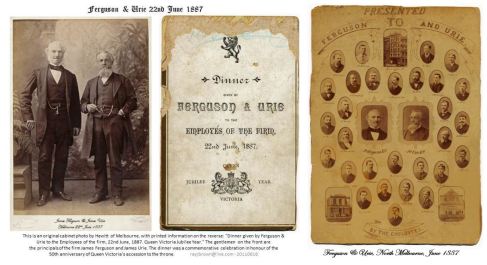
The windows were made by the Ferguson & Urie stained glass company of North Melbourne in 1877 at the time when extensions and renovations were being made to St Peter’s. Amongst these improvements was the addition of a new chancel complete with the stained glass windows. James Fry donated £500 towards the chancel and windows on the provision that the church raise the additional funds for a parsonage and a new organ and chamber. [1]
The Ballarat Star, Vic, Wednesday 20th June 1877, page 3.
“ADDITIONS TO ST. PETERS CHURCH.
We mentioned recently that some extensive improvements were being made at ST. Peter’s Church, and the approaching completion of the works warrants their being noticed. The church as it stands at present has in use a nave, and on the western side a transept, the original design being for another transept on the east, and an apse at the rear. As regards the apse, Mr Oakden (of Terry and Oakden), Melbourne, altered the design when he was drawing the plans for the western transept, and a chancel was projected instead of the apse. The requirements of the church have now necessitated this plan being carried out, and the work will soon be completed. Messrs James and Creber are superintending the work, and Messrs Llewellyn and Roberts are the contractors. The chancel is built of bluestone, to correspond with body of the church, and the inside measurements are:- Width, 18 feet; depth, 12 feet 6 inches; height of side walls, 20 feet 6 inches. The chancel window is a fine specimen of the stonemason’s art, the tracery being done in Waurn Ponds freestone. Stained glass is now being prepared in Melbourne to fill the window. There will be a small window on each side of the chancel, and a door on the east leads to the vestry. From the floor of the church there will be a step upwards before the chancel arch, and two others within it leading to the altar. An organ chamber is also being built, which will form part of the future eastern transept. The amount of Messrs Llewellyn and Roberts’ contract is about £480, but this amount will be considerably augmented before all the work is done in fitting up the chancel, &c. Mr Fincham, of Melbourne, is building the organ, whose largest pipe will be 16 feet, and the cost of the organ, we understand, will be about £500, so that it will be seen that the church authorities have launched into an expenditure of over £1000, towards which sum, as we mentioned a short time since, Mr. James Fry has contributed the handsome donation of £500. It is expected that all the new works will be finished, and the organ erected, in a little over a month’s time from the present.”
In early August 1877 the three light stained glass window had arrived from the workshops of the renowned Melbourne stained glass firm of Ferguson & Urie and was erected in the chancel. The Church of England Messenger published a very detailed description of the window:
“The stained-glass window for the chancel of St. Peter’s Church has arrived in Ballaarat, and was placed in position. It is a very good specimen of Messrs. Ferguson and Urie’s art, and it is a matter of congratulation that such excellent workmanship can be produced in the colony. The window is divided into three lights, surmounted by tracery pierced with trefoils. These trefoils are filled with richly-coloured glass, bearing upon a starry background the three emblems of faith, hope, and charity; the heart with the sacred monogram, the cross with the crown of thorns, the anchor with the dove and olive branch. The subject of the central light is the “Ecce Homo.” The side lights, having reference to the pious and charitable lives of the ladies in whose memory the chancel was erected. are illustrations of Mark XIV, 8 (“She hath done what she could’) and Matthew XXV. 40 (“Inasmuch as ye have done it unto one of the least of these My brethren, ye have done it unto Me”). In the central light the Saviour stands forth a solemn and mournful figure. Pilate and a Roman soldier occupying the background. Underneath there is a panel with a small but exceedingly well-drawn picture of Christ’s charge to Peter – “Feed my Sheep.” In the apex of the window is the emblem of the Holy Spirit, the dove, descending with rays of light. The right hand picture of Mary wiping the Saviour’s feet with her hair is remarkable for the beauty of the Saviour’s countenance and the grace of His gesture. In the light upon the left-hand side a female figure is casting a garment around an aged man and a child at her feet. The background of both of these pictures is of a similar character – a low wall decorated with scroll-work, overtopped with trees and flowers, the sky space being filled in with ruby glass in irregular lead-work. Underneath are the old church emblems – the Agnus Dei and the Pelican; and above are the Alpha and Omega. The side window, which can be seen only upon entering the chancel, is the more special memorial window, having the upper part a scroll with the text – “Write, Blessed are the dead which die in the Lord;” and at the bottom, a panel with the memorial inscription. The quarries of which the rest of the window is composed are ornamented with fleurs-de-lys, and the effect of the whole is highly satisfactory. The organ has been inspected on behalf of the church authorities, and is pronounced a first-class instrument. No time will now be lost in erecting it in the church.”

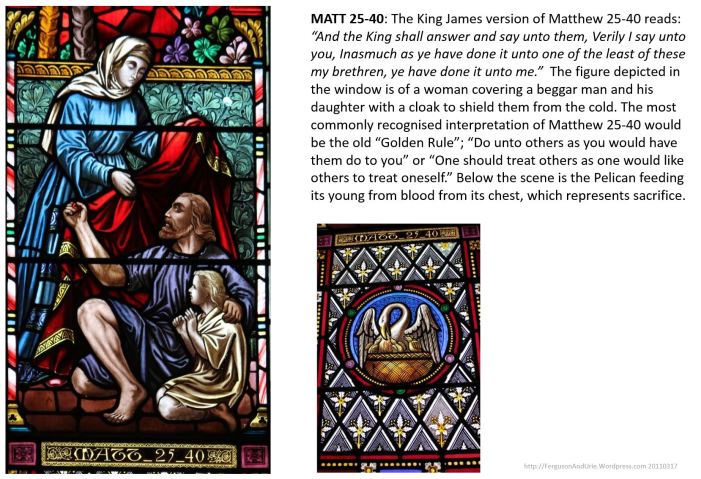


The new chancel of St Peter’s was consecrated on Sunday 12th August 1877 [2]
Whilst there were significant descriptions of the three light chancel window in the tabloids, there was only a minor mention of the smaller single light memorial window erected in the liturgical south wall.
“…The side window, which can be seen only upon entering the chancel, is the more special memorial window, having the upper part a scroll with the text – “Write, Blessed are the dead which die in the Lord;” and at the bottom, a panel with the memorial inscription…”[3]
The memorial text on the lower panel of the window provides the historic clues about the donor, James Fry, and his generosity to the church and the dates of death of his first two wives, Mary & Williamina.. As stated in 1877, unless you are standing in the chancel of St Peter’s you would not know the window was there. The Gothic design is recognisable as the work of Ferguson & Urie which includes a central scrolling ribbon design containing a piece of scripture from the King James Bible, Revelations Chapter 14, verse 13;
“WRITE BLESSED ARE THE DEAD WHICH DIE IN THE LORD”
Unfortunately, the memorial text at the bottom of the window no longer has back lighting from outside so it can only be read when artificially illuminated from behind. I managed to do that via the simple trick of utilising the smart-phone flashlight function and dangling it down the back of the vent which was sufficient to highlight the text enough to be read. There are many unfortunate paint splatters on the window and the fact that the memorial text cannot be read at all unless illuminated from behind gives the impression that it probably hasn’t been seen or known for many years. Probably not known for longer than I have been alive!
“THIS CHANCEL WAS ERECTED BY
JAMES FRY
TO THE GLORY OF GOD
AND IN AFFECTIONATE REMEMBRANCE OF
MARY FRY, DIED MAY 14th 1863 &
WILLIAMINA FRY DIED APRIL 13th 1876”
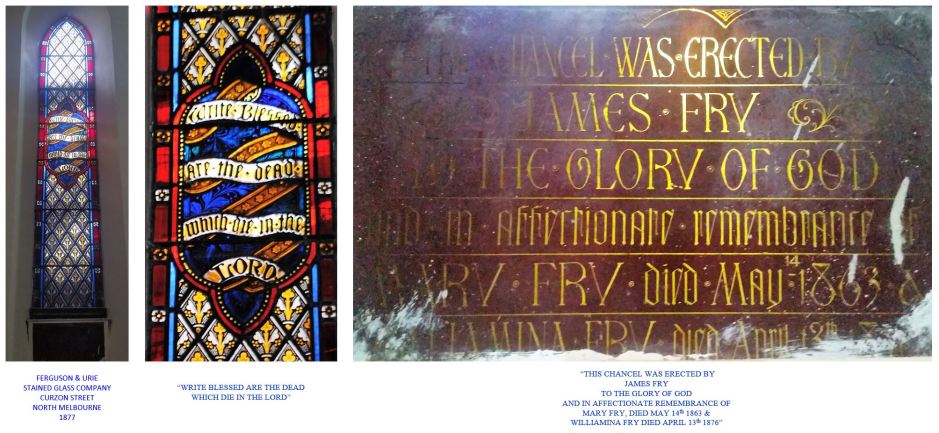
James Fry (1821-1903) was a native of Somersetshire in England and he can be credited as a colonial pioneer of Victoria’s grain growing and flour milling in western districts of Victoria.
His official biography[4] records that he came to Australia with his wife Mary in 1854 aboard the ‘Brilliant’ but there is no record of their names on the passenger list.
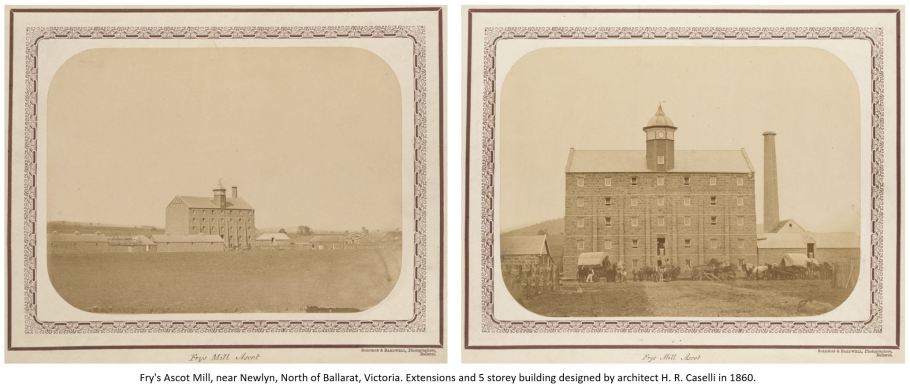
After successfully pioneering as a grain grower in the Wimmera region in the late 1850’s, he began his own flour milling operations and entered in partnership with Thomas Creed in the Ascot Flour Mills north of Ballarat. In May of 1857 they dissolved their partnership[5] by mutual consent and James became the sole owner. The mill was known for many years as “Fry’s Ascot Mills” and he expanded it in 1860 by erecting a massive five storey bluestone building to the designs of Ballarat architect Henry Richards Caselli.[6]
In 1857 the first family tragedy struck when his infant daughter, Mary Grimstead Fry, died on the 2nd of July. James obtained a family grave site at the Miners Rest ‘Dowling Forrest’ cemetery, 10km North West of Ballarat, where his daughter was interred. An imposing monument was later erected on the site which would provide an historic record of the family’s tragedies and history.
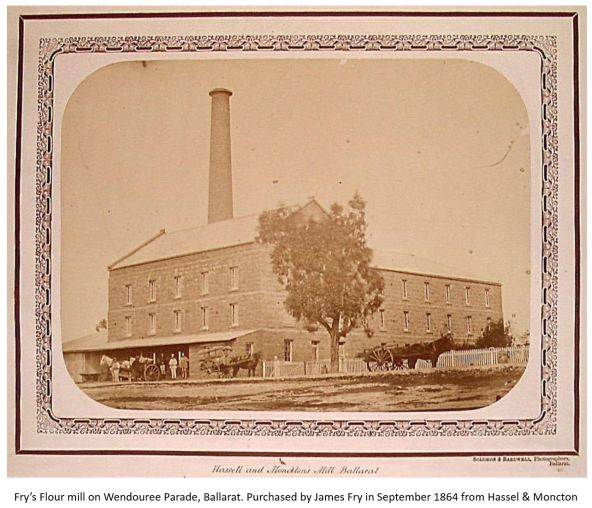
By the early 1860’s James’s milling empire was expanding. In September 1864 he purchased a flour mill at Ballarat opposite Lake Wendouree from “Hassell & Monckton” for £4500 [7]. He expanded the business further via leasing or purchasing mills all over the western districts at Ararat, Donald, St. Arnaud, Horsham, Nhill, Kaniva, Dimboola, and Natimuk[8]. His favoured estate, Sutton Park, at Newlyn near the Ascot mill remained a central hub to all his operations.
Fry’s prize winning ‘Ascot Mills’ flour was exhibited at the International Exhibition in London of 1862[9] and by the 1880’s it became a household staple throughout the colony known as Fry’s “Five Stars Flour”.
On the 14th May 1863 his first wife Mary, nee Gear[10], died at his Sutton Park estate near the Ascot Mills. She was only 45 years old and was interred in the family vault at Miners Rest with their infant daughter Mary Grimstead.
Being a widower was not a part of James’s future plans and he wasted little time in finding a new companion. On the 21st April 1864, at Brompton Cottage in Brighton, Victoria, he married Williamina Smith (nee Hay), the widow of Mungo Park Smith, Engineer and city surveyor of Melbourne[11].
James’s generosity was not just confined to the church. In October 1864 he and Williamina hosted a luncheon for his employees and their families. About 60 people were transported to Lake Burrumbeet in four decorated wagons where the best part of the day was taken up by games and; “At noon, a sumptuous dinner was spread and was partaken of with the best of appetites.” Wine and Spirits were supplied in generous quantities and later in the day, as heavy rain set in, the whole party returned to the Ascot mill where singing and dancing continued to a late hour[12]. This was undoubtedly one of the many occasions that James displayed his generosity towards his employees. Some of them would later join him as partners in his milling operations for many years.
On the 12th of July 1869 a tragic accident occurred at the Wendouree flour mill. On the Monday at about 7:30am a massive 36ft long boiler exploded at the mill. The sound of the explosion could be heard over three miles away and a huge plume of steam and debris could be seen in the air above the mill for many miles around. James’s nephew, Albert Hill, who was acting superintendent at the time, was unfortunately standing next to the boiler when it exploded. Albert was killed instantly. His mangled near naked and disembowelled body was blown more than one hundred yards away and landed in the Swamp on the other side of Wendouree Parade.
“…The clothing was torn into shreds, while the skull was completely smashed in. Both legs were broken, and besides several other terrible wounds, the body was almost disembowelled…”
When his body was recovered it was taken to Fry’s residence near the mill. Williamina was so traumatised by the horrific scene that she became seriously ill.[13] The inquest on Albert’s body was held the following day at the Wendouree Parade Hotel, where, coincidentally, some small portions of brick had been thrown a few hundred yards from the explosion and had landed in the bar. Albert’s funeral was held on the 14th and he was interred with James’s first wife Mary and their infant daughter Mary Grimstead at the Miners Rest Cemetery.
“The procession started from Mrs Fry’s residence, Wendouree-parade, and consisted of about thirty well-filled mourning coaches, buggies, &c, and several horsemen.”[14]
James’s second wife, Williamina died at his Sutton Park estate on the 13th April 1876. Coincidentally she was also only 45 years of age. Williamina was interred with James’s first wife and his nephew Albert at Miners Rest. Whether by coincidence or design, some scriptural text from Revelations 14:13 which appears on their memorial stained glass window at St Peter’s in Ballarat is from the same chapter and verse as that on their monument at Miners Rest:
“Blessed are the dead who die in the Lord: even you saith the Spirit that they may rest from their labours.” Rev. XIV:13″

In June of 1877, the year following Williamina’s death, James Fry donated £500 to St Peter’s Church for the construction of a new chancel and the stained glass windows. Shortly after this he departed Victoria aboard the ‘Northumberland’ for London[15]. James had been back to the old country a number of times before but this venture would secure his third wife.
At St. Mary’s, Stoke Newington, London, on the 27th December 1877 he married Louisa Anne Coles[16], the widow of Edward Coles. James and Louisa returned to Melbourne aboard the ‘Chimborazo’[17] in March the following year and she would be his companion for the next twenty three years.
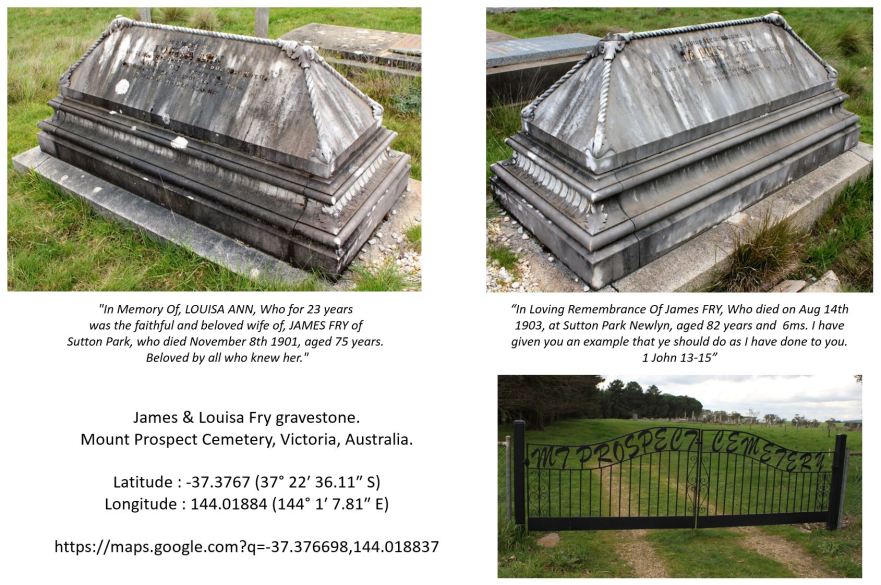
On the 8th November 1901 Louisa died at Sutton Park aged 75. James had now outlived three wives. Louisa was interred at the Mount Prospect cemetery north of Ballarat and a marble casket type grave-stone was erected over the grave. After more than a century most of the lead letters in the inscription have gone and it’s now almost unreadable:
“In Memory Of, LOUISA ANN, Who for 23 years was the faithful and beloved wife of, JAMES FRY of Sutton Park, who died November 8th 1901, aged 75 years. Beloved by all who knew her.”
James was now in his early eighties and had not taken an active interest in the flour milling operations since he floated the company on the stock exchange in 1884. He devoted his time to agricultural pursuits at his estate near Newlyn. On Friday the 14th August 1903 James died there at the age of 82 and was buried with his third wife Louisa at Mount Prospect.
The Ballarat Star, Vic, Monday 17th August 1903, page 1.
“DEATH OF MR. JAMES FRY.
One of the earliest pioneers of the grain trade in Victoria, Mr James Fry, died on Friday at Sutton Park, Newlyn, at the advanced age of 82. Deceased was a native of Somersetshire, and came to the colony in 1854 in the ship Brilliant, settling first at Geelong with his wife and family, where he purchased a property. After various experiences on the Ballarat goldfields, in 1856 he purchased a property at Ascot, and shortly after secured a flour mill near Geelong, which he removed to that point, as the Talbot shire was fast becoming the centre of a large agricultural district. Beginning in a small way, he built up a very extensive business among the various mining townships, and erected plant and machinery at that time considered to be as complete an establishment as then existed in Australia. In 1865 he purchased a mill near Lake Wendouree, Ballarat, from Messrs Hassell and Monkton, and went there to reside. In 1868 he acquired a freehold property in the Wimmera, situated between Glenorchy and Banyena. He was the first to grow wheat to any extent on the Wimmera Plains, and demonstrate that it could be cultivated there at a profit. From Ballarat, as his centre, he followed up the settlement of the selectors on the land, first around Ararat, and then on to Stawell, having business relations with both places. When growers commenced to select on an extensive scale in the Wimmera, he opened at Horsham, in anticipation of the railway line being continued from Stawell to that centre, and intimately to the border, and as the movement spread, extended his operations till they gradually embraced all the centres in that far-reaching territory. In addition to the large grain business, Mr Fry erected, brought or leased flour mills at Ballarat, Ararat, Donald, St. Arnaud, Horsham, Nhill, Kaniva, Dimboola, and Natimuk. In 1884 the grain and milling business having reached large dimensions, with its head office in Melbourne, and branches in all the leading grain growing districts of the Wimmera and other parts of the colony, he decided to float it into a limited company, which was successfully accomplished, and shortly afterwards retired from the active management, devoting most of his time thenceforth to grazing and agricultural pursuits.
At St. Peter’s Church yesterday, notice was taken of the death of Mr Fry. Mr Fry gave the land on which St. Peter’s Vicarage stands; the chancel, with a stained glass window; the tower and the bells, to St. Peter’s Church. The flag was flown at half-mast throughout the day, and muffled peals were rang on the bells. Before the service in the morning, the rev. Dr Pritchard alluded to the sad event. He reminded the congregation of all the late Mr Fry’s generous gifts, and said that he was a regular and frequent worshipper at ST. Peter’s when resident in the parish. Such a good example of generous help to the house of God should cause his name to be ever held in honored remembrance at St. Peter’s and they should pray that others might emulate such generous deeds. At the evening service similar reference was made, and special music was sung at the offertory. Mr L. Richardson played Mendelssohn’s Funeral March at the close of service.”
On the opposite side of the gravestone to Louisa’s memorial words are his;
“IN LOVING REMEMBRANCE OF JAMES FRY, WHO DIED ON AUG 14th 1903, AT SUTTON PARK NEWLYN, AGED 82 YEARS AND 6ms. I HAVE GIVEN YOU AN EXAMPLE THAT YE SHOULD DO AS I HAVE DONE TO YOU. 1 JOHN 13-15”
James Fry’s total estate was valued at £128,400 and it was distributed to many family members in Australia and England. It included provisions for his daughter, step daughters, step granddaughters, the Ballarat Church of England, and his surviving son, James Rood Fry.
The Sutton Park Estate was left to his son James but by 1918 it was under control of the government for soldier settlement purposes.[18]
Today, on a lonely dirt intersection amongst the farmland at Newlyn, you will find the original gates that once framed the entrance to Sutton Park. They now form part of an historic memorial of the district and nearby a stone cairn holds a plaque showing how the estate was divided for soldier settlement.
The gravesites at Miners rest and Mount Prospect, some of the old crumbling mill buildings around the district, the old gates to Sutton Park, and the stained glass windows at St Peter’s Church in Ballarat are the last physical reminders of a Colonial Pioneer and his family who shaped the western district of Victoria.

Footnotes:
[1] The Ballarat Star, Vic, Monday 11th June 1877, page 3
[2] The Ballarat Star, Vic, Monday 13th August 1877, page 3.
[3] The Church of England Messenger and Ecclesiastical Gazette for the Diocese of Melbourne and Ballarat, Vic, Thursday 9th August 1877, page 14.
[4] Australian Dictionary of Biography: Fry, James (1821-1903)
[5] The Star, Ballarat, Vic, Tuesday 26th May 1857, page 4.
[6] The Star, Ballarat, Vic, Tuesday 14th August 1860, page 4.
[7] The Star, Ballarat, Vic, Friday 30th September 1864, page 2.
[8] The Ballarat Star, Vic, Monday 17th August 1903, page 1.
[9] Victorian Govt Gazette, Tuesday 14th April 1863, page 842.
[10] Daughter of John Gear (or Gean) and Jane Grimstead.
[11] The Age, Melbourne, Vic, Monday 25th April 1864, page 4.
[12] The Star, Ballarat, Vic, Saturday 29th October 1864, page 2.
[13] The Ballarat Star, Vic, Tuesday 13th July 1869, page 2.
[14] The Age, Melbourne, Vic, Friday 16th July 1869, page 4.
[15] Geelong Advertiser, Vic, Tuesday 19th June 1877, page 9.
[16] The Bath Chronicle, Somerset, England, Thursday 10th Jan 1878, page 5.
[17] The Argus, Melbourne, Vic, Monday 11th March 1878, page 5.
[18] The Age, Melbourne, Vic, Saturday 24th October 1903, page 11.
Short link to this page: http://wp.me/p28nLD-2Mv
This is a new research article based on new information.
The old article can be seen at: http://wp.me/p28nLD-Uv

 Ferguson and Urie