19-11-1886: Auction of the Curzon Street Cottages.

By the mid 1880’s James Ferguson & James Urie had built their substantial new homes in Parkville and Flemington and their humble cottages in Curzon street near their workshop were obviously no longer required.  James Urie’s cottage was at 28 Curzon Street and  James Ferguson’s at No 24 Curzon street. The company’s first business premises was situated in very close proximity to the two cottages and was diagonally opposite the Union Memorial Presbyterian Church in Curzon Street.

In todays terms (2018) the address is 42 Curzon Street and the majority of the facade of the original building still exists.

In November 1886 they placed their cottages in the hands of Barrett & Co Auctioneers.

The Argus, Melbourne, Friday 19th November 1886, page 3.In

“SATURDAY, NOVEMBER 20. At Three O’Clock.

On the Premises, Little Curzon-street, Hotham. 2 BRICK COTTAGES. By Order of Messrs. Ferguson and Urie.

BARRETT and Co. will SELL by AUCTION, on the premises, as above, land having frontage of 55ft. to Little Curzon-street by a good depth, on which is erected two brick cottages, containing six rooms, outhouses, &c. Terms at sale.

The auctioneers would call special attention to this sale the property being well-built, near the omnibus and cab route, and within a few minutes’ walk of the city. Barrett and Co., auctioneers, corner of Queensberry and Abbotsford street, Hotham, and Racecourse-road, Newmarket”.

The partial municipal map below from 1878 shows the three key addresses in Curzon & Little Curzon street in North Melbourne.

Curzon St map [1878] [c1]

Curzon Street Municipal plans 1878


Short link to this page: https://wp.me/p28nLD-P8
© Copyright

10-03-1888: The 1888 Ferguson & Urie Employee Dinner.

North Melbourne Advertiser, Saturday 10th March 1888, page 2

“Messrs. Ferguson and Urie gave their Annual Dinner to their employės in the North Melbourne Town Hall, last evening, when a most enjoyable time was spent, and a number of songs and recitations were indulged in. One of he principal toasts was the health of Mr. William Urie, who with his uncle, Mr, John Yeaman, leaves by the R.M.S. Victoria to-day, on a nine months trip to the old country. A full report will appear in our next issue.”


Related pages: (Full transcriptions of the dinners).

The 1886 Employee Dinner
The 1887 Employee Dinner
The 1888 Employee Dinner

19-04-1886: Jane Ferguson (nee Lawson) (1820-1886)

Jane Williamson Lawson (1820-1886) was the eldest daughter of Gavin Lawson and Margaret Williamson of Ayrshire Scotland. At the age of 21 Jane married Master Slater and Glazier James Ferguson (1818-1894) on the 13th June 1841 in St Quivox, Ayrshire, Scotland.

Between 1842 and 1852 James and Jane had five children; Margaret (mentally disabled from birth) born 1842, Janet Kay 1844, Jane Williamson 1846, Marion 1948, James 1851 (died as an infant) and Antonia Wallace in 1852.

On the 12th December 1852, her husband James and his younger brother David departed Greenock, Scotland,  aboard the “Tamerlane” bound for Melbourne, Australia. A very patient Jane would wait in the “old country” for three years with the children whilst James established the business in Melbourne with his business partner James Urie.

In November 1855 Jane and the five girls arrived in Port Melbourne aboard the “Emma”. A further three children were born in Melbourne; Barbara in 1856, Sarah Campbell in 1859 and James Jnr in 1861.

In 1886 James had his two storey gothic design house built  in Leonard street Parkville by local architect Harry Lording, but Jane would never step foot in.

Jane died on the 17th of April 1886 and  James would eventually move into the Parkville mansion as a widower, accompanied by his bachelor son James Jnr, and eldest mentally disabled daughter, Margaret.

Photos from the family history collection.

This slideshow requires JavaScript.

The Argus, Melbourne, Monday 19th April 1886, page 1.

“FERGUSON – On the 17th inst, at her residence, 24 Little Curzon-street, Hotham, Jane, the dearly beloved wife of Mr. James Ferguson, aged 66 years”.

“THE Friends of Mr. JAMES FERGUSON, of Ferguson and Urie, are respectfully invited to follow the remains of his late beloved wife, Jane, to the place of interment in the Melbourne General Cemetery. The funeral will leave his residence, 24 Curzon street, Hotham, at half-past 4 o’clock, THIS DAY. ALFRED ALLISON, undertaker, 40 Victoria-street west, Melbourne”.

29-04-1882: “Lisava”, 13 Chetwynd Street, North Melbourne.

John Daly, Esq, sells his house “Lisava” in Chetwynd Street North Melbourne by public auction.

The Argus, Melbourne, Saturday 29th April 1882, page 14.

“THURSDAY, MAY 18. At Twelve O’Clock. HOTHAM. Chetwynd-street, Close to Victoria-street. HANDSOME RESIDENCE, known as LISAVA, Ten minutes walk from general Post-office […]”

“[…] The lobby window and hall fanlights are of stained glass, beautifully constructed by Messrs. Ferguson and Urie […]”

The house no longer exists. Nothing further known about the fate of the stained glass windows.

14-03-1867: Application for land in Curzon street, North Melbourne, Victoria.

The Argus, Melbourne, Thursday 14th March 1867, page 2S.

 James Ferguson and James Urie apply for transfer of an allotment of land in Curzon street Hotham adjoining their current Curzon street premises.

“TRANSFER of LAND STATUTE – No. 1222

JAMES FERGUSON and JAMES URIE, each of Curzon-street, in the Borough of Hotham, plumbers and glaziers, have APPLIED to bring the land described at the foot hereof under the above statute; and the Commissioner of Titles has directed notice of the application to be advertised in “The Argus” newspaper, and has appointed fourteen days from such advertisement after which time the land will be brought under the operation of the statute, unless a caveat shall be lodged forbidding the same. Dated the 12th day of March, 1867.

 LAND REFERRED TO.

Part of the Crown allotment 13, section 1, town of Melbourne, parish of Jika Jika, county of Bourke, commencing at a point 65 feet east from the south-west corner, thence further east 25 feet, thence north 58 feet, thence west by a road or way 90 feet, thence south by Curzon street 20 feet, thence east 65 feet, and thence south 20 feet to commencing point.

W. K. HUGHES, Registrar of Titles, Malleson and England, 24 Queen-street, applicant’s solicitors”.

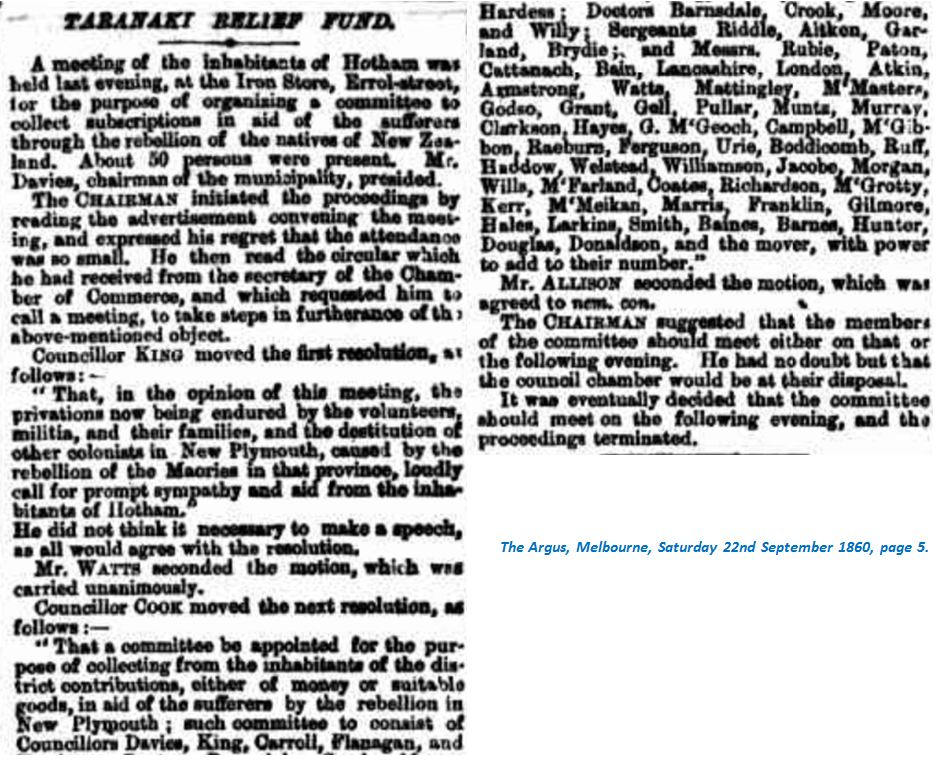
22-09-1860: Taranaki Relief Fund

When the Native Insurrection occurred in New Plymouth, New Zealand, the inhabitants of Melbourne subscribed liberally to Taranaki Relief Fund for the benefit of the suffering settlers.The sum collected, amounting to nearly £3,000, was placed in the hands of the committee formed of the most influental citizens of Melbourne. Amongst the extensive list of prominent North Melbourne identities was included “Ferguson,Urie” as well as other names closely associated with the firm Ferguson & Urie.

The Argus, Melbourne, Saturday 22nd September 1860, page 5.

“TARANAKI RELIEF FUND.”

 “A meeting of the inhabitants of Hotham was held last evening, at the Iron Store, Errol-street, for the purpose of organising a committee to collect subscriptions in aid of the sufferers through the rebellion of the natives of New Zealand […]”

 “[…] Councillor King moved the first resolution, as follows:-

‘That, in the opinion of this meeting, the privations now being endured by the volunteers, militia, and their families, and the destitution of other colonists in New Plymouth, caused by the rebellion of the Maoris in that province, loudly call for prompt sympathy and aid from the inhabitants of Hotham […]”

 “Councillor Cook moved the next resolution, as follows:-

‘That a committee be appointed for the purpose of collecting from the inhabitants of the district, contributions, either of money or suitable goods, in aid of the sufferers by the rebellion in New Plymouth; such committee to consists of […]”

The Argus, Melbourne, Saturday 22nd September 1860, page 5.

30-01-1857: David Ferguson returns to Scotland.

In April 1853 James and David Ferguson arrived in Australia aboard the “Tamerlane” from Greenock, Scoland, and immediately began establishing the Ferguson & Urie plumbing, slating, and glazing business with their partner James Urie from premises in Curzon street, North Melbourne.

Davids involvement in the business was short and in 1857 he decided to return to Scotland.

In late October 1856, he and his brother James had received ‘word from home.’ What that information was has never been ascertained. An advertisement was placed in the Victorian Government Gazette on Friday 30th of January 1857 indicating his partnership is “dissolved by mutual consent” and the partnership would continue under the same name of “Ferguson & Urie” between James Ferguson and James Urie. Witness to the document was James Urie’s brother in law Alexander Young.

David returned to Scotland and re-joined his father (James Ferguson Snr, 1777-1866) in the Plumbing, Slating and Glazing Business in River Street Wallacetown. In 1859 James Ferguson Snr was declared bankrupt, but this was not the demise of his business. When James Snr died in 1866 it would appear that David carried on the business as sole proprietor.

In 1871 or earlier David contracted “phthisis abdominalis” (An archaic medical term for a form of Tuberculosis) and so began his slow and painful demise. Probably fully aware of his imminent death, he sold the company to long time employee, John Meikle, on the 20th January 1872.

Nine weeks later David died a bachelor on the 26th March 1872, aged 48.

Some of the most important clues in the family history can be found in David’s last will & testament and his probate documents from 1872. He had left his two unmarried sisters Antonia & Margaret the contents of his house. He had two historic fob watches, the watch he had inherited from his father, James Ferguson Snr (1877-1866), was willed to his brother Robert who was living in Manchester. To his nephew, James Ferguson Jnr (1861-1945), the son of his elder brother James Ferguson (1818-1894) who he had come out to Australia with in 1853 to start the “Ferguson & Urie” business, he left his own fob watch with gold chain and gold nugget attached to the chain.

This slideshow requires JavaScript.

It should be noted, from a family history perspective, that Davids father, James Ferguson Snr’s age 89 at the time of death, was an extraordinary feat at that time in history. In the end he actually did not succumb to ‘old age’, he died of Typhoid fever. How much longer he may have lived if it were not for Typhoid will be a mystery forever. There are other recorded instances of different generations of his descendants in Australia living to an extraordinary age.


Short link to this page: https://wp.me/p28nLD-1R

© Copyright

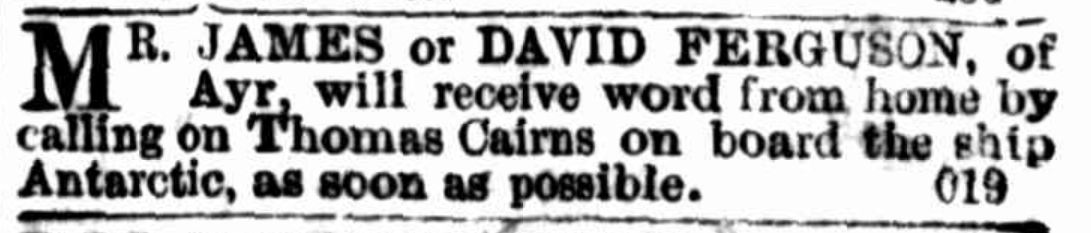
23-10-1856: The Ferguson brothers receive word from home.

The Argus, Melbourne, 23rd October 1856, page 1.

“MR. JAMES or DAVID FERGUSON, of Ayr, will receive word from home by calling on Thomas Cairns on board the ship Antarctic, as soon as possible”.

The Argus, Melbourne, 23rd October 1856, page 1.

What the ‘word from home’ was has never been ascertained but three months later David Ferguson would dissolve his partnership with his brother and James Urie and he return to Scotland.

See: 30-01-1857: David Ferguson returns to Scotland.

Or, had David had enough of the lawlessness and stench of Melbourne’s Streets? His elder brother James almost met his maker a year earlier when he was held up at gun point and robbed of a significant amount of money, so was this his David’s response to colonial Australia?


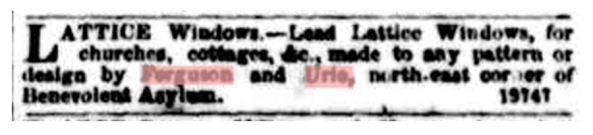
19-08-1853: The first Ferguson & Urie advertisement in 1853.

In August 1853 the first newspaper advertisement for the Ferguson & Urie business appeared in the Melbourne Argus newspaper.

The Scottish Brothers, James & David Ferguson from Wallace Town, and James Urie from Kilmarnock, were by trade Slaters, Glaziers & Plumbers from Ayr in Scotland and had arrived in Melbourne circa 29th April 1853 to seek their fortune in the Australian Colony.

Although the discovery of gold in Victoria was a temptation to many immigrants, the three men stuck to the business principals of making money via a demand for a commodity and advancing the likelihood of their success from the side economic effects of the gold rush. In the years 1853 to 1861 the company stuck to the skills of their trade, primarily as slaters, glaziers and plumbers, but in late 1861 this situation would change. The company’s new direction would see them cemented in history as Australia’s Pioneers in the medieval art of stained glass craftsmanship in Australia.

The Argus, Melbourne, Friday 19 August 1853, page 7.

“LATTICE Windows – Lead lattice Windows, for churches, cottages, etc, made to say pattern or design by Ferguson and Urie, north-east corner of Benevolent Asylum”.


Short link to this page: http://wp.me/p28nLD-Q

© Copyright