26-06-1863: John Knox (Church of Christ), Swanston Street, Melbourne.

In the heart of Melbourne, opposite the State Library in Swanston Street, stands the former John Knox Free Presbyterian Church built in 1863 to the designs of Charles Webb. It contains many original Ferguson & Urie stained glass windows that are now over a century and a half old. The three-light Gothic decorated window facing Swanston Street is also rare, being one of only five extant windows known to have the Ferguson & Urie company name on it.

Photos were taken 16th January 2011.

This slideshow requires JavaScript.

This is the second church erected on the site for the Free Presbyterians; the foundation stone of the first church was laid on Wednesday the 17th November 1847 on the corner of Little Lonsdale and Swanston Streets, Melbourne[1] and opened on the 8th May the following year.

Vandalism was a common occurrence in Colonial Melbourne and the Swanston Street Church was not immune. Four days after Christmas day in 1848 the windows of the church were the target of a supposed band of drunken bushmen who demolished the windows. A reward of three guineas was offered by the trustees for the apprehension of the sacrilegious perpetrators[2]. Fortunately, there is no historical attachment to these windows as there is no record of any historic stained glass this early in Melbourne’s history.

Twenty-six years later the church was deemed unsafe and at a public meeting circa 1862, it was resolved to build a new church on the same site, the foundation stone of which was laid on the 13th February 1863.[3]

The new church was reconstructed to the Neo-Gothic designs of architect Charles Webb and built by contractor Peter Cunningham and opened a mere six months later by the Reverend William McIntyre on the 26th of July 1863.

At a public meeting three days later the treasurer’s report was read:

“…Mr WILLIAM M. BELL, merchant, treasurer to the congregation, then read the report of the managers on the opening of the new church, which was as follows:- “The church built in 1847 having become unsafe, it was found necessary either to repair it at great expense, or build a new one. At a meeting duly called, it was resolved to build a new church, and we procured plans and specifications which were laid before, and approved of, by you. The foundation stone was laid by our pastor, on Friday, the 13th February last.…”[4]

This new church was decorated throughout with ornamental stained glass windows by the historic Ferguson & Urie stained glass company of North Melbourne and were described as follows:

“The stained glass for the ornamental windows was supplied by Messrs Ferguson and Urie, Curzon street, North Melbourne, and is of such a character as will not fail to secure for the firm a high position among the producers of this style of art manufacture….”[5]

All the stained glass windows are likely to have been installed at the time of the church construction in 1863 and the three-light window facing Swanston Street is a rarity amongst the early ecclesiastical windows created by the company as it is one of a rare few found to this date that has the company’s name on it, located in the lower edge of the centre light.

Since 1879 the church has been the home of the Church of Christ congregation and in 1883 the Presbyterians sold the building at auction which the Church of Christ took possession of at £4,500[6].

Significant tabloid transcriptions:

The Argus, Melbourne, Friday 24th July 1863, page 8.

“JOHN KNOX CHURCH, Swanston-street.- The NEW CHURCH will be OPENED for Divine Service upon Sabbath, the 26th inst. The Rev. WILLIAM MCINTYRE, of Sydney, will preach in the morning, at 11 o’clock, evening at 6.30; and the rev WILLIAM MILLER, Minister of the congregation, at 3 o’clock in the afternoon. A special collection in aid of the building fund will be made at these services. A public meeting of the congregation and friends will be held in the church upon Tuesday, the 28th, at 7 o’clock p.m., which will be addressed by several ministers and gentlemen.”

The Age, Melbourne, Vic, Wednesday 29th July 1863, page 6.

“JOHN KNOX FREE PRESBYTERIAN CHURCH, SWANSTON STREET.

A public meeting, in connection with the John Knox Free Presbyterian Congregation, was held yesterday evening, in the new church, which has been built by that body, in Swanston street. The new building, as our readers are aware, was opened for public worship on Sunday last. This edifice, if not of a most imposing character, is an exceedingly neat and elegant erection, and forms an addition to the architectural ornaments of the city, for the design of which Mr Charles Webb deserves much credit. It is in the early decorated style of Gothic architecture; the basement story is constructed of bluestone, the superstructure being of brick, which is already partially, and will be wholly finished with Portland cement. Internally, the church is 76 feet in extreme length, and 41 feet wide. The height of the walls is 21½ feet. The roof is of one span, and is open to the ridge so as to show the construction, and has a very fine effect, the trusses being ornamented with Gothic tracery and pendants. The timbers are stained in a light oak color. The pulpit and precentor’s desk are placed on a platform at the west end of the church, and are constructed of polished cedar, as are also the seats. In the basement story there are erected a vestry, session-house, and rooms for the residence of the beadle. The principal front of the building, facing Swanston street, presents the chief architectural features, consisting of a large “entrance doorway,: approached by a flight of nine steps, and enriched with Gothic columns with foliated capitals; and a handsome three-light window with Gothic tracery, and glazed with ornamental glass. The centre of the front projects so as to form the entrance lobby, and has at each angle an octagonal turret, of very handsome design rising to the height of 62ft. In the rear or west end of the building there is a handsome wheel window, glazed with ornamental glass, and the apex of this gable is surmounted by a neat bell turret. As we have already mentioned the architect was Mr Charles Webb, Collins street, and the contractor was Mr Peter Cunningham, Nicholson street, whose work has been performed most creditably. The stained glass for the ornamental windows was supplied by Messrs Ferguson and Urie, Curzon street, North Melbourne, and is of such a character as will not fail to secure for the firm a high position among the producers of this style of art manufacture….”

Note: This building was classified under the Historic Buildings Act 1974.

Footnotes:

[1] The Melbourne Argus, Vic, Friday 19th November 1847, page 2.

[2] The Argus, Melbourne, Friday 29th December 1848, page 2.

[3] The Age, Melbourne, Vic, Wednesday 29th July 1863, page 6.

[4] The Age, Melbourne, Vic, Wednesday 29th July 1863, page 6.

[5] The Age, Melbourne, Vic, Wednesday 29th July 1863, page 6.

[6] South Australian Register, Adelaide, Wednesday 14th March 1883, page 5.


Short link to this page: http://wp.me/p28nLD-10A

Article updated: 6th Oct 2014.
© Copyright

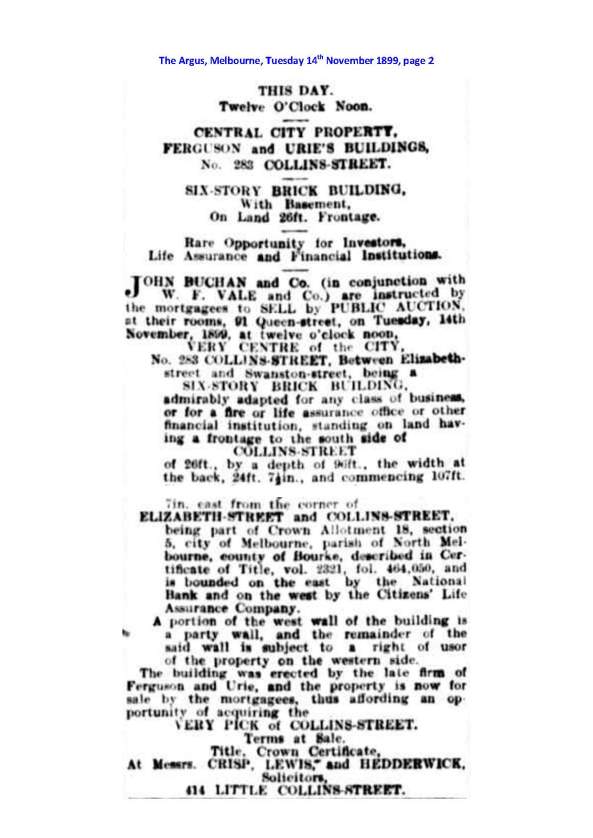
14-11-1899: The Auction of 283 Collins Street Melbourne.

The Argus, Melbourne, Tuesday 14th November 1899, page 2.

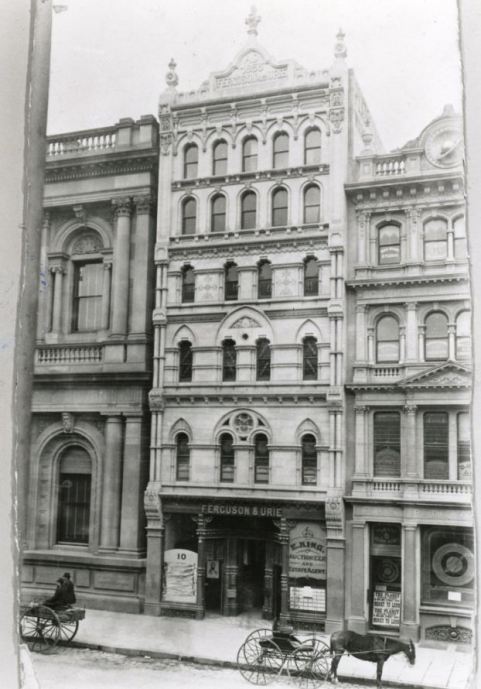
On Tuesday the 14th of November 1899, Ferguson & Urie’s flagship 281-283 Collins Street building went up for auction at “twelve o’clock noon” . There were no takers!

It wasn’t until February 1901 that the adjoining Citizens Life Assurance Company brought the building for an “undisclosed sum”. Other obscure reports from West Australian tabloids revealed a price of “between  £600 and £620 per foot frontage”.

The Ferguson & Urie building would eventually be demolished circa 1915 leaving no evidence of one of the first buildings in Melbourne to have the facade approved to have been built of “Hydraulic Freestone“.

The Ferguson & Urie Building at 10 Collins Street East.

The Ferguson & Urie Building at 10 (later 281-283) Collins Street East.

Related posts:

30-09-1873: For sale, 10 Collins Street.

20-03-1884: Ferguson & Urie building facade approved to be made of Hydraulic Freestone.

22-08-1884: Ferguson & Urie New Premises at 281-283 Collins Street

21-02-1901: The Citizens Life Life Assurance Company purchases the building.


Short link to this page: http://wp.me/p28nLD-ZI

© Copyright


14-06-1894: Probate lodged for the Will of James Ferguson

The Argus, Melbourne, Thursday 14th June 1894.

“WILLS AND ESTATES”

“The will, dated April 2, 1887, and codicils, dated May 8, 1890, and September 27, 1891, of James Ferguson, late of Leonard-street, Royal-park, glass importer, who died on April 17, has been lodged for probate. The estate is valued as £24,317, of which £15,088 is realty and £9,229 personalty. The testator directs that his interest in his Collins-street property shall be sold, and that out of the proceeds a sum of £1,000 shall be invested for the three children of his deceased daughter, Barbara Kier, wife of Crawford Kier, of Sydney, and £1,000 for the benefit of his daughter, Margaret Ferguson, for life, and then to his other daughters now surviving in equal shares. The residue of this fund and the proceeds of his Dryburgh-street and Eden-park properties is to be equally divided among his daughters, Janet Kay Auld, wife of Thomas Auld, of Flinders-street, Melbourne, grocer; Marion Williams, wife of Edward Williams, of Inglewood, Ironmonger; Antonia Wallace Gordon, widow of Alexander Gordon; and Sarah Campbell Gentles, wife of Alexander Gentles, of Moonee ponds, wool-classer. Her directs a sum of £1,000 to be invested for the benefit of his sister, Marion Ferguson Bishop, of Glasgow, Scotland, for life, and then to her son, Thomas Bishop, and the testator’s sister in-law, Barbara Lawson Kennedy, in equal shares. The residue of the estate is left to the testator’s son, James Ferguson, for life, and then to his children, or failing children to the testator’s surviving daughters in equal shares”.


Short link to this page: https://wp.me/p28nLD-Ya

© Copyright

17-03-1882: Christ Church, South Yarra. Melbourne, Victoria.

The Argus, Melbourne, Friday 17th March 1882, page 5.

“Two new stained-glass windows have been placed in the  choir of Christ Church, South Yarra. One representing SS, Peter and John converting converts at Samaris, is erected by some hundred and ten young people of the parish who were confirmed in the church last year. The other represents Our Saviour commissioning St. Peter, who kneels in front of the Twelve Apostles, to “Feed my Sheep.” Some sheep and lambs are depicted in the foreground. This window is placed in the church by the incumbent and his family in commemoration of his induction to the parish. Both windows are the work of Messrs. Ferguson and Urie, of this city.”

The two windows described in the article are depicted in the slideshow. See post 04-10-1881 for other Ferguson & Urie windows in the church.

Photos were taken 26th March 2012.

This slideshow requires JavaScript.

Related posts:

04-10-1881: Christ Church South Yarra.


Short link to this page: https://wp.me/p28nLD-XT

© Copyright

26-03-1883: St Luke’s Anglican Church, South Melbourne.

The foundation stone of St Luke’s Church of England was laid by Sir Henry Barkly on the 9th of  March 1857 at South Melbourne (at which time it was known as Emerald Hill).  The land the church now resides on was reserved in the original township plan back in 1852. The church was designed by Francis White and had a frontage to Clarendon Street before the church later sold it for retail development in the 1900’s which changed their address to the Dorcas street frontage. Architect Charles Webb added Transepts to the church in 1862 and it is the North Transept that has the Ferguson & Urie stained glass window.

The window depicts “Jesus in the House of Martha and Mary” and was installed in March 1883 to the memory of Mary Skeats (1817-1879) and has the memorial inscription “In Loving Memory of Mary the beloved wife of Charles Skeats, July 24th 1879.”

Photos taken 13th May 2012.

This slideshow requires JavaScript.

[View larger images]

Record, Emerald Hill, Vic, Friday 30th March 1883, page 3.

“…A very fine memorial window has also been placed in the church by Messrs. Ferguson and Urie in their most expensive style, to the order of Mr. Charles Skeats, in memory of his wife, Mary. The subject he has, therefore, very appropriately chosen, is Christ with Mary and Martha – “Mary hath chosen that good part,” &c. It is placed over the seat where Mrs. Mary Skeats used to sit in the church.”

The Argus, Melbourne, Monday 26th March 1883, page 5.

“Great improvements have been recently effected in St. Luke’s Church, Emerald-hill. The temporary arrangements of the east end of the church have been entirely altered, the choir seats, pulpit, and Communion table have all been rearranged, and a carpet and cedar reredos, with Gothic paneling, provided. A memorial window of stained glass has been also placed in the north transept by Mr Charles Skeats, in memory of his wife Mary Skeats, who used to sit in that part of the church. The subject is. “Mary hath chosen that good part,” &c.” 

The Argus, Melbourne, Saturday 26th July 1879, page 1.

SKEATS – On the 24th inst., at No. 10 Romsey-terrace, St Vincent place, Emerald hill, Mary, the beloved wife of Charles Skeats, Esq., aged 61 years. Deeply regretted.

The Argus, Melbourne, Friday 25th July 1879, page 8.

“THE Friends of CHARLES SKEATS, Esq., are respectfully invited to follow the remains of his beloved wife to the place of interment, the Melbourne General Cemetery.
The funeral is appointed to leave his residence, No 10 Romsey-terrace, St Vincent place south, Emerald-hill, on Saturday, the 26th inst., at two o’clock. THOMAS RENTLE, undertaker, 77 Napier-street, Emerald-hill”.

The Mary Skeats gravestone is located at the Melbourne General Cemetery, CofE, section W-189, but it has unfortunately fallen over sometime in the past century. Some of the text is still readable via digital images from beneath.

STH MELB St Lukes 98a

STH MELB St Lukes 98b


Attached documents:

09/03/1857: The Laying of the Foundation Stone of St Luke’s


Short link to this page: https://wp.me/p28nLD-Ws

© Copyright

04-05-1889: Is Marriage a Failure?

This is good for a laugh, but it’s highly likely that the opposing debaters named as Ferguson and Urie, were the sons of James Ferguson (James Ferguson Jnr b. 1861) and James Urie (William Urie b. 1864). The Australian Natives Association (ANA) was formed in 1871 as a friendly society and its membership was only open to Australian born males of which the sons of James Ferguson & James Urie were, and at the time of the debate both were single men. James Urie was a councillor (and Mayor) of Flemington & Kensington and would have been a significant influence in ensuring the young men took an active part in associations such as this.

The North Melbourne Advertiser, Saturday 4th May 1889, page 3

“IS MARRIAGE A FAILURE?”

“An interesting debate on the above subject took place at the ordinary meeting of the Flemington and Kensington branch of the Australian Natives Association, on Friday evening. Mr Roberts, vice president, in the chair.

            Mr Rowe, who opened the debate, did not distinctly affirm that marriage was a failure, but assuming, for the sake of argument, that it was so, then it behoved them to trace some of the causes of the failure. In one case failure was due to the fact that the wife was not domesticated. The young lady, in the spinster stage of her existence, was too proud, too idle, or too indifferent to attend to household duties, and it was only natural that she should develop into ‘the ornamental wife’. Such a woman was unable to cook a chop or even a potato, and the dyspeptic husband was sometimes driven into the bar parlour in disgust. To his thinking, the best wives were the daughters of workmen, and such seldom turned out to be incapable or extravagant. Some women who complained that marriage was a failure, would do well to ask themselves whether they had tried to be as agreeable and as winning towards their husbands as they were in the days of courtship. Then there were instances in which the husband was to blame for marital infelicity. As a lover, a man may be a model of tenderness and devotion, but as soon as the prise is secured, neglect often takes the place of love, attendance at the club is resumed, or it may be, the demon drink steps in to make the home miserable. But if marriage is a failure, the question would naturally arise ‘Where are we to find a substitute?”

            Mr Urie spoke on the affirmative side of the question. He had known young men who were happy and as jolly as possible before marriage, but as soon as they were fairly engaged a change came over their dispositions, and they grew disagreeable and morose. After marriage matters became worse still. You could not get them out for half-an-hour because were required to stay at home to mind the baby – the only time they were allowed out was when the infant required an airing, and they were needed to drive ‘the barrow’. He had known young fellows who, while bachelors, always had a shilling in their pockets, but, after they became married, never seemed to have a penny of their own, and who went around ‘cadging’ tobacco of their single acquaintances. Surely marriage was a failure when it came to that. Of course he was speaking as a single man; he had never been through the mill himself, and he never meant to. Mr Phillips took the negative side of the question. Of course there were individual cases of failure, but the system as a whole was successful enough. When young couples went courting they should find out whether they could trust one another, and the young man should satisfy himself that the young woman was capable of keeping house. In some cases people rushed into matrimony in a hurry and were sorry for it afterwards. A man took a fancy to a woman and made up his mind he would marry her whether she was good or bad. Such a union was a failure as frequently as not. But if the parties were of ‘the right sort’, he knew of nothing happier than the married state. It was desirable that the wife should be domesticated, and, whatever her station in life she should try to ‘save up a little for a rainy day’, should try to put a little by week by week.

            A member – What Building Society do you represent?

Mr Phillips went on to say that a man was not much benefit to the colony if he had not the moral courage to marry. He often pitied the poor man who was not married.

            Mr Mahoney thought marriage was only a failure in the minority of cases, and 99 times out of a 100 the fault was on the side of the man. Sometimes former companions got hold of a married man and enticed him away from his home to the hotel. In the course of time, the wife, weary of being left by herself , went into society and mixed up with other men – and the marriage was a failure. As to getting on in life, a single man had not half the chance a married man had. Before he was married he spent all he earned, but after marriage he found that 5s went as far as £1 used to go. Besides, no one could sympathise with one, either in times of prosperity of adversity, the same as a wife could. He spoke after 15 years experience. Marriage was calculated to make a man happy and moral. Single men rarely we’re respectable. (Laughter.)

            Mr Ferguson doubted that Mr Rowe wanted to prove that marriage was a failure, and probably he could not if he tried, because he had no grounds to go on, being a single man he had no practical experience of the question. Want of means was one cause of the failure of marriage – poverty was a heart rendering thing in the house. Another prolific cause of infelicity was over-indulgence in drink. He would like to know the reason why men married. He considered it was either a question of passion or necessity.

            Mr Maloney – You look at it from a very low standpoint.

Mr Ferguson said – Home was a great English institution. Many persons married to secure a home. In China the woman was the slave of her husband. Amongst the American Indians the female worked while the male went out fishing or shooting. In Turkey, and amongst the Mormons, a man married as many wives as he could afford. In these latter cases marriage was not a failure so long as the husband had the means to keep his establishment going. In certain tribes in South Africa, the men had their wives in common. In the Border land between England and Scotland, in the olden time, men took their wives on trial, but history was silent as to what became of the children. In ancient Sparta, the State took charge of all children; if the child was weakly it was exposed to die, if strong, it was trained up by the State. Under our system of education, children were not fitted for the duties of after life. He was of the opinion that the State should take upon itself the care of all children. Amongst the causes of the failure of matrimony, the mother-in-law was a prominent factor, and should not be overlooked.

            The chairman was of the opinion that in the great majority of cases marriage was anything but a failure. He did not agree with Mr Rowe that the daughters of poor men made the best wives. An old proverb said that if you want a good bird you must go to a good nest. The girls of the better class were, to his mind, better educated and quite domesticated as their humbler sisters, and were therefore more companionable. Mr Urie’s argument re married men staying at home was certainly no proof of connubial infelicity. Nor was there much force in Mr Ferguson’s theory as to the want of means, because most people were agreed that the greatest happiness was to be found in the humble homes. The companionship of a good woman had a most beneficial influence on men. The quarrels of husbands and wives were often retailed in newspapers, but the Press was silent as to the happiness of thousands of married people. He had boarded out for three or four years, and it was the most miserable period of his existence. The mother-in-law difficulty was greatly exaggerated. If a husband put his foot firmly down at the outset, the wife’s mother soon shrank back into her proper position in the household.

            After some remarks, in reply, from Messrs Rowe and Urie, the debate closed.


31-08-1976: Stained glass windows stolen in city raid.

Number 9 Collins Street Melbourne is the Grosvenor Chambers building built in 1887-1888 by architect Oakden, Addison & Kemp for the Scottish decorative artist Charles Stewart Paterson. At some point in its history it also hosted the prestigious Melbourne Club and was Australia’s first custom designed studio complex, used by prominent Australian artists.

In 1976 a brazen thief stole some original stained glass windows from the Collins Street face of the building. It was claimed that these historic windows were the work of the Colonial Victorian firm of Ferguson & Urie!

The Age, Melbourne, Tuesday 31st August 1976, page 3.

“Stained glass windows stolen in city raid”

“Thieves yesterday hacked out two stained glass windows worth more than $5,000 from a Collins Street building. The building, No.9 Collins St., has been classified by the national Trust. Since it was built in 1887 it has housed such famous Australian artists as Tom Roberts, Sir John Longstaff and Albert tucker. The building is the centre of a controversy between the Trust and the owners, Colonial Mutual Life Assurance Society, who want to demolish it. A tenant of the building, photographer Mr. Eric Baylis, said he last saw the window late on Sunday night. “When I got here yesterday morning it was gone. Part of the window had been cut out of the frame, while other parts had been hacked out”, Mr. Baylis said. An authority of stained glass windows, Mr. Allan Sumner, said the windows were made by Ferguson and Urie of Melbourne in the late 1880’s. “It is a classic example of that type of work. Now it has been stolen it is irreplaceable”. He said the windows would be hard to sell. “People who know anything about glass will know that that type of work is hard to come by. What people should look for is that the margins on a couple of frames will be damaged because they have been hacked out by a knife or screwdriver”.

“ABOVE: Photographer Eric Bayliss with one of the gaps left by the stolen windows. BELOW: One of the windows before it disappeared”.

(photos from article shown together below)

The Age, Melbourne, Tuesday 31st August 1976, page 3.

The Age, Melbourne, Vic, Friday 3rd September 1976.

“Old glass windows recovered”.

“Two stained glass windows stolen from a Collins St. building last Sunday were found abandoned behind a Westmeadows church on Wednesday. The windows, made by Ferguson and Urie, of Melbourne, in the 1880’s, were lying in a paddock wrapped in blankets. Thieves removed them from their frames at the Colonial Mutual Life Assurance building last Sunday. CMLA senior property officer. Mr. A. Gray, said yesterday the windows would not be put back. ‘They are being crated for safe storage. We do not propose to put them back for the same thing to happen again”, Mr. Gray said. He said the windows did not appear to be damaged. An authority on stained glass windows, Mr. Allan Sumner, said the windows would be worth about $5,000. The CMLA building, built in 1887, has a National Trust classification”.

As Dr. Bronwyn Hughes has pointed out on her comment to this article in June 2012, it’s extremely likely that Sumner is incorrect in his observation as to who made the window. “The stairwell window for Grosvenor Chambers was designed by John Hughes and made by Brooks, Robinson & Co. The article doesn’t make clear whether it was the stairwell, but it seems unlikely that another firm would be brought in for other windows.”

This is further corroborated by an article published in April 1888 which chronicled the opening of the Grosvenor Buildings and included a significant amount of detail about the stained glass windows by the “Mr. Hughes” from the stained glass firm of Brooks, Robinson & Co.

Resources links:

Wikipedia: Grosvenor Chambers

Walking Melbourne: Grosvenor Chambers

Walking Melbourne blog: Grosvenor Chambers, 9 Collins Street

NLA: The Age, Melbourne, Vic, Friday 3rd September 1976.
(mentioned in Biog of his brother John Ford Paterson)
Article Short Link: http://wp.me/p28nLD-Sq

04-07-1901: The sale of Ayr Cottage, Parkville, Melbourne.

James Ferguson indicated in his will that he wished his surviving children to retain ‘Ayr Cottage’ within the family but this was not to be the case. Only a year after his death it was sold on the 2nd of December 1895 to Edgar, Violet and Margaret Lockington who retained the house for a period of six years. On the 4th of July 1901 the household furniture and effects were auctioned and on the 13th of September 1901, the house was offered for auction and subsequently purchased by the Victorian Children’s Aid Society. The society had a long association with the house for over half a century. In 1966 it finally changed into the hands of International House, the University of Melbourne, who still own it as at 2013.

The photos in the slideshow depict James Ferguson’s ‘Ayr-Cottage’, in Leonard street Parkville, at five dates in its history, being the years 1888, 1901, 1963, 1966 and 2009.

This slideshow requires JavaScript.

The Argus, Melbourne, Saturday 29th June 1901, page 2.

“THURSDAY, JULY 4. At Eleven O’Clock Forenoon. On the Premises,
AYR-COTTAGE, Corner Leonard-street and Sydney-road, PARKVILLE
(Brunswick Trams Pass the Property).
Mr PURVES is instructed to SELL by AUCTION, as above,
The whole of the excellent HOUSEHOLD FURNITURE and other effects, comprising magnificent upright Grand PIANOFORTE, by Schwechten, in beautiful walnut case; cedar sideboard, telescope dining table, chairs, and sofa, in leather and haircloth; chiffonier, chimney mirrors, plated articles, china, &c,; also the complete furnishings of six bedrooms, including iron bedsteads and bedding, wardrobes, toilet tables, washstands, chamber ware; handsome oak hall table and chairs, four artistic stained glass window screens, oil paintings, engravings, carpets, linoleums, roller mangle, kitchen furniture and utensils, ferns, pot plants, and a large quantity of miscellaneous articles, as per catalogue. On view the day before sale, from twelve to four. Inspection invited. Australian-buildings, 49 Elizabeth-street. Tel 1776”

Note: Nothing further is known about the “stained glass window screens” mentioned.

Additional references:

Register of the National Estate 22 June 1993, place ID 16875, File 2/11/033/0494

Related posts:

1886: The History of ‘Ayr’ Cottage, 1 Leonard St. Parkville, Melbourne, Victoria.

08-10-1887: ‘Ayr Cottage’, 1 Leonard Street, Parkville, Melbourne, Victoria.

01-01-1888: The Ferguson Clan at Ayr Cottage, Parkville.

18-04-1894: James Ferguson (1818-1894)

© Copyright

09-09-1935: Trinity Church, Camberwell, Victoria, Australia.

In 1935 the West Melbourne Presbyterian Church was dismantled and re-erected as St Andrew’s at Box Hill. St Andrew’s was meant to be a faithful replica of the old West Melbourne Church and so the stained glass windows were included in the reconstruction.

Except for one, which found its new home at Trinity Church, Camberwell.

The Argus, Melbourne, Monday 9th September 1935, page 5.

 “JUBILEE SERVICE”

“Trinity Church, Camberwell”.

 “…During the service Mr. Macaulay announced that in honour of the Rev. P. J. Murdoch’s long ministry in the church Sir Keith and lady Murdoch had decided to provide a stained glass window, of three lights, for the church….”

Albury Banner and Wodonga Express, NSW, Friday 7th February 1936, page 15.

“On Sunday Rev. R. W. Macaulay dedicated a renovated stained glass window at Trinity Presbyterian Church, Camberwell. The window was originally erected in the West Melbourne Presbyterian Church to commemorate the ministry there of Rev. P. J. Murdock, who was also minister at Camberwell from 1887 till his retirement.”

The window mentioned here has been confirmed to be the one the fourteen three-light nave windows that came from the old West Melbourne Church that was dismantled in 1935. It would appear this window was obtained by Sir Keith Murdoch for Trinity Church Camberwell and erected in the name of his father’s long standing ministry in the Church. It was unveiled on Sunday 2nd February 1936. (see post 01-02-1936)

This slideshow requires JavaScript.

The window contains a piece of scripture in the centre of each of the three lights with the relevant bible reference:

“I AM THE WAY AND THE TRUTH AND THE LIFE” “JOHN: 14-6”

“SHEW ME THY WAY O LORD” “PS: 25-4” (Psalms 25-4)

“SEEK YE THE LORD WHILE HE MAY BE FOUND” “IS: 55-6” (Isaiah 55-6)


Biography: Rev Patrick John Murdoch (1850-1940)

Biography: Sir Keith Arthur Murdoch (1885-1952).

Related posts: 29-04-1867 > 02-05-186727-04-1935 > 09-09-1935 > 16-12-1935 > 01-02-1936

To see a slideshow of the entire cycle of windows at St Andrews Box Hill, see post:  27-04-1935

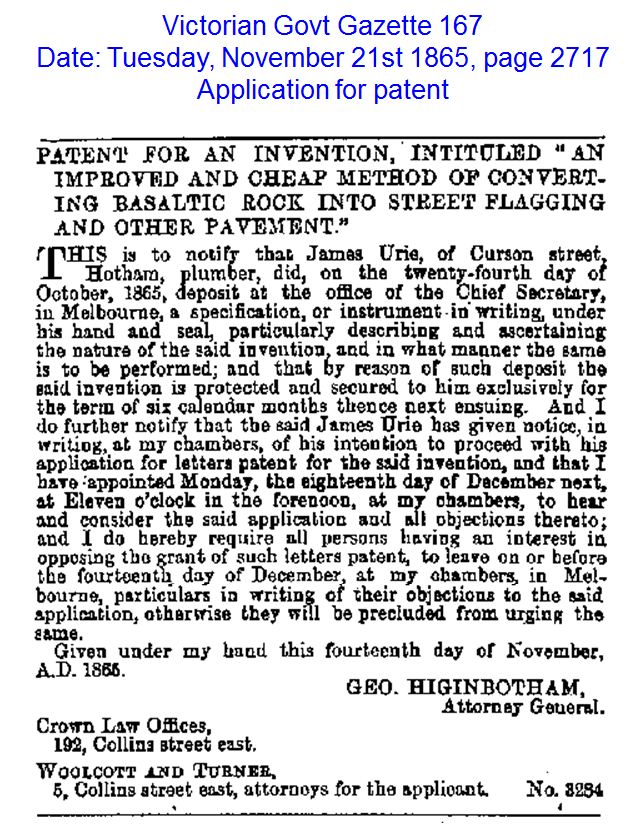
21-11-1865: James Urie’s Invention

Victorian Govt Gazette 167, Tuesday, November 21st 1865, page 2717

“PATENT FOR AN INVENTION, INTITLED “AN IMPROVED AND CHEAP METHOD OF CONVERTING BASALTIC ROCK INTO STREET FLAGGING AND OTHER PAVEMENT.”

THIS is to notify that James Urie, of Curzon street, Hotham, plumber, did, on the twenty-fourth day of October, 1865, deposit at the office of the Chief Secretary, in Melbourne, a specification, or instrument in writing, under his hand and seal, particularly describing and ascertaining the nature of the said invention, and in what manner the same is to be performed; and that by reason of such deposit the said invention is protected and secured to him exclusively for the term of six calendar months thence next ensuing. And I do further notify that the said James Urie has given notice, in writing , at my chambers, of his intention to proceed with his application for letters patent for the said invention, and that I have appointed Monday, the eighteenth day of December next, at Eleven o’clock in the forenoon, at my chambers, to hear and consider the said application and all objections thereto; and I do hereby require all persons having an interest in opposing the grant of such letters patent, to leave on or before the fourteenth day of December, at my chambers, in Melbourne, particulars in writing of their objections to the said application, otherwise they will be precluded from urging the same.

 Given under my hand this fourteenth day of November, A.D. 1865.

 GEO. HIGINBOTHAM, Attorney General.

Crown Law Offices, 192 Collins street east.

WOOLCOTT AND TURNER,

5, Collins street east, attorneys for the applicant. No. 3254″.

Victorian Govt Gazette 167, Tuesday, November 21st 1865, page 2717, James Urie’s application for patent.

Related posts: 19-02-1874 > 18-09-1885  > 25-07-1890 > 29-08-1890 > 20-07-1899


Short link to this page: https://wp.me/p28nLD-Mn

© Copyright