20-05-1915: Mrs Marion Reyburn.

The Essendon Gazette & Keilor, Bulla and Broadmeadows Reporter, Moonee Ponds, Thursday 20th May 1915, page 3.

“Mrs. Marion Reyburn died at the residence of her relatives, at 38 Chaucer street, Moonee Ponds, on Thursday, at the grand old age of 100 years. Mrs Reyburn, who celebrated her 100th birthday on 13th April last, was born at Kilmarnock, Scotland, in the year of the battle of Waterloo. She came to Australia with her husband, the late Mr. James Reburn, in the Indus, the voyage occupying 18 weeks. For many years she carried on a drapery business with her husband at Curzon street, North Melbourne, but after his death she lived with her relatives. Deceased was the eldest daughter of the late Mr. William Urie, and sister of the late Mr. James Urie, of the firm Urie and Ferguson.”

Marion Reyburn (nee Urie) Photo from Herald Sun 14 Apr 1915 (From Mrs Noelle Nathan 13 Aug 2010)

21-02-1901: Citizens’ Life Assurance Company purchase the Ferguson & Urie building.

The Argus, Melbourne, Thursday 21st February 1901, page 4.

“We are informed by the Citizens’ Life Assurance Company Limited that they have purchased the property adjoining that which they occupy in Collins-street, known as Ferguson and Urie’s Buildings. The price paid is not stated.”

The West Australian, Perth, WA, Wednesday 27th February 1901, page 5.

“The price paid by the Citizens’ Life Assurance Company for Messrs. Ferguson and Urie’s buildings in Collins-street is understood to be something between £600 and £620 per foot frontage.”

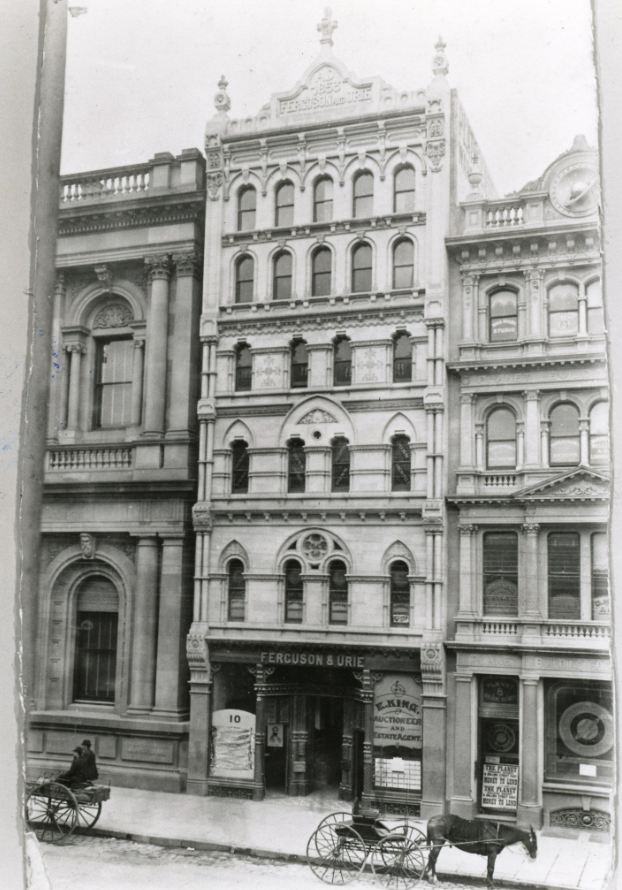
The Ferguson & Urie building is shown in the centre of the photo below. The National Bank is on the left and the Citizens Life Assurance Company is seen on the right as the Planet Building Society[1] which was brought by the Citizens Life Assurance Company in 1901.

The photo below is considered to be circa 1885. The Ferguson & Urie and Planet building are believed to have been demolished circa 1915 to make way for the Bank of Queensland (also demolished 1970).

The Ferguson & Urie Building at 10 Collins Street East.

The Ferguson & Urie Building at 10 (later 281-283) Collins Street East, Melbourne

Related posts:

30-09-1873: For sale, 10 Collins Street.

20-03-1884: Ferguson & Urie building facade approved to be made of Hydraulic Freestone.

22-08-1884: Ferguson & Urie New Premises at 281-283 Collins Street

14-11-1899: The Auction of 283 Collins Street.

Footnotes:

[1]  The Advertiser, Adelaide, SA, Wednesday 8th March 1899, page 7.   The Citizens Life Assurance Company: “…During the year the directors purchased the freehold premises of the late Planet Building Society, Collins Street, Melbourne. The premises are centrally situated, and the business of our Melbourne branch is now being conducted therein...”

© Copyright

24-11-1899: Dividends for Ferguson & Urie declared.

Victorian Govt Gazette 98, Friday 24th November 1899, page 4333.

“The Insolvency Acts.- In the Court of Insolvency, Melbourne District […]”.

“A DIVIDEND is intended to be declared in the matter of Ferguson and Urie, of 100 Franklin-street, Melbourne, in the colony of Victoria, glass stainers, whose estate was assigned on the 22nd day of June, 1899. Creditors who have not proved their debts by the 12th day of December, 1899, will be excluded. Dated this 24th day of November, 1899. J. DRYSDALE PURVES, Trustee. Australian Buildings, 49 Elizabeth-street, Melbourne.”

This nears the final stages of the Ferguson & Urie companies forty six year history as the first commercial stained glass company to have been established in the Australian colonies.

Victorian Govt Gazette 98, Date: Friday, November 24th 1899, page 4333

Related posts: 06-09-1899

06-09-1899: 100 Franklin Street warehouse To Let.

The Argus, Melbourne, Wednesday 6th September 1899, page 3.

“MAGNIFICENT WAREHOUSE, 100 Franklin-street, Lately Occupied by Ferguson and Urie, Suitable for factory or any class of trade, TO LET. TO LET. TO LET. Rent Moderate. Apply to DRYSDALE PURVES, Trustee, Australian-buildings, 49 Elizabeth-street.”

On the 17th October 1899, The Argus reported that Edward Keep and Co were going out of business because of a fire, (which had occurred at their Lonsdale premises) and “Messrs. Fras and Albert Keep, in conjunction with the departmental manager, Mr H. S. Wood, propose to continue the carriage ironmongery and agricultural implement business at 100 Franklin-street”.

Later the business would be known as “Keep Bros & Wood. Saddlers and Ironmongers”. On the 30th September 1899, the Argus reported that a number of buildings were being sold by the trustees of the estate of the late “Alfred Joseph” and the 100 Franklin street building was included for sale “subject to existing tenancies”.

In 1913, Keep Bros & Wood still advertised the business at 100 Franklin Street but have now advertised as “Keep Bros & Wood Wheel Factory, Franklin Street” producing wooden coach wheels. By 1916 they have diversified and are selling agents for the “Trumbull Car”.

In 1945, Keep Bros & Wood purchased several old properties in Elizabeth street for re-development as the new company premises and in the 1960’s started producing the “Hallmark” Bicycle.

Related posts: (about Franklin Street)

16-04-1891 > 10-07-1891 > 01-08-189129-07-1899 > 10-08-1899 > 06-09-1899

© Copyright

10-08-1899: The auction of the Ferguson & Urie stock at the Franklin Street premises.

The Argus, Melbourne, Thursday 10th August 1899, page 2.

A similar notice appeared in the Argus on the 10th of August 1899 with the only difference being the addition of office furniture and:

“TERMS – UNDER 100, NET CASH; ABOVE THAT SUM, CASH, LESS 2 ½ PERCENT DISCOUNT”

This is a continuation notice regards the sale of the firms stock.

Related posts: (about Franklin Street)

16-04-1891 > 10-07-1891 > 01-08-1891 > 29-07-1899 > 10-08-1899 > 06-09-1899

29-07-1899: The auction of the Ferguson & Urie stock at the Franklin Street premises.

The Sydney Morning Herald, NSW, Saturday 29th July 1899, page 11.

“Messrs. Fraser and Co., of Melbourne, advertise elsewhere and unreserved sale of the stock-in-trade in the assigned estate of Messrs. Ferguson and Urie, glass stainers and merchants.”

Related posts: (about Franklin Street)

16-04-1891 > 10-07-1891 > 01-08-189129-07-1899 > 10-08-1899 > 06-09-1899

1897: Sands & Kenny’s directory, Melbourne, 1897.

Sands & Kenny’s directory, Melbourne, 1897.

In the Sands & Kenny’s Melbourne Directory for 1897 another company is listed as operating from the Ferguson & Urie building in Collins street. The firm is listed as ‘E Rowlands’ late Rowlands & Lewis, manufacturer of all kinds of aerated waters, cordials and bitters, proprietor of Vigorine, Ballarat, Sydney, Newcastle, 266 King Street, and 281 Collins Street, Melbourne.

18-04-1894: James Ferguson (1818-1894)

From a family history perspective there is quite a lot known about James Ferguson, his family, and his colonial colonial stained glass company from North Melbourne.

I have many historical artifacts which include photographs, pieces of furniture, documents, and many other interesting items which make up a magnificent collection of colonial history as well as my own family history.

James Ferguson was born in Ayr, Scotland circa 1818. His parents were Janet Kay (1791-1860) and Master Slater & Glazier, James Ferguson Snr (1777-1886).

On the 13th of June 1841 he married Jane Williamson Lawson (1820-1886), the daughter of Gavin Lawson and Margaret Williamson and between 1842 and 1852 five girls and a boy were born in Wallacetown;
Margaret (1842-1913) who was mentally disabled from birth, Janet Kay (1844-1925), Jane Williamson (1846-1875), Marion (1848-1927) and Antonia Wallace (1852-1926). A son named James was born in 1851 but died as an infant in the same year.

On the night of the 1851 Scottish Census (30/31 March) his future business partner, James Urie, was recorded as a visitor at his cottage in John Street Wallacetown. Whether this was one of many meetings the two men would have to discuss their bold plans for the future can only be speculation but only nine months later their plans would come to fruition.

In early December 1852 James Ferguson was given a farewell party at the Robert Burns Arms Inn at Wallacetown prior to his departure for Australia.

“…After the usual preliminaries, Mr John Templeton, watchmaker, in neat and appropriate terms, proposed the health of Mr Ferguson and, in name of many friends, present and absent, presented him with a splendid purse containing 25 sovereigns…”

James and his younger brother David departed Greenock on the 12th of December 1852 aboard the ‘Tamerlane’ and after more than four an a half months at sea they arrived in Port Philip on the 29th of April 1853.  James’s wife Jane would remain in Wallacetown for two years with the children whilst James established the business in North Melbourne. She arrived  aboard the ‘Emma’ with the five girls in November 1855.

In August 1853 the first business advertisements for the company, “Ferguson & Urie”, began in the Melbourne Argus Newspaper. The rest of the Ferguson & Urie history forms the basis of this entire web site.

This slideshow requires JavaScript.

The Argus, Melbourne, Wednesday 18th April 1894, page 5.

“The death is announced of Mr. James Ferguson, the surviving partner of the well known firm of Messrs. Ferguson and Urie. Mr. Ferguson was a colonist of about 40 years’ standing, and for many years carried on business with his partner in Collins-street near the National Bank. Mr. Ferguson died at his residence, Parkville, early yesterday morning, at the advanced age of 84 [sic].”

(James Ferguson was 74 years of age at death).

The North Melbourne Advertiser, Friday 20th April 1894, page 2.

“DEATH OF MR. J. FERGUSON”

“We regret to have to record the death of Mr. James Ferguson, the surviving partner of the well known glass staining firm of Ferguson and Urie. Mr. Ferguson was a colonist of about forty years’ standing, and for many years carried on business with his partner, Mr. Urie (deceased about six years ago) [sic: 1890], in Collins Street, near the National Bank. Mr. Ferguson passed away at his residence, Parkville, early on Tuesday morning, his death being simply a decay of nature, as he was in his seventy-first year [sic: 74]. For the past four years the business of the firm has been carried on in Franklin Street and Curzon Street, North Melbourne. Mr. Ferguson was a member of the Presbyterian Church, and was much respected as a private citizen, but never aspired to enter public life. He died a widower, and leaves a grown up family. The funeral took place yesterday afternoon, deceased being interred in the Melbourne general cemetery and the cortege was followed by a large number of mourners. The body was conveyed to the grave in a panelled hearse, and enclosed in a plain coffin. There were three mourning coaches. Mr. Ferguson was buried in the Presbyterian compartment, the arrangements being carried out by Alfred Allison, of 221 Victoria Street, West Melbourne.”

Related posts:

19-04-1886: Jane Ferguson (nee Lawson) (1820-1886)

19-04-1894: The funeral of James Ferguson Snr.

1886: The History of ‘Ayr’ Cottage, 1 Leonard St. Parkville, Melbourne, Victoria.

08-10-1887: ‘Ayr Cottage’, 1 Leonard Street, Parkville, Melbourne, Victoria.

01-01-1888: The Ferguson Clan at Ayr Cottage, Parkville.

04-07-1901: The sale of Ayr Cottage, Parkville, Melbourne.

19-02-1874: The Hotham (North Melbourne) School of Art.


Short link to this page: http://wp.me/p28nLD-Jf

© Copyright

14-11-1891: Charitable donations by Ferguson & Urie.

The Argus, Melbourne, Saturday 14th November 1891, page 7

Charitable acknowledgements appeared in the Argus newspaper many times until the closure of the company in 1899. Donations were made in the name of Ferguson & Urie and in the name of Employees of the firm for donations to Hospitals and other charitable organisations. Although James Ferguson and James Urie were staunch Presbyterians, they appeared to make no particular distinction or favour when it came to charity or the church.

10-07-1891: The Ferguson & Urie warehouse, Franklin Street, Melbourne.

In 1891 the Ferguson & Urie stained glass company were either consolidating or downsizing their operations. The earlier stock market crash of the 1890s must have wreaked havoc on many market-dependent businesses but this following information gives the impression that the company was having one last act of defiance as it consolidated all its business into one huge four story warehouse in Franklin Street Melbourne. By this time senior partner and founder James Urie had died a year earlier and in another three years James Ferguson would also meet ‘the man with the keys’ (St Peter) who had been depicted in so many of the company’s works of art in stained glass.

The Franklin Street warehouse building still exists but has been substantially modified. As at 2012 it’s known as ‘Burbank House’ and a tribute plaque affixed to the front of the building gives more recognition to the site as being the location of the first Victorian Ice-works and the inventor of the refrigeration process, James Harrison. There is no mention of the actual building as being the location of the historic Ferguson & Urie stained glass establishment whose works of art can still be found all over the eastern states of Australia.

This slideshow requires JavaScript.

The North Melbourne Advertiser, Friday 10th July 1891, page 2.

“MESSRS. FERGUSON AND URIE’S ESTABLISHMENT”

“The above firm is one which is known throughout the Australian colonies as the designers and manufacturers of many a handsome chancel window, radiant with the forms of saints and apostles, clad in those rich garments, which the artistic piety of the middle ages loved to clothe the Founder of the Christian Church and His disciples, while the secular side of the art of glass staining is exemplified by specimens of the firm’s work in the colored crests and historical pictures on hall windows in the homes of the wealthy colonist. The new premises are in Franklin-street, and are four stories high, being commodious and comfortable throughout. The top flat contains large quantities of ornamental glass and samples of work, indeed these latter abound throughout the building, and greatly enhances the general effect. The name of the firm is shortly to be fixed on the summit of the roof, with the letters delineated on variegated glass, which will be a novel and striking announcement. Beneath the top story is a department where sheet glass is stored and descending to the next flat more of this article is discovered, but the sides of the store are covered with some beautiful specimens of the glass stainer’s art. One of the most striking of these is a pair of windows representing “Tragedy” and “Comedy”. The colouring is faultless, and the drapery most effectively arranged. These windows would show to great advantage in the main hall or conservatory of a mansion, or in the dress circle corridor of an elegantly appointed theatre. Representations of Lord Nelson and Bacon are here displayed, and would greatly adorn a library or some educational institute. Those who have a weakness for seeing the crest of their ancestors emblazoned in rich and varied hues in their homes, Messrs Ferguson and Urie can accommodate to a nicety, as their heraldic designs in colored glass are most effective. The most interesting part of he building is undoubtedly the artist’s room, where Mr Jackson plans and paints amid representations of angels, cherubim, Madonnas, scenes from Christ’s Passion, and various other representations that give his chamber the appearance of the scriptorium of some wealthy monastery in which Art is wedded to Religion. Here all designs are drawn, and the firm’s clients exercise their choice and are informed as to estimates. The paintings are executed in water colours, and the stock of samples extensive and original. On the ground floor is the general office and private apartment for the principals. Round these are specimens and examples of what the firm can turn out, including embossed margins for door side lights and slides for large hall lamps. Plate glass is kept on the ground floor in large quantities, some of the sheets being of great superficial measurement. At the rear of the building is a bending kiln, used as its name denotes, for bending the glass. This is one of the largest structures of its kind in Melbourne, and is substantially put together. The works of the firm are in Curzon Street, North Melbourne, but it is at the Franklin-street depot that the beautiful results are to be viewed. Ferguson and Urie are household words among those possessing artistic tastes, and have been so for many years, and not withstanding the importation of several specimens of ecclesiastical stained glass from Belgium and Germany, still continue to take the lead in beautifying the churches and public buildings of Australia.”

Some of the information quoted below about the building and its history was obtained from The Melbourne City Council Heritage review document, and I have made my comments where I have doubts as to the validity of the information stated.

Melbourne Council, Central City Heritage Review 2011, page 61 to 67 (accessed 4 Apr 2012).

“HISTORIC & DESCRIPTION
96-102 Franklin Street, was constructed c.1867 as a five storey warehouse. The designer and builder are not known although it appears to have been built for Ferguson & Urie, Glass Merchants and McEwan & Co ironmongers 2. It is an early example of Italianate design within Melbourne. The building has been stripped of many of its decorative elements and now retains the form but almost none of the detail of the original design. The building is in good but considerably altered condition”

The heritage review document makes reference to the building as also being built for ‘McEwan & Co,’ but I have found no evidence of this company as ever been at Franklin street. The reference to “Keep Bros, and Wood, saddlers and Ironmongers” is correct, but this company only tenanted the premises in October 1899 after their Lonsdale street warehouse had burnt down, and most likely only in response to advertisements in October 1899 for the Ferguson & Urie Franklin Street warehouse being for rent. “Keep Bros, and Wood” remained tenants possibly until 1945 when they purchased another site in Elizabeth street.

The earliest known reference to the Franklin street site is to a “James Harrison (1816?-1893)” who pioneered the revolutionary design of a refrigerator: “In 1873 he won a gold medal at the Melbourne Exhibition by proving that meat kept frozen for months remained perfectly edible …”. A brass plaque affixed to the front of the 100 Franklin street building (currently known as Burbank House) reads:

“A TRIBUTE TO AN EARLY PIONEER
THIS PLAQUE COMMEMORATES JAMES HARRISON INVENTOR OF THE REFRIDGERATION PROCESS AND FOUNDER OF THE VICTORIA ICE WORKS ON THIS SITE 1859.
DONATED BY THE AUSTRALIAN INSTITUTE OF REFRIDGERATION, AIRCONDITIONING AND HEATING. APRIL 1985.”

Whether the existing Franklin street building was originally built as the James Harrison’s ice works is extremely doubtful, but the Argus newspaper article from 1891 about Ferguson & Urie’s new premises says: The new premises are in Franklin-street, and are four stories high, being commodious and comfortable throughout …”

This gives the impression that the Franklin street building was only built circa 1891.The article goes on to give the impression that the building was solely occupied by Ferguson & Urie who occupied every floor of the building with no mention at all of any business or the company name of “McEwan & Co”. Ferguson & Urie had also affixed their company name to the top of the building:
“…The name of the firm is shortly to be fixed on the summit of the roof, with the letters delineated on variegated glass…”

Additional weight is added to this theory from an article published in July 1899 during the final phases of the closure of the company. A sale notice published the following line;..The above affords an unusually favourable opportunity of acquiring one of the oldest-established businesses in the colony. The stock is large and varied, and the premises were specially erected for the trade…”

Regardless of the Franklin street buildings history, before and after Ferguson and Urie had occupied it, there is undoubtedly a more significant historical meaning to the history of the building as being one of the cities greatest artistic establishments that created many of Australia’s oldest and most historical stained glass windows which can still be seen throughout Melbourne, regional Victoria, the eastern sates, and rare instances in New Zealand.

Ferguson & Urie’s very first workshop building was in Curzon Street North Melbourne where they first advertised as being located at the north east corner of the Benevolent Asylum  in Curzon street (the Asylum was demolished late 1911) [1]. The original workshop building still exists at No: 42 Curzon Street opposite the Union Memorial Church. Advertisements for the company first appeared in August 1853 but it’s likely that the workshop/warehouse wasn’t built until after 1858 (based on information in the Drape diaries). The company’s other warehouse at “Yarra Bank South” (Normanby Road South Melbourne) was a wooden structure and was destroyed by fire on the 31st January 1888.

Related posts: (about Franklin Street)

16-04-1891 > 10-07-1891 > 01-08-1891 > 29-07-1899 > 10-08-1899 > 06-09-1899

Footnotes:

Short link to this page: http://wp.me/p28nLD-I1

© Copyright