Herbert Moesbury Smyrk (1861–1947)

Stained Glass Artist – Herbert Moesbury Smyrk (1861–1947)

Herbert Moesbury Smyrk was a stained-glass artist with Ferguson & Urie in the mid-1890’s. He was nomadic, and his stained-glass work can be traced across nearly every major Australian studio from the 1880’s to 1947.

Overview

Herbert Mosebury/Moesbury Smyrk was a widely travelled stained-glass artist and designer who worked across England, the United States, Australia and the Pacific. Though he never ran a studio under his own name for long, he supplied designs and glasswork to many of the leading stained-glass firms of his era, and later in life turned to writing and illustration under the pen name “Herbert Moesbury.”

Early Life and Training

  • Born 1 December 1861 at “Brontè Villa,” Guildford, Surrey, England, the seventh child of Charles Frederick Smyrk (a surveyor/auctioneer) and Sarah Ann Miller.
  • Baptised 22 June 1862 as “Herbert Mosebury Smyrk” — the unusual middle name came from his grandmother, Elisabeth Mosebury, but he adapted it to the spelling Moesbury.
  • Trained with leading London stained-glass firms including Heaton, Butler & Bayne; Lavers, Barraud & Westlake; and Gibbs & Moore. A 1935 press profile states he was apprenticed around age 14 to Powell and Shellard after being selected from the Lambeth Schools of Art.
  • The 1881 England census lists him, age 19, as a “Glass Draughtsman” lodging in Elswick, Newcastle-upon-Tyne.
  • By his own later account, he stowed away on a ship bound for America, worked in New York and then California (Judson Studios, San Francisco) before heading to Australia.

Melbourne (1884–1891)

  • Arrived in Victoria aboard the Chimborazo, reaching Melbourne 23 February 1885, and joined Brooks, Robinson & Co.
  • By 1886 he had partnered with Charles Rogers to form Smyrk & Rogers, 166 Little Collins Street. The firm undercut rival Ferguson & Urie to win the glazing contract for St Mary’s Anglican Church, and exhibited at the 1887 Adelaide International Jubilee Exhibition.
  • Married Laura Elizabeth Davies in Melbourne on 9 July 1888; they had two sons, Rowland Herbert (1888–1953) and Harold Nelson (1889–1956).
  • The Smyrk & Rogers partnership was dissolved by mutual consent in September 1888; Rogers continued the business alone. Smyrk & Rogers completed the stained glass for St Mary’s, North Melbourne, that October.
  • A separate 1888 source (of disputed fit with the timeline) links him to Adelaide and the Adelaide Easel Club around this period, including a window for the original St Augustine’s Church, Unley.
  • Travelled to London and back with his family (1891–92).

Ferguson & Urie, Melbourne (c. 1894–96)

  • Worked as stained-glass artist for Ferguson & Urie, 100 Franklin Street, Melbourne.
  • Attributed works from this period include the C. H. Armytage memorial window at St Mary’s, Balmoral (c. Jan 1895) and the Cr. William Ievers memorial window at St George’s, Carlton (Feb 1896, destroyed by fire in 1924).
  • Also associated with decorative glass for a private residence (“Watersdale”) in North Melbourne (1895) and a Last Supper window for St Andrew’s Presbyterian Church, Werribee (1896).
  • Contemporary press consistently praised his liberal use of silver stain and his lighter, less heavily painted treatment of glass compared with the norm at Ferguson & Urie.

Adelaide, with E. F. Troy (1896–1898)

  • Engaged by decorative firm E. F. Troy, Flinders Street, Adelaide, as chief designer. Notable commissions include:
  • The “Good Shepherd” memorial window for Father Joseph Peters, St Ignatius’ Church, Norwood (1896).
  • Windows for private clients (C. H. De Rose’s Medindie residence; Delano and Eickhoff commissions).
  • The Ascension and Resurrection windows, St Margaret’s Church, Woodville (1897), memorialising John Bristow Hughes and the Harrison family respectively.
  • A three-light east window (Ascension, Good Shepherd, Light of the World) for St George’s Church, Gawler, in memory of Canon Coombs (1897–98) — reportedly the largest stained-glass window made in South Australia at the time, at a contract price of £200.
  • Windows for the Kent Town Wesleyan Church.
  • Active in the Adelaide Easel Club, exhibiting alongside artists such as Hans Heysen; served as the club’s honorary treasurer until resigning in February 1898 ahead of his return to England.

Perth, with Barnett Bros (1899–1900)

  • Emigrated with his family to Western Australia in 1899 to join Barnett Bros, Hay Street, Perth.
  • Designed “The Good Shepherd,” described locally as the first stained-glass window made in the colony.
  • The same design, exhibited by the WA Commission at the 1900 Paris Exposition Universelle, won a bronze medal — a career highlight.

Sydney and Personal Loss (1901–c.1906)

  • Living in Sydney by 1901.
  • His wife, Laura Elizabeth, died on 7 October 1902 at their Sydney home, aged 33.
  • Returned to England afterwards, joining William Morris & Co. (Ruskin House), Westminster, as a principal glass-painting artist for roughly a decade (sources vary between about 9 and 10 years).

Return to the Pacific, America and Later Career

  • Around 1916 he travelled again to the United States, working extensively in Los Angeles at the Judson Studios, including a major commission (reported as a $50,000 contract for 16 windows in a $1,250,000 church) executed with four assistants over about a year.
  • Spent significant time in Tahiti, an experience he later wrote about at length.
  • By 1914 he was associated with James Sandy & Co., Sydney, as head of their new stained-glass and mural decoration department.
  • Returned to Australia by 1935, joining Frank G. O’Brien Ltd., Waterloo, Sydney, undertaking new commissions including windows and an altarpiece for St Francis’ Church, Paddington.
  • Other firms associated with his work over the decades include R. S. Exton (Brisbane).

Writing and Illustration

  • Adopted the shortened pen name “Herbert Moesbury” for his literary and artistic work.
  • Published The Trader’s Story (Radcliffe Press, Sydney, 1922), an illustrated narrative poem set in the Pacific islands, noted for its restrained, melodic verse; described as the first in a planned series.
  • Contributed illustrated poems to the Weekly Times (December 1922).
  • Wrote “The Scapegoat,” a short story of betrayal and reconciliation set partly in Tahiti, published in The Australian Women’s Weekly (March 1939).
  • In November 1925, two Adelaide papers (The News and The Mail) published his reminiscences of years lived in Tahiti — covering the island’s history (including the Bounty mutiny), Tahitian hospitality and physical vigour (with lengthy quotation of Captain Cook’s 1769 journal), the monotony of the local diet, the prevalence of elephantiasis among long-term white settlers, and his eventual homesickness and departure for San Francisco.

Family Notes

  • Sons Rowland Herbert (1888–1953) and Harold Nelson (1889–1956); Harold later represented Great Britain in diving at the Olympics.
  • A separate Smyrk relative, Leopold Charles “Charlie” Smyrk (1876–1956), was a decorated British Army veteran (Boer War and WWI) and long-serving licensee of the Dolphin Hotel, Guildford — connected to Herbert through their shared Guildford-based family (their fathers/grandfather, Charles Frederick Smyrk, was a Guildford auctioneer and surveyor).

Death and Legacy

  • Died at Woollahra, Sydney, in 1947, aged 85.
  • Never established a lasting studio under his own name, but is credited with designing for numerous major Australian firms (Brooks Robinson, Smyrk & Rogers, Ferguson & Urie, E. F. Troy, Barnett Bros, James Sandy & Co., Frank G. O’Brien Ltd.) across Melbourne, Adelaide, Perth and Sydney, as well as work in England (William Morris & Co.) and the USA (Judson Studios).
  • His stylistic hallmarks are noted as refined figure drawing, expressive painted faces, English Gothic composition, luminous colour, and a distinctive lightness achieved through silver stain rather than heavy overpainting.
  • Because studio-made windows were typically credited to the manufacturing firm rather than the individual designer, many of his works remain only tentatively attributed, and researchers note his career is still not widely recognised despite its scope.

Compiled from my research collection of newspaper clippings, genealogical records, and museum catalogue entries, with dates and sources as noted in the original clippings from the National Library of Australia’s Trove, Sydney Living Museums, and others.


Short link to this article: https://wp.me/p28nLD-3Ns

© Copyright

1884-George Francis Smith (1870-1927)


The cameo image of a young George Francis Smith appears amongst thirty-one images of employees in a portrait collage for the Ferguson & Urie stained glass company[1] dinner in 1887.

George Francis Smith (1870-1927)

The historic collage of photos was commissioned by the employees as a gift to the founders of the company, James Ferguson[2] and James Urie[3]. It was presented at the company dinner held at the Mechanics Institute within the North Melbourne Town Hall on the 22nd of June 1887.[4] A large copy was on display in the foyer on the night and many smaller copies about 8×10 size were created and given to each employee, as well as a reporter from the North Melbourne Advertiser who had been invited to chronicle the evening’s proceedings.

Ferguson & Urie employees 22 June 1887

It can only be surmised that George was apprenticed to Ferguson & Urie as a glass-cutter around the time he turned fourteen in 1884. His father had died at Castlemain in 1882 and his mother and younger siblings moved to North Melbourne in close proximity to his elder siblings. His mother’s house, in Errol Street North Melbourne, was within walking distance to the Ferguson & Urie workshop in Curzon Street.

Other than George’s image in the poster collage, not much is known of his time with Ferguson & Urie but it turns out that he was not very lucky in life.

George Francis Smith was the son of David Samuel Smith and Alicia Carey. He was born in 1870 in the tiny town of Vaughan, fifteen kilometers south of Castlemaine in Victoria.

In 1894 George married Elizabeth Jane Bence in North Melbourne. George and Elizabeth took up residence in a tiny cottage at 49 Percy-street in West Brunswick. The following year Elizabeth became seriously ill and died of enteric pneumonia fever at the Melbourne Hospital on the 27th of December 1895. She was only twenty-two years old and they had no children. Elizabeth was buried at the Melbourne General Cemetery on the 29th of December.

At the end of 1899, the Ferguson & Urie stained glass company closed its doors and the employees were scattered to the winds. Many sought employment at other glazing, stained glass, plumbing, and masonry firms. George had spent sixteen years with Ferguson and Urie and he had now been a widower for the last five years.

In 1907 George married thirty-seven-year-old Emma Valice Deacon at Prahran, and there were no children from this marriage either.  By 1912 George & Emma were residing at 46 Nicholson Street in South Yarra. The electoral roll of the time still recorded George’s profession as a glass cutter.

Outside of his employment as a glass-cutter at Ferguson & Urie, he was a member of the Stanhope I.O.O.F. at Malvern and the Captain of their lawn bowls team.

By 1917 George and Emma were living at “Albert Villa” on Balaclava Road, Caufield East. Emma died there on the 16th of March 1917. She was fifty-three years old.

George was now a widower for the second time. He never married again. His last run of bad luck would be his own demise a decade later when he attempted to board a moving train at Flinders street station in Melbourne on the 24th of October 1927.

“FATAL DASH FOR TRAIN. Body Badly Mutilated
MELBOURNE, Nov. 7. In making an attempt to board a moving train on October 24, George Francis Smith, 56, glazier, residing at Caulfield, missed his footing and fell between the train and the platform. He was dragged some yards before the train was stopped. The accident proved fatal. At the inquest to-day Albert Francis Brown, railway porter, said he saw deceased dart across the platform and attempt to board the train, which was travelling at about 15 miles per hour. The deceased missed his footing and fell under the train, which was then stopped. His body was badly mutilated. The Coroner, Mr. Berriman, found death to be due to being crushed by a train.” [5]

Melbourne General Cemetery, CofE, T-757

Melbourne General Cemetery, CofE, T-757

George was buried with his wives Elizabeth and Emma at the Melbourne General Cemetery on the 29th October 1927 – Melbourne General Cemetery, CofE, T-757. His probate was granted on 2nd December 1927.


Footnotes:

[1] Ferguson & Urie: Colonial Victoria’s Historic Stained Glass Craftsmen 1853-1899.

[2] Biography: James Ferguson (1818-1894)

[3] Biography: James Urie (1828-1890)

[4] North Melbourne Advertiser, Saturday 25th June 1887, Page 3.

[5] Geelong Advertiser, Vic, Tuesday 8th November 1927, page 5.


Short link to this page: https://wp.me/p28nLD-3cX

© Copyright

1891: James Ferguson Williams (1877-1959)

James Ferguson Williams (1877-1959), Stained Glass Artist and former member of the Ferguson & Urie stained glass company of North Melbourne circa 1891-1898.

James Ferguson Williams is recognised as a member of the historic Ferguson & Urie stained glass company of North Melbourne circa 1891 – 1898.

In my early research of South Australian stained glass I had seen many references to a stained-glass artist named “J. F. Williams” in relation to the H. L. Vosz and later the Clarkson Ltd stained-glass company, but it never occurred to me at the time that he was the grandson of James Ferguson (1918-1894) from the historic North Melbourne stained-glass firm Ferguson & Urie.

The key to this family history revelation was found by pure chance in the guest book of St George’s Anglican Church at Queenscliff in Victoria. I had taken an Aunt & Uncle there to see the magnificent cycle of stained glass windows by our ancestor James Ferguson of the Colonial Victorian stained glass company Ferguson & Urie 1853-1899.

I had been to St Georges many times, and also signed the guest book. On this occasion, my aunt had been looking at the names further back in the book and found a vital clue. On the 13th of March 2014 there was an entry by visitors named Marion Ferguson Cullen and Gavin MacSwiney from London:

“…we were tracing James Ferguson my great-great grandfathers’ history, knowing about his stained glass window business & were incredibly fortunate that Wendy gave us access to this magnificent church with the best exposition if his windows. Stunning beauty – & wonderful to have this link with my g-g-gfa. Marion F. Cullen”[1]

My first question was, who is this? I have been researching the family tree for more than a decade and this name hadn’t been revealed to me in any branch. Could this visitor hold some more clues to the Ferguson & Urie company?

A snail mail address was supplied in the guest book but no email and so I began the long slow process of written communication via the traditional post. By the time I had packaged up my parcel for the UK it was quite an epistle.

Nearly a year passed before I received a reply. Marion & Gavin had been traveling the world and their mail had been piling up at their home in London.

Amongst Marion’s first correspondence was this significant clue as to where James Ferguson Williams gained his experience in the stained-glass business:

“I had known about the stained-glass business from an early age as my mother had told me family stories, although some of them were a little vague or inaccurate as family memories passed on tend to be. I was unaware that there was a partner Urie[2], until some years later. Although James Ferguson was my Gt Gt Grandfather, he always seemed a familiar person to me as my maternal grandfather James Williams had moved to live with him when his father, Edward Williams, died.  Edward’s widow, Marion (nee Ferguson), who lived in Royal Parade Parkville, was left fairly destitute and the story we were told was that the lawyers handling the estate disappeared with all the money. She and all her six children moved to live with her father in “Ayr Cottage” Parkville.  I was told there were other cousins also living there but don’t know any more about this.  I am not sure how old my Grandfather was when he moved, as currently I don’t have the date of death of his father Edward, but he spoke warmly of being there, and developed a life- long interest in stained glass.  He studied at the Melbourne School of Art and specialised in design and stained glass in particular.  For most of his career he worked as a designer and then a director for Clarkson[3], a specialist leadlight company in Adelaide.” [4]

On the 20th March 1889 Edward Williams[5] died at Inglewood Victoria leaving his wife Marion with no further financial means. Marion’s six children were Edward Sydney (c.1875-1946), James Ferguson (1877-1859), Jane Grant, (1872-1908), Annie (1873-1948), Elsie Marion (1882-1966), and Percy Alexander (1883-1952). A seventh child, Francis died in infancy in 1884.

Edward was buried in the family plot at the Melbourne General Cemetery. His wife Marion and the children moved back to Melbourne to live with their grandfather James Ferguson at his home “Ayr Cottage” at Leonard Street in Parkville.

The two eldest Williams boys, Edward and James, were apprenticed to their grand-fathers stained glass firm, Ferguson & Urie. James had the artistic talent to become a stained-glass artist in the firm. His elder brother Edward’s trade in the company is not known at this stage but in later years at Adelaide, he was specified as a “Glass Estimator”.

In 1894 their grandfather James Ferguson had died and it was now increasingly obvious that the Ferguson & Urie Stained Glass company was in decline. In mid-1898 Edward and James Williams left Melbourne and headed for Adelaide in South Australia where James enrolled as a student at the Adelaide School of Design to continue his art education.

At the Students Exhibition in September 1898, attended by the Governor of South Australia, he received accolades in the Figure Detail and Anatomy section as well as the Charcoal art section. He was also mentioned alongside another, soon-to-be-famous, art student named Hans Heyson. [6]

Adelaide’s “Century Exhibition”, held in March 1899, gives the first indication that James, and presumably his brother Edward, had joined the H. L. Vosz firm in Adelaide.

“…The first two entries in the catalogue – embossed glass, and painted and fired glass, by Mr. J. F. Williams, are to be found in Mr. H. L. Vosz’s stand. From point of merit they justify the position they take in the catalogue, and they do much to make Mr. Vosz’s stand the artistic exhibit that it is. A portion of the wall has been removed to show the stained glass and lead lights off to advantage, and one cannot but notice the fine effect that has been produced. The large leadlight window that has been formed is most brilliantly coloured. The principal panel represents a figure on horseback, clad in ancient picturesque costume, leaving his home, with two hounds running alongside the horse. For a bright piece of work the colours chosen are most suitable, and these, as well as the designing and drawing, reflect great credit on the taste and ability of Mr. Williams, the firm’s artist. Below this is a picture of St. Patrick driving snakes out of Ireland, a cathedral showing in the distance. Two other excellent panels are charming landscape pictures, and show to what a high degree the art of glass-staining has been brought…” [7]

A tabloid article published in August 1915[8] indicates the year 1898 is likely to be the accurate year as to when the Williams brothers were engaged by the Vosz company. James is credited with starting up the new stained-glass department of the business where he became the chief designer and glass painter.  Given the very close timeframe from when they left Melbourne and joined H. L. Vosz, it seems likely that they may have arranged their employment via correspondence with the firm before they left Melbourne.

James was still studying art at the Adelaide School of Design whilst simultaneously running the stained-glass department for H. L. Vosz. In April 1899 one of his stained-glass window designs was selected as the best in the art section. [9]

In April 1900, James was awarded a Silver Medal for his “stained glass, painted and fired glass, and Lead Lights”. Controversially, one of the judges in this section at the exhibition was E. F. Troy, an Adelaide artist, and decorator with his own firm producing stained-glass windows in competition with H. L. Vosz. [10]

Two months later In June the H. L. Vosz company took advantage of their accolades and prizes awarded at the Century Exhibition by shining a light on the skills of the employees;

“My Employes Secured Three First and Three Second Prizes at the late Century Exhibition for LEADED LIGHTS AND STAINED GLASS, also First and Second Prize for BEVELLED GLASS…” [11]

These accolades were the kickstart the Stained-Glass department required, and the business began receiving significant commissions. The stained glass designs of J. F. Williams began appearing in Churches and private homes all over South Australia.

At the age of 28 James married Nellie Clark Burgess on the 25th of March 1905 at the Pirie-street Methodist Church in Adelaide[12]. They had three children, Jack Corbin in 1906, Jean Ferguson in 1908, and Marion Ruth in 1913. Jean was the one that had artistic talents like her father and her daughter Marion recalled:

“…She won a scholarship to the Adelaide School of Art…She did not pursue a career in art for very long, although she told me she spent some time in stained glass window design…She completed nursing training and spent 6 years abroad with the Australian nursing forces in WW2, and later in life returned to her first love of painting and drawing” [13]

Nothing more is known about Jean’s return to her love of painting and drawing after WW2.

Some of the significant windows in South Australia by J. F. Williams during the H. L. Vosz period include:

1902: St Bede’s, Semaphore. H. L. Vosz Ltd. Depiction of St Bede by J. F. Williams.

1903: Good Shepherd, Bowden, Adelaide. Trooper Horsfall Boer War memorial window, H. L. Vosz Ltd by J. F. Williams.

1903: Adelaide School of Mines. Depicts the Armorial bearings of Sir Langton Bonython, the Marquis of Linlithgow (Earl of Hopetown), Lord Tennyson, and the Lieut-Governor (Sir Samuel Way). Other depict the images of Watt, Newton, Stephenson Bessemer, Lord Kelvin, Faraday and Wren. H. L. Vosz Ltd by J. F. Williams.

1906: Immaculate Conception, Port Adelaide.  H. L. Vosz Ltd, twelve windows designed & executed by J. F. Williams.

1908: St Albans, Gladstone.  H. L. Vosz Ltd, three light window executed by J. F. Williams. 

1909: St Raphael’s, Parkside. H. L. Vosz Ltd, designed by J. F. Williams (also other works at same church).

1909: Methodist ladies College, Wayville. H. L. Vosz Ltd. Four windows depicting Literature, Art, Poetry and Music under supervision of J. F. Williams.

1909: All Saint’s, Hindmarsh. H. L. Vosz Ltd under supervision J. F. Williams. Three light Window depicting the Nativity, Crucifixion and Ascension.

1910: Methodist Church, Kent Town. H. L. Vosz Ltd, under supervision of J. F. Williams. The “Lathlean” family memorial window depicting the enthroned Christ holding the Globus Cruciger.

1911: St Raphael’s, Parkside. St Patrick & St Bridgid windows by H. L. Vosz Ltd under the supervision of J. F. Williams 1911.

1912: St Laurence’s, North Adelaide. H. L. Vosz Ltd, under the supervision of J. F. Williams. The Rev Bannon & MacLean memorial windows.

1913: St Raphael’s, Parkside. Two windows depicting Archangel St Raphael and Gabriel.  St Laurence, North Adelaide. Six Sanctuary windows depicting St. Catherine of Sienna, St Catherine De Ricci, St Rose, St Vincent, St Thomas, and St Dominic.

Under increasing anti-German sentiment in the lead-up to WW1 it was decided to change the name of the Vosz company. In August 1915 an Extraordinary General Meeting was held and it was resolved to change the company name to that of the Managing Director, Mr. Alfred Ernest Clarkson, and trade under the name Clarkson Ltd.[14]

“BRITISH NAME PREFERRED. CLARKSON INSTEAD OF VOSZ… A smoke social was held at Bricknell’s Cafe on Friday night to celebrate the changing of the name of the firm to H. L. Vosz, Limited, to Clarkson, limited. There was a large gathering of shareholders and employees, and the chairman of directors (Mr Alfred Wilkinson) presided… Mr. J. F. Williams, an employee of the firm for 17 years. also spoke to the toast…” [15]

From circa September 1915, all the stained-glass windows produced by the Vosz company would then be recognised under the name of Clarkson Ltd.

Some of the stained-glass windows made under the Clarkson Ltd company name include:

1918: Adelaide Tourist Bureau Windows

1920: Malvern Methodist Church, Soldiers Memorial window.

1920: The Honour Roll at the Peace Exhibition containing flags, laurels, and wreaths.

Outside of the stained-glass business, James was a keen Lawn Bowler like his brother Edward. A few months after the company name changed to Clarkson Ltd, the Governor of South Australia and his select team played bowls at the Sturt club against a team Captained by J. F. Williams. The Governor’s crack team supposedly gave them a thorough flogging on the rink [16]

James was still the head of the stained-glass department in 1915 and in 1922 another change in the company structure occurred which meant a significant promotion for James:

“In a recent re-adjustment of the directorate of Clarkson, Limited, Mr. J. F. Williams, of the Wallpaper and leaded light departments, was appointed to the board, which now comprises Messrs, A. E. Clarkson (Chairman), W. Douglas Ure, Robert Weymiss, and J. F. Williams.” [17]

The following year, in January 1923 Clarkson Ltd celebrated the 75th Anniversary of the firm:

“The directors of Clarkson, Limited, of Adelaide, entertained employees and other guests at the Arcadia Cafe on Friday night in a celebration of the seventy-fifth anniversary of the firm…” [18]

In the first quarter of 1924 James and A. E. Clarkson did a world tour to discover the emerging trends in decoration, wallpapers, and stained glass;

“Mr. A. E. Clarkson and Mr. J. F. Williams, who are on a world tour, had an exceptionally good time in America, and were overwhelmed with invitations to dinners and receptions. They are now touring England.”[19]

In September 1927 James was appointed to the Industrial Board for Glass Workers[20]. Less than a decade later, on the 26th April 1936, tragedy struck the Clarkson family and in turn everyone at Clarkson Ltd;

“Mr. A. E. Clarkson, managing director of Clarkson Ltd., disappeared from the deck of the motor ship Moonta in the early hours of yesterday morning while the vessel was at sea on its way to Port Lincoln…” [21]

Albert Clarkson’s cruise was supposed to be a convalescent holiday voyage to recover from a recent bout of double pneumonia. Two weeks earlier he had celebrated his 60th birthday. At 04:30am on April 26th, 1936, he was last seen on the deck of the ship Moonta in his dressing gown and afterward never seen again.

Two months after the tragedy the Clarkson board convened;

“Sir Wallace Bruce was appointed chairman of directors of Clarkson Limited, and Mr. L. S. Clarkson has been made managing director in succession to his late father (Mr. A. E. Clarkson). Other directors are Messrs W. D. Ure, J. F. Williams, and Robert Wemyss.” [22]

On the 27th of May 1946, James’ brother Edward died. Edward had been in a car accident on the 22nd of April and suffered a significant but not life-threatening injury to his leg (at the time). His cause of death a month later was later specified as heart failure. His role in his department at Clarkson was “Glass Estimator” but his original trade when at Ferguson & Urie is not known.

In 1948 Clarkson’s celebrated their Centenary Year. In the photo below, James Ferguson Williams sits prominently in the center of the photo in the lighter grey suit.

Strangely enough the famous cricketer Sir Donald Bradman was a director of the firm in 1952.

On the 24th of July 1959, James Ferguson Williams died of a heart attack whilst visiting his daughter Jean at Glen Iris in Victoria[23]. He was 82 years old.

James was cremated, and his ashes were interred at the Adelaide Centennial Park cemetery in South Australia [24] next to his wife Nellie Clarke (nee Burgess) who pre-deceased him a year earlier in 1958.

It’s quite remarkable to think that James Ferguson Williams began his career in stained glass with his grandfather’s historical firm, Ferguson & Urie, in North Melbourne.

Ferguson & Urie was the oldest recorded commercial stained-glass company in Australia. James took his skills with him to South Australia and continued his art education and started up the Stained-Glass department of H. L. Vosz which later evolved into Clarkson Ltd where he became a director.

James was not only an enthusiastic pioneer in his stained-glass craft, but he can also rightly be attributed with paving the way for women to enter the medieval craft. A young aspiring artist named Nora Burden (1908-1992) was amongst the earliest South Australian female artists to have been accepted into the field of stained glass at Clarkson’s. In turn, Nora mentored Vanessa Rose Smith 1907-2005 (nee Lambe) as an artist at Clarkson. Another talented young lady named Nola Collins started her career at Clarkson’s and by 1929 was the principal stained glass artist for Barrenger & Lansdell at Hobart, Tasmania. This may never have occurred if not for James Ferguson Williams.

Clarkson Ltd closed in 1960.


Footnotes:

[1] Guest Book, St George’s Anglican Church, Queenscliff, Victoria, 13th March 2014

[2] In reference to James Urie of the Ferguson & Urie stained glass company of North Melbourne.

[3] The E. L. Vosz company became Clarkson’s in 1915.

[4] Marion Ferguson Cullen – via email 20170602

[5] Edward Williams (1843-1889). Came to Australia from Northern Wales circa 1854 aged 11.

[6] The Advertiser, Adelaide, SA, Thursday 8th September 1898, page 8

[7] The Advertiser, Adelaide, SA, Wednesday 21st March 1900, page 6.

[8] The Advertiser, Adelaide, SA, Saturday 14th August 1915, page 19.

[9] The Express & Telegraph, Adelaide, SA, Monday 10th April 1899, page 2.

[10] The Adelaide ‘Century Exhibition’ Chronicle, Adelaide, SA, Saturday 14th April 1900, page 19.

[11] The Advertiser, Adelaide, SA, Saturday 2nd June 1900, page 2.

[12] Chronicle, Adelaide, SA, Saturday 11th March 1905, page 50.

[13] Email from Marion Ferguson Cullen to Ray Brown 20190304

[14] The Advertiser, Adelaide, SA, Thursday 5th August 1915, page 2

[15] The Advertiser, Adelaide, SA, Saturday 14th August 1915, page 19.

[16] The Advertiser, Adelaide, SA, Wednesday 8th December 1915, page 10

[17] The Register, Adelaide, SA, Saturday 9th December 1922, page 8

[18] The Register, Adelaide, SA, Saturday 20th January 1923, page 13.

[19] Adelaide, SA, Wednesday 12th March 1924, page 16

[20] The Advertiser, Adelaide, SA, Tuesday 27th September 1927, page 21.

[21] The Advertiser, Adelaide, SA, Monday 27th April 1936, page 15.

[22] The Advertiser, Adelaide, SA, Wednesday 10th June 1936, page 20.

[23] 4 Hortense St, Glen Iris, Victoria (then listed as Burwood).

[24] Centenial Park, East Area, Rose Bed N7, Position 011. (tenure expired 31st July 2009).


Short link to this page: https://wp.me/p28nLD-3aH

© Copyright

1945: James Auld, Lead-lighter & Glazier (1873-1945)

James Auld (1873-1945) is recognised as an employee of the Ferguson & Urie stained glass company between 1888 and 1898. He was also a  grandson of the principal partner of the company James Ferguson (1818-1894).

Photos from family history collections dating from 1898 from Australia & New Zealand.

This slideshow requires JavaScript.

James Auld was the second eldest of nine children and was born on the 27th of August 1873 at his parent’s chandlery and grocery business premises in Flinders Street Melbourne. His parents, Thomas Auld (1838-1913) and Janet Kay Ferguson (1844-1925) were natives of Scotland who married in the West Melbourne Presbyterian Church in 1871.

His mother was the second eldest daughter of James Ferguson, a principal partner of the pioneering stained glass company Ferguson & Urie of North Melbourne.

It had long been suspected that James Auld had been an apprentice to his grandfather’s stained glass firm but no evidence had previously been found to make any association with him and the Ferguson & Urie Company despite it being known in later years that he was a Glazier and Lead-light craftsman by trade.

The first clue comes in 1891 when The Ballarat Star of 15 May 1891 reported the prizes awarded at the Ballarat Juvenile Industrial Exhibition. In Class 17 it listed “J. Auld, Melbourne” as Silver Medal winner for “stained glass windows”. At the time this report was published James Auld was just short of his eighteenth birthday. 

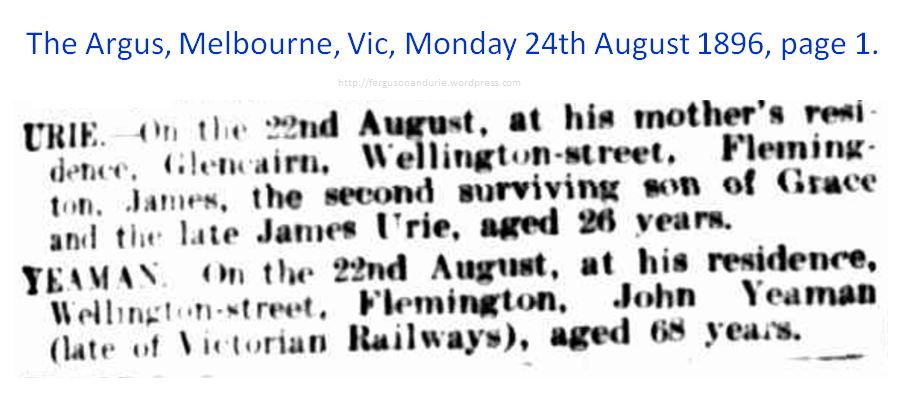
In August 1896 another clue reveals him as an employee of his grandfathers stained glass company. A Ferguson & Urie employee named, James ‘Jim’ Urie (1870-1896)[1], the son of James Urie[2], died. An account of Jim Urie’s funeral in the local tabloids referred to the names of his coffin bearers as:

“…the deceased’s fellow employe’s – Messrs. J. Scott, C. Hardess. F. L. Lording (sic), J. Murdoch, J. Auld, and E. R. King…” [3]

One of those employees listed was James Auld. Many other confirmed employees of the firm were also listed as pall bearers, such as; John Scott[4], Charles William Hardess[5], Frank Clifford Lording[6], E. R. King[7], James Ferguson Jnr[8], and J. M. Gilligan[9].

It can be surmised that James Auld was apprenticed to his grandfathers firm when he was about the age of fourteen or fifteen years of age (circa 1888) where he started learnt his trade with firm.

In 1890 Ferguson & Urie partner James Urie died[10] followed by James Ferguson in 1894[11] and the business ceased trading in 1899[12].

James spent some time in Western Australia circa 1898, but for how long is unknown. The last dated photograph of him in Victoria was in Melbourne in June 1899 and sometime after this he left for New Zealand where he gained employment with “Robert Martin, Ltd”[13] sometime between 1900 and 1903. This firm were decorators in Manners Street Wellington[14] and whilst they were primarily renowned for their wall papers and other decorations, they had their own dedicated stained glass department under the direction of stained glass artist Chester Edward Carter (1862-1908)[15]. At the 1898-99 Auckland Exhibition the company was awarded a first prize for a stained glass window[16]. In 1900 the Wellington Industrial Association published a detailed report of their visit to Robert Martin Ltd in Wellington. The article provided an in depth description of the company’s business premises and stained glass department and of the specialist employees it stated;

“…Special men have been procured by Mr. Martin for each branch of the work here described – men having both English and Australian experience…” [17]

James Auld married Charlotte Mary Clarke (1876-1937) in Wellington on the 9th April 1903[18] and between 1904 and 1915 they had seven children;

Ian Kay (1904-1992), Marion Una (1906-1977), Stella Mary (1907-2010), Eric James (1908-1998), Jessie Olive (1910-2009), Irene Florence (1913-1914) and Frances Norma (1915-1987).

In 1907 James returned to Melbourne with Mary and their first three children, Ian, Marion and Stella aboard the “Maheno” in November 1907[19]. Family lore has it that they intended on staying in Australia but within a short time were reminded of the Australian summer heat and they subsequently returned to New Zealand circa mid 1908.

In 1913 James formed a business partnership with a Mr. Patrick Gleeson as “Auld & Gleeson”[20] in Gisborne and by the 1930’s they had premises in Taranaki Street Wellington advertising as Oil and Colour Merchants, Leadlight Makers, Glass Bevellers, Painting supplies, Wallpapers, Window Glazing, and Bevelled Mirrors.

In 1915 Auld & Gleeson were awarded a Government tender at Gisborne to supply “…paints, oils, colors, etc…” “…for the period ending June 30, 1916…”[21] This undoubtedly increased their trade turnover and along with their reputation for quality workmanship and materials enabled them to expand and employ more craftsmen in the trade. In 1920 they advertised for an apprentice, requesting a “Smart Lad” to learn the lead-light and glazing trade at their premises in Gladstone Road at Gisborne[22]. Later they were able to expand the business to include premises at Napier.

In many of the New Zealand electoral rolls, James’s occupation was listed as a “Glass Merchant,”  “Lead Glazier,” and other variations of the same.

In December 1938 James visited his six surviving sisters at Moonee Ponds in Melbourne and it’s thought that at this time he gifted them a handmade lead-light fire-place screen, most likely of his own workmanship. The screen still exists and has been handed down to Australian descendants of his sister Isabella Stella Burleigh (nee Auld 1884-1980).

James’s wife Mary died on the 23rd of August 1937 at the age of 62[23] and was buried in the Karori cemetery. James died eight years later on the 12th of February 1945[24] at the age of 71 and was buried with Mary.

The other partner in “Auld & Gleeson”, Patrick Gleeson, sold his business interests in the company and retired to Auckland where he died in 1965 aged 78 [25]. The new business owners, “Smith & Smith,” retained the “Auld & Gleeson” Company name and built a new warehouse in Jackson Street Petone in the mid-1960s where James Auld’s second eldest son Eric was an employee of the firm until his retirement in the 1970s.[26]

James’ second eldest daughter, Stella Mary Fowler (nee Auld 1907-2010), lived to the extraordinary age of 103 years and in her lifetime she had revealed very little of her father’s history in the glazing trade. After she passed away in 2010 five extraordinary pieces of family history were uncovered.

The designs for Ferguson & Urie stained glass windows:

Among Stella’s family history items, were four hand-drawn and water colour painted designs for secular stained glass windows [images]. One rectangular window depicts a woman with long blond hair surrounded by the letters which make up the word “INDUSTRY”. On either side of her are two bluebirds in diamond-shaped quarries and the rest of the window depicts floral designs with the inclusion of three crimson bullseyes above and below the central image.

The second design is of a rectangular window which depicts another image of the long-haired woman picking and eating an apple from a tree. The surrounding floral designs include fourteen glass bullseyes of varying colours.

The third design is of an arch-shaped window of simple leadlight design with no figurative element and the fourth design depicts three long thin rectangular windows incorporating arch shapes with glass bullseyes of varying sizes and colours.

Along the edge of two of the designs, stamped in purple lettering, are the words, “For Ferguson & Urie”[27]. It is not known whether this series of windows were ever made but written in pencil on the reverse of one of the designs is what appears to be the dimensions for the windows and the name “…for Johnston” and at the bottom is what appears to be an estimate for the creation of the windows of  “15/- per foot.”

Based on the patterns and designs for the windows it is estimated that the drawings were most likely created in the mid to late 1890s. No other detail is known.

The E. L. Yencken Glass Cart Photo:

Another of Stella’s historical items was an original photo of the employees of the “E. L. Yencken” lead-light and stained glass Company of Melbourne. The photo depicts a horse-drawn cart adorned with lead-light glass panels that had been decorated for the eight-hour week procession and has the company employees next to it.

At the top of the cart can be seen the Royal Crown with the numbers “888.” Below this, within the lead-light windows can be seen the letters “E” and “R” on the far left and right of the cart. The date of the photo can only be estimated as between 1901 and 1910 as this is the period of King Edward’s (E.R) reign from the 22nd January 1901 until his death on the 6th of May 1910. The Eight Hour March, which began on April 21st 1856, continued each year until 1951 and since then Australian workers continue to enjoy the Labour Day public holiday celebrated by a public holiday on the 2nd Monday in March each year.

It’s not known how Stella came into possession of these historical artifacts but it can reasonably be assumed that they originally belonged to her father James Auld.

Significant transcriptions:

Evening Post, New Zealand, Vol CXXXIX, Issue 37, 13th February 1945, page 1.

“AULD.- On February 12, 1945, at his residence, 82 Jubilee Rd., Khandallah, James, dearly-beloved husband of the late Mary Charlotte Auld, and father of Ian, Una, Stella, Eric, Jessie, and Frances; in his 72nd year.”

Evening Post, New Zealand, Vol CXXXIX, Issue 37, 13th February 1945, page 1.

“AULD.- The friends of the late James Auld are invited to attend his Funeral, which will leave our Chapel Tomorrow (Wednesday), February 14, 1945, at the conclusion of a service, commencing at 11 a.m., for Karori Cemetery. Robt. H. Wilson and Sons, Ltd., 164 Adelaide Rd.”

New Zealand – Evening Post Issue 40, 16 February 1945 Page 3.

“MR. JAMES AULD

The many friends of Mr. James Auld will regret to hear of his death at Wellington on Monday morning after a brief illness. Born in Melbourne Mr. Auld came to Wellington 47 years ago to the firm of Robert Martin, Ltd. In 1913 he joined Mr. P. Gleeson and started business in Gisborne, subsequently expanding to Wellington, Napier, and Petone. He retired from active business six years ago. Being of a kindly and reserved nature he endeared himself to all with whom he came in contact. He was a member of the Khandallah Bowling Club and also of the Masonic lodge. His wife predeceased him seven years ago. He is survived by two sons, Mr. I. K. Auld and Mr. E. J. Auld, and four daughters, Mrs. C. H. Fowler, Wellington, Mrs. A. T. Robinson, Mrs. D. Lee, and Mrs. S. R. Vincent, Gisborne. Six sisters reside in Melbourne.”

References:

Robert Martin Ltd, Wellington New Zealand.

Footnotes:

[2] James Urie (1828-1890) was a principal partner in the Ferguson & Urie stained glass firm.

[4] John Scott (1850-1919), appears in the 1887 Ferguson & Urie dinner portraits.

[5] Charles William Hardess (1859-1849), appears in the 1887 Ferguson & Urie dinner portraits

[6] Frank Clifford Lording (1860-1944) appears in the 1887 Ferguson & Urie dinner portraits.

[7] A photo of “E. R. King” appears in the 1887 company dinner portraits.

[8] James Ferguson Jnr (1860-1945), appears in the 1887 company dinner portrait.

[9] A photo of “J. M. Gilligan” appears in the 1887 company dinner portrait.

[12] The Ferguson & Urie Company closed in July 1899 after a 46 year history.

[13] Shop interior, including wallpapers, Robert Martin Ltd, Wellington. Shore Bennett, Beverley Doris, 1928- :Photographs. Ref: 1/2-173024-F. Alexander Turnbull Library, Wellington, New Zealand. http://natlib.govt.nz/records/22578337

[18] NZ BDM: 1903/2577, Presbyterian Church Kent Terrace Wellington.

[19] PROV, index to Unassisted Inward Passengers, Nov 1907, Fiche 328, page 003.

[23] NZ BDM: 1937/27935, age 63.

[24] NZ BDM: 1945/28964.

[25] Patrick Gleeson born Cowwarr, Victoria, Australia VIC BDM: 1886/17478, died Auckland New Zealand age 78, NZBDM: 1965/27070 age 78.

[26] Janice Ball (nee Auld) – email 28th August 2013.

[27] Copies of items from James’s grandson, Errol Vincent, New Zealand 2010.

Acknowledgements:

My gratitude to the Auld family descendants from New Zealand who have liberally contributed some fantastic family history and magnificent photos which appear on this and many other articles on the web site.


Short link to this page: http://wp.me/p28nLD-29m

© Copyright

1889: Alexander Lumsden Young (1833-1889)

Alexander Lumsden Young (1833-1889) played a significant role in the Ferguson & Urie stained glass company.

He was born in Scotland circa 1833-34 to Benjamin Young and Isabella Cumming. He married Elizabeth Belle Gray on the 27th December 1864 in Melbourne at the age of 30, at which time his profession was cited as being a plumber.

His early business interests were with Urie, Young & Co producing by-products from maize such as ‘maizena starch’, which won awards at the 1866-67 Intercolonial Exhibition. 

Sometime in the 1860s or 70s joined his brother in law, James Urie, and became a member of the stained glass firm Ferguson & Urie. His sister Grace Hardy Young had married James Urie in Nth Melbourne in 1855 . In late 1885 he traveled to Brisbane with his nephew, William Urie (son of James Urie, principal of Ferguson & Urie), to supervise the installation of the companies largest stained glass window known to have been created by the firm  (35 feet in height) which was erected at the west end of St Stephen’s Catholic Cathedral in Brisbane.

At the 1886, 87, and 88 Ferguson & Urie company dinners he played the part of Vice-Chairman for the formalities on each occasion.

His portrait appears amongst the 31 photographs in the collage created for the occasion of the Ferguson & Urie company dinner held on the evening of the 22nd of June 1887 at the North Melbourne Mechanics Institute.

Alexander Lumsden Young died at his residence, “Dean-Bank” 21 Abbotsford St, North Melbourne, on the 1st August 1889 aged 56. His probate (intestate) was not applied for until more than seven years later, by his wife Elizabeth, who cited her eldest son, George Watson Young, as the reason and that the entire matter was left in his hands, which he had neglected. Elizabeth died 36 years later in 1925.

Alexander Lunsden Young [1887 Company Dinner]

Alexander Lumsden Young on the occasion of the Ferguson & Urie Company Dinner held on 22 June 1887.

The Argus, Melbourne, Vic, Friday 30th December 1864, page 4.

“YOUNG-GRAY.- On the 27th inst, at the Manse of the Presbyterian Church of Scotland, Collins-street, by the Rev. Irving Hetherington. Alexander Lumsden Young, plumber, Melbourne, to Elizabeth Bell Gray, late of Stockbridge, Edinburgh”.

The Argus, Melbourne, Vic, Friday 2nd August 1889, page 1.

“YOUNG.- On the 1st inst., at Deanbank, Abbotsford-street, North Melbourne. Alexander, the beloved husband of Elizabeth Young, aged 56 years. Home papers please copy”.

The Argus, Melbourne, Vic, Saturday 3rd August 1889. page 1.

“THE Friends of the late Mr. ALEXANDER L, YOUNG are respectfully invited  to follow his remains to the place of interment in the Melbourne General Cemetery. The funeral will leave his late residence, “Dean-Bank”, Abbotsford-street, North Melbourne, THIS DAY (Saturday, 3rd inst), at 3 o’clock. ALFRED ALLISON, undertaker, 221 Victoria-street, West Melbourne; Mount Alexander road, Moonee Ponds; and Racecourse-road, Newmarket, Telephone 980″.

The Argus, Melbourne, Vic, Monday 9th March 1925, page 1.

“YOUNG.- On the 6th March (passed peacefully away), at her late residence, Dean Bank, Beaconsfield parade, Croxton, Elizabeth Belle, widow of the late Alexander Young, much loved mother of Isabelle (Mrs. Arthur H. Padley, Bacchus Marsh, Vic). In God’s Care”.


Short link to this page: https://wp.me/p28nLD-1NI
 

22-08-1896: James ‘Jim’ Urie (1870-1896)

James ‘Jim’ Urie Junior, son of the late James Urie (1828-1890) of the stained glass firm, Ferguson & Urie, died of Tuberculosis on the 22nd August 1896.

North Melbourne Courier and West Melbourne Advertiser, Vic, Friday 28th August 1896, page 2.

“DEATH OF MR. JAMES URIE.- The above gentleman died on the 22nd, at his mother’s residence, “Glencairn,” Wellington-street, Kensington, of consumption, after an illness of about twelve months’ duration. The funeral took place on Monday, and was largely attended. The Rev. Mr. Taylor, Presbyterian Minister, of Flemington, officiated; and the bearers of the coffin were the deceased’s fellow employes – Messrs. J. Scott, C. Hardess, F. L. [sic] Lording, J. Murdoch, J. Auld, and E. R. King; the pall-bearers being J. Ferguson, A. Young, P. Gunter, D. McPhail, A. Nathan, and J. M. Gilligan. Mr Urie was only 26 years of age at the time of his death; and was generally liked owing to his kind and urbane disposition. Amongst the many floral tributes was a beautiful one sent by the employes of the firm of Ferguson and Urie. By a strange coincidence Mr. Urie’s uncle, Mr. J. Yeaman, died the same day, at his residence, which adjoined that of his nephew, and was also buried on Monday. Mr. Yeaman was 68 years of age. Great sympathy is felt on all hands for Mrs. Urie and the other members of the bereaved family. Mr. Alfred Allison, of Victoria-street, West Melbourne, carried out the funeral arrangements”.

James ‘Jim’ Urie 1870-1896 -A

James ‘Jim’ Urie 1828-1896 -B

James ‘Jim’ Urie and his uncle John Yeaman both died of  Tuberculosis, coincidentally, on the same day. They both lived in close proximity to each other and it was a highly infectious disease. The coincidence is that they both happened to die on the same day. His uncle mentioned as ‘John Yeaman’ also accompanied William Urie (Jim’s elder brother) to England in March 1888 as described at The 1888 Ferguson and Urie Company Dinner.

Other names mentioned at the funeral:

F. L. Lording –  One of the pall bearers mentioned was Frank Clifford Lording (1860-1944), not ”F. L. Lording” as described in the article.

J. Scott – John Scott (1850-1915)

C. Hardess – Charles William Hardess (1859-1949)

J. Auld – James Auld (1873-1945). Grandson of James Ferguson Snr (1818-1894).
James Auld left Australia for New Zealand c.1898 and later formed the partnership of “Auld & Gleeson” glaziers in Wellington. Prior to this article, it was only a theory that he gained his skills in the glass trade with his grandfather James Ferguson at ‘Ferguson & Urie’.

J. Ferguson – James Ferguson jnr (1860-1945) son of James Ferguson Snr (1818-1894).

A. Young – Alexander Lumsden Young (1833-1889)?

P. Gunter – Unknown

D. McPhail – Possibly Donald McPhail 1856-1926, son in law of James Urie Snr (1828-1890). Mcphail is not (yet) known to have been an employee.

A. Nathan – Alfred Lewis Nathan (1867-1939), son in law of James Urie Snr (1828-1890). Nathan is not (yet) known to have been an employee.

J. M. Gilligan – No detail known (photo appears as an employee in the 1887 Ferguson & Urie Company dinner poster).

References / Links:

The 1887 Ferguson & Urie Company Dinner

© Copyright

1890: Curzon Street, Ferguson & Urie Employees circa 1890.

This is a magnificent historical photo of James Ferguson and five of the Ferguson & Urie employees circa 1890. I would guess this photo may have been taken at the rear of the Curzon street workshops North Melbourne which was their first workshops when they started business in 1853. They advertised from the site as early as 1853 but the workshop building wasn’t erected until after 1858 as indicated in the diaries of stained glass artist David Relph Drape. The building still exists as at 2012 but the interior has been converted to individual apartments and only the shell and facade remain as it appeared in the Ferguson & Urie employee photos of June 1887.

The only two positively identified men in the photo are, James Urie Jnr,  James Ferguson Snr and James Ferguson Jnr. The other identifications are based on a likeness from the 1887 employees photos that were taken for the company dinner held on the 22nd January 1887.

CURZON Street Photos 01a

1.D. Morris, 2. unknown, 3. James Urie Jnr (1870-1896), 4. James Ferguson Snr (1818-1894), 5. J. M. Gilligan, 6. James Ferguson Jnr (1861-1945). Photo kindly contributed by my 3rd cousin Errol Vincent from New Zealand 2010.

CURZON Street Photos 02a

The Curzon Street workshop building as it appeared in June 1887 and photo taken 2012.

When the building was being converted to apartments in 2012 the sales brochures indicated that the building had been “remodeled circa 1875 to become the North Melbourne Masonic Lodge”. This incorrect. Ferguson & Urie retained the building as their workshops until the company demise in 1899.

18990506

In May 1899 an advertisement was placed in the Melbourne Age advertising the auction of their stained glass workshops at 42 Curzon Street would occur at 3p.m. on the 9th of May 1899.

The first tabloid article indicating the building had become the North Melbourne Masonic Lodge appeared in the North Melbourne Courier & West Melbourne Advertiser in September 1902 and it remained in their possession until 2008 when it was put up for auction and sold for $1.3m.

20081014 Curzon

Related posts:

1887 Ferguson & Urie Company Dinner


Short link to this page: https://wp.me/p28nLD-1aP

© Copyright

05-03-1949: Charles William Hardess (1858-1949)

Charles William Hardess (1858-1949) was the son of George Mathew Hardess (1827-1909) and Mary Ann McCarthy (1834-1889). He began his career at the Ferguson and Urie stained glass company as an apprentice stained glass artist circa 1873 at the age of fourteen. As part of his apprenticeship, he attended the Hotham School of Art which was formed in 1873 by prominent members of the Ferguson & Urie company. His father, George, was an Honorary Superintendent of the school in 1877 as well as a reader of the Legislative Assembly.

C. W. Hardess married Janet ‘Jessie’ Gilchrist Pie on the 28th of October 1886 and they had three known children. William, Hilda, and Elsie.

After the Ferguson & Urie company closed in 1899, the stained glass firm of E. L. Yencken purchased the vast majority of  the equipment and stock in trade from their Franklin Street warehouse. My fair assumption at this point in time is that C. W. Hardess was enticed to join the Yencken firm as their stained glass artist. On Good Friday in 1900 a stained glass window was unveiled in the Buninyong Presbyterian Church to the memory of the Rev Thomas Hastie and notes of this event recorded in the  Buninyong Historical Society’s June 2014 newsletter wrote that the window was made by ‘Zenken & Co Melb’ and the artist was a ‘Mr. Hardness’. That clue was too coincidental to ignore and so I’m absolutely sure that this was supposed to refer to the company as
‘E. L. Yencken & Co, Melb’ and the artist was none other than ‘Charles William Hardess)’. 

In later years Hardess teamed up with another former employee of Ferguson & Urie named Frank Clifford Lording, and they became a partnership as ‘Hardess & Lording’. They are known to have done the lead-lighting for the homestead ‘Warra’ in Wangaratta (sometime after 1908). C. W. Hardess was buried in the Burwood cemetery 1st March 1949.[1]

The Argus, Melbourne, Vic Saturday 13th November 1886, page 1.

“HARDESS-PIE.- On the 28th ult., at the residence of the bride’s parents, Ravenscraig, Flemington-road, Hotham, by the Rev. R. Short, Charles W., second son of George K, Hardess, Royal-park, to Jessie G., eldest daughter of Captain W. Pie, Hotham.”

The Argus, Melbourne, Saturday 5th March 1949, page 15.

“HARDESS.- On February 28 at the residence of his daughter, 8 Martin Crescent, Glen Iris, Charles William, loved husband of the late Jessie G., and loving father of William G., Hilda (Mrs. Ellis), and the late Elsie Vera (Mrs. Clark), aged 90 years”.

Charles William Hardess. Photo was taken for the June 1887 North Melbourne company dinner


This article was updated 20190706 to reflect the connection with the Yencken company at para 3.

Related posts:

27-07-1945: James Ferguson Jnr (1861-1945)

James Ferguson Jnr (1861-1945), was the only son of James Ferguson Snr (1818-1894), who was a principal partner in the firm ‘Ferguson & Urie’.  James Jnr was also a member of the firm until its closure in 1899. He never married and nothing significant is known of his life between 1899 and 1945. Numerous electoral rolls after 1899 simply listed him as a labourer and he resided in a small two storey terrace house at 22 Capel street North Melbourne (one street back from the Victoria Markets) prior to his death in 1945. Family lore has it that he was spoilt as a result of being the only son (amongst his seven elder sisters) and never had any of the business acumen and determination to succeed like his pioneering father. This would seem to be a contributing factor in the firm’s demise after his father’s death in 1894. Most noticeable was the absence of regular company advertising in the leading Melbourne newspapers after the death of James Ferguson Snr on the 18th April 1894. After September 1894 all traces of advertising for the company ceased to exist.

Only three photos of James Jnr are known to exist, being: the employee poster created for the June 1887 company dinner, the Ferguson Clan photo at ‘Ayr Cottage’ on 1st January 1888 and a photo with his father and some employees at the back of one of the stained glass workshops (at either Curzon or Franklin street) thought to be circa 1892-94.

James Ferguson Jnr is buried with his parents, James and Jane Ferguson, and sibling Margaret in the Ferguson family grave at the Melbourne General cemetery but he and Margaret are not listed on the headstone.

This slideshow requires JavaScript.

The Argus, Melbourne, Friday 27th July 1945, page 2.

“FERGUSON.- On July 26, at Parkville, James, loving son of the late James and Jane Ferguson, and loving brother of Margaret Ferguson (deceased), Mrs. Koop (sic) (deceased), Mrs. Auld (deceased), Mrs. Williams (deceased), Mrs. Gordon (deceased), Mrs. Kier (deceased), Mrs. Gentles (deceased). – At rest.”

The Argus, Melbourne, Vic, Friday 27th July 1945, page 14.

“FERGUSON.- The funeral of the late JAMES FERGUSON will arrive at the Melbourne General Cemetery, Carlton, THIS DAY, at 3.30 p.m. RONALD MAY, St. Kilda LA4406.”

Related posts:

18-04-1894: James Ferguson (1818-1894)

© Copyright

14-10-1944: Frank Clifford Lording (1860-1944)

Frank Clifford Lording (1860-1944), was born in Melbourne on the 10th of October 1860 to architect and builder, Frederick Henry “Harry” Lording and Marianne Coulsell.

Frank became an apprentice glass stainer and embosser with the Ferguson & Urie stained glass company in his early teens. In 1879 was awarded a prize at the Hotham School of Art as a senior student in the category of “Ornamental Shaded” under the tutelage of Ferguson & Urie’s stained glass artist David Relph Drape (1821-1882).

His name is mentioned a number of times in the press articles about the company dinners of 1886, 1887, and 1888.  At the 1886 company dinner, he sang ‘The Old Brigade’, and at the 1887 dinner sang, ‘Romany Lass’. After the firm closed in 1899 he went into partnership with Charles William Hardess (1859-1849), another employee of the firm, to become ‘Hardess & Lording’. Lording was also a capable footballer and was selected for the Victorian team in the first Inter-colonial football match against South Australia on Tuesday 1st July 1879 [1] which the Victorian team won. The Hotham Football club later became the North Melbourne Football Club and he was selected as a state representative in 1879 and 1881.

Frank married Mary Ann Christie in 1884 and had three sons, Frank Clifford ‘Cliff’ Jnr, Frederick ‘Fred’ Alexander, and Walter Leonard ‘Len’.

Frank died at his home at 18 McDonald Street, Mordialloc on the 7th October 1944 aged 84, and was interred at the Cheltenham New Cemetery.

Frank Clifford Lording. A subset photo from the Ferguson & Urie company dinner portraits in June 1887, North Melbourne.
Frank Clifford Lording in the Hotham (North Melbourne) Football Club uniform in 1879 (Museum Victoria)

Coincidentally Frank’s father ‘Harry’ was the architect and builder of James Ferguson‘s house in Leonard Street Parkville in 1887

In April 1937 Frank’s brother Frederick ‘Harry’ Lording (1855 – 1939) wrote to the Melbourne Age about his brother’s football history.

The Argus, Melbourne, 14th October 1944, page 15.

“LORDING.- On October 7, at his residence, 18 McDonald street, Mordialloc, Frank Clifford, beloved father of Cliff, Fred, and Len, aged 84 years.”

Related Posts:

Footnotes:

[1] The Argus, Melbourne, Wednesday 2nd July 1979, page 5.


Short link to this page: http://wp.me/p28nLD-OC

27-07-1930: George James Coates (1869-1930)

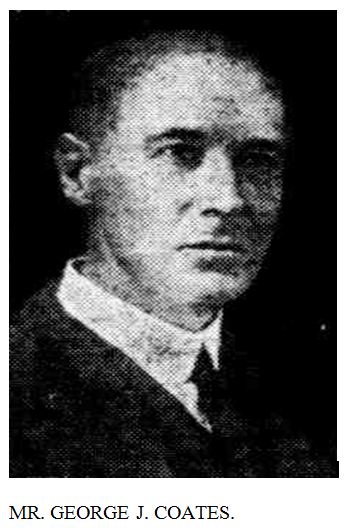
George James Coates was born at Emerald Hill (South Melbourne) on the 9th August 1869, the son of John Robert Coates (1842-1877) and Elizabeth Mina Irwin (1847-1902).

His father died when he was eight years old and his mother allowed him to be apprenticed to the Ferguson & Urie stained glass company at age fifteen, circa 1884.

George studied at the North Melbourne School of Design and Hotham School of Art and attended classes under Frederick McCubbin. He won a scholarship in 1896 that enabled him to travel to London then Paris and in 1903 he married artist Dora Meeson (they had no issue). He was also the Australian Governments unofficial war artist during WW1.

In 1937 his wife Dora wrote his biography; George Coates, ‘His Art and His Life’, in which she makes minor mention of his time with the Ferguson & Urie stained glass company and that he had a distaste for the coarse jokes from the other employees.

In all of the Ferguson & Urie windows found to-date,  it is impossible to know which of them, within George’s era at the company, may contain examples of his artwork. The exception to this may be in the house of his employer, James Ferguson, whose house ‘Ayr Cottage,’ in Parkville has a stairwell window containing a detailed portrait of the Scottish bard ‘Robbie Burns‘ which I reasonably suspect may have been done by a young 17 year old George Coates in 1886.

The photo below is of a young George, age 17, as he appeared in the Ferguson & Urie employee poster created for the 1887 company dinner, held at the North Melbourne Mechanics Institute hall on the 22nd June 1887.

George James Coates. Photo taken for Ferguson & Urie company dinner June 1887.

The Register, Adelaide, 23rd September 1921, page 7.

Transcription of article “NOTABLE ARTISTS’ RETURN”

“In the realm of the arts, Australia is proving herself a keen contestant for honours, and during the past few years many Australian painters have obtained public recognition. Mr. and Mrs. George J. Coates (nee Miss Dora Meeson), of Melbourne, went abroad to study, and now have returned to their native land covered with honours. They arrived in Adelaide by the Melbourne express on Wednesday, having reached their own city some months ago. It is 24 years since Mr. Coates set out for the great adventure, and, like many other Australians, he found it a stressful road, full of obstacles, and necessitating the most frugal mode of living. But the painter felt that he had something to impart to lovers of beauty, and so he persevered in London, and then migrated to Paris with such success that to-day he can boast of more significant letters after his name than any other Australian artist.

Among his distinctions may be mentioned:- Member of the International Society of painters, Sculptors, and Gravers, London; Member of the National Portrait Society, London; On the Council of the Royal Portrait Society, London; Member of the Royal Society of Oil Painters, London; Associate of the Nationale des Beaux Arts (New Salon), Paris; Hon. Member Royal Society of Arts, Sydney; and also of he Victorian Artists of Australia. Asked about his first works, Mr. Coates said that as he evinced a leaning towards art at the age of 11 years it was definitely decided that he should be given his chance. That this decision was justified was revealed when the youthful painter won the Victorian Travelling Scholarship, and set out for London.

– The Road to Fame –

After hard work he went on to Paris and studied under Jeans Paul Laurens, Constant, and others. From 1897 to 1900 he exhibited in the salon des Artistes Fracaise (old Salon), and then returned to London, where he and his wife engaged upon some illustrations for the Encyclopedia Brittanica [sic] and the Historian’s History of the World (an American publication). They also contributed to the Royal Academy and the Paris Salon. In 1910 the well-known “Walker Brothers,” a group, was accepted by the Royal Academy of London, and in 1912 by the Associate de Nationale de Beaux Arts (new salon). By some mistake it was sent to the new Salon in stead of the Champ Elysees, as first intended, and was accepted and brought an Associate ship in its ?rain. “So much for a happy accident,” as the creator of the picture modestly remarked. A portrait of Miss Strubelle, an American singer, also won recognition in the old Salon of Paris. At the Grand International Exhibition, Pittsberg, a Diploma of Honour was conferred upon Mr. Coates’s work; and he had the honour to

be specialty incited to again contribute last year and this year too. The Carnegie Institute exhibits only 300 works, and these come from brushes of artists selected by a jury from England, Europe, and America. In reply to a request for further details, Mr. Coates said, “I have painted for the Australian Commonwealth a portrait of Gen. Sir Neville Smythe, V.C., and with natural pride I heard this usually reserved and cold type of man break out into eulogy of the gallantry of the Australians in the war; and, during the sittings he told me that he considered their deeds were equal to those heroic achievements of the Greeks at Salamis and Marathon. I also painted Capt. Jacka, the first Australian V.C; Gen Griffiths, C.O, Australian headquarters in London; Gen. Tivey, Gen. Foott, and other notabilities of the war. These were commissions by the Australian Commonwealth for the War Museum. During the war I spent four years in the R.A.M.C., and so came into personal contacts with realities. I was official war artist to the Canadian Government and to the Australian Commonwealth. It is pleasant to return to our homeland and feel that appreciation awaits my wife and me. When I return to Melbourne various commissions will occupy me, including a group of generals who went to Gallipoli. We have had exhibitions of our work in Melbourne, Sydney, and Brisbane, and in each capital some of our works have been purchased by the national Galleries. Next week we intend to hold an exhibition in Adelaide.” Mrs. Coates (Miss Dora Meeson) has no love for the limelight either; but she had to confess to membership of the Royal Institute of Oil Paintings, London, and also membership of the Mural Decoration and Tempera Society.

– Australia Revisited –

In reply to a query, Mr. Coates said that, of course, he observed a great advance all over Australia, and whether for good or for evil, he was struck with the gradual assertion of independent characteristics in the race as a whole, that seemed to be crowding out English characteristics. Asked about impressionism in art, Mr. Coates said he did not consider that belonged to any particular age or craze, but should be regarded merely as the ordinary impressions of an artist’s mind. The works of men like Manet, Monet, and Pissaro, of the so-called impressionistic school, would live forever. These men gave exquisite beauty through their brushes, and sincerity too. The futurists and cubists were all dead.  It was wisdom, indeed, that made people judge a nation by its art, for literature had no eyes. The Elgin marbles of ancient Greece showed the visitor to the British Museum what a vision that nation had held. Australia was young and immature, but in her natural talent was ahead of the other dominions; and her representatives were in all the big “shows” in England. The Australian climate was so much like that of Italy or Greece, which were the home of fresco, that Mrs. Coates was sure that fresco painting would be a happy style of decoration here. It was an art entirely suited to the dry climate, and Mrs. Coates gave a demonstration in Melbourne with a lecture at the Victorian Artists’ Galleries. Mrs. Coates painted a picture at Southampton of the last Australian wounded to leave England, which has been purchased by the Sydney Gallery. In Australia this gifted couple are represented in the galleries of Adelaide, Melbourne, Sydney, Brisbane, and Bendigo. They look forward to viewing Adelaide from the hills, of which they have heard much. Among many interesting incidents that have occurred in Mr. Coates’s career, none was more remarkable than that associated with a portrait of George Claridge, who sat as a “wounded Tommy,” and then went back to the trenches, won his commission, and was killed. His fiancé in Adelaide recognised his portrait in a catalogue, and sent home to purchase it. It was being exhibited in the Royal Academy. The portrait “King and Empire,” a lovely piece of work, is on loan in our own gallery”.

George Coates, ‘His Art and His Life’, Dora Meeson Coates, Dent & Sons Ltd, London, 1937:

“Lionel Lindsay, in an article on George Coates in Art in Australia, mentions his prowess with the gloves and how a trainer had begged him to give up art and take up a ‘mans’ work, i.e. boxing,’ instead, and become a professional…” [p3]

“He was twelve when he first went to North Melbourne Art School, and at the age of fifteen was apprenticed by his mother to the leading firm of glass-stainers in Melbourne, Messrs. Ferguson & Urie, and he worked there for seven years…” [p5]

“The years in the glass-staining workshop were a great ordeal. Though the work was congenial enough, as good models were set up to be carried out in glass, he hated the coarse jokes of the men, for he had a woman’s sensitive refinement along with his masculine strength.” [p5]

Related posts:

19-02-1874: The Hotham (North Melbourne) School of Art.

External links:

Obituary: George James Coates.

Biography: George James Coates.


Short link to this page: http://wp.me/p28nLD-MD

© Copyright

1915: John Scott (1850-1915)


John Scott (1850-1915)

Cameo portrait of John Scott for the 1887 Ferguson & Urie Company Dinner


John Scott was born in Paisley, Scotland circa 1850 and apprenticed to the Ferguson & Urie stained glass company circa 1866 at the age of 16.

At the company dinner held on the 9th of April 1886[1], he was presented with a handsome diamond locket in appreciation of his twenty years of faithful service to the company and as a farewell gift before his impending holiday to Europe.

“In making the presentation Mr. Young addressed a few words of good advice to the recipient, whom he strongly recommended to become a Benedict so that he could hand down the locket to his family as an heirloom”.

John Scott did eventually marry, but no marriage record has been found in Australia. I suspect that he may have married his wife Agnes in Scotland on his journey back to the old country in 1886. On their return to Australia, they lived at Haines Street in North Melbourne. They never had children.

In James Urie’s speech at the dinner, he stated: “Mr. Scott had come to them when a boy as an apprentice and had gradually worked himself up to be the right-hand man in his department”. His department was where the pieces for the stained glass windows were selected and cut to the exact dimensions according to the glass painters’ designs.

At the dinner John Scott sang “Remember me Mr. George Drury, when Jeff comes home today’ and “Bonnie Hills of Scotland”. At the company dinner the following year, held on the 22nd of June 1887, he again gave a rendition of “Bonnie Hills of Scotland” [2]. His name is not mentioned in the tabloid report of the 1888 company dinner [3].

John Scott died at Ballarat on the 1st June 1915 at the age of 65.

“SCOTT. – On the 1st June (suddenly), at 506 Doveton Street, Ballarat, John Scott, husband of Agnes Scott, and for many years of the firm of Ferguson and Urie, glass merchants, North Melbourne. A native of Paisley, Scotland.” [4]

His remains were conveyed to the Ballarat West station on the 3rd of June for Melbourne and subsequently buried in the Presbyterian section of the Melbourne General Cemetery.[5] (MGC-PRE-Comp-F-No-132)

His Last Will & Testament was dated 3rd September 1892. His occupation was specified as Plumber & Glass Cutter and he appointed his wife Agnes as sole beneficiary and executrix. His probate documents specified his address as “formerly of Haines Street North Melbourne by late of Doveton Street North Ballarat”.

Johns’ meager inventory included a vacant piece of land in Ormond Street Kensington in the Parish of Doutta Galla worth £300, watches, trinkets, Jewellery, an old silver watch, and a gold chain valued at £5, and 242 shares in the Northcote Brick Co. Ltd worth £169.

Footnotes:

[1] Ferguson & Urie Company Dinner, Fri 9th Apr 1886.

[2] Ferguson & Urie Company Dinner, Wed 22nd Jun 1887.

[3] Ferguson & Urie Company Dinner, Thu 15th Mar 1888.

[4] The Argus, Melbourne, Vic, Thursday 3rd June 1915, page 1

[5] The Evening Echo, Ballarat, Vic, Wednesday 2nd Jun 1915, page 4.

Related posts:

The 1886 Employee Dinner
The 1887 Employee Dinner
The 1888 Employee Dinner


Short link to this page: https://wp.me/p28nLD-Mf

© Copyright

18-04-1894: James Ferguson (1818-1894)

From a family history perspective there is quite a lot known about James Ferguson, his family, and his colonial colonial stained glass company from North Melbourne.

I have many historical artifacts which include photographs, pieces of furniture, documents, and many other interesting items which make up a magnificent collection of colonial history as well as my own family history.

James Ferguson was born in Ayr, Scotland circa 1818. His parents were Janet Kay (1791-1860) and Master Slater & Glazier, James Ferguson Snr (1777-1886).

On the 13th of June 1841 he married Jane Williamson Lawson (1820-1886), the daughter of Gavin Lawson and Margaret Williamson and between 1842 and 1852 five girls and a boy were born in Wallacetown;
Margaret (1842-1913) who was mentally disabled from birth, Janet Kay (1844-1925), Jane Williamson (1846-1875), Marion (1848-1927) and Antonia Wallace (1852-1926). A son named James was born in 1851 but died as an infant in the same year.

On the night of the 1851 Scottish Census (30/31 March) his future business partner, James Urie, was recorded as a visitor at his cottage in John Street Wallacetown. Whether this was one of many meetings the two men would have to discuss their bold plans for the future can only be speculation but only nine months later their plans would come to fruition.

In early December 1852 James Ferguson was given a farewell party at the Robert Burns Arms Inn at Wallacetown prior to his departure for Australia.

“…After the usual preliminaries, Mr John Templeton, watchmaker, in neat and appropriate terms, proposed the health of Mr Ferguson and, in name of many friends, present and absent, presented him with a splendid purse containing 25 sovereigns…”

James and his younger brother David departed Greenock on the 12th of December 1852 aboard the ‘Tamerlane’ and after more than four an a half months at sea they arrived in Port Philip on the 29th of April 1853.  James’s wife Jane would remain in Wallacetown for two years with the children whilst James established the business in North Melbourne. She arrived  aboard the ‘Emma’ with the five girls in November 1855.

In August 1853 the first business advertisements for the company, “Ferguson & Urie”, began in the Melbourne Argus Newspaper. The rest of the Ferguson & Urie history forms the basis of this entire web site.

This slideshow requires JavaScript.

The Argus, Melbourne, Wednesday 18th April 1894, page 5.

“The death is announced of Mr. James Ferguson, the surviving partner of the well known firm of Messrs. Ferguson and Urie. Mr. Ferguson was a colonist of about 40 years’ standing, and for many years carried on business with his partner in Collins-street near the National Bank. Mr. Ferguson died at his residence, Parkville, early yesterday morning, at the advanced age of 84 [sic].”

(James Ferguson was 74 years of age at death).

The North Melbourne Advertiser, Friday 20th April 1894, page 2.

“DEATH OF MR. J. FERGUSON”

“We regret to have to record the death of Mr. James Ferguson, the surviving partner of the well known glass staining firm of Ferguson and Urie. Mr. Ferguson was a colonist of about forty years’ standing, and for many years carried on business with his partner, Mr. Urie (deceased about six years ago) [sic: 1890], in Collins Street, near the National Bank. Mr. Ferguson passed away at his residence, Parkville, early on Tuesday morning, his death being simply a decay of nature, as he was in his seventy-first year [sic: 74]. For the past four years the business of the firm has been carried on in Franklin Street and Curzon Street, North Melbourne. Mr. Ferguson was a member of the Presbyterian Church, and was much respected as a private citizen, but never aspired to enter public life. He died a widower, and leaves a grown up family. The funeral took place yesterday afternoon, deceased being interred in the Melbourne general cemetery and the cortege was followed by a large number of mourners. The body was conveyed to the grave in a panelled hearse, and enclosed in a plain coffin. There were three mourning coaches. Mr. Ferguson was buried in the Presbyterian compartment, the arrangements being carried out by Alfred Allison, of 221 Victoria Street, West Melbourne.”

Related posts:

19-04-1886: Jane Ferguson (nee Lawson) (1820-1886)

19-04-1894: The funeral of James Ferguson Snr.

1886: The History of ‘Ayr’ Cottage, 1 Leonard St. Parkville, Melbourne, Victoria.

08-10-1887: ‘Ayr Cottage’, 1 Leonard Street, Parkville, Melbourne, Victoria.

01-01-1888: The Ferguson Clan at Ayr Cottage, Parkville.

04-07-1901: The sale of Ayr Cottage, Parkville, Melbourne.

19-02-1874: The Hotham (North Melbourne) School of Art.


Short link to this page: http://wp.me/p28nLD-Jf

© Copyright

23-07-1890: James Urie (1828-1890)

–
Undoubtedly the Colonist who was the driving force behind the success of the Ferguson & Urie stained glass company was James Urie.

His business acumen and enthusiasm made Ferguson & Urie the most successful commercial stained glass company in Australian Colonial history.

The Argus, Melbourne, 23rd July 1890, page 1.

“URIE – On the 21st inst, at his late residence, Wellington-street, Flemington, James, the beloved husband of Grace Urie (and of the firm Ferguson and Urie, Collins-street), aged 62.”

The memorial photos were taken at the Melbourne General Cemetery, 27th Dec 2009.

This slideshow requires JavaScript.

James Urie (1828-1890) was born in Kilmarnock, Ayrshire, Scotland on the 14th May 1828, to William Urie and Jane Ferguson.

On the night of the Scottish census record of March 1851, James Urie (age 22), was indicated as being a visitor to James Ferguson’s (age 33) home at John Street Wallacetown in Ayr. Their professions were listed as Slater and Glaziers. As James Ferguson was 11 years older than Urie, the age difference leads me to believe that he may have formerly been an apprentice of James Ferguson or James Ferguson Snr.

Was the night of the census a meeting to discuss their bold plans to emigrate to Australia? Who knows! What we do know is that that their decision would cement them firmly in history as the founders of Australia’s most prolific and talented stained glass studio.

By late 1852 their decision had been made and they would set sail for Australia.  James Urie departed first and was followed a day later by James & David Ferguson. Which ship James Urie departed on  has not been established but James & David Ferguson departed Greenock on the 12th Dec 1852 aboard the ‘Tamerlane’. In a speech at the Company dinner held in North Melbourne in 1886, James Urie stated: “..it was just 34 years since he left the old country for the colony and Mr. Ferguson left a day after him”.

On arrival in Melbourne the men set about establishing their business as Plumbers, Slaters and Glaziers from premises in Curzon street North Melbourne. For a short time James Urie took up residence at the Tam O’Shanter Hotel in North Melbourne, whilst James Ferguson and his brother David found cottage accommodation in Little Curzon street.

On the 31st August 1855 James Urie married ‘Grace Hardie Young’ at the first Curzon Street Presbyterian church in North Melbourne and they took up residence in a small cottage at 28 Curzon Street North Melbourne, only a short distance from the Ferguson brothers and the business’s workshop. Between 1856 and 1882 James and Grace had fourteen children, five of whom unfortunately died as infants.

After the initial pioneering hard work of establishing the business and transforming the business to stained glass production in 1861, James took the lead as the enterprising salesman of the business and traveled far and wide to the eastern states as far north as Queensland, west to South Australia and as far south as Tasmania and possibly New Zealand to establish the company name “Ferguson & Urie” as Australia’s premier colonial stained glass firm. James was an an astute business man and had an inventive streak as well. On the 24th of October 1865 he registered a patent for “An invention of an improved and cheap method of converting Basaltic Rock into Street Flagging and other pavement”. By 1888 he had established a substantial two storey family home in Wellington Street Flemington named “Glencairn” after the name of “Glencairn Square” near his family home back in Kilmarnock, Scotland.

Outside of the business James actively participated in public life. He was a Justice of the Peace as well as a Councillor of Flemington and Kensington from August 1886 to August 1888, and Mayor of the Borough from August 1887 to August 1888.

On the afternoon of Monday 25th June 1888 he laid the foundation stone of the Presbyterian Church in Norwood Street Flemington.

On the 21st of July 1890, after a brief illness, James Urie died at the age of 62.

On Thursday the 28th August 1890 the Mayor and members of the Flemington council visited his wife Grace at their house “Glencairn” in Wellington Street and presented Grace Urie with an illuminated letter of condolence.

James Urie’s funeral was one of the largest ever seen in Flemington:

“…the procession being the most imposing seen in the borough. The employės of Messrs Ferguson & Urie marched in front of the hearse, then came four mourning coaches and upward of fifty vehicles. Immediately following the mourning coaches came a hansom, in which the Hon Alfred Deakin was seated, then next in order a buggy containing the deceased gentleman’s council colleagues…”.

The Honorable Alfred Deakin (later to be the second, fifth and seventh Prime Minister of Australia) played the part as a pall bearer at the grave site.

James Urie was buried at the Melbourne General Cemetery with the five children who died as infants, and his wife Grace who died in 1899.

Table Talk, Melbourne, Vic, Friday 12th September 1890, page 8.

“James Urie, formerly of Curzon-street, North Melbourne, but latterly of Wellington-street, Flemington, one of the partners of the firm of Messrs. Fergusson [sic] and Urie glass importers, Collins-street East, Melbourne, by his will dated, November 24, 1870, and presented for probate by, Messrs. Madden and Butler, solicitors, appointed his wife, Grace Hardie, executrix. He gave her a life interest in his estate as long as she remains his widow; on her death or re-marriage the estate passes to his children in equal shares. ‘The testator died July 21, 1890, and his will was sworn at 34,808 real and £12,798 personal. Total, £47,606.”

In 2013, more than 120 years after his death, a lane-way between 17 and 19 Waltham Street in Flemington was  named in honor of James Urie [See: Photo | Map]. The lane-way is less than one hundred meters down Waltham street from James Urie’s home ‘Glencairn‘ (now St Brendan’s Presbytery) on the corner of Waltham and Wellington Street.

Related posts: 21-11-1865 >19-02-1874 > 18-09-1885  > 25-07-1890 > 29-08-1890 > 20-07-1899


Short link to this page: http://wp.me/p28nLD-GV

© Copyright

30-03-1882: David Relph Drape, Stained Glass Artist, (1821-1882)

In the nineteen year period between 1863 and 1882, an English artist by the name of David Relph Drape can lay claim to being one of the Ferguson & Urie stained glass companies most talented in the field of glass painting and staining.

Drape was born at Greenrow, Cumberland, England in 1821, the son of Quaker parents, Isaac Drape and Catherine Relph.

David Relph Drape c1880

David Relph Drape c1880

Little is known of his early life or what steered his artistic talents. His father Isaac (1790-1822) died when he was only one year old but his family would assure his education. Many members of his father’s family were from a long line of educators with interests in mathematics and navigational astronomy. A number of them had close ties to the Greenrow Academy which was founded in 1780 by his grandfather John Drape (1751-1793) who was a principal of the establishment until his death. It was then followed by John’s brother-in-law, Joseph Saul (1769-1842),  then Saul’s son John (1804-1853). Isaac Drape (1813-1870), a grandson of the academy’s founder, (David’s first cousin) took over as headmaster of the Academy in 1853 and it eventually closed after his death 1871.

It hasn’t been proven as to whether David was a student at the academy, but it would certainly seem highly likely during the period when his mother’s brother, Joseph Saul, was headmaster of the school until 1842.

Drape’s early thirties start to reveal his business exploits and talents. He was in the employ of a local Carlisle painter named William Atkinson from circa 1845 and in February 1854, Mrs Mary Atkinson, the widow of the late William Atkinson, decorative painter of 5 Abbey Street Carlisle, placed an advert in the Carlisle Patriot tabloid stating that she had engaged “Mr. David R. Drape, who was for a number of years Foreman for her late husband…” [1] Drapes association with William Atkinson may be the clue as to where he gained his first apprenticeship as a decorative artist, but his continuation as a foreman for the widow Mary Atkinson was very short. By early 1855 he had formed a partnership with another Carlisle tradesman named John Scott whose father, John Scott Snr, had retired and passed the business to his son. A dual advertisement for John Scott Snr’s retirement and the new Scott & Drape business appeared in the Carlisle Patriot, 3rd March 1855.

The Scott & Drape’s business advertisements began to appear in the Carlisle Patriot as:-

“SCOTT & DRAPE – PLAIN AND DECORATIVE HOUSE PAINTERS, ECCLESIASTICAL AND HERALDIC DECORATORS, ILLUMINISTS, GLASS STAINERS, CARVERS, GILDERS, GLAZIERS, &c., &c.” [2]

In November 1855 Scott & Drape created a stained glass window to the memory of Drape’s cousin, John Saul[3] who was principal of the Green Row Academy from 1842-1853. The window was to be erected in the west end of St Paul’s Church, Holme Cultram (now known as St Paul’s Causwayhead):

“ST. PAUL’S CHURCH, HOLME CULTRAM.- A very beautiful window of stained glass has just been inserted in the west end of this church, as a memorial to the late Mr. John Saul [4], of Green Row. The background is a rich mosaic of azure and ruby, upon which two large medallions are placed, representing the Adoration of the Shepherds, and the Presentation in the Temple; in the upper part of the window is a cross of a golden hue in the midst of a floriated ruby background, surrounded by the motto Hoc Signo Vinces[5]. A Latin inscription at the base states that the window has been placed there by the friends and pupils of Mr. Saul. The grouping, drapery, and expression of the various figures are remarkably fine, and reflect great credit upon the artists, Messrs. Scott and Drape, of this city.”[6]
[My research to-date indicates that this window no longer exists.]

A significant clue as to the style of glass painting Scott & Drape adopted is revealed in their advertisements; “S. and D., respectfully invite an inspection of their unique Specimens of Glass painting, in the style as now practiced by the Bavarian Artists at Munich.” This was undoubtedly in response to the debacle at Glasgow Cathedral in 1856 where the Cathedral authorities had awarded a large contract to the Royal Bavarian Glassworks to provide 60 or more stained glass windows for the Cathedral. English and Scottish stained glass craftsmen and artists were enraged with the decision and considered it as robbing them of their birth right. The Master Glazier to the Cathedral, David Kier, who installed the Bavarian windows, even felt compelled to adopt the same style of glass painting in his own windows and this seemed to force varying degrees of adaption to the Munich style that spread amongst the English and Scottish stained glass establishments until late into the 19th century.

Over the next four years Scott & Drape expanded their business and employed a number of tradesmen and apprentices. Their workshops at 23 Rickersgate, Carlisle, became well known and it was frequented numerous times by the local tabloids who were eager to report on their ecclesiastical decorations.

In 1855 Carlisle Cathedral was undergoing significant renovations but there was considerable debate amongst the authorities as to the proposed “highly ornamental” decorations which were opposed by the Bishop who had a preference for a more subdued tone. After a number of months had elapsed without a decision, the famous architect and designer Owen Jones was consulted to break the impasse; “Accordingly that gentleman visited Carlisle, examined the respective specimens and has just sent in his recommendation, which have been adopted, and are to be carried out forthwith by Messrs. Scott & Drape, carvers, gilders, and decorators, of this city.” [7] One of the major tasks to be undertaken for these renovations included the decoration of the Cathedral ceiling which Jones recommended to be in a blue azure dusted with gold stars and gilded angels;

“The panels are to have a ground work of bright azure, powdered with gold stars (that is the technical phrase); the ribs and bosses are to be painted various colours, red, blue, &c., and the coats of arms and other armorial bearings are to be restored after the most accurate heraldic designs; the angels which surround the cornices are to be gilded and coloured, and the large angels on the hammer beams are to be treated in a similar manner…” [8]

At the same time Scott & Drape were working on the Carlisle Cathedral renovations, they had completed a stained glass window for St Paul’s Anglican Cathedral, Dundee in April 1856 and they were permitted to display it in the north transept of the Carlisle Cathedral;

“A beautiful stained glass window, executed by Messrs. Scott & Drape, of this city, for the New Church, at Dundee, has been exhibited in the north transept of our [Carlisle] Cathedral during the past week…”[9]

The window was described as 18ft high, excluding tracery windows, and consisted of two lights. In the left light depicted the Good Shepherd with Christ’s Charge to Peter below and in the right light, the Saviour as the Sower with the Sermon on the Mount below.[10] As at August 2015, this window has been identified as extant in St Paul’s Cathedral at Dundee.

In July 1856 Scott & Drape completed a single light memorial window for a church at Brough, Westmorland. “The subject is a panel formed by the interlacing branches of the vine, and represents the resurrection of our Lord…” [11] Evidence as to the existence of this window has not yet been ascertained.

In January 1857 a letter was penned to the editor of the Carlisle Patriot by “A.B”. The writer was specifically making a point about “Powell’s Glass” being the most successful imitation of ancient glass and that the firm of Scott & Drape were “in the habit of using it for some considerable time…” The author mentions that Scott & Drape; “directed my attention to a Rose window in the north transept, and one in the clere-storey of our Cathedral, both executed by them with Powell’s Glass.” [12] This indicates that the Rose window in the north transept of Carlisle Cathedral and clerestory window(s) were also the work of Scott & Drape, but these windows were not of coloured or stained glass. A window of plain (Powell’s) glass, with lead lines forming the shape of the hexagram, recently removed (c.2011) from the clerestory of Carlisle Cathedral for restoration, revealed the following text scratched into the surface of the glass; “Scott & Drape decorated & glazed this Cathedral AD 1856.” Another window from the clerestory also included the surname of an apprentice named “Johnstone.”

In June of 1857 Scott & Drape completed a further three stained glass windows for St Paul’s Church, Holme Cultram;

“The three side windows in the chancel of St. Paul’s Church have, this week, been filled with stained glass by Messrs Scott and Drape of this city. The general design is a cross with crosslets, in a style which accords well with the architecture of the church and prevailed in the thirteenth century. The border is of azure, emerald, and ruby, and the colours are particularly brilliant. The east window also was inserted by the same artists some time ago, and is a work highly creditable to them.” [13]

In October 1857 Scott & Drape were paid a visit to their Rickersgate workshops by a reporter from the “Carlisle Journal.” The subject of their visit was to inspect a stained glass window that was nearing completion for the Cheltenham Proprietary College. The window was to be of seven lights, 25 feet high and 14 feet wide;

“The design comprises fourteen figures, representing our Saviour, the apostles, and evangelists, each about four feet high. The figures are arranged in two rows one above the other, and are surrounded by perpendicular canopies…” [14]

The tracery windows were to comprise monograms and sprigs of Ivy with the central light in the tracery to contain the armorial bearings of the principal of the College, the Rev William Dobson who had commissioned and paid for the window.

On the 24th February 1858 the Cheltenham “Proprietary College Chapel” was formally opened and their window was further described in the tabloids which also indicated that two other windows on the east side were the work of Scott & Drape, being commemorative of officers who were former pupils of the College and who had lost their lives in the Crimea and India.[15] The Cheltenham College Register of 1890 further described the window;

“The window above the altar is a large transomed composition of seven lights, and has a double row of figures. In the upper tier are St. John the Baptist and six of the Apostles in the lower, our Saviour and the other Apostles. Inscription on Brass beneath:- ‘The window over the Communion table was presented by Rev. W. Dobson, M.A., Principal of Cheltenham College. A.D. 1858.” [16]

Sadly there is no longer any trace of Rev Dobson memorial window today. The Cheltenham College Archivist provided the following correspondence in August 2015;

“A new chapel was consecrated in 1896 and the old building became the College library. The stained glass from the window above the altar was removed and replaced with plain glass to allow more light in. What happened to the original glass remains, I’m afraid, a mystery. The old chapel is now the College dining hall and retains all its stained glass except for the window you describe…” [17]

In January 1858, David Relph Drape, Painter and Glazier of Carlisle, placed an advertisement in the Carlisle Patriot giving notice that he will no longer be liable for any debts that his wife “AMELIA ARMSTRONG DRAPE” incurs. [18] Extracts from Drape’s diaries penned by his granddaughter Elizabeth Bradshaw in 1970, indicate that “Amelia” was his first wife who had suffered a mental breakdown after the birth of their son. Amelia supposedly never recovered and was eventually admitted to a Lunatic Asylum. Their son was brought up by Amelia’s parents and on completing his education, is supposed to have taken up a career in the Navy. [19]

By March1858, Drape had received a life changing letter from the Antipodes. His diary extracts record that he received a tempting offer of employment in the Colony of Victoria, Australia, from a businessman named James Ferguson from the plumbing and glazing firm Ferguson & Urie of North Melbourne. This firm was transforming their business to become the first commercial stained glass company in the Colony, and arguably the whole of Australia, and they offered Drape a contract to join the firm as a senior stained-glass artist. Ferguson & Urie promised him, that on his arrival in the colony, there would be a brand new building erected and fitted out for the purpose of stained glass production. This, in conjunction with the knowledge that they would have a local monopoly in the stained glass industry was undoubtedly tempting. His mother Catherine had died[20] the previous year, his wife was in a Lunatic Asylum and his son was in the care of his in-laws. He accepted the offer. [21]

By early April of 1858 Drape had officially dissolved his partnership with John Scott at Carlisle[22] and he departed England aboard the ship “Morning Light” on the 3rd July 1858.

The ship arrived in Hobson’s Bay, Victoria, on the 20th of September 1858, and Drape’s greeting by James Ferguson and James Urie was undoubtedly less promising than he had anticipated. The stained glass workshops had not been built and there was no work for him. The gold rush had caused a massive downturn in building and construction in Melbourne. Every able-bodied tradesman had left the city high on the prospects of making their fortune on the gold fields. Drape is supposed to have torn up his contract with Ferguson & Urie, but, resigned to the fact that the economic circumstances and the gold rush was the root cause of the situation, he decided to set out for the gold fields himself. [23]

Drape remained in the vicinity of the central Victorian town of Maldon for the next four years making a meager living as an Architect, during which time he designed many buildings, including the historical Beehive Mine Chimney, the Holy Trinity Church, and the Maldon Hospital, all of which still exist today.

In 1860 and 1861 he was appointed secretary of the Concord Quartz Mining Association in Maldon.[24] Other minor pursuits included writing poems for the Tarrangower Times, sketching, painting, illuminated testimonials and parchments, and even an occurrence of designing the gravestone of Maldon resident John Bentley in 1864.

By 1860-62, thousands of tradesmen and failed gold miners had flocked back to the city eager to find employment. This meant that Ferguson & Urie could resurrect their plans for the stained glass workshop in Curzon Street, North Melbourne and in 1863 they enticed Drape back to Melbourne where he took position as one of the firm’s senior stained glass artists alongside John Lamb Lyon. Drape’s diary extracts record: “Com. work at Messrs Ferguson & Uries Nov. 8th/63…” [25]

By this time Drape had received correspondence from England that his mentally ill wife Amelia had died. This undoubtedly released a huge burden from him and his vision for the future with Ferguson & Urie in North Melbourne became much clearer.

One of the earliest stained glass windows that Drape is likely to have been involved with before starting with Ferguson & Urie in late 1863, was for the Holy Trinity Church at Maldon which he had designed and supervised the construction of in 1861. Coincidentally, when Drape had been living in Maldon from late 1858, a Scottish stained glass artist named John Lamb Lyon was also in the area of Tarrengower and Maldon and it’s highly likely that they may have collaborated together on the design of the window, which Lyon is likely to have executed at the Ferguson & Urie glass workshop in Curzon Street North Melbourne. This window is extant in the west wall above the entrance to Holy Trinity.[26] Lyon had joined the firm in late 1861 and Drape had commenced with the firm on the precise date of 8th November 1863.

On the 27th of August 1864, Drape married Jane Selby, whose family he had known back in Carlisle. Jane had emigrated to Australia earlier to care for her younger brother Joseph who had emigrated for the sake of his health.

David designed his modest cottage to be built in Chapman Street, North Melbourne, within walking distance of the stained glass workshops at Curzon Street. Between 1866 and 1873 they had four sons, Isaac Selby, John Campbell, David Saul, and Horace. [27]

When Lyon departed Ferguson & Urie in 1873 the firm decided that they needed to foster and encourage the young men of Melbourne to attain the skills required for the stained glass business. They established the Hotham School of Art expressly for the purpose and Drape played a part as a teacher in the field of Ornamental shading and Landscape. Drape was also one of the founding members of the Victorian Academy of Arts and an active committee member of the Hotham School of Art from 1873 [28].

During Drape’s nineteen years with the firm, he painted many landscape and portrait scenes in ecclesiastical and secular windows. Many of the scenes depicted in the roundels and other intricate parts of secular stained glass windows have his name almost invisibly hidden within the pictures, such as the hunting scenes in the extant windows of Rupertswood Mansion in Sunbury and the garden with creek scene at Mandeville Hall in Toorak.

The Maldon Museum in Victoria also has a number of paintings and pencil drawings by Drape and the State Library at Melbourne has a folio in their manuscripts collection that contain some of his original pencil sketches and designs for ecclesiastical and secular windows. Of his sketches and fragments of drawings held at the library, a number have now been positively identified and matched to extant stained glass windows in Victoria and New Zealand. There is also a complete design of the window for the chapel of Sacred Heart Girls School in Newtown, Geelong, the James Maitland memorial window at St Matthews Anglican Church in Dunedin, New Zealand, and numerous partial sketches for elements of the “Season’s” window located in the stairwell and hallway of Mandeville Hall in Toorak.

David Relph Drape died at his Chapman Street cottage on the 30th March 1882 [29] and was buried in the Melbourne General Cemetery the following day[30]. His wife Jane died at her son David’s residence at Neerim Junction on the 8th of November 1920, aged 92.

The slide show images below depict a number of Drape’s original drawings that have been matched to existing stained glass windows known of to date. There are many other sketches that have not been identified and these obviously leave scope for continued research. Other photos show examples of his initials deliberately hidden within some of the secular stained glass windows.

The photo of David Relph Drape was kindly contributed by Drape’s descendant, Mrs Val Goller (nee Woolstencroft) in 2010. Other images from the State Library of Victoria and personal research data & photos.

This slideshow requires JavaScript.

[Show larger images]

Related posts:

1875: Rupertswood Mansion, Sunbury, Victoria.

19-02-1874: The Hotham (North Melbourne) School of Art.

Footnotes:

[1] Carlisle Patriot, Cumbria, England, Saturday 25th February 1854, page 1.
[2] Carlisle Patriot, Cumbria, England, Saturday 16th May 1857, page 4.
[3] John Saul (1804-1853), Davids’s 1st cousin 1x removed.
[4] John Saul (1804-1853), Headmaster of Greenrow Academy 1842-1853)
[5] Latin: “In this sign shalt thou conquer”.
[6] Carlisle Patriot, Cumbria, England, Saturday 10th November 1855, page 5.
[7] Chronicle, London, England, Monday 21st January 1856, page 3.
[8] Chronicle, London, England, Monday 21st January 1856, page 3.
[9] Carlisle Journal, Cumbria, England, Friday 25th April 1856, page 4.
[10] Carlisle Patriot, Cumbria, England, Friday 26th April 1856, page 5.
[11] Carlisle Patriot, Cumbria, England, Saturday 12th July 1856, page 5.
[12] Carlisle Patriot, Cumbria, England, Saturday 31st January 1857, page 7.
[13] Carlisle Patriot, Cumbria, England, Saturday 20th June 1857, p5.
[14] Carlisle Journal, Cumbria, England, Friday 23rd October 1857, page 5.
[15] Cheltenham Chronicle, Gloucestershire, England, Tuesday 23rd February 1858, p 5.
[16] The Cheltenham College Register, 1841-1889, Bell & Sons, Covent Garden, London 1890, page 15.
[17] Jill Barlow, Cheltenham College Archives, Gloucestershire, England 25 Aug 2015.
[18] Carlisle Patriot, Cumbria, England, Saturday 16th January 1858, page 4.
[19] David Relph Drape, Architect and Glass Stainer; E.M. Bradshaw 1970; Unpublished Manuscript, State Library of Victoria.
[20] Catherine Drape (nee Relph) died 2 Sep 1857, aged 67. She had re-married to Edward Richard in 1828.
[21] David Relph Drape, Architect and Glass Stainer; E.M. Bradshaw 1970; Unpublished Manuscript, State Library of Victoria.
[22] Carlisle Patriot, Cumbria, England, 3rd April 1858, page 4
[23] David Relph Drape, Architect and Glass Stainer; E.M. Bradshaw 1970; Unpublished Manuscript, State Library of Victoria.
[24] The Argus, Melbourne, Vic, Tuesday 9th October 1860, page 8.
[25] David Relph Drape, Architect and Glass Stainer; E.M. Bradshaw 1970; Unpublished Manuscript, State Library of Victoria.
[26] The Holy Trinity window includes the date 1863 on it: “PRESENTED A.D MDCCCLXIII BY W.S.T”
[27] Ferguson & Urie Employees; Family Tree research; Ancestry.com.au, Ray Brown 2015.
[28] The Argus, Melbourne, Vic, Tuesday 2nd May 1882, page 9.
[29] The Australasian Sketcher with Pen and Pencil, Melbourne, Saturday 22 April 1882, page 126.
[30] The Argus, Melbourne, Friday 31st March 1882, page 8.


Short link: http://wp.me/p28nLD-zl

Last edited: 02 Sept 2015 – This is a complete re-write from new research.

© Copyright