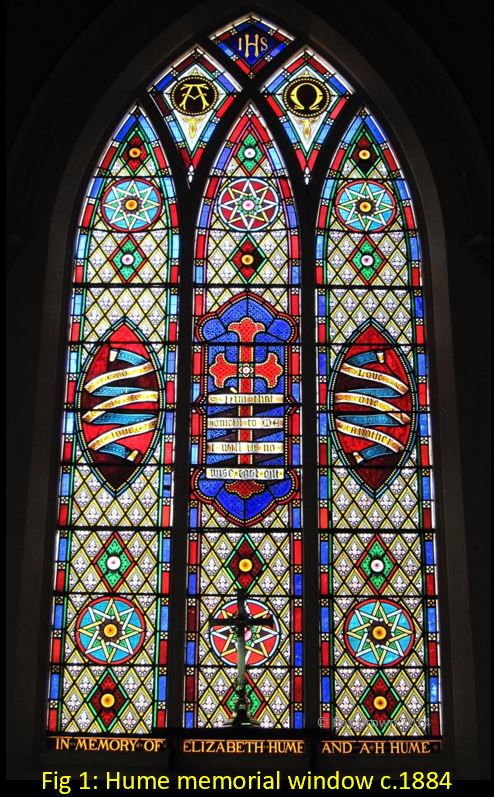
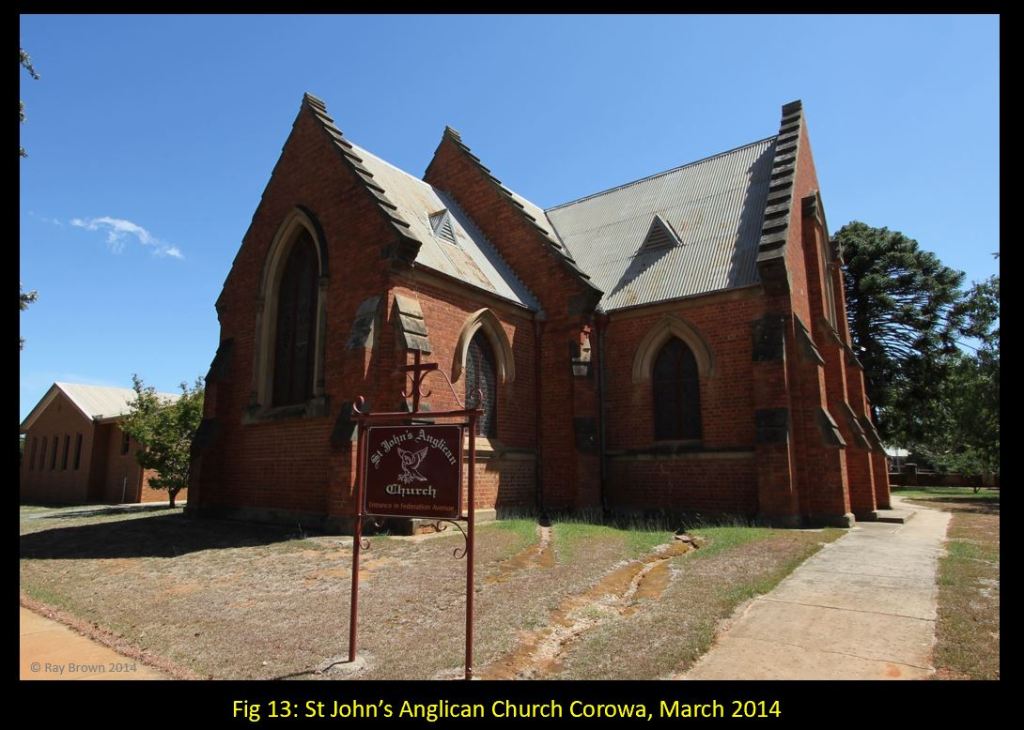
1884 St John’s Anglican Church Corowa, NSW.

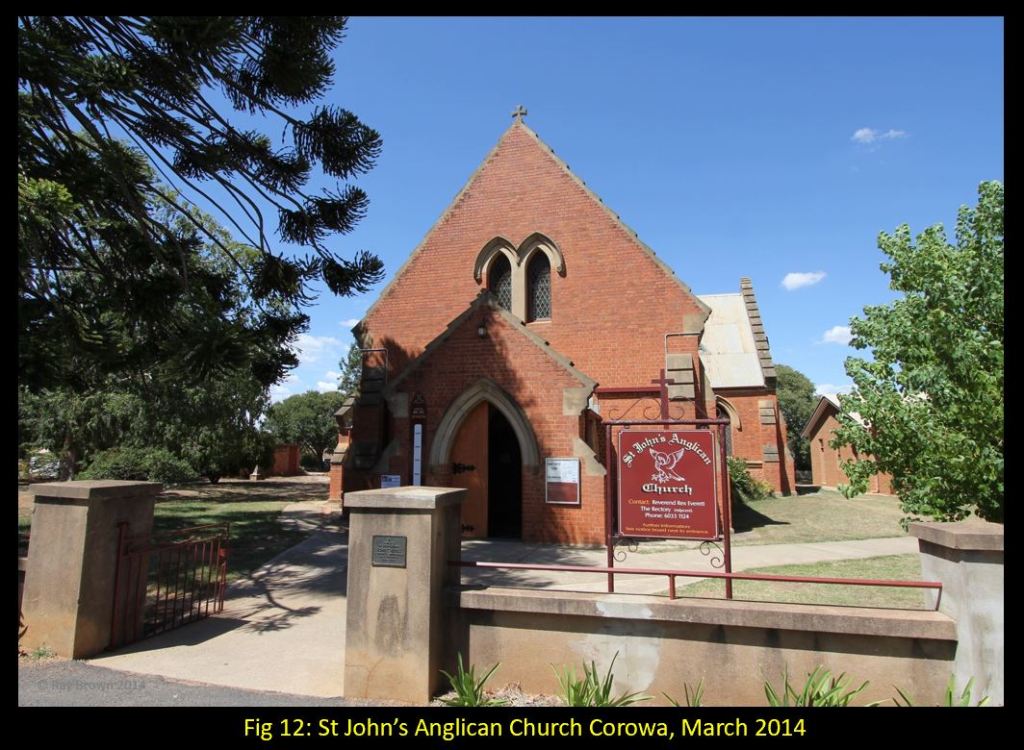
In 1863 the first wooden Anglican church was built at Corowa and dedicated as St John’s. The land was donated by John Foord. Circa 1859 the area was known as North Wahgunyah and later changed to Corowa to differentiate it from Wahgunyah on the south side of the river in Victoria.

On the 25th of January 1884, a brief article appeared in the Corowa Free Press about a stained glass window being delivered for the new brick building of St John’s.

“…The memorial window for St. John’s Church, presented by the Misses Hume, has been delivered at Corowa, and its erection will be proceeded with shortly..” [1]

A week later the same tabloid reported that the window had been installed in the church but there were errors in the article:

“MEMORIAL WINDOW.- The window presented to St. John’s Church, in memory of Elizabeth and Andrew E. [sic] Hume, has this week been put into its place by Messrs. Armstrong and Johnson – free of cost. It is a very beautiful piece of workmanship, and was executed to the order of the Misses Hume, by Messrs. Ferguson and Wise [sic], of Melbourne.”[2]

Slide show: Images were taken in March 2014:

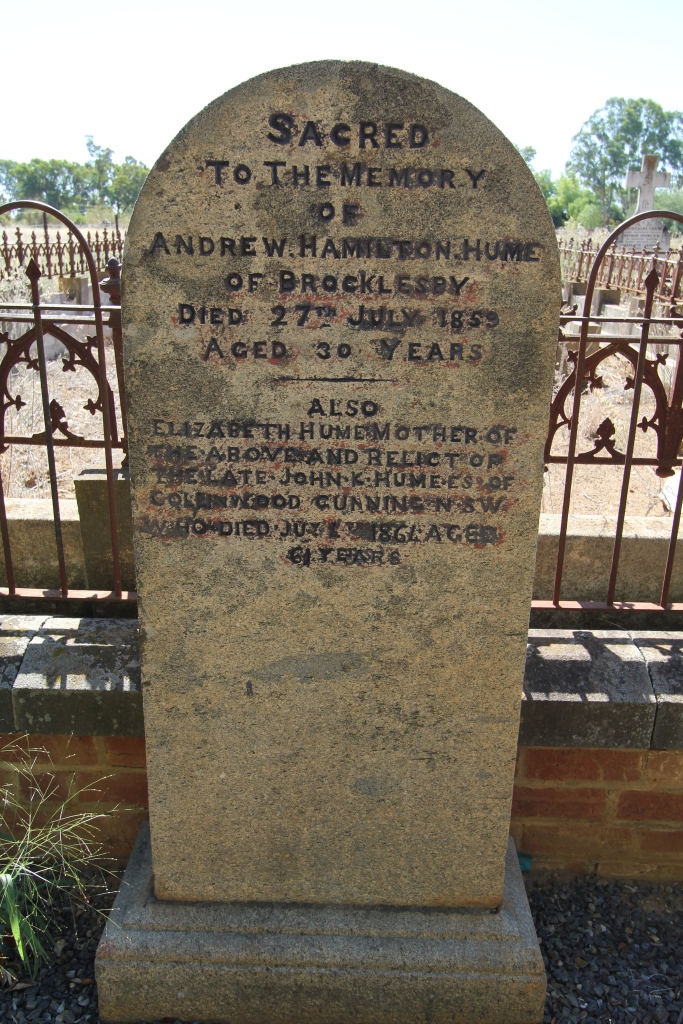
The window was dedicated to Andrew Hamilton Hume (1828-1859) and his mother Elizabeth (nee O’Neill 1802-1864). Andrew’s father was John Kennedy Hume (1800-1840) who was shot by bushrangers at Gunning, NSW, 20th Jan 1840 [3]

The newspaper incorrectly named the stained glass company as ‘Ferguson & Wise’. There was no stained glass company of that name anywhere in Australia. The window is accurately attributed to the ‘Ferguson & Urie’ stained glass company of North Melbourne. This company started out as a plumbing, slating, and glazing business, in Curzon Street North Melbourne in 1853 by Scottish immigrants, James & David Ferguson, and James Urie. In 1861 they transformed the company towards commercial glazing and stained glass production and for the next thirty-nine years, they made ecclesiastical and secular stained-glass windows.

After confirming with Rev Canon Rex Everet at St John’s in March 2014 that the window still existed, A trip to Corowa was next on my ‘To Do’ list.

A tabloid report in August 1896 gives an account of the Church and mentions stained glass windows by other studios from New South Wales:

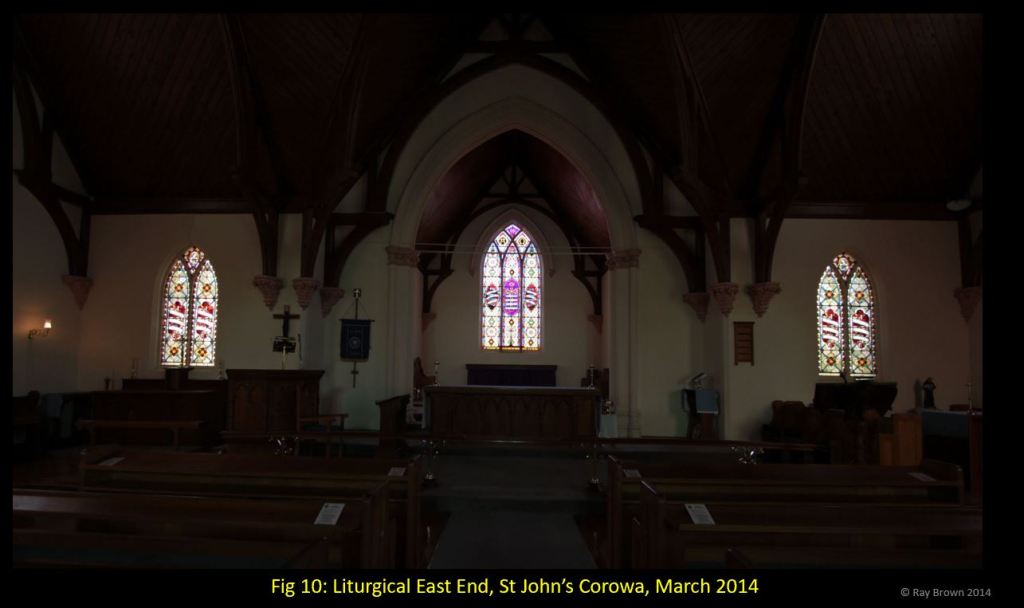
“…The older portion of the building was erected about twenty-five years ago by Mrs. Bladen Neill in memory of her husband, Lieutenant-Colonel Neill; the newer parts of the structure dating from some eleven years back. The church is cruciform in shape, and has a highly ornamental interior. The roof is of Murray pine diagonally laid, the massive worked principals supporting the same resting on artistically designed corbels. The stained glass windows, mostly presents from various residents, and costing over £250, largely enhanced the solemn beauty of the interior. The windows on each side of the altar, representing four scenes of the resurrection, are from designs supplied by the vicar, the Rev. William Clark Hose, and admirably executed by Messrs. Asher [sic] and Falconer[4], of Sydney. The three-light east window is in memory of Elizabeth and A. H. Hume, old and esteemed residents of the district. In the transept is a large three-light window in memory of Mr. Ross Ramsay, of Narrow Plains Station. Of the four lesser windows, one was presented by the late Bishop Linton; another by the Rev. W. Swindlehurst, of West Maitland, in memory of his deceased wife; and the remaining two by the Sunday School children…”[5]

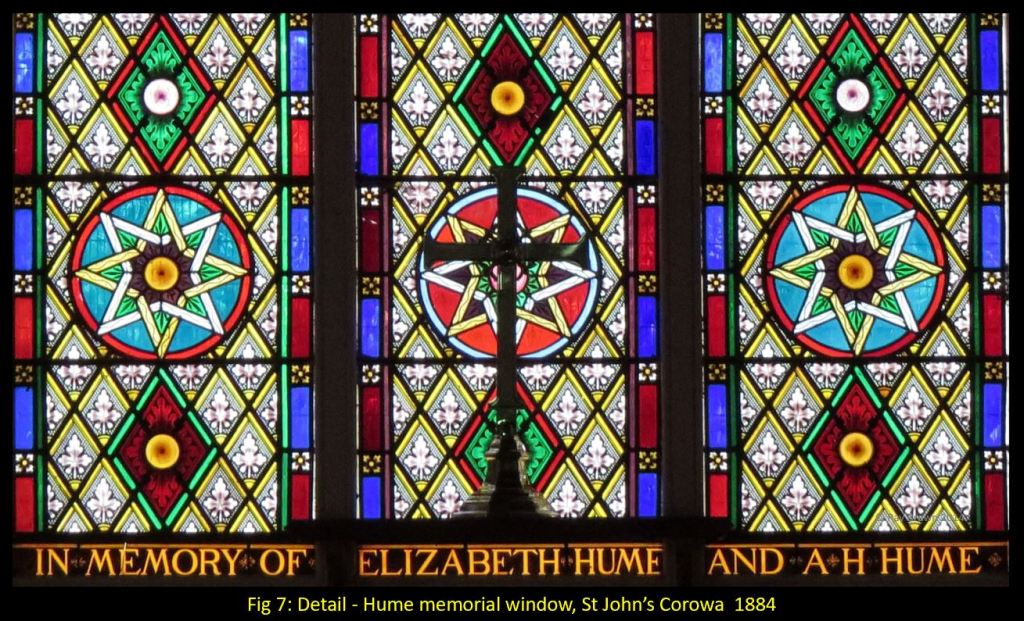
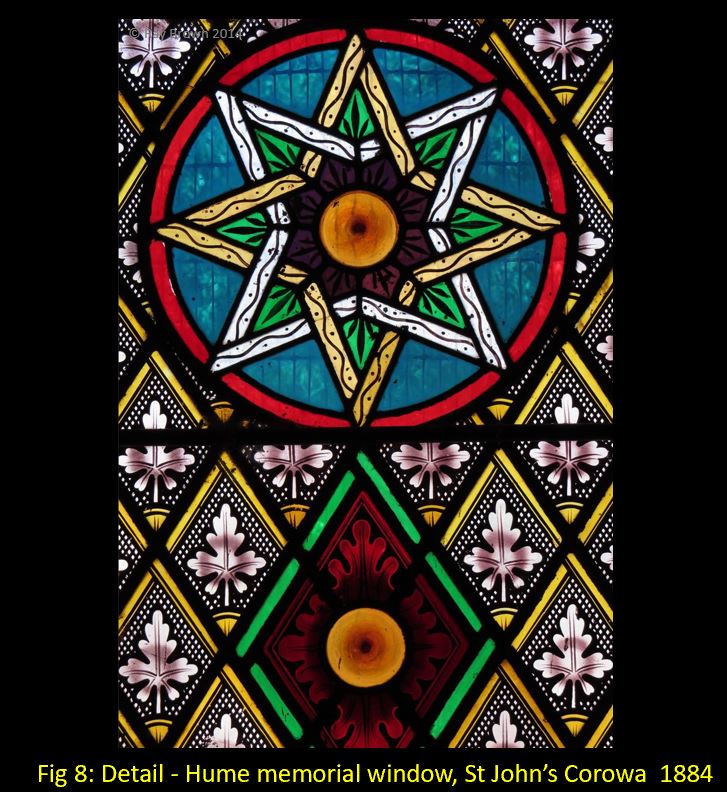
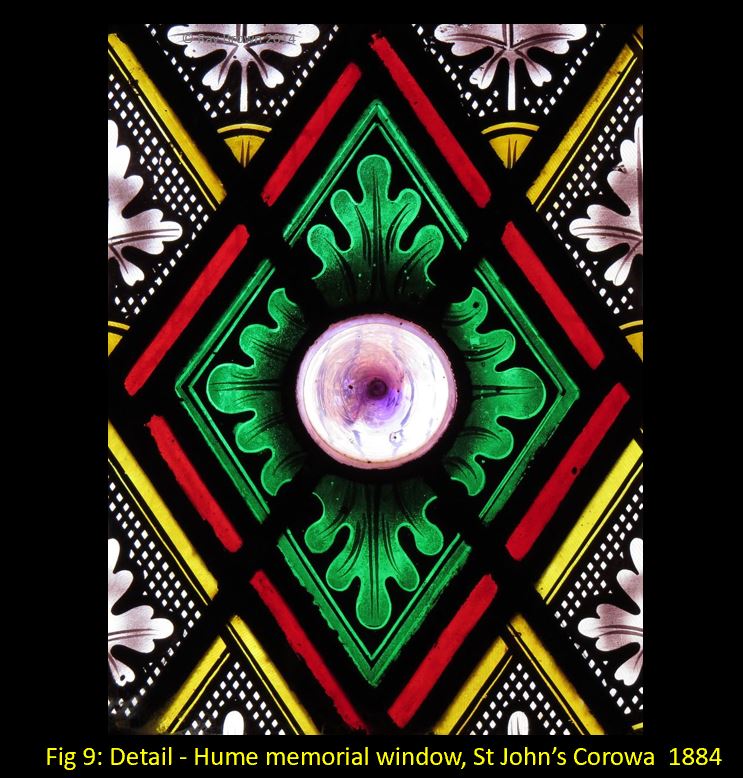
The Ferguson & Urie window in the chancel follows the company’s decorative style from their 1870s period of geometric patterns and scrolling ribbons with text from the bible. This window wasn’t made by the company’s first two pioneering stained glass artists. The artist who joined the firm in 1861, John Lamb Lyon, had left Ferguson & Urie in 1873 to form the Lyon & Cottier company in Sydney, and David Relph Drape died in 1882. This leaves two of the company’s earliest apprentice glass painters, Charles William Hardess and Frank Clifford Lording as the likely suspects who had a significant role in the window. There is no figurative work depicting any human form in the window, it has been copied faithfully from variations of their catalogue of designs over the previous twenty years, which Hardess and Lording would have been very familiar with producing.

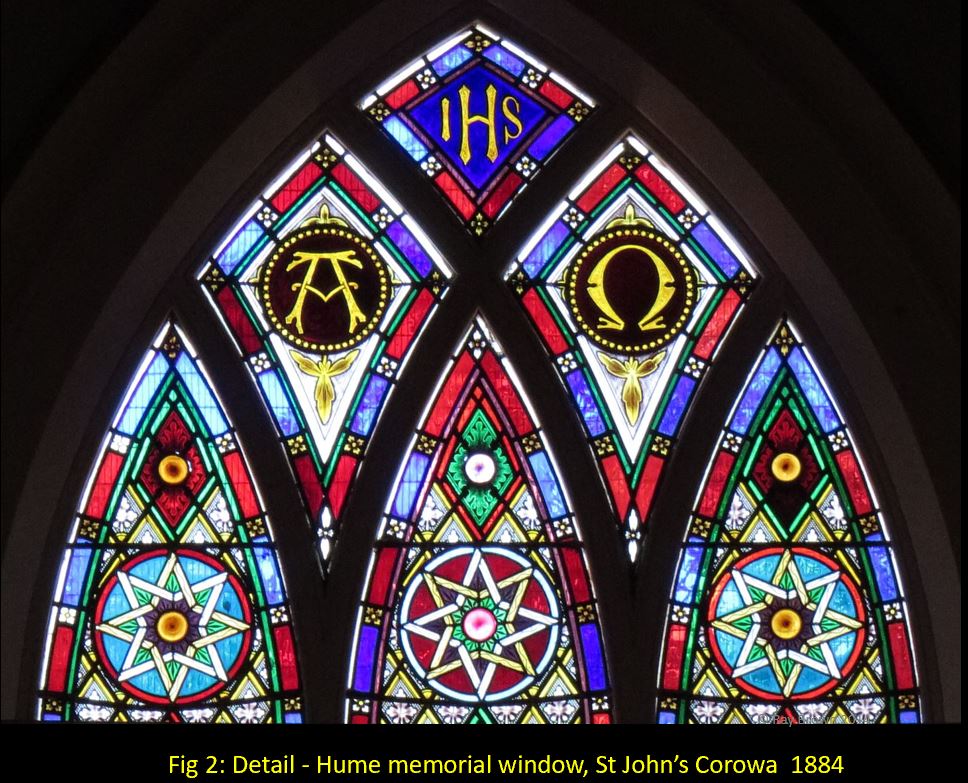
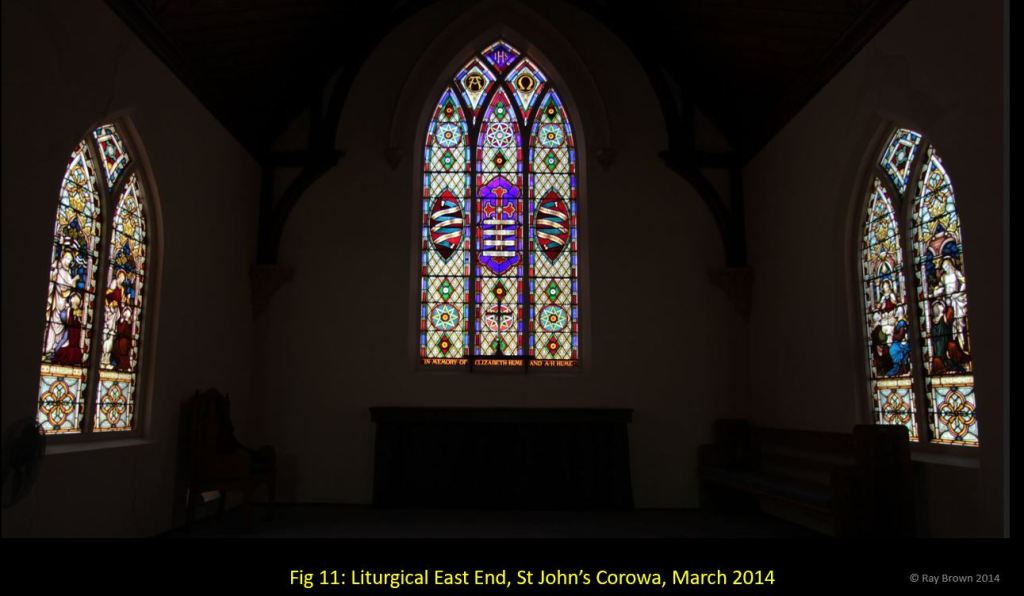
At the top of the window above the three lancets is a window with the letters “I.H.S”, a monogram symbolizing Jesus Christ. Below this are two windows with the Greek Lettering for “A” and “O” representing Alpha and Omega and meaning the Beginning and the End.

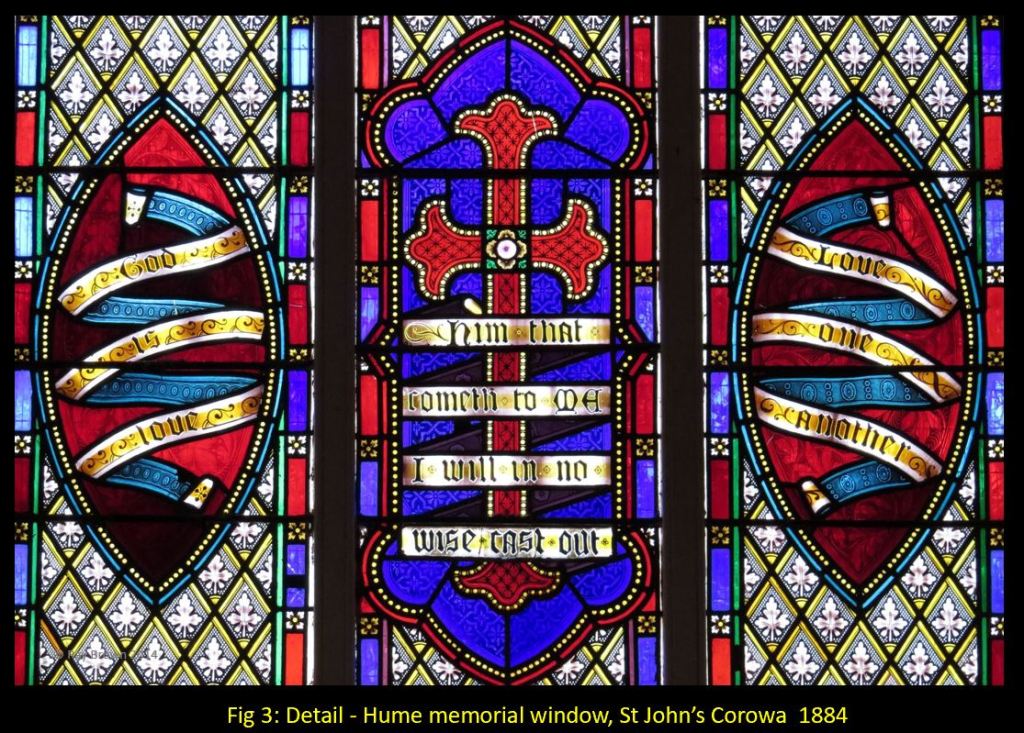
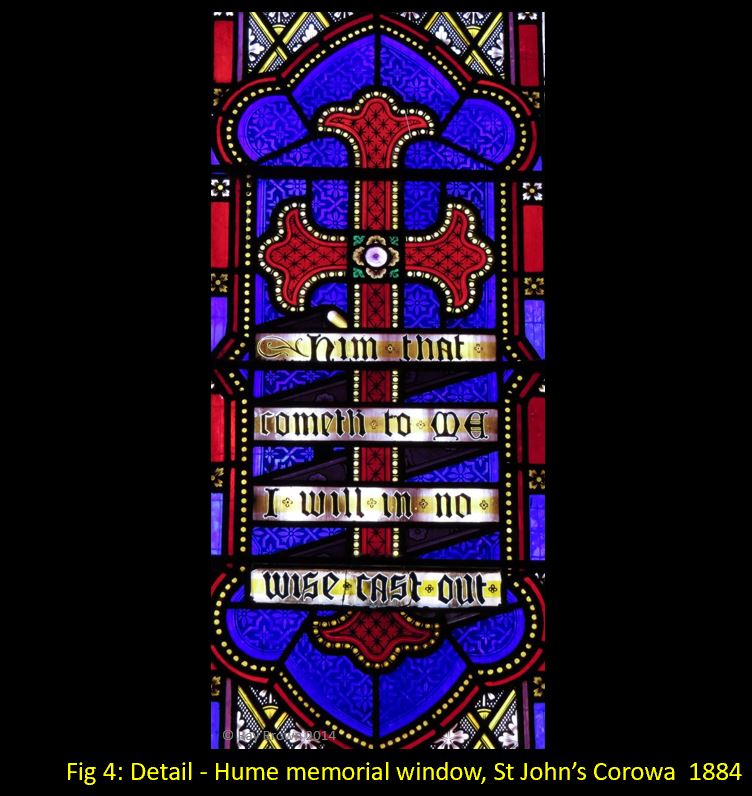
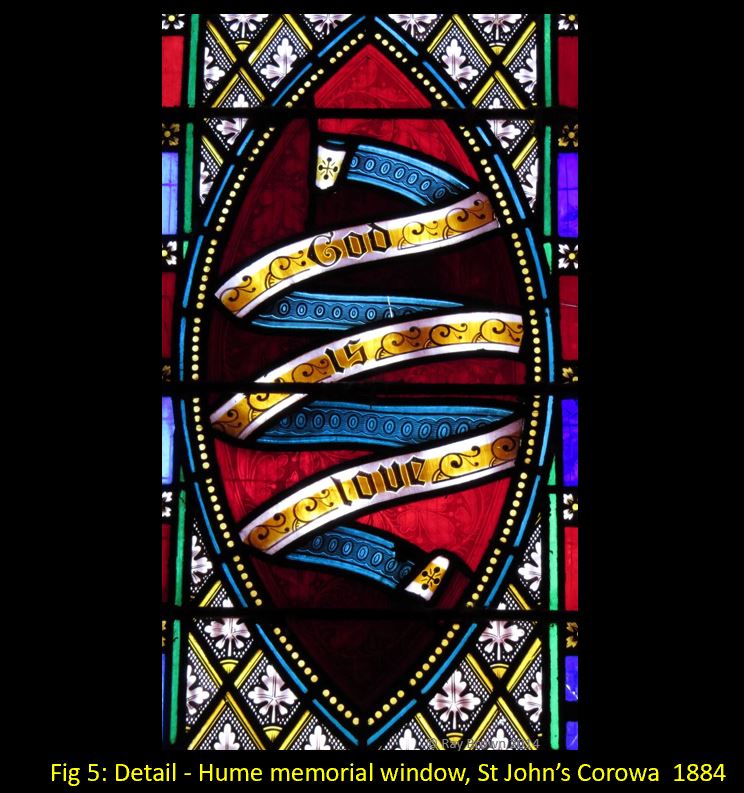
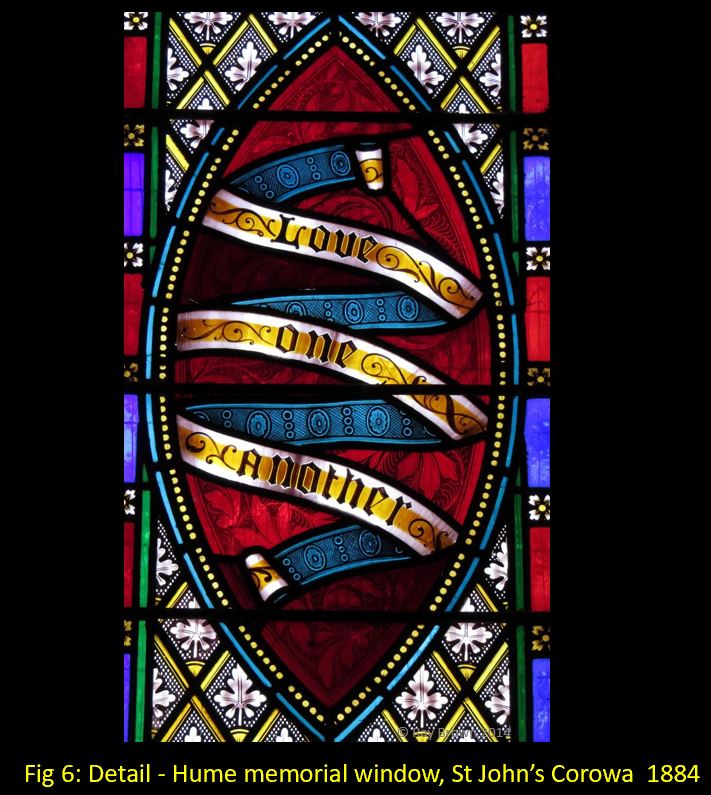
The centre light in the window contains a beautiful gothic decorated crimson cross on a sapphire blue background. The cross and the backgrounds have finely detailed sgraffito work picked out to reveal tiny stars. A ribbon scrolling around the cross has the words “Him that cometh to me I will in no wise cast out”. The left light contains a crimson pointed ellipse with leaves and fronds with a scrolling ribbon with the words “God is Love”. The right light is the same design but has the words on the ribbon “Love one Another”.

The memorial text at the base of the window states: “IN MEMORY OF ELIZABETH HUME AND A.H. HUME”.

The Hume memorial window in the chancel is the only Ferguson & Urie window in the church. The windows flanking it in the chancel were made by the Sydney firm of Ashwin & Falconer and are a distinctively different style. , but in the nave, there are other windows that would trick you into believing they are also Ferguson & Urie windows. They’re not, and the reason these are similar-looking windows is that they are the work of Lyon & Cottier of Sydney. Lyon, mentioned earlier, was the Ferguson & Urie glass painter at North Melbourne between 1861 and 1873.

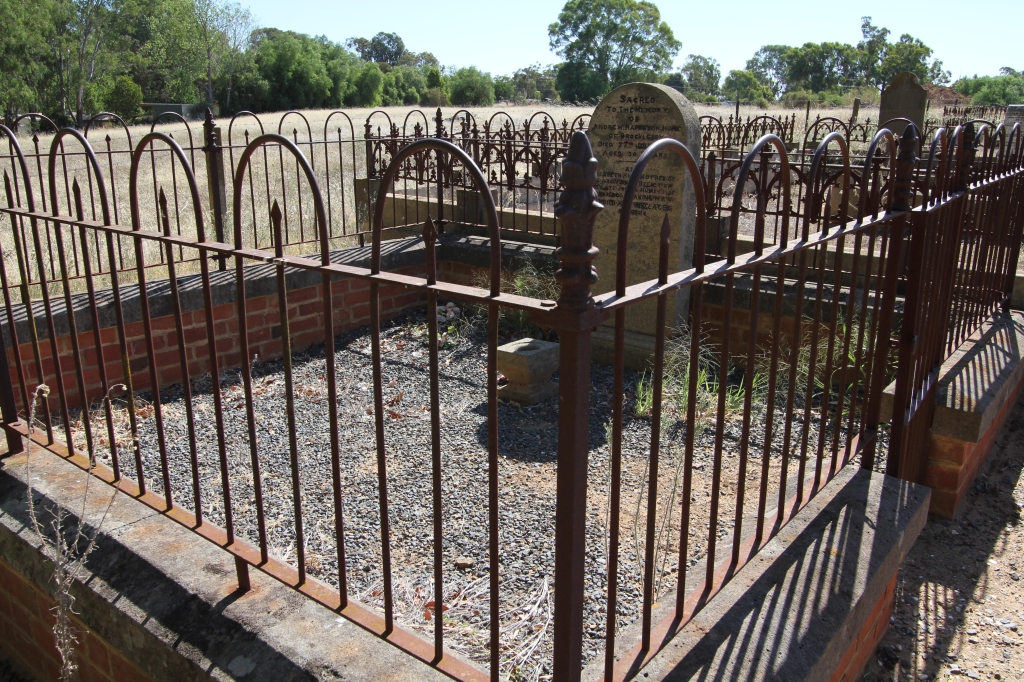
Andrew Hamilton Hume died at his station, Hume River, at age 30, on the 27th of July 1859[6]. His mother, Elizabeth (nee O’Neil 1802-1964) died 4th July 1864 at Yarrawonga in Victoria. Andrew and his mother are buried at the Corowa cemetery.

The Ferguson & Urie window was restored in 2015 at a cost of $25,000.

St John’s has an extraordinarily diverse range of stained glass windows by different artists and studios spanning nearly a century and a half. The windows from the late 1800s and early into the 1900s are by Ferguson & Urie, Ashwin & Falconer, and Lyon & Cottier. The modern-styled windows are by artists such as Bowers & Wilkins and Leonie Le Cornu.


Footnotes:

[1] The Corowa Free Press, NSW, Friday 25th January 1884, page 2.

[2] The Corowa Free Press, NSW, Friday 1st February 1884, page 3.

[3] The Sydney Morning Herald, NSW, Monday 27th January 1840, page 2.

[4] Aswin and Falconer, later Falconer and Ashwin, and F. Ashwin & Co.

[5] Australian Town and Country Journal, NSW, Saturday 8th August 1896, page 27.

[6] The Argus, Melbourne, Vic, Tuesday 9th August 1859, page 4.


Short Link to this page: https://wp.me/p28nLD-39y

© Copyright

1870: The Convent of Mercy, Albury, New South Wales.

The Convent of Mercy at Albury, New South Wales, has remnants of original Ferguson & Urie stained glass. The main entrance doors originally contained the figures of St Bernard and St Bridget with the Virgin and child in the window above the doorway.

The convent was formally opened on the 4th February 1870 by the Bishops of Bathurst and Maitland and the Freemans Journal of 19th February published very a detailed account of the proceedings.

In December 2013 Fr. Joel Wallace sent me some photos of the entrance windows and the stained glass above the doorway appears to be the most intact. The St Bridget window in the right door panel looks to have had multiple fractures over the last 144 years and there is evidence of many additional lead lines introduced to arrest the past damage. The St Patrick window in the left doorway unfortunately no longer exists.

Photos were kindly supplied by Fr. Joel Wallace, 13th December 2013.

This slideshow requires JavaScript.

Freeman’s Journal, Sydney, NSW, Saturday 19th February 1870, page 10.

“OPENING OF THE CONVENT OF MERCY, ALBURY”
(From a Correspondent)

“On Friday, the 4th February, their Lordships the Bishops of Bathurst and Maitland arrived in Albury to formally open and bless the Convent of Mercy…”

“…On Sunday the 6th the ceremony of opening and blessing the Convent took place, an event marking a new era in the Catholic history of this important and fast rising town not soon to be forgotten…”

“…Entering the hall under the verandah arches, the visitor is struck with the magnificent appearance of the stained glass in the upper panel of doors and fanlights over. In the centre of fanlight is a splendid medallion representing the Blessed Virgin and Child; on one side of the medallion the monogram of St. Bernard, on the other I.H.S. In one panel of the doors a full length figure of ‘St. Bridget,” whose name the Convent bears, the other panel the figure of St. Patrick, both in elaborately wrought canopies. The glass is from the manufactory of Messrs. Farguson [sic], Urie, and Lyon, of Melbourne, on whom it reflects great credit…”


Short link to this page: http://wp.me/p28nLD-2m1

© Copyright


1884: Gunsler’s Cafe, Pitt Street, Sydney, New South Wales

Gunsler’s Café in Pitt Street Sydney was built in 1884 to the designs of Melbourne architect Lloyd Tayler and had ornamental stained, coloured, and plate glass decorations supplied by the Ferguson and Urie Stained Glass Company of North Melbourne.

Photos: The historical engravings of Gunsler’s Sydney premises were published in the Illustrated Sydney News, NSW, Tuesday 23rd September 1884 and the Melbourne premises were published by May & Ebsworth in July 1879.

This slideshow requires JavaScript.

Illustrated Sydney News, NSW, Tuesday 23rd September 1884, page 3.

“Gunsler’s Cafe, Pitt Street.
It has always been a source of surprise to visitors, that a city like ours should be so inadequately supplied with first class restaurants. Efforts have been made within the last few years to remedy this want, but it has remained for an enterprising man like Mr. Gunsler, known for years as the leading caterer in Australia, to go into the matter thoroughly, and by long acquired experience, combined with a large expenditure of money, to provide Sydney with an establishment second to none in the southern hemisphere. Mr. Gunsler, encouraged by the patronage received at the temporary establishment in King Street, secured the premises known as 175 Pitt Street, close to the Federal Bank, and having obtained suitable designs from Mr. Lloyd Tayler, of Melbourne, has erected an admirably arranged building…”

“…The shop windows are of plate-glass, the upper compartments of the lights being filled in with coloured glass of various designs. The upper portions of the windows above are similarly treated, and the effect produced by this artistic ornamentation of the frontage is highly pleasing. In the central compartment of the tower is written on glass “Gunsler’s Café,” and the electric light apparatus is fixed up at the back, by means of which establishment will be splendidly advertised over the length and breadth of the city. A clock is inserted in the pediment that forms the central feature of the structure. Above the shop windows in the frieze of the main cornice the words “Gunsler’s Café” are again prominent, standing out clearly in gold lettering on a ground of plate-glass; the light over the main entrance is filled with ground glass bearing the word ‘Café” embossed in gold letters…”

“..The general contractors for the building were Messrs. White and Coghill, of Paddington. The fittings were supplied by Mr. James Aylward, of Redfern; the ornamental coloured-glass and plate-glass by Messrs. Ferguson and Urie. Mr. F. Messenger acted as clerk of works…”

John Ferdinand Gunsler (c.1827-1911).

In April 1873 John Ferdinand Gunsler entered into partnership with Charles James Hughes as “Hughes & Co”, pastry cooks and confectioners, at 29 Collins street Melbourne[1]. By September of the same year the partnership was dissolved by mutual consent[2] and Gunsler brought out Hughes’s share of the business but traded under the same name until early 1874 when he then began trading under his own name.

Having gained special appointment as caterer to the Governor Sir George Ferguson Bowen in September 1874[3], he quickly gained widespread recognition as reputable caterer and restaurateur and for many years was chosen for many significant government, sporting, regal and private events around Melbourne as the preferred caterer for all occasions.

In February 1878 he admitted Henry George Iles (1850-1899), a gold buyer and investor, as a financial partner in the business and then traded under the name of “Gunsler & Co”[4]. In August of the same year they purchased an allotment of dilapidated buildings in Collins Street known as ‘Petty’s block’ from the estate of Mr George Petty[5] and under the direction of architect Lloyd Tayler[6], proceeded to build Café Gunsler which opened in June 1879[7]. In later years the Café was known as the Vienna Café (1890-1915). The Australia Hotel was built on the site c.1940 and is now home to the “Australia on Collins” shopping centre at 260 Collins Street Melbourne.

Gunsler’s reputation as the very best in the catering business allowed him to expand his operations substantially. In October 1879 he brought the lease of the Victoria Club in Melbourne[8] and in May 1881 Gunsler & Co advertised that they had purchased the South Australian Club (Adelaide Club Hotel) at North-Terrace[9] and in 1882 they purchased the former Bank of South Australia building in Adelaide which was converted to a family Hotel[10].

In January 1884 Gunsler ventured into New South Wales and advertised from temporary premises at 110 King Street Sydney[11] and later built the opulent “Gunsler’s Café” at 175 Pitt Street Sydney which had the ornamented windows supplied by the Ferguson & Urie stained glass Company of Melbourne.

Gunsler obviously had a great affection for the architectural work of Melbourne architect Lloyd Tayler, having engaged him to oversee the design and construction of his Melbourne premises and the later Sydney premises. The other choice of having the Ferguson & Urie stained glass company of Melbourne provide the glazing is also unusual, considering that by 1884, a number of local Sydney firms such as Ashwin & Falconer and Lyon & Cottier could have easily undertaken the work. What is most likely is that Lloyd Tayler had chosen Ferguson & Urie to complement his designs which possibly means that Gunsler’s Melbourne restaurant may also have had decorative glazing done by Ferguson & Urie, but there has been no evidence found to support this.

Gunsler’s Café in Pitt Street Sydney burnt down on the 27th January 1889[12].

John Ferdinand Gunsler died in Sydney on the 28th November 1911 aged 84[13].

Footnotes:

[1] The Argus, Melbourne, Vic, Friday 18th April 1873, page 3.

1872: St John’s Anglican Church, Raymond Terrace, New South Wales.

In late November 1872 a magnificent three-light stained-glass window was unveiled in St John’s Anglican Church at Raymond Terrace in New South Wales.

“…It is due to the firm of Messrs Furgusson [sic], Urie, and Lyon, of Melbourne, to say that the window is regarded as a beautiful specimen of Australian art, which will favourably compare with works of a similar character executed in England…” [1].

The window was crafted by the North Melbourne stained-glass firm ‘Ferguson, Urie, and Lyon’ for £80 and was erected in the chancel in memory of the district pioneer and geologist William Keene.

Photos were taken October 2013 and have been kindly contributed by Michaela Sorensen. The historic photo of the chancel and window was taken by the Rector of St John’s, the Rev Norman Alfred Pullin (1913-1983), during his incumbency of St John’s circa 1949-52 [2].

This slideshow requires JavaScript.

St John’s Anglican Church is located at Raymond Terrace, 167km North of Sydney and 26km North of Newcastle in New South Wales.

The church was built on land formerly owned by the Cafferay[3] family and was constructed of locally quarried stone to the designs of architect Edmund Blacket for £1500. It was consecrated by the Bishop of Newcastle, William Tyrell, on Thursday the 25th September 1862[4] and the first incumbent was the Rev John Roe Blomfield.

After the death of William Keene in 1872 it was resolved that a memorial stained-glass window should be erected to his memory in St John’s. One of the lead organisers of the creation of the window was Henry Bayes Cotton (1820-1906)[5], a well-known and respected manager of the National Bank of New South Wales at nearby Newcastle.

The craftsmanship of the window was entrusted to the Ferguson, Urie and Lyon[6] Stained-glass Company of North Melbourne in Victoria. The biblical theme represented in the window being, in the centre light, the Nativity, Crucifixion and the Resurrection. The flanking side lights had the inscription beneath each figure being, ‘Teach the Ignorant,’ and ‘Help the Helpless.’

The window was erected in the chancel of St John’s and was unveiled in late November 1872. The ‘Maitland Mercury’ of the 3rd December 1872 provided a detailed description of the historic window;

“…Commencing at the foot of the light, there is the scene of our Saviour’s birth. In the centre of the light is represented the Crucifixion, and this is again surmounted by the Resurrection. These subjects are all taken from the old masters, and are beautifully executed. The intermediate spaces are occupied with chaste and varied medallions, and the sacred monograms, I.H.S. In the right side light there is an admirably designed and well finished group, representing a venerable teacher engaged in instructing those around him; the countenances of this group are peculiarly pleasing. In the left side light is likewise a corresponding group, consisting of a benevolent person, and a female figure of benign aspect, engaged in receiving orphan children…”
“…The inscription at the base of the memorial is, “To the Glory of God, and in memory of William Keene, 1872”
[7]

Just over a century later the chancel of St John’s had to be demolished and the window, now more than a century old, was considered to be in a fragile condition and was subsequently removed and stored in the rectory of St John’s. The repairs to the sanctuary and extensions to the chapel and vestry were completed in 1975 [8] and, later, at the instigation of William Keene’s great granddaughter, Annette Keene Holloway, funds were raised from family members and parishioners of St John’s to repair and re-erect the windows. Because there was no longer a position in the chancel for the windows to be re-erected in their original configuration, they were refashioned into five single lights and re-installed along the south wall of the nave.

“A stained glass window depicting the nativity, Life and Crucifiction [sic] was erected in St. John’s Church in memory of Great Grandfather William Keene. Later I heard it had been removed and the opening cemented up. I wrote to the Rev. Sores and he replied that the window had been in bad repair and in danger of being broken. Raymond Terrace was a poor parish without the money to restore the damage so the windows were stored in the Rectory. I wrote to my cousins who sent money. Other parishioners did too and the windows were re-installed on the side wall of the church where they can still be admired as a link with early colonial days.”[9]

Mr Don Denham, Parish Secretary of St Johns, Raymond Terrace, provides further insight as to the time line of the historical windows:

“In the late 1960’s the original sanctuary/ chancel of the church was demolished and in the 1970’s a new sanctuary/ chancel and side chapel were constructed of modern design. In the new construction there was no east window to house the windows and so they were placed in the five small lancet windows of the southern side of the nave”.

“… the complete east window fitted perfectly into the nave windows and the completed affect is quite pleasing…”

“…The windows have been recently restored and we are planning the rededication service for 20 October this year”.[10]

The most recent conservation work on the windows was carried out in 2011 by Ron Jensen, of Heritage Stained Glass at New Lambton in New South Wales. Only two of the five windows required attention, being the one at the south west corner titled “Teach the ignorant” and the centre window of the five titled “Death” which depicts the Crucifixion.

The five individual windows, from left to right along the south wall are;

“Help the Helpless”, “Birth” (Nativity), “Death” (Crucifixion), “Resurrection” and “Teach the Ignorant.”

Each of the reconstructed windows retains the original 1872 Ferguson & Urie figurative stained glass work depicting the five biblical scenes. Each scene has two of the original decorative quatrefoils below it. These quatrefoils are of varying colours with gothic floral designs of yellow and white flowers in the centre, surrounded by a stylized depiction of the passion flower with the stamen in each of the four lobes.

The background quarries of glass surrounding the figurative scenes and quatrefoils are no-longer original and are now of varying sized rectangular and diamond shapes in soft pastel colours. The monogram described as containing the letters “I.H.S” originally appeared between the nativity and Crucifixion scenes in the centre light of the window but this no longer exists. The memorial inscription at the base of the window now has the year ‘1872’ in the far left light which in its original configuration appeared immediately after William Keene’s name (To the Glory of God, and in memory of William Keene, 1872”).

There are many cases of our historic stained-glass artefacts that no longer exist after more than a century and a half. Some of the historic churches have met their demise by fire, demolition, or have been sold to private enterprise over the last 150 years and in many cases their original artefacts and stained-glass windows have been lost. St John’s church at Raymond Terrace represents a rare example of the dedication of the parishioners and Keene family descendants to save the historic windows so they still have a reminder of their pioneer heritage.

In September 2012 St John’s celebrated its 150 year anniversary and the re-dedication of the Keene memorial stained-glass windows will occur at St John’s on the 20th October 2013.

William Keene (1798 – 1872)

William Keene was born at Bath, in Somersetshire, England, c.1798. His English ancestry associates him with ‘The Bath Journal’ of London, founded in 1742. The tabloid was later known as ‘Keene’s Bath Journal’ circa 1822 which remained in the Keene family until c.1916 before being absorbed by the ‘Bath Herald’.

William Keene initially trained in the medical profession but his interests in geology were his passion and he changed his career to become a geologist and mining and civil engineer. Circa 1822 he left for France where he gained a prestigious appointment with the French government;

“…in connection with some salt mines in the Pyrenees. His services, highly esteemed by that government, brought him an order and a pecuniary grant…[11]

Keene later became a ‘Fellow of the Geological Society’ in London[12] which entitled him to the prestigious post nominal of ‘F.G.S’. On the 13th August 1822 William was married to Sarah Charles Evans (1804-1867) at the British Embassy Chapel in Paris[13] by the Chaplain Edward Forster. The Keene’s had a long association with France where many of their children were born. During their time in France William gained a passion for the French style of wine making which would become an interest for the rest of his life. At the beginning of the French Revolution in 1848 they returned to England[14].

Circa 1852 William migrated to Australia with his family and on the 12th December 1854 he was appointed as Government Examiner of Coal Fields in New South Wales[15] and in 1856 promoted to Government Geologist[16]. His geological interests allowed him to amass a significant collection of mineral specimens and fossils which he displayed in 1858[17] and in August 1859 the collection was on public display at the military barracks in Newcastle[18].

In 1861 William Keene’s extraordinary collection of geological specimens was singled out for particular attention at the Sydney Industrial and Art Exhibition;

“To the collection of Mr. W. Keene, Government examiner of coal fields and mines, it is desirable to invite particular attention. It is on the north side of the upper gallery, and consists of some valuable specimens from our gold, copper, lead, iron, and coal fields, and some remarkable fossils, the whole having been collected by himself, and chiefly in the counties of Hunter and Argyle…”[19]

Over a twenty year period William Keene wrote several papers on the subject of fossils and authored a significant number of Government reports on Colonial mineral wealth and mining.

William Keene was a staunch supporter of the Church of England and in his position as the first acting Registrar of St John’s he read the petition for the consecration of the church, which he had the honour to perform shortly after 11am on Thursday the 25th September 1862[20].

William Keene was a member of the Newcastle Church Diocese, Local School Board, and Founder and Treasurer of the Clergy Widows and Orphan’s Fund[21]. He was elected President of the Newcastle School of Arts in 1869[22] and he laid the foundation stone of that school on the 8th April 1870[23].

Aside from his geological interests he was renowned in the Hunter River area as a viticulturist and vintner, who passionately advocated the French style of vine-growing in the district. He was also an active member of the Hunter River Vineyard Association, of which he was president in 1865-66[24], and also a member of the Agricultural Association[25]. His experience in this field often saw him called upon to act as a wine-judge at the regional exhibitions[26].

William Keene died at his home, ‘Kingsmead House’, in Raymond Terrace on the 2nd February 1872[27] and was buried in the Raymond Terrace Cemetery. His wife Sarah predeceased him on the 2nd of July 1867[28].

Henry Bayes Cotton (1820-1906)

Henry Bayes Cotton is recognised as one of the principal promoters in having the Keen memorial window erected in St John’s in 1872.

“…It cannot fail to give great pleasure to H. B. Cotton, Esq., of Newcastle, who has taken a large amount of trouble and interest in accomplishing the work; and the friends of the deceased must be greatly gratified and comforted when they gaze upon this tribute of respect and affection to their departed relative…”[29]

Henry Bayes Cotton arrived in the Colony circa 1839 and was appointed as the first manager of the Bank of New South Wales at Geelong circa 1854 and in 1863-64, appointed as first manager of the Newcastle branch[30] in New South Wales where he remained until his retirement in early 1888.[31] Although retired he maintained an interest in financial affairs and in 1893 he was appointed a director of the New South Wales ‘de Piété Deposit and Investment Company.’[32]

Like William Keene, he was a staunch supporter of the Church of England and was also for many years a lay reader and active member of the Synod[33].

The association or friendship between Keene and Cotton is not specifically known but it is reasonable to assume that they knew each other well as Cotton was also involved in the establishment of the Newcastle School of Arts[34] with William Keene, who had laid the foundation stone of that school in 1862 and both were parishioners of St John’s at Raymond Terrace with Cotton actively involved in the choir of St. John’s.

Henry Bayes Cotton left Newcastle and retired to the Sydney suburb of Hunters Hill where he died aged 86 at his residence ‘Fig Tree’ on the 15th January 1906[35]. His wife Rachel predeceased him, 18th April 1903, aged 78[36].

The Maitland Mercury & Hunter River Advertiser, NSW, Tuesday 3rd December 1872, page 3.

“MEMORIAL STAINED GLASS WINDOW IN ST. JOHN’S CHURCH, RAYMOND TERRACE, TO THE LATE WILLIAM KEENE, ESQ.- This window was placed in St. John’s Church, Raymond Terrace, Raymond Terrace, last week, and as it is the admiration of all who have viewed it, a short description may be interesting to your readers, whilst it is due to those kind friends who contributed towards the window. It may be as well to state in the first place, that the Church of St. John is a Gothic edifice, pleasantly situated on a spot which affords a view of the Hunter River and of the rich alluvial farms spreading for miles on the opposite side; the churchyard is neatly kept, having been tastefully laid out and planted with choice evergreen trees about six years ago. The east window of the church consists of three lancet lights; the central light is eleven feet high, being admirably adapted for the style and subjects which have been chosen. Commencing at the foot of the light, there is the scene of our Saviour’s birth. In the centre of the light is represented the Crucifixion, and this is again surmounted by the Resurrection. These subjects are all taken from the old masters, and are beautifully executed. The intermediate spaces are occupied with chaste and varied medallions, and the sacred monograms, I.H.S. In the right side light there is an admirably designed and well finished group, representing a venerable teacher engaged in instructing those around him; the countenances of this group are peculiarly pleasing. In the left side light is likewise a corresponding group, consisting of a benevolent person, and a female figure of benign aspect, engaged in receiving orphan children. It is scarcely necessary to say that these subjects are intended to perpetuate the memory of the offices which the deceased gentleman so long and faithfully filled in the Church of the Diocese, as a member of the Local School Board, and Founder and Treasurer of the Clergy Widows’ and Orphans’ Fund. The inscription under these subjects respectively is, ‘Teach the Ignorant,’ ‘Help the Helpless.’ The window adds much to the beauty of the chancel and the church generally. It cannot fail to give great pleasure to H. B. Cotton, Esq., of Newcastle, who has taken a large amount of trouble and interest in accomplishing the work; and the friends of the deceased must be greatly gratified and comforted when they gaze upon this tribute of respect and affection to their departed relative. It is due to the firm of Messrs Furgusson [sic], Urie, and Lyon, of Melbourne, to say that the window is regarded as a beautiful specimen of Australian art, which will favourably compare with works of a similar character executed in England. The cost of the window, with transmission and erection, has been £80. The inscription at the base of the memorial is, “To the Glory of God, and in memory of William Keene, 1872,” –Newcastle Pilot, Nov. 30.”

A comprehensive eleven page document of all the significant historical newspaper transcriptions can be viewed here Raymond_Terrace_St John’s_Transcriptions This document is well worth reading as it gives a more in depth perspective to the history and has much more detail than I have attempted to sumarise in the above article.

Acknowledgements:

Thanks to Don Denham, Jock Keene and Carolyn Wulff, for their much appreciated correspondence and contributions to this article and to Michaela Sorensen for the current photos of the stained glass windows.

Foot notes:

[2] Historic photograph contributed with thanks to Rev Pullin’s daughter, Carolyn Wulff (email 28th Sept 2013)

[6] Stained Glass artist John Lamb Lyon (1835-1916) was and employee of the firm from 1862 and a partner from 1866 to 1873.

[8] newcastleanglican.org, Mission Statement, St John’s, Raymond Terrace, parish profile, page 3. (accessed 18 Sept 2013).

[9] Holloway, Annette Keene, “The Keene family of Raymond Terrace”, Raymond Terrace and District Historical Bulletin, Vol. 5, No. 3, June, 1982, p. 119-122.

[10] Mr Don Denham, Parish Secretary, St John’s Raymond Terrace NSW, email 16th Sept 2013.

[13] Marriages Solemnized in the house of his Excellency, the British Ambassador (Lord Sir Charles Stuart) at the Court of France in the year 1822.

[14] Australian Dictionary of Biography, http://adb.anu.edu.au/biography/keene-william-3931/text6183, accessed 17 September 2013.

[17] David F. Branagan, Geology and Coal Mining in the Hunter Valley, 1791-1861 (Newcastle 1972), p. 72.

[24] Australian Dictionary of Biography, http://adb.anu.edu.au/biography/keene-william-3931/text6183,, accessed 17 September 2013.

1867: St Peter’s Anglican Church, Woolloomooloo, Sydney, New South Wales

The foundation stone of St Peter’s Anglican Church was laid on the 1st of May 1866[1] on the corner of Anne and Bourke streets at Woolloomooloo (now Darlinghurst) by the Governor Sir John Young (1807-1876) and was officially opened on the 25th of July 1867[2] by the Bishop of Sydney, Frederick Barker (1808-1882).

The great east window of St Peters is a 16ft high triple light window of Gothic design with the centre light taller than the outer two. The window was the gift of the ministers Church Warden and Treasurer of the building fund, James Gordon[3], to commemorate the installation of the first incumbent of the church, the Rev George Harman Moreton (1826-1902).

The window was made by the “Ferguson, Urie, and Lyon”[4] stained glass company of Melbourne for £182[5] and was placed on display at the company’s workshops in Curzon-street, North Melbourne. Between the 20th and 22nd of June 1867 the public were invited to view it until 4.p.m on the Saturday before it was to be shipped to Sydney[6].

St Peter’s was deconsecrated in 1993 and subsequently purchased by the Sydney Church of England Girls Grammar School (SCEGGS) and is now known as the “Great Hall” of the School at Darlinghurst.

Photos taken 6th May 2011.

This slideshow requires JavaScript.

[View larger images]

The window is described as follows:

The base of each window bears the following inscriptions:

“PRESENTED BY JAMES GORDON, ST PETERS DAY A.D. 1867”.

“TO BEAUTIFY THE HOUSE OF GOD AND TO COMMEMORATE THE”

“INSTALLATION OF THE REVd G. H. MORETON AS FIRST INCUMBENT OF THIS CHURCH”.

There are nine biblical scenes and three symbols depicted in the windows. Each of the nine figurative scenes has the text reference below it to a chapter and verse from the King James Bible.

Left light:

“John – 1:42”“And he brought him to Jesus. And when Jesus beheld him, he said, Thou art Simon the son of Jona: thou shalt be called Cephas, which is by interpretation, A stone.” This refers to Peter, also known as Simon Peter.

“Luke – 9:32”“But Peter and they that were with him were heavy with sleep: and when they were awake, they saw his glory, and the two men that stood with him”.
The depiction is of the ‘Transfiguration’ which is one of five major milestones in the life of Jesus.

“Matw – 8:25”“And his disciples came to him, and awoke him, saying, Lord, save us: we perish.” The scene depicts the disciples pending shipwreck in the rough seas calling for the Lord to save them.

Centre Light:

The apex of the centre light window contains the Hexagram symbol, more commonly recognised as the Star of David.

“Matw – 26:36”“Then cometh Jesus with them unto a place called Gethsemane, and saith unto the disciples, Sit ye here, while I go and pray yonder”. The scene depicted is commonly recognised as ‘The Agony in the Garden’.

“SALVATOR MUNDI.” –  (Meaning, “Saviour of the World”). This is the central image of the centre light and depicts Christ standing and wearing crimson robes. In his left hand is the “Globus Cruciger” (representing the world or earth) which is surmounted by a cross. His right hand depicts the early Byzantine hand gesture of the benediction or blessing.

“P X” – Below Christ is the stylized letters P & X which are the Greek for Christ.

“Mark – 14:22” “And as they did eat, Jesus took bread, and blessed, and brake it, and gave to them, and said, Take, eat: this is my body.” The scene depicted is commonly recognised as “The Last Supper.”

“IHS” – Below the Last Supper Scene is the letters “IHS”, the 8th century abbreviation for “IHESUS,” the way Christ’s name was spelled in the Middle Ages.

Right light:

“Matw – 14:29” – “And he said, Come. And when Peter was come down out of the ship, he walked on the water, to go to Jesus.” The image depicts Peter walking on the water towards Jesus who had sent the disciples to the Sea of Galilee, but their ship became caught in a storm. Jesus was seen walking upon the water and gave Peter the courage to walk upon the sea towards him.

“John – 19:26” – “When Jesus therefore saw his mother, and the disciple standing by, whom he loved, he saith unto his mother, Woman, behold thy son!” The scene depicted is the Crucifixion where Jesus is nailed to the cross and says to his mother, “Woman, behold your son.”

“John – 21:17” – “He saith unto him the third time, Simon, son of Jonas, lovest thou me? Peter was grieved because he said unto him the third time, Lovest thou me? And he said unto him, Lord, thou knowest all things; thou knowest that I love thee. Jesus saith unto him, Feed my sheep.” Christ is depicted as the Good Shepherd with his sheep and Peter is seen kneeling before him with his key.

Significant historical newspaper transcriptions:

The Argus, Melbourne, Thursday 20th June 1867, page 5.

There is now in view at the stained glass manufactory of Messrs. Ferguson, Urie and Lyon, Curzon Street, North Melbourne, a memorial window for St. Peter’s Church, Woolloomooloo. The window has been presented by Mr. James Gordon, on the occasion of the installation of the first incumbent, and bears an inscription to that effect. It represents five episodes in the history of St. Peter, and is designed in the early English style of art, the execution of the figures and the harmony of colours reflecting great credit on the artist employed. The window is divided into three lights, and is 16ft by 7ft in size, the middle division containing a well executed figure of our Saviour, with the motto, “Salvatore mundi”. The public will be admitted until Saturday next.”

The Argus, Melbourne, Saturday 22nd June 1867, page 3.

“NOTICE – The STAINED GLASS CHANCEL WINDOW for St. Peter’s Church, Woolloomooloo, will be ON VIEW, at the premises of Ferguson, Urie and Lyon, Curzon-street, North Melbourne, from Wednesday, the 19th, until Saturday, the 22nd inst, at 4 p.m. All interested in stained glass and church decorations are invited to inspect it.”

Empire, Sydney, Friday 12th July 1867, page 4.

“CHANCEL WINDOW IN ST. PETER’S CHURCH, WOOLLOOMOOLOO – A beautiful stained window has just been erected over the chancel at the eastern end of St Peter’s Church, Ann-street, Wooloomooloo. This window is the gift of Mr. James Gordon. It is the workmanship of Messrs. Ferguson and Urie, glass stainers, Melbourne. The colouring is rich and the general effect striking. In the centre of the window is a large figure of the saviour, with the robes and insignia of royalty, and underneath the inscription “Salvator Mundi”. At the top is the agony in Gethsemane, and at the foot the Lord’s Supper. The other lights represent scenes in which St. Peter had part. On the left hand, at the top, is the calling of St. Peter and St. Andrew; and under it, the Transfiguration and the storm on the Lake of Gennesaret. On the right hand, at the top, is represented Christ walking on the water and rescuing St. Peter from the waves; below this is the Crucifixion, and then, under, the delivery of the keys to St. Peter. Along the foot of the window is the inscription:-“Presented by James Gordon, on St. Peter’s Day 1867, to beautify the House of God, and to commemorate the installation of the Rev. G. H. Moreton as first incumbent of this Church”.

The Sydney Morning Herald, NSW, Tuesday 6th August 1867, page 5.

“…Mr. JAMES GORDON, the minister’s churchwarden, then rose, as the treasurer of the building fund, to make a statement of the moneys received for and expended on the building…”

 “…the chancel window, which cost £182…”

The Sydney Morning Herald, NSW, Saturday 5th July 1902, page 9.

“THE LATE CANON MORETON”

Here passed away shortly before midnight on Thursday the venerable Canon George Harman Moreton, one of the early ministers of the Church of England in this State. The late Canon was born at Highway Wycombe, Buckinghamshire, in 1826, and his early history as a minister was one of indomitable perseverance and zeal. At the age of 17 Mr. Moreton announced to his guardian that he desired to enter the ministry. His intention was thwarted at every turn, and at last the youth left home and walked to London. He presented himself to the London City Mission, but his youth was considered a bar to his engagement. Young Moreton however, asked that he might be allowed to enter for the examinations, and after some time his request was granted. The youth passed the examinations with great credit, and was one of the youngest missionaries accepted. He received an appointment in the eastern mission field, and after his marriage went to Loo Choo, on the island of Lapa, Japan, in 1853. He laboured there three years, and was invalided home after a paralytic seizure. While at Japan, Mr. Moreton received new of British success in the Crimea from a Russian man-of-war. Mr. Moreton was ordained deacon at Trinity Church, Shanghai, by the first Bishop of Victoria, on October 9, 1853, and raised to the priesthood at the Chapel Royal, Whitehall, by Bishop Tait, of London, on December 20, 1857. He became curate of Pertenhall, Ely, in 1857, and in that year received an invitation from Bishop Barker to visit Australia. The long voyage of six months to Australia restored the young clergyman’s health, and Sydney was reached in 1858. Mr. Moreton preached in St. Philip’s Church the evening after he landed in Sydney, and was then appointed curate at St. James’ under Canon Allwood. This position he held till 1867 when he was asked by the late Mr. Charles Kemp to start a Church at Woolloomooloo. Mr. Moreton immediately set to work to found the Church of St. Peter’s, and in a short time the church, schools, and parsonage were built. In 1878 Mr. Moreton was elected a canon of St. Andrew’s Cathedral. The duties of the parish being rather heavy Canon Moreton left St. Peter’s in 1882, and went to St. Like’s, Burwood, which was then vacant. The debt on St. Luke’s was at that time 600, but in a little time this incubus was wiped out and a parsonage was built. With the aid of Miss Fadith [sic?] Walker a parish hall was built and an organ was placed in the church. During Canon Moreton’s incumbency at St. Luke’s two district churches connected with the parish were built. These were St Mary’s, Mortlake, and St. Peter’s Croydon, and they were erected free of debt. In 1897 Canon Moreton resigned his position at St. Luke’s, failing health having weakened his mental vigour. Canon Moreton was a ripe scholar, particularly in Hebrew, Greek, and Latin. On Thursday night the Canon succumbed to an apoplectic seizure at his residence, Holchester, Burwood-street, Burwood. He had been confined to his room for many months. To-day shortly after 1 o’clock a funeral service is to be conducted by the Rev. A. E. Bellingham at St. Luke’s, Burwood, after which the body will be conveyed to Rookwood by rail when the Rev. H. Bryant will conduct the burial service. Mrs. Moreton died in 1896. Mr. P. H. Moreton is the only son of the late canon.”

Related post: 13-08-1867: James Urie visits Tasmania on Ferguson and Urie business

Footnotes:

26-08-1876: St John’s Church, Wagga Wagga, New South Wales.

Australian Town and Country Journal, Saturday 26th August 1876, page 10.

 “WAGGA WAGGA”

 “…A very handsome and costly window has just been added to the new building of St. John’s Church. It was presented by Mrs. H. S. Moxham, and was designed by Messrs. Fergusson [sic] and Urie, of Melbourne…”

Photo taken circa 1990’s. Thanks to Dr. Bronwyn Hughes, September 2012.

This slideshow requires JavaScript.

External links:

St John’s Anglican Church, Wagga Wagga, New South Wales (photo from Wikipedia Commons)

Short link to this page: https://wp.me/p28nLD-1hC
S.SSh
© Copyright

1993: St Matthew’s Anglican Church, Albury, New South Wales.

St Matthew’s Anglican Church in Albury originally contained many Ferguson & Urie stained glass windows as well as a five-light east window by Lyon & Cottier of Sydney.

The church was destroyed by fire on Saturday 14th September 1991 and it was resolved, where possible, to re-create the east window by Lyon & Cottier by Philip Handel based on photographs. The only remnant of a Ferguson & Urie window was incorporated into a new design depicting the Phoenix rising from the ashes.

Ausglass Magazine, Dr Bronwyn Hughes, Editor, Monday 30th August 1993, page 5.

“… A total of ten windows, mainly in the transepts, were the work of Ferguson & Urie of Melbourne and were installed from about 1876. Mainly grisaille work with inset medallions and small scenes, as well as two nativity windows, they epitomise the Ferguson & Urie style which used strong blues and reds in borders, brown paint and silver stain in the vignettes. Most of these windows will not be replaced to resemble the originals as the photographic evidence is simply not good enough to allow satisfactory reproduction. New transept windows, which recreate the spirit of the former windows through grisaille and monograms, are being made by Mr Philip Handel who also has family connections with the firm Lyon & Cottier through his father, Alfred Handel”.

The Albury Banner & Wodonga Express, NSW, Saturday 15th January 1876, page 6.
“OPENING OF THE NEW CHURCH OF ST. MATTHEW”
[Excerpt about the stained-glass windows]

“…The stained glass windows are in every instance choice specimens of one of the most beautiful of the decorative arts, and the largest of them – east window in the chancel – is one of the best in the Australian colonies. This window, the cost of which was kindly guaranteed by a member of another denomination – Mr. G. Day, M.P. for the district – 22ft. high and 10ft. in width at the base. It was made by Messrs. Lyon, Cottier and Co., of Sydney, the principal subject being the calling of St Matthew, while the side lights represent full-length figures of the four Evangelists. The principal point of excellence in this window is the design, which is particularly bold and well-conceived; the coloring, however, is also rich and harmonious, and, taken as a whole, the windows is probably surpassed by few in the colony, and certainly is not equalled by any outside Sydney or Melbourne. The two centre figures are especially good. The other windows, ten in number, have been made by Messrs. Ferguson and Urie, of Melbourne, and though smaller than the east window are equally distinguished by beauty of design, and harmony of color. Two of the largest are situated at the end of the south transept, and are the gift of the Sunday School pupils and Dr. R. N. Cobbett, respectively. Both are specimens of the modern style of art. The former contains two large full-length figures illustrative of the text “Suffer little children to come unto me;” the first figure representing the Saviour in the act of teaching little children, the second being an illustration of Christ as the Good Shepherd. The window given by Dr. Cobbett contains three figures personifying the cardinal virtues – Faith and Hope on the lower and larger lights, surmounted by Charity above; this window bears the legend “In Deo est nostra apes.” [in God is our hope] On the east side of the South transept are two windows ornamented with geometrical designs; these are presented by the masons and carpenters engaged upon the building. On the west side of the north transept, have been purchased with funds gathered for the purpose by Mrs. Husing and Mrs. Wilcox respectively. The second window on the east side of the north transept is the gift of Mr. W. N. M. Edmondson. This is a very chastely designed and tasteful memorial window, representing the Saviour conversing with children. The principal subject is surmounted by an angel, and a scroll at the bottom of the window bears the text “Suffer little children to come unto me.” Though last not least, comes the window presented through Mr. Crommelin, by Mr. Dufaure, of Sydney. This is placed on the north side of the nave, immediately below the north transept, and is the only window in the building of English manufacture. The subject of this window, two texts have been chosen, in the illustration of which the Saviour is represented first as fainting beneath the weight of the cross. The conception of this picture is remarkably good, every line in the face and figure being suggestive of meekness and long suffering in the Redeemer. In excellent contrast with this is the subject of the second picture, Christ in glory, all memory of the agony suffered during the Incarnation banished for ever from that celestial countenance. The text chosen here is “In my Father’s home are many mansions,” For brilliancy and purity of color this window is unsurpassed by any in the building; if it has any fault it is that of being too bright, and of almost requiring to be toned down by a background of some kind which would  render the gorgeous tints somewhat less dazzling to the eye in the glare of an Australian Summer…”

Photos taken 9th March 2014.

This slideshow requires JavaScript.


Short link to this page: http://wp.me/p28nLD-OW

© Copyright

19-06-1873: St. Andrew’s Church of England Cathedral, Sydney, New South Wales.

On the 12th and 19th of June 1873, the Sydney tabloids reported that a Ferguson & Urie window had been made for the Sydney Cathedral. The window depicted ‘Faith, Hope & Charity’ and was to be placed in the clerestory of St Andrew’s Church of England Cathedral in Sydney. The window was erected to the memory of Mary Ann Stephen (nee Pasmore), the widow of Judge John Stephen, the first puisne Judge appointed to the Supreme Court in the Colony of New South Wales. The window was subscribed for by her surviving children and was erected in the clerestory of St Andrew’s in 1873, ten years after her death in 1863 at the age of 89.

The memorial text on the window reads: “In memory of Mary Ann Stephen, The widow of John Stephen Esq., First Puisne Judge of this colony, Died in Sydney 1st January 1863, Aged 89 years”.

Photos of St Andrews Church were taken 8th May 2011. Photos of the stained glass window were taken by Ken Burke (via historian Karla Whitmore, 6th May 2013).

This slideshow requires JavaScript.


The Argus, Melbourne, Vic, Saturday 7th June 1873, page 5. 

“A stained glass window, which has many elegant features, has been made by Messrs Ferguson and Urie, of Hotham for the Church of England Cathedral of Sydney. The window is to be placed in the clerestory as a memorial of the widow of the late Mr Justice Stephen. The principal figures represented are Faith, Hope, and Charity, with the last in the middle. Hope has her hand upon the anchor, and Faith carries the Bible and the Cross. The tracery of the window shows the lamb, and the pelican feeding its young. The window is most to be admired for the harmony of the colouring and the softness of the tone. A good general effect has been produced. The drapery on the figures has been exceedingly well done, and is somewhat in advance of the expression upon the faces. The letters underneath the figures state that the window is erected in memory of Mary Ann Stephen, widow of John Stephen, puisne Judge, who died in Sydney on the 1st of January, 1863, at the age of eighty-nine years. It is erected by her children. The height of it is 12 feet.”

The Sydney Morning Herald, NSW, Friday 2nd January 1863, page 1.

“On 1st January, at Eveleigh House, the residence of her son-in-law, Mary Anne Stephen, widow of John Stephen Esquire, first judge of this colony, and mother of Sir Alfred Stephen, in her eighty-ninth year.”

Judge John Stephen died on Saturday, 21st December 1833, his wife Mary Ann (nee Pasmore), survived him by a further thirty years.

The Sydney Gazette & New South Wales Advertiser, Tuesday 24th December 1833, page 3.

DIED, At Clairville, on Saturday last, JOHN STEPHEN, Esq., late Judge of the Supreme Court of New South Wales. The funeral of this respected gentleman is intended to be public, and will take place on Thursday next.”

The SydneyMonitor, NSW, Wednesday 25th December 1833, page 2.

THE LATE JUDGE STEPHEN.

Mr Justice Stephen endeared himself to the people of New South Wales, by his unflinching consistent integrity, in irving times.When the public press was assailed, he ever stood up for its independence. His views of the law were in its favour, and he did not shrink from expressing his views, in the worst of times; and when his office depended, in a measure, on his silence. When the Editors were under prosecution, and demanded a common Jury, according to the common law, under the plea, that the Act of Parliament could not set aside the common Law and natural justice, by its not permitting the prosecutor (Darling) to appoint the Jury. Judge Stephen was the only Judge who maintained the inviolability of this axiom of common sense and common justice.”

The Australian, Sydney, NSW, Friday 27th December 1833, page 2.

“Funeral of John Stephen, Esq. Late Judge of the Supreme Court.

The body of the above respected individual was brought ito town, from his country house at Clareville, accompanied by some members of his family, at 1 o’clock yesterday morning, and deposited in St. James’ Church, preparatory to its being interred in the new burying ground. About half past seven o’clock the gentlemen who attended the funderal having previously assembled in the Court House were summoned by the tolling of the bell into St. James’s Church, where the Rev. Mr. Hill read the first portion of the funderal service:- Precisely at eight o’clock the procession began to move in the following order. The Band of the 4th regiment, playing the Masonic March of Burn’s Fare-well. Members of the bar, two and two. A number of Civil Officers, Magistrates, Merchants, and private friends of the deceased followed. The procession was closed by about twenty carriages. The procession moved along George street, followed by a very considerable crowd, the band playing until they reached the burying ground.- On arriving there the Body was taken from the Hearse and carried to the grave by six of the Masonic Brethren, who were desirious of performing this last sad ceremony themselves. The funeral service having been read and the body lowered into the grave, the members of the Masonic Lodges proceeded to perform the ceremonies of their order, in compliance with a wish, expressed by the deceased a short time before his death, of being buried with the honours bestowed upon its members, by an institution to which he had in earlier life been attached. From the church to the grave, the procession was accompanied by a numerous concourse of spectators, who thus testified the respect with which the character of the deceased was held in the public estimation.”

Two and a half months after the reports of this windows creation, Ferguson & Urie stained glass artist and partner, John Lamb Lyon, prepared the final stages for his move to Sydney to start the Lyon & Cottier stained glass firm. On the 27th August 1873 advertisements appear in the Melbourne tabloids for the sale of his Dudley Street cottage and furnishings. On the 29th of August 1873 the Govt Gazette published the official dissolution of his partnership with Ferguson & Urie.

Biography:

John Stephen (1771-1833). (first puisne judge of the Supreme Court of New South Wales).

Sir Alfred Stephen (1802-1894). (son of Judge John Stephen)

Other references:

The Sydney Morning Herald, NSW, Thursday 12th June 1873, page 5.
Queanbeyan Age, NSW, Thursday 19th June 1873, page 4.
The Maitland Mercury & Hunter River General Advertiser, NSW, Thursday 12th June 1873, page 3.
The Sydney Mail and New South Wales Advertiser, Saturday 14th June 1873, page 753.


Short link to this page: http://wp.me/p28nLD-k8

© Copyright

07-10-1870: The 1870 Sydney Intercolonial Exhibition.

The Ferguson & Urie Stained Glass company actively participated in exhibitions from as early as 1854. There was minor mention of the company exhibiting stained glass samples at the Sydney Intercolonial Exhibition in 1870.

The Sydney Morning Herald, NSW, Friday 7th October 1870, page 8.

 THE EXHIBITION IN PRINCE ALFRED PARK, SYDNEY.

 THE summary of news by the Avoca contained an account of the ceremony observed on the occasion of the opening of the Metropolitan Intercolonial Exhibition on the 3oth August. This exhibition was called into existence under the auspices of the Agricultural Society of New South Wales, and it has proved a splendid success. It has been to this colony what the Great Exhibition of 1851 was to England – what the Exposition Universelle of Paris was to France in 1862. It has attracted large numbers of people from all parts of New South Wales, and also from other colonies of Australasia…”

 “HIGHLY COMMENDED …”

 “…1471 Samples stained glass, Ferguson, Urie, and Lyon, Melbourne…”

Illustrated Australian News for Home Readers, Melbourne, Monday 10th October 1870, page 174.

“THE INTERCOLONIAL EXHIBITION. No. 1.Last month we announced the opening of the Intercolonial Exhibition at Sydney; we are now able to give full particulars with regard to the character of he various exhibits, especially those sent from Victoria…”

“… Some of the handsomest features of this portion of the building are the stained glass windows of Ferguson, Urie and Lyon, of Curzon-street, of which there are seven, representing Christ’s Charge to Peter, Salvator Mundi, Charge to Peter, Immaculate Conception, and some others filled with heraldic designs…”

As at June 2012, no match or further detail has been found regarding the windows described.

External links:

Sydney Intercolonial Exhibition 1870


Short link to this page: https://wp.me/p28nLD-fd

© Copyright

22-09-1870: The 1870 Sydney Intercolonial Exhibition.

At the 1870 Sydney Intercolonial Exhibition, Ferguson & Urie were recommended for a bronze medal for their samples of stained glass, but the judges inquire as to some authenticity that the work was actually crafted in the Victorian Colony.

The Argus, Melbourne, Thursday 22 September 1870, page 6.

 “… Messrs. Ferguson, Urie, and Lyon have been recommended for a bronze medal for their very beautiful samples of stained glass. But there are two Sydney competitors in the same line, and the judges have intimated a wish that some sort of certificate had been forwarded guaranteeing that the alleged Victorian work was really done in Victoria. They have instituted a very close inquiry to ascertain whether the Sydney exhibits were really produced in New South Wales, but they have no means of prosecuting similar inquiries about the exhibits from other colonies…”

Evening News, Sydney, NSW, Tuesday 27th September 1870, page 4.

Exhibit “1471 Samples stained glass, Ferguson, Urie, and Lyon, Melbourne.”


External links:

Example of a Bronze medal at the 1875 exhibition presented to Lyon & Cottier.