14-06-1894: Probate lodged for the Will of James Ferguson

The Argus, Melbourne, Thursday 14th June 1894.

“WILLS AND ESTATES”

“The will, dated April 2, 1887, and codicils, dated May 8, 1890, and September 27, 1891, of James Ferguson, late of Leonard-street, Royal-park, glass importer, who died on April 17, has been lodged for probate. The estate is valued as £24,317, of which £15,088 is realty and £9,229 personalty. The testator directs that his interest in his Collins-street property shall be sold, and that out of the proceeds a sum of £1,000 shall be invested for the three children of his deceased daughter, Barbara Kier, wife of Crawford Kier, of Sydney, and £1,000 for the benefit of his daughter, Margaret Ferguson, for life, and then to his other daughters now surviving in equal shares. The residue of this fund and the proceeds of his Dryburgh-street and Eden-park properties is to be equally divided among his daughters, Janet Kay Auld, wife of Thomas Auld, of Flinders-street, Melbourne, grocer; Marion Williams, wife of Edward Williams, of Inglewood, Ironmonger; Antonia Wallace Gordon, widow of Alexander Gordon; and Sarah Campbell Gentles, wife of Alexander Gentles, of Moonee ponds, wool-classer. Her directs a sum of £1,000 to be invested for the benefit of his sister, Marion Ferguson Bishop, of Glasgow, Scotland, for life, and then to her son, Thomas Bishop, and the testator’s sister in-law, Barbara Lawson Kennedy, in equal shares. The residue of the estate is left to the testator’s son, James Ferguson, for life, and then to his children, or failing children to the testator’s surviving daughters in equal shares”.


Short link to this page: https://wp.me/p28nLD-Ya

© Copyright

04-07-1901: The sale of Ayr Cottage, Parkville, Melbourne.

James Ferguson indicated in his will that he wished his surviving children to retain ‘Ayr Cottage’ within the family but this was not to be the case. Only a year after his death it was sold on the 2nd of December 1895 to Edgar, Violet and Margaret Lockington who retained the house for a period of six years. On the 4th of July 1901 the household furniture and effects were auctioned and on the 13th of September 1901, the house was offered for auction and subsequently purchased by the Victorian Children’s Aid Society. The society had a long association with the house for over half a century. In 1966 it finally changed into the hands of International House, the University of Melbourne, who still own it as at 2013.

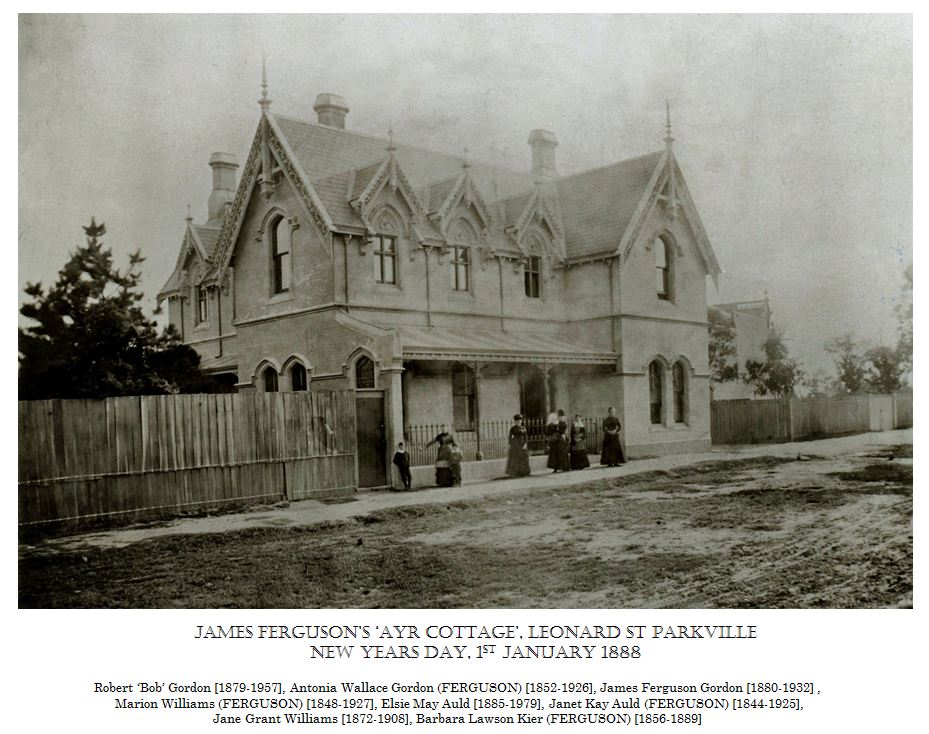
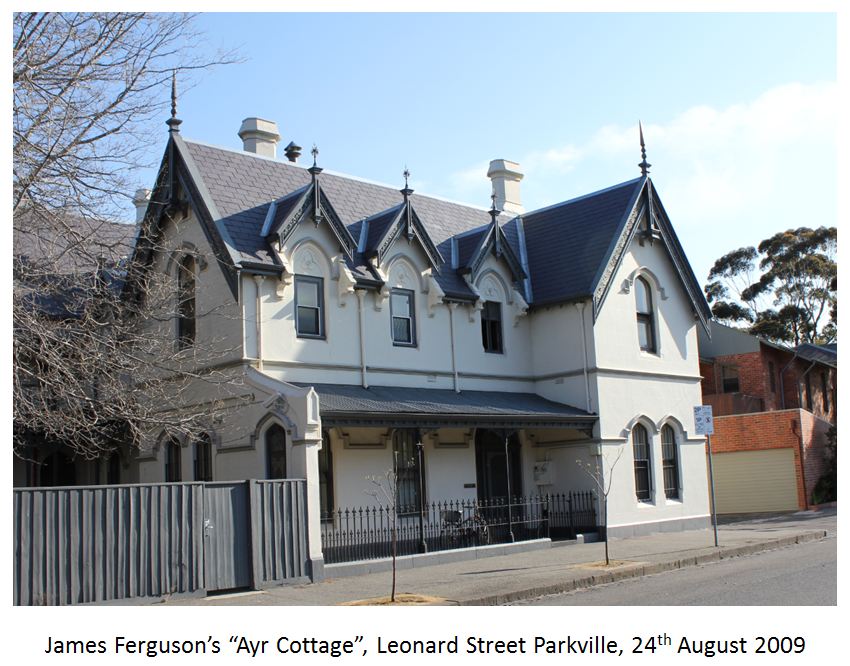
The photos in the slideshow depict James Ferguson’s ‘Ayr-Cottage’, in Leonard street Parkville, at five dates in its history, being the years 1888, 1901, 1963, 1966 and 2009.

This slideshow requires JavaScript.

The Argus, Melbourne, Saturday 29th June 1901, page 2.

“THURSDAY, JULY 4. At Eleven O’Clock Forenoon. On the Premises,
AYR-COTTAGE, Corner Leonard-street and Sydney-road, PARKVILLE
(Brunswick Trams Pass the Property).
Mr PURVES is instructed to SELL by AUCTION, as above,
The whole of the excellent HOUSEHOLD FURNITURE and other effects, comprising magnificent upright Grand PIANOFORTE, by Schwechten, in beautiful walnut case; cedar sideboard, telescope dining table, chairs, and sofa, in leather and haircloth; chiffonier, chimney mirrors, plated articles, china, &c,; also the complete furnishings of six bedrooms, including iron bedsteads and bedding, wardrobes, toilet tables, washstands, chamber ware; handsome oak hall table and chairs, four artistic stained glass window screens, oil paintings, engravings, carpets, linoleums, roller mangle, kitchen furniture and utensils, ferns, pot plants, and a large quantity of miscellaneous articles, as per catalogue. On view the day before sale, from twelve to four. Inspection invited. Australian-buildings, 49 Elizabeth-street. Tel 1776”

Note: Nothing further is known about the “stained glass window screens” mentioned.

Additional references:

Register of the National Estate 22 June 1993, place ID 16875, File 2/11/033/0494

Related posts:

1886: The History of ‘Ayr’ Cottage, 1 Leonard St. Parkville, Melbourne, Victoria.

08-10-1887: ‘Ayr Cottage’, 1 Leonard Street, Parkville, Melbourne, Victoria.

01-01-1888: The Ferguson Clan at Ayr Cottage, Parkville.

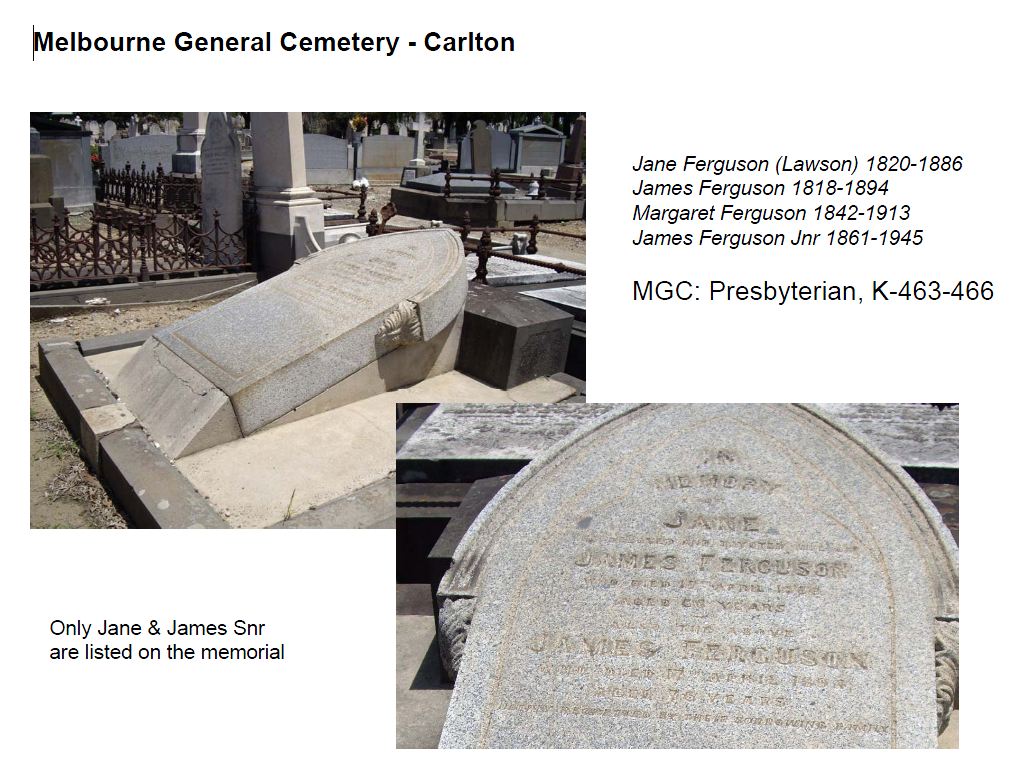
18-04-1894: James Ferguson (1818-1894)

© Copyright

19-04-1894: The funeral of James Ferguson Snr.

The Argus, Melbourne, Wednesday 19th April 1894, page 1.

“THE Friends of the late Mr. JAMES FERGUSON (of Ferguson and Urie, glass stainers) are respectfully invited to follow his remains to the place of interment in the Melbourne General Cemetery. The funeral will leave his late residence, Leonard street, Royal-park. Tomorrow (Thursday, 19th inst.), at 3 o’clock. ALFRED ALLISON, Undertaker, 221 Victoria street west, Melbourne; Mount Alexander road; Moonee Ponds; and Racecourse road, Newmarket. Telephone 980.”

Ayr Cottage, Leonard street Parkville (Royal Park), 1st January 1888

Ayr Cottage 2009


Related posts: 18-04-189420-04-1894

18-04-1894: James Ferguson (1818-1894)

From a family history perspective there is quite a lot known about James Ferguson, his family, and his colonial colonial stained glass company from North Melbourne.

I have many historical artifacts which include photographs, pieces of furniture, documents, and many other interesting items which make up a magnificent collection of colonial history as well as my own family history.

James Ferguson was born in Ayr, Scotland circa 1818. His parents were Janet Kay (1791-1860) and Master Slater & Glazier, James Ferguson Snr (1777-1886).

On the 13th of June 1841 he married Jane Williamson Lawson (1820-1886), the daughter of Gavin Lawson and Margaret Williamson and between 1842 and 1852 five girls and a boy were born in Wallacetown;
Margaret (1842-1913) who was mentally disabled from birth, Janet Kay (1844-1925), Jane Williamson (1846-1875), Marion (1848-1927) and Antonia Wallace (1852-1926). A son named James was born in 1851 but died as an infant in the same year.

On the night of the 1851 Scottish Census (30/31 March) his future business partner, James Urie, was recorded as a visitor at his cottage in John Street Wallacetown. Whether this was one of many meetings the two men would have to discuss their bold plans for the future can only be speculation but only nine months later their plans would come to fruition.

In early December 1852 James Ferguson was given a farewell party at the Robert Burns Arms Inn at Wallacetown prior to his departure for Australia.

“…After the usual preliminaries, Mr John Templeton, watchmaker, in neat and appropriate terms, proposed the health of Mr Ferguson and, in name of many friends, present and absent, presented him with a splendid purse containing 25 sovereigns…”

James and his younger brother David departed Greenock on the 12th of December 1852 aboard the ‘Tamerlane’ and after more than four an a half months at sea they arrived in Port Philip on the 29th of April 1853.  James’s wife Jane would remain in Wallacetown for two years with the children whilst James established the business in North Melbourne. She arrived  aboard the ‘Emma’ with the five girls in November 1855.

In August 1853 the first business advertisements for the company, “Ferguson & Urie”, began in the Melbourne Argus Newspaper. The rest of the Ferguson & Urie history forms the basis of this entire web site.

This slideshow requires JavaScript.

The Argus, Melbourne, Wednesday 18th April 1894, page 5.

“The death is announced of Mr. James Ferguson, the surviving partner of the well known firm of Messrs. Ferguson and Urie. Mr. Ferguson was a colonist of about 40 years’ standing, and for many years carried on business with his partner in Collins-street near the National Bank. Mr. Ferguson died at his residence, Parkville, early yesterday morning, at the advanced age of 84 [sic].”

(James Ferguson was 74 years of age at death).

The North Melbourne Advertiser, Friday 20th April 1894, page 2.

“DEATH OF MR. J. FERGUSON”

“We regret to have to record the death of Mr. James Ferguson, the surviving partner of the well known glass staining firm of Ferguson and Urie. Mr. Ferguson was a colonist of about forty years’ standing, and for many years carried on business with his partner, Mr. Urie (deceased about six years ago) [sic: 1890], in Collins Street, near the National Bank. Mr. Ferguson passed away at his residence, Parkville, early on Tuesday morning, his death being simply a decay of nature, as he was in his seventy-first year [sic: 74]. For the past four years the business of the firm has been carried on in Franklin Street and Curzon Street, North Melbourne. Mr. Ferguson was a member of the Presbyterian Church, and was much respected as a private citizen, but never aspired to enter public life. He died a widower, and leaves a grown up family. The funeral took place yesterday afternoon, deceased being interred in the Melbourne general cemetery and the cortege was followed by a large number of mourners. The body was conveyed to the grave in a panelled hearse, and enclosed in a plain coffin. There were three mourning coaches. Mr. Ferguson was buried in the Presbyterian compartment, the arrangements being carried out by Alfred Allison, of 221 Victoria Street, West Melbourne.”

Related posts:

19-04-1886: Jane Ferguson (nee Lawson) (1820-1886)

19-04-1894: The funeral of James Ferguson Snr.

1886: The History of ‘Ayr’ Cottage, 1 Leonard St. Parkville, Melbourne, Victoria.

08-10-1887: ‘Ayr Cottage’, 1 Leonard Street, Parkville, Melbourne, Victoria.

01-01-1888: The Ferguson Clan at Ayr Cottage, Parkville.

04-07-1901: The sale of Ayr Cottage, Parkville, Melbourne.

19-02-1874: The Hotham (North Melbourne) School of Art.


Short link to this page: http://wp.me/p28nLD-Jf

© Copyright

14-02-1891: Probate notice for Crawford Kier, son in law of James Ferguson.

Crawford Kier was the son in law of  James Ferguson who was a principal partner in the Ferguson & Urie stained glass company. Crawford married James’s seventh daughter, Barbara,  in North Melbourne on the 19th of May 1881. At one stage Crawford was employed in a managerial position with company.

There are certainly doubts that James Ferguson had confidence in the marriage between Crawford Kier and his daughter Sarah. In June 1885, four years after they married, Crawford was declared insolvent with the causes stated as; “Want of employment, and having borrowed money at a high rate of interest…” What is even more perplexing is that his father in-law James Ferguson employed him as a clerk with the Ferguson & Urie company,  yet in his his insolvency notice in 1885 he indicated he was unemployed! There were many other family members on the Ferguson and the Urie family lines who were employed with the firm and by all accounts everyone, even those not related, were regarded as family and everyone was looked after and supported. What happened with Crawford may never be known. On Monday the 15th June 1885, Crawford and Barbara’s home and furnishings at “Elizabeth Cottage” on Mount Alexander Road, Moonee Ponds (near the Ascotvale Hotel) was put up for auction by the Sherriff.

Crawford, Barbara, and their three children left Melbourne for Sydney where they departed for Scotland in early 1889 for a holiday (as family legend has it), but they would never return. Barbara died of Kidney disease at Bothwell, Scotland, on the 3rd of November 1889 and only a few months later Crawford died, also of kidney disease, on the 3rd of March 1890. Their three children, William, Mary and James were then brought up by James Ferguson’s widowed sister Marion Bishop (nee Ferguson), residing in Glasgow. They would never return to Australia. When their grandfather James Ferguson died in 1894 he made modest provisions for their upbringing and included the grandchildren and his sister Marion in his will of 1894.

The Argus, Melbourne, Saturday 14th February 1891, page 5.

“NOTICE is hereby given, that after the expiration of fourteen days from the publication hereof application will be made to the Supreme Court of the Colony of Victoria, in its Probate jurisdiction, by JAMES FERGUSON, of 10 Collins-street east, Melbourne, in the Colony of Victoria, glass-stainer, the duly authorised attorney under power of James Johnstone Kier, of 368 Saint Vincent street, Glasgow, Scotland, stained glass merchant; Andrew Malloch Bayne, of 28 Miller-street, Glasgow aforesaid, glass merchant; and Adam Young, of 193 Saint Vincent street, Glasgow aforesaid, writer, the executors named and appointed by the trust disposition and settlement bearing date the thirteenth day of October, one thousand eight hundred and eighty seven, of CRAWFORD KIER, sometime manager with Messieurs Ferguson and Urie, glass merchants, Melbourne, in the colony of Victoria, afterwards residing at Craigievar-house, Uddingston, Scotland, but lately of Woodlea-house, Uddingston aforesaid, glass cutter, deceased, that the CONFIRMATION of the nomination of James Johnstone Kier, Andrew Malloch Bayne, and Adam Young as executors aforesaid may be SEALD with the SEAL of the Supreme Court of the colony of Victoria. Dated this thirteenth day of February, one thousand eight hundred and ninety-one. ALEXANDER GRANT and SON, of Number 4 St. James’s Buildings, William-street, Melbourne, proctors for the said James Ferguson”.
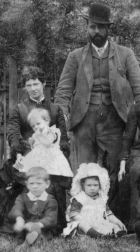
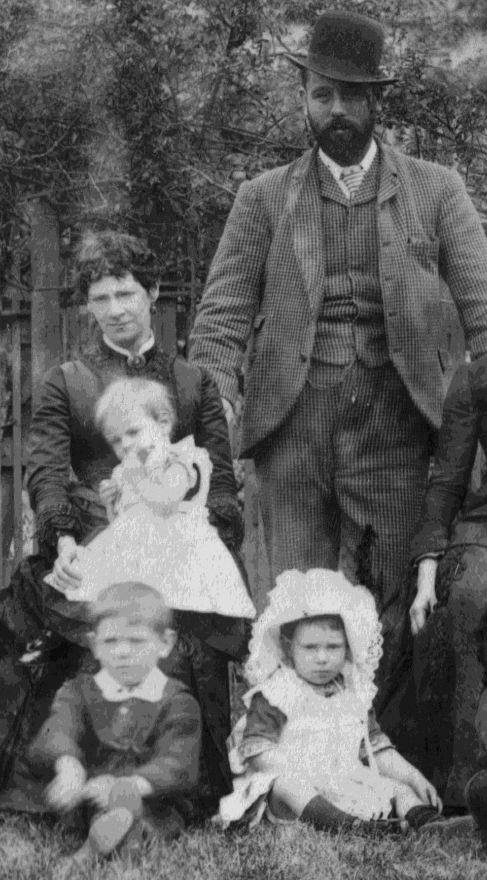
Crawford Kier & family at James Ferguson's Ayr Cottage, Parkville, Melbourne, 1st Jan 1888.

This photo is a subset of the Ferguson Clan photo from the family history collection. The original family photo shows thirty five family members on the east side of James Ferguson’s Ayr Cottage, Parkville, 1st January 1888. This portion shows Barbara Kier (nee Ferguson) 1856‐1889 , Crawford Kier 1858‐1890, James Ferguson Kier 1886‐1964,William Maitland Kier 1881‐1936, Mary Ferguson Kier 1884‐1946.

Crawford’s own ancestry was also in the stained glass trade. His grandfather, David Kier, was a master stained glass craftsman from Glasgow and had a stained glass business in Irvine with his sons as “David Kier & Sons”. After David’s death in 1864 the business was continued by the sons as “W & J.J. Kier” (William and James Johnston Kier).

The Presbyterian Church at Strathalbyn, South Australia, commissioned the Scottish stained glass firm W & J. J. Kier to create a stained glass window for their church in 1870!

The South Australian Advertiser, Adelaide, Monday 8th August 1870, page 2.

“The Glasgow Mail says:- ‘We have had an opportunity of inspecting, at the works of our townsmen, Messrs. W. & J. J. Kier, a memorial windows which they have just completed, and which is to be forthwith dispatched to Adelaide, to be erected in the Presbyterian Church, Strathalbyn, South Australia, in memory of the late Dr. Rankine. It is what is called a two-light window, the subject-in-chief of one of the compartments being a full-length figure of our saviour, and of the other a similar figure of St. John the Evangelist. At the base of the canopy are the inscriptions – ‘In Memory of Dr. John Rankine, late of Blackwood, South Australia. Died at Helensburgh, Scotland, March 15, 1864;’ and – ‘Erected by his sorrowing widow, Mary M. Rankine.’ On a lozenge-shaped shield forming the apex of the window is the family crest, with the motto, ‘Fortiter in Recte.’ As a specimen of what it purports to be true ‘stained’ glass art, as opposed to glass painting, or any other composite device, this window will compare favorably with anything of the kind hitherto produced in Scotland – and indeed, for the matter of that, we are quite convinced there is nothing finer to be seen in the Cathedral.”

Unfortunately it would seem that the stained glass window was never actually erected in the church and was summarily sent back to Scotland.

Southern Argus, Port Elliot, SA, Friday 9th June 1871, page 2.

“THE MEMORIAL WINDOW TO THE LATE DR. RANKINE.- We understand that the authorities of the Presbyterian Church in Strathalbyn have decided not to put in the memorial window lately presented by the widow of the late Dr. Rankine, and which arrived in the colony some few weeks since, and it will therefore, in accordance with Mrs Rankine’s instructions, be immediately returned to Scotland.”

On the 4th October 2012, Mr Brian Simpson from Strathalbyn wrote:

“Dear Ray,

Your email has been forwarded to me, as an amateur local historian with an interest in your subject. This is indeed a sad story!!! The window apparently arrived on board the “Glen Osmond” in late-Sept, 1870, & was seen by the members of the Session (the committee in charge of St Andrews Church, Strathalbyn), & promptly sent back to Scotland! The church & the town thereby lost what could have been its most valuable icon. The minutes of the Session meeting do not record what in particular they objected to. Perhaps they were affronted that the Rankine crest was placed above the figure of Jesus, rather than below? They refused to take the matter to a general meeting of the congregation, despite the fact that many were very interested. This precipitated the resignation from the Session of William Rankine, brother of John (fellow founders of the township of Strathalbyn in 1839).

Presumably, the window was returned to Mary Rankine (John’s widow) in Glasgow, at the earliest opportunity. I wonder who paid for its return journey? This story has fascinated me for years, & I have often wondered what became of that very valuable window. I have visited Scotland several times in the last several years, & had hoped to be able to track down that window. I wrote to the head offices of three branches of the Presbyterian Church in Glasgow, & to a museum/gallery of historic church windows, etc, in Glasgow. All replied in the negative. Perhaps the window is still in the possession of descendants of the Rankine family? I continue to wonder at the intransigence & stupidity of the Session at the Strathalbyn Presbyterian Church in 1870. Presumably, very few people ever saw that window to know what all of the fuss was about. The Session had previously agreed to accept the window, & were presumably looking forward to its arrival with great anticipation. What went wrong we will never know.  If you ever do locate the window, I & the rest of Strathalbyn, would be very pleased to hear about it. Good luck with your search. It hurts me every time I think about that lost opportunity!

Kind regards, Brian Simpson” – STRATHALBYN

Many thanks to Brian Simpson for his research and response on the subject of the Kier stained glass window.

Related posts: 14-06-1894: Probate lodged for the Will of James Ferguson


Short link to this page: http://wp.me/p28nLD-Hu

© Copyright


01-01-1888: The Ferguson Clan at Ayr Cottage, Parkville.

On the new years day in 1888 the Ferguson family clan assembled at James Ferguson’s ‘Ayr Cottage’ in Leonard street Royal Park (now Parkville) for festivities and a family photo.

The first photo shows the front of the house from Leonard street with eight of the family members out front and the second photos is of of the entire family on the east side of the house with James Ferguson in the centre with grey hair and bow tie.

The family photo was kindly contributed by Errol Vincent from New Zealand and he and his wife Ann also assisted with the extensive identification of all the family members in the photo.

This slideshow requires JavaScript.

Related posts:

1886: The History of ‘Ayr’ Cottage, 1 Leonard St. Parkville, Melbourne, Victoria.

08-10-1887: ‘Ayr Cottage’, 1 Leonard Street, Parkville, Melbourne, Victoria.

18-04-1894: James Ferguson (1818-1894)

04-07-1901: The sale of Ayr Cottage, Parkville, Melbourne.


Short link to this page: https://wp.me/p28nLD-EU

© Copyright

1886: The History of Ayr Cottage, Leonard Street, Parkville, Melbourne, Victoria.

In 1886 James Ferguson decided to build his family home, ‘Ayr Cottage’, on a block of land that he purchased some sixteen years earlier, on the 28th of June 1870, from a Mr Morton Moss.

James’s intention was to have the house built with the front facing Leonard Street, but this was objected to;

The Australasian, Melbourne, Vic, Saturday 13th February 1886, page 27.

Inquiries were recently made by the Minister of lands with regard to an alleged violation of the conditions under which the Royal-park frontages to the Sydney-road were sold by the department for building purposes. When the fee-simple of the land was parted with, it was stipulated that he allotments should not be subdivided, and that all buildings should be erected fronting the Sydney-road. It was reported to the Minister that Mr. Jas. Ferguson, of Messrs. Ferguson and Urie, was building a house on the back portion of one of the allotments, with the front to a side street leading from Sydney-road to the park. Mr. Tucker, on inspecting the plans, formed the opinion that the conditions of sale were being violated, and the Inspector-General of Public Works, to whom the matter was referred, endorsed this view. Mr. Ferguson has expressed his willingness to alter the plans so as to comply with the conditions, which he states, however, were not mentioned on the certificate of title received by him from the original purchaser of the allotment.”

Despite the objections by the Minister of Lands, Ayr Cottage was still built facing Leonard Street.

The construction of Ayr Cottage began in the latter half of 1886 and was completed in early 1887 by architect and builder Harry Lording. (Lording’s son, Frank Clifford, was also employed as a glass stainer with Ferguson & Urie).

The stained glass windows in Ayr Cottage reflect the personal preference of James Ferguson as  well as elements of his Scottish heritage. His obvious deep affection for the Scottish bard, Robbie Burns, is immortalised by a detailed depiction of his bust in the stairwell window.

Photos have been updated 19th June 2013. The older historical photos are from family history collections.

This slideshow requires JavaScript.

[View larger images]

Unfortunately James Ferguson’s wife, Jane (nee Lawson), never got to see the magnificent home. She died on the 19th of April 1886 at the former family home at 24 Little Curzon Street North Melbourne which James had purchased in 1853.

As far as I can gather, only James Ferguson Snr and his bachelor son James Jnr, and mentally disabled daughter Margaret had moved into Ayr Cottage when it was completed in early 1887. I suspect there was possibly a house-keeper but this is unconfirmed. At some point later, James’ sister in-law, Barbara Kennedy (nee Lawson 1821-1902), moved in after her husband had died circa 1890.

After James Ferguson’s death in 1894, Ayr Cottage was sold to the Lockington family who retained it for seven years. In 1901 the Victorian Neglected Children’s Aid Society purchased it and they retained it for the next 65 years.

In 1966 the Victorian Neglected Children’s Aid Society had considered the building no longer economical to continue repairs and tabled the options of either demolishing the house and rebuilding, or selling and buying elsewhere. Fortunately they opted to sell and it was subsequently purchased by the adjoining “International House”, the University of Melbourne, who still own it as at 2012. It is now known as Hilda Stevenson House.

Ayr Cottage still contains many original stained glass windows by Ferguson & Urie that were obviously of James Ferguson’s personal preference with the feature stairwell window containing a medallion of the Scottish poet, Robbie Burns which I suspect may have been the work of apprentice George James Coates. The fanlight window above the main Leonard street entrance, and the eastern entrance doorway, contain a depiction of the Scottish Thistle with a Bee hovering above which is the Ferguson Clan motto; Dulcius Ex Asperis” (Sweeter after difficulties).

The whole house contains an eclectic collection of stained glass which doesn’t seem to fit a particular theme in general. Some elements, such as the Robbie Burns window, and the bee hovering above the thistle have a right of way, but everything else appears random. Close inspection of various elements of the glass leads you to believe that James Ferguson’s windows comprise bits and pieces or leftovers from the workshops. There is practically every element of the company’s style depicted. Like the modern day Plumber who has his own house full of leaky pipes, the same principal seems to apply to the stained glass craftsman!

One of the photos in the slideshow of the stained glass windows depicts what appears to be a native bird, the ‘blue wren’. The background through my photo shows a modern 2013 city landscape and modern vehicles. What was the scene through that same window nearly 130 years ago?

Special thanks to Peter Cole, Deputy Head of College, International House, Parkville and Laurel Clark, Librarian/Archivist, International House, Parkville for the wealth of information and assistance they provided regards Ayr Cottage and it’s history.


Related posts:

08-10-1887: ‘Ayr Cottage’, 1 Leonard Street, Parkville, Melbourne, Victoria.

01-01-1888: The Ferguson Clan at Ayr Cottage, Parkville.

20-04-1894: James Ferguson (1818-1894)

04-07-1901: The sale of Ayr Cottage, Parkville, Melbourne.


Short link to this page: http://wp.me/p28nLD-DP

© Copyright