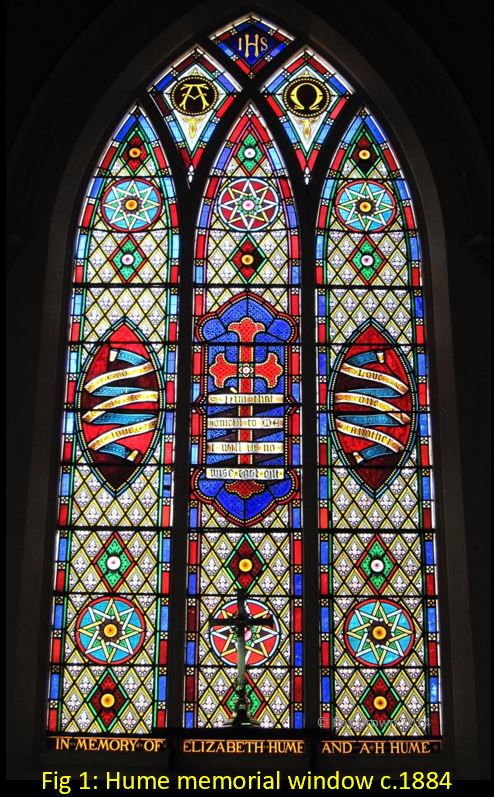
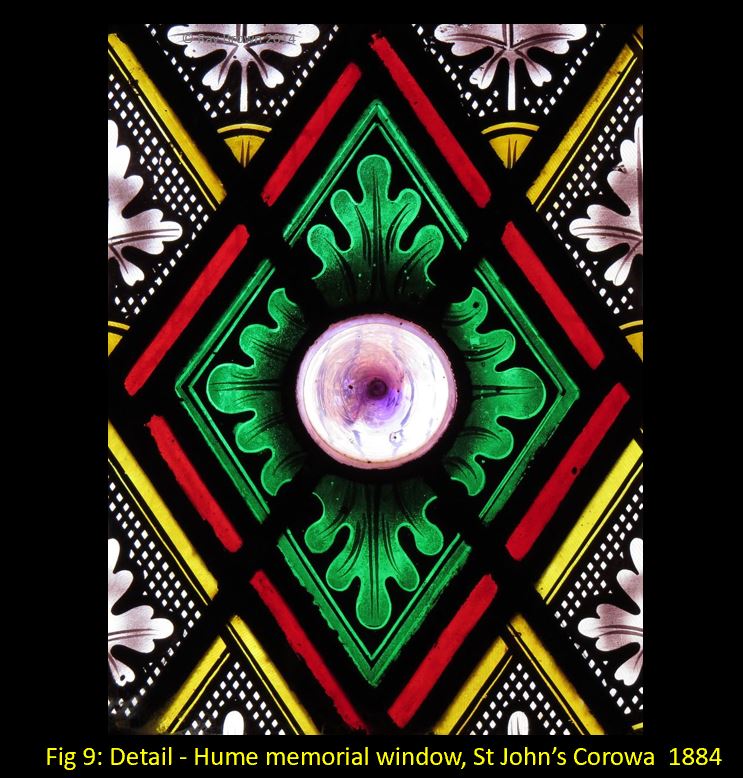
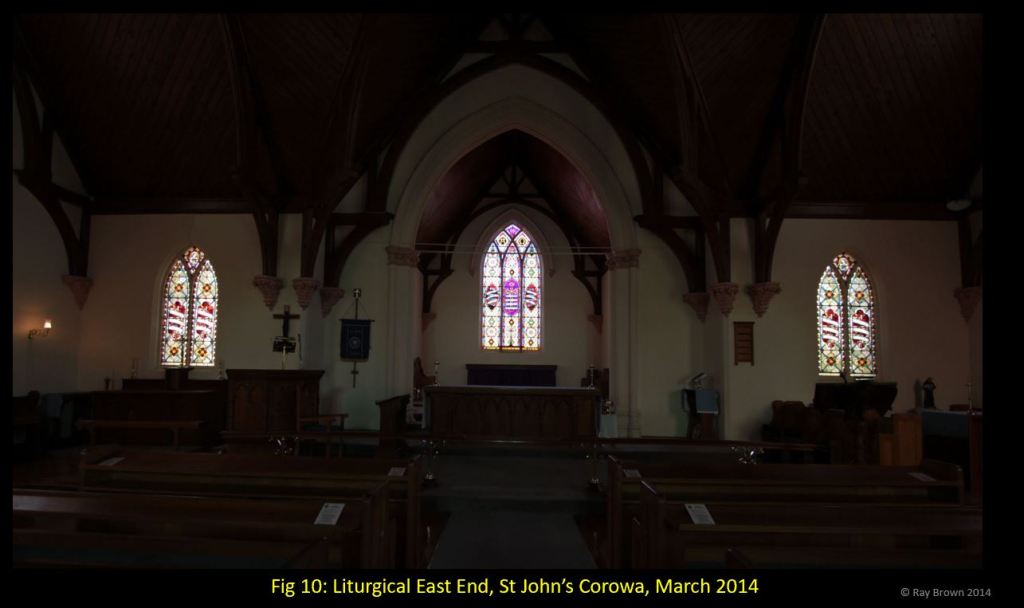
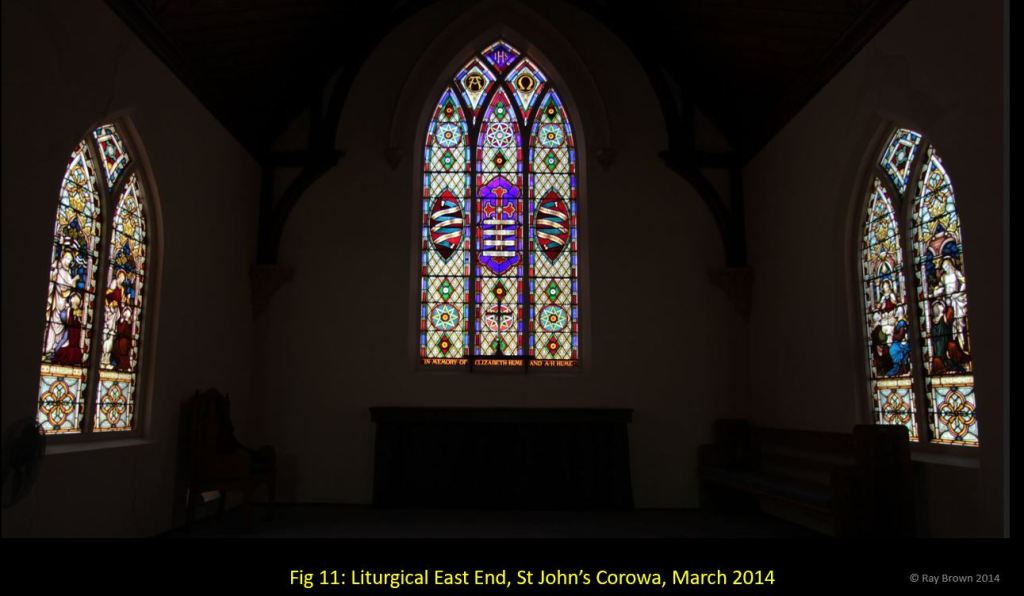
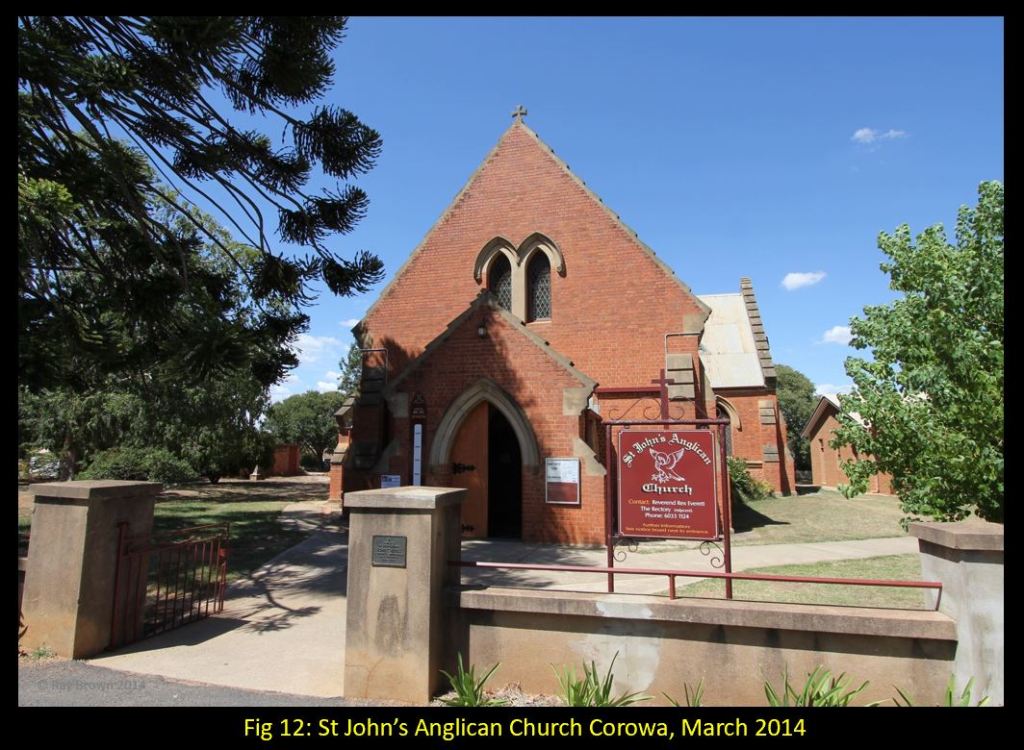
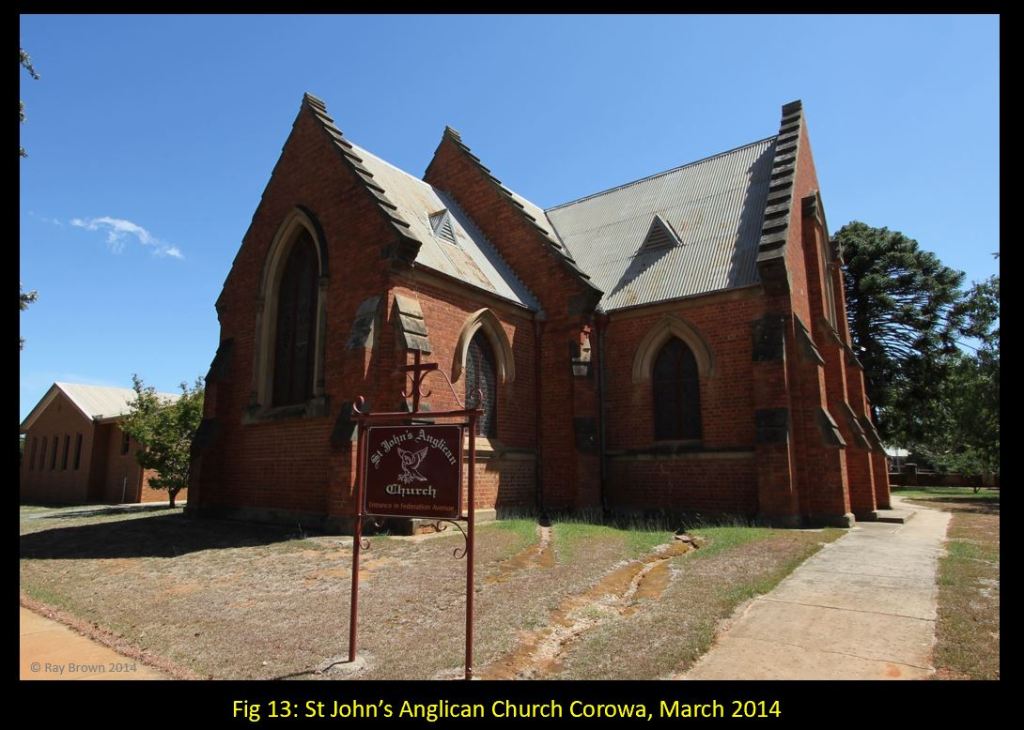
1884 St John’s Anglican Church Corowa, NSW.

In 1863 the first wooden Anglican church was built at Corowa and dedicated as St John’s. The land was donated by John Foord. Circa 1859 the area was known as North Wahgunyah and later changed to Corowa to differentiate it from Wahgunyah on the south side of the river in Victoria.

On the 25th of January 1884, a brief article appeared in the Corowa Free Press about a stained glass window being delivered for the new brick building of St John’s.

“…The memorial window for St. John’s Church, presented by the Misses Hume, has been delivered at Corowa, and its erection will be proceeded with shortly..” [1]

A week later the same tabloid reported that the window had been installed in the church but there were errors in the article:

“MEMORIAL WINDOW.- The window presented to St. John’s Church, in memory of Elizabeth and Andrew E. [sic] Hume, has this week been put into its place by Messrs. Armstrong and Johnson – free of cost. It is a very beautiful piece of workmanship, and was executed to the order of the Misses Hume, by Messrs. Ferguson and Wise [sic], of Melbourne.”[2]

Slide show: Images were taken in March 2014:

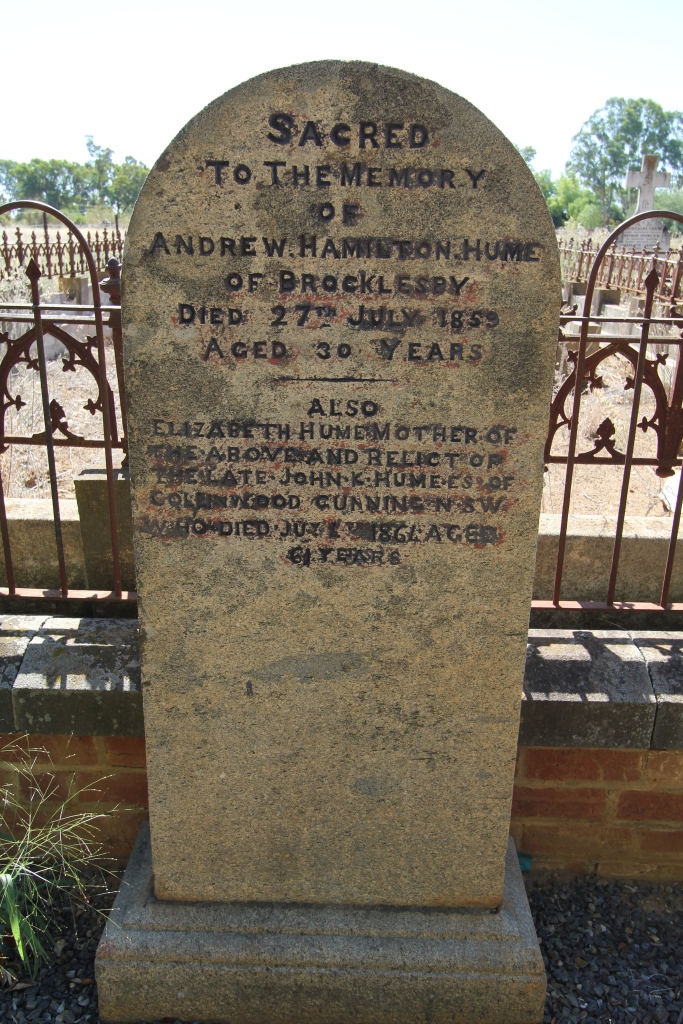
The window was dedicated to Andrew Hamilton Hume (1828-1859) and his mother Elizabeth (nee O’Neill 1802-1864). Andrew’s father was John Kennedy Hume (1800-1840) who was shot by bushrangers at Gunning, NSW, 20th Jan 1840 [3]

The newspaper incorrectly named the stained glass company as ‘Ferguson & Wise’. There was no stained glass company of that name anywhere in Australia. The window is accurately attributed to the ‘Ferguson & Urie’ stained glass company of North Melbourne. This company started out as a plumbing, slating, and glazing business, in Curzon Street North Melbourne in 1853 by Scottish immigrants, James & David Ferguson, and James Urie. In 1861 they transformed the company towards commercial glazing and stained glass production and for the next thirty-nine years, they made ecclesiastical and secular stained-glass windows.

After confirming with Rev Canon Rex Everet at St John’s in March 2014 that the window still existed, A trip to Corowa was next on my ‘To Do’ list.

A tabloid report in August 1896 gives an account of the Church and mentions stained glass windows by other studios from New South Wales:

“…The older portion of the building was erected about twenty-five years ago by Mrs. Bladen Neill in memory of her husband, Lieutenant-Colonel Neill; the newer parts of the structure dating from some eleven years back. The church is cruciform in shape, and has a highly ornamental interior. The roof is of Murray pine diagonally laid, the massive worked principals supporting the same resting on artistically designed corbels. The stained glass windows, mostly presents from various residents, and costing over £250, largely enhanced the solemn beauty of the interior. The windows on each side of the altar, representing four scenes of the resurrection, are from designs supplied by the vicar, the Rev. William Clark Hose, and admirably executed by Messrs. Asher [sic] and Falconer[4], of Sydney. The three-light east window is in memory of Elizabeth and A. H. Hume, old and esteemed residents of the district. In the transept is a large three-light window in memory of Mr. Ross Ramsay, of Narrow Plains Station. Of the four lesser windows, one was presented by the late Bishop Linton; another by the Rev. W. Swindlehurst, of West Maitland, in memory of his deceased wife; and the remaining two by the Sunday School children…”[5]

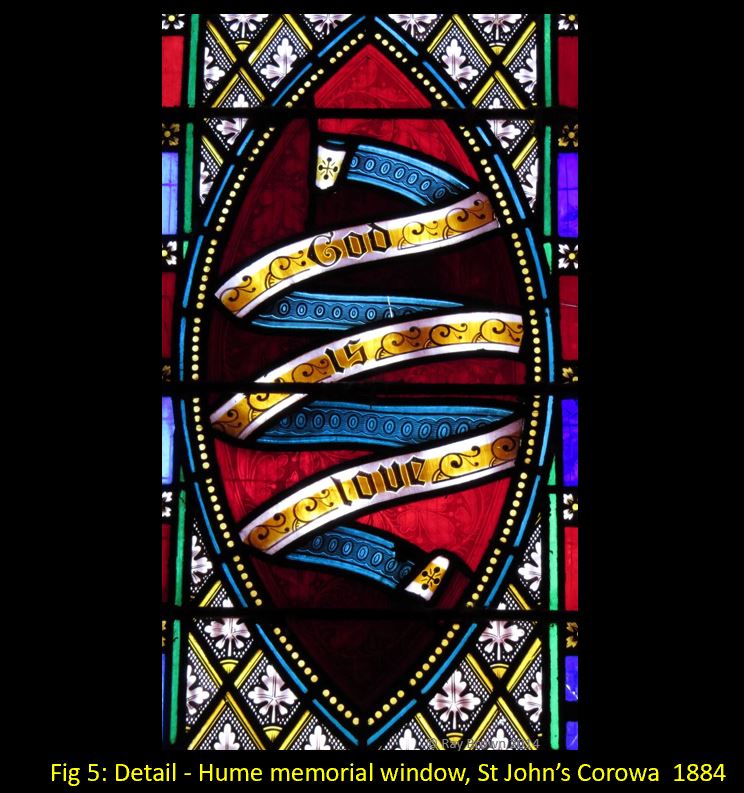
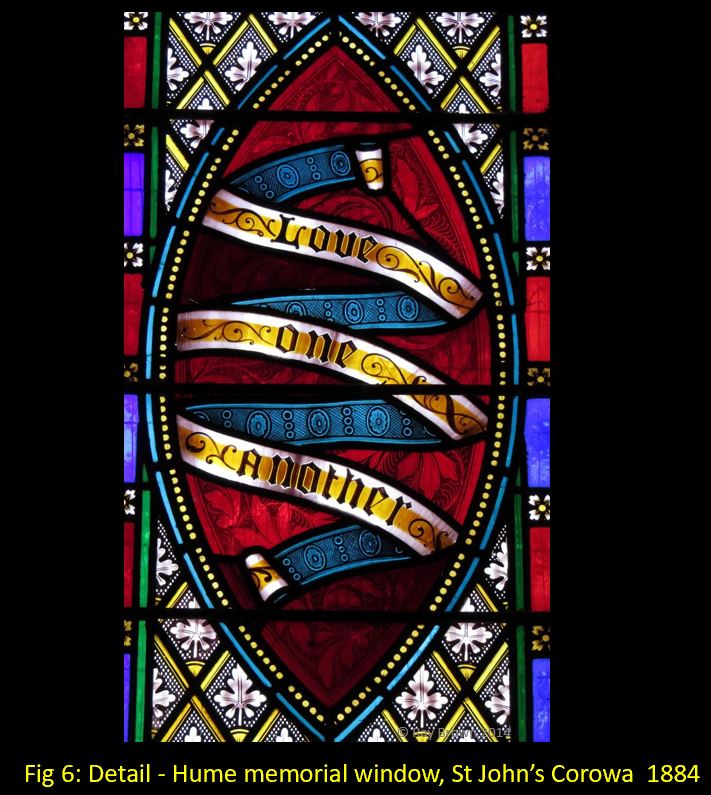
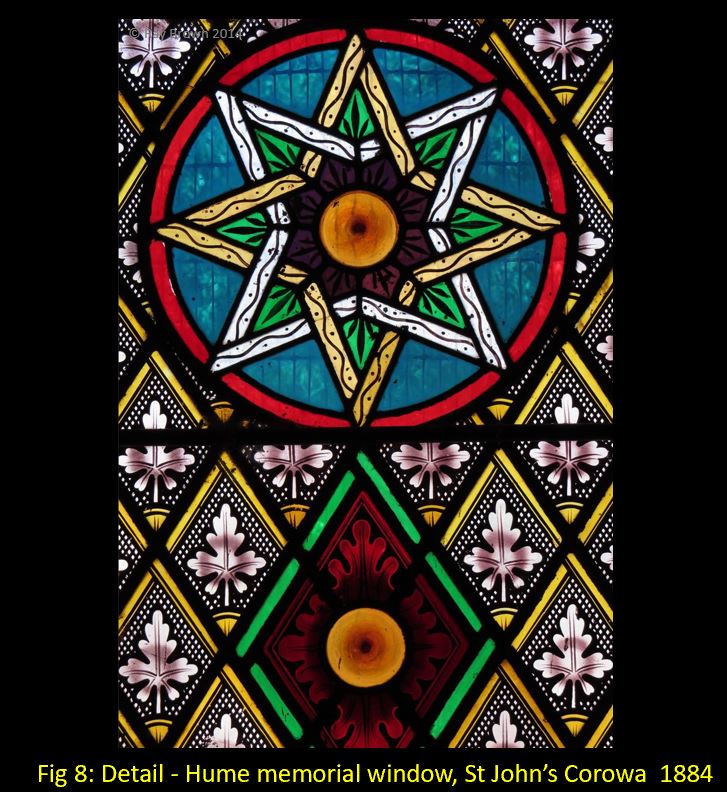
The Ferguson & Urie window in the chancel follows the company’s decorative style from their 1870s period of geometric patterns and scrolling ribbons with text from the bible. This window wasn’t made by the company’s first two pioneering stained glass artists. The artist who joined the firm in 1861, John Lamb Lyon, had left Ferguson & Urie in 1873 to form the Lyon & Cottier company in Sydney, and David Relph Drape died in 1882. This leaves two of the company’s earliest apprentice glass painters, Charles William Hardess and Frank Clifford Lording as the likely suspects who had a significant role in the window. There is no figurative work depicting any human form in the window, it has been copied faithfully from variations of their catalogue of designs over the previous twenty years, which Hardess and Lording would have been very familiar with producing.

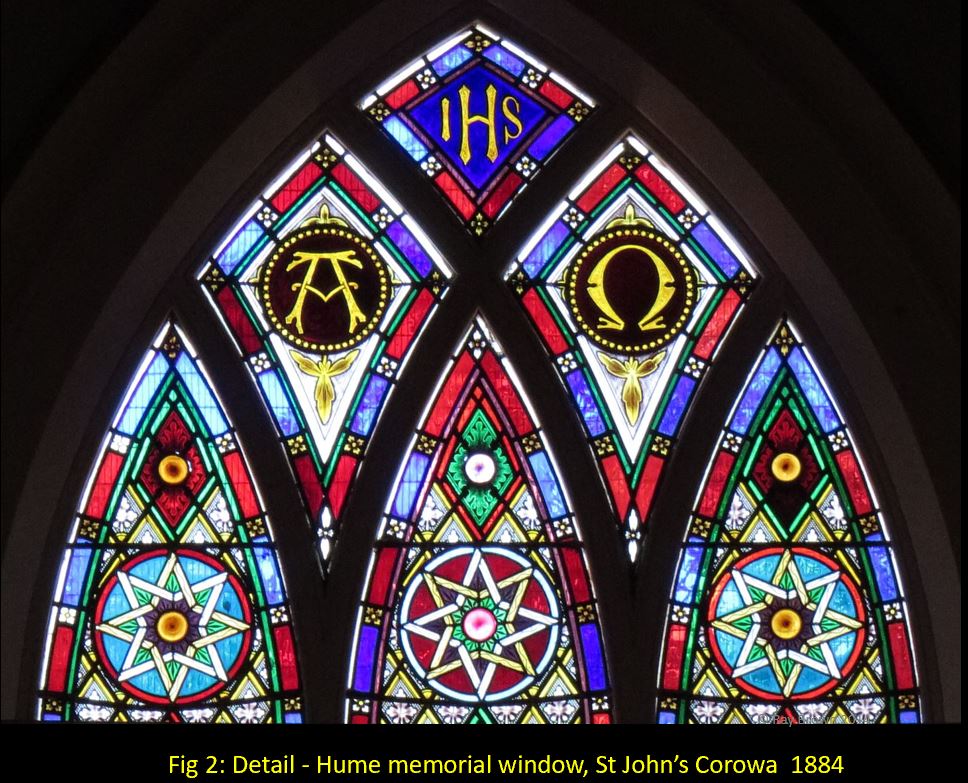
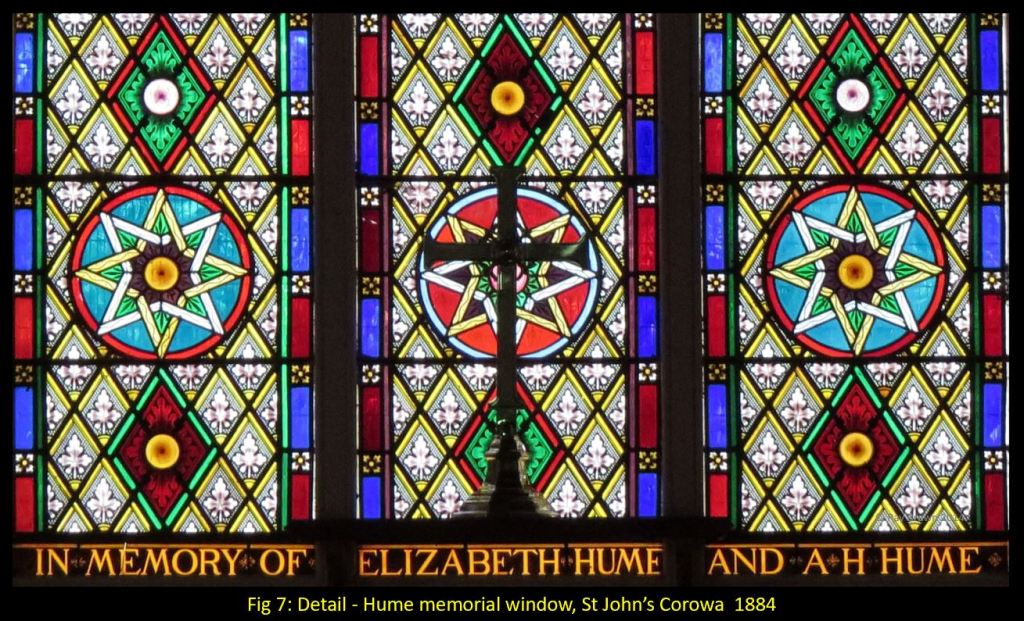
At the top of the window above the three lancets is a window with the letters “I.H.S”, a monogram symbolizing Jesus Christ. Below this are two windows with the Greek Lettering for “A” and “O” representing Alpha and Omega and meaning the Beginning and the End.

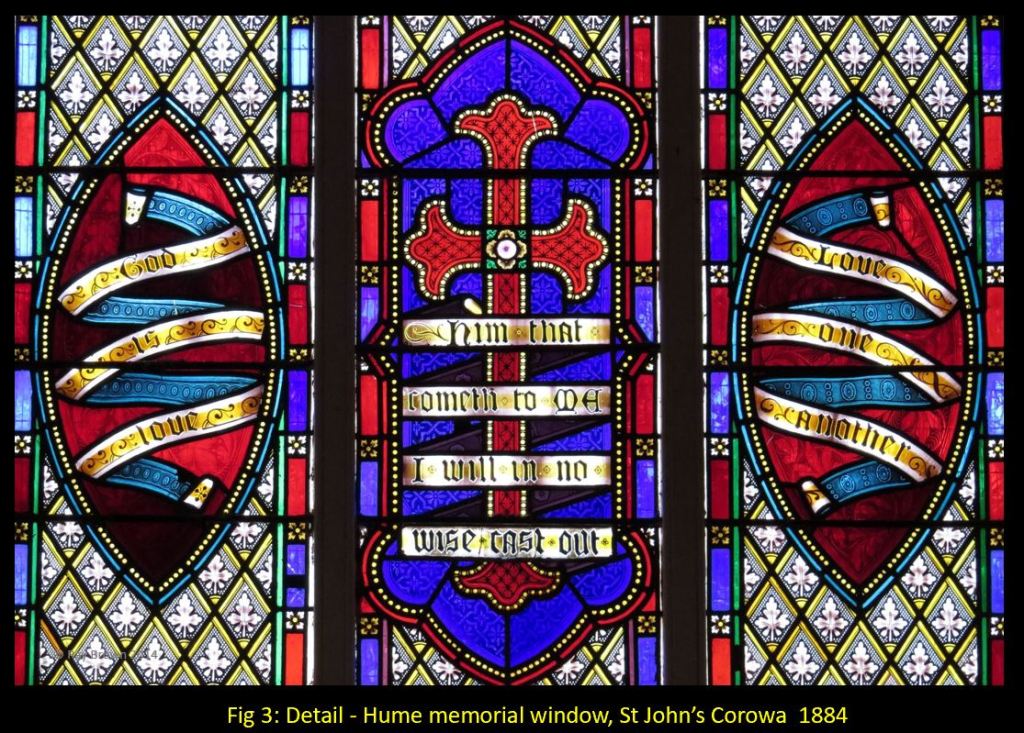
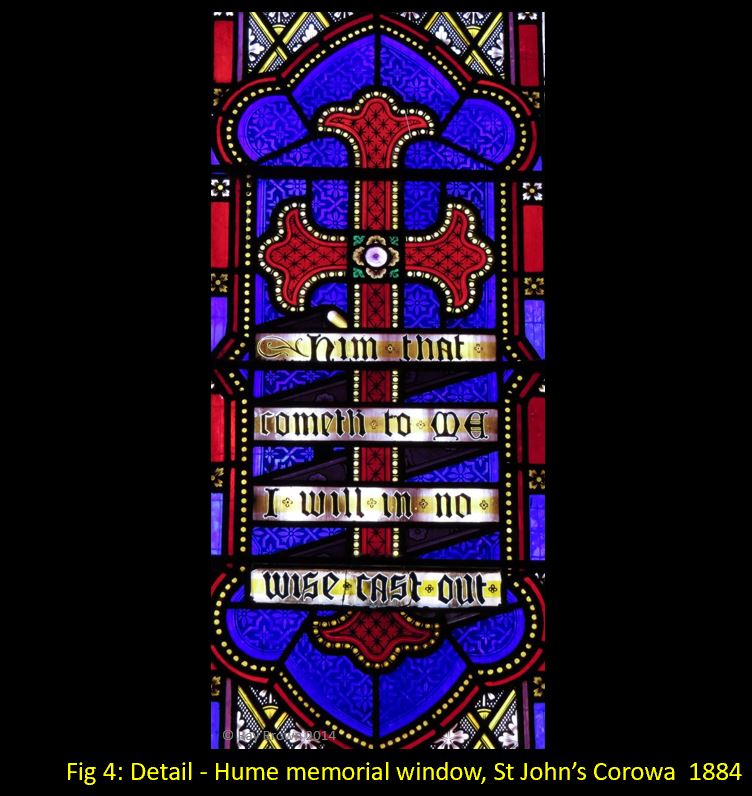
The centre light in the window contains a beautiful gothic decorated crimson cross on a sapphire blue background. The cross and the backgrounds have finely detailed sgraffito work picked out to reveal tiny stars. A ribbon scrolling around the cross has the words “Him that cometh to me I will in no wise cast out”. The left light contains a crimson pointed ellipse with leaves and fronds with a scrolling ribbon with the words “God is Love”. The right light is the same design but has the words on the ribbon “Love one Another”.

The memorial text at the base of the window states: “IN MEMORY OF ELIZABETH HUME AND A.H. HUME”.

The Hume memorial window in the chancel is the only Ferguson & Urie window in the church. The windows flanking it in the chancel were made by the Sydney firm of Ashwin & Falconer and are a distinctively different style. , but in the nave, there are other windows that would trick you into believing they are also Ferguson & Urie windows. They’re not, and the reason these are similar-looking windows is that they are the work of Lyon & Cottier of Sydney. Lyon, mentioned earlier, was the Ferguson & Urie glass painter at North Melbourne between 1861 and 1873.

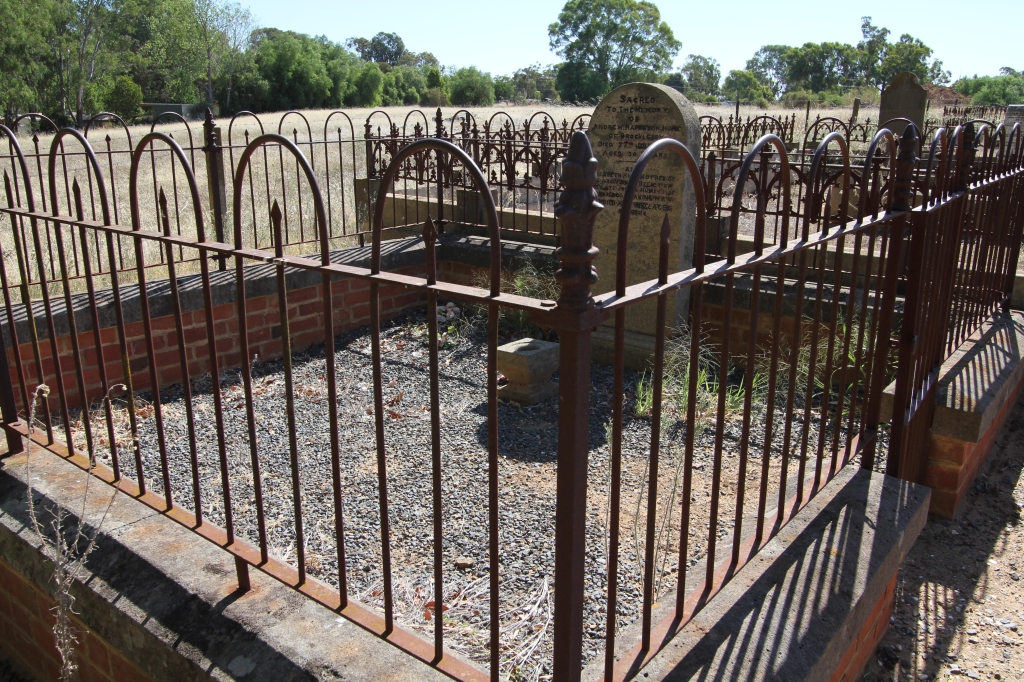
Andrew Hamilton Hume died at his station, Hume River, at age 30, on the 27th of July 1859[6]. His mother, Elizabeth (nee O’Neil 1802-1964) died 4th July 1864 at Yarrawonga in Victoria. Andrew and his mother are buried at the Corowa cemetery.

The Ferguson & Urie window was restored in 2015 at a cost of $25,000.

St John’s has an extraordinarily diverse range of stained glass windows by different artists and studios spanning nearly a century and a half. The windows from the late 1800s and early into the 1900s are by Ferguson & Urie, Ashwin & Falconer, and Lyon & Cottier. The modern-styled windows are by artists such as Bowers & Wilkins and Leonie Le Cornu.


Footnotes:

[1] The Corowa Free Press, NSW, Friday 25th January 1884, page 2.

[2] The Corowa Free Press, NSW, Friday 1st February 1884, page 3.

[3] The Sydney Morning Herald, NSW, Monday 27th January 1840, page 2.

[4] Aswin and Falconer, later Falconer and Ashwin, and F. Ashwin & Co.

[5] Australian Town and Country Journal, NSW, Saturday 8th August 1896, page 27.

[6] The Argus, Melbourne, Vic, Tuesday 9th August 1859, page 4.


Short Link to this page: https://wp.me/p28nLD-39y

© Copyright

1874: St John’s Anglican Church, Ballan, Victoria.

The foundation stone of St John’s Anglican Church in Ballan was laid by Juliet Vivian Lyon (nee Anderson) in 1861. Thirteen years after that historical event Juliet died and in late 1874 a stained glass window was erected in her memory in  the chancel of St John’s. The window was made by the Colonial stained glass craftsmen Ferguson & Urie of North Melbourne.

Photos taken 10th April 2011.

This slideshow requires JavaScript.

[View larger images]

Juliet was born at Norfolk Island on the 10th Feb 1839, the daughter of the decorated army officer Joseph Anderson (1790-1877) and Mary Campbell. Her father Joseph was was stationed as commandant of the Norfolk Island Penal Colony from March 1834 to February 1839. One of his first duties on Norfolk Island was to dispense the punishment for the Norfolk Island Prisoner revolt in 1834 in which thirteen of the twenty-nine convicted prisoners were executed.

Juliet married pastoralist Charles Hugh Lyon (1826-1905)[1] at St Paul’s church in Melbourne on the 30th December 1859[2] . They settled at Hughe’s ‘Ballanee’ estate at Ballan where they had five known children; Clara, Lily Mary, Violet Mary, Vivian Hugh and Charles Gordon.

In 1861 Juliet had the honour of laying the foundation stone of St John’s Anglican Church in Ballan. Very little information is known of this event other than Juliet had laid its foundation stone as mentioned on her memorial stained glass window, and the obscure mention that on the 29th January 1862 the Church was reported as being near completion[3].

Juliet died at her father’s residence ‘Fairlie-house’ in South Yarra on the 16th of March 1874, aged 35[4]. She was buried with her parents, Joseph and Mary Anderson, in the St Kilda cemetery on the 17th March 1874 and her husband Hugh was also buried them in 1905.

The Ferguson & Urie stained glass window was erected to her memory in St John’s, thirteen years after she had laid its foundation stone.

The two-light stained glass window depicts ‘Faith & Hope’;

The left lancet depicts an angel at the top carrying a banner with the words ‘HALLELUJIA’. Below is the depiction of Faith carrying a cross with her right hand held towards heaven. The text below the figure is ‘HAVE FAITH IN GOD’ and below this is another angel carrying a banner with the text; ‘BLESSED ARE THE DEAD’

The right lancet depicts an angel at the top carrying a banner with the words ‘PRAISE THE LORD’. Below is the depiction of Hope with the ships anchor and below this is another angel carrying a banner with the text; ‘WHICH DIE IN THE LORD’

Across the base of both windows is the memorial text:

‘IN MEMORY OF JULIET VIVIAN LYON WHO LAID THE FOUNDATION STONE OF THIS CHURCH IN 1861.’

The Australian News for Home Readers, Vic, Saturday 18th March 1865, page 7.

BALLAN St John's 98c

“EPISCOPAL CHAPEL AT BALLAN,

The neat little building, shown in the engraving, is the newly erected Episcopal Chapel, at Ballan, a distance of about sixty miles from Melbourne. The building has been raised solely by the exertions of the congregation, and is a pleasing instance of the progress of Christianity in the provincial districts of Victoria. The chapel belongs to the Gothic order of architecture, and is commodious enough to meet the requirements of the Episcopalians of Ballan. The nave is 57 feet by 25 feet in extent, and chancel 10 feet 3 inches by 21 feet.”

Juliets’ husband Charles died at ‘Ballanee’ estate at Ballan on the 13th February 1905 aged 79[5].

In the historical engraving depicting St John’s from 1865 it shows  a ‘Pugin’ type bell-cote at the west end and a small side building at the east end which is presumably a vestry. Neither of these exist to this day.

The left lancet of the Ferguson & Urie window which depicts ‘Faith’ is taken from a famous oil painting by Sir Joshua Reynolds (1723-1792) and replicated in a stained glass window by Thomas Jervaise at Holy Trinity, Fareham, Hampshire, England. There are three other known instances of this depiction of ‘Faith’ in Ferguson & Urie windows which are located at All Saints, South Hobart; Christ Church, Hawthorne; St Mark’s, Remuera, New Zealand.

In 1883 another Ferguson & Urie window was erected in St John’s to the memory of Rebecca Mary O’Cock. See: 10-03-1883: St John’s Church, Ballan, Victoria.

Location: Simpson Street Ballan

Footnotes:

1872: St John’s Anglican Church, Raymond Terrace, New South Wales.

In late November 1872 a magnificent three-light stained-glass window was unveiled in St John’s Anglican Church at Raymond Terrace in New South Wales.

“…It is due to the firm of Messrs Furgusson [sic], Urie, and Lyon, of Melbourne, to say that the window is regarded as a beautiful specimen of Australian art, which will favourably compare with works of a similar character executed in England…” [1].

The window was crafted by the North Melbourne stained-glass firm ‘Ferguson, Urie, and Lyon’ for £80 and was erected in the chancel in memory of the district pioneer and geologist William Keene.

Photos were taken October 2013 and have been kindly contributed by Michaela Sorensen. The historic photo of the chancel and window was taken by the Rector of St John’s, the Rev Norman Alfred Pullin (1913-1983), during his incumbency of St John’s circa 1949-52 [2].

This slideshow requires JavaScript.

St John’s Anglican Church is located at Raymond Terrace, 167km North of Sydney and 26km North of Newcastle in New South Wales.

The church was built on land formerly owned by the Cafferay[3] family and was constructed of locally quarried stone to the designs of architect Edmund Blacket for £1500. It was consecrated by the Bishop of Newcastle, William Tyrell, on Thursday the 25th September 1862[4] and the first incumbent was the Rev John Roe Blomfield.

After the death of William Keene in 1872 it was resolved that a memorial stained-glass window should be erected to his memory in St John’s. One of the lead organisers of the creation of the window was Henry Bayes Cotton (1820-1906)[5], a well-known and respected manager of the National Bank of New South Wales at nearby Newcastle.

The craftsmanship of the window was entrusted to the Ferguson, Urie and Lyon[6] Stained-glass Company of North Melbourne in Victoria. The biblical theme represented in the window being, in the centre light, the Nativity, Crucifixion and the Resurrection. The flanking side lights had the inscription beneath each figure being, ‘Teach the Ignorant,’ and ‘Help the Helpless.’

The window was erected in the chancel of St John’s and was unveiled in late November 1872. The ‘Maitland Mercury’ of the 3rd December 1872 provided a detailed description of the historic window;

“…Commencing at the foot of the light, there is the scene of our Saviour’s birth. In the centre of the light is represented the Crucifixion, and this is again surmounted by the Resurrection. These subjects are all taken from the old masters, and are beautifully executed. The intermediate spaces are occupied with chaste and varied medallions, and the sacred monograms, I.H.S. In the right side light there is an admirably designed and well finished group, representing a venerable teacher engaged in instructing those around him; the countenances of this group are peculiarly pleasing. In the left side light is likewise a corresponding group, consisting of a benevolent person, and a female figure of benign aspect, engaged in receiving orphan children…”
“…The inscription at the base of the memorial is, “To the Glory of God, and in memory of William Keene, 1872”
[7]

Just over a century later the chancel of St John’s had to be demolished and the window, now more than a century old, was considered to be in a fragile condition and was subsequently removed and stored in the rectory of St John’s. The repairs to the sanctuary and extensions to the chapel and vestry were completed in 1975 [8] and, later, at the instigation of William Keene’s great granddaughter, Annette Keene Holloway, funds were raised from family members and parishioners of St John’s to repair and re-erect the windows. Because there was no longer a position in the chancel for the windows to be re-erected in their original configuration, they were refashioned into five single lights and re-installed along the south wall of the nave.

“A stained glass window depicting the nativity, Life and Crucifiction [sic] was erected in St. John’s Church in memory of Great Grandfather William Keene. Later I heard it had been removed and the opening cemented up. I wrote to the Rev. Sores and he replied that the window had been in bad repair and in danger of being broken. Raymond Terrace was a poor parish without the money to restore the damage so the windows were stored in the Rectory. I wrote to my cousins who sent money. Other parishioners did too and the windows were re-installed on the side wall of the church where they can still be admired as a link with early colonial days.”[9]

Mr Don Denham, Parish Secretary of St Johns, Raymond Terrace, provides further insight as to the time line of the historical windows:

“In the late 1960’s the original sanctuary/ chancel of the church was demolished and in the 1970’s a new sanctuary/ chancel and side chapel were constructed of modern design. In the new construction there was no east window to house the windows and so they were placed in the five small lancet windows of the southern side of the nave”.

“… the complete east window fitted perfectly into the nave windows and the completed affect is quite pleasing…”

“…The windows have been recently restored and we are planning the rededication service for 20 October this year”.[10]

The most recent conservation work on the windows was carried out in 2011 by Ron Jensen, of Heritage Stained Glass at New Lambton in New South Wales. Only two of the five windows required attention, being the one at the south west corner titled “Teach the ignorant” and the centre window of the five titled “Death” which depicts the Crucifixion.

The five individual windows, from left to right along the south wall are;

“Help the Helpless”, “Birth” (Nativity), “Death” (Crucifixion), “Resurrection” and “Teach the Ignorant.”

Each of the reconstructed windows retains the original 1872 Ferguson & Urie figurative stained glass work depicting the five biblical scenes. Each scene has two of the original decorative quatrefoils below it. These quatrefoils are of varying colours with gothic floral designs of yellow and white flowers in the centre, surrounded by a stylized depiction of the passion flower with the stamen in each of the four lobes.

The background quarries of glass surrounding the figurative scenes and quatrefoils are no-longer original and are now of varying sized rectangular and diamond shapes in soft pastel colours. The monogram described as containing the letters “I.H.S” originally appeared between the nativity and Crucifixion scenes in the centre light of the window but this no longer exists. The memorial inscription at the base of the window now has the year ‘1872’ in the far left light which in its original configuration appeared immediately after William Keene’s name (To the Glory of God, and in memory of William Keene, 1872”).

There are many cases of our historic stained-glass artefacts that no longer exist after more than a century and a half. Some of the historic churches have met their demise by fire, demolition, or have been sold to private enterprise over the last 150 years and in many cases their original artefacts and stained-glass windows have been lost. St John’s church at Raymond Terrace represents a rare example of the dedication of the parishioners and Keene family descendants to save the historic windows so they still have a reminder of their pioneer heritage.

In September 2012 St John’s celebrated its 150 year anniversary and the re-dedication of the Keene memorial stained-glass windows will occur at St John’s on the 20th October 2013.

William Keene (1798 – 1872)

William Keene was born at Bath, in Somersetshire, England, c.1798. His English ancestry associates him with ‘The Bath Journal’ of London, founded in 1742. The tabloid was later known as ‘Keene’s Bath Journal’ circa 1822 which remained in the Keene family until c.1916 before being absorbed by the ‘Bath Herald’.

William Keene initially trained in the medical profession but his interests in geology were his passion and he changed his career to become a geologist and mining and civil engineer. Circa 1822 he left for France where he gained a prestigious appointment with the French government;

“…in connection with some salt mines in the Pyrenees. His services, highly esteemed by that government, brought him an order and a pecuniary grant…[11]

Keene later became a ‘Fellow of the Geological Society’ in London[12] which entitled him to the prestigious post nominal of ‘F.G.S’. On the 13th August 1822 William was married to Sarah Charles Evans (1804-1867) at the British Embassy Chapel in Paris[13] by the Chaplain Edward Forster. The Keene’s had a long association with France where many of their children were born. During their time in France William gained a passion for the French style of wine making which would become an interest for the rest of his life. At the beginning of the French Revolution in 1848 they returned to England[14].

Circa 1852 William migrated to Australia with his family and on the 12th December 1854 he was appointed as Government Examiner of Coal Fields in New South Wales[15] and in 1856 promoted to Government Geologist[16]. His geological interests allowed him to amass a significant collection of mineral specimens and fossils which he displayed in 1858[17] and in August 1859 the collection was on public display at the military barracks in Newcastle[18].

In 1861 William Keene’s extraordinary collection of geological specimens was singled out for particular attention at the Sydney Industrial and Art Exhibition;

“To the collection of Mr. W. Keene, Government examiner of coal fields and mines, it is desirable to invite particular attention. It is on the north side of the upper gallery, and consists of some valuable specimens from our gold, copper, lead, iron, and coal fields, and some remarkable fossils, the whole having been collected by himself, and chiefly in the counties of Hunter and Argyle…”[19]

Over a twenty year period William Keene wrote several papers on the subject of fossils and authored a significant number of Government reports on Colonial mineral wealth and mining.

William Keene was a staunch supporter of the Church of England and in his position as the first acting Registrar of St John’s he read the petition for the consecration of the church, which he had the honour to perform shortly after 11am on Thursday the 25th September 1862[20].

William Keene was a member of the Newcastle Church Diocese, Local School Board, and Founder and Treasurer of the Clergy Widows and Orphan’s Fund[21]. He was elected President of the Newcastle School of Arts in 1869[22] and he laid the foundation stone of that school on the 8th April 1870[23].

Aside from his geological interests he was renowned in the Hunter River area as a viticulturist and vintner, who passionately advocated the French style of vine-growing in the district. He was also an active member of the Hunter River Vineyard Association, of which he was president in 1865-66[24], and also a member of the Agricultural Association[25]. His experience in this field often saw him called upon to act as a wine-judge at the regional exhibitions[26].

William Keene died at his home, ‘Kingsmead House’, in Raymond Terrace on the 2nd February 1872[27] and was buried in the Raymond Terrace Cemetery. His wife Sarah predeceased him on the 2nd of July 1867[28].

Henry Bayes Cotton (1820-1906)

Henry Bayes Cotton is recognised as one of the principal promoters in having the Keen memorial window erected in St John’s in 1872.

“…It cannot fail to give great pleasure to H. B. Cotton, Esq., of Newcastle, who has taken a large amount of trouble and interest in accomplishing the work; and the friends of the deceased must be greatly gratified and comforted when they gaze upon this tribute of respect and affection to their departed relative…”[29]

Henry Bayes Cotton arrived in the Colony circa 1839 and was appointed as the first manager of the Bank of New South Wales at Geelong circa 1854 and in 1863-64, appointed as first manager of the Newcastle branch[30] in New South Wales where he remained until his retirement in early 1888.[31] Although retired he maintained an interest in financial affairs and in 1893 he was appointed a director of the New South Wales ‘de Piété Deposit and Investment Company.’[32]

Like William Keene, he was a staunch supporter of the Church of England and was also for many years a lay reader and active member of the Synod[33].

The association or friendship between Keene and Cotton is not specifically known but it is reasonable to assume that they knew each other well as Cotton was also involved in the establishment of the Newcastle School of Arts[34] with William Keene, who had laid the foundation stone of that school in 1862 and both were parishioners of St John’s at Raymond Terrace with Cotton actively involved in the choir of St. John’s.

Henry Bayes Cotton left Newcastle and retired to the Sydney suburb of Hunters Hill where he died aged 86 at his residence ‘Fig Tree’ on the 15th January 1906[35]. His wife Rachel predeceased him, 18th April 1903, aged 78[36].

The Maitland Mercury & Hunter River Advertiser, NSW, Tuesday 3rd December 1872, page 3.

“MEMORIAL STAINED GLASS WINDOW IN ST. JOHN’S CHURCH, RAYMOND TERRACE, TO THE LATE WILLIAM KEENE, ESQ.- This window was placed in St. John’s Church, Raymond Terrace, Raymond Terrace, last week, and as it is the admiration of all who have viewed it, a short description may be interesting to your readers, whilst it is due to those kind friends who contributed towards the window. It may be as well to state in the first place, that the Church of St. John is a Gothic edifice, pleasantly situated on a spot which affords a view of the Hunter River and of the rich alluvial farms spreading for miles on the opposite side; the churchyard is neatly kept, having been tastefully laid out and planted with choice evergreen trees about six years ago. The east window of the church consists of three lancet lights; the central light is eleven feet high, being admirably adapted for the style and subjects which have been chosen. Commencing at the foot of the light, there is the scene of our Saviour’s birth. In the centre of the light is represented the Crucifixion, and this is again surmounted by the Resurrection. These subjects are all taken from the old masters, and are beautifully executed. The intermediate spaces are occupied with chaste and varied medallions, and the sacred monograms, I.H.S. In the right side light there is an admirably designed and well finished group, representing a venerable teacher engaged in instructing those around him; the countenances of this group are peculiarly pleasing. In the left side light is likewise a corresponding group, consisting of a benevolent person, and a female figure of benign aspect, engaged in receiving orphan children. It is scarcely necessary to say that these subjects are intended to perpetuate the memory of the offices which the deceased gentleman so long and faithfully filled in the Church of the Diocese, as a member of the Local School Board, and Founder and Treasurer of the Clergy Widows’ and Orphans’ Fund. The inscription under these subjects respectively is, ‘Teach the Ignorant,’ ‘Help the Helpless.’ The window adds much to the beauty of the chancel and the church generally. It cannot fail to give great pleasure to H. B. Cotton, Esq., of Newcastle, who has taken a large amount of trouble and interest in accomplishing the work; and the friends of the deceased must be greatly gratified and comforted when they gaze upon this tribute of respect and affection to their departed relative. It is due to the firm of Messrs Furgusson [sic], Urie, and Lyon, of Melbourne, to say that the window is regarded as a beautiful specimen of Australian art, which will favourably compare with works of a similar character executed in England. The cost of the window, with transmission and erection, has been £80. The inscription at the base of the memorial is, “To the Glory of God, and in memory of William Keene, 1872,” –Newcastle Pilot, Nov. 30.”

A comprehensive eleven page document of all the significant historical newspaper transcriptions can be viewed here Raymond_Terrace_St John’s_Transcriptions This document is well worth reading as it gives a more in depth perspective to the history and has much more detail than I have attempted to sumarise in the above article.

Acknowledgements:

Thanks to Don Denham, Jock Keene and Carolyn Wulff, for their much appreciated correspondence and contributions to this article and to Michaela Sorensen for the current photos of the stained glass windows.

Foot notes:

[2] Historic photograph contributed with thanks to Rev Pullin’s daughter, Carolyn Wulff (email 28th Sept 2013)

[6] Stained Glass artist John Lamb Lyon (1835-1916) was and employee of the firm from 1862 and a partner from 1866 to 1873.

[8] newcastleanglican.org, Mission Statement, St John’s, Raymond Terrace, parish profile, page 3. (accessed 18 Sept 2013).

[9] Holloway, Annette Keene, “The Keene family of Raymond Terrace”, Raymond Terrace and District Historical Bulletin, Vol. 5, No. 3, June, 1982, p. 119-122.

[10] Mr Don Denham, Parish Secretary, St John’s Raymond Terrace NSW, email 16th Sept 2013.

[13] Marriages Solemnized in the house of his Excellency, the British Ambassador (Lord Sir Charles Stuart) at the Court of France in the year 1822.

[14] Australian Dictionary of Biography, http://adb.anu.edu.au/biography/keene-william-3931/text6183, accessed 17 September 2013.

[17] David F. Branagan, Geology and Coal Mining in the Hunter Valley, 1791-1861 (Newcastle 1972), p. 72.

[24] Australian Dictionary of Biography, http://adb.anu.edu.au/biography/keene-william-3931/text6183,, accessed 17 September 2013.

1870: St John’s Anglican Church, Diamond Creek, Victoria.

St John’s Anglican Church at Diamond Creek was built to the designs of Charles Maplestone (1809-1878). His wife, Isabella Margaret Maplestone (nee Beale) (1822-1888) laid the foundation stone of St John’s on the 11th of November 1867[1].

A balance sheet from St John’s parish archives, dated 3rd May 1870 contains reference to stained glass windows with costs. One for £18-10s, and second for a side window for £5-5s to Ferguson, Urie, and Lyon[2].

Photos taken: 26th May 2013.

This slideshow requires JavaScript.

Charles Maplestone (1809-1878):

Charles Maplestone was a well-known Victorian Public Works architect and avid Vintner in the Heidelberg area. He was born in 1809 at Beccles, Suffolk, England, and married Sarah Elizabeth Mash (1816-1856)[3] in Suffolk, England in 1837. In early 1853, 16 members of three generations of the Maplestone family departed England aboard the “Strathfieldsaye” and arrived in Victoria in April of 1853[4]. After his wife Sarah died in 1856 he then married Isabella Margaret Nodin (nee Beale) at St Helena, Victoria, on the 15th July 1857[5]. He died at “Ivanhoe Lodge”, Ivanhoe on the 25th May 1878 in his 70th year[6].

Isabella Margaret Maplestone (nee Beale) (1822-1888):

Isabella was a daughter of retired Pay Master, Major Anthony Beale, of the East India Corps and was born on the island of St Helena in 1822. She arrived in Van Diemens Land with her parents and siblings aboard the ‘Cecilia’ on the 29th July 1839[7] and then later to Melbourne in November 1839[8]. She first married Francis Nodin (1805-1856)[9] in Melbourne on the 12th December 1840[10] and after his death in 1856 she married Charles Maplestone on the 15th July 1857 at her father’s property at St Helena, Victoria. She died at Kew, Victoria, on the 15th May 1888 aged 65 [11].

There is also an association to other Ferguson & Urie stained glass windows that were erected in the Beale family chapel at St Katherine’s, St Helena. A single light stained glass window in the south wall of the nave was erected to the memory of Charles Maplestone’s son, Luther Maplestone (his son by his first marriage) who died in 1869. The east window of St Katherine’s, also originally by Ferguson & Urie, was erected to the memory of the pioneers Katherine and Anthony Beale. All the original stained glass windows in St Katherine’s were destroyed in a fire in 1957 and were re-created as replicas by the Melbourne stained glass firm Brooks, Robinson & Co.

On the 8th of August 1897 a memorial window, by stained glass artist William Montgomery was dedicated in St John’s Anglican Church Heidelberg, to the memory of Charles and Isabella Margaret Maplestone[12].

The Argus, Melbourne, Vic, Wednesday 13th November 1867, page 5.

“On Monday the foundation-stone of an Anglican church was laid in the new township of Diamond Creek, by Mrs. Charles Maplestone, the wife of the honorary architect. The Rev. J. Hullis (parochial minister), the Rev. B. S. Walker, and Mr. Watkins, M.L.A., took part in the ceremony…”

The Argus, Melbourne, Vic, Monday 5th October 1868, page 3.

“TENDERS for QUARRYING, Excavating, and Building a portion of the Foundation (labour only) of St. John’s Church, Diamond Creek. Plans and specifications to be seen at the Carlton Club Hotel, Gertrude-street.”

The Argus, Melbourne, Vic, Friday 4th November 1870, page 5.

“On Tuesday last the ceremony of opening St. John’s Church, on the Diamond Creek, in the parish of Millumbik, was performed by the bishop of Melbourne, assisted by the Very Rev. the Dean and the Rev. A. Brown. Service was held in the building, which was crowded to excess. At the conclusion of the address delivered by the Bishop, a collection was made, which realised upwards of 20. In the evening a tea meeting was held, in aid of the building fund, to which some 300 sat down, and an adjournment then took place to the church where, the Dean presiding, addresses were delivered by the Rev. Mr. Walton, a minister of the Primitive Methodist Church; Mr. A. Ross, of the Presbyterian; Mr. Rodda of Queenstown; and Messrs. Billing, Johnson, Maplestone, Bell, Beale, and others. Mr. Christian, to whose exertions is mainly to be attributed the erection of the building, brought up a report, which is a handsome specimen of the Early English style of Gothic architecture, is capable of holding some 200 persons, and will be an ornament and a credit to the district.”

The Argus, Melbourne, Vic, Monday 27th May 1878, page 1.

“MAPLESTONE.- On the 25th inst., at Ivanhoe-lodge, Ivanhoe, Charles Maplestone, in his 70th year.”

The Argus, Melbourne, Vic, Thursday 17th May 1888, page 1.

“MAPLESTONE.- On the 15th inst., at her residence, Kew, Isabella Margaret, widow of the late Charles Maplestone, of Ivanhoe Lodge, Ivanhoe, aged 65 years.”

Advertiser, Hurstbridge, Vic, Friday 3rd December 1937, page 1.

“…The foundation stone was laid on November 11, 1867, in the twenty-first year of the Episcopate of Charles Perry, D.D., Bishop of Melbourne, by Mrs. Charles Maplestone, the wife of the honorary architect. It is curious that the foundation stone cannot be identified as there is no sign or mark to tell which is the stone that was laid by Mrs. Maplestone. Although there are a few residents of the district who were present at the laying of the stone, they are not agreed as to the exact location, or where the ceremony took place. Some say at the east end, others at the north end of the building. Some believe that the historic stone has been hidden by the porch, when the church was renovated in 1927. It is known, however, that the stone is a massive one and is hollowed out for the reception of a hermetically sealed bottle containing an interesting account of church life at that time and the daily papers including “The Advertiser,” and every coin of the realm…”

Rev Jock Ryan & Henry Huggins; email from Mrs Bev Ward, 15th June 2013.

“…the Revd. Jock Ryan has let me know that he and Henry Huggins (a parishioner involved with previous extensions at St. John’s) have searched the parish archives and have found a balance sheet dated 3rd May 1870 which contains reference to a stained glass windows. One window for 18 pounds 10 shillings and second one for a side window for 5 pounds, 5 shillings to Ferguson, Urie, and Lyon. This would confirm the names of the makers of the original windows.”

Footnotes:

[2] Rev Jock Ryan & Henry Huggins; email from Mrs Bev Ward, 15th June 2013.

[4] Index to Unassisted Inward Passenger Lists to Victoria 1852-1923, Fiche 036, Pages 001 & 015.

[5] Vic BDM: 2754/1857.

1884: St John’s Anglican Church, Bairnsdale, Victoria.

St John’s Anglican Church in Bairnsdale contains a stained glass window dedicated to the memory of Bairnsdale solicitor, Edward George Gregory Sandford (c.1852-1882), who died of Tuberculosis aged 30 at Albury on the New South Wales Border, 16th of May 1882[1].

The window was erected at the east end of St John’s behind the altar and was presented by his wife Florence (nee Kirkpatrick)[2] in June 1884. St John’s Church was officially opened in the same month, on the feast day of St John the Baptist, 24th of June 1884[3].

The window is attributed to the Ferguson & Urie stained glass company of North Melbourne and depicts Christ as “The Good Shepherd” and has the inscription at the base; “In Memoriam – Edward George Gregory Sandford, Obit, May 16th, 1882”. [4]

In 1980 the window was restored by Philip Handel of Sydney in 1980 and now has an additional memorial which appears below the original inscription:

“THIS WINDOW RESTORED 1980 IN MEMORY OF MRS E.M.W JONES”

Photos taken: 24th April 2011. (historic B/W images from State Library Victoria Collections)

This slideshow requires JavaScript.

[View larger images]

Edward George Gregory Sandford (1852-1882) was the son of Edward Sandford, a former barrister of the Supreme Court of NSW, and Eliza Catherine Gregory. His parents married in Sydney in 1849[5] and circa 1852 they moved to Newtown (Melbourne’s first suburb, now known as Fitzroy) where Edward was born in 1852, and then later moved to St Kilda. Edward followed his father in the legal profession and on the 20th January 1880 he married Florence Kirkpartick (1855-1945) at All Saints Church in St Kilda[6]. Edward and Florence then returned to Bairnsdale where he had been practicing as a solicitor since circa 1877. A daughter, Mary Maitland, was born at Bairnsdale on the 3rd of November 1880[7], and a son, Edward Herbert, born 3rd January 1882[8]. In circumstance of his failing health from Tuberculosis, they traveled to Albury shortly after his son’s birth, where he died five months later on the 16th of May 1882 aged 30. Florence never remarried and she died on the 8th June 1945[9] aged 90. She was buried with Edward in the St Kilda cemetery[10] 63 years after Edwards death.

Gippsland Times, Vic, Friday 21st December 1883, page 3.

“The foundation stone of the above church was laid on Wednesday last, in the presence of a large concourse of people, by the Rev. W. G. Hindley, Incumbent of the parish. Copies of the local and town papers, current coins, and a parchment document, were placed in the cavity of the stone. During the ceremony W. A. L. Elston, Esq., read a copy of the document as follows:-

In Nomine Dei, Amen.
Colony of Victoria, Australia.
Diocese of Melbourne, Archdeaconry of Melbourne.
Parish of St. John’s, Bairnsdale, County of Tanjil, North Gippsland.
Anno Domini MDCCCLXXXIII
Being the 47th year of the Reign of Her Most Gracious Majesty, Queen Victoria.
Bishop of Melbourne, Right Rev. J. Moorehouse, D.D.
Archdeacon Very Rev. H. B. Macartney D.D.
Incumbent of St. John’s, Rev. W. G. Hindley.
Board of Guardians:
H. Besley, M. W. Bower, E. Bull, B. Johnson, W. L. A. Elston, H. Goodenough, J. Jackson, J. Tipping.
Trustees:
C. C. Greene, Alex Smith, J. D. Smith.

The first foundation stone of this church was laid by John Davidson Smith on the 8th October, 1866, but the design was never completed, and the building being inadequate for the growth of the district, it was decided to erect the present more commodious structure in its place. Architect, J. Ibler; contractor, W. J. Yates.

The Rev. W. G. Hindley laid the stone and briefly alluded to the history, present position, and future prospects, of the church in Bairnsdale. The old church, which was a monument of their earlier struggles, had been pulled down, and the one of which they had laid the foundation stone would meet the wants of their growing town, and be a memorial of a most prosperous season, and an acknowledgement that God is the giver of all good. He hoped soon to see the church completed and out of debt.

The Rev. Canon Watson congratulated the people of Bairnsdale on their bright church prospects, and said how gratifying it was to see such evidence of success in church and other work. In Sale, he could tell them, they were doing a similar work, and were preaching what he, as a Sale man, hoped would be the Cathedral Church of the future. There was a great deal of rivalry among the towns of Gippsland, and this provided a wholesome emulation in church matters, which was productive of good.

The Rev. J. Hollis followed, and said he was glad the old church had been demolished, it was like our ambition too narrow and too high, he trusted that the new church would be broad in the test, and every sense of the word, but thoroughly evangelical. Referring to what Canon Watson had said he humorously said that the Bairnsdale Church would be finished and paid for before the Sale church.

The Rev. T. Walker spoke of foundations from from [sic]an architectural and spiritual point of view.

About £20, 10s was laid on the stone. The building is cruciform with nave, transepts, chancel, vestry and organ chamber, and will when completed, be an ornament to the town.”

The Argus, Melbourne, Vic, Tuesday 20th January 1880, page 1.

“SANDFORD-KIKPATRICK.- On the 13th inst, at All Saints’ Church, St. Kilda, by the Rev. J. H. Gregory, Edward George Gregory Sandford, of Bairnsdale, solicitor, eldest son of Edward Sandford, of Alma-road, St Kilda, solicitor, examiner of titles, to Florence, only daughter of the late William Maitland Kirkpatrick, formerly of Caulfield, Victoria.”

Bairnsdale Advertiser & Tambo & Omeo Chronicle, Vic Thursday 18th May 1882, page 2.

“The painful news was received in Bairnsdale by wire on Tuesday, stating that Mr. E. G. G. Sandford, who has been practicing in this town between four and five years as a solicitor, had died at Albury that morning. The event was not unexpected, as it was generally known that the deceased gentleman had been ailing from pulmonary consumption for a long time past, and had removed to Albury for the benefit of his health, and the news lately received from him was such as to induce his friends to be prepared at any moment to hear of the sorrowful event of which they were informed on Tuesday. During his residence in Bairnsdale the late Mr. Sandford married Miss Kirkpatrick, and during his sojourn here he took an active part in all social and religious movements, and in public matters, and was respected and esteemed by all. He leaves a widow and two young children to mourn his loss.”

Bairnsdale Advertiser & Tambo & Omeo Chronicle, Vic Thursday 18th May 1882, page 2.

“BAIRNSDALE CIRCUIT COURTS
WEDNESDAY, MAY 17TH
(Before His Honor Judge Nolan.)

DEATH OF MR. SANDFORD

When the General Sessions Court was opened, Mr. Kelleher, who was greatly affected, and who spoke very feelingly, observed that he had been requested by his brethren in both branches of the profession, and he spoke for himself, to refer sorrowfully to the absence of a young solicitor who had been practicing before the court during the last four or five years, and whose absence was occasioned by death. He (Mr. Kelleher) knows that the late Mr. Sandford was esteemed by the public of Bairnsdale, and was respected by his brother professionals: he was a good citizen, a good husband, and a good father, and his demise was generally regretted. He (Mr. Kelleher) did not apply to his Honor for an adjournment of the court, but on behalf of the professional gentlemen – and he spoke for himself – he solicited and expression from his Honor touching the painful circumstance.

His Honor feelingly remarked that he had heard a few minutes previously of the death of Mr. Sandford, and he felt very much shocked. The deceased gentleman had practiced before him for years, and his conduct in court had been most exemplary and courteous. He (his Honor) had known of he late Mr. Sandford’s illness some time ago, and had frequently inquired of he deceased gentleman’s father concerning his health. The court expressed deep sorrow at the loss of so esteemed a gentleman who had practiced before it.”

Bairnsdale Advertiser & Tambo & Omeo Chronicle, Vic, Saturday 20th May 1884, p2.

“SANDFORD.- On the 16th inst., at Albury, N.S.W., Edward George Gregory Sandford, of Bairnsdale, solicitor, in his 30th year.”

The Argus, Melbourne, Vic, Monday 22nd May 1882, page 1.

“SANDFORD.- On the 16th inst., at Albury, New South Wales, Edward George Gregory Sandford, late of Bairnsdale, solicitor, examiner of titles, in his 30th year.”

Gippsland Times, Vic, Monday 16th June 1884, page 3.

“A handsome In Memoriam window has just been erected in the new Church of England, Bairnsdale. It is the gift of Mrs Sandford, and is in memory of her late husband, formerly a solicitor, practicing in Bairnsdale. The subject is “The Good Shepherd,” representing Christ carrying a lamb in his arms, and is very beautifully finished, reflecting great credit on the firm by whom the order was executed. The window bears the following inscription:-

In Memoriam – Edward George Gregory Sandford, Obit, May 16th, 1882”.

Bairnsdale Advertiser & Tambo & Omeo Chronicle, Vic, Thursday 26th June 1884, p2.

“OPENING OF ST. JOHN’S CHURCH”

On Tuesday last the new Church of England, which has been erected by the Episcopalians of Bairnsdale, was opened for divine worship, special services being conducted on the occasion. There was a very large congregation both morning and evening, and not withstanding that the edifice has been constructed to seat 400 persons, chairs and forms had to be placed in all available places, in the morning and in the evening every nook and corner of the building was densely crowded, and may persons being desirous of gaining admittance were unable to do so. The guardians of the church had evidently been busy for some days past, as all arrangements for the services were most complete, and the large congregation were seated without the slightest confusion. A musical treat was provided for the occasion, the choir being of unusual strength as their ranks were augmented by several well known amateurs, and Mr. Plaisted, the talented and well-known organist of Melbourne presiding at the organ, the splendid instrument belonging to the Catholic Church having been kindly lent for the occasion by the Rev. Father O’Donohoe. Bridgewater’s morning and evening services were rendered by the choir, the anthem in the morning being “Rejoice in the Lord,” and in the evening “The earth is the Lord’s and the fullness thereof,” both being from the Campbell’s selection of anthems. The solos were contributed by Mrs. Cole and Messrs. Bower and Winkelmann, all of whom are to be complimented on their efforts, as also must be the choir generally, for the musical portion of the service has never been excelled in Bairnsdale. Before, however, proceeding to notice the other features of the opening ceremony, we must refer to the appearance of the church, more especially during the time the rite of confirmation was being administered. The bright sunlight streaming in through the many colored windows, cast a varied tint over the whole edifice, and falling on the white apparel of the ladies presented to the Bishop for confirmation, was most impressive in effect, and when combined with the solemn supplication of his Lordship as each couple took their kneeling positions before the communion rails, could not fail to produce an impression on the congregation present which will last for many a day. The magnificent altar cloth was presented to the church by Mrs. Moorehouse, wife of the bishop, and was much admired by all present, and the stained window facing the east, as has previously been mentioned by us, is the gift of Mrs. Sandford, in memory of the late Mr. E. G. G. Sandford, who during his life in Bairnsdale was a prominent member of the congregation. At the conclusion of each service a collection was taken up in aid of the building fund of the church, the result in the morning being £14,10s,9d. and in the evening £22. At each service the officiating clergymen were the Bishop, Dr. Moorehouse, The Rev. Canon Watson, of sale, and the rev. W. G. Hindley, the incumbent of St. John’s, Mr. H. R. Kelsall, the lay reader, also being present. The opening ceremony was appropriately fixed for the day set apart by the Anglican Church for the feast of St. John the Baptist, to whom the church is dedicated, and this fact was referred to by the young people before proceeding to administer the rite of confirmation, as his Lordship remarked that there some significance in the fact that the church dedicated to St. John should be opened on the feast day of that saint. His lordship referred to the teachings of St. John in the wilderness to the Israelites to repent, and as that saint taught in the olden times, so did the ministers at the present time. He charged them to repent – to change their lives – in order to be prepared to receive the rite of the Sacrament of the Lord’s Supper, and in a most eloquent address, admonished those about to receive the rite of Confirmation that they were to ask themselves whether they were prepared to crucify the lusts of the flesh, to renounce the evil influences of the world. He asked them if they were so prepared, and if so, he invited them to accept the full privilege of the blessings bestowed, and to be constant attendants at the Communion table. The rite of confirmation was administered to over thirty candidates. The evening discourse delivered by the bishop was an earnest and eloquent one, and was listened to with wrapt attention by the large congregation.

The ceremony of Tuesday marks an epoch in the history of Bairnsdale which must have an interest for all in the community, marking as it does the rise and progress of the town. The highly esteemed and much respected incumbent, the rev. W.G. Hindley, has taken a very active and earnest interest in having a church erected adequate to the requirements of the congregation, and being ably supported by the guardians the present building stands as a very substantial proof of their labours. They have taken a great responsibility upon themselves, taking upon their own shoulders the burden of seeing debt on the building paid off, and in this the congregation should join heartly in seeing the building unencumbered. We may be pardoned for throwing out one suggestion, and that is, having a fine edifice in which to assemble for public worship, they should not rest content until all their appointments are complete, and such cannot be the case until they have an organ suitable for the building, for it must be apparent to all that the little musical instrument which has hitherto done service will not be adequate to the requirements of the new church.”

Bairnsdale Advertiser & Tambo & Omeo Chronicle, Vic, Tuesday 1st July 1884, p 2.

“…The building was designed by Mr. J. Ibler, lately and architect practicing in Bairnsdale, and the contract for the erection of eh church was let to Mr. W. J. Yates, builder of Bairnsdale, and it is very evident that he has discharged his duties in a most faithful manner, the entire building being a masterpiece of the builder’s and decorator’s art; and while eulogising Mr. Yates and the workmen engaged by him, we must congratulate the congregation on the substantial and artistic manner in which their church has been erected, and the appreciable addition it forms to the architecture of Bairnsdale.”

Ellen Maria Watts Jones [nee Kemp] (1887-1979)

The east window was restored in 1980 in memory of Ellen Maria Watts Jones.

Ellen was the daughter of Arthur Kemp and Harriet Elizabeth Watts and was born in 1887. She married John Jones (c.1884 – 1961) and she died on the 2nd May 1979 at Clifton Waters Village at Bairnsdale aged 92.

Ellen left a bequest to St John’s church, part of which was used for the restoration of the historic east stained glass window created by the Ferguson & Urie stained glass company of North Melbourne. The dedication of the restored window and other items purchased via the bequest was planned for 25th May 1980 by Bishop Graham Richard Delbridge.

Records from Parish Council minutes revealed the following information:

4th February 1980:

“A bequest from Mrs Jones, late of C.W.V., is considered being used in part to restore the east window”.

17th February 1980:

“East window which is unique will be restored by bequest for $1,000”

The restoration work on the Ferguson & Urie stained glass window was completed by Philip Handel (1931-2009) of Sydney, in 1980. [11]

Footnotes:

[10] St Kilda Cemetery, CofE, Compartment C, Grave 764A.

[11] Research by Archdeacon Ted Gibson. (email via Mrs Judi Hogan 24 Sep 2013).


Short link to this page: https://wp.me/p28nLD-1Xq

© Copyright

1878: St John’s Aboriginal Mission Church, Lake Tyers, Victoria.

St John’s Anglican Church at the Lake Tyers Aboriginal Mission was built in 1878 to the designs of architects Terry and Oakden and formally opened on Sunday 26th October 1878[1].

Photo of the chancel window was taken 17th Dec 2012 and kindly contributed by Bruce Hutton of Almond Glass, Oakleigh.

This slideshow requires JavaScript.

The first minister of the Aboriginal Mission at Lake Tyers was John Bulmer (1833-1913). Bulmer arrived in Australia aboard the ‘Emigrant’ on the 12th Jan 1853 with his employer John Eggars and his family (Eggars died on the voyage)[2] For the first three years in the colony Bulmer worked as a carpenter to repay his passage and assist the Eggars family to return to England.

In 1855, having witnessed the maltreatment of the Aborigines, Bulmer offered himself for the Church of England Aboriginal mission being planned for Yelta near the Murray River. He was accepted by the Church, despite his Methodist background, and in 1858, with the assistance of the Rev Friedrich Hagenauer, was invited to open a mission in the South Gippsland region and in 1862 he and his second wife Caroline began the Lake Tyers Aboriginal Mission[3].

Eighteen years later Bulmer sought to have a suitable house of god on the mission estate and in 1878 a wooden church was “erected by the blacks under the able superintendence of Mr Bulmer”[4]

In the presence of the Rev. Canon Stuart Lloyd Chase, who was the donor of the stained glass windows, the church was formally opened on the 26th October 1878.

Amongst the description of the building and its furnishings was the mention of the stained glass windows:-

“…painted glass in the three light window of chancel (presents by the Rev. Cannon Chase), as well as that of all other windows, were sent up from Melbourne…”

The three light chancel window is identified as the work of the Ferguson & Urie stained glass company of Curzon Street, North Melbourne. It has the typical Ferguson & Urie stained glass border design of alternating red and blue, but in this window it has a small depiction of a majestic crown separating each colour instead of the usual yellow or white flower.  In the left light is the Greek symbol of Alpha (the beginning) and in the right light the symbol of Omega (the end). The diamond in-fill quarries in each light are of a repeat depiction of the passion flower in grey, gold and pink. The centre light comprises a scrolling ribbon on a crimson background with biblical text:

“THE GOOD SHEPHERD GIVETH HIS LIFE FOR THE SHEEP”
(John 10-11, – King James Bible).

The three light chancel window has recently undergone restoration and conservation by Bruce Hutton of Almond Glass, Oakleigh, Victoria, in 2012.

Gippsland Times, Vic, Friday 1st November 1878, page 3

“NEW CHURCH AT LAKE TYERS.

The ceremony of opening a new church in connection with the Church of England Missions to the natives at Lake Tyers’ Aboriginal Station was celebrated on Sunday with unusual éclat. On Saturday, the Tanjil conveyed to the Lakes Entrance a party of visitors, among whom were the Rev. Canon Chase, W. E. Morris, Esq., Deputy Registrar of the Diocese, and hon. Sec. of the Mission, H. Henty, Esq., and other gentlemen, who were joined at Sale by the Rev. Canon Watson, the Rev. Mr. Hagenauer, and other friends. Several ladies were of the party. Bairnsdale was reached in the afternoon, and the steamer then went on to the Entrance, the party walking to the station, where they found accommodation. On Sunday, after a preliminary service conducted by the Rev. Mr. Hagenauer in the school-room, the congregation assembled in the new church. The opening sermon was preached by the Rev. Canon Chase. During the afternoon a missionary meeting was held, Mr. Henty in the chair, at which addresses were delivered, service in the evening being conducted by the Rev. Mr. Hagenauer. On Monday the programme was diversified by a most enjoyable pic-nic. During the evening several aboriginals were baptized. On Tuesday, the Rev. Canon Watson delivered an address in the Church, and on Wednesday morning the party left in the Tanjil, reaching Sale in time for the afternoon train for Melbourne, all exceedingly delighted with the excursion, and loud in their praises of the Tanjil. The occasion was one of great delight among the 120 natives at the station, the arrangements of which were the theme of general commendation. The following is a description of the new building:-
The Mission Church has a nave 40 feet long by 20 feet wide and about 16 feet high from floor to roof, which has a Gothic pitch. The chancel is 12 feet by 10 feet deep. The tower is square, rising well above the Church roof, is terminated by a stunted spire, crowned by a gilt weathercock vane. The lower stage of the tower forms a spacious porch, with double doors at each side window in front; above the porch is a ringing chamber, and over it a belfry, with lowered lights. The structure is of hardwood, and erected by the blacks under the able superintendence of Mr Bulmer. It is covered with painted weatherboarding outside, and lined inside, including also the roof, with slightly stained and well-varnished boarding. The roofs of nave, chancel, and spire, are covered with galvanised corrugated iron. The doors, windows, painted glass in the three light window of chancel (presents by the Rev. Cannon Chase), as well as that of all other windows, were sent up from Melbourne. The chancel arch is the full width of the Church, and is to have illuminated text round it. The Church ceiling is of a neat pierced wood-work executed on the station; the pulpit was a present from Melbourne; the pews of good solid character of polished deal, made in Melbourne. The plan was furnished gratuitously by Messrs Terry and Oakden, architects, Melbourne.”

Gippsland Times, Vic, Friday 12th March 1880, page 4

“…If the exterior of the Church pleased us, we were more than delighted with the interior. As the doors swung back, the glories of a large stained glass window, placed over the chancel, burst suddenly upon us…”

 ATNS – Agreements, Treaties and Negotiated Settlements Project   (Accessed 04/06/2013)

“The Lake Tyers Mission Station was established in 1861 by the Church of England Mission. In 1863, the Victorian Colonial Government set aside 2000 acres of land as the Lake Tyers Reserve. In the early 1900’s, residents from Ramahyuck moved to Lake Tyers as did those from Lake Condah and Coranderk after these stations were closed. By 1962 the State Government had announced plans to close Lake Tyers. In 1971, the Government returned the Lake Tyers Reserve, including 4000 acres, to the local Aboriginal community under the Aboriginal Lands Act 1970.”

“…In 1858, Bulmer married a young school teacher, Miss Stocks, and shortly afterwards was invited to open a mission in Gippsland. Mrs Bulmer died in Melbourne in 1861. Bulmer went to Gippsland where, with the help of local Aboriginal people, he chose a mission site on Lake Tyers. Returning to Melbourne Bulmer married Caroline Blay. Together they commenced the Lake Tyers Mission in 1862, with both church and government support…”

Traralgon Record, Vic, Tuesday 19th August 1913, page 2

“The Rev. John Bulmer, associated with the Lake Tyers Mission Station for over 50 years, died last Wednesday, in his 81st year.”

The Bairnsdale Advertiser, Friday 15th August 1913, page 3.

“BULMER.- The friends of the late Rev. John Bulmer are respectfully informed that his remains will be interred THIS (Friday) AFTERNOON. The funeral is appointed to leave St. Nicholas’s Church, Cuninghame, at 2 o’clock for the Cuninghame Cemetery. W.SHARROW, Funeral Director, Phone 27.”

The Argus, Melbourne, Vic, Wednesday 10th July 1918, page 1.

“BULMER.- On the 2nd July, at Lakes Entrance, Caroline, widow of the late Rev. John Bulmer, formerly of the Lake Tyers Mission Station, in her 80th year.”

After John Bulmer’s death in 1913 the Victorian Board for the Protection of Aborigines sought to have his wife Caroline and his daughter Ethel evicted from the Lake Tyers station. With the support of the Aboriginals, she petitioned the board to be allowed to stay on the station but after numerous failed attempts, she and her daughter were forced to leave[5]. Caroline Bulmer died five years later at Cunninghame near Lakes Entrance aged 80.

Footnotes:

[1] Gippsland Times, Vic, Friday 1st November 1878, page 3

[2] ‘Aboriginal Mission Stations in Victoria’, Aldo Massola, Hawthorn Press, 1970

[5] The Journal of the Public Records Office Victoria, September 2008, Number 7

Acknowledgements:

Many thanks to Bruce Hutton of Almond Glass for the correspondence, his contribution to the preservation of the historical stained glass, and for contributing the photo of the chancel window.


Short link to this page: https://wp.me/p28nLD-1Wa

© Copyright

25-09-1866: St John’s Anglican Church, Launceston, Tasmania.

St John’s Anglican Church in Launceston contains a three-light Ferguson & Urie stained glass window representing the ‘Ascension’.

This window was originally erected in the chancel of St John’s in 1866 and later moved to the nave in the 1930’s, but in its current configuration it is missing the upper portions of the window above the three main lights which are known as the tracery windows.

The figures or emblems that may have been in the missing pieces have been a mystery until recently. A report of the window in September 1866 described the main body of the windows in detail and “…At the top is the figure of a dove…”[1] As luck would have it I found a copy of Ferguson & Urie’s original design for this window in the State Library of Victoria’s collections. In the original design, the tracery above the three main lights contains three quatrefoil shaped windows with the descending dove in the one at the apex and the symbols Alpha and Omega in the ones below. There are only minor differences in the figurative designs in comparison to the entire window that was actually made and these can be seen in the slideshow of photographs.

Interestingly, the bottom of the original design for the window has the date 1864 which, at minimum, is about nineteen months prior to when it was finally erected in St John’s!

Photos taken: 11th October 2011.
(The copy of Ferguson & Urie’s original design for the window is dated 1864).

This slideshow requires JavaScript.

[View larger images]

Lieutenant George Arthur (1784-1854), Governor of Tasmania, laid the foundation stone of St John’s Anglican Church at Launceston on the 28th of December 1824[2]. On the 19th of February 1826, the church was opened[3] for the first time by Archdeacon Thomas Hobbes Scott (1773-1860) assisted by the first incumbent, Rev John Youl (1773-1827).

Governor Arthur had disapproved of the original plans for St John’s and controversially made an executive decision to have it changed:

“…Sir George ARTHUR, without asking the opinion of any professional man, executive or other council, glanced at the plan, saw that a church built upon it would accommodate as large a congregation as the Colonial Cathedral in his Southern Metropolis[4]. He was a man of action – not words. Assuming at once that Launceston would scarcely ever require so large and extent of Church accommodation as the Architect proposed to provide, he struck a red ink pen mark across the plan of the body of the Church, cutting two windows, or more than one third of the entire length off…”[5]

Some of the most significant and controversial changes to the church began in the mid 1860’s. In February of 1866, in the vestry of St John’s, a meeting was held to discuss the erection of a chancel at the east end with plans and specifications by architect Peter Mills. At the same meeting there was also mention of the new stained glass window to be donated by Mr John Cameron Esq that would be erected in this new chancel:

“The beautiful illuminated window to be presented by John Cameron, Esq., on the enlargement of the church, will be placed in the Chancel. We have seen a photograph of this window, which is richly ornamented. The centre piece is the Ascension of our Saviour.”[6]

The chancel didn’t quite go as expected. It was generally understood by the Rev Dr. Browne and the Wardens that the new chancel would be built up to the height of the original church roof, but miscommunication between the church wardens, the contractor (J. W. Lloyd) and the misinterpretation of the architects plans, caused much confusion between the parties[7].

On Wednesday the 15th August, 1866 John Cameron’s stained glass window arrived from Ferguson & Urie’s workshops in Melbourne aboard the ‘Black Swan’:

The Cornwall Chronicle, Launceston, TAS, Saturday 18th August 1866, page 4.

“The beautiful illustrated window, the munificent gift of the late John Cameron. Esq., arrived here by the Black Swan on Wednesday. The Rev Dr Browne requires the architect’s certificate that the new chancel to St John’s Church is in a fit state to receive this beautiful work of art, and then it can be placed there.”

John Cameron was a staunch supporter and liberal donor to St John’s Church in Launceston. In February 1865 he suffered a serious stroke[8] and although it was reported in the following June that he was recovering[9] he only enjoyed mediocre health for a further year and on the 28th June 1866 suffered another stroke and died at his home ‘Oakburn’ in Launceston, aged 60 years[10]. He never saw his magnificent stained glass window. His obituary was published three days later:

The Cornwall Chronicle, Launceston, TAS, Saturday 30th June 1866, page 4.

“DEATH OF JOHN CAMERON, Esq.
We sincerely regret to announce the demise of John Cameron, Esq, J.P., an old colonist of high standing in this community. Mr Cameron had been attacked with paralytic and apoplectic fits last year, and for a time his recovery to health was doubtful. He soon became convalescent, however, and has enjoyed tolerable good health since. He drove into town almost daily from his residence, Oakburn, Elphin Road, and a short time back paid a visit to Hobart Town. He was in Launceston on Monday, Tuesday and Wednesday last, and said he felt even in better health than usual, but about midnight on Wednesday night he had another fit of apoplexy, and though the usual means were promptly resorted to for his recovery, he sank and died at 10 o’clock on Thursday morning. Mr Cameron amassed a large fortune many years since in this colony by commerce, and since retiring from business he has paid several visits to England. He last returned to this colony some four or five years ago. He was respected and esteemed by all classes for his mild and charitable views and kindly disposition. He was attached to no political sector party; and considered that unanimity amongst the people would tend more to the prosperity of the country than division. Mr Cameron came to this colony about forty years ago at the age of twenty years, and has, therefore, spent nearly two-thirds of his lifetime in Tasmania. He was one of a class of sterling, hard working, successful men who by their energy and perseverance laid the foundations of prosperity in this colony. If the example set by Mr Cameron and other old colonists of his stamp was more closely followed, it would be well for the best interests of Tasmania. Mr Cameron was connected with some of the families of the highest standing in this colony, the present mayor of Hobart Town being his son-in-law, and few men had a wider circle of friends. His removal from amongst them will be felt throughout the colony as a serious loss.”

John Cameron’s funeral was held in St John’s on Tuesday the 3rd of July 1866, two months before his stained glass window was to be erected in the chancel of the church. In late September the Launceston Examiner reported that the window had been erected:

The Launceston Examiner, Tasmania, Tuesday 25th September 1866, page 2.

“RELIGIOUS INTELLIGENCE – CHURCH OF ENGLAND”
“The chancel in connection with St. John’s Church, Launceston, has been finished, and a portion of the service has been conducted in it. The Bishop, it is anticipated, will visit the north in a week or two, when the building will be consecrated. Two handsome stained-glass windows have been erected in the chancel. One is the gift of the late John Cameron, Esq., and represents the Ascension. A half figure of our Saviour is exhibited at the bottom of a centre light, and above that is the Ascension with the words beneath “I go to prepare a place for you.” On either side are the eleven Apostles, looking with wonder and adoration to their ascending Lord. At the top is the figure of a dove. The work does infinite credit to Messrs. Ferguson and Urie, of Melbourne, by whom it was designed and executed. The antique glass – which is a late discovery of the glass used by glass painters in the middle ages – has a very rich although subdued tone, and being heavy in substance gives great additional strength to the window. This contrasts favourably with the smaller window, the resurrection, the gift of the Rev. Dr. Browne, chaplain, in memory of the Venerable Archdeacon Hutchins, the first Archdeacon appointed to the diocese. This window is of common glass, by Headsland
[sic: ‘Hedgeland’]
, of London”.

Seven months after the erection of the window it was subjected to vandalism by boys with slingshots:

The Cornwall Chronicle, Launceston, TAS, Wednesday 8th May 1867, page 5.

“The use of the toy catapult has become a serious nuisance in Town. Schoolboys seem to consider that they have a prescriptive right to do damage to the full extent of the power of the catapult. Whether accidentally or on purpose, the beautiful memorial window in the chancel of St. John’s Church, the gift of the late John Cameron, Esq., has been injured in this way, and ladies and children are daily and hourly subjected to annoyance and danger from the juveniles armed with the catapult. The masters of schools have it in their power to check this nuisance by condemning the use of the catapult in the streets; and the police can also do much to out down this new species of entertainment, so dangerous to persons passing through the streets.”

The lower portions of the window show an extensive number of cracks in the small figure of Christ at the bottom of the window, but whether these were a result of the vandalism from more than a century ago is not known.

In September 2015, David Morris, from St John’s, Launceston, provided the following information in regards to the missing three quatrefoils from the window;

“I was reading your article on your website about a window designed and executed by Ferguson & Urie in 1866 for Mr John Cameron’s donation to St John’s Anglican Church in Launceston. In that article you refer to “the missing three quatrefoils depicting the Dove and Apha & Omega” that were part of the original window. I am happily able to report that those “missing” quatrefoils were saved, and are alive and well, and are on display in the same church, St John’s Church in Launceston, in a history display cabinet available to public view, properly labelled. Your article correctly records that these parts did not fit into the clerestory where the rest of the window has been for many years now.” [11]

Other related posts that mention this window:

13-08-1867: James Urie visits Tasmania on Ferguson and Urie business.
07-08-1867: Decorative Art. James Urie sojourning in Tasmania.

Footnotes:

[1] The Launceston Examiner, Tasmania, Tuesday 25th September 1866, page 2.

[3] Hobart Town Gazette, TAS, Saturday 25th February 1826, page 2.

[4] In reference to St David’s Cathedral in Hobart.

[10] The Cornwall Chronicle, Launceston, TAS, Saturday 30th June 1866, page 4.

[11] David Morris, St John’s, Launceston, Email, 12 Sep 2015.


Article short link: http://wp.me/p28nLD-1E0

© Copyright

03-09-1869: St John’s Anglican Church, Heathcote, Victoria.

St John’s Anglican Church at Heathcote was constructed by local builders Flee and Bell to the design of Bendigo based architects Vahland & Getzschmann.

The foundation stone was laid by Bishop Charles Perry[1] on the afternoon of Monday the 11th May 1868[2] and officially opened for services on the 3rd October 1869[3]. Nearly twenty years later, Bishop, James Moorhouse[4] consecrated the church on the evening of the 14th August 1889[5].

The three light east and west end stained glass windows are of geometric designs with Passion Flower and Fleur-de-lis patterns and were made by Ferguson & Urie of North Melbourne. The newspaper report of the opening ceremony of the church in 1869 referred to the company as “famous throughout the colonies for skill and designs in this particular art”.

Photos taken: 26th December 2010.

This slideshow requires JavaScript.

McIvor Times & Rodney Advertiser, Heathcote, Vic, Friday 3rd September 1869, page 2.

“THE OPENING OF THE NEW EPISCOPALIAN CHURCH.

[COMMUNICATED]”

“This neat edifice will be opened for Divine service by the Bishop of Melbourne on Sunday, 3rd October (assisted by one or two clergymen), who will preach both morning and evening. The choir have been very active in practicing some new chants and anthems for the occasions, which will add to the solemnity of the services materially. A building of this nature has for years past been greatly needed by the members of that body, and that now erected, when properly furnished, will seat 250 persons comfortably, and although it has cost more time and money to bring it to its present condition than was at first anticipated, yet both the work and material used is of the first quality, and would stand the test of the closest inspection. The coloured windows are from the glassworks of Messrs. Ferguson, Urie, and Lyon, of Curzon Street, Melbourne, which firm is now become famous throughout the colonies for skill and designs in this particular art. The building is roofed with best Bangor slates, and altogether it may be considered and ornament to the town. A polished cedar altar rail and reading desk, which are being constructed, will add to the rich effect of the whole of the interior. A font, carved in New Zealand free stone, will also shortly be added. The bell is the gift of Messrs Christie and Spinks”.

The Ballarat Star, Vic, Tuesday 7th September 1869, page 2.

“The McIvor Times gives an account of the new Episcopalian Church in that locality. It will seat 250 persons comfortably. The colored windows are from the glassworks of Messrs Ferguson, Urie, and Lyon, of Curzon street, Melbourne, which firm has now become famous throughout the colonies for skill and designs in this particular art. The building is roofed with best Bangor slates, and  altogether it maybe considered an ornament to the town, A polished cedar altar rail and reading desk, which are being constructed, will add to the rich effect of the whole of the interior. A font, carved in New Zealand freestone, will also shortly be added. The bell is the gift of Messrs Christie and Spinks”.

Footnotes:

10-03-1883: St John’s Church, Ballan, Victoria.

The Bacchus Marsh Express, Vic, Saturday 10th March 1883, page 3.

“BALLAN.

(FROM OUR OWN CORRESPONDENT)”

“THE stained glass window in memory of the late Mrs. Ocock has been put in St. John’s church. It is small but very handsome. It represents on one side the figure of the Good Shepherd, holding a lamb in his arms, and on the other, the figure of St. John the Evanjelist. The inscription under the former is “I am the Good Shepherd,” and under the latter “Little children love one another,” and below these “In memoriam, Rebecca Ocock, died 23rd August 1882.” The whole is most tasteful and handsome, and is executed in Ferguson & Urie’s well known style. The window was presented by the relations and connections of the deceased lady”.

Photos dated: 10th April 2011.

This slideshow requires JavaScript.

St John’s Anglican Church is located in Simpson Street Ballan. Tenders for the erection of the Leonard Terry designed church were advertised in March 1860 [1] . Mrs Juliet Vivian Lyon (nee Anderson) laid the foundation stone in 1861 and the church was completed in early 1862 [2]. In March 1883 Ferguson & Urie erected a two light memorial window to the memory of Rebecca Mary Ocock [3] who died at Ballan on the 23rd of August 1882 in her 79th year. She was the wife of well known[4] and respected Ballan Solicitor Richard Ocock who died eleven months after her at Bungeeltap-house, on the 10th of July 1883 aged 79 [5]. They are both buried in the Ballan cemetery. The stained glass window depicts Christ as the Good Shepherd in the left light and St John in the other.

Note: Elizabeth, daughter of Rebecca Mary & Richard O’Cock, married Ballan Councillor Dougald MacPherson and she co-donated the liturgical west stained glass window of St Paul’s Presbyterian Church in Ballan , also created by Ferguson & Urie c.1866. See: 28-07-1866: St Paul’s Presbyterian Church, Ballan, Victoria.

Footnotes:

26-08-1876: St John’s Church, Wagga Wagga, New South Wales.

Australian Town and Country Journal, Saturday 26th August 1876, page 10.

 “WAGGA WAGGA”

 “…A very handsome and costly window has just been added to the new building of St. John’s Church. It was presented by Mrs. H. S. Moxham, and was designed by Messrs. Fergusson [sic] and Urie, of Melbourne…”

Photo taken circa 1990’s. Thanks to Dr. Bronwyn Hughes, September 2012.

This slideshow requires JavaScript.

External links:

St John’s Anglican Church, Wagga Wagga, New South Wales (photo from Wikipedia Commons)

Short link to this page: https://wp.me/p28nLD-1hC
S.SSh
© Copyright