12-07-1877: St Matthew’s Anglican Church, Prahran, Victoria.

St Matthew’s Anglican Church in High street Prahran was built to the designs of architects Terry & Oakden, the contractors were Purves and Rankine[1], and local Prahran Councillor William Harrison was the clerk of works. Building commenced in July 1877[2] and the foundation stone was laid by Bishop James Moorehouse on Saturday the 1st of September 1877[3]. It was formally opened by Bishop Moorehouse on the afternoon of Friday 28th June 1878[4].

Just over a century later, in May 1982, a fire destroyed the majority of the centre section of the Nave. Rather than rebuild to its original state, the burnt out centre section was converted to an open court yard. The front section, (liturgical west) facing the street, was reconstructed with mezzanine floors and converted to three levels of office accommodation. The rear of the church (east), comprising the original chancel, remains as the congregation’s portion of the church for worship. Each section, either side of the central court yard is separated by modern glass walls. Many of the stained glass windows in the centre of the nave were destroyed by the fire but some of the original Ferguson & Urie stained glass survived. The main main five light west window facing High street is extant, as well as most of the simple stained glass bordered windows in the west end, and the triple light William Harrison memorial window in the north wall near the chancel.

Other surviving stained glass windows in the church are by the artists/studios of, Christian Waller (the Penitence, Pardon, & Peace window).

The five light chancel window to the memory of “Arthur Granger Langmore” (c.1839-1886) , is an anomaly and I was almost convinced this was the work of Lyon & Cottier of Sydney, (John Lamb Lyon) being a former partner in Ferguson & Urie circa 1866-1873).

On the thirteenth of January 2018 my friend Dr. Brownwyn Hughes provided the definitive clue as to who had made the langmore memorial window;

“I was looking through the notes I made while at the Victoria & Albert Design Archive in London and found the following reference in a James Powell a cash book. My notes are brief, but I think, conclusive.

JP-W Cash book Sept 1886 20 June 1887 3341/383 p86. Langmour & Co, FG 13 Great St Helens EC London. St Matthew’s Church, Prahran Vic. Australia. E window 5 lights & tracery Painted graisaille & quarries alternately, with coloured border. 3 large medallions with texts. Inscription etc. 1- 8.1 x 1.9 = 14.1 76’6″” 75.0.0 LB589 & No 56 27 & 28 Jan 1887 3.2.6 . . 1.1.0 2 export cases, 1 skeleton case 77.14.4 true cost was 81.13.6 less 5% discount.”

The “JP-W” refers to James Powell & Whitefriars stained glass. The designs have obviously been done to complement with the other Ferguson & Urie windows.

The triple light window in the south wall, east end, is by by Ferguson & Urie and was the gift of the church clerk of works, William Harrison, erected during the building of the church in 1878. William Harrison was an architect by profession and a local Prahran Councillor who had represented the rate-payers of Prahran for a period of nine years. A glowing tribute to his memory is unlikely to ever be written though. As a Councillor he was labelled with the unfortunate nickname of “Terrible Billy” [5]. At a church service in St Matthew’s in April 1878 he was the first on the scene to assist the dying Reverend Barnabas Walker who had collapsed during the Sunday service [6] .  After Harrison’s electoral defeat in August 1886 his life began its eventual downward slide with effects of acute alcoholism and he eventually lost contact with his friends and family and he slipped into obscurity. A sad, but inevitable set of circumstances saw him eventually buried as an UN-identified ‘john-doe’ after being found intoxicated and near death in a local park circa late 1886, but, sadly this was not realised until 1889 [7].

The centre lancet of the Harrison window contains the figure of a character looking like a saint but with no saintly Nimbus. Who it is, is a matter for debate. The character could be male or female and in his/her left hand is the bible and in the right hand is an engineering instrument identified as a “Geophysical Governator”[8] orCentrifugal governor, which was primarily used to regulate the speed of steam driven equipment or timing devices. The text below the character gives the impression that he maybe St Bennedict, but the lack of Nimbus around his head probably precludes him as any form of saint. The engineering “Governor” in his hand also adds the extra mystery as to whom the image is supposed to represent. The text below the figure reads:

ORA ET LABORA“, from the Latin: “Pray and Work”, (which is the “Rule of St Bennedict“).

A shield appears at the base of the window with the text:

“THE GIFT OF WM HARRISON CLERK OF WORKS

AT BUILDING OF THIS CHURCH 1878”

Photos taken: 13th November 2011.

This slideshow requires JavaScript.

The Argus, Melbourne, Vic, Thursday 12th July 1877, page 5.

“After some delay, the new church of St. Matthew’s, in High-street, Prahran, has been commenced. The contractors are Messrs. Rankin and Purvis, whose tender amounts to £6,150. The church is to be built of bluestone, with Waurn Ponds freestone dressings, and will accommodate 800 persons. It is to be ready for opening next Easter. The bishop of Melbourne is to be asked to lay the stone.”

The Argus, Melbourne, Vic, Monday 3rd September 1877, page 6.

“ST. MATTHEW’S CHURCH, PRAHRAN.”

“The ceremony of laying the memorial stone of the new St. Matthew’s Episcopal Church, High-street, Prahran, took place on Saturday, in the presence of a large concourse of people. This church has been in existence for the last 25 years, and during that period no fewer than three others have sprung from it, viz, St. John’s, Toorak; Christ Church, South Yarra; and All Saints’, St. Kilda. Singularly enough, however, while the children have enjoyed a large measure of prosperity, and built for themselves structures in keeping with the positions to which they have attained, the mother has hitherto continued in rather humble circumstances. The history of St. Matthew’s Church commenced in the old school-room in Chapel-street, and when the new school-room was erected in High-street, at the rear of the site of the new church, they proceeded thither, and have occupied that building ever since. During the past few years, and especially under the pastorate of the present incumbent, the rev. B.S. Walker, there have been symptoms of fresh vigour amongst the members, as well as a desire and necessity for a larger and more appropriate place of worship. Hence the present undertaking. The church is designed by Messrs. Terry and Oakden, architects, and is in the early decorated Gothic style of the 13th century…”

“…Mr. Black presented Dr. Moorhouse with a silver trowel, bearing the following inscription:- “Presented to the Right Rev. Dr. Moorehouse, Bishop of Melbourne, on the occasion of his laying the memorial stone of St. Matthew’s Church, Prahran, September 1, 1877…”
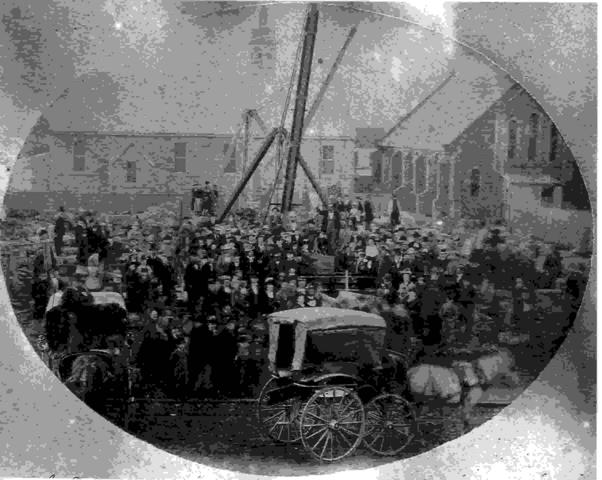
Laying of the foundation Stone of St Mathew’s Church, Prahran, 1st September 1877 (in-line image from Picture Victoria)

The Australasian Sketcher with Pen and Pencil, Saturday 11th May 1878, page 23.

“…the porch containing the main entrance to the nave, and a bold west (or rather south) window of five lights with rich geometric tracery. The side windows – with the exception of the first window on the east side of the nave, which is a four-light tracery window, elevated in a gable to rise above the gallery – are plain three-light windows with segmented pointed enclosing arches…”

The Argus, Melbourne, Vic, Saturday 29th June 1878, page 5.

“OPENING OF ST. MATTHEW’S CHURCH.”

The new church of St. Matthew, which is situated in High-street, Prahran, was opened for divine service last night by the Bishop of Melbourne. The church supercedes one that has been in existence for many years near the same site, and it has been erected by the parishioners in consequence of the wooden building formerly occupied having become too small for the wants of the congregation. The building has been completed with the exception of stuccoing and painting inside, and last night it was thoroughly crowded, about 1,000 persons being inside it, although it has been designed to seat only 700…”

Star, New Zealand, Issue 6470, 13th February 1889, page 3.

“A SENSATION.
EXTRAORDINARY DISAPPEARANCE OF A PROMINENT CITIZEN.
[FROM OUR OWN CORRESPONDENT.]
{Per s.s. Waihora, at the Bluff.)
MELBOURNE
, FEB. 7.”
“A sensation has been created at Prahran by a disclosure which last week made concerning the disappearance of a prominent citizen, named William Harrison, who has been missing for a period of two years. Harrison was an ex-Councillor of the city, and always took a keen interest in the public affairs of the district. He was an architect by profession, and his peculiar temperament, coupled with the enthusiasm he at all times displayed on public questions, gained him the title of “Terrible Billy,” and it is under this sobriety that he was generally known by the residents of the municipality. For a period of nine years Mr Harrison represented the ratepayers on the Council Board, and after remaining a private citizen for some years he, during the month of August, 1886, contested another election for a seat, and was defeated. This was probably due to his having given way to excessive drinking in conducting his candidature and it is about this time that he was lost sight of by his friends. A few days after the election he gave his relatives to understand that he purposed visiting Queensland, and since then he was not heard of until a few days ago, when his family connections placed his photograph in the hands of the detective police, who recognised it as the picture of a man who, about two years ago, died in a Melbourne hospital from the effects of drink. Deceased was discovered lying in one of the public gardens in a dying condition, with two brandy bottles at his side. He was never identified, and was buried as an unknown man. The police are fully persuaded that the deceased man was none other than Harrison. His relatives have been greatly distressed at the unfortunate man’s terrible fate.”

Excerpt from Prahran  Conservation Review document, HO126.

“In May 1982 part of the nave of the church and the south-west corner was destroyed by fire. Some reconstruction was carried out at this time but the original structure of the church was retained. The western transept has been replaced with a bluestone wall with brick quoins finishing the buttresses. An external steel staircase provides access to three levels of offices in this section of the church. The entry on the eastern side of the façade, with its ornate shafted jam has a new mirror door. A courtyard is a feature of the recent alterations to the church. The offices which occupy the front section of the church are separated from the rear section by the courtyard which is enclosed by the original nave walls. The rear walls of the church, including sanctuary and vestry are intact.”

Footnotes:

[8] Email from Dr. B. D. Hughes 7 Dec 2012.

External links:

Other historical images from Picture Victoria of St Matthew’s, include historical images and from the 1892 fire damage and reconstruction:

http://www.picturevictoria.vic.gov.au/site/stonnington/miscellaneous/11267.html
http://www.picturevictoria.vic.gov.au/site/stonnington/miscellaneous/13183.html
http://www.picturevictoria.vic.gov.au/site/stonnington/miscellaneous/13206.html
http://www.picturevictoria.vic.gov.au/site/stonnington/miscellaneous/13186.html
http://www.picturevictoria.vic.gov.au/site/stonnington/miscellaneous/13188.html
http://www.picturevictoria.vic.gov.au/site/stonnington/miscellaneous/13189.html


Short link to this page: http://wp.me/p28nLD-1tI

© Copyright

31-08-1878: St. Matthews Church, Dunedin, New Zealand.

A rare Ferguson & Urie stained glass window exists in St Matthews [1] Church at Dunedin, New Zealand.

On the afternoon of the 21st of May 1878, a young boy by the name of James Ernest Maitland died as the result of a horrific coach accident that occurred between Palmerston and Moeraki.

The memorial stained glass window to the Maitland boy was designed by Ferguson & Urie’s senior stained glass artist David Relph Drape and was selected by Mr. Thomas Austin of New Zealand in 1878. The Otago Witness newspaper in New Zealand ran an article about the window on the 31st of August 1878, with the mention of Ferguson & Urie as the makers. On the 6th of January 2010, the original pencil sketch design for the window was found amongst a collection of Drape’s stained glass designs at the State Library of Victoria. The window has the memorial text at the bottom “IN MEMORIAM JAMES ERNEST MAITLAND 22 MAY ____”. At some time the window’s history the bottom right corner that contained the year “1878” was broken and was replaced with a plain coloured piece of glass.

Photo of the window by Errol Vincent, New Zealand, 5th October 2010.

This slideshow requires JavaScript.

The following are historical accounts of the coach accident as reported in the tabloids of the time:

Otago Witness, New Zealand, Issue 1396, 31st August 1878, page 7.

“A stained-glass window has lately been placed in St. Matthew’s Church, in memory of James Ernest Maitland, son of Mr J. P. Maitland, who was killed in the late terrible coach accident. The window was erected by the choir of St Matthew’s, of which the deceased was a chorister for a long time, and the Carisbrook Cricket Club, in which Ernest Maitland’s name will long be remembered as one of the most promising juniors. The chaste design and colouring of the window reflect credit on the builders, Messrs Ferguson and Urie, of Melbourne, and on Mr Thomas Austin, who selected the plan when recently in Melbourne”.

Otago Witness, New Zealand, Issue 1382, 25th May 1878, page 10.

ADDITIONAL PARTICULARS. (FROM OUR OWN CORRESPONDENT.)

Oamaru, May 23rd.

It is difficult to ascertain fully the extent of the injuries received by the passengers on the coach which met with the accident yesterday. The medical men have been too much engaged to attend to the numerous inquiries. It is equally difficult to arrive at any definite conclusion as to the real cause of the accident. Several passengers give different versions of the matter. Some say that one of the traces broke or got loose, and dangling about the horses legs, caused them to bolt; others that the boy Maitland fell from his seat on the box and dragged the reins out of the driver’s hands in his fall. Others state that a bolt came out, and that the two portions of the coach became severed, and that the horses bolted with fore part of the vehicle, leaving the main body to run down hill as best it might. The latter seems the most probable cause, as all agree in saying that the horses bolted with the fore part of the coach, and that the coach continued to run rapidly down hill, notwithstanding that the brake was applied with all force by the driver and the boy Maitland, who was sitting on the box on the near side. It appears that there were about twenty persons in the coach, including the driver. Of these, nine were inside, six on the box, and the rest at the back and on top. Those on the box were – Maitland, Hill, and Fulton, the two latter having Mr Strode’s two sons on their knees. Mr Nichols and Mr Hunter were on the outside seat at the back, and two others were on the rack below them, and one or two on the top. Most of the passengers had walked up the hill to relieve the horses, and had not long resumed their seats when the accident occurred. When the horses bolted several of the passengers at the back of the coach jumped off, none of them being severely injured by doing so. The coach appears to have run down the hill at a rapid pace. The driver applied the brake on one side, and Maitland did so on the other side, in obedience to the bidding of the driver, but failed to check the speed of the coach. After going about a hundred yards it seems to have swerved, and run off the road, tumbling over and over down the embankment, for a distance of some forty or fifty feet, its further progress being stopped by a wire fence. Just before the coach went over, Mr Bishop, of the Sun newspaper, who was on the top, jumped off and fell with his head against a rock, inflicting a nasty scalp wound. He also sprained his ankle, rolled over the embankment, and was picked up insensible, remaining in that state two or three hours. He is, however, progressing favourably. The extent of the injuries received by Mr Nichols and young Maitland you will find recorded in the evidence of Dr Hazard. The poor lad Maitland, after lying all night at the National Bank, whither he was taken at the request of the Manager, expired shortly after 10 o’clock this morning. From the first it was evident that he was beyond hope of recovery. He never regained consciousness. His body, and that of Mr Nichols, were forwarded to Dunedin this evening by train. Mr Nichols was thrown violently on his head, and expired about a quarter of an hour afterwards. Mr Francis Fulton, in addition to being severely shaken, had one of the small bones of his lame leg broken, and is likely to be laid up for some time. The two sons of Mr A. C. Strode escaped almost miraculously. In addition to bruises and severe shaking, it is said one of them dislocated his arm. They did not come on here, but resumed to Dunedin. I believe Messrs Hill and Hunter were both severely shaken and bruised, the former receiving a cut on the knee-cap which will cause him to be confined to his room for some time, while the latter had one of his arms badly hurt. Another passenger named Connor, brother to one of the witnesses at the inquest, also received severe injuries, but the extent of them I cannot find out. He is in the hospital, and doing very well. Mr Goddard, the driver, received several very severe wounds on the head, one of which is very deep, in addition to other injuries. He ha 3at times during the day teen out of his mind, but is much better this evening. When Borne of the uninjured passengers or those only slightly wounded lifted the coach up, Mr McNicol and others were found underneath it. How they escaped being killed or severely injured is a mystery. According to the statement of one of the passengers, the coach seems to have bounded over several persons in tumbling down the hill. Of all the passengers those inside seem to have fared best. None of them appear to have received any injuries worthy of mention. The spectacle presented after the accident is described as appalling. The sufferers were strewn in all directions, and lying; in every conceivable position, some insensible and some conscious, but unable to move. Blood was freely flowing from most of them. The feelings of those who were injured, but conscious, must have been terrible, seeing that they were far away from any source of help, or any means of sending for assistance, and dependent entirely upon any chance passer-by. It was fortunate that Mr Bell happened to pass by that lonely spot, and for his prompt action in driving to Hampden and telegraphing for assistance he is deserving of praise, as is also Mr Back for speedily responding to the call by tending a special train. Long before the special train arrived in Oamaru, arrangements of a perfect nature had been made at the Hospital for the reception of the sufferers, while abundance of cabs and expresses, with mattresses and blankets, were waiting at the railway station. Goddard has been driving on the same road for seven or eight years, and has always been looked upon as a careful driver. It is remarkable that the only accident of any note he ever met with was reserved for his last trip, and that too when his final journey to Moeraki had nearly been completed.

Otago Daily Times, New Zealand, Issue 5083, 3 June 1878, page 7

THE INQUEST.

An inquest on the bodies of Mr Charles Nicholas and Master J. E. Maitland was commenced on May 22, before Mr Parker, Coroner.

The first witness called was Alexander John Fergusson, duly qualified medical practitioner residing in Dunedin, who deposed that he had seen the body lying in the premises of the Northern Hotel, and identified it as that of Charles Nichols, of the firm of Dalgety, Nichols, and Co. He had also seen the body lying at the National Bank. It was that of James Ernest Maitland, a son of Mr J. P. Maitland. He thought Mr Nichols between 50 and 60 years of age, and Master Maitland about 14 years[2].

John Hazard, duly qualified medical practitioner, at present residing at Oamaru, deposed that he made an examination of the body lying at the Northern Hotel, which had been identified as that of Mr Nichols. He found a comminuted fracture of the bones entering into the formation of the left orbit. The superior maxillary bone was broken into fragments. The left eye-ball was disorganised. These injuries were sufficient to account for death. He had also examined the body of James Ernest Maitland, and found a very severe lacerated wound commencing at the right eye brow and extending to the back of the head, entirely denuding the bone of the forehead. There was also a very extensive comminuted fracture of the frontal bone and right parietal bone. Deceased had also sustained a fracture of the right pelvis, with very severe laceration of the neighbouring parts, and a lacerated transverse wound on the left knee, in addition to several minor contusions in different parts of the body. The injuries received were quite sufficient to cause death.

Thomas Hunter, commission agent, residing at Wellington, deposed that he was a passenger by the coach which left Palmerston about 2 p.m. for Moeraki on Tuesday. He could not say how many passengers were on the coach. He was sitting on the outside back seat with Mr Nichols, two more passengers sat below them on the rack, and two and two others on the roof just above witness and Mr Nichols. The inside appeared to be full. He knew the Horse range. Up to the time of reaching the hill nothing, so far as he was aware, was wrong with the coach. The driver was perfectly sober, and had driven at a steady pace the whole time. When the coach was about a quarter of a mile down the bill, witness became aware that the horses were bolting. Two men below witness dropped off almost immediately, and witness followed them, but Mr Nichols kept his seat. One of the passengers on the roof also dropped down. The coach then went down hill at full speed for about a hundred yards. When he got up he could not see the coach, but the horses with both fore wheels were some distance ahead of him. Three of the horses were standing and another lying down, the pole being partly entangles with its legs. After walking a little distance witness was the remains of the coach down an embankment about 40 or 50 feet from the road. It appeared to have been stopped in its descent by a wire fence. When witness left the scene of the accident the deceased, Charles Nichols, was not dead, but he was frightfully mangled and breathed with great difficulty. He (deceased) was lying at the bottom of the gully. The lad – Maitland was lying close by him.

To the Foreman: There were ten of twelve persons on the outside of the coach, including the driver, and with exception of two on the roof they appeared to be all comfortably seated.

To the Jury: There were only a few parcels on the roof. He did not know how many the coach was supposed to carry. The inside appeared to be full. In jumping off he (witness) sustained some slight bruises on his left side and arm. He could not say whether or not the brake was acting.

W. Connor, lately of Tokomairiro, deposed that he was a passenger by the coach from Palmerston to Moeraki yesterday. He left the latter place about two o’clock. Nothing went wrong until at the top of the Horse Range. He could not say how many were on the box seat or inside the coach. On the roof on the luggage were two passengers. The last witness, Mr Hunter, and Mr Nichols were on the back seat, and he and another sat on the luggage. There were six passengers outside, besides those on the box seat. There was not much luggage on the roof. They had just reached the crown of the hill when some one cried “Trace loose.” After he heard this the coach commenced to go very fast, and he dropped on to the ground, and held on to the vehicle, running behind it. He saw what he thought was a trace loose, flapping on the near side. He could not say whether the brake was acting or not. He heard it grating up to the time he left the coach. From the place where he jumped off to that where the coach fell over there was an embankment for a distance of six or seven chains. Before the coach went over last witness and two others jumped off. He did not see the vehicle fall. When he saw it next it was 40 or 50 feet down the embankment. The top was smashed, and the body on its side, some of the wheels were broken. He saw the fore carriage about five chains farther down the road, with what appeared to be two horses lying beside it. He went back along the road, and at the place where he heard the cry he found a piece of iron, called the tree, that holds the trace, with a link of the trace, lying on the road.

To the Jury: He did not pick them up. When he saw Mr Nichols he was lying three or four yards from the remains of the coach, bleeding profusely from the mouth, nose, eyes, and ears. He was alive then, but died about 20 minutes afterwards. Master Maitland was lying with his feet on Mr Nichol’s legs, and was fearfully cut above the abdomen and head. Witness did not know, of his own knowledge, when he died. Goddard was sober, and drove steadily and carefully. Witness could not say whether the cry came from inside the coach. The horses were, he thought, very steady. His brother, who was an inside passenger, was hurt.

To the Jury: He did not see the pole of he coach after the accident. He and another man removed the coach from the three passengers who were underneath.

The inquest was then adjourned till the 6th June to obtain the evidence of the driver and Mr Fulton.

The Funerals of the late Mr Charles Nichols and Master James Ernest Maitland, who were killed by the recent coach accident, took place on the 24th ultimo, at the Northern Cemetery. There was a large number of mourners, and the bodies were interred close to each other, and the service was read jointly by the Rev. R. L. Stanford and the Ven. Archdeacon Edwards.

Grey River Argus New Zealand, Volume 07, Issue 3061, 7 June 1878, page 2.

COACH ACCIDENT INQUIRY.

Wellington, June 8.

The adjourned inquiry into the cause of the recent coach accident, by which Mr Nicholls and young Maitland, were killed, took place to-day. Goddard, the driver appeared in court with his head bandaged up. He gave evidence, that when the coach had descended the Horse Range about two or three hundred yards, the trace of the offside pole horse came loose, and this caused the horses to take fright, and they broke into a gallop. In crossing a water course on the road the coach jerked violently and the king bolt came out, and the brake then had no control. After going a short distance the coach capsized. The Jury returned the following verdict: “That Chas. Nicholls and James Ernest Maitland, met their death accidentally, and that there is no blame to be attributed.”

Foot notes:

[1] The foundation stone of St Matthews was laid, with Masonic honours, on the 11th of July, 1873 and was opened on the 3rd of December, 1874, costing £4,854 4s 3d.

[2] James Ernest Maitland was age 16 at time of death. Born 1862 (NZ BDM:1862/1889), died 1878 (NZ BDM: 1878/2211)

Acknowledgments:

My gratitude to the late Errol & Ann Vincent for undertaking the massive 2,000 km round trip to follow this up and take the photos of the stained glass window.


Short link to this page: http://wp.me/p28nLD-11u

© Copyright

1993: St Matthew’s Anglican Church, Albury, New South Wales.

St Matthew’s Anglican Church in Albury originally contained many Ferguson & Urie stained glass windows as well as a five-light east window by Lyon & Cottier of Sydney.

The church was destroyed by fire on Saturday 14th September 1991 and it was resolved, where possible, to re-create the east window by Lyon & Cottier by Philip Handel based on photographs. The only remnant of a Ferguson & Urie window was incorporated into a new design depicting the Phoenix rising from the ashes.

Ausglass Magazine, Dr Bronwyn Hughes, Editor, Monday 30th August 1993, page 5.

“… A total of ten windows, mainly in the transepts, were the work of Ferguson & Urie of Melbourne and were installed from about 1876. Mainly grisaille work with inset medallions and small scenes, as well as two nativity windows, they epitomise the Ferguson & Urie style which used strong blues and reds in borders, brown paint and silver stain in the vignettes. Most of these windows will not be replaced to resemble the originals as the photographic evidence is simply not good enough to allow satisfactory reproduction. New transept windows, which recreate the spirit of the former windows through grisaille and monograms, are being made by Mr Philip Handel who also has family connections with the firm Lyon & Cottier through his father, Alfred Handel”.

The Albury Banner & Wodonga Express, NSW, Saturday 15th January 1876, page 6.
“OPENING OF THE NEW CHURCH OF ST. MATTHEW”
[Excerpt about the stained-glass windows]

“…The stained glass windows are in every instance choice specimens of one of the most beautiful of the decorative arts, and the largest of them – east window in the chancel – is one of the best in the Australian colonies. This window, the cost of which was kindly guaranteed by a member of another denomination – Mr. G. Day, M.P. for the district – 22ft. high and 10ft. in width at the base. It was made by Messrs. Lyon, Cottier and Co., of Sydney, the principal subject being the calling of St Matthew, while the side lights represent full-length figures of the four Evangelists. The principal point of excellence in this window is the design, which is particularly bold and well-conceived; the coloring, however, is also rich and harmonious, and, taken as a whole, the windows is probably surpassed by few in the colony, and certainly is not equalled by any outside Sydney or Melbourne. The two centre figures are especially good. The other windows, ten in number, have been made by Messrs. Ferguson and Urie, of Melbourne, and though smaller than the east window are equally distinguished by beauty of design, and harmony of color. Two of the largest are situated at the end of the south transept, and are the gift of the Sunday School pupils and Dr. R. N. Cobbett, respectively. Both are specimens of the modern style of art. The former contains two large full-length figures illustrative of the text “Suffer little children to come unto me;” the first figure representing the Saviour in the act of teaching little children, the second being an illustration of Christ as the Good Shepherd. The window given by Dr. Cobbett contains three figures personifying the cardinal virtues – Faith and Hope on the lower and larger lights, surmounted by Charity above; this window bears the legend “In Deo est nostra apes.” [in God is our hope] On the east side of the South transept are two windows ornamented with geometrical designs; these are presented by the masons and carpenters engaged upon the building. On the west side of the north transept, have been purchased with funds gathered for the purpose by Mrs. Husing and Mrs. Wilcox respectively. The second window on the east side of the north transept is the gift of Mr. W. N. M. Edmondson. This is a very chastely designed and tasteful memorial window, representing the Saviour conversing with children. The principal subject is surmounted by an angel, and a scroll at the bottom of the window bears the text “Suffer little children to come unto me.” Though last not least, comes the window presented through Mr. Crommelin, by Mr. Dufaure, of Sydney. This is placed on the north side of the nave, immediately below the north transept, and is the only window in the building of English manufacture. The subject of this window, two texts have been chosen, in the illustration of which the Saviour is represented first as fainting beneath the weight of the cross. The conception of this picture is remarkably good, every line in the face and figure being suggestive of meekness and long suffering in the Redeemer. In excellent contrast with this is the subject of the second picture, Christ in glory, all memory of the agony suffered during the Incarnation banished for ever from that celestial countenance. The text chosen here is “In my Father’s home are many mansions,” For brilliancy and purity of color this window is unsurpassed by any in the building; if it has any fault it is that of being too bright, and of almost requiring to be toned down by a background of some kind which would  render the gorgeous tints somewhat less dazzling to the eye in the glare of an Australian Summer…”

Photos taken 9th March 2014.

This slideshow requires JavaScript.


Short link to this page: http://wp.me/p28nLD-OW

© Copyright

04-03-1882: St Matthew’s Church, New Norfolk, Tasmania.

The Anglican Church of St Matthew is in Bathurst Street New Norfolk, opposite Arthur Square. It was built in 1823 and is the oldest church in Tasmania. The church was consecrated in 1828 by Archdeacon Scott from Sydney and has been altered a number of times since. In 1833 extensive additions transformed it significantly. The tower was added in 1870 (no longer exists) and in 1894,the chancel was added and the windows, roof and transepts also altered. All that remains of the original church are the walls, floor of the nave, and part of the western transept.

The church contains many historical stained glass windows, among which are the ‘Moore’ and ‘Sharland’ stained glass windows crafted by Ferguson & Urie of North Melbourne.

Photos taken 7th October 2010:

This slideshow requires JavaScript.

[View all images]

The Mercury Hobart, Tasmania, Saturday 4th March 1882, page 3.

“… The church is without pretentions to good looks – it is neither imposing nor elegant. Yet with all its plainness it is a building endeared to many by sacred associations; and also contains features of interest to the visitor. Over the communion table is a stained glass window, representing our lord’s interview with the two disciples at Emmaus, and erected by Mr. W. S. Sharland, in memory of his first wife. Another stained glass window, placed at the back of the font, and representing the baptism of Christ in the River Jordan, was presented by the late Dr. Moore and his son, to commemorate their escape from shipwreck on the occasion of the loss of the s.s. City of Launceston in Hobson’s Bay…”

The Dr. Moore window:

On the evening of 20th November 1865 the ‘SS City of Launceston’ departed Launceston and within two hours of departure it had collided with the SS Penola from Adelaide in Hobson’s Bay. All passengers and crew were rescued by the severely damaged Penola before the Launceston sank.

“…One cabin passenger, Dr. Moore, got his portmanteau, containing £100 in money, into the boat, but it fell overboard [1]

It was thought that the SS City of Launceston could be raised and tenders were called for the work however this never eventuated. Although there were many newspaper reports in 1865 that appeared to describe the exact location of where the ship sank, the Maritime Archaeologists Association of Victoria only found the intact wreck in 1980.

Dr. John Anthony Moore died on the 6th of July 1878 at New Norfolk aged 62[2].

The text on the Moore memorial window reads:

“S. Mark 1:9” “ERECTED BY J. A. MOORE, SENr & JUNr, TO COMMEMORATE A DELIVERANCE FROM SHIPWRECK, NOVr 19th, 1865”.

The window depicts St. John the Baptist, Babtising Christ in the river Jordan.

The Sharland window:

The text on the Sharland memorial window reads:

“TO THE GLORY OF GOD  AND IN MEMORY OF FRANCES SARAH WIFE OF WILLIAM STANLEY SHARLAND WHO DIED ON THE VIIIth DAY OF MARCH IN THE YEAR OF OUR LORD MDCCLIX” (8th March 1859).

Although the biblical scene the window represents is not written anywhere on the window, Janice Ball, from New Zealand, has identified it (07 Apr 2012) as “Emmaus” (Luke 25: 13-37) where Christ is seen breaking bread with two disciples who were walking from Jerusalem to Emmaus .

WikipediaThe two disciples have heard the tomb of Jesus was found empty earlier that day. They are discussing the events of the past few days when a stranger asks them what they are discussing. “Their eyes were kept from recognizing him.” He soon rebukes them for their unbelief and gives them a Bible study on prophecies about the Messiah. On reaching Emmaus, they ask the stranger to join them for the evening meal. When he breaks the bread “their eyes were opened” and they recognize him as the resurrected Jesus. Jesus immediately vanishes”.

The top third of the window has the symbol letters “IHS”. The centre depicts three men with Christ in the middle with a disciple on either side and Christ is breaking bread. The lower has a rather unusual depiction of the Hexagram or Star of David.

Related posts: 07-08-1867 > 13-08-1867

External Links:

Web Site: Diving the City of Launceston Shipwreck

Obit: Dr Moore (no mention of his past shipwreck though!)

Bio: William Stanley Sharland (1803-1877)

Obit: William Stanley Sharland (1801-1877)

Footnotes:

Short link to this page: http://wp.me/p28nLD-xr

© Copyright

13-08-1867: James Urie visits Tasmania on Ferguson and Urie business.

In August 1867, James Urie of the Melbourne stained glass firm ‘Ferguson & Urie’, traveled to Tasmania with a portfolio of the companies designs for ecclesiastical and secular stained glass. As of May 2013, over twenty-five Tasmanian buildings have been identified as having one or more extant stained glass windows by the firm. The newspaper article below contains a gold mine of clues for Ferguson & Urie windows erected in Tasmania and in Victoria and I have included my comments as to what have found on each clue.

The Mercury, Hobart Tasmania, Tuesday 13th August 1867, page 5.

 “STAINED WINDOWS – A few days since we stated that Mr. Urie of the firm of Ferguson, Urie, and Lyon, glass stainers, &c, Melbourne, was on a professional visit to Hobart Town. This gentleman is now in Launceston, and we were much gratified yesterday by inspecting a large portfolio of designs for church and other windows which his firm has executed or has in hand. Amongst the most elegant we may mention the chancel window of St. George’s Church, Queenscliff, the subject being taken from the Litany, whilst the side lights represent the twelve Apostles and the west window other emblems; chancel window of St. Peter’s, Wooloomooloo (Sydney), embracing nine events in the life of St. Peter; Roman Catholic Church of St. Peter and St. Paul, Geelong; St Joseph’s Roman Catholic Church, Collingwood; St. Patrick’s Church, Duneed; the Melbourne Convent; the Presbyterian Churches at West Melbourne and Ballan; the Wesleyan Churches at Daylesford and Kent Town (S. Australia). They have also erected some very elegant memorial windows including one for the late Prince Consort at Kew; Rev. R. W. Needham, at Mount Gambier; Dr. Peck, at Sale; Judge Pohlman’s wife, and wife of Mr Stoddart both in Melbourne. We have already referred to Dr. Moore’s at New Norfolk, and the two windows in St. John’s, Launceston. One of the most elegant windows is in the house of Mr. George Stevenson, at Toorak; it represents the four seasons with figures of Art, Science, Agriculture, and Commerce, with Faith and Hope, coat of arms, and crest. This window cost £250. This firm also supplied a staircase window for the new mansion of the Hon. R. Q. Kermode at Mona Vale, but it has been decided to substitute one much more elaborate. They are also to fit up two windows for the new Wesleyan Church of this town – one at either end, which will be very handsome. Several private homes in this town, and a large number in Victoria, have been ornamented in this way, and no doubt the practice will extend when it is known how skilfully the art is carried out by Messrs. Ferguson & Co.”

Notes:

1. Queenscliff, Victoria, St Georges, All windows extant.
Related posts: 22-02-186429-01-1866 > 12-02-1881 07-04-188230-12-1893

2. Wooloomooloo, Sydney, NSW, St Peter’s (Darlinghurst), now part of Sydney Church of England Girls Grammar School.
Related posts: 1867: St Peter’s Anglican Church, Woolloomooloo, Sydney, New South Wales.

3. Geelong, Victoria, St Peter & Paul Catholic. Three light principal east window.
Related post: 13-08-1867: St Peter & St Paul, Geelong, Victoria.

4. Collingwood, Melbourne, Roman Catholic (St Joseph’s) destroyed by fire in 2007.
See: 1863: St Joseph’s Catholic Church, Collingwood, Victoria.

5. Duneed, Victoria, St Patrick’s (Mt Moriac) foundation laid in 1858. Ferguson & Urie east window erected in 1866 but was destroyed my a massive hail storm in 1887. The church was rebuilt in 1950’s and sold at auction in February 2017..

6. Melbourne, Victoria, the “Melbourne Convent”. This is likely to be the “Convent of Our Immaculate Lady of Mercy” in Nicholson street Fitzroy. My correspondence with the Convent has revealed nothing.

7. West Melbourne, Presbyterian. Dismantled in 1935 and re-erected as St Andrews at Box Hill in 1936. It contains the original F&U windows except for one which went to the Camberwell Church on Riversdale Road.
Related posts: 27-04-1935

8. Ballan, Victoria, Presbyterian (St Paul’s). All windows are extant.
Related posts: > 22-07-1866 > 28-07-1866 > 13-08-1867

9. Daylesford, Victoria, Wesleyan. Only small ‘stock’ windows in the porch exist in poor condition. See photos <here>

10. Kent Town, South Australia, Wesleyan. Nothing further known.
Related posts: 26-10-1864

11. Kew, Melbourne. The Prince Consort window at Holy Trinity is extant and recently restored.
Related posts: 08-06-1881

12. Mount Gambier, Christ Church, Rev Needham memorial window and others are extant.
Related posts: 02-11-1867

13. Sale, Victoria, St Paul’s Anglican Cathedral. Dr. Peck memorial window is extant.
Related post: 29-01-1867

14. Melbourne, Pohlman and Stoddart memorial windows.
Nothing found in regards to the Pohlman window but the Stoddart window exists.
Related post: South Yarra Presbyterian 1867

Pohlman:

Judge Robert Williams Pohlman (1811-1877): Biography | Obit 1877 | Funeral | Obit 1878 His funeral was in St Stephen’s in Richmond and he was buried in the Melbourne General Cemetery on the 8th Dec 1877. He was married twice. His second wife, Mercy Clifton Bachelor died of an embolism at age 26 on the 21st January 1876 only a couple of weeks after giving birth to a stillborn daughter on the 5th of January 1876. He only had one daughter to his second wife named Annie who married Navy Commander Frederick Owen Pike at St John’s in Toorak on the 27th December 1893.

This would mean that the stained glass window would have been a memorial to his first wife “Eliza” who died at Richmond on the 11th Feb 1856.

Stoddart/Stodart:

This is James Dickson Stodart (c1825-1867), Mayor of Prahran 1864/65 and councilor 1858/59-1859/60, 1863/64-1864/65.

Arrived from Edinburgh in 1853. Was later a financial agent for Cornish & Bruce railway contractors. See: Yarra Presbyterian 1867

An active member of the Scotch Presbyterian Church in Punt Road South Yarra, where his memorial stained glass window resides.

He died on Wednesday 12th June 1867. The window has been found at the South Yarra Presbyterian Church See: http://wp.me/p28nLD-2I3.

15. New Norfolk, Tasmania, St Matthew’s, Dr. Moore memorial window is extant.
Related posts: 04-03-1882

16. Launceston, St John’s: The window is extant but no longer in its original position. The canopy glass above the main three lights no longer exists but an original design for the window shows that it contained the descending Dove and the symbols for Alpha and Omega.
Full details see  post: 25-09-1866

17. George Stevenson’s house at Toorak was named “Trawalla” and is located at 22 Lascelles Avenue Toorak. Window is extant.

18. Ross, Tasmania, Kermode’s Mona Vale Mansion. This window still exists. Images are shown in various historical books written in the last 30 years.

19. Launceston, Wesleyan, (Pilgrims Uniting), window facing Patterson street is extant but nothing seen in the opposite end. Gavin Merrington from Hobart has confirmed that a wheel window exists above the organ loft.

Also see: 07-08-1867: Decorative Art. James Urie sojourning in Tasmania.

Other related posts: 03-03-1868 , 29-01-1866, 20-06-1867, 29-04-1864,


Short link to this page: http://wp.me/p28nLD-98