24-09-1924: The Rosalie Grundy window, St James Church, Glenburn (Delamere), South Australia.

In 1889 a memorial window was unveiled by the young boy Archie Grundy to the memory of his mother Rosalie Grundy in St James’s Church Glenburn (now known as Delamere). The window was created by Ferguson & Urie of Melbourne and supposedly took two years to make.

There are actually three windows in the chancel of St James that are by Ferguson & Urie and all are of similar design and layout. The left window is of St James Major, the centre light is of Jesus Christ, and the right light is of St John. It’s not known whether there is specific memorial text below each window that identifies which particular window either side Christ is the memorial to William Gerrard or Rosalie Grundy as the lower portions are obscured from view.

I disagree with the mention in the 1929 news article that the Grundy window “…took two years in making, because of the difficulty of matching the two new lights with the centre figure of St James…”. This is obviously wrong as the centre figure is of Christ not St James (St James Major) which is the left window. It does suggests that that each window was made at different times in history which is not unusual. I would suggest that the statement about the window being “two years in making” has been misinterpreted over the 35 years that followed. It’s more likely that the funds for the window took two years to raise, or it was simply created two years after the other two windows or something similar. It would difficult to imagine Ferguson & Urie not being easily able to match their own work to something they created earlier unless they had completely lost the designs of their earlier work for the church or the time frame between correspondence with Melbourne and Glenburn/Delamere in South Australia was a contributing factor.

Photos kindly contributed by Mrs Noelle Nathan, taken November 2010.

This slideshow requires JavaScript.

Significant transcriptions:

The Register, Adelaide, South Australia, Wednesday 24th September 1924, page 12.

“… Rosalie Grundy died at the birth of her only son and child, now Archie Grundy, who has just sold his beautiful property at the Valley, intending to reside in town. In 1889 he unveiled a memorial window to his mother in St. James’s, Glenburn. The window was the work of Ferguson & Urie, of Melbourne, and took two years in making, because of the difficulty of matching the two new lights with the centre figure of St James.…”

Observer. Adelaide, SA, Saturday 11th February 1928, page 48.

“SOME OLD FAMILIES OF RAPID BAY.

By Miss L. Webb.

Among the old hands of Rapid Bay were the Grundy family, whose name has now passed out of the district. The late Joseph Grundy was a well-known pastoralist of the south, and his parents were there before him. His first wife was Rosalie, daughter of the late James Lord. She died a year after marriage, leaving a son, now Mr. Archie Grundy, of Glenelg. The second Mrs. Grundy was Miss Sophia Helen Shillabeer, of an old established family in the district. There were two daughters of this marriage. Mrs. Grundy was a keen war worker, and was on the committee of the Second Valley War Memorial. She was greatly attached to St James’s Church, Glenburn, in which she was confirmed, and in whose church yard she was buried. The east window of St. James’s is in memory of the first Mrs. Grundy, and was unveiled by her son, then quite a child, it was the work of Ferguson & Urie, of Melbourne…”

The Advertiser, Adelaide, SA, Wednesday 21st August 1929, page 15.

 “ST. JAMES’S CHURCH GLENBURN”

 “… The foundation stone was laid on September 19, 1870, by Dean Russell, assisted by the Revs. Green (Port Adelaide), Howell (Port Elliot), Howitt (Robe), and Morse. The building was designed by Mr. William Anderson, C. E., and was opened on May 4, 1871 by Bishop Short, the Governor of the Province (Sir James Fergusson) being present…”

“… The centre light of the east window represents our Lord. One of the sidelights is in memory of Mr. William Gerrard, a foundation member and benefactor of the church. He left it a sum which yields from £30 to £35 per annum. The other light was in memory of Rosalie, first wife of Joseph Grundy, of Second Valley, and was unveiled by her son and only child, Mr. Archie Grundy, then a boy. There are also windows in memory of Frederick William Collins and Egbert Bennett, both baptised and confirmed in the church, and who gave their lives in the Great War…”

Other references:

The Advertiser, Adelaide, SA, Wednesday 21st August 1929, page 15.

Publications not yet viewed:

The Anglican Church of St James, Delamere, 1871-2001 /​ Maurice V. Carter.


26-10-1864: Wesleyan Church, Kent Town, South Australia.

There has only been a minor reference to Stained Glass windows made by Ferguson and Urie at the Wesleyan Church at  Kent Town, South Australia. The following articles and references aim to add context.

The South Australian Register, Adelaide, Wednesday 26th October 1864, page 5

“KENT TOWN WESLEYAN JUBILEE CHURCH”

“…The foundation-stone of a new church in connection with the Wesleyan body was laid on on Monday afternoon, October 10, at Kent Town…”

“…The Rev. Mr. Ironside having pronounced the stone duly laid, made a short address, in the course of which he observed that it was with great pleasure that he accepted the wish of the trustees of the new building to lay the foudnation stone  and said there was nothing which he had done since his connection with the province that he should look upon with greater gratification…”.

“…The design is transition gothic, lighted by six lancet windows on one side and five on the other, and by two small windows and one large tracery window in front. The former are so arranged that one-half of each window will open, but the latter is to be filled with stained glass…”

The South Australian Register, Adelaide, Saturday 26th August 1865, page 6.

“XI.-RELIGIOUS. KENT TOWN WESLEYAN JUBILEE CHURCH.
“The services in connection with the opening of the Kent Town Wesleyan Jubilee Church were continued on Thursday, August 10…”

The Mercury, Hobart Tasmania, Tuesday 13th August 1867, page 5.

The actual article that mentions Ferguson & Urie was in the Hobart Mercury that had a detailed account of James Urie’s business  trip around Tasmania and the article mentioned many locations that Ferguson & Urie had completed commissions for stained glass windows including:  “…the Wesleyan Churches at Daylesford and Kent Town (S. Australia).”

Photos from the Wesleyan Church, Kent Town,  kindly contributed by Mrs Dianne Tucker via Mrs Noelle Nathan, 28th Apr 2012.

This slideshow requires JavaScript.

Related post: 13-08-1867: James Urie visits Tasmania on Ferguson and Urie business.

27-07-1930: George James Coates (1869-1930)

George James Coates was born at Emerald Hill (South Melbourne) on the 9th August 1869, the son of John Robert Coates (1842-1877) and Elizabeth Mina Irwin (1847-1902).

His father died when he was eight years old and his mother allowed him to be apprenticed to the Ferguson & Urie stained glass company at age fifteen, circa 1884.

George studied at the North Melbourne School of Design and Hotham School of Art and attended classes under Frederick McCubbin. He won a scholarship in 1896 that enabled him to travel to London then Paris and in 1903 he married artist Dora Meeson (they had no issue). He was also the Australian Governments unofficial war artist during WW1.

In 1937 his wife Dora wrote his biography; George Coates, ‘His Art and His Life’, in which she makes minor mention of his time with the Ferguson & Urie stained glass company and that he had a distaste for the coarse jokes from the other employees.

In all of the Ferguson & Urie windows found to-date,  it is impossible to know which of them, within George’s era at the company, may contain examples of his artwork. The exception to this may be in the house of his employer, James Ferguson, whose house ‘Ayr Cottage,’ in Parkville has a stairwell window containing a detailed portrait of the Scottish bard ‘Robbie Burns‘ which I reasonably suspect may have been done by a young 17 year old George Coates in 1886.

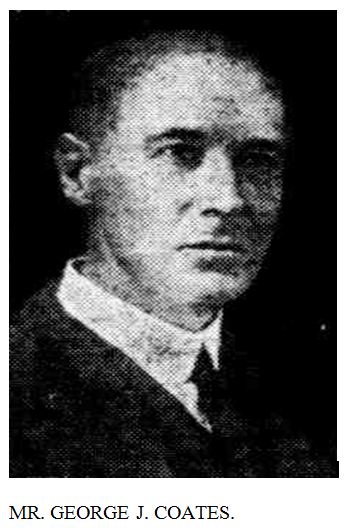
The photo below is of a young George, age 17, as he appeared in the Ferguson & Urie employee poster created for the 1887 company dinner, held at the North Melbourne Mechanics Institute hall on the 22nd June 1887.

George James Coates. Photo taken for Ferguson & Urie company dinner June 1887.

The Register, Adelaide, 23rd September 1921, page 7.

Transcription of article “NOTABLE ARTISTS’ RETURN”

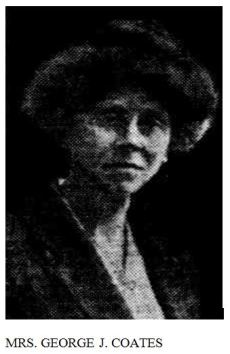
“In the realm of the arts, Australia is proving herself a keen contestant for honours, and during the past few years many Australian painters have obtained public recognition. Mr. and Mrs. George J. Coates (nee Miss Dora Meeson), of Melbourne, went abroad to study, and now have returned to their native land covered with honours. They arrived in Adelaide by the Melbourne express on Wednesday, having reached their own city some months ago. It is 24 years since Mr. Coates set out for the great adventure, and, like many other Australians, he found it a stressful road, full of obstacles, and necessitating the most frugal mode of living. But the painter felt that he had something to impart to lovers of beauty, and so he persevered in London, and then migrated to Paris with such success that to-day he can boast of more significant letters after his name than any other Australian artist.

Among his distinctions may be mentioned:- Member of the International Society of painters, Sculptors, and Gravers, London; Member of the National Portrait Society, London; On the Council of the Royal Portrait Society, London; Member of the Royal Society of Oil Painters, London; Associate of the Nationale des Beaux Arts (New Salon), Paris; Hon. Member Royal Society of Arts, Sydney; and also of he Victorian Artists of Australia. Asked about his first works, Mr. Coates said that as he evinced a leaning towards art at the age of 11 years it was definitely decided that he should be given his chance. That this decision was justified was revealed when the youthful painter won the Victorian Travelling Scholarship, and set out for London.

– The Road to Fame –

After hard work he went on to Paris and studied under Jeans Paul Laurens, Constant, and others. From 1897 to 1900 he exhibited in the salon des Artistes Fracaise (old Salon), and then returned to London, where he and his wife engaged upon some illustrations for the Encyclopedia Brittanica [sic] and the Historian’s History of the World (an American publication). They also contributed to the Royal Academy and the Paris Salon. In 1910 the well-known “Walker Brothers,” a group, was accepted by the Royal Academy of London, and in 1912 by the Associate de Nationale de Beaux Arts (new salon). By some mistake it was sent to the new Salon in stead of the Champ Elysees, as first intended, and was accepted and brought an Associate ship in its ?rain. “So much for a happy accident,” as the creator of the picture modestly remarked. A portrait of Miss Strubelle, an American singer, also won recognition in the old Salon of Paris. At the Grand International Exhibition, Pittsberg, a Diploma of Honour was conferred upon Mr. Coates’s work; and he had the honour to
be specialty incited to again contribute last year and this year too. The Carnegie Institute exhibits only 300 works, and these come from brushes of artists selected by a jury from England, Europe, and America. In reply to a request for further details, Mr. Coates said, “I have painted for the Australian Commonwealth a portrait of Gen. Sir Neville Smythe, V.C., and with natural pride I heard this usually reserved and cold type of man break out into eulogy of the gallantry of the Australians in the war; and, during the sittings he told me that he considered their deeds were equal to those heroic achievements of the Greeks at Salamis and Marathon. I also painted Capt. Jacka, the first Australian V.C; Gen Griffiths, C.O, Australian headquarters in London; Gen. Tivey, Gen. Foott, and other notabilities of the war. These were commissions by the Australian Commonwealth for the War Museum. During the war I spent four years in the R.A.M.C., and so came into personal contacts with realities. I was official war artist to the Canadian Government and to the Australian Commonwealth. It is pleasant to return to our homeland and feel that appreciation awaits my wife and me. When I return to Melbourne various commissions will occupy me, including a group of generals who went to Gallipoli. We have had exhibitions of our work in Melbourne, Sydney, and Brisbane, and in each capital some of our works have been purchased by the national Galleries. Next week we intend to hold an exhibition in Adelaide.” Mrs. Coates (Miss Dora Meeson) has no love for the limelight either; but she had to confess to membership of the Royal Institute of Oil Paintings, London, and also membership of the Mural Decoration and Tempera Society.

– Australia Revisited –

In reply to a query, Mr. Coates said that, of course, he observed a great advance all over Australia, and whether for good or for evil, he was struck with the gradual assertion of independent characteristics in the race as a whole, that seemed to be crowding out English characteristics. Asked about impressionism in art, Mr. Coates said he did not consider that belonged to any particular age or craze, but should be regarded merely as the ordinary impressions of an artist’s mind. The works of men like Manet, Monet, and Pissaro, of the so-called impressionistic school, would live forever. These men gave exquisite beauty through their brushes, and sincerity too. The futurists and cubists were all dead.  It was wisdom, indeed, that made people judge a nation by its art, for literature had no eyes. The Elgin marbles of ancient Greece showed the visitor to the British Museum what a vision that nation had held. Australia was young and immature, but in her natural talent was ahead of the other dominions; and her representatives were in all the big “shows” in England. The Australian climate was so much like that of Italy or Greece, which were the home of fresco, that Mrs. Coates was sure that fresco painting would be a happy style of decoration here. It was an art entirely suited to the dry climate, and Mrs. Coates gave a demonstration in Melbourne with a lecture at the Victorian Artists’ Galleries. Mrs. Coates painted a picture at Southampton of the last Australian wounded to leave England, which has been purchased by the Sydney Gallery. In Australia this gifted couple are represented in the galleries of Adelaide, Melbourne, Sydney, Brisbane, and Bendigo. They look forward to viewing Adelaide from the hills, of which they have heard much. Among many interesting incidents that have occurred in Mr. Coates’s career, none was more remarkable than that associated with a portrait of George Claridge, who sat as a “wounded Tommy,” and then went back to the trenches, won his commission, and was killed. His fiancé in Adelaide recognised his portrait in a catalogue, and sent home to purchase it. It was being exhibited in the Royal Academy. The portrait “King and Empire,” a lovely piece of work, is on loan in our own gallery”.

George Coates, ‘His Art and His Life’, Dora Meeson Coates, Dent & Sons Ltd, London, 1937:

“Lionel Lindsay, in an article on George Coates in Art in Australia, mentions his prowess with the gloves and how a trainer had begged him to give up art and take up a ‘mans’ work, i.e. boxing,’ instead, and become a professional…” [p3]

“He was twelve when he first went to North Melbourne Art School, and at the age of fifteen was apprenticed by his mother to the leading firm of glass-stainers in Melbourne, Messrs. Ferguson & Urie, and he worked there for seven years…” [p5]

“The years in the glass-staining workshop were a great ordeal. Though the work was congenial enough, as good models were set up to be carried out in glass, he hated the coarse jokes of the men, for he had a woman’s sensitive refinement along with his masculine strength.” [p5]

Related posts:

19-02-1874: The Hotham (North Melbourne) School of Art.

External links:

Obituary: George James Coates.

Biography: George James Coates.


Short link to this page: http://wp.me/p28nLD-MD

© Copyright

19-06-1923: Christ Church Yankalilla, South Australia.

Place holder for new article:

The only thing of relevance here is the current three light chancel window by Ferguson & Urie which was installed in 1879 and donated by William Gilbert Snr when the new chancel was built.

The Register, Adelaide, Tuesday 19 June 1923, page 12.

“Christ Church, Yankalilla, has now four stained glass windows, counting the Hudson Beare two lights as one. The last mentioned was the first placed in the church, and served as the east window for many years. It was given by Mrs. Brooks in memory of her father, Mr. Thomas Hudson Beare who came out in the Duke of York in 1836 as a second in command of the S.A. Company. In later life Hudson Beare took up land at Myponga, and died there on November ?, 1861, and was buried in the Methodist Chapel yard there, according to the rites of the Church of England. The service was read by the Rev. Astley Cooper. The window is in the Norman style, with geometrical tracing. The present east window was the work of Ferguson and Urie, of Melbourne, and was given by William Gilbert, sen., as a thank offering for his recovery from illness when the chancel was built in 1879. The Archdeacon’s window was placed in the chancel in 1909. It is by Powell, of London, and depicts, St. Luke, the Beloved Physician. The subject was chosen because the Archdeacon studied medicine as well as theology at Cambridge, and when there was no doctor nearer than Victor Harbour saved many lives by his medical skill and knowledge”.

Also see: http://christchurchyankalilla.org/st_james.html


[No photos yet]

18-02-1882: Port Adelaide Presbyterian Church, South Australia.

The South Australian Register, Saturday 18th February 1882, page 1S.

 “[…] A departure from the contract has been made by adopting stained glass to the windows[…]”

“[…] Messrs. Ferguson & Urie, of Melbourne, who supplied the stained glass for the windows […]”

No photos available yet. See related post 02-02-1882 below for further detail.

Related posts: 02-02-1882

02-02-1882: Port Adelaide Presbyterian Church, South Australia.

South Australian Register, Adelaide, Thursday 2nd February 1882, page 5.

“PORT ADELAIDE PRESBYTERIAN CHURCH.- This church is now completed, and the opening services advertised for Sunday, the 5th instant …”

“… A departure from the contract has been made by adopting stained glass to the windows in the church, the one facing St. Vincent-street being undoubtedly one of the best in the colony, and erected in memory of the late pastor, the Rev. Peter McLaren.…”

“… Messrs. Ferguson & Urie, of Melbourne, supplied the stained glass for the windows…”

The first service in the new Presbyterian Church was held on Sunday the 5th of February 1882[1] by the Rev, James Lyall. The Rev Peter McLaren was the fourth minister of the old church between 1871 and 1878, having been inducted on the 10th October 1871[2]. The new church includes the historic stained glass windows from the old church being prominently placed on the front wall[3].

No photos of the stained glass has been found to date.

This slideshow requires JavaScript.


Related posts: 02-02-1882 > 18-02-1882

External links:

Biography: Rev James Lyall (1827-1905)

(no significant detail has yet been found for the Rev Peter McLaren)


Footnotes:

[1] South Australian Register, Thursday 2nd February 1882, page 5.

[2] South Australian Register, Thursday 2nd February 1882, page 5.

13-09-1881: St Peter’s Anglican Cathedral, 27 King William Rd, North Adelaide.

South Australian Register, Adelaide, Tuesday 13th September 1881, page 4.

“MEMORIAL WINDOW – A Very handsome memorial window has been lately completed in the eastern transept of St. Peter’s Cathedral, North Adelaide, in remembrance of the Rev. C. B. Howard, M.A, the first Colonial Chaplain. The window has been constructed by Messrs. Ferguson & Urie, of Melbourne, to designs furnished by Mr. D. Garlick, the subject being the Judgement. Mr. Howard arrived in the colony in 1836, and from thence to his death in 1843 he laboured earnestly and successfully in his vocation as a minister of the Anglican Church”.

The foundation stone of St. Peter’s was laid on Tuesday 25th of June 1869 representing the 22nd anniversary of the ordination of Augustus Short, the first Bishop of Adelaide.

The Rev Charles Beaumont Howard was born in Dublin, Ireland in 1807 and after graduating from Trinity College in Dublin, he sailed to Australia with Governor Hindmarsh aboard the ‘Buffalo’ in July 1836 and he became the first Colonial Chaplain for the province of South Australia.

He died 19th July 1843 aged 36 and was buried in the Adelaide West Terrace Cemetery.

The St Peter’s Church History pamphlet (as at Feb 2012) reads:

“The Dean’s Chapel Windows: The Last Judgement (Matthew 25:3). This window is a memorial to Charles Beaumont Howard, the first Colonial Chaplain. He died at the age of 36 in 1843. Of unknown origin, it was erected approximately 50 years after his death by his few remaining friends”.

The mystery as to the maker of the window is a mystery no more. The window was created by the Ferguson & Urie stained glass company at Curzon Street, North Melbourne, 38 years after his death and not the reported 50 years!

This slideshow requires JavaScript.

The text on the window reads:

“ERECTED BY A FEW REMAINING FRIENDS IN MEMORY OF CHARLES BEAUMONT HOWARD FIRST COLONIAL CHAPLAIN HE ARRIVED HERE 28 DEC 1836 DIED 19 JULY 1843 AGED 36”.

“DURING THE WHOLE OF WHICH TIME HE LABOURED IN THE ADVANCEMENT OF THE HONOUR AND GLORY OF GOD AND WAS UNIVERSALLY RESPECTED BY ALL CLASSES”.

Images: Window photos courtesy of Ben Oborn, SA (10/02/2012), Church photo courtesy of Kerry Kroen SA (02/03/2012) .

External Links:

Biography: Charles Beaumont Howard 1807-1843

Biography: Rev Augustus Short (1802-1883)


Short link to this page: https://wp.me/p28nLD-wt

© Copyright


11-06-1877: St. George’s Anglican Church, Gawler, South Australia.

The first St Georges Church was built in 1847. In 1857 it was rebuilt, the foundation stone having been laid by Mrs. Short, wife of the Bishop. In 1909 the tower was completed.

Dr William Hull Lewis 1806-1875, died age 68 at “Yenda”, Gawler, South Australia on the 1st of June 1875. He was memorialised by a stained glass window erected in his memory at St. George’s Church in Gawler, South Australia. The window was crafted by the Melbourne stained glass firm of Ferguson & Urie in 1877.

The South Australian Register, Monday 11th June 1877, page 5.

 “MEMORIAL WINDOW, – We have inspected (states the Bunyip) a very beautiful stained glass window, raised by subscription and just erected in St. George’s Church, Gawler, in affectionate memory of the late Dr. Lewis, J.P. The central figure illustrates the Good Samaritan ministering to the wounded traveller. It is the work of Messrs. Ferguson & Urie, of Melbourne, church decorators, and is an artistic and admirable specimen of the stained-glass painter’s art. It seems to embody in measure Ruskin’s idea – “The true perfection of a painted window is to be serene, intense, brilliant, like flaming jewellery, full of easy, legible, and quaint subjects, and exquisitely subtle, yet simple in its harmonies.” The inscription beneath is – “In memoriam William Hull Lewis, J.P., surgeon, Gawler, Synodsman St. George’s Church 21 years. June 1, 1875.” It is placed next the window bearing Colonel Gawler’s crest and arms.”

The Lewis memorial window depicts “The Good Samaritan” and was restored in 1999. The memorial text at the bottom of the window reads:

‘IN MEMORIAM WILLIAM HULL LEWIS SURGEON GAWLER SYNODSMAN FOR ST GEORGES CHURCH 21 YEARS 1st JUNE 1875’.

Photos courtesy of Kerry Kroehn 19th May 2011.

This slideshow requires JavaScript.

The South Australian Advertiser, Adelaide, Saturday 5th June 1875, page 2.

“During the past week,” writes the Bunyip of June 4. “a severe double bereavement has fallen upon Mr. W.R. Lewis, solicitor, whose wife died on Sunday morning, after a very short illness, and whose father expired only two days after. Both the deceased were most highly esteemed in Gawler, and the deepest sympathy is everywhere expressed for the bereaved husband and son. The remains were interred in the Church of England cemetery – those of Mrs. Lewis on Monday, and Dr. Lewis on Wednesday. In each case there was a very large attendance, although, doubtless, a great many who would have been present were prevented by the bad weather which prevailed. Canon Coombs officiated at each interment, and spoke highly of the virtues of the departed. In consequence of his long membership, the Gawler Lodge of Freemasons followed the remains of Dr. Lewis in procession. Dr. Lewis was born in the city of Cork, Ireland, in 1806, and having decided to follow the medical profession he commenced his studies at Dublin, and completed them in London. In 1830 he went to Queen’s County, where he followed his profession for many years. In 1851, about the time of the great gold discoveries in Victoria, he emigrated to South Australia, and finally settled near Gawler, where he purchased land built Baroma Lodge, so long known as his residence. After his settlement at Gawler Dr. Lewis practised his profession, and also devoted a portion of his time to agricultural pursuits, but his delicate health prevented him from answering all the numerous calls on his professional skill and care. In the comparatively small circle in which he ministered to the sick and needy, he was most highly esteemed, and was constantly called in consultation with professional brethren, both in the town and from Adelaide. His name is fondly cherished as a household word in many homes, the scenes of his skill, where he was truly esteemed as the ‘beloved physician.’ As a magistrate, a gentleman, and a public man, he was a foremost citizen of Gawler, where to the last he always exercised a powerful influence for good, and his high character and thorough conscientiousness always added weight to any course he took.” 

(This transcription above was submitted by me to Obituaries Australia 14/03/2012)

Note: According to information on the web site http://www.gawler.nowandthen.net.au the Ferguson & Urie window was restored in 1999 to the memory of George Alexander Weaver, by his wife Betty and Family.

External Links:

National Library Australia photo c.1995: St Georges Anglican Church, Gawler, SA


Short link to this page: https://wp.me/p28nLD-r7

© Copyright

15-07-1876: St. Thomas’ Church, Port Lincoln, South Australia.

The South Australian Register, Saturday 15th July 1876, page 7.

“CONSECRATION OF ST. THOMAS’S CHURCH PORT LINCOLN”
“… Over the communion table in the chancel there are three lancet-headed splay windows fitted with stained glass, and on each side are very chaste tablets of the Commandments, chosen by the Dean of Melbourne, and supplied by Messrs. Ferguson & Urie, of Melbourne …”.

“…The stained windows had been glazed by Mr. Soar, with glass supplied by Messrs. Ferguson and Urie, of Melbourne …”.

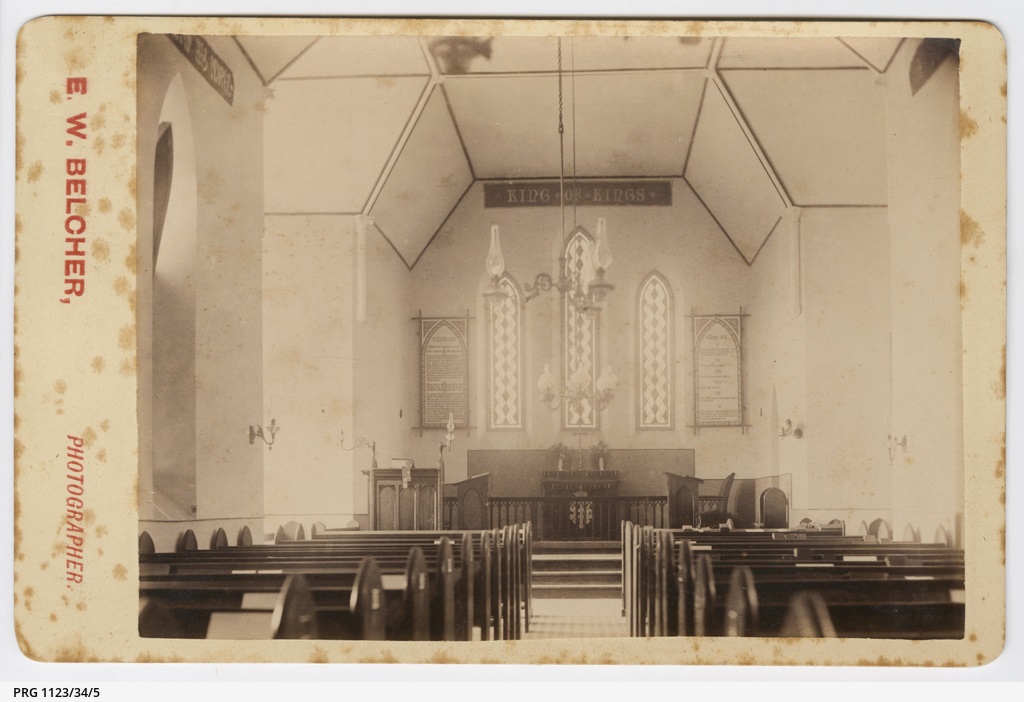
The original stained glass and tablets of the Commandments by Ferguson & Urie no longer exist. The tablets were an offering by the company but rarely advertised. These were usually painted in gold or gold leaf with red and black text in old English type lettering. Originals of these decorations are extremely rare to find as they were often painted over or replicated as renovations occurred over the course of time.

The image below shows the chancel of St Thomas’s circa 1885 depicting the original three light stained glass windows flanked by the tablets of the Ten Commandments by Ferguson and Urie.

Source: Collections South Australia: PRG 1123/34/5. Photographer: E. W. Belcher, circa 1885

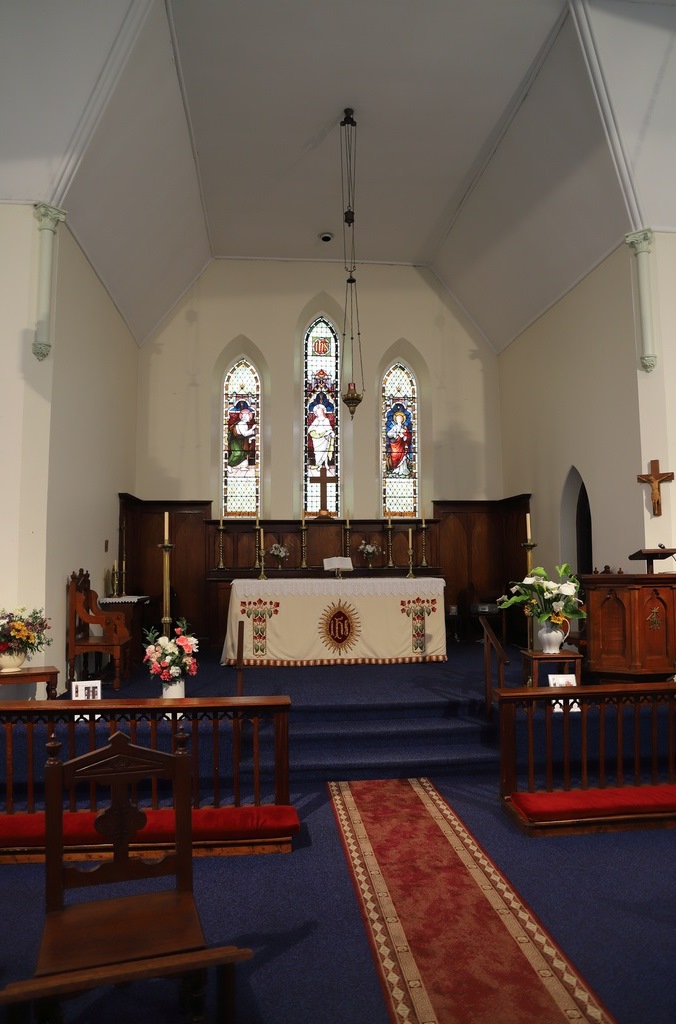
In 1893 the three lights in the chancel were replaced by figurative stained glass from Montgomery & Grimbly and were dedicated to Mr. F. S. Sison. The windows depict Christ flanked by St Thomas and St John.

St Thomas’s Port Lincoln, SA. Stained Glass by Montgomery & Grimbly 1893.
Source: Collections South Australia B77612 Photographer: Jenny Scott 18 Aug 2019

Evening Journal, Adelaide. SA, Tuesday 17th Oct 1893, page 2.

“A MEMORIAL IN STAINED GLASS.- Messrs. Montgomery & Grimbly, stained glass artists, of Waymouth street, have just completed a handsome memorial window to the order of the trustees in the estate of the late Mr. F. S. Sison, one of the founders of the firm of Messrs. Syme & Sison, brewers, and who died at Port Lincoln about two years ago. The window consists of three lights, the height of the central one being 10ft. 6 in., and those of the sides 8ft. each. The subject represented on the panels is the incredulity and conversion of Thomas and the figures portrayed are those of the Saviour, St Thomas, and St John. The figures, drapery, and surroundings are commendably finished, and as a work of art reflect great credit on Messrs. Montgomery & Grimbly. Part of the inscription hereon reads – “In memory of Frederick Samuel Sison, died December 29, 1891.” The window cost L150, and is intended for presentation to St Thomas’s Church, Port Lincoln, where it will be placed in the chancel, and will no doubt be appreciated for the excellence of its design and colouring.”

Updated: 18th July 2021

Short link to this page: http://wp.me/p28nLD-pa

© Copyright

21-11-1873: St. Peter’s Anglican Church, Robe, South Australia.

South Australia Register, Adelaide, Friday 21st November 1873, page 6.

“ROBE, November 18. A movement is on foot in this district for placing a window in St. Peter’s Church in memory of the late George Ormerod. About £100 will be required for the purpose.”

This stained glass window was eventually created. The two light window dedicated to the memory of George Ormerod was created by the Ferguson & Urie stained glass company of Melbourne circa 1874 and depicts the Nativity, Baptism, Resurrection and Ascension.

The Robe church history book supposedly has reference to this window being made by “Ferguson Will and Nyon” which is incorrect from two facets. It obviously should read “Ferguson, Urie and Lyon” but this would also be technically incorrect as the partner in the firm, John Lamb Lyon, officially dissolved his interest in the business with James Ferguson & James Urie on the 29th August 1873 and left for Sydney shortly afterwards. The date of the article above, 21 Nov 1873, is nearly three months after Lyon left the business so the window that was eventually made for Ormerod would have technically been “Ferguson & Urie” and the artist being David Relph Drape.

The former business partner John Lamb Lyon went to Sydney to take up partnership with Daniel Cottier to become Sydney’s premier stained glass studio “Lyon & Cottier”.

Photos kindly contributed by Liz Harfull 19/02/2012.

This slideshow requires JavaScript.

The Overland Telegraph, South Australia, 20th April 1872, page 5.

“THE LATE MR. ORMEROD.- Our Guichen Bay correspondent writes:- “As announced previously by telegram, Mr. George Ormerod, of Ormerod & Co., died at his Robe residence on the 10th inst. The death of one so long and intimately connected with this district could not but cause the most painful sensation. For some years past Mr. Ormerod has suffered from general debility and mental malady, the result of an overwrought brain. Frequent rallies had given hope that he might yet live many years; but during the last fortnight alarming symptoms showed themselves. Many far and near have watched anxiously the fluctuations of this last attack, still hoping his great vitality would carry him through; but he expired on the evening of the 10th. Mr Ormerod was a member of a very old Lancashire family, and was born at Rochdale in 1822. He came out to Victoria in 1842, and amongst the pioneer squatters settled at Naracoorte, about 1845 to 1846, on the station known as the Naracoorte Station. About 18 years ago he settled at Guichen Bay, opening up a large business there, which has aided greatly in the development of the South East. Mr. Ormerod shrunk from a public career, and the only public positions he held were those of J.P. and Chairman of the Local Road Board. These were retained as long as health permitted. The funeral took place on Friday afternoon, the body being interred in the Robe Cemetery. The procession was largely attended, some coming over 50 miles to be present. Many residents from Kingston testified their regard by following the remains to the grave. The Rev. H. Howitt, of St. Peter’s, preached a funeral sermon last Sunday, in which Mr. Ormerod’s many good qualities were appropriately alluded to. Mr. Ormerod has made a will, and it is understood that the business will be continued as heretofore for the benefit of his widow and family.”


Short Link: https://wp.me/p28nLD-lr

© Copyright

01-11-1921: The Lady Edith Fergusson memorial window at St. Andrew’s Church, Walkerville, South Australia.

The Register, Adelaide, Tuesday 1st November 1921, page 4.

“Fifty years ago, on October 28, 1871, there passed away the saintly and beautiful spirit of Lady Edith Fergusson, wife of the Governor of that name. She died at Glanville Hall, Semaphore, whither she had been taken for sea air. It was then owned and occupied by Capt. The Hon. John Hart, C.M.G., and now belongs to Mr. Magnus Waid. Lady Edith rests in the North Road Cemetery. The earliest painted window in St. Andrew’s, Walkerville, was raised to her memory in 1873. Mr. and Mrs. H. Kent Hughes presented the glass which was the work of Messrs. Urie & Ferguson, Melbourne. The woodwork was the gift of the congregation, and was designed by Mr. Woods, at that time architect of St. Peter’s Cathedral. A memorial window to Lady Edith is in the Cathedral itself. Lady Edith’s maiden name was Ramsay. Her father, the Marquis of Dalhousie, was Viceroy of India […]”

The remainder of the article is quite lengthy and describes many other historical events and information but not relevant to Ferguson & Urie.

Related posts: 22-10-1872 > 02-11-1872 > 08-01-1873 > 01-11-1921

08-01-1873: St. Andrew’s Church, Walkerville, South Australia.

The South Australian Register, Wednesday 8th January 1873, page 6.& The South Australian Register, Thursday 30th January 1873, page 3s.

“ST. ANDREW’S, WALKERVILLE. The congregation of this church have recently had a three-light stone window inserted in the chancel in place of the wooden tracery before filling the opening .The centre light is rather wider than the sides, and all have cusped heads. The jambs have small shafts, with carved and moulded caps and label terminations, and moulded bases resting upon a stone sill and moulded string. Messrs. Brown & Thompson executed the work from drawings by Mr. E. J. Woods. The above window is filled with stained glass by Ferguson & Urie, of Melbourne, and was a gift of Mr. H. Kent Hughes, in memory of the late Lady Edith Ferguson.”

Related posts:

22-10-1872 >  02-11-1872 > 08-01-1873 > 01-11-1921

22-10-1872: St Andrews Church, Walkerville, South Australia.

The Argus, Melbourne, Tuesday 22nd October 1872, page 5 & Border Watch, Mount Gambier, Saturday 26th October 1872, page 3.

 “A very handsome stained glass memorial window in memory of the late Lady Edith Christian Fergusson, wife of Sir James Fergusson, Bart, Governor of South Australia, who died about a year ago, has just been finished by Messrs. Ferguson, Urie, and Lyon of this city, and is to be forwarded to Adelaide today with the view of it being erected in St. Andrew’s Episcopal Church there by the 28th inst, the anniversary of her ladyship’s death. The principal figures in the window are life size representations of Christ ascending to Heaven from Mount Olivet, with St. Peter on one side holding the keys of Heaven and the Scriptures, and St. Andrew, the patron saint of the church where the window is to be erected, on the other side. The window also displays in large size the emblems of the four evangelists, and over the central figure the Holy Spirit is represented by the dove, while under it is a large artistic monogram of the letters I.H.S, surrounded by vines. The whole design is filled in with stained-glass devices of various colours; one corner having the arms of the Marquis of Dalhousie, of whom Lady Edith was a daughter, and at the bottom in large letters is the name Edith Christian Fergusson. The work is all executed in the old mosaic style, each different colour being one separate piece of glass, the whole being joined together by lead at the back. The ground colour of the design is blue, which is selected as being the most appropriate for a northern aspect, which the window is to have. The three principal figures are extremely handsome, the colours of the faces and the garments being well and clearly brought out, and the other accessory designs mentioned assist in forming a beautiful allegorical picture. Messrs. Ferguson, Urie, and Lyons’ reputation as stained glass window artists is fully established, and this last work of theirs is well calculated to support the name they have earned in their special line.”

South Australian Register, Adelaide, Wednesday 23rd October 1872. page 2.

“A stained glass window for St. Andrew’s Church, in memory of the late lady Edith Fergusson was shipped to-day. It is very handsome.”

Photos kindly provided by Kerry Kroehn 24/01/2011.

This slideshow requires JavaScript.

Related posts:

22-10-1872 > 02-11-1872 > 08-01-1873 > 01-11-1921


Short link to this page: https://wp.me/p28nLD-jE

© Copyright

02-11-1872: St Andrews Church, Walkerville, South Australia.

Australian Town and Country Journal, Saturday 2nd November 1872, Page 9.& Empire, Sydney, Saturday 26th October 1872, page 2.

“A memorial stained glass window for the chancel of St. Andrews Church, Adelaide, has just been completed, says the Melbourne Age, by Messrs. Ferguson, Urie, and Lyon. This work is to be placed in the church as a memento of the late Lady Edith Christian Fergusson, who died on the 28th October, 1871. Messrs. Ferguson and Co. have succeeded in producing a most creditable piece of workmanship. In the centre is placed the Saviour in the act of ascension; the clouds, a portion of Mount Olivet, and the figure give scope for some exquisite colouring. On one side of the central figure is St. Peter, and on the other side St. Andrew, with his cross. In the four corners are placed the four Evangelists, and on the top of all a dove is seen as if descending upon the central figure. At the foot of the window is placed the crest and monogram of the deceased lady. The memorial was to be sent on 22nd October to Adelaide, so that it may be in its place on the anniversary of the death of Lady Fergusson. The design for the work was forwarded by the Rev. Kent Hughes, the clergyman of the church.”

HISTORY WEEK SA, May 2010. TOUR GUIDE BOOK. St Andrews Church, 43 Church Terrace, Walkerville. Page 10.

“Window 10 – Above the main Altar
(a) ST PETER
(b) THE ASCENSION
(c) ST ANDREW
flank the figure of the ascending Jesus. Peter holds the keys to the kingdom of heaven and the gospel.  A Andrew [sic] as an old man is holding the cross on which he died. The cross is diagonal because Andrew would not be crucified in the same way as Jesus. This is the earliest window in the Church dating from 1873.
Inscription: “To the glory of God and the dear memory of the Lady Edith Christian Fergusson obit 28th October 1871”. She was a devoted churchwoman and wife of the Governor of South Australia, Sir James Fergusson.
Maker: Ferguson and Urie, Melbourne. Stonework designed by E.T. Woods architect for St. Peter’s Cathedral”.

Photos by Kerry Kroen 24th January 2012.

This slideshow requires JavaScript.

Related posts:
22-10-1872 >  02-11-1872 > 08-01-1873 > 01-11-1921

31-05-1872: Mr. J. Loessel, Adelaide, South Australian agent for Ferguson & Urie.

South Australian Register, Adelaide, Friday 31st May 1872, page 5.

“STAINED WINDOWS.- We had an opportunity on Thursday of inspecting a fine specimen of stained glass windows of colonial manufacture, with a large number of additional designs. They are made by Ferguson & Co. of Melbourne, who have advertised the appointment of Mr. J. Loessel, King William-street, as their agent.”

The South Australian Advertiser, Adelaide, Friday 31st May 1872, page 2.

 “In our business columns Messrs. J. Loessel & Co. invite the attention of the Trustees of Churches and others to designs for stained glass windows which they have received from Messrs. Ferguson, Urie, & Lyon, glass stainers, North Melbourne. These designs, which may be seen at Mr. Loessel’s office, in King William-street, are very rich in character, and have time to time been made to order by Messrs. Ferguson, Urie, & Lyons for churches in Victoria. Persons who are contemplating the erection of memorial windows will do well to inspect these designs.”

 The South Australian Register, Adelaide, Tuesday 4th June 1872, page 1.

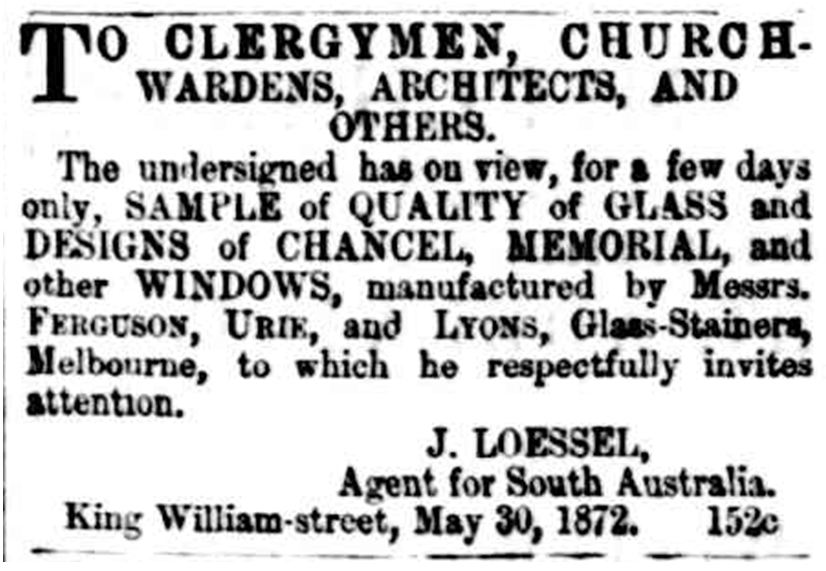
 “TO CLERGYMEN, CHURCH WARDENS, ARCHITECTS, AND OTHERS. The undersigned has on view, for a few days only, SAMPLE of QUALITY of GLASS and DESIGNS of CHANCEL, MEMORIAL, and other WINDOWS, manufactured by Messrs. Ferguson, Urie, and Lyons, Glass-Stainers, Melbourne, to which he respectfully invites attention. J. LOESSEL, Agent for South Australia. King William Street, May 30, 1872.”

LOESSEL Advert 1872

The level of success of Loessel as the South Australian agent for the firm is not known. As at 1st of March 2012 there are only eleven known locations in South Australia with extant Ferguson & Urie stained glass windows.

02-11-1867: Christ Church, Mount Gambier, South Australia, Australia.

The Rev. R. W. Needham memorial window.

 South Australian Register, Adelaide, Saturday 2nd November 1867, page 3.

 “MOUNT GAMBIER”

 “NEEDHAM MEMORIAL WINDOW.- Some time ago it was proposed to fill in with stained glass the chancel window of Christchurch, as a memorial of the late Rev. Mr. Needham; but owing to the want of funds the centre light as yet has only been completed. The subject chosen was that of the Ascension, which has been artistically carried out in the ‘atelier’of Messrs. Ferguson, Urie, and Lyon, of Melbourne, to whom too much praise cannot be awarded for their masterly rendering of the subject. The grouping and drawing of the figures are in excellent taste, and the principal figure – that of our Saviour – is a glorious conception, and stands out from the background with a relieve almost stereoscopic. The purple drapery of this figure is one of the most magnificent pieces of colouring we have ever seen. On a hand under the figure of the Saviour is His promise:-“I go to prepare a place for you, that where I am ye may be also;” and in the lower part of the window, under the group of Apostles, &c., is a shield with the following inscription:- “In memoriam R. W. Needham, died 3rd Decr., 1865. First incumbent of this Church.”

 Note: Christ Church Mount Gambier also has many other Ferguson & Urie stained glass windows. All are displayed in this slide show along with the east ‘Needham’ memorial window.

This slideshow requires JavaScript.

[View larger images]

Border Watch, Mount Gambier, SA, Saturday 19th October 1867, page 2.

“MEMORIAL WINDOW CHRIST CHURCH.-We were yesterday permitted to inspect a memorial window which has been placed in the east front of the Church of England over the Communion table, in memory of the Rev. R. W. Needham. The work which is of a very high is in the medieval style and the colored glasses of which the window is composed are so admirably matched and graduated in shade that the whole might very readily be taken for a painting by an artist of no mean attainments. The upper portion of the window is descriptive of teh ascension. Between these compartments are two angels bearing a scroll on which is inscribed the words, “Jesus shal so come as ye have seen him go into heaven.” Beneath the lower compartment are the words, “I go to prepare a place for you that where I am ye may be also.” At the base of the window, the object of the memorial is expressed by the words “In memory of the Rev. R. W. Needham who died December 3rd, 1866, first Incumbant [sic] of this Church.” The memorial window is alike creditable to those who subscribed the fund for its erection, the designer, Mr. T. W. Gore, and the artists who executed the work in Melbourne.”


Short link to this page: http://wp.me/p28nLD-9r

13-08-1867: James Urie visits Tasmania on Ferguson and Urie business.

In August 1867, James Urie of the Melbourne stained glass firm ‘Ferguson & Urie’, traveled to Tasmania with a portfolio of the companies designs for ecclesiastical and secular stained glass. As of May 2013, over twenty-five Tasmanian buildings have been identified as having one or more extant stained glass windows by the firm. The newspaper article below contains a gold mine of clues for Ferguson & Urie windows erected in Tasmania and in Victoria and I have included my comments as to what have found on each clue.

The Mercury, Hobart Tasmania, Tuesday 13th August 1867, page 5.

 “STAINED WINDOWS – A few days since we stated that Mr. Urie of the firm of Ferguson, Urie, and Lyon, glass stainers, &c, Melbourne, was on a professional visit to Hobart Town. This gentleman is now in Launceston, and we were much gratified yesterday by inspecting a large portfolio of designs for church and other windows which his firm has executed or has in hand. Amongst the most elegant we may mention the chancel window of St. George’s Church, Queenscliff, the subject being taken from the Litany, whilst the side lights represent the twelve Apostles and the west window other emblems; chancel window of St. Peter’s, Wooloomooloo (Sydney), embracing nine events in the life of St. Peter; Roman Catholic Church of St. Peter and St. Paul, Geelong; St Joseph’s Roman Catholic Church, Collingwood; St. Patrick’s Church, Duneed; the Melbourne Convent; the Presbyterian Churches at West Melbourne and Ballan; the Wesleyan Churches at Daylesford and Kent Town (S. Australia). They have also erected some very elegant memorial windows including one for the late Prince Consort at Kew; Rev. R. W. Needham, at Mount Gambier; Dr. Peck, at Sale; Judge Pohlman’s wife, and wife of Mr Stoddart both in Melbourne. We have already referred to Dr. Moore’s at New Norfolk, and the two windows in St. John’s, Launceston. One of the most elegant windows is in the house of Mr. George Stevenson, at Toorak; it represents the four seasons with figures of Art, Science, Agriculture, and Commerce, with Faith and Hope, coat of arms, and crest. This window cost £250. This firm also supplied a staircase window for the new mansion of the Hon. R. Q. Kermode at Mona Vale, but it has been decided to substitute one much more elaborate. They are also to fit up two windows for the new Wesleyan Church of this town – one at either end, which will be very handsome. Several private homes in this town, and a large number in Victoria, have been ornamented in this way, and no doubt the practice will extend when it is known how skilfully the art is carried out by Messrs. Ferguson & Co.”

Notes:

1. Queenscliff, Victoria, St Georges, All windows extant.
Related posts: 22-02-1864 > 29-01-1866 > 12-02-1881 > 07-04-1882 > 30-12-1893

2. Wooloomooloo, Sydney, NSW, St Peter’s (Darlinghurst), now part of Sydney Church of England Girls Grammar School.
Related posts: 1867: St Peter’s Anglican Church, Woolloomooloo, Sydney, New South Wales.

3. Geelong, Victoria, St Peter & Paul Catholic. Three light principal east window.
Related post: 13-08-1867: St Peter & St Paul, Geelong, Victoria.

4. Collingwood, Melbourne, Roman Catholic (St Joseph’s) destroyed by fire in 2007.
See: 1863: St Joseph’s Catholic Church, Collingwood, Victoria.

5. Duneed, Victoria, St Patrick’s (Mt Moriac) foundation laid in 1858. Ferguson & Urie east window erected in 1866 but was destroyed my a massive hail storm in 1887. The church was rebuilt in 1950’s and sold at auction in February 2017..

6. Melbourne, Victoria, the “Melbourne Convent”. This is likely to be the “Convent of Our Immaculate Lady of Mercy” in Nicholson street Fitzroy. My correspondence with the Convent has revealed nothing.

7. West Melbourne, Presbyterian. Dismantled in 1935 and re-erected as St Andrews at Box Hill in 1936. It contains the original F&U windows except for one which went to the Camberwell Church on Riversdale Road.
Related posts: 27-04-1935

8. Ballan, Victoria, Presbyterian (St Paul’s). All windows are extant.
Related posts: > 22-07-1866 > 28-07-1866 > 13-08-1867

9. Daylesford, Victoria, Wesleyan. Only small ‘stock’ windows in the porch exist in poor condition. See photos <here>

10. Kent Town, South Australia, Wesleyan. Nothing further known.
Related posts: 26-10-1864

11. Kew, Melbourne. The Prince Consort window at Holy Trinity is extant and recently restored.
Related posts: 08-06-1881

12. Mount Gambier, Christ Church, Rev Needham memorial window and others are extant.
Related posts: 02-11-1867

13. Sale, Victoria, St Paul’s Anglican Cathedral. Dr. Peck memorial window is extant.
Related post: 29-01-1867

14. Melbourne, Pohlman and Stoddart memorial windows.
Nothing found in regards to the Pohlman window but the Stoddart window exists.
Related post: South Yarra Presbyterian 1867

Pohlman:

Judge Robert Williams Pohlman (1811-1877): Biography | Obit 1877 | Funeral | Obit 1878 His funeral was in St Stephen’s in Richmond and he was buried in the Melbourne General Cemetery on the 8th Dec 1877. He was married twice. His second wife, Mercy Clifton Bachelor died of an embolism at age 26 on the 21st January 1876 only a couple of weeks after giving birth to a stillborn daughter on the 5th of January 1876. He only had one daughter to his second wife named Annie who married Navy Commander Frederick Owen Pike at St John’s in Toorak on the 27th December 1893.

This would mean that the stained glass window would have been a memorial to his first wife “Eliza” who died at Richmond on the 11th Feb 1856.

Stoddart/Stodart:

This is James Dickson Stodart (c1825-1867), Mayor of Prahran 1864/65 and councilor 1858/59-1859/60, 1863/64-1864/65.

Arrived from Edinburgh in 1853. Was later a financial agent for Cornish & Bruce railway contractors. See: Yarra Presbyterian 1867

An active member of the Scotch Presbyterian Church in Punt Road South Yarra, where his memorial stained glass window resides.

He died on Wednesday 12th June 1867. The window has been found at the South Yarra Presbyterian Church See: http://wp.me/p28nLD-2I3.

15. New Norfolk, Tasmania, St Matthew’s, Dr. Moore memorial window is extant.
Related posts: 04-03-1882

16. Launceston, St John’s: The window is extant but no longer in its original position. The canopy glass above the main three lights no longer exists but an original design for the window shows that it contained the descending Dove and the symbols for Alpha and Omega.
Full details see  post: 25-09-1866

17. George Stevenson’s house at Toorak was named “Trawalla” and is located at 22 Lascelles Avenue Toorak. Window is extant.

18. Ross, Tasmania, Kermode’s Mona Vale Mansion. This window still exists. Images are shown in various historical books written in the last 30 years.

19. Launceston, Wesleyan, (Pilgrims Uniting), window facing Patterson street is extant but nothing seen in the opposite end. Gavin Merrington from Hobart has confirmed that a wheel window exists above the organ loft.

Also see: 07-08-1867: Decorative Art. James Urie sojourning in Tasmania.

Other related posts: 03-03-1868 , 29-01-1866, 20-06-1867, 29-04-1864,


Short link to this page: http://wp.me/p28nLD-98