20-10-1885: Christ Church, Frederick St, Launceston, Tasmania.

The Launceston City Baptist Church (former Prince’s Square Congregational and Christ Church Congregational Church) 11 Frederick Street, Launceston.

Launceston Examiner, Tasmania, Tuesday 20th October 1885, page 3.

“OPENING OF CHRIST CHURCH.”

“A handsome stained glass memorial window has been placed on the eastern side of the church near the north end, by Mr. C. S. Button, of Scottsdale, Mrs. Calvert, of Hobart, and Miss Helen Button, the present organist, in memory of their father, Mr. W. S. Button (first Mayor of Launceston), and their mother. The window was obtained from the firm of Messrs. Ferguson and Urie, Collins-street, Melbourne.”

Photos by Gavin Merrington taken 23rd June 2012.

This slideshow requires JavaScript.

William Stammers Button (1795-1876) was born in Nayland, Suffolk, England. He arrived in Van Diemens Land (Tasmania) with his brother Thomas and other family members in 1833 aboard the ship “Forth,”[1] and initially starting business as a brewer in partnership with his brother-in-law, Jonathan Stammers Waddell, at Norfolk Plains (later known as Longford), and then at Launceston as “Button & Waddell”[2].

On New Years day in 1853, under much controversy and accusations of collusive fraud, the first elections for Aldermen for the town of Launceston were conducted[3]. Seven men were elected, one of whom was William Stammers Button (as well as his brother Thomas). Prior to the Aldermen retiring to elect the position of Mayor, each took the stand to address the crowd;

“William Williams, alias William Stammers Button advanced amidst a tornado of yells, groans, and hisses, and from what we could hear, we understood him to say – Gentlemen, I shall attend to my duties as well as I can. The public good I shall always endeavour to keep in view, and I will maintain it. The interests of the working man shall occupy my especial attention, and I will do all in my power to find employment – remunerative employment – for the free poor of this town. Gentlemen, I heartily thank you for the honor you have done me. (A voice – ‘much obliged to you – well done ali-ass Mr. Williams,’)” followed by groans and hisses.”

“…The successful candidates then retired to one of the apartments at the back of the court house to elect the mayor, when after the absence of about half an hour, the Sheriff, to the astonishment of every one present, declared William Williams, alias WILLIAM STAMMERS BUTTON, (brewer) first mayor of Launceston.”[4]

The reference to William Stammers Button as being William Williams is shrouded in controversy. Ten years earlier, in 1843, Button successfully won a law suit against a William Lushington Goodwin for “printing and publishing a malicious libel” against him in the Cornwall Chronicle[5], to which Goodwin was convicted and fined. After the election in 1853, further publications appeared to cast aspersions as his origins as the unknown William Williams[6].

William Stammers Button held the position of the Mayor of Launceston for four consecutive years and was universally admired for his efforts in the advancement of Launceston. He held many other public and private positions and in 1856 was elected to represent the Tamar district in the Legislative Council[7]. He was a liberal donor to all deserving institutions, and a served as a deacon of the Congregational church for over 40 years[8].

William Stammers Button died on the 17th September 1876 and was buried in the Mulgrave Square Cemetery in Charles street Launceston. The cemetery was closed for further interments in 1925[9].

In October 1885[10], the surviving children of William Stammers Button erected a stained glass window to his and his wife Marianne’s memory, in the City Baptist Church (former Christ Church Congregational) in Frederick Street, Launceston.

The window was crafted by the Colonial Victorian stained glass firm Ferguson & Urie of Melbourne.

The Mercury, Hobart, Tasmania, Wednesday 21st October 1885, page 3

“…On each side of the organ alcove there are round openings in the end wall, filled with geometrical designs on stained glass. There is also a stained glass window with a tablet, marked, “In loving memory of William Stammers Button, M.L.C, for nearly 40 years deacon of this church, also the first Mayor of Launceston, and Marianne, his wife, this window is dedicated.” The window, which bears the inscriptions on stained glass, “Blessed are the dead who die in the Lord,” and “Honour thy father and thy mother,” has been erected by Mr. C. S. Button, of Scottsdale, Mrs. Calvert, of Hobart, and Miss Helen Button, the organist of the church, the children of the deceased deacon.…”

The Mercury, Hobart, Saturday 26th January 1907, page 8.

“…There are some interesting, and indeed historic, memorials in Christ Church. A marble tablet perpetuates the memory of Mr. West, the historian of Tasmania, and a stained-glass window is a memorial of Mr. William Stammers Button, the first Mayor of Launceston…”

“…The window to the memory of the first Mayor bears this inscription:- “In loving memory of William Stammers Button, M.L.C., for nearly 40 years deacon of this church, also the first mayor of Launceston, and Marianne, his wife, this window is dedicated.” There is also a stained-glass window to the memory of another mayor of Launceston, Mr. Landon Fairthorne, who died in 1890…”

The Mercury, Hobart, TAS, Saturday 7th March 1953, page 20.

“MR. WILLIAM STAMMERS BUTTON, who was Launceston’s first mayor, and held office from 1853 to 1856. Mr. Button was associated with the beginnings of the Princes Square Independent Church, now Christ Church, where a memorial window honours his name.”
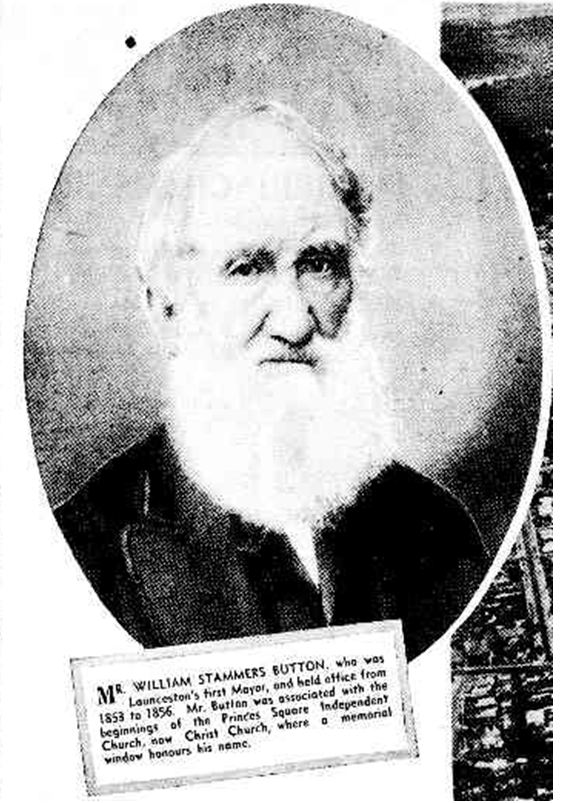
The Mercury, Hobart, TAS, Saturday 7th March 1953, page 20.

The Mercury, Hobart, TAS, Saturday 7th March 1953, page 20.

Launceston Examiner, Tasmania, Tuesday 19th September 1876, page 2.

“THE LATE MR W.S. BUTTON. (1876, September 19). Launceston

One more old colonist has finished his course. Mr. W. Button died peacefully at his residence, St. John-street, at a quarter-past eight on Sunday morning, aged 80 years, having lived in Tasmania 43 years. He was born at Nayland, in Suffolk, in the year 1795, where his early boyhood was spent, removing to Sudbury, in the same county, while yet young, in which place he was associated in business with his uncle, in whose service he frequently travelled to various parts of England, visiting also France and Flanders, when travelling by land and sea was attended by numerous perils. He was wont to recount to some of his friends the incidents of his wintry voyages and long journeys by coach, contrasting them with modern methods of conveyance. From his retentive memory he would sometimes recall the state of England in his youthful days during the awful struggles of the Peninsular war, and describe with the graphic power of a keen observer those days of dear bread, iron rule, and wearing anxiety. On his marriage he removed to Long Melford, a place historically famous like the other towns where he had lived. While there, he took an active part in politics, working hard on the liberal side, and especially seeking with others the repeal of “The Test and Corporation Acts,” which was happily accomplished in the year 1828. In 1833 he came to this colony in the ship Forth, bound to Circular Head and Launceston. He was accompanied by his brother Mr Thomas Button, Mr J. S. Waddell, and other members of his family. He first took up his residence at Norfolk Plains, removing to Launceston for business purposes. During his 40 years residence in Launceston he has been one of our most prominent and useful citizens. He was from the beginning one of the chief members of the Anti-Transportation League, giving cheerfully of his time and money. He was among the earliest promoters of the Cornwall Insurance Company in 1842, one of its first Directors, for many years Chairman of the Company, and to the last was warmly devoted to its interests. When Launceston was declared a municipality he was elected a member of the first Council and its first Mayor on January 1st, 1853. He filled the office by successive elections for four years, and during his mayoralty the chief portion of the work was done in supplying the town with water – a work that took up much of his time, yet by some strange oversight no notice is taken of his efforts on the commemorative fountain in Prince’s Square or on the pillar at St. Patrick’s River. Mr Button was appointed a justice of the peace in 1855, and has rendered good service in that capacity, his clear judicial mind eminently fitting him for the post. In October, 1856, he was elected a member of the Legislative Council for Tamar, and served in that capacity for six years. In the Council he was looked upon as a valuable member. His unobtrusive manners, wide experience, and extensive knowledge made him a man of power; he was firm and fearless – an independent member, one courteous and true. With the Launceston and Western Railway Mr Button was connected from the very beginning. Anxious to see the colony advance he gave labour and money to aid in improving our means of transit. For a while he was chairman of the Railway Company, till increasing years compelled him to retire. As one of the early shareholders of the Gas Company and a Director from its formation until his death, he took great interest in its working, and read carefully to qualify himself for his duties. Mr Button was also one of the chief agents in establishing the Launceston Examiner, though he never took an active part in the management; and was also one of the founders of the Launceston Mechanics’ Institute, of which he was subsequently President. It may be safely said that few men have ever striven more zealously and unselfishly than Mr Button did to advance the interests of our town, district, and colony. It cannot be expected that all his public actions will have secured the approval of all men, but there are none who will not admit that his integrity of purpose, his resolute method of work, his general wisdom, and his hearty sympathy with all onwards movements, were beyond question. Those who knew Mr Button best were most aware that he was distinguished for his religious zeal: he was a man who feared God, and sought to serve his day and generation as one who must give account at last. No notice of his life amongst us, even in a public newspaper like this, would be complete that passed over this aspect of his life. As a friend and fellow-worker of the late Rev. J. West, he greatly aided in the building and support of the Prince’s Square Independent Church. From the formation of the congregation until within a recent period he had served the church faithfully as Treasurer, for a short time was Superintendent of the Sunday school, and at his death was senior deacon. He also for many years acted as Treasurer of the Northern Branch of the Congregational Home Mission, and had taken an active interest in the working of the mission on the N.W. Coast. In his death the Bible Society loses an attached friend. As a working member of it’s local committee, and subsequently President for years, until failing health compelled him to resign, he gave one of the many proofs of the catholic nature of his religious principles and life. We have been given to understand that not withstanding the conservatism natural to old age, Mr Button had very considerable acquaintance and sympathy with many liberal forms of modern thought on religious matters. Mr Button’s family life is not a theme to dwell upon in a newspaper, but it may be mentioned that a few months ago his golden wedding was appropriately honored by a few friends, on which occasion he ascribed much of his public usefulness to his happy home life. He has left many sincere friends, who will cherish his memory to the very last. His interest in al things relating to colonial life was as fresh and strong as in his days of robust strength and willing work.

Though old, he still retained
His manly sense and energy of mind;
Virtuous and wise he was, but not severe,
He still remembered that once he was young.

Most of places of business wee partially closed yesterday as a mark of respect for the deceased gentleman, and the Municipal Council adjourned immediately after meeting for the same reason. The funeral will take place this afternoon, friends assembling at Prince’s Square Congregational Church at half-past three”.

The Mercury, Hobart, TAS, Tuesday 19th September 1876, page 3.

“OUR LAUNCESTON LETTER.
[From our own correspondent.]
LAUNCESTON, Monday morning.

“I regret to have to record the death, at about a quarter past eight o’clock on Sunday morning, at his residence St. John-street, of Mr. William Stammers Button, at the ripe age of 81 years. Mr. Button is a very old colonist, having arrived in the colony in 1832. He first settled in Longford, where he entered into partnership with a brother-in=law, the late Mr. William Waddell, in the establishment of a brewery on that township. After carrying on the business for some three years at Longford the firm removed to Launceston, taking the premises then known as Barnes’ brewery, opposite the gaol, and in this business Mr. Button continued til 1853. Up to this time he had been very active in taking part in all matters calculated to promote the advancement of the town, and initiating schemes of public utility. When municipal institutions were established in 1853, Mr. Button was one of the first members, and the first mayor elected. The election of mayor at that time was for two years, and Mr. Button was elected twice in succession, holding the office for four years. He then retired from the municipal council. In Oct., 1856 he was elected a representative of the Tamar in the Legislative Council, and filled that position til 1862. He had always been considered an industrious and energetic patron of Agricultural and Horticultural pursuits, and a liberal contributor to any institution calculated to improve the condition of his fellow townspeople. In public life he has taken a very active part. He was one of the founders of the Cornwall Insurance Company established in 1842, and has been connected with it ever since having occupied the position of chairman of directors till within a short time of his death. He was also one of the founders of the Mechanics’ Institute, established in the same year, and has ever since evinced a lively interest in its rise and progress. In the initiatory stages of the agitation for a water supply to the town he took a prominent part, and it was mainly through his instrumentality that the great boon of a waterworks was obtained. In the establishment of the Launceston Steam Navigation Company, which is now incorporated in the Tasmanian Steam Navigation Company, and in the support given to the Launceston Gas Company, of which he was for many years a director, he contributed greatly to their success. In all religious and philanthropic efforts Mr. Button was always to the fore, and amongst other positions he held for some time was that of the President of the Bible Society. He was connected with the Congregational denomination, and attended the Prince’s Square Church, of which the Rev. Wm. Law is the pastor. To the erection of this handsome and commodious edifice the deceased gentleman contributed largely, and continued his liberality up to the time of his death. He was generally esteemed by the townspeople as an honourable and upright man, and a steadfast friend, and his decease is universally regretted. Although the deceased gentleman’s health and strength had been visibly declining some time, it was not till a few days ago that any serious consequences were anticipated by his friends. He attended divine service on Sunday the 10th inst., and was working in his garden on Thursday last. On Thursday night, however, serious symptoms manifested themselves, and he then sank rapidly up to the time of his death, which took place on Sunday morning. The pastor of Prince’s Square Church, the Rev. Wm. Law, in his morning service, both in his prayer and sermon, alluded in feeling terms to the long connection of Mr. Button with the church, and his many excellent qualities, and then announced that the funeral service would take place on Tuesday afternoon, at three o’clock, at the church; and that on the following Sunday evening he should preach a memorial sermon.”

The Mercury, Hobart, TAS, Thursday 21st September 1876, page 3.

“The funeral of Mr. William Stammers Button left his late residence, St. John-street, at 25 minutes past 3 this afternoon, arriving at the Prince’s Square Congregational Church about half-past 3. During the passing of the funeral cortege to the church, the bell of St. Andrew’s Church was tolled. The funeral service was conducted by the Rev. J. Lindsay and the Rev. C. Price, after which the Rev. W. Law delivered a funeral oration in which he commented at length on the many estimable qualities of the deceased, and his long and useful career. The funeral was largely attended, and after leaving the church the procession was formed in the following order:- The Revs. W. Law, J. Lindsay, and C. Price; next Drs. Miller and Hardy; then the hearse with the following gentlemen acting as pall bearers:- Messrs. E. L. Diteham, H. Dowling, E. Dickens, J. Kemp, F.L. Fyah and J. Steer, senr. Alderman C. S. Button, son of the deceased gentleman, followed, and with him the other near relations and connections of the deceased. The Mayor, the Town Clerk, the members of the corporation and those of eh Maritime board cam next, and then followed a long procession, there being some 200 persons present. The remains were conveyed to their last resting place the cemetery in Mulgrave Square.”

The Cornwall Chronicle, Launceston, TAS, Monday 2nd October 1876, page 4.

“THE LATE MR. W. S. BUTTON

 Mr. William Stammers Button died at his residence, St. John street, Launceston, on the morning of Sunday, 17th September, a little after eight o’clock. His illness had been a very short one. He was about as usual on the 13th September, was taken unwell in the course of the evening, gradually sank into a comatose state, and passed quietly away. Mr. Button came to the colony 43 years ago, and after a short residence at Norfolk Plains came to Launceston, where he won for himself a large measure of general respect and confidence. His active public life has brought him into connection with most local objects. As the first mayor of Launceston from 1st January, 1853, to 31st December, 1857, Mr Button had a great amount of work to perform, and during his mayoralty the chief difficulties connected with the water supply of Launceston overcome. He was for some years a member of the Legislative Council of this Colony, in which capacity his services were highly valued. Mr Button was one of the promoters of the Launceston and Western Railway, for a long time chairman of the company, and was ever ready to aid in all public works. His devotion to the interests of the Cornwall Insurance Company was well known; as its chairman for many years, he was one of he most trusted counsellors. He was a director of the Launceston gas Company. We believe that few men amongst us were more zealous and useful in public life than the subject of our notice. All our local societies of a philanthropic and religious kind shared in his gifts and labors [sic]. Mr Button was also well known in association with Prince’s Square Independent Church, of which he had been a member and officer from its formation til the time of his death, and was always a liberal supporter of its funds. He was a man who early in life had received a good education, was gifted with considerable natural powers, and had always been a great reader. Mixed up as Mr Button had been in many questions in which considerable diversity of opinion prevailed, it cannot be expected that he always in his public life pleased everyone; but he was recognised throughout his long career as a man whose wish was to do good, and one who had fully identified himself with the land of his adoption. In private life Mr Button was an intelligent companion – a kind and faithful friend. He lived to reach the age of eighty years.”

The Mercury, Hobart, TAS, Tuesday 26th September 1876, page 3.

“At the Prince’s Square Congregational Church on Sunday evening, the Rev. Wm. Law delivered a memorial sermon on the death of the late Mr. William Stammers Button, choosing his text from Acts, xiii., 36. “For David after he had served his own generation by the will of God fell on sleep.” Both the body of the church and the galleries were filled. The rev. gentleman made the text the basis of an appropriate and impressive sermon, and concluded with an enumeration of the many acts of philanthropic and Christian usefulness, which had marked the long and honoured life of their departed townsman.”

Launceston Examiner, TAS, Saturday 14th January 1843, page 7.

“SUPREME COURT, CRIMINAL SITTINGS.
THURSDAY, JANUARY 12.
The Queen, at the instance of W. S. Button, v. W. L. Goodwin, for printing and publishing a malicious libel…”

On the 16th of April, William Lushington Goodwin published in the Cornwall Chronicle the following malicious libel against William Stammers Button:-

“In all transactions let us honest be,
And honour give to strict integrity,
Let bolters by their creditors be scouted,
And their professions afterwards be doubted;
In whatsoever clime they take their fight
Let them be doomed to everlasting night,
And honest men with them all business shun,
Fearful they might again up stick and run!
For Button may once more design,
For the same reason choose to cross the line,
Which once he crossed. God knows the reason –
Whether for highway robbery or treason.
But true it is, as Williams he did fly
He’s Button now – though folks say ‘tis a lie’;
Some day the truth will out, if not too late.
And that the bolter will not ‘scape his fate’;
Perhaps the hulks – perhaps a halter –
Exhibited to public gaze – this malster,
Newspaper-man, hypocrite and bolter.”

Goodwin was found guilty of the libelous slander against Button and ordered to pay a fine to the Queen of £30 and be imprisoned until it was paid. He paid it immediately!

Footnotes:

04-03-1882: St Matthew’s Church, New Norfolk, Tasmania.

The Anglican Church of St Matthew is in Bathurst Street New Norfolk, opposite Arthur Square. It was built in 1823 and is the oldest church in Tasmania. The church was consecrated in 1828 by Archdeacon Scott from Sydney and has been altered a number of times since. In 1833 extensive additions transformed it significantly. The tower was added in 1870 (no longer exists) and in 1894,the chancel was added and the windows, roof and transepts also altered. All that remains of the original church are the walls, floor of the nave, and part of the western transept.

The church contains many historical stained glass windows, among which are the ‘Moore’ and ‘Sharland’ stained glass windows crafted by Ferguson & Urie of North Melbourne.

Photos taken 7th October 2010:

This slideshow requires JavaScript.

[View all images]

The Mercury Hobart, Tasmania, Saturday 4th March 1882, page 3.

“… The church is without pretentions to good looks – it is neither imposing nor elegant. Yet with all its plainness it is a building endeared to many by sacred associations; and also contains features of interest to the visitor. Over the communion table is a stained glass window, representing our lord’s interview with the two disciples at Emmaus, and erected by Mr. W. S. Sharland, in memory of his first wife. Another stained glass window, placed at the back of the font, and representing the baptism of Christ in the River Jordan, was presented by the late Dr. Moore and his son, to commemorate their escape from shipwreck on the occasion of the loss of the s.s. City of Launceston in Hobson’s Bay…”

The Dr. Moore window:

On the evening of 20th November 1865 the ‘SS City of Launceston’ departed Launceston and within two hours of departure it had collided with the SS Penola from Adelaide in Hobson’s Bay. All passengers and crew were rescued by the severely damaged Penola before the Launceston sank.

“…One cabin passenger, Dr. Moore, got his portmanteau, containing £100 in money, into the boat, but it fell overboard [1]

It was thought that the SS City of Launceston could be raised and tenders were called for the work however this never eventuated. Although there were many newspaper reports in 1865 that appeared to describe the exact location of where the ship sank, the Maritime Archaeologists Association of Victoria only found the intact wreck in 1980.

Dr. John Anthony Moore died on the 6th of July 1878 at New Norfolk aged 62[2].

The text on the Moore memorial window reads:

“S. Mark 1:9” “ERECTED BY J. A. MOORE, SENr & JUNr, TO COMMEMORATE A DELIVERANCE FROM SHIPWRECK, NOVr 19th, 1865”.

The window depicts St. John the Baptist, Babtising Christ in the river Jordan.

The Sharland window:

The text on the Sharland memorial window reads:

“TO THE GLORY OF GOD  AND IN MEMORY OF FRANCES SARAH WIFE OF WILLIAM STANLEY SHARLAND WHO DIED ON THE VIIIth DAY OF MARCH IN THE YEAR OF OUR LORD MDCCLIX” (8th March 1859).

Although the biblical scene the window represents is not written anywhere on the window, Janice Ball, from New Zealand, has identified it (07 Apr 2012) as “Emmaus” (Luke 25: 13-37) where Christ is seen breaking bread with two disciples who were walking from Jerusalem to Emmaus .

WikipediaThe two disciples have heard the tomb of Jesus was found empty earlier that day. They are discussing the events of the past few days when a stranger asks them what they are discussing. “Their eyes were kept from recognizing him.” He soon rebukes them for their unbelief and gives them a Bible study on prophecies about the Messiah. On reaching Emmaus, they ask the stranger to join them for the evening meal. When he breaks the bread “their eyes were opened” and they recognize him as the resurrected Jesus. Jesus immediately vanishes”.

The top third of the window has the symbol letters “IHS”. The centre depicts three men with Christ in the middle with a disciple on either side and Christ is breaking bread. The lower has a rather unusual depiction of the Hexagram or Star of David.

Related posts: 07-08-1867 > 13-08-1867

External Links:

Web Site: Diving the City of Launceston Shipwreck

Obit: Dr Moore (no mention of his past shipwreck though!)

Bio: William Stanley Sharland (1803-1877)

Obit: William Stanley Sharland (1801-1877)

Footnotes:

Short link to this page: http://wp.me/p28nLD-xr

© Copyright

27-12-1881: St Paul’s Anglican Church, Launceston, Tasmania.

In 1881 a Ferguson & Urie three light stained glass window depicting the “Resurrection and the life, Good Shepherd, and Light of the world” was supposed to have been erected in the chancel of St Paul’s, Launceston and unveiled on Christmas day 1881. Unfortunately the company couldn’t complete the window in time and requested an extension.

By April 1882 the three light chancel window was in place and at the same time two other single light windows by Ferguson & Urie, depicting St Peter and St Paul, were awaiting arrival to be subsequently placed either side of the chancel.

The church was demolished circa 1875 to make way for the Launceston Hospital.

The Ferguson & Urie window and others were relocated and now appear in St Paul’s Chapel by the Sea at Low Head.

Launceston Examiner, Tasmania, Tuesday 27th December 1881, page 3.

“CHRISTMAS DAY ….”

“… As usual the church of St. Paul’s was decorated very chastely and effectively, and perhaps suffered no loss by comparison with more extensive Christmas decorations in previous years…”

 “… At the close of the sermon in the morning, the incumbent alluded to one feature of Christmas greeting which he regretted the absence of, and which he hoped would be there that day, viz, a stained glass window for the chancel, which was to replace the painted one, which so often became an eye-sore when the paint began to peel off. A parishioner, in humble circumstances, had liberally offered to pay the cost of the new window, but through press of business Messrs Ferguson and Uril [sic], of Melbourne, had not been able to complete it in time for Christmas; and as they wished to do the work well, they asked a little extension of time. Probably a few weeks more will see this addition in its place, and it will not be the less welcomed through not making its first appearance at the Christmas festival.”

Launceston Examiner, Tasmania, Tuesday 11th April 1882, page 3.

“During Holy Week, owing to alterations, which were being made in connection with putting up the stained glass window in the Chancel of St. Paul’s Church, the daily service was held in the adjoining School-room….”

“… Before commencing the sermon in the evening, he alluded with feelings of thankfulness to the hearty and earnest services of Good Friday, and expressed his gratitude that the ugly painted window in the Chancel had given place to the handsome one, which those who were present in the morning had the privilege of witnessing the full effect of…”

“….and with pleasure announced that two additional stained glass windows had been liberally presented to the church, to be placed at the end of each aisle, right and left of the chancel. One window would represent St. Paul, whose name of the church and parish bear, and the other St. Peter, his brother apostle, and these windows would probably be finished in about three months. The chancel window, the noble and generous gift of a working man in the parish, consists of three lights; the central one containing a representation of Christ as the “Good Shepherd”, underneath this figure is the lamb with banner and cross, and above it the I.H.S., and alpha and omega in very rich colours. To the right is Christ as the “Light of the world;” above, the symbol of St. Mark, and below, that of St. John. To the left is Christ as the “Resurrection and the life,” with the symbol of St. Matthew above, and St. Luke below. Taken altogether the window is very pleasing and effective, and was supplied by Messrs Ferguson and Urie, of Melbourne, who will also provide the two additional windows….”

Tasmanian Govt, LINC, Record NG472, accessed 24 Mar 2012:

“The Anglican Parish of St Paul’s was officially created and opened on 15 October 1854. Prior to this it was part of the Parish of St John’s, Launceston. It comprised the church of St Paul’s in Cleveland Street. On 5 October 1975 the final service was conducted in the church prior to its demolition to make way for redevelopment of the Launceston General Hospital on the church site. The demolition was agreed upon only if the hospital recycled the building as much as possible. Much of the fabric and contents of the St Paul’s church went to Low Head and were used in the construction of St Paul’s Chapel by the Sea, an interdenominational church which by c. 2000 was incorporated into the Ainslie House Aged Care Complex at Low Head.  The chapel built at the redevelopment of the Launceston General Hospital was named St Paul’s chapel”.

The Organs Historical Trust of Australia record for Christ Church Low Head, accessed 24 Mar 2012:

“This substantial brick church was opened around 1980. It contains many fittings from St Paul’s Anglican Church, Launceston including the stained glass, memorial tablets and organ. St Paul’s was a large timber church to the south of the city centre close to the Launceston General Hospital”.


Short link to this page: https://wp.me/p28nLD-wU

© Copyright


06-01-1876: Holy Trinity (Greek Orthodox), Hobart, Tasmania.

The Mercury Hobart, Tasmania, Thursday 6th January 1876, page 2.
The Mercury Hobart, Tasmania, Monday 24th January 1876, page 2s.

“MEMORIAL WINDOW – A beautiful and richly coloured window (says the Church News) has lately been placed in Holy Trinity Church, Hobart Town, by a large number of the parishioners and friends of the Rev. Canon Davenport as a memorial of his eldest son. It is the work of Messrs. Ferguson and Urie, Melbourne, and the chief design is a Cross with the words, “Thou art my hope, O God. Jesu, Mercy”. The window also bears the following inscription:- “WALTER CHARLES DAVENPORT. Died 31st March, 1875. Aged 22 years. A tribute from Friends”. This mark of sympathy is deeply valued by Cannon Davenport and his family.”

Holy Trinity was designed in the Gothic Style by the convict architect James Blackburn. The Governor, Sir John Franklin, laid the foundation stone in October 1841 and the church was consecrated on the 27th December 1849.

Despite many attempts by the Anglican diocese to retain the church, it was found uneconomical  to pay the four million ongoing repair bill and it was eventually decided to sell it to the Greek Orthodox Church in 2009.

Apart from the Davenport memorial window, there are two other Ferguson & Urie windows in the church. The three windows are:

1. The Davenport memorial window has a blue cross with IHS above, floral and geometric designs with text : “THOU ART MY HOPE O GOD, JESU MERCY”, “WALTER CHARLES DAVENPORT. DIED 31st MARCH 1875 AGED 22 YEARS. A TRIBUTE FROM FRIENDS.”

2. Christ carrying the cross with text: “THE LORD HATH LAID ON HIM THE INIQUITY OF US ALL – ISAIAH 53 VER 6”.

3. A depiction of the Suffer little Children with the text, “OF SUCH IS THE KINGDOM OF HEAVEN”. The memorial text reads: “TO THE GLORY OF GOD AND IN MEMORY OF SARAH NOWELL , DIED 29th NOV 1880”

All three windows, with closeup detail, are depicted in the slideshow:

This slideshow requires JavaScript.

External links:

Short link to this page: http://wp.me/p28nLD-oL

22-05-1874: Holy Trinity Catholic Church, Westbury, Tasmania

The Mercury, Hobart, Tasmania, Friday 22nd May 1874, page 2.

“OPENING CEREMONIES AT THE CHURCH OF HOLY TRINITY, WESTBURY”

“The Nave is lighted by a magnificent Oriel window in the centre which is a representation of the Divine Lord, surrounded by a representation of the Pelican in the wilderness, the cross and Heart, the cross with the hammer and nails, the cross with the circle of thorns, with I.N.R.I; a representation of the undivided garment of Christ, the lamp of faith, and the lamb. This window was executed by Messrs Ferguson & Urie. It was the gift of Daniel Burke Esq the Warden of Westbury […]”.

“[…] Two stained glass windows with two lights being St Patrick and St Bridget and the other, The Annunciation – a gift from Mrs William Smith of Westbury and the Rev W.J Dunn vicar general. These windows were executed by Ferguson & Urie.[…]”

Photos taken 11th October 2010.

This slideshow requires JavaScript.

See post 21-05-1874 for additional article about the Westbury windows.

Related posts:

21-05-1874 > 22-05-1874


21-05-1874: Holy Trinity Catholic Church, Westbury, Tasmania.

Launceston Examiner, Tasmania, Thursday 21st May 1874, page 3.

 “CHURCH OF THE HOLY TRINITY, WESTBURY”.

 “OPENING CEREMONIES. WEDNESDAY, MAY 20”.

 “…The east end window is the gift of Mr John barber and family; it represents the nativity, the Crucifixion, and the Resurrection, with artistically enriched borders; the colors are exquisitely beautiful. This presentation window came from the establishment of Messrs Couttes and Sons, London, and is an admirable work of art. Another window is of stained glass in two lights each, one representing St. Patrick and St. Bridget, the patron saints of Ireland, the gift of Mr William Smith; and the other “The Annunciation,” the gift of the Very Rev. Vicar-General Dunne. A third window, also of stained glass, is the gift of Mr Dignam, formerly of Westbury, and represents “father, Son, and Holy Ghost,” the church being dedicated to the Holy Trinity. There are also presentation windows by Mr D. Burke, Churchwarden of the church and Warden of the Municipality of Westbury, emblematic of the Crucifixion; and another from funds collected by Mrs Steward, representing Faith, Hope, and Charity. All the stained glass windows, with the exception of the barber presentation at the east end, are the artistic work of Messrs Ure [sic] and Ferguson, Melbourne, and are well worth inspection and study. All the lead lights were made by Howard Bros., Launceston…”

Photos taken 11th October 2010.

This slideshow requires JavaScript.

[View larger images]

There are a significant number of errors in the article about the windows. According to the actual text on some windows, the Ferguson & Urie windows were donated by the following:

1. Nave – “St Patrick” and “St Bridget” – “The gift of Mrs Thomas Field”.

2. Nave – The Annunciation –“Ave Maria” and “Gratia Plena” – (Hail Mary Full of Grace), “The gift of Mrs William Smith” and “The gift of the Very Rev Dr Dunne V. G”

3. Transept – The only text on the window reads – “Sancta Trinitas Unus Deus” – (The Trinity – The Father, Son & the Holy Ghost) – written in the article as the gift of Mr Dignam.

4. Transept – The only text on the window reads “Fides Spes Caritas” (Faith, Hope & Charity) and written in the article as from funds collected by Mrs Steward.

The window not mentioned in the article is the oriel shaped west window. It was specifically mentioned in an article published the following day but has been included it in this slideshow to complete the full cycle of the Ferguson & Urie windows at Holy Trinity Westbury.

See related posts: 22-05-1874

The east window described as being made by “Couttes and Sons, London” can be see on my alternate site: http://stainedglassaustralia.wordpress.com

10-07-1873: St. David’s Cathedral, Hobart, Tasmania.

St David’s Church Hobart Town is being built with the nave, aisles and transepts completed.

The Illustrated Sydney News, 10th June 1873 and  Illustrated Australian News for Home Readers, Melbourne, Friday 10th October 1873, page 170.

“NEW CATHEDRAL OF ST. DAVID, HOBART TOWN”

 “[…] The west elevation consists, in its lower stage, of a porch of no great projection, the front of which exhibits three arched openings. Above this is a noble Gothic window of five lights with decorated tracery in the head. This is filled with plain “cathedral glass” imported from Ferguson, Urie and Co., of Melbourne, as are the windows of the clerestory. Several of the windows of the aisles are filled with stained glass of English manufacture, presented in memoriam by friends of deceased persons.[…]”

The original plain five light west window has been replaced by a modern stained glass window by Joseph Stansfield (date unknown). The plain clerestory windows by Ferguson & Urie are all still original.

Photos taken: 7th Oct 2010 & 12th Aug 2012.

This slideshow requires JavaScript.

External links:

26-07-1872: Memorial Congregational, Elizabeth and Brisbane streets, Hobart, Tasmania.

The foundation stone of the Memorial Independent Church was laid on the corner of Elizabeth and Brisbane streets in Hobart by Henry Hopkins (1787-1870) on the 16th August 1870 [1] and was formally opened on Thursday 7th November 1872 [2].

In late July 1872 the stained glass windows for the church had arrived from the Ferguson, Urie, and Lyon stained glass company of Melbourne[3] and were promptly erected. A further two “variegated pattern” windows were expected to arrive by the Southern Cross from Victoria on the 4th of August 1872[4].

Photos taken 8th October 2010.

This slideshow requires JavaScript.

The Memorial Independent church was built in the decorated gothic style to the designs of the architect Francis Butler (1823-1916) and erected by the contractors ‘R & R Shield’ who tendered for the construction at a cost of £6,835.

The laying of the foundation stone by Henry Hopkins was one of his last public events. The 16th of August 1870 also marked his 83rd birthday and he died five weeks later on the 27th September 1870 [5].

Preceding his laying of the foundation stone of the church the usual affair of placing a time capsule beneath the stone occurred and;

“…A zinc box containing copies of The Mercury, Tasmanian Times, Tasmanian Independent, Friend, and other journals, various coins of the realm, photographs of the old and proposed new church, and cartes de viste of the Rev. F. Miller, H. Hopkins, Esq., the late Mrs. Hopkins, and the Rev. W. C. Robinson. The zinc box was hermetically sealed, and laid in the cist beneath the memorial stone…” [6]

Also included in the box was the speech read by the Rev. W. C. Robinson, after which the elderly Henry Hopkins was assisted to the platform from his nearby carriage and seated on a chair where he was then presented with;

“…A beautiful box made of Tasmanian light wood, by Mr. Wooley, of Macquarie-street, containing a handsome silver trowel, manufactured and presented by Mr. C. Gaylor, of Liverpool-street, and a mallet, made of coloured myrtle wood, with ivory handle, the work of Mr. Haywood, of Goulburn-street, was then presented to Mr. Hopkins. The silver trowel bore the following inscription: “Presented by Charles Gaylor to the congregation of the Memorial Church, Hobart Town, on the occasion of laying the foundation stone, by Henry Hopkins, August 16th, 1870.” On the lid of the box was a photograph of the proposed edifice. Mr. Shields, the contractor, having had the memorial stone raised about three feet, the mortar was spread, the box containing the records, deeds, &c., placed in the cist, and the stone was slowly lowered to its permanent position. Mr. Hopkins, after giving the stone two or three knocks with the trowel, said: “I declare this foundation stone laid in the name of the Father, Son, and Holy Ghost; and may the blessing of God attend the labours of all concerned in it. Forty years ago I had the privilege of introducing the first Independent minister to this colony, and thirty years since I was the means of the introduction of the first Independent minister into Victoria. Two months ago I had the privilege of laying the foundation stone of the new Wesleyan Church in Davey-street, and now I am called upon to lay the foundation stone of the Memorial Church, which stone bears the name of the Rev Frederick Miller, who arrived in this place forty years ago. He was a man of piety and energy and he felt a great love for the people, and for every cause that had for its object the glory of god and the good of his fellow man. I rejoice in having the opportunity of laying this stone; and may the blessing of God attend the labours of all those who shall be engaged in this building.” The following is the inscription engraved on the brass plate which is let into the stone:- “Memorial Congregational Church, the first Christian Church formed in the Australias upon Independent principles; the Rev. F. Miller, pastor, A.D. 1830 to the year 1862. This stone was laid by Henry Hopkins, Esq., 16th August 1870.” [7]

The church was to be known as the ‘Memorial Congregational Church’ in memory of the first Independent or Congregational minister, the Reverend Frederick Miller (1806-1862), who arrived in Van Diemen’s Land in 1830 and commenced his ministry on the 17th of October in the same year. The very first chapel on the site was funded solely by him at a cost of £500 and opened on the 20th April 1832[8]. He died on the 13th in October 1862 aged 56 [9].

Since 2006 the Memorial Congregational church has been the Seventh Day Adventist & Multicultural Church.

Significant tabloid transcriptions about the windows:

The Mercury, Hobart, Tasmania, Friday 26th July 1872, page 2,

 “THE MEMORIAL CHURCH – The whole of the windows for the Memorial Church having arrived from Melbourne, with the exception of the transept windows, the contractors are busy fitting them in, so that the internal work of the building may be proceeded with as soon as possible. The large front window is completed. It is of stained glass, beautifully designed and ornamented, bearing the inscription in the lower panes, “Christ Jesus came into the world to save sinners.” There will be four windows on each side, some of them with a quarter-foil over the two side lights, and others with cinque-foil and six-foil, while the borders will be of different colours, blue, yellow, purple, or green. There will be two vestry windows with blue borders, three apse windows with yellow borders, and a large number of small windows, the colours of the borders in each instance being varied. The whole of the windows, except the front and transept, which are stained, are of cathedral glass; and the makers, Messrs. Fergusson[sic], Urie, and Lyon, of Melbourne, have eminently sustained the name which they have already obtained in these colonies as stained glass manufacturers. The large window in the gable is a piece of work which shows the remarkable progress which has been made in this art during the last few years in Victoria.”

The Launceston Examiner, Saturday 3rd August 1872, page 5.

“…The stained glass windows, so far as they go, give the building a picturesque appearance; two more windows have to be supplied, and they are expected to arrive by the Southern Cross tomorrow, from the establishment of Messrs. Ferguson, Urie, and Lyon, Curzon-street, Melbourne. The pattern, variegated and blending colors of the glass are of an artistic description, and in due proportion with the general coup d’oeil of the interior of the building…”

The Mercury, Hobart, Tasmania, Saturday 10th August 1872, page 3.

 “The Memorial Church, at the corner of Elizabeth and Brisbane-streets, is in an advanced state toward completion, and some idea can now be realised of the very elegant appearance the church will present when it is entirely finished. While externally it will have the semblance of a magnificent building, internally its appearance will be fully compatible with the outside. The embellishments are of a rich chaste character, consistent with the beautiful design of the building. The roof and the gallery are finished. The windows are also in. The front and transept windows are of stained glass, beautifully designed and ornamented, while the remainder of the windows, which are of cathedral glass, are improved by borders of various colours. The makers, Messrs. Ferguson, Urie, and Lyon, of Melbourne, have eminently sustained the name which they have already obtained in these colonies as stained glass manufacturers. The church, it is anticipated, will be opened as soon after its completion as possible.”

External links:

Biography: Henry Hopkins (1787-1870)

State Library Vic: A Sermon occasioned by the death of Mr. Henry Hopkins, Rev George Clarke, 9 Oct 1870.

Biography: Rev Frederick Miller (1806-1862)

Biography: Rev George Clarke (1823-1913)

Footnotes:

Short link to this page: http://wp.me/p28nLD-hR

© Copyright

21-03-1871: Struan House, Launceston, Tasmania, Australia.

In Cameron-street in Launceston, Tasmania, stands the historical Supreme Court Building originally built in 1870-71 as “Struan House”[1] for the wealthy Scottish Colonist James Robertson. It was designed by architect Peter Mills[2] and constructed by building contractor Edward Ford.

In 1893 the building was used as a private maternity hospital and in 1929 was acquired by the Tasmanian Government for use by the Launceston Supreme Court.

During the construction of Struan House in early 1871 the Launceston Examiner tabloid reported;

“…We must not omit to mention that the side and fan lights of the entrance door, and of the doors leading out on to the verandah and balcony are glazed with rich designs in stained glass, manufactured by the well known firm of Ferguson, Urie, and Lyon, of Melbourne…”[3]

In 2011, enquiries revealed that there is still an original piece of Ferguson & Urie stained glass above a doorway in the building having the year 1870 emblazoned on it!

On the 18th April 2011 Mr Chris Nason, wrote:

“Dear Ray, Thankyou for your email. I confirm that Struan House does still exist and has been maintained as part of the Supreme Court since 1929. In terms of stained glass the only item that remains is above a door that opens onto the north facing balcony. I have taken a couple of shots of the window and attached for you. Unfortunately the shot from outside is not great. I hope this is of some use to you. Regards Chris Nason, District Registrar, Supreme Court of Tasmania…“

Photos kindly provided by Mr Chris Nason, 18th April 2011.

This slideshow requires JavaScript.

James Robertson (1800- 18741800- 1874).

James Robertson was a native of Alvey, Inverness-shire, Scotland and arrived in Van Diemen’s Land in the early 1820’s where he joined his brothers John, William and Daniel, breeding sheep and cattle in the Campbelltown district.

Later they diversified to form Robertson Brothers Mercantile Importers in Elizabeth Street Hobart in 1829[4], run by John & William, and in Brisbane-street Launceston in 1831[5], headed by James and Daniel.

On the 18th of November 1833, at St David’s Church in Hobart, James married Mary McDonald, daughter of Roderick McDonald of Glengarry[6].

James had been a Justice of the Peace in Launceston since September of 1843 and was a supporter of the anti-transportation of convicts to the colony. In 1853 he declined requests to stand for the election of the first Mayor of Launceston[7] which was subsequently won, under much controversy, by William Stammers Button.

He was a local director of the Union bank of Australia and had been Captain and Paymaster of the Volunteer Artillery[8] and for many years was the treasurer[9] of the Launceston branch of the ‘St Andrew’s Society’ [10]

In January 1841 his brother Daniel had decided to dissolve his partnership leaving James as sole proprietor of the Launceston Mercantile business[11]. Just over twelve months later, on the 12th March 1842, Daniel drowned in the Esk River whilst on a fishing trip with friends[12]. In 1848 unknown persons referred to as “miscreants” attempted to rob Daniel’s grave![13].

In February 1850 James’ wife Mary died at the age of 35 [14] and on the 28th of May 1851 he married Mary’s younger sister Margaret, the eighth daughter of Roderick McDonald of Glengarry[15].

James Robertson died on the 1st of April 1874[16] and was interred in the Robertson family vault at the Scotch Cemetery in Launceston[17]. His wife Margaret died on the 3rd of September 1891[18].

His former residence ‘Struan House’ now forms part of the Launceston Supreme Court. Only the top portion of a fan light window above a doorway in the building exists of the original Ferguson & Urie stained glass created in 1871.

Of coincidental interest, James Robertson’s elder brother William went on to become one of the largest landholders in the western district of Victoria and in 1877 the Ferguson & Urie Company created a large ‘Rose’ stained glass window which was erected to his memory in St Andrew’s Presbyterian Church at Colac, Victoria.

Significant transcriptions:

Launceston Examiner, Tas, 15th January 1853, page 4.

“MR. JAMES ROBERTSON. FEW inhabitants better deserve the tribute of respect about to be paid to him on his departure for Britain, than Mr Robertson. In his sphere of public usefulness, none have been more energetic and successful; and he has often taken the most arduous part, when a benevolent or popular object was in view. There can be no question that if he had assented to the request recently addressed to, him, he would have been the first Mayor of Launceston. But business arrangements prevented compliance, and the St. Andrew’s Society, of which he is a” pillar,” have gracefully come forward to recognise his claims to general esteem. In his commercial career he has been successful, and as a staunch anti-transportationist, he will doubtless exert his influence at home, in favor of the land of his adoption; and the birth-place of his children. The invitations to gentlemen, not members of the St. Andrew’s Club, ought to be very extensive, or they should be permitted, at their own cost, to be present on the occasion. We heartily wish him a pleasant voyage home, success in his mission, and a safe and speedy return.”

The Launceston Examiner, Tuesday 21st March 1871, page 2.

 “MR. ROBERTSON’S NEW RESIDENCE. The new residence of James Robertson, Esq., situate in Cameron-street near the old Military Barracks, and now rapidly approaching completion, is a building that deserves something more than a mere passing notice, for it is one of the best finished, and certainly the most commodious of private dwellings on this side of the island. Erected on the summit of a gentle slope which extends down to the bank of the River Tamar, it commands a fine view of the windings of that stream, and a still finer view of the Cataract on the South Esk, with its bold romantic scenery, and the pretty light looking iron bridge which spans the entrance to what may fairly be termed on of the lions of Launceston. Turning his back on these, a considerable portion of the town is presented to the gaze of the spectator. But the building itself is an ornament to the town, and forms a prominent object that that is sure to attract the attention of visitors or others sailing up the river. The main building is in style Italian, and two storeys high. The walls are constructed of brick, the dressings to the windows, string courses, quoins, cornices, chimneys, and the enrichments generally being executed in Portland cement. The brickwork is uniform in color, and neatly finished with a white joint. The roofs are of slate, and the roof of the main building overhangs the wall about three feet, the projection being supported by ornamental cantalivers [sic]. The front of the building faces the north, but there is an entrance on the east, by means of a massive looking porch and steps. On the ground floor are the large entrance hall, staircase hall, dining, drawing, breakfast and ball rooms, also a business room. The entrance hall is divided from the staircase hall by fluted Corinthian columns and pilasters, supporting a decorated cornice of the same order. The dining and drawing rooms which are well proportioned, open into the entrance hall. The breakfast and ball rooms are entered from a wide corridor leading from the staircase hall to the kitchen, the former room being well lighted by a large bay window of clear plate-glass, from which an excellent view of the Cataract and Tamar can be obtained. The whole of the fittings are of bright cedar French polished, and the finishing’s round the hall side of the doors are ornamented and carved very handsomely. The principal rooms also have elaborately wrought marble mantle-pieces, and are enriched with light and elegant moulded cornices. A verandah, accessible from the staircase hall, runs round the front and a portion of the two sides of the building, terminating on one side against the kitchen wing, and on the other against the entrance porch; and above the verandah is a balcony accessible from the first landing of the staircase. The roof of this is curved and covered with corrugated iron, the railings, trellis work, and brackets being of cast iron, and in appearance very ornamental. The verandah and balcony are wide, and furnish a very agreeable promenade, in which the eye can not fail to be delighted with the surrounding scenery. We must not omit to mention that the side and fan lights of the entrance door, and of the doors leading out on to the verandah and balcony are glazed with rich designs in stained glass, manufactured by the well known firm of Ferguson, Urie, and Lyon, of Melbourne. The kitchen wing contains a large kitchen, scullery, washhouse, stores, pantries, and servants’ staircase. A first-class cooking range manufactured by Mr William Peter, Wellington-street, is fitted up in the kitchen, and from this, by means of pipes, the bedrooms on the upper floor are supplied with hot water for baths, &c. Underneath the building are dry cellars floored with cement. The upper or chamber floor is reached by a handsome staircase, having a continuous ornamental iron railing, and here we find a number of lofty, well-ventilated bedrooms with dressing and bathrooms attached. The nursery and servants’ bedrooms are placed over the kitchen, &c. The baths are fitted up so that hot or cold water can be turned on at pleasure. The whole of the fittings in the rooms, except the mantle pieces, are of French polished cedar. The court yard is enclosed by out-offices – including accommodation for men servants, a coach house, stables, harness room, cow house, hay loft – and by entrance gates, provision been made to get a carriage drive through this court yard round to the river frontage. The Cameron-street frontage is enclosed by an ornamental iron palisading of cast iron with gates, &c., to correspond.
The total cost of erecting these fine premises will be about ₤6000. Mr E. Ford is the contractor, and appears to have executed his work very faithfully. The buildings were designed by Mr Peter Mills, and have been erected under his vigilant superintendence, and we must say that the manner in which everything has been carried out reflects the greatest credit on him.”

Launceston Examiner, Tas, Thursday 2nd April 1874, page 2.

“OBITUARY
Another old colonist has gone from our midst: JAMES ROBERTSON, so long connected with various interests of Launceston, died last evening, in his 75th year, having completed his 74th on the 23rd of March.
After a few years’ occupation as sheep farmer in the Campbell Town district, in this colony, Mr Robertson came into Launceston in 1830, to enter into commercial business with his younger brother, Daniel, unfortunately drowned in the South Esk, in 1841 [sic], which business he carried on very successfully, first on premises now occupied by Messrs. Smith and Poole, and subsequently in the large premises built by the firm for the purpose now known as the International Hotel, until a comparatively recent period, when he retired from more active pursuits to the handsome residence he erected in Cameron-street, known as Struan House, and in which he died.

           Through a long mercantile career Mr Robertson maintained the character of a strictly honourable merchant, and sincere friend. Amongst his mercantile connections he numbered most of the older colonists; and he enjoyed the immediate friendship of an unusually large circle.
            There are some incidents of his “settler life” which possess unusual interest, at once characteristic of his personal courage and of the peculiar difficulties of early settlement in these colonies. On one occasion when sitting reading at the fire in his hut, his back to the door, he was surprised by the entrance of a notorious bushranger, with two equally notorious companions. They had previously secured his shepherd servant, and came so sudden upon him that resistance was useless. After helping themselves to provisions, they set off for a distant rendezvous, marching Mr Robertson and his servant before them, still tied, until they arrived at midnight, on the banks of the South Esk, at a crossing place where they expected to find a boat; which, however was on the opposite shore. One of the bushrangers crossed the river to fetch the boat for the conveyance of the party and their plunder; when the subject of our memoir, seeing an opportunity, succeeded in getting one of his arms sufficiently at liberty to get his hand into his pocket and secure a penknife. The robbers were so intently engaged in watching the progress of their companion that they gave to Mr Robertson the opportunity of communicating by signs, in the light of partial moonlight, with his servant; and after cutting the cord which confined his own arms, he cut that of his servant. They both remained in a position of apparent confinement until they could hear the splash of oars of the returning bushranger, when they each closed upon one of the confederates, and with the handkerchief torn from their own necks tied the hands of each. The man in the boat hearing the conflict turned for the other shore, but was promptly fired on with the arms now in the possession of Mr Robertson and his servant. The two prisoners were soon handed over to the police, and were conveyed to Launceston gaol; and on further enquiry the boat was found riddled with ball but abandoned by the robber, who was afterwards found wounded and captured. On another occasion the self-possession and courage of Mr Robertson were even more conspicuously displayed. A bushranger, who had become the terror of the district, occupied a mi-mi in the depths of the forest. Mr Robertson discovered it, or was informed of the locality – no matter which. Having obtained the co-operation of a neighboring settler he determined to effect capture. Keeping their secret they set out together for the place, but when they arrived found the fellow that occupied it away. They laid their plans accordingly – crouching themselves in the scrub until the evening, when they saw their man return, watched him dismantle himself of his fire-arms with the exception of pistols in his belt, cook his evening meal, and creep into his mi-mi. Mr Robertson immediately rushed in the aperture requiring almost a crawling posture whilst his settler friend made loud demonstrations of directing a body of men outside. He threatened to shoot the robber and disarm him, tied him securely, and led him out to show him (as Mr Robertson often told with considerable humour), to his great disgust, that he had been captured  by two nearly unarmed men!
            Mr Robertson’s genial countenance and bustling habits will long be missed in the streets of Launceston. He leaves an estimable widow, his second wife, and a large family, comfortably provide for. Mr Robertson has been in the Commission of the Peace since the 20th September, 1843. It will be remembered that his eldest brother William died in Victoria on 18th January last.”

Launceston Examiner, Tas, 9th April 1874, page 3.

“THE LATE MR  JAMES  ROBERTSON.

The funeral of the late Mr James Robertson took place on Tuesday afternoon, and was attended by a very large number of personal friends and others from various parts of the colony anxious to pay the last tribute of respect to the memory of one who had maintained business and social relations with the colonists, especially of the Northern districts, for so lengthened a period. By request of Mr Robertson communicated shortly before his decease, the funeral obsequies were superintended by his old friend, Mr Alderman Tyson, Messrs Richards and Son being the undertakers. The remains had been enclosed in a leaden coffin which was encased in a shell, neatly covered with black cloth, and suitably furnished. Shortly after 3 o’clock the coffin was   deposited in a plain hearse drawn by a pair of horses, and the mournful cortege left Struan House, deceased’s late residence in Cameron-street: the following gentlemen acting as pall-bearers, viz., the hon. James Aikenhead, M.L.C., a local Director of the Commercial Bank ; J. T. Sale, Esq., J.P., Manager of the Union Bank of Australia, of which deceased had been for many years a local director; C. J. Weedon, Esq., J.P., one of the Directors of the Bank of Tasmania; Thomas Corbett, Esq., J.P., a director of the Bank of Van Diemen’s Land; John Fawns, Esq., J.P., one of the Executive Committee of the Savings Bank; and Dr. Miller, J.P. The pall-bearers were flanked on either side by members of the Volunteer Artillery Corps, of which deceased had been Captain and Paymaster. The sons of deceased, Messrs. Hector and Angus Robertson were chief mourners with other relatives following; and in addition there were from 140 to 150 townsmen and colonists. There were also a number of private carriages behind. The route of the cortege was Cameron-street, Charles-street, Brisbane-street, and High-street to the Scotch Cemetery, where the family vault is situated; and the esteem in which deceased had been held by his fellow townsmen was evinced by the closing of the shops and other places of business along the line of route. The Revs. J. Gardner, W. Law, J. Lindsay, and R. M’Clean were among the ministers who attended. At the grave the Rev. R. McClean, of Hobart Town, read a portion of Scripture, and delivered an appropriate address. The Rev. J. Lindsay offered prayer. The coffin was borne to the hearse, and to the vault by the Volunteer Artillerymen.”

Footnotes:

[1] The Launceston Examiner, Tuesday 21st March 1871, page 2.

[2] Peter Mills also designed the Launceston Town Hall in 1864 and several other historical buildings in Launceston.

[10] Formed in 1841 to not only entice skilled labourers from Scotland to the Colony, but to provide friendship and assistance to them and their families and benevolent acts to their widows and orphans in times of need.

[17] The Scotch Cemetery opened in 1835 and closed in 1928. It was re-developed as “St. Andrew’s Gardens” from c.1951 with some of the grave stones transferred to the Carr Villa Cemetery.

03-07-1869: St. John’s Anglican Church, Ross, Tasmania.

St John’s Anglican Church in Ross, Tasmania, was erected to the designs of architect Henry Hunter using some of the sandstone from the original church built in 1835.  The building was completed in 1868 and consecrated the following year on the 14th of May 1869  by the Bishop of Tasmania, Charles Henry Bromby (1814-1907).

Launceston Examiner, Tasmania, Saturday 3rd July 1869, page 4.

“THE NEW CHURCH AT ROSS.- From the Church News..”

 “… The nave is lighted on each side by cusped lancet windows, placed in couplets. The west end has three plain lancets, over which is a circular window filled with geometrical tracery; and a small circular window is placed in the gable of the transept. The east window is of three lights, the head being filled with rich tracery. The masonry throughout is of fine Ross free-stone. The roofs are of high pitch, finished internally with pine boarding, panelled and moulded. All the windows are filled with stained pattern-glass, manufactured by Ferguson & Urie, of Melbourne…”

 “… Everything was done by workmen employed by the chief benefactor of the church, Mr. Kermode, under the general direction of its designer and architect. Mr. Hunter…”

Photos: (updated) taken 12th August 2012. There are also some photos of restoration work, by Gavin Merrington. between June 2006 and Jan 2007. The August 2012 photos were taken during an awesome historical stained glass road trip with Gavin on the 12th Aug 2012.

This slideshow requires JavaScript.

Note: Robert Quayle Kermode (1812-1870) also owned the mansion “Mona Vale” near the town of Ross in Tasmania, and it also contains stained glass windows made by Ferguson & Urie.

The Mercury. Hobart, Tas, Wednesday 12th May 1869, page 2.

“CONSECRATION OF ROSS’ CHURCH.- The Lord Bishop of Tasmania is to consecrate the new church at Ross on Friday, 14th inst., when divine service will be held at 11 o’clock. The clergy are invited to meet in the vestry at half-past ten and to bring their surplices”.


Short link to this page: http://wp.me/p28nLD-cu

© Copyright