16-07-1868: Cook’s Tailoring Establishment, Elizabeth Street, Hobart, Tasmania.

Henry Cook’s new Tailoring establishment in Elizabeth Street Hobart, near “Lord’s Buildings”, was opened 1868 and contained a Ferguson & Urie stained glass window in the show room.

The Mercury Hobart, Tasmania, Thursday 16th July 1868, page 3.

“… Mr Cook’s new tailoring establishment in Elizabeth-street, near Lord’s Buildings, has also been opened; two large houses and shops are converted into one place of business, and a pile of buildings at the rear has been razed, and a mansion erected on the site. Mr. Wiggins was the contractor for the new building, and Messrs. Jackson, Nicol, Martin, and Roberts were employed for the joinering work, cabinet making, and embellishment of the new business premises. A stained glass window in the show room is from the warehouse of Messrs. Ferguson, Urie, and Co, Melbourne. The premises are lighted with forty gas burners”

Henry Cook was elected as Mayor of Hobart in 1860-61. In 1868 he was appointed as Tailor[1] to H.R.H. the Duke of Edinburgh. On the 13th August 1869 he was in the position of acting Mayor of Hobart and was on that day elected as Mayor[2] until the end of the year. He was as also a Justice of the Peace, Churchwarden of St David’s, and the first president of The Benevolent Society of Hobart. There is also a monument dedicated to him at the Fern Tree Pipeline development.

Henry Cooks Tailoring shop was advertised as at 45 Elizabeth Street Hobart in the late 1850’s. The Hobart Post office is now on the site formerly known as “Lord’s Buildings”.

Nothing further is known about what was depicted in the stained glass window or whether it still exists anywhere.

The Mercury, Hobart, TAS, Monday 26th May 1890, page 3.

DEATH OF MR. HY. COOK, J.P”

“…A few years after his arrival in Hobart, he commenced business as a tailor and woollen merchant, which line he has since followed with marked success. His first premises were at the corner of Collins and Elizabeth streets, the spot now occupied by the A.M.P. Society’s offices. Afterwards he removed higher up Elizabeth-street, between Liverpool and Bathurst streets, returning some 20 years ago to the premises in Elizabeth-street, now occupied by his firm.”

Henry Cook died on the 25th May 1890. His son, Henry Jnr, carried on the business “…in a shop which at one time stood on the present site of the Commonwealth Bank, and in 1912 the business was removed to 136 Collins-street, where it is presently conducted.” Henry Cook Jnr died aged 70 on the 17th July 1925.

External links:

Recollections of Old Hobart – The Post Office Block (The Mercury 28th July 1910)

Footnotes:


Short link to this page: https://wp.me/p28nLD-aP

© Copyright

08-08-1868: ‘Thompson Villa’, AKA ‘Enstone Park’, Falmouth, Tasmania

Note: as at 3rd Apr 2017 this marker post is due to be replaced by an extensive research article including images of the stained glass window (but please don’t hold your breath waiting).

The Launceston Examiner, Tasmania, Saturday 8th August 1868, page 2.

“FROM LAUNCESTON TO ST.GEORGES BAY. (By H. T. D., in the Australian Journal)”.

“….another half hours drive brought us to the residence of J. Steel, Esq, whom we were bent on visiting. On a gentle slope, about a half mile from the sea, stands the mansion of our host, known as Thompson Villa. The exterior of the building produces a highly picturesque and pleasing effect. The style is Italian, with projecting roof. The principal rooms open onto a wide veranda, the design of which, as also the balcony, is decidedly ornamental. The interior fittings are of the best character, the entrance hall being divided by Corinthian fluted columns, with pilasters and Corinthian cornice; and well lighted up by a beautiful ornamental stained glass window, which I recognised as the handiwork of our enterprising fellow colonists, Messrs. Ferguson, Urie and Lyon, of North Melbourne…”

Thompson Villa is now known as Enstone Park near the town of Falmouth on the east coast of Tasmania, 202km south east of Launceston. It was built by William Steel’s nephew in 1867 for £1740. After WW1 it was named ‘Enstone Park’ by L. J Steel who lived in the house until his death at the age of 102 in 1968. The property is now owned by the Enstone Park Pastoral Company Pty Ltd.

Refer to comments below regarding the existence of this window.


Short link to this page: http://wp.me/p28nLD-aQ

© Copyright

03-03-1868: Wesleyan (Pilgrims Uniting) Church, Patterson street, Launceston, Tasmania.

Illustrated Australian News for Home Readers, Tuesday 3rd March 1868, page 3

“NEW WESLEYAN CHURCH PATTERSON-STREET, LAUNCESTON, TASMANIA”

“The new Wesleyan Church, in Patterson-street, Launceston, Tasmania, of which we give an engraving in the present number, was opened for worship on Friday, the 21st…”
“… The principal windows, front and rear, are fitted with stained glass, by Ferguson and Urie, of Melbourne…”

Launceston Examiner, Tasmania, Saturday 24th August 1867, page 4.

“WESLEYAN. Two stained glass decorative windows have been ordered from Melbourne for the Wesleyan Church now building in this town. They are to be of very handsome design and will be placed at either end of the edifice.”

This is now the Pilgrims Uniting Church, Launceston. The windows were ordered circa August 1867 from Melbourne. The large five light window facing Patterson street is twenty two feet high and absolutely stunning. No stained glass window was seen in the opposite end of the church on my visit in 2010 but Gavin Merrington from ‘Original Stained Glass’ at South Hobart has confirmed its existence and is hidden by the organ loft.

Photos taken 10th October 2010.

This slideshow requires JavaScript.

Related posts: 13-08-1867: James Urie visits Tasmania on Ferguson and Urie business. 


Short link to this page: https://wp.me/p28nLD-a7

© Copyright

20-01-1868: Mona Vale Mansion, Ross, Tasmania, Australia.

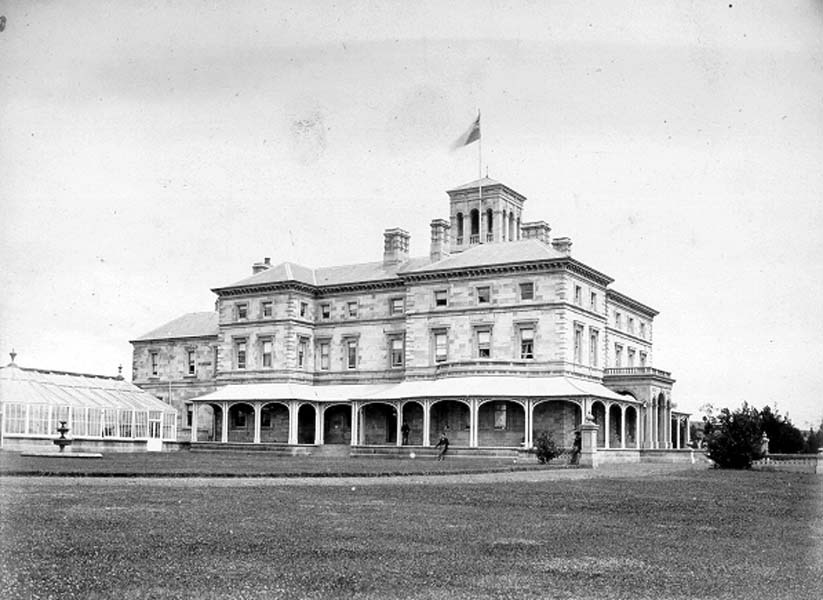
Mona Vale mansion, at Ross in Tasmania, was built in 1867 for the wealthy land owner and Tasmanian Parliamentarian Robert Quayle Kermode and he entertained the Duke of Edinburgh there shortly after it was completed. The stained glass windows were created by the Ferguson & Urie stained glass company of North Melbourne and were selected by the architect of Mona Vale, Henry Hunter, during a visit to Victoria in 1867.

The Mercury, Hobart, Monday 20th January 1868, page 3.

“THE JOURNEY TO THE NORTH. (From our Special Reporter)

 MONA VALE – RESIDENCE OF THE HON. R. Q. KERMODE, ESQ., M.L.C.

 “In my last article I concluded my description of the trip of H.R.H. the Duke of Edinburgh to the northern side of the island, and landed him safely once again at the threshold of Government House. The narrative would, however, be very incomplete unless accompanied by some kind of description of the mansion at Mona Vale, where His Royal Highness stayed on his upward and downward journey, and where every provision was made for his comfort, which the real genuine hospitality of an English gentleman could devise, or Princely munificence accomplish. The mansion of Mona Vale is, I have no hesitation in saying, one of the most splendid and magnificently furnished residences in the whole of the Australian colonies, and it is replete with every comfort and conveniences that modern art has yet suggested.…”

 “… Retreating to the main corridor we arrive at its junction with the main hall, and here for the first time I observed the beautiful windows of stained glass, which surround the front door. The fanlight is especially worth mention, having in the centre Mr. Kermode’s crest, an arm and dagger surrounded by a handsome design. The side lights have a stained glass bordering, with centre pieces in frosted glass of floral design. Arrived at the foot of the grand staircase, I observed that the whole of the windows by which it is lighted were also of stained glass, showing groups of flowers most tastefully arranged. The whole of these windows are in the style known as enamel painting, and were executed by Messrs. Ferguson and Urie, of Melbourne, some of them being selected for Mr. Kermode by Mr. Henry Hunter, during a late visit to Victoria…”.

Unfortunately, I don’t have any photos of the stained glass windows. Only copyright images exist in a handful of publications. The property is now owned by the Cameron family.

Robert Quayle Kermode was also a substantial benefactor and instrumental in the erection of St John’s Church in Ross which also has a complete cycle of Ferguson & Urie stained glass windows.

Related posts:

1869: St John’s Anglican Church, Ross, Tasmania.

External Links:

Biography – Robert Quayle Kermode (1812-1870)

Obituary – Robert Quayle Kermode (19 May 1870)

Article – ‘Fine Old Country Residence is Landmark in Northern Tasmania’

Obituary – Robert Crelin Kermode (1847-1927) [son of R. Q. Kermode]


Short link to this page: https://wp.me/p28nLD-a2

© Copyright

13-08-1867: James Urie visits Tasmania on Ferguson and Urie business.

In August 1867, James Urie of the Melbourne stained glass firm ‘Ferguson & Urie’, traveled to Tasmania with a portfolio of the companies designs for ecclesiastical and secular stained glass. As of May 2013, over twenty-five Tasmanian buildings have been identified as having one or more extant stained glass windows by the firm. The newspaper article below contains a gold mine of clues for Ferguson & Urie windows erected in Tasmania and in Victoria and I have included my comments as to what have found on each clue.

The Mercury, Hobart Tasmania, Tuesday 13th August 1867, page 5.

 “STAINED WINDOWS – A few days since we stated that Mr. Urie of the firm of Ferguson, Urie, and Lyon, glass stainers, &c, Melbourne, was on a professional visit to Hobart Town. This gentleman is now in Launceston, and we were much gratified yesterday by inspecting a large portfolio of designs for church and other windows which his firm has executed or has in hand. Amongst the most elegant we may mention the chancel window of St. George’s Church, Queenscliff, the subject being taken from the Litany, whilst the side lights represent the twelve Apostles and the west window other emblems; chancel window of St. Peter’s, Wooloomooloo (Sydney), embracing nine events in the life of St. Peter; Roman Catholic Church of St. Peter and St. Paul, Geelong; St Joseph’s Roman Catholic Church, Collingwood; St. Patrick’s Church, Duneed; the Melbourne Convent; the Presbyterian Churches at West Melbourne and Ballan; the Wesleyan Churches at Daylesford and Kent Town (S. Australia). They have also erected some very elegant memorial windows including one for the late Prince Consort at Kew; Rev. R. W. Needham, at Mount Gambier; Dr. Peck, at Sale; Judge Pohlman’s wife, and wife of Mr Stoddart both in Melbourne. We have already referred to Dr. Moore’s at New Norfolk, and the two windows in St. John’s, Launceston. One of the most elegant windows is in the house of Mr. George Stevenson, at Toorak; it represents the four seasons with figures of Art, Science, Agriculture, and Commerce, with Faith and Hope, coat of arms, and crest. This window cost £250. This firm also supplied a staircase window for the new mansion of the Hon. R. Q. Kermode at Mona Vale, but it has been decided to substitute one much more elaborate. They are also to fit up two windows for the new Wesleyan Church of this town – one at either end, which will be very handsome. Several private homes in this town, and a large number in Victoria, have been ornamented in this way, and no doubt the practice will extend when it is known how skilfully the art is carried out by Messrs. Ferguson & Co.”

Notes:

1. Queenscliff, Victoria, St Georges, All windows extant.
Related posts: 22-02-186429-01-1866 > 12-02-1881 07-04-188230-12-1893

2. Wooloomooloo, Sydney, NSW, St Peter’s (Darlinghurst), now part of Sydney Church of England Girls Grammar School.
Related posts: 1867: St Peter’s Anglican Church, Woolloomooloo, Sydney, New South Wales.

3. Geelong, Victoria, St Peter & Paul Catholic. Three light principal east window.
Related post: 13-08-1867: St Peter & St Paul, Geelong, Victoria.

4. Collingwood, Melbourne, Roman Catholic (St Joseph’s) destroyed by fire in 2007.
See: 1863: St Joseph’s Catholic Church, Collingwood, Victoria.

5. Duneed, Victoria, St Patrick’s (Mt Moriac) foundation laid in 1858. Ferguson & Urie east window erected in 1866 but was destroyed my a massive hail storm in 1887. The church was rebuilt in 1950’s and sold at auction in February 2017..

6. Melbourne, Victoria, the “Melbourne Convent”. This is likely to be the “Convent of Our Immaculate Lady of Mercy” in Nicholson street Fitzroy. My correspondence with the Convent has revealed nothing.

7. West Melbourne, Presbyterian. Dismantled in 1935 and re-erected as St Andrews at Box Hill in 1936. It contains the original F&U windows except for one which went to the Camberwell Church on Riversdale Road.
Related posts: 27-04-1935

8. Ballan, Victoria, Presbyterian (St Paul’s). All windows are extant.
Related posts: > 22-07-1866 > 28-07-1866 > 13-08-1867

9. Daylesford, Victoria, Wesleyan. Only small ‘stock’ windows in the porch exist in poor condition. See photos <here>

10. Kent Town, South Australia, Wesleyan. Nothing further known.
Related posts: 26-10-1864

11. Kew, Melbourne. The Prince Consort window at Holy Trinity is extant and recently restored.
Related posts: 08-06-1881

12. Mount Gambier, Christ Church, Rev Needham memorial window and others are extant.
Related posts: 02-11-1867

13. Sale, Victoria, St Paul’s Anglican Cathedral. Dr. Peck memorial window is extant.
Related post: 29-01-1867

14. Melbourne, Pohlman and Stoddart memorial windows.
Nothing found in regards to the Pohlman window but the Stoddart window exists.
Related post: South Yarra Presbyterian 1867

Pohlman:

Judge Robert Williams Pohlman (1811-1877): Biography | Obit 1877 | Funeral | Obit 1878 His funeral was in St Stephen’s in Richmond and he was buried in the Melbourne General Cemetery on the 8th Dec 1877. He was married twice. His second wife, Mercy Clifton Bachelor died of an embolism at age 26 on the 21st January 1876 only a couple of weeks after giving birth to a stillborn daughter on the 5th of January 1876. He only had one daughter to his second wife named Annie who married Navy Commander Frederick Owen Pike at St John’s in Toorak on the 27th December 1893.

This would mean that the stained glass window would have been a memorial to his first wife “Eliza” who died at Richmond on the 11th Feb 1856.

Stoddart/Stodart:

This is James Dickson Stodart (c1825-1867), Mayor of Prahran 1864/65 and councilor 1858/59-1859/60, 1863/64-1864/65.

Arrived from Edinburgh in 1853. Was later a financial agent for Cornish & Bruce railway contractors. See: Yarra Presbyterian 1867

An active member of the Scotch Presbyterian Church in Punt Road South Yarra, where his memorial stained glass window resides.

He died on Wednesday 12th June 1867. The window has been found at the South Yarra Presbyterian Church See: http://wp.me/p28nLD-2I3.

15. New Norfolk, Tasmania, St Matthew’s, Dr. Moore memorial window is extant.
Related posts: 04-03-1882

16. Launceston, St John’s: The window is extant but no longer in its original position. The canopy glass above the main three lights no longer exists but an original design for the window shows that it contained the descending Dove and the symbols for Alpha and Omega.
Full details see  post: 25-09-1866

17. George Stevenson’s house at Toorak was named “Trawalla” and is located at 22 Lascelles Avenue Toorak. Window is extant.

18. Ross, Tasmania, Kermode’s Mona Vale Mansion. This window still exists. Images are shown in various historical books written in the last 30 years.

19. Launceston, Wesleyan, (Pilgrims Uniting), window facing Patterson street is extant but nothing seen in the opposite end. Gavin Merrington from Hobart has confirmed that a wheel window exists above the organ loft.

Also see: 07-08-1867: Decorative Art. James Urie sojourning in Tasmania.

Other related posts: 03-03-1868 , 29-01-1866, 20-06-1867, 29-04-1864,


Short link to this page: http://wp.me/p28nLD-98

07-08-1867: Decorative Art. James Urie sojourning in Tasmania.

The following historical tabloid transcriptions contain a wealth of clues for my research on Ferguson & Urie stained glass.

In 1867 James Urie has traveled to Tasmania on the quest to further the company’s interests. By all accounts it would seem that his business acumen was extremely successful and there have been quite a few tabloid articles written which trace his movements. For many years after his venture to Tasmania the company would receive commissions from all over the state.

Each of the obscure clues in the following articles has been researched in great depth and links to other detailed posts on the windows mentioned have been included.

The Mercury, Hobart Tasmania, Wednesday 7th August 1867, page 2.

“DECORATIVE ART – The admirers of art workmanship will be glad to hear that there has for the last couple of weeks been sojourning in Tasmania, a partner of the Victorian firm of Ferguson, Urie, and Lyon, to whom many ecclesiastical and private edifices in this and the neighboring colonies are indebted for some of the finest specimens of pictorial decoration on glass, of which they have yet become the possessors. The objects of the visit have been to fulfil some orders previously given and to obtain others, and it is satisfactory to know that in the latter design the gentleman referred to, Mr. Urie, has not been unsuccessful. The name of the firm of which Mr. Urie is a member will be familiar to all visitors to the late Intercolonial Exhibition in Melbourne, in which a court furnished by them to illustrate the ornamentation of churches constituted a very interesting and pleasing feature. Mr. Urie has brought with him a portfolio of designs prepared in his establishment for the embellishment of ecclesiastical windows, and inspection of which is quite sufficient to establish the claim of the house he represents to consideration at the hands of all persons of cultivated taste, who may have made this branch of the art a subject of special study. The appropriateness with which the conventional religious symbols of the ancient church are introduced, the fidelity with which scriptural incidents are treated, and the beauty of the drawing and colouring combine to render the collection at once suggestive to the mind, and pleasing to the eye; and a familiarity with it, on the part of the rising generation of Tasmanians, would do much towards engendering and fostering a healthy appreciation of one of the highest forms of art workmanship amongst the community. The decorations already supplied by Messrs. Ferguson, Urie, and Lyon to churches in Tasmania, include a stained window erected in St Luke’s Church, Launceston, and another which has been placed in the Episcopalian Church, New Norfolk. The former contains a representation of the “Ascension,” supplemented by groups of the apostles, the entire constituting a most ornate adjunct of the building, and being completed at a cost of £130. The latter has been contributed by Dr. Moor as a memorial of gratitude for his preservation from shipwreck in the City of Launceston, steamer. The central group of figures in the latter represents the baptism of Christ. In addition to these the firm are in receipt of commissions from John Foster, Esq, for a memorial window to be placed in All Saints’ church, Hobart Town, remembrance of the donor’s deceased son, and from A. Kennerley Esq, for other decorated windows for the same church. They have also executed commissions for hall and staircase windows, some of them of highly artistic design, for R. Q. Kermode Esq, of Mona Vale, which afford evidence of the attention paid by them to the profane as well as to the religious style of decoration in the branch of pictorial art to which they devote themselves.”

Geelong Advertiser, Vic, Thursday 15th August 1867, page 3.

“A Tasmanian paper thus refers to the success of an enterprising Melbourne firm: -“Mr Urie, of the firm of Ferguson, Urie and Lyon, of Melbourne, who, it will be remembered, designed and executed one of the stained-glass decorations in St. John’s Church, is now visiting Hobart Town, having fitted up a window in the Episcopalian Church, New Norfolk, which has been contributed by Dr Moore as a memorial of gratitude for his preservation from shipwreck in the City of Launceston steamer. The central group of figures represents the baptism of Christ. In addition to these the firm are in receipt of commissions from John Foster, Esq., for a memorial window to be placed in All Saints’ Church, Hobart Town, in remembrance of the donor’s deceased son, and from. A. Kennerley, Esq., for other decorated windows for the same church. They have also executed commissions for hall and staircase windows, some of them of highly artistic design, for R. Q. Kermode, Esq, of Mona Vale.”

All the windows mentioned in the historical articles are extant:

1. St John’s window Launceston (incorrectly mentioned as St Luke’s in the first article).

2. The Episcopalian Church, New Norfolk, is St Matthews and has the Moore window.

3. The Foster memorial window at All Saints Anglican Hobart.

4. The A. Kennerley windows are in the ‘Kennerley’ aisle in All Saints.

5. The Kermode window at Mona Vale is extant but only copyright photos exist.

Also see: 13-08-1867: James Urie visits Tasmania on Ferguson and Urie business.


Short link to this page: http://wp.me/p28nLD-95

© Copyright

23-10-1863: St Andrew’s Presbyterian Church, Evansdale, Tasmania, Australia.

The Mercury, Hobart, Friday 23rd October 1863, page 3.

“Two very handsome stained glass windows have recently been placed in the Evandale, Presbyterian church, one on either side of the pulpit. They cost £125 and are a great ornament to the interior of the building.”

The two windows mentioned here are certainly to be by Ferguson & Urie but not yet officially attributed. Images exist in some copyright publications by Professor Miles Lewis.