14-11-1891: Charitable donations by Ferguson & Urie.

The Argus, Melbourne, Saturday 14th November 1891, page 7

Charitable acknowledgements appeared in the Argus newspaper many times until the closure of the company in 1899. Donations were made in the name of Ferguson & Urie and in the name of Employees of the firm for donations to Hospitals and other charitable organisations. Although James Ferguson and James Urie were staunch Presbyterians, they appeared to make no particular distinction or favour when it came to charity or the church.

15-05-1891: The 1876 Melbourne Cup winner ‘Briseis’ in stained glass.

In 1876 a horse named Briseis won the Melbourne Cup and its owner and trainer, James Wilson, commissioned the Ferguson & Urie stained glass company of North Melbourne to create a stained glass window depicting the head of Briseis. The surrounding pictures in the lower window panels depicted racing trophies, jockey’s cap, whip and other horse racing devices. Wilson had the window installed in his Camberwell home at the entrance of his breakfast room where it was admired for many years. In the early 1900’s he sold the Camberwell house and legend has it that as part of the sale all the furniture and fittings would stay, except for the stained glass of Briseis. The trail of the windows whereabouts becomes a bit of a mystery from that point but I eventually found it more than 100 kilometers from its original location at Camberwell.

Photos were taken 6th January 2012.

This slideshow requires JavaScript.

The North Melbourne Advertiser, Friday 15th May 1891, page 3

ARCHITECTURE AND ART

“Last week we had the pleasure of inspecting ‘Aire’, the residence of Mr James Wilson, senr, late of St. Albans Geelong, the well known racing veteran. It is situated at the corner of Riversdale road and Waterloo Street, Camberwell, on the brow of the hill…”

“…It was purchased last December by Mr Wilson, who has spent about £900 in renovating and decorating…The bathroom window and door are fitted with embossed plate glass by Ferguson & Urie…”

“… At the end of the hall is a door opening into the breakfast room having a stained glass upper panel (manufactured by Ferguson & Urie, of Curzon street North Melbourne); in the centre of the panel is a medallion in which is painted the head of Briseis who won the Melbourne Cup in 1876..” “The portrait is from a life study by Mr. Fred Woodhouse, snr. This panel presents exceedingly rich appearance. In the lower panels are painted racing trophies, jockey cap, whip, etc. painted in the colors of Messrs Wilson, senr and jun, these have been treated in a very artistic manner. The glass in front door and sidelights is in similar rich tints …”

The 1876 Melbourne cup winner, Briseis, was owned and trained by James Wilson. The Jockey, 13 year old Peter “St Albans” Bowden, was the youngest to have ridden in a Melbourne Cup. His age was a lie though,  in order to meet the minimum age requirement. He was actually just short of his twelfth birthday. Peter led Briseis past the post for a 1.1/2 length win over 2nd Place Sibyl, 3rd Place Timothy. Briseis also had a triple win of the Derby, Melbourne Cup and The Oaks all in the space of six days. At odds of 13/2 her win in the Melbourne Cup gave Wilson a prize of  £1,775.

The Briseis stained glass window has been a great discovery and is a magnificent example of a secular stained glass window by Ferguson & Urie. Although the roundel depicting Briseis is only 20cm in diamter, it is in greater detail and condition than original paintings of Briseis of the time.

The current owner of Wilson’s former house known as ‘Aire’ in Camberwell, informed me in late 2011 that it had been stated that when James Wilson sold the Camberwell house in early 1900 he had specified that everything would stay for the sale except the stained glass window of Briseis.

The location of the window remained a mystery until I found a restaurant review article published in the Melbourne Age on the 16th May 1989,  titled: “Form to Please a Horseman”. An obscure line in the article mentioned; … the glorious colors in the Briseis stained-glass door…”.

After a long process of elimination and research of Wilson’s property’s and property name changes, this restaurant review was the crucial clue and so it was tracked down to a residence at one of Wilson’s former horse studs on the coast. The extant parts of the historic Briseis stained glass window are now located at “Suma Park” (originally known as “Frankfurt-on-Sea” or “Frankfort”) just north of Queenscliff on the Bellarine Peninsula in Victoria.

Sadly, the whereabouts of the other parts of the window that contained pictures of trophies and other horse racing items is not known. As at November 2011 the remaining part of the window containing the head of Briseis is installed in the door to the former smoking room at “Suma Park”. The house in Camberwell still retains some other extant examples of Frosted/Etched glass by Ferguson & Urie.

The Jockey: Peter “St. Albans” Bowden (15 Nov 1864 – 23 July 1898)

There were many unsubstantiated rumors of the time of the 1876 Melbourne Cup that claimed that the jockey Peter ‘St Albans” was aboriginal or of aboriginal descent. None of it has ever been proven.

Bendigo Advertiser, Vic, Monday 25th July 1898, page 2.

“On Saturday Mounted-constable Bowden, who is in charge of the police station in Strathfieldsaye, received intelligence by telegram of the death of his brother, Mr. Peter Bowden, the well-known lightweight jockey of St. Albans. Deceased, who was better known by the sobriquet of “St. Albans,” was only 31[sic] years of age. He rode his first winning mount in a maiden race at Geelong about 20 years ago, when he only weighed 4st 8lb. During his career he won some important events, notably the Melbourne Cup on Briseis, while he was second to Chester on Savanake and second to Grand Flaneur on Progress when they won the big event. He won the Hobart and Launceston Cups for the late Sir W. J. Clarke with Avernus. He trained Forest King when he won at Bendigo. Deceased was also a good all-round athlete. He was deservedly held in high esteem by all who were brought in contact with him. About four months ago he caught a cold, which developed into congestion of the lungs, and was the cause of his death. He was married about 12 or 14 months ago, and his widow survives him.”

The owner & Trainer: James Wilson (  c.1829 – 1917)

The Argus, Melbourne, Vic, Monday 26th November 1917, page 6.

MR. JAMES WILSON.
NOTED RACEHORSE OWNER.
Racing men all over Australia will regret to learn of the death which occurred on Saturday at his residence, Frankford, Marcus, near Geelong, of Mr. James Wilson, one of the oldest and best-known racehorse owners and trainers in Australia. Mr. Wilson, who was born in Yorkshire, came to Australia as a very young man, and settled near Geelong. As far back as 1850 he was well known in the hunting field with Pyke’s Hounds at Werribee. Subsequently he brought the St. Albans Estate, on the Barwon River, near Geelong, and there established the famous St. Albans Stud. He subsequently sold this property to Mr. John Crozier, who later sold out to the late W. R. Wilson.
The late Mr. Wilson was one of he outstanding figures in Australian turf history, and one the men who helped to make it. He was a great judge of horses, and incidentally a great trainer. His methods were those of the period in which his successes began, the keynote being the thoroughness of the preparation which the horses were required to undergo. Racehorses nowadays run their races on much less work. In the seventies Mr. James Wilson’s stable (St. Albans) was one of the most famous in Australia. Among his patrons at that period were the late “Joe” Thompson and Mr. W. Branch. The latter owned Progress, a good horse, but an unlucky one, in that he was foaled in the same year as the unbeaten Grand Flaneur, to whom Progress finished second in a number of races. Mr. Wilson was the first trainer to win the Melbourne Cup with a mare. That was in 1876, when Briseis won the treble. Victoria Derby, Melbourne Cup, and Oakes. No filly has ever repeated that performance, and it was not till 1895 that another mare (Auraria) won the Melbourne Cup. Horses owned or trained by Mr. Wilson in the sixties and seventies played a prominent part in the Melbourne Cups. In 1863 he was second with Musidora. Both Lapdog, in 1870, and Romula in the following year, also acted as runner-up. Success came in 1873 with Don Juan. “Joe” Thompson, who was the largest winner over Don Juan, named his house in East Melbourne after the horse. A year later came another second in the great two miles race with Protos. The victory of Briseis in 1876 was followed by a stroke of ill-luck in the Cup of 1877, when Savanaka, backed to win a fortune, was beaten by Chester by a half head. Mr, Wilson trained Savanaka for Mr. Herbert Power. No fewer than nine winners of the Oakes Stakes were owned or trained by Mr. Wilson. These winners were:- My Dream (1868), Sunshine (1872), Maid of All Work (1875), Briseis (1876), Pardon (1877), Melita (1878), Petrea (1879), Royal Maid (1881), Nitre (1899). In addition to Briseis, he trained the Victoria Derby winners My Dream (1869) and Miss Jessie (1871). The Maribyrnong Plate was established in 1871, and Mr. Wilson trained three out of the first four winners of the race, beginning with Argus Scandal (1871), then Dagmar (1872), and Maid of All Work (1874). One of the best horses owned by Mr. Wilson was First King, who won the Champion Stakes twice (1878 and 1880). Another winner of that race whom he trained was Romula (1871), owned by “Joe” Thompson. Australian Cup winners from his stable were Protos (1874), First King (1878), and Savanaka (1879). With Little Jack (owned by Mr. W. Branch). Mr. Wilson won the Caulfield Cup of 1881. Mermaid (1871), Savanaka (1879), Petrea (1880), and Progress (1881) were four Sydney Cup victors who were trained by Mr. Wilson, and among his numerous other successes were the V.R.C. St. Leger Stakes on four occasions. Another well known horse which was under his care was “Joe” Thompson’s King of the Ring. After he sold St. Alban’s to the late Mr. John Crozier Mr. Wilson played a less important part on the Australian turf. Among the more recent winners whom he owned were Reaper, relic, Grizzle, and Wink. One of the last was Hush Money, a good mare, but one who promised more than she actually achieved. With advancing years Mr. Wilson had taken less and less active part in the sport, but he maintained an interest in it to the end. He had for many years bred horses, and he was also very successful in this branch of the sport. First King, Maid of All Work, and many another winners having been bred at his establishment. His son, known for so long as Mr. James Wilson, jun., rode some of the earlier winners, and he later aided his father, finally becoming a leading owner and trainer himself. He trained Merriwee, who won the Victoria Derby and Cup in 1899 for Mr. Herbert Power, who had been one of his father’s patrons. Mr. Wilson, jun., has been very successful this spring with Outlook and King’s Bounty. The funeral, which will be private, will be at the Melbourne General Cemetery at 10 o’clock this morning.”

There is a race carrying the name of Briseis at the Melbourne Cup carnival each year and the Briseis Gold Cup at Geelong is held on the first Sunday in December each year. Every year the Peter St Albans Trophy is awarded to the champion jockey and the Geelong Racing Club has named their state of art “Briseis Function Centre” after her.

In the eighteen year period, between 1868 to 1886, only one Melbourne ‘Cup’ trophy cup was awarded which was coincidentally in the year 1876 when Briseis was the victor. The 1876 Melbourne Cup was the first to be made in Australia by an Austrian Immigrant named Edward Fischer. The Trophy was an Etruscan shape with two handles. On one side it depicted horses racing past the grand-stand at Flemington. The other side had the words “Melbourne Cup, 1876” and the name of the winning horse (Briseis). Nothing is know as to whether the trophy still exists. James Wilson’s probate documents of 1918 included an obscure description of (and other trophy cups) what may have been the 1876 Melbourne Cup trophy but it’s whereabouts is still not known to this day.

Other references:

http://en.wikipedia.org/wiki/Briseis_(Australian_horse)

http://en.wikipedia.org/wiki/Peter_St._Albans

http://en.wikipedia.org/wiki/Melbourne_Cup

Australian Town and Country Journal, NSW, Saturday 6th August 1898, page 43.

The Australasian Sketcher with Pen and Pencil, Melbourne, Vic, Saturday 25th November 1876, page 131.


Short link to this page: https://wp.me/p28nLD-Io

© Copyright
10-07-1891: The Ferguson & Urie warehouse, Franklin Street, Melbourne.

In 1891 the Ferguson & Urie stained glass company were either consolidating or downsizing their operations. The earlier stock market crash of the 1890s must have wreaked havoc on many market-dependent businesses but this following information gives the impression that the company was having one last act of defiance as it consolidated all its business into one huge four story warehouse in Franklin Street Melbourne. By this time senior partner and founder James Urie had died a year earlier and in another three years James Ferguson would also meet ‘the man with the keys’ (St Peter) who had been depicted in so many of the company’s works of art in stained glass.

The Franklin Street warehouse building still exists but has been substantially modified. As at 2012 it’s known as ‘Burbank House’ and a tribute plaque affixed to the front of the building gives more recognition to the site as being the location of the first Victorian Ice-works and the inventor of the refrigeration process, James Harrison. There is no mention of the actual building as being the location of the historic Ferguson & Urie stained glass establishment whose works of art can still be found all over the eastern states of Australia.

This slideshow requires JavaScript.

The North Melbourne Advertiser, Friday 10th July 1891, page 2.

“MESSRS. FERGUSON AND URIE’S ESTABLISHMENT”

“The above firm is one which is known throughout the Australian colonies as the designers and manufacturers of many a handsome chancel window, radiant with the forms of saints and apostles, clad in those rich garments, which the artistic piety of the middle ages loved to clothe the Founder of the Christian Church and His disciples, while the secular side of the art of glass staining is exemplified by specimens of the firm’s work in the colored crests and historical pictures on hall windows in the homes of the wealthy colonist. The new premises are in Franklin-street, and are four stories high, being commodious and comfortable throughout. The top flat contains large quantities of ornamental glass and samples of work, indeed these latter abound throughout the building, and greatly enhances the general effect. The name of the firm is shortly to be fixed on the summit of the roof, with the letters delineated on variegated glass, which will be a novel and striking announcement. Beneath the top story is a department where sheet glass is stored and descending to the next flat more of this article is discovered, but the sides of the store are covered with some beautiful specimens of the glass stainer’s art. One of the most striking of these is a pair of windows representing “Tragedy” and “Comedy”. The colouring is faultless, and the drapery most effectively arranged. These windows would show to great advantage in the main hall or conservatory of a mansion, or in the dress circle corridor of an elegantly appointed theatre. Representations of Lord Nelson and Bacon are here displayed, and would greatly adorn a library or some educational institute. Those who have a weakness for seeing the crest of their ancestors emblazoned in rich and varied hues in their homes, Messrs Ferguson and Urie can accommodate to a nicety, as their heraldic designs in colored glass are most effective. The most interesting part of he building is undoubtedly the artist’s room, where Mr Jackson plans and paints amid representations of angels, cherubim, Madonnas, scenes from Christ’s Passion, and various other representations that give his chamber the appearance of the scriptorium of some wealthy monastery in which Art is wedded to Religion. Here all designs are drawn, and the firm’s clients exercise their choice and are informed as to estimates. The paintings are executed in water colours, and the stock of samples extensive and original. On the ground floor is the general office and private apartment for the principals. Round these are specimens and examples of what the firm can turn out, including embossed margins for door side lights and slides for large hall lamps. Plate glass is kept on the ground floor in large quantities, some of the sheets being of great superficial measurement. At the rear of the building is a bending kiln, used as its name denotes, for bending the glass. This is one of the largest structures of its kind in Melbourne, and is substantially put together. The works of the firm are in Curzon Street, North Melbourne, but it is at the Franklin-street depot that the beautiful results are to be viewed. Ferguson and Urie are household words among those possessing artistic tastes, and have been so for many years, and not withstanding the importation of several specimens of ecclesiastical stained glass from Belgium and Germany, still continue to take the lead in beautifying the churches and public buildings of Australia.”

Some of the information quoted below about the building and its history was obtained from The Melbourne City Council Heritage review document, and I have made my comments where I have doubts as to the validity of the information stated.

Melbourne Council, Central City Heritage Review 2011, page 61 to 67 (accessed 4 Apr 2012).

“HISTORIC & DESCRIPTION
96-102 Franklin Street, was constructed c.1867 as a five storey warehouse. The designer and builder are not known although it appears to have been built for Ferguson & Urie, Glass Merchants and McEwan & Co ironmongers 2. It is an early example of Italianate design within Melbourne. The building has been stripped of many of its decorative elements and now retains the form but almost none of the detail of the original design. The building is in good but considerably altered condition”

The heritage review document makes reference to the building as also being built for ‘McEwan & Co,’ but I have found no evidence of this company as ever been at Franklin street. The reference to “Keep Bros, and Wood, saddlers and Ironmongers” is correct, but this company only tenanted the premises in October 1899 after their Lonsdale street warehouse had burnt down, and most likely only in response to advertisements in October 1899 for the Ferguson & Urie Franklin Street warehouse being for rent. “Keep Bros, and Wood” remained tenants possibly until 1945 when they purchased another site in Elizabeth street.

The earliest known reference to the Franklin street site is to a “James Harrison (1816?-1893)” who pioneered the revolutionary design of a refrigerator: “In 1873 he won a gold medal at the Melbourne Exhibition by proving that meat kept frozen for months remained perfectly edible …”. A brass plaque affixed to the front of the 100 Franklin street building (currently known as Burbank House) reads:

“A TRIBUTE TO AN EARLY PIONEER
THIS PLAQUE COMMEMORATES JAMES HARRISON INVENTOR OF THE REFRIDGERATION PROCESS AND FOUNDER OF THE VICTORIA ICE WORKS ON THIS SITE 1859.
DONATED BY THE AUSTRALIAN INSTITUTE OF REFRIDGERATION, AIRCONDITIONING AND HEATING. APRIL 1985.”

Whether the existing Franklin street building was originally built as the James Harrison’s ice works is extremely doubtful, but the Argus newspaper article from 1891 about Ferguson & Urie’s new premises says: The new premises are in Franklin-street, and are four stories high, being commodious and comfortable throughout …”

This gives the impression that the Franklin street building was only built circa 1891.The article goes on to give the impression that the building was solely occupied by Ferguson & Urie who occupied every floor of the building with no mention at all of any business or the company name of “McEwan & Co”. Ferguson & Urie had also affixed their company name to the top of the building:
“…The name of the firm is shortly to be fixed on the summit of the roof, with the letters delineated on variegated glass…”

Additional weight is added to this theory from an article published in July 1899 during the final phases of the closure of the company. A sale notice published the following line;..The above affords an unusually favourable opportunity of acquiring one of the oldest-established businesses in the colony. The stock is large and varied, and the premises were specially erected for the trade…”

Regardless of the Franklin street buildings history, before and after Ferguson and Urie had occupied it, there is undoubtedly a more significant historical meaning to the history of the building as being one of the cities greatest artistic establishments that created many of Australia’s oldest and most historical stained glass windows which can still be seen throughout Melbourne, regional Victoria, the eastern sates, and rare instances in New Zealand.

Ferguson & Urie’s very first workshop building was in Curzon Street North Melbourne where they first advertised as being located at the north east corner of the Benevolent Asylum  in Curzon street (the Asylum was demolished late 1911) [1]. The original workshop building still exists at No: 42 Curzon Street opposite the Union Memorial Church. Advertisements for the company first appeared in August 1853 but it’s likely that the workshop/warehouse wasn’t built until after 1858 (based on information in the Drape diaries). The company’s other warehouse at “Yarra Bank South” (Normanby Road South Melbourne) was a wooden structure and was destroyed by fire on the 31st January 1888.

Related posts: (about Franklin Street)

16-04-1891 > 10-07-1891 > 01-08-1891 > 29-07-1899 > 10-08-1899 > 06-09-1899

Footnotes:

Short link to this page: http://wp.me/p28nLD-I1

© Copyright

01-08-1891: Visitors to Melbourne call at Ferguson & Urie, Franklin Street.

Oakleigh Leader, North Brighton, Saturday 1st August 1891, page 4s.

“VISITORS TO MELBOURNE Should call at the following place…”

“… FERGUSON and URIE, Glass Stainers, Importers of Sheet and Plate Glass, Manufacturers of Church Windows And Lead Lights for dwellings. Franklin street, West Melbourne …”

Related posts: (about Franklin Street)

16-04-1891 > 10-07-1891 > 01-08-189129-07-1899 > 10-08-1899 > 06-09-1899

16-04-1891: Ferguson & Urie move to Franklin Street, Melbourne, Victoria.

The Argus, Melbourne, Thursday 16th April 1891, page 3.

“NOTICE OF REMOVAL. FERGUSON and URIE, GLASS STAINERS and IMPORTERS of WINDOW GLASS, Have REMOVED to NEW PREMISES, FRANKLIN-STREET, Three Doors West of ELIZABETH-STREET”.

Ferguson & Urie are now feeling the pinch of the financial turmoil and have moved to the Franklin street warehouse.

Related posts: (about the Franklin Street building)

16-04-1891 > 10-07-1891 > 01-08-189129-07-1899 > 10-08-1899 > 06-09-1899

14-02-1891: Probate notice for Crawford Kier, son in law of James Ferguson.

Crawford Kier was the son in law of  James Ferguson who was a principal partner in the Ferguson & Urie stained glass company. Crawford married James’s seventh daughter, Barbara,  in North Melbourne on the 19th of May 1881. At one stage Crawford was employed in a managerial position with company.

There are certainly doubts that James Ferguson had confidence in the marriage between Crawford Kier and his daughter Sarah. In June 1885, four years after they married, Crawford was declared insolvent with the causes stated as; “Want of employment, and having borrowed money at a high rate of interest…” What is even more perplexing is that his father in-law James Ferguson employed him as a clerk with the Ferguson & Urie company,  yet in his his insolvency notice in 1885 he indicated he was unemployed! There were many other family members on the Ferguson and the Urie family lines who were employed with the firm and by all accounts everyone, even those not related, were regarded as family and everyone was looked after and supported. What happened with Crawford may never be known. On Monday the 15th June 1885, Crawford and Barbara’s home and furnishings at “Elizabeth Cottage” on Mount Alexander Road, Moonee Ponds (near the Ascotvale Hotel) was put up for auction by the Sherriff.

Crawford, Barbara, and their three children left Melbourne for Sydney where they departed for Scotland in early 1889 for a holiday (as family legend has it), but they would never return. Barbara died of Kidney disease at Bothwell, Scotland, on the 3rd of November 1889 and only a few months later Crawford died, also of kidney disease, on the 3rd of March 1890. Their three children, William, Mary and James were then brought up by James Ferguson’s widowed sister Marion Bishop (nee Ferguson), residing in Glasgow. They would never return to Australia. When their grandfather James Ferguson died in 1894 he made modest provisions for their upbringing and included the grandchildren and his sister Marion in his will of 1894.

The Argus, Melbourne, Saturday 14th February 1891, page 5.

“NOTICE is hereby given, that after the expiration of fourteen days from the publication hereof application will be made to the Supreme Court of the Colony of Victoria, in its Probate jurisdiction, by JAMES FERGUSON, of 10 Collins-street east, Melbourne, in the Colony of Victoria, glass-stainer, the duly authorised attorney under power of James Johnstone Kier, of 368 Saint Vincent street, Glasgow, Scotland, stained glass merchant; Andrew Malloch Bayne, of 28 Miller-street, Glasgow aforesaid, glass merchant; and Adam Young, of 193 Saint Vincent street, Glasgow aforesaid, writer, the executors named and appointed by the trust disposition and settlement bearing date the thirteenth day of October, one thousand eight hundred and eighty seven, of CRAWFORD KIER, sometime manager with Messieurs Ferguson and Urie, glass merchants, Melbourne, in the colony of Victoria, afterwards residing at Craigievar-house, Uddingston, Scotland, but lately of Woodlea-house, Uddingston aforesaid, glass cutter, deceased, that the CONFIRMATION of the nomination of James Johnstone Kier, Andrew Malloch Bayne, and Adam Young as executors aforesaid may be SEALD with the SEAL of the Supreme Court of the colony of Victoria. Dated this thirteenth day of February, one thousand eight hundred and ninety-one. ALEXANDER GRANT and SON, of Number 4 St. James’s Buildings, William-street, Melbourne, proctors for the said James Ferguson”.

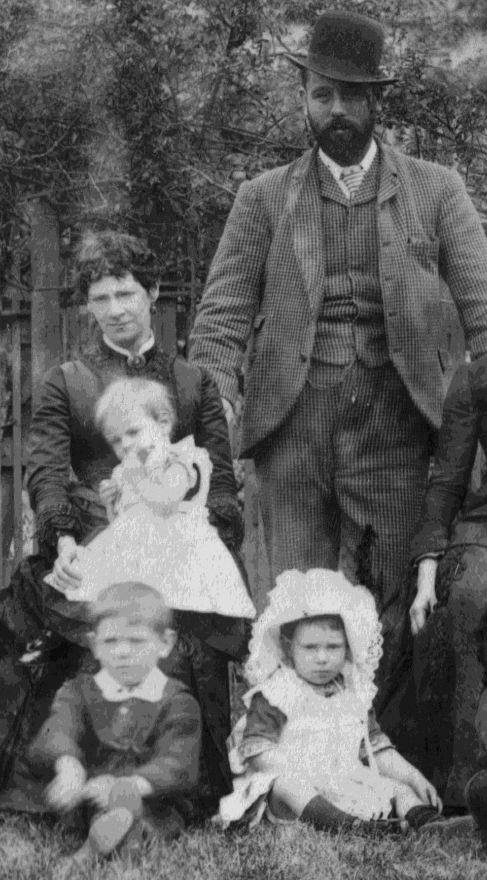
Crawford Kier & family at James Ferguson's Ayr Cottage, Parkville, Melbourne, 1st Jan 1888.

This photo is a subset of the Ferguson Clan photo from the family history collection. The original family photo shows thirty five family members on the east side of James Ferguson’s Ayr Cottage, Parkville, 1st January 1888. This portion shows Barbara Kier (nee Ferguson) 1856‐1889 , Crawford Kier 1858‐1890, James Ferguson Kier 1886‐1964,William Maitland Kier 1881‐1936, Mary Ferguson Kier 1884‐1946.

Crawford’s own ancestry was also in the stained glass trade. His grandfather, David Kier, was a master stained glass craftsman from Glasgow and had a stained glass business in Irvine with his sons as “David Kier & Sons”. After David’s death in 1864 the business was continued by the sons as “W & J.J. Kier” (William and James Johnston Kier).

The Presbyterian Church at Strathalbyn, South Australia, commissioned the Scottish stained glass firm W & J. J. Kier to create a stained glass window for their church in 1870!

The South Australian Advertiser, Adelaide, Monday 8th August 1870, page 2.

“The Glasgow Mail says:- ‘We have had an opportunity of inspecting, at the works of our townsmen, Messrs. W. & J. J. Kier, a memorial windows which they have just completed, and which is to be forthwith dispatched to Adelaide, to be erected in the Presbyterian Church, Strathalbyn, South Australia, in memory of the late Dr. Rankine. It is what is called a two-light window, the subject-in-chief of one of the compartments being a full-length figure of our saviour, and of the other a similar figure of St. John the Evangelist. At the base of the canopy are the inscriptions – ‘In Memory of Dr. John Rankine, late of Blackwood, South Australia. Died at Helensburgh, Scotland, March 15, 1864;’ and – ‘Erected by his sorrowing widow, Mary M. Rankine.’ On a lozenge-shaped shield forming the apex of the window is the family crest, with the motto, ‘Fortiter in Recte.’ As a specimen of what it purports to be true ‘stained’ glass art, as opposed to glass painting, or any other composite device, this window will compare favorably with anything of the kind hitherto produced in Scotland – and indeed, for the matter of that, we are quite convinced there is nothing finer to be seen in the Cathedral.”

Unfortunately it would seem that the stained glass window was never actually erected in the church and was summarily sent back to Scotland.

Southern Argus, Port Elliot, SA, Friday 9th June 1871, page 2.

“THE MEMORIAL WINDOW TO THE LATE DR. RANKINE.- We understand that the authorities of the Presbyterian Church in Strathalbyn have decided not to put in the memorial window lately presented by the widow of the late Dr. Rankine, and which arrived in the colony some few weeks since, and it will therefore, in accordance with Mrs Rankine’s instructions, be immediately returned to Scotland.”

On the 4th October 2012, Mr Brian Simpson from Strathalbyn wrote:

“Dear Ray,

Your email has been forwarded to me, as an amateur local historian with an interest in your subject. This is indeed a sad story!!! The window apparently arrived on board the “Glen Osmond” in late-Sept, 1870, & was seen by the members of the Session (the committee in charge of St Andrews Church, Strathalbyn), & promptly sent back to Scotland! The church & the town thereby lost what could have been its most valuable icon. The minutes of the Session meeting do not record what in particular they objected to. Perhaps they were affronted that the Rankine crest was placed above the figure of Jesus, rather than below? They refused to take the matter to a general meeting of the congregation, despite the fact that many were very interested. This precipitated the resignation from the Session of William Rankine, brother of John (fellow founders of the township of Strathalbyn in 1839).

Presumably, the window was returned to Mary Rankine (John’s widow) in Glasgow, at the earliest opportunity. I wonder who paid for its return journey? This story has fascinated me for years, & I have often wondered what became of that very valuable window. I have visited Scotland several times in the last several years, & had hoped to be able to track down that window. I wrote to the head offices of three branches of the Presbyterian Church in Glasgow, & to a museum/gallery of historic church windows, etc, in Glasgow. All replied in the negative. Perhaps the window is still in the possession of descendants of the Rankine family? I continue to wonder at the intransigence & stupidity of the Session at the Strathalbyn Presbyterian Church in 1870. Presumably, very few people ever saw that window to know what all of the fuss was about. The Session had previously agreed to accept the window, & were presumably looking forward to its arrival with great anticipation. What went wrong we will never know.  If you ever do locate the window, I & the rest of Strathalbyn, would be very pleased to hear about it. Good luck with your search. It hurts me every time I think about that lost opportunity!

Kind regards, Brian Simpson” – STRATHALBYN

Many thanks to Brian Simpson for his research and response on the subject of the Kier stained glass window.

Related posts: 14-06-1894: Probate lodged for the Will of James Ferguson


Short link to this page: http://wp.me/p28nLD-Hu

© Copyright


23-07-1890: James Urie (1828-1890)


Undoubtedly the Colonist who was the driving force behind the success of the Ferguson & Urie stained glass company was James Urie.

His business acumen and enthusiasm made Ferguson & Urie the most successful commercial stained glass company in Australian Colonial history.

The Argus, Melbourne, 23rd July 1890, page 1.

“URIE – On the 21st inst, at his late residence, Wellington-street, Flemington, James, the beloved husband of Grace Urie (and of the firm Ferguson and Urie, Collins-street), aged 62.”

The memorial photos were taken at the Melbourne General Cemetery, 27th Dec 2009.

This slideshow requires JavaScript.

James Urie (1828-1890) was born in Kilmarnock, Ayrshire, Scotland on the 14th May 1828, to William Urie and Jane Ferguson.

On the night of the Scottish census record of March 1851, James Urie (age 22), was indicated as being a visitor to James Ferguson’s (age 33) home at John Street Wallacetown in Ayr. Their professions were listed as Slater and Glaziers. As James Ferguson was 11 years older than Urie, the age difference leads me to believe that he may have formerly been an apprentice of James Ferguson or James Ferguson Snr.

Was the night of the census a meeting to discuss their bold plans to emigrate to Australia? Who knows! What we do know is that that their decision would cement them firmly in history as the founders of Australia’s most prolific and talented stained glass studio.

By late 1852 their decision had been made and they would set sail for Australia.  James Urie departed first and was followed a day later by James & David Ferguson. Which ship James Urie departed on  has not been established but James & David Ferguson departed Greenock on the 12th Dec 1852 aboard the ‘Tamerlane’. In a speech at the Company dinner held in North Melbourne in 1886, James Urie stated: “..it was just 34 years since he left the old country for the colony and Mr. Ferguson left a day after him”.

On arrival in Melbourne the men set about establishing their business as Plumbers, Slaters and Glaziers from premises in Curzon street North Melbourne. For a short time James Urie took up residence at the Tam O’Shanter Hotel in North Melbourne, whilst James Ferguson and his brother David found cottage accommodation in Little Curzon street.

On the 31st August 1855 James Urie married ‘Grace Hardie Young’ at the first Curzon Street Presbyterian church in North Melbourne and they took up residence in a small cottage at 28 Curzon Street North Melbourne, only a short distance from the Ferguson brothers and the business’s workshop. Between 1856 and 1882 James and Grace had fourteen children, five of whom unfortunately died as infants.

After the initial pioneering hard work of establishing the business and transforming the business to stained glass production in 1861, James took the lead as the enterprising salesman of the business and traveled far and wide to the eastern states as far north as Queensland, west to South Australia and as far south as Tasmania and possibly New Zealand to establish the company name “Ferguson & Urie” as Australia’s premier colonial stained glass firm. James was an an astute business man and had an inventive streak as well. On the 24th of October 1865 he registered a patent for “An invention of an improved and cheap method of converting Basaltic Rock into Street Flagging and other pavement”. By 1888 he had established a substantial two storey family home in Wellington Street Flemington named “Glencairn” after the name of “Glencairn Square” near his family home back in Kilmarnock, Scotland.

Outside of the business James actively participated in public life. He was a Justice of the Peace as well as a Councillor of Flemington and Kensington from August 1886 to August 1888, and Mayor of the Borough from August 1887 to August 1888.

On the afternoon of Monday 25th June 1888 he laid the foundation stone of the Presbyterian Church in Norwood Street Flemington.

On the 21st of July 1890, after a brief illness, James Urie died at the age of 62.

On Thursday the 28th August 1890 the Mayor and members of the Flemington council visited his wife Grace at their houseGlencairnin Wellington Street and presented Grace Urie with an illuminated letter of condolence.

James Urie’s funeral was one of the largest ever seen in Flemington:

“…the procession being the most imposing seen in the borough. The employės of Messrs Ferguson & Urie marched in front of the hearse, then came four mourning coaches and upward of fifty vehicles. Immediately following the mourning coaches came a hansom, in which the Hon Alfred Deakin was seated, then next in order a buggy containing the deceased gentleman’s council colleagues…”.

The Honorable Alfred Deakin (later to be the second, fifth and seventh Prime Minister of Australia) played the part as a pall bearer at the grave site.

James Urie was buried at the Melbourne General Cemetery with the five children who died as infants, and his wife Grace who died in 1899.

Table Talk, Melbourne, Vic, Friday 12th September 1890, page 8.

“James Urie, formerly of Curzon-street, North Melbourne, but latterly of Wellington-street, Flemington, one of the partners of the firm of Messrs. Fergusson [sic] and Urie glass importers, Collins-street East, Melbourne, by his will dated, November 24, 1870, and presented for probate by, Messrs. Madden and Butler, solicitors, appointed his wife, Grace Hardie, executrix. He gave her a life interest in his estate as long as she remains his widow; on her death or re-marriage the estate passes to his children in equal shares. ‘The testator died July 21, 1890, and his will was sworn at 34,808 real and £12,798 personal. Total, £47,606.”

In 2013, more than 120 years after his death, a lane-way between 17 and 19 Waltham Street in Flemington was  named in honor of James Urie [See: Photo | Map]. The lane-way is less than one hundred meters down Waltham street from James Urie’s homeGlencairn(now St Brendan’s Presbytery) on the corner of Waltham and Wellington Street.

Related posts: 21-11-1865 >19-02-1874 > 18-09-1885  > 25-07-1890 > 29-08-1890 > 20-07-1899


Short link to this page: http://wp.me/p28nLD-GV

© Copyright

29-08-1890: Letter of Condolence from the Borough Council to Grace Urie.

On the 21st July 1890 James Urie, a principal partner of the Ferguson & Urie stained glass company died.

As a mark of respect, the Flemington Council presented his wife Grace with a leather bound letter of condolence from the members of the council. James had not only been a principal partner in the Ferguson & Urie stained glass firm,  but also a very prominent member of the Flemington & Kensington council and Mayor in 1887-1887.

It’s not known whether the letter of condolence may possibly still exists somewhere, but if it was ever found it would be a remarkable piece of history worthy of being displayed in a museum for all to see.

North Melbourne Advertiser, Friday 29th August 1890, page 2.

“THE LATE COUNCILLOR URIE”

 “Yesterday afternoon the mayor of Flemington, Cr Rigby, the ex-Mayor, Mr Thomas Millar, Cr Barrett, and Mr Cattanach, town clerk, waited on Mrs Urie at her residence, Wellington street, and presented her with a ‘Letter of Condolence’ from the Borough Council, worded as follows:-

‘To Mrs Grace Urie, Wellington street, Flemington – Dear Madam, We the Mayor and Councillors of Flemington and Kensington, desire to express our deep sense of the loss you and your family have sustained through the lamented death of your beloved husband, our esteemed friend and colleague, Councillor James Urie, whose death is universally deplored and has cast gloom over the whole district. While asking you to receive our warmest and most sincere sympathy in your sad bereavement, we trust that the loving influence of the dear departed one will still sustain you under your heavy burden. Again assuring you of our deepest sympathy for you in the loss of one to whom you were so fondly and deeply attached, We are, dear madam, yours sincerely T. Millar (Mayor), R. C. Barrett, J. E. Rigby, M. J. Hardiman, F. Melville, W. Blackwell, J. M. Dalglish, R. Mitchell, Wm Cattanach’.
The letter of condolence has the seal of the Borough Council attached. It is beautifully illuminated by Messrs Arnall and Jackson, and is bound in morocco leather, the cost of the testimonial being borne by the gentlemen whose signatures are appended. Mrs Urie thanked the gentlemen who made the presentation in feeling and appropriate terms.”

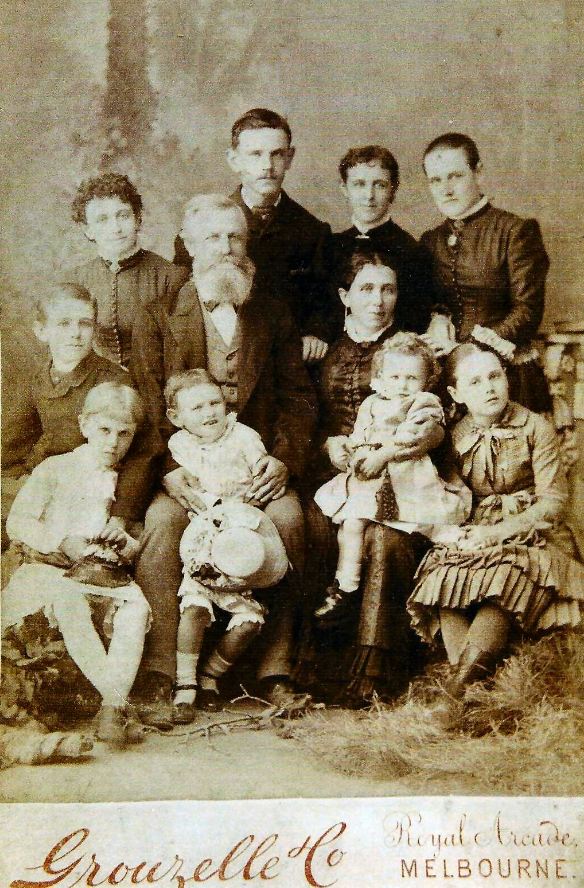
Photo of the Urie family kindly contributed by Mrs Noelle Nathan 26 Apr 2010.

The James & Grace Urie family, Flemington 1884.

Related posts:

23-07-1890: James Urie, principal partner in the firm Ferguson & Urie dies.

25-07-1890: The late Councillor Urie.


Short link to this page: http://wp.me/p28nLD-H2

© Copyright

25-07-1890: The late Councillor Urie, Flemington, Victoria.


The North Melbourne Advertiser, Friday 25th July 1890, page 2

“THE LATE COUNCILLOR URIE”

“Councillor James Urie died at his residence, Wellington Street, Flemington, on Monday evening, after an illness which barely extended over a week and which, in its first appearance, gave no indication or warning of fatal termination. The family of the deceased gentleman – and never was there a family more united or more affectionate – were led to expect the worst only a day or so before the end came, but it needed the exercise of true Christian resignation to enable them to bear up under the dreadful visitation. The people of Flemington and Kensington received the announcement of Cr Urie’s death with unfeigned sorrow. Outside the municipality the sad item of intelligence was discussed in terms that gave indubitable evidence of the general esteem in which the deceased was held. By the removal of a prominent public man such as Cr Urie the borough and district have sustained a grievous loss. Relatives, friends, and acquaintances have just cause to deplore the demise of one endeared to them by reason of innumerable good qualities, kindly disposition, and upright character. In commercial circles too, where his unswerving rectitude and sterling honesty in all matters of business were well known, the deceased merchant will be greatly missed.

            Mr Urie came to the colony from Scotland (his native land) early in the fifties and, after ‘roughing it’ in the usual pioneer fashion, started in trade in Curzon street, North Melbourne, and, by dint of genuine hard work, laid the foundation of the flourishing  Collins street firm of Ferguson and Urie. Some 17 years ago Mr Urie purchased the land in Wellington Street, on which his late residence now stands, and erected thereon a house for his mother. On the death of the old lady he enlarged the house, removed there with his family, and continued to reside there for the remainder of his days. The deceased took deep interest in the progress of the borough, and when the agitation for the removal of the cattle yards was begun he joined in the crusade with all the ardour of an enthusiast. For six years he occupied a seat in the Borough Council, and once held the position of Mayor. As a councillor he performed his duties without fear or favour, bringing with him to the Council table the same honesty of mind and singleness of purpose which characterised all his actions outside, His return at the head of the poll at the last municipal election may be taken as evidence of the popularity of the deceased gentlemen. CR Urie was a staunch supporter of the present member for the district, Mr Deakin, and at the general elections last year acted as chairman of the committee for the Flemington district. The deceased was a leading member of the Presbyterian Church and chiefly to his exertions and assistance is due the presence of ‘the Kirk’ in Norwood Street. In private life Mr Urie was distinguished for his imperturbable good humour, his lack of ostentation, and for general all-round ‘goodness’.

            The funeral left Wellington Street about half-past three on Wednesday afternoon, the procession being the most imposing seen in the borough. The employės of Messrs Ferguson & Urie marched in front of the hearse, then came four mourning coaches and upward of fifty vehicles. Immediately following the mourning coaches came a hansom, in which the Hon Alfred Deakin was seated, then next in order a buggy containing the deceased gentleman’s council colleagues. Crs Millar (mayor) and Barrett. The other members of the council, Mr Cattanach (town clerk), Mr McIver (surveyor), Mr Elmslie (valuer), Mr Glyn (foreman of works), Mr Ryan (borough inspector), were also in attendance. Essendon Council was represented by the Mayor and Cr Hanna, and North Melbourne Council by Cr Fogarty. Rev J. Thomson, minister, and the adherents of the Presbyterian Church, the president and leading members of the Australian Natives Association, the business people of the borough, and a number of private citizens also followed the remains to the cemetery. The funeral arrangements were conducted by Mr A. Allison, of Victoria street, in his usual efficient manner.

            Deceased was interred in the Presbyterian section of the Melbourne Cemetery, the pall bearers being Messrs James and William Urie, Ferguson, Yeaman, G. Young, Cr Millar, and the Hon A. Deakin. Rev J. Thompson delivered a brief address at the grave.”

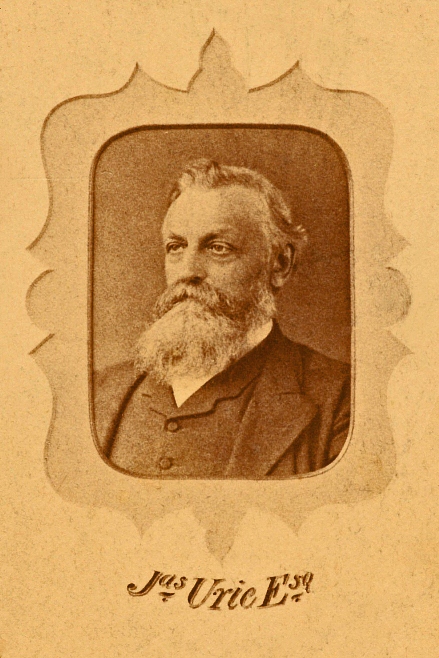
This photo is a portion of the Ferguson & Urie employee poster kindly provided by Mrs Noelle Nathan via Mrs Valma Jean McPhail, April 2011.

James Urie, June 1887

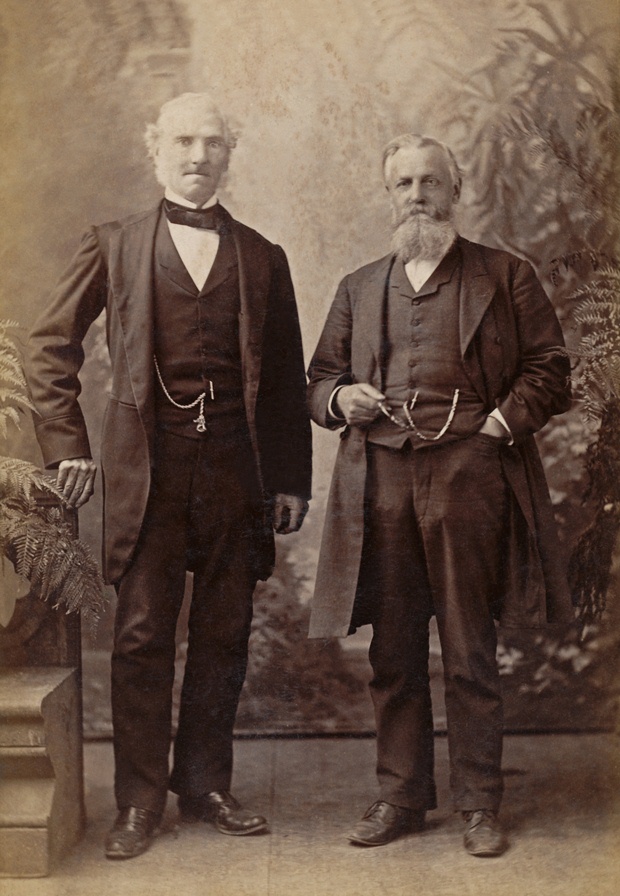
The photo below is from my family history collection and shows James Ferguson and James Urie in a portrait taken specifically for the occasion of the company dinner held at the North Melbourne Mechanic’s Institute on the evening of the 22nd June 1887.

James Ferguson & James Urie 1887


Related posts:

31-08-1855: James Urie marries Grace Hardie Young.

23-07-1890: James Urie, principal partner in the firm Ferguson & Urie dies.

29-08-1890: Letter of Condolence from the Borough Council to Grace Urie.

External links:

‘Urie, James (1828–1890)’, Obituaries Australia, National Centre of Biography, Australian National University, http://oa.anu.edu.au/obituary/urie-james-14449/text2553.
(Transcription originally submitted by Ray Brown – Feb 2012)

Short link to this page: https://wp.me/p28nLD-GX

© Copyright

07-11-1889: The Ross Portable Fire Escape Demonstration.

Thomas Ross of Sydney, New South Wales, invented the “Ross Patent Portable Fire Escape”. In Victoria it was filed as patent No 6650 on the 2nd of April 1889 and in the US was filed as US patent 434888 dated August 19, 1890.

Why the Ferguson & Urie premises at 10 Collins Street was selected for the demonstration is a mystery.

The Argus, Melbourne, 7th November 1889, page 11.

“THE ROSS PATENT PORTABLE FIRE ESCAPE. A PUBLIC EXHIBITION Of the above will be given at Messrs. Ferguson and Urie’s Buildings, Collins-street east, TODAY, At 11 a.m. Sole Agents – BARNETT BROS. 407 Collins-street.”

Goulburn Herald, NSW, Tuesday 12th November 1889, page 4.

“New FIRE-ESCAPE.-A public exhibition of a new fire-escape, known as “The Ross Portable Fire-escape,” was given recently at Messrs. Fergusson and Urie’s establishment in Collins-street, Melbourne. The appliance consists simply of a moderately stout asbestos or fire-proof rope, which is fixed to the upper windows of a building by an ordinary staple. The rope is wound round a drum or reel provided for the purpose, and as soon as a fire originates this is thrown out into the street. Attached to the rope, and running along it, is a metal brake fitted with antifrictional grooves. This brake carries a broad sling, which is passed under the armpits of the person desiring to escape. Then by holding the rope gently in the hand, he can regulate the speed with which he descends to the ground. No fewer than three descents were made by Mr. Thos. Ross, the inventor. He left the top story, which is about 70 ft. in height, and showed how simply the invention worked by stopping himself several times in his descent, and by decreasing and increasing his speed at will. Other advantages claimed for the patent are that it is oheap and easily port able, and that it can be fixed in position in a few moments. – Melbourne Argus.”

Ross Portable Fire Escape (click to see complete Patent file)

Ross Portable Fire Escape Patent US434888