1870: St Paul’s Anglican Church, Koroit, Victoria.

The foundation stone of St Paul’s Anglican Church at Koroit was laid on the 8th of March 1870 and it contains a Ferguson & Urie three light memorial window in the chancel erected to the memory of Mary, the wife of the first minister of the church, the Rev. Louis A. Baker.

Photos taken: 7th January 2011.

This slideshow requires JavaScript.

The Bacchus Marsh Express, Vic, Saturday 20th April 1889, page 7.

(on the minister, Rev. Louis A. Baker).

…For many years he officiated in the district surrounding Koroit, between Belfast and Warnambool, where he was much beloved  and valued, his name being a household word in that locality to the present day. A stained chancel window in the church, put up to the memory of his first wife, is a lasting memento of the kindly feelings of the people towards himself.”

The three light chancel window was created by Ferguson & Urie of Melbourne, possibly about the time of the churches erection in 1870. The borders of the windows are made up of alternating pieces of stained glass in the primary colours of red and blue with a yellow flower. which are unique to early Ferguson & Urie stained glass windows. In the centre light is a ruby red cross and a gold crown which are entwined by a ribbon that has the text: “I KNOW THAT MY REDEEMER LIVETH” (Job 19-25).

The remainder of the windows are made up of plain diamond quarries and nine groups of four diamond quarries depicting elements of the passion flower in grey and yellow with a surrounding red or pink border.

The memorial text across the bottom of the three lights reads:

“IN MEMORY OF MARY, WIFE OF THE REVD. LOUIS A. BAKER FIRST MINISTER OF THIS CHURCH. DIED 8th APRIL 1865”

The Rev Louis A. Baker, died at the age of 76 on the 13th of April 1889 of Typhoid.

About fifty years after the erection of the window it was subject to vandalism by known delinquents. The extent of the damage at the time is not known, nor who may have made the necessary repairs circa 1914.

Warrnambool Standard, Vic, Thursday, 2nd April 1914, page 2.

“VANDELISM AT KOROIT”.

“There is a set of three beautiful memorial windows at the east end of St. Paul’s Church, Koroit, which were erected to the memory of Mrs. Baker, the wife of the Rev. L. Baker, who was a former incumbent of the church (writes our Koroit correspondent). Last Sunday week the Vicar’s attention was drawn to the fact that four holes had been made in these windows by stone throwing, and last Sunday a number of holes were discovered in the west windows, which consist of small diamond shaped leaded panes. The matter has been placed in the hands of the police, and as it is stated the delinquents are known, a prosecution will shortly follow.”

The Argus, Melbourne, Vic, Wednesday 9th March 1870, page 5.

“WARRNAMBOOL, Tuesday.

The Bishop of Melbourne laid the foundation stone of St. Paul’s Church, Koroit, today, assisted by the Rev’s. Messrs. Baker and Beamish. There was a good attendance of spectators, many of whom came from a considerable distance. The contributions were liberal, and the ceremony was completely successful. It will be a stone building, in the early English style of Gothic architecture, after designs drawn by Mr. Rawlinson, the architect.”

Bendigo Advertiser, Vic, Friday 25th March 1870, page 2.

“A SACRILEGIOUS THIEF.- Some mischievous fellow has had the audacity to remove the foundation stone of St. Paul’s Church, Koroit, recently laid by the Bishop of Melbourne. This occurred on the morning of Friday last, when it was discovered that the stone had been removed, the cavity opened, the bottle extracted, and the contents, namely, the scroll and newspapers, cast on one side. These are now in the possession of the trustees. It was thought by some (states the Warrnambool Advertiser) to be either a malicious act, or one committed during a drunken bout; but the officers of the church believe that it was done by a loafing scoundrel who hoped to find some coins deposited in the bottle under the stone, but who had his trouble for nothing.”

Kilmore Free Press, Vic, Thursday 29th December 1870, page 2.

“A DISGRCEFUL SCENE IN A CHURCH;

[From the Banner of Belfast.]

On Tuesday last the building committee of the Presbyterian Church at Koroit held a meeting to consider tenders for the erection of a new church, there being present amongst others the Rev Mr. Adams, Mr Officer (mayor), and a Mr. Wilson. Mr Officer, in a fiery oration, objected to the acceptance of tenders, reviewing the impecunious condition of the district, and considering that the necessary funds could not be raised. The Rev Mr Adams, in reply to the mayor, said that some of his (the mayor’s) statements were true, and some were not true. This brought the mayor to his legs. He demanded of the Rev Mr Adams to know which of his statements were untrue; he would not submit to be called a liar, and in a very intemperate speech, in which he was frequently called to order, assailed the Rev Mr Adams, Mr Wilson, and by implication other members of the congregation. Mr Wilson, with some warmth, defended the Rev Mr Adams. He repelled the mayor’s assertions generally, and retorted with some effect on his exaggerated notions of his own importance. On this the mayor dashed his hat aside, and jumping over the seats laid violent hold of Mr Wilson by the neck with both hands, Mr Wilson making such effective resistance as he was able, and using such force and violence as he was justified in using under the circumstances. The mayor’s object was apparently to have the fight outside the church, but it was precipitated by his violence, and his mayoral dignity, unrespected by himself, was not sufficient to protect him from the hands of Wilson, or from a severe hauling from other members of committee who naturally felt indignant at the desecration of the church, and endeavored to separate the combatants before much damage was done to either, or many blows exchanged. The committee of course adjourned, and the Rev Mr Adams intimated his intention of resigning, and bringing under notice of the congregation from the pulpit the indignity to which he and the other members of the committee were subjected by the ruffianly conduct of he mayor. The feeling in Koroit, and especially among the Presbyterian body, is, as may be determined, one of a mitigated disgust at the conduct of one who has brought so much disgrace on them. Mr Wilson intends to take out a summons for assault against the Mayor”.


Short link to this page: https://wp.me/p28nLD-1kt
© Copyright

17-05-1865: Kings Shop, Pall Mall, Bendigo, Victoria.

Bendigo Advertiser, Vic, Wednesday 17th May 1865, page 2.

“COLONIAL GLASS PAINTING.- In the shop of Mr King, Pall Mall, is to be seen a very handsome specimen of glass painting, or glass staining as it is commonly termed. The work was executed by Messrs Ferguson and Urie, of North Melbourne, who have, we are informed, within the last twelve months brought the art of glass painting to a very high standard in the colony. Previous to that time, the greater portion of the stained glass windows for places of worship, was imported from Europe. Now, the manufacturers referred to are able to produce painted glass windows at the same prices at which they can be imported, and according to the opinion of connisseurs [sic] in the art, with as much taste and skill. The sample to be seen at Mr King’s warrants that opinion.”

King’s of Pall Mall Bendigo was a dealer of Paperhangings, Borderings, Varnishes and Oil and Lamp merchant. In 1864 his shop in the Bendigo Pall Mall area was described as wooden and was saved from being burnt down in a fire that started in the early hours of 9th May 1864. Nothing further is known about the stained glass window created by Ferguson & Urie described as being on display in King’s shop in Pall Mall in May 1865.

1865: St Stephen’s Church, Mount Waverley, Victoria.

St Stephen’s Church at Mount Waverley was designed by architect Nathaniel Billing and built for modest sum of £370 and was opened on the 23rd of July 1865. The circular west window was reported to be made by Ferguson & Urie as indicated in the church Gazette of 16th August 1865. Fifty years later the entire window was blown in during a storm in late November 1915 and fell 18 feet to the floor of the church. The extent of damage the window suffered at the time is not known but it was repaired and re-installed and still exists in the position it was placed, which is now nearly one and a half centuries ago.

Photos taken 3rd February 2013.

This slideshow requires JavaScript.

The Oakleigh and Caulfield Times, Vic, Saturday 27th November 1915, page 4.

“St Stephen’s Church, Mt. Waverley.

JUBILEE CELEBRATION.

“The celebration of the jubilee of the above church, which was quite an event in the district, took place on Sunday, 19th September, and we have held back the report in order to gather particulars of the church’s past history, which is appended…”

“…We extract from the “Church Gazette.” Of August 16, 1865, the following report of the opening services, tea and public meeting:- “St Stephen’s Church. Waverley, District of Malvern and Oakleigh – This pretty little church, which was opened for divine worship on the 23rd ult, is built in the early English style of variegated brick work, and will seat 100 persons. It is an admirable specimen of what can be produced for the small sum of £370, and reflects much credit on the architect, Mr N. Billing, who designed and superintended its erection gratuitously. In the west end is a neat circular stained glass window, presented by Mesrs Fergusson [sic] and Urie…”

The Oakleigh and Caulfield Times, Vic, Saturday 4th December 1915, page 3

“Our Letter Box.
A WORD OF APPRECIATION.
To The Editor.

Sir, – I wish on behalf of the Vestry of St Stephens’ Church to thank you for the splendid report in last week’s issue. There are, however, two corrections which you might set right. The late Mr W. Q. Hore, senr., he was a vestryman, and the tablet mentioned is his (E. Hore’s) memory; the first services were held in his house. Mr C. Doolan’s name was omitted from the present vestry, he being the oldest and one of the most consistent supporters of the Church probably for nearly 40 years. A strange coincidence happened during stormy weather last Sunday. During the service the stained glass window, gift of Messrs Ferguson and Urie, mentioned in your report, was blown in and fell with a crash. No one was injured, I am glad to say; it had a fall of about 18ft.

Yours faithfully,
CHAS H. COLEMAN.
Mt Waverley,
Dec. 1, 1915.


Short link to this page: https://wp.me/p28nLD-1fu

© Copyright

21-11-1865: James Urie’s Invention

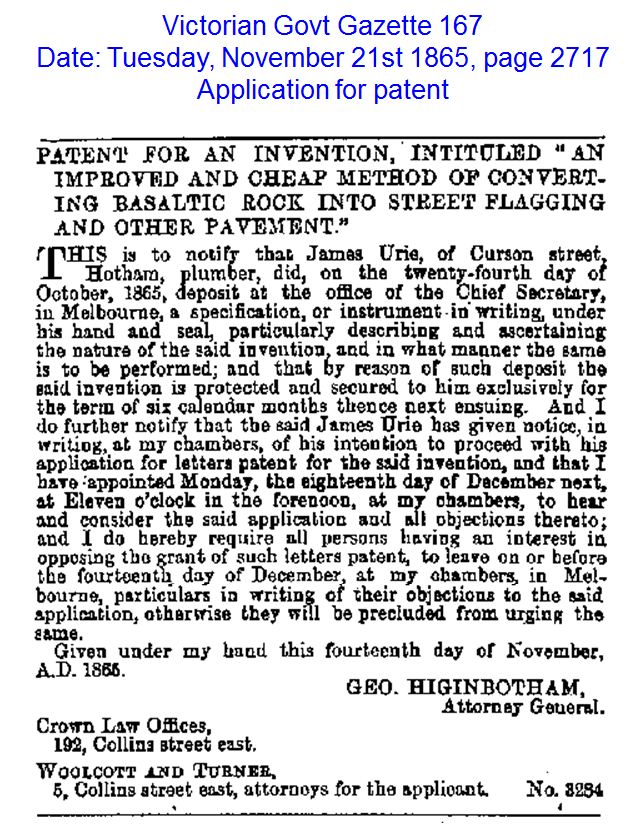
Victorian Govt Gazette 167, Tuesday, November 21st 1865, page 2717

“PATENT FOR AN INVENTION, INTITLED “AN IMPROVED AND CHEAP METHOD OF CONVERTING BASALTIC ROCK INTO STREET FLAGGING AND OTHER PAVEMENT.”

THIS is to notify that James Urie, of Curzon street, Hotham, plumber, did, on the twenty-fourth day of October, 1865, deposit at the office of the Chief Secretary, in Melbourne, a specification, or instrument in writing, under his hand and seal, particularly describing and ascertaining the nature of the said invention, and in what manner the same is to be performed; and that by reason of such deposit the said invention is protected and secured to him exclusively for the term of six calendar months thence next ensuing. And I do further notify that the said James Urie has given notice, in writing , at my chambers, of his intention to proceed with his application for letters patent for the said invention, and that I have appointed Monday, the eighteenth day of December next, at Eleven o’clock in the forenoon, at my chambers, to hear and consider the said application and all objections thereto; and I do hereby require all persons having an interest in opposing the grant of such letters patent, to leave on or before the fourteenth day of December, at my chambers, in Melbourne, particulars in writing of their objections to the said application, otherwise they will be precluded from urging the same.

 Given under my hand this fourteenth day of November, A.D. 1865.

 GEO. HIGINBOTHAM, Attorney General.

Crown Law Offices, 192 Collins street east.

WOOLCOTT AND TURNER,

5, Collins street east, attorneys for the applicant. No. 3254″.

Victorian Govt Gazette 167, Tuesday, November 21st 1865, page 2717, James Urie’s application for patent.

Related posts: 19-02-1874 > 18-09-1885  > 25-07-1890 > 29-08-1890 > 20-07-1899


Short link to this page: https://wp.me/p28nLD-Mn

© Copyright

05-01-1865: The Wesleyan Church, Punt Road, Prahran.

The Wesleyan church was opened on the 4th of January 1865.

All glazing, including the principal four light stained glass window over the main entrance facing Punt Road, were executed by the Ferguson & Urie stained glass company of Curzon Street North Melbourne.

As at 2011 or earlier, this church is now a block of apartments with original west window still extant in the façade. The location is in the vicinity of 272 Punt Rd,  now zoned in the suburb of South Yarra.

The Argus, Melbourne, Thursday 5th January 1865, page 5.

 “The opening of the new building erected for the accommodation of the congregation of the Wesleyan Church, Punt-road, Prahran, was celebrated last evening by a tea meeting, given by the ladies of the congregation, in the old church. About 500 or 600 persons took tea, after which a public meeting was held in the new building, Mr. J. Price, the commander of the Great Victoria, in the chair. The chair having been taken, the Rev. F. Neale read a brief financial statement, showing that the erection of the new church had cost on the whole about £2,350, of which £1,100 was yet unpaid. Addresses were then delivered by the Revs. D. J. Draper, J. Eggleston, J. Dare, and G. Mackie, and in the intervals of speaking several anthems were very well given by the choir of he church. The new building is a neat substantial-looking erection, in the perpendicular style; constructed of bluestone, with white brick and cement dressings, from the designs of Messrs. Crouch and Wilson, architects. The contractor for the building itself was Mr. Whatmough, and the glazing, including a very handsome window over the main entrance, and facing the road, was executed by Messrs. Ferguson and Urie. The opening sermons were preached on Sunday, the Revs. D. J. Draper, J. Taylor, and J. Dare preaching in the morning, afternoon, and evening respectively. The services were largely attended, some 800 persons being present in the evening. The building supplies comfortable sitting accommodation for 600 persons.”

This slideshow requires JavaScript.

Wesleyan Church, Punt Rd, South Yarra – Prahran, 25th August 1864. (State Library of Victoria Image No: b48863)


Short link to this page: https://wp.me/p28nLD-51

© Copyright