21-07-1868: St Paul’s Anglican Cathedral, Myers Street, Bendigo, Victoria

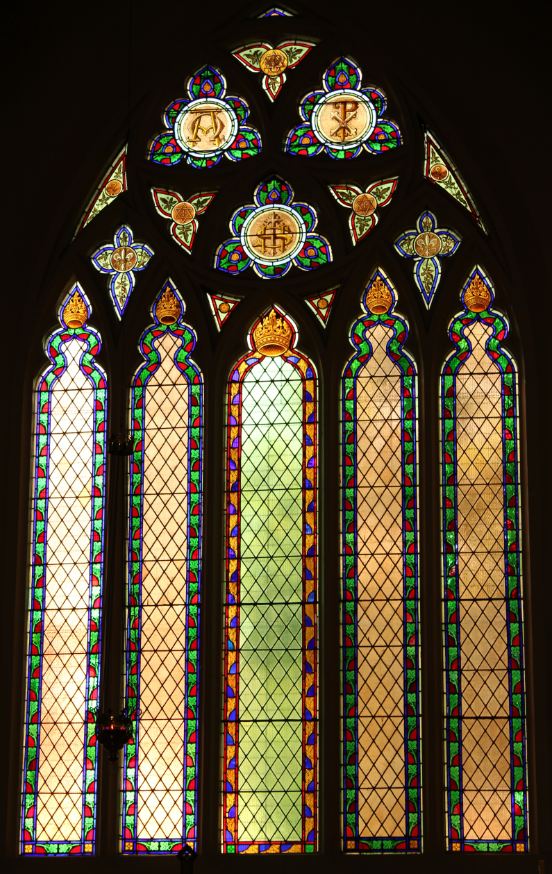
St Paul’s Cathedral in Myers street Bendigo contains a number of original historic stained glass windows by Ferguson & Urie of North Melbourne.

St Paul’s was built as a parish church in 1868 to the designs of the Irish Architect Robert Alexander Love[1], with the contractors being Deague and Cowper[2]. In July 1868 a contract was made with Ferguson & Urie for the supply of the twelve apostle stained glass windows for the nave at a cost of £250, with a further two smaller windows for the organ lights to be contributed by the company at no cost[3].

As seen in November 2012, two and a half of the original Ferguson & Urie windows in the nave no longer exist. The liturgical south wall still contains six of the original two light windows, each with a small symbol in the apex with the names of the Saints; John, Philip, Paul, Thomas, James the Less, and Simon. On the north wall, only three and a half of the original Ferguson and Urie windows exist. In the apex of each they have the names of the saints; Jude, Matthew, Bartholemew, and James the Great. The two light window with the name of St Bartholemew in the apex has had the right lancet completely replaced with stained glass by “J. Valstar, ‘73”. The last two bays of windows, to the right of the St James the Greater window, are complete replacements that were most likely the work of Brooks, Robinson & Co after 1948, and depict St Andrew & St James and dedicated to the Gall family, and St Peter & St John and dedicated to the Williams family.

High above either side of the Myers street entrance are two other smaller Ferguson & Urie windows, possibly being the ones originally described as “the organ lights,” donated by Ferguson & Urie. These two small windows each depict an angel with a ribbon containing the text “O Sing unto the Lord” (Psalms 96-1) and “Sing Praise upon the Harp” (Psalms 147-7). The later, as at 17th November 2012, has the angels face missing completely.

Photos taken: 17th November 2012.

This slideshow requires JavaScript.

Each of the original stained glass windows in the nave are typical of the Ferguson & Urie geometric designs from their early period (1860’s-70’s). Each lancet has a central scrolling ribbon with the following scripture contained within each ribbon:

South Wall:- (east to west)

St John: “I HAVE NO GREATER JOY THAN TO HEAR” “THAT MY CHILDREN WALK IN TRUTH, 3. John 1-4”

St Philip: “I AM THE LIGHT OF THE WORLD. John 8-12”. “SURALY THE LORD IS IN THIS PLACE, John 28-16”.

St Paul: “THE JUST SHALL LIVE BY FAITH, Rom 1-17”. “BE NOT WEARY IN WELL DOING, 2. Thes 3-13”

St Thomas: “LET THE WICKED FORSAKE HIS WAYS, Is 55-7”. “BEAR YE ONE ANOTHERS BURDENS, Corinthians 6-2”.

St James ye Less: “PREPARE TO MEET THY GOD, Amos 4-12”. “HONOR THE LORD WITH THY SUBSTANCE, Pro 3-9”.

St Simon: “GOD IS LOVE, John 4-8”. “ONE GOD AND FATHER OF ALL, Epns 4-6”.

West Wall:- South side:

An Angel carrying a ribbon containing the text, “O SING UNTO THE LORD” (From Psalms 96-1).

West Wall:- North side:

An Angel carrying a ribbon containing the text, “SING PRAISE UPON THE HARP” (From Psalms 147-7).

North Wall:- (west to east)

St Jude: “STAND FAST IN THE FAITH, 1.Cor 16-13”. “WATCH AND PRAY, Matt 26-41”.

St Matthew: ‘BLESSED ARE THE PURE IN HEART, Matt 5-8”. “ASK AND IT SHALL BE GIVEN, Matt 7-7”.

St Bartholemew: “HOLINESS BECOMETH THINE HOUSE, Ps 93-5”. (The right lancet is a complete replacement by “J. Valstar, ‘73”)

St James ye Great: “SPEAK NOT EVIL ONE OF ANOTHER, James 4-11”. “TO ME TO LIVE IS CHRIST, Phils 1-21”.

The last two bays of windows towards the east end are complete replacements depicting St Andrew & St James and dedicated to the Gall family, the other depicts St Peter & St John and dedicated to the Williams family. These were done post 1948 and were most likely the work of the stained glass studio of Brooks, Robinson & Co of Melbourne.

Of the two replacement windows, which two apostle names did they originally have on them? What piece of scripture was written in the ribbons on each lancet? By a process of elimination I can only ascertain that one of them should have been St Andrew. The name of the other apostle would probably be the source of a long argument due to the complexity of who was really who, and at what point in history the existing names in the windows were taken to be apostles, or whether they are technically correct to start with. St Paul’s Church historical minute books may be the only records to confirm  this, as well as what pieces of scripture were written on the missing windows!

Bendigo Advertiser, Vic, Tuesday 21st July 1868, page 2.

“ST. PAUL’S CHURCH.- The committee of this church met the Bishop of Melbourne yesterday at the church, and after an inspection of the building and plans, the Bishop expressed his great satisfaction at the progress made. An adjournment took place to the Duke’s room at the Shamrock Hotel, and there a long conversation ensued on matters connected with the church in which it was stated that the building would be completed by November, and that the committee would be able to give a salary of £500 to a pastor for the first year. The names of several pastors were named, and it was left to the committee to signify to the Bishop upon whom their choice would fall, and he would take the necessary steps for confirming it. The church will be comfortably and handsomely fitted up internally; a contract has been made with Messrs Ferguson, Urie, Lygon[4] [sic], for twelve stained glass windows for £240, the contributors agreeing to contribute two stained glass windows for the organ lights. Subscriptions have been coming in freely. The committee appear to have been highly gratified at the warm interest taken in their affairs by the Bishop, and it is hoped that when he comes up to open the church, he will also lay the foundation stone of the tower in which the peal of bells are to be hung”.

Illustrated Australian News for Home Readers, Saturday 8th August 1868, page 3.

“The committee of St. Paul’s Church, Bendigo, met the Bishop of Melbourne on 21st ult, at the church, and, after an inspection of the building and plans, the Bishop expressed his great satisfaction at the progress made…”

“…a contract has been made with Messrs Ferguson, Urie and Lyon for twelve stained glass windows for £240, the contributors agreeing to contribute two stained glass windows for the organ lights”

Illustrated Australian News for Home Readers, Monday 19th April 1869, page 101.

“ST. PAUL’S CHURCH, EAST SANDHURST.

We give a view of the new Church of England at Sandhurst, as it will appear when finished, but at present the nave only is completed, and so enclosed next to the transcripts as to enable holding of public worship. The large number of Episcopalians residing in Sandhurst has made this work for some years back a necessity. The portion now completed was opened by the Dean of Melbourne for public worship last November, and is capable of accommodating over 350, and the whole is designed to seat 800. From the Sandhurst Evening News of 5th November 1868, we take the following description of this really excellent structure:- “We find an interior that will bear favorable comparison with any in the colonies as far as now finished, and we question if there is an open timbered roof out of Britain which surpasses the one here, spanning from wall to wall in graceful cuspings, at once light, strong, and elegant. The windows, twelve in number, are filled with elegant stained glass, each having an apolostic emblem, with a variety of monograms and quotations from scripture on freely executed scrolls, in the finest harmony and taste, and were executed by Messrs Ferguson, Urie and Lyon, of Melbourne. The Style adopted is the lancet-pointed or Gothic of so-called transition period, – though from “Norman” to “Tudor” we fancy it was transition throughout – and when the designer’s intention is fully developed we are satisfied it will place him on a footing not to be disputed . The ventilation of the building is on an entirely new plan, by the architect, R. A. Lowe[5] [sic], as the air is admitted high up by tubular walls and ornamental gratings, which have their reception openings in the bare externally, regulated by a metal air damp in the quantity of air admitted according to the season. We wish the trustees and their architect high success in the further carrying out of this sacred edifice. Messrs Deague and Cowper are the contractors”.

 Foot notes:

27-01-1868: Royal Victorian Institute for the Blind, Melbourne, Victoria, Australia.

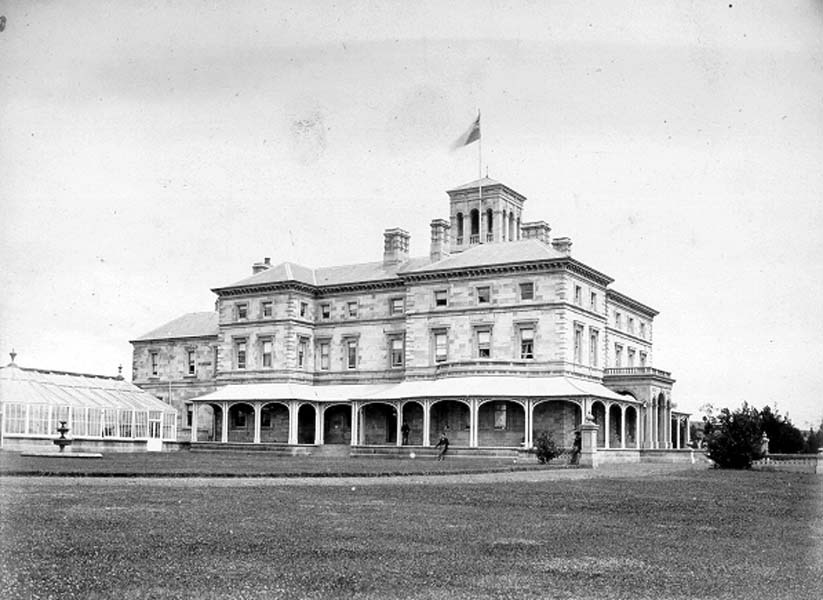
The Victorian Asylum and School for the Blind was formed at a public meeting in Prahran, Melbourne on 21 August 1866. Less than two years later, on the 25th of January 1868 the Hon. George Harker laid the foundation stone for the new building to be erected on St Kilda road. The architects chosen for the asylums design were Crouch & Wilson.

In 1891 the Asylums name was formally changed to the “Royal Victorian Institute for the Blind” (RVIB) and as at 2012,  the original building now hosts a Belgian Beer Hall and Restaurant.

The most historical, and striking feature, is the original Ferguson & Urie stained glass window in the stairwell.

Photos kindly contributed by Mrs Noelle Nathan, taken 16th July 2012.

This slideshow requires JavaScript.

The Argus Melbourne, Monday 27th January 1868, page 6.

“THE ASYLUM AND SCHOOL FOR THE BLIND”

“On Saturday the memorial stone of the Asylum and School for the Blind – a building now being erected on the St. Kilda road was laid by the Hon. G. Harker. It had been originally intended that the ceremony should be performed some weeks ago by Prince Alfred, and we are informed that a promise to that effect was made by the Royal Reception Commission; but shortly before His Royal Highness’s departure a communication was received to the effect that it would be impossible for him to fulfill the promise…”

“…This institution was started about eighteen months since, but it is only about a year since it was brought to working order…”

Illustrated Australian News for Home Readers, Melbourne, Tuesday 3rd March 1868, page 4.

“…The third storey will be devoted to paying pupils, and the staircase window is to be of stained glass…”

The Argus, Melbourne, Saturday 1st August 1891, page 5

“… PROPOSED CHANGE OF TITLE. Mr. Alston moved that the title of the institution be changed to “The Royal Victorian Institute for the Blind: subject to the consent of Her Majesty to the use of the prefix. It had been felt that under its present title some misapprehension existed in regard to the objects of the institution, which were primarily to supply an education of a scholastic, musical, and industrial character to its inmates. Mr. Crews seconded the motion, which was carried…”


Short link to this article: http://wp.me/p28nLD-1c7

© Copyright

1868: All Saints Anglican Church, South Hobart, Tasmania.

The Colonial Victorian Stained Glass firm, Ferguson & Urie created the John Henry Foster Memorial Window, and the ‘St Matthew & St Luke’ and ‘St Mark & St Peter’ windows at All Saints Anglican Church, South Hobart, Tasmania.

The vast majority of our historical stained glass memorial windows have an element of tragedy and mystery surrounding them, but over the course of more than a century the story behind who they were memorials to has long faded from memory.

In August 1867, James Urie, a principal partner in the Colonial Victorian Stained Glass firm, Ferguson & Urie, was travelling Tasmania with a portfolio of the companies secular and ecclesiastical stained glass designs. Amongst the many commissions he had received for stained glass windows, was one for Mr John Foster Esq, to be erected as a memorial to his eldest son, John Henry Foster[1].

 “DECORATIVE ART– The admirers of art workmanship will be glad to hear that there has for the last couple of weeks been sojourning in Tasmania, a partner of the Victorian firm of Ferguson, Urie, and Lyon, to whom many ecclesiastical and private edifices in this and the neighbouring colonies are indebted for some of the finest specimens of pictorial decoration on glass, of which they have yet become the possessors…”[2]

“…the firm are in receipt of commissions from John Foster, Esq, for a memorial window to be placed in All Saints’ church, Hobart Town, in remembrance of the donor’s deceased son, and from A. Kennerley Esq[3], for other decorated windows for the same church…” 

Photos taken 8th October 2010.

This slideshow requires JavaScript.

The two light Foster memorial window for All Saints Anglican Church in Hobart was created by Ferguson & Urie and erected circa 1868.

A trefoil above both lights depicts the Lamb of God (Latin ‘Anus Dei”) carrying the Christian banner.

The central figures in each light depict beautifully coloured and intricately designed figures that correspond with verses from Mark 11:22, with the text below: “HAVE FAITH IN GOD” and Luke 18:16 with the text, “SUFFER LITTLE CHILDREN TO COME UNTO ME”.

Above each figure is an angel carrying a ribbon with text from Revelations 14:13 “Blessed are the dead” and “Which die in the lord”

The bottom edge of the window has the memorial text:

“ERECTED BY JOHN FOSTER ESQ. IN MEMORY OF HIS DEAR SON”.

The memorial text on the window doesn’t reveal much information, but the prominent Tasmanian newspapers of the time reveal the sad story of the boys demise.

On the evening of the 3rd of December 1866 a tragic accident occurred near the Foster family home at 94 Davey street Hobart. In the vicinity of the barrack gates in Davey street, the young John Henry Foster was knocked from his pony by a coach and subsequently run over by its wheels and he died shortly after.

“DISTRESSING AND FATAL ACCIDENT.- One of the most distressing and fatal accidents, which it has for some time past been our lot to record, occurred in Davey-street at about half past four o’clock yesterday afternoon. It appears that Master Foster, son of John Foster, Esq., of Davey-street, a promising little lad between six and seven years of age, was riding on his piebald pony along Barrack-street, being accompanied by Master Hinsby, who was also on horseback. When nearing the corner opposite the barrack gate a cab was observed coming down Davey-street at full speed. Master Hinsby kept his right side, taking a full sweep, and passing the cab. He was closely followed by Master Foster, but the cab took rather a wide sweep in turning the corner and ran right into the poor lad, who was struck it is believed by the pole, knocked off his pony and the wheels of the cab passing over him. He was at once picked up, and under the direction of the Hon. R. Q. Kermode, Esq., and Dr. Benson, who were passing at the time, he was conveyed into a cottage near the residence of Captain Clinch…”[4]

Young John Henry Foster was subsequently dispatched to hospital and Dr Bright was in attendance within half an hour but “…on his arrival the poor little fellow had breathed his last.”[5] Equally tragic was the fact that the boys parents were away in Melbourne at the time and it was left to the Hon R. Q. Kermode to contact them and advise of the tragedy.

“Mr. Kermode has, we believe, written to the bereaved gentleman informing him of his terrible loss.” [6]

An inquest was held in the absence of the boys parents, at the Greyhound Inn on Wednesday the 5th of December 1866 [7] before A. B. Jones, Esq,. and a jury of seven. The jury foreman was none other than the long time friend of John Foster, the Hon Alfred Kennerley, Esq.

The inquest found that the cab was not speeding as previously reported and that the pole brace attached to the collar of the cabs outside horse had bumped the rear of the boys pony causing the boy to fall off and go under the wheels. No blame was attributed to any anyone for the accident.

“…The jury would not call upon the coroner to go through the evidence, and returned a verdict that deceased had been accidentally killed, requesting that it might be noticed by the press that no blame was attached to John Newhey, the driver of the cab, nor did the jury attribute any blame to Mr. Hinsby, junior. The inquest was then closed.” [8]

The funeral of Master John Henry Foster didn’t occur until his parents had arrived back from Melbourne some twelve days later and was interred in the Foster family vault at Cornelian Bay Cemetery, Hobart, on the 15th of December 1866 [9].

 Over 144 years has passed since the tragic event and the windows creation by Ferguson & Urie. The newspaper article from 1867 also mentioned that Alfred Kennerley had also commissioned Ferguson & Urie for other decorative windows:

“…and from A. Kennerley Esq[10], for other decorated windows for the same church…”

The windows donated by Alfred Kennerly are the ‘St Matthew & St Luke’ and ‘St Mark & St Peter’ windows. None of these windows appear to be memorials as such and are likely to have been erected at the same time as the Foster memorial window.

Biographies:

John Foster (1792-1875)

Alfred Kennerley (1810-1897)

End Notes:

[1] John Henry Foster, born 27th January 1860. (date as per memorial at Cornelian Bay Cemetery, Hobart)

[2] The Mercury, Hobart Tasmania, Wednesday 7th August 1867, page 2.

[3] The Hon. Alfred Kennerley. Alfred Kennerley (1810-1897)

[4] The Mercury, Hobart, Tasmania, Tuesday 4th December 1866, page 2.

[5] ibid

[6] ibid

[7] The Mercury, Hobart, Tasmania, Thursday 6th December 1866, page 3.

[8] Ibid

[9] The Mercury, Hobart, Tasmania, Saturday 15th December 1866, page 1.

[10] The Hon. Alfred Kennerley.

Restoration/Conservation:

The Ferguson & Urie windows are undergoing restoration in 2013 by Gavin Merrington. The Foster memorial is the first in the series to be restored and has been removed as at May 2013.


Short link o this page: https://wp.me/p28nLD-1a3

© Copyright

31-08-1868: St. Mary’s Church, Queensberry street, North Melbourne, Victoria.

In 1868 it was reported that the Ferguson & Urie stained glass company had prepared the designs for a 22ft high five light window depicting the Virgin Mary and the Crucifixion for St Mary’s church in Queensberry Street, Hotham, at an estimated cost of £375. The window was never actually created by Ferguson & Urie!

The Argus Melbourne, Monday 31st August 1868, page 6.

ST MARY’S CHURCH, HOTHAM…”

“… One of the noticeable features of this church is its windows. Those in the gables of the transepts are “four-light” windows, and of good size, but the finest of all is that of the chancel, which is the principal window of the church and one of the largest in Melbourne. It is twelve feet wide, and twenty-two feet high, and contains five “lights,” the mullions being of free-stone, beautifully carved. It is intended, when funds permit, to fill this window with stained glass, each “light” or compartment containing a design illustrative of some memorable scriptural incident in the life of the Virgin Mary. The design for the centre light will be the Crucifixion of the Saviour, with the Virgin Mary and St. John at the foot of the cross, and the subjects for the other compartments will include the Annunciation, the Adoration of the Magi, &c. The designs for this window have already been partly prepared by Messrs. Ferguson and Urie, and the estimated cost of carrying them out is £375. The remainder of the windows will be fitted with plain cathedral glass….”

Although it was reported that Ferguson & Urie had ‘prepared’ the designs, the window was never made by them. The window remained as plain cathedral glass for a further twenty years before being made by Smyrk & Rogers of Little-Collins street east in 1888 who were also responsible for most of the others in the church.

St. Mary's, Hotham, Nth Melbourne, Rogers & Co stained glass

St. Mary’s, Hotham, Nth Melbourne, stained glass by Smyrk & Rogers in 1888 (Photo: 12 Dec 2012)

See Stained Glass Australia web site post: 27-10-1888 St Mary’s Anglican Church, North Melbourne, Victoria, Australia.

© Copyright

16-07-1868: Cook’s Tailoring Establishment, Elizabeth Street, Hobart, Tasmania.

Henry Cook’s new Tailoring establishment in Elizabeth Street Hobart, near “Lord’s Buildings”, was opened 1868 and contained a Ferguson & Urie stained glass window in the show room.

The Mercury Hobart, Tasmania, Thursday 16th July 1868, page 3.

“… Mr Cook’s new tailoring establishment in Elizabeth-street, near Lord’s Buildings, has also been opened; two large houses and shops are converted into one place of business, and a pile of buildings at the rear has been razed, and a mansion erected on the site. Mr. Wiggins was the contractor for the new building, and Messrs. Jackson, Nicol, Martin, and Roberts were employed for the joinering work, cabinet making, and embellishment of the new business premises. A stained glass window in the show room is from the warehouse of Messrs. Ferguson, Urie, and Co, Melbourne. The premises are lighted with forty gas burners”

Henry Cook was elected as Mayor of Hobart in 1860-61. In 1868 he was appointed as Tailor[1] to H.R.H. the Duke of Edinburgh. On the 13th August 1869 he was in the position of acting Mayor of Hobart and was on that day elected as Mayor[2] until the end of the year. He was as also a Justice of the Peace, Churchwarden of St David’s, and the first president of The Benevolent Society of Hobart. There is also a monument dedicated to him at the Fern Tree Pipeline development.

Henry Cooks Tailoring shop was advertised as at 45 Elizabeth Street Hobart in the late 1850’s. The Hobart Post office is now on the site formerly known as “Lord’s Buildings”.

Nothing further is known about what was depicted in the stained glass window or whether it still exists anywhere.

The Mercury, Hobart, TAS, Monday 26th May 1890, page 3.

DEATH OF MR. HY. COOK, J.P”

“…A few years after his arrival in Hobart, he commenced business as a tailor and woollen merchant, which line he has since followed with marked success. His first premises were at the corner of Collins and Elizabeth streets, the spot now occupied by the A.M.P. Society’s offices. Afterwards he removed higher up Elizabeth-street, between Liverpool and Bathurst streets, returning some 20 years ago to the premises in Elizabeth-street, now occupied by his firm.”

Henry Cook died on the 25th May 1890. His son, Henry Jnr, carried on the business “…in a shop which at one time stood on the present site of the Commonwealth Bank, and in 1912 the business was removed to 136 Collins-street, where it is presently conducted.” Henry Cook Jnr died aged 70 on the 17th July 1925.

External links:

Recollections of Old Hobart – The Post Office Block (The Mercury 28th July 1910)

Footnotes:


Short link to this page: https://wp.me/p28nLD-aP

© Copyright

08-08-1868: ‘Thompson Villa’, AKA ‘Enstone Park’, Falmouth, Tasmania

Note: as at 3rd Apr 2017 this marker post is due to be replaced by an extensive research article including images of the stained glass window (but please don’t hold your breath waiting).

The Launceston Examiner, Tasmania, Saturday 8th August 1868, page 2.

“FROM LAUNCESTON TO ST.GEORGES BAY. (By H. T. D., in the Australian Journal)”.

“….another half hours drive brought us to the residence of J. Steel, Esq, whom we were bent on visiting. On a gentle slope, about a half mile from the sea, stands the mansion of our host, known as Thompson Villa. The exterior of the building produces a highly picturesque and pleasing effect. The style is Italian, with projecting roof. The principal rooms open onto a wide veranda, the design of which, as also the balcony, is decidedly ornamental. The interior fittings are of the best character, the entrance hall being divided by Corinthian fluted columns, with pilasters and Corinthian cornice; and well lighted up by a beautiful ornamental stained glass window, which I recognised as the handiwork of our enterprising fellow colonists, Messrs. Ferguson, Urie and Lyon, of North Melbourne…”

Thompson Villa is now known as Enstone Park near the town of Falmouth on the east coast of Tasmania, 202km south east of Launceston. It was built by William Steel’s nephew in 1867 for £1740. After WW1 it was named ‘Enstone Park’ by L. J Steel who lived in the house until his death at the age of 102 in 1968. The property is now owned by the Enstone Park Pastoral Company Pty Ltd.

Refer to comments below regarding the existence of this window.


Short link to this page: http://wp.me/p28nLD-aQ

© Copyright

26-06-1868: St. John’s Anglican Church, Toorak, Melbourne, Victoria.

The liturgical east window of St John’s in Toorak is a memorial to William Crocker Cornish who died in 1859 and his wife Jane (née Rowell), who died in 1867.

The four light window represents the Nativity, Baptism, Crucifixion and Resurrection and was made by Ferguson & Urie of North Melbourne in 1868.

In 2010, the Verger of St. John’s church told me that the window was restored sometime c.1960’s and when it was reinstalled the lower panels of two windows were installed out of sequence. The verse, “John, Chapter, 19, Verse 16” (The Crucifixion) is installed beneath the scene of the Baptism and the verse “Mark, Chapter 1, Verse 10” (The Baptism) is installed beneath the Crucifixion scene.

In 1984 Australia Post issued a prepaid Aerogram envelope for Christmas that depicted the Nativity scene from this window at St. John’s. I obtained a mint specimen of it from a collector in 2010 and a copy is shown in the slide show of photos. In Feb 2013 one of Ferguson & Urie’s original designs was found for this window amongst the State Libraries Collections and a copy of the design is also included along with its comparison to the window as seen in 2010.

Photos – 31st October 2010.

This slideshow requires JavaScript.

[View larger images]

The Cornish family are buried at the Melbourne General Cemetery. Their monument is amongst the more elaborate gravestones in the cemetery and as can be expected it has degraded significantly over nearly a century and a half. Photos of the monument were taken 19th October 2014 and these maybe the last images of it before the spire topples and the memorial text can no longer be read. Hopefully their memorial stained glass window at St John’s in Toorak will be looked after better and last for many more centuries.

Significant transcriptions:

The Argus, Melbourne, Friday 26th June 1868, page 5.

 “MEMORIAL WINDOWS”

 “…The window in the church at Toorak has been raised to the memory of the late Mr. Cornish, by Mr. and Miss Cornish. It is the work of Messrs. Ferguson, Urie, and Lyon, of this city, and does high honour to their skill and art. The architecture of the window, being of the decorated Gothic style, is eminently favourable to the development of a rich and harmonious style of colouring. The design of the stained glass is to illustrate the principal events in our Saviour’s life – the nativity, baptism, crucifixion, and resurrection. In the first, we have the Virgin with the child in her arms, Joseph hanging over her, and the shepherds looking intently at the babe. The second represents the baptism at the Jordan, and the third the crucifixion. The latter is peculiarly well treated, and the figures of St. John at the one side, the Virgin at the other, and Mary Magdalene at the foot of the cross, are full of mingled sorrow and affection. In the last, the resurrection, the Saviour is represented emerging from the tomb, while an astonished soldier falls down before him. The figure is full of majestic dignity, and the folds of the mantle in which he is enveloped hang about him with natural grace. In the top tracery is the ascension witnessed by St. John and the Virgin. The last two are in medallion form, and are exceedingly well executed; the softness and heavenliness of expression in the Virgin’s face almost approaching that of some of the pictures of the Madonna. In the trefoil pieces are signs of the four evangelists, and in other parts of the tracery the “Agnus Dei,” and certain scripture texts. The colours of the picture are exceedingly well chosen; brilliant and effective, as all glass painting ought to be, but at the same time harmoniously and tastefully blended. A process of colouring has been adopted more suitable to the clear light of our atmosphere, and the consequence is that the window possesses a richness of tone, which agrees well with the style of art to which it belongs. We may add, that the chancel of the church in which this window is placed promises to be one of the most richly-decorated in the colony. At each side of the central window are two tablets of the law, in a highly illuminated style of writing; underneath are to be three tablets – one with a Calvary cross, and the other two with texts in scroll work; and the remainder of the space is being covered with an ornamental design in stencilling – the last work being performed by the ladies of the congregation. The side windows are also to be filled with stained glass representations of Faith, Hope, and Charity. A very fine altar-cloth has been recently received, as a present, from Mr. John King. It is made of rich Utrecht velvet, and has a large cross, studded with precious stones, in the centre.”

Illustrated Australian News for Home Readers, Melbourne, Friday 10th October 1873, page 170.

“The Church of St. John the Evangelist, Toorak, is erected on a site given by Mr. Alfred Ross, forming part of the Orrong estate, at the angle formed by the Gardiner’s Creek and Clendon roads. The foundation-stone was laid by Sir Henry Barkly in April, 1860. The designs were made by Mr. W. W. Wardell, architect, presented to Mr. Henry Dauglish, one of the trustees, and carried out by Mr. F. M. White, architect. Messrs. Gosling Brothers were the contractors. The opening services were celebrated on Sunday, 13th July, 1862, by the Rev. Dr. Bromby, who continued as officiating minister during a period fifteen months, until the arrival from England of the Rev. Walter Fellows, B.A., of Christ Church, Oxford, since which time the congregation has steadily increased…”

“…The chancel is 20 feet deep, having a four-light window, enriched with tracery and filled with stained glass representing the Nativity, Baptism, Crucifixion and Resurection of our Lord; also on the north side is a smaller two-light window…” 

The Argus, Melbourne, Vic, Friday 1st April 1859, page 4.

“DEATH of MR. CORNISH. – We announce with great regret the death of Mr. Cornish, of the firm of Cornish and Bruce, the contractors for the Melbourne and Murray River Railway. Mr. Cornish expired yesterday afternoon at his residence, at Brighton, after a lengthened illness, at the age of 44 years. The medical gentlemen in attendance upon him (Drs. Motherwell, Ford, and Brownless) ascribe his death to a complication of maladies, arising from disorganisation of the heart, the liver, and the lungs, and there is no doubt that these have been aggravated to a very considerable extent by the mental harassment and anxiety which are inseparable from the important business responsibilities in which he has been involved. The immediate cause of death, however, is said to be effusion into the pericardium – water on the chest – from which complaint he has for several months been a sufferer. The death of Mr. Cornish, in the midst of the vast undertaking in which he has been actively and successfully engaged, must be regarded as a great calamity, and will excite feelings of deep regret throughout the community. We believe that the funeral will take place on Monday.”

The Argus, Melbourne, Vic, Saturday 2nd April 1859, page 8.

“THE Friends of the Late WILLIAM CROCKER CORNISH, Esq. (of the firm of Cornish and Bruce, railway contractors), are respectfully invited to follow his remains to the place of interment, in the Melbourne General Cemetery. The funeral procession is appointed to move from his late residence, Myrtle Grove (opposite the residence of J. Bignell, Esq.) Brighton, at 1. and pass the Prince’s Bridge about 3 o’clock, on Monday, April 4. JOHN SLEIGHT, undertaker, 71 Collins-street east.”

The Argus, Melbourne, Vic, Tuesday 5th April 1859, page 4.

“FUNERAL OF THE LATE MR. CORNISH. – The remains of this gentleman were yesterday consigned to their resting-place in the New Cemetery, Melbourne. The cortége left the residence of the deceased, at Brighton, at 1 p.m., arriving at Prince’s Bridge shortly after 3 o’clock. At this portion of the route the procession was joined by a large number of friends of the late Mr. Cornish in vehicles and on horseback, also by a party of work- men employed by Messrs. Cornish and Bruce, on foot. The religious services at the place of burial were performed by the Rev. S. L. Chase, the principal mourners being the three sons of the deceased and his late partner, Mr. Bruce.”

The Sydney Morning Herald, NSW, Wednesday 8th May 1867, page 1.

“On the 7th instant, at Petty’s Hotel, of paralysis, JANE, widow of the late W. C. CORNISH, of Melbourne, aged 44 years.”

St John’s – its story for seventy years, 1860-1930, page 23.

“THE EAST WINDOW is an old Melbourne work by Fergusson and Ure [sic], and was erected in memory of William and Jane Cornish, who died in 1859 and 1867 respectively. It represents the leading incidents in the Life of Christ. Like the West Window, it has latterly been “graded” with a tinted glass outside to protect it, and also to lower the primary colouring.”


Short link to this page: http://wp.me/p28nLD-av

© Copyright

08-05-1868: Advertisement for Brassworker.

The Argus, Melbourne, Thursday 8th May 1868, page 1.

“BRASSWORKERS.- WANTED, a first-class BRASS WORKER, accustomed to church work. Ferguson, Urie, and Lyon, Curzon-street, Hotham.”

03-03-1868: Wesleyan (Pilgrims Uniting) Church, Patterson street, Launceston, Tasmania.

Illustrated Australian News for Home Readers, Tuesday 3rd March 1868, page 3

“NEW WESLEYAN CHURCH PATTERSON-STREET, LAUNCESTON, TASMANIA”

“The new Wesleyan Church, in Patterson-street, Launceston, Tasmania, of which we give an engraving in the present number, was opened for worship on Friday, the 21st…”
“… The principal windows, front and rear, are fitted with stained glass, by Ferguson and Urie, of Melbourne…”

Launceston Examiner, Tasmania, Saturday 24th August 1867, page 4.

“WESLEYAN. Two stained glass decorative windows have been ordered from Melbourne for the Wesleyan Church now building in this town. They are to be of very handsome design and will be placed at either end of the edifice.”

This is now the Pilgrims Uniting Church, Launceston. The windows were ordered circa August 1867 from Melbourne. The large five light window facing Patterson street is twenty two feet high and absolutely stunning. No stained glass window was seen in the opposite end of the church on my visit in 2010 but Gavin Merrington from ‘Original Stained Glass’ at South Hobart has confirmed its existence and is hidden by the organ loft.

Photos taken 10th October 2010.

This slideshow requires JavaScript.

Related posts: 13-08-1867: James Urie visits Tasmania on Ferguson and Urie business. 


Short link to this page: https://wp.me/p28nLD-a7

© Copyright

20-01-1868: Mona Vale Mansion, Ross, Tasmania, Australia.

Mona Vale mansion, at Ross in Tasmania, was built in 1867 for the wealthy land owner and Tasmanian Parliamentarian Robert Quayle Kermode and he entertained the Duke of Edinburgh there shortly after it was completed. The stained glass windows were created by the Ferguson & Urie stained glass company of North Melbourne and were selected by the architect of Mona Vale, Henry Hunter, during a visit to Victoria in 1867.

The Mercury, Hobart, Monday 20th January 1868, page 3.

“THE JOURNEY TO THE NORTH. (From our Special Reporter)

 MONA VALE – RESIDENCE OF THE HON. R. Q. KERMODE, ESQ., M.L.C.

 “In my last article I concluded my description of the trip of H.R.H. the Duke of Edinburgh to the northern side of the island, and landed him safely once again at the threshold of Government House. The narrative would, however, be very incomplete unless accompanied by some kind of description of the mansion at Mona Vale, where His Royal Highness stayed on his upward and downward journey, and where every provision was made for his comfort, which the real genuine hospitality of an English gentleman could devise, or Princely munificence accomplish. The mansion of Mona Vale is, I have no hesitation in saying, one of the most splendid and magnificently furnished residences in the whole of the Australian colonies, and it is replete with every comfort and conveniences that modern art has yet suggested.…”

 “… Retreating to the main corridor we arrive at its junction with the main hall, and here for the first time I observed the beautiful windows of stained glass, which surround the front door. The fanlight is especially worth mention, having in the centre Mr. Kermode’s crest, an arm and dagger surrounded by a handsome design. The side lights have a stained glass bordering, with centre pieces in frosted glass of floral design. Arrived at the foot of the grand staircase, I observed that the whole of the windows by which it is lighted were also of stained glass, showing groups of flowers most tastefully arranged. The whole of these windows are in the style known as enamel painting, and were executed by Messrs. Ferguson and Urie, of Melbourne, some of them being selected for Mr. Kermode by Mr. Henry Hunter, during a late visit to Victoria…”.

Unfortunately, I don’t have any photos of the stained glass windows. Only copyright images exist in a handful of publications. The property is now owned by the Cameron family.

Robert Quayle Kermode was also a substantial benefactor and instrumental in the erection of St John’s Church in Ross which also has a complete cycle of Ferguson & Urie stained glass windows.

Related posts:

1869: St John’s Anglican Church, Ross, Tasmania.

External Links:

Biography – Robert Quayle Kermode (1812-1870)

Obituary – Robert Quayle Kermode (19 May 1870)

Article – ‘Fine Old Country Residence is Landmark in Northern Tasmania’

Obituary – Robert Crelin Kermode (1847-1927) [son of R. Q. Kermode]


Short link to this page: https://wp.me/p28nLD-a2

© Copyright