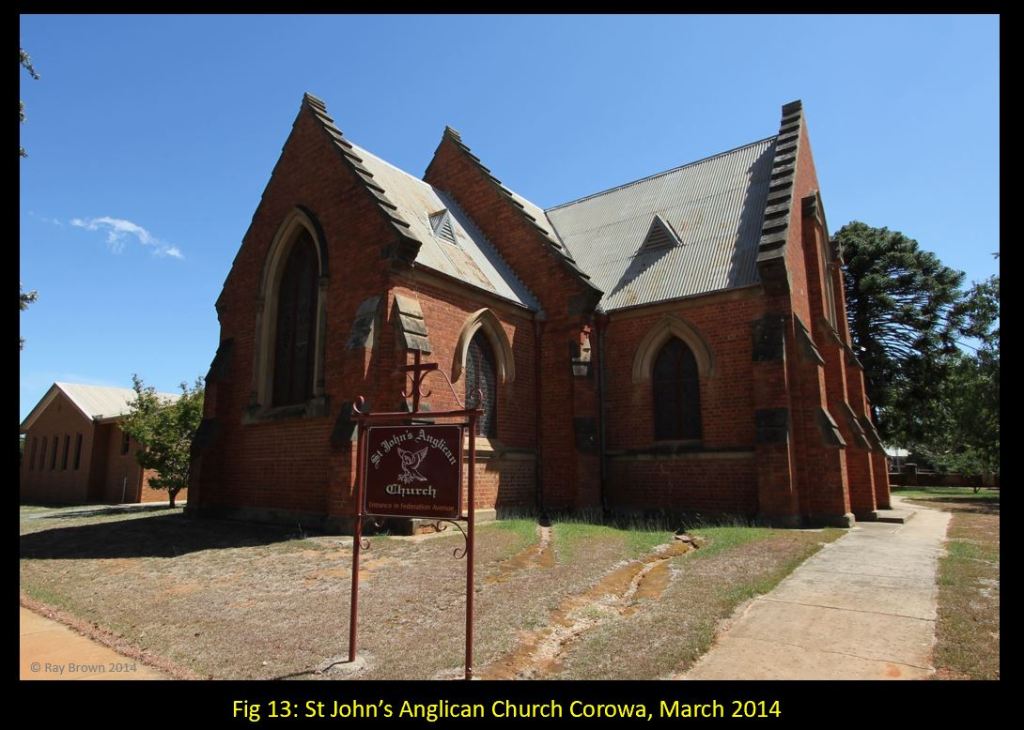
1884 St John’s Anglican Church Corowa, NSW.

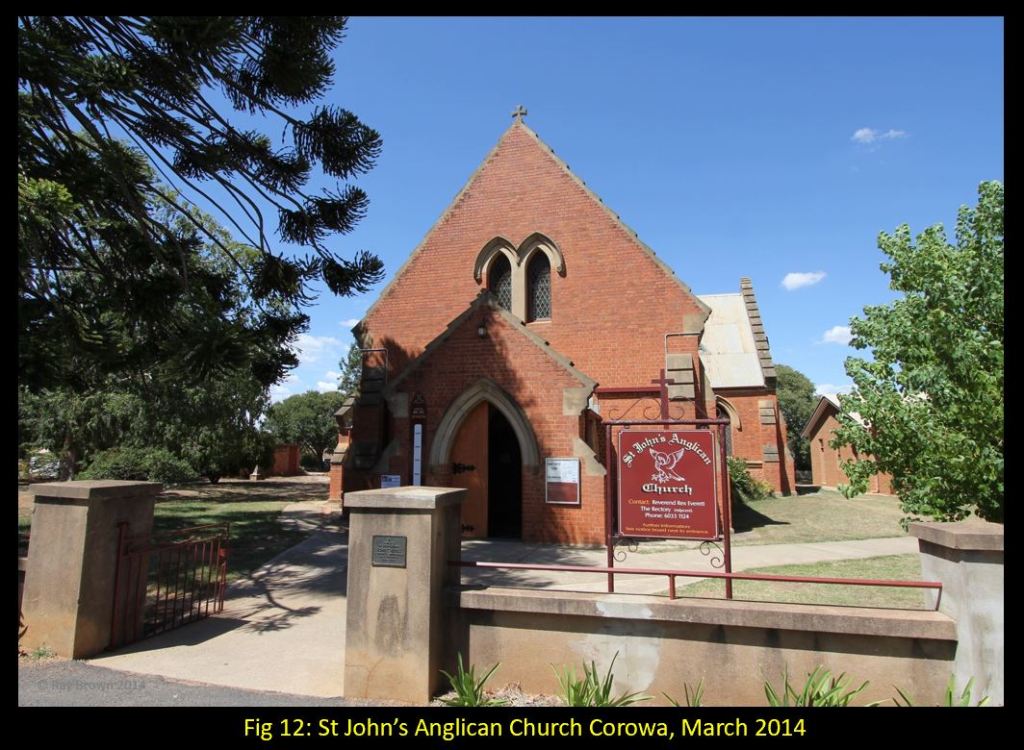
In 1863 the first wooden Anglican church was built at Corowa and dedicated as St John’s. The land was donated by John Foord. Circa 1859 the area was known as North Wahgunyah and later changed to Corowa to differentiate it from Wahgunyah on the south side of the river in Victoria.

On the 25th of January 1884, a brief article appeared in the Corowa Free Press about a stained glass window being delivered for the new brick building of St John’s.

“…The memorial window for St. John’s Church, presented by the Misses Hume, has been delivered at Corowa, and its erection will be proceeded with shortly..” [1]

A week later the same tabloid reported that the window had been installed in the church but there were errors in the article:

“MEMORIAL WINDOW.- The window presented to St. John’s Church, in memory of Elizabeth and Andrew E. [sic] Hume, has this week been put into its place by Messrs. Armstrong and Johnson – free of cost. It is a very beautiful piece of workmanship, and was executed to the order of the Misses Hume, by Messrs. Ferguson and Wise [sic], of Melbourne.”[2]

Slide show: Images were taken in March 2014:

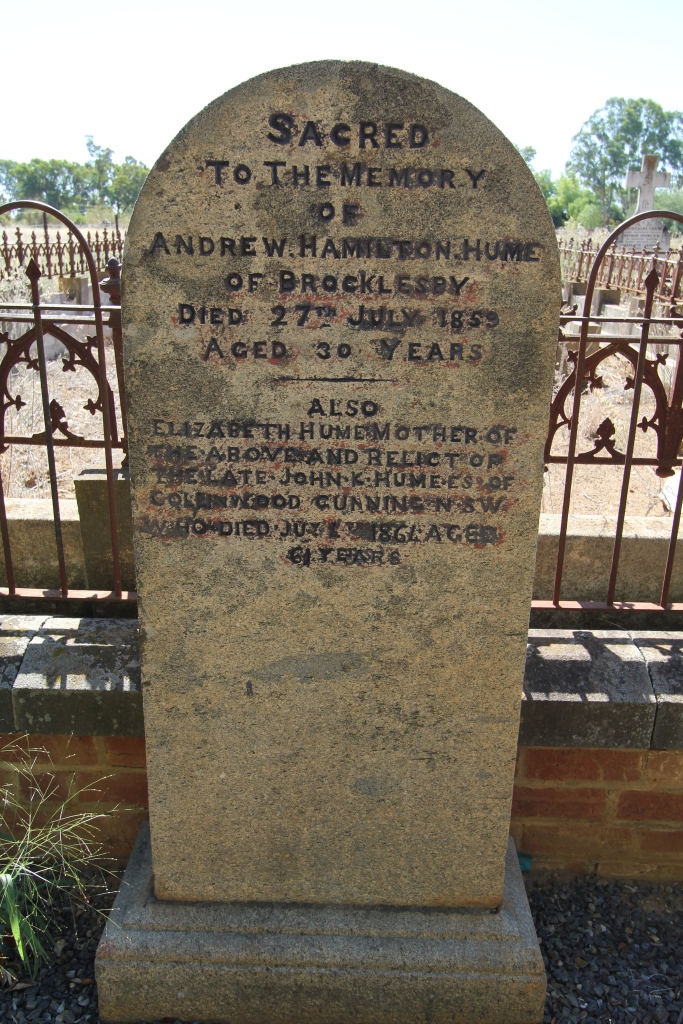
The window was dedicated to Andrew Hamilton Hume (1828-1859) and his mother Elizabeth (nee O’Neill 1802-1864). Andrew’s father was John Kennedy Hume (1800-1840) who was shot by bushrangers at Gunning, NSW, 20th Jan 1840 [3]

The newspaper incorrectly named the stained glass company as ‘Ferguson & Wise’. There was no stained glass company of that name anywhere in Australia. The window is accurately attributed to the ‘Ferguson & Urie’ stained glass company of North Melbourne. This company started out as a plumbing, slating, and glazing business, in Curzon Street North Melbourne in 1853 by Scottish immigrants, James & David Ferguson, and James Urie. In 1861 they transformed the company towards commercial glazing and stained glass production and for the next thirty-nine years, they made ecclesiastical and secular stained-glass windows.

After confirming with Rev Canon Rex Everet at St John’s in March 2014 that the window still existed, A trip to Corowa was next on my ‘To Do’ list.

A tabloid report in August 1896 gives an account of the Church and mentions stained glass windows by other studios from New South Wales:

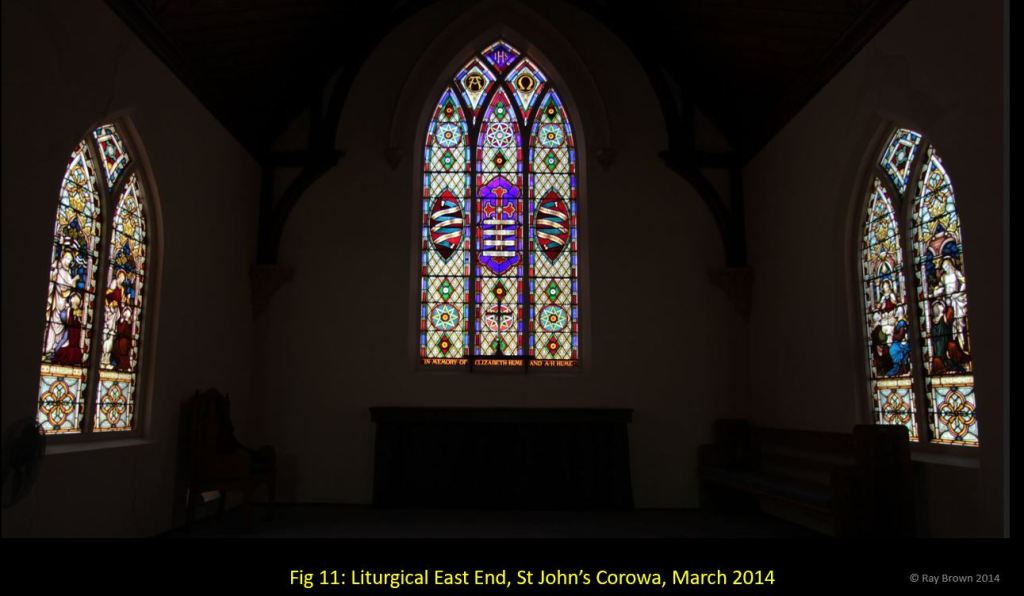
“…The older portion of the building was erected about twenty-five years ago by Mrs. Bladen Neill in memory of her husband, Lieutenant-Colonel Neill; the newer parts of the structure dating from some eleven years back. The church is cruciform in shape, and has a highly ornamental interior. The roof is of Murray pine diagonally laid, the massive worked principals supporting the same resting on artistically designed corbels. The stained glass windows, mostly presents from various residents, and costing over £250, largely enhanced the solemn beauty of the interior. The windows on each side of the altar, representing four scenes of the resurrection, are from designs supplied by the vicar, the Rev. William Clark Hose, and admirably executed by Messrs. Asher [sic] and Falconer[4], of Sydney. The three-light east window is in memory of Elizabeth and A. H. Hume, old and esteemed residents of the district. In the transept is a large three-light window in memory of Mr. Ross Ramsay, of Narrow Plains Station. Of the four lesser windows, one was presented by the late Bishop Linton; another by the Rev. W. Swindlehurst, of West Maitland, in memory of his deceased wife; and the remaining two by the Sunday School children…”[5]

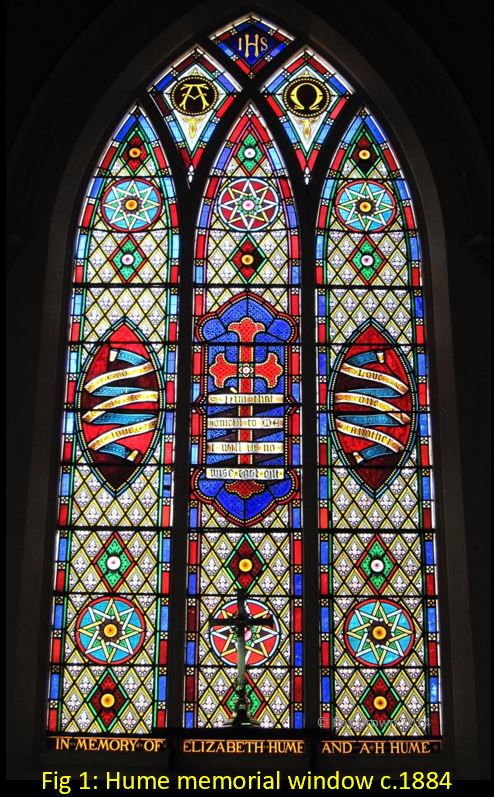
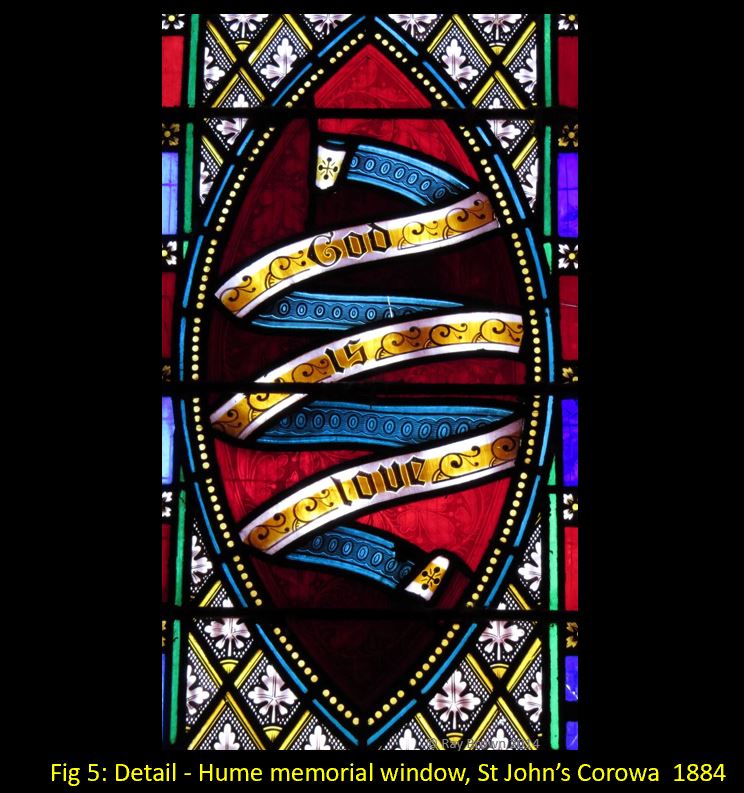
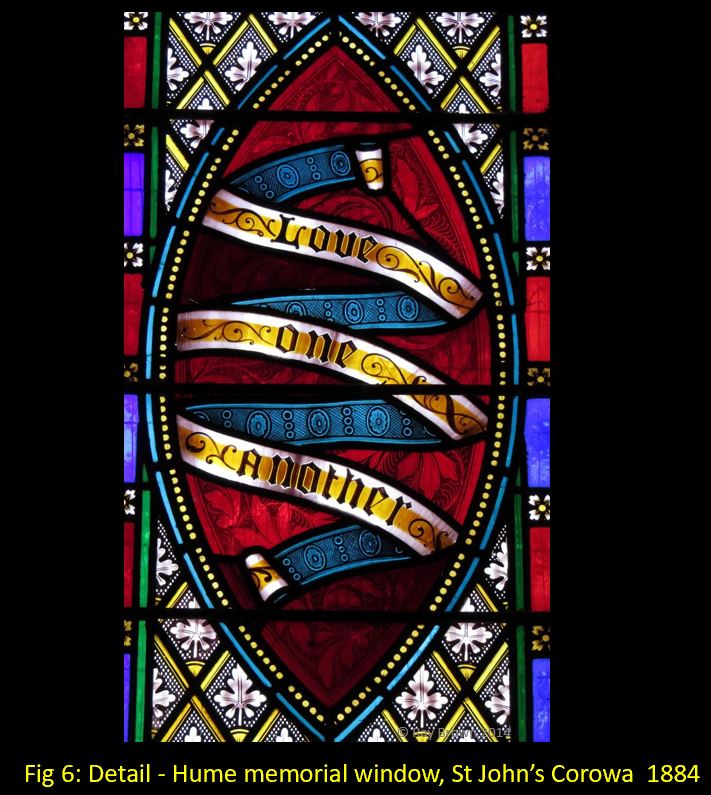
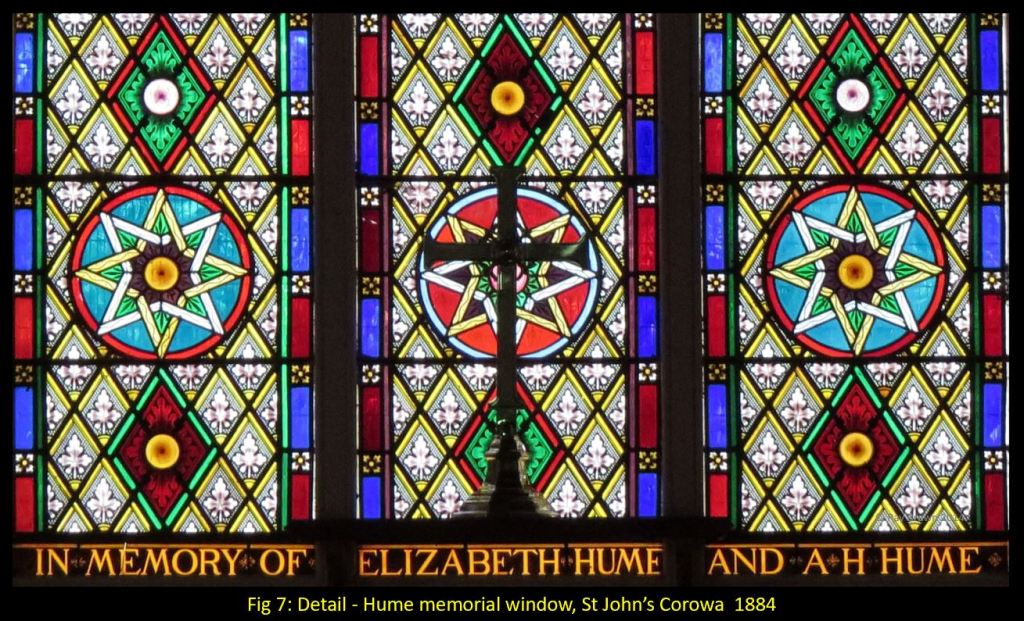
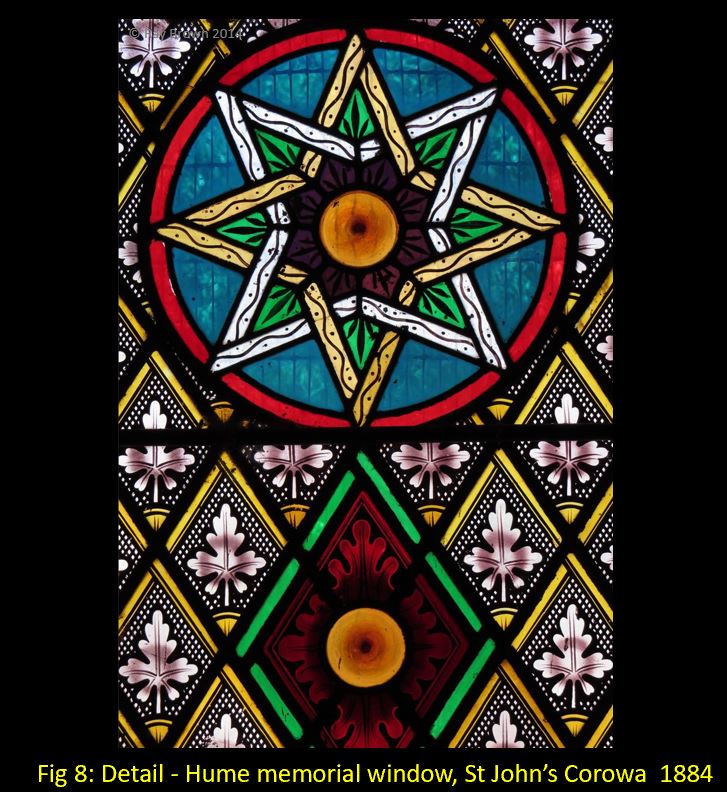
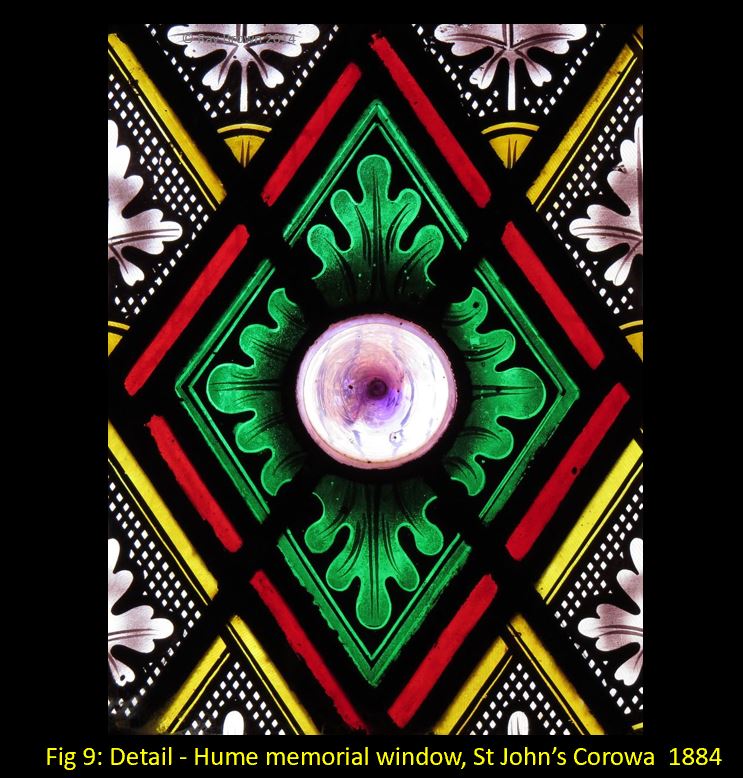
The Ferguson & Urie window in the chancel follows the company’s decorative style from their 1870s period of geometric patterns and scrolling ribbons with text from the bible. This window wasn’t made by the company’s first two pioneering stained glass artists. The artist who joined the firm in 1861, John Lamb Lyon, had left Ferguson & Urie in 1873 to form the Lyon & Cottier company in Sydney, and David Relph Drape died in 1882. This leaves two of the company’s earliest apprentice glass painters, Charles William Hardess and Frank Clifford Lording as the likely suspects who had a significant role in the window. There is no figurative work depicting any human form in the window, it has been copied faithfully from variations of their catalogue of designs over the previous twenty years, which Hardess and Lording would have been very familiar with producing.

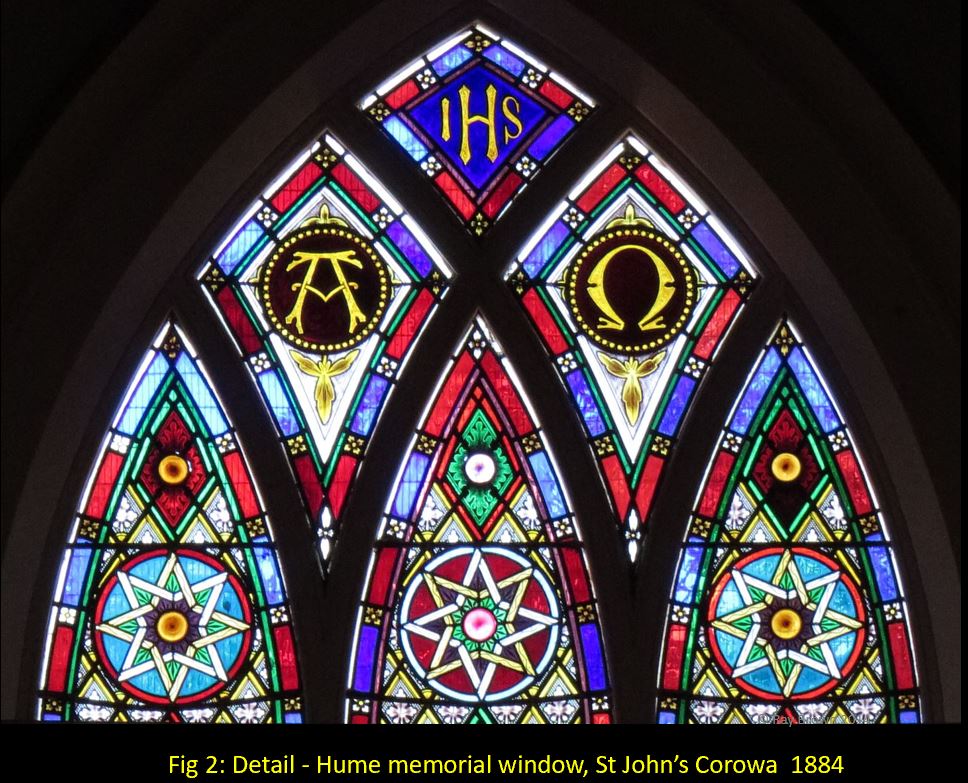
At the top of the window above the three lancets is a window with the letters “I.H.S”, a monogram symbolizing Jesus Christ. Below this are two windows with the Greek Lettering for “A” and “O” representing Alpha and Omega and meaning the Beginning and the End.

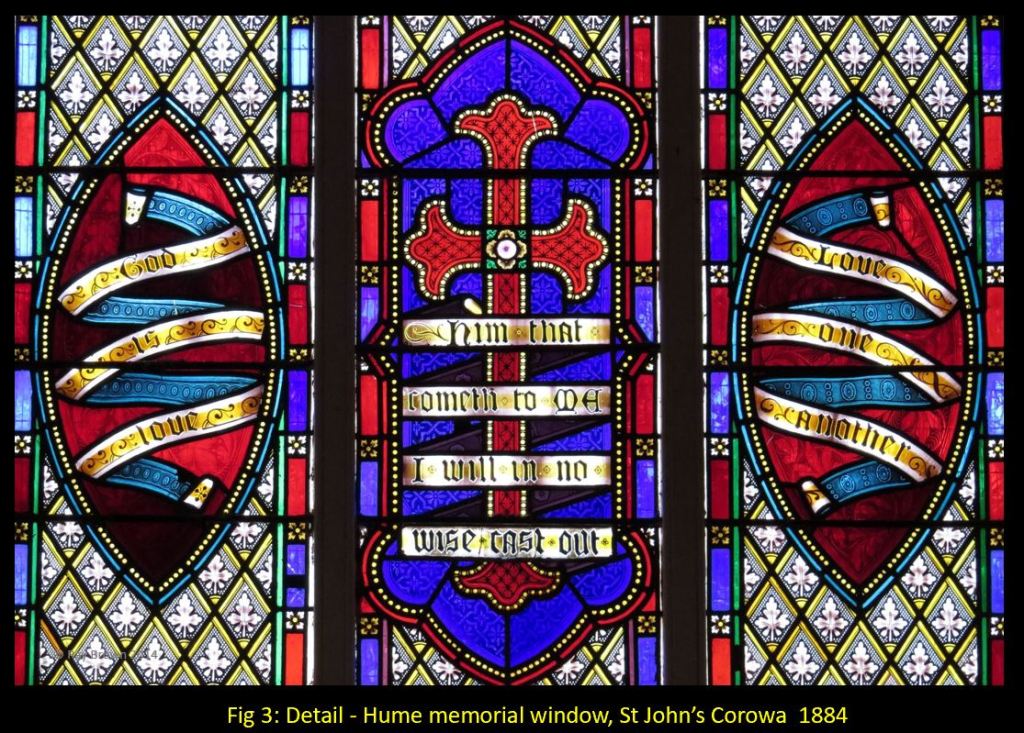
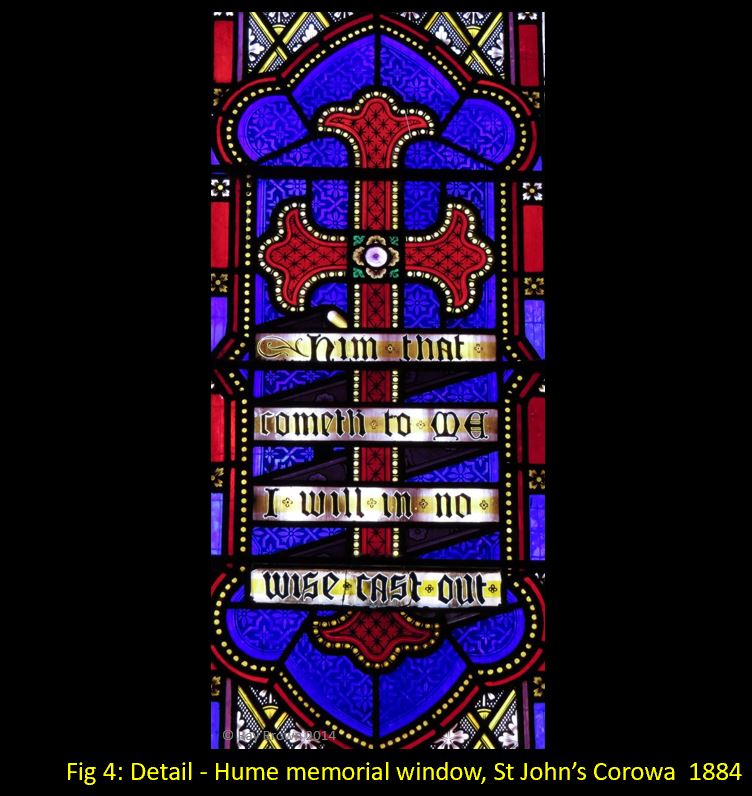
The centre light in the window contains a beautiful gothic decorated crimson cross on a sapphire blue background. The cross and the backgrounds have finely detailed sgraffito work picked out to reveal tiny stars. A ribbon scrolling around the cross has the words “Him that cometh to me I will in no wise cast out”. The left light contains a crimson pointed ellipse with leaves and fronds with a scrolling ribbon with the words “God is Love”. The right light is the same design but has the words on the ribbon “Love one Another”.

The memorial text at the base of the window states: “IN MEMORY OF ELIZABETH HUME AND A.H. HUME”.

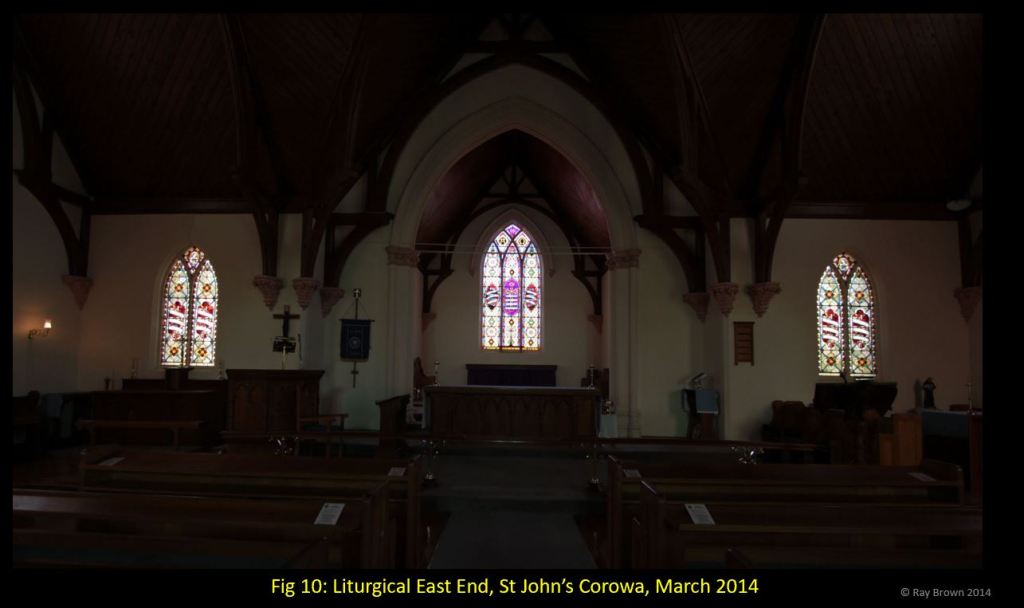
The Hume memorial window in the chancel is the only Ferguson & Urie window in the church. The windows flanking it in the chancel were made by the Sydney firm of Ashwin & Falconer and are a distinctively different style. , but in the nave, there are other windows that would trick you into believing they are also Ferguson & Urie windows. They’re not, and the reason these are similar-looking windows is that they are the work of Lyon & Cottier of Sydney. Lyon, mentioned earlier, was the Ferguson & Urie glass painter at North Melbourne between 1861 and 1873.

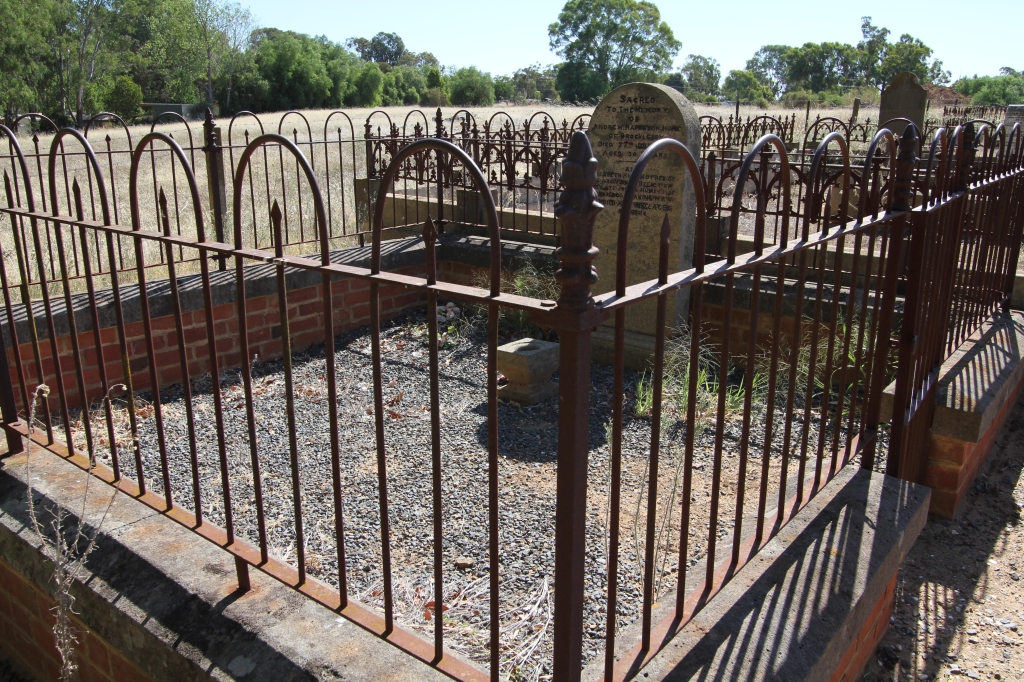
Andrew Hamilton Hume died at his station, Hume River, at age 30, on the 27th of July 1859[6]. His mother, Elizabeth (nee O’Neil 1802-1964) died 4th July 1864 at Yarrawonga in Victoria. Andrew and his mother are buried at the Corowa cemetery.

The Ferguson & Urie window was restored in 2015 at a cost of $25,000.

St John’s has an extraordinarily diverse range of stained glass windows by different artists and studios spanning nearly a century and a half. The windows from the late 1800s and early into the 1900s are by Ferguson & Urie, Ashwin & Falconer, and Lyon & Cottier. The modern-styled windows are by artists such as Bowers & Wilkins and Leonie Le Cornu.


Footnotes:

[1] The Corowa Free Press, NSW, Friday 25th January 1884, page 2.

[2] The Corowa Free Press, NSW, Friday 1st February 1884, page 3.

[3] The Sydney Morning Herald, NSW, Monday 27th January 1840, page 2.

[4] Aswin and Falconer, later Falconer and Ashwin, and F. Ashwin & Co.

[5] Australian Town and Country Journal, NSW, Saturday 8th August 1896, page 27.

[6] The Argus, Melbourne, Vic, Tuesday 9th August 1859, page 4.


Short Link to this page: https://wp.me/p28nLD-39y

© Copyright

1882: St Paul’s Launceston and Low Head, Tasmania.

Launceston and Low Head in Tasmania are only 56 kilometers from each other but in the 1860’s they might have been an entire world apart.

The ongoing quest to find the rare and historic stained glass windows crafted by the colonial ‘Ferguson & Urie’ company of North Melbourne sometimes create more questions than answers. After more than a century and a half the clues that lead to their existence are still being discovered.

Tenders for the construction of St Paul’s Anglican Church at Launceston were advertised in early October 1860[1] and on ‘All Saints Day,’ 1st November 1860 the foundation stone for a wooden church, to the designs of architect Peter Mills[2], was laid in Cleveland Street Launceston by Archdeacon Thomas Reiby [3].

On the 12th May 1861 the church was officially opened for services by Francis Russell Nixon , the Bishop of Tasmania[4].

It would be another twenty years before any stained glass windows were installed in St Paul’s although there was mention of an early chancel window previously being described as an: “ugly painted window”[5] and “…which so often became an eye-sore when the paint began to peel off…”[6] It’s highly likely that this ‘eye-sore’ of a window may have been a simple window film transfer known under various patent names such as ‘Vitrimanie,’ ‘Diaphanie,’ and ‘Chrystograph’.

In 1881 a member of the congregation who was only described as “A parishioner, in humble circumstances” had offered to pay for a new stained glass window for the chancel of St Paul’s. The Ferguson & Urie stained glass company of North Melbourne was commissioned to create the three light figurative stained glass window which was supposed to have been erected in the chancel and unveiled on Christmas day in 1881. Unfortunately the company responded that they couldn’t complete the window in time for the Christmas day ceremony and requested an extension, citing that they “wished to do the work well”[7].

By April 1882 the window had arrived from Melbourne and was erected in the chancel as intended. The window depicted Christ as three of the seven “I Am” sayings from the Gospel of John, being;
“I am The Resurrection and the Life” (John 11-25);
“I am The Good Shepherd” (John 10-11) and;
“I am The Light of the World” (John 8-12).

Photos taken by Gavin Merrington of “Original Stained Glass“, South Hobart, dated 19th August 2014

This slideshow requires JavaScript.

[View larger images]

The left light depicted Christ as the “Resurrection & the Life” with St Mark depicted above as the winged lion and at the base, St John as the Eagle.

In the centre light was Christ as “The good Shepherd” and above, the interwoven Greek symbols for Alpha and Omega and the letters ‘I.H.S’. Below Christ was the Agnus Dei or Paschal Lamb carrying the victory banner.

The right light depicted Christ as “The Light of the World” with St Mathew above as the Winged Man and below Christ is St Luke as the Winged Bull or Ox.

A further two single light windows by Ferguson & Urie, depicting St Peter and St Paul, were awaiting arrival for circa June 1882 and these were intended to be placed either side of the chancel window[8].

The next major stained glass window to be installed in St Paul’s was in 1886, although this window, depicting the Crucifixion, was obtained from the studio of E. R. Suffling of London. It arrived in late June 1886 aboard the “ss. Gulf of Mexico” and was erected in the liturgical west wall of the church[9]. The base of the centre light of this window contains the company name “E. R. Suffling & Co. Edgware Rd, London, England.”

St Paul’s church would serve the parishioners for the next 115 years but in the early 1970’s the development of the Launceston General Hospital was underway and St Paul’s was right in the path of the proposed plans. The church was eventually demolished c.1975 with some caveats specified regarding the recycling of the materials and artifacts from the church;

“…The demolition was agreed upon only if the hospital recycled the building as much as possible. Much of the fabric and contents of the St Paul’s church went to Low Head and were used in the construction of St Paul’s Chapel by the Sea…”[10]

During my early inquiries about the historic windows in the chapel at Low Head I was graciously sent a copy of a book about the history of Ainslie House which contains photos of the east three light window by Ferguson & Urie of North Melbourne and the west three light window by E. R. Suffling of London. There were no photos or evidence of the existence of the windows depicting St Peter and St Paul.

Thanks to Gavin Merrington of “Original Stained Glass” at South Hobart, it has now been confirmed, as of 19th August 2014, that all the historic windows are extant in St Paul’s Chapel at the Ainslie House aged care facility, Low Head, along with many other early 20th century stained glass from other artists and studios.

Ainslie House is a private Aged Care facility located at Low Head: 196-244 Low Head Road Low Head, Tasmania, Australia.


Significant transcriptions:

Launceston Examiner, Tasmania, Tuesday 27th December 1881, page 3.

“CHRISTMAS DAY ….”

“… As usual the church of St. Paul’s was decorated very chastely and effectively, and perhaps suffered no loss by comparison with more extensive Christmas decorations in previous years…”

“… At the close of the sermon in the morning, the incumbent alluded to one feature of Christmas greeting which he regretted the absence of, and which he hoped would be there that day, viz, a stained glass window for the chancel, which was to replace the painted one, which so often became an eye-sore when the paint began to peel off. A parishioner, in humble circumstances, had liberally offered to pay the cost of the new window, but through press of business Messrs Ferguson and Uril [sic], of Melbourne, had not been able to complete it in time for Christmas; and as they wished to do the work well, they asked a little extension of time. Probably a few weeks more will see this addition in its place, and it will not be the less welcomed through not making its first appearance at the Christmas festival.”

Launceston Examiner, Tasmania, Tuesday 11th April 1882, page 3.

“During Holy Week, owing to alterations, which were being made in connection with putting up the stained glass window in the Chancel of St. Paul’s Church, the daily service was held in the adjoining School-room….”

“… Before commencing the sermon in the evening, he alluded with feelings of thankfulness to the hearty and earnest services of Good Friday, and expressed his gratitude that the ugly painted window in the Chancel had given place to the handsome one, which those who were present in the morning had the privilege of witnessing the full effect of…”

“….and with pleasure announced that two additional stained glass windows had been liberally presented to the church, to be placed at the end of each aisle, right and left of the chancel. One window would represent St. Paul, whose name of the church and parish bear, and the other St. Peter, his brother apostle, and these windows would probably be finished in about three months. The chancel window, the noble and generous gift of a working man in the parish, consists of three lights; the central one containing a representation of Christ as the “Good Shepherd”, underneath this figure is the lamb with banner and cross, and above it the I.H.S., and alpha and omega in very rich colours. To the right is Christ as the “Light of the world;” above, the symbol of St. Mark, and below, that of St. John. To the left is Christ as the “Resurrection and the life,” with the symbol of St. Matthew above, and St. Luke below. Taken altogether the window is very pleasing and effective, and was supplied by Messrs Ferguson and Urie, of Melbourne, who will also provide the two additional windows….”

Examiner, Launceston, TAS, Wednesday 26th October 1904, page 7.

“ST. PAUL’S CHURCH. THE JUBILEE YEAR. AN INTERESTING RETROSPECT.

The present month has been a notable one in connection with St. Paul’s Church, which has reached its jubilee, and the event will be celebrated by a special function towards the end of the year. A few particulars regarding the history of the church should prove interesting.
The parish of St. Paul’s is bounded by the parishes of St. John’s and those of Perth and St. Leonards. In the year 1842 the population of Launceston had increased to such an extent as to render it necessary to relieve St. John’s of certain amount of work and responsibility, and therefore the northern portion of the town, with Brisbane-street as the dividing line, was formed into a separate cure, and Holy Trinity Church was erected. In 1851 the population still being on the increase, and stretching southward, it was found necessary to still further relieve St. John’s, and so another parish was formed, taking in all that portion of the town south of Balfour-street, and to be known as the parish of St. Paul’s. The mission district of Newnham, or Allenvale, situated about three miles from Launceston, on the George Town-road, was added to this parish. Here in the same year, 1851, a small church was erected and opened for divine service on April 27, by the Ven. Archdeacon Davies. This building is still in existence, and is used as a state school.
Mr. George Banks-Smith (afterwards canon and rector of St. George’s, Hobart) was first placed in charge of this parish as catechist. The first building used for divine service in St. Paul’s parish was the Frankland-street school; a building which was erected in the year 1847 and a school established there under the supervision of the chaplain of St. John’s. It was a strange looking old weatherboard structure of the bush hut style of architecture, and was perched up on a clay bank fronting the Frankland-street, and about midway between Charles and Wellington streets on the north side. The ‘Tasmanian Church Chronicle’ for November, 1854, contained the following account of the opening of the parish:- “On Sunday, October, 13, the opening of the new parish of St. Paul’s, Launceston (a sub division of St. John’s) took place. The sermon in the morning was preached by the Rev. P. V. M. Filleul, warden of Christ College, and in the afternoon by the lord Bishop of the Diocese. The building commonly known as the Frankland-street school room, has been temporarily fitted up for the performance of Divine worship, and on the occasion in question was well filled, the collection amounting to £25. The parish comprises a thickly populated part of Launceston, principally inhabited by the working classes, who have now the means of religious worship brought home to their doors with the benefits of a resident clergyman.”
The Rev. G. B. Smith worked hard in his new parish, and was ably assisted by the late Mr. Wm. Henty, Mr. and Mrs. Cleveland, and many others who formed the congregation in those days; and amongst those who took a great interest and did much to keep the congregation together at Newnham, were the late Messrs. Smith and Hutchinson, who, although residing in Launceston, walked backwards and forwards to the little mission church every Sunday, regardless of the weather. The Rev. G. B. Smith resigned the incumbency of St. Paul’s in 1859, and accepted the charge of St. George’s, Hobart. The parishioners then petitioned the Bishop to appoint the Rev. E. P. Adams (late Canon Adams), he being well known to them, having taken charge of the parish for a few months during the absence of the Rev. G. B. Smith in Sydney, but the Bishop required Mr. Adams’s services for the then newly formed parish of Mersey, and offered the incumbency of St. Paul’s to the Rev. Augustus Barkway, which he accepted.
It was not to be supposed that a congregation, especially a town one, would long put up with such a miserable building as that which served the purpose of a church in Frankland-street. Accordingly in 1860 a site was purchased, and on All Saint’s Day, November 1, the corner-stone of the present church, St. Paul’s, was laid by Archdeacon Reiby, assisted by the Rev’s. A. Barkway and John Chambers. In the short space of six months the building was completed, and opened for divine service on May 12, 1861, by Bishop Nixon. The building is of wood, in Gothic style of architecture, the dimensions being – Nave, 50ft x 32ft height 40ft; the chancel being 16ft x 13ft. The whole of the seats are composed of low benches, which have a remarkably neat appearance under the lofty nave. The church contains a very handsome font, a decorated Gothic altar rail and prayer desk, besides well carved lectern, made and presented by one of the parishioners.
After the opening of the church in 1861 the old Frankland-street building was still used as a Sunday school, but in 1863 a substantial stone and brick building was erected for the purpose on land adjoining the church. This land was generously given by three of the parishioners. The cost of the school building was £420. In the year 1867 money was raised and an organ procured at a cost of £150. On account of the increasing population it was found necessary in 1871 to enlarge the church, and this was done by the addition of another aisle.
At Easter, 1882, a handsome altar cloth and two windows, one to commemorate St. Paul and the other St. Peter,
were presented to the church by two of the parishioners. The beautiful chancel window was the noble and generous voluntary gift of a working class man. It consists of three lights, the central one containing a representation of Christ as the ‘Good Shepherd,’ underneath the figure is the Lamb with banner and cross, and above this I.H.S, and Alpha and Omega in very rich colours. To the right is Christ as the ‘Light of the World,’ above the symbol of St. Mark, and below that of St. John. To the left is Christ as the ‘Resurrection and the Life,’ with symbol of St. Matthew above, and that of St. Luke below.[11] A handsome memorial stained glass window was erected in the west end in 1886[12]; this was the gift of a very old family of parishioners, and another gave a carved cedar altar table, the old one being presented to the church at Frankford, in the Tamar parish.
In the year 1887, owing, unfortunately, to various causes, the congregation at the little mission church at Newnham having diminished, services, with the consent of the Bishop, were discontinued. The congregation of St. Paul’s have always looked well after their church, and entered heartily into ay scheme which would tend to increase and beautify it. The church has many benefactors. In addition to those already mentioned, the Cleveland family placed a beautiful painted window at the south end, and a marble cross was given by them also for the accommodation of a surpliced choir, and another gave a suitable brass altar desk. A handsome silver alms-dish and a silver altar table were also gifts to the church. The new chancel mentioned above was opened by the Bishop on September 19, 1888, and altogether the church, from a church man’s point of view, is the best appointed building in Launceston.
The Rev. Augustus Barkway has had charge of the parish for the last 45 years, and the many good qualities he possesses have endeared him to his congregation. The poor and afflicted have always been his special charge, and to them his kindly face is ever welcome.”

Tasmanian Govt, LINC, Record NG472, (accessed 24 Mar 2012)

“The Anglican Parish of St Paul’s was officially created and opened on 15 October 1854. Prior to this it was part of the Parish of St John’s, Launceston. It comprised the church of St Paul’s in Cleveland Street. On 5 October 1975 the final service was conducted in the church prior to its demolition to make way for redevelopment of the Launceston General Hospital on the church site. The demolition was agreed upon only if the hospital recycled the building as much as possible. Much of the fabric and contents of the St Paul’s church went to Low Head and were used in the construction of St Paul’s Chapel by the Sea, an interdenominational church which by c. 2000 was incorporated into the Ainslie House Aged Care Complex at Low Head. The chapel built at the redevelopment of the Launceston General Hospital was named St Paul’s chapel”.

The Organs Historical Trust of Australia, Christ Church Low Head, (accessed 24 Mar 2012)

“This substantial brick church was opened around 1980. It contains many fittings from St Paul’s Anglican Church, Launceston including the stained glass, memorial tablets and organ. St Paul’s was a large timber church to the south of the city centre close to the Launceston General Hospital”.

Footnotes:

[1] Launceston Examiner, Tas, Thursday 4th October 1860, page 1.

[2] Launceston Examiner, Tas, Saturday 3rd November 1860, page 3.

[3] Launceston Examiner, Tas, Tuesday 30th October 1860, page 2.

[4] Launceston Examiner, Tas, Thursday 9th May 1861, page 5.

[5] Launceston Examiner, Tasmania, Tuesday 11th April 1882, page 3.

[6] Launceston Examiner, Tasmania, Tuesday 27th December 1881, page 3.

[7] Launceston Examiner, Tasmania, Tuesday 27th December 1881, page 3.

[8] Launceston Examiner, Tasmania, Tuesday 11th April 1882, page 3.

[9] Launceston Examiner, Tas, Monday 5th July 1886, page 2.

[10] Tasmanian Govt, LINC, Record NG472, (accessed 24 Mar 2012)

[11] Windows made by Ferguson & Urie, Melbourne.

[12] Made by E. R. Suffling, London. (Ernest Richard Suffling 1855-1911)


Short link to this page: https://wp.me/p28nLD-2Cf

© Copyright

1884: St John’s Anglican Church, Bairnsdale, Victoria.

St John’s Anglican Church in Bairnsdale contains a stained glass window dedicated to the memory of Bairnsdale solicitor, Edward George Gregory Sandford (c.1852-1882), who died of Tuberculosis aged 30 at Albury on the New South Wales Border, 16th of May 1882[1].

The window was erected at the east end of St John’s behind the altar and was presented by his wife Florence (nee Kirkpatrick)[2] in June 1884. St John’s Church was officially opened in the same month, on the feast day of St John the Baptist, 24th of June 1884[3].

The window is attributed to the Ferguson & Urie stained glass company of North Melbourne and depicts Christ as “The Good Shepherd” and has the inscription at the base; “In Memoriam – Edward George Gregory Sandford, Obit, May 16th, 1882”. [4]

In 1980 the window was restored by Philip Handel of Sydney in 1980 and now has an additional memorial which appears below the original inscription:

“THIS WINDOW RESTORED 1980 IN MEMORY OF MRS E.M.W JONES”

Photos taken: 24th April 2011. (historic B/W images from State Library Victoria Collections)

This slideshow requires JavaScript.

[View larger images]

Edward George Gregory Sandford (1852-1882) was the son of Edward Sandford, a former barrister of the Supreme Court of NSW, and Eliza Catherine Gregory. His parents married in Sydney in 1849[5] and circa 1852 they moved to Newtown (Melbourne’s first suburb, now known as Fitzroy) where Edward was born in 1852, and then later moved to St Kilda. Edward followed his father in the legal profession and on the 20th January 1880 he married Florence Kirkpartick (1855-1945) at All Saints Church in St Kilda[6]. Edward and Florence then returned to Bairnsdale where he had been practicing as a solicitor since circa 1877. A daughter, Mary Maitland, was born at Bairnsdale on the 3rd of November 1880[7], and a son, Edward Herbert, born 3rd January 1882[8]. In circumstance of his failing health from Tuberculosis, they traveled to Albury shortly after his son’s birth, where he died five months later on the 16th of May 1882 aged 30. Florence never remarried and she died on the 8th June 1945[9] aged 90. She was buried with Edward in the St Kilda cemetery[10] 63 years after Edwards death.

Gippsland Times, Vic, Friday 21st December 1883, page 3.

“The foundation stone of the above church was laid on Wednesday last, in the presence of a large concourse of people, by the Rev. W. G. Hindley, Incumbent of the parish. Copies of the local and town papers, current coins, and a parchment document, were placed in the cavity of the stone. During the ceremony W. A. L. Elston, Esq., read a copy of the document as follows:-

In Nomine Dei, Amen.
Colony of Victoria, Australia.
Diocese of Melbourne, Archdeaconry of Melbourne.
Parish of St. John’s, Bairnsdale, County of Tanjil, North Gippsland.
Anno Domini MDCCCLXXXIII
Being the 47th year of the Reign of Her Most Gracious Majesty, Queen Victoria.
Bishop of Melbourne, Right Rev. J. Moorehouse, D.D.
Archdeacon Very Rev. H. B. Macartney D.D.
Incumbent of St. John’s, Rev. W. G. Hindley.
Board of Guardians:
H. Besley, M. W. Bower, E. Bull, B. Johnson, W. L. A. Elston, H. Goodenough, J. Jackson, J. Tipping.
Trustees:
C. C. Greene, Alex Smith, J. D. Smith.

The first foundation stone of this church was laid by John Davidson Smith on the 8th October, 1866, but the design was never completed, and the building being inadequate for the growth of the district, it was decided to erect the present more commodious structure in its place. Architect, J. Ibler; contractor, W. J. Yates.

The Rev. W. G. Hindley laid the stone and briefly alluded to the history, present position, and future prospects, of the church in Bairnsdale. The old church, which was a monument of their earlier struggles, had been pulled down, and the one of which they had laid the foundation stone would meet the wants of their growing town, and be a memorial of a most prosperous season, and an acknowledgement that God is the giver of all good. He hoped soon to see the church completed and out of debt.

The Rev. Canon Watson congratulated the people of Bairnsdale on their bright church prospects, and said how gratifying it was to see such evidence of success in church and other work. In Sale, he could tell them, they were doing a similar work, and were preaching what he, as a Sale man, hoped would be the Cathedral Church of the future. There was a great deal of rivalry among the towns of Gippsland, and this provided a wholesome emulation in church matters, which was productive of good.

The Rev. J. Hollis followed, and said he was glad the old church had been demolished, it was like our ambition too narrow and too high, he trusted that the new church would be broad in the test, and every sense of the word, but thoroughly evangelical. Referring to what Canon Watson had said he humorously said that the Bairnsdale Church would be finished and paid for before the Sale church.

The Rev. T. Walker spoke of foundations from from [sic]an architectural and spiritual point of view.

About £20, 10s was laid on the stone. The building is cruciform with nave, transepts, chancel, vestry and organ chamber, and will when completed, be an ornament to the town.”

The Argus, Melbourne, Vic, Tuesday 20th January 1880, page 1.

“SANDFORD-KIKPATRICK.- On the 13th inst, at All Saints’ Church, St. Kilda, by the Rev. J. H. Gregory, Edward George Gregory Sandford, of Bairnsdale, solicitor, eldest son of Edward Sandford, of Alma-road, St Kilda, solicitor, examiner of titles, to Florence, only daughter of the late William Maitland Kirkpatrick, formerly of Caulfield, Victoria.”

Bairnsdale Advertiser & Tambo & Omeo Chronicle, Vic Thursday 18th May 1882, page 2.

“The painful news was received in Bairnsdale by wire on Tuesday, stating that Mr. E. G. G. Sandford, who has been practicing in this town between four and five years as a solicitor, had died at Albury that morning. The event was not unexpected, as it was generally known that the deceased gentleman had been ailing from pulmonary consumption for a long time past, and had removed to Albury for the benefit of his health, and the news lately received from him was such as to induce his friends to be prepared at any moment to hear of the sorrowful event of which they were informed on Tuesday. During his residence in Bairnsdale the late Mr. Sandford married Miss Kirkpatrick, and during his sojourn here he took an active part in all social and religious movements, and in public matters, and was respected and esteemed by all. He leaves a widow and two young children to mourn his loss.”

Bairnsdale Advertiser & Tambo & Omeo Chronicle, Vic Thursday 18th May 1882, page 2.

“BAIRNSDALE CIRCUIT COURTS
WEDNESDAY, MAY 17TH
(Before His Honor Judge Nolan.)

DEATH OF MR. SANDFORD

When the General Sessions Court was opened, Mr. Kelleher, who was greatly affected, and who spoke very feelingly, observed that he had been requested by his brethren in both branches of the profession, and he spoke for himself, to refer sorrowfully to the absence of a young solicitor who had been practicing before the court during the last four or five years, and whose absence was occasioned by death. He (Mr. Kelleher) knows that the late Mr. Sandford was esteemed by the public of Bairnsdale, and was respected by his brother professionals: he was a good citizen, a good husband, and a good father, and his demise was generally regretted. He (Mr. Kelleher) did not apply to his Honor for an adjournment of the court, but on behalf of the professional gentlemen – and he spoke for himself – he solicited and expression from his Honor touching the painful circumstance.

His Honor feelingly remarked that he had heard a few minutes previously of the death of Mr. Sandford, and he felt very much shocked. The deceased gentleman had practiced before him for years, and his conduct in court had been most exemplary and courteous. He (his Honor) had known of he late Mr. Sandford’s illness some time ago, and had frequently inquired of he deceased gentleman’s father concerning his health. The court expressed deep sorrow at the loss of so esteemed a gentleman who had practiced before it.”

Bairnsdale Advertiser & Tambo & Omeo Chronicle, Vic, Saturday 20th May 1884, p2.

“SANDFORD.- On the 16th inst., at Albury, N.S.W., Edward George Gregory Sandford, of Bairnsdale, solicitor, in his 30th year.”

The Argus, Melbourne, Vic, Monday 22nd May 1882, page 1.

“SANDFORD.- On the 16th inst., at Albury, New South Wales, Edward George Gregory Sandford, late of Bairnsdale, solicitor, examiner of titles, in his 30th year.”

Gippsland Times, Vic, Monday 16th June 1884, page 3.

“A handsome In Memoriam window has just been erected in the new Church of England, Bairnsdale. It is the gift of Mrs Sandford, and is in memory of her late husband, formerly a solicitor, practicing in Bairnsdale. The subject is “The Good Shepherd,” representing Christ carrying a lamb in his arms, and is very beautifully finished, reflecting great credit on the firm by whom the order was executed. The window bears the following inscription:-

In Memoriam – Edward George Gregory Sandford, Obit, May 16th, 1882”.

Bairnsdale Advertiser & Tambo & Omeo Chronicle, Vic, Thursday 26th June 1884, p2.

“OPENING OF ST. JOHN’S CHURCH”

On Tuesday last the new Church of England, which has been erected by the Episcopalians of Bairnsdale, was opened for divine worship, special services being conducted on the occasion. There was a very large congregation both morning and evening, and not withstanding that the edifice has been constructed to seat 400 persons, chairs and forms had to be placed in all available places, in the morning and in the evening every nook and corner of the building was densely crowded, and may persons being desirous of gaining admittance were unable to do so. The guardians of the church had evidently been busy for some days past, as all arrangements for the services were most complete, and the large congregation were seated without the slightest confusion. A musical treat was provided for the occasion, the choir being of unusual strength as their ranks were augmented by several well known amateurs, and Mr. Plaisted, the talented and well-known organist of Melbourne presiding at the organ, the splendid instrument belonging to the Catholic Church having been kindly lent for the occasion by the Rev. Father O’Donohoe. Bridgewater’s morning and evening services were rendered by the choir, the anthem in the morning being “Rejoice in the Lord,” and in the evening “The earth is the Lord’s and the fullness thereof,” both being from the Campbell’s selection of anthems. The solos were contributed by Mrs. Cole and Messrs. Bower and Winkelmann, all of whom are to be complimented on their efforts, as also must be the choir generally, for the musical portion of the service has never been excelled in Bairnsdale. Before, however, proceeding to notice the other features of the opening ceremony, we must refer to the appearance of the church, more especially during the time the rite of confirmation was being administered. The bright sunlight streaming in through the many colored windows, cast a varied tint over the whole edifice, and falling on the white apparel of the ladies presented to the Bishop for confirmation, was most impressive in effect, and when combined with the solemn supplication of his Lordship as each couple took their kneeling positions before the communion rails, could not fail to produce an impression on the congregation present which will last for many a day. The magnificent altar cloth was presented to the church by Mrs. Moorehouse, wife of the bishop, and was much admired by all present, and the stained window facing the east, as has previously been mentioned by us, is the gift of Mrs. Sandford, in memory of the late Mr. E. G. G. Sandford, who during his life in Bairnsdale was a prominent member of the congregation. At the conclusion of each service a collection was taken up in aid of the building fund of the church, the result in the morning being £14,10s,9d. and in the evening £22. At each service the officiating clergymen were the Bishop, Dr. Moorehouse, The Rev. Canon Watson, of sale, and the rev. W. G. Hindley, the incumbent of St. John’s, Mr. H. R. Kelsall, the lay reader, also being present. The opening ceremony was appropriately fixed for the day set apart by the Anglican Church for the feast of St. John the Baptist, to whom the church is dedicated, and this fact was referred to by the young people before proceeding to administer the rite of confirmation, as his Lordship remarked that there some significance in the fact that the church dedicated to St. John should be opened on the feast day of that saint. His lordship referred to the teachings of St. John in the wilderness to the Israelites to repent, and as that saint taught in the olden times, so did the ministers at the present time. He charged them to repent – to change their lives – in order to be prepared to receive the rite of the Sacrament of the Lord’s Supper, and in a most eloquent address, admonished those about to receive the rite of Confirmation that they were to ask themselves whether they were prepared to crucify the lusts of the flesh, to renounce the evil influences of the world. He asked them if they were so prepared, and if so, he invited them to accept the full privilege of the blessings bestowed, and to be constant attendants at the Communion table. The rite of confirmation was administered to over thirty candidates. The evening discourse delivered by the bishop was an earnest and eloquent one, and was listened to with wrapt attention by the large congregation.

The ceremony of Tuesday marks an epoch in the history of Bairnsdale which must have an interest for all in the community, marking as it does the rise and progress of the town. The highly esteemed and much respected incumbent, the rev. W.G. Hindley, has taken a very active and earnest interest in having a church erected adequate to the requirements of the congregation, and being ably supported by the guardians the present building stands as a very substantial proof of their labours. They have taken a great responsibility upon themselves, taking upon their own shoulders the burden of seeing debt on the building paid off, and in this the congregation should join heartly in seeing the building unencumbered. We may be pardoned for throwing out one suggestion, and that is, having a fine edifice in which to assemble for public worship, they should not rest content until all their appointments are complete, and such cannot be the case until they have an organ suitable for the building, for it must be apparent to all that the little musical instrument which has hitherto done service will not be adequate to the requirements of the new church.”

Bairnsdale Advertiser & Tambo & Omeo Chronicle, Vic, Tuesday 1st July 1884, p 2.

“…The building was designed by Mr. J. Ibler, lately and architect practicing in Bairnsdale, and the contract for the erection of eh church was let to Mr. W. J. Yates, builder of Bairnsdale, and it is very evident that he has discharged his duties in a most faithful manner, the entire building being a masterpiece of the builder’s and decorator’s art; and while eulogising Mr. Yates and the workmen engaged by him, we must congratulate the congregation on the substantial and artistic manner in which their church has been erected, and the appreciable addition it forms to the architecture of Bairnsdale.”

Ellen Maria Watts Jones [nee Kemp] (1887-1979)

The east window was restored in 1980 in memory of Ellen Maria Watts Jones.

Ellen was the daughter of Arthur Kemp and Harriet Elizabeth Watts and was born in 1887. She married John Jones (c.1884 – 1961) and she died on the 2nd May 1979 at Clifton Waters Village at Bairnsdale aged 92.

Ellen left a bequest to St John’s church, part of which was used for the restoration of the historic east stained glass window created by the Ferguson & Urie stained glass company of North Melbourne. The dedication of the restored window and other items purchased via the bequest was planned for 25th May 1980 by Bishop Graham Richard Delbridge.

Records from Parish Council minutes revealed the following information:

4th February 1980:

“A bequest from Mrs Jones, late of C.W.V., is considered being used in part to restore the east window”.

17th February 1980:

“East window which is unique will be restored by bequest for $1,000”

The restoration work on the Ferguson & Urie stained glass window was completed by Philip Handel (1931-2009) of Sydney, in 1980. [11]

Footnotes:

[10] St Kilda Cemetery, CofE, Compartment C, Grave 764A.

[11] Research by Archdeacon Ted Gibson. (email via Mrs Judi Hogan 24 Sep 2013).


Short link to this page: https://wp.me/p28nLD-1Xq

© Copyright

1875: St Peter’s Anglican Church, Akaroa, New Zealand.

St Peter’s Anglican Church in Akaroa contains one of only seven rare examples of Ferguson & Urie stained glass found in New Zealand to date.

The window in St Peter’s was erected circa 1877 in the east sanctuary as a memorial to two young men, C. Allan Nalder a Solicitor, and Randal Sayle a district surveyor, who both drowned as a result of a boating accident when their yacht “Ripple” capsized in Tikau Bay on the 12th January 1875.

Photos taken 2nd October 2010 and kindly contributed by Errol Vincent, NZ.

This slideshow requires JavaScript.

[View larger images]

The first Anglican Church at Akaroa was built c.1852 in Church street to the designs of Samuel Charles Farr (1827-1918). Circa 1863, the Resident Magistrate at Akaroa, John Watson[1], donated the land for the new Church at Rue Balguerie, Akaroa, and builders Checkley, Bates and Newton began construction of St Peter’s in 1863. It was consecrated by the Bishop of Christchurch, Henry John Chitty Harper (1804-1893), on the 27th of November 1864[2].

In response to the need for more room, in 1876 architects Cane and Drewett (Thomas Cane 1830-1905 & John W. Drewett) presented the plans for the enlargement of the church, which included transepts and extended sanctuary, and on completion of these extensions, it was officially re-opened for services on St Mark’s day on the 25th April 1877[3].

In relation to the date the Ferguson & Urie window was erected, noted historian Dr. Fiona Ciaran records that the following was reported in the Lyttelton Times of 1875:

“…The LT records the studio and the arrival of the window [(6 April 1875, p2]…”[4]

In April 1877, two years after the arrival of the window, a statement of subscriptions and expenditure was published with mention of an amount paid to Ferguson & Urie:

Akaroa Mail and Banks Peninsula Advertiser, Vol 1, Issue 78, 17th April 1877, page 3.

“ACCOUNT OF SUBSCRIPTIONS AND EXPENDITURE MEMORIAL WINDOW…”
“…Paid Ferguson and Urie…£46-3-1…”

Transcriptions of some significant source records:

Colonist [NZ], Volume 1861, issue 1861, 12 January 1875, page 3.

“Monday.

“Mr. Randall Sayle, late of Nelson, was drowned on Saturday afternoon, at Akaroa, during a trial trip of the yacht Ripple, which he had just purchased. Mr Nalder, junior, a lawyer, was also drowned. A squall struck the yacht, which sank in deep water”.

Star, [NZ] Issue 2133, 12 January 1875, page 2.

“THE FATAL ACCIDENT AT AKAROA”.

“The following is a detailed account of this sad accident, of which a brief telegraphic account was published yesterday.
As has been already stated, the yacht Ripple, which was built at Port Chalmers, was brought to Lyttelton to compete at the late regatta in the yacht race, which she won. Mr Sayle, who was at the regatta as captain of the Akaroa four-oar crew, taking a fancy to the yacht negotiated for and purchased her, got her unrigged and sent down to Akaroa by the Bruce on Jan. 7. The day following her arrival at Akaroa, Mr Sims, one of the survivors of the accident, commenced to re-rig her, and finished his work on the morning of the 9th. Mr Sayle was very anxious and excited to get the work done so that he could have a trial trip of his purchase, and, accordingly, in the afternoon, himself, Mr C. Allan Nalder, Mr A. Westenra of the bank of New Zealand, and Mr W. Sims started for a cruise. The yacht was narrowly watched at starting and for some time afterwards by different persons on shore as she appeared to some who understood those matters not so stiff under canvas as she had been represented to be. At starting, two reefs were taken in the mainsail, and, subsequently, another one, the jib being also replaced by a smaller sail. The wind at the time was from the north-east, blowing rather gustily and fresh on the Akaroa side of the bay; on the opposite side it appeared as if the wind was stronger. The first part of the cruise was run down the harbour past the buoy of Green’s point, then a tack was made to winward, when the yacht fetched near Tikau Bay, she was then again put about. Mr Sayle was at the tiller and holding the main-sheet in his hand, when Mr Sims, noticing that she was heeling over too much, called out to Mr Sayle to let go of the sheet. As this was not done, Mr Sims twice more made the same request, but Mr Sayle was as one paralysed, looking at the others, but apparently unable to do what was required of him. The vessel heeling over more, the ballast shifted, and the yacht immediately filled and went down at, about a mile from the shore, in some six fathoms of water. The four, who were all swimmers, having got clear of the vortex caused by the sinking vessel, at once struck out for the shore. Mr Westenra and Mr Nalder being near each other, and Mr Sims and Mr Sayle a little distance from them. As they swam, Mr Nalder addressed Mr Westenra more than once, and wished he could get his coat off, which Mr Westenra told him was impossible, but kept cheering him up with hopes of their reaching shore safely. Mr Westenra supposes they must have swam nearly half way to shore when he heard a call from his fellow swimmer. He turned round and found he was alone, Mr Nalder having sunk to rise no more. At this time the beach was not to be seen, but struggling on, Mr Westenra at last reached the shore, exhausted and almost insensible. In the meantime, Mr Sims had kept near Mr Sayle, and they had been swimming some time, when Mr Sims noticed his companion apparently losing strength, and faltering and saying that he was afraid he could not keep on. Mr Sims then swam behind him, and catching hold of the serge coat which Mr Sayle wore, held him up whilst still swimming toward the shore, until he found they were both sinking, and that unless he let go, they must both go down together. Thoroughly exhausted, but reluctantly, Mr Sims let go his hold, and shortly afterwards Mr Sayle must have sunk. At this time, Mr Sims knew nothing of the others. He had heard a cry which he thought came from Mr Nalder, but whether it was of encouragement or despair he could not tell. Resting a little, and getting himself free from his boots, he again commenced swimming towards shore, which he ultimately, with great difficulty reached, and there found Mr Westenra. After taking off and wringing their clothes, they started for the Maori pah, and when on the hill, they noticed that Mr Bridge’s yacht, the Scud, had started from Akaroa, and was making for the scene of the accident. The Maoris treated them very kindly and hospitably, making them tea, and wanting them to change their clothes, which both declined to do; the Natives volunteered also to take them to Akaroa in a dingy. A fire was then lit to draw attention of those on board the Scud, but, owing to the peculiar haziness of the atmosphere, it could not be seen. However, the Natives getting out their dingy, took them, and, succeeding in drawing attention, put them safely on board. Mr Nalder was well known throughout the province, but Mr Sayle was not so well known. Both gentlemen were single, and the latter held the appointment of district surveyor at Akaroa. The fatality occurred about five o’clock in the evening, and, when known, caused quite a consternation in Akaroa, both gentlemen being held in more than ordinary esteem and respect.”

Lyttelton Times [NZ], Volume XXII, issue 1325, 1 December 1864, page 4.

“CONSECRATION OF ST. PETER’S AKAROA

On Sunday morning, the 27th day of November, the Bishop of Christchurch was met at the usual hour for divine service by the minister, churchwardens, and some of the inhabitants of Akaroa after the form prescribed, when the Rev. William Aylmer, M.A., the incumbent, read the petition praying his Lordship to consecrate their building, to which petition, consent was given according to the prayer therein contained. The ceremony of consecration and the dedication immediately followed. The Bishop having received the instrument of conveyance, presented to him, by which we learnt that the area of ground upon which the church was erected had been the gift of Mr. John Watson, the Resident Magistrate at Akaroa, declared the same to be dedicated to the use of the Episcopal Church, and henceforth to be known by the style of St. Peter. Being the first Sunday in Advent the psalms and Lessons for that day were read instead of those usually chosen at a consecration in this diocese; the second Lesson, containing the narrative of the cleansing of the Temple by our Redeemer. His Lordship afterwards preached from Matthew ix. Chapter and 29th verse – “According to your faith, be it unto you.” His sermon was a plain, but forcible explanation of the nature and quality of a saving faith, remarkable for the earnest tone in which he strove to bring home the necessity of such a faith to his hearer’s apprehension while he dwelt strongly upon the privileges which they would henceforth enjoy in making public prayer and supplication unitedly to Him who had promised that wheresoever two or three were met together there to be present with them. After the conclusion of the sermon, the Holy Communion was administered. The choir had prepared a musical treat, and sang Jackson’s noble Te Deum in F – in a manner which, if it left anything open to regret, was only that so inspiring a composition should not be the rule instead of the exception. The chants and hymns chosen for the day, were also well sung – the congregation joining throughout, intelligibly bearing their part in the service. After evening service, the Bishop administered the rite of confirmation, and addressed in his happy, affectionate, and impressive manner, those upon whom he had laid his hands, exhorting them, and all those who had preceded them, to help one another to fight the good fight and never be ashamed of he glorious calling whereunto they had been called. If another regret again obtruded, it was only that his Lordship was not able to be a more frequent visitor to the district of Akaroa.”

Akaroa Mail &Banks Peninsula Advertiser [NZ], Vol VII, Issue 704, 13 April 1883, page 2

“OBITUARY NOTICE

On the authority of a letter received by the last mail from England, we hear from Mr. A. H. Westenra of the decease of Mr John Watson, for many years the Resident Magistrate of Akaroa, and for some years the only Stipendiary magistrate in all of what is now Canterbury. It appears almost like going back to pre-historic times to write of the deceased gentleman, and his connection with Akaroa and the public service of the Colony, more especially, too, as but few who are now among us had the opportunity of hearing from his own lips the reminiscences of his earlier Colonial career.
From what we remember and have heard of our deceased fellow-colonist and former kindly neighbour, we understand that he was born at Ballydarton, in the County of Carlow, Ireland, his father being John Watson, Esq., who was then considered the first and best master of foxhounds in the United Kingdom[5]. This love of sport and horsemanship has descended, the present master of the Melbourne pack, which position he has honourably held for many years, being a half brother[6] of the deceased; while every old Akaronian must well remember the late gentleman’s pride in horses, even to breaking them in, the last one, we believe, that he owned and broke here being a horse named by him Blarney.
Mr Watson, we believe, came to this colony in November or December, 1843, with Captain – afterwards Admiral – Fitzroy, but in what capacity we do not know. It is a matter of colonial history that he distinguished himself at Kororareka, in the Bay of Islands, at the contest with the then redoubtable chief Heki. Shortly after this he must have been sent to Akaroa, succeeding Mr C. B. Robinson, the first R.M. here. From that date until 1869 or ’70 Mr Watson was one of us, strict in his duties and straightforward in his intentions, Like other men, he had his official peculiarities, but for unostentatious kindness, in which his widow was always a ready and eager helper, and more than aid, his name was in those days proverbial. The site of St. Peter’s Church section was a present from the deceased gentleman, who always, while he was amongst us, took a deep interest in Church matters, and otherwise interested himself in the advancement of the town and district; in fact, his and Mrs Watson’s aid and advocacy, combined with the Rev. W. Aylmer’s efforts, resulted in the present Church being built. Many and very many of the “old identities” of this district will be very sorry to read of Mr’s Watson’s bereavement, and though she is far away will still sympathise with her as a friend, although out of sight, but not out of mind to them. Most of us know that although a non resident the deceased gentleman still held property among us, notably the residence or Mr H. C. Jacobson, and a freehold on the German Bay hill. To quote Mrs Hemans:-

“Leaves have their time to fall, And flowers wither at the North wind’s breath, And stars to set; but all Thou hast all seasons for thine own, O Death!”

Stained Glass windows of Canterbury, New Zealand, Ciaran, Fiona. Dunedin, N.Z.: University of Otago Press, 1998, p153.

W370. E sanctuary, 3L, 2740mm x 1630mm.
The Risen Christ Blessing in Majesty.
Unsigned:
[Ferguson, Urie, and Lyon, Melbourne].

Undated: 1875.
Commemoration: C. Allan Nalder and G.R.F. Sayle, drowned in Akaroa Harbour, 9 Jan 1875 [plaque]. Both worked in Akaroa, Nalder as a solicitor and Sayle as a surveyor [MDCB N3, S74].
Donor: Public subscription.
Documentation: The LT records the studio and the arrival of the window [(6 April 1875, p2]. NZCN reported that more money was needed for the window which would cost approximately £60 [5, no. 9 (July 1875), p.103]. At a vestry meeting on 29 Sept 1877, which he attended while on a visit to the parish, Bp Harper noted that this window had been installed without a faculty. A formal request for a faculty was to be made [VMB (unpaginated)], but there is no faculty entry in the BR.
Note: This window may have been obtained from this studio as a result of an advertisement first placed by Ferguson, Urie and Lyon in NZCN, 1, no 5 (Feb 1871), p.16.”

(Abbreviations: BR: Christ Church Anglican Bishop’s Register. NZCN: New Zealand Church News. MDCB: Macdonald Dictionary of New Zealand Biographies. LT: Lyttelton Times. VMB: Vestry Minute Book).

Footnotes:

[1] Akaroa Mail &Banks Peninsula Advertiser, Vol VII, Issue 704, 13 April 1883, page 2

[6] George John Watson (1829-1906)

Acknowledgements:

Thanks to Errol Vincent for contributing the photos and for his and Ann’s enthusiasm for the history.  Errol is a great great grandson of James Ferguson of the stained glass firm ‘Ferguson & Urie’.

Thanks to Dr. Fiona Ciaran for signing my copy of her book ;-), ‘Stained Glass windows of Canterbury, New Zealand,’ which has been an invaluable resource for this article.


Short link to this page: https://wp.me/p28nLD-1X8

© Copyright

19-08-1876: Memorial Church, Brisbane, Queensland.

The Brisbane Courier, Queensland, Saturday 19th August 1876, page 4.

“Several of the Anglican clergy who came down for the Synod are still remaining in town. Of these the Rev. H. J. Hughill, of Leyburn, will preach to-morrow at the Memorial Church, in the morning; and the Rev. E. Moberly, of Gympie, in the evening. The occasion is, we believe, the improvement of the church by various additions, and especially by windows, the gift of an anonymous gentleman, which were ordered specially from Messrs. Ferguson and Urie, of Melbourne, and are highly ornamental.”

14 Oct 2013 – A great clue from Dianne Parker reveals this is the historic wooden church located in the shadow of Suncorp Stadium at Milton…..investigations continue!

13-09-1881: St Peter’s Anglican Cathedral, 27 King William Rd, North Adelaide.

South Australian Register, Adelaide, Tuesday 13th September 1881, page 4.

“MEMORIAL WINDOW – A Very handsome memorial window has been lately completed in the eastern transept of St. Peter’s Cathedral, North Adelaide, in remembrance of the Rev. C. B. Howard, M.A, the first Colonial Chaplain. The window has been constructed by Messrs. Ferguson & Urie, of Melbourne, to designs furnished by Mr. D. Garlick, the subject being the Judgement. Mr. Howard arrived in the colony in 1836, and from thence to his death in 1843 he laboured earnestly and successfully in his vocation as a minister of the Anglican Church”.

The foundation stone of St. Peter’s was laid on Tuesday 25th of June 1869 representing the 22nd anniversary of the ordination of Augustus Short, the first Bishop of Adelaide.

The Rev Charles Beaumont Howard was born in Dublin, Ireland in 1807 and after graduating from Trinity College in Dublin, he sailed to Australia with Governor Hindmarsh aboard the ‘Buffalo’ in July 1836 and he became the first Colonial Chaplain for the province of South Australia.

He died 19th July 1843 aged 36 and was buried in the Adelaide West Terrace Cemetery.

The St Peter’s Church History pamphlet (as at Feb 2012) reads:

“The Dean’s Chapel Windows: The Last Judgement (Matthew 25:3). This window is a memorial to Charles Beaumont Howard, the first Colonial Chaplain. He died at the age of 36 in 1843. Of unknown origin, it was erected approximately 50 years after his death by his few remaining friends”.

The mystery as to the maker of the window is a mystery no more. The window was created by the Ferguson & Urie stained glass company at Curzon Street, North Melbourne, 38 years after his death and not the reported 50 years!

This slideshow requires JavaScript.

The text on the window reads:

“ERECTED BY A FEW REMAINING FRIENDS IN MEMORY OF CHARLES BEAUMONT HOWARD FIRST COLONIAL CHAPLAIN HE ARRIVED HERE 28 DEC 1836 DIED 19 JULY 1843 AGED 36”.

“DURING THE WHOLE OF WHICH TIME HE LABOURED IN THE ADVANCEMENT OF THE HONOUR AND GLORY OF GOD AND WAS UNIVERSALLY RESPECTED BY ALL CLASSES”.

Images: Window photos courtesy of Ben Oborn, SA (10/02/2012), Church photo courtesy of Kerry Kroen SA (02/03/2012) .

External Links:

Biography: Charles Beaumont Howard 1807-1843

Biography: Rev Augustus Short (1802-1883)


Short link to this page: https://wp.me/p28nLD-wt

© Copyright


21-11-1873: St. Peter’s Anglican Church, Robe, South Australia.

South Australia Register, Adelaide, Friday 21st November 1873, page 6.

“ROBE, November 18. A movement is on foot in this district for placing a window in St. Peter’s Church in memory of the late George Ormerod. About £100 will be required for the purpose.”

This stained glass window was eventually created. The two light window dedicated to the memory of George Ormerod was created by the Ferguson & Urie stained glass company of Melbourne circa 1874 and depicts the Nativity, Baptism, Resurrection and Ascension.

The Robe church history book supposedly has reference to this window being made by “Ferguson Will and Nyon” which is incorrect from two facets. It obviously should read “Ferguson, Urie and Lyon” but this would also be technically incorrect as the partner in the firm, John Lamb Lyon, officially dissolved his interest in the business with James Ferguson & James Urie on the 29th August 1873 and left for Sydney shortly afterwards. The date of the article above, 21 Nov 1873, is nearly three months after Lyon left the business so the window that was eventually made for Ormerod would have technically been “Ferguson & Urie” and the artist being David Relph Drape.

The former business partner John Lamb Lyon went to Sydney to take up partnership with Daniel Cottier to become Sydney’s premier stained glass studio “Lyon & Cottier”.

Photos kindly contributed by Liz Harfull 19/02/2012.

This slideshow requires JavaScript.

The Overland Telegraph, South Australia, 20th April 1872, page 5.

THE LATE MR. ORMEROD.- Our Guichen Bay correspondent writes:- “As announced previously by telegram, Mr. George Ormerod, of Ormerod & Co., died at his Robe residence on the 10th inst. The death of one so long and intimately connected with this district could not but cause the most painful sensation. For some years past Mr. Ormerod has suffered from general debility and mental malady, the result of an overwrought brain. Frequent rallies had given hope that he might yet live many years; but during the last fortnight alarming symptoms showed themselves. Many far and near have watched anxiously the fluctuations of this last attack, still hoping his great vitality would carry him through; but he expired on the evening of the 10th. Mr Ormerod was a member of a very old Lancashire family, and was born at Rochdale in 1822. He came out to Victoria in 1842, and amongst the pioneer squatters settled at Naracoorte, about 1845 to 1846, on the station known as the Naracoorte Station. About 18 years ago he settled at Guichen Bay, opening up a large business there, which has aided greatly in the development of the South East. Mr. Ormerod shrunk from a public career, and the only public positions he held were those of J.P. and Chairman of the Local Road Board. These were retained as long as health permitted. The funeral took place on Friday afternoon, the body being interred in the Robe Cemetery. The procession was largely attended, some coming over 50 miles to be present. Many residents from Kingston testified their regard by following the remains to the grave. The Rev. H. Howitt, of St. Peter’s, preached a funeral sermon last Sunday, in which Mr. Ormerod’s many good qualities were appropriately alluded to. Mr. Ormerod has made a will, and it is understood that the business will be continued as heretofore for the benefit of his widow and family.”


Short Link: https://wp.me/p28nLD-lr

© Copyright

07-08-1867: Decorative Art. James Urie sojourning in Tasmania.

The following historical tabloid transcriptions contain a wealth of clues for my research on Ferguson & Urie stained glass.

In 1867 James Urie has traveled to Tasmania on the quest to further the company’s interests. By all accounts it would seem that his business acumen was extremely successful and there have been quite a few tabloid articles written which trace his movements. For many years after his venture to Tasmania the company would receive commissions from all over the state.

Each of the obscure clues in the following articles has been researched in great depth and links to other detailed posts on the windows mentioned have been included.

The Mercury, Hobart Tasmania, Wednesday 7th August 1867, page 2.

“DECORATIVE ART – The admirers of art workmanship will be glad to hear that there has for the last couple of weeks been sojourning in Tasmania, a partner of the Victorian firm of Ferguson, Urie, and Lyon, to whom many ecclesiastical and private edifices in this and the neighboring colonies are indebted for some of the finest specimens of pictorial decoration on glass, of which they have yet become the possessors. The objects of the visit have been to fulfil some orders previously given and to obtain others, and it is satisfactory to know that in the latter design the gentleman referred to, Mr. Urie, has not been unsuccessful. The name of the firm of which Mr. Urie is a member will be familiar to all visitors to the late Intercolonial Exhibition in Melbourne, in which a court furnished by them to illustrate the ornamentation of churches constituted a very interesting and pleasing feature. Mr. Urie has brought with him a portfolio of designs prepared in his establishment for the embellishment of ecclesiastical windows, and inspection of which is quite sufficient to establish the claim of the house he represents to consideration at the hands of all persons of cultivated taste, who may have made this branch of the art a subject of special study. The appropriateness with which the conventional religious symbols of the ancient church are introduced, the fidelity with which scriptural incidents are treated, and the beauty of the drawing and colouring combine to render the collection at once suggestive to the mind, and pleasing to the eye; and a familiarity with it, on the part of the rising generation of Tasmanians, would do much towards engendering and fostering a healthy appreciation of one of the highest forms of art workmanship amongst the community. The decorations already supplied by Messrs. Ferguson, Urie, and Lyon to churches in Tasmania, include a stained window erected in St Luke’s Church, Launceston, and another which has been placed in the Episcopalian Church, New Norfolk. The former contains a representation of the “Ascension,” supplemented by groups of the apostles, the entire constituting a most ornate adjunct of the building, and being completed at a cost of £130. The latter has been contributed by Dr. Moor as a memorial of gratitude for his preservation from shipwreck in the City of Launceston, steamer. The central group of figures in the latter represents the baptism of Christ. In addition to these the firm are in receipt of commissions from John Foster, Esq, for a memorial window to be placed in All Saints’ church, Hobart Town, remembrance of the donor’s deceased son, and from A. Kennerley Esq, for other decorated windows for the same church. They have also executed commissions for hall and staircase windows, some of them of highly artistic design, for R. Q. Kermode Esq, of Mona Vale, which afford evidence of the attention paid by them to the profane as well as to the religious style of decoration in the branch of pictorial art to which they devote themselves.”

Geelong Advertiser, Vic, Thursday 15th August 1867, page 3.

“A Tasmanian paper thus refers to the success of an enterprising Melbourne firm: -“Mr Urie, of the firm of Ferguson, Urie and Lyon, of Melbourne, who, it will be remembered, designed and executed one of the stained-glass decorations in St. John’s Church, is now visiting Hobart Town, having fitted up a window in the Episcopalian Church, New Norfolk, which has been contributed by Dr Moore as a memorial of gratitude for his preservation from shipwreck in the City of Launceston steamer. The central group of figures represents the baptism of Christ. In addition to these the firm are in receipt of commissions from John Foster, Esq., for a memorial window to be placed in All Saints’ Church, Hobart Town, in remembrance of the donor’s deceased son, and from. A. Kennerley, Esq., for other decorated windows for the same church. They have also executed commissions for hall and staircase windows, some of them of highly artistic design, for R. Q. Kermode, Esq, of Mona Vale.”

All the windows mentioned in the historical articles are extant:

1. St John’s window Launceston (incorrectly mentioned as St Luke’s in the first article).

2. The Episcopalian Church, New Norfolk, is St Matthews and has the Moore window.

3. The Foster memorial window at All Saints Anglican Hobart.

4. The A. Kennerley windows are in the ‘Kennerley’ aisle in All Saints.

5. The Kermode window at Mona Vale is extant but only copyright photos exist.

Also see: 13-08-1867: James Urie visits Tasmania on Ferguson and Urie business.


Short link to this page: http://wp.me/p28nLD-95

© Copyright

19-12-1864: St. John’s Anglican Church, Digby, Victoria.

The Foundation Stone of St John’s was laid by the Rev. Francis Thomas Cusack Russell on the 19th April 1861 and was consecrated on the 21st January 1888.

Amongst the many historic artifacts in the church is the the three light Gothic stained glass window by Ferguson & Urie erected in 1864.

The Portland Guardian, Monday 19th December 1864, page 2.

I am able to congratulate the township of Digby upon the possession of three very handsome stained windows in St. John’s church The design is very neat and the appearance is peculiarly rich; the centre compartment contains a full length figure of St John and he side windows have the emblems of the Evangelists and also the “Agnus Dei;” the whole is in rich antique glass and was supplied by Messrs. Ferguson and Urie of Melbourne.”

This slideshow requires JavaScript.

[Show larger images]

Portland Guardian and Normanby General Advertiser, Vic, Monday 6th May 1867, page 2.

 “DIGBY”

 “The most prominent feature in the township of Digby is the English Church, St. John’s, and the common school on the same reserve. The church is built of brick and is a remarkably chaste gothic. The interior is beautifully fitted up, and the east window of stained glass, is perhaps the most beautiful in design and execution of any in the Western district. The window is in three compartments, the centre with a well executed figure of the saint in flowing eastern drapery, with a book in one hand and candle-stick and candle in the other, with an eagle at his feet“

Related posts:
1877: Holy Trinity Anglican Church, Coleraine, Victoria.
1867: St Peter’s Anglican Church, Merino, Victoria


Short link to this page: https://wp.me/p28nLD-4V

© Copyright