1874: St John’s Anglican Church, Ballan, Victoria.

The foundation stone of St John’s Anglican Church in Ballan was laid by Juliet Vivian Lyon (nee Anderson) in 1861. Thirteen years after that historical event Juliet died and in late 1874 a stained glass window was erected in her memory in  the chancel of St John’s. The window was made by the Colonial stained glass craftsmen Ferguson & Urie of North Melbourne.

Photos taken 10th April 2011.

This slideshow requires JavaScript.

[View larger images]

Juliet was born at Norfolk Island on the 10th Feb 1839, the daughter of the decorated army officer Joseph Anderson (1790-1877) and Mary Campbell. Her father Joseph was was stationed as commandant of the Norfolk Island Penal Colony from March 1834 to February 1839. One of his first duties on Norfolk Island was to dispense the punishment for the Norfolk Island Prisoner revolt in 1834 in which thirteen of the twenty-nine convicted prisoners were executed.

Juliet married pastoralist Charles Hugh Lyon (1826-1905)[1] at St Paul’s church in Melbourne on the 30th December 1859[2] . They settled at Hughe’s ‘Ballanee’ estate at Ballan where they had five known children; Clara, Lily Mary, Violet Mary, Vivian Hugh and Charles Gordon.

In 1861 Juliet had the honour of laying the foundation stone of St John’s Anglican Church in Ballan. Very little information is known of this event other than Juliet had laid its foundation stone as mentioned on her memorial stained glass window, and the obscure mention that on the 29th January 1862 the Church was reported as being near completion[3].

Juliet died at her father’s residence ‘Fairlie-house’ in South Yarra on the 16th of March 1874, aged 35[4]. She was buried with her parents, Joseph and Mary Anderson, in the St Kilda cemetery on the 17th March 1874 and her husband Hugh was also buried them in 1905.

The Ferguson & Urie stained glass window was erected to her memory in St John’s, thirteen years after she had laid its foundation stone.

The two-light stained glass window depicts ‘Faith & Hope’;

The left lancet depicts an angel at the top carrying a banner with the words ‘HALLELUJIA’. Below is the depiction of Faith carrying a cross with her right hand held towards heaven. The text below the figure is ‘HAVE FAITH IN GOD’ and below this is another angel carrying a banner with the text; ‘BLESSED ARE THE DEAD’

The right lancet depicts an angel at the top carrying a banner with the words ‘PRAISE THE LORD’. Below is the depiction of Hope with the ships anchor and below this is another angel carrying a banner with the text; ‘WHICH DIE IN THE LORD’

Across the base of both windows is the memorial text:

‘IN MEMORY OF JULIET VIVIAN LYON WHO LAID THE FOUNDATION STONE OF THIS CHURCH IN 1861.’

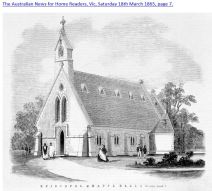
The Australian News for Home Readers, Vic, Saturday 18th March 1865, page 7.

BALLAN St John's 98c

“EPISCOPAL CHAPEL AT BALLAN,

The neat little building, shown in the engraving, is the newly erected Episcopal Chapel, at Ballan, a distance of about sixty miles from Melbourne. The building has been raised solely by the exertions of the congregation, and is a pleasing instance of the progress of Christianity in the provincial districts of Victoria. The chapel belongs to the Gothic order of architecture, and is commodious enough to meet the requirements of the Episcopalians of Ballan. The nave is 57 feet by 25 feet in extent, and chancel 10 feet 3 inches by 21 feet.”

Juliets’ husband Charles died at ‘Ballanee’ estate at Ballan on the 13th February 1905 aged 79[5].

In the historical engraving depicting St John’s from 1865 it shows  a ‘Pugin’ type bell-cote at the west end and a small side building at the east end which is presumably a vestry. Neither of these exist to this day.

The left lancet of the Ferguson & Urie window which depicts ‘Faith’ is taken from a famous oil painting by Sir Joshua Reynolds (1723-1792) and replicated in a stained glass window by Thomas Jervaise at Holy Trinity, Fareham, Hampshire, England. There are three other known instances of this depiction of ‘Faith’ in Ferguson & Urie windows which are located at All Saints, South Hobart; Christ Church, Hawthorne; St Mark’s, Remuera, New Zealand.

In 1883 another Ferguson & Urie window was erected in St John’s to the memory of Rebecca Mary O’Cock. See: 10-03-1883: St John’s Church, Ballan, Victoria.

Location: Simpson Street Ballan

Footnotes:

10-03-1883: St John’s Church, Ballan, Victoria.

The Bacchus Marsh Express, Vic, Saturday 10th March 1883, page 3.

“BALLAN.

(FROM OUR OWN CORRESPONDENT)”

“THE stained glass window in memory of the late Mrs. Ocock has been put in St. John’s church. It is small but very handsome. It represents on one side the figure of the Good Shepherd, holding a lamb in his arms, and on the other, the figure of St. John the Evanjelist. The inscription under the former is “I am the Good Shepherd,” and under the latter “Little children love one another,” and below these “In memoriam, Rebecca Ocock, died 23rd August 1882.” The whole is most tasteful and handsome, and is executed in Ferguson & Urie’s well known style. The window was presented by the relations and connections of the deceased lady”.

Photos dated: 10th April 2011.

This slideshow requires JavaScript.

St John’s Anglican Church is located in Simpson Street Ballan. Tenders for the erection of the Leonard Terry designed church were advertised in March 1860 [1] . Mrs Juliet Vivian Lyon (nee Anderson) laid the foundation stone in 1861 and the church was completed in early 1862 [2]. In March 1883 Ferguson & Urie erected a two light memorial window to the memory of Rebecca Mary Ocock [3] who died at Ballan on the 23rd of August 1882 in her 79th year. She was the wife of well known[4] and respected Ballan Solicitor Richard Ocock who died eleven months after her at Bungeeltap-house, on the 10th of July 1883 aged 79 [5]. They are both buried in the Ballan cemetery. The stained glass window depicts Christ as the Good Shepherd in the left light and St John in the other.

Note: Elizabeth, daughter of Rebecca Mary & Richard O’Cock, married Ballan Councillor Dougald MacPherson and she co-donated the liturgical west stained glass window of St Paul’s Presbyterian Church in Ballan , also created by Ferguson & Urie c.1866. See: 28-07-1866: St Paul’s Presbyterian Church, Ballan, Victoria.

Footnotes:

28-07-1866: St Paul’s Presbyterian Church, Ballan, Victoria.

The Bacchus Marsh Express, Vic, Saturday 28th July 1866, page 2.

THE OPENING OF THE NEW PRESBYTERIAN CHURCH, BALLAN”.

“SABBATH last brought with it the long-looked-for day of opening of this beautiful Church. The new building is, perhaps, the most prominent, as it is certainly the finest erection in this rising township. The style of architecture is modern Gothic. The building is of bluestone rubble, every alternate stone having a four inch sneck, and is neatly tuck-pointed. It stands on a base two feet high, while the outer walls are supported by twenty abutments of freestone, with small bluestone snecks let in, and finished at the tops with two weatherings. The fine large window in front of the edifice consists of freestone reveals and arches, and is divided by two mullions nine feet high, being finished in the same way both externally and internally. There are also eleven other windows, while the whole is surmounted by an exceedingly chaste spire, which rises to a considerable height. The spire is likewise built of mixed blue and freestone, which is carried up sixteen feet square, at which point commences an octagon tower, perforated with eight windows four feet high, the interior of which forms the bell-tower. Immediately above the bell-tower stands a circle of freestone moulding, which is destined to receive a very handsome clock. Attached to the main building is a vestry, divided into two rooms, the whole edifice being finished by a freestone water-table. The building occupies a commanding situation, and the effect is altogether very pleasing, as the eye first rests upon it. Unlike many colonial buildings, whether public or private, the new church will bear the closest scrutiny. The grounds have been securely and handsomely fenced in, while great taste and skill have been displayed in laying them out, and planting them with choice trees. The same care and taste which is visible in the exterior of the building, is observable in the furnishing and decorating of the interior. Here all is comfort and elegance. On entering, the first thing which strikes the eye is the highly-elaborate way in which the windows have been filled in with stained glass. They were furnished by Messrs. Fergusson [sic] and Urie, of North Melbourne. With one exception, we question if any building in the colony, whether ecclesiastical or otherwise, will compare in this respect with the new Church in Ballan. The large triple window in front is exceedingly rich, and is the gift of three ladies belonging to the congregation – Mrs. Dugald McPherson of Bungeeltap, Mrs. Peter Inglis of Ingliston, and Mrs. John Edols of Mount Dariwell. The pulpit is of red cedar, elaborately carved, and is surrounded by a rail, supported on twisted pillars, within which stands the desk and chair for use of the precentor. The church is lighted by two bronze chandeliers suspended from the lofty arched ceiling, each bearing four large lights. But to realise the beauty and effect of the whole, one must be present when the noonday sun is streaming through the large triple window which faces the pulpit; then the various windows are seen in all their exquisite beauty of finish and colour. Of course the finest of all is the centre-piece of the large centre window. On an Egyptian scroll which winds round the delicate tendrils of the red rose of Albion, so much celebrated and esteemed by the crusaders of the Holy Wars, there is inscribed these appropriate words of Holy Writ, “I am the Way, and the Truth, and the Life.” We may notice, as a matter of paramount importance in a building designed for public worship, that its acoustic properties are perfect. It is seldom that so complete a public building is seen, and too high praise cannot be accorded to the Presbyterians of Ballan for the spirit and liberality which they have manifested in this undertaking. To the ladies who throughout have manifested such an unwearied interest, great praise is due. It is, perhaps, slightly invidious to mention further any names, where so many have been characterised by such activity and generosity, but we think that all will unite with us in testifying to the special liberality and zeal displayed by the following gentlemen:- Dugald McPherson, Esq., J.P., whose munificence has been of a princely nature, and to whom, more than all others, the Presbyterians in Ballan are indebted for this truly handsome erection; Peter Inglis, Esq., J.P., who from the first has shown the warmest interest in the undertaking, and who, we believe, was the first to head the list with a subscription of £100; Walter Duncan, Esq., J.P., who has been the friend and treasurer of the congregation from the beginning of its history. It is exceedingly gratifying and hopeful to see gentlemen of high character and social standing identifying themselves with the cause, as these and others like them are doing.”

Photos taken: 29th December 2010.

This slideshow requires JavaScript.

The memorial text at the base of the liturgical west three light window has the names of each of the donors:
“Ye gift of Mrs John Edols AD 1866″ | “Ye gift of Mrs Dugald Macpherson AD 1866″ | “Ye gift of Mrs Peter Inglis AD 1866″

The Donors:

Edols:

Mrs John Edols (Margaret, nee Brown) was the wife of John Edols Esq., of Dariwell Park, John was appointed as a trustee[1] of the Ballan Race track and recreational reserve in July 1860, along with Dugald MacPherson and others and also acted as a steward[2] at the Ballan racing events. Margaret died[3] at “Ingliston” on the 17th of September 1872 and was buried in the Melbourne General Cemetery on the 19th of September 1872 [4]. (there is no known gravestone recorded).  John Edols left the Ballan area circa 1888 and died at “Bryan O’Lynn”, near Warrnambool on the 28th December 1888 [5] He was buried at the Tower Hill Cemetery (a gravestone still exists).

MacPherson:

Mrs Dugald MacPherson was Mary Elizabeth MacPherson (nee O’Cock), wife of Ballan Councillor Dugald Macpherson (1820-1901) of Bungeeltap. She died at ‘Bungeeltap-house’ at Ballan in August 1916 and was buried at the Ballan New Cemetery on Wednesday 16th August 1916[6]. Dugald MacPherson died at Bungeeltap, Ballan, on the 20th of October 1901 aged 81 [7] . The Macpherson family grave still exists at the Ballan cemetery but the memorial writing is nearly impossible to read.

External Links:

Museum Victoria: Dugald Macpherson (1820-1901)

Gordon, Egerton and Ballan Advertiser, Vic, Friday 25th August 1916, page 4.

“The late Mrs Macpherson, of Bangeeltap, whose death was reported in last week’s Adverister, was a native of Exeter, England, and a daughter of the late Mr Richard Ocock, solicitor, Ballan. She was married at St Kilda in 1852, and spent the first 2 years of her married life in the Wimmera, and was the first white woman to go to that part of Victoria, which was then inhabited by aboriginies. In 1854, Mr Macpherson, (who died 16 years ago) having purchased Bangeeltap [sic], Mrs Macpherson went there to live, where she resided till her death. Eight sons and five daughters were born at Bangeeltap. During her 62 years residence at Bangeeltap Mrs Macpherson had many and varied experiences, one of which was a corroboree amongst the blacks, which she witnessed. She was one of the first members of the Ballan Presbyterian church, laid the foundation stone, presented a large window, and with her husband was a most liberal supporter for many years. The Rev E. J. Welsh conducted an In Memoriam service in the church on Sunday last. The service was largely attended by many friends of the deceased lady”.

Note: Her mother, Rebecca Mary O’Cock, also has a stained glass window by the Ferguson & Urie Company which was erected in St John’s Anglican Church in Ballan in 1883.

See: 10-03-1883: St John’s Church, Ballan, Victoria.

Inglis:

Mrs Peter Inglis, wife of Ballarat magistrate, Peter Inglis (1796-1869, a native of Glasgow) of Ingliston, near Ballan. Peter Inglis died on the 6th of July 1869, aged 73 [8]. There are also ‘Inglis’ streets in Ballan, Buninyong, and Warrenheip named after the family. The Inglis family memorial exists at the Ballan Cemetery but the text for Peter Inglis side of the memorial has almost faded completely.

Excerpt, HISTORY OF BALLARAT, page 6

In the year 1843, Mr. Peter Inglis, who had a station at Ballan, took up the Warrenheip run, and shortly after that purchased the Lal Lal station, and throwing them both together, grazed on the united runs one of the largest herds in the colony. The western boundary of Mr. Inglis’ Warrenheip run marched with the eastern boundary of Mr. Yuille’s run, the line being struck by marked trees running from Mount Buninyong across Brown Hill to Slaty Creek. Mr. Donald Stewart, now of Buninyong, was stock-rider for Mr. Inglis, on the Warrenheip and Lal Lal stations, and superintendent during the minority of the present owner of Lal Lal”

Minor mention in Biography of: Archibald Fisken (1827-1907)

Obituaries for Peter Inglis.

1. The Argus, Melbourne, Vic, Monday 12th July 1869, page 5.

2. Obituaries Australia

Related posts:  22-07-186613-08-1867

Foot notes:


[8] The Argus, Melbourne, Vic, Thursday 8th July 1869, page 4.


Short link to this page: https://wp.me/p28nLD-1jZ

© Copyright

22-07-1866: St Paul’s Presbyterian Church, Ballan, Victoria.

St. Paul’s Presbyterian Church in Ballan, eastern Victoria, was officially opened 22nd of July 1866.

The following year, on the 13th August 1867, the Hobart Mercury reported that James Urie, one of the principal partners in the Victorian Stained glass firm of Ferguson & Urie, had been “sojourning” in Tasmania with a catalogue of the firm’s designs for ecclesiastical and secular stained glass. The Presbyterian Church at Ballan, St Paul’s, was mentioned in the article as one of many Victorian Churches that had recently received stained glass windows by Ferguson & Urie.

[…] This gentleman is now in Launceston, and we were much gratified yesterday by inspecting a large portfolio of designs for church and other windows which his firm has executed or has in hand […]

I visited St Paul’s (now a Uniting Church) in Ballan in December 2010 and found that all the windows were original Ferguson & Urie stained glass, none of which appear to have been repaired or restored since they were erected in the church over 140 years ago.

The principle triple light east window has the typical Ferguson & Urie scroll design. In the ribbon of the centre light is the verse from John 14-6: “I AM THE WAY AND THE TRUTH AND THE LIFE”

The text at the bottom of each lancet has the names of each of the donors:
“Ye gift of Mrs John Edols AD 1866” | “Ye gift of Mrs Dugald Macpherson AD 1866” | “Ye gift of Mrs Peter Ingles AD 1866”

Photos were taken 29 Dec 2010.
Some of the dark patches seen in the borders of some windows in the vestry are from a thick carpet of spider webs on the inside and outside of the windows.

This slideshow requires JavaScript.

The Donors:

Edols:

Mrs John Edols (Margaret) was the wife of John Edols Esq (1817-1888)., of Dariwell Park, he was appointed as a trustee[1] of the Ballan Race track and recreational reserve in July 1860, along with Dugald MacPherson and others and also acted as a steward[2] at the Ballan racing events. Margaret Edols (nee Brown) died[3] at “Ingliston” on the 17th of September 1872 and was buried in the Melbourne General Cemetery on the 19th of September 1872 [4]. John Edols left the Ballan area circa 1888 and died at “Bryan O’Lynn”, near Warrnambool on the 28th December 1888 [5]. He was buried at the Tower Hill Cemetery.

MacPherson:

Mrs Dugald MacPherson was Mary Elizabeth MacPherson (nee O’Cock), wife of Ballan Councillor Dugald Macpherson (1820-1901) of Bungeeltap. She died at Bungeeltap-house” at Ballan in August 1916 and was buried at the Ballan New Cemetery on Wednesday 16th August 1916[6]. Dugald MacPherson died at Bungeeltap, Ballan, on the 20th of October 1901 aged 81 [7] .

Inglis:

Mrs Peter Inglis, wife of Ballarat magistrate, Peter Inglis of Ingliston. Peter Inglis died on the 6th of July 1869, aged 73 [8].

HISTORY OF BALLARAT, page 6

“In the year 1843, Mr. Peter Inglis, who had a station at Ballan, took up the Warrenheip run, and shortly after that purchased the Lal Lal station, and throwing them both together, grazed on the united runs one of the largest herds in the colony. The western boundary of Mr. Inglis’ Warrenheip run marched with the eastern boundary of Mr. Yuille’s run, the line being struck by marked trees running from Mount Buninyong across Brown Hill to Slaty Creek. Mr. Donald Stewart, now of Buninyong, was stock-rider for Mr. Inglis, on the Warrenheip and Lal Lal stations, and superintendent during the minority of the present owner of Lal Lal”.

Related posts:  22-07-1866 > 28-07-1866 > 13-08-1867

External links:

Museum Vic: Dugald Macpherson (1820-1901)

Obituaries: Peter Inglis.

The Argus, Melbourne, Vic, Monday 12th July 1869, page 5.

Obituaries Australia