12-08-1870: Sydney Intercolonial Exhibition 1870.

The Argus, Melbourne, Friday 12th August 1870, page 4.

“The Dandenong, which sailed yesterday for Sydney, conveyed 60 packages for the Intercolonial Exhibition. The exhibits included specimens of auriferous quartz from Messrs. Latham and Watson; Pianos of local manufacture from Messrs. Wilkie, Kilner, and Co; an interesting mineralogical collection from Professor Abel, of Ballarat; stained glass from Messrs. Fergusson,[sic] Urie, and Lyon; and a large quantity of agricultural implements, beer, spirits, oatmeal, and biscuits. The Victorian commissioners intend to make their last shipment by the City of Adelaide, as they have already exceeded the time allowed them by the Sydney authorities.”

11-05-1870: Charitable Donations.

Over a forty year period the company name and many of the employees names were mentioned in numerous columns as having been donors to many institutions.

The Argus, Melbourne, Wednesday 11th may 1870, page 5.

“The secretary for the Victorian Asylum and School for the Blind acknowledges the receipt of the following sums in aid of that institution:-[…]“

“[…].Ferguson, Urie, and Lyon, £1,1s […].”


19-08-1870: Immaculate Conception Church, Hawthorn, Melbourne, Victoria.

South Bourke Standard, Friday 19th August 1870. page 2.

“A meeting of the Catholics of Hawthorn was held in the church of the Immaculate Conception on Sunday last, for the purpose of alloting the eight stained glass windows to those parishioners who had volunteered subscriptions for their purchase. The Rev. Edward Nolan, S. J., occupied the chair, and the windows were alotted as follows:-1. “The Annunciation”, Hon. J. O’Shanassy, M.L.C.; 2. Marriage of the Blessed Virgin Mary and St. Joseph, Robert Hepburn, Esq.; 3. Nativity, and Adoration of the Magi, Hon. M. O’Grady, M.L.A.; 4. The visitation, John McDonald, Esq.; 5. The flight into Egypt, Michael Lynch, Esq.; 6. The Carrying of the Cross, Mrs. Walsh and Mrs. Norton; 7. Crucifixion, Wm. Henry Archer, Esq.; 8. Entombment and Taking Down from the Cross, Mrs. Conran, and Mrs. E. J. Prevot, per Hon . M. O’Grady. The reverend chairman received warm congratulations from his flock on his return from New Zealand invigorated with renewed health”.

The slideshow of the windows has been arranged in order as per below:

1.”The Annunciation“, Hon. J. O’Shannassy, M.L.C.
2.”The Marriage of the Blessed Virgin Mary and St. Joseph“, Robert Hepburn, Esq.
3.”Nativity and Adoration of the Magi“, Hon. M. O’Grady, M.L.A.
4.”The Visitation“, John McDonald, Esq.
5. “The Flight into Egypt“, Michael Lynch, Esq. [1]
6. “The Carrying of the Cross“, Mrs Walsh and Mrs Norton  [2]
7. “Crucifixion“, Wm. Henry Archer, Esq
8. “Entombment and Taking Down from the Cross“, Mrs. Conran and Mrs. E.J. Prevot,, per Hon. M. O’Grady.

All eight windows were created by Ferguson & Urie. There are 42 photos in this slideshow showing various detailed close-ups. The links above (1 to 8) will display the main window image on it’s own.

This slideshow requires JavaScript.

Related posts: 11-10-1869

[1] Michael Lynch was the builder of Grace Park House in Hawthorn. In the 1860s he donated the land on the corner of Burwood road and Glenferrie road to the Catholic Church for the purpose of constructing the Immaculate Conception church. Inside the church are two memorials to the family, a small plaque the front of the church and the stained glass window “The Flight into Egypt” on the left as you go in the main entrance.

[2] The window “The Carrying of the Cross”, actually has the names Scott & Norton on it and not Walsh and Norton.

© Copyright

11-10-1869: Immaculate Conception, Grace-Park, Hawthorn, Melbourne, Victoria.j

The Argus, Melbourne, Monday 11th October 1869, page 5.

“The Opening of the Church of he Immaculate Conception, Grace-park, Hawthorn, took place yesterday forenoon. …”

 “… With the view of having the church ready for the ceremony of yesterday, some work had to be left undone. For instance, only the windows in the clerestory have been permanently filled in. They are filled in with stained glass having various emblems of the Virgin Mary, St Joseph and the Apostles. This is the work of Messrs Ferguson and Urie. The stained glass for the lower windows has yet to be filled in. It will be of a larger and more handsome pattern, and will represent different incidents in the life of Jesus…”

Photos taken 13th March 2011.

This slideshow requires JavaScript.

Note: There is some confusion about this window. The window described as being by Ferguson & Urie above contains the Virgin Mary, St Joseph and the Apostles but it is obviously not installed as a clerestory window. The church has this great west window recorded as being by Mayer of Munich, which is correct and was not installed in readiness for the church opening in October 1869. No ‘clerestory’ windows were identified with similar depictions. The liturgical west window was erected in 1875 and most likely only installed by Ferguson & Urie.

The noticeboard just inside the church records the following information:

Immaculate Conception Church, Hawthorn, Noticeboard historical articles, 13th March 2011.

“THE ASCENSION WINDOW”

The large window at the back of the ICC is called the Ascension Window since it depicts this event. Mary and the eleven apostles are shown in the lower part of the window.(Mathias has not yet been been chosen to replace Judas). In the upper part of the window, angels welcome and escort the ascended Christ into heaven. It was made by Mayer of Munich (Germany). It represents the Ascension of Our Lord copied from a celebrated painting by the artist Raphael. The window was installed in the church in readiness for the opening in October 1869 [sic]”.

Related Posts:

19-08-1870 (The eight Ferguson & Urie windows in the nave)

© Copyright

03-07-1869: St. John’s Anglican Church, Ross, Tasmania.

St John’s Anglican Church in Ross, Tasmania, was erected to the designs of architect Henry Hunter using some of the sandstone from the original church built in 1835.  The building was completed in 1868 and consecrated the following year on the 14th of May 1869  by the Bishop of Tasmania, Charles Henry Bromby (1814-1907).

Launceston Examiner, Tasmania, Saturday 3rd July 1869, page 4.

“THE NEW CHURCH AT ROSS.- From the Church News..”

 “… The nave is lighted on each side by cusped lancet windows, placed in couplets. The west end has three plain lancets, over which is a circular window filled with geometrical tracery; and a small circular window is placed in the gable of the transept. The east window is of three lights, the head being filled with rich tracery. The masonry throughout is of fine Ross free-stone. The roofs are of high pitch, finished internally with pine boarding, panelled and moulded. All the windows are filled with stained pattern-glass, manufactured by Ferguson & Urie, of Melbourne…”

 “… Everything was done by workmen employed by the chief benefactor of the church, Mr. Kermode, under the general direction of its designer and architect. Mr. Hunter…”

Photos: (updated) taken 12th August 2012. There are also some photos of restoration work, by Gavin Merrington. between June 2006 and Jan 2007. The August 2012 photos were taken during an awesome historical stained glass road trip with Gavin on the 12th Aug 2012.

This slideshow requires JavaScript.

Note: Robert Quayle Kermode (1812-1870) also owned the mansion “Mona Vale” near the town of Ross in Tasmania, and it also contains stained glass windows made by Ferguson & Urie.

The Mercury. Hobart, Tas, Wednesday 12th May 1869, page 2.

“CONSECRATION OF ROSS’ CHURCH.- The Lord Bishop of Tasmania is to consecrate the new church at Ross on Friday, 14th inst., when divine service will be held at 11 o’clock. The clergy are invited to meet in the vestry at half-past ten and to bring their surplices”.


Short link to this page: http://wp.me/p28nLD-cu

© Copyright

1869: St Peter’s Pebble Church, Carapooee, Victoria.

St Peter’s Anglican Church Carapooee.

St Peter’s Church at Carapooee, known as the “Pebble Church”, is about thirteen kilometers south of St Arnaud in western Victoria.

Originally the area was called ‘St Peter’s Diggings’ but known by the local Aborigines as ‘The Carapooee’, (“an earthly paradise”). The church was designed by architect Leonard Terry and Mr. Valentine Nott Mogg of ‘Swanwater Station’ laid its foundation stone in May 1869. The church is constructed of white quartz pebbles in varying sizes which are set in pinkish colored mortar. The pebbles were collected by locals from miners’ claims in the nearby hills. Valentine Mogg’s ‘Swanwater Station’ was also constructed of quartz pebbles in the same manner but there is supposedly no other church in Victoria constructed this like this.

The first service was held in St Peter’s in July 1870 with a formal opening taking place in October 1874.

The simple stained glass windows are of plain diamond quarries with red and blue stained glass borders and were supplied by the Colonial Victorian Stained Glass firm Ferguson & Urie of Melbourne.

Photos taken 11th June 2011.

This slideshow requires JavaScript.

The last service and deconsecration of the Carapooee “Pebble Church” occurred on the 2nd of June 2019.


Short link to this page:https://wp.me/p28nLD-ch

© Copyright


17-04-1869: An Art Treasures Exhibition is held at the hall of the Public Library Melbourne.

The South Australian Register, Saturday 17th April 1869, page 3.

 “[…] Several additions have been made to the Exhibition, and among the most remarkable is a painted window, illustrative of the seasons, the work of Messrs. Ferguson, Urie & Lyon, glass-stainers of Hotham[…].”

 Note: This refers to the window for John Wilson’s mansion “Woodlands” near Ararat in western Victoria.

Related posts: 13-04-1869 > 1868

16-07-1868: Cook’s Tailoring Establishment, Elizabeth Street, Hobart, Tasmania.

Henry Cook’s new Tailoring establishment in Elizabeth Street Hobart, near “Lord’s Buildings”, was opened 1868 and contained a Ferguson & Urie stained glass window in the show room.

The Mercury Hobart, Tasmania, Thursday 16th July 1868, page 3.

“… Mr Cook’s new tailoring establishment in Elizabeth-street, near Lord’s Buildings, has also been opened; two large houses and shops are converted into one place of business, and a pile of buildings at the rear has been razed, and a mansion erected on the site. Mr. Wiggins was the contractor for the new building, and Messrs. Jackson, Nicol, Martin, and Roberts were employed for the joinering work, cabinet making, and embellishment of the new business premises. A stained glass window in the show room is from the warehouse of Messrs. Ferguson, Urie, and Co, Melbourne. The premises are lighted with forty gas burners”

Henry Cook was elected as Mayor of Hobart in 1860-61. In 1868 he was appointed as Tailor[1] to H.R.H. the Duke of Edinburgh. On the 13th August 1869 he was in the position of acting Mayor of Hobart and was on that day elected as Mayor[2] until the end of the year. He was as also a Justice of the Peace, Churchwarden of St David’s, and the first president of The Benevolent Society of Hobart. There is also a monument dedicated to him at the Fern Tree Pipeline development.

Henry Cooks Tailoring shop was advertised as at 45 Elizabeth Street Hobart in the late 1850’s. The Hobart Post office is now on the site formerly known as “Lord’s Buildings”.

Nothing further is known about what was depicted in the stained glass window or whether it still exists anywhere.

The Mercury, Hobart, TAS, Monday 26th May 1890, page 3.

DEATH OF MR. HY. COOK, J.P”

“…A few years after his arrival in Hobart, he commenced business as a tailor and woollen merchant, which line he has since followed with marked success. His first premises were at the corner of Collins and Elizabeth streets, the spot now occupied by the A.M.P. Society’s offices. Afterwards he removed higher up Elizabeth-street, between Liverpool and Bathurst streets, returning some 20 years ago to the premises in Elizabeth-street, now occupied by his firm.”

Henry Cook died on the 25th May 1890. His son, Henry Jnr, carried on the business “…in a shop which at one time stood on the present site of the Commonwealth Bank, and in 1912 the business was removed to 136 Collins-street, where it is presently conducted.” Henry Cook Jnr died aged 70 on the 17th July 1925.

External links:

Recollections of Old Hobart – The Post Office Block (The Mercury 28th July 1910)

Footnotes:


Short link to this page: https://wp.me/p28nLD-aP

© Copyright

26-06-1868: St. John’s Anglican Church, Toorak, Melbourne, Victoria.

The liturgical east window of St John’s in Toorak is a memorial to William Crocker Cornish who died in 1859 and his wife Jane (née Rowell), who died in 1867.

The four light window represents the Nativity, Baptism, Crucifixion and Resurrection and was made by Ferguson & Urie of North Melbourne in 1868.

In 2010, the Verger of St. John’s church told me that the window was restored sometime c.1960’s and when it was reinstalled the lower panels of two windows were installed out of sequence. The verse, “John, Chapter, 19, Verse 16” (The Crucifixion) is installed beneath the scene of the Baptism and the verse “Mark, Chapter 1, Verse 10” (The Baptism) is installed beneath the Crucifixion scene.

In 1984 Australia Post issued a prepaid Aerogram envelope for Christmas that depicted the Nativity scene from this window at St. John’s. I obtained a mint specimen of it from a collector in 2010 and a copy is shown in the slide show of photos. In Feb 2013 one of Ferguson & Urie’s original designs was found for this window amongst the State Libraries Collections and a copy of the design is also included along with its comparison to the window as seen in 2010.

Photos – 31st October 2010.

This slideshow requires JavaScript.

[View larger images]

The Cornish family are buried at the Melbourne General Cemetery. Their monument is amongst the more elaborate gravestones in the cemetery and as can be expected it has degraded significantly over nearly a century and a half. Photos of the monument were taken 19th October 2014 and these maybe the last images of it before the spire topples and the memorial text can no longer be read. Hopefully their memorial stained glass window at St John’s in Toorak will be looked after better and last for many more centuries.

Significant transcriptions:

The Argus, Melbourne, Friday 26th June 1868, page 5.

 “MEMORIAL WINDOWS”

 “…The window in the church at Toorak has been raised to the memory of the late Mr. Cornish, by Mr. and Miss Cornish. It is the work of Messrs. Ferguson, Urie, and Lyon, of this city, and does high honour to their skill and art. The architecture of the window, being of the decorated Gothic style, is eminently favourable to the development of a rich and harmonious style of colouring. The design of the stained glass is to illustrate the principal events in our Saviour’s life – the nativity, baptism, crucifixion, and resurrection. In the first, we have the Virgin with the child in her arms, Joseph hanging over her, and the shepherds looking intently at the babe. The second represents the baptism at the Jordan, and the third the crucifixion. The latter is peculiarly well treated, and the figures of St. John at the one side, the Virgin at the other, and Mary Magdalene at the foot of the cross, are full of mingled sorrow and affection. In the last, the resurrection, the Saviour is represented emerging from the tomb, while an astonished soldier falls down before him. The figure is full of majestic dignity, and the folds of the mantle in which he is enveloped hang about him with natural grace. In the top tracery is the ascension witnessed by St. John and the Virgin. The last two are in medallion form, and are exceedingly well executed; the softness and heavenliness of expression in the Virgin’s face almost approaching that of some of the pictures of the Madonna. In the trefoil pieces are signs of the four evangelists, and in other parts of the tracery the “Agnus Dei,” and certain scripture texts. The colours of the picture are exceedingly well chosen; brilliant and effective, as all glass painting ought to be, but at the same time harmoniously and tastefully blended. A process of colouring has been adopted more suitable to the clear light of our atmosphere, and the consequence is that the window possesses a richness of tone, which agrees well with the style of art to which it belongs. We may add, that the chancel of the church in which this window is placed promises to be one of the most richly-decorated in the colony. At each side of the central window are two tablets of the law, in a highly illuminated style of writing; underneath are to be three tablets – one with a Calvary cross, and the other two with texts in scroll work; and the remainder of the space is being covered with an ornamental design in stencilling – the last work being performed by the ladies of the congregation. The side windows are also to be filled with stained glass representations of Faith, Hope, and Charity. A very fine altar-cloth has been recently received, as a present, from Mr. John King. It is made of rich Utrecht velvet, and has a large cross, studded with precious stones, in the centre.”

Illustrated Australian News for Home Readers, Melbourne, Friday 10th October 1873, page 170.

“The Church of St. John the Evangelist, Toorak, is erected on a site given by Mr. Alfred Ross, forming part of the Orrong estate, at the angle formed by the Gardiner’s Creek and Clendon roads. The foundation-stone was laid by Sir Henry Barkly in April, 1860. The designs were made by Mr. W. W. Wardell, architect, presented to Mr. Henry Dauglish, one of the trustees, and carried out by Mr. F. M. White, architect. Messrs. Gosling Brothers were the contractors. The opening services were celebrated on Sunday, 13th July, 1862, by the Rev. Dr. Bromby, who continued as officiating minister during a period fifteen months, until the arrival from England of the Rev. Walter Fellows, B.A., of Christ Church, Oxford, since which time the congregation has steadily increased…”

“…The chancel is 20 feet deep, having a four-light window, enriched with tracery and filled with stained glass representing the Nativity, Baptism, Crucifixion and Resurection of our Lord; also on the north side is a smaller two-light window…” 

The Argus, Melbourne, Vic, Friday 1st April 1859, page 4.

“DEATH of MR. CORNISH. – We announce with great regret the death of Mr. Cornish, of the firm of Cornish and Bruce, the contractors for the Melbourne and Murray River Railway. Mr. Cornish expired yesterday afternoon at his residence, at Brighton, after a lengthened illness, at the age of 44 years. The medical gentlemen in attendance upon him (Drs. Motherwell, Ford, and Brownless) ascribe his death to a complication of maladies, arising from disorganisation of the heart, the liver, and the lungs, and there is no doubt that these have been aggravated to a very considerable extent by the mental harassment and anxiety which are inseparable from the important business responsibilities in which he has been involved. The immediate cause of death, however, is said to be effusion into the pericardium – water on the chest – from which complaint he has for several months been a sufferer. The death of Mr. Cornish, in the midst of the vast undertaking in which he has been actively and successfully engaged, must be regarded as a great calamity, and will excite feelings of deep regret throughout the community. We believe that the funeral will take place on Monday.”

The Argus, Melbourne, Vic, Saturday 2nd April 1859, page 8.

“THE Friends of the Late WILLIAM CROCKER CORNISH, Esq. (of the firm of Cornish and Bruce, railway contractors), are respectfully invited to follow his remains to the place of interment, in the Melbourne General Cemetery. The funeral procession is appointed to move from his late residence, Myrtle Grove (opposite the residence of J. Bignell, Esq.) Brighton, at 1. and pass the Prince’s Bridge about 3 o’clock, on Monday, April 4. JOHN SLEIGHT, undertaker, 71 Collins-street east.”

The Argus, Melbourne, Vic, Tuesday 5th April 1859, page 4.

“FUNERAL OF THE LATE MR. CORNISH. – The remains of this gentleman were yesterday consigned to their resting-place in the New Cemetery, Melbourne. The cortége left the residence of the deceased, at Brighton, at 1 p.m., arriving at Prince’s Bridge shortly after 3 o’clock. At this portion of the route the procession was joined by a large number of friends of the late Mr. Cornish in vehicles and on horseback, also by a party of work- men employed by Messrs. Cornish and Bruce, on foot. The religious services at the place of burial were performed by the Rev. S. L. Chase, the principal mourners being the three sons of the deceased and his late partner, Mr. Bruce.”

The Sydney Morning Herald, NSW, Wednesday 8th May 1867, page 1.

“On the 7th instant, at Petty’s Hotel, of paralysis, JANE, widow of the late W. C. CORNISH, of Melbourne, aged 44 years.”

St John’s – its story for seventy years, 1860-1930, page 23.

“THE EAST WINDOW is an old Melbourne work by Fergusson and Ure [sic], and was erected in memory of William and Jane Cornish, who died in 1859 and 1867 respectively. It represents the leading incidents in the Life of Christ. Like the West Window, it has latterly been “graded” with a tinted glass outside to protect it, and also to lower the primary colouring.”


Short link to this page: http://wp.me/p28nLD-av

© Copyright
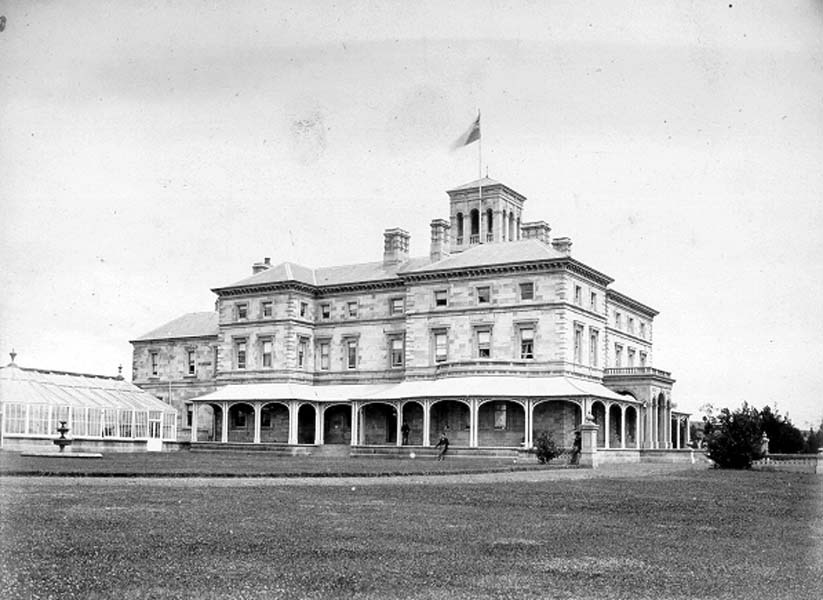
20-01-1868: Mona Vale Mansion, Ross, Tasmania, Australia.

Mona Vale mansion, at Ross in Tasmania, was built in 1867 for the wealthy land owner and Tasmanian Parliamentarian Robert Quayle Kermode and he entertained the Duke of Edinburgh there shortly after it was completed. The stained glass windows were created by the Ferguson & Urie stained glass company of North Melbourne and were selected by the architect of Mona Vale, Henry Hunter, during a visit to Victoria in 1867.

The Mercury, Hobart, Monday 20th January 1868, page 3.

“THE JOURNEY TO THE NORTH. (From our Special Reporter)

 MONA VALE – RESIDENCE OF THE HON. R. Q. KERMODE, ESQ., M.L.C.

 “In my last article I concluded my description of the trip of H.R.H. the Duke of Edinburgh to the northern side of the island, and landed him safely once again at the threshold of Government House. The narrative would, however, be very incomplete unless accompanied by some kind of description of the mansion at Mona Vale, where His Royal Highness stayed on his upward and downward journey, and where every provision was made for his comfort, which the real genuine hospitality of an English gentleman could devise, or Princely munificence accomplish. The mansion of Mona Vale is, I have no hesitation in saying, one of the most splendid and magnificently furnished residences in the whole of the Australian colonies, and it is replete with every comfort and conveniences that modern art has yet suggested.…”

 “… Retreating to the main corridor we arrive at its junction with the main hall, and here for the first time I observed the beautiful windows of stained glass, which surround the front door. The fanlight is especially worth mention, having in the centre Mr. Kermode’s crest, an arm and dagger surrounded by a handsome design. The side lights have a stained glass bordering, with centre pieces in frosted glass of floral design. Arrived at the foot of the grand staircase, I observed that the whole of the windows by which it is lighted were also of stained glass, showing groups of flowers most tastefully arranged. The whole of these windows are in the style known as enamel painting, and were executed by Messrs. Ferguson and Urie, of Melbourne, some of them being selected for Mr. Kermode by Mr. Henry Hunter, during a late visit to Victoria…”.

Unfortunately, I don’t have any photos of the stained glass windows. Only copyright images exist in a handful of publications. The property is now owned by the Cameron family.

Robert Quayle Kermode was also a substantial benefactor and instrumental in the erection of St John’s Church in Ross which also has a complete cycle of Ferguson & Urie stained glass windows.

Related posts:

1869: St John’s Anglican Church, Ross, Tasmania.

External Links:

Biography – Robert Quayle Kermode (1812-1870)

Obituary – Robert Quayle Kermode (19 May 1870)

Article – ‘Fine Old Country Residence is Landmark in Northern Tasmania’

Obituary – Robert Crelin Kermode (1847-1927) [son of R. Q. Kermode]


Short link to this page: https://wp.me/p28nLD-a2

© Copyright