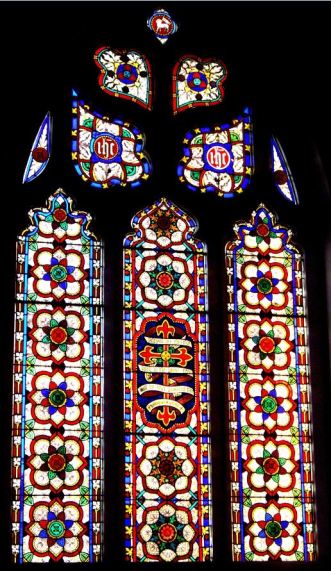
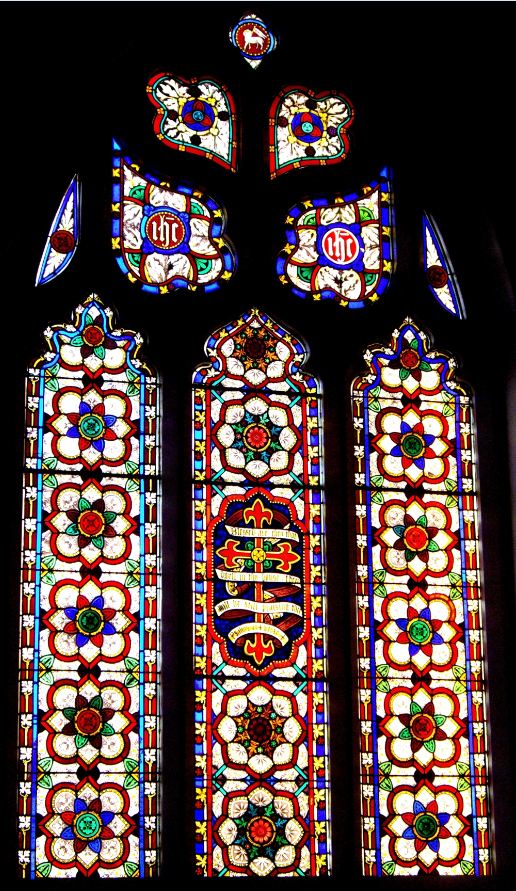
04-06-1862:St. Paul’s Anglican Church, Humfray St, Bakery Hill, Ballarat.

The Star, Ballarat, Vic, Wednesday 4th June 1862, page 1s.

“ST. PAUL’S CHURCH SOIREE”.

 “A soiree in aid of the enlargement fund of St. Paul’s was held on Tuesday evening, in the hall of the Mechanics’ Institute, when that large place was crowded in every part […].”

 “[…] The thanks of the Church were due also to Messrs Robson, and Ferguson and Urie, for their gifts of the beautiful triplet window, and tracery. (cheers.)”

St Pauls Bakery Hill Ballarat

The Ferguson & Urie chancel window at St. Paul’s Anglican Church, Humfray Street Ballarat. Photo: Ray Brown 17 Mar 2011.

Related posts: 29-03-1862 > 14-04-1862 > 19-05-1862 > 04-06-1862 > 24-06-1862 > 15-07-1862 > 01-03-1863 > 07-08-1863

19-05-1862: St. Paul’s Anglican Church, Humfray St, Bakery Hill, Ballarat.

The Star, Ballarat, Monday 19th May 1862, page 2.

“At a meeting of St. Paul’s Church Committee held on Friday evening a vote of thanks was unanimously accorded to Messrs Seeley and Bradbury, the contractors for the enlargement of the building, for the very satisfactory manner in which they have executed the work; also, to Mr Thomas Robson, of Sturt street, for his handsome gift of the centre part of the chancel window, and to Messrs Ferguson and Urie, of Melbourne, for presenting the church with the beautiful portions inserted in the tracery of the window. We understand that the decorations of the chancel have not yet been completed.”

St Pauls Bakery Hill Ballarat

The Ferguson & Urie chancel window at St. Paul’s Anglican Church, Humfray Street Ballarat. Photo: Ray Brown 17 Mar 2011.

Related posts: 29-03-1862 > 14-04-1862 > 19-05-1862 > 04-06-1862 > 24-06-1862 > 15-07-1862 > 01-03-1863 > 07-08-1863

14-04-1862: St Paul’s Church, Humfray St, Bakery Hill, Ballarat, Victoria.

The Star, Ballarat, Monday 14th April 1862, page 2.

“… The window consists of three lights, with top tracery, all produced in the colony, save the clear light portions. The two side lights were presented by the committee of the church, and the centre one by Mr Robson, of Sturt-street, agent for Messrs Ferguson & Urie, glass stainers, of Melbourne, which later firm gave the tracery at the top…”


St Pauls Bakery Hill Ballarat

The Ferguson & Urie chancel window at St. Paul’s Anglican Church, Humfray Street Ballarat. Photo: Ray Brown 17 Mar 2011.


Related posts: 29-03-1862 > 14-04-1862 > 19-05-1862 > 04-06-1862 > 24-06-1862 > 15-07-1862 > 01-03-1863 > 07-08-1863


Short link to this page: https://wp.me/p28nLD-2M

© Copyright

08-04-1862: St Paul’s, Bakery Hill, Ballarat, Victoria.

In early April 1862, two stained glass windows were on display at the Ferguson & Urie workshops in Curzon Street North Melbourne.

The Argus, Melbourne, Tuesday 8th April 1862, page 4.

“Yesterday our attention was directed to two stained-glass windows, at the establishment of Messrs. Ferguson and Urie, Curzon-street, North Melbourne. They are both what are called ‘single light’ windows, and are adapted for ecclesiastical edifices. The design of one is in the early English style of architecture, and that of the other is the decorated style. The centre of the former window is occupied by a figure of the Saviour, seated upon a throne, underneath a canopy, and holding in one hand the symbols of Majesty. Above the canopy is the paschal lamb, and at the bottom of the window is the scriptural text, “He shall judge the world in righteousness”. The Principal feature of the second window are a cross and crown, with the inscription, “Blessed are the dead”. Both designs are exceedingly chaste, and the colours rich and harmonious. As specimens of painted glass, the windows are alike creditable to Messrs. Ferguson and Urie, by whom they were made, and to Mr. Lyons[sic], by whom they were designed. A beautiful triple light window, executed by the same gentlemen, has recently been placed in St. Paul’s Church, Ballarat. The two already referred to, remain on view at Messrs. Ferguson and Urie’s, and are well worthy of inspection, both for their intrinsic merits and as specimens of a new branch of the Victorian industry”.

The location or existence of the two windows described are not known.
The triple light ‘decorated’ window for St. Paul’s Church at Ballarat is extant.

St Pauls Bakery Hill Ballarat

The Ferguson & Urie chancel window at St. Paul’s Anglican Church, Humfray Street Ballarat. Photo: Ray Brown 17 Mar 2011.

St Pauls Bakery Hill Ballarat

The Ferguson & Urie chancel window at St. Paul’s Anglican Church, Humfray Street Ballarat. Photo: Ray Brown 17 Mar 2011.

St. Paul's, Bakery Hill, Ballarat, Victoria

St. Paul’s Anglican Church, Humfray Street Ballarat. Photo: Ray Brown 17 Mar 2011

29-03-1862: St. Paul’s Church, Humfray St, Bakery Hill, Ballarat.

The Star, Ballarat, Saturday 29th March 1862, page 2.

“The congregation attending St. Paul’s Church will re-assemble on Sunday next in their own church …”

 “…The stained glass window now being placed in the chancel by Mr Robson will be a very handsome addition to the church, and has been executed in first rate style …”

Thomas Robson was the designated Ballarat agent for Ferguson & Urie. See: https://wp.me/p28nLD-1hK

Photo taken 17th March 2011.

St Pauls Bakery Hill Ballarat

The Ferguson & Urie chancel window at St. Paul’s Anglican Church, Humfray Street, Bakery Hill, Ballarat. Photo: Ray Brown 17 Mar 2011.

Related posts: 29-03-1862 > 14-04-1862 > 19-05-1862 > 04-06-1862 > 24-06-1862 > 15-07-1862 > 01-03-1863 > 07-08-1863


Short link to this page: https://wp.me/p28nLD-2z

© Copyright

26-03-1862: A NEW BRANCH OF THE ART. John Lamb Lyon joins Ferguson & Urie.

The Mercury, Hobart, Wednesday 26th March 1862, page 3.

“A NEW BRANCH OF THE ART.- As we are always ready to notice the development of colonial industry, we have much pleasure in calling attention to a new branch of art which has been commenced in Melbourne, vis., that of glass staining. Messrs Ferguson and Urie, of Curzon-street, North Melbourne, have the credit of initiating it, and we had the opportunity yesterday of seeing on the premises some beautiful specimens of the art. The expence[sic] of importing stained glass windows, which is augmented by the risk of breakage, may account for the absence, generally speaking, of this kind of decoration in our churches, but this difficulty is obviated by the fact that Messrs. Ferguson and Co, have engaged the services of a competent artist in this difficult and useful art. Mr Lyon, to whom we refer, has not long been in the colony, and has had a lengthened experience in his profession at home and judging from the specimens of his talent now to be seen at Messrs. Ferguson and Urie’s, we should suppose that those who require this description of decoration will find no difficulty in future in carrying out their designs. – Herald.”.

Lyon had  joined Ferguson & Urie in late 1861 or very early 1862 after spending some time in the gold fields near Maldon in central Victoria. By 1866 he was advertised as a partner and the company name began appearing as “Ferguson, Urie, and Lyon”. In 1873 Lyon left the partnership and headed for Sydney where he entered into partnership with Daniel Cottier as “Lyon & Cottier”, Sydney.

Related Posts:

1916: John Lamb Lyon, Stained Glass Artist, (1835-1916)


Short link to this page: http://wp.me/a28nLD-zE

© Copyright


01-03-1862: St Paul’s Church, Bakery Hill, Ballarat.

The Star, Ballarat, Vic, Saturday 1st March 1862, page 2.

“We are informed that a very handsome stained glass window is about to be placed in the chancel of St. Paul’s Church. The centre light is the gift of Mr Thos. Robson, of Sturt street; the side ones have been provided for by private contributions, and those enclosed by the tracery have been presented to the church by the Melbourne Stained Glass Company. When completed the window will have a very rich and elegant appearance. We understand that Mr St. Quentin, of Dawson street, has undertaken to execute the decorations of the chancel, and other parts of the building. Divine service, as will be seen by an advertisement in another portion of the paper, is held at present, and will be held until further notice, in the new Town Hall, Barkly street”.

The Melbourne Stained Glass company mentioned was ‘Ferguson & Urie’ and Thomas Robson was the Ballarat agent for the company.

St Pauls Bakery Hill Ballarat

Detail: ‘Blessed are they that dwell in the house they will be still praising thee. Psalms 84 Verse 4’.

St Pauls Bakery Hill Ballarat

Chancel window at St. Paul’s Anglican Church, Humfray Street Ballarat.

Related posts: 29-03-1862 > 14-04-1862 > 19-05-1862 > 04-06-1862 > 24-06-1862 > 15-07-1862 > 01-03-1863 > 07-08-1863


Short link to this page: http://wp.me/p28nLD-28

© Copyright

07-12-1861: The 1861 Melbourne Industrial Exhibition.

The 1861 Melbourne Industrial Exhibition is recognised as the event that changed the course of the Ferguson & Urie Company history. This exhibition is where the Scottish Stained Glass Artist, John Lamb Lyon would have undoubtedly been convinced to join the firm in late 1861.

Ferguson & Urie received an honorable mention for ornamental glazing, and John Lamb Lyon, for a design for stained glass. Lyon joined the firm a short time after this exhibition and between 1866-1873 was installed as a partner in the firm.

The 1861 Exhibition was almost exclusively Victorian. The poorly constructed exhibition building was erected in William Street and was prone to leaking. The glass roof, supposedy copied from the London’s Crystal Palace, was painted white during 1857–58. The Exhibition Building was the main concert venue for the Melbourne Philharmonic Society from 1854 to 1866 and also served as an interim lecture theatre for the university (1855) and as the venue for Temperance League rallies in 1857. The last function to be held there was Governor Darling’s Vice-Regal Ball of 1864 and it was demolished in the late 1860s, and the existing Mint building erected on the site during 1871–72. [1]

The Argus, Melbourne, Saturday 7th December 1861, page 7.

“THE EXHIBITION. LIST OF AWARDS”.

“The following completes the list of awards in connexion with the Industrial Exhibition …”.

“HONOURABLE MENTION …”

“Fergusson [sic] and Urie – Ornamental glazing”

“Lyon, J.N [sic] – Design for stained glass …”

Exhibition building 1861 latrobe-56-009a

Melbourne’s first exhibition building photographed during the
1861 Melbourne Exhibition (Source SLV I.TAF 451)

The 1872 Mint Building which now stands on the site of the first Exhibition Building

The Mint Building built in 1872 in William Street, which now stands on the site of the first Exhibition Building

Foot notes:

[1] The Latrobe Journal, No 56, Spring 1995.

22-11-1861: St Margaret’s Eltham, Church Archives

St Margaret’s Eltham, Church Archives, 22nd November 1861.

St Margaret’s Church at Eltham has a letter in their archives from the Ferguson and Urie stained glass company dated the 22 November 1861, addressed to the Church Committee on the progress of the window. It mentions specifically the production of imitation ancient glass for the small end window as being the first in the colony. The window was reported to have cost £1 (one pound). This is the oldest extant stained glass window by the firm and whilst there were reports that this may have been done by James Urie and James Ferguson, this is highly unlikely. The artist John Lamb Lyon (1835-1916) joined the firm officially in late 1861 as a result of his encounter with Ferguson & Urie at the . This is definitely his work and would be amongst the earliest windows made at the Ferguson & Urie workshops in Curzon Street North Melbourne.  The Artist David Relph Drape (1821-1882) officially joined the firm on the 8th November 1863.

Advertiser, Hurstbridge, Friday 22 July 1932, page 2.

‘Early History of the Church of St. Margaret’.

St Margaret’s Church Eltham awarded contracts for building the church and Ferguson & Urie were awarded the contract for windows and varnishing seats at £41.

( The reference to varnishing seats I believe to be incorrect).

ABOUT ST MARGARET’S:

The foundation stone for St Margaret’s was laid on the 4th of April 1861 and was built by George Stebbings to the designs of architect Nathaniel Billing. The Church was opened and dedicated on the 12 December 1861 and consecrated by the Rt.Rev. Bishop Thornton of Ballarat on the 16th of May 1876.

In 2000, St Margaret’s received a grant of $12,000 from Heritage Victoria  to restore all the windows in the church and during the renovations, a Dossal erected behind the altar in 1935, was removed to reveal the historic Ferguson & Urie stained glass window which no one had seen for over 65 years.

As at 2012, the Ferguson & Urie window at St Mararet’s, Eltham, is the earliest known extant stained glass window by the company.

Photos taken 2nd January 2011.

This slideshow requires JavaScript.

St Margaret’s Eltham [summary 20110117]


Short link to this page: http://wp.me/p28nLD-21

© Copyright

22-09-1860: Taranaki Relief Fund

When the Native Insurrection occurred in New Plymouth, New Zealand, the inhabitants of Melbourne subscribed liberally to Taranaki Relief Fund for the benefit of the suffering settlers.The sum collected, amounting to nearly £3,000, was placed in the hands of the committee formed of the most influental citizens of Melbourne. Amongst the extensive list of prominent North Melbourne identities was included “Ferguson,Urie” as well as other names closely associated with the firm Ferguson & Urie.

The Argus, Melbourne, Saturday 22nd September 1860, page 5.

“TARANAKI RELIEF FUND.”

 “A meeting of the inhabitants of Hotham was held last evening, at the Iron Store, Errol-street, for the purpose of organising a committee to collect subscriptions in aid of the sufferers through the rebellion of the natives of New Zealand […]”

 “[…] Councillor King moved the first resolution, as follows:-

‘That, in the opinion of this meeting, the privations now being endured by the volunteers, militia, and their families, and the destitution of other colonists in New Plymouth, caused by the rebellion of the Maoris in that province, loudly call for prompt sympathy and aid from the inhabitants of Hotham […]”

 “Councillor Cook moved the next resolution, as follows:-

‘That a committee be appointed for the purpose of collecting from the inhabitants of the district, contributions, either of money or suitable goods, in aid of the sufferers by the rebellion in New Plymouth; such committee to consists of […]”
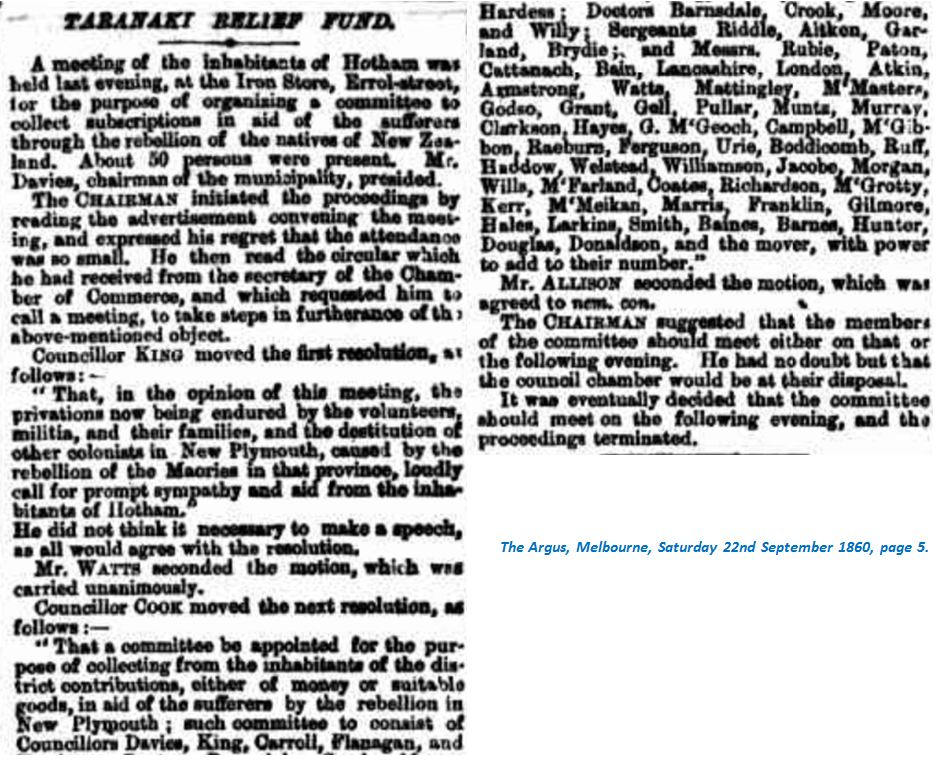
The Argus, Melbourne, Saturday 22nd September 1860, page 5.