07-01-1907: William Urie (1864-1907)


William Urie was born in North Melbourne on the 19th October 1864. He joined his fathers stained glass firm ‘Ferguson & Urie’ as a boy and in late 1885, aged 21, he accompanied his uncle Alexander Young (1833-1889), who was also a member of the firm, to Brisbane. Queensland, to assist with the installation of the firms largest stained glass window in St Stephen’s Cathedral.

In 1888 William accompanied another uncle, John Yeaman, on a nine month trip back to the ‘old country’ (Scotland) as mentioned at the company dinner in 1888;

“…The event of the evening then took place in the shape of the presentation of a very handsome dressing case containing all the requisites for a gentleman’s toilet to Mr. W. Urie. Mr. Loughrey in handing this present to Mr. Urie said that he was proud to have the honour of making the presentation and proposing the health of the recipient. Mr. Urie was going to the home of his fathers, and he was sure they all wished him a pleasant trip. From his quiet and unassuming manner he had won the hearty good wishes of all with whom he came in contact, and it had been decided that he should not be allowed to leave Australia without some souvenir.

Mr. Loughrey then handed Mr. Urie the dressing case, and the latter gentleman’s health was enthusiastically drank with musical honours. Mr. Urie said he must thank them very much for their kindness, and he would certainly not fail to use the valuable present tendered to him, especially the razors (laughter). He was going to a land that was unknown to him and he would endeavour to keep his eyes open and learn as much as possible of the old country. He hoped to be back among them again soon, and thanked them heartily for their kindness…”

On the 8th of May 1891 William married Rose Emma Smith at the Holy Trinity church in Kensington (Flemington) and they had four children.

William Urie died in 1907 aged 42.

This slideshow requires JavaScript.


The Argus, Melbourne, Vic, Saturday May 9th 1891, page 1.

URIE-SMITH.- On the 8th ult., at Holy Trinity Church, Kensington, William Urie (son of the late James Urie, of Ferguson and Urie) to Rose Emma Smith (daughter of Ralph Smith, of Fletcher and Smith), both of Flemington.

The Argus, Melbourne, Vic, Monday 7th January 1907, page 1.

URIE – On the 5th January, at Finsbury-street, Flemington, William, dearly beloved husband of Rosa Urie, and beloved father of James, Muriel, Grace, and Ralph, also eldest son of the late James and Grace Urie, Flemington.

Related posts:

07-12-1885: St. Stephens Roman Catholic Church, Brisbane, Queensland.

© Copyright

12-04-1875: Holy Trinity Anglican Church, Port Chalmers, New Zealand.

The foundation stone of Holy Trinity Anglican Church, at Port Chalmers, New Zealand, was laid on Wednesday the 7th of June 1871 [1] by Bishop Samuel Tarratt Nevill (1837-1921) [2] and was constructed of volcanic Breccia stone to the designs of architect Robert Arthur Lawson (1833-1902) [3].

The donor of the historic Ferguson & Urie stained glass window was John Elmer (1823-1874). Elmer was born in Barking, Essex, England, and was a Master Mariner by profession. He arrived aboard the ‘Thetis’ on the 1st of August 1854 with his wife Rosetta nee-Lovell, a son, and two daughters [4]. He became a landowner in Port Chalmers, Deborah, and Sawyers’ Bay areas and later became a councillor in Port Chalmers [5].

In early 1874 John Elmer commissioned a single light stained glass window depicting the crucifixion, from the North Melbourne stained glass firm Ferguson & Urie. Unfortunately he died at his residence ‘Wickliff Terrace’ at Port Chalmers on the 18th June 1874, aged 55 [6], before the window was to be erected. 

On the 12th April 1875, the New Zealand press reported that the window had been installed and that it was believed to be the first stained glass window erected anywhere in the Anglican Diocese of Dunedin [7].

Photos were taken 2nd April 2013 by Cindy Ballantyne on commission. Historical photos with permission Bill & Evelyn Lloyd & the Hocken Library, University of Otago, NZ.

This slideshow requires JavaScript.

Otago Daily Times, Issue 4102, 12 April 1875, Page 4

“A very beautifully-executed stained glass window has been placed in the Holy Trinity Church, Port Chalmers, and is, we believe the first introduced into any church of the diocese. It was presented to the church by the late Mr Elmer, of Port Chalmers, and was prepared in Melbourne. It is a choice work of art, and is illuminated with a central figure of the Crucifixion, surmounted by the Agnus Dei, with a lower staining of a pelican feeding its young, according to the once vulgarly-received idea, and which has been introduced as typical of Christ’s sacrifice. The illumination forms the central division of the chancel window, and adds greatly to the general effect of the interior of the church.” [8]

The window was erected in the centre of the three light chancel window of Holy Trinity. In March 2013 Mr Bill Lloyd from Port Chalmers provided the following detail from research conducted by his wife Evelyn for the book “Safe Harbour” [9], which was produced to mark the 120th Anniversary of Holy Trinity in 1994:

“Mr John Elmer, had donated a beautiful stained glass window to be placed in the east end of the church but he died in 1874 before this could be carried out. At a vestry meeting on 26th August a motion was passed “that, this vestry sanction the placing of the memorial window in the memory of the late Mr John Elmer as proposed by his executrix (possibly his wife) the said window to occupy the centre light of the three light window in the east end of the church” [10].

“…In 1946, two new pieces of stained glass were placed on either side of the Elmer Window and did not match. A benefactor gave a new matching centre light and the John Elmer window was transferred to the north side window of the chancel, I believe the pelican roundel was removed at this time. Literally nobody knew the window was there[11]. Evelyn the organist became aware of it one Easter morning when the sun shone through the window and cast coloured lights onto the organ as she played. About 2000, the Elmer window was releaded and moved to the north side of the nave at the same time as protective glass was placed over all of the stained glass in the church…”

 “…It would appear that there was no record of its origin, because, at a vestry meeting on 25th September, 1946 “Mr Brown stated that he felt sure that it was a memorial window.”  The lower part of the window (the pelican) was removed and replaced by the dedication “Given by Mr John Elmer, in memory of his mother 1870…” [12].

It’s not known what became of the original lower stained glass piece that depicted the Pelican feeding its young.

John Elmer’s wife, Rosetta, died aged 67 on the 10th August 1887.

Holy Trinity was eventually consecrated on the 6th October 1907 by Bishop Samuel Tarratt Nevill (1837-1921), who also laid the foundation stone of the church 36 years earlier in 1871[13].

Otago Daily Times , Issue 2913, 8 June 1871, Page 5

“PORT CHALMERS.

LAYING THE FOUNDATION STONE OF THE CHURCH OF ENGLAND”.

“The above ceremony took place at Port Chalmers yesterday, at 2 o’clock in the afternoon…”

The Bishop accepted the crown grant of the land and placed a bottle in the cavity of the foundation stone containing a manuscript with the following words:

“…The foundation stone of Holy Trinity Church, Port Chalmers, was solemnly laid on this 7th day of June, in the year of our Lord, 1871, by the Right Reverend Samuel Tarratt Neville, M.A., Lord Bishop of the Diocese of Dunedin…”

Otago Daily Times , Issue 3850, 19 June 1874, Page 2

“DEATHS…”

“On the 18th June, suddenly, at his residence, Wickliff Terrace, Port Chalmers, John Elmer, Esq., aged 55 years.”

Otago Daily Times , Issue 7946, 10 August 1887, Page 2

“ELMER.- On the 13th July, suddenly, at her residence, Wickliffe terrace, Port Chalmers, Mrs Rosetta Elmer, youngest daughter of the late George Lovell, Esq., late of the city of London, widow of the late John Elmer, Esq., and mother of John Elmer, J.P., of this colony; in her 67th year of her age. London papers please copy.”

Otago Witness , Issue 2300, 31 March 1898, Page 11

“Biographical Notes of Settlers of the First Decade…”

“Elmer, John, born Barking, Essex, 1823; was by profession master mariner; arrived by Thetis in 1854; became landowner in Port Chalmers, Deborah, and Sawyers’ Bays. Was councillor Port Chalmers Council. Mr Elmer died June 18, 1874. Elmer, John (son), well known at Port Chalmers (where he was in business for number of years), Waitati, and Dunedin. Mr Elmer died March 3, 1895”.

Otago Daily Times, Issue 14027, 7 October 1907, page 7.

“CONSECRATION SERVICE AT PORT CHALMERS”.

“The consecration of Holy Trinity Church, Port Chalmers, attracted a very large congregation yesterday, the church being crowded. The foundation of he church was laid in 1871 with masonic honours, and the service held yesterday was largely attended by Freemasons in full regalia. The church building having been cleared of debt, was duly consecrated by the primate, Bishop Neville…”

Footnotes:

[1] Otago Daily Times, NZ, Issue 2913, 8 June 1871, Page 5

[9] “Safe Harbour”; Evelyn E. Lloyd, Holy Trinity Church (Dunedin, N. Z.), 1994.

[10] “Safe Harbour”; Evelyn E. Lloyd, Holy Trinity Church (Dunedin, N. Z.), 1994.

[11] In reference to the lower ‘Pelican’ at the base of the window which had been hidden by the Reredos for many years.

[12] Email correspondence, Bill Lloyd & Ray Brown, 20 March 2013.

[13] Otago Daily Times, Issue 14027, 7 October 1907, page 7.

Thanks to:

  • Janice Ball for the follow up action in New Zealand.
  • Bill & Evelyn Lloyd, Holy Trinity Port Chalmers, for the correspondence, information, and permission to include the c.1900 interior photo from Evelyn’s 1994 book “Safe Harbour”, and for obtaining the additional photos with permission of the Hocken Library, University of Otago, (permission grant date 8 May 2013). The images included have the required citation.

Short link to this page: https://wp.me/p28nLD-1Ou

© Copyright

1889: Alexander Lumsden Young (1833-1889)

Alexander Lumsden Young (1833-1889) played a significant role in the Ferguson & Urie stained glass company.

He was born in Scotland circa 1833-34 to Benjamin Young and Isabella Cumming. He married Elizabeth Belle Gray on the 27th December 1864 in Melbourne at the age of 30, at which time his profession was cited as being a plumber.

His early business interests were with Urie, Young & Co producing by-products from maize such as ‘maizena starch’, which won awards at the 1866-67 Intercolonial Exhibition. 

Sometime in the 1860s or 70s joined his brother in law, James Urie, and became a member of the stained glass firm Ferguson & Urie. His sister Grace Hardy Young had married James Urie in Nth Melbourne in 1855 . In late 1885 he traveled to Brisbane with his nephew, William Urie (son of James Urie, principal of Ferguson & Urie), to supervise the installation of the companies largest stained glass window known to have been created by the firm  (35 feet in height) which was erected at the west end of St Stephen’s Catholic Cathedral in Brisbane.

At the 1886, 87, and 88 Ferguson & Urie company dinners he played the part of Vice-Chairman for the formalities on each occasion.

His portrait appears amongst the 31 photographs in the collage created for the occasion of the Ferguson & Urie company dinner held on the evening of the 22nd of June 1887 at the North Melbourne Mechanics Institute.

Alexander Lumsden Young died at his residence, “Dean-Bank” 21 Abbotsford St, North Melbourne, on the 1st August 1889 aged 56. His probate (intestate) was not applied for until more than seven years later, by his wife Elizabeth, who cited her eldest son, George Watson Young, as the reason and that the entire matter was left in his hands, which he had neglected. Elizabeth died 36 years later in 1925.

Alexander Lunsden Young [1887 Company Dinner]

Alexander Lumsden Young on the occasion of the Ferguson & Urie Company Dinner held on 22 June 1887.

The Argus, Melbourne, Vic, Friday 30th December 1864, page 4.

“YOUNG-GRAY.- On the 27th inst, at the Manse of the Presbyterian Church of Scotland, Collins-street, by the Rev. Irving Hetherington. Alexander Lumsden Young, plumber, Melbourne, to Elizabeth Bell Gray, late of Stockbridge, Edinburgh”.

The Argus, Melbourne, Vic, Friday 2nd August 1889, page 1.

“YOUNG.- On the 1st inst., at Deanbank, Abbotsford-street, North Melbourne. Alexander, the beloved husband of Elizabeth Young, aged 56 years. Home papers please copy”.

The Argus, Melbourne, Vic, Saturday 3rd August 1889. page 1.

“THE Friends of the late Mr. ALEXANDER L, YOUNG are respectfully invited  to follow his remains to the place of interment in the Melbourne General Cemetery. The funeral will leave his late residence, “Dean-Bank”, Abbotsford-street, North Melbourne, THIS DAY (Saturday, 3rd inst), at 3 o’clock. ALFRED ALLISON, undertaker, 221 Victoria-street, West Melbourne; Mount Alexander road, Moonee Ponds; and Racecourse-road, Newmarket, Telephone 980″.

The Argus, Melbourne, Vic, Monday 9th March 1925, page 1.

“YOUNG.- On the 6th March (passed peacefully away), at her late residence, Dean Bank, Beaconsfield parade, Croxton, Elizabeth Belle, widow of the late Alexander Young, much loved mother of Isabelle (Mrs. Arthur H. Padley, Bacchus Marsh, Vic). In God’s Care”.


Short link to this page: https://wp.me/p28nLD-1NI
 

22-08-1896: James ‘Jim’ Urie (1870-1896)

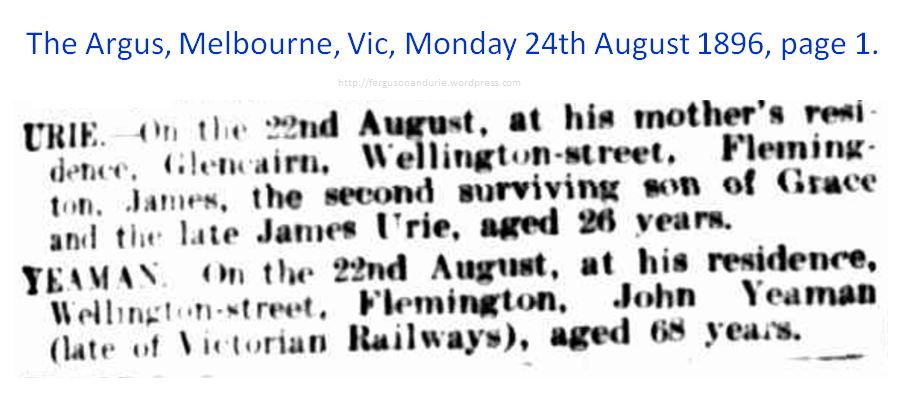
James ‘Jim’ Urie Junior, son of the late James Urie (1828-1890) of the stained glass firm, Ferguson & Urie, died of Tuberculosis on the 22nd August 1896.

North Melbourne Courier and West Melbourne Advertiser, Vic, Friday 28th August 1896, page 2.

“DEATH OF MR. JAMES URIE.- The above gentleman died on the 22nd, at his mother’s residence, “Glencairn,” Wellington-street, Kensington, of consumption, after an illness of about twelve months’ duration. The funeral took place on Monday, and was largely attended. The Rev. Mr. Taylor, Presbyterian Minister, of Flemington, officiated; and the bearers of the coffin were the deceased’s fellow employes – Messrs. J. Scott, C. Hardess, F. L. [sic] Lording, J. Murdoch, J. Auld, and E. R. King; the pall-bearers being J. Ferguson, A. Young, P. Gunter, D. McPhail, A. Nathan, and J. M. Gilligan. Mr Urie was only 26 years of age at the time of his death; and was generally liked owing to his kind and urbane disposition. Amongst the many floral tributes was a beautiful one sent by the employes of the firm of Ferguson and Urie. By a strange coincidence Mr. Urie’s uncle, Mr. J. Yeaman, died the same day, at his residence, which adjoined that of his nephew, and was also buried on Monday. Mr. Yeaman was 68 years of age. Great sympathy is felt on all hands for Mrs. Urie and the other members of the bereaved family. Mr. Alfred Allison, of Victoria-street, West Melbourne, carried out the funeral arrangements”.

James ‘Jim’ Urie 1870-1896 -A

James ‘Jim’ Urie 1828-1896 -B

James ‘Jim’ Urie and his uncle John Yeaman both died of  Tuberculosis, coincidentally, on the same day. They both lived in close proximity to each other and it was a highly infectious disease. The coincidence is that they both happened to die on the same day. His uncle mentioned as ‘John Yeaman’ also accompanied William Urie (Jim’s elder brother) to England in March 1888 as described at The 1888 Ferguson and Urie Company Dinner.

Other names mentioned at the funeral:

F. L. Lording –  One of the pall bearers mentioned was Frank Clifford Lording (1860-1944), not ”F. L. Lording” as described in the article.

J. Scott – John Scott (1850-1915)

C. Hardess – Charles William Hardess (1859-1949)

J. Auld – James Auld (1873-1945). Grandson of James Ferguson Snr (1818-1894).
James Auld left Australia for New Zealand c.1898 and later formed the partnership of “Auld & Gleeson” glaziers in Wellington. Prior to this article, it was only a theory that he gained his skills in the glass trade with his grandfather James Ferguson at ‘Ferguson & Urie’.

J. Ferguson – James Ferguson jnr (1860-1945) son of James Ferguson Snr (1818-1894).

A. Young – Alexander Lumsden Young (1833-1889)?

P. Gunter – Unknown

D. McPhail – Possibly Donald McPhail 1856-1926, son in law of James Urie Snr (1828-1890). Mcphail is not (yet) known to have been an employee.

A. Nathan – Alfred Lewis Nathan (1867-1939), son in law of James Urie Snr (1828-1890). Nathan is not (yet) known to have been an employee.

J. M. Gilligan – No detail known (photo appears as an employee in the 1887 Ferguson & Urie Company dinner poster).

References / Links:

The 1887 Ferguson & Urie Company Dinner

© Copyright

1872: Christ Church Anglican, Birregurra, Victoria.

The Ferguson & Urie stained glass window in the chancel of Christ Church, Birregurra, was erected to the memory of the colonial pioneer John Davenport Bromfield who died on the 20th of May 1870 aged 52.[1]

Photos taken 28th December 2010.

This slideshow requires JavaScript.

Geelong Advertiser, Vic, Friday 3rd January 1873, page 2.

“The village of Birregurra is prettily situated, on rising ground, on the banks of the river Barwon, at the termination of Ripple Vale, and can boast of a commodious two story parsonage built of brick, and a handsome stone church which has been erected at a cost amounting to some 2,500. The church was further embellished on Christmas Eve by the addition of a handsome memorial window of stained glass. In the centre compartment is the representation of our Saviour ascending on the clouds of glory. On the right hand is the figure of St. John, and on the left that of St. Peter. In the centre trefoil is the triangle an dove, emblematicical of the Trinity; on one side is the Pelican and on the other the Agnus Dei. The colors are rich and the general appearance is pleasing. At the bottom, in old English letters, is the following inscription:- “To the Glory of God.” “To the memory of John Davenport Bromfield, died 20th May, 1870; erected by his widow.” The chancel is laid with encaustic tiles in a handsome pattern.”

The historic township of Birregurra lies approximately 135km west of Melbourne. In 1837 the Englishman John Davenport Bromfield arrived in the colony and took up land west of Geelong.

“…It may be interesting to note that Mr. Bromfield pitched his first camp in the district in 1837, on the present site of the Anglican Church, Birregurra, which church he had the distinguished honor of laying the foundation stone thereof (April 6th, 1870), thirty years prior to which event he had conducted shearing operations within a few yards of said building…”[2]

In August 1838 Bromfield was granted a licence to “depasture” stock in the South-western Geelong region[3] in the area originally known as “Bowden’s Point” and later as known as “Birregurra on the Barwon”. In 1839 the Wesleyan Missionary Society established the Aboriginal “Buntingdale Mission” in the area which caused much resentment between warring tribes. Bromfield’s station was within a short distance of the mission and he made a detailed account of one of the savage conflicts between the Barabool Hill and Mount Rouse tribes, the deadly results of which he described in June 1942 as; “such a disgusting scene can scarcely be imagined”[4]

Geelong Advertiser, Vic, Monday 13th June 1842, page 2.

“A FIGHT BETWEEN THE BLACKS.
TO THE EDITOR OF THE GEELONG ADVERTISER.
Ion Court, Geelong, June 4, 1842.

SIR.- I have to state to you the particulars of an affray which took place last Tuesday night, the 31st instant, the particulars of which are as follow:- “On the evening above-mentioned, two parties of aborigines encountered each other within a mile and  half of my station, part of the Barrabool Hill natives and part of the Mount Rouse tribe, which immediately gave battle, but were defeated with the loss of three men and two unfortunate young females. On the Wednesday morning the few natives immediately belonging to my neighbourhood arrived bearing this intelligence, evidently in a great state of excitement, and dreadfully afraid to return to their encampment without the protection of myself and servants, who were to be well armed. Directly after breakfast, I started, accompanied by the natives to within a short distance of their huts, where they all remained, and I proceeded forward myself, and on reaching the spot found their report to be perfectly correct. Such a disgusting scene can scarcely be imagined, the whole encampment deluged with blood, first lay the body of a middle aged man named Codjajah, speared through the breast in many places, his bowels taken off them, and a few pieces cut out of his thigh. The next was that of a woman speared in many places, quite dead. A short distance from her stood a young lubra with two spears through the belly, the whole of her intestines hanging to the ground – she was perfectly sensible – it would have been a charity to have shot her then, but she departed this life in the evening. Besides these three, within a short distance of the huts lay the bodies of two more men, known by the names of Jim and Big-one Tom, they were partly eaten, the fat being taken by their Christian brethren. These are the civilised aborigines who have been well instructed by our assistant protectors, and certainly have profited no little by the time and expense that have been lavished upon them. Such are the particulars of this affair, by the insertion of which, you will much oblige,

Your’s &c.,
JOHN DAVENPORT BROMFIELD”.

Although the Wesleyan Missionaries held the belief that their concept for aboriginal protectionism was a success, white man’s diseases became more devastating than the effects of their own tribal conflicts and the Buntingdale Mission eventually failed. By late 1847 there were calls for the resignation[5] of the missionary Francis Tuckfield and by 1850 the site had been abandoned altogether.

John Davenport Bromfield remained in the Birregurra area and in 1860 he was appointed as a Territorial Magistrate for the Colac district[6] as well as a trustee of the Colac Cemetery[7]. In January 1864 he was appointed as a Returning Officer for the district of Polwarth & South Grenville[8], but resigned the position in January 1870[9].

In 1865 he built his (now Heritage listed) home “Elliminook” at Birregurra.

In 1867 he was appointed as one of the “trustees of the land set apart on the 12th of November, 1866, for Church of England purposes, at Birregurra[10]. In January 1869 he was appointed as a magistrate for the general session’s district of Geelong[11].

On the 6th of April 1870 John Davenport Bromfield laid the foundation stone of Christ Church at Birregurra[12], which would only a short time later contain his lasting memorial stained glass window created by the Ferguson & Urie stained glass company of Melbourne.

Illustrated Australian News for Home readers, Vic, Saturday 16th April 1870, page 84.

“CHRIST CHURCH BIRREGURRA

This pretty church will be built substantially of bluestone in the decorated style, the windows having freestone tracery and mullions. The foundation-stone will be laid in a few days. The church will consist of a nave forty-seven feet long by twenty-four broad. The chancel will be sixteen feet square. The tower will be fifteen feet square, and the height will be fifty-seven feet to the parapet. The size of the vestry is twelve feet by ten. The contract has been taken by Messrs. Trovana and Gubly, of Geelong, at £1998, without fittings. Mr. Terry, of Melbourne, is the architect”.

Less than a month and a half later, on the 20th May 1870, John Davenport Bromfield died from an aneurism aged 52[13].

The Argus, Melbourne, Vic, Wednesday 25th May 1870, page 4.

“BROMFIELD.- On the 20th inst., at Birregurra, near Colac, from aneurism of the aorta, after a lingering illness, John Davenport Bromfield, aged 52; arrived in the colony 1837; eldest son of the late John Davenport Bromfield, formerly of Pershore, Worcestershire, England.”

Christ Church was opened just over seven months later on the 5th of February 1871 at a total cost of £3000[14]. The first incumbent of the Church was the Rev. Thomas Sabine.

The Argus, Melbourne, Vic, Monday 27th February, 1871, page 7.

“One of the finest buildings in the Western District,” says the Geelong Advertiser, “has recently been erected at Birregurra; this is the new Church of England, which was completed about a fortnight ago. The church is constructed of bluestone, ornamented profusely with freestone from Pettavel. The sides of the windows and doors are lined with this material, which offers a beautiful contrast to the darker shades of the building. Situated to the west of the township, on a rise above the Barwon, it presents and imposing appearance. The interior is capacious, and well finished, and the total cost £3000. It was opened on the 5th instant, the services being conducted by the Bishop of Melbourne. There was a large assemblage, no less 1000 persons being computed to be present on the occasion.”

(The tower and spire of Christ Church were added in 1890 and the “Buntingdale” Aboriginal Mission bell is still located in the Church)

After John Davenport Bromfield’s death, his widow Eliza commissioned the Melbourne stained glass firm “Ferguson & Urie” to create the chancel window of Christ Church in his memory.

The three light window depicts the Ascension of Christ in the centre light with St Peter in the left light holding an open book in his left hand and the Key in his right. St John appears in the right light holding the poisoned chalice containing a serpent and a book in his right hand, his alter ego, the Eagle appears at his feet. The memorial inscription at the base of the windows reads:

“TO THE GLORY OF GOD

IN MEMORY OF JOHN DAVENPORT BROMFIELD DIED 2OTH MAY 1870

ERECTED BY HIS WIDOW”

Three years after Bromfield’s death, his widow Eliza married William Edmundson at St John’s Church in Colac, on the 8th of January 1873[15].

The Argus, Melbourne, Vic, Friday 10th January 1873. page 4.

“EDMUNDSON-BROMFIELD.- On the 8th inst., at St. John’s Church, Colac, by the Rev. Thos. Sabine, William Edmundson, of Birregurra, to Lizzie, relict of the late John Davenport Bromfield, of Colac.”

Interestingly, William Edmundson’s name appears in John Davenport Bromfield’s Probate documents as signatory to the documents. Undoubtedly Edmundson, who was wealthy and well known in his own right, was also well known to Bromfield!

The Colac Herald, Vic, Tuesday 3rd September 1889, page 2.

“A contract (writes the local correspondent of the Geelong Advertiser) has been let for the completion of the steeple of Christ Church at Birregurra, and the whole of the work will, it is expected, be carried out by the end of November. The steeple is being erected as a memorial to the late Mrs. J. F. Strachan. Mr. Laird, one of the partners of the contracting firm, visited the township a few days ago for the purpose of making preliminary arrangements in connection with the work. The architects are Messrs. Reid, Henderson and Co., of Melbourne. The building of a Sunday-school, to be erected by Mrs. Edmundson, of “Eliminook,” in memory of her late husband, will also shortly be commenced. On the completion of the school, Christ Church will well deserve the compliment paid to it by Bishop Moorhouse, when he designated it “the prettiest and most compact country Church of England in the colony.”

Camperdown Chronicle, Vic, Thursday 29th April 1920, page 4.

“BIRREGURRA.

“The past week has been an important and memorable one for the Anglicans of Birregurra. The foundation stone of the fine stone church, with its Norman tower and spire, was laid in April, 1870, and the parishioners have been celebrating the jubilee…”

“…The vicar who opened the church, Rev. Thos. Sabine, died thirty years ago, but the people are very thankful to have had every other of their pastors with them in their jubilee each occasion the service was conducted by the present vicar, Rev. G. D. Frewin.” 

The Argus, Melbourne, Vic, Wednesday 3rd June 1931, page 12.

“BIRREGURRA.- Christ Church of England celebrated its diamond jubilee on Sunday. The Bishop of Ballarat (Dr. Crick) was the preacher.”

Footnotes:

1875: St John the Baptist Church, Ouse, Tasmania.

The foundation stone of St John the Baptist church at Ouse, was laid in 1842 and opened for services in 1843. No newspaper records of the time have been found to corroborate these dates but a stained glass window, erected in the liturgical south wall of the nave in 1943 commemorates the centenary of the church. The text at the base of the window has the following inscription:

“To the glory of God and in commemoration of the centenary of this church of St. John the Baptist 1843 – 1943 Erected by the parishioners”

(The window was made by the Mathieson & Gibson stained glass company of Melbourne and depicts Jesus being Baptised by St John in the river Jordan)

The oldest and most historical stained glass window in the church is the three light liturgical east window behind the altar. The window was created by the Ferguson & Urie stained glass company of North Melbourne and was erected to the memory of Thomas Lloyd Gellibrand circa 1875.

Photos taken 7th October 2010.

This slideshow requires JavaScript.

Each of the three lancets in the window contains the unique Ferguson & Urie scrolling ribbon design with a piece of scripture from the the King James Bible.

Two ribbons either side of the apex of the centre light have the text “Ecce Agnus Dei ” (Behold the Lamb of God), also known as another title for Jesus. It appears in the Gospel of John 1:29, where John the Baptist sees Jesus and exclaims, “Behold the Lamb of God who takes away the sin of the world.”

The three pieces of scripture depicted in each of the three lights of the window are:

“BLESSED ARE THEY THAT MOURN FOR THEY SHALL BE COMFORTED”.
(Matthew 5-4)

“LIKE AS A FATHER PITIETH HIS CHILDREN SO THE LORD PITIETH THEM THAT FEAR HIM”.
(Psalms 103-13)

“DELIGHT THOU IN THE LORD AND HE SHALL GIVE THEE THY HEARTS DESIRE”.
(Psalms 37-4)

The Mercury, Hobart, TAS, Thursday 1st July 1943, page 5

“The centenary of the Church of St John the Baptist, Ouse, was celebrated by a service in the church on Sunday. Miss Bolland was organist. In the unavoidable absence of the rector (Rev L. L. Oldham) the service was taken by the Rev. J. W. Bethune, who preached the sermon and also spoke to the children. The preacher reminded all of their heritage and sacred associations with the church they loved, and urged them to be true to the faith of their fathers. The offerings for a special centenary commemoration exceeded £113. The following extract from “Church News” more than 50 years ago was written by the late Canon Adams, of Hagley, and authenticated by the late Mr. Bethune, of Dunrobin, the late Rev H. W. Adams, and others: “The Ouse Church was built entirely by the parishioners during the incumbency of Dr. Pogson. The land for the church and cemetery, on a gentle rise, in the midst of the township, was given by the late W. A. Bethune, Esq., of Dunrobin. The east window in St. John’s Church, Ouse, is in memory of T. L. Gellibrand, Esq., late of Lleintwardine, Ouse.”

Thomas Lloyd Gellibrand (1820-1874):

Thomas Lloyd Gellibrand, was the eldest son of Joseph Tice Gellibrand (1792-1836), the first Attorney-General of Tasmania (1825) and Isabella Kerby.
(Also see: 22-10-1864: All Saints Anglican Church, South Hobart, Tasmania, Australia).

Thomas was a grazier and landowner around Bothwell and Ouse in Tasmania and a parliamentarian. He married Isabella Brown, on the 1st of December 1860 at All Saints Anglican Church in South Hobart[1]. He was a member of the House of Assembly in 1856-61[2] and appointed as Captain in the ‘Third Rifles” Southern Tasmanian Volunteers in 1861[3]. He died at his house ‘Vaucluse’ in Macquarie street Hobart on the 9th November 1874 aged 53[4]. His funeral took place on the 12th:

“…The remains of the late Mr. T. L. Gellibrand were yesterday morning conveyed on board the steamer Enterprise, which vessel afterwards left for South Arm, where the family vault is situated. The relatives, and a large number of friends of the deceased proceeded by the steamer. Throughout the day the vessels in harbour lowered their flags to half mast, out of respect to the memory of the deceased gentleman.” [5]

His wife Isabella later married Dr. Edward Clayton Ling (1844-1882)[6] in Suffolk in December 1876. She died in Sussex, England, on the 11th March 1907 aged 67[7].

The Mercury, Hobart, TAS, Wednesday 11th November 1874, page 2.

“Thomas Lloyd Gellibrand, son of Joseph Tice Gellibrand, Attorney-General of Tasmania, in 1856,(sic:1825[8]) who was removed from office by Governor Arthur on charges made against him by persons who have been since convicted of swindling, robbery of the Government, and murder. Mr. Thomas Gellibrand was born in 1821 and educated at Thompsons Academy in Melville-street. In 1848 Sir H. Dennison placed the young colonist who had commenced farming on his own account in the Hamilton district, in the Commission of the Peace, and here on the banks of the Dee, Mr. Gellibrand formed an extensive sheep farm. In Sept. 1856 he was elected a Member of the first House of Assembly for the district of Cumberland, in which he resided and sat in the House an useful active member till the dissolution of the House in 1861. In I860 Session he saw the necessity of protecting the game of his native country, and brought in the first Bill which became law on the subject and which is still in force. He married a daughter of Mr. Thomas Brown the well-known merchant of the New Wharf, and has several children, the youngest being only a few weeks old. His wife’s brother’s death by accident occurred on tho 5th inst[9]., and whilst mourning the death of a favourite brother, Mrs. Gellibrand has now to mourn the death of a husband. To Mr. Thos. Gellibrand the inhabitants of the Bothwell and Hamilton Districts are indebted for the security of the water supply of the Clyde River, which it is well-known rises in the Lakes Crescent and Sorell and which in l856-7, he took great pains to legislate for. Useful colonists of this type, educated, active, zealous men, always eager to push on the latent resources of the colony are fast fading away. Day after day has the record of the loss of one after another; whilst their places, which should be filled by their sons or relatives, are either vacant, by the emigration of those who should fill them, to other lands, where they are more highly appreciated, and much more highly remunerated. An active magistrate – a good master – a kind father and husband – Mr. Thomas Gellibrand has gone to the fullness of repose.”

One of his sons was Sir John Gellibrand (1872-1945) (Major General Sir John Gellibrand, K.C.B., D.S.O) He was was highly decorated in WW1, promoted to Major General circa 1918, appointed as Chief Commissioner of Police in Victoria in 1920 to 1922, elected to the House of Representatives in 1925 and was a founding member of the organisation now known as ‘Legacy’. He died at his property at Murrindindi in 1945 and is buried in the Yea cemetery in Victoria.

Footnotes:

1881: Holy Trinity Anglican Church, Bacchus Marsh, Victoria.

Holy Trinity Church at Bacchus Marsh contains a number of historical stained glass windows created by Ferguson & Urie dating from 1881. These windows represent memorials to pioneers of the district such as Captain William Henry Bacchus and members of the Bacchus family, and the Grant, Greene, Dalton, Wood, and Staughton families.

Photos taken 30th December 2010.

This slideshow requires JavaScript.

As early as 1851 a pre-fabricated iron church imported from England, known as an “Iron Pot,” had been erected for the Anglican’s of Bacchus Marsh on land donated by the districts founding pioneer, Captain William Henry Bacchus.

The old iron church “… began to fall into the ‘sere and yellow leaf’ stage of existence…”[1] and on the 27th December 1867 a violent dust storm blew down the steeple [2] which triggered serious discussions to erect a more substantial church.

In 1869 Bishop Perry laid the foundation stone[3] for the new church but it was incorrectly laid on ground set aside for the parsonage. This, in conjunction with the formation of the new Ballarat Diocese and re-distribution of funds, caused a delay in building for a further seven years[4].

Tenders for the erection of the current church were received by architects Taylor & Wyatt in March 1876[5]. The old foundation stone, previously laid in 1869, was removed but it was found that:

“… the bottle containing the documents and coins was found to have a hole in it, and the documents were a good deal decayed in consequence…”

On the afternoon of the 20th of May 1876 Bishop Thorton re-laid[6] the foundation stone a few yards north of the original position and building commenced at the hands of the contractor Jonathon Coulson[7] of Ballarat. On the 5th of June 1877 Rev Moorehouse officially opened[8] the church free from debt thanks to additional donations by Molesworth Greene, Stephen and Samuel Staughton and W. J. Clarke.

In early 1881 a very descriptive article about Holy Trinity’s stained glass windows was published in the Bacchus Marsh Express:

The Bacchus Marsh Express, Vic, Saturday 26th March 1881, page 2.

(Note: Some words in the original article were unreadable and are shown as [??])

“Some handsome stained glass windows have been fixed in Trinity Church, Bacchus Marsh, and much improve the appearance of the interior of the church, which will, when the whole of the windows are filled in, be quite a model of [??] and elegance, both outside and inside. There is a two-light window at the western end of the church above the chief entrance, with the three [??] round windows above them, are the gift of Mr. Samuel Thomas Staughton, and are in memory of his father, the late Mr. Simon Staughton. The windows are each about 8 feet long by 1 foot wide and figures represented upon them are the Saviour and St. John, with appropriate accessories and tracery. The colours and designing will be the closest artistic criticism, and the whole reflect much credit upon Messrs. Ferguson & Urie, of Melbourne, who have executed them, as well as most of the other windows, and it is worth mentioning that Bacchus Marsh native Mr. A. Murdoch, has executed nearly the whole of the work, the only parts he has not done being the actual painting of the designs, but the fitting up, placing of the glass and lead work has been done by him, as well as the fixing of the windows. The three small windows above the two large ones contain representations of the Dove, His (Trinity) and Agnes Dei. The windows along the northern wall are eight in number, and represent six of the Apostles, namely Sts. Peter, Paul, Andrew, James, Philip and John, with two grisaille or decorated windows flanking them at each end of the church. These two latter are placed there by Mr. W. Grant, lately of Hopetoun, Bacchus Marsh, in memory of his brothers Dr. John Grant and Henry George Grant, who are buried in the church yard surrounding the church. The windows containing the figures the figures of Sts. Peter and Paul are supplied by Mr. George Wood in memory of deceased relatives, and the next two windows, containing representations of Sts. Andrew and James are the gift of Mrs. George Wood, and bear, as do the others, an in memoriam inscription of names of her relatives. The figures upon the next windows are those of St. Philip and St. John, and are in memory of deceased children of Mr. and Mrs. Molesworth Greene, who have erected these windows. Passing into the chancel, at the back of the choir seats two windows imported from England have been placed by the relatives of the late Mrs. Catherine McLeod, formerly of Tallisker, Scotland, who is buried in the adjacent church yard, and was a highly respected resident of the district and member of the congregation at the time of her death, in 1863. These windows bear various scriptural emblems, and the inscriptions – “Blessed are the dead which die in the Lord,” and “I was a stranger and ye took me in.” Three quatrefoil windows in the apse which forms the eastern end of the chancel bear scroll which surrounding the letters IHS in the centre, with Alpha and Omega at the two sides. The other windows on the southern side of the church remain in plain glass. Since this church was opened the tablets bearing the Ten Commandments, The Lord’s Prayer, and the Belief have been fixed to the walls of the chancel, and add the necessary completeness in this respect to the interior of the church. Around the chancel arch the inscription has been placed – “The Lord is in His Holy Temple, let the earth keep silence before Him.” The whole of the windows display most accurate drawing and harmonious blending of colours, and their own width rendered the task of duly proportioning the figures a matter requiring more than ordinary skill. Both the donors of the windows and the members of the congregation have every reason to be completely satisfied with the artistic and mechanical skill displayed by Messrs. Ferguson & Urie and their workmen in these windows…”

On the 20th April 1881 Holy Trinity was consecrated by Rev Dr Moorehouse in the presence of a large congregation[9].

In September 1897 it was reported that four panes of stained glass windows were damaged by vandalism. It’s not known who may have done the repairs to the windows.

The Bacchus marsh Express, Vic, Saturday 11th September 1897, page 2.

“Wanton and serious damage has been done lately by stone-throwing to the windows of Holy-Trinity Church. Four panes have been broken and cracked in the south porch, and one of the handsome stained glass memorial windows on the north side has been broken and splintered in 10 pieces…”

A quarter of a century later a reporter under the name of ‘Christopher Crisp’ pens an unflattering article about the architecture and the stained glass windows of Holy Trinity.

The Bacchus Marsh Express, Vic, Saturday 24th February 1906, page 1.

HOLY TRINITY CHURCH, BACCHUS MARSH.
(BY CHRISTOPHER CRISP)

THIS church needs a gift of 1,000 for present improvements, and an endowment of 2,000 to provide a fund to keep it in repair.

            The architect, like all his tribe, thought only of architectural features and altogether forgot ventilation and escape exits. Not a window will open, and there is no “perflation,” but only a few apertures in the side walls, above some of the windows, to admit fresh air. There are only two narrow door exits. Our plan would be to make the upper halves of the least ornamented of the side windows double sashed ventilators, after the modern method. The side wall between the chancel and the vestry should be arched, and the two windows in the vestry porch should be made into a doorway, for ventilation, and escape purposes.

            Repairs are also required now, chiefly to the fencing and drainage, and the bell tower should be raised and strengthened, as the bell (one of the best in Victoria) cannot be properly rung because of those two weaknesses. An imprimis requirement is a better lectern. The one at present in use is worth about 2.6, and is tottering. Yet it has to hold a Bible!

Some Londoners never visit the British Museum, and we must confess that we were not aware that this church contains a good two light stained glass memorial window to the late Simon Staughton. It is high up in the gable above the entrance porch and the wording is small and badly painted in old English letters. The only good piece of work of that kind (and there is a lot of it) in the church, is that round the chancel arch. This gable window has in the upper spaces, an open hand, with three fingers uplifted, representing the three persons of the Trinity. Next it is the Lamb of God, carrying a banner and Cross. Below are the two lights, filled by figures of the Good Shepherd and of John the Baptist. Below is the lettering – “In memory of Simon Staughton. Died, 1863, aged 63,” so far as can be made out. Two winged angels with harps beneath.

The latest addition to the stained glass windows in this church is the best of the lot, and it is by the Melbourne artist, William Montgomery. It is an exquisite piece of work, in every detail. The colouring is brilliant, yet not gaudy; the drapery, the expressions, and all the background, show “work,” not slumming, as in a window not far off. There are two windows, both showing female figures. One represents Faith, a youthful lady, as befits the subject, clasping a cross, and with rays of Divine light striking her head. Robe, blue, with white bodice starred with gold. The companion figure, as befits Charity, is maternal, with a very fine expression, although the right eyelid does droop too much. She is carrying an infant on her right arm, and her left arm and hand encircle an older child. She wears a white robe, with a crimson cloak. Below runs the scroll work – not too well done, and wrongly spaced – “Emma, wife of Molesworth R. Greene, in memory of. Aged 76 years. Died, 5th March, 1905.”

Other windows in this church are – In the apse, above the altar, 3 quatre foils, the centre one being I.H.S, flanked by the Greek letters representing A.O. – Alpha and Omega. Next the choir seats and the organ are two windows both lettered – “Catherine McLeod, of Tallisker, died 28th Feb., 1863.” This lady gave some of the land upon which the church is built, and also built the old Sunday school. She was generally known as lady McLeod. She is buried in the adjacent churchyard, if we read the tombstones there aright. Next the pulpit is a memorial window to Henry George Grant, died 1st May, 1871. Aged 27. Next that a two-light window showing figures of St. John and St. Phillip, and to the memory of Charles Stawell Greene, born 1855, died 1856; Alice Fairlie Greene, 1859-1860; Molesworth William Greene, 1865-1867. Next, St. Andrew and St. James, to the memory of father, sister, and brother of Mrs. George Wood. Next, St. Peter and St. Paul, to the memory of the father, mother, and sister of Mr. George Wood. Next, a window to memory of John Grant, 30th April, 1856, aged 29 years. On the other side of the church, next the font, there are three plain glass windows. Next them the window to Mrs. Greene. Then two very poor ones, representing the Madonna and Crucified Savour [sic]. One is to the memory of Eliza Bacchus, 1828-1872. The other to the memory of Captain William Henry Bacchus, born 12th August, 1872, died Feb. 26, 1849. This church, therefore, with its tombstones outside, deserves an endowment, if anyone is rich enough and generous enough to provide it.

            Outside, some of the graves have been repaired and cleaned. The Dr. Grant headstone is toppling over sideways; and the Bence marble slab is leaning forward, owing to the foundations to the bluestone base having subsided. During the cleaning up, a loose slab of marble was found within the McLeod railings, and it reads, as far as can be made out – “This tablet, erected by his children, is sacred to the memory of Major McLeod, who died in Sydney, N.S.W., 11th April, 1838, leaving a widow and twelve children”

            The church has been well built, but being upon a gravel hill the hot weather seems to have a disturbing effect, and the drainage by underground pipes is a danger. Surface drains are much safer. All of which points to the conclusion that persons who wish to see this church improved and maintained should endeavour to help the Rev. C. A. Brewer (who is a good Conservator and good worker) and his colleagues in management, in the directions above indicated”.

The majority of the  Ferguson and Urie stained glass windows in Holy Trinity were erected in early 1881 with the Virgin & Child window erected early 1882.

The Virgin & Child and Crucifixion:

The Virgin & Child and Crucifixion windows were erected in early 1882 by William Henry Bachus Jnr (1820-1887) in memory of his father, Captain W. H. Bacchus and his sister Eliza.

“Eliza Bacchus, Born June 23rd 1828, Died Dec 6th 1872”

“Capt William Henry Bacchus, Born Aug 12th 1782, Died Feb 26th 1849”

Captain William Henry Bacchus (1782-1849) is the pioneer[10] who the town of Bacchus Marsh is named after[11]. He was originally stationed in Van Diemens Land (Tasmania) with his regiment, the 18th Light Dragoons. In 1837 he and his son William Jnr (1820-1887) brought sheep from Tasmania and proceeded to Victoria and increased their land holdings in the district that would eventually bear the Bacchus name. His gravestone[12] still exists on the grounds of Holy Trinity Church at Bacchus Marsh on land he had donated to the church. In 1935 an unusual story was published about an “Unclaimed Fortune” of £80,000 to which Captain William Henry Bacchus had been entitled to on the death of his uncle George Henry Bacchus who died in England[13] but nothing further is known of the outcome.

Launceston Examiner, Tas, Saturday 10th March 1849, page 6.

“At Bacchus’ Marsh, on the 26th February, Captain W.H. Bacchus, aged 67.”

The Bacchus Marsh Express, Vic, Saturday 9th July 1887, page 2.

 BACCHUS.- On the 7th inst., at his residence Peerewur, near Ballarat, William Henry Bacchus, aged 66 years.

Two Grisaille or Decorated windows:

First window is dedicated to Henry George Grant:

“In memory of Henry George Grant who died 1st May 1871, aged 27 years”

 The Bacchus Marsh Express, Vic, Saturday 13th May 1871, page 2.

 GRANT.- On the 1st inst., at Hopetoun, Bacchus Marsh, Henry George Grant, youngest son of the late James Grant, Gilmore-place, Edinburgh, Scotland.

 Second window is dedicated to Dr. John Grant:

 “In memory of John Grant who died 30th April 1856, aged 29 years”

The Argus, Melbourne, Vic, Monday 5th May 1856, page 4.

“On the 30th ult., at the residence of Mrs. McLeod, Bacchus Marsh, John Grant, Esq., surgeon, aged twenty-nine years.”

These windows were erected by William Grant, the brother of Henry & John.

William was elected Bacchus Marsh Shire President on Wednesday 14th September 1892[14].

St Phillip & St John windows.

 Dedicated to the infant children of Molesworth & Emma Greene:

 “In memory of Charles Stawell Greene, born 1855, died 1856”

“Alice Fairlie Greene, born 1859, died 1860”

“Molesworth William Greene, born 1864, died 1867”

 At the Consecration ceremony of Holy Trinity in April 1881, Molesworth Greene acted as Registrar of the Diocese and read the form of petition of consecration in the capacity of Chancellor of the Diocese[15].

Biography: Molesworth Richard Greene 1827-1916)

St Andrew & St James Major windows.

Dedicated to Francis, Mary, & William Dalton:

“In memory of her Father Francis Dalton, Sister Mary, Brother William, By Fanny C Wood”

 The Bacchus Marsh Express, Vic, Saturday 31st August 1872, page 2.

 DALTON.- On the 4th July, Mr. Francis Dalton, of Hackney, London, aged 72, father of Mrs. George Wood, of Bacchus Marsh.

The donor of the windows was Frances Catherine Wood nee Dalton, wife of George Wood. The Wood’s returned to England in April 1881 with only the intention of an 18 month stay but never returned to Australia. George died on the 26th October 1899 at his brother’s residence in Bristol, aged 75[16] and his wife Frances died fourteen years later on the 28th October 1913 at London, aged 85 [17].

St Peter & St Paul windows.

Dedicated to George, Jane & Elizabeth Wood.

“In memoriam of his father George, mother Jane, Sister Elizabeth, By George Wood”

George Wood was a prominent Grocer, wine and spirit merchant, trustee of Holy Trinity[18], and member of the Bacchus Marsh Council[19]. A significant number of the entries in the Bacchus Marsh Express of the time indicate that he spent much of his time in the court of petty sessions chasing small debts owed to him. In 1879 he was fined £25 for selling retail Brandy without a liquor licence[20].

George Wood and family returned to England aboard the Hydaspes on Monday 25th of April 1881. On the preceding Thursday, 21st of April 1881, a function was held at the Bacchus Marsh Mechanics Institute to bid them farewell. Their intention was to return to Bacchus Marsh in eighteen months but this never occurred and George and Frances died in England in 1899 and 1913 respectively.

The Bacchus Marsh Express, Vic, Saturday 23rd April 1881, page 2.

“On Thursday afternoon a presentation was made in the Mechanics’ Institute, Bacchus Marsh, to Mr. and Mrs. George Wood, and Miss Wood, who will sail on Monday by the mail steamer Hydaspes on a visit to England, from whence they purpose returning, and probably to Bacchus marsh, in about eighteen months time. The presentation consisted of a silver fruit epergne or centre table ornament bearing four handsomely chased glass dishes, three being supported by branches from the main stem and the fourth surmounting the centre pillar. There were also two smaller silver side ornaments bearing a single glass dish each. The design of these handsome articles of table garniture was unusually neat and effective, the principal features being representations of elephants heads and tusks, silver chains being used to impart gracefulness and lightness. Upon the principal epergne the following inscription was engraved:- “Presented to Mr. and Mrs. George Wood, on the eve of their departure for England, by friends and well wishers residents of Melbourne and Bacchus Marsh, as a token of their esteem and regard. Bacchus Marsh, Victoria, A.D. April 22, 1881”. In addition to these articles a gold chain and pendant was presented to Miss Wood. The whole represented a value of £50 we understand…”

The Bacchus Marsh Express, Vic, Saturday 16th December 1899, page 2.

WOOD.- On the 26th Oct., at the residence of his brother, Highfields, Chew Magna, Bristol, George Wood, late of Merrimu, Alleyn-park, Dulwich, aged 75.

 The Bacchus Marsh Express, Vic, Saturday 20th December 1913, page 2.

WOOD.- On Tuesday, 28th October, 1913, at “Braemar,” Kersfield Road, Putney Heath, London, S.W., Frances Catherine, widow of the late George Wood (formerly of Bacchus Marsh, Victoria), in her 85th year.”

The Good Shepherd & St John the Baptist windows.

Dedicated to Simon Staughton:

“In memoriam, Simon Staughton, died 18th May 1863, aged 68”.

The Argus, Melbourne, Vic, Tuesday 19th May 1863, page 5.

“We regret to announce the death of Mr. Simon Staughton, one of the early Victorian settlers, and one who personally and by repute is well known throughout the Australian colonies. The event took place at four o’clock yesterday morning, at Prince of Wales Hotel, St. Kilda. For some years past Mr. Staughton has suffered from disease of the liver, and for the last twelve months he has been to a great extent confined to his house. The immediate attack which occasioned his death was of some six weeks duration, and its fatal termination was by no means unexpected. Mr. Staughton arrived in Victoria in the early part of 1841. Though the architect of his own fortune, he brought with him means which enabled him to enter largely and at once into pastoral pursuits. He purchased the Exford Station, situated some twenty-four miles from Melbourne, from Dr. Walton, and from this locality he never removed. During the severe though temporary depression the colony suffered prior to the discovery of the gold-fields Mr. Staughton had to put forth his best efforts to maintain his position; but in the end he was successful. When prosperous times returned, he devoted his energies to the purchase of the fee-simple of his station, and at the present time some 70,000 acres – nearly the whole of the run – are in the possession of the family. His accumulated wealth thus enabled him to become one of the largest land owners in the colony, and in addition he purchased many city properties, was owner of a station on the Darling, and had recently taken a prominent position in connexion with the Melbourne Banking Company. Mr. Staughton has never taken an active part in the political affairs of the colony. He was a native of Huntingdonshire and was in the sixty-seventh year of his age. He has left a family of seven children. The funeral of the deceased gentleman is announced to take place on Wednesday morning.”

The Bacchus Marsh Express, Vic, Saturday 20th May 1916, page 3.

“BACCHUS MARSH.
By W. Williams, B.A.
No. 72”.

“…March 26th, 1881. Account of handsome stained glass windows placed in Holy Trinity Church. The large two-light window, above chief entrance, with three small round windows above it, was the gift of Mr. Samuel Thomas Staughton, and in memory of his father, the late Mr. Simon Staughton. The windows along northern wall, represent six of the Apostles, with two grisaille, or decorated windows flanking them at each end of the church. These two latter were placed there by Mr. W. Grant, lately of Hopetoun, in memory of his brothers, Dr. John Grant and Henry George Grant who are buried in church yard surrounding church. Two windows were supplied by Mr. Geo. Wood in memory of deceased relatives, and two were the gift of Mrs. George Wood, and bear an in memoriam inscription of names of her relatives. Mr. and Mrs. Molesworth Greene have two windows in memory of deceased children. In the chancel, at the back of the choir stalls, two windows, imported from England were placed by relatives of the late Mrs. Catherine McLeod formerly of Tallisker, Scotland, who is buried in the adjacent church yard, and was a highly respected resident of district, and member of congregation up to the time of her death in 1863. The artistic and mechanical skill displayed by Messrs. Ferguson & Urie, in the erection of these windows, was subject of much favorable [sic] comment, a note was made to the effect that it was worth mentioning that a Bacchus Marsh native, Mr. A. Murdoch executed nearly the whole of the work, the only part he had not done being the actual painting of the designs, but the placing of the glass and lead work had been performed by him as well as the fixing of the windows…”

[1] The Bacchus Marsh Express, Vic, Saturday 9th June 1877, page 2.

25-09-1866: St John’s Anglican Church, Launceston, Tasmania.

St John’s Anglican Church in Launceston contains a three-light Ferguson & Urie stained glass window representing the ‘Ascension’.

This window was originally erected in the chancel of St John’s in 1866 and later moved to the nave in the 1930’s, but in its current configuration it is missing the upper portions of the window above the three main lights which are known as the tracery windows.

The figures or emblems that may have been in the missing pieces have been a mystery until recently. A report of the window in September 1866 described the main body of the windows in detail and “…At the top is the figure of a dove…”[1] As luck would have it I found a copy of Ferguson & Urie’s original design for this window in the State Library of Victoria’s collections. In the original design, the tracery above the three main lights contains three quatrefoil shaped windows with the descending dove in the one at the apex and the symbols Alpha and Omega in the ones below. There are only minor differences in the figurative designs in comparison to the entire window that was actually made and these can be seen in the slideshow of photographs.

Interestingly, the bottom of the original design for the window has the date 1864 which, at minimum, is about nineteen months prior to when it was finally erected in St John’s!

Photos taken: 11th October 2011.
(The copy of Ferguson & Urie’s original design for the window is dated 1864).

This slideshow requires JavaScript.

[View larger images]

Lieutenant George Arthur (1784-1854), Governor of Tasmania, laid the foundation stone of St John’s Anglican Church at Launceston on the 28th of December 1824[2]. On the 19th of February 1826, the church was opened[3] for the first time by Archdeacon Thomas Hobbes Scott (1773-1860) assisted by the first incumbent, Rev John Youl (1773-1827).

Governor Arthur had disapproved of the original plans for St John’s and controversially made an executive decision to have it changed:

“…Sir George ARTHUR, without asking the opinion of any professional man, executive or other council, glanced at the plan, saw that a church built upon it would accommodate as large a congregation as the Colonial Cathedral in his Southern Metropolis[4]. He was a man of action – not words. Assuming at once that Launceston would scarcely ever require so large and extent of Church accommodation as the Architect proposed to provide, he struck a red ink pen mark across the plan of the body of the Church, cutting two windows, or more than one third of the entire length off…”[5]

Some of the most significant and controversial changes to the church began in the mid 1860’s. In February of 1866, in the vestry of St John’s, a meeting was held to discuss the erection of a chancel at the east end with plans and specifications by architect Peter Mills. At the same meeting there was also mention of the new stained glass window to be donated by Mr John Cameron Esq that would be erected in this new chancel:

“The beautiful illuminated window to be presented by John Cameron, Esq., on the enlargement of the church, will be placed in the Chancel. We have seen a photograph of this window, which is richly ornamented. The centre piece is the Ascension of our Saviour.”[6]

The chancel didn’t quite go as expected. It was generally understood by the Rev Dr. Browne and the Wardens that the new chancel would be built up to the height of the original church roof, but miscommunication between the church wardens, the contractor (J. W. Lloyd) and the misinterpretation of the architects plans, caused much confusion between the parties[7].

On Wednesday the 15th August, 1866 John Cameron’s stained glass window arrived from Ferguson & Urie’s workshops in Melbourne aboard the ‘Black Swan’:

The Cornwall Chronicle, Launceston, TAS, Saturday 18th August 1866, page 4.

“The beautiful illustrated window, the munificent gift of the late John Cameron. Esq., arrived here by the Black Swan on Wednesday. The Rev Dr Browne requires the architect’s certificate that the new chancel to St John’s Church is in a fit state to receive this beautiful work of art, and then it can be placed there.”

John Cameron was a staunch supporter and liberal donor to St John’s Church in Launceston. In February 1865 he suffered a serious stroke[8] and although it was reported in the following June that he was recovering[9] he only enjoyed mediocre health for a further year and on the 28th June 1866 suffered another stroke and died at his home ‘Oakburn’ in Launceston, aged 60 years[10]. He never saw his magnificent stained glass window. His obituary was published three days later:

The Cornwall Chronicle, Launceston, TAS, Saturday 30th June 1866, page 4.

“DEATH OF JOHN CAMERON, Esq.
We sincerely regret to announce the demise of John Cameron, Esq, J.P., an old colonist of high standing in this community. Mr Cameron had been attacked with paralytic and apoplectic fits last year, and for a time his recovery to health was doubtful. He soon became convalescent, however, and has enjoyed tolerable good health since. He drove into town almost daily from his residence, Oakburn, Elphin Road, and a short time back paid a visit to Hobart Town. He was in Launceston on Monday, Tuesday and Wednesday last, and said he felt even in better health than usual, but about midnight on Wednesday night he had another fit of apoplexy, and though the usual means were promptly resorted to for his recovery, he sank and died at 10 o’clock on Thursday morning. Mr Cameron amassed a large fortune many years since in this colony by commerce, and since retiring from business he has paid several visits to England. He last returned to this colony some four or five years ago. He was respected and esteemed by all classes for his mild and charitable views and kindly disposition. He was attached to no political sector party; and considered that unanimity amongst the people would tend more to the prosperity of the country than division. Mr Cameron came to this colony about forty years ago at the age of twenty years, and has, therefore, spent nearly two-thirds of his lifetime in Tasmania. He was one of a class of sterling, hard working, successful men who by their energy and perseverance laid the foundations of prosperity in this colony. If the example set by Mr Cameron and other old colonists of his stamp was more closely followed, it would be well for the best interests of Tasmania. Mr Cameron was connected with some of the families of the highest standing in this colony, the present mayor of Hobart Town being his son-in-law, and few men had a wider circle of friends. His removal from amongst them will be felt throughout the colony as a serious loss.”

John Cameron’s funeral was held in St John’s on Tuesday the 3rd of July 1866, two months before his stained glass window was to be erected in the chancel of the church. In late September the Launceston Examiner reported that the window had been erected:

The Launceston Examiner, Tasmania, Tuesday 25th September 1866, page 2.

“RELIGIOUS INTELLIGENCE – CHURCH OF ENGLAND”
“The chancel in connection with St. John’s Church, Launceston, has been finished, and a portion of the service has been conducted in it. The Bishop, it is anticipated, will visit the north in a week or two, when the building will be consecrated. Two handsome stained-glass windows have been erected in the chancel. One is the gift of the late John Cameron, Esq., and represents the Ascension. A half figure of our Saviour is exhibited at the bottom of a centre light, and above that is the Ascension with the words beneath “I go to prepare a place for you.” On either side are the eleven Apostles, looking with wonder and adoration to their ascending Lord. At the top is the figure of a dove. The work does infinite credit to Messrs. Ferguson and Urie, of Melbourne, by whom it was designed and executed. The antique glass – which is a late discovery of the glass used by glass painters in the middle ages – has a very rich although subdued tone, and being heavy in substance gives great additional strength to the window. This contrasts favourably with the smaller window, the resurrection, the gift of the Rev. Dr. Browne, chaplain, in memory of the Venerable Archdeacon Hutchins, the first Archdeacon appointed to the diocese. This window is of common glass, by Headsland
[sic: ‘Hedgeland’]
, of London”.

Seven months after the erection of the window it was subjected to vandalism by boys with slingshots:

The Cornwall Chronicle, Launceston, TAS, Wednesday 8th May 1867, page 5.

“The use of the toy catapult has become a serious nuisance in Town. Schoolboys seem to consider that they have a prescriptive right to do damage to the full extent of the power of the catapult. Whether accidentally or on purpose, the beautiful memorial window in the chancel of St. John’s Church, the gift of the late John Cameron, Esq., has been injured in this way, and ladies and children are daily and hourly subjected to annoyance and danger from the juveniles armed with the catapult. The masters of schools have it in their power to check this nuisance by condemning the use of the catapult in the streets; and the police can also do much to out down this new species of entertainment, so dangerous to persons passing through the streets.”

The lower portions of the window show an extensive number of cracks in the small figure of Christ at the bottom of the window, but whether these were a result of the vandalism from more than a century ago is not known.

In September 2015, David Morris, from St John’s, Launceston, provided the following information in regards to the missing three quatrefoils from the window;

“I was reading your article on your website about a window designed and executed by Ferguson & Urie in 1866 for Mr John Cameron’s donation to St John’s Anglican Church in Launceston. In that article you refer to “the missing three quatrefoils depicting the Dove and Apha & Omega” that were part of the original window. I am happily able to report that those “missing” quatrefoils were saved, and are alive and well, and are on display in the same church, St John’s Church in Launceston, in a history display cabinet available to public view, properly labelled. Your article correctly records that these parts did not fit into the clerestory where the rest of the window has been for many years now.” [11]

Other related posts that mention this window:

13-08-1867: James Urie visits Tasmania on Ferguson and Urie business.
07-08-1867: Decorative Art. James Urie sojourning in Tasmania.

Footnotes:

[1] The Launceston Examiner, Tasmania, Tuesday 25th September 1866, page 2.

[3] Hobart Town Gazette, TAS, Saturday 25th February 1826, page 2.

[4] In reference to St David’s Cathedral in Hobart.

[10] The Cornwall Chronicle, Launceston, TAS, Saturday 30th June 1866, page 4.

[11] David Morris, St John’s, Launceston, Email, 12 Sep 2015.


Article short link: http://wp.me/p28nLD-1E0

© Copyright

01-01-1867: The Infant Jesus Catholic Church, Koroit, Victoria.

The township of Koroit lies 275 kilometres west of Melbourne and is located on the northern slopes of the dormant Tower Hill Volcano.

The Catholic Church of the Infant Jesus was built in two stages; the first stage was erected in the Gothic style by architect William Wardell, between 1867-70. In 1914 the second stage began and the architect Augustus Andrew Fritsch (1864-1933) advertised for tenders for the extensions and the erection of a tower[1].

The church contains many stained glass windows by the North Melbourne firm Ferguson & Urie. The triple light chancel window is the largest window in the church. It is at the east end behind the altar and the designs for the figurative emblems in each compartment were from the ideas of the Rev James Parle, who instigated the erection of the church in 1867:

“…the subject for each compartment for the glass-stainers was the conception of his fertile brain…”[2]

Photos taken 7th January 2011.

This slideshow requires JavaScript.

[View image gallery]

The Rev James Parle (1811-1870) arrived in Victoria aboard the “Avalanche”[3] from Liverpool on the 13th June 1862[4], under recommendation from the Rev Thomas Furlong, Bishop of Fern, County Wexford, Ireland[5].

Empire Sydney, NSW, Saturday 9th July 1864, page 2.

“LETTERS OF THE RIGHT REV. DR. FURLONG, ROMAN CATHOLIC BISHOP OF FERN, COUNTY WEXFORD, IRELAND.
To all whom it may concern, we testify and declare that JAMES PARLE, a secular priest of this diocese, who is about to proceed to foreign countries, for religious and laudable purpose, approved of by us, is in the highest sense to be commended for his zeal and piety and unwearied labour in the Church of God. Hence, we recommend him with all our soul, in God to all ecclesiastical superiors, earnestly requesting that they receive him kindly and hospitably, and that they permit him to celebrate the Divine Sacrifice of the Mass. Given at Wexford, Ireland, on the second of February, 1862. ┼ THOMAS FURLONG”.

The Rev Parle immediately began his campaign of collecting funds for his home diocese of Ferns in Ireland, much to the annoyance of the Bishop Goold of Victoria. In 1863 in the face of increasing criticism Parle decided to try his efforts in New Zealand but within six months he had returned to Australia and went to New South Wales where he clashed with Archbishop Polding and the church authorities. On his return to Victoria he again clashed with Bishop Goold for the same reasons. The Sydney ‘Empire’ tabloid wrote:

“The Rev. James Parle, a Catholic priest, who has come to Australia to raise funds for industrial schools in the diocese of Ferns, Ireland, and is aserecied [?] by the Right Reverend Dr. Furlong Bishop of Ferns, is now at Goulburn. The ecclesiastical authorities of Victoria and New South Wales have opposed his mission.” [6]

As tensions cooled in the following years, Bishop Goold appointed the Rev Parle to the parish of Richmond in Melbourne and shortly after in 1866, to Port Fairy (then known as Belfast). It’s here that Parle began to exert his efforts for the completion of St Patricks Church in Port Fairy. Another church was also needed at nearby Koroit and with the approval of the church authorities he put his collecting skills to work by establishing fund raising committees for the construction of the Koroit Catholic Church which was estimated to cost £12,000.

The Argus, Melbourne, Vic, Saturday 30th March 1867, page 5.

“According to the local paper, the township of Koroit is making rapid progress, the fertility of the soil having stimulated settlement, and produced general prosperity. Buildings of a substantial character are being erected, and changes in the aspect of the place are continually noticeable. The Roman Catholic Church, of which the foundation-stone was laid on New Year’s Day, will be a large, handsome building, the estimated cost of its completion being £12,000. The town is also beautifully situated and surrounded – the scenery is romantic and picturesque; and with its lake, its botanic gardens, the remarkable old crater of Tower-hill, and the view thence obtained across the bay of Belfast to Moon-light Heads, and even to Cape Otway, when the weather is clear, forms a landscape which, for interest and loveliness, is unsurpassed.”

The foundation stone of the “Infant Jesus” Catholic Church at Koroit was laid on New Years Day 1867[7] by the Bishop of Victoria, the Rev James Alipius Goold, assisted by the Rev’s Hayes, Slattery, and Parle[8].

The Rev Parle was said to have “very high standards” when it came to church building and in the following two and a half years he meticulously oversaw the construction of his Koroit church to ensure that it was to going to be the most admired in the district. In August 1869 Parle became seriously ill and never truly recovered and eight months before his church was to be consecrated he died at the Belfast (Port Fairy) presbytery on the 29th March 1870 aged 58.

The Argus, Melbourne, Vic, Thursday 31st March 1870, page 5.

“BELFAST, Wednesday.
The Rev. Father Parle, who has been long seriously ill, died last night. His remains will be interred on Friday in the Tower-hill cemetery”.

Shortly after his death the ‘Banner of Belfast’ reported:

“…From the greatest architectural outline to the minutest detail everything was conceived and arranged by him; not only the sculpture of the chancel windows but the subject for each compartment for the glass-stainers was the conception of his fertile brain”.[9]

On Sunday the 13th of November 1870 the Koroit Church was officially opened and consecrated by the Vicar-General, James Fitzpatrick (1810-1890), assisted by the Rev George Vincent Barry.

The Argus, Melbourne, Vic, Thursday 17th November 1870, page 1s.

“A fine new Roman Catholic Church at Koroit was opened on Sunday last by Dr. Fitzpatrick, vicar-general, assisted by the Rev. G. V. Barry.”

During the opening and consecration ceremony it was suggested that the remains of Rev Parle should be interred inside the Koroit church. This never occurred and he and his monument remain at the Tower Hill Cemetery, but the church did act upon erecting a befitting memorial to him and commissioned Ferguson & Urie to create a set of three stained glass windows in his memory which were erected in the nave.

On the 15th of November 1870, The Warrnambool Examiner mentioned the chancel window:

“…The large stained glass triple lancet window above its altar, furnished by Fergusson [sic] and Urie of Melbourne, is harmonious in colour…”[10]

Apart from the chancel window, and the memorial windows to Rev Parle, there is another set of Ferguson & Urie windows in the nave as well as a remarkable cycle of twelve pairs of small windows high up in the clerestory. The detail in these windows is difficult to see with the naked eye, but high quality digital images reveal the consistent attention to detail employed by the company which aptly earned them the title of being known as “…famous throughout the colonies for skill and designs in this particular art…”[11]

 The three light chancel window: [View]

The three light chancel window is the centrepiece of the church and is possibly more than twenty feet in height. The left lancet contains images of the Tabernacle, the Crucifixion, and the Pelican feeding its blood to its young. The centre light depicts the Holly Dove, the Magi and the Lamb sleeping upon the Book of the Seven Seals. The right window depicts an angel offering communion, the Ascension of Christ, and the Phoenix in flames.

Reverend James Parle memorial windows: [View]

There are three single light windows together in the nave that were erected in memory of the Reverend James Parle. The windows each depict St. Patrick, St. Mary Magdalene and St. Mary. The memorial text across the foot of the windows reads:

“IN MEMORIAM REV J. PARLE – WHO COMMENCED THIS CHURCH – OBIT 1870”

Tabernacle window: [View]

Behind the tabernacle is a two light window with round window above. The round window contains a crimson cross with purple background of oak leaves and is surrounded by a crimson border with eight blue stars. The two windows below depict the Mother and Child and the other is possible St Anthony? (Holding a Lily).

Clerestory windows:

Each window in the clerestory has the names of sixteen saints and Latin terms related to the Seven Gifts of the Holy Spirit.

1. “SEPTIFORMIS” – “MUNERE” [View]
2. “SPIRITUS SAPIENTIAE” – “INTELLECTUS” [View]
3. “S. PHILLIP” – “S. PETER” [View]
4. “S. JAMES YE GREAT” – “S. JOHN” [View]
5. “S. JUDE” – “St. ANDREW” [View]
6. “St. PATRICK” – “St. BRENDAN” [View]
7. “St. MALACHY” – “St. COLUMBANUS” [View]
8. “St. BARTHOLOMEW” – “St. THOMAS” [View]
9. “St. MATTHEW” – “S. JAMES YE LESS” [View]
10. “S. SIMON” – “S. PAUL” [View]
11. “ET FORTITUDINIS” – “SPIRITUS CENSILIO” [View]
12. “SPIRITUS DOMINI” – “REQUIESCIT SUPER EUM” [View]

Some very detailed history of the stained glass at the church was written in 1991 by the Rev. Michael Linehan; “Stories in Glass, The Stained Glass Windows in the Church of the Infant Jesus Koroit, M. J. Linehan, 1991.”

In the Rev Linehan’s accounts of all the historic windows there is some very detailed information about the history of the Ferguson & Urie glass;

“…the Clerestory windows. There are 24 of them, arranged in pairs, 6 pairs in each wall…”
“…In the 1990 storm, 10 of the 12 western clerestory  windows were damaged. One had been damaged before. The only original one is the window which displays the word “Intellectus” (understanding) which is one of the gifts of the Holy Spirit. The central circular panes in all the others were made in Koroit in December 1990 or January-February 1991. They are copies of the panes that were originally placed in the church, except for the window of St Jude which was both designed and manufactured following the storm of November 1990. Some years before that, the original pane had been replaced with a piece of red fibreglass and there is no record of what the original looked like. Of the eastern clerestory windows, the only new one is the one commemorating St Paul. In all the “new” clerestory windows, it is the central circular pane that really is new as well as some 30% to 60% of the other pieces of glass. All the lead which holds the pieces of glass together is also new…”

“…The artists responsible for the restoration work that was necessary after the 1990 hailstorm are Ruth Ball and Jill Edwards of Ti Glynna the leadlight and stained glass studio at Koroit…”

Footnotes:

[1] The Argus, Melbourne, Vic, Wednesday 4th March 1914, page 3.

[3] Index to Unassisted Inward Passenger Lists to Victoria: Parle, Jas Rev, age 50, Jun 1862, “Avalanche”, Fiche 203, page 001.

[8] Warrnambool Examiner, Vic, Tuesday 4th January 1867.

[10] Warrnambool Examiner, Vic, Tuesday 15th November 1870.

1988: Monash Medical Centre, Clayton, Victoria.

In 1878 the controversial and flamboyant Dr James George Beaney donated a stained glass window to the Melbourne Hospital in Swanston Street. The window was created by Ferguson & Urie and now resides in modern surroundings that would now be unfamiliar to its historical past, but still befitting to its history in medicine.

I’ve written a previous post on the Beaney window before with detailed information about the life and times of the controversial so called ‘Quack’ doctor Beaney. On the 18th of May 2012 Ms Laurel Clark found the current location of the historic Ferguson & Urie ‘Beaney’ stained glass window in the Chapel of the Monash Medical Centre at Clayton and graciously sent me photos. I visited the Monash on the 10th June 2012 to see the window personally and found that there were another three historical Ferguson & Urie window that have been placed in unusual settings. In this post I’ve included more detailed photos of the Beaney window, and the other two Ferguson & Urie windows located in the chapel (artificially illuminated) and also the ‘Good Samaritan’ window, now strangely incorporated within an unsympathetic  modern setting in the food court.

Photos taken 10th June 2012 and 17th August 2013.

This slideshow requires JavaScript.

[View larger images]

As I mentioned in the original article about the Beaney window, the glass has unfortunately been re-installed back-to-front in its frame with the exception of the small text panel at the base of the window, which is an extremely bizarre outcome from a restoration/conservation aspect. Until this is rectified we may never know the true intended colouring of this 135 year old window and how it was originally intended to be seen by the viewer.

The other three stained glass windows found at the Monash are equally important to the Ferguson & Urie stained glass history. Two predominantly yellow/gold coloured windows are artificially lighted just inside the chapel door and described as follows:

The left window in the chapel has a scrolling ribbon wrapped around a golden cross made up of small golden stylised depictions of the passion flower and has the text “The Lord Shall deliver him in the time of trouble”. The right window has the text:  “Blessed is the man that provideth for the sick and needy”, written in a ribbon that entwines a depiction of a ships anchor (well known as the religious symbol of “Hope”) and has a background of oak leaves and acorns.

The last window is outside the chapel and located in the fast food court and depicts the ‘Good Samaritan’. The text at the top of the window reads; “In as much as he did to one of the least of these we did it unto me”, and at the base; “Who is my neighbour”. This poor old historic window has now been fitted above a modern exit doorway in the Medical Centre’s food court and looks completely out of place. Its surroundings now look more akin to having been installed above the entrance to a MacDonald’s fast food outlet.

The last set of photos are of the memorial monument to James George Beaney located at the Melbourne General Cemetery and it still stands as testament to his ego. My photos of his monument were taken on the 9th December 2012 and it is quite an imposing landmark in the cemetery.


 Short link to this page: https://wp.me/p28nLD-1BO

© Copyright