05-08-1876: St Peters, Eastern Hill, Melbourne, Victoria.

The foundation stone of St Peter’s was laid by the Superintendent of the Port Phillip district, Charles Joseph La Trobe[1], on 18 June 1846[2], on the corner of Albert and Gisborne Streets on the eastern hill of Melbourne. The building was used for services as early as 1847, and was formally opened on the 6th August 1848[3].

The first stages of the church were designed by architect Charles Laing and the contractors were Ramsden & Brown (Samuel Ramsden – stone mason, and Charles & Henry Brown –bricklayers, contracted for a reported £820) [4]. In 1853-54 the Chancel & Transepts were added to the designs of Charles Vickers.

In June 1876, the chancel of St Peter’s was extended to the designs of architects Terry and Oakden, and the five figurative Ferguson & Urie windows were installed[5] at this time. An engraving showing the new chancel was published in the newspaper on the 5th August 1876[6] and it shows five single lancet figurative windows surrounding the chancel. The centre window of the five, depicting the “Ascension”, was moved to a small chapel in the south west corner of the church, possibly during further alterations in 1927-29[7]. Other single lancet windows in the nave are of Ferguson & Urie’s simple diamond quarry with stained glass borders.

Originally the chancel windows were installed (left to right) as, The Prophet Elias, St Peter, Christ & The Ascension, St Paul, and The Prophet Moses. The design and artwork of the Ascension window seems to be extremely at odds with that of the other flanking prophets and saints windows. Whether there has been been conservation on this window is not known but it’s design and artwork do not fit within the period equaling the other prophet and saint windows of the time.

Photos taken: 26th September 2010.

This slideshow requires JavaScript.

The Melbourne Argus, Vic, Friday 19th June 1846, page 2.

“The foundation stone of the new English Episcopal Church on the Eastern Hill was laid yesterday, in due form by his Honor the Superintendent, in the presence of a large concourse of people assembled to witness the ceremonial. The arrangements were presided over by the Rev. A.C. Thomson, Minister of St. James’s Church, who conducted the services, aided by the Rev. Mr. Collins, of Geelong. The inscription on the plate was as follows:- “The Foundation Stone of St. Peter’s Church, In the Town of Melbourne, District of Port Phillip, Colony of New South Wales, Built by Local Subscriptions, Aided by an equal amount from the Colonial Government, Was laid by His Honor Charles Joseph La Trobe, Esquire, Superintendent of Port Phillip, On the 18th day of June, A.D. 1846, And in the Ninth Year of the Reign of Queen Victoria. Adam Compton Thomson, Minister of St. James’ Parish of Melbourne. James Simpson, James Denham Pinnock, Robert Williams Pohlman, Esquires, Trustees. Charles Laing, Architect”

The Australasian Sketcher with Pen and Pencil, Melbourne, Vic, Saturday 5th August 1876, page 70.

THE INTERIOR OF ST. PETER’S CHURCH, EASTERN-HILL: THE NEW CHANCEL.

The alterations and improvements which have lately been made to St. Peter’s Church (Church of England), Eastern-hill, consist of the extension and completion of the chancel, which now includes an additional space of 31ft. from the east wall of the church. On the north side of this, and communicating with it, a vestry has been built for the use of clergymen and choristers, and at the south side a chamber has been erected for the organ, which formerly stood near the western entrance. The organ has been reconstructed in its chamber by Mr. Fincham, the organ builder, of Bridge-road, and is hidden from the greater part of the congregation. The choir seats are placed within the new chancel. By means of the alterations thus effected a s space is gained which furnishes 80 additional sittings, and in course of time still further room will be made by filling in with seats that part of the western gallery which was formerly blocked by the top of he organ. The addition is a great improvement to the church internally, and will add much to the convenience of the congregation as well as to that of the choir and clergy. The cost of these alterations, which have been carried out on the plans and under the supervision of Messrs. Terry and Oakden, architects, amounts to £920, of which £750 is the expense of the new building; the balance is for removing the organ and furnishing the choir. The opening of he chancel was celebrated on June 29, St. Peter’s Day, and the thirtieth anniversary of the laying of the foundation of the church. Divine service was held, the musical portion of which was under the control of Mr. Summers, and was admirably given.”

12-07-1877: St Matthew’s Anglican Church, Prahran, Victoria.

St Matthew’s Anglican Church in High street Prahran was built to the designs of architects Terry & Oakden, the contractors were Purves and Rankine[1], and local Prahran Councillor William Harrison was the clerk of works. Building commenced in July 1877[2] and the foundation stone was laid by Bishop James Moorehouse on Saturday the 1st of September 1877[3]. It was formally opened by Bishop Moorehouse on the afternoon of Friday 28th June 1878[4].

Just over a century later, in May 1982, a fire destroyed the majority of the centre section of the Nave. Rather than rebuild to its original state, the burnt out centre section was converted to an open court yard. The front section, (liturgical west) facing the street, was reconstructed with mezzanine floors and converted to three levels of office accommodation. The rear of the church (east), comprising the original chancel, remains as the congregation’s portion of the church for worship. Each section, either side of the central court yard is separated by modern glass walls. Many of the stained glass windows in the centre of the nave were destroyed by the fire but some of the original Ferguson & Urie stained glass survived. The main main five light west window facing High street is extant, as well as most of the simple stained glass bordered windows in the west end, and the triple light William Harrison memorial window in the north wall near the chancel.

Other surviving stained glass windows in the church are by the artists/studios of, Christian Waller (the Penitence, Pardon, & Peace window).

The five light chancel window to the memory of “Arthur Granger Langmore” (c.1839-1886) , is an anomaly and I was almost convinced this was the work of Lyon & Cottier of Sydney, (John Lamb Lyon) being a former partner in Ferguson & Urie circa 1866-1873).

On the thirteenth of January 2018 my friend Dr. Brownwyn Hughes provided the definitive clue as to who had made the langmore memorial window;

“I was looking through the notes I made while at the Victoria & Albert Design Archive in London and found the following reference in a James Powell a cash book. My notes are brief, but I think, conclusive.

JP-W Cash book Sept 1886 20 June 1887 3341/383 p86. Langmour & Co, FG 13 Great St Helens EC London. St Matthew’s Church, Prahran Vic. Australia. E window 5 lights & tracery Painted graisaille & quarries alternately, with coloured border. 3 large medallions with texts. Inscription etc. 1- 8.1 x 1.9 = 14.1 76’6″” 75.0.0 LB589 & No 56 27 & 28 Jan 1887 3.2.6 . . 1.1.0 2 export cases, 1 skeleton case 77.14.4 true cost was 81.13.6 less 5% discount.”

The “JP-W” refers to James Powell & Whitefriars stained glass. The designs have obviously been done to complement with the other Ferguson & Urie windows.

The triple light window in the south wall, east end, is by by Ferguson & Urie and was the gift of the church clerk of works, William Harrison, erected during the building of the church in 1878. William Harrison was an architect by profession and a local Prahran Councillor who had represented the rate-payers of Prahran for a period of nine years. A glowing tribute to his memory is unlikely to ever be written though. As a Councillor he was labelled with the unfortunate nickname of “Terrible Billy” [5]. At a church service in St Matthew’s in April 1878 he was the first on the scene to assist the dying Reverend Barnabas Walker who had collapsed during the Sunday service [6] .  After Harrison’s electoral defeat in August 1886 his life began its eventual downward slide with effects of acute alcoholism and he eventually lost contact with his friends and family and he slipped into obscurity. A sad, but inevitable set of circumstances saw him eventually buried as an UN-identified ‘john-doe’ after being found intoxicated and near death in a local park circa late 1886, but, sadly this was not realised until 1889 [7].

The centre lancet of the Harrison window contains the figure of a character looking like a saint but with no saintly Nimbus. Who it is, is a matter for debate. The character could be male or female and in his/her left hand is the bible and in the right hand is an engineering instrument identified as a “Geophysical Governator”[8] orCentrifugal governor, which was primarily used to regulate the speed of steam driven equipment or timing devices. The text below the character gives the impression that he maybe St Bennedict, but the lack of Nimbus around his head probably precludes him as any form of saint. The engineering “Governor” in his hand also adds the extra mystery as to whom the image is supposed to represent. The text below the figure reads:

ORA ET LABORA“, from the Latin: “Pray and Work”, (which is the “Rule of St Bennedict“).

A shield appears at the base of the window with the text:

“THE GIFT OF WM HARRISON CLERK OF WORKS

AT BUILDING OF THIS CHURCH 1878”

Photos taken: 13th November 2011.

This slideshow requires JavaScript.

The Argus, Melbourne, Vic, Thursday 12th July 1877, page 5.

“After some delay, the new church of St. Matthew’s, in High-street, Prahran, has been commenced. The contractors are Messrs. Rankin and Purvis, whose tender amounts to £6,150. The church is to be built of bluestone, with Waurn Ponds freestone dressings, and will accommodate 800 persons. It is to be ready for opening next Easter. The bishop of Melbourne is to be asked to lay the stone.”

The Argus, Melbourne, Vic, Monday 3rd September 1877, page 6.

“ST. MATTHEW’S CHURCH, PRAHRAN.”

“The ceremony of laying the memorial stone of the new St. Matthew’s Episcopal Church, High-street, Prahran, took place on Saturday, in the presence of a large concourse of people. This church has been in existence for the last 25 years, and during that period no fewer than three others have sprung from it, viz, St. John’s, Toorak; Christ Church, South Yarra; and All Saints’, St. Kilda. Singularly enough, however, while the children have enjoyed a large measure of prosperity, and built for themselves structures in keeping with the positions to which they have attained, the mother has hitherto continued in rather humble circumstances. The history of St. Matthew’s Church commenced in the old school-room in Chapel-street, and when the new school-room was erected in High-street, at the rear of the site of the new church, they proceeded thither, and have occupied that building ever since. During the past few years, and especially under the pastorate of the present incumbent, the rev. B.S. Walker, there have been symptoms of fresh vigour amongst the members, as well as a desire and necessity for a larger and more appropriate place of worship. Hence the present undertaking. The church is designed by Messrs. Terry and Oakden, architects, and is in the early decorated Gothic style of the 13th century…”

“…Mr. Black presented Dr. Moorhouse with a silver trowel, bearing the following inscription:- “Presented to the Right Rev. Dr. Moorehouse, Bishop of Melbourne, on the occasion of his laying the memorial stone of St. Matthew’s Church, Prahran, September 1, 1877…”

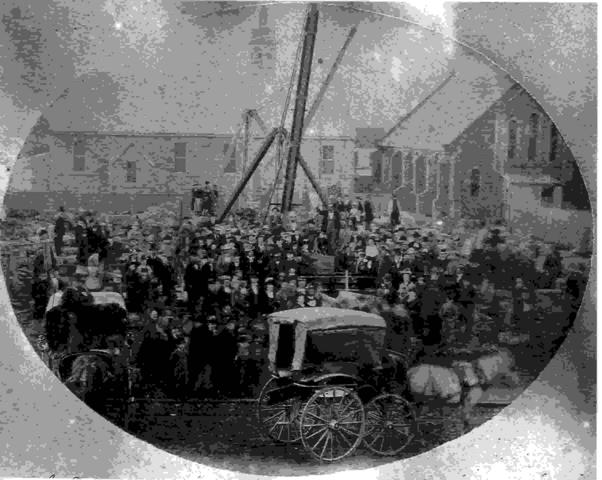
Laying of the foundation Stone of St Mathew’s Church, Prahran, 1st September 1877 (in-line image from Picture Victoria)

The Australasian Sketcher with Pen and Pencil, Saturday 11th May 1878, page 23.

“…the porch containing the main entrance to the nave, and a bold west (or rather south) window of five lights with rich geometric tracery. The side windows – with the exception of the first window on the east side of the nave, which is a four-light tracery window, elevated in a gable to rise above the gallery – are plain three-light windows with segmented pointed enclosing arches…”

The Argus, Melbourne, Vic, Saturday 29th June 1878, page 5.

“OPENING OF ST. MATTHEW’S CHURCH.”

The new church of St. Matthew, which is situated in High-street, Prahran, was opened for divine service last night by the Bishop of Melbourne. The church supercedes one that has been in existence for many years near the same site, and it has been erected by the parishioners in consequence of the wooden building formerly occupied having become too small for the wants of the congregation. The building has been completed with the exception of stuccoing and painting inside, and last night it was thoroughly crowded, about 1,000 persons being inside it, although it has been designed to seat only 700…”

Star, New Zealand, Issue 6470, 13th February 1889, page 3.

“A SENSATION.
EXTRAORDINARY DISAPPEARANCE OF A PROMINENT CITIZEN.
[FROM OUR OWN CORRESPONDENT.]
{Per s.s. Waihora, at the Bluff.)
MELBOURNE
, FEB. 7.”
“A sensation has been created at Prahran by a disclosure which last week made concerning the disappearance of a prominent citizen, named William Harrison, who has been missing for a period of two years. Harrison was an ex-Councillor of the city, and always took a keen interest in the public affairs of the district. He was an architect by profession, and his peculiar temperament, coupled with the enthusiasm he at all times displayed on public questions, gained him the title of “Terrible Billy,” and it is under this sobriety that he was generally known by the residents of the municipality. For a period of nine years Mr Harrison represented the ratepayers on the Council Board, and after remaining a private citizen for some years he, during the month of August, 1886, contested another election for a seat, and was defeated. This was probably due to his having given way to excessive drinking in conducting his candidature and it is about this time that he was lost sight of by his friends. A few days after the election he gave his relatives to understand that he purposed visiting Queensland, and since then he was not heard of until a few days ago, when his family connections placed his photograph in the hands of the detective police, who recognised it as the picture of a man who, about two years ago, died in a Melbourne hospital from the effects of drink. Deceased was discovered lying in one of the public gardens in a dying condition, with two brandy bottles at his side. He was never identified, and was buried as an unknown man. The police are fully persuaded that the deceased man was none other than Harrison. His relatives have been greatly distressed at the unfortunate man’s terrible fate.”

Excerpt from Prahran  Conservation Review document, HO126.

“In May 1982 part of the nave of the church and the south-west corner was destroyed by fire. Some reconstruction was carried out at this time but the original structure of the church was retained. The western transept has been replaced with a bluestone wall with brick quoins finishing the buttresses. An external steel staircase provides access to three levels of offices in this section of the church. The entry on the eastern side of the façade, with its ornate shafted jam has a new mirror door. A courtyard is a feature of the recent alterations to the church. The offices which occupy the front section of the church are separated from the rear section by the courtyard which is enclosed by the original nave walls. The rear walls of the church, including sanctuary and vestry are intact.”

Footnotes:

[8] Email from Dr. B. D. Hughes 7 Dec 2012.

External links:

Other historical images from Picture Victoria of St Matthew’s, include historical images and from the 1892 fire damage and reconstruction:

http://www.picturevictoria.vic.gov.au/site/stonnington/miscellaneous/11267.html
http://www.picturevictoria.vic.gov.au/site/stonnington/miscellaneous/13183.html
http://www.picturevictoria.vic.gov.au/site/stonnington/miscellaneous/13206.html
http://www.picturevictoria.vic.gov.au/site/stonnington/miscellaneous/13186.html
http://www.picturevictoria.vic.gov.au/site/stonnington/miscellaneous/13188.html
http://www.picturevictoria.vic.gov.au/site/stonnington/miscellaneous/13189.html


Short link to this page: http://wp.me/p28nLD-1tI

© Copyright

09-01-1885: Elm Street Hall, North Melbourne, Victoria.

The North Melbourne Presbyterian Church was initially founded in 1854 with the first services being conducted in a Blacksmiths shop near the site of the North Melbourne Town Hall. A temporary iron building was first erected for the congregation in Curzon street, and only a few years later a new bluestone church was erected, the foundation of which was laid by Sir Henry Barkly on Friday the 8th of April 1859[1].

In less than twenty years this church was deemed too small for the growing congregation and in the 1870’s plans were afoot to erect a new one. The designs of local Brunswick architect Evander McIver were chosen and the foundation stone for the new Union Memorial Church was laid on the corner of Curzon & Elm Streets North Melbourne by the Hon James MacBain, M.L.A, on the afternoon of Tuesday 14th January 1879[2]. In less than eight months the new Church was completed and was officially opened on Sunday 31st August 1879[3].

At the same time as the new church was to be erected, the old one was dismantled and, using most of the original building material, was re-erected about fifty meters to the rear of the site and would later become known as the Elm Street Hall. In May 1889 the Sabbath School was erected[4] to the rear of the church and the Elm Street Hall.

The Elm Street hall has a series of four single lancet stained glass windows that are a memorial to David Howat (1814-1885), the father[5] of the Sabbath School Superintendent William Howat (1850-1935). William was most likely the one who commissioned Ferguson & Urie to create the memorial windows to his father and it’s possible that these windows may have been originally erected in the Sabbath School at the time of it’s erection in 1889 and later moved to the Elm Street Hall where they exist to this day in the liturgical south wall.

Photos taken: 21st July 2012.

This slideshow requires JavaScript.

The four windows are in very poor condition and there are many pieces of modern uncomplimentary glass used to fill the gaps where pieces were broken at various times during their history. Three of the four pieces of text that describe the figurative depictions in each window are missing altogether and the memorial text at the base of each window is also missing a number of pieces. The only memorial text that can be ascertained at the base of each window is:

1.  “TO THE GLORY OF GOD AND IN MEMORY OF”
Depicts possibly someone as the teacher? A woman or apostle seated with an open book and two children either side. The text below the figure, which may explain the precise depiction, is missing.

2. “(missing piece) HOWAT (missing piece)”
Depicts a child kneeling in prayer at the foot of an apostle? The text below the figure, which may explain the precise depiction, is missing.

3. “WHO DIED 9th JAN 1885 AGED 71”.
This window has the well known figurative depiction of Christ as the Good Shepherd. It has the partial text “The Good Shepherd”, holding a lamb in one arm and his crook in the other with sheep at his feet, so I presume the missing word are “I Am” and “The” to make up “I Am The Good Shepherd”.

4. “(All the memorial text is missing from this window)”.
This window appears to have the figurative depiction usually associated with “Suffer Little Children To Come Unto Me.” But, below the figure is the partial text “…Remember Now Creator…”. This is most likely from Ecclesiastes 12-1 which says “Remember now thy Creator in the days of thy youth, while the evil days come not, nor the years draw nigh, when thou shalt say, I have no pleasure in them”.

The windows were a memorial to David Howat, at one time a session clerk of St. Andrew’s Presbyterian Church of Carlton. He was elected in 1872[6] and held office for more than twelve years until his death in 1885. He died at his residence at 180 William-street Melbourne on the 9th of January 1885 [7], in his 71st year. He was buried in the Melbourne General Cemetery on the 12th of January 1885 [8] and many other family members, including his wife Sarah, infant son David, only daughter Mary and son William are buried in the same family plot.

The Union Memorial Sabbath School and William Howat.

North Melbourne Advertiser, Vic, Saturday 18th May 1889, page 3.

“AN INTERESTING CEREMONY”
“Last Saturday afternoon a large number of ladies and gentlemen interested in the Sabbath school work, met by invitation to celebrate the opening of the new infant school, erected in connection with the Union Memorial denomination, North Melbourne…”
“…Owing to the energy of their superintendent who had not an equal in the colony – in fact there was no superintendent like him, his heart and soul were in the glorious work – they were as a school able to declare the building completed, seated, and opened free of debt…”

The stained glass windows in the Sabbath School were described in the newspapers as:

“It is lighted with ornamental cathedral lancet lights of stained glass, which when finally completed will give a softened and effective tone to the interior…”

The much revered Superintendent of the Sabbath School was William Howat (1850-1935), the son of David Howat (1814-1885) and Sarah Robertson (1814-1891). He was born in Ayrshire Scotland and arrived in Australia with his parents and elder siblings, George and Mary, aboard the Lady Octavia from Greenock on the 31st December 1855 [9][10].

He had been associated with the Y.M.C.A and the Sunday School Union movement from his early 30’s and had for more than 70 years, a long business association with four generations of the wealthy Clarke family of pastoralists[11].

He was first involved with the establishment of a Sabbath School in connection with St Andrew’s Presbyterian Church of Carlton (now zoned in Brunswick) which was opened in August 1884[12] and his efforts in that area made him well qualified to exert himself in the cause for a Sabbath School in North Melbourne.

Apart from being the revered Superintendant of the Union Memorial Sabbath School, William Howat was an avid and eclectic antiques collector and over a 65 year period had amassed an extraordinary collection of books and all manner of curios from all over the world[13]. His love of books also extended to the Sabbath School where he donated the vast majority of the books to its library. At the opening of the Sabbath School in 1889 it was described:

“The library is a model. It contains some 1800 volumes, mostly the gift the superintendent. The teacher’s library is a collection of the best works extant…”[14]

William Howat died unmarried on the 1st of August 1935[15], at his home ‘Glaisnock’ in William Street West Melbourne aged 85. He left an estate reported to be worth £9,912[16] and apart from many bequests to relatives and friends, and charitable institutions, he bequeathed a life interest in most of his estate to his housekeeper.

The William Howat collection of books, art, and curios, was put up for auction in November 1935[17] which consisted of over 20,000 volumes of rare old editions and modern works on all branches of literature as well as a collection of native weapons, Chinese artworks and curios[18]. It was described in the papers as “one of the Greatest Sales ever held in Melbourne[19].

Other References:

http://vhd.heritage.vic.gov.au/#detail_places;884

http://www.cv.vic.gov.au/stories/sound-in-space/12225/elm-street-hall-north-melbourne/

Foot notes:

[1] The Argus, Melbourne, Vic, Saturday 9th April 1859, page 5.

[5] Vic Births Deaths & Marriages No: 6681/1935. William Howat, son of David Howat and Sarah Robertson.

[9] Prov.vic.gov.au (Fiche 084 page 002)

Short link to this page: http://wp.me/p28nLD-1sO

© Copyright

02-10-1871: St George’s Church, Battery Point, Hobart, Tasmania

The foundation stone of St George’s Anglican Church was laid by Governor George Arthur[1] on the 19th October 1836 on land at Battery Point, previously known as ‘Kermode’s Hill’ that was purchased from William Kermode[2] for a reported £250.

St George’s has a Georgian facade and three-tiered bell tower which is quite unusual amongst the predominantly Gothic Architecture of other Hobart Churches.  The main body of the church was designed by the Government architect John Lee Archer[3] and the later tower and porch by the convict architect James Blackburn[4].  The church was consecrated in 1838[5] by the Bishop, Rev William Grant Broughton[6]The unusual three tiered bell tower designed by Blackburn is supposedly a copy of the ‘Temple of the Winds[7]in Athens.

In late 1871, it was reported that a Ferguson & Urie stained glass window was erected in the chancel of St George’s, but the current chancel window, seen as at 2012, does not resemble anything like other known Ferguson & Urie windows. The obscure description given in the tabloids of the time only described it as “neat and un-ostentatious”. That description could easily apply to the window seen in the chancel now, but such an obscure description could broadly apply to anything.

Photos taken: 13th August 2012.

This slideshow requires JavaScript.

On the 4th February 2012, the Rev John Langloise from St George’s wrote:

“The only record I am aware of is in a booklet on the history of the church which records this: Sanctuary Windows: Obtained from Germany in 1871, and said to be unique. It is of very thin German glass with the colours burnt in. The Greek key design surrounds it, and we remember that St. George is the patron saint of Greece. It is 8½ feet (2.59 metres) across at the bottom, and is now backed with plate glass. Please note that all the windows are of the same shape. The window is still there in its original condition, though the colour seems to me to be painted on rather than burnt in, But I am no expert : -)…”

This throws some confusion into the windows origins. There isn’t any actual evidence to confirm the window as being of “German glass” other than the obscure mention of , “Obtained from Germany in 1871,”  in the church history booklet. There is no source reference given. The mention of the windows as being “the same shape” is probably not quite correct either, as the bottom of the window is probably a good 20cm wider than the top and each of the ten panes on the left and right edge are each slightly smaller as they reach the top of the window.

In two separate instances, in October 1871, the Hobart Mercury reported that a window by Ferguson & Urie “has just been placed in the chancel of St. George’s Church, Battery Point”. There maybe three likely possibilities that explain this:

  1. Option 1: Possibly the newspaper reports of the time were incorrect.. This has been known to happen, but it seems highly unlikely in this case considering that they actually got the company name correct. There are also no known “letters to the editor” of the time that refute the claim that the makers were not Ferguson & Urie.
  2. Option two: If this is actually German glass, then it must have been installed many years later to replace the 1871 Ferguson & Urie window. How much later is another matter to consider! Between 1871 and 1942 is a reasonable guide.
  3. Option three: I consider this scenario to be the most likely and in fact I’m absolutely convinced of it!
    The original newspaper articles were indeed correct and the window was, as reported, supplied by Ferguson & Urie. I’m sure that the window is a very, very rare example of one of the companies transfers or transparencies on glass[8], of which no others are known to still exist. The transfers were of a similar process to the “Glacier” or “Crystograph” patent window film of which Ferguson & Urie were known to have done en-masse during the 1867 Royal Visit to Melbourne .The likelihood of this is plausible, but its longevity to this point in time is questionable, as any prolonged exposure to light (especially in the case of over a century or more) causes this window film to degrade and ‘craze’ so it looks like thousands of cracks as the window film deteriorates on the surface of the glass. In this case it could be possible as the chancel window is completely internal and doesn’t have any direct exposure to light. The other unusual factor to consider is the complete lack of any lead lines. There are none whatsoever! One of the closeup photos is the best clue as to the windows composition which shows a very distinct trait of a dull greyish film on the glass. An article in 1882 referred to the window as “the mansion staircase window behind the communion table”?

On Christmas day in 1905 an article about the Christmas decorations in St George’s included a short description of the chancel window which describes the designs seen in the window today.

“…The principal decorative feature was the chancel, which, in its simplicity, resembles a tabernacle, across which runs the appropriate line, “The Lord is in this Holy Temple,” the effect being heightened by the lofty oblong window of pale white glass at the back, covered with differently coloured mathematical figures resembling crosses and stars…” [9]

Another unusual aspect of the window is its shape. The article from 1905 describes its shape correctly as an oblong. The frame gives the illusion that the window is a true rectangle but, it is wider at the bottom than at the top, which gives the impression that the window was possibly custom made to fit an opening that may have been the result of a building design flaw, or it was designed that way to give the illusion that it is taller than it really is!

In May 1938[10], the Hobart Mercury included a picture of the chancel of St George’s which, although black and white and poor quality, clearly shows the patterns in the window as seen in 2012.

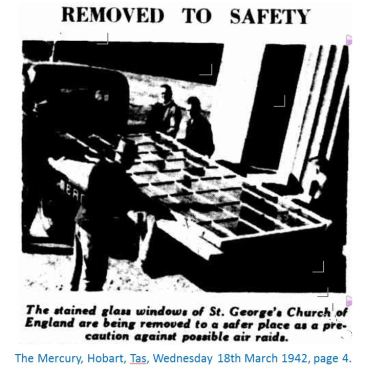
At the height of WWII, the civil defence regulations placed stringent rules on exposed plate glass windows. Whether these rules applied to the chancel window or not is not known but the church decided to remove the window as a precaution against air raids. In March 1942 the Hobart Mercury included a photo of workmen loading the entire window frame onto a truck with the caption:

“The stained glass windows of St. George’s Church of England are being removed to a safer place as a precaution against possible air raids”[11]

A close inspection of the newspaper picture shows that there are ten panes deep and five wide in the frame of the window, which exactly matches the number of panes seen in the chancel window as at 2012.

The Mercury, Hobart, Monday 2nd October 1871, page 2.

“ST. GEORGE’S, BATTERY POINT. – A neat and un-ostentatious stained glass window manufactured by Messrs. Ferguson, Urie, and Lyon, of Melbourne, has just been placed in the chancel of St. George’s Church, Battery Point. Most of the cost has been collected from the working classes by ladies of the congregation. Yesterday at both morning and evening services collections in aid of the same object were made. …”

The Mercury, Hobart, Tasmania, Saturday 7th October 1871, page 4.

“… Sermons were preached at St. George’s Church, Battery point, on the 21st inst., and collections made to supplement subscriptions (principally) by the working classes for a neat and unostentatious stained glass window, manufactured by Messrs. Ferguson, Urie, and Lyon, of Melbourne, and placed in the chancel of the church…”

The Mercury, Hobart, TAS, Friday 7th April 1882, page 3.

(About St Georges Church Hobart)

“…But the interior, elegant, well-arranged and admirably lighted, leaves little to be desired, except stained “ecclesiastical: glass to replace the “mansion staircase” window behind the communion table”

Foot notes:

21-08-1876: St Martin’s Church, Muskerry, Victoria.

St Martin’s Catholic Church, known as St Martin of Tours,  is located at Muskerry, about 30km North East of Bendigo and 7km South East of Goornong in western Victoria. The foundation stone was laid by the Rev. Dr. Crane the Catholic Bishop of Sandhurst (Bendigo) on the 19th September 1875 [1], and less than a year later the church was consecrated by Rev. Crane on the 20th August 1876 [2]. All the glazing and stained glass was supplied by Ferguson & Urie of North Melbourne.

Unfortunately there doesn’t appear to be any remaining Ferguson & Urie windows in St Martins as they have all been replaced over the course of more than a century with stained glass by artists such as Auguste Fischer (the O’Keefe windows c.1905), and William Montgomery, and the simpler nave windows most likely by E. L. Yencken & Co [3]

This slideshow requires JavaScript.

Photos by Ray Brown: Updated 20190208

Bendigo Advertiser, Vic, Monday 21st August 1876, page 3.

“THE CONSECRATION OF ST. MARTIN’S ROMAN CATHOLIC CHURCH, MUSKERRY.”

“The ceremony above referred to took place yesterday, and, the weather being fine, many of our citizens availed themselves of this as an excuse for taking a trip in the country, while adding éclat to an event of no everyday occurrence in the neighbourhood of the Campaspe…”

“…Acting on the Dean’s suggestions, a committee was formed and an active canvass undertaken, and some twenty months since the foundations of the new church were laid (on the 19th September, 1875). The site – a magnificent one, well elevated, situated about a half-a-mile from the Clare Inn, and about three acres in extent – was generously given, free of all cost, by Mr. Ed Cahill. On the day of the laying of the foundation £104 was collected, and this amount, in conjunction with the free site, encouraged the committee to erect St Martin’s Church, at a cost of £1,480 7s 1d. The building has, at present, a debt amounting to about 947, which, by yesterday’s collection, was reduced by close on £160….”

“There are circular windows in each gable of ground and stained glass, and all the other windows are glazed with the same material, supplied by Messrs Fergusson [sic] and Urie, of Melbourne…”

“Great credit is due to the several contractors for the admirable manner in which they have completed their contracts from the designs and under the superintendence of Mr. J. M. Brady, the architect, of Pall Mall, Sandhurst. The service of consecration was conducted by the Rev. Dr. Crane, Roman Cathlilic Bishop, assisted by the Very Rev. Dean Backhaus and Dr. Revell…”

02-12-1871: Holy Trinity Anglican Church, Stawell, Victoria.

A two light Ferguson & Urie stained glass window exists in the nave of Holy Trinity Anglican Church at Stawell in western Victoria. The window depicts St Peter & St. Paul and is dedicated to the memory of William Henry Pettett (1814-1871), M.L.C, J.P. The memorial text on the window reads:

“THY ETERNAL GOD IS THY REFUGE AND UNDERNEATH ARE THE EVERLASTING ARMS Deut’n 33d: 27th” (Deutronomy, Ch-33, Verse-27)

“IN MEMORY OF THE HON W. H. PETTETT MLC WHO ARRIVED IN THIS COLONY IN 1837 AND DIED 3rd DECEMBER 1871 AGED 56 YEARS”.

Photos taken: 12th June 2011.

This slideshow requires JavaScript.

William Henry Pettett, M.L.C, J.P, was born in Greenwich, London, 4th September 1814. He arrived in Van Diemens Land in 1832 and in 1837 moved to Victoria where he managed property for W. J. T. Clarke[1] at Dowling Forrest, between 1838-1842, and then the James Hodgkinson run known as “Maiden Hills” in 1848[2].

In June 1847, he had a minor altercation in relation to a breach of the customs act regarding the stated value of thirteen horses he was to pay duties on and was subsequently fined £10. [3]

His first wife Caroline (nee Taylor) died at their residence in Lonsdale street on the 11th of October 1854[4] aged 27, (three children), he then married Emily Ruddle in St Mark’s Church, Collingwood, on the 28th of June 1855[5] (ten children).

In 1863 he was elected Mayor [6] of Hawthorn for a twelve month period and in October 1864, he soundly defeated Thomas Herbert Power M.L.C  for the seat of the Southern Province[7] by a completely unpredicted margin of 615 to Power’s 388 votes[8].

By mid-1871 his political activities were being hampered by his declining health. He drew up his last will and testament on the 23rd of June 1871[9] and died five months later on the 2nd December 1871 at his property “Warra Warra[10]station near Stawell in Western Victoria, aged 56[11]. He left an estate valued at £12,709.

The memorial date on the stained glass window indicates his date of death as the 3rd of December 1871. Newspaper reports of the time, his probate documents, and the family gravestone at Stawell have this recorded as the 2nd December 1871.

The Argus, Melbourne, Vic, Monday 4th December 1871, page 5.

News of the death of the Hon. William Henry Pettett, M.L.C., one of the members for the Southern Province, reached town on Saturday. Mr. Pettett had been ailing for some time past, and on that account had not taken an active part in political affairs. During the last three months of the late session he was absent from the Council on leave. Mr. Pettett’s connexion with the colony dates from an early period. The following reference is made to him in Mr. Wither’s ‘History of Ballarat’: “Messrs. Pettett and Francis in 1838 (as managers for W. H. T. Clarke) took up the country at Dowling Forest, so called after Mrs. Clarke’s maiden name. Shortly after they had settled there Mr. Francis was killed by one of his own men with a spear-blade at one of the stations on the run. Before Mr. Pettett took up the Dowling Forest run he was living at the Little River, and a native chief named Balliang offered to show him the country about Lal Lal.” Mr. Pettett was elected a member of the Legislative Council in October, 1864.[12]

The Argus, Melbourne, Vic, Monday 4th December 1871, page 4.

“PETTETT.- On the 2nd inst, at Warra Warra, Hon. W. H. Pettett, M.L.C., aged 57 years.”

Foot notes:

[9] Vic Probate file 9/523, W.H. Pettett. 1871.

17-04-1867: St Paul’s Anglican Church, Latrobe Terrace, Geelong, Victoria.

St Paul’s Anglican Church in Latrobe Terrace, Geelong has a two light Ferguson & Urie stained glass window dedicated to the memory of Frederick & Emma Hawkes who perished in the wreck of the ‘Jane Elizabeth’ off the coast of Tasmania in 1867.

The window depicts Christ as the Saviour of the doomed, appearing at the scene of the wreck of the ‘Jane Elizabeth’. It has the memorial text:

“IN MEMORY OF FREDERICK HAWKES AGED 35 YEARS AND HIS WIFE EMMA AGED 30 YEARS WHO WERE LOST AT SEA APRIL 17, 1867”.

Photos taken: 18th December 2010.

This slideshow requires JavaScript.

[View larger images]

On the afternoon of the 17th of April 1867 the schooner, ‘Jane Elizabeth’, left the Circular Head wharf for Launceston at half-past 1 o’clock with a light westerly wind [1]. Later in the evening the ship was seen just off ‘Table Cape”. The wind had changed to west nor’-west and soon reached a gale. Amongst the passengers were the Geelong couple, Frederick Hawkes and his wife Emma (nee Horwood) who had only eighteen months earlier married in London.[2]

The following day some wreckage from the Jane Elizabeth was found near Tamar Heads, amongst which, was a broken case with a shirt marked “F. Hawkes” and a lady’s handkerchief marked “E. Horwood.”[3]

These were the only remaining identifying items of the couple.

No survivors or bodies were ever found.

The stained glass memorial window depicting St Peter and St Paul was erected in St Paul’s by Thomas Hawkes, who was Frederick’s brother and also a member of the Geelong hardware an Iron Mongers firm “Hawkes Bros” [4], to whom Frederick also belonged.

Significant transcriptions:

The Cornwall Chronicle, Launceston, Tas, Wednesday 24th April 1867, page 3.

“The following telegram was received from the Tamar Heads at one o’clock yesterday. Messrs. J. H. and B. H. Stutterd of table Cape report the following list of crew and passengers per “Jane Elizabeth.” Crew – Mr. Andrew Soresson, (master and owner); Seamen – Miller, and cook known as George. Passengers from Table Cape – Frederick Hawkes, aged 32; Emma Hawkes, age 30; Charlotte Rebecca Stutterd, aged 16. From Circular Head – One man from the wrecked schooner Rose Ann, Constable Shanassy and Michael Dempsey a prisoner.”

The Argus, Melbourne, Vic, Friday 26th April 1867, page 5.

“It is believed at Geelong that there is great reason to fear that Mr. and Mrs. Frederick Hawkes of that town, were amongst the passengers of the schooner Jane Elizabeth, which is supposed to have been lost during the recent gales on the passage from Circular Head to Launceston.

The Cornwall Chronicle, Launceston, Tas, Wednesday 1st May 1867, page 5.

“The Melbourne Age says – There is some reason to fear that Mr. and Mrs. Frederick Hawkes, of Geelong, were amongst the passengers of the schooner Jane Elizabeth, which is supposed to have been lost during recent gales, on her passage from Circular Head to Launceston. Ten days ago, as we learn from the ‘Advertiser,’ Mr. Thomas Hawkes received a letter from his brother, who was then staying at Circular Head with his wife’s uncle, Mr. Stutterd, to the effect that there were no other means of reaching Launceston to catch the steamer than by making a journey across the country which would have to be done on horseback, and would occupy six days, or to go round in the schooner, and that he would come by the latter route, if the weather was fine. Among other articles found on the beach was a pocket-book, evidently belonging to young Mrs. Stutterd, Mr. Hawkes cousin. From subsequent accounts, it would appear that the rumoured loss of Mr. and Mrs. Frederick Hawkes is only too true. This young couple had not been long from England, and were very happy and prosperous in Geelong.”

The Argus, Melbourne, Vic, Wednesday 1st May 1867, page 4.

“HAWKES.- Lost at sea, on the 17th ult., by the wreck of the schooner Jane and Elizabeth, Frederick Hawkes, of the firm of Hawkes Brothers, of Geelong, aged thirty-five. Also, at the same time, his wife Emma, daughter of the late Henry Horwood, Esq., London, aged thirty. Both sincerely regretted by a large circle of friends.”

Geelong Advertiser, Vic, Tuesday 18th February 1868, page 3.

ST. PAUL’S CHURCH, GEELONG.

This church has during the last week received an addition to its treasures in the form of a handsome stained glass window, placed in the north aisle opposite to the reading-desk, the work of Messrs Ferguson and Urie of Melbourne. This window represents the figures of St Paul and St Peter, both life size – St Paul habited in a dark tunic and holding the double headed sword of the Spirit in his hand; his more delicate features (drawn from reliable authority), seeming to indicate tenderness of feeling and depth of thought. St Peter, a more ordinary figure, according to the usual tradition. with the keys of the Church in his hand. Over their heads an angel is holding a scroll with these words upon it, “Praise ye the Lord.” Below is the inscription of the window;- “Erected by the brethren of the Masonic Order and Geelong Volunteer Fire Brigade and other friends, in affectionate remembrance of Thomas Thompson, who died march 20, 1887, aged 35 years.” Immediately above the inscription are the emblems of the Masonic Order and the initials of the Geelong Volunteer Fire Brigade.   It is in contemplation to complete the series of windows in the church, numbering twenty-four loghts. The subjects are to represent the rest of the Apostles, and scenes from Scripture alternately.  At the present time Messrs Ferguson and Urie are executing a window to be erected in Memory of Mr and Mrs Frederick Hawkes, who perished last year by drowining on the coast of Tasmania.”

Geelong Advertiser, Vic, Saturday 25th April 1868, page 3.

“ST. PAUL’S CHURCH.

Sometime ago we gave our readers a description of the “Thompson Memorial Window” which has been placed in this church by the friends, of the deceased. Another window has, been placed by the side of this- to the memory of Mr and Mrs Frederic Hawkes, who perished at sea, off the coast of Tasmania, about this time last year, a disastrous event which was generally so much deplored. In looking at the window we are much struck with the appropriateness of the design, as well as the manner of its execution. The window is divided into two lights; in the eastern light there is an illustration of the narrative of the “Walking on the sea,” as given by St. Matthew, in his Gospel, (chapter 14, verses 22—33). The artist has thrown into St. Peter’s face an expression of terror as he feels himself sinking, and as we view the figure of the Saviour laying hold of the doubting disciple with His left hand, while he has the forefinger of His right hand erect, we feel that the illustration brings out the idea of the sacred words—”And immediately Jesus stretched forth His hand, and caught him, and said unto him, ‘Oh thou of little faith, wherefore didst thou doubt?” In this light, of course, the chief figures are those of the Saviour— which is 3 ½ feet in length—and that of St. Peter, but in the distance can be seen the boat which St. Peter has just left, and three men, brother disciples, in charge of it. In the western light there is an artistic description of the miraculous “Stilling of the Tempest,” founded on the narrative of St. Matthew (chap. 8, vers. 23—28). The expression of the sleeping Christ in the fishing boat, weary with the toils of the day, is well given, and the fear in the hearts of the disciples, and the possible consequences resulting from the “great tempest in the sea,” may be read from the marked expression of their countenances while we can well imagine their earnest words, “Lord save us, we perish.” At the top of these two lights is an angel with outstretched wings, holding a, scroll with the divine inscription, “The sea gave up the dead.” The filling up is good in design, and the colours harmonise well throughout. There are twelve figures in all in this window, with floral decorations. At the base of the window is the following inscription:—” In memory of Frederic Hawkes, aged 35 years, and his wife Emma, aged 30 years, who were lost at sea, April 17,1867.” – This window has been placed in this church by Mr Thomas Hawkes, of this town, as a small tribute of brotherly affection for the many estimable qualities they both possessed.”

Note: The Thompson memorial window described in the first part of the report is included in another article which can be seen [here]

Related posts:

14-02-1868: The Thomas Thompson window at St Paul’s Anglican Church, Latrobe Terrace, Geelong.

Foot notes:


Short link to this page: http://wp.me/p28nLD-1py
© Copyright

1895: Apsley House, Armadale, Melbourne, Victoria.

Apsley House in Armadale contains a magnificent Ferguson & Urie stained glass window in the stairwell. The window depicts the Patron Saint of England, St George, on horseback and in full armour, slaying the legendary dragon. Below the figure of St George is the “Order of the Garter” with the Latin text “Honi soit qui mal y pense” (loosely translated to “Shame on him who thinks evil of it”). [1] Conservation work on the window was completed in 2012 by Bruce Hutton of Almond Glass, Oakleigh [2].

Photos taken: 10th November 2012.

This slideshow requires JavaScript.

An early colonial owner of Apsley house in the 1890s was the accountant William Crellin, who was the founding member, and first president of the Incorporated Institute of Accountants (the IIAV, now known as CPA[3] Australia).

William Crellin arrived in Australia in the 1850s and married Margaret Anne Fisher in Melbourne in 1856[4]. They began their family in Brunswick, first residing at “Parkside-Cottage,” [5] and later at 24 Peel-street, Windsor[6]. Between 1857 and 1870 they had seven children but only three boys, William, John, and Edward, survived to adulthood and all followed in their father’s footsteps to become accountants with William and John in their own business partnership[7].

During Crellin’s residency in Brunswick, he was both the council secretary[8] and auditor[9] and on the 8th of March 1870, J. W. Fleming, the Brunswick Mayor, declared that William Crellin was the only candidate nominated to fill a council vacancy created by the resignation of Councillor Thomas Clarke, and was subsequently elected to fill the vacancy[10], a position which he held until his resignation in March 1872 [11]

William Crellin lived and breathed his profession as an accountant and took great pride in his mathematical abilities. On numerous occasions, he felt the necessity to prove a point and was quite prolific at submitting “letters to the editor” of the tabloids, where he would refute the dubious calculations and claims of others in matters of accountancy. Apart from his role as the president of the IIAV, he held many positions among which were; Honorary Auditor to the Alfred Hospital [12], Honorary Treasurer of the Australian Health Society [13], and Secretary of the Australian Fresh Meat Company [14] and many other voluntary and paid positions. He had business premises at 46 Elizabeth street Melbourne and was regularly appointed as the trustee in many insolvency cases[15].

William Crellin died on Sunday the 17th of February 1895 at “Apsley” house in his 74th year [16]. He left an estate valued at £3,763 [17] which he left entirely to his wife Margaret.

It’s not known if William Crellin was the original owner of “Apsley”, or whether it was he who had commissioned Ferguson & Urie to create the St. George stained glass window. Crellin’s probate documents filed in March 1895 indicate that he was “formerly of “Lansmere,” Alma Road St Kilda in the colony of Victoria but late of “Apsley” Malvern Road Armadale,”[18]  indicating that he had possibly not resided in “Apsley” very long before his death in February 1895.

One of his sons, William Langdon Crellin, took up residence in “Apsley” after his wedding to Maggie Wauchope in September 1896 [19].

William Crellin’s wife, Margaret died on the 4th Oct 1915 in her 89th year [20]. They are both buried in the St Kilda Cemetery [21].

Circa 1915, “Apsley” house was then used exclusively as “Nurse Thomas’s” Private Nursing Home [22].

In 1925 “Apsley” was either owned or resided in, by the actor Arthur Styan, famous for his roles as “the mustache-twirling villain”[23] who had a 25-year career as a stage actor until his death on Christmas day in 1925 [24].

 In 1947 a Mrs Clarice Evelyn Herring resided at Apsley [25].


[3] “Certified Practicing Accountants”.

[4] Vic BDM: 2899/1856 Marriage; William Crellin & Margaret Anne Fisher.

[14] Vic Probate Record File: 106/177 in the estate of William Crellin 27th Mar 1895.

[18] Vic Probate Record File: 106/177 in the estate of William Crellin 27th Mar 1895.

[21] St Kilda Cemetery, Independent Monumental, Compartment A, Grave 9A.

Short link to this page: http://wp.me/p28nLD-1pg

© Copyright

03-09-1869: St John’s Anglican Church, Heathcote, Victoria.

St John’s Anglican Church at Heathcote was constructed by local builders Flee and Bell to the design of Bendigo based architects Vahland & Getzschmann.

The foundation stone was laid by Bishop Charles Perry[1] on the afternoon of Monday the 11th May 1868[2] and officially opened for services on the 3rd October 1869[3]. Nearly twenty years later, Bishop, James Moorhouse[4] consecrated the church on the evening of the 14th August 1889[5].

The three light east and west end stained glass windows are of geometric designs with Passion Flower and Fleur-de-lis patterns and were made by Ferguson & Urie of North Melbourne. The newspaper report of the opening ceremony of the church in 1869 referred to the company as “famous throughout the colonies for skill and designs in this particular art”.

Photos taken: 26th December 2010.

This slideshow requires JavaScript.

McIvor Times & Rodney Advertiser, Heathcote, Vic, Friday 3rd September 1869, page 2.

“THE OPENING OF THE NEW EPISCOPALIAN CHURCH.

[COMMUNICATED]”

“This neat edifice will be opened for Divine service by the Bishop of Melbourne on Sunday, 3rd October (assisted by one or two clergymen), who will preach both morning and evening. The choir have been very active in practicing some new chants and anthems for the occasions, which will add to the solemnity of the services materially. A building of this nature has for years past been greatly needed by the members of that body, and that now erected, when properly furnished, will seat 250 persons comfortably, and although it has cost more time and money to bring it to its present condition than was at first anticipated, yet both the work and material used is of the first quality, and would stand the test of the closest inspection. The coloured windows are from the glassworks of Messrs. Ferguson, Urie, and Lyon, of Curzon Street, Melbourne, which firm is now become famous throughout the colonies for skill and designs in this particular art. The building is roofed with best Bangor slates, and altogether it may be considered and ornament to the town. A polished cedar altar rail and reading desk, which are being constructed, will add to the rich effect of the whole of the interior. A font, carved in New Zealand free stone, will also shortly be added. The bell is the gift of Messrs Christie and Spinks”.

The Ballarat Star, Vic, Tuesday 7th September 1869, page 2.

“The McIvor Times gives an account of the new Episcopalian Church in that locality. It will seat 250 persons comfortably. The colored windows are from the glassworks of Messrs Ferguson, Urie, and Lyon, of Curzon street, Melbourne, which firm has now become famous throughout the colonies for skill and designs in this particular art. The building is roofed with best Bangor slates, and  altogether it maybe considered an ornament to the town, A polished cedar altar rail and reading desk, which are being constructed, will add to the rich effect of the whole of the interior. A font, carved in New Zealand freestone, will also shortly be added. The bell is the gift of Messrs Christie and Spinks”.

Footnotes:

24-10-1866: Guide to the Intercolonial Exhibition of 1866, Melbourne, Victoria.

The Ferguson & Urie stained glass company displayed examples of their workmanship at many exhibitions over a forty year period from 1853.

The 1866 exhibition stands out as the most unique in the company history as being the one that gave them their greatest exposure on the eastern side of Australia and even into New Zealand.

An entire “Medieval Court” was constructed at the 1866 exhibition which included a detailed reconstruction of a church chancel decorated by Ferguson & Urie which was complete with stained glass windows. The idea for the medieval court was based on Augustus Welby Pugin’s Medieval Court, which was first shown at London’s International Exhibition of 1851 and then at the Crystal Palace, Sydenham, between 1852 and 1866. This medieval court reconstruction at the 1866 Melbourne exhibition was the first of its kind seen in the Australian colony and drew and extraordinary crowd.

The most remarkable of the historical artifacts in the medieval court were Ferguson & Urie’s set of five single light stained glass windows depicting the Nativity, Passion, Crucifixion, Resurrection and Ascension. After the exhibition these windows were installed in the chancel of Christ Church at Casterton in Western Victoria and are still in place to this day, although there is a small mysterious anomaly as the the order the windows were installed!

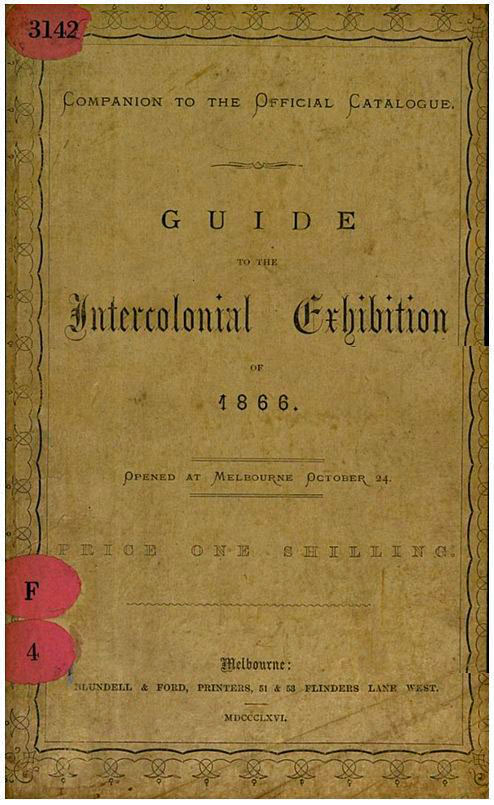
“GUIDE TO THE INTERCOLONIAL EXHIBITION OF 1866”.

“THE MAIN HALL”.

“ON entering this hall from Latrobe-street, visitors who put themselves under our guidance will find, by turning immediately to the left before arriving at the fur trophy, which faces them, that they have come upon perhaps the last thing one might expect to encounter in an exhibition of the products and manufactures of a new colony – to wit, a Mediaeval Court, the whole of the decorations and contents of which are the work of two Melbourne houses, the one that of Mr. John Young, contractor, and the other that of Messrs. Ferguson, Urie and Lyon, glass-stainers, &c. The excellence of this court consists not more in the beauty of the various articles it contains than in the admirable tone of all the decorations, giving to the place that “dim, religious light” befitting the character it assumes. The stained-glass windows let into the partitions surrounding the court are mainly instrumental in producing this effect. The court is filled with statuary, fonts, and elaborately-ornamented wrought-iron articles, suitable for mediaeval church purposes. One of the statues represents the Madonna and Child; others personify St. John, St. Thomas, and St. Theresa. Attached to the walls near the roof are several of the quaintly-carved figures which catch the eye in old churches. These are intended for St. Patrick’s Cathedral, now in course of erection on the Eastern Hill. To complete the ingenious effect of this court as a complete work of art, Messrs. Ferguson, Urie and Lyon have constructed at the side opposite the entrance a recess representing an early English chancel, the decorations of which are most complete. The furniture of the chancel consists of an altar table, an illuminated oil painting of the last Supper, and illuminated tablets of the commandments, creed, and Lord’s Prayer. The light admitted to the chancel pours through five stained-glass windows, representing respectively the nativity, Passion, Crucifixion, Resurrection, and Ascension. These are designed for the Episcopalian Church at Casterton. The walls are also artistically decorated, and altogether this chancel, with the court leading to it, make up one of the most remarkable objects of the Exhibition”.

Related posts: 10-06-1867 > 25-10-1865 > 03-11-1866 > 20-12-1866


Shortlink to this page: https://wp.me/p28nLD-1os

© Copyright