1916: John Lamb Lyon, Stained Glass Artist, (1836-1916)

John Lamb Lyon (1835-1916) played an instrumental role in the early success of the Melbourne stained glass firm Ferguson & Urie.

Photos courtesy of John Lyon, Western Australia, 13th September 2012. Painting of Elizabeth aboard the ‘Great Britain’ 13th Feb 1872 courtesy of Phil & Lisa, England, 8th Jan 2015.

This slideshow requires JavaScript.

[View images and detail]

Born in Scotland on the 14th February 1836, to James Lyon and Janet Thorburn, he was apprenticed to the Glasgow stained glass firm of David Kier and then John Cairney & Co and later worked with the London firm of Ward & Hughes for a period of six years.

On the 23rd June 1857 John married Jane Clarke who died childless the following year.

On the 3rd of December 1860 he married Elizabeth Gillespie Pearson and less than a week later they departed Liverpool for Australia aboard the ‘Donald McKay’ on the 9th December 1860. On the 12th March 1861 the ship arrived in Port Phillip Heads, Melbourne, but due to an outbreak of smallpox on-board all passengers and crew were detained at the Port Nepean Quarantine station for fourteen days. The run of bad luck continued when a fresh outbreak occurred in quarantine which forced the Governor., Sir Henry Barkly, to extend the quarantine for another fourteen days from the 18th March 1861. They were officially cleared from quarantine on the 5th April 1861.

John and Elizabeth headed to the goldfields town of Maldon in central Victoria where his parents, James and Janet, had earlier set up as storekeepers.

John’s first known Colonial work in stained glass in Australia was recorded in the Argus of 2nd September 1861:

 “…Amongst the contributions which Tarrengower will forward to the forthcoming Exhibition will be a stained-glass window, in the Early English style, the work of Mr. John Lyon, of Maldon…” [1]

The Melbourne Exhibition list of awards published on the 7th December 1861 includes an “Honourable mention” for a “Design for Stained Glass”. In the same category at the exhibition, the firm of Ferguson & Urie also received an honourable mention for “Ornamental glazing”.

 “…In 1861, Mr. Lyon joined the firm of Ferguson and Urie, Melbourne. Their commencement was on a very primitive scale. They made their own colours and acid, and fired the glass in a colonial camp oven. They, however, soon got properly going, and produced good work under the firm name of Ferguson, Urie and Lyon…” [2]

John’s encounter with James Ferguson and James Urie at the 1861 exhibition would have to the catalyst for him joining the firm, but some prior persuasion may have come from the English artist David Relph Drape, who had been enticed to Australia by James Ferguson as early as 1858. Their first attempt to start the stained glass business had failed due to the gold rush labour shortage and Drape coincidentally ended up living at Maldon at the same time as Lyon.

In March 1862 the first article appeared mentioning Lyon being engaged as an artist with Ferguson & Urie.[3] He was then officially the firms first stained glass artist. Drape returned from Maldon to join Ferguson & Urie on the 8th of November 1863.

“…Messrs. Ferguson and Co, have engaged the services of a competent artist in this difficult and useful art. Mr Lyon, to whom we refer, has not long been in the colony, and has had a lengthened experience in his profession at home and judging from the specimens of his talent now to be seen at Messrs. Ferguson and Urie’s, we should suppose that those who require this description of decoration will find no difficulty in future in carrying out their designs…” [4]

At the Melbourne exhibition [5] in late October 1866, the firm was now mentioned as “Ferguson, Urie, and Lyon”, being the earliest indication he was now a partner in the firm. In February 1867 newspaper advertisements for the company began to include Lyon in the company name.

Between 1870 and 1872 the Lyon family returned to the UK, departing aboard the “George Thompson” on Tuesday 15th Mar 1870 for London and returning to Australia aboard the “Great Britain” which departed Liverpool 17th December 1871 and arrived in Hobson’s Bay, Melbourne on 21st February 1872.

During the return voyage to Australia John completed a portrait of his wife Elizabeth dated 13th February 1872. This painting still exists 143 years later and was purchased by a family at Kingston Upon Hull, UK, circa 1985 and they are still the caretakers of this historical piece of art to this day.

During Lyon’s partnership with Ferguson & Urie he had an active part in the design and execution of many of Melbourne’s finest examples of Colonial stained glass work, some notable works include:

Many other examples of stained glass by Ferguson, Urie, and Lyon can be found all over Victoria, Tasmania, South Australia and rare examples in New South Wales, Queensland, and New Zealand.

In 1873, after just over ten years with Ferguson & Urie, Lyon left the partnership and on the 27th of August he sold [8] his house and contents at Dudley Street, North Melbourne in preparation for his move to Sydney. On the 29th of August a notice was published in the Victorian Government Gazette [9] advising of his official dissolution of the partnership with the firm. Lyon then took up partnership with an old friend, and former fellow apprentice, Daniel Cottier, to become “Lyon, Cottier & Co” in Pitt Street Sydney.

During Lyon’s time with Ferguson & Urie he received many accolades and awards for his work and this continued with him at the helm of Lyon, Cottier & Co during which time he traveled overseas on many occasions, visiting New York, Britain and Europe in his quest for the latest trends in the craft.

The Catholic Press, NSW, Thursday 26th November 1908, page 24.

“AN HISTORIC FIRM OF GLASS STAINERS”

“Mr. John Lamb Lyon, the head of the well known firm of Lyon, Cottier and Co., glass stainers and decorators of 179 Liverpool street, city, has just returned from a six months’ trip to Europe, and comes back full of new ideas, which will no doubt be seen later in many of our Catholic churches. Whilst in England he had the pleasure of hearing encomiums of his window in the Franco-British Exhibition, in which the King in his Coronation robes was the leading subject, and for which the firm received a gold medal. Their window in the New Zealand Exhibition secured a similar honour. This could hardly be surprising to Australians who have had the pleasure of viewing their fin artistic works in the Lismore Cathedral, and in so many of the churches of New South Wales. In Braidwood, Tenterfield, Murrumburrah, Newcastle, Waratah, and other towns, Catholic edifices are adorned by some of Lyon and Cottier’s handsome specimens of the stainer’s art, and in the houses of the Governor-General, the State Governor and the Admiral, the tasteful coats of arms stand as evidence of the artistic workmanship of this historic firm, which has been established for over 40 years, and has no fear of being outrivalled by the stainers and decorators of Europe. All the work is executed in Sydney and on the premises at Liverpool-street visitors will find much to delight the eye, whilst the connoisseur will find criticism silenced.”

He continued an active role in Lyon & Cottier until circa 1914 and maintained an interest in his painting until his death.

John Lamb Lyon died at his Balmain home on the 14th of June 1916 and was buried at the Waverley cemetery [10]. He was survived by his wife, three sons and three daughters.

Related posts:

02-09-1861: Tarrengower Victoria. John Lamb Lyon stained glass.

External links:

Australian Dictionary of Biography – John Lamb Lyon

The stained glass in Lyon’s Birchgrove home in Sydney c.1884

Footnotes:

[1] The Argus, Melbourne, Monday 2nd September 1861, page 5.

[2] The Australasian Decorator and Painter, August 1st, 1909.

[3] The Mercury, Hobart, Wednesday 26th March 1862, page 3

[4] The Mercury, Hobart, Wednesday 26th March 1862, page 3.

[6] The Argus, Melbourne, Thursday 22 September 1870, page 6.

[8] The Argus, Melbourne, Wednesday 27th August 1873, page 2.

[9] Victorian Government Gazette, Friday 29th August 1873, No: 64, page 1553.

[10] Martha Rutledge, ‘Lyon, John Lamb (1835 – 1916), Australian Dictionary of Biography, Volume 10, Melbourne University Press, 1986, pp 182-183


Short link to this page: http://wp.me/p28nLD-1mh
© Copyright

1876: Werribee Park Mansion, Werribee, Victoria.

Werribee Park Mansion was built for the Scottish brothers, Andrew (1818-1890) and Thomas Chirnside (1815-1887) [1] between 1874 and 1876 to the designs of Colquhoun and Fox [2].

“…the contractor for the building. Mr. P. Colquhoun – has been the chief designer, assisted by Mr. Fox, architect, and by the Messrs. Chirnside themselves… [3]

The most striking features of the mansion are the large acid etched picture windows, in, and surrounding the stairwell which was the work of the colonial Victorian stained glass firm, Ferguson & Urie (1853‐1899) of North Melbourne[4].

Photos taken: 20th October 2012.

This slideshow requires JavaScript.

[View larger images]

In October 1876 the Mansion was reported to be nearing completion and an extremely detailed account of the architecture, decorations and embellishments was reported in the Bacchus Marsh Express. On the windows it reported:

“…At the end of the staircase hall there is an immense window, for which Messrs. Fergusson [sic] & Urie are making a quantity of embossed glass, portions of which will contain large figures of St. Andrew and St. George…[5]

The St. Andrew and St. George windows appear on the bottom floor flanking the first flight of stairs. Beneath the St George window is the Latin Motto “HONI SOIT QUI MAL Y PENSE”, a French phrase meaning “Shamed be he who thinks evil of it”. On the opposite side of the stairs is the St. Andrew window, and beneath is the Motto “NEMO ME IMPUNE LACESSAT,” meaning ‘No one attacks me with impunity’ or ‘No one can harm me unpunished’. Interestingly, the exact same cartoon used for the St. George window was also used for the full colour stained glass stairwell window extant in the Tolarno Hotel in St Kilda.

The centrepiece window of the Chirnside’s mansion is in the stairwell. The window contains an intricate reproduction of the famous 1869 wildlife painting of “Red Deer at Chillingham” by Sir Edwin Landseer (1802‐1873). It depicts a majestic stag in full profile with a deer and faun in the foreground, intricately acid etched into a single pane of glass of nearly five feet in height. Surrounding the central picture are twelve smaller panels depicting game that can be hunted in each month of the year. “…each representing the class of game obtainable here and in the old country… [6]

These smaller panels make up the wide outer border with each class of game alternately separated by a panel of floral designs with birds. At the apex of the window appear the initials of Andrew and Thomas Chirnside as an interwoven logo of the letters “ATC”. Near the base of the window is the interwoven numbers of the year “1876”, the year the mansion was completed. Flanking the main window are two smaller arched windows. On the left is Britannia, wearing a medieval helmet and carrying the trident, and on the right side is depicted Victoria. Many other acid etched windows appear throughout the mansion.

“…the embossed glass, for instance, being extremely rich, and freely employed… [7]

Various designs appears in doorways and fanlights and the conservatory includes a large cycle of windows from floor to ceiling depicting flowers in vases adorned with birds and other floral designs and an intricate bowl of fruit in a roundel above.

The concept and designs for the windows at Werribee Park began circa mid‐1875, at the time when the Ferguson & Urie stained glass windows for Sir William Clarke’s mansion “Rupertswood” at Sunbury were in course of erection.

“…Messrs. Chirnside are also adopting stained glass decorations; and if the design submitted be approved of, they will have “The twelve months of the year,” each representing the class of game obtainable here and in the old country, have made an elegant border. Many sketches, all in colors, some lay, others ecclesiastical, are to be seen in the establishment of Messrs. Fergusson [sic] and Urie, the bulk of which have been accepted and executed.- Age [8]

It appears that Ferguson & Urie’s ideas and sketches were to be adopted as described in the historic newspaper articles, although not as expected in traditional full coloured stained glass. Although the company displayed full colour designs of the windows at their workshops in Curzon Street North Melbourne, the entire cycle of windows for the Chirnside’s mansion was eventually created in acid etched glass with no coloured stained glass whatsoever. This cycle of windows currently represents the single largest collection of acid etched windows known to have been created by the firm. Other smaller examples of the same kind of work by the company are extant at Mandeville Hall in Toorak (Flora & Pomona, in the doors to the conservatory, c.1878) and the entrance doors to the Deaf Children Australia building erected on St Kilda Road in 1866.

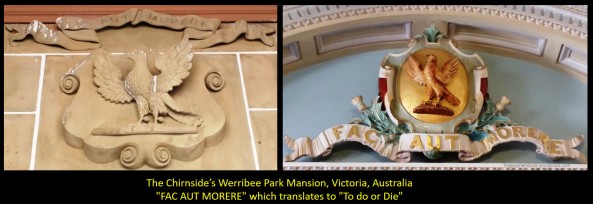
Above the sandstone eagle in a banner above the entrance to Werribee Mansion, and also in gold painted plaster in the vestibule, are the latin words “FAC AUT MORERE” which translates to “To do or Die”. The latter part of the saying dictated the next few years of Chirnside history.

WERRIBEE PARK MANSION 99d

After a long illness, and believing himself bankrupt, Thomas Chirnside shot himself in the laundry of the mansion on the 25th June 1887 [9]. After a lengthy illness, Andrew Chirnside died at his daughters residence at Irrewarra near Colac on the 30th of April 1890 [10].

Six years after Andrew’s death, his widow, Mary (nee Begby), commissioned Ferguson & Urie to create a memorial stained glass window for the Presbyterian Church at Werribee [11]. The Chirnside’s were liberal donors to the church and Thomas had originally donated the land for it. The three light chancel window was eventually erected in 1896 and depicts “The Last Supper” which, whether by design or coincidence, includes the characters St. Thomas and St. Andrew amongst the apostles portrayed in the window.

Mary Chirnside died at Colac aged 80 on the 4th of March 1908 [12]. A report published in the Bacchus Marsh Express [13] stated that she had died at Dr. Brown’s private hospital at Colac as a result of blood poisoning from an earlier knee injury.

By 1922 there was no Chirnside family involvement in the mansion and it was subsequently used as a Catholic Seminary until the Victorian Government acquired it in 1973 and is now managed as a tourist attraction by Parks Victoria.

The Bacchus Marsh Express, Vic, Saturday 14th October 1876, page 2.

“The mansion for Messrs. T. and A. Chirnside, which has been in course of erection for them upon their Werribee park estate, Wyndham, since February, 1874, is now nearly completed, the only work remaining to be done being the fixing of a few mantelpieces, a portion of the grand staircase, and some flagging of the arcade fronting the ground floor of the building. We have given occasional notices of this mansion during the course of its erection, and our readers may probably recollect that it is built of Barrabool freestone principally, so far as the ornamental work is concerned, and of bluestone in the rear portions. The quantity of dressed stonework is immense, an has added very much to the cost of the building and the time occupied in erecting it, and in this stonework lies the great beauty of the building, for nothing can equal the rich grandeur of cut stone, unless it be polished marble. The style of architecture adopted is Ionic, and the general appearance of he building is, so far as one word can convey an idea of it, stately. It will be a pity if an illustration of it is not given in one of the Melbourne illustrated papers, for, in our opinion, it is one of the few buildings in the colony which an architect can look upon with pleasure, especially one who prefers the solid beauties of the old orders of architecture to the more foreign-looking adaptions of the present day, known as Venetian-Gothic, &c. The house consists of a main building, facing the east, with about 100 feet frontage, by the same depth, and two stories high, with a basement beneath and a tower 80 feet high at the main entrance. All round the building and arcade is carried, composed of beautifully-proportioned freestone arches supporting a balcony fronted with the usual Ionic balustrade and cornices, and giving a promenade of 300 feet by 11 feet wide, a promenade of the same dimensions existing below, of course, in the arcade. The balcony is laid with Minton’s encaustic tiles, of elaborate pattern, showing seven colours. Ample and very ingenious provision is made for carrying off the rain water, which flows into a filter in the courtyard, whence it is taken to an immense 40,000 gallons tank, from which it can b pumped to five cisterns placed somewhere in the various roofs of the mansion, and possessing altogether a capacity of 5,000 gallons. Each cistern is provided with a gauge showing its contents, and visible from the central courtyard between the two wings which flank the main building. This courtyard is 40 feet by 80 feet, and could be used for a ballroom by laying down a floor in sections and covering it with an awning. The wings are about 80 feet by 30 feet, and in addition to these, and the main building, there are a billiard room 30 feet by 22 feet and a conservatory 30 feet by 14 feet, besides a number of substantial out-buildings. Returning to the arcade and balcony, it should be mentioned that the ceiling of the arcade is beautifully panelled and painted, and the floor or promenade is laid with Malmsbury rubbed flagging down the centre, with dove and white marble slabs at each side. The tower is of useful proportions, being 14 feet square as high as the roof of the mansion, and the two stories above are 12 feet square. This tower is a work of sculpture more than of masonry, and reflects very great credit indeed upon the artist (Mr. Samuel Peters) who has put so much beautiful work into it. One feature is specially noticeable – namely, the bunches of grapes and vine leave, which stand out from the stone as naturally as though hanging pendent from a vine. Over the main entrance the escutcheon of the Chirnsides is cut out, showing a hawk upon a shield, and the motto “Facaut Morere” (Do or Die!) beneath. This device also appears on each side of the entrance hall, in a portion of the cornice, and upon the centre of the very handsome white marble mantelpiece in the drawing room. From the principal doorway a hall 15 feet by 30 feet and 17 feet high is entered, profusely ornamented with cement work executed by Mr. Mackennal, and to be further embellished with stags’ heads, statues, and hall furniture. The whole of this hall, with a staircase hall beyond, 30 feet by 19 feet, is floored with Minton’s tiles of elaborate and handsomely illuminated pattern, which contrasts well with the snowy whiteness of the cement work of the walls. The doorways hereabout are all massively panelled in polished blackwood, with what are known as pyramid headings, supported on trusses. The staircase hall contains, of course, the grand staircase, which is of polished blackwood, 6 feet 6 inches wide in the central portion, and turning to the right and left to the first floor in 6 feet wide portions. The handrail, and iron-work beneath, are, as may be conjectured, a prominent feature in this part of he house. At the end of the staircase hall there is an immense window, for which Messrs. Fergusson [sic] & Urie are making a quantity of embossed glass, portions of which will contain large figures of St. Andrew and St. George. The portions of the building upon the first floor corresponding with the two halls below will form a picture gallery and museum, and are beautifully ornamented in cement work. In fact wherever the eye rests costly and yet severely chaste decorations are to be seen, and among them some exquisite Corinthian pillars and cornices. Niches have been left for statues, and nothing seems to have been overlooked to add a stately elegance to the general effect, without anything obtrusively gaudy, the embossed glass, for instance, being extremely rich, and freely employed. The domed ceiling to the tower at this floor is beautifully proportioned and embellished. Double doors from it give access to the balcony. To describe the 50 or 60 rooms in the house, exclusive of the basement cellars, would make these remarks too lengthy, although a description of each would show that all contain some special feature reflecting credit upon those who had the designing of them, and here we may say that the contractor for the building 0 Mr. P. Colquhoun – has been the chief designer, assisted by Mr. Fox, architect, and by the Messrs. Chirnside themselves. The dining room and the drawing room are both on the ground floor, and are each 30 feet by 22 feet, exclusive of bay windows 6 feet deep, and of grand proportions and decorations. These rooms have elaborately moulded cornices, and marble mantelpieces of special design. Next to the dining room, and forming part of it if need be, is the breakfast room, 24 feet by 18 feet 6 inches. The passages connecting these rooms with the butler’s department are very conveniently arranged, and several folding doors are provided to shut off the series of kitchen apartments (which are on a lower level) from the principal ground floor. In the same way separate suites of apartments are provided up-stairs for night and day nurseries. All the floors below stairs are laid with 3 inch Oregon boards, forming an exceedingly smooth and firm flooring. Upstairs 2 ½ inch Kauri boards have been used. In several of the principal rooms a 20 inch border has been laid down in polished rosewood and oak parquetry work, which has a noble appearance. All the passages in the house are 6 feet wide and 12 feet high, so that abundant ventilation is given even by this means and there is an appearance of roominess everywhere which is most gratifying, none of the rooms being less than 11 feet high, and the principal ones are 18 feet high. The baths in various parts of the house are most complete, and very numerous, the servants being provided with two. The principal baths are fitted with electric bells, of which there are thirty four altogether, and two speaking tubes. In one of the storeys of the tower there is a smoking room, and upon the top of the tower a 25 feet kauri pine flagstaff is erected, sheathed with copper, to act as a lightening conductor. The staircase in the tower, and the provision made for closing in the head of the stairway, are details which have been attended to with more than ordinary care for the comfort of persons ascending the tower, and for the protection of the building. From the top of the tower a fine view of Melbourne can be obtained, also of the bay, and the various ranges to the west and north. The grounds surrounding the building are at present being brought into cultivation as ornamental shrubbery, &c., by Mr. Webley, the gardener, who has a difficult task, as the soil is poor and the surface is almost dead level. Thirty acres have been laid off for present operations, and the design includes a small lake in the south-eastern corner. A sunk fence will divide the ornamental grounds from the rest of the estate, and a handsome lodge will be erected at the end of the principal carriage drive. Provision has been made for lighting the whole house with gas, which will have to be made somewhere adjacent. The cost of the building alone is estimated at £40,000, and of course a very large sum will be required for properly furnishing it, and improving the grounds surrounding it. We think the Messrs. Chirnside deserve commendation for having spent so much money and time in erecting a building which has given profitable employment for a long time to nearly every branch of he building industry in the colony, and the maintenance of which cannot fail to cause a large annual expenditure. They are frequently abused for being wealthy, as though it were a crime, but they have shown in a variety of ways that they desire to make their wealth of considerable benefit to individuals other than themselves, and to the colony at large, and especially to the neighbourhood in which they have made for themselves a home of such princely proportions”.

Conservation work:

Both sidelights to the front entry door at the mansion are the reproduction artwork of Bruce Hutton of Almond Glass based on the original  designs from the smashed originals in 2012 (The hydrofluoric immersion was conducted in Sydney).
(re: email, Bruce Hutton & Ray Brown 10th April 2013)

Related posts:

1875: Rupertswood Mansion, Sunbury, Victoria.
31-10-1878: Mandeville Hall, Toorak, Victoria.
23-05-1896: Presbyterian Church, Werribee, Victoria.

Other related links:

An album of my recent sepia photos of Werribee Mansion.

Footnotes:

[1] Biography: Andrew Spencer Chirnside (1818-1890) & Thomas Chirnside (1815-1887).

[2] London born and Hamilton based architect and designer, James Henry Fox. He also designed Holy Trinity Church at Coleraine which also has F&U windows.

10-03-1883: St John’s Church, Ballan, Victoria.

The Bacchus Marsh Express, Vic, Saturday 10th March 1883, page 3.

“BALLAN.

(FROM OUR OWN CORRESPONDENT)”

“THE stained glass window in memory of the late Mrs. Ocock has been put in St. John’s church. It is small but very handsome. It represents on one side the figure of the Good Shepherd, holding a lamb in his arms, and on the other, the figure of St. John the Evanjelist. The inscription under the former is “I am the Good Shepherd,” and under the latter “Little children love one another,” and below these “In memoriam, Rebecca Ocock, died 23rd August 1882.” The whole is most tasteful and handsome, and is executed in Ferguson & Urie’s well known style. The window was presented by the relations and connections of the deceased lady”.

Photos dated: 10th April 2011.

This slideshow requires JavaScript.

St John’s Anglican Church is located in Simpson Street Ballan. Tenders for the erection of the Leonard Terry designed church were advertised in March 1860 [1] . Mrs Juliet Vivian Lyon (nee Anderson) laid the foundation stone in 1861 and the church was completed in early 1862 [2]. In March 1883 Ferguson & Urie erected a two light memorial window to the memory of Rebecca Mary Ocock [3] who died at Ballan on the 23rd of August 1882 in her 79th year. She was the wife of well known[4] and respected Ballan Solicitor Richard Ocock who died eleven months after her at Bungeeltap-house, on the 10th of July 1883 aged 79 [5]. They are both buried in the Ballan cemetery. The stained glass window depicts Christ as the Good Shepherd in the left light and St John in the other.

Note: Elizabeth, daughter of Rebecca Mary & Richard O’Cock, married Ballan Councillor Dougald MacPherson and she co-donated the liturgical west stained glass window of St Paul’s Presbyterian Church in Ballan , also created by Ferguson & Urie c.1866. See: 28-07-1866: St Paul’s Presbyterian Church, Ballan, Victoria.

Footnotes:

1870: St Paul’s Anglican Church, Koroit, Victoria.

The foundation stone of St Paul’s Anglican Church at Koroit was laid on the 8th of March 1870 and it contains a Ferguson & Urie three light memorial window in the chancel erected to the memory of Mary, the wife of the first minister of the church, the Rev. Louis A. Baker.

Photos taken: 7th January 2011.

This slideshow requires JavaScript.

The Bacchus Marsh Express, Vic, Saturday 20th April 1889, page 7.

(on the minister, Rev. Louis A. Baker).

…For many years he officiated in the district surrounding Koroit, between Belfast and Warnambool, where he was much beloved  and valued, his name being a household word in that locality to the present day. A stained chancel window in the church, put up to the memory of his first wife, is a lasting memento of the kindly feelings of the people towards himself.”

The three light chancel window was created by Ferguson & Urie of Melbourne, possibly about the time of the churches erection in 1870. The borders of the windows are made up of alternating pieces of stained glass in the primary colours of red and blue with a yellow flower. which are unique to early Ferguson & Urie stained glass windows. In the centre light is a ruby red cross and a gold crown which are entwined by a ribbon that has the text: “I KNOW THAT MY REDEEMER LIVETH” (Job 19-25).

The remainder of the windows are made up of plain diamond quarries and nine groups of four diamond quarries depicting elements of the passion flower in grey and yellow with a surrounding red or pink border.

The memorial text across the bottom of the three lights reads:

“IN MEMORY OF MARY, WIFE OF THE REVD. LOUIS A. BAKER FIRST MINISTER OF THIS CHURCH. DIED 8th APRIL 1865”

The Rev Louis A. Baker, died at the age of 76 on the 13th of April 1889 of Typhoid.

About fifty years after the erection of the window it was subject to vandalism by known delinquents. The extent of the damage at the time is not known, nor who may have made the necessary repairs circa 1914.

Warrnambool Standard, Vic, Thursday, 2nd April 1914, page 2.

“VANDELISM AT KOROIT”.

“There is a set of three beautiful memorial windows at the east end of St. Paul’s Church, Koroit, which were erected to the memory of Mrs. Baker, the wife of the Rev. L. Baker, who was a former incumbent of the church (writes our Koroit correspondent). Last Sunday week the Vicar’s attention was drawn to the fact that four holes had been made in these windows by stone throwing, and last Sunday a number of holes were discovered in the west windows, which consist of small diamond shaped leaded panes. The matter has been placed in the hands of the police, and as it is stated the delinquents are known, a prosecution will shortly follow.”

The Argus, Melbourne, Vic, Wednesday 9th March 1870, page 5.

“WARRNAMBOOL, Tuesday.

The Bishop of Melbourne laid the foundation stone of St. Paul’s Church, Koroit, today, assisted by the Rev’s. Messrs. Baker and Beamish. There was a good attendance of spectators, many of whom came from a considerable distance. The contributions were liberal, and the ceremony was completely successful. It will be a stone building, in the early English style of Gothic architecture, after designs drawn by Mr. Rawlinson, the architect.”

Bendigo Advertiser, Vic, Friday 25th March 1870, page 2.

“A SACRILEGIOUS THIEF.- Some mischievous fellow has had the audacity to remove the foundation stone of St. Paul’s Church, Koroit, recently laid by the Bishop of Melbourne. This occurred on the morning of Friday last, when it was discovered that the stone had been removed, the cavity opened, the bottle extracted, and the contents, namely, the scroll and newspapers, cast on one side. These are now in the possession of the trustees. It was thought by some (states the Warrnambool Advertiser) to be either a malicious act, or one committed during a drunken bout; but the officers of the church believe that it was done by a loafing scoundrel who hoped to find some coins deposited in the bottle under the stone, but who had his trouble for nothing.”

Kilmore Free Press, Vic, Thursday 29th December 1870, page 2.

“A DISGRCEFUL SCENE IN A CHURCH;

[From the Banner of Belfast.]

On Tuesday last the building committee of the Presbyterian Church at Koroit held a meeting to consider tenders for the erection of a new church, there being present amongst others the Rev Mr. Adams, Mr Officer (mayor), and a Mr. Wilson. Mr Officer, in a fiery oration, objected to the acceptance of tenders, reviewing the impecunious condition of the district, and considering that the necessary funds could not be raised. The Rev Mr Adams, in reply to the mayor, said that some of his (the mayor’s) statements were true, and some were not true. This brought the mayor to his legs. He demanded of the Rev Mr Adams to know which of his statements were untrue; he would not submit to be called a liar, and in a very intemperate speech, in which he was frequently called to order, assailed the Rev Mr Adams, Mr Wilson, and by implication other members of the congregation. Mr Wilson, with some warmth, defended the Rev Mr Adams. He repelled the mayor’s assertions generally, and retorted with some effect on his exaggerated notions of his own importance. On this the mayor dashed his hat aside, and jumping over the seats laid violent hold of Mr Wilson by the neck with both hands, Mr Wilson making such effective resistance as he was able, and using such force and violence as he was justified in using under the circumstances. The mayor’s object was apparently to have the fight outside the church, but it was precipitated by his violence, and his mayoral dignity, unrespected by himself, was not sufficient to protect him from the hands of Wilson, or from a severe hauling from other members of committee who naturally felt indignant at the desecration of the church, and endeavored to separate the combatants before much damage was done to either, or many blows exchanged. The committee of course adjourned, and the Rev Mr Adams intimated his intention of resigning, and bringing under notice of the congregation from the pulpit the indignity to which he and the other members of the committee were subjected by the ruffianly conduct of he mayor. The feeling in Koroit, and especially among the Presbyterian body, is, as may be determined, one of a mitigated disgust at the conduct of one who has brought so much disgrace on them. Mr Wilson intends to take out a summons for assault against the Mayor”.


Short link to this page: https://wp.me/p28nLD-1kt

© Copyright

28-07-1866: St Paul’s Presbyterian Church, Ballan, Victoria.

The Bacchus Marsh Express, Vic, Saturday 28th July 1866, page 2.

THE OPENING OF THE NEW PRESBYTERIAN CHURCH, BALLAN”.

“SABBATH last brought with it the long-looked-for day of opening of this beautiful Church. The new building is, perhaps, the most prominent, as it is certainly the finest erection in this rising township. The style of architecture is modern Gothic. The building is of bluestone rubble, every alternate stone having a four inch sneck, and is neatly tuck-pointed. It stands on a base two feet high, while the outer walls are supported by twenty abutments of freestone, with small bluestone snecks let in, and finished at the tops with two weatherings. The fine large window in front of the edifice consists of freestone reveals and arches, and is divided by two mullions nine feet high, being finished in the same way both externally and internally. There are also eleven other windows, while the whole is surmounted by an exceedingly chaste spire, which rises to a considerable height. The spire is likewise built of mixed blue and freestone, which is carried up sixteen feet square, at which point commences an octagon tower, perforated with eight windows four feet high, the interior of which forms the bell-tower. Immediately above the bell-tower stands a circle of freestone moulding, which is destined to receive a very handsome clock. Attached to the main building is a vestry, divided into two rooms, the whole edifice being finished by a freestone water-table. The building occupies a commanding situation, and the effect is altogether very pleasing, as the eye first rests upon it. Unlike many colonial buildings, whether public or private, the new church will bear the closest scrutiny. The grounds have been securely and handsomely fenced in, while great taste and skill have been displayed in laying them out, and planting them with choice trees. The same care and taste which is visible in the exterior of the building, is observable in the furnishing and decorating of the interior. Here all is comfort and elegance. On entering, the first thing which strikes the eye is the highly-elaborate way in which the windows have been filled in with stained glass. They were furnished by Messrs. Fergusson [sic] and Urie, of North Melbourne. With one exception, we question if any building in the colony, whether ecclesiastical or otherwise, will compare in this respect with the new Church in Ballan. The large triple window in front is exceedingly rich, and is the gift of three ladies belonging to the congregation – Mrs. Dugald McPherson of Bungeeltap, Mrs. Peter Inglis of Ingliston, and Mrs. John Edols of Mount Dariwell. The pulpit is of red cedar, elaborately carved, and is surrounded by a rail, supported on twisted pillars, within which stands the desk and chair for use of the precentor. The church is lighted by two bronze chandeliers suspended from the lofty arched ceiling, each bearing four large lights. But to realise the beauty and effect of the whole, one must be present when the noonday sun is streaming through the large triple window which faces the pulpit; then the various windows are seen in all their exquisite beauty of finish and colour. Of course the finest of all is the centre-piece of the large centre window. On an Egyptian scroll which winds round the delicate tendrils of the red rose of Albion, so much celebrated and esteemed by the crusaders of the Holy Wars, there is inscribed these appropriate words of Holy Writ, “I am the Way, and the Truth, and the Life.” We may notice, as a matter of paramount importance in a building designed for public worship, that its acoustic properties are perfect. It is seldom that so complete a public building is seen, and too high praise cannot be accorded to the Presbyterians of Ballan for the spirit and liberality which they have manifested in this undertaking. To the ladies who throughout have manifested such an unwearied interest, great praise is due. It is, perhaps, slightly invidious to mention further any names, where so many have been characterised by such activity and generosity, but we think that all will unite with us in testifying to the special liberality and zeal displayed by the following gentlemen:- Dugald McPherson, Esq., J.P., whose munificence has been of a princely nature, and to whom, more than all others, the Presbyterians in Ballan are indebted for this truly handsome erection; Peter Inglis, Esq., J.P., who from the first has shown the warmest interest in the undertaking, and who, we believe, was the first to head the list with a subscription of £100; Walter Duncan, Esq., J.P., who has been the friend and treasurer of the congregation from the beginning of its history. It is exceedingly gratifying and hopeful to see gentlemen of high character and social standing identifying themselves with the cause, as these and others like them are doing.”

Photos taken: 29th December 2010.

This slideshow requires JavaScript.

The memorial text at the base of the liturgical west three light window has the names of each of the donors:
“Ye gift of Mrs John Edols AD 1866″ | “Ye gift of Mrs Dugald Macpherson AD 1866″ | “Ye gift of Mrs Peter Inglis AD 1866″

The Donors:

Edols:

Mrs John Edols (Margaret, nee Brown) was the wife of John Edols Esq., of Dariwell Park, John was appointed as a trustee[1] of the Ballan Race track and recreational reserve in July 1860, along with Dugald MacPherson and others and also acted as a steward[2] at the Ballan racing events. Margaret died[3] at “Ingliston” on the 17th of September 1872 and was buried in the Melbourne General Cemetery on the 19th of September 1872 [4]. (there is no known gravestone recorded).  John Edols left the Ballan area circa 1888 and died at “Bryan O’Lynn”, near Warrnambool on the 28th December 1888 [5] He was buried at the Tower Hill Cemetery (a gravestone still exists).

MacPherson:

Mrs Dugald MacPherson was Mary Elizabeth MacPherson (nee O’Cock), wife of Ballan Councillor Dugald Macpherson (1820-1901) of Bungeeltap. She died at ‘Bungeeltap-house’ at Ballan in August 1916 and was buried at the Ballan New Cemetery on Wednesday 16th August 1916[6]. Dugald MacPherson died at Bungeeltap, Ballan, on the 20th of October 1901 aged 81 [7] . The Macpherson family grave still exists at the Ballan cemetery but the memorial writing is nearly impossible to read.

External Links:

Museum Victoria: Dugald Macpherson (1820-1901)

Gordon, Egerton and Ballan Advertiser, Vic, Friday 25th August 1916, page 4.

“The late Mrs Macpherson, of Bangeeltap, whose death was reported in last week’s Adverister, was a native of Exeter, England, and a daughter of the late Mr Richard Ocock, solicitor, Ballan. She was married at St Kilda in 1852, and spent the first 2 years of her married life in the Wimmera, and was the first white woman to go to that part of Victoria, which was then inhabited by aboriginies. In 1854, Mr Macpherson, (who died 16 years ago) having purchased Bangeeltap [sic], Mrs Macpherson went there to live, where she resided till her death. Eight sons and five daughters were born at Bangeeltap. During her 62 years residence at Bangeeltap Mrs Macpherson had many and varied experiences, one of which was a corroboree amongst the blacks, which she witnessed. She was one of the first members of the Ballan Presbyterian church, laid the foundation stone, presented a large window, and with her husband was a most liberal supporter for many years. The Rev E. J. Welsh conducted an In Memoriam service in the church on Sunday last. The service was largely attended by many friends of the deceased lady”.

Note: Her mother, Rebecca Mary O’Cock, also has a stained glass window by the Ferguson & Urie Company which was erected in St John’s Anglican Church in Ballan in 1883.

See: 10-03-1883: St John’s Church, Ballan, Victoria.

Inglis:

Mrs Peter Inglis, wife of Ballarat magistrate, Peter Inglis (1796-1869, a native of Glasgow) of Ingliston, near Ballan. Peter Inglis died on the 6th of July 1869, aged 73 [8]. There are also ‘Inglis’ streets in Ballan, Buninyong, and Warrenheip named after the family. The Inglis family memorial exists at the Ballan Cemetery but the text for Peter Inglis side of the memorial has almost faded completely.

Excerpt, HISTORY OF BALLARAT, page 6

In the year 1843, Mr. Peter Inglis, who had a station at Ballan, took up the Warrenheip run, and shortly after that purchased the Lal Lal station, and throwing them both together, grazed on the united runs one of the largest herds in the colony. The western boundary of Mr. Inglis’ Warrenheip run marched with the eastern boundary of Mr. Yuille’s run, the line being struck by marked trees running from Mount Buninyong across Brown Hill to Slaty Creek. Mr. Donald Stewart, now of Buninyong, was stock-rider for Mr. Inglis, on the Warrenheip and Lal Lal stations, and superintendent during the minority of the present owner of Lal Lal”

Minor mention in Biography of: Archibald Fisken (1827-1907)

Obituaries for Peter Inglis.

1. The Argus, Melbourne, Vic, Monday 12th July 1869, page 5.

2. Obituaries Australia

Related posts:  22-07-186613-08-1867

Foot notes:


[8] The Argus, Melbourne, Vic, Thursday 8th July 1869, page 4.


Short link to this page: https://wp.me/p28nLD-1jZ

© Copyright

23-05-1896: Presbyterian Church, Werribee, Victoria.

Thomas Chirnside donated the land for the Presbyterian church in Werribee and on the 5th of February 1884 he laid the foundation stone of the bluestone Church, to be known as St. Thomas the Apostle.

Believing himself to be bankrupt, Thomas Chirnside shot himself in the laundry of Werribee Mansion in 1887. His brother Andrew died in 1890. In August 1895 Andrew’s widow, Mary (nee Begby), commissioned Ferguson & Urie, of Franklin-street Melbourne, to create a three light stained glass window to be erected in their memory at the east end of the church. The window was erected ten months later, in June 1896, and depicts the Last Supper.

Whether by coincidence or design, the Last Supper window contains the apostles “St Thomas” and “St Andrew”.

The Church is now known as the Cross Roads Uniting Church.

Photos dated: 30th December 2010.

This slideshow requires JavaScript.

The Bacchus Marsh Express, Vic, Saturday 23rd May 1896, page 4.

“Messrs. Ferguson & Urie have been busy this week placing a handsome stained glass memorial window in the Presbyterian church here. The work was ordered last August by Mrs. Andrew Chirnside, senior, Werribee Park. Further particulars will be given next week.”

The Bacchus Marsh Express, Vic, Saturday 13th June 1896, page 3.

“A memorial window recently placed in the Presbyterian Church at Werribee by Messrs. Ferguson & Urie, of Melbourne, to the order of Mrs. Andrew Chirnside, Werribee Park, is an admirable piece of stained glass art. The pictorial subject chosen – The Lord’s Supper – fills the three panels of the large gable window of the Church. The centre panel contains three figures, our Lord in the central and prominent place, and the two apostles, Peter and John, on His right hand and left hand respectively. Each of the two side panels contains the figures of five apostles, suitably grouped at each end of the table. Above the principal picture, filling the sharp-pointed arches of the three panels, are placed the figures of three cherubs or angels, the two side ones bearing scrolls with the inscription “Alleluia” thereon, while the bottom parts of the three panels contain, as emblems, a few heads of wheat, and bunches of vine leaves and grapes. The scroll work filling the large arch of the window itself is also suitable stained, with a larger cherub of angel in the centre bearing the inscription “Alleluia.”  The whole effect of the window, particularly the principal picture, as seen from the centre of the church, in the soft morning light, is very pleasing, the colouring being at once rich and chaste. The scene of the picture is particularly natural, and the various details thoroughly in keeping with the subject. The picture represents that particular historical moment when our Lord began to institute the supper, and just as Judas, to whom He had said, “That thou doest do quickly,” was leaving the room to arrange for the betrayal. Judas’ vacant seat, containing his discarded robe, is seen at the side of the table, directly opposite where our Lord is seated; while in the background is seen Judas himself making for the door, with the money-bag grasped tightly in his right hand, and with the usual imaginary “nimbus” gradually fading away from his head. The other Apostles grouped round the table have their eyes directed towards our Lord, who has in his left hand a loaf of bread, and is supposed to be saying, as he points to the bread with his right hand. “This is my body, &c.” While John the beloved disciple, is seen with his hand leaning on Jesus’ breast. At the right and left corners of the table respectively are seen Andrew and Thomas (the former indicated by his age, as having been one of the first to follow Jesus, and the latter by the parted forefingers, referring to his expressed intention to test our Lord’s wounds.) According to the perspective of the picture, and the prominent positions assigned to Andrew and Thomas (being nearest the spectator) it is a somewhat remarkable undesigned coincidence that the deceased gentlemen, to whose memory this memorial window has been inserted in the church which they themselves had built, should have born the same names as those of these apostles – namely the late Messrs. Andrew and Thomas Chirnside. When taken into consideration along with the many other benefits which Mrs. Chirnside has so generously bestowed upon the church and congregation during the past year, this handsome memorial window ought to call forth heartfelt appreciation of the Presbyterian community throughout the Werribee district, and this appreciation could best be shown by increased attendance at the services, and increased interest in the work of the church generally.”

Related posts:

1876: Werribee Park Mansion.
1897: Storm damages Presbyterian church window

External References:

Biography: Thomas Chirnside (1815-1887), and Andrew Spencer Chirnside (1818-1890).


Short link to this page: https://wp.me/p28nLD-1jd

© Copyright

20-07-1872: St James Church, Drysdale, Victoria.

St James Church at Drysdale was constructed between 1871-72 with bricks donated, and made locally in Portarlington, by Thomas Henry Widdicombe. The architect was Andrew McWilliams from Geelong

The first stained glass window to be erected in the church by Ferguson & Urie was the three-light chancel window in 1872 and subscribed for by the parishioners. Twenty years later, in 1892. the single light memorial window to John Drake and his wife Susannah Tomazin (nee Avery) was erected by their family.

Photos dated: 14th October 2012.

This slideshow requires JavaScript.

[View larger images]

The Argus, Melbourne, Vic, Saturday 20th July 1872, page 5.

“A handsome little place of worship, designated St. James’s Church, and situated about a quarter of a mile from the township of Drysdale, is to be opened to-morrow by the Right Rev. the Bishop of Melbourne. The building is in the pointed Gothic style, with lancet windows, having a tower on the south-west gable and finished pinnacles. The walls are built of bricks made by Mr. Widdicombe, of Drysdale, and the dressings are of white pressed bricks from the same maker. The chancel and vestry are on the north-east side of the building, the whole presenting the appearance of a fine little country church. In the chancel is placed a beautifully curved stained-glass window, the chief subject presented being the four Mary’s at the tomb. The nave lights are of yellow-tinted cathedral glass. The table, reading-desk, chairs, &c., are of Gothic pattern, and varnished. The platform for the harmonium is elevated, and has a neat painted screen, upon which is painted the words “Let all the earth praise the Lord.” Upon the walls and other parts of the interior are inscribed other appropriate texts from the scriptures. The building was designed by and erected under the supervision of Mr. McWilliams, architect, of Drysdale.”

Geelong Advertiser, Vic, Wednesday 8th October 1873, page 3.

“…,The stained window in the chancel has the centre piece, the women at the tomb after the Resurrection, and the words “He is not here, He is risen,” underneath. The nave windows are filled with thick cathedral and colored glass. The whole work is tasty and reflects credit on the congregation…”

In 1892 another Ferguson & Urie single light window was erected in the south wall of the nave to the memory of the Drake family:

The Church of England Messenger for Victoria and Ecclesiastical Gazette for the Diocese of Melbourne. No.289 Vol.XXIV Melbourne November 4, 1892, page 191.

Drysdale.  ‘A very handsome stained-glass memorial window has been placed in St. James’ Church, Drysdale.  The subject of the window is “The Raising of Lazarus”, and a special service to inaugurate the opening of the window was conducted by the Rev, S.C. Kent on Sunday October 16th.  The text on the window (John XI. 43-44) formed the subject of an interesting and instructive sermon.  There was a large congregation, both morning and evening.  The inscription on the window is –To the Glory of God, and in memory of Mr. and Mrs. John Drake. Erected by their family. The work was executed by Messrs. Ferguson & Urie.

John Drake (1828-1892) was born in Devonshire, England, to William Drake and Mary Pillar. He married Susannah Tomazin Avery (1827-1887) in Devonshire circa 1852 and they emigrated to Australia sometime between 1852-54. They took up farming on the Bellarine Peninsula near Drysdale and had a further six known children between 1857 and 1867. Many of their descendants still reside in the area to this day.

Susanna died on the 11th of July 1887 at the age of 60 and John died in at the age of 64 on the 24th April 1892. On October the 16th 1892, the stained glass window by Ferguson & Urie was unveiled to their memory in St James Church in Drysdale by their children. Based on the glass painting style I suspect this window was painted by Charles William Hardess who began his apprenticeship with Ferguson & Urie as a boy.


Short link to this page: http://wp.me/p28nLD-1iN

© Copyright

18-08-1951: Zeerust/Glenferrie Mansion, Malvern, Victoria.

‘Zeerust’ mansion had its origins as ‘Glenferrie’, originally a parcel of land purchased by solicitor, Peter Ferrie[1], circa 1841. In 1864-65 the property came into the hands of James Fergusson[2] M.L.A, a partner in the firms, Fergusson and Mitchell, stationers, and Ferguson & Moore. Fergusson built a two storey mansion on the site circa 1870’s and as part of the embellishments, he commissioned the Melbourne stained glass firm ‘Ferguson & Urie’ to create a magnificent stained glass stairwell window of about 3.5 x 2 meters wide. The window depicted scenes of Pastoral, Printing, Shipping, Mining, Agriculture, Commerce, Railways, and Farming. The Fergusson clan coat of arms was depicted below the central panel with the knight’s helmet, three Boars heads, and Buckle, and the Fergusson clan motto “Dulcius Ex Asperis” (Sweeter after difficulties).  At the apex of the window, flanked by a Kangaroo and an Emu, was the early Colonial Australian Coat of Arms with the text below “Advance Australia”.

Photos taken: 10th May 2011.

This slideshow requires JavaScript.

On the 15 of April 1905, Estate agents W. L. Baillieu & Co auctioned the estate and subdivision allotments, and the mansion known as ‘Glenferrie House’ was purchased by George Stevenson (1831-1907)[3], a wealthy clothing manufacturer who held various trade positions including President of the Melbourne Chamber of Commerce.

Stevenson re-named ‘Glenferrie’ to ‘Zeerust’ and he died two years later in 1907[4]. His wife Amy (1838-1911) [5] retained the property and further subdivision of the estate occurred for many year after[6]. When Amy died in 1911 the property passed to the children and in 1914 further subdivisions occurred as well as the attempted sale of the mansion[7]. The Stevenson’s three surviving daughters eventually retained the estate until 1951 and then sold the mansion and remaining property at auction and the mansion was demolished in 1954.

The Ferguson & Urie stained glass window survived, and was installed in a house in Kooyong in the 1970’s. Mr Richard Price donated the window to the Melbourne Museum in 2001 where it was meticulously restored by the Geoffrey Wallace studio and mounted in its own frame for display in the Australiana collection at the Museum.

The Argus, Melbourne, Saturday 18th August 1951, page 7.

“Wrecker’s pick hangs over this old home”.

“ZEERUST,” one of Melbourne’s oldest mansion homes, is to be auctioned-and probably demolished. Ninety years ago its main gates were show pieces so imposing that during the last war they were bought to front the Springvale Cemetery. The old place has given ground slowly-and literally. Once it stood in wide Kooyong acres, touching Toorak rd. to the south, Glenferrie rd. to the west, and Gardiner’s Creek to the north. But down the years its grounds have been subdivided for home sites. Now all that’s left probably will be parcelled out for flats. The first owner built big for a purpose-a kitchen fit for a country hotel and a dining room 84ft. by 24ft.-you could put a villa into it. He had hopes of entertaining the late Duke of Edinburgh, who visited Melbourne in 1865. But the Duke didn’t come to Zeerust.  The late Mr. George Stevenson, of L. Stevenson and Sons, Flinders lane, bought the mansion about 50 years ago. His daughters, Misses. Gertrude, MabeI, and Myra Stevenson, own it now. Yesterday they were busy sorting out furniture and decorations to take to a new and smaller house. It was a hard task. Miss Gertrude Stevenson showed an “Argus” photographer stained glass windows (below, right), a solid brass bedstead with brass canopy and laced tester (centre, below), and antiques in Victorian profusion (left, below). Light from the stained glass tinted family portraits. But the hardest thing of all for the Misses Stevenson to leave may be the sight of the Yarra Valley and Hawthorn, commanded by the top windows in the picture left”.

The Argus, Melbourne, Vic, Tuesday 12th October 1937, page 10.

“Stonnington.

“Sir, – I was greatly interested in your article published last Wednesday dealing with Stonnington and the neighbourhood and Mr. J. B. McLeans’s reminiscences, but would like to point out that the James Ferguson mentioned was James Fergusson (note the double “s” in the spelling), who was the senior partner in the firms of Fergusson and Mitchell and Fergusson and Moore (not Muries). Fergusson and Mitchell had a stationer’s shop in Collins street, near Drummond’s, the jeweller’s, not Elizabeth street. James Fergusson was for some years a member of the Legislative Assembly, representing South Bourke, which included Malvern. His house in Glenferrie road, now occupied by the Misses Stevenson, was named Glenferrie, and, I understand, is of German renaissance style of architecture. – Yours, &c. HERBERT KONG-MENG, Longwood.”

The Argus, Melbourne, Vic, Thursday 14th October 1937, page 10.

“Stonnington

“Sir, – I was very interested in your article on the homes in Glenferrie road. My uncle, James Fergusson, purchased the property at the corner of Glenferrie and Toorak roads extending to Gardiner’s Creek in each road, containing 60 acres, in 1865 for £4,500. The dwelling, which was built in the ‘70’s, was called “Glenferrie,” and faces north-east; it is now called “Zeerust,” with entrance from Monaro road. In 1881 my uncle was offered £30,000 for the property, and in 1888 refused £100,000 for it. This was after the Glen Iris railway had passed through the estate, and Kooyong station was built on the property. After the land boom had burst the property was offered for £15,000, without finding a purchaser. – Yours, &c., A. M. FERGUSSON. East Hawthorn.”

Related posts: Dr Richard Gillespie talks about the ‘Glenferrie’ window at the Melbourne Museum.

Footnotes:

[1] The Argus, Melbourne, Vic, Monday 4th January 1869, page 4.
“FERRIE.- On the 5th November, at 64 Harley street, Cavendish-square, London, Peter Ferrie, Esq., of Blairtumach, Glasgow, and late of Glen Ferrie, Toorak”.

[2] The Argus, Melbourne, VIC, Wednesday 4th April 1888, page 1.
“FERGUSSON.-On the 3rd inst., at Glenferrie, Malvern, James Fergusson, aged 59 years, of the firm Fergusson and Mitchell”. Buried at Boroondarra Cemetery, Kew, 5th April 1888.

[3] Stevenson also built the mansion ‘Trawalla’ in Toorak which also still has a magnificent stained glass window in the stairwell by Ferguson & Urie.

[4] The Argus, Melbourne, VIC, Monday 14th October 1907, page 1.
“STEVENSON.- On the 13th October, at Melbourne, George Stevenson, of “Zeerust,” Malvern, the dearly beloved husband of Amy Stevenson, in his 76th year.”

Short link to this page: https://wp.me/p28nLD-1hP

15-07-1862: Mr Robson’s Shop, Ballarat, Victoria.

The Star, Ballarat, VIC, Tuesday 15th July 1862, page 2.

“In the window of Mr Robson, the painter and decorator, Sturt street, is a stained glass centrepiece of a window, the subject being the Crucifixion. The picture is best seen from inside the shop, and worth looking at. The colouring is clear and brilliant, and the shading well managed. Messrs Ferguson and Co., of Melbourne, are the producers of the work.”

Nothing further is known as to where this window may have been eventually erected, if at all. Although there are other windows in the Ballarat area by Ferguson & Urie, there is not enough information to place this feeble description to any particular window known in that region for the date period.

Thomas Robson was well known as the Ballarat agent for Ferguson & Urie Stained Glass and instrumental in the commissioning of the chancel window for St Paul’s Church in Bakery Hill, Ballarat.

In January 1867 Robson was declared insolvent due to losses by fire and bad debts.

Related posts:

29-03-1862 > 14-04-1862 > 19-05-1862 > 04-06-1862 > 24-06-1862 > 15-07-1862 > 01-03-1863 > 07-08-1863


Short link to this page: https://wp.me/p28nLD-1hK

© Copyright

26-08-1876: St John’s Church, Wagga Wagga, New South Wales.

Australian Town and Country Journal, Saturday 26th August 1876, page 10.

 “WAGGA WAGGA”

 “…A very handsome and costly window has just been added to the new building of St. John’s Church. It was presented by Mrs. H. S. Moxham, and was designed by Messrs. Fergusson [sic] and Urie, of Melbourne…”

Photo taken circa 1990’s. Thanks to Dr. Bronwyn Hughes, September 2012.

This slideshow requires JavaScript.

External links:

St John’s Anglican Church, Wagga Wagga, New South Wales (photo from Wikipedia Commons)

Short link to this page: https://wp.me/p28nLD-1hC
S.SSh
© Copyright