1894: St Mary’s Anglican Church, Balmoral, Victoria.

After 1894, finding extant stained-glass windows created by the historic stained-glass firm Ferguson & Urie of North Melbourne is rare. A mention of one of their windows at St Mary’s Anglican Church in the tiny township of Balmoral is a significant bonus for my research of the company.

Balmoral is a tiny town 73km northeast of Casterton and 80km South of Horsham in Western Victoria. It was settled in the early 1850s and today its population is under 300.

Caroline Armytage[1], the wife of Charles Henry Armytage laid the foundation stone of St Mary’s Anglican Church at Balmoral on the 27th of September 1894 [2] and the Bishop of Ballarat officially opened it on the 24th of January 1895. An account of the church furnishings and fittings was chronicled in detail but there was only a brief mention of the stained-glass window in the chancel;

“… a chancel in early English style, with handsome triple east window (presented by the Armytage family in memory of the late C. Armytage, Esq., of Fulham), by Ferguson and Urie…” [3]

There was no indication of what the window depicted so that just left me a mystery and enough curiosity to undertake a 260-kilometer trip to see if it still existed and if so, what was in it?

The date of the tabloid article indicates the window was likely made in late 1894. The Ferguson & Urie company closed in late December 1899, so finding extant examples of their stained glass in this period their final decade is rare.

At the time the Balmoral window was made, the original founders of the company had died. James Urie, in 1890 and James Ferguson, in 1894. The company was then in the hands of their sons, James Ferguson Jnr and William Urie. Neither founders nor their sons were stained-glass artists in the company, so at this late stage in the company’s history, identifying which of the firm’s remaining stained-glass artists who may have had a hand in the design and painting of the windows becomes vague.

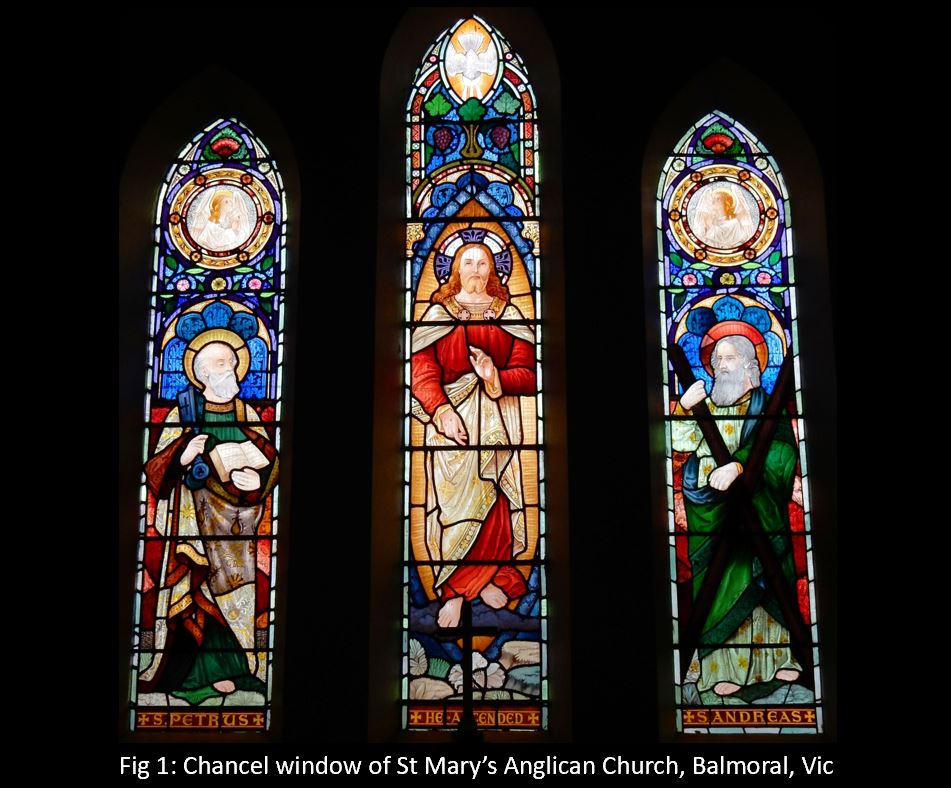
We visited Balmoral in August 2017 to see the window at St Mary’s. The three-light window is the only stained glass in the church, others are generic lead-light.

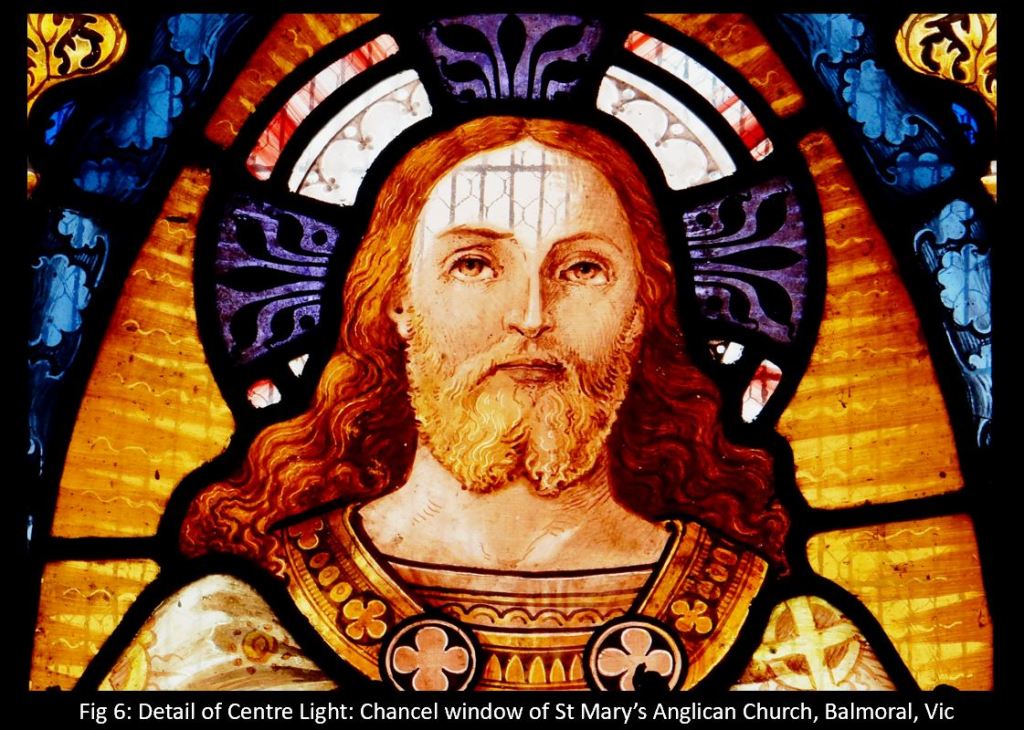
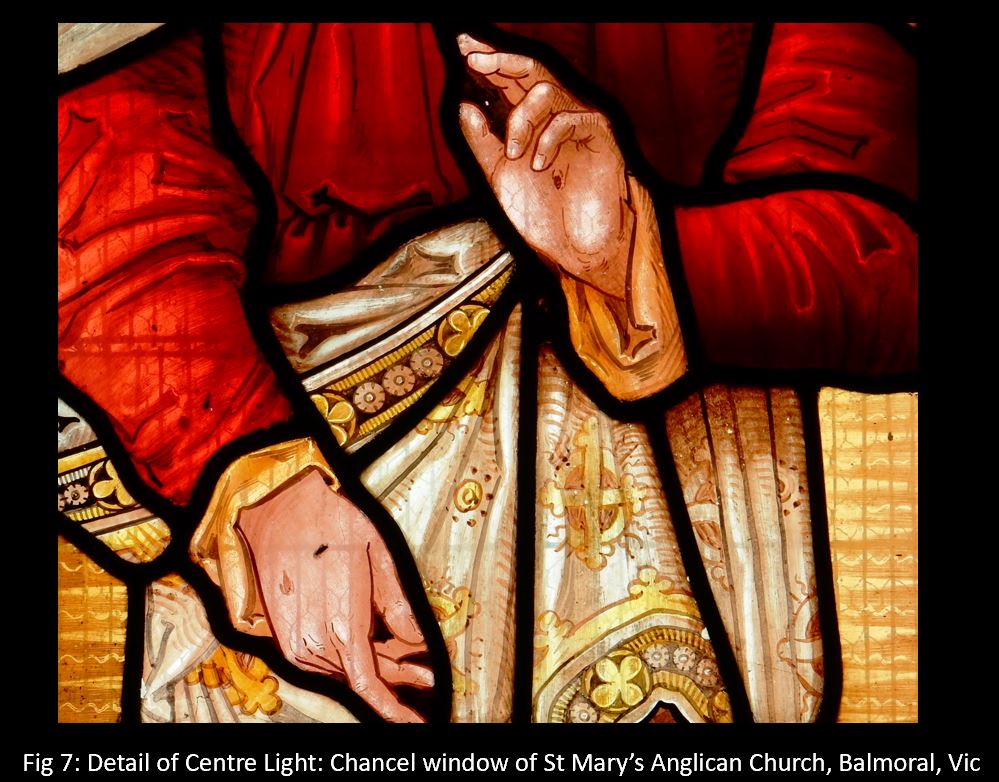
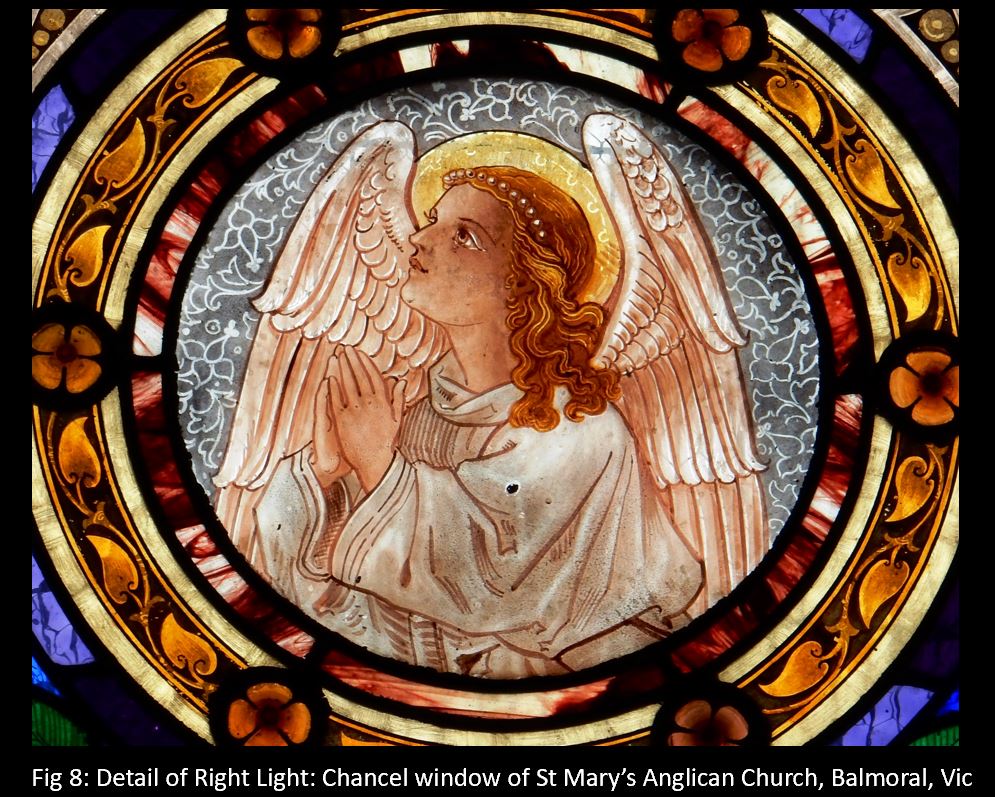
From left to right the window depicts St Peter, Christ, and St Andrew. There is no doubt it was a Ferguson & Urie window, but the figurative depictions of St Peter, Christ, and St Andrew were very different.  

The company’s early figurative style is easily recognisable in the period of their first two stained-glass artists with the company, John Lamb Lyon [4] (from 1861 to 1873), and David Relph Drape [5] (from 1863 until his death 1882). Windows made after Drape’s death in 1882 leave some mystery as to who the artists may have been.

Dr. Bronwyn Hughes OAM proposed that the Balmoral window could be the work of stained glass artist Herbert Moesbury Smyrk [6].

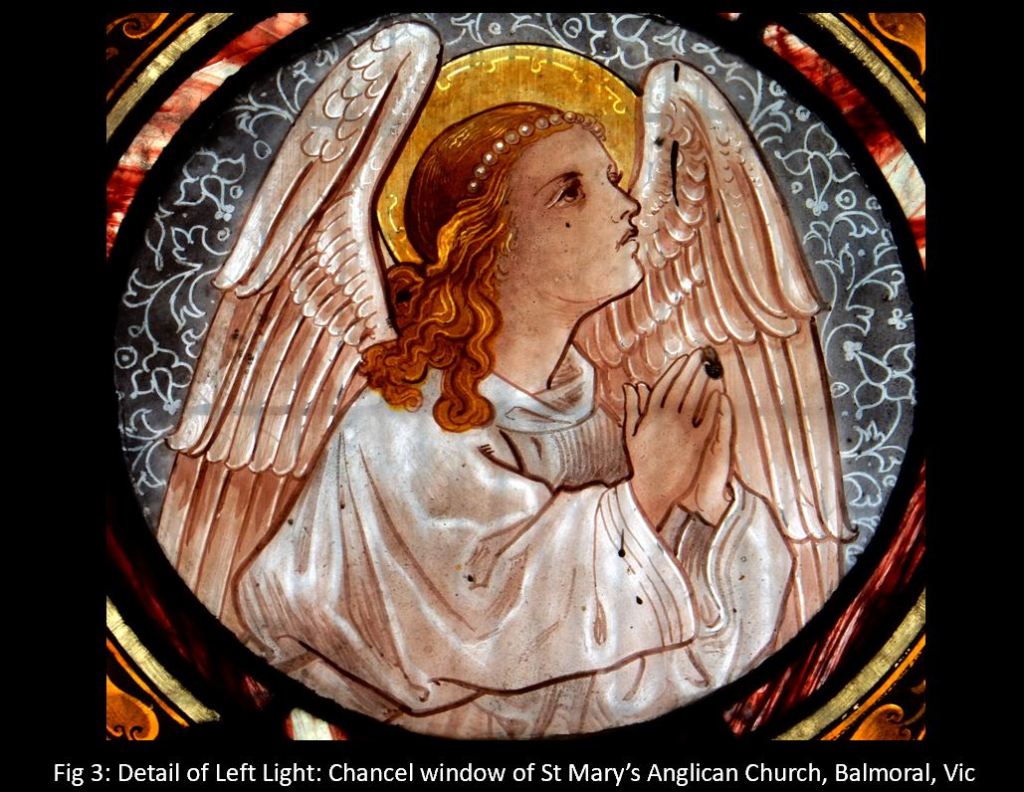
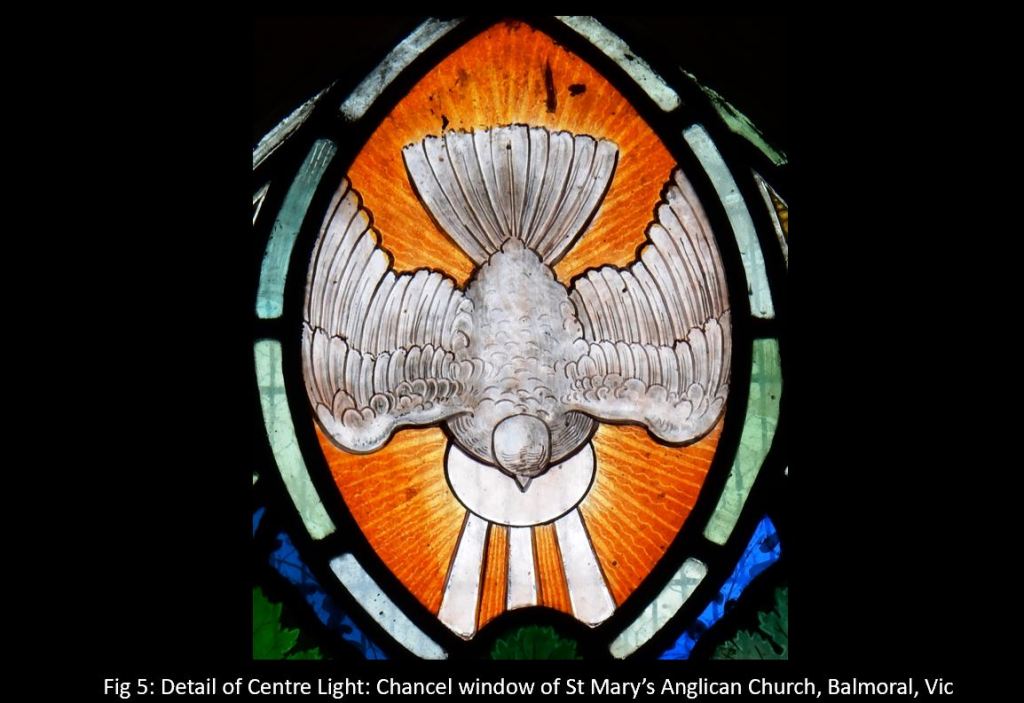
Whilst many parts of the window are typical of Ferguson & Urie’s company style, the figurative work in the faces of St Peter, Christ, and St Andrew are quite different. Smyrk’s painting style is very delicate and he was quite prolific at using the traditional silver stain to create varying shades from light yellow to deep gold. Some parts of his figurative images let through a lot of light which wasn’t prevalent in early Ferguson & Urie windows created in the Lyon and Drape era. A further study of my photo collection of stained glass windows in this same period has now revealed more of Smyrk’s style under the guise of Ferguson & Urie, and many other windows created during his time with Ferguson & Urie are now attributed to him. 

Positive evidence of Smyrk’s association with Ferguson & Urie is revealed in February 1896 when a memorial stained-glass window, dedicated to Councillor William Ievers MLA, was erected in St George’s church (now part of Corpus Christie) at Carlton. The window was executed by Ferguson & Urie and Smyrk was named as the designer [7]. The church was gutted by fire in 1924 and none of the original windows survived [8]

An obscure article in May 1896 provides further evidence of Smyrk’s connection to Ferguson & Urie when he writes to the editor of The Herald about the rules of Cricket. He signs off as; “H. Smyrk. 100 Franklin Street, 2nd May”. That address was the Ferguson & Urie Franklin Street Warehouse which they occupied in mid-1891.[9]

The window at St Mary’s, Balmoral has no memorial inscription on it but a nearby brass plaque records that it is dedicated to Charles Henry Armytage:

“In Loving Memory of Charles Henry Armytage, Died 26th April 1876”.

The Armytage family name is probably more well known to Melburnians for their period of ownership of the heritage-listed “Como House” in South Yarra where Charles died in 1876 [10]. It’s likely that his wife Caroline would have been the instigator for the erection of the stained-glass window at St Mary’s at Balmoral. It was also the first church to be built in the district.

Charles’ estate of £120,000 was left to his wife Caroline[11] with other complex divisions and trusts for his children. As was usual of the time, his will included archaic conditions that if Caroline remarried, her future husband could have no control of any of her estate, and nor would Caroline be liable for any future husband’s debts.

Image gallery:

Stained Glass Artists – Herbert Moesbury Smyrk 1861-1947:

Smyrk, seems to have passed through nearly every major Stained glass company in Australia between 1884 and 1947. His prolific association with so many companies makes attribution to his work very difficult.

Smyrk was born in Guildford, Surrey, England. At the age of fourteen was selected from hundreds of art students to be apprenticed to Powell and Shellard[12] as a stained glass artist and designer. [13]

On completion of his apprenticeship circa 1881, Smyrk stowed away on the ship ‘Queen’ at St Catherine’s docks in London which was bound for America. He began designing and painting windows for firms in New York and San Francisco. In 1884 he came out to Australia where he joined Brooks, Robinson & Co., in Melbourne.[14]

By March 1886 he was a partner of the Smyrk & Rogers stained glass company in Melbourne with Charles Rogers. That partnership was dissolved in September 1888 [15] and he returned to London to work with William Morris & Co.[16]

In later years, between many trips back to England, and America, and some years living a nomadic life in Tahiti, he returned to Australia where he designed and painted for Australian firms such as Ferguson & Urie in North Melbourne, E. F. Troy in Adelaide, Barnett Bros in Perth, R. S. Exton in Brisbane, James Sandy & Co in Sydney, and Frank G. O’Brien Ltd., at Waterloo in Sydney.

Herbert Moesbury Smyrk died at Woollahra, Sydney, in 1947 at the age of 85.

A more extensive biography of Herbert Moesbury Smyrk is in progress.

Acknowledgements:

My thanks to Helen Curkpatrick, the human history dynamo from the Wimmera National Trust, Ross & Pam from Longerenong, Denize Raggatt from the Balmoral Historical Society, Bronwyn & David Hughes for joining me on the Hamilton & Balmoral trip, and ABC Radio Horsham.

Footnotes:


[1] Caroline Morrell (nee Tuckwell), whom he married in 1856.

[2] Hamilton Spectator, Vic, Saturday 22nd September 1894, page 3.

[3] Hamilton Spectator, Vic, Saturday 26th January 1895, page 3.

[4] Biography: John Lamb Lyon (1835-1916)

[5] Biography: David Relph Drape (1821-1882)

[6] News, Adelaide, SA, Tuesday 3rd November 1925, page 8.

[7] Advocate, Melbourne, Vic, Saturday 15th February 1896, page 16.

[8] St. George’s Church, Carlton, Victoria 1896

[9] The Herald, Melbourne, Vic, Monday 4th May 1896, page 3.

[10] The Argus, Melbourne, Vic, Thursday 27th April 1876, page 1.

[11] Biography: Charles Henry Armytage (1824-1876)

[12] I believe this to be incorrect. The name of “Shellard & Powell” doesn’t exist.

[13] The Catholic Press, Sydney, NSW, Thursday 28th February 1935, page 24.

[14] News, Adelaide, SA, Tuesday 3rd November 1925, page 8.

[15] The Argus, Melbourne, Vic, Friday 21st September 1888, page 5.

[16] Building & Real Estate, Vol 15, No 86. 12th October 1914, page 3.


Short link to this page: https://wp.me/p28nLD-3bF

© Copyright


1891: James Ferguson Williams (1877-1959)

James Ferguson Williams (1877-1959), Stained Glass Artist and former member of the Ferguson & Urie stained glass company of North Melbourne circa 1891-1898.

James Ferguson Williams is recognised as a member of the historic Ferguson & Urie stained glass company of North Melbourne circa 1891 – 1898.

In my early research of South Australian stained glass I had seen many references to a stained-glass artist named “J. F. Williams” in relation to the H. L. Vosz and later the Clarkson Ltd stained-glass company, but it never occurred to me at the time that he was the grandson of James Ferguson (1918-1894) from the historic North Melbourne stained-glass firm Ferguson & Urie.

The key to this family history revelation was found by pure chance in the guest book of St George’s Anglican Church at Queenscliff in Victoria. I had taken an Aunt & Uncle there to see the magnificent cycle of stained glass windows by our ancestor James Ferguson of the Colonial Victorian stained glass company Ferguson & Urie 1853-1899.

I had been to St Georges many times, and also signed the guest book. On this occasion, my aunt had been looking at the names further back in the book and found a vital clue. On the 13th of March 2014 there was an entry by visitors named Marion Ferguson Cullen and Gavin MacSwiney from London:

“…we were tracing James Ferguson my great-great grandfathers’ history, knowing about his stained glass window business & were incredibly fortunate that Wendy gave us access to this magnificent church with the best exposition if his windows. Stunning beauty – & wonderful to have this link with my g-g-gfa. Marion F. Cullen”[1]

My first question was, who is this? I have been researching the family tree for more than a decade and this name hadn’t been revealed to me in any branch. Could this visitor hold some more clues to the Ferguson & Urie company?

A snail mail address was supplied in the guest book but no email and so I began the long slow process of written communication via the traditional post. By the time I had packaged up my parcel for the UK it was quite an epistle.

Nearly a year passed before I received a reply. Marion & Gavin had been traveling the world and their mail had been piling up at their home in London.

Amongst Marion’s first correspondence was this significant clue as to where James Ferguson Williams gained his experience in the stained-glass business:

“I had known about the stained-glass business from an early age as my mother had told me family stories, although some of them were a little vague or inaccurate as family memories passed on tend to be. I was unaware that there was a partner Urie[2], until some years later. Although James Ferguson was my Gt Gt Grandfather, he always seemed a familiar person to me as my maternal grandfather James Williams had moved to live with him when his father, Edward Williams, died.  Edward’s widow, Marion (nee Ferguson), who lived in Royal Parade Parkville, was left fairly destitute and the story we were told was that the lawyers handling the estate disappeared with all the money. She and all her six children moved to live with her father in “Ayr Cottage” Parkville.  I was told there were other cousins also living there but don’t know any more about this.  I am not sure how old my Grandfather was when he moved, as currently I don’t have the date of death of his father Edward, but he spoke warmly of being there, and developed a life- long interest in stained glass.  He studied at the Melbourne School of Art and specialised in design and stained glass in particular.  For most of his career he worked as a designer and then a director for Clarkson[3], a specialist leadlight company in Adelaide.” [4]

On the 20th March 1889 Edward Williams[5] died at Inglewood Victoria leaving his wife Marion with no further financial means. Marion’s six children were Edward Sydney (c.1875-1946), James Ferguson (1877-1859), Jane Grant, (1872-1908), Annie (1873-1948), Elsie Marion (1882-1966), and Percy Alexander (1883-1952). A seventh child, Francis died in infancy in 1884.

Edward was buried in the family plot at the Melbourne General Cemetery. His wife Marion and the children moved back to Melbourne to live with their grandfather James Ferguson at his home “Ayr Cottage” at Leonard Street in Parkville.

The two eldest Williams boys, Edward and James, were apprenticed to their grand-fathers stained glass firm, Ferguson & Urie. James had the artistic talent to become a stained-glass artist in the firm. His elder brother Edward’s trade in the company is not known at this stage but in later years at Adelaide, he was specified as a “Glass Estimator”.

In 1894 their grandfather James Ferguson had died and it was now increasingly obvious that the Ferguson & Urie Stained Glass company was in decline. In mid-1898 Edward and James Williams left Melbourne and headed for Adelaide in South Australia where James enrolled as a student at the Adelaide School of Design to continue his art education.

At the Students Exhibition in September 1898, attended by the Governor of South Australia, he received accolades in the Figure Detail and Anatomy section as well as the Charcoal art section. He was also mentioned alongside another, soon-to-be-famous, art student named Hans Heyson. [6]

Adelaide’s “Century Exhibition”, held in March 1899, gives the first indication that James, and presumably his brother Edward, had joined the H. L. Vosz firm in Adelaide.

“…The first two entries in the catalogue – embossed glass, and painted and fired glass, by Mr. J. F. Williams, are to be found in Mr. H. L. Vosz’s stand. From point of merit they justify the position they take in the catalogue, and they do much to make Mr. Vosz’s stand the artistic exhibit that it is. A portion of the wall has been removed to show the stained glass and lead lights off to advantage, and one cannot but notice the fine effect that has been produced. The large leadlight window that has been formed is most brilliantly coloured. The principal panel represents a figure on horseback, clad in ancient picturesque costume, leaving his home, with two hounds running alongside the horse. For a bright piece of work the colours chosen are most suitable, and these, as well as the designing and drawing, reflect great credit on the taste and ability of Mr. Williams, the firm’s artist. Below this is a picture of St. Patrick driving snakes out of Ireland, a cathedral showing in the distance. Two other excellent panels are charming landscape pictures, and show to what a high degree the art of glass-staining has been brought…” [7]

A tabloid article published in August 1915[8] indicates the year 1898 is likely to be the accurate year as to when the Williams brothers were engaged by the Vosz company. James is credited with starting up the new stained-glass department of the business where he became the chief designer and glass painter.  Given the very close timeframe from when they left Melbourne and joined H. L. Vosz, it seems likely that they may have arranged their employment via correspondence with the firm before they left Melbourne.

James was still studying art at the Adelaide School of Design whilst simultaneously running the stained-glass department for H. L. Vosz. In April 1899 one of his stained-glass window designs was selected as the best in the art section. [9]

In April 1900, James was awarded a Silver Medal for his “stained glass, painted and fired glass, and Lead Lights”. Controversially, one of the judges in this section at the exhibition was E. F. Troy, an Adelaide artist, and decorator with his own firm producing stained-glass windows in competition with H. L. Vosz. [10]

Two months later In June the H. L. Vosz company took advantage of their accolades and prizes awarded at the Century Exhibition by shining a light on the skills of the employees;

“My Employes Secured Three First and Three Second Prizes at the late Century Exhibition for LEADED LIGHTS AND STAINED GLASS, also First and Second Prize for BEVELLED GLASS…” [11]

These accolades were the kickstart the Stained-Glass department required, and the business began receiving significant commissions. The stained glass designs of J. F. Williams began appearing in Churches and private homes all over South Australia.

At the age of 28 James married Nellie Clark Burgess on the 25th of March 1905 at the Pirie-street Methodist Church in Adelaide[12]. They had three children, Jack Corbin in 1906, Jean Ferguson in 1908, and Marion Ruth in 1913. Jean was the one that had artistic talents like her father and her daughter Marion recalled:

“…She won a scholarship to the Adelaide School of Art…She did not pursue a career in art for very long, although she told me she spent some time in stained glass window design…She completed nursing training and spent 6 years abroad with the Australian nursing forces in WW2, and later in life returned to her first love of painting and drawing[13]

Nothing more is known about Jean’s return to her love of painting and drawing after WW2.

Some of the significant windows in South Australia by J. F. Williams during the H. L. Vosz period include:

1902: St Bede’s, Semaphore. H. L. Vosz Ltd. Depiction of St Bede by J. F. Williams.

1903: Good Shepherd, Bowden, Adelaide. Trooper Horsfall Boer War memorial window, H. L. Vosz Ltd by J. F. Williams.

1903: Adelaide School of Mines. Depicts the Armorial bearings of Sir Langton Bonython, the Marquis of Linlithgow (Earl of Hopetown), Lord Tennyson, and the Lieut-Governor (Sir Samuel Way). Other depict the images of Watt, Newton, Stephenson Bessemer, Lord Kelvin, Faraday and Wren. H. L. Vosz Ltd by J. F. Williams.

1906: Immaculate Conception, Port Adelaide.  H. L. Vosz Ltd, twelve windows designed & executed by J. F. Williams.

1908: St Albans, Gladstone.  H. L. Vosz Ltd, three light window executed by J. F. Williams. 

1909: St Raphael’s, Parkside. H. L. Vosz Ltd, designed by J. F. Williams (also other works at same church).

1909: Methodist ladies College, Wayville. H. L. Vosz Ltd. Four windows depicting Literature, Art, Poetry and Music under supervision of J. F. Williams.

1909: All Saint’s, Hindmarsh. H. L. Vosz Ltd under supervision J. F. Williams. Three light Window depicting the Nativity, Crucifixion and Ascension.

1910: Methodist Church, Kent Town. H. L. Vosz Ltd, under supervision of J. F. Williams. The “Lathlean” family memorial window depicting the enthroned Christ holding the Globus Cruciger.

1911: St Raphael’s, Parkside. St Patrick & St Bridgid windows by H. L. Vosz Ltd under the supervision of J. F. Williams 1911.

1912: St Laurence’s, North Adelaide. H. L. Vosz Ltd, under the supervision of J. F. Williams. The Rev Bannon & MacLean memorial windows.

1913: St Raphael’s, Parkside. Two windows depicting Archangel St Raphael and Gabriel.  St Laurence, North Adelaide. Six Sanctuary windows depicting St. Catherine of Sienna, St Catherine De Ricci, St Rose, St Vincent, St Thomas, and St Dominic.

Under increasing anti-German sentiment in the lead-up to WW1 it was decided to change the name of the Vosz company. In August 1915 an Extraordinary General Meeting was held and it was resolved to change the company name to that of the Managing Director, Mr. Alfred Ernest Clarkson, and trade under the name Clarkson Ltd.[14]

“BRITISH NAME PREFERRED. CLARKSON INSTEAD OF VOSZ… A smoke social was held at Bricknell’s Cafe on Friday night to celebrate the changing of the name of the firm to H. L. Vosz, Limited, to Clarkson, limited. There was a large gathering of shareholders and employees, and the chairman of directors (Mr Alfred Wilkinson) presided… Mr. J. F. Williams, an employee of the firm for 17 years. also spoke to the toast…” [15]

From circa September 1915, all the stained-glass windows produced by the Vosz company would then be recognised under the name of Clarkson Ltd.

Some of the stained-glass windows made under the Clarkson Ltd company name include:

1918: Adelaide Tourist Bureau Windows

1920: Malvern Methodist Church, Soldiers Memorial window.

1920: The Honour Roll at the Peace Exhibition containing flags, laurels, and wreaths.

Outside of the stained-glass business, James was a keen Lawn Bowler like his brother Edward. A few months after the company name changed to Clarkson Ltd, the Governor of South Australia and his select team played bowls at the Sturt club against a team Captained by J. F. Williams. The Governor’s crack team supposedly gave them a thorough flogging on the rink [16]

James was still the head of the stained-glass department in 1915 and in 1922 another change in the company structure occurred which meant a significant promotion for James:

“In a recent re-adjustment of the directorate of Clarkson, Limited, Mr. J. F. Williams, of the Wallpaper and leaded light departments, was appointed to the board, which now comprises Messrs, A. E. Clarkson (Chairman), W. Douglas Ure, Robert Weymiss, and J. F. Williams.” [17]

The following year, in January 1923 Clarkson Ltd celebrated the 75th Anniversary of the firm:

“The directors of Clarkson, Limited, of Adelaide, entertained employees and other guests at the Arcadia Cafe on Friday night in a celebration of the seventy-fifth anniversary of the firm…” [18]

In the first quarter of 1924 James and A. E. Clarkson did a world tour to discover the emerging trends in decoration, wallpapers, and stained glass;

Mr. A. E. Clarkson and Mr. J. F. Williams, who are on a world tour, had an exceptionally good time in America, and were overwhelmed with invitations to dinners and receptions. They are now touring England.”[19]

In September 1927 James was appointed to the Industrial Board for Glass Workers[20]. Less than a decade later, on the 26th April 1936, tragedy struck the Clarkson family and in turn everyone at Clarkson Ltd;

“Mr. A. E. Clarkson, managing director of Clarkson Ltd., disappeared from the deck of the motor ship Moonta in the early hours of yesterday morning while the vessel was at sea on its way to Port Lincoln…” [21]

Albert Clarkson’s cruise was supposed to be a convalescent holiday voyage to recover from a recent bout of double pneumonia. Two weeks earlier he had celebrated his 60th birthday. At 04:30am on April 26th, 1936, he was last seen on the deck of the ship Moonta in his dressing gown and afterward never seen again.

Two months after the tragedy the Clarkson board convened;

Sir Wallace Bruce was appointed chairman of directors of Clarkson Limited, and Mr. L. S. Clarkson has been made managing director in succession to his late father (Mr. A. E. Clarkson). Other directors are Messrs W. D. Ure, J. F. Williams, and Robert Wemyss.” [22]

On the 27th of May 1946, James’ brother Edward died. Edward had been in a car accident on the 22nd of April and suffered a significant but not life-threatening injury to his leg (at the time). His cause of death a month later was later specified as heart failure. His role in his department at Clarkson was “Glass Estimator” but his original trade when at Ferguson & Urie is not known.

In 1948 Clarkson’s celebrated their Centenary Year. In the photo below, James Ferguson Williams sits prominently in the center of the photo in the lighter grey suit.

Strangely enough the famous cricketer Sir Donald Bradman was a director of the firm in 1952.

On the 24th of July 1959, James Ferguson Williams died of a heart attack whilst visiting his daughter Jean at Glen Iris in Victoria[23]. He was 82 years old.

James was cremated, and his ashes were interred at the Adelaide Centennial Park cemetery in South Australia [24] next to his wife Nellie Clarke (nee Burgess) who pre-deceased him a year earlier in 1958.

It’s quite remarkable to think that James Ferguson Williams began his career in stained glass with his grandfather’s historical firm, Ferguson & Urie, in North Melbourne.

Ferguson & Urie was the oldest recorded commercial stained-glass company in Australia. James took his skills with him to South Australia and continued his art education and started up the Stained-Glass department of H. L. Vosz which later evolved into Clarkson Ltd where he became a director.

James was not only an enthusiastic pioneer in his stained-glass craft, but he can also rightly be attributed with paving the way for women to enter the medieval craft. A young aspiring artist named Nora Burden (1908-1992) was amongst the earliest South Australian female artists to have been accepted into the field of stained glass at Clarkson’s. In turn, Nora mentored Vanessa Rose Smith 1907-2005 (nee Lambe) as an artist at Clarkson. Another talented young lady named Nola Collins started her career at Clarkson’s and by 1929 was the principal stained glass artist for Barrenger & Lansdell at Hobart, Tasmania. This may never have occurred if not for James Ferguson Williams.

Clarkson Ltd closed in 1960.


Footnotes:

[1] Guest Book, St George’s Anglican Church, Queenscliff, Victoria, 13th March 2014

[2] In reference to James Urie of the Ferguson & Urie stained glass company of North Melbourne.

[3] The E. L. Vosz company became Clarkson’s in 1915.

[4] Marion Ferguson Cullen – via email 20170602

[5] Edward Williams (1843-1889). Came to Australia from Northern Wales circa 1854 aged 11.

[6] The Advertiser, Adelaide, SA, Thursday 8th September 1898, page 8

[7] The Advertiser, Adelaide, SA, Wednesday 21st March 1900, page 6.

[8] The Advertiser, Adelaide, SA, Saturday 14th August 1915, page 19.

[9] The Express & Telegraph, Adelaide, SA, Monday 10th April 1899, page 2.

[10] The Adelaide ‘Century Exhibition’ Chronicle, Adelaide, SA, Saturday 14th April 1900, page 19.

[11] The Advertiser, Adelaide, SA, Saturday 2nd June 1900, page 2.

[12] Chronicle, Adelaide, SA, Saturday 11th March 1905, page 50.

[13] Email from Marion Ferguson Cullen to Ray Brown 20190304

[14] The Advertiser, Adelaide, SA, Thursday 5th August 1915, page 2

[15] The Advertiser, Adelaide, SA, Saturday 14th August 1915, page 19.

[16] The Advertiser, Adelaide, SA, Wednesday 8th December 1915, page 10

[17] The Register, Adelaide, SA, Saturday 9th December 1922, page 8

[18] The Register, Adelaide, SA, Saturday 20th January 1923, page 13.

[19] Adelaide, SA, Wednesday 12th March 1924, page 16

[20] The Advertiser, Adelaide, SA, Tuesday 27th September 1927, page 21.

[21] The Advertiser, Adelaide, SA, Monday 27th April 1936, page 15.

[22] The Advertiser, Adelaide, SA, Wednesday 10th June 1936, page 20.

[23] 4 Hortense St, Glen Iris, Victoria (then listed as Burwood).

[24] Centenial Park, East Area, Rose Bed N7, Position 011. (tenure expired 31st July 2009).


Short link to this page: https://wp.me/p28nLD-3aH

© Copyright

1867: St Patrick’s Catholic Church Port Fairy

St Patrick’s Catholic Church, Port Fairy, Victoria.

There are many mysteries to be unraveled in historic Ferguson & Urie stained glass windows. This one at Port Fairy in Western Victoria is yet another that I needed to pick to pieces.

The foundation stone of St Patrick’s Catholic Church at Port Fairy (then known as Belfast) was laid on the 30th July 1857 by Bishop James Alipius Goold. The land was donated by one of Port Fairy’s earliest settlers James Atkinson.[1]

The church was built to the designs of London architect Charles Francis Hansom[2] and officially dedicated by Bishop Goold on Thursday 17th January 1861.

In August/September 1868, some stained-glass windows for St Patrick’s were ordered by the Rev James Parle[3] from the Ferguson, Urie & Lyon [4]stained-glass company of North Melbourne. A pair of small two-light windows were the first to be completed and installed on the liturgical south side of the chancel.

The symbolism in the first pair of windows depicts the fleur-de-lis with a crown and the Chi-Rho.

The second pair contains the monogram letters “I.H.C”[5] incorporated with a gold crown and a monogram for the Virgin Mary also with a gold crown. Each of the lancets has the recognisable Ferguson & Urie border design of alternating red and blue glass separated by a flower. The diamond quarries contain repeating patterns of the fleur-de-lis. A quatrefoil in matching colours appears above each pair of windows.

In 2015 master stained-glass craftsman Geoffrey Wallace mentioned some elements in the Ferguson & Urie glass that impressed him, in particular, the ruby red sgraffito rose decoration, in the background of the window depicting the “I.H.C” monogram.

“…There are also two, 2 lancet geometric windows that have the most wonderful sgraffito decoration, particularly the roses…”[6]

The detail of the sgraffito work in the roses is extraordinary, and this level of detail is a highlight of the company’s early stained glass work. St George’s Anglican Church at Queenscliff in Victoria is another example of this detailed sgraffito work in their twelve apostle windows.

The stained glass windows for the main four lights at the liturgical east end of St Patrick’s were originally supposed to depict the Nativity, Baptism, Crucifixion, and Resurrection but these were never ordered by the Rev Parle.

In late September 1867 it was reported;

“…The chancel and spire of the Belfast [Port Fairy] church has been completed. Two very beautiful stained glass windows light the chancel from the northern side, but the great chancel window has not yet been ordered, the estimate of Messrs Ferguson and Co, for which is £250…” [7] – The Age 30th Sept 1867

Almost a year had passed before Rev Parle placed the order for the chancel windows but on the 29th of March 1870 he died, and this would likely be the reason why further progress on the windows was put on hold.

In August 1868 the Melbourne Age reported on the stained-glass for the tracery windows and that temporary windows would be inserted in the lower portions:

“A MAGNIFICENT STAINED GLASS WINDOW has been ordered by the Rev. Mr Parle, for the chancel of St. Patrick’s R.C. Church, Belfast, from Messrs Ferguson, Urie and Lyon, of Melbourne. The design for the four lower or principal openings consists of the nativity, baptism, death and resurrection of our Saviour. In the large circular opening in the upper portion of the tracery the Ascension is the subject, and in the intermediate openings, other scenes in the life of our Saviour are represented. The upper portion is complete, but temporary windows of plain cathedral glass will be inserted in the lower portions. The cost when completed will be £280.” [8] – The Age, Victoria 15th Aug 1868

On the 5th of September further information was reported with a detailed description of the figures that appear in the upper tracery windows:

“ST. PATRICK’S CHURCH, BELFAST.- A new stained glass window has been erected in this church. The lower compartments have been temporarily glazed with plain cathedral glass, but hereafter will be filled in with designs of the Nativity, Baptism, Death, and Resurrection of our Saviour. The tracery about these portions is completed; and in the four trefoils immediately above them are representations of the four Evangelists. In the central and uppermost opening is the Ascension, and in those on either side the Annunciation, and the descent of the Holy Ghost on the Apostles; the various interstices being filled with appropriate emblems. The coloring is very beautiful, and, both in design and execution, this window is a very creditable production of colonial art. It is, we believe, from the establishment of Messrs. Ferguson, Urie, and Lyon, Curzon street, North Melbourne.”[9] – Advocate, Victoria 5th Sep 1868

Starting from the top of the arrangement in the tracery windows is the Ascension. Directly below this is the Paschal Lamb or Lamb of God with Victory Banner. On the left is the Annunciation of Mary and on the right is the Descent of the Holy Ghost. The lower row of four windows depicts the four evangelists as their alter egos, St Mathew as the Winged Man, St Mark as the Winged Lion, St Luke as the Winged Bull, and St John as the Eagle.

Reports of the stained glass windows for St Patrick’s even made it across the globe to Ireland.

“The Builder informs us that “a stained-glass window has been ordered by the Rev. Mr. Parle, for the chancel of St. Patricks (R. C.) Church, Belfast, from Messrs. Ferguson, Urie, and Lyon, of Melbourne”!! Was there not a possibility of the reverend gentleman procuring a window somewhat nearer home?”[10]

The writer from the ‘Dublin Builder’ of November 1868 has me perplexed with this quip. I’m not sure if it was meant to be a joke or whether he was truly oblivious to the ‘Belfast’ he refers to being in Australia and not Ireland.

The temporary cathedral glass that was installed in the four lancets below the Ferguson, Urie and Lyon tracery windows remained an uninspiring bland feature of the chancel of St Patrick’s for more than half a century. They were eventually completed by the Melbourne stained glass of firm Brooks, Robinson & Co circa 1920, but they didn’t depict the scenes originally intended. The scenes in each of the four lights now depict the Agony in the Garden, Christ bearing the Cross, Crucifixion, and the Ascension. 

The depiction of Christ in the window at the top of the tracery had at some point in time been removed for repair or conservation and unfortunately, it was re-installed back to front, which means the delicately painted side was outside and exposed to the weather, which significantly damaged that window. In May 2015, Geoffrey Wallace indicated:

“…The East window has the tracery section done by F&U while the lancets below are by Brooks Robinson.  At the top is an image of God the Father…Unfortunately, someone has installed this panel back to front and most of the paint has washed off…”[11]

A historic black and white photo of the chancel of St Patrick’s dated circa 1920 reveals that the image of Christ in the tracery window is facing to the right which means that it had been installed back to front before 1920. The Lamb carrying the banner below was also facing the wrong way.

In 2017 stained glass craftsman Robert Rusev[12] from Melbourne was commissioned to do some conservation work on the four lancets made by Brooks, Robinson & Co. In addition to that, Rob indicated the following:

“I rectified that situation of the Ascension window being installed painted side out, but I’m afraid I was too late. Almost all of the painted detail has been lost.” [13]

Robert also rectified the reverse installation of the Lamb with Banner window below Christ. 

Rob also wrote:

“… You may have also noticed that the St. Mark roundel is not original. Whilst working I bumped into the old fellow that broke it and all those years later he was still very upset on out it…” [14]

The History of Port Fairy:

Circa 1828, Captain Henry Wishart steered his cutter, the “Fairy,” to shelter from a storm in a little bay off the southwest coast of Victoria. He named the inlet “Port Fairy” after his vessel and it later became the site of a busy whaling station. In less than twelve years unsustainable fishing practices had decimated the whale population in that area and by1840 it was closed as a whaling station. After more than 175 years the fragile whale population is still recovering.

In 1843 the Government wanted a township established in the area and began selling significant parcels of land at very cheap prices. These land sales had a special condition attached to encourage settlers to establish a township. James Atkinson[15], in partnership with William Rutledge and others, purchased 5120 acres from the Crown and Atkinson named the area “Belfast” after his birthplace. The sale to Atkinson was published in the Government Gazette on the 19th Sep 1843[16] but the concept was flawed. Atkinson’s sizeable land holding was considered more of a threat and eventually meant the establishment of the town would stall.

In 1887 the residents of Belfast petitioned the Victorian Government to rename the township back to its original name “Port Fairy” and in May 1887 the Governor of Victoria, Sir Henry Brougham Loch, officially proclaimed the name change[17].

In 2012, nearly 185 years after the inlet had been discovered; Port Fairy was bestowed with the honor of being the world’s most liveable town.[18].

Another church at Port Fairy that has extant stained glass windows by Ferguson & Urie is St John’s Anglican Church.

Acknowledgements:

My thanks to Geoffrey Wallace and Robert Rusev for their contribution of photographs and quotes for this article, and for all the fantastic conservation and replica work they have done and continue to do on the historic Ferguson & Urie and other historic stained glass windows.

Foot notes:


[1] James Atkinson 1804-1864, proprietor of the “Special Survey” for land at Port Fairy in 1843.

[2] Charles Francis Hansom (1817 – 1888)

[3] The Rev James Parle (1811-1870) also instigated the Ferguson & Urie windows for the Infant Jesus Catholic Church at Koroit, Victoria, in November 1870.

[4] John Lamb Lyon became a partner with Ferguson & Urie between 1866 and 1873 at which time the company name was known as Ferguson, Urie and Lyon.

[5] IHC or IHS is a monogram contraction of the Greek word for Jesus.

[6] Geoffrey Wallace email to Ray Brown 14th May 2015.

[7] The Age, Melbourne, Vic, Monday 30th September 1867, page 6.

[8] The Age, Melbourne, Vic, Saturday 15th August 1868, page 3.

[9] Advocate, Melbourne, Vic, Saturday 5th September 1868, page 11.

[10] The Dublin Builder, Ireland, Sunday 1st November 1868, page 9.

[11] Geoffrey Wallace, May 2015.

[12] Robert Rusev was formerly an apprentice to Master Glass Craftsman Geoffrey Wallace.

[13] Robert Rusev email 12th June 2022.

[14]  Robert Rusev email 14th June 2022.

[15]  James Atkinson died in Sydney on the 17th of December 1864.

[16] Victorian Govt Gazette, No.78, Tuesday 19th September 1843, page 1209

[17] Victorian Govt Gazette, No.46, Friday 27th May 1887, page 1388.

[18] The Standard, Vic, 28th November 2012.  (on-line accessed 18 Oct 2020)


Short link to this page: https://wp.me/p28nLD-3af

© Copyright

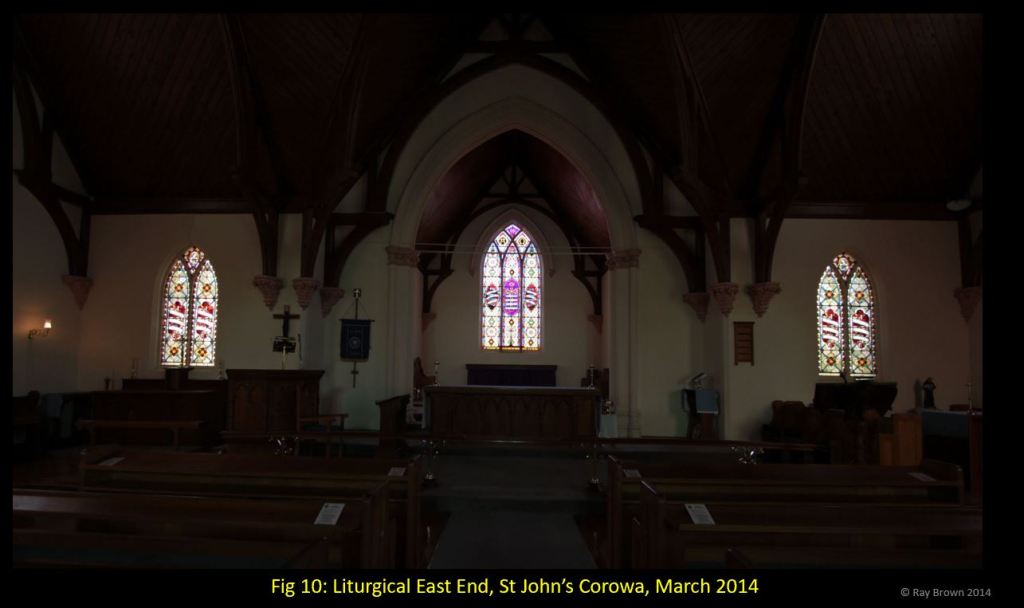
1884 St John’s Anglican Church Corowa, NSW.

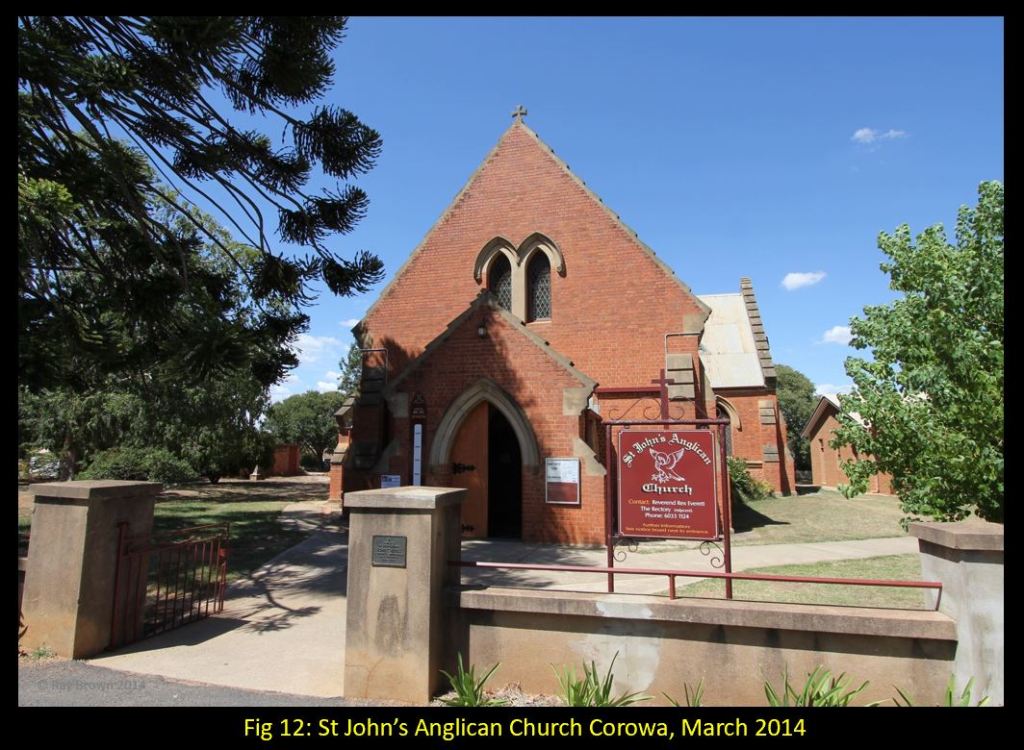
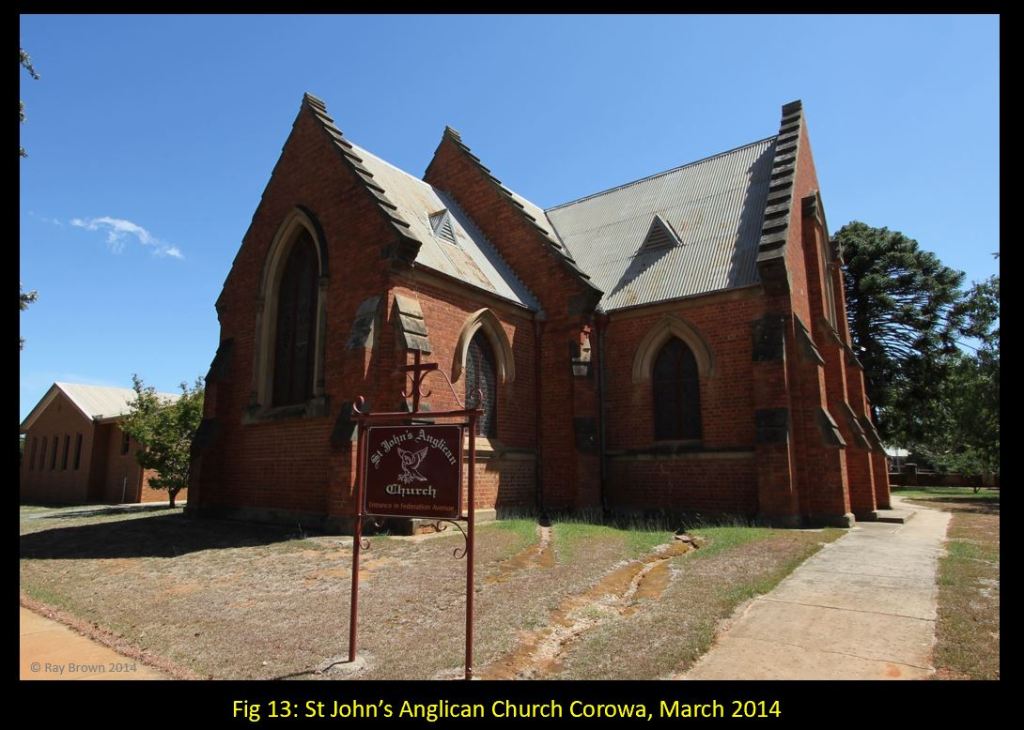
In 1863 the first wooden Anglican church was built at Corowa and dedicated as St John’s. The land was donated by John Foord. Circa 1859 the area was known as North Wahgunyah and later changed to Corowa to differentiate it from Wahgunyah on the south side of the river in Victoria.

On the 25th of January 1884, a brief article appeared in the Corowa Free Press about a stained glass window being delivered for the new brick building of St John’s.

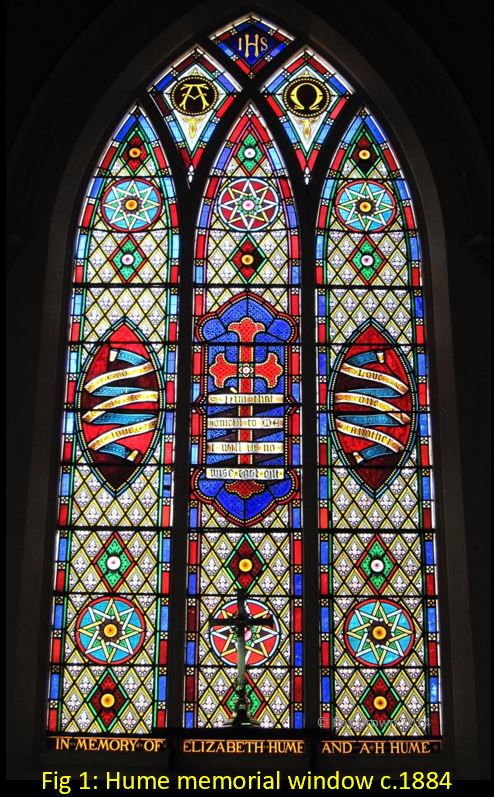
“…The memorial window for St. John’s Church, presented by the Misses Hume, has been delivered at Corowa, and its erection will be proceeded with shortly..” [1]

A week later the same tabloid reported that the window had been installed in the church but there were errors in the article:

“MEMORIAL WINDOW.- The window presented to St. John’s Church, in memory of Elizabeth and Andrew E. [sic] Hume, has this week been put into its place by Messrs. Armstrong and Johnson – free of cost. It is a very beautiful piece of workmanship, and was executed to the order of the Misses Hume, by Messrs. Ferguson and Wise [sic], of Melbourne.”[2]

Slide show: Images were taken in March 2014:

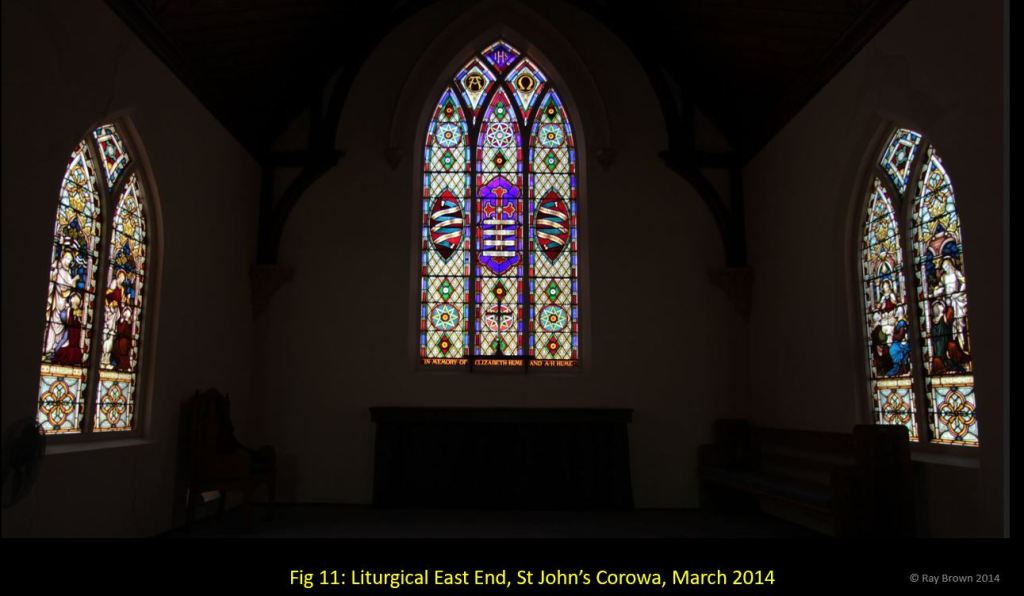
The window was dedicated to Andrew Hamilton Hume (1828-1859) and his mother Elizabeth (nee O’Neill 1802-1864). Andrew’s father was John Kennedy Hume (1800-1840) who was shot by bushrangers at Gunning, NSW, 20th Jan 1840 [3]

The newspaper incorrectly named the stained glass company as ‘Ferguson & Wise’. There was no stained glass company of that name anywhere in Australia. The window is accurately attributed to the ‘Ferguson & Urie’ stained glass company of North Melbourne. This company started out as a plumbing, slating, and glazing business, in Curzon Street North Melbourne in 1853 by Scottish immigrants, James & David Ferguson, and James Urie. In 1861 they transformed the company towards commercial glazing and stained glass production and for the next thirty-nine years, they made ecclesiastical and secular stained-glass windows.

After confirming with Rev Canon Rex Everet at St John’s in March 2014 that the window still existed, A trip to Corowa was next on my ‘To Do’ list.

A tabloid report in August 1896 gives an account of the Church and mentions stained glass windows by other studios from New South Wales:

“…The older portion of the building was erected about twenty-five years ago by Mrs. Bladen Neill in memory of her husband, Lieutenant-Colonel Neill; the newer parts of the structure dating from some eleven years back. The church is cruciform in shape, and has a highly ornamental interior. The roof is of Murray pine diagonally laid, the massive worked principals supporting the same resting on artistically designed corbels. The stained glass windows, mostly presents from various residents, and costing over £250, largely enhanced the solemn beauty of the interior. The windows on each side of the altar, representing four scenes of the resurrection, are from designs supplied by the vicar, the Rev. William Clark Hose, and admirably executed by Messrs. Asher [sic] and Falconer[4], of Sydney. The three-light east window is in memory of Elizabeth and A. H. Hume, old and esteemed residents of the district. In the transept is a large three-light window in memory of Mr. Ross Ramsay, of Narrow Plains Station. Of the four lesser windows, one was presented by the late Bishop Linton; another by the Rev. W. Swindlehurst, of West Maitland, in memory of his deceased wife; and the remaining two by the Sunday School children…”[5]

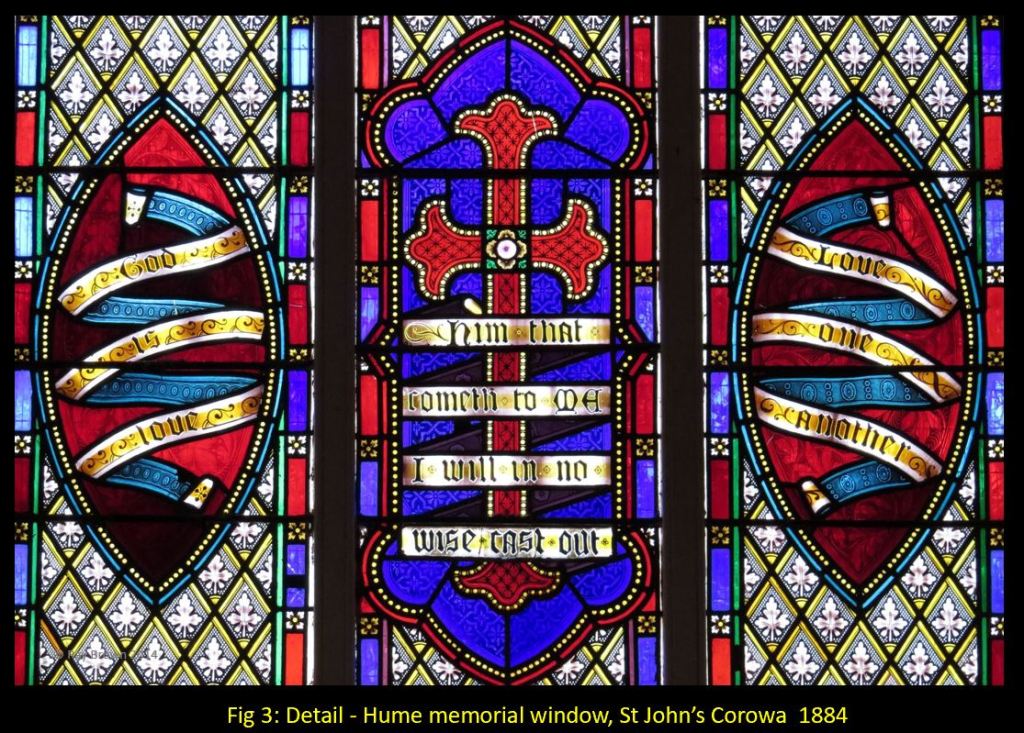
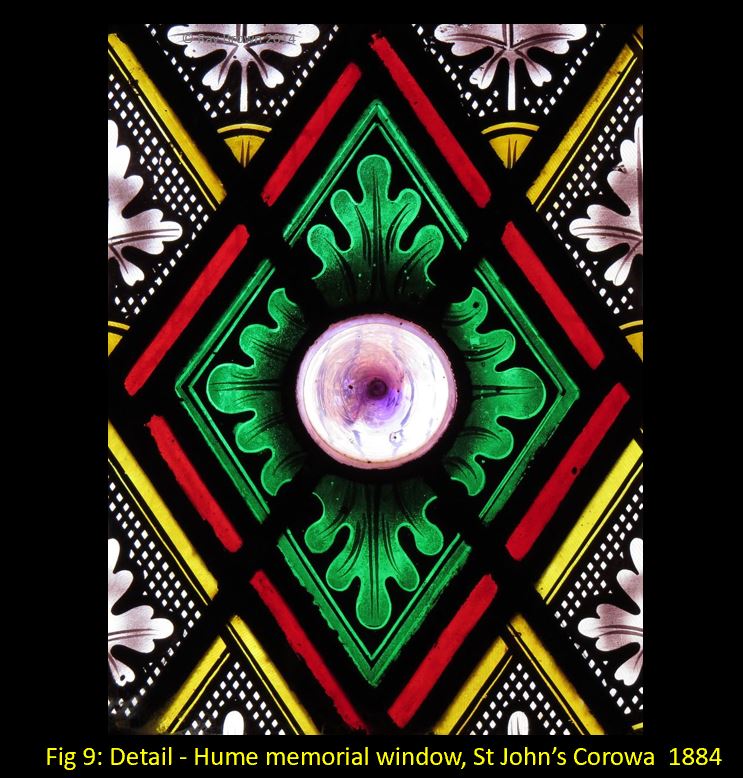
The Ferguson & Urie window in the chancel follows the company’s decorative style from their 1870s period of geometric patterns and scrolling ribbons with text from the bible. This window wasn’t made by the company’s first two pioneering stained glass artists. The artist who joined the firm in 1861, John Lamb Lyon, had left Ferguson & Urie in 1873 to form the Lyon & Cottier company in Sydney, and David Relph Drape died in 1882. This leaves two of the company’s earliest apprentice glass painters, Charles William Hardess and Frank Clifford Lording as the likely suspects who had a significant role in the window. There is no figurative work depicting any human form in the window, it has been copied faithfully from variations of their catalogue of designs over the previous twenty years, which Hardess and Lording would have been very familiar with producing.

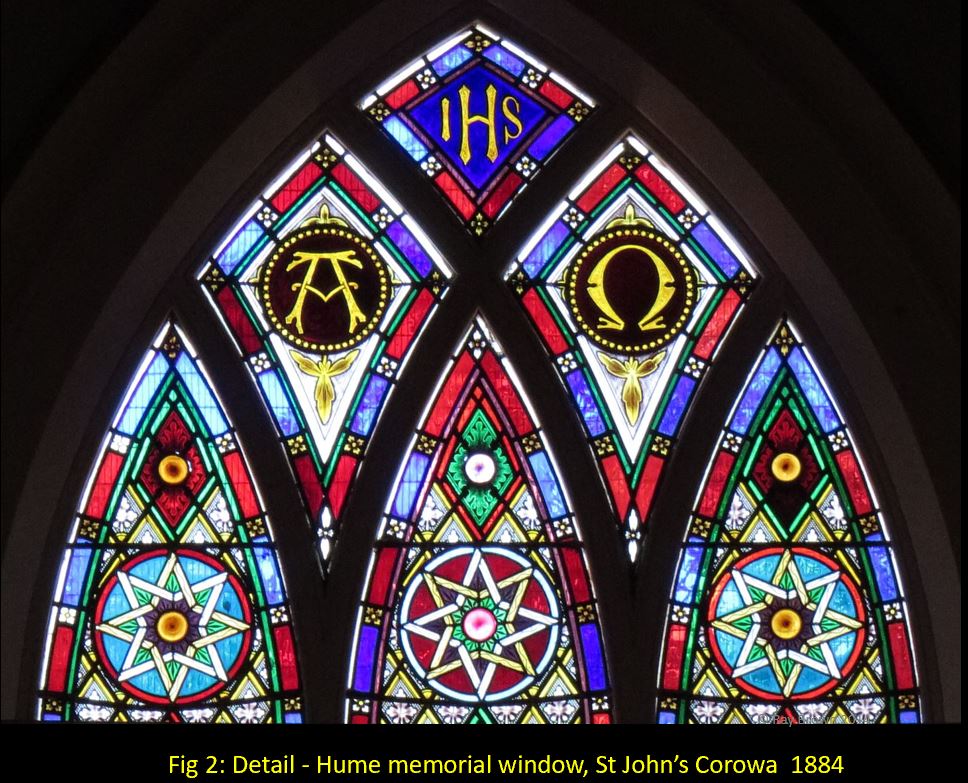
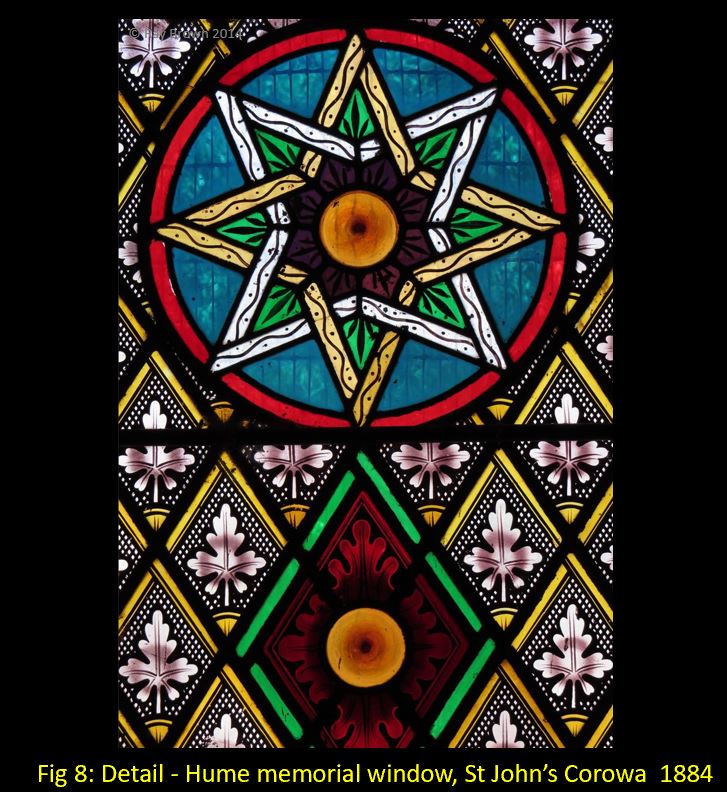
At the top of the window above the three lancets is a window with the letters “I.H.S”, a monogram symbolizing Jesus Christ. Below this are two windows with the Greek Lettering for “A” and “O” representing Alpha and Omega and meaning the Beginning and the End.

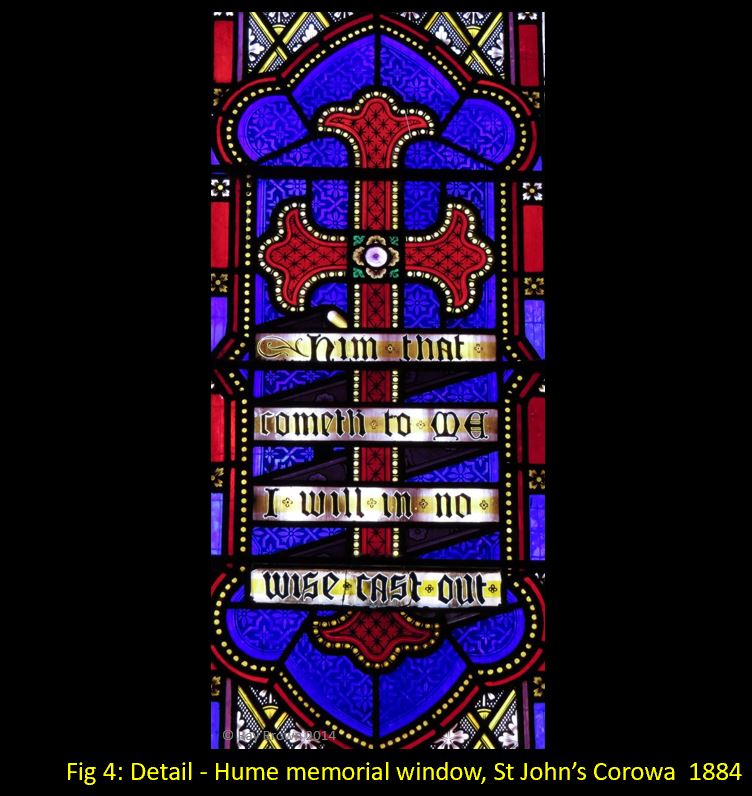
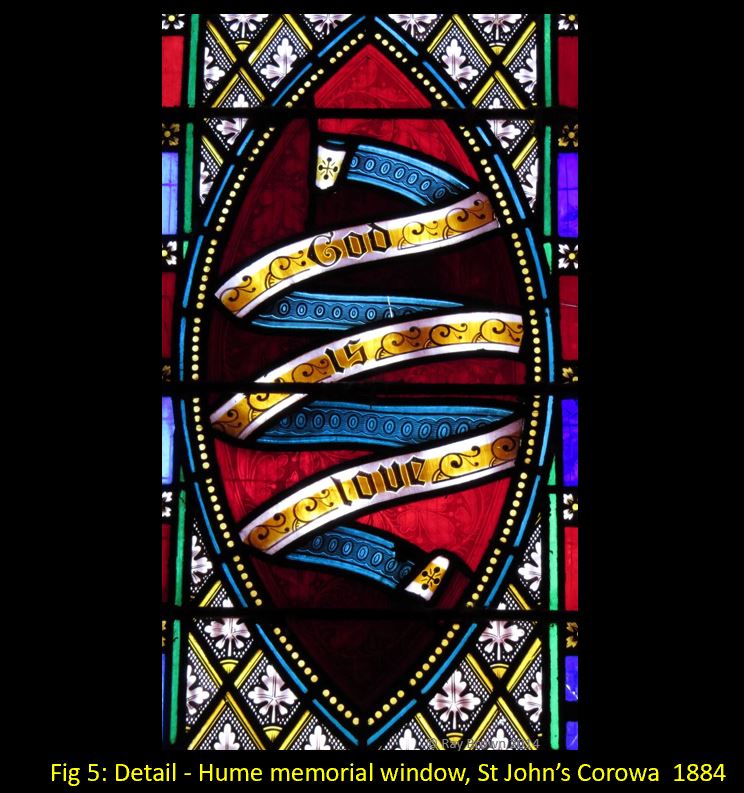
The centre light in the window contains a beautiful gothic decorated crimson cross on a sapphire blue background. The cross and the backgrounds have finely detailed sgraffito work picked out to reveal tiny stars. A ribbon scrolling around the cross has the words “Him that cometh to me I will in no wise cast out”. The left light contains a crimson pointed ellipse with leaves and fronds with a scrolling ribbon with the words “God is Love”. The right light is the same design but has the words on the ribbon “Love one Another”.
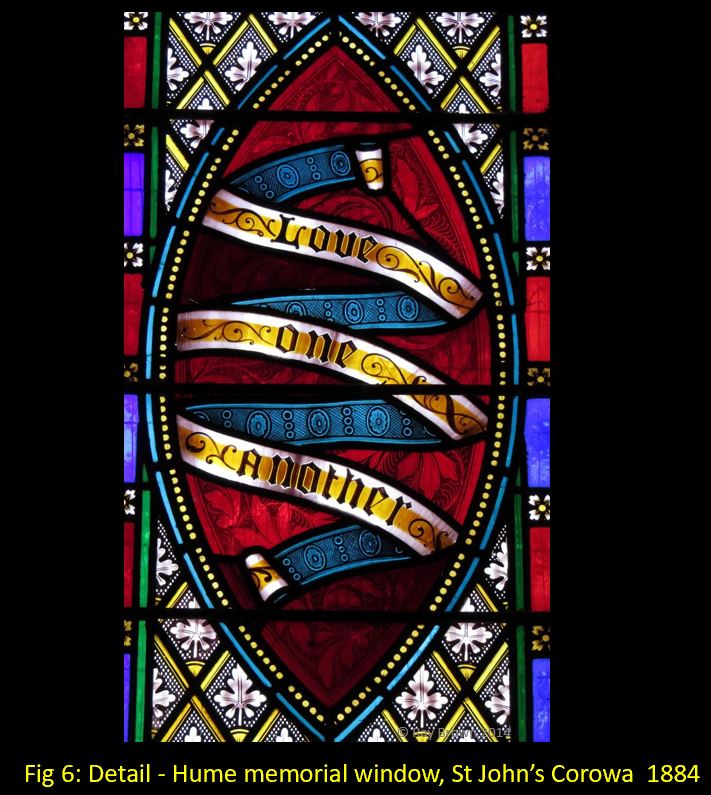
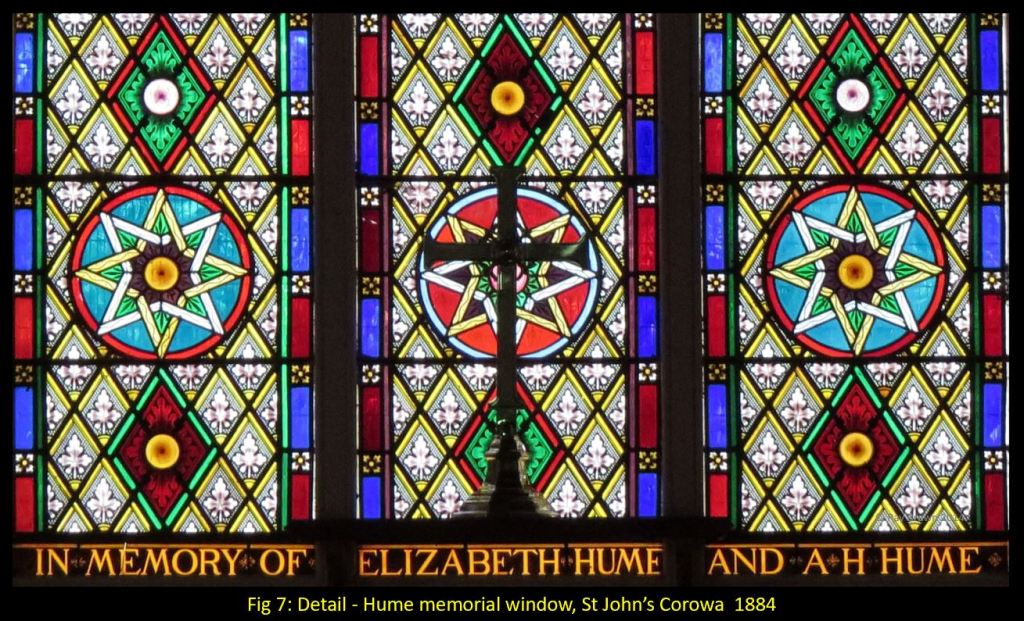
The memorial text at the base of the window states: “IN MEMORY OF ELIZABETH HUME AND A.H. HUME”.

The Hume memorial window in the chancel is the only Ferguson & Urie window in the church. The windows flanking it in the chancel were made by the Sydney firm of Ashwin & Falconer and are a distinctively different style. , but in the nave, there are other windows that would trick you into believing they are also Ferguson & Urie windows. They’re not, and the reason these are similar-looking windows is that they are the work of Lyon & Cottier of Sydney. Lyon, mentioned earlier, was the Ferguson & Urie glass painter at North Melbourne between 1861 and 1873.

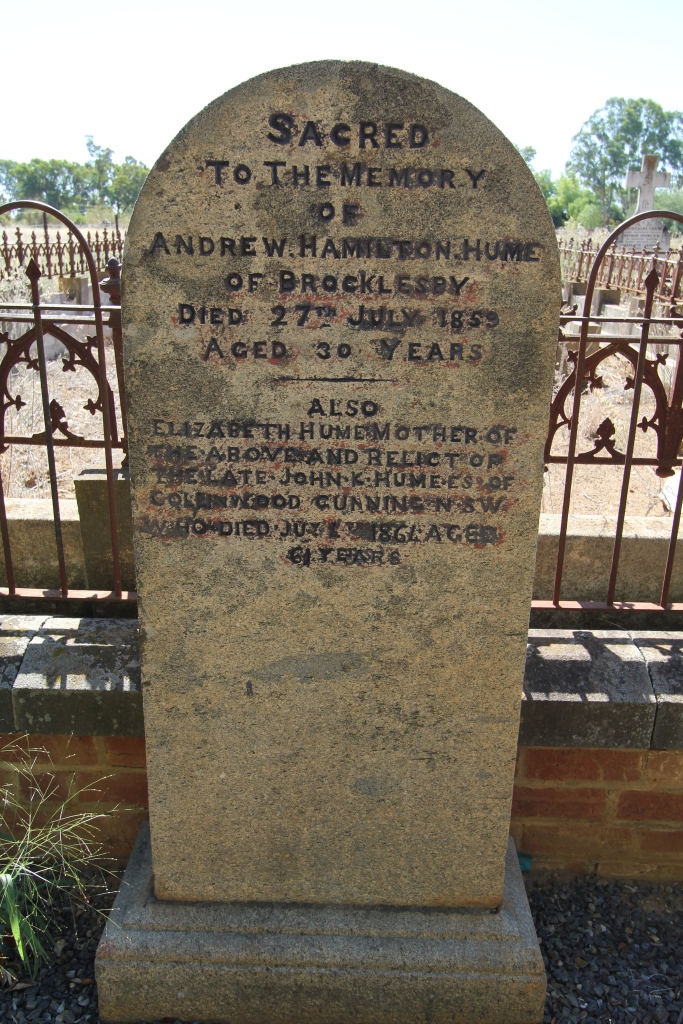
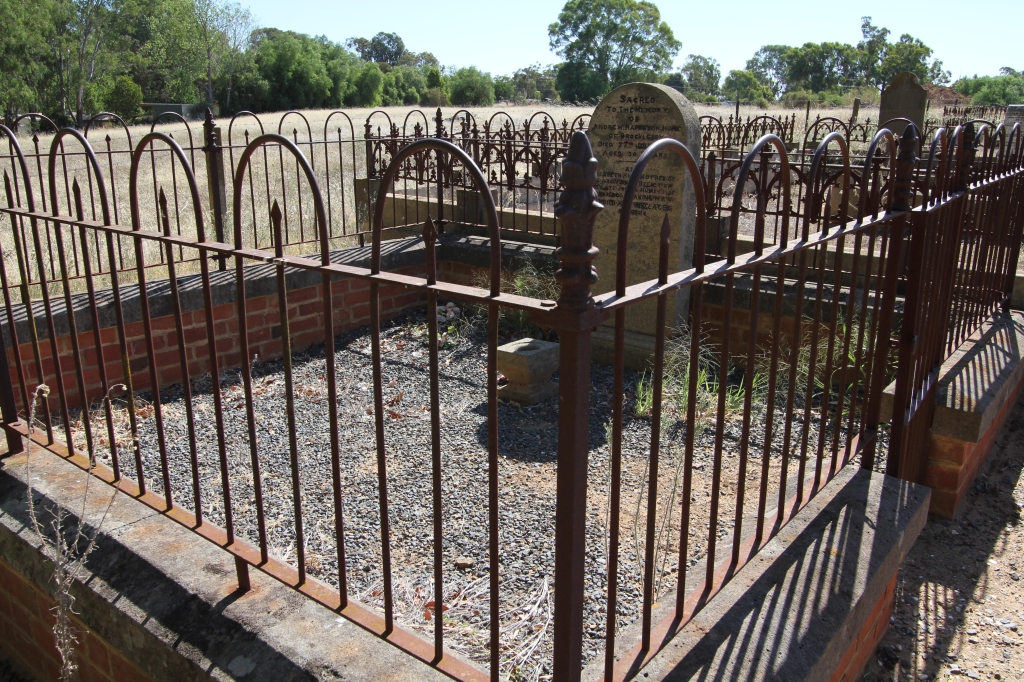
Andrew Hamilton Hume died at his station, Hume River, at age 30, on the 27th of July 1859[6]. His mother, Elizabeth (nee O’Neil 1802-1964) died 4th July 1864 at Yarrawonga in Victoria. Andrew and his mother are buried at the Corowa cemetery.

The Ferguson & Urie window was restored in 2015 at a cost of $25,000.

St John’s has an extraordinarily diverse range of stained glass windows by different artists and studios spanning nearly a century and a half. The windows from the late 1800s and early into the 1900s are by Ferguson & Urie, Ashwin & Falconer, and Lyon & Cottier. The modern-styled windows are by artists such as Bowers & Wilkins and Leonie Le Cornu.


Footnotes:

[1] The Corowa Free Press, NSW, Friday 25th January 1884, page 2.

[2] The Corowa Free Press, NSW, Friday 1st February 1884, page 3.

[3] The Sydney Morning Herald, NSW, Monday 27th January 1840, page 2.

[4] Aswin and Falconer, later Falconer and Ashwin, and F. Ashwin & Co.

[5] Australian Town and Country Journal, NSW, Saturday 8th August 1896, page 27.

[6] The Argus, Melbourne, Vic, Tuesday 9th August 1859, page 4.


Short Link to this page: https://wp.me/p28nLD-39y

© Copyright