In August 1867, James Urie of the Melbourne stained glass firm ‘Ferguson & Urie’, traveled to Tasmania with a portfolio of the companies designs for ecclesiastical and secular stained glass. As of May 2013, over twenty-five Tasmanian buildings have been identified as having one or more extant stained glass windows by the firm. The newspaper article below contains a gold mine of clues for Ferguson & Urie windows erected in Tasmania and in Victoria and I have included my comments as to what have found on each clue.
The Mercury, Hobart Tasmania, Tuesday 13th August 1867, page 5.
“STAINED WINDOWS – A few days since we stated that Mr. Urie of the firm of Ferguson, Urie, and Lyon, glass stainers, &c, Melbourne, was on a professional visit to Hobart Town. This gentleman is now in Launceston, and we were much gratified yesterday by inspecting a large portfolio of designs for church and other windows which his firm has executed or has in hand. Amongst the most elegant we may mention the chancel window of St. George’s Church, Queenscliff, the subject being taken from the Litany, whilst the side lights represent the twelve Apostles and the west window other emblems; chancel window of St. Peter’s, Wooloomooloo (Sydney), embracing nine events in the life of St. Peter; Roman Catholic Church of St. Peter and St. Paul, Geelong; St Joseph’s Roman Catholic Church, Collingwood; St. Patrick’s Church, Duneed; the Melbourne Convent; the Presbyterian Churches at West Melbourne and Ballan; the Wesleyan Churches at Daylesford and Kent Town (S. Australia). They have also erected some very elegant memorial windows including one for the late Prince Consort at Kew; Rev. R. W. Needham, at Mount Gambier; Dr. Peck, at Sale; Judge Pohlman’s wife, and wife of Mr Stoddart both in Melbourne. We have already referred to Dr. Moore’s at New Norfolk, and the two windows in St. John’s, Launceston. One of the most elegant windows is in the house of Mr. George Stevenson, at Toorak; it represents the four seasons with figures of Art, Science, Agriculture, and Commerce, with Faith and Hope, coat of arms, and crest. This window cost £250. This firm also supplied a staircase window for the new mansion of the Hon. R. Q. Kermode at Mona Vale, but it has been decided to substitute one much more elaborate. They are also to fit up two windows for the new Wesleyan Church of this town – one at either end, which will be very handsome. Several private homes in this town, and a large number in Victoria, have been ornamented in this way, and no doubt the practice will extend when it is known how skilfully the art is carried out by Messrs. Ferguson & Co.”
Notes:
1. Queenscliff, Victoria, St Georges, All windows extant.
Related posts: 22-02-1864 > 29-01-1866 > 12-02-1881 > 07-04-1882 > 30-12-1893
2. Wooloomooloo, Sydney, NSW, St Peter’s (Darlinghurst), now part of Sydney Church of England Girls Grammar School.
Related posts: 1867: St Peter’s Anglican Church, Woolloomooloo, Sydney, New South Wales.
3. Geelong, Victoria, St Peter & Paul Catholic. Three light principal east window.
Related post: 13-08-1867: St Peter & St Paul, Geelong, Victoria.
4. Collingwood, Melbourne, Roman Catholic (St Joseph’s) destroyed by fire in 2007.
See: 1863: St Joseph’s Catholic Church, Collingwood, Victoria.
5. Duneed, Victoria, St Patrick’s (Mt Moriac) foundation laid in 1858. Ferguson & Urie east window erected in 1866 but was destroyed my a massive hail storm in 1887. The church was rebuilt in 1950’s and sold at auction in February 2017..
6. Melbourne, Victoria, the “Melbourne Convent”. This is likely to be the “Convent of Our Immaculate Lady of Mercy” in Nicholson street Fitzroy. My correspondence with the Convent has revealed nothing.
7. West Melbourne, Presbyterian. Dismantled in 1935 and re-erected as St Andrews at Box Hill in 1936. It contains the original F&U windows except for one which went to the Camberwell Church on Riversdale Road.
Related posts: 27-04-1935
8. Ballan, Victoria, Presbyterian (St Paul’s). All windows are extant.
Related posts: > 22-07-1866 > 28-07-1866 > 13-08-1867
9. Daylesford, Victoria, Wesleyan. Only small ‘stock’ windows in the porch exist in poor condition. See photos <here>
10. Kent Town, South Australia, Wesleyan. Nothing further known.
Related posts: 26-10-1864
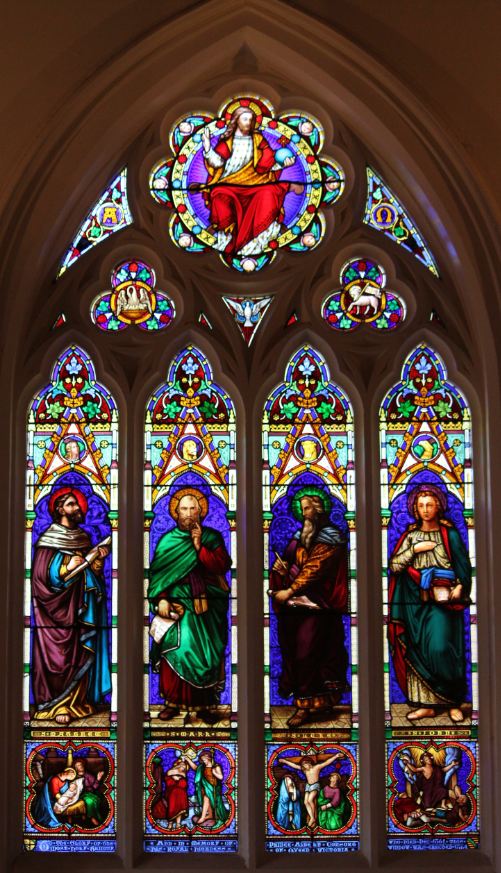
11. Kew, Melbourne. The Prince Consort window at Holy Trinity is extant and recently restored.
Related posts: 08-06-1881
12. Mount Gambier, Christ Church, Rev Needham memorial window and others are extant.
Related posts: 02-11-1867
13. Sale, Victoria, St Paul’s Anglican Cathedral. Dr. Peck memorial window is extant.
Related post: 29-01-1867
14. Melbourne, Pohlman and Stoddart memorial windows.
Nothing found in regards to the Pohlman window but the Stoddart window exists.
Related post: South Yarra Presbyterian 1867
Pohlman:
Judge Robert Williams Pohlman (1811-1877): Biography | Obit 1877 | Funeral | Obit 1878 His funeral was in St Stephen’s in Richmond and he was buried in the Melbourne General Cemetery on the 8th Dec 1877. He was married twice. His second wife, Mercy Clifton Bachelor died of an embolism at age 26 on the 21st January 1876 only a couple of weeks after giving birth to a stillborn daughter on the 5th of January 1876. He only had one daughter to his second wife named Annie who married Navy Commander Frederick Owen Pike at St John’s in Toorak on the 27th December 1893.
This would mean that the stained glass window would have been a memorial to his first wife “Eliza” who died at Richmond on the 11th Feb 1856.
Stoddart/Stodart:
This is James Dickson Stodart (c1825-1867), Mayor of Prahran 1864/65 and councilor 1858/59-1859/60, 1863/64-1864/65.
Arrived from Edinburgh in 1853. Was later a financial agent for Cornish & Bruce railway contractors. See: Yarra Presbyterian 1867
An active member of the Scotch Presbyterian Church in Punt Road South Yarra, where his memorial stained glass window resides.
He died on Wednesday 12th June 1867. The window has been found at the South Yarra Presbyterian Church See: http://wp.me/p28nLD-2I3.
15. New Norfolk, Tasmania, St Matthew’s, Dr. Moore memorial window is extant.
Related posts: 04-03-1882
16. Launceston, St John’s: The window is extant but no longer in its original position. The canopy glass above the main three lights no longer exists but an original design for the window shows that it contained the descending Dove and the symbols for Alpha and Omega.
Full details see post: 25-09-1866
17. George Stevenson’s house at Toorak was named “Trawalla” and is located at 22 Lascelles Avenue Toorak. Window is extant.
18. Ross, Tasmania, Kermode’s Mona Vale Mansion. This window still exists. Images are shown in various historical books written in the last 30 years.
19. Launceston, Wesleyan, (Pilgrims Uniting), window facing Patterson street is extant but nothing seen in the opposite end. Gavin Merrington from Hobart has confirmed that a wheel window exists above the organ loft.
Also see: 07-08-1867: Decorative Art. James Urie sojourning in Tasmania.
Other related posts: 03-03-1868 , 29-01-1866, 20-06-1867, 29-04-1864,
0.000000
0.000000
 Ferguson and Urie