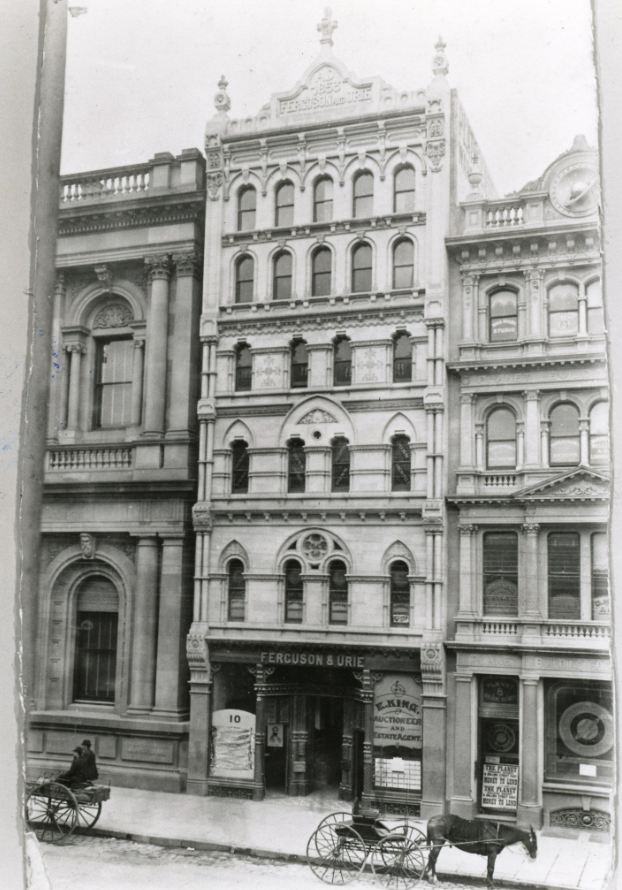
01-08-1891: Visitors to Melbourne call at Ferguson & Urie, Franklin Street.

Oakleigh Leader, North Brighton, Saturday 1st August 1891, page 4s.

“VISITORS TO MELBOURNE Should call at the following place…”

“… FERGUSON and URIE, Glass Stainers, Importers of Sheet and Plate Glass, Manufacturers of Church Windows And Lead Lights for dwellings. Franklin street, West Melbourne …”

Related posts: (about Franklin Street)

16-04-1891 > 10-07-1891 > 01-08-189129-07-1899 > 10-08-1899 > 06-09-1899

16-04-1891: Ferguson & Urie move to Franklin Street, Melbourne, Victoria.

The Argus, Melbourne, Thursday 16th April 1891, page 3.

“NOTICE OF REMOVAL. FERGUSON and URIE, GLASS STAINERS and IMPORTERS of WINDOW GLASS, Have REMOVED to NEW PREMISES, FRANKLIN-STREET, Three Doors West of ELIZABETH-STREET”.

Ferguson & Urie are now feeling the pinch of the financial turmoil and have moved to the Franklin street warehouse.

Related posts: (about the Franklin Street building)

16-04-1891 > 10-07-1891 > 01-08-189129-07-1899 > 10-08-1899 > 06-09-1899

14-02-1891: Probate notice for Crawford Kier, son in law of James Ferguson.

Crawford Kier was the son in law of  James Ferguson who was a principal partner in the Ferguson & Urie stained glass company. Crawford married James’s seventh daughter, Barbara,  in North Melbourne on the 19th of May 1881. At one stage Crawford was employed in a managerial position with company.

There are certainly doubts that James Ferguson had confidence in the marriage between Crawford Kier and his daughter Sarah. In June 1885, four years after they married, Crawford was declared insolvent with the causes stated as; “Want of employment, and having borrowed money at a high rate of interest…” What is even more perplexing is that his father in-law James Ferguson employed him as a clerk with the Ferguson & Urie company,  yet in his his insolvency notice in 1885 he indicated he was unemployed! There were many other family members on the Ferguson and the Urie family lines who were employed with the firm and by all accounts everyone, even those not related, were regarded as family and everyone was looked after and supported. What happened with Crawford may never be known. On Monday the 15th June 1885, Crawford and Barbara’s home and furnishings at “Elizabeth Cottage” on Mount Alexander Road, Moonee Ponds (near the Ascotvale Hotel) was put up for auction by the Sherriff.

Crawford, Barbara, and their three children left Melbourne for Sydney where they departed for Scotland in early 1889 for a holiday (as family legend has it), but they would never return. Barbara died of Kidney disease at Bothwell, Scotland, on the 3rd of November 1889 and only a few months later Crawford died, also of kidney disease, on the 3rd of March 1890. Their three children, William, Mary and James were then brought up by James Ferguson’s widowed sister Marion Bishop (nee Ferguson), residing in Glasgow. They would never return to Australia. When their grandfather James Ferguson died in 1894 he made modest provisions for their upbringing and included the grandchildren and his sister Marion in his will of 1894.

The Argus, Melbourne, Saturday 14th February 1891, page 5.

“NOTICE is hereby given, that after the expiration of fourteen days from the publication hereof application will be made to the Supreme Court of the Colony of Victoria, in its Probate jurisdiction, by JAMES FERGUSON, of 10 Collins-street east, Melbourne, in the Colony of Victoria, glass-stainer, the duly authorised attorney under power of James Johnstone Kier, of 368 Saint Vincent street, Glasgow, Scotland, stained glass merchant; Andrew Malloch Bayne, of 28 Miller-street, Glasgow aforesaid, glass merchant; and Adam Young, of 193 Saint Vincent street, Glasgow aforesaid, writer, the executors named and appointed by the trust disposition and settlement bearing date the thirteenth day of October, one thousand eight hundred and eighty seven, of CRAWFORD KIER, sometime manager with Messieurs Ferguson and Urie, glass merchants, Melbourne, in the colony of Victoria, afterwards residing at Craigievar-house, Uddingston, Scotland, but lately of Woodlea-house, Uddingston aforesaid, glass cutter, deceased, that the CONFIRMATION of the nomination of James Johnstone Kier, Andrew Malloch Bayne, and Adam Young as executors aforesaid may be SEALD with the SEAL of the Supreme Court of the colony of Victoria. Dated this thirteenth day of February, one thousand eight hundred and ninety-one. ALEXANDER GRANT and SON, of Number 4 St. James’s Buildings, William-street, Melbourne, proctors for the said James Ferguson”.
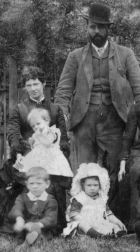
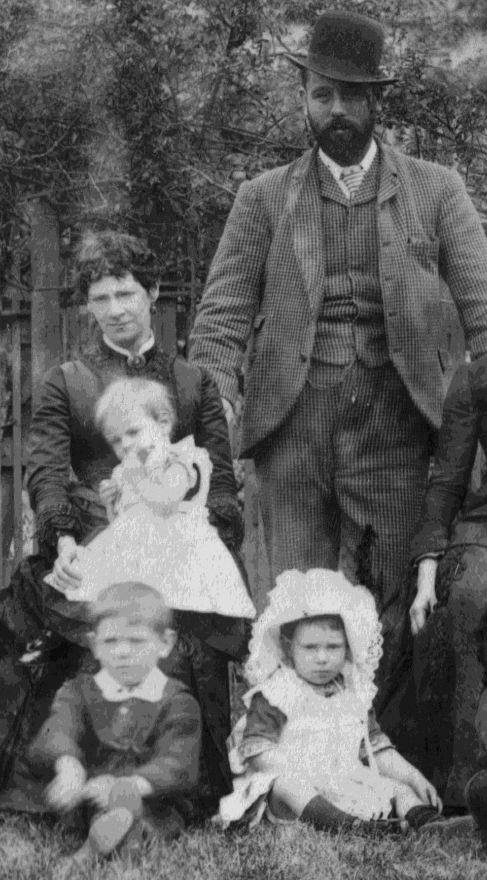
Crawford Kier & family at James Ferguson's Ayr Cottage, Parkville, Melbourne, 1st Jan 1888.

This photo is a subset of the Ferguson Clan photo from the family history collection. The original family photo shows thirty five family members on the east side of James Ferguson’s Ayr Cottage, Parkville, 1st January 1888. This portion shows Barbara Kier (nee Ferguson) 1856‐1889 , Crawford Kier 1858‐1890, James Ferguson Kier 1886‐1964,William Maitland Kier 1881‐1936, Mary Ferguson Kier 1884‐1946.

Crawford’s own ancestry was also in the stained glass trade. His grandfather, David Kier, was a master stained glass craftsman from Glasgow and had a stained glass business in Irvine with his sons as “David Kier & Sons”. After David’s death in 1864 the business was continued by the sons as “W & J.J. Kier” (William and James Johnston Kier).

The Presbyterian Church at Strathalbyn, South Australia, commissioned the Scottish stained glass firm W & J. J. Kier to create a stained glass window for their church in 1870!

The South Australian Advertiser, Adelaide, Monday 8th August 1870, page 2.

“The Glasgow Mail says:- ‘We have had an opportunity of inspecting, at the works of our townsmen, Messrs. W. & J. J. Kier, a memorial windows which they have just completed, and which is to be forthwith dispatched to Adelaide, to be erected in the Presbyterian Church, Strathalbyn, South Australia, in memory of the late Dr. Rankine. It is what is called a two-light window, the subject-in-chief of one of the compartments being a full-length figure of our saviour, and of the other a similar figure of St. John the Evangelist. At the base of the canopy are the inscriptions – ‘In Memory of Dr. John Rankine, late of Blackwood, South Australia. Died at Helensburgh, Scotland, March 15, 1864;’ and – ‘Erected by his sorrowing widow, Mary M. Rankine.’ On a lozenge-shaped shield forming the apex of the window is the family crest, with the motto, ‘Fortiter in Recte.’ As a specimen of what it purports to be true ‘stained’ glass art, as opposed to glass painting, or any other composite device, this window will compare favorably with anything of the kind hitherto produced in Scotland – and indeed, for the matter of that, we are quite convinced there is nothing finer to be seen in the Cathedral.”

Unfortunately it would seem that the stained glass window was never actually erected in the church and was summarily sent back to Scotland.

Southern Argus, Port Elliot, SA, Friday 9th June 1871, page 2.

“THE MEMORIAL WINDOW TO THE LATE DR. RANKINE.- We understand that the authorities of the Presbyterian Church in Strathalbyn have decided not to put in the memorial window lately presented by the widow of the late Dr. Rankine, and which arrived in the colony some few weeks since, and it will therefore, in accordance with Mrs Rankine’s instructions, be immediately returned to Scotland.”

On the 4th October 2012, Mr Brian Simpson from Strathalbyn wrote:

“Dear Ray,

Your email has been forwarded to me, as an amateur local historian with an interest in your subject. This is indeed a sad story!!! The window apparently arrived on board the “Glen Osmond” in late-Sept, 1870, & was seen by the members of the Session (the committee in charge of St Andrews Church, Strathalbyn), & promptly sent back to Scotland! The church & the town thereby lost what could have been its most valuable icon. The minutes of the Session meeting do not record what in particular they objected to. Perhaps they were affronted that the Rankine crest was placed above the figure of Jesus, rather than below? They refused to take the matter to a general meeting of the congregation, despite the fact that many were very interested. This precipitated the resignation from the Session of William Rankine, brother of John (fellow founders of the township of Strathalbyn in 1839).

Presumably, the window was returned to Mary Rankine (John’s widow) in Glasgow, at the earliest opportunity. I wonder who paid for its return journey? This story has fascinated me for years, & I have often wondered what became of that very valuable window. I have visited Scotland several times in the last several years, & had hoped to be able to track down that window. I wrote to the head offices of three branches of the Presbyterian Church in Glasgow, & to a museum/gallery of historic church windows, etc, in Glasgow. All replied in the negative. Perhaps the window is still in the possession of descendants of the Rankine family? I continue to wonder at the intransigence & stupidity of the Session at the Strathalbyn Presbyterian Church in 1870. Presumably, very few people ever saw that window to know what all of the fuss was about. The Session had previously agreed to accept the window, & were presumably looking forward to its arrival with great anticipation. What went wrong we will never know.  If you ever do locate the window, I & the rest of Strathalbyn, would be very pleased to hear about it. Good luck with your search. It hurts me every time I think about that lost opportunity!

Kind regards, Brian Simpson” – STRATHALBYN

Many thanks to Brian Simpson for his research and response on the subject of the Kier stained glass window.

Related posts: 14-06-1894: Probate lodged for the Will of James Ferguson


Short link to this page: http://wp.me/p28nLD-Hu

© Copyright


23-07-1890: James Urie (1828-1890)


Undoubtedly the Colonist who was the driving force behind the success of the Ferguson & Urie stained glass company was James Urie.

His business acumen and enthusiasm made Ferguson & Urie the most successful commercial stained glass company in Australian Colonial history.

The Argus, Melbourne, 23rd July 1890, page 1.

“URIE – On the 21st inst, at his late residence, Wellington-street, Flemington, James, the beloved husband of Grace Urie (and of the firm Ferguson and Urie, Collins-street), aged 62.”

The memorial photos were taken at the Melbourne General Cemetery, 27th Dec 2009.

This slideshow requires JavaScript.

James Urie (1828-1890) was born in Kilmarnock, Ayrshire, Scotland on the 14th May 1828, to William Urie and Jane Ferguson.

On the night of the Scottish census record of March 1851, James Urie (age 22), was indicated as being a visitor to James Ferguson’s (age 33) home at John Street Wallacetown in Ayr. Their professions were listed as Slater and Glaziers. As James Ferguson was 11 years older than Urie, the age difference leads me to believe that he may have formerly been an apprentice of James Ferguson or James Ferguson Snr.

Was the night of the census a meeting to discuss their bold plans to emigrate to Australia? Who knows! What we do know is that that their decision would cement them firmly in history as the founders of Australia’s most prolific and talented stained glass studio.

By late 1852 their decision had been made and they would set sail for Australia.  James Urie departed first and was followed a day later by James & David Ferguson. Which ship James Urie departed on  has not been established but James & David Ferguson departed Greenock on the 12th Dec 1852 aboard the ‘Tamerlane’. In a speech at the Company dinner held in North Melbourne in 1886, James Urie stated: “..it was just 34 years since he left the old country for the colony and Mr. Ferguson left a day after him”.

On arrival in Melbourne the men set about establishing their business as Plumbers, Slaters and Glaziers from premises in Curzon street North Melbourne. For a short time James Urie took up residence at the Tam O’Shanter Hotel in North Melbourne, whilst James Ferguson and his brother David found cottage accommodation in Little Curzon street.

On the 31st August 1855 James Urie married ‘Grace Hardie Young’ at the first Curzon Street Presbyterian church in North Melbourne and they took up residence in a small cottage at 28 Curzon Street North Melbourne, only a short distance from the Ferguson brothers and the business’s workshop. Between 1856 and 1882 James and Grace had fourteen children, five of whom unfortunately died as infants.

After the initial pioneering hard work of establishing the business and transforming the business to stained glass production in 1861, James took the lead as the enterprising salesman of the business and traveled far and wide to the eastern states as far north as Queensland, west to South Australia and as far south as Tasmania and possibly New Zealand to establish the company name “Ferguson & Urie” as Australia’s premier colonial stained glass firm. James was an an astute business man and had an inventive streak as well. On the 24th of October 1865 he registered a patent for “An invention of an improved and cheap method of converting Basaltic Rock into Street Flagging and other pavement”. By 1888 he had established a substantial two storey family home in Wellington Street Flemington named “Glencairn” after the name of “Glencairn Square” near his family home back in Kilmarnock, Scotland.

Outside of the business James actively participated in public life. He was a Justice of the Peace as well as a Councillor of Flemington and Kensington from August 1886 to August 1888, and Mayor of the Borough from August 1887 to August 1888.

On the afternoon of Monday 25th June 1888 he laid the foundation stone of the Presbyterian Church in Norwood Street Flemington.

On the 21st of July 1890, after a brief illness, James Urie died at the age of 62.

On Thursday the 28th August 1890 the Mayor and members of the Flemington council visited his wife Grace at their houseGlencairnin Wellington Street and presented Grace Urie with an illuminated letter of condolence.

James Urie’s funeral was one of the largest ever seen in Flemington:

“…the procession being the most imposing seen in the borough. The employės of Messrs Ferguson & Urie marched in front of the hearse, then came four mourning coaches and upward of fifty vehicles. Immediately following the mourning coaches came a hansom, in which the Hon Alfred Deakin was seated, then next in order a buggy containing the deceased gentleman’s council colleagues…”.

The Honorable Alfred Deakin (later to be the second, fifth and seventh Prime Minister of Australia) played the part as a pall bearer at the grave site.

James Urie was buried at the Melbourne General Cemetery with the five children who died as infants, and his wife Grace who died in 1899.

Table Talk, Melbourne, Vic, Friday 12th September 1890, page 8.

“James Urie, formerly of Curzon-street, North Melbourne, but latterly of Wellington-street, Flemington, one of the partners of the firm of Messrs. Fergusson [sic] and Urie glass importers, Collins-street East, Melbourne, by his will dated, November 24, 1870, and presented for probate by, Messrs. Madden and Butler, solicitors, appointed his wife, Grace Hardie, executrix. He gave her a life interest in his estate as long as she remains his widow; on her death or re-marriage the estate passes to his children in equal shares. ‘The testator died July 21, 1890, and his will was sworn at 34,808 real and £12,798 personal. Total, £47,606.”

In 2013, more than 120 years after his death, a lane-way between 17 and 19 Waltham Street in Flemington was  named in honor of James Urie [See: Photo | Map]. The lane-way is less than one hundred meters down Waltham street from James Urie’s homeGlencairn(now St Brendan’s Presbytery) on the corner of Waltham and Wellington Street.

Related posts: 21-11-1865 >19-02-1874 > 18-09-1885  > 25-07-1890 > 29-08-1890 > 20-07-1899


Short link to this page: http://wp.me/p28nLD-GV

© Copyright

29-08-1890: Letter of Condolence from the Borough Council to Grace Urie.

On the 21st July 1890 James Urie, a principal partner of the Ferguson & Urie stained glass company died.

As a mark of respect, the Flemington Council presented his wife Grace with a leather bound letter of condolence from the members of the council. James had not only been a principal partner in the Ferguson & Urie stained glass firm,  but also a very prominent member of the Flemington & Kensington council and Mayor in 1887-1887.

It’s not known whether the letter of condolence may possibly still exists somewhere, but if it was ever found it would be a remarkable piece of history worthy of being displayed in a museum for all to see.

North Melbourne Advertiser, Friday 29th August 1890, page 2.

“THE LATE COUNCILLOR URIE”

 “Yesterday afternoon the mayor of Flemington, Cr Rigby, the ex-Mayor, Mr Thomas Millar, Cr Barrett, and Mr Cattanach, town clerk, waited on Mrs Urie at her residence, Wellington street, and presented her with a ‘Letter of Condolence’ from the Borough Council, worded as follows:-

‘To Mrs Grace Urie, Wellington street, Flemington – Dear Madam, We the Mayor and Councillors of Flemington and Kensington, desire to express our deep sense of the loss you and your family have sustained through the lamented death of your beloved husband, our esteemed friend and colleague, Councillor James Urie, whose death is universally deplored and has cast gloom over the whole district. While asking you to receive our warmest and most sincere sympathy in your sad bereavement, we trust that the loving influence of the dear departed one will still sustain you under your heavy burden. Again assuring you of our deepest sympathy for you in the loss of one to whom you were so fondly and deeply attached, We are, dear madam, yours sincerely T. Millar (Mayor), R. C. Barrett, J. E. Rigby, M. J. Hardiman, F. Melville, W. Blackwell, J. M. Dalglish, R. Mitchell, Wm Cattanach’.
The letter of condolence has the seal of the Borough Council attached. It is beautifully illuminated by Messrs Arnall and Jackson, and is bound in morocco leather, the cost of the testimonial being borne by the gentlemen whose signatures are appended. Mrs Urie thanked the gentlemen who made the presentation in feeling and appropriate terms.”

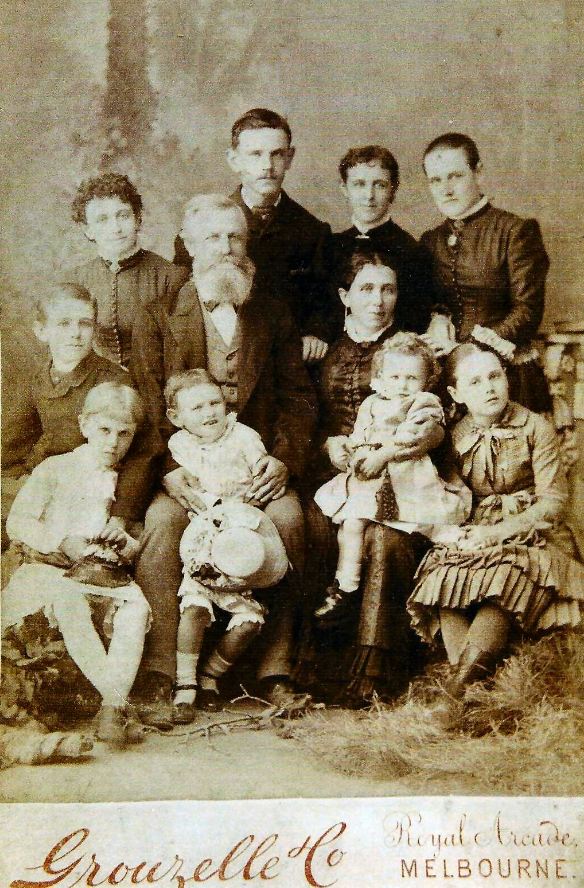
Photo of the Urie family kindly contributed by Mrs Noelle Nathan 26 Apr 2010.

The James & Grace Urie family, Flemington 1884.

Related posts:

23-07-1890: James Urie, principal partner in the firm Ferguson & Urie dies.

25-07-1890: The late Councillor Urie.


Short link to this page: http://wp.me/p28nLD-H2

© Copyright

25-07-1890: The late Councillor Urie, Flemington, Victoria.


The North Melbourne Advertiser, Friday 25th July 1890, page 2

“THE LATE COUNCILLOR URIE”

“Councillor James Urie died at his residence, Wellington Street, Flemington, on Monday evening, after an illness which barely extended over a week and which, in its first appearance, gave no indication or warning of fatal termination. The family of the deceased gentleman – and never was there a family more united or more affectionate – were led to expect the worst only a day or so before the end came, but it needed the exercise of true Christian resignation to enable them to bear up under the dreadful visitation. The people of Flemington and Kensington received the announcement of Cr Urie’s death with unfeigned sorrow. Outside the municipality the sad item of intelligence was discussed in terms that gave indubitable evidence of the general esteem in which the deceased was held. By the removal of a prominent public man such as Cr Urie the borough and district have sustained a grievous loss. Relatives, friends, and acquaintances have just cause to deplore the demise of one endeared to them by reason of innumerable good qualities, kindly disposition, and upright character. In commercial circles too, where his unswerving rectitude and sterling honesty in all matters of business were well known, the deceased merchant will be greatly missed.

            Mr Urie came to the colony from Scotland (his native land) early in the fifties and, after ‘roughing it’ in the usual pioneer fashion, started in trade in Curzon street, North Melbourne, and, by dint of genuine hard work, laid the foundation of the flourishing  Collins street firm of Ferguson and Urie. Some 17 years ago Mr Urie purchased the land in Wellington Street, on which his late residence now stands, and erected thereon a house for his mother. On the death of the old lady he enlarged the house, removed there with his family, and continued to reside there for the remainder of his days. The deceased took deep interest in the progress of the borough, and when the agitation for the removal of the cattle yards was begun he joined in the crusade with all the ardour of an enthusiast. For six years he occupied a seat in the Borough Council, and once held the position of Mayor. As a councillor he performed his duties without fear or favour, bringing with him to the Council table the same honesty of mind and singleness of purpose which characterised all his actions outside, His return at the head of the poll at the last municipal election may be taken as evidence of the popularity of the deceased gentlemen. CR Urie was a staunch supporter of the present member for the district, Mr Deakin, and at the general elections last year acted as chairman of the committee for the Flemington district. The deceased was a leading member of the Presbyterian Church and chiefly to his exertions and assistance is due the presence of ‘the Kirk’ in Norwood Street. In private life Mr Urie was distinguished for his imperturbable good humour, his lack of ostentation, and for general all-round ‘goodness’.

            The funeral left Wellington Street about half-past three on Wednesday afternoon, the procession being the most imposing seen in the borough. The employės of Messrs Ferguson & Urie marched in front of the hearse, then came four mourning coaches and upward of fifty vehicles. Immediately following the mourning coaches came a hansom, in which the Hon Alfred Deakin was seated, then next in order a buggy containing the deceased gentleman’s council colleagues. Crs Millar (mayor) and Barrett. The other members of the council, Mr Cattanach (town clerk), Mr McIver (surveyor), Mr Elmslie (valuer), Mr Glyn (foreman of works), Mr Ryan (borough inspector), were also in attendance. Essendon Council was represented by the Mayor and Cr Hanna, and North Melbourne Council by Cr Fogarty. Rev J. Thomson, minister, and the adherents of the Presbyterian Church, the president and leading members of the Australian Natives Association, the business people of the borough, and a number of private citizens also followed the remains to the cemetery. The funeral arrangements were conducted by Mr A. Allison, of Victoria street, in his usual efficient manner.

            Deceased was interred in the Presbyterian section of the Melbourne Cemetery, the pall bearers being Messrs James and William Urie, Ferguson, Yeaman, G. Young, Cr Millar, and the Hon A. Deakin. Rev J. Thompson delivered a brief address at the grave.”

This photo is a portion of the Ferguson & Urie employee poster kindly provided by Mrs Noelle Nathan via Mrs Valma Jean McPhail, April 2011.

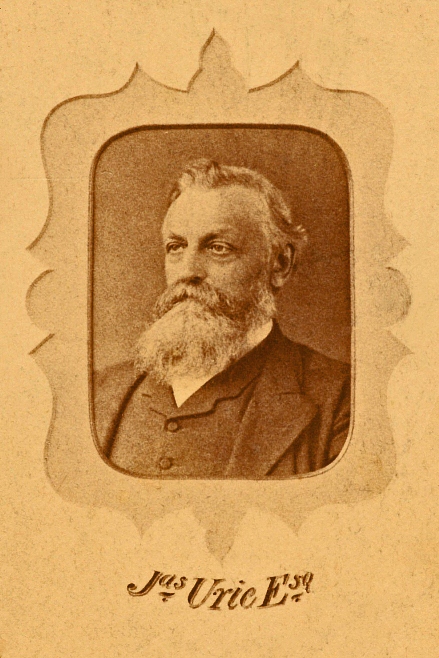
James Urie, June 1887

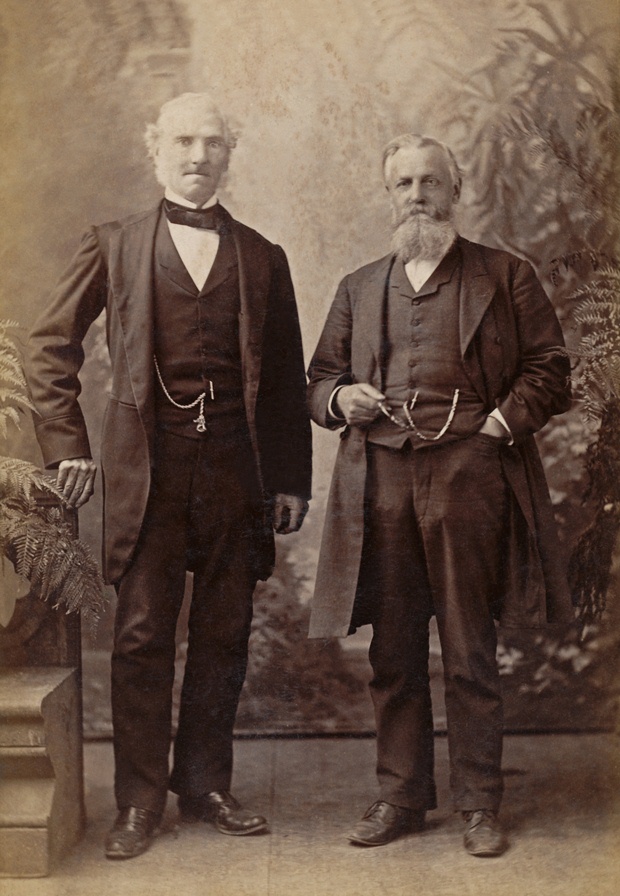
The photo below is from my family history collection and shows James Ferguson and James Urie in a portrait taken specifically for the occasion of the company dinner held at the North Melbourne Mechanic’s Institute on the evening of the 22nd June 1887.

James Ferguson & James Urie 1887


Related posts:

31-08-1855: James Urie marries Grace Hardie Young.

23-07-1890: James Urie, principal partner in the firm Ferguson & Urie dies.

29-08-1890: Letter of Condolence from the Borough Council to Grace Urie.

External links:

‘Urie, James (1828–1890)’, Obituaries Australia, National Centre of Biography, Australian National University, http://oa.anu.edu.au/obituary/urie-james-14449/text2553.
(Transcription originally submitted by Ray Brown – Feb 2012)

Short link to this page: https://wp.me/p28nLD-GX

© Copyright

07-11-1889: The Ross Portable Fire Escape Demonstration.

Thomas Ross of Sydney, New South Wales, invented the “Ross Patent Portable Fire Escape”. In Victoria it was filed as patent No 6650 on the 2nd of April 1889 and in the US was filed as US patent 434888 dated August 19, 1890.

Why the Ferguson & Urie premises at 10 Collins Street was selected for the demonstration is a mystery.

The Argus, Melbourne, 7th November 1889, page 11.

“THE ROSS PATENT PORTABLE FIRE ESCAPE. A PUBLIC EXHIBITION Of the above will be given at Messrs. Ferguson and Urie’s Buildings, Collins-street east, TODAY, At 11 a.m. Sole Agents – BARNETT BROS. 407 Collins-street.”

Goulburn Herald, NSW, Tuesday 12th November 1889, page 4.

“New FIRE-ESCAPE.-A public exhibition of a new fire-escape, known as “The Ross Portable Fire-escape,” was given recently at Messrs. Fergusson and Urie’s establishment in Collins-street, Melbourne. The appliance consists simply of a moderately stout asbestos or fire-proof rope, which is fixed to the upper windows of a building by an ordinary staple. The rope is wound round a drum or reel provided for the purpose, and as soon as a fire originates this is thrown out into the street. Attached to the rope, and running along it, is a metal brake fitted with antifrictional grooves. This brake carries a broad sling, which is passed under the armpits of the person desiring to escape. Then by holding the rope gently in the hand, he can regulate the speed with which he descends to the ground. No fewer than three descents were made by Mr. Thos. Ross, the inventor. He left the top story, which is about 70 ft. in height, and showed how simply the invention worked by stopping himself several times in his descent, and by decreasing and increasing his speed at will. Other advantages claimed for the patent are that it is oheap and easily port able, and that it can be fixed in position in a few moments. – Melbourne Argus.”

Ross Portable Fire Escape (click to see complete Patent file)

Ross Portable Fire Escape Patent US434888

19-08-1889: Sale of the Ferguson & Urie building in Collins Street, Melbourne, Victoria.

The Argus, Melbourne, Monday 19th August 1889, page 8.

“CENTRAL CITY PROPERTY. To Banking and Insurance Companies and Others. That CENTRAL PROPERTY. No. 10 Collins-street East, For Sale. Principals only. Apply Ferguson and Urie, 10 Collins-street East”.

Financial market turmoil has begun and it’s likely the sale of the flagship Collins street building is the first casualty to fall in the company. The stock market crashed in 1890 and many businesses fell under pressure from the market woes. This was the first attempt by the company to sell the building but it was not sold until until 1901.

The building at 10 Collins Street (later 281-283) was built in 1884 and demolished circa 1915.

The Ferguson & Urie Building at 10 Collins Street East.

The Ferguson & Urie Building at 10 Collins Street East.

Related posts:

30-09-1873: For sale, 10 Collins Street.

20-03-1884: Ferguson & Urie building facade approved to be made of Hydraulic Freestone.

22-08-1884 : Ferguson & Urie’s new premises.

14-11-1899: The Auction of 283 Collins Street.

21-02-1901: The Citizens Life Assurance Company purchases the building.


Short link to this page: http://wp.me/p28nLD-FV

© Copyright

27-07-1888: Flemington & Kensington Council.

The Argus, Melbourne, Friday 27 July 1888, page 9.

“FLEMINGTON AND KENSINGTON (Borough). By effluxion of the time three councillors retire, viz, the mayor, (Councillor Urie), Councillors F. Melville, and J. Mitchell. These gentlemen seek re-election, and are opposed by Mr. R. Donovan, of the Pastoral Hotel. Mr Leonard, the local auditor, has been returned unopposed”.

03-03-1888: St Andrew’s Church, Sydney Road, Brunswick, Melbourne, Victoria.

The Presbyterian Church of Brunswick, now known as St Andrew’s, was the design of architect Evander McIver and was opened on the 2nd August 1885 (see entry for 14-08-1885). All of the stained glass in St Andrew’s was executed by the Ferguson & Urie Stained Glass Company of Curzon Street, North Melbourne.

In early 1888 Evander McIvor presented a stained glass window to the memory of his wife, Mary Louisa Buzaglo, second daughter of  William Frederick Buzaglo, secretary for the shire of Coburg. Mary died at the age of 37 on the 1st October 1887.

The North Melbourne Advertiser, Saturday 3rd March 1888, page 2.

“MEMORIAL WINDOW”

 “The Presbyterian Church, Brunswick, has been enriched by a handsome memorial stained glass window, presented by Mr. Evander McIver. It is in three bays at the rear of the rostrum, the side bays in trefoils of pleasing floral designs, and the centre bay a three 3 light lancet window bearing the following inscription:- “In Sacred Memory of Mary Louisa Buzaglo, the beloved wife of Evander McIver – a dutiful daughter, and affectionate sister, a faithful friend, a devoted mother, a loving wife, a consistent Christian. Died 1st October, 1887”. The subjects illustrated are from the Life of Christ, the part above the inscription bearing the representation of The Lord’s Supper and extending over the three lights. The upper part of the central light represents Christ before Pilate. “Behold the Man!” and the side light with the subject, “Naked, and Ye Clothed Me,” and Mary anointing Jesus Feet. Each of these subjects are surmounted by a very rich antique canopy elaborately designed. The columns are rich blending and harmonizing with nice effect. The work has been executed by the well known firm of Messrs. Ferguson and Urie, and as a specimen of ecclesiastical art it is highly creditable. A new feature in this window is that is can be illuminated by gas at night, this having been effected by Messrs. Danks and Son, of Bourke street.”

Photos taken: 14th Nov 2010.T hese images are of the Mary Louisa Buzaglo memorial window, wife of the church architect, Evander McIvor.

This slideshow requires JavaScript.

The Rose window and other Ferguson & Urie stained glass in St Andrew’s were restored by Wesley Vine Stained Glass studio c.2010.

Related posts: 14-08-1885 (All windows in St Andrew’s by Ferguson & Urie)


Short link to this page: https://wp.me/p28nLD-Fd

© Copyright