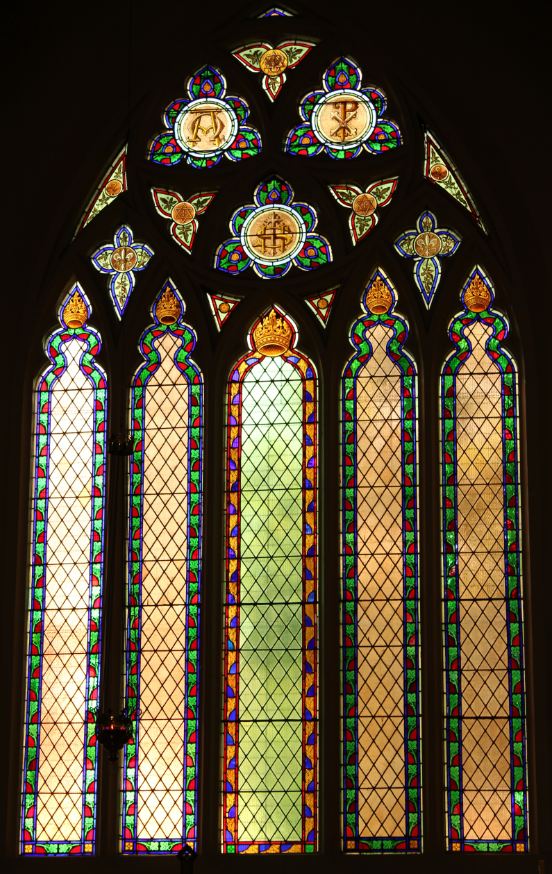
10-09-1862: The Congregational Church, Victoria St, East Melbourne.

The Congregational church was built in 1862 and stands on the corner of Victoria Parade and Simpson Street (176 Simpson Street), East Melbourne. It remained a Congregational Church for more than 70 years until 1937 when the building was sold to the Syrian Orthodox Church. It is now known as the Antiochian Orthodox Church of St Nicholas.

The three-light west window above the principal entrance was crafted by Ferguson & Urie. The centre light contains a scrolling ribbon with a piece of scripture from the King James Bible;

“BEHOLD THE HEAVEN AND HEAVEN OF HEAVENS CANNOT CONTAIN THEE HOW MUCH LESS THIS HOUSE THAT I HAVE BUILDED? 1st KINGS 8:27”

At the bottom edge of the centre light there also appears a very rare occurrence of the company name “Ferguson & Urie”. The two outer lights have obvious evidence of replacement pieces of rudimentary painted glass which have faded to a light brown colour.

Photos were taken: 11th September 2012.

This slideshow requires JavaScript.

The Age, Melbourne, Wednesday September 10th 1862, page 3.

 “A new Congregational Church in Victoria Parade, East Melbourne, was opened for public worship on Sunday last. Sermons were preached by the Revs. J. W. Beer, J. Taylor, and J. Bickford. Yesterday evening a public soiree to celebrate the event was held, the ladies of the congregation providing the necessary refreshments gratuitously. A public meeting subsequently took place, at which George Harker, Esq., presided. Addresses were delivered by the Revs. J. L. Poore, I. New, Moss, Day, W. Butters, and J. Beer; and by the Hon. G. Rolfe, M.L.C. The church is a handsome building, though possessing no pretensions to a high order or architecture. It is 65 feet long by 39 wide, and is capable of comfortably seating from 400 to 500 persons. The windows are of stained glass, manufactured by Messrs Ferguson and Urie, of North Melbourne. The building cost altogether 1300; of which about 200 is still due, though a liberal offer was made in the course of the evening by Mr Ramsden, to subscribe 100 if the balance of the debt was raised by the congregation. It need scarcely be mentioned that the cost of the construction is solely borne by the members of the congregation, no portion of it being received from the state-aid grant”.


External links:

St Nicholas Church web site

Heritage Victoria


Short link to this page: https://wp.me/p28nLD-hA

© Copyright

01-01-1872: Welsh Church, Latrobe street, Melbourne, Victoria.

The Argus, Melbourne, Monday 1st January 1872, page 5.

A new Welsh Presbyterian or Calvanistic Methodist Church was opened for Divine worship on Saturday, in Latrobe-street. The congregation first met in a common school in Collins street in 1853, but in a year or two became sufficiently numerous to remove to a larger building in Latrobe-street. This, in time, failed to afford sufficient accommodation, and the present structure has been erected in its place. It was designed by Messrs. Crouch and Wilson, and was erected by Mr. Ireland, the total cost being about £1,800. Its style is what is known as the early decorated. It is built of brick, on stone foundations, and measures over all 65ft. 6in. by 42ft. It is intended to stucco the whole exterior of the church, but at present only the front elevation has been so treated. This facade stands upon a fine axed bluestone base, and is 50ft. high to the top of the finial on the gable. The principal entrance is in the centre, and above it is a large triple-light window, with geometrical tracery filled with stained glass, from the manufactory of Messrs. Ferguson, Urie and Lyon.

The Gothic Revival Church in Latrobe street was opened on 30th December 1871.

The text in the ribbon in the centre of the triple light window facing Latrobe street is written in Welsh which translates as follows:

Welsh: –  “ANNWYL CARWN EIN GILYDD OBLEGID CARIAD O DDUW Y MAE”
English: –  “BELOVED LET US LOVE ONE ANOTHER FOR LOVE IS OF GOD”

The text comes from the King James Bible, 1 John 4.7 – “Beloved, let us love one another: for love is of God; and every one that loveth is born of God, and knoweth God”

Photos taken 16th July 2011.

This slideshow requires JavaScript.


Short link to this page: http://wp.me/p28nLD-h3

© Copyright

08-12-1871: Christ Church, Hawthorn, Melbourne, Victoria.


The Argus, Melbourne, Friday 8th December 1871, page 5.

 “A very handsome memorial window has recently been placed in the north transept of Christ Church, Hawthorn, by Lady Palmer, in commemoration of her husband, Sir James F. Palmer, the late president of the Legislative Council. It is the work of Messrs. Ferguson, Urie and Lyon, of Curzon-street, North Melbourne, stained glass manufacturers, and is an exceedingly creditable production. The design, which is typical of the three Christian virtues, Faith, Hope, and Charity, is identical with that of the west window of New College Chapel, Oxford, which was painted by Jervais, from cartoons furnished by Sir Joshua Reynolds. The colours are very rich, and harmonise well together. The whole treatment of he subject is good, the drapery of he figures, in particular, being admirably managed. Mr.Wyatt, architect, supervised the execution of the work.”

Photos taken 14th November 2010.

This slideshow requires JavaScript.

[View larger images]

Geelong Advertiser, Vic, Thursday 7th December 1871, page 3.

 “A very handsome memorial window has jnst been placed in Christ Church, Hotham, at the expense of Lady Palmer, in commemoration of the death of her husband, the late President of the Legislative Council. As a specimen of colonial art, the work is probably in its way the finest production in Victoria. The window consists of three compartments, containing allegorical representations of the three Christian virtues, Faith, Hope, and Charity, respectively. The last named of these personifications is represented on the centre compartment, which is 9 feet 8 inches in height and 2 feet broad; the two others being 7 feet high by 2 feet wide. The colours are extremely rich, and the execution compares very favourably with that of two other painted memorial windows of English manufacture in the same church. The work was executed by Messrs Ferguson, Urie, and Lyon, of this city, under the direction of Mr F. Wyatt, architect, the design, so far as the forms are concerned, being copied from a portion of the Hew College Chapel window, which latter was the work of Jervaise, from paintings by Sir Joshua Reynolds. Running along the lower portion of the new window is the following inscription in old English letters:—”To the memory of James Frederick Palmer, Knt., who died April 23rd, 1871.” I understand that the total cost of the work was a little over £100”.

The first parts of Christ Church Hawthorn were constructed in 1853-54 of bluestone in the Gothic design of Charles Vickers. The chancel and temporary organ chamber were added in 1873 and extensions to the nave and north transept in 1886. The church has many historic stained glass windows by craftmen such as Ferguson & Urie, Brooks Robinson & Co, William Montgomery, William Wailes and Hardman of Birmingham.

In late 1871 Lady Isabella Palmer had a memorial stained glass window erected in the South Transept of Christ Church, Hawthorn in honour of her husband Sir James Frederick Palmer (1803-1871)There is always the question of how or why particular subjects are selected for memorial windows, but in the case of Sir James’ memorial window it was made a little easier for Lady Isabella. She would have been acutely aware of her husbands taste in art. At the Art Treasures Exhibition in Melbourne in April 1869, “…Sir James Palmer contributes two relics of his illustrious kinsman, Sir Joshua Reynolds…” All Lady Isabella had to do now was pick something by Sir Joshua Reynolds with a religious theme that Sir James’ would have loved.

The resulting stained glass window she comissioned was to be made by local stained glass craftsmen “Ferguson, Urie & Lyon” of Curzon St North Melbourne and depicts the three Christian virtues, Faith, Hope, and Charity. The window uses quite large pieces of glass with very few lead lines and although quite spectacular to see is considered technically inferior to their earlier work. The depictions of Faith, Hope and Charity are copied from a stained glass window, located in New College Chapel, Oxford that was created by Jervais and based on the designs by Sir Joshua Reynolds. Ferguson and Urie also copied some elements of the same for the Foster memorial window erected in All Saints Church in South Hobart in 1868.

There is another Ferguson & Urie window in this church not mentioned in any other article found to date. The Henry Nathaniel Ray memorial window is by Ferguson & Urie circa 1879 and depicts Christ carrying the Cross. Henry Ray was the son of Henry Gibbons Ray & Mary Singer and husband of Maria Josephine Ray.  Ray was a Broker, formerly of Middlesex, and died at his home “Maida Estate” at Weinberg Rd Hawthorn on on the 6th of Aug 1879 aged 59 after only a few hours of illness (as reported in the Argus, 7th of August 1879). (Vic BDM: 8008/1879). His family home “Maida Estate”, situated at Glenferrie and Riversdale Roads at Hawthorn, went up for public auction on the 26th of February 1880.

External links:

Sir James Frederick Palmer (1803-1871)


Short link to this page: https://wp.me/p28nLD-gI

© Copyright

21-06-1871: Roman Catholic Mortuary Chapel at the Melbourne General Cemetery.

The Argus, Melbourne, Wednesday 21st June 1871, page 5.

 “The Melbourne Cemetery has received another adornment, now that the new mortuary chapel in the Roman Catholic portion of the ground has been completed. This elegant structure, of which the sanctuary only is wanting, is of bluestone, with windows and exterior ornaments of Tasmanian freestone, from Kangaroo Point. It consists of a pointed porch, enriched with carved finials, which leads into a lofty open-roofed chapel, lighted by four trefoil-pattern windows, and paved with encaustic tiles, and two crypts beneath. The style is Gothic, and the dimensions are – length 60ft.,width 22ft., while the slated roof reaches a height of 50ft from the ground. The Belfry is not yet finished. The crypts are solidly floored with concrete, and are provided with sufficient means of ventilation. They are intended as a final receptacle for the remains of deceased priests, which are to be placed there in leaden coffins. The bodies of about 10 deceased clergymen await their transit to this repository, which will take place contemporaneously with the solemn dedication of the building to the Blessed Virgin and St. Joseph by the bishop. This will be celebrated in a few weeks, and the Rev. G. V. Barry will preach a special sermon on the occasion. This mortuary chapel is, we believe, the only one worthy the name in Australia; at least such was the opinion of Archbishop Polding, who visited it the other day, and whose knowledge on the subject is doubtless considerable. The entire edifice, which has cost over £1,000 is due to the Rev. W. M. Finn, who, with the permission of the bishop, initiated the movement which has resulted so successfully at the time that he was appointed to his present cure at Heidelberg. Since then the rev, gentleman has been unremitting in his exertions to obtain subscription, and when the money was forthcoming extended his careful supervision to every detail of the construction. The architect of the chapel is Mr. J. B. Denney, and the work was done in two contracts, the superstructure being erected by Messrs. J. Young and Co.”

The dedication ceremony of the chapel was to have taken place on Sunday 20th August 1871 but was postponed due to heavy rain. The service finally took place in the presence of a crowd of 10 to 15 thousand people on Sunday 10th September 1871.

Geoffrey Wallace Stained Glass Studio at Caulfield restored the windows after they were vandalised in 2008.

Four saints are depicted in individual lancets being:

  1. Saint Brigitta of Sweden, holding a candle,
  2. Saint Patrick of Ireland holding the staff with the snake at his feet,
  3. Saint Joseph holding a stalk of Lily flowers,
  4. Saint Maria with her hands folded in prayer.

Each window has the Latin Motto “ORA PRO NOBIS” (Pray for us) at the bottom.

All the photos of the windows have been kindly contributed by Geoffrey Wallace . The images show the remarkable transformation before and after the restoration by Geoff’s Studio.

This slideshow requires JavaScript.


Short link to this page: https://wp.me/p28nLD-g8

27-02-1871: Shipping Intelligence notices.

The Argus and other local newspapers of the time included hundreds of shipping notices detailing cargo notices for the colony’s businesses.

The Argus, Melbourne, Monday 27th February 1871, page 4.

“SHIPPING INTELLIGENCE. HOBSON’S BAY”

“Dilharce, from London – 28 cases, Ferguson, Urie, and Lyon;”

04-06-1870: Christ Church, Acland Street, St Kilda, Melbourne, Victoria.

In late May of 1870 the first five stained glass windows for the Chancel of Christ in Acland Street St Kilda were erected by the Ferguson & Urie Stained Glass company. These single light lancet headed windows represent the Annunciation, Nativity, Baptism, Crucifixion & Burial and Resurrection. In the following four years the Ascension, Rising of Lazarus, Jairu’s Daughter, Good Shepherd and I.H.S. windows were erected.

The Argus, Melbourne, Saturday 4th June 1870, page 5.

“We have much pleasure in observing that the illuminated windows manufactured by Messrs. Ferguson, Urie, and Lyon, of this city, have been completed, and are now placed in the chancel of Christ Church, St. Kilda. They are five in number, representing the annunciation, birth, baptism, death, and resurrection of our Lord, and the Lamb of God. They add very greatly to the beauty of the edifice, and are an excellent sample of colonial art. These windows were obtained in response to an offer made by a member of the congregation to give the central window, provided the other four were subscribed for by the parishioners. This most desirable condition was fulfilled by a concert at the town-hall, Prahran, last September, at which several lady and gentleman amateurs performed, together with a donation of £20 given by Mr. E. Courtney towards the object to the lady who got up the concert.”

Photos taken: 11th February 2011.

This slideshow requires JavaScript.

The article from 1870 only mentions the first five windows installed in the chancel of the church but there are a total of ten Ferguson and Urie windows in the church installed at different times in history.

1. Annunciation (Restored by Alan Sumner).

2. Nativity

3. Baptism (Restored by Alan Sumner).

4. Crucifixion and Burial

5. Resurrection (Restored by Bruce Hutton from Almond Glass).

6. Ascension (A copy of the original Ferguson & Urie Ascension by Alan Sumner in his own style).

7. The Rising of Lazarus from the Dead.

The lower panel has the finely painted roundel depicting the storm and shipwreck of the ‘British Admiral’ with the inscription:

“In memory of Miles Nicholson died 27th April 1974 Aged 28. William Dalzell Nicholson drowned in the wreck of the British Admiral 23rd May 1874 Aged 25″. Interestingly there is also a memorial to Nicholson on King Island.

The morning Bulletin, Rockhampton, QLD, Friday 2nd December 1887, page 6.

 “King Island has been the scene of a terrible number of ship wrecks and the remains of these are to be seen all round the coast. On the southern side stands a marble monument erected by the late Hon. William Nicholson tot he memory of his son who was lost with 78 others in the “British Admiral” which foundered there in 1874. There is much of interest derived from the trip of the naturalists and there is no doubt that they have made most of the opportunity offered to them. November 24, 1887”.

The marble monument on King Island reads:

“Head stone erected to the memory of Wm. Dalzell Nicholson who with ‘Tilly’ Dale & many others perished in the vicinity in the wreck of the ‘British Admiral” 23rd May 1874″.

This window has its own fascinating and sad story and I have written an individual article about it. See: post: 27-04-1874: All Saints Church, St Kilda, Victoria.

8. Jairus’s daughter restored to life. (Restored by Bruce Hutton from Almond Glass).

This window is the Constance Emily Fanning memorial window and is claimed to be the second window to be installed in the church. It was badly damaged in 1995 and has been restored by Bruce Hutton of Almond Glass. There is the biblical reference on the window “‘S. Mark C.5. V.47” which I believe is an error as there is no Verse 47 in chapter 5 of St Mark.What I believe it should refer to is Mark c5-v41 which in the King James Bible reads; “And he took the damsel by the hand, and said unto her, Talitha cumi; which is, being interpreted, Damsel, I say unto thee. arise”. 

The scroll and text to the lower edge of the window reads:
“Blessed are the Dead which die in the Lord” and “In Memory of Constance Emily Fanning. Died 28th May 1874.”

9. I am the Good Shepherd.

The plaque at the base reads: “In memory of John Jennings Smith died 7th August at Adelaide South Australia 1871 in his 21st year”.

South Australian Chronicle and Weekly Mail, Adelaide, SA, Saturday 2nd September 1871, page 6.

John Jennings Smith drowned in the river whilst on a boating expedition with friends. His first, last, and fatal mistake was that he could not swim!

South Australian Register, Adelaide, SA, Monday 14th August 1871, page 5.

“SMITH.- On the 7th August, in his 21st year, John Jennings Smith, eldest son of Francis Grey Smith, of the Bank of South Australia, and grandson of the late Rev. John Jennings Smith, M.A., first Incumbent of St. Paul’s, Paterson, New South Wales.”

10. The monogram “I.H.S” set into a trefoil shaped window.

This window is to the memory of the Rev. John Stanley Lowe who was the Vicar of Christ Church for a 36 year period between 1868 and 1904 and also Chaplain General to the Victorian Forces.


Short link to this page: https://wp.me/p28nLD-ei

© Copyright
11-05-1870: Charitable Donations.

Over a forty year period the company name and many of the employees names were mentioned in numerous columns as having been donors to many institutions.

The Argus, Melbourne, Wednesday 11th may 1870, page 5.

“The secretary for the Victorian Asylum and School for the Blind acknowledges the receipt of the following sums in aid of that institution:-[…]“

“[…].Ferguson, Urie, and Lyon, £1,1s […].”


22-04-1870: The Haymarket Theatre Dispute. Melbourne, Victoria.

The Argus, Melbourne, Friday 22nd April 1870, page 6.

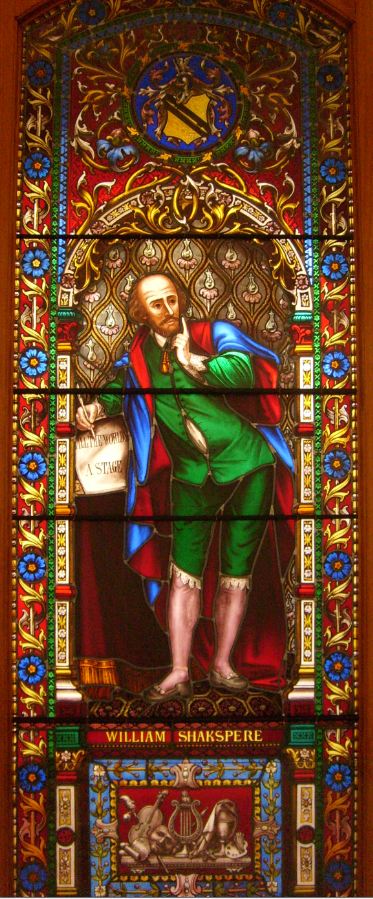
Mr P.T. Conlon, Architect, writes to the Editor of the Argus in an attempt to correct a misinformed statement made by a Mr. Sullivan at a meeting of bondholders of the Haymarket Theatre..

“THE HAYMARKET THEATRE DISPUTE”

 “Sir, – In the absence of Mr. George Coppin from the colony, will you permit me to contradict a statement made by Mr. Sullivan, at a meeting of bondholders held yesterday, at the office of Mr. Mackenzie. In your report of the meeting in this mornings issue of the Argus, it appears that Mr Sullivan made a statement to the effect that Mr. Coppin had four bonds given to him for certain articles that he provided when the theatre was built, amongst which was a stained glass window that was placed in front of the Apollo-hall. Upon this subject Mr. Sullivan must have been misinformed. The history of the stained glass window, of which so much has been said of late, is simply that in my original specification for building the Haymarket Theatre the whole of the windows in front were to be of plate glass. Messrs. Ferguson and Urie being anxious to introduce their exceedingly beautiful system of imitating stained glass, made an offer to Mr. Coppin to fill in the spaces with their workmanship, at atleast two thirds less than Its actual cost. Mr. Coppin accepted their offer and paid the difference between that and the plate-glass, and to my certain knowledge there was no source from whence Mr. Coppin could obtain the bonus (of four debentures) spoken of by Mr. Sullivan. – I am, Sire, yours, &c. P.T. CONLON, Architect. April 21, 1870.”

Note: The Shakespeare window now is on display at the State Library in Swanston St Melbourne and was restored by Geoffrey Wallace Stained Glass in 2005.

Shakespeare Window 01

Related posts:

05-07-1862, 12-07-1862 (slideshow), 06-08-1862


Short link to this page: https://wp.me/p28nLD-e4

© Copyright


17-04-1869: An Art Treasures Exhibition is held at the hall of the Public Library Melbourne.

The South Australian Register, Saturday 17th April 1869, page 3.

 “[…] Several additions have been made to the Exhibition, and among the most remarkable is a painted window, illustrative of the seasons, the work of Messrs. Ferguson, Urie & Lyon, glass-stainers of Hotham[…].”

 Note: This refers to the window for John Wilson’s mansion “Woodlands” near Ararat in western Victoria.

Related posts: 13-04-1869 > 1868

31-08-1868: St. Mary’s Church, Queensberry street, North Melbourne, Victoria.

In 1868 it was reported that the Ferguson & Urie stained glass company had prepared the designs for a 22ft high five light window depicting the Virgin Mary and the Crucifixion for St Mary’s church in Queensberry Street, Hotham, at an estimated cost of £375. The window was never actually created by Ferguson & Urie!

The Argus Melbourne, Monday 31st August 1868, page 6.

ST MARY’S CHURCH, HOTHAM…”

“… One of the noticeable features of this church is its windows. Those in the gables of the transepts are “four-light” windows, and of good size, but the finest of all is that of the chancel, which is the principal window of the church and one of the largest in Melbourne. It is twelve feet wide, and twenty-two feet high, and contains five “lights,” the mullions being of free-stone, beautifully carved. It is intended, when funds permit, to fill this window with stained glass, each “light” or compartment containing a design illustrative of some memorable scriptural incident in the life of the Virgin Mary. The design for the centre light will be the Crucifixion of the Saviour, with the Virgin Mary and St. John at the foot of the cross, and the subjects for the other compartments will include the Annunciation, the Adoration of the Magi, &c. The designs for this window have already been partly prepared by Messrs. Ferguson and Urie, and the estimated cost of carrying them out is £375. The remainder of the windows will be fitted with plain cathedral glass….”

Although it was reported that Ferguson & Urie had ‘prepared’ the designs, the window was never made by them. The window remained as plain cathedral glass for a further twenty years before being made by Smyrk & Rogers of Little-Collins street east in 1888 who were also responsible for most of the others in the church.

St. Mary's, Hotham, Nth Melbourne, Rogers & Co stained glass

St. Mary’s, Hotham, Nth Melbourne, stained glass by Smyrk & Rogers in 1888 (Photo: 12 Dec 2012)

See Stained Glass Australia web site post: 27-10-1888 St Mary’s Anglican Church, North Melbourne, Victoria, Australia.

© Copyright