19-02-1874: The Hotham (North Melbourne) School of Art.

In 1873 the Hotham School of Art[1] has been established and operates from premises in Chetwynd Street North Melbourne. Prominent figures from the stained glass firm Ferguson & Urie are involved in its inception.

Ferguson & Urie’s senior stained glass artist, David Relph Drape (1821-1882), lends his expertise as a teacher in the field of “Ornamental and Figure Drawing” as well as being a member of the Board of Advice. The principals of the Ferguson & Urie stained glass company, James Ferguson (1818-1894) and James Urie (1828-1890) are also members of the Board of Advice. In 1877 the school moved to more suitable accommodation within the North Melbourne Town hall and at that time maintained an average of 95 scholars during the terms[2].

In 1877, Drape’s eldest sons, Isaac Selby Drape (1866-1916) and John Campbell Drape (1866-1920), are mentioned amongst the recipients of prizes in the category of “Ornamental Outline”[3]. Neither continued a career in art.

In 1879, Ferguson & Urie apprentice Frank Clifford Lording (1860-1944) was awarded a prize as a senior student in the category of “Ornamental Shaded”[4]. After the closure of Ferguson & Urie in 1899, Lording joined another fellow employee of Ferguson & Urie named Charles William Hardess (1858-1949) to form ‘Hardess & Lording’ as lead-lighters. Hardess’s father, George Matthew Hardess, was also treasurer of the Hotham School of Art and Chairman of the Board of Advice in 1874[5].

In 1883, Ferguson & Urie apprentice George James Coates (1869-1930), was awarded a prize in the senior class for Landscape drawing[6]. Coates was apprenticed to Ferguson & Urie at the age of 15 and later became an accomplished artist in his own right as well the unofficial war artist to the Australian Government during WW1.

The photos of Frank Clifford Lording, Charles William Hardess and George James Coates appear amongst the photo collage of the employees created for the company dinner held at the North Melbourne Mechanics Institute on the 22nd of June 1887.

Principal partner in the Ferguson & Urie stained glass company, James Urie, continued the promotion of the arts as a founder and committee member of the Flemington and Kensington School of Art founded in 1884[7].

HOTHAM SCHOOL OF ART 01a

Ferguson & Urie members.
Sepia photos dated June 1887, photo of Drape circa late 1870’s.


North Melboure Advertiser, Vic, Thursday 19th February 1874, page 3.

“Under the Auspices of the Commission for Promoting Technological Education.

HOTHAM SCHOOL OF ART, held AT ST. MARY’S SCHOOLROOM, Chetwynd street. Terms: two shillings per quarter. The following classes meet every THURSDAY EVENING, at eight p.m. :- Practical Geometry, Teacher, J. Ingamells; Mechanical Drawing, J. Buncle and R. Bodycombe; Architectural Drawing, T. Caine; Ornamental and Figure Drawing, D. R. Drape; Landscape and Elementary Drawing, J. M. Kennedy. The committee consists of the following gentlemen:- The Mayor of Hotham, Mr. Cr. Carroll, Mr. Cr. Thomas, Mr. Cr. White, Mr. Cr. Barwise, Mr. Cr. Clarke, Mr. Cr. Laurens, Mr. Cr. Ryan, Mr. Cr. Paton. The following Members of the Board of Advice:- Mr. G. Hardess (chairman), Mr. Alcock, Mr. W. Clarke, Mr. Beasley, Mr. Cook, Mr. Laurens, and Mr. Buncle, Mr. Bodycombe, Mr. Drape, Mr. Caine, Mr. Kennedy, Mr. Kurz, Mr. Walker, Mr. White, head, Mr. C. E. Randall, Mr. Marley, Mr. Gilchrist, Mr. McGrotty, Mr. Reynolds, Mr. Kirkus, Mr. Atkin, Mr. Ferguson, Mr. Urie, Mr. Chrystal.

Mr. G. M. HARDESS, Treasurer.
Mr. H. WARNER, Secretary.”

1889: Alexander Lumsden Young (1833-1889)

Alexander Lumsden Young (1833-1889) played a significant role in the Ferguson & Urie stained glass company.

He was born in Scotland circa 1833-34 to Benjamin Young and Isabella Cumming. He married Elizabeth Belle Gray on the 27th December 1864 in Melbourne at the age of 30, at which time his profession was cited as being a plumber.

His early business interests were with Urie, Young & Co producing by-products from maize such as ‘maizena starch’, which won awards at the 1866-67 Intercolonial Exhibition. 

Sometime in the 1860s or 70s joined his brother in law, James Urie, and became a member of the stained glass firm Ferguson & Urie. His sister Grace Hardy Young had married James Urie in Nth Melbourne in 1855 . In late 1885 he traveled to Brisbane with his nephew, William Urie (son of James Urie, principal of Ferguson & Urie), to supervise the installation of the companies largest stained glass window known to have been created by the firm  (35 feet in height) which was erected at the west end of St Stephen’s Catholic Cathedral in Brisbane.

At the 1886, 87, and 88 Ferguson & Urie company dinners he played the part of Vice-Chairman for the formalities on each occasion.

His portrait appears amongst the 31 photographs in the collage created for the occasion of the Ferguson & Urie company dinner held on the evening of the 22nd of June 1887 at the North Melbourne Mechanics Institute.

Alexander Lumsden Young died at his residence, “Dean-Bank” 21 Abbotsford St, North Melbourne, on the 1st August 1889 aged 56. His probate (intestate) was not applied for until more than seven years later, by his wife Elizabeth, who cited her eldest son, George Watson Young, as the reason and that the entire matter was left in his hands, which he had neglected. Elizabeth died 36 years later in 1925.

Alexander Lunsden Young [1887 Company Dinner]

Alexander Lumsden Young on the occasion of the Ferguson & Urie Company Dinner held on 22 June 1887.

The Argus, Melbourne, Vic, Friday 30th December 1864, page 4.

“YOUNG-GRAY.- On the 27th inst, at the Manse of the Presbyterian Church of Scotland, Collins-street, by the Rev. Irving Hetherington. Alexander Lumsden Young, plumber, Melbourne, to Elizabeth Bell Gray, late of Stockbridge, Edinburgh”.

The Argus, Melbourne, Vic, Friday 2nd August 1889, page 1.

“YOUNG.- On the 1st inst., at Deanbank, Abbotsford-street, North Melbourne. Alexander, the beloved husband of Elizabeth Young, aged 56 years. Home papers please copy”.

The Argus, Melbourne, Vic, Saturday 3rd August 1889. page 1.

“THE Friends of the late Mr. ALEXANDER L, YOUNG are respectfully invited  to follow his remains to the place of interment in the Melbourne General Cemetery. The funeral will leave his late residence, “Dean-Bank”, Abbotsford-street, North Melbourne, THIS DAY (Saturday, 3rd inst), at 3 o’clock. ALFRED ALLISON, undertaker, 221 Victoria-street, West Melbourne; Mount Alexander road, Moonee Ponds; and Racecourse-road, Newmarket, Telephone 980″.

The Argus, Melbourne, Vic, Monday 9th March 1925, page 1.

“YOUNG.- On the 6th March (passed peacefully away), at her late residence, Dean Bank, Beaconsfield parade, Croxton, Elizabeth Belle, widow of the late Alexander Young, much loved mother of Isabelle (Mrs. Arthur H. Padley, Bacchus Marsh, Vic). In God’s Care”.


Short link to this page: https://wp.me/p28nLD-1NI
 

09-01-1885: Elm Street Hall, North Melbourne, Victoria.

The North Melbourne Presbyterian Church was initially founded in 1854 with the first services being conducted in a Blacksmiths shop near the site of the North Melbourne Town Hall. A temporary iron building was first erected for the congregation in Curzon street, and only a few years later a new bluestone church was erected, the foundation of which was laid by Sir Henry Barkly on Friday the 8th of April 1859[1].

In less than twenty years this church was deemed too small for the growing congregation and in the 1870’s plans were afoot to erect a new one. The designs of local Brunswick architect Evander McIver were chosen and the foundation stone for the new Union Memorial Church was laid on the corner of Curzon & Elm Streets North Melbourne by the Hon James MacBain, M.L.A, on the afternoon of Tuesday 14th January 1879[2]. In less than eight months the new Church was completed and was officially opened on Sunday 31st August 1879[3].

At the same time as the new church was to be erected, the old one was dismantled and, using most of the original building material, was re-erected about fifty meters to the rear of the site and would later become known as the Elm Street Hall. In May 1889 the Sabbath School was erected[4] to the rear of the church and the Elm Street Hall.

The Elm Street hall has a series of four single lancet stained glass windows that are a memorial to David Howat (1814-1885), the father[5] of the Sabbath School Superintendent William Howat (1850-1935). William was most likely the one who commissioned Ferguson & Urie to create the memorial windows to his father and it’s possible that these windows may have been originally erected in the Sabbath School at the time of it’s erection in 1889 and later moved to the Elm Street Hall where they exist to this day in the liturgical south wall.

Photos taken: 21st July 2012.

This slideshow requires JavaScript.

The four windows are in very poor condition and there are many pieces of modern uncomplimentary glass used to fill the gaps where pieces were broken at various times during their history. Three of the four pieces of text that describe the figurative depictions in each window are missing altogether and the memorial text at the base of each window is also missing a number of pieces. The only memorial text that can be ascertained at the base of each window is:

1.  “TO THE GLORY OF GOD AND IN MEMORY OF”
Depicts possibly someone as the teacher? A woman or apostle seated with an open book and two children either side. The text below the figure, which may explain the precise depiction, is missing.

2. “(missing piece) HOWAT (missing piece)”
Depicts a child kneeling in prayer at the foot of an apostle? The text below the figure, which may explain the precise depiction, is missing.

3. “WHO DIED 9th JAN 1885 AGED 71”.
This window has the well known figurative depiction of Christ as the Good Shepherd. It has the partial text “The Good Shepherd”, holding a lamb in one arm and his crook in the other with sheep at his feet, so I presume the missing word are “I Am” and “The” to make up “I Am The Good Shepherd”.

4. “(All the memorial text is missing from this window)”.
This window appears to have the figurative depiction usually associated with “Suffer Little Children To Come Unto Me.” But, below the figure is the partial text “…Remember Now Creator…”. This is most likely from Ecclesiastes 12-1 which says “Remember now thy Creator in the days of thy youth, while the evil days come not, nor the years draw nigh, when thou shalt say, I have no pleasure in them”.

The windows were a memorial to David Howat, at one time a session clerk of St. Andrew’s Presbyterian Church of Carlton. He was elected in 1872[6] and held office for more than twelve years until his death in 1885. He died at his residence at 180 William-street Melbourne on the 9th of January 1885 [7], in his 71st year. He was buried in the Melbourne General Cemetery on the 12th of January 1885 [8] and many other family members, including his wife Sarah, infant son David, only daughter Mary and son William are buried in the same family plot.

The Union Memorial Sabbath School and William Howat.

North Melbourne Advertiser, Vic, Saturday 18th May 1889, page 3.

“AN INTERESTING CEREMONY”
“Last Saturday afternoon a large number of ladies and gentlemen interested in the Sabbath school work, met by invitation to celebrate the opening of the new infant school, erected in connection with the Union Memorial denomination, North Melbourne…”
“…Owing to the energy of their superintendent who had not an equal in the colony – in fact there was no superintendent like him, his heart and soul were in the glorious work – they were as a school able to declare the building completed, seated, and opened free of debt…”

The stained glass windows in the Sabbath School were described in the newspapers as:

“It is lighted with ornamental cathedral lancet lights of stained glass, which when finally completed will give a softened and effective tone to the interior…”

The much revered Superintendent of the Sabbath School was William Howat (1850-1935), the son of David Howat (1814-1885) and Sarah Robertson (1814-1891). He was born in Ayrshire Scotland and arrived in Australia with his parents and elder siblings, George and Mary, aboard the Lady Octavia from Greenock on the 31st December 1855 [9][10].

He had been associated with the Y.M.C.A and the Sunday School Union movement from his early 30’s and had for more than 70 years, a long business association with four generations of the wealthy Clarke family of pastoralists[11].

He was first involved with the establishment of a Sabbath School in connection with St Andrew’s Presbyterian Church of Carlton (now zoned in Brunswick) which was opened in August 1884[12] and his efforts in that area made him well qualified to exert himself in the cause for a Sabbath School in North Melbourne.

Apart from being the revered Superintendant of the Union Memorial Sabbath School, William Howat was an avid and eclectic antiques collector and over a 65 year period had amassed an extraordinary collection of books and all manner of curios from all over the world[13]. His love of books also extended to the Sabbath School where he donated the vast majority of the books to its library. At the opening of the Sabbath School in 1889 it was described:

“The library is a model. It contains some 1800 volumes, mostly the gift the superintendent. The teacher’s library is a collection of the best works extant…”[14]

William Howat died unmarried on the 1st of August 1935[15], at his home ‘Glaisnock’ in William Street West Melbourne aged 85. He left an estate reported to be worth £9,912[16] and apart from many bequests to relatives and friends, and charitable institutions, he bequeathed a life interest in most of his estate to his housekeeper.

The William Howat collection of books, art, and curios, was put up for auction in November 1935[17] which consisted of over 20,000 volumes of rare old editions and modern works on all branches of literature as well as a collection of native weapons, Chinese artworks and curios[18]. It was described in the papers as “one of the Greatest Sales ever held in Melbourne[19].

Other References:

http://vhd.heritage.vic.gov.au/#detail_places;884

http://www.cv.vic.gov.au/stories/sound-in-space/12225/elm-street-hall-north-melbourne/

Foot notes:

[1] The Argus, Melbourne, Vic, Saturday 9th April 1859, page 5.

[5] Vic Births Deaths & Marriages No: 6681/1935. William Howat, son of David Howat and Sarah Robertson.

[9] Prov.vic.gov.au (Fiche 084 page 002)

Short link to this page: http://wp.me/p28nLD-1sO

© Copyright

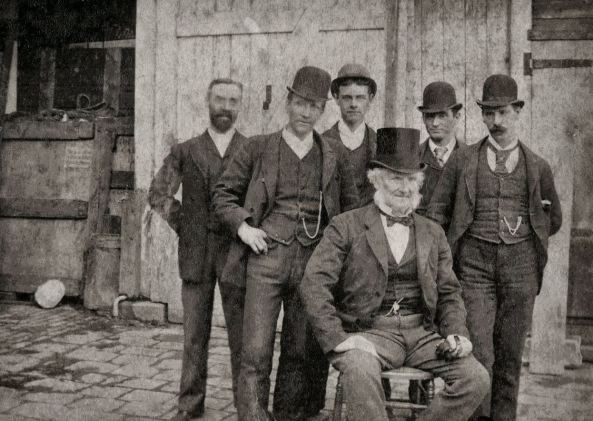
1890: Curzon Street, Ferguson & Urie Employees circa 1890.

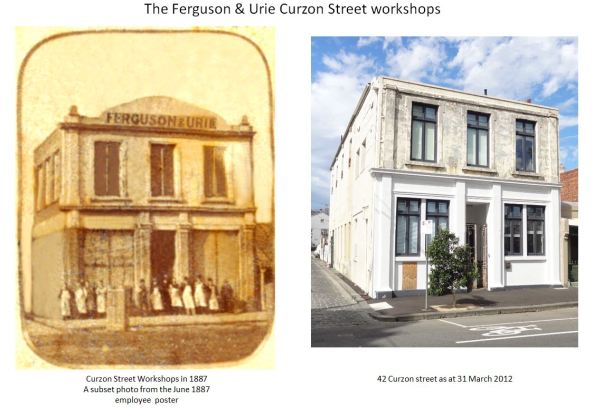
This is a magnificent historical photo of James Ferguson and five of the Ferguson & Urie employees circa 1890. I would guess this photo may have been taken at the rear of the Curzon street workshops North Melbourne which was their first workshops when they started business in 1853. They advertised from the site as early as 1853 but the workshop building wasn’t erected until after 1858 as indicated in the diaries of stained glass artist David Relph Drape. The building still exists as at 2012 but the interior has been converted to individual apartments and only the shell and facade remain as it appeared in the Ferguson & Urie employee photos of June 1887.

The only two positively identified men in the photo are, James Urie Jnr,  James Ferguson Snr and James Ferguson Jnr. The other identifications are based on a likeness from the 1887 employees photos that were taken for the company dinner held on the 22nd January 1887.

CURZON Street Photos 01a

1.D. Morris, 2. unknown, 3. James Urie Jnr (1870-1896), 4. James Ferguson Snr (1818-1894), 5. J. M. Gilligan, 6. James Ferguson Jnr (1861-1945). Photo kindly contributed by my 3rd cousin Errol Vincent from New Zealand 2010.

CURZON Street Photos 02a

The Curzon Street workshop building as it appeared in June 1887 and photo taken 2012.

When the building was being converted to apartments in 2012 the sales brochures indicated that the building had been “remodeled circa 1875 to become the North Melbourne Masonic Lodge”. This incorrect. Ferguson & Urie retained the building as their workshops until the company demise in 1899.

18990506

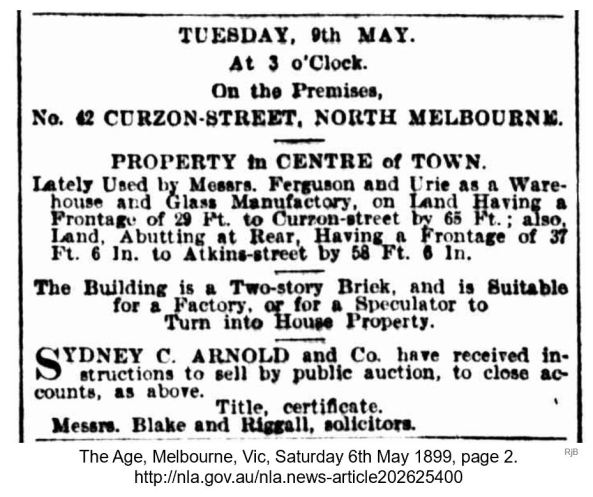
In May 1899 an advertisement was placed in the Melbourne Age advertising the auction of their stained glass workshops at 42 Curzon Street would occur at 3p.m. on the 9th of May 1899.

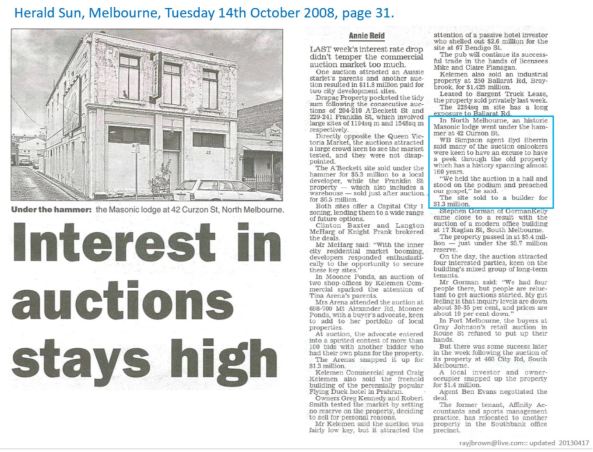
The first tabloid article indicating the building had become the North Melbourne Masonic Lodge appeared in the North Melbourne Courier & West Melbourne Advertiser in September 1902 and it remained in their possession until 2008 when it was put up for auction and sold for $1.3m.

20081014 Curzon

Related posts:

1887 Ferguson & Urie Company Dinner


Short link to this page: https://wp.me/p28nLD-1aP

© Copyright

19-11-1886: Auction of the Curzon Street Cottages.

By the mid 1880’s James Ferguson & James Urie had built their substantial new homes in Parkville and Flemington and their humble cottages in Curzon street near their workshop were obviously no longer required.  James Urie’s cottage was at 28 Curzon Street and  James Ferguson’s at No 24 Curzon street. The company’s first business premises was situated in very close proximity to the two cottages and was diagonally opposite the Union Memorial Presbyterian Church in Curzon Street.

In todays terms (2018) the address is 42 Curzon Street and the majority of the facade of the original building still exists.

In November 1886 they placed their cottages in the hands of Barrett & Co Auctioneers.

The Argus, Melbourne, Friday 19th November 1886, page 3.In

“SATURDAY, NOVEMBER 20. At Three O’Clock.

On the Premises, Little Curzon-street, Hotham. 2 BRICK COTTAGES. By Order of Messrs. Ferguson and Urie.

BARRETT and Co. will SELL by AUCTION, on the premises, as above, land having frontage of 55ft. to Little Curzon-street by a good depth, on which is erected two brick cottages, containing six rooms, outhouses, &c. Terms at sale.

The auctioneers would call special attention to this sale the property being well-built, near the omnibus and cab route, and within a few minutes’ walk of the city. Barrett and Co., auctioneers, corner of Queensberry and Abbotsford street, Hotham, and Racecourse-road, Newmarket”.

The partial municipal map below from 1878 shows the three key addresses in Curzon & Little Curzon street in North Melbourne.

Curzon St map [1878] [c1]

Curzon Street Municipal plans 1878


Short link to this page: https://wp.me/p28nLD-P8

© Copyright

05-03-1949: Charles William Hardess (1858-1949)

Charles William Hardess (1858-1949) was the son of George Mathew Hardess (1827-1909) and Mary Ann McCarthy (1834-1889). He began his career at the Ferguson and Urie stained glass company as an apprentice stained glass artist circa 1873 at the age of fourteen. As part of his apprenticeship, he attended the Hotham School of Art which was formed in 1873 by prominent members of the Ferguson & Urie company. His father, George, was an Honorary Superintendent of the school in 1877 as well as a reader of the Legislative Assembly.

C. W. Hardess married Janet ‘Jessie’ Gilchrist Pie on the 28th of October 1886 and they had three known children. William, Hilda, and Elsie.

After the Ferguson & Urie company closed in 1899, the stained glass firm of E. L. Yencken purchased the vast majority of  the equipment and stock in trade from their Franklin Street warehouse. My fair assumption at this point in time is that C. W. Hardess was enticed to join the Yencken firm as their stained glass artist. On Good Friday in 1900 a stained glass window was unveiled in the Buninyong Presbyterian Church to the memory of the Rev Thomas Hastie and notes of this event recorded in the  Buninyong Historical Society’s June 2014 newsletter wrote that the window was made by ‘Zenken & Co Melb’ and the artist was a ‘Mr. Hardness’. That clue was too coincidental to ignore and so I’m absolutely sure that this was supposed to refer to the company as
E. L. Yencken & Co, Melb’ and the artist was none other than ‘Charles William Hardess)’. 

In later years Hardess teamed up with another former employee of Ferguson & Urie named Frank Clifford Lording, and they became a partnership as ‘Hardess & Lording’. They are known to have done the lead-lighting for the homestead ‘Warra’ in Wangaratta (sometime after 1908). C. W. Hardess was buried in the Burwood cemetery 1st March 1949.[1]

The Argus, Melbourne, Vic Saturday 13th November 1886, page 1.

“HARDESS-PIE.- On the 28th ult., at the residence of the bride’s parents, Ravenscraig, Flemington-road, Hotham, by the Rev. R. Short, Charles W., second son of George K, Hardess, Royal-park, to Jessie G., eldest daughter of Captain W. Pie, Hotham.”

The Argus, Melbourne, Saturday 5th March 1949, page 15.

“HARDESS.- On February 28 at the residence of his daughter, 8 Martin Crescent, Glen Iris, Charles William, loved husband of the late Jessie G., and loving father of William G., Hilda (Mrs. Ellis), and the late Elsie Vera (Mrs. Clark), aged 90 years”.

Charles William Hardess. Photo was taken for the June 1887 North Melbourne company dinner


This article was updated 20190706 to reflect the connection with the Yencken company at para 3.

Related posts:

27-07-1945: James Ferguson Jnr (1861-1945)

James Ferguson Jnr (1861-1945), was the only son of James Ferguson Snr (1818-1894), who was a principal partner in the firm ‘Ferguson & Urie’.  James Jnr was also a member of the firm until its closure in 1899. He never married and nothing significant is known of his life between 1899 and 1945. Numerous electoral rolls after 1899 simply listed him as a labourer and he resided in a small two storey terrace house at 22 Capel street North Melbourne (one street back from the Victoria Markets) prior to his death in 1945. Family lore has it that he was spoilt as a result of being the only son (amongst his seven elder sisters) and never had any of the business acumen and determination to succeed like his pioneering father. This would seem to be a contributing factor in the firm’s demise after his father’s death in 1894. Most noticeable was the absence of regular company advertising in the leading Melbourne newspapers after the death of James Ferguson Snr on the 18th April 1894. After September 1894 all traces of advertising for the company ceased to exist.

Only three photos of James Jnr are known to exist, being: the employee poster created for the June 1887 company dinner, the Ferguson Clan photo at ‘Ayr Cottage’ on 1st January 1888 and a photo with his father and some employees at the back of one of the stained glass workshops (at either Curzon or Franklin street) thought to be circa 1892-94.

James Ferguson Jnr is buried with his parents, James and Jane Ferguson, and sibling Margaret in the Ferguson family grave at the Melbourne General cemetery but he and Margaret are not listed on the headstone.

This slideshow requires JavaScript.

The Argus, Melbourne, Friday 27th July 1945, page 2.

“FERGUSON.- On July 26, at Parkville, James, loving son of the late James and Jane Ferguson, and loving brother of Margaret Ferguson (deceased), Mrs. Koop (sic) (deceased), Mrs. Auld (deceased), Mrs. Williams (deceased), Mrs. Gordon (deceased), Mrs. Kier (deceased), Mrs. Gentles (deceased). – At rest.”

The Argus, Melbourne, Vic, Friday 27th July 1945, page 14.

“FERGUSON.- The funeral of the late JAMES FERGUSON will arrive at the Melbourne General Cemetery, Carlton, THIS DAY, at 3.30 p.m. RONALD MAY, St. Kilda LA4406.”

Related posts:

18-04-1894: James Ferguson (1818-1894)

© Copyright

14-10-1944: Frank Clifford Lording (1860-1944)

Frank Clifford Lording (1860-1944), was born in Melbourne on the 10th of October 1860 to architect and builder, Frederick Henry “Harry” Lording and Marianne Coulsell.

Frank became an apprentice glass stainer and embosser with the Ferguson & Urie stained glass company in his early teens. In 1879 was awarded a prize at the Hotham School of Art as a senior student in the category of “Ornamental Shaded” under the tutelage of Ferguson & Urie’s stained glass artist David Relph Drape (1821-1882).

His name is mentioned a number of times in the press articles about the company dinners of 1886, 1887, and 1888.  At the 1886 company dinner, he sang ‘The Old Brigade’, and at the 1887 dinner sang, ‘Romany Lass’. After the firm closed in 1899 he went into partnership with Charles William Hardess (1859-1849), another employee of the firm, to become ‘Hardess & Lording’. Lording was also a capable footballer and was selected for the Victorian team in the first Inter-colonial football match against South Australia on Tuesday 1st July 1879 [1] which the Victorian team won. The Hotham Football club later became the North Melbourne Football Club and he was selected as a state representative in 1879 and 1881.

Frank married Mary Ann Christie in 1884 and had three sons, Frank Clifford ‘Cliff’ Jnr, Frederick ‘Fred’ Alexander, and Walter Leonard ‘Len’.

Frank died at his home at 18 McDonald Street, Mordialloc on the 7th October 1944 aged 84, and was interred at the Cheltenham New Cemetery.

Frank Clifford Lording. A subset photo from the Ferguson & Urie company dinner portraits in June 1887, North Melbourne.
Frank Clifford Lording in the Hotham (North Melbourne) Football Club uniform in 1879 (Museum Victoria)

Coincidentally Frank’s father ‘Harry’ was the architect and builder of James Ferguson‘s house in Leonard Street Parkville in 1887

In April 1937 Frank’s brother Frederick ‘Harry’ Lording (1855 – 1939) wrote to the Melbourne Age about his brother’s football history.

The Argus, Melbourne, 14th October 1944, page 15.

“LORDING.- On October 7, at his residence, 18 McDonald street, Mordialloc, Frank Clifford, beloved father of Cliff, Fred, and Len, aged 84 years.”

Related Posts:

Footnotes:

[1] The Argus, Melbourne, Wednesday 2nd July 1979, page 5.


Short link to this page: http://wp.me/p28nLD-OC

31-08-1855: James Urie marries Grace Hardie Young.

At North Melbourne, in 1855, the twenty two year old James Urie married eighteen year old Grace Hardy Young.

James arrived in Victoria in late April or early May of 1853 from Scotland and in partnership with James Ferguson (1818-1894) started the the ‘Ferguson & Urie’ company from premises in Curzon Street in North Melbourne.

The Argus, Melbourne, 12th September 1855, page 4.

“On the 31st ult, at Curzon-street, North Melbourne, by the Rev. William Millar, Mr. James Urie, formerly of Ayr Scotland, to Grace Hardie, youngest daughter of the late Mr. Benjamin Young, Clackmannan, Scotland”.

Based on historical dates and the assumption that they married in the Curzon street Presbyterian Church in North Melbourne, the church building would have been the first temporary prefabricated iron church in North Melbourne. The first permanent structure wasn’t constructed until 1859. In 1879 the current Union Memorial Presbyterian Church was built on the same site, opposite the Ferguson & Urie stained glass workshops. Unsurprisingly this church would later have stained glass by the firm erected in it that were made in the workshops on the opposite side of the street.

Related posts:

20-07-1899: The death of Grace Urie.

29-08-1890: Letter of Condolence from the Borough Council to Grace Urie.

23-07-1890: James Urie (1828-1890)


SHort link to this page: https://wp.me/p28nLD-Ml

© Copyright

26-10-1895: ‘Waterdale’, 56 Chapman Street, North Melbourne.

The house known as ‘Waterdale’ in Chapman Street North Melbourne was built for prominent colonial Cobbler and footwear salesman William Leeming in 1895. The house was purchased around 1970 by a branch of the Royal Children’s Hospital and is now known as Uncle Bob’s Child Development Centre. The building was classified by the National Trust in 1993 ( Place ID: 15743 File: 2/11/033/0369). There are Ferguson & Urie stained glass windows in many of the rooms as well as frosted/etched windows depicting bird life in the bathroom and walls at the rear of the house. Based on subsequent research of the 1895 period and the figurative painting style, the artist responsible for some of the windows depicting women, birds, and fruit in golden hues would have been Herbert Moesbury Smyrk who was prolific in painting with silver nitrate stain.

The photos were taken on 14th July 2011.

This slideshow requires JavaScript.

The Building and Engineering Journal and Australasian Builder and Contractor News, Saturday, 26th October 1895.

“[…] the stained glass, which has been executed by Messrs. Ferguson and Urie. The sash frames are all fitted with transom lights, filled in with stained glass designed to suit the various apartments. The hall door leading to corridor is filled with an artistic panel representing night and morning. The front door panels and upper lights are treated in a conventional style introducing Australian bird and flower subjects. The doors and windows of the back corridors and bathroom, etc, are treated in floral and marine subjects, specially designed in embossed glass[…]”

The Age, Friday, December 8, 1972.

LIVING WITH HISTORY – Alex Macdonald.

“Cobbler prospered at last.

The Advertising industry might well consider establishing an archive to preserve the memories of some of its notable 19th century practitioners, such as North Melbourne’s William Leeming. Born in Castlemaine in 1859, Leeming started in the footwear business a few years after leaving school, and by 1885 was able to open the Colonnade Boot Bazaar at 1 Errol Street, North Melbourne. Other shops followed, and some time before 1900 he was wealthy enough to build a fine house, Waterdale, in Chapman Street, North Melbourne. The one-storey house, of rendered brick, commands a sloping site. Outside it has in good measure the fashionable ornaments of its age – stone urns, cast iron fence, verandah and roof finials. Inside, it’s decorated to a degree rarely excelled. The house is now Uncle Bobs’ Club Rehabilitation Centre, a branch of the nearby Royal Children’s Hospital. It is a temporary home for 12 children, mainly asthma sufferers, who receive medical care, schooling, physical and occupational therapy, and other help needed to restore them to normal home life. Two house mothers, Miss Nan Smith and Miss Val Sullivan, look after them. According to his daughter-in-law, Mrs. Jessie Leeming, of Brighton, William Leeming also had shoe shops at various times in Swanston Street (on the capitol Theatre site), and nearby in Bourke Street. In the Cyclopaedia of Victoria (1903), he is further credited with a business in Prahran. The Cyclopaedia devotes considerable space, and a photograph, to Leeming and mentions what must have been one of the most daring advertising gimmicks. A keen racing man, he entered a horse called Leeming’s Boots in the 1900 Melbourne Cup. It failed to prosper, but another Leeming horse, Patronus, won a Williamstown Cup. Mrs. Leeming recalls that a photograph of Patronus used to hang in Waterdale’s billiard room, where Leeming was in the habit of retiring with his men friends.

Mythical beast.

Another ploy Leeming used was to give away attractive little gifts. The china shoes, plates and toys bore his trademark, a mythical beast known as the “gazeka”. He must have distributed many of these, for when one of his descendants talked out “gazekas” on radio, the station was inundated with calls from people who owned them, but refused to part with them. Although the Leeming family left Waterdale some time after World War 1, it was still a private house when the hospital, with the help of money raised by the Uncle Bob’s Club, bought it two and a half years ago.      It was then much as the Leeming’s must have known it, and although the kitchen and bathrooms have now been modernised, the hospital has managed to retain and restore most of William Leeming’s decorative features. The drawing room, now the children’s school room, is notable for its gilded, moulded ceiling; Deep curving cornices have friezes of classical figures entwined in foliage. The archway on the inside of the bay window is heavily moulded, too, and even the ceiling of the bay is decorated. The door panels are painted with delicate 18th century figures and jewel motifs in pastel colors. Over this, and other important doorways throughout the house, are pediments of wood carved with flowers in high relief. The door fittings themselves are ornately chased and ornamented brass. Elsewhere in the house they are mostly crystal or china. In the dining room, the ceiling and cornices are not only covered with moulded details, but colored in shades of pink, green and gold. Still in its place is the fluted, curving brass gas chandelier. The former study, now the doctor’s room, is fitted with glass and mahogany bookcases on either side of the fireplace, and the billiard room too has a moulded ceiling icicle-like bosses hanging from it. This is now the children’s recreation room, and the raised seats around the edge, from which gentleman onlookers watched others at play have gone, and the marble floored lavatory attached is now a cloak room. Yet more color at Waterdale comes from the glass panels of the front door, dining room to verandah door, and hall door. Set in stained glass are paintings of birds and female figures, and more birds perch in small colored panels above each of he windows in the three main rooms.

Happy Memories.

            For Mrs. Leeming, Waterdale holds many happy memories, for as a child she used to play there with the four children of he house, one of whom, Leslie, she eventually married. As far as she recalls, the Lemmings’ entertain extensively in their grand house until World War 1, when they threw it open each week for soldiers from the big army camp in Royal Park. “They would have the blinds right down over the front verandah, and we’d dance there,” Mrs. Leeming said.      The estate included land right up to Flemington Road, and each of the four children had a horse. Mrs. Leeming remembers there was a live-in staff of groom, cook and maid. Those wee the days of late shopping. According to Mrs. Leeming, William Leeming used to bring home the takings from his shop, and hide them overnight in a secret panel next to the bedroom mantel. “I wonder if it is still there?” she said.”

The Argus, Melbourne, Wednesday 27th July 1932, page 8.

Mr. and Mrs. William Leeming, of Echo, Burke road, Upper Hawthorn, will celebrate their golden wedding to-day. They were both born in Victoria. Mr Leeming commenced business in 1884 when he opened a boot shop in North Melbourne, and later extended his operations to the city, Prahran, and South Melbourne. The “Gazeka” sign adopted as an advertisement for his wares was the striking pioneer of that form of publicity. The name is still registered. Mr. Leeming at different times owned Patronus, Charmans, Pendil, Zephe?, Periloous, and Decollette, with which he won several important races including two St. Kilda Cups and a Moonee Valley Cup. In 1899 he entered a horse which did not exist for the Melbourne Cup under the name of “Leeming’s Boots”. This is no longer possible under the amended racing rules. Mr. and Mrs. Leeming’s two sons and daughter are ???? (unreadable word)


Short link to thos page: https://wp.me/p28nLD-K0

© Copyright