18-10-1884: The Risby Memorial window, St George’s, Queenscliff, Victoria.

The stained glass window by Ferguson & Urie was erected  to the memory of the St George’s church choir member, Susanna  Lavinia Risby who died at the age of twenty seven on the 29th January 1884. The window was  installed in the west wall of St George’s Anglican Church in Queenscliff in early October 1884. It depicts Saint Cecilia, the patroness of musicians and Church music.

Between the year of the opening of the church in 1864 and the year 1892, all the windows of St George’s were fitted with stained glass window by Ferguson & Urie and a number of these were restored by Bruce Hutton of Almond Glass in 2005. In 1958 a vestry was added to the church and in 1995 two modern stained glass windows were placed in the vestry created by stained glass artist Derek Pearse.

Only the Risby memorial window is displayed here. See bottom of page for other related posts for St George’s stained glass. Photos were taken 25th September 2010.

Queenscliff Sentinel, Saturday 18th October 1884, page 1.

“A beautiful lancet-shaped stained glass light, from the factory of Messrs Ferguson and Urie, of Melbourne, having for its centre figure St Cecilia, the patroness of church music, has this week been placed in the West end of St George’s Church, by her relatives in memory of the late Miss Risby, who was one of the members of the choir”.

This slideshow requires JavaScript.

[View larger images]

The Argus, Melbourne, Thursday 31 January 1884, page 1.

“THE remains of SUSANNAH LAVINIA RISBY, of Queenscliff, youngest daughter of the late Thomas Risby, will be interred in the Melbourne General Cemetery THIS DAY (THURSDAY), 31st January, 1884. The funeral will leave the Spencer-street railway station on the arrival of the 10 o’clock a.m. train from Geelong”.

Susannah was buried with her parents at the Melbourne General Cemetery but her name is not mentioned on the memorial stone.

The Queenscliff Sentinel, Saturday 2nd February 1884, page 2.

“We regret to record the death of a young lady, Miss Risby, who during her residence in our community has shown a quiet example of good works, especially in the choir and in the Sunday school of St. George’s Church. Her cheerful disposition and willingness to oblige made her a great favourite wherever she was known. Great men pass away and are missed; but humble workers, by their unselfishness and little deeds of kindness, help in their own way, to make the world happier and better to live in”.

The Queenscliff Sentinel, Saturday 2nd February 1884, page 2.

“TO THE EDITOR OF THE SENTINEL”

“I desire to return sincere thanks on behalf of myself and the late Miss S. Risby’s sisters, to the numerous kind friends on Queenscliff, who have during her long illness shown such constant,  unremitting attention in every way possible for a neighbour to do. To mention names would be invidious, nay, almost impossible, but the loving services will always be present to our minds in connection with the, to us, sad event, – to her the glorious change.

CHAS.  CURTIS. Neptune Cottage, Jan 30, 1884″.

Related posts: 22-02-186429-01-186613-08-186712-02-1881 07-04-1882 >18-10-1884 > 30-12-1893


Short link to this page: https://wp.me/p28nLD-Xy

© Copyright

15-05-1891: The 1876 Melbourne Cup winner ‘Briseis’ in stained glass.

In 1876 a horse named Briseis won the Melbourne Cup and its owner and trainer, James Wilson, commissioned the Ferguson & Urie stained glass company of North Melbourne to create a stained glass window depicting the head of Briseis. The surrounding pictures in the lower window panels depicted racing trophies, jockey’s cap, whip and other horse racing devices. Wilson had the window installed in his Camberwell home at the entrance of his breakfast room where it was admired for many years. In the early 1900’s he sold the Camberwell house and legend has it that as part of the sale all the furniture and fittings would stay, except for the stained glass of Briseis. The trail of the windows whereabouts becomes a bit of a mystery from that point but I eventually found it more than 100 kilometers from its original location at Camberwell.

Photos were taken 6th January 2012.

This slideshow requires JavaScript.

The North Melbourne Advertiser, Friday 15th May 1891, page 3

ARCHITECTURE AND ART

“Last week we had the pleasure of inspecting ‘Aire’, the residence of Mr James Wilson, senr, late of St. Albans Geelong, the well known racing veteran. It is situated at the corner of Riversdale road and Waterloo Street, Camberwell, on the brow of the hill…”

“…It was purchased last December by Mr Wilson, who has spent about £900 in renovating and decorating…The bathroom window and door are fitted with embossed plate glass by Ferguson & Urie…”

“… At the end of the hall is a door opening into the breakfast room having a stained glass upper panel (manufactured by Ferguson & Urie, of Curzon street North Melbourne); in the centre of the panel is a medallion in which is painted the head of Briseis who won the Melbourne Cup in 1876..” “The portrait is from a life study by Mr. Fred Woodhouse, snr. This panel presents exceedingly rich appearance. In the lower panels are painted racing trophies, jockey cap, whip, etc. painted in the colors of Messrs Wilson, senr and jun, these have been treated in a very artistic manner. The glass in front door and sidelights is in similar rich tints …”

The 1876 Melbourne cup winner, Briseis, was owned and trained by James Wilson. The Jockey, 13 year old Peter “St Albans” Bowden, was the youngest to have ridden in a Melbourne Cup. His age was a lie though,  in order to meet the minimum age requirement. He was actually just short of his twelfth birthday. Peter led Briseis past the post for a 1.1/2 length win over 2nd Place Sibyl, 3rd Place Timothy. Briseis also had a triple win of the Derby, Melbourne Cup and The Oaks all in the space of six days. At odds of 13/2 her win in the Melbourne Cup gave Wilson a prize of  £1,775.

The Briseis stained glass window has been a great discovery and is a magnificent example of a secular stained glass window by Ferguson & Urie. Although the roundel depicting Briseis is only 20cm in diamter, it is in greater detail and condition than original paintings of Briseis of the time.

The current owner of Wilson’s former house known as ‘Aire’ in Camberwell, informed me in late 2011 that it had been stated that when James Wilson sold the Camberwell house in early 1900 he had specified that everything would stay for the sale except the stained glass window of Briseis.

The location of the window remained a mystery until I found a restaurant review article published in the Melbourne Age on the 16th May 1989,  titled: “Form to Please a Horseman”. An obscure line in the article mentioned; … the glorious colors in the Briseis stained-glass door…”.

After a long process of elimination and research of Wilson’s property’s and property name changes, this restaurant review was the crucial clue and so it was tracked down to a residence at one of Wilson’s former horse studs on the coast. The extant parts of the historic Briseis stained glass window are now located at “Suma Park” (originally known as “Frankfurt-on-Sea” or “Frankfort”) just north of Queenscliff on the Bellarine Peninsula in Victoria.

Sadly, the whereabouts of the other parts of the window that contained pictures of trophies and other horse racing items is not known. As at November 2011 the remaining part of the window containing the head of Briseis is installed in the door to the former smoking room at “Suma Park”. The house in Camberwell still retains some other extant examples of Frosted/Etched glass by Ferguson & Urie.

The Jockey: Peter “St. Albans” Bowden (15 Nov 1864 – 23 July 1898)

There were many unsubstantiated rumors of the time of the 1876 Melbourne Cup that claimed that the jockey Peter ‘St Albans” was aboriginal or of aboriginal descent. None of it has ever been proven.

Bendigo Advertiser, Vic, Monday 25th July 1898, page 2.

“On Saturday Mounted-constable Bowden, who is in charge of the police station in Strathfieldsaye, received intelligence by telegram of the death of his brother, Mr. Peter Bowden, the well-known lightweight jockey of St. Albans. Deceased, who was better known by the sobriquet of “St. Albans,” was only 31[sic] years of age. He rode his first winning mount in a maiden race at Geelong about 20 years ago, when he only weighed 4st 8lb. During his career he won some important events, notably the Melbourne Cup on Briseis, while he was second to Chester on Savanake and second to Grand Flaneur on Progress when they won the big event. He won the Hobart and Launceston Cups for the late Sir W. J. Clarke with Avernus. He trained Forest King when he won at Bendigo. Deceased was also a good all-round athlete. He was deservedly held in high esteem by all who were brought in contact with him. About four months ago he caught a cold, which developed into congestion of the lungs, and was the cause of his death. He was married about 12 or 14 months ago, and his widow survives him.”

The owner & Trainer: James Wilson (  c.1829 – 1917)

The Argus, Melbourne, Vic, Monday 26th November 1917, page 6.

MR. JAMES WILSON.
NOTED RACEHORSE OWNER.
Racing men all over Australia will regret to learn of the death which occurred on Saturday at his residence, Frankford, Marcus, near Geelong, of Mr. James Wilson, one of the oldest and best-known racehorse owners and trainers in Australia. Mr. Wilson, who was born in Yorkshire, came to Australia as a very young man, and settled near Geelong. As far back as 1850 he was well known in the hunting field with Pyke’s Hounds at Werribee. Subsequently he brought the St. Albans Estate, on the Barwon River, near Geelong, and there established the famous St. Albans Stud. He subsequently sold this property to Mr. John Crozier, who later sold out to the late W. R. Wilson.
The late Mr. Wilson was one of he outstanding figures in Australian turf history, and one the men who helped to make it. He was a great judge of horses, and incidentally a great trainer. His methods were those of the period in which his successes began, the keynote being the thoroughness of the preparation which the horses were required to undergo. Racehorses nowadays run their races on much less work. In the seventies Mr. James Wilson’s stable (St. Albans) was one of the most famous in Australia. Among his patrons at that period were the late “Joe” Thompson and Mr. W. Branch. The latter owned Progress, a good horse, but an unlucky one, in that he was foaled in the same year as the unbeaten Grand Flaneur, to whom Progress finished second in a number of races. Mr. Wilson was the first trainer to win the Melbourne Cup with a mare. That was in 1876, when Briseis won the treble. Victoria Derby, Melbourne Cup, and Oakes. No filly has ever repeated that performance, and it was not till 1895 that another mare (Auraria) won the Melbourne Cup. Horses owned or trained by Mr. Wilson in the sixties and seventies played a prominent part in the Melbourne Cups. In 1863 he was second with Musidora. Both Lapdog, in 1870, and Romula in the following year, also acted as runner-up. Success came in 1873 with Don Juan. “Joe” Thompson, who was the largest winner over Don Juan, named his house in East Melbourne after the horse. A year later came another second in the great two miles race with Protos. The victory of Briseis in 1876 was followed by a stroke of ill-luck in the Cup of 1877, when Savanaka, backed to win a fortune, was beaten by Chester by a half head. Mr, Wilson trained Savanaka for Mr. Herbert Power. No fewer than nine winners of the Oakes Stakes were owned or trained by Mr. Wilson. These winners were:- My Dream (1868), Sunshine (1872), Maid of All Work (1875), Briseis (1876), Pardon (1877), Melita (1878), Petrea (1879), Royal Maid (1881), Nitre (1899). In addition to Briseis, he trained the Victoria Derby winners My Dream (1869) and Miss Jessie (1871). The Maribyrnong Plate was established in 1871, and Mr. Wilson trained three out of the first four winners of the race, beginning with Argus Scandal (1871), then Dagmar (1872), and Maid of All Work (1874). One of the best horses owned by Mr. Wilson was First King, who won the Champion Stakes twice (1878 and 1880). Another winner of that race whom he trained was Romula (1871), owned by “Joe” Thompson. Australian Cup winners from his stable were Protos (1874), First King (1878), and Savanaka (1879). With Little Jack (owned by Mr. W. Branch). Mr. Wilson won the Caulfield Cup of 1881. Mermaid (1871), Savanaka (1879), Petrea (1880), and Progress (1881) were four Sydney Cup victors who were trained by Mr. Wilson, and among his numerous other successes were the V.R.C. St. Leger Stakes on four occasions. Another well known horse which was under his care was “Joe” Thompson’s King of the Ring. After he sold St. Alban’s to the late Mr. John Crozier Mr. Wilson played a less important part on the Australian turf. Among the more recent winners whom he owned were Reaper, relic, Grizzle, and Wink. One of the last was Hush Money, a good mare, but one who promised more than she actually achieved. With advancing years Mr. Wilson had taken less and less active part in the sport, but he maintained an interest in it to the end. He had for many years bred horses, and he was also very successful in this branch of the sport. First King, Maid of All Work, and many another winners having been bred at his establishment. His son, known for so long as Mr. James Wilson, jun., rode some of the earlier winners, and he later aided his father, finally becoming a leading owner and trainer himself. He trained Merriwee, who won the Victoria Derby and Cup in 1899 for Mr. Herbert Power, who had been one of his father’s patrons. Mr. Wilson, jun., has been very successful this spring with Outlook and King’s Bounty. The funeral, which will be private, will be at the Melbourne General Cemetery at 10 o’clock this morning.”

There is a race carrying the name of Briseis at the Melbourne Cup carnival each year and the Briseis Gold Cup at Geelong is held on the first Sunday in December each year. Every year the Peter St Albans Trophy is awarded to the champion jockey and the Geelong Racing Club has named their state of art “Briseis Function Centre” after her.

In the eighteen year period, between 1868 to 1886, only one Melbourne ‘Cup’ trophy cup was awarded which was coincidentally in the year 1876 when Briseis was the victor. The 1876 Melbourne Cup was the first to be made in Australia by an Austrian Immigrant named Edward Fischer. The Trophy was an Etruscan shape with two handles. On one side it depicted horses racing past the grand-stand at Flemington. The other side had the words “Melbourne Cup, 1876” and the name of the winning horse (Briseis). Nothing is know as to whether the trophy still exists. James Wilson’s probate documents of 1918 included an obscure description of (and other trophy cups) what may have been the 1876 Melbourne Cup trophy but it’s whereabouts is still not known to this day.

Other references:

http://en.wikipedia.org/wiki/Briseis_(Australian_horse)

http://en.wikipedia.org/wiki/Peter_St._Albans

http://en.wikipedia.org/wiki/Melbourne_Cup

Australian Town and Country Journal, NSW, Saturday 6th August 1898, page 43.

The Australasian Sketcher with Pen and Pencil, Melbourne, Vic, Saturday 25th November 1876, page 131.


Short link to this page: https://wp.me/p28nLD-Io

© Copyright
30-12-1893: St Georges Church Queenscliff, Victoria, Australia.

Charles Cheney Simpson (1835-1892) was born in Derbyshire in 1835, the son of Edward Lloyd Simpson and Maria Cade.

He arrived in Melbourne on the Angelsey in December 1856 at the age of 20. He came to Queenscliff in 1859 and in 1861 married Rebecca Jane Vary (1844-1929) at St Paul’s church in Geelong.

He established himself in Queenscliff as a Chemist opposite the current Queenscliff museum in 1862 and was an avid diarist, photographer, Mason, and treasurer of St George’s Anglican Church. He was elected Mayor of Queenscliff for the period 1882-83.

He died at Queenscliff on the 23rd of December 1892 aged 57 and was buried in the Queenscliff cemetery. In late 1893 a stained glass window to his memory was created by Ferguson & Urie Company of North Melbourne and unveiled in the St George the Martyr church in Queenscliff on Sunday 24th December 1893. Their only child Charles Edward died in September 1879 at the age of 17. His wife Rebecca died in July 1929 aged 85.

Photos were taken 25 September 2010.

This slideshow requires JavaScript.

[View larger images]

Queenscliff Sentinel, Drysdale, Portarlington & Sorrento Advertiser, Saturday 30th December 1893, page 1.

“The window representing St. John the Baptist made by Ferguson and Urie appeared in St. George’s Church on Sunday last and was much admired. Many of Mr C C Simpson’s old friends, and some of the Masonic brethren,

(un-readable line here)

preached by the Rev J H Gregory, which alluded to Mr Simpson in the following terms – “The effigy which represents the Herald of Christ appears for the first time in the window of this church today. It is put up in memory of an esteemed member of this community and of this congregation, Charles Simpson, whom I knew well. I may be permitted to say that our excellent friend resembled the Baptist in one particular, in constantly speaking the truth, and, without which speaking the truth is valueless, in doing the truth. He was for many years manager and treasurer of church affairs. In this capacity he displayed untiring industry, and he also manifested an extreme conscientiousness which would not suffer him to let the church promises and engagements remain for a single day unfulfilled. Requiescat in peace.”

 Queenscliff Sentinel, Drysdale, Portarlington & Sorrento Advertiser, Victoria, Saturday 24th December 1892, page 1.

 “Death of Mr Charles C. Simpson.

 It is with deep regret we record the death of Mr. C. C. Simpson. Although he had been ailing for some time, a fatal termination to his illness was not feared, as he had purchased tickets for trip to New Zealand. But within the past few days serious symptoms set in, and yesterday afternoon he closed a life of usefulness in connection with local affairs which will scarcely be replaced. Born in 1835, Mr Simpson was a native of Derby in England. In 1859 he came to Queenscliff, and started in business as a druggist. His ability was soon appreciated, for shortly after his arrival here he was elected a councillor of the borough, which position he held for 20 years. During that time he was made mayor, and interested himself strenuously in the improvement of the Public Reserves. Appointed Justice of the Peace, he unremittingly fulfilled his duty with care and marked intelligence. But Mr. Simpson, whose death we deplore, was an all round man. Whether as a councillor or in any other capacity, Queenscliff was his home and heart. He lived in and for Queenscliff. Whatever he undertook seemed to prosper in his hands – Library, Church, Bowling Green, and anything else, all were successful, if he gave it his attention. Whether on the magisterial bench or at local meetings, in his own business or anything which had for its end the advancement of the town, his energy was never failing. We must make special mention of the unceasing interest he took in the Public Library. In this respect we scarcely know where to look for his successor. But all the public institutions of the borough will miss his intelligent mind and marked business capacity, especially in the matters of finance. In the death of Mr. Charles C. Simpson, Queenscliff has lost an able man, and we trust that his worth may not be wanting in the younger generation”.

The Sentinel, Queenscliff, Saturday, December 31, 1892, page 1.

“The funeral of Mr C. C. Simpson took place on Sunday and was largely attended. A Masonic service was held in the Lodge room, and then the brethren adjourned to St. George’s, where the coffin was laid in the chancel. Here and at the grave the Rev. H. J. Wilkinson conducted the services. As the procession left the church the sight was a very impressive one, the Masons heading the cortege. A large number of Freemasons belonging to Geelong Lodges were present. The funeral procession was one of the largest ever seen on Queenscliff”.

Related posts:
22-02-186429-01-186613-08-186712-02-1881 07-04-1882 >18-10-1884


Short link to this page: https://wp.me/p28nLD-uT

© Copyright

07-04-1882: St George’s Church, Queenscliff, Victoria.

Launceston Examiner, Tasmania, Friday 7th April 1882, page 3.

“A good story is told me of the late Judge Fellows. The deceased gentleman always took a warm interest in the Anglican Church at Queenscliff, and he sat there one Sunday listening to a long and prosy sermon. A gentleman sitting in a pew behind the great lawyer noted that His Honor was glancing round at the windows, after which he heard him mutter “Twelve, twelve, oh, twelve Apostles, by Jove!” Not long afterwards Mr. Fellows presented a dozen stained glass windows to the little church.”

Photos taken: 6th Jan 2012.

This slideshow requires JavaScript.

Photos of the twelve Apostles are shown first, being: ST BARTHOLEMEW, ST THOMAS, ST JAMES THE LESS, ST PHILIP, ST SIMON, ST JUDE, ST ANDREW, ST JAMES THE ELDER, ST PAUL, ST PETER, ST JOHN, ST MATTHEW. Then photos of all the other Ferguson & Urie windows are shown.

The Church of England Messenger, 2nd December 1878, page 5.

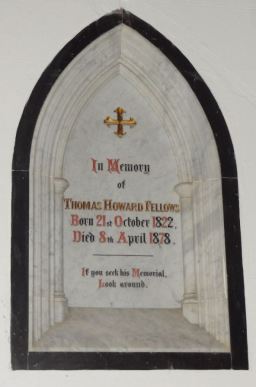
QUEENSCLIFF,- The tablet in memory of the late Mr. Justice Fellows has, during the last week, been erected in St. George’s Church, Queenscliff, to the left of the pulpit, and over the seat he formerly occupied. Mr. Clement Nash, of Geelong, is the sculptor. The tablet is of white marble, with St. George’s Cross in the apex of the arch, and has a margin of black slate 1-in. in width, and bears the following inscription:- “In memory of Thomas Howard Fellows, born October 21st. 1822; died April 8th, 1878. If you seek his memorial, look around.” The letters are black and red, with the exception of the name, which is in gold. The cost of the tablet is about £40, and has been defrayed by subscriptions from inhabitants of Queenscliff and visiting members of the church.”

"In Memory of Thomas Howard Fellows Born 21st October 1822, Died 8th April 1878. If you seek his Memorial, Look around".

“In Memory of Thomas Howard Fellows Born 21st October 1822, Died 8th April 1878. If you seek his Memorial, Look around”.

Despite Justice Fellows donating the great east window and the Twelve Apostle windows in the nave of St George’s, there is no stained glass window in the church as a memorial to him.

In 1881 a window was erected in his memory in Christ Church South Yarra.

Related posts:
22-02-186429-01-186613-08-186712-02-1881 07-04-1882 >18-10-1884 > 30-12-1893

External links:

Biography: Thomas Howard Fellows (1822-1878)

Obituary: Justice Fellows. The Argus, 9th April 1878, page 5

Conservation: The majority of the Ferguson & Urie windows at St George’s Church at Queenscliff were restored or have had conservation work by Bruce Hutton of Almond Glass between 2006-2012.

Below is my rudimentary YouTube video of St George’s windows taken with an iPhone 3GS on 6th January 2012.


Short link to this page: https://wp.me/p28nLD-uQ

© Copyright

12-02-1881: St George’s Church, Queenscliff, Victoria.

The Australasian Sketcher, Melbourne, Saturday 12th February 1881, page 54.

“ST. GEORGE’S CHURCH, QUEENSCLIFF”

“THE church of St. George, Queenscliff, was begun to be built at the end of 1862 through the energy of Dr. Williams, the recent Government health officer at Queenscliff. It was completed in 1863, and opened for divine worship in January, 1864, by the Rev. R. Cummins, of St. Paul’s, Ballarat […]”

“[…] The chancel window is of stained glass, and is illustrative of a portion of the Litany, each pane bearing underneath it the words of some appropriate quotation. It consists of 15 panes […]”

“[…] There are 12 stained glass windows dedicated to the Twelve Apostles, with suitable texts from the Epistles over each […].”

All the stained glass windows in St. Georges were made by Ferguson & Urie between 1864 and 1892. Two windows in the vestry built in 1958 has Derek Pearse windows installed in 1995.

The related posts links below show many of the Ferguson & Urie windows.

Related posts:
22-02-186429-01-186613-08-186712-02-1881 07-04-1882 >18-10-1884 > 30-12-1893


Short link to this page: https://wp.me/p28nLD-uO

© Copyright

13-08-1867: James Urie visits Tasmania on Ferguson and Urie business.

In August 1867, James Urie of the Melbourne stained glass firm ‘Ferguson & Urie’, traveled to Tasmania with a portfolio of the companies designs for ecclesiastical and secular stained glass. As of May 2013, over twenty-five Tasmanian buildings have been identified as having one or more extant stained glass windows by the firm. The newspaper article below contains a gold mine of clues for Ferguson & Urie windows erected in Tasmania and in Victoria and I have included my comments as to what have found on each clue.

The Mercury, Hobart Tasmania, Tuesday 13th August 1867, page 5.

 “STAINED WINDOWS – A few days since we stated that Mr. Urie of the firm of Ferguson, Urie, and Lyon, glass stainers, &c, Melbourne, was on a professional visit to Hobart Town. This gentleman is now in Launceston, and we were much gratified yesterday by inspecting a large portfolio of designs for church and other windows which his firm has executed or has in hand. Amongst the most elegant we may mention the chancel window of St. George’s Church, Queenscliff, the subject being taken from the Litany, whilst the side lights represent the twelve Apostles and the west window other emblems; chancel window of St. Peter’s, Wooloomooloo (Sydney), embracing nine events in the life of St. Peter; Roman Catholic Church of St. Peter and St. Paul, Geelong; St Joseph’s Roman Catholic Church, Collingwood; St. Patrick’s Church, Duneed; the Melbourne Convent; the Presbyterian Churches at West Melbourne and Ballan; the Wesleyan Churches at Daylesford and Kent Town (S. Australia). They have also erected some very elegant memorial windows including one for the late Prince Consort at Kew; Rev. R. W. Needham, at Mount Gambier; Dr. Peck, at Sale; Judge Pohlman’s wife, and wife of Mr Stoddart both in Melbourne. We have already referred to Dr. Moore’s at New Norfolk, and the two windows in St. John’s, Launceston. One of the most elegant windows is in the house of Mr. George Stevenson, at Toorak; it represents the four seasons with figures of Art, Science, Agriculture, and Commerce, with Faith and Hope, coat of arms, and crest. This window cost £250. This firm also supplied a staircase window for the new mansion of the Hon. R. Q. Kermode at Mona Vale, but it has been decided to substitute one much more elaborate. They are also to fit up two windows for the new Wesleyan Church of this town – one at either end, which will be very handsome. Several private homes in this town, and a large number in Victoria, have been ornamented in this way, and no doubt the practice will extend when it is known how skilfully the art is carried out by Messrs. Ferguson & Co.”

Notes:

1. Queenscliff, Victoria, St Georges, All windows extant.
Related posts: 22-02-186429-01-1866 > 12-02-1881 07-04-188230-12-1893

2. Wooloomooloo, Sydney, NSW, St Peter’s (Darlinghurst), now part of Sydney Church of England Girls Grammar School.
Related posts: 1867: St Peter’s Anglican Church, Woolloomooloo, Sydney, New South Wales.

3. Geelong, Victoria, St Peter & Paul Catholic. Three light principal east window.
Related post: 13-08-1867: St Peter & St Paul, Geelong, Victoria.

4. Collingwood, Melbourne, Roman Catholic (St Joseph’s) destroyed by fire in 2007.
See: 1863: St Joseph’s Catholic Church, Collingwood, Victoria.

5. Duneed, Victoria, St Patrick’s (Mt Moriac) foundation laid in 1858. Ferguson & Urie east window erected in 1866 but was destroyed my a massive hail storm in 1887. The church was rebuilt in 1950’s and sold at auction in February 2017..

6. Melbourne, Victoria, the “Melbourne Convent”. This is likely to be the “Convent of Our Immaculate Lady of Mercy” in Nicholson street Fitzroy. My correspondence with the Convent has revealed nothing.

7. West Melbourne, Presbyterian. Dismantled in 1935 and re-erected as St Andrews at Box Hill in 1936. It contains the original F&U windows except for one which went to the Camberwell Church on Riversdale Road.
Related posts: 27-04-1935

8. Ballan, Victoria, Presbyterian (St Paul’s). All windows are extant.
Related posts: > 22-07-1866 > 28-07-1866 > 13-08-1867

9. Daylesford, Victoria, Wesleyan. Only small ‘stock’ windows in the porch exist in poor condition. See photos <here>

10. Kent Town, South Australia, Wesleyan. Nothing further known.
Related posts: 26-10-1864

11. Kew, Melbourne. The Prince Consort window at Holy Trinity is extant and recently restored.
Related posts: 08-06-1881

12. Mount Gambier, Christ Church, Rev Needham memorial window and others are extant.
Related posts: 02-11-1867

13. Sale, Victoria, St Paul’s Anglican Cathedral. Dr. Peck memorial window is extant.
Related post: 29-01-1867

14. Melbourne, Pohlman and Stoddart memorial windows.
Nothing found in regards to the Pohlman window but the Stoddart window exists.
Related post: South Yarra Presbyterian 1867

Pohlman:

Judge Robert Williams Pohlman (1811-1877): Biography | Obit 1877 | Funeral | Obit 1878 His funeral was in St Stephen’s in Richmond and he was buried in the Melbourne General Cemetery on the 8th Dec 1877. He was married twice. His second wife, Mercy Clifton Bachelor died of an embolism at age 26 on the 21st January 1876 only a couple of weeks after giving birth to a stillborn daughter on the 5th of January 1876. He only had one daughter to his second wife named Annie who married Navy Commander Frederick Owen Pike at St John’s in Toorak on the 27th December 1893.

This would mean that the stained glass window would have been a memorial to his first wife “Eliza” who died at Richmond on the 11th Feb 1856.

Stoddart/Stodart:

This is James Dickson Stodart (c1825-1867), Mayor of Prahran 1864/65 and councilor 1858/59-1859/60, 1863/64-1864/65.

Arrived from Edinburgh in 1853. Was later a financial agent for Cornish & Bruce railway contractors. See: Yarra Presbyterian 1867

An active member of the Scotch Presbyterian Church in Punt Road South Yarra, where his memorial stained glass window resides.

He died on Wednesday 12th June 1867. The window has been found at the South Yarra Presbyterian Church See: http://wp.me/p28nLD-2I3.

15. New Norfolk, Tasmania, St Matthew’s, Dr. Moore memorial window is extant.
Related posts: 04-03-1882

16. Launceston, St John’s: The window is extant but no longer in its original position. The canopy glass above the main three lights no longer exists but an original design for the window shows that it contained the descending Dove and the symbols for Alpha and Omega.
Full details see  post: 25-09-1866

17. George Stevenson’s house at Toorak was named “Trawalla” and is located at 22 Lascelles Avenue Toorak. Window is extant.

18. Ross, Tasmania, Kermode’s Mona Vale Mansion. This window still exists. Images are shown in various historical books written in the last 30 years.

19. Launceston, Wesleyan, (Pilgrims Uniting), window facing Patterson street is extant but nothing seen in the opposite end. Gavin Merrington from Hobart has confirmed that a wheel window exists above the organ loft.

Also see: 07-08-1867: Decorative Art. James Urie sojourning in Tasmania.

Other related posts: 03-03-1868 , 29-01-1866, 20-06-1867, 29-04-1864,


Short link to this page: http://wp.me/p28nLD-98

29-01-1866: St George’s Anglican Church, Queenscliff, Victoria. Australia.

The Anglican Church of St George at Queenscliff contains a magnificent chancel window made by Ferguson & Urie that was installed in early 1866. The original design for this window was also found amongst the State Library collections and images of it are included in this article.

The Australasian, Melbourne, Vic, Saturday 3rd February 1866, page 6.

“A stained-glass window, admittedly the handsomest ever manufactured in the colony, has just been placed in the Anglican church of St. George, at Queenscliff. It is a three-light window, and contains illustrations of some fifteen different subjects, all memorable passages in the life of Christ, arranged in the order in which they are mentioned in the Litany of the Church of England; the sentences from which, together with the prayer, “Good Lord deliver us.” being included in the design. It is the work of Messrs. Urie and Co., of North Melbourne. The window cost about 300, and was presented to the church by the Hon. T. H. Fellows, M.L.C.”

This is undoubtedly my favorite window of all Ferguson & Urie windows. It’s also the only stained glass window I have seen, so far, that depicts the ‘Devil’ in a modern recognizable form in fiery red with wings resembling the prehistoric Pterodactyl.  The window has fifteen scenes from the litany starting from the immaculate conception to the Holy Ghost coming down.

The entire window is displayed in the slideshow below with detailed photos of each element of the fifteen scenes from the litany displayed in order as they appear in the window. The order of each appears to be correct but there are doubts about the ‘Bloody Sweat” being after the “Agony in the garden” scene.

This slideshow requires JavaScript.

The newspaper article was also published in;

The Argus, Melbourne, Monday 29th January 1866, page 4.
The Sydney Morning Herald, Friday 2nd February 1866, page 2.

Related posts about the Ferguson & Urie windows at St George’s:
22-02-186429-01-186613-08-186712-02-1881 07-04-1882 >18-10-1884 > 30-12-1893


Short link to this page: http://wp.me/p28nLD-5l

© Copyright

22-02-1864: St George’s Anglican Church, Queenscliff, Victoria, Australia.

In 1864 the liturgical west three light stained glass window of St George’s Anglican Church at Queenscliff was donated by Dr. David John Williams (1819-1902). He was Trustee and Vestryman of St George’s Church and the first Mayor of the Borough of Queenscliffe in 1863-64. He had served in Russia as part of the English Medical Service and was appointed personal medical officer to Czar Nicholas 1st who awarded him the order of St Ann in 1842. The Czar presented him with an engraved jewel encrusted ring (which sold at auction in 1951 for £270 and at auction in 2012 for $51,000).  Dr Williams also had a lead medical role at the Eureka Stockade at Ballarat in 1854 as well as other government appointed medical positions.

All the Ferguson & Urie stained glass windows were installed  in St. George’s Church at Queenscliff between 1864 and 1892. The window described in this article is the liturgical ‘West’ window which fronts the street and was the first to be erected in the Church and donated by Dr. Williams. The window depicts the Evangelists. Matthew, Mark. Luke and John and the Shield of the Trinity or Apostles Creed.

Photos taken 25th September 2010.

This slideshow requires JavaScript.

The Argus, Melbourne, Monday 22nd February 1864, page 5.

“COUNTRY NEWS. QUEENSCLIFF”.

 ST.GEORGE’S CHURCH. – A large proportion of the visitors to Queenscliff will be well pleased to hear that the episcopal church is completed, and open for public worship. It has been erected – after the designs of Mr. Albert Purchas, of Melbourne – on the summit of Swan-hill, the highest part of the borough …”

 “…At the west end is a three light window, filled with stained glass, designed and executed by Messrs. Ferguson and Urie of North Melbourne…”.

The Australasian Sketcher, Melbourne, Saturday 12th February 1881, page 54.

“ST. GEORGE’S CHURCH, QUEENSCLIFF”

“THE church of St. George, Queenscliff, was begun to be built at the end of 1862 through the energy of Dr. Williams, the recent Government health officer at Queenscliff. It was completed in 1863, and opened for divine worship in January, 1864, by the Rev. R. Cummins, of St. Paul’s, Ballarat. In May of the same year the Rev. H. J. Wilkinson, the present incumbent, was appointed. It was consecrated by Bishop Perry in January, 1868. Its length is 67ft., and its breadth 36ft. 3in.; its height from apex of roof about 40ft. Mr. Purchas, of Melbourne, is the architect. Soon after the commencement of the church the late Judge Fellows took an active interest in it, and continued his liberal help until his death. An Estey organ has just been procured from Messrs, Glen and Co., and is at the entrance of the church. The description of the interior was recently given in a Melbourne daily journal in the following terms:- In Queenscliff itself the principal object is, undoubtedly, St. George’s Church of England, not alone from its internal beauty and perfection of arrangement, but from its being the “outward and visible sign” of the charity of one who was never weary in well doing – the late Judge fellows. The chancel window is of stained glass, and is illustrative of a portion of the Litany, each pane bearing underneath it the words of some appropriate quotation. It consists of 15 panes. The reredos is beautifully coloured, and the whole of the floor of the sanctuary is tiled. There is a marbled credence table, and the sacramental and offertory vessels are of silver, appropriately engraved. There are seats for the assistant priests within the sanctuary, one on the Episcopal, and one on the decanal side. The reading-desk, pulpit, and altar rails are all of polished oak. Over the reading-desk is painted “Pray now unto the Lord,” and over the pulpit, “Preach the Kingdom of God.” There are twelve stained glass windows dedicated to the Twelve Apostles, with suitable texts from the Epistles over each. The pews are slightly raised, as in All Saints’ Church, East St. Kilda, and are arranged so as to leave a centre aisle from the altar gate. Almost immediately over the pulpit is a plain white marble slab, bearing the inscription, “In Memory of Thomas Howard Fellows, Born 21st October 1822 Died 8th April 1878. If you seek his memorial look around.”

The Argus, Melbourne, Vic, Monday 20th January 1902, page 1.

“WILLIAMS.- On the 18th January, at Queenscliff, David John Williams, M.D., F.R.C.S., aged 84.”

The Argus, Melbourne, Vic, Tuesday 19th June 1951, page 3.

THIS jewel of Russia’s Czarist days will be auctioned in Melbourne on Thursday. Czar Nicholas I gave it to Dr. David John Williams, a Victorian surgeon, for service aboard the Imperial yact Queen Victoria in 1847. It is set in gold and diamonds, with an amethyst centre. Dr. Williams, born in Glamorganshire in 1816, came to Australia in 1844 as surgeon-superintendent on the Templar. Two years later he was appointed to the Queen Victoria, which Nicholas had built in England. Dr. Williams returned to Melbourne in 1852. He attended wounded men at Eureka Stockade. Leonard Joel Pty. Ltd. will conduct the auction”.

The Argus, Melbourne, Vic, Friday 22nd June 1951, page 5.

“Czar’s relic for £270.”
“A jewelled order presented to a Victorian surgeon in 1847 by Czar Nicholas I yesterday passed into the keeping of a Malvern art dealer for £ 270.
For the buyer, Mr. John A. Hogan, the value of the order lies in its historic interest. Set in diamonds, with an amethyst centrepiece, it is faced with green enamel. At the base is a double-headed eagle holding a sceptre. “If I break it up the jewels will probably bring only from £10 to £20 each,” Mr. Hogan said. I would have done that a few years ago, but now historic pieces like this find New Australian buyers. They are far keener on them than old Australians.” The inscription on the red leather case reads “Presented by His Majesty, the Emperor of All the Russians, to Dr. J. Williams. MD, surgeon on His Majesty’s yacht, Queen Victoria.” Dr Williams came to Australia in 1844. Two years later he was appointed ship’s surgeon on Czar Nicholas’ yacht. He returned to Melbourne in 1852.”

Fifty seven years later, in July 2008, the Dr D. J. Williams ring, the gift from Czar Nicholas the 1st, again went up for auction. This time it sold for a staggering $51,000.

Noble Numismatics Pty Ltd, Sale 88, Lot 741. 22-24 Jul 2008, Dallas Brooks Centre Melbourne.

“Provenance: The current owner acquired this piece in the late 1950s from a direct descendant of Dr D.J.Williams. David John Williams (1819-1902) Born in Glamorganshire, Wales, in 1819, he studied medicine in England and Scotland, graduating M.R.C.S. Eng., 1841; L.S.A. Lond., 1845; M.D. St Andrews, 1848; F.R.C.S. Eng., 1861. In 1844 he sailed aboard the `Templar’ as Surgeon-Superintendent arriving in Sydney in August of that year. On his return to England he served in Russia as part of the English Medical Service. He was appointed personal medical officer to Czar Nicholas I and spent the summer sailing with the Czar aboard his yacht `Queen Victoria’, and the winter serving in hospitals in St Petersburg. On leaving Russia Dr Williams was presented with the Order of St Anne by Czar Nicholas. Arriving in Melbourne aboard the `Bride’ in May 1853 Williams went first into private practice, then Government service before being posted to the Quarantine Station at Point Nepean in September 1853. Williams was transferred to Ballarat as District Surgeon, whilst there he conducted the inquest into the death of James Scobie on 7 October 1854 and, later that of Henry Powell on 9 December 1854 (who was wounded during the Eureka rebellion). As Camp Doctor Williams attended to the wounded from the Eureka rebellion. Dr Williams remained in Ballarat as coroner when the position of District Surgeon was abolished. He resigned in March 1855, visited England and on his return settled in Queenscliffe serving first as Assistant Health Officer at the Heads in 1858, then as Health Officer in 1867. Whilst in Queenscliffe he took an active part in civic and church affairs, being elected to the Council and becoming the first Mayor of the Borough of Queenscliffe in 1863. Williams died in 1902 and was buried in Queenscliffe. St George’s Church vestry erected a rear window as a memorial to Dr Williams in recognition of his long and invaluable contribution to the church. (References: `Goldrush Doctors at Ballarat’ by Keith Macrae Bowden, Mulgrave, 1977; `Great News Stories of Queenscliff’)”.

(in-line image from noble.com.au)

(in-line image from noble.com.au)

Related posts:
22-02-186429-01-186613-08-186712-02-1881 07-04-1882 >18-10-1884 > 30-12-1893

External Links:

Noble Numismatics:  On leaving Russia Dr Williams was presented with the Order of St Anne by Czar Nicholas.


Short link to this page: https://wp.me/p28nLD-44

© Copyright