27-04-1935: St. Andrew’s, Box Hill, Melbourne, Victoria, Australia.

St Andrews church at Box Hill had its origins as the West Melbourne Presbyterian Church which was demolished in 1935 and rebuilt at Box Hill as St Andrew’s using the same bluestone blocks.

Amongst the money raising ventures to pay for the new Box Hill church were the sale of tiny pieces of stone from the original building and the re-dedication of the original Ferguson & Urie stained glass windows for £50 each. The appearance of the new memorial dates below the windows gives the impression that the windows are of more recent origin than their original date of manufacture.

The foundation stone of the new church at Box Hill was laid on the 27th of April 1935 and was opened on the 14th December 1935. When the new church was built, its original West Melbourne character was retained but it was shortened by 10ft which was one complete window bay (each side).

St Andrews is a rarity as every stained glass window in the building was produced by Ferguson & Urie of Melbourne (another is St George’s Church  Queenscliff). According to the St Andrews church history booklet produced in 1985, eleven of the original Ferguson & Urie windows from the nave were reinstalled in the nave at Box Hill, one went to Trinity church in Camberwell (confirmed as extant), and the remaining windows were refashioned to make the windows in the foyer, tower room, vestries and porches. The main Apostle window was placed in the West Melbourne church in 1876 when the tower was built which faced William Street in Melbourne. The window originally showed two rows of four full length figures of apostles with the head of another apostle above each figure. When it was installed in St Andrews it was remodeled to show the upper four Apostles in one window and the lower four apostles divided into two windows which now flank the one on either side in the tower.

The original Ferguson & Urie stained glass now appears as twenty one sets of windows in the Box Hill church.

The photos were taken 29th October 2010. Every window in the church is represented in this slideshow.

This slideshow requires JavaScript.

Related posts: 29-04-1867 > 02-05-186727-04-1935 > 09-09-1935 > 16-12-1935 > 01-02-1936


Short link to this page: https://wp.me/p28nLD-MP
© Copyright

09-09-1935: Trinity Church, Camberwell, Victoria, Australia.

In 1935 the West Melbourne Presbyterian Church was dismantled and re-erected as St Andrew’s at Box Hill. St Andrew’s was meant to be a faithful replica of the old West Melbourne Church and so the stained glass windows were included in the reconstruction.

Except for one, which found its new home at Trinity Church, Camberwell.

The Argus, Melbourne, Monday 9th September 1935, page 5.

 “JUBILEE SERVICE”

“Trinity Church, Camberwell”.

 “…During the service Mr. Macaulay announced that in honour of the Rev. P. J. Murdoch’s long ministry in the church Sir Keith and lady Murdoch had decided to provide a stained glass window, of three lights, for the church….”

Albury Banner and Wodonga Express, NSW, Friday 7th February 1936, page 15.

“On Sunday Rev. R. W. Macaulay dedicated a renovated stained glass window at Trinity Presbyterian Church, Camberwell. The window was originally erected in the West Melbourne Presbyterian Church to commemorate the ministry there of Rev. P. J. Murdock, who was also minister at Camberwell from 1887 till his retirement.”

The window mentioned here has been confirmed to be the one the fourteen three-light nave windows that came from the old West Melbourne Church that was dismantled in 1935. It would appear this window was obtained by Sir Keith Murdoch for Trinity Church Camberwell and erected in the name of his father’s long standing ministry in the Church. It was unveiled on Sunday 2nd February 1936. (see post 01-02-1936)

This slideshow requires JavaScript.

The window contains a piece of scripture in the centre of each of the three lights with the relevant bible reference:

“I AM THE WAY AND THE TRUTH AND THE LIFE” “JOHN: 14-6”

“SHEW ME THY WAY O LORD” “PS: 25-4” (Psalms 25-4)

“SEEK YE THE LORD WHILE HE MAY BE FOUND” “IS: 55-6” (Isaiah 55-6)


Biography: Rev Patrick John Murdoch (1850-1940)

Biography: Sir Keith Arthur Murdoch (1885-1952).

Related posts: 29-04-1867 > 02-05-186727-04-1935 > 09-09-1935 > 16-12-1935 > 01-02-1936

To see a slideshow of the entire cycle of windows at St Andrews Box Hill, see post:  27-04-1935

01-02-1936: Trinity Presbyterian Church, Camberwell, Melbourne, Victoria.

The Argus, Melbourne, Saturday 1st February 1936, page 10.

“At Trinity Presbyterian Church Camberwell, to-morrow morning, the Rev. R. Wilson Macaulay will dedicate a large English[sic] stained glass window removed from the old West Melbourne Presbyterian Church. The window is to commemorate the ministry of the Rev. P. J. Murdoch, who was minister at West Melbourne from 1884 to 1887, when he was called to Camberwell, where he occupied the pulpit for many years”.

The article incorrectly reports the window as “English” when it was in fact made by the Ferguson & Urie stained glass company in North Melbourne. All of the stained glass windows in the old West Melbourne church were made by this firm and when it was dismantled in 1935, it was reconstructed as St. Andrew’s at Box Hill and thirteen of the original fourteen nave windows were reinstalled in the Box Hill church. The the other window (mentioned in the above article) went to the Trinity Church in Camberwell. This window was donated by Sir Keith & Lady Murdoch in the name of Sir Keith’s father the, Rev. Patrick John Murdoch, as indicated during the church jubilee service on the 8th September 1935. (see post 09-09-1935).

This slideshow requires JavaScript.

Biography: Rev Patrick John Murdoch (1850-1940)

Biography: Sir Keith Arthur Murdoch (1885-1952).

Related posts: 29-04-1867 > 02-05-186727-04-1935 > 09-09-1935 > 16-12-1935 > 01-02-1936

To see a slideshow of the entire cycle of windows at St Andrews Box Hill, see post:  27-04-1935


Short link to this page: http://wp.me/p28nLD-MZ

16-12-1935: St. Andrew’s, Box Hill, Melbourne, Victoria, Australia.

The Argus, Melbourne, Monday 16th December 1935, page 4.

“The Pulpit – ST. ANDREW’S CHURCH TRANSFERRED. Opened on New Site at Box Hill”.

“With the original key which opened the old Gothic doors of St. Andrew’s Presbyterian Church at West Melbourne, the same doors were reopened on Saturday, when the church, which has been re-erected at White Horse road, Box Hill, was dedicated on its new site in the presence of nearly 1,000 people…”

“…The Apostle window, valued at £1,500, has been placed in the lower portion of the tower, visible within the church above a gallery. Flood-lighting will make it visible at night from the road…”

The Apostle window and all other windows in the Box Hill Church came from the former West Melbourne Church, all of which were made by Ferguson & Urie. The final service in the old West Melbourne Church was held on Sunday 3rd February 1935.

Note: Only images of the Apostle window are shown in this slide show. The photos were taken on the 28th November 2010. There was no access to the gallery for closeup shots and only portions of the windows could be taken from varying angles with a zoom lens.

This slideshow requires JavaScript.

To see a slideshow of the entire cycle of windows at St Andrews Box Hill, see post:  27-04-1935

Related posts: 29-04-1867 > 02-05-186727-04-1935 > 09-09-1935 > 16-12-1935 > 01-02-1936


Short link to this page: https://wp.me/p28nLD-MX

© Copyright

21-11-1865: James Urie’s Invention

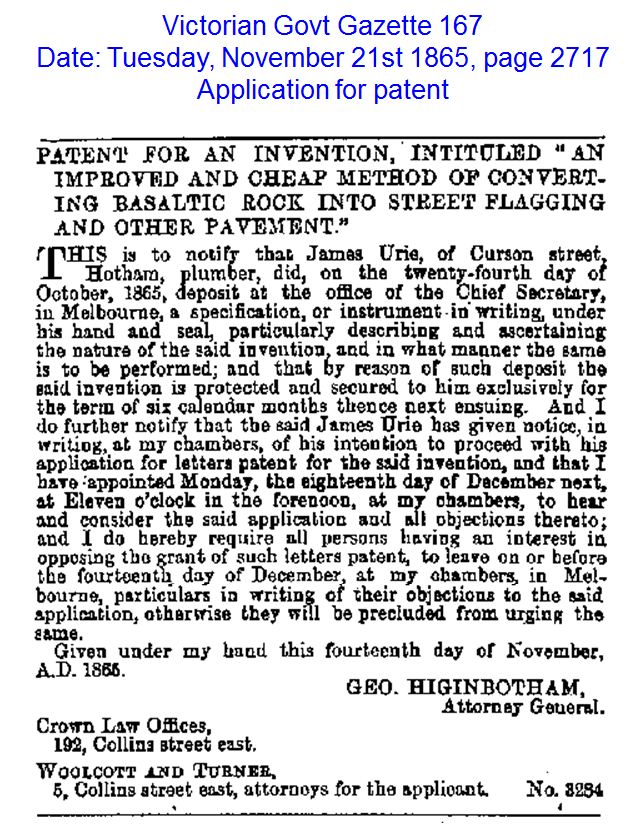
Victorian Govt Gazette 167, Tuesday, November 21st 1865, page 2717

“PATENT FOR AN INVENTION, INTITLED “AN IMPROVED AND CHEAP METHOD OF CONVERTING BASALTIC ROCK INTO STREET FLAGGING AND OTHER PAVEMENT.”

THIS is to notify that James Urie, of Curzon street, Hotham, plumber, did, on the twenty-fourth day of October, 1865, deposit at the office of the Chief Secretary, in Melbourne, a specification, or instrument in writing, under his hand and seal, particularly describing and ascertaining the nature of the said invention, and in what manner the same is to be performed; and that by reason of such deposit the said invention is protected and secured to him exclusively for the term of six calendar months thence next ensuing. And I do further notify that the said James Urie has given notice, in writing , at my chambers, of his intention to proceed with his application for letters patent for the said invention, and that I have appointed Monday, the eighteenth day of December next, at Eleven o’clock in the forenoon, at my chambers, to hear and consider the said application and all objections thereto; and I do hereby require all persons having an interest in opposing the grant of such letters patent, to leave on or before the fourteenth day of December, at my chambers, in Melbourne, particulars in writing of their objections to the said application, otherwise they will be precluded from urging the same.

 Given under my hand this fourteenth day of November, A.D. 1865.

 GEO. HIGINBOTHAM, Attorney General.

Crown Law Offices, 192 Collins street east.

WOOLCOTT AND TURNER,

5, Collins street east, attorneys for the applicant. No. 3254″.

Victorian Govt Gazette 167, Tuesday, November 21st 1865, page 2717, James Urie’s application for patent.

Related posts: 19-02-1874 > 18-09-1885  > 25-07-1890 > 29-08-1890 > 20-07-1899


Short link to this page: https://wp.me/p28nLD-Mn

© Copyright

31-08-1855: James Urie marries Grace Hardie Young.

At North Melbourne, in 1855, the twenty two year old James Urie married eighteen year old Grace Hardy Young.

James arrived in Victoria in late April or early May of 1853 from Scotland and in partnership with James Ferguson (1818-1894) started the the ‘Ferguson & Urie’ company from premises in Curzon Street in North Melbourne.

The Argus, Melbourne, 12th September 1855, page 4.

“On the 31st ult, at Curzon-street, North Melbourne, by the Rev. William Millar, Mr. James Urie, formerly of Ayr Scotland, to Grace Hardie, youngest daughter of the late Mr. Benjamin Young, Clackmannan, Scotland”.

Based on historical dates and the assumption that they married in the Curzon street Presbyterian Church in North Melbourne, the church building would have been the first temporary prefabricated iron church in North Melbourne. The first permanent structure wasn’t constructed until 1859. In 1879 the current Union Memorial Presbyterian Church was built on the same site, opposite the Ferguson & Urie stained glass workshops. Unsurprisingly this church would later have stained glass by the firm erected in it that were made in the workshops on the opposite side of the street.

Related posts:

20-07-1899: The death of Grace Urie.

29-08-1890: Letter of Condolence from the Borough Council to Grace Urie.

23-07-1890: James Urie (1828-1890)


SHort link to this page: https://wp.me/p28nLD-Ml

© Copyright

1915: John Scott (1850-1915)


John Scott (1850-1915)

Cameo portrait of John Scott for the 1887 Ferguson & Urie Company Dinner


John Scott was born in Paisley, Scotland circa 1850 and apprenticed to the Ferguson & Urie stained glass company circa 1866 at the age of 16.

At the company dinner held on the 9th of April 1886[1], he was presented with a handsome diamond locket in appreciation of his twenty years of faithful service to the company and as a farewell gift before his impending holiday to Europe.

“In making the presentation Mr. Young addressed a few words of good advice to the recipient, whom he strongly recommended to become a Benedict so that he could hand down the locket to his family as an heirloom”.

John Scott did eventually marry, but no marriage record has been found in Australia. I suspect that he may have married his wife Agnes in Scotland on his journey back to the old country in 1886. On their return to Australia, they lived at Haines Street in North Melbourne. They never had children.

In James Urie’s speech at the dinner, he stated: “Mr. Scott had come to them when a boy as an apprentice and had gradually worked himself up to be the right-hand man in his department”. His department was where the pieces for the stained glass windows were selected and cut to the exact dimensions according to the glass painters’ designs.

At the dinner John Scott sang “Remember me Mr. George Drury, when Jeff comes home today’ and “Bonnie Hills of Scotland”. At the company dinner the following year, held on the 22nd of June 1887, he again gave a rendition of “Bonnie Hills of Scotland” [2]. His name is not mentioned in the tabloid report of the 1888 company dinner [3].

John Scott died at Ballarat on the 1st June 1915 at the age of 65.

“SCOTT. – On the 1st June (suddenly), at 506 Doveton Street, Ballarat, John Scott, husband of Agnes Scott, and for many years of the firm of Ferguson and Urie, glass merchants, North Melbourne. A native of Paisley, Scotland.” [4]

His remains were conveyed to the Ballarat West station on the 3rd of June for Melbourne and subsequently buried in the Presbyterian section of the Melbourne General Cemetery.[5] (MGC-PRE-Comp-F-No-132)

His Last Will & Testament was dated 3rd September 1892. His occupation was specified as Plumber & Glass Cutter and he appointed his wife Agnes as sole beneficiary and executrix. His probate documents specified his address as “formerly of Haines Street North Melbourne by late of Doveton Street North Ballarat”.

Johns’ meager inventory included a vacant piece of land in Ormond Street Kensington in the Parish of Doutta Galla worth £300, watches, trinkets, Jewellery, an old silver watch, and a gold chain valued at £5, and 242 shares in the Northcote Brick Co. Ltd worth £169.

Footnotes:

[1] Ferguson & Urie Company Dinner, Fri 9th Apr 1886.

[2] Ferguson & Urie Company Dinner, Wed 22nd Jun 1887.

[3] Ferguson & Urie Company Dinner, Thu 15th Mar 1888.

[4] The Argus, Melbourne, Vic, Thursday 3rd June 1915, page 1

[5] The Evening Echo, Ballarat, Vic, Wednesday 2nd Jun 1915, page 4.

Related posts:

The 1886 Employee Dinner
The 1887 Employee Dinner
The 1888 Employee Dinner


Short link to this page: https://wp.me/p28nLD-Mf

© Copyright

20-05-1915: Mrs Marion Reyburn.

The Essendon Gazette & Keilor, Bulla and Broadmeadows Reporter, Moonee Ponds, Thursday 20th May 1915, page 3.

“Mrs. Marion Reyburn died at the residence of her relatives, at 38 Chaucer street, Moonee Ponds, on Thursday, at the grand old age of 100 years. Mrs Reyburn, who celebrated her 100th birthday on 13th April last, was born at Kilmarnock, Scotland, in the year of the battle of Waterloo. She came to Australia with her husband, the late Mr. James Reburn, in the Indus, the voyage occupying 18 weeks. For many years she carried on a drapery business with her husband at Curzon street, North Melbourne, but after his death she lived with her relatives. Deceased was the eldest daughter of the late Mr. William Urie, and sister of the late Mr. James Urie, of the firm Urie and Ferguson.”

Marion Reyburn (nee Urie) Photo from Herald Sun 14 Apr 1915 (From Mrs Noelle Nathan 13 Aug 2010)

21-02-1901: Citizens’ Life Assurance Company purchase the Ferguson & Urie building.

The Argus, Melbourne, Thursday 21st February 1901, page 4.

“We are informed by the Citizens’ Life Assurance Company Limited that they have purchased the property adjoining that which they occupy in Collins-street, known as Ferguson and Urie’s Buildings. The price paid is not stated.”

The West Australian, Perth, WA, Wednesday 27th February 1901, page 5.

“The price paid by the Citizens’ Life Assurance Company for Messrs. Ferguson and Urie’s buildings in Collins-street is understood to be something between £600 and £620 per foot frontage.”

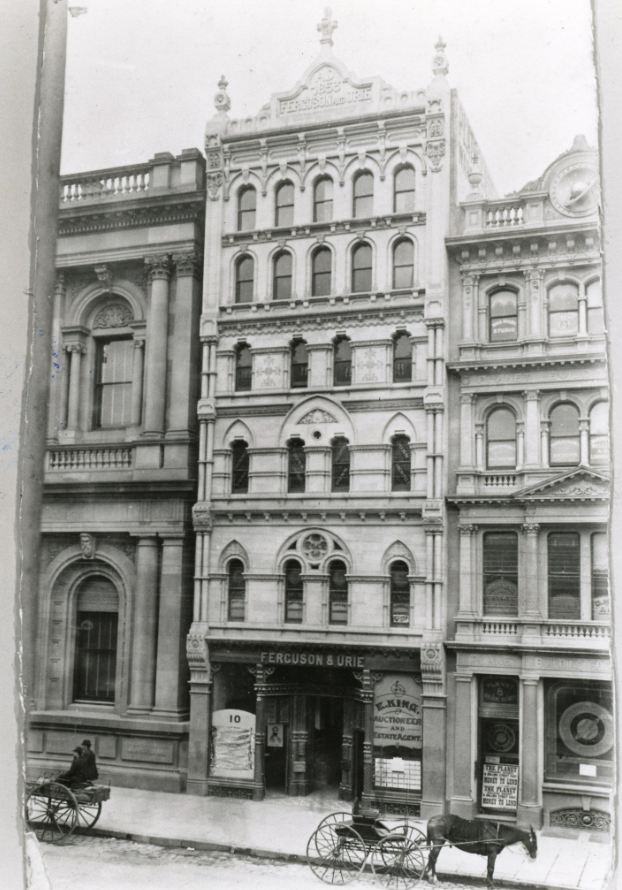
The Ferguson & Urie building is shown in the centre of the photo below. The National Bank is on the left and the Citizens Life Assurance Company is seen on the right as the Planet Building Society[1] which was brought by the Citizens Life Assurance Company in 1901.

The photo below is considered to be circa 1885. The Ferguson & Urie and Planet building are believed to have been demolished circa 1915 to make way for the Bank of Queensland (also demolished 1970).

The Ferguson & Urie Building at 10 Collins Street East.

The Ferguson & Urie Building at 10 (later 281-283) Collins Street East, Melbourne

Related posts:

30-09-1873: For sale, 10 Collins Street.

20-03-1884: Ferguson & Urie building facade approved to be made of Hydraulic Freestone.

22-08-1884: Ferguson & Urie New Premises at 281-283 Collins Street

14-11-1899: The Auction of 283 Collins Street.

Footnotes:

[1]  The Advertiser, Adelaide, SA, Wednesday 8th March 1899, page 7.   The Citizens Life Assurance Company: “…During the year the directors purchased the freehold premises of the late Planet Building Society, Collins Street, Melbourne. The premises are centrally situated, and the business of our Melbourne branch is now being conducted therein...”

© Copyright

24-11-1899: Dividends for Ferguson & Urie declared.

Victorian Govt Gazette 98, Friday 24th November 1899, page 4333.

“The Insolvency Acts.- In the Court of Insolvency, Melbourne District […]”.

“A DIVIDEND is intended to be declared in the matter of Ferguson and Urie, of 100 Franklin-street, Melbourne, in the colony of Victoria, glass stainers, whose estate was assigned on the 22nd day of June, 1899. Creditors who have not proved their debts by the 12th day of December, 1899, will be excluded. Dated this 24th day of November, 1899. J. DRYSDALE PURVES, Trustee. Australian Buildings, 49 Elizabeth-street, Melbourne.”

This nears the final stages of the Ferguson & Urie companies forty six year history as the first commercial stained glass company to have been established in the Australian colonies.

Victorian Govt Gazette 98, Date: Friday, November 24th 1899, page 4333

Related posts: 06-09-1899