06-09-1899: 100 Franklin Street warehouse To Let.

The Argus, Melbourne, Wednesday 6th September 1899, page 3.

“MAGNIFICENT WAREHOUSE, 100 Franklin-street, Lately Occupied by Ferguson and Urie, Suitable for factory or any class of trade, TO LET. TO LET. TO LET. Rent Moderate. Apply to DRYSDALE PURVES, Trustee, Australian-buildings, 49 Elizabeth-street.”

On the 17th October 1899, The Argus reported that Edward Keep and Co were going out of business because of a fire, (which had occurred at their Lonsdale premises) and “Messrs. Fras and Albert Keep, in conjunction with the departmental manager, Mr H. S. Wood, propose to continue the carriage ironmongery and agricultural implement business at 100 Franklin-street”.

Later the business would be known as “Keep Bros & Wood. Saddlers and Ironmongers”. On the 30th September 1899, the Argus reported that a number of buildings were being sold by the trustees of the estate of the late “Alfred Joseph” and the 100 Franklin street building was included for sale “subject to existing tenancies”.

In 1913, Keep Bros & Wood still advertised the business at 100 Franklin Street but have now advertised as “Keep Bros & Wood Wheel Factory, Franklin Street” producing wooden coach wheels. By 1916 they have diversified and are selling agents for the “Trumbull Car”.

In 1945, Keep Bros & Wood purchased several old properties in Elizabeth street for re-development as the new company premises and in the 1960’s started producing the “Hallmark” Bicycle.

Related posts: (about Franklin Street)

16-04-1891 > 10-07-1891 > 01-08-189129-07-1899 > 10-08-1899 > 06-09-1899

© Copyright

10-08-1899: The auction of the Ferguson & Urie stock at the Franklin Street premises.

The Argus, Melbourne, Thursday 10th August 1899, page 2.

A similar notice appeared in the Argus on the 10th of August 1899 with the only difference being the addition of office furniture and:

“TERMS – UNDER 100, NET CASH; ABOVE THAT SUM, CASH, LESS 2 ½ PERCENT DISCOUNT”

This is a continuation notice regards the sale of the firms stock.

Related posts: (about Franklin Street)

16-04-1891 > 10-07-1891 > 01-08-1891 > 29-07-1899 > 10-08-1899 > 06-09-1899

29-07-1899: The auction of the Ferguson & Urie stock at the Franklin Street premises.

The Sydney Morning Herald, NSW, Saturday 29th July 1899, page 11.

“Messrs. Fraser and Co., of Melbourne, advertise elsewhere and unreserved sale of the stock-in-trade in the assigned estate of Messrs. Ferguson and Urie, glass stainers and merchants.”

Related posts: (about Franklin Street)

16-04-1891 > 10-07-1891 > 01-08-189129-07-1899 > 10-08-1899 > 06-09-1899

20-07-1899: The death of Grace Urie.

The Argus, Melbourne, Thursday 20th July 1899, page 1.

“URIE – On the 18th July, at her residence, Glencairn, Wellington-street, Flemington, Grace Hardie Urie (relict of the late James Urie, of Ferguson and Urie, Melbourne)”.

“URIE – The Friends of he late Mrs. GRACE HARDIE URIE (relict of the late James Urie) are respectfully invited to follow her remains to the place of interment, in the Melbourne General Cemetery. The funeral will leave her late residence, Glencairn, Wellington-street, Flemington, THIS DAY (Thursday, 20th inst.), at 3 o’clock p.m. ALFRED ALLISON, Undertaker and Embalmer, 221 Victoria-street west, Melbourne; and Racecourse road, Newmarket. Tel. 980.”

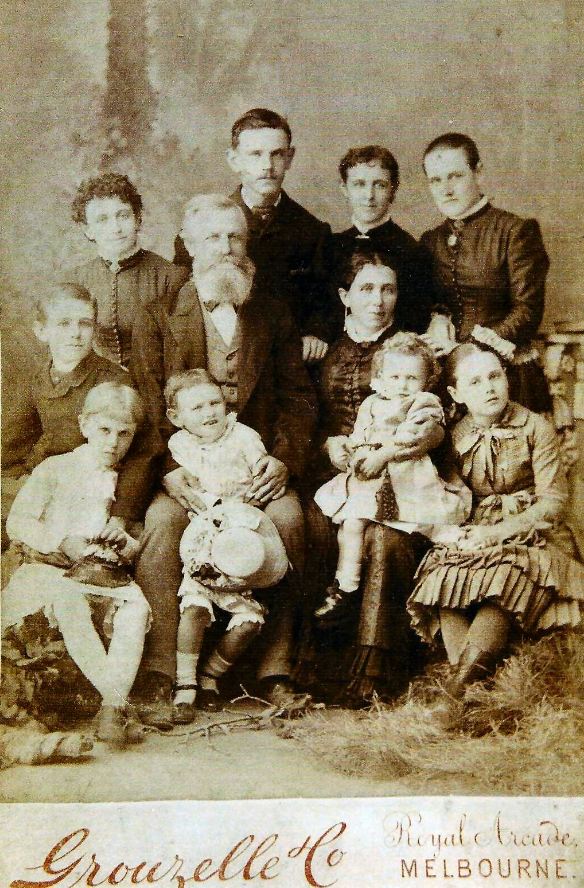
Grace Hardie Urie (nee Young) was born in Dunfermline, Fifeshire, Scotland in 1838 to parents Benjamin Young and Isabella Cumming. She married James Urie in Melbourne on the 31st of August 1855 and they had fourteen children born between 1856 and 1882. Grace is buried in the Melbourne General Cemetery with  husband James and five of their children who had died as infants.

The James & Grace Urie family, Flemington 1884.

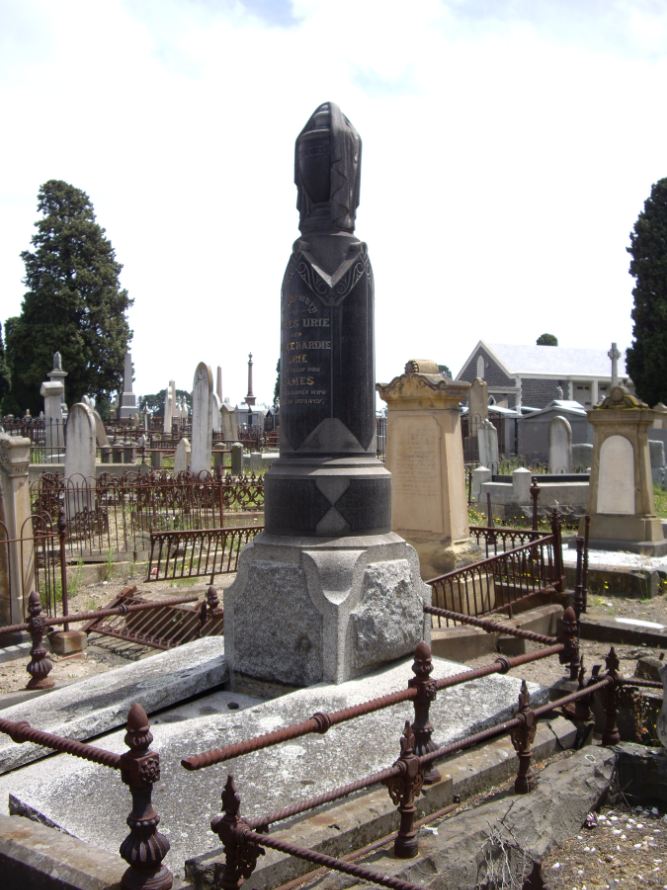
Urie family memorial. Melbourne General Cemetery

Related posts: 31-08-1855 > 23-07-1890 > 25-07-1890 > 29-08-1890

1897: Sands & Kenny’s directory, Melbourne, 1897.

Sands & Kenny’s directory, Melbourne, 1897.

In the Sands & Kenny’s Melbourne Directory for 1897 another company is listed as operating from the Ferguson & Urie building in Collins street. The firm is listed as ‘E Rowlands’ late Rowlands & Lewis, manufacturer of all kinds of aerated waters, cordials and bitters, proprietor of Vigorine, Ballarat, Sydney, Newcastle, 266 King Street, and 281 Collins Street, Melbourne.

26-10-1895: ‘Waterdale’, 56 Chapman Street, North Melbourne.

The house known as ‘Waterdale’ in Chapman Street North Melbourne was built for prominent colonial Cobbler and footwear salesman William Leeming in 1895. The house was purchased around 1970 by a branch of the Royal Children’s Hospital and is now known as Uncle Bob’s Child Development Centre. The building was classified by the National Trust in 1993 ( Place ID: 15743 File: 2/11/033/0369). There are Ferguson & Urie stained glass windows in many of the rooms as well as frosted/etched windows depicting bird life in the bathroom and walls at the rear of the house. Based on subsequent research of the 1895 period and the figurative painting style, the artist responsible for some of the windows depicting women, birds, and fruit in golden hues would have been Herbert Moesbury Smyrk who was prolific in painting with silver nitrate stain.

The photos were taken on 14th July 2011.

This slideshow requires JavaScript.

The Building and Engineering Journal and Australasian Builder and Contractor News, Saturday, 26th October 1895.

“[…] the stained glass, which has been executed by Messrs. Ferguson and Urie. The sash frames are all fitted with transom lights, filled in with stained glass designed to suit the various apartments. The hall door leading to corridor is filled with an artistic panel representing night and morning. The front door panels and upper lights are treated in a conventional style introducing Australian bird and flower subjects. The doors and windows of the back corridors and bathroom, etc, are treated in floral and marine subjects, specially designed in embossed glass[…]”

The Age, Friday, December 8, 1972.

LIVING WITH HISTORY – Alex Macdonald.

“Cobbler prospered at last.

The Advertising industry might well consider establishing an archive to preserve the memories of some of its notable 19th century practitioners, such as North Melbourne’s William Leeming. Born in Castlemaine in 1859, Leeming started in the footwear business a few years after leaving school, and by 1885 was able to open the Colonnade Boot Bazaar at 1 Errol Street, North Melbourne. Other shops followed, and some time before 1900 he was wealthy enough to build a fine house, Waterdale, in Chapman Street, North Melbourne. The one-storey house, of rendered brick, commands a sloping site. Outside it has in good measure the fashionable ornaments of its age – stone urns, cast iron fence, verandah and roof finials. Inside, it’s decorated to a degree rarely excelled. The house is now Uncle Bobs’ Club Rehabilitation Centre, a branch of the nearby Royal Children’s Hospital. It is a temporary home for 12 children, mainly asthma sufferers, who receive medical care, schooling, physical and occupational therapy, and other help needed to restore them to normal home life. Two house mothers, Miss Nan Smith and Miss Val Sullivan, look after them. According to his daughter-in-law, Mrs. Jessie Leeming, of Brighton, William Leeming also had shoe shops at various times in Swanston Street (on the capitol Theatre site), and nearby in Bourke Street. In the Cyclopaedia of Victoria (1903), he is further credited with a business in Prahran. The Cyclopaedia devotes considerable space, and a photograph, to Leeming and mentions what must have been one of the most daring advertising gimmicks. A keen racing man, he entered a horse called Leeming’s Boots in the 1900 Melbourne Cup. It failed to prosper, but another Leeming horse, Patronus, won a Williamstown Cup. Mrs. Leeming recalls that a photograph of Patronus used to hang in Waterdale’s billiard room, where Leeming was in the habit of retiring with his men friends.

Mythical beast.

Another ploy Leeming used was to give away attractive little gifts. The china shoes, plates and toys bore his trademark, a mythical beast known as the “gazeka”. He must have distributed many of these, for when one of his descendants talked out “gazekas” on radio, the station was inundated with calls from people who owned them, but refused to part with them. Although the Leeming family left Waterdale some time after World War 1, it was still a private house when the hospital, with the help of money raised by the Uncle Bob’s Club, bought it two and a half years ago.      It was then much as the Leeming’s must have known it, and although the kitchen and bathrooms have now been modernised, the hospital has managed to retain and restore most of William Leeming’s decorative features. The drawing room, now the children’s school room, is notable for its gilded, moulded ceiling; Deep curving cornices have friezes of classical figures entwined in foliage. The archway on the inside of the bay window is heavily moulded, too, and even the ceiling of the bay is decorated. The door panels are painted with delicate 18th century figures and jewel motifs in pastel colors. Over this, and other important doorways throughout the house, are pediments of wood carved with flowers in high relief. The door fittings themselves are ornately chased and ornamented brass. Elsewhere in the house they are mostly crystal or china. In the dining room, the ceiling and cornices are not only covered with moulded details, but colored in shades of pink, green and gold. Still in its place is the fluted, curving brass gas chandelier. The former study, now the doctor’s room, is fitted with glass and mahogany bookcases on either side of the fireplace, and the billiard room too has a moulded ceiling icicle-like bosses hanging from it. This is now the children’s recreation room, and the raised seats around the edge, from which gentleman onlookers watched others at play have gone, and the marble floored lavatory attached is now a cloak room. Yet more color at Waterdale comes from the glass panels of the front door, dining room to verandah door, and hall door. Set in stained glass are paintings of birds and female figures, and more birds perch in small colored panels above each of he windows in the three main rooms.

Happy Memories.

            For Mrs. Leeming, Waterdale holds many happy memories, for as a child she used to play there with the four children of he house, one of whom, Leslie, she eventually married. As far as she recalls, the Lemmings’ entertain extensively in their grand house until World War 1, when they threw it open each week for soldiers from the big army camp in Royal Park. “They would have the blinds right down over the front verandah, and we’d dance there,” Mrs. Leeming said.      The estate included land right up to Flemington Road, and each of the four children had a horse. Mrs. Leeming remembers there was a live-in staff of groom, cook and maid. Those wee the days of late shopping. According to Mrs. Leeming, William Leeming used to bring home the takings from his shop, and hide them overnight in a secret panel next to the bedroom mantel. “I wonder if it is still there?” she said.”

The Argus, Melbourne, Wednesday 27th July 1932, page 8.

Mr. and Mrs. William Leeming, of Echo, Burke road, Upper Hawthorn, will celebrate their golden wedding to-day. They were both born in Victoria. Mr Leeming commenced business in 1884 when he opened a boot shop in North Melbourne, and later extended his operations to the city, Prahran, and South Melbourne. The “Gazeka” sign adopted as an advertisement for his wares was the striking pioneer of that form of publicity. The name is still registered. Mr. Leeming at different times owned Patronus, Charmans, Pendil, Zephe?, Periloous, and Decollette, with which he won several important races including two St. Kilda Cups and a Moonee Valley Cup. In 1899 he entered a horse which did not exist for the Melbourne Cup under the name of “Leeming’s Boots”. This is no longer possible under the amended racing rules. Mr. and Mrs. Leeming’s two sons and daughter are ???? (unreadable word)


Short link to thos page: https://wp.me/p28nLD-K0

© Copyright
10-10-1895: French stained glass window for St. Patricks R.C. Kilmore.

In October 1895 a stained glass window was erected over the Virgins Chapel at St Patrick’s Catholic Church at Kilmore. This window was reported to have been made in Lyons, France and its erection was at the instigation of Catherine Murray (c.1827-1896) in memory of her daughter Bridget Frances Rush and her grandson Ormond Thomas Murray Rush.

Catherine’s daughter Bridget had married Thomas Joseph Rush in St Patricks Catholic Church in Kilmore on the 24th April 1889[1]. She gave birth to their only son, Ormond, on the 9th June 1891 but Bridget died five days later[2] and the infant Ormond died two years later on the 1st September 1893[3].

In early October 1895 the triple light stained glass window was erected behind the Virgins Altar in the liturgical east wall of St Patrick’s Catholic Church at Kilmore. The window was not made by the Ferguson & Urie Company but was reported as having been installed by a “capable workman from the firm of Ferguson and Urie”[4].

Ten months after the window was erected, the donor of the window, Catherine Murray, died at the Royal Oak Hotel at Kilmore on the 19th July 1896, aged 69. She was the wife of Publican Mathew Murray (c.1810-1886) who was the licensee of The Royal Oak Hotel in Sydney Street Kilmore from circa 1860 until his death in 1886[5].  The hotel was then under the joint ownership of Alexander Murray and their son, Thomas Francis Murray[6].

Bridget’s husband, Thomas Joseph Rush, was a local businessman in Kilmore[7] as well as a Kilmore District Electoral Returning Officer[8], Kilmore Waterworks Trust Commissioner[9], President and member of the Kilmore hospital committee and Justice of the Peace. In March 1896 he sold his business interests and household furniture and effects[10] and decided to leave Kilmore and in May he was fare-welled at the Royal Oak Hotel by the Councillors and prominent members of the district[11].

The lone gravestone of Bridget Rush and her infant son Ormond is located at the Kilmore Catholic cemetery and is inscribed:

“ERECTED BY THOMAS JOSEPH RUSH IN MEMORY OF HIS LOVING WIFE BRIDGET FRANCES, WHO DIED 14th JUNE 1891. MAY THE ALMIGHTY HAVE MERCY UPON HER SOUL. ALSO, ORMOND THOMAS MURRAY RUSH, WHO DIED 1st SEPT 1893, AGED 2 YEARS & 3 MONTHS”

Photos taken 14th Dec 2013.

This slideshow requires JavaScript.


Kilmore Free Press, Victoria, Thursday 10th October 1895, page 3.

“ERECTION OF MEMORIAL WINDOW”

“Last week, at St. Patrick’s R.C. Church, Kilmore, a capable workman from the firm of Ferguson and Urie erected a stained glass window, in accordance with instructions from an esteemed and respected townswoman. The window is placed at the back of the Virgin’s Altar, and consists of three lights, in which are placed figures, the centre one being a full length representation of our Blessed lady, while in the lights in either side are representations of the Annunciation and the Immaculate Conception. All three are surmounted with suitable tracery in the mullions, both overhead and beneath. The glass, antique in pattern, was imported from one of the principal houses in Lyons, France, famous for work of this description, and a very noticeable feature in connection with the figures is the perfection with which they are drawn, indeed for beauty of design, completeness of detail, and for forcible expression, they seem to leave nothing to be desired, and in time to come when the present and coming generations shall have passed away, it will speak for the solid piety and charity of the generous donor. At the base of the very chaste memorial window is the following inscription in plain Roman letters:- ‘Erected by Mrs Murray to the memory of her beloved daughter and grandchild, Bridget Francis Rush and Ormond Thomas Murray. R.I.P.”

The window is indicated as being made in Lyons, France and only installed by a Ferguson & Urie employee in 1895. The makers are likely to be from the parent firm of Louis Gille & Co or Lyons, France.

Significant transcriptions:

The Argus, Melbourne, Vic, Thursday 11th June 1891, page 1.

“RUSH.- On the 9th inst., at Sydney-street, Kilmore, the wife of T. J. Rush – a son.”

This is Ormond Thomas Murray Rush – who died on the 1st September 1893. His mother Bridget died five days after giving birth to him.

The Argus, Melbourne, Vic, Monday 15th June 1891, page 1.

“RUSH.- On the 14th inst., at her late residence, Sydney-street, Kilmore, Bridget, the beloved wife of Thomas J. Rush. Deeply regretted. R.I.P.”

The Argus, Melbourne, Vic, Thursday 16th June 1891, page 1.

“THE Friends of Mr. T. J. RUSH are respectfully invited to follow the remains of his late beloved wife from his residence, Sydney-street, Kilmore, THIS DAY (Tuesday, 16th inst.), at 9.30 a.m. The funeral will proceed first to St. Patrick’s R. C. Church, where a requiem mass will be celebrated, and thence at 3 p.m. to place of interment, the Kilmore Catholic Cemetery. THOMAS BOSSENCE, Undertaker, Kilmore.”

The Argus, Melbourne, Vic, Thursday 2nd September 1893, page 7.

“RUSH.- On the 1st instant, at Kilmore, Ormond Thomas Murray, only son of T. J. and the late Bridget Frances Rush, aged 2 years and 3 months. R.I.P.”

The Argus, Melbourne, Vic, Monday 20th July 1896, page 1.

“MURRAY.- On the 19th July, at the Royal Oak Hotel, Kilmore, Catherine, relict of Matthew Murray, aged 69 years.”

Footnotes:

[8] Victorian Government Gazette, No.92, Friday 5th July 1895, page 2563.

[9] Victorian Government Gazette, No.36, Friday 30th October 1891, page 4360.

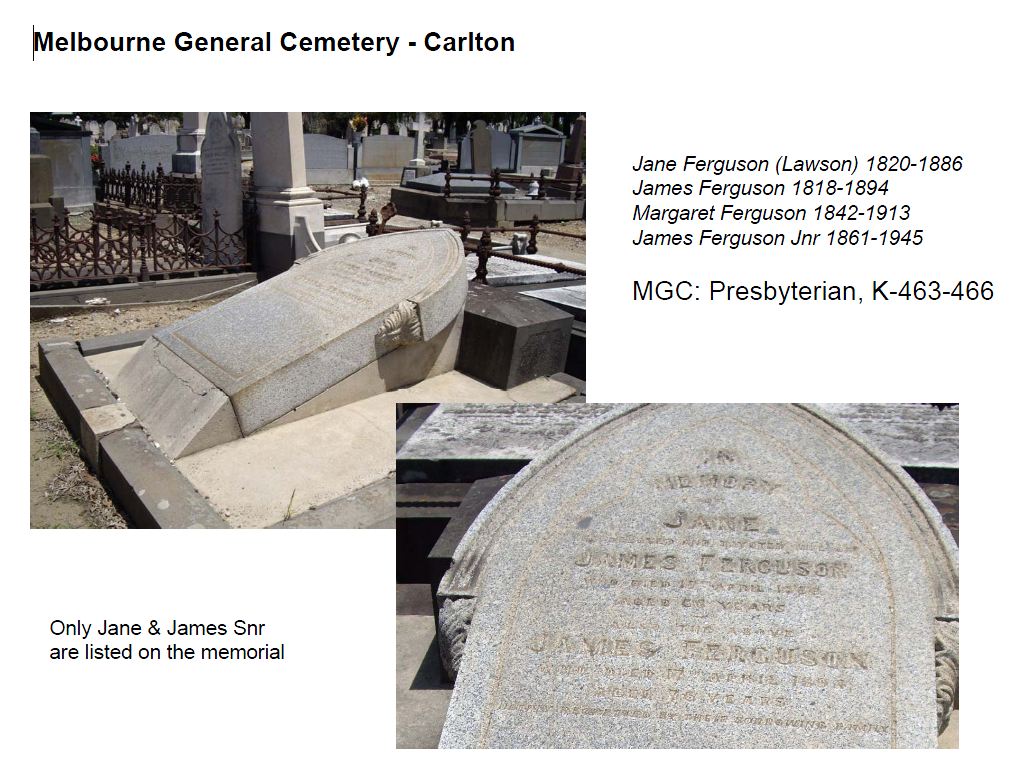
19-04-1894: The funeral of James Ferguson Snr.

The Argus, Melbourne, Wednesday 19th April 1894, page 1.

“THE Friends of the late Mr. JAMES FERGUSON (of Ferguson and Urie, glass stainers) are respectfully invited to follow his remains to the place of interment in the Melbourne General Cemetery. The funeral will leave his late residence, Leonard street, Royal-park. Tomorrow (Thursday, 19th inst.), at 3 o’clock. ALFRED ALLISON, Undertaker, 221 Victoria street west, Melbourne; Mount Alexander road; Moonee Ponds; and Racecourse road, Newmarket. Telephone 980.”

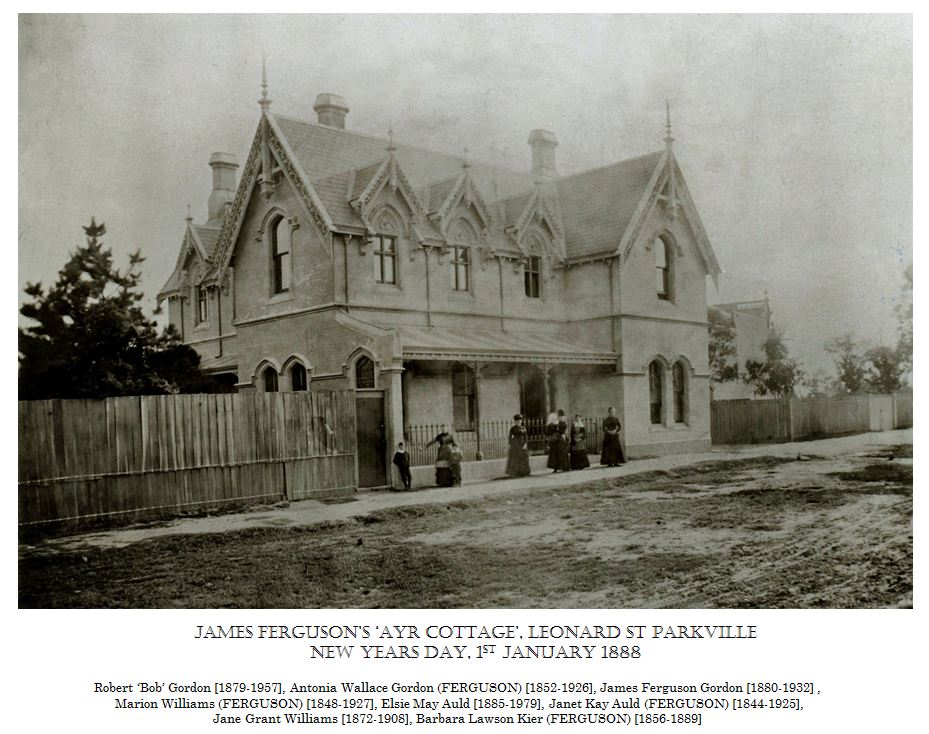
Ayr Cottage, Leonard street Parkville (Royal Park), 1st January 1888

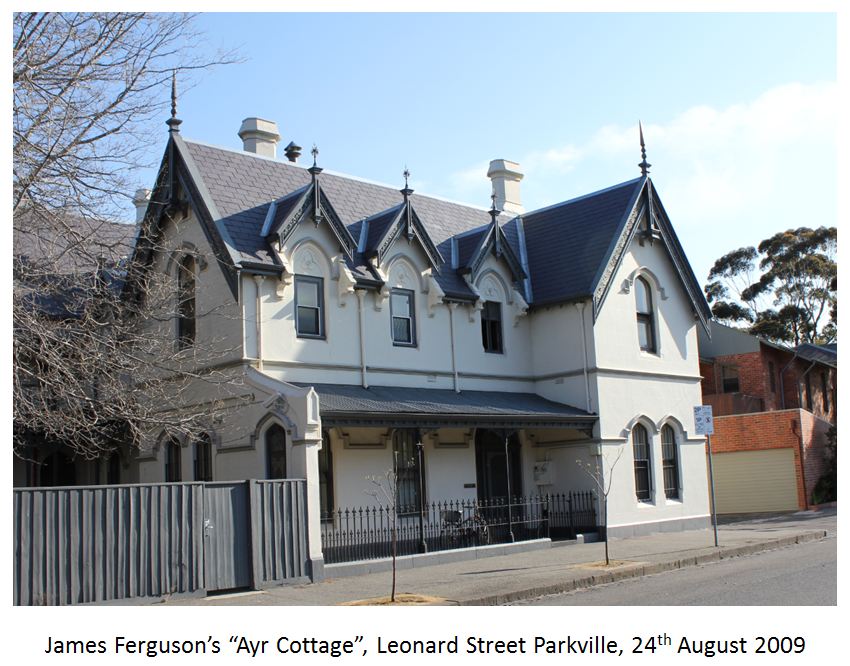
Ayr Cottage 2009


Related posts: 18-04-189420-04-1894

18-04-1894: James Ferguson (1818-1894)

From a family history perspective there is quite a lot known about James Ferguson, his family, and his colonial colonial stained glass company from North Melbourne.

I have many historical artifacts which include photographs, pieces of furniture, documents, and many other interesting items which make up a magnificent collection of colonial history as well as my own family history.

James Ferguson was born in Ayr, Scotland circa 1818. His parents were Janet Kay (1791-1860) and Master Slater & Glazier, James Ferguson Snr (1777-1886).

On the 13th of June 1841 he married Jane Williamson Lawson (1820-1886), the daughter of Gavin Lawson and Margaret Williamson and between 1842 and 1852 five girls and a boy were born in Wallacetown;
Margaret (1842-1913) who was mentally disabled from birth, Janet Kay (1844-1925), Jane Williamson (1846-1875), Marion (1848-1927) and Antonia Wallace (1852-1926). A son named James was born in 1851 but died as an infant in the same year.

On the night of the 1851 Scottish Census (30/31 March) his future business partner, James Urie, was recorded as a visitor at his cottage in John Street Wallacetown. Whether this was one of many meetings the two men would have to discuss their bold plans for the future can only be speculation but only nine months later their plans would come to fruition.

In early December 1852 James Ferguson was given a farewell party at the Robert Burns Arms Inn at Wallacetown prior to his departure for Australia.

“…After the usual preliminaries, Mr John Templeton, watchmaker, in neat and appropriate terms, proposed the health of Mr Ferguson and, in name of many friends, present and absent, presented him with a splendid purse containing 25 sovereigns…”

James and his younger brother David departed Greenock on the 12th of December 1852 aboard the ‘Tamerlane’ and after more than four an a half months at sea they arrived in Port Philip on the 29th of April 1853.  James’s wife Jane would remain in Wallacetown for two years with the children whilst James established the business in North Melbourne. She arrived  aboard the ‘Emma’ with the five girls in November 1855.

In August 1853 the first business advertisements for the company, “Ferguson & Urie”, began in the Melbourne Argus Newspaper. The rest of the Ferguson & Urie history forms the basis of this entire web site.

This slideshow requires JavaScript.

The Argus, Melbourne, Wednesday 18th April 1894, page 5.

“The death is announced of Mr. James Ferguson, the surviving partner of the well known firm of Messrs. Ferguson and Urie. Mr. Ferguson was a colonist of about 40 years’ standing, and for many years carried on business with his partner in Collins-street near the National Bank. Mr. Ferguson died at his residence, Parkville, early yesterday morning, at the advanced age of 84 [sic].”

(James Ferguson was 74 years of age at death).

The North Melbourne Advertiser, Friday 20th April 1894, page 2.

“DEATH OF MR. J. FERGUSON”

“We regret to have to record the death of Mr. James Ferguson, the surviving partner of the well known glass staining firm of Ferguson and Urie. Mr. Ferguson was a colonist of about forty years’ standing, and for many years carried on business with his partner, Mr. Urie (deceased about six years ago) [sic: 1890], in Collins Street, near the National Bank. Mr. Ferguson passed away at his residence, Parkville, early on Tuesday morning, his death being simply a decay of nature, as he was in his seventy-first year [sic: 74]. For the past four years the business of the firm has been carried on in Franklin Street and Curzon Street, North Melbourne. Mr. Ferguson was a member of the Presbyterian Church, and was much respected as a private citizen, but never aspired to enter public life. He died a widower, and leaves a grown up family. The funeral took place yesterday afternoon, deceased being interred in the Melbourne general cemetery and the cortege was followed by a large number of mourners. The body was conveyed to the grave in a panelled hearse, and enclosed in a plain coffin. There were three mourning coaches. Mr. Ferguson was buried in the Presbyterian compartment, the arrangements being carried out by Alfred Allison, of 221 Victoria Street, West Melbourne.”

Related posts:

19-04-1886: Jane Ferguson (nee Lawson) (1820-1886)

19-04-1894: The funeral of James Ferguson Snr.

1886: The History of ‘Ayr’ Cottage, 1 Leonard St. Parkville, Melbourne, Victoria.

08-10-1887: ‘Ayr Cottage’, 1 Leonard Street, Parkville, Melbourne, Victoria.

01-01-1888: The Ferguson Clan at Ayr Cottage, Parkville.

04-07-1901: The sale of Ayr Cottage, Parkville, Melbourne.

19-02-1874: The Hotham (North Melbourne) School of Art.


Short link to this page: http://wp.me/p28nLD-Jf

© Copyright

24-03-1893: Christian Chapel, St Leonard’s Rd, Ascot Vale, Melbourne, Victoria.

The North Melbourne Advertiser, Friday 24th March 1893, page 2.

“[…] The whole of e building is lighted by ten windows, all filled with tinted cathedral glass, giving subdued effect to the interior[…].”“[…] Stained glass by Ferguson and Urie […]”

The new Christian Chapel is St Leonard’s road Ascot Vale was opened on Sunday the 19th of March 1893.

The church was described in the full article as wooden but there is no such building on the current site anymore.