1874: St John’s Anglican Church, Ballan, Victoria.

The foundation stone of St John’s Anglican Church in Ballan was laid by Juliet Vivian Lyon (nee Anderson) in 1861. Thirteen years after that historical event Juliet died and in late 1874 a stained glass window was erected in her memory in  the chancel of St John’s. The window was made by the Colonial stained glass craftsmen Ferguson & Urie of North Melbourne.

Photos taken 10th April 2011.

This slideshow requires JavaScript.

[View larger images]

Juliet was born at Norfolk Island on the 10th Feb 1839, the daughter of the decorated army officer Joseph Anderson (1790-1877) and Mary Campbell. Her father Joseph was was stationed as commandant of the Norfolk Island Penal Colony from March 1834 to February 1839. One of his first duties on Norfolk Island was to dispense the punishment for the Norfolk Island Prisoner revolt in 1834 in which thirteen of the twenty-nine convicted prisoners were executed.

Juliet married pastoralist Charles Hugh Lyon (1826-1905)[1] at St Paul’s church in Melbourne on the 30th December 1859[2] . They settled at Hughe’s ‘Ballanee’ estate at Ballan where they had five known children; Clara, Lily Mary, Violet Mary, Vivian Hugh and Charles Gordon.

In 1861 Juliet had the honour of laying the foundation stone of St John’s Anglican Church in Ballan. Very little information is known of this event other than Juliet had laid its foundation stone as mentioned on her memorial stained glass window, and the obscure mention that on the 29th January 1862 the Church was reported as being near completion[3].

Juliet died at her father’s residence ‘Fairlie-house’ in South Yarra on the 16th of March 1874, aged 35[4]. She was buried with her parents, Joseph and Mary Anderson, in the St Kilda cemetery on the 17th March 1874 and her husband Hugh was also buried them in 1905.

The Ferguson & Urie stained glass window was erected to her memory in St John’s, thirteen years after she had laid its foundation stone.

The two-light stained glass window depicts ‘Faith & Hope’;

The left lancet depicts an angel at the top carrying a banner with the words ‘HALLELUJIA’. Below is the depiction of Faith carrying a cross with her right hand held towards heaven. The text below the figure is ‘HAVE FAITH IN GOD’ and below this is another angel carrying a banner with the text; ‘BLESSED ARE THE DEAD’

The right lancet depicts an angel at the top carrying a banner with the words ‘PRAISE THE LORD’. Below is the depiction of Hope with the ships anchor and below this is another angel carrying a banner with the text; ‘WHICH DIE IN THE LORD’

Across the base of both windows is the memorial text:

‘IN MEMORY OF JULIET VIVIAN LYON WHO LAID THE FOUNDATION STONE OF THIS CHURCH IN 1861.’

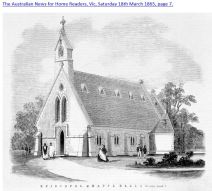
The Australian News for Home Readers, Vic, Saturday 18th March 1865, page 7.

BALLAN St John's 98c

“EPISCOPAL CHAPEL AT BALLAN,

The neat little building, shown in the engraving, is the newly erected Episcopal Chapel, at Ballan, a distance of about sixty miles from Melbourne. The building has been raised solely by the exertions of the congregation, and is a pleasing instance of the progress of Christianity in the provincial districts of Victoria. The chapel belongs to the Gothic order of architecture, and is commodious enough to meet the requirements of the Episcopalians of Ballan. The nave is 57 feet by 25 feet in extent, and chancel 10 feet 3 inches by 21 feet.”

Juliets’ husband Charles died at ‘Ballanee’ estate at Ballan on the 13th February 1905 aged 79[5].

In the historical engraving depicting St John’s from 1865 it shows  a ‘Pugin’ type bell-cote at the west end and a small side building at the east end which is presumably a vestry. Neither of these exist to this day.

The left lancet of the Ferguson & Urie window which depicts ‘Faith’ is taken from a famous oil painting by Sir Joshua Reynolds (1723-1792) and replicated in a stained glass window by Thomas Jervaise at Holy Trinity, Fareham, Hampshire, England. There are three other known instances of this depiction of ‘Faith’ in Ferguson & Urie windows which are located at All Saints, South Hobart; Christ Church, Hawthorne; St Mark’s, Remuera, New Zealand.

In 1883 another Ferguson & Urie window was erected in St John’s to the memory of Rebecca Mary O’Cock. See: 10-03-1883: St John’s Church, Ballan, Victoria.

Location: Simpson Street Ballan

Footnotes:

1874: Sacred Heart College, Newtown, Geelong, Victoria.

Sacred Heart College at Newtown, Geelong, contains a number of historic stained glass windows created by the Ferguson & Urie Stained Glass Company circa 1874.

Originally established as a Convent and boarding school by the Sisters of Mercy in 1860 it was extended over a number of years and in 1874 a Gothic chapel was built to the designs of Melbourne architect Thomas Anthony Kelly and was formally opened on the 24th of May 1874 [1].

The liturgical east end of the chapel contains one of the most unique stained glass windows produced by the Ferguson & Urie Company and was designed by the firm’s senior artist David Relph Drape (1821-1882). What is probably even more remarkable is that the original design for this window still exists amongst a collection of sketches by Drape at the State Library of Victoria.

“The most outstanding feature of the ornate domed sanctuary is a large stained window on the rear wall above the altar. The window was a gift to the sisters from the families of the early boarders.”[2]

Photos taken: 17th October 2013.

This slideshow requires JavaScript.

The liturgical east window is technically known as a five light window with a series of smaller stained glass windows in the tracery above. The two outer lights depict the fourteen scenes of the Stations of the Cross which represent the significant events Jesus endured in the hours leading to his death.

Each of the fourteen scenes have been intricately designed and painted by Drape to closely represent the scenes as they have been represented in many publications over the centuries.

The scenes are:

1st:  Jesus is condemned to death

2nd: Jesus carries His cross

3rd: Jesus falls the first time

4th: Jesus meets his mother

5th: Simon of Cyrene helps Jesus to carry his cross

6th Veronica wipes the face of Jesus

7th: Jesus falls the second time

8th: Jesus meets the women of Jerusalem

9th: Jesus falls a third time

10th: Jesus clothes are taken away

11th: Jesus is nailed to the cross

12th: Jesus dies on the cross

13th: The body of Jesus is taken down from the cross

14th: Jesus is laid in the tomb

The centre light of the window contains a life size depiction of Jesus and his Sacred Heart and below that is the Pelican in the act of self sacrifice feeding its young with blood from her chest.

The smaller windows in the tracery above contain a quite complex series of biblical symbols which mostly represent some of the Instruments of the Passion. The symbolism represented in the upper tracery of the window are;

The Scourging Post

The Seamless Garment,

The Bread of Life or Holy Sponge?

The Holy Chalice & Host,

The Crown of Thorns with the Three Nails,

The La Salette Crucifix with pincers and hammer on either side.

The four evangelists depicted as their winged biblical representations;

Mathew (the Angel), Mark (the Lion), Luke (the Ox) and John (the Eagle).

The centre of this arrangement of windows in the tracery contains the “Agnus Dei” – Lamb of God carrying the victory banner with cross to represent the risen Christ, triumphant over death.

In the south wall near the east window are another two Ferguson & Urie windows set in rose or wheel shaped tracery. Each window contains three quatrefoils with biblical scenes and smaller windows around the edges contain cherubic angels to give the whole arrangement the appearance of a round window.

The first rose window contains the following three scenes:

1. St Christopher with Jesus on his shoulders – Christopher was known as a man of great strength who devoted himself to Jesus by helping travellers cross a dangerous river. One day a child asked to ride on Christopher’s shoulders across the river, but the child grew heavier and heavier with every step. When they arrived on the other side, the child identified himself as Christ and told Christopher he had just carried the weight of all the sin of the world. St Christopher is best known as the patron saint of travelers!

2. The Presentation of Jesus at the Temple – This event is described in the Gospel of Luke (2:22-40). Mary and Joseph took the baby Jesus to the Temple in Jerusalem to complete Mary’s ritual purification after childbirth and to perform the redemption of the firstborn. Luke explicitly says that Joseph and Mary take the option provided for poor people (those who could not afford a lamb –Leviticus 12:8), by sacrificing a pair of turtledoves, or two young pigeons. One was for the burnt offering and the other for a sin offering.

3. The Flight into Egypt – The Flight into Egypt is described in Matthew (2: 13-23), in which Joseph and Mary fled to Egypt with baby Jesus after learning that King Herod intended to kill all the infants of the area in the hunt for the baby Jesus.

(The Flight into Egypt scene in this window has also been matched to one of the original drawings by Drape located at the State Library).

The second rose window contains the following three scenes:

1. The Nativity – The baby Jesus is shown in the manger with emanating rays of light.

2. The Annunciation – This is described in Luke (1:26-38) where the Angel Gabriel was sent from God to visit the Virgin Mary and told her that she was with child who was the son of God and to name him Jesus.

3. Visit of Mary to Elizabeth – The Visit of Mary to Elizabeth (Luke 1. 39-56).

Outside the chapel, above a door in the hallway, is a round window by Ferguson & Urie depicting the Madonna and Child and at the far end of the hallway at the landing of the first flight of stairs are two single light windows. One depicts the Sacred Heart of Jesus and the other a monogram of the letters “AM” (Auspice Maria).


The founder of Sacred Heart – Mother Mary Cecilia Xavier [Elizabeth Maguire] (c.1819-1879)

Elizabeth Maguire was the eldest daughter of Richard Maguire and Margaret McCann and was born in County Meath Ireland circa 1819 [3].

She entered the Mercy Convent in Baggot St, Dublin, Ireland on the 1st May 1843, took the name Sister Mary Cecilia Xavier and was professed on the 26th November 1845. Three of her younger siblings also followed in her footsteps [4].

On the 25th May 1855 she was elected as Mother Superior of the Baggot Street Convent for a term[5] and in 1859, Archbishop James Alipius Goold of Melbourne, petitioned the Sisters of Mercy in Dublin to establish a community in Australia at Geelong.

Mother Maguire, in the company of five other Sisters of Mercy; Sherlock, Mullally, Lynch, Manly and Ryan, they departed Liverpool in ‘Saloon Class’ aboard the Ocean Chief on the 7th September 1859[6].

On the 28th November 1859, after 83 days at sea, the ship arrived in Hobson’s Bay and the following day the ships passengers penned a testimonial letter of thanks to Captain William Brown of the Ocean Chief to which “The Six Sisters of Mercy” were a signatory to[7].

After a short stay in Melbourne as the guests of Mother Ursula Frayne at the Nicholson Street Convent in Fitzroy, they boarded the train for Geelong and arrived at St Augustine’s Orphanage on the 3rd of December;

 “ARRIVAL OF NUNS.- Amongst the passengers by the Ocean Chief were Mrs. McGuire, the superioress or the principal of Bagot-street convent, Dublin, and five other nuns of the Order of Mercy. Their ministrations will be confined for the present to Geelong, whither they go to-day, and they will assume the control and conduct of the St. Augustine’s Orphanage, and other charities of the town. Ultimately, as the sisters become more intimately acquainted with the district, their sphere of action will be extended.- Herald.”[8].

The Sacred Heart Convent of Mercy began in a house named ‘Sunville’ in the Mercer’s Hill estate at Newtown, Geelong, which was formerly owned by the wealthy Geelong solicitor Joseph William Belcher (1784-1865). As early as January 1855 agents for Belcher, who had returned to Ireland in 1852, had been advertising the property ‘to let’ with the advertisements describing it as;

“…Being a large and commodious House, is very suitable for a Boarding School, or Seminary for young ladies…”[9].

It wasn’t until January 1859 that Sunville was eventually to be used as a boarding school when Mrs Sarah Scales (c.1821-1884) [10], the wife of independent congregational minister Reverend Alfred Scales (c.1814-1893)[11], moved her pupils from their premises in Virginia street[12] to Sunville on the 18th January 1859 [13]. Mrs Scales’s boarding school was still at Sunville as late as July 1859 [14] but within a few months of the arrival of the Sisters of Mercy in December, the Sunville mansion and twelve acres of the surrounding Mercer’s Hill estate would become the home of the Convent of Our Lady of Mercy.

On the 17th of February 1860 the Argus Newspaper reported;

“The house and grounds known as Sunville, on Mercer’s Hill, have been purchased for a convent by the Catholic clergymen here. There are about 12 acres of pleasure-grounds attached to the mansion, which is in every respect well adapted for the purpose. Six ladies of the Order of Mercy, who were sent out from the parent house in Dublin by Mrs. Cecilia Zavier McGuire [sic], have arrived in Geelong, for the purpose of establishing this new institution. Some of these ladies are said to have been in the Crimea on the same holy errand. They will attend the poor, the maimed, the sick, and the dying at their own homes, and in the public hospitals, and will superintend a boarding and day school to be attached to the institution. Mrs. McGuire is the founder of the Mater Miserecordia [sic] Hospital also. The house and grounds of Sunville are beautifully situated for the purpose for which they have been brought.”[15]

In late April 1860 the Sisters advertised for their first boarders and Mother Mary Cecilia Xavier Maguire would be the first Mother Superior of the new institution[16].

The following fourteen years saw the rapid expansion of the convent buildings with the Orphanage building erected in 1864, the boarding school in 1869 and the chapel in 1874.  The construction of the chapel was not without mishap as the newly erected belfry-wall and corridor-gable blew down in a storm on the 19th December 1873[17]. They decided not to continue with the construction of the belfry and within six months the building was ready to be opened.

The official opening occurred on Sunday the 24th May 1874 and the Melbourne Argus reported;

“The new conventual church at Newtown-hill was formally opened this morning, in the presence of about 400 persons. The dedication ceremony was performed by the vicar-general. Previous to this the children of the convent formed a long procession, and marched several times through and around the church. They were all dressed in white. The children of St. Mary’s headed the procession, wearing wreaths of blue flowers and scarfs of the same colour. The children of the Sacred Heart followed, wearing rich crimson regalia. Then came the children of St. Catherine’s, with brilliant green scarfs, followed by the Orphan and Industrial School children. The effect altogether was very striking. After the dedication ceremony, High Mass was celebrated by the Archdeacon Slattery, assisted by the Rev. Fathers Kelly and Hegarty. The Rev. Father Kelly afterwards preached a sermon suitable to the occasion. About £300 was obtained from the collection. During the afternoon two young ladies took the veil.”[18]

On the 30th August 1879 Mother Mary Cecelia Xavier Maguire died at the age of 60 and was interred in the Convent cemetery[19].

Today the historical establishment founded by the Sisters of Mercy in 1860 is known as Sacred Heart College which celebrated its 150th anniversary in April 2010.

Acknowledgements:

Thanks to Claudette Brennan, Archivist of Sacred Heart College, for inviting us to see and photograph the windows and for her very generous time to show us around and impart her extensive knowledge of the history of the College.

Footnotes:

[1] The Argus, Melbourne, Vic, Monday 25th May 1874, page 5.

[2] Mercy Girls, The Story of Sacred Heart College Geelong 1860-2010, Watts, Turnbull, Walsh, 2010, Sacred Heart College 2010. P22.


19-02-1874: The Hotham (North Melbourne) School of Art.

In 1873 the Hotham School of Art[1] has been established and operates from premises in Chetwynd Street North Melbourne. Prominent figures from the stained glass firm Ferguson & Urie are involved in its inception.

Ferguson & Urie’s senior stained glass artist, David Relph Drape (1821-1882), lends his expertise as a teacher in the field of “Ornamental and Figure Drawing” as well as being a member of the Board of Advice. The principals of the Ferguson & Urie stained glass company, James Ferguson (1818-1894) and James Urie (1828-1890) are also members of the Board of Advice. In 1877 the school moved to more suitable accommodation within the North Melbourne Town hall and at that time maintained an average of 95 scholars during the terms[2].

In 1877, Drape’s eldest sons, Isaac Selby Drape (1866-1916) and John Campbell Drape (1866-1920), are mentioned amongst the recipients of prizes in the category of “Ornamental Outline”[3]. Neither continued a career in art.

In 1879, Ferguson & Urie apprentice Frank Clifford Lording (1860-1944) was awarded a prize as a senior student in the category of “Ornamental Shaded”[4]. After the closure of Ferguson & Urie in 1899, Lording joined another fellow employee of Ferguson & Urie named Charles William Hardess (1858-1949) to form ‘Hardess & Lording’ as lead-lighters. Hardess’s father, George Matthew Hardess, was also treasurer of the Hotham School of Art and Chairman of the Board of Advice in 1874[5].

In 1883, Ferguson & Urie apprentice George James Coates (1869-1930), was awarded a prize in the senior class for Landscape drawing[6]. Coates was apprenticed to Ferguson & Urie at the age of 15 and later became an accomplished artist in his own right as well the unofficial war artist to the Australian Government during WW1.

The photos of Frank Clifford Lording, Charles William Hardess and George James Coates appear amongst the photo collage of the employees created for the company dinner held at the North Melbourne Mechanics Institute on the 22nd of June 1887.

Principal partner in the Ferguson & Urie stained glass company, James Urie, continued the promotion of the arts as a founder and committee member of the Flemington and Kensington School of Art founded in 1884[7].

HOTHAM SCHOOL OF ART 01a

Ferguson & Urie members.
Sepia photos dated June 1887, photo of Drape circa late 1870’s.


North Melboure Advertiser, Vic, Thursday 19th February 1874, page 3.

“Under the Auspices of the Commission for Promoting Technological Education.

HOTHAM SCHOOL OF ART, held AT ST. MARY’S SCHOOLROOM, Chetwynd street. Terms: two shillings per quarter. The following classes meet every THURSDAY EVENING, at eight p.m. :- Practical Geometry, Teacher, J. Ingamells; Mechanical Drawing, J. Buncle and R. Bodycombe; Architectural Drawing, T. Caine; Ornamental and Figure Drawing, D. R. Drape; Landscape and Elementary Drawing, J. M. Kennedy. The committee consists of the following gentlemen:- The Mayor of Hotham, Mr. Cr. Carroll, Mr. Cr. Thomas, Mr. Cr. White, Mr. Cr. Barwise, Mr. Cr. Clarke, Mr. Cr. Laurens, Mr. Cr. Ryan, Mr. Cr. Paton. The following Members of the Board of Advice:- Mr. G. Hardess (chairman), Mr. Alcock, Mr. W. Clarke, Mr. Beasley, Mr. Cook, Mr. Laurens, and Mr. Buncle, Mr. Bodycombe, Mr. Drape, Mr. Caine, Mr. Kennedy, Mr. Kurz, Mr. Walker, Mr. White, head, Mr. C. E. Randall, Mr. Marley, Mr. Gilchrist, Mr. McGrotty, Mr. Reynolds, Mr. Kirkus, Mr. Atkin, Mr. Ferguson, Mr. Urie, Mr. Chrystal.

Mr. G. M. HARDESS, Treasurer.
Mr. H. WARNER, Secretary.”

1874: Holy Cross Catholic Church, Moyhu, Victoria.

Twenty-seven kilometres south of Wangaratta in the north east of Victoria is the tiny township of Moyhu, noted in history for its connection with the the early Irish pioneers of the district and the infamous Kelly gang of the late 1800’s.

On Sunday the 4th of May 1873, in weather described as “unpropitious”, upwards of 150 people gathered about four kilometres north of the town of Moyhu to witness the Catholic Bishop of Victoria,  James Alepius Goold, lay the foundation stone of the Holy Cross Catholic Church. The sermon was preached by the Rev S. J. Kelly and the sum of £66 was raised at the collection [1]. A year later, Bishop Goold returned to officially dedicate the Church on Sunday 28th February 1875 [2].

In the chancel of Holy Cross are three historically significant stained glass windows that were crafted by the Colonial Victorian Stained Glass firm, Ferguson & Urie of North Melbourne.

Photos taken 14th January 2013.

This slideshow requires JavaScript.

[View attached images]   [View Flickr images]

The windows were donated by pioneers of the district, Richard Shanley, James Whitty and Thomas Byrne.

Richard Shanley donated the single lancet window to the left of the altar depicting ‘St Patrick’, the patron saint of Ireland. The text at the base of the window reads; “The Gift of Mr Richard Shanley”.

Above the altar is a quatrefoil shaped stained glass window in the gable depicting the ‘Madonna and Child’. This was the gift of James Whitty in 1874 in memory of his wife Catherine. A brass plaque near the chancel reads; “The Rose Window of the mother and child above the altar in the sanctuary was presented by James Whitty of Boggy Creek in memory of his wife Catherine. Died 3rd April 1874, aged 52 years. R.I.P”.

To the right of the altar is a single lancet window depicting the Crucifixion, which was donated by Thomas Byrne and has the text at the base which reads; “The gift of Mr Thomas Byrne”.

It’s my opinion that all three of the Ferguson & Urie windows were erected at the same time in the latter half of 1874 during the construction of the church.

About the donors of the stained glass windows:

James Whitty (c.1814-1882):

The Whitty’s were natives of Wexford in Ireland and came to Victoria circa 1840’s as assisted Irish immigrants and began farming in the Woodstock area, south west of Whittlesea. On the 6th of February 1842 James Whitty married 20-year old Catherine Parnell at St Francis Church in Melbourne[3] and later began farming in the Moyhu area south of Wangaratta. The Whitty family prospered and in subsequent years increased their land holdings significantly. On the 3rd of April, 1874 James’ wife died. In memory of his beloved Catherine, James commissioned the Melbourne stained glass firm ‘Ferguson & Urie’ to create a beautiful stained glass window depicting the ‘Madonna and Child’. It was erected behind the altar of the new Holy Cross Catholic Church being built at Moyhu. Nearly twelve months to the day after Catherine’s death, James Whitty purchased the “Myrhee” run in the Boggy Creek area near Moyhu. James didn’t marry again and the following years would continue to be a test of his resolve as he became an arch nemesis of the outlaw Ned Kelly. In August 1877 Ned Kelly and his gang stole eleven of Whitty’s horses which they subsequently sold to unsuspecting farmers near Howlong just over the NSW border. The respectable German farmers, the Baumgarten brothers, and farmers Kennedy, Studders, and Cooke were all implicated in receiving the stolen Whitty horses and sent to trial [4]. In the following years James Whitty and his neighbouring farmers would continue to be the target of the Kelly gang. Subsequently Whitty and other farmers in the district formed the North Eastern Stock Protection League. They offered sizeable rewards for the conviction of the thieves, a move that was squarely aimed at the Kelly gang. Ned Kelly responded in kind by continuing the relentless theft of Whitty’s stock for years to come. One newspaper account quoted Kelly as saying “…during his career he had stolen 280 horses from Whitty’s station, and sold them; and beyond this he had never been guilty of any other crime…[5]”. The thefts and accusations continued and on one occasion Whitty was confronted by Ned Kelly at the Moyhu race course where Kelly accused Whitty of perpetuating the false rumour that he had stolen one of Whitty’s prized bulls[6].

In January 1879 Whitty’s horse “Prince Alfred” was disqualified in an Albury Hurdle race.[7] Although Kelly had nothing to do with the event it would no doubt have pleased him greatly.

Ned Kelly was eventually apprehended during the Glenrowan shoot-out on the 28th June 1880, thus ending years of animosity between the Kellys and Whitty and his fellow farmers. Ned Kelly was hanged on the 11th November 1880. Just over a year and a half later James Whitty died at his Moyhu property on the 11th June 1882 [8], aged 68. He was buried near his wife Catherine and daughter Julia at the Milawa cemetery. The gravestones read; “…erected by James Whitty in memory of his beloved wife Catherine, Died 3rd April 1874, aged 52 years. Also her daughter Julia who died Aug 27, 1880, aged 23 years.” Nearby, James Whitty’s gravestone reads; “Erected by his sons and daughters, to the memory of their beloved father, James Whitty, who died on the 14th of July 1882, aged 68 years, may his soul rest in peace”.

The stained glass window James donated to the Holy Cross Church at Moyhu, stands as testament to his devotion to his wife Catherine and the Whitty family’s Irish Catholic roots.

Richard Shanley (1835-1922)[9]:

Richard Shanley was a native of the parish of Kell, King’s County Ireland, and arrived in Hobson’s Bay as an unassisted immigrant at the age of 26 on the 31st of October, 1860 [10]. Having only spent a few days in Melbourne he set off for Wangaratta by coach and then “humped his bluey” (swag)[11] 50km south towards the Whitfield and Moyhu area. He gained employment doing general farm work in the area and later held a position as Cheese Maker at the Whitfield station with the Evans brothers who had come out on the same ship. In the following five years he worked for the Farrell, Dennett and Evans families and then rented a portion of the “Manarhee estate” from the Evans family and started farming on his own. Around 1867 his parents and brother arrived in the colony to join him and in 1870 he selected 320 acres of “Redcamp” station where he made his home and named the property “Fairfield” after the name of his father’s property in Ireland. In subsequent years he increased the size of his land holdings to around 1400 acres.

In 1874 Richard Shanley married Ellen Prendergast and in the same year donated a stained glass window to the Holy Cross Catholic Church at Moyhu. The window was created by Ferguson & Urie of North Melbourne and depicts St Patrick, the Patron Saint of Ireland.  The text at the base of the window reads: “The Gift of Mr Richard Shanley”.

In February 1901, disastrous bush fires swept over Moyhu and surrounding district and lives were lost and homesteads burnt. Richard Shanley was one of the lucky few and only lost 1500 acres of grassland and fencing [12].

In June 1907 Shanley attended a banquet on the farm of John Hughes at Greta, to celebrate the pioneers of the district. The event was attended by upwards of 250 people and Shanley was invited to speak during the dinner in which he gave a short account of his early days in the colony.

Four years later, on Wednesday the 18th January 1911, Shanley celebrated his half century in the Colony of Victoria by holding his own banquet for the pioneers of the Moyhu district, to which over 150 persons attended at his “Fairfield” property[13] where he extended on his previous speech in 1907 and gave a very detailed summary of his life, struggles, and friendship with the other pioneers of the district.

In January 1914, at the age of 79, he and his daughter Mary narrowly escaped serious injury near “Thistlebrook” when his horses broke loose from the buggy and bolted but despite his advanced age he succeeded in bringing the situation under control without injury to himself or Mary [14].

Richard Shanley died at his property “Fairfield” at Moyhu on the 31st August 1922 [15], aged 87. His wife Ellen (nee Prendergast 1824-1924) died two years later on the 21st August 1924 [16]and both were buried at the Milawa cemetery. They were survived by eight adult children.

Their grave stone at Milawa reads: “In loving memory of Richard Shanley, died 31st Aug 1922, aged 87. Also his wife Ellen Shanley, died 21st Aug 1924, aged 78”.

Thomas Byrne (c.1798-1883):

Thomas Byrne was a native of Wicklow, Ireland, and arrived in Australia as an un-assisted immigrant with his children aboard the ‘Phoenix’ in January 1856[17], his wife, unconfirmed as Sarah Dunne, having died in Ireland circa 1844.

In 1874 Thomas Byrne donated the single light stained glass window depicting the ‘Crucifixion’ to the Holy Cross Catholic Church in Moyhu. Thomas Byrne died at Moyhu aged 85 in 1883 [18]. He was buried at the Milawa cemetery with the inscription on the gravestone reading:

“In Memory of Thomas Byrne, A Patriarch, died 24th February 1883, aged 86 years. Also his daughter Mary Byrne who died April 21st 1903 aged 81 years.”

The North Eastern Ensign, Benalla, Vic, Friday 9th May 1873, page 2.

(On Sunday 4th May 1873 the foundation stone was laid by the Catholic Bishop of Melbourne, James Alepius Goold)

“MOYHU ROMAN CATHOLIC CHURCH.- On Sunday last the foundation stone of the new Roman Catholic Church at Moyhu was laid by the Right Reverend Dr. Goold, the Roman Catholic Bishop of Melbourne. The weather was unpropitious, but the ceremony was nevertheless attended by upwards of 150 persons. A sermon was preached by the Rev. Father Kelly, S. J., and a collection which was subsequently made realised the handsome sum of £66”.

The Colac Herald, Vic, Friday 5th March 1875, page 3.

(On Sunday 28th February 1875, the Catholic Church at Moyhu was dedicated)

“On Sunday last Archbishop Goold presided at the dedication of the Roman Catholic Church of St. John [sic?] of the Cross, at Moyhu, near Wangaratta…”

Foot notes:

[3] Married 6th February 1842 at St Francis’ Church Melbourne (marriage VIC BDM: 35423/1842). Catherine Parnell, born Offaly, Ireland to James Parnell and Catherine Horan.

[6] The Argus, Melbourne, Vic, Wednesday 18th Dec 1878, page 6. (Ned Kelly’s letter to Donald Cameron. MLA, post-marked Glenrowan, 14 Dec 1878).

[9] Richard Shanley, Vic BDM: 10575/1922. Aged 87. Son of Peter Shanley and Sarah Whelan.

[10] Richard Shanley arrived aboard the “Lightning”: Index to Unassisted Inward Passenger Lists to Victoria 1852-1923, Fiche 183, Page 007. (surname transcribed as ‘Chanley’). He arrived with his long time friend Rowland Hughes in their early 20’s.

[11] Wangaratta Dispatch and North-Eastern Advertiser, Wednesday 26 June 1907.

[13] Wangaratta Chronicle, Saturday 21st January, 1911.

[15] Wangaratta Chronicle, Saturday September 2,1922

[17] Thos Byrne: Index to un-assisted inward passengers lists to Vic 1852-1923, Fiche 105, page 001.

[18] Thos Byrne: Vic BDM: 2659/1883, aged 85.

Acknowledgements:

Special thanks to Joan Ellis for her assistance with access to Holy Cross at Moyhu and enthusiasm for the history.

© Copyright

19-09-1874: Holy Trinity Church of England, Williamstown, Victoria.

The first Holy Trinity Church at Williamstown was a prefabricated iron building known as an “Iron Pot” (freezing in winter and boiling in summer). There were many of these “Iron Pot” churches imported from England and erected throughout the colony and this one was erected in Nelsons Place in Williamstown. The Rev. George Wilkinson was obviously not happy with this poor excuse for the house of the lord and began the movement to have a respectful stone church erected for his congregation in 1859. The foundation stone for the new Leonard Terry designed church was eventually laid on the 11th of February 1871 by Bishop Charles Perry and was opened on the 7th October 1874. The “pretty chancel window” described as being made by Ferguson & Urie, circa 1874, no longer exists and was replaced by the Charlotte & William Holten memorial window circa 1941. According to the Holy Trinity’s newsletter (The Pilot, Vol 2, Issue 3, April 2012, page 4): “The artist for this window is unknown. We do know it was made in England and brought to Williamstown by Mrs Dorothy Raverty 2nd, step mother of Reverend J. Raverty who had it installed in Memory of her parents.”

This newsletter item is not correct. The Holten memorial window was actually made by the Brooks, Robinson & Co stained glass company of Melbourne, who also made other windows in Holy Trinity.

All the original windows in the nave of Holy Trinity have also been replaced over the course of a century and are made by the artists and studios of William Montgomery, Napier Waller, Brooks Robinson & Co, and Alan Sumner.

The west four light window, with rose window above, and those in the clerestory, with the simple coloured borders and plain diamond quarries, are very likely be some of the original circa 1874 installations by Ferguson & Urie of North Melbourne.

Photos taken: 11th September 2010.

This slideshow requires JavaScript.

Williamstown Chronicle, Vic, Saturday 19th September 1874, page 2.

“THE NEW CHURCH OF ENGLAND.- The new place of worship which the adherents of the Church of England have just erected in Williamstown is one of the most handsome and commodious churches in the colony. With the exception of the tower and spire the building is now complete, and the conspicuous position it occupies makes it a prominent and pleasing feature in the town as seen from the Bay. The cost, as it stands, is £5000, and the erection of such a noble structure speaks well for the energy and liberality of the Episcopalians in our comparatively small parish, particularly as the new church when entered upon will be but slightly involved financially. The church, including the chancel, is 110 feet in length, and is from a design by Mr. Leonard terry, in the gothic style, with nave and aisles of lofty proportions. The material employed is bluestone, with freestone dressings. The interior has a very handsome appearance, which is heightened by the tone of the glazing, the body colour being amber with varicoloured margins. A pretty chancel window, made by Ferguson and Urie, imparts to that portion of the interior a very pleasing effect, which is continued in the rich yet simple decorations of the ceiling. The seating, to which the greatest attention has been given, is very convenient and comfortable. The material used is lightly stained Oregon pine. A lectern, from one of the best medieval workers in England, and the gift of Sir George Verdon, will shortly be added, and from the known liberality of the donor and the high reputation of the makers, will no doubt prove a further ornament. The substitution of a nice front picket fence for the old palings which have so long done duty has also contributed to the fine appearance of the church. The new place of worship will be opened on Friday, the 2nd prox, by the rev. pastor, Mr. Wilkinson.”

Also See:

Holy Trinity web site.

Flickr Photo album of Holy Trinity’s stained glass.

1889: St John’s Church of England, Sorrento, Victoria.


St John’s Anglican Church at Sorrento was built of local Limestone in 1874. It was used by the Presbyterian and Anglicans for services and other community functions and later, solely by the Anglican’s. The transepts were built in 1889 by George Morse who was the original architect/builder of the church.

The “Prince Consort” stained glass window, made by the Ferguson & Urie stained glass company of North Melbourne, was installed in the South Transept at this time. The window was originally installed in St Paul’s Anglican Church on the corner of Swanston and Flinders street Melbourne which was demolished in 1889 to make way for the new St Paul’s Cathedral.  Canon Chase was the original Donor of the stained glass window for St Paul’s and when it was decided that the original stained glass was not applicable for the new Cathedral it was returned to him for his decision to donate it elsewhere as he saw fit. Despite the intimations of the tabloids that it would be installed in the “Working Men’s College”, he eventually chose St John’s Anglican Church at Sorrento where it has resided for the past 125 years.

Australian Heritage database, Place ID: 5797, File: 2/18/021/0004, Registered 21/03/1978.

 “… St John’s Church of England, Nepean Highway, Sorrento, was commenced in 1874, the transepts being added in 1889 and the chancel during 1908-11…”

 “… The transepts were built in 1889, presumably also by Morce. The stained glass windows in the easterly transept were donated by St Paul’s Anglican Church in Melbourne which was demolished in 1889.…”

Photos were taken on 25th September 2010.

This slideshow requires JavaScript.

The Australasian Sketcher with Pen and Pencil, Melbourne, Monday 27th July 1885, page 115.

“OLD MELBOURNE.
REMOVAL OF ST. PAUL’S PRO-CATHEDRAL”.

“ST. PAUL’S PRO-CATHEDRAL., which is being pulled down to make room for the new cathedral, has an interesting history. It was the third church built in Melbourne, St. James’s and St. Peter’s being the other two older edifices, and the date of it’s inception takes us back to the early days of the colony…”

“…The window in the chancel is a beautiful work of art, illustrative of the ancestry and life of the Prince Consort. The design has been most carefully studied, and every detail is in harmony with and descriptive of some national emblems or traits of Prince Albert, and only that the chancel is in an unsuitable place to disclose the beauties of the window, it would have been far more noted and prized than it is. The window was at first intended to be the gift of the public, and one of the lady members of St. Paul’s Church collected £50 towards paying for it, but the Rev. Canon Chase at that stage presented the window, and at his request the subscriptions were devoted to the general building fund. Now that the church is being pulled down, the Building Committee have placed the window at the disposal of the donor, as the subjects of the windows of the new cathedral have already been chosen; and the Rev. Canon Chase is willing to present his gift to the Working Men’s College, which it is thought it would most appropriately adorn, considering how actively the Prince Consort exerted himself in the cause of social progress. The other memorial window at the east end of the north aisle was erected by the Sunday School of St. Paul’s Church as a mournful token of the esteem in which the wife of the incumbent, the Rev. Canon Chase, was held. There are also decorative windows in the galleries which would have been spared if the ephemeral nature of the career of the church could have foreseen, but no doubt other parishes will be eager to acquire them and replace them in their mullions, which are to be carefully preserved…”

In 1984 Melbourne University Student G. Marie Moore wrote in her thesis;

One of this firm’s better known works is the three-light Albert Memorial window of 1877, now in the south transept of St. John’s church Sorrento. It was originally designed and made by the company for the chancel of the old St. Paul’s church in Swanston Street, together with two smaller windows, depicting. Peter and Paul. The Church of England Messenger described the memorial in glowing terms:

“…the middle portion of the window is filled by three crowned figures under canopies. The central king holds a sceptre. Above his head is the inscription ‘Oh Lord, in Thee have I trusted’. Beneath his feet, ‘Hezekiah Rex’. The Royal figures on his right and left hand hold respectively a harp and the book of the Law. The inscriptions above them are, ‘Praise the Lord’ and ‘In Thy Law is my delight’. Beneath them, ‘David Rex’, ‘Josiah Rex’. The upper portion of the window is divided (in the middle) into four small compartments, containing the emblems of England (lion), Scotland (crown held by a lion), Wales (three feathers), Ireland (harp). An aval on either side displays a cherub holding a scroll lettered in black on a white band, ‘When the righteous are in authority the people rejoice’. The lower portion beneath the kings has three large compartments. That in the centre displays the arms of the late Prince Consort resting on those of the Queen. On the right, the lion of England, in gold on crimson; on the left the unicorn, in silver on crimson. At the foot of the window, lettered in white (mediaeval) on black ground ‘In memory of His Royal Highness, Franc is Albert Augustus Charles Emmanuel, Prince Consort, died Dec. 1861. A brass plate under the window is inscribed in old English and carries the inscription:

Fear God, Honour the King”. It is more than likely that David Drape was the artist responsible for this spectacular piece, as Lyon had already left the partnership in 1873 and moved to Sydney. Drape as an architect, was fully aware of the differences of our climate from that of European countries, and this is readily apparent in the brilliant colouring of the glass manipulated to cope with the high lights of our country…”[1]

The Prince Consort window at Sorrento was restored by Geoffrey Wallace’s Stained Glass studios in 2011.

The most recent historical event associated with this stained glass window was celebration of the life of Geoffrey ‘John’ Nathan (1931-2013). John died on the 28th June 2103. and his service was held at  at St John’s Anglican Church at Sorrento on the 12th of July 2013. John was the grandson of ‘James Urie’ of the stained glass firm ‘Ferguson & Urie’ who had originally created the masterpiece in stained glass.

Related posts: 27-07-1885: St Paul’s Pro Cathedral, Flinders St, Melbourne, Victoria.

Footnotes:

[1] Antipodean Gothic – Melburne University Thesis 1884, G. Marie Moore.


Short link to this page: https://wp.me/p28nLD-nV

© Copyright

1864: Burke Museum, Beechworth, Victoria.

Amongst the most famous secular stained glass windows created by the Ferguson & Urie company is the Burke memorial window at the Beechworth Museum in Northern Victoria.

In 1861 the former Superintendent of Police at Beechworth, Robert O’Hara Burke (1821-1861), met his demise during the infamous ‘Burke & Wills’ expedition, an event which is well recorded in Australian history.

The expedition was reportedly the most expensive ever undertaken at over £60,000 and the loss of seven lives and was the topic of much discussion at the time and still is after over a century and a half.

Newspapers all over Australia wrote of the expedition in great detail and monuments to Burke an Wills began to appear across the colony.

At Beechworth, in July 1864 it was reported that a design for a Burke memorial stained glass window, submitted by John H. Cuzner (Principal of Beechworth Grammar School and Hon. Sec of the Athenaeum), would be accepted, but the window would not come to fruition for another ten years until 1874.

Photos taken 18 Dec 2011.

This slideshow requires JavaScript.

The window features the Colonial Flag of Australia, the red Cross of St George, the White Rose of England, the emblem of New South Wales in gold within the red cross, the Thistle of Scotland, the Shamrock of Ireland and the Southern Cross in gold stars with the wording “Burke Memorial”. The window was reportedly made for £30 and still exists in remarkable condition and is now the centrepiece attraction in the museum. The museum guides, pamphlets and advertising sign outside the museum all include pictures of the window and there are postcards of the window on sale.

An article on the wall at the Beechworth museum (18th Dec 2011) reads:

“In 1861, when the disastrous fate of the Burke and wills expedition became known in Beechworth it was decided that a monument be erected in memory of Robert O’Hara Burke who, as Superintendent of Police for the whole Ovens district from 1854-1858, has been stationed in Beechworth. The Athenaeum building was extended in 1863 to incorporate a museum and in 1874 the Burke Memorial stained glass window was made to order by Ferguson & Urie of Melbourne at the cost of thirty pounds. The building was further extended with the addition of wings on three sides from 1971-1979.”

“Robert O’Hara Burke was chosen by the Royal Society of Victoria to lead an expedition across Central Australia in 1860-61. Burke succeeded in crossing the Australian continent from south to north, but at a terrible price; the expedition cost him his life. The crossing ranked Burke as one of the most controversial figures in the history of Australian exploration”.

“Some called him ‘The mad amateur bushman’, others said ‘He was betrayed at the hour of success’, The Royal Commission set up to investigate the disaster which overtook the expedition, concluded by issuing the following statement: “We cannot too deeply deplore the lamentable result off an expedition undertaken at so great a cost to the Colony; but while we regret the absence of a systematic plan of operations on the part of the leader, we desire to express our admiration of his gallantry and daring”.

In 1864 the concept of a memorial stained glass window has been adopted and a design by Mr. Cuzner has been approved.

Ovens and Murray Advertiser, Beechworth, Vic, Saturday 2nd July 1864, page 2. 
“BEECHWORTH ATHENAEUM – The first meeting of the new Committee is to be held on Monday evening next, when we are informed, it is contemplated to bring under consideration the desirability of attempting to get up a Bruce Auction for the purpose of obtaining funds to complete the Burke Museum, and render it suitable for the object it is intended to accomplish; also, a better plan than at present adopted for ensuring all subscribers easy access to the books they may desire to take home from the Library. The advantages of a Museum to the district are so apparent that we feel confident the public will liberally respond to any well considered project to give that of the Athenaeum a fair start, and look forward to shortly having to congratulate the town on the possession a collection that will be creditable not only to the Athanaeum, but to this part of the colony, being aware that there are gentlemen on the committee able and willing to render great assistance in its formation. It is considered by many that the subscribers to the building itself should have an opportunity given them of expressing their approval, or otherwise, of the intended memorial to ‘Burke,’ and we are sure the Athenaeum Committee will be anxious to give them satisfaction before definitely determining on the carrying out of the design. We, ourselves, highly approve of the memorial window, designed by Mr Cuzner, as being both useful and ornamental, and merely express the feeling we have heard for the information of the Committee. Steps are also to be taken with the view of commencing the lecture session without unnecessary delay, and from the material of which the Officers and Committee are composed, we have every assurance that all that energy and zeal can accomplish will be done to preserve the Athenaeum in its present efficiency, and to give satisfaction to members of that very useful Institution.”

Mr Cuzner’s design for the window would remain on ice for the next ten years. In 1874 it finally came to fruition.

Ovens & Murray Advertiser, Beechworth, Vic, Saturday 1st August 1874, page 5.
“…The unsightly boarding in the oval aperture in the end wall of the Museum has been replaced by a stained glass window, intended to commemorate the memory of the ill-fated explorer from whom this part of the institution takes its name, and if not everything that could have been desired, your Committee trust it will be considered as a great improvement upon the state of things that previously existed. The cost of this memorial window is £30, which will be augmented by the cost of placing it in the position designed for it…”

The window is the only known extant Ferguson & Urie stained glass in an oval shape and is now artificially lighted from behind.

External Links:

Biography: Robert O’Hara Burke.

National Archives: Burke memorial window.


Short link to this page: https://wp.me/p28nLD-mp

© Copyright

22-05-1874: Holy Trinity Catholic Church, Westbury, Tasmania

The Mercury, Hobart, Tasmania, Friday 22nd May 1874, page 2.

“OPENING CEREMONIES AT THE CHURCH OF HOLY TRINITY, WESTBURY”

“The Nave is lighted by a magnificent Oriel window in the centre which is a representation of the Divine Lord, surrounded by a representation of the Pelican in the wilderness, the cross and Heart, the cross with the hammer and nails, the cross with the circle of thorns, with I.N.R.I; a representation of the undivided garment of Christ, the lamp of faith, and the lamb. This window was executed by Messrs Ferguson & Urie. It was the gift of Daniel Burke Esq the Warden of Westbury […]”.

“[…] Two stained glass windows with two lights being St Patrick and St Bridget and the other, The Annunciation – a gift from Mrs William Smith of Westbury and the Rev W.J Dunn vicar general. These windows were executed by Ferguson & Urie.[…]”

Photos taken 11th October 2010.

This slideshow requires JavaScript.

See post 21-05-1874 for additional article about the Westbury windows.

Related posts:

21-05-1874 > 22-05-1874


21-05-1874: Holy Trinity Catholic Church, Westbury, Tasmania.

Launceston Examiner, Tasmania, Thursday 21st May 1874, page 3.

 “CHURCH OF THE HOLY TRINITY, WESTBURY”.

 “OPENING CEREMONIES. WEDNESDAY, MAY 20”.

 “…The east end window is the gift of Mr John barber and family; it represents the nativity, the Crucifixion, and the Resurrection, with artistically enriched borders; the colors are exquisitely beautiful. This presentation window came from the establishment of Messrs Couttes and Sons, London, and is an admirable work of art. Another window is of stained glass in two lights each, one representing St. Patrick and St. Bridget, the patron saints of Ireland, the gift of Mr William Smith; and the other “The Annunciation,” the gift of the Very Rev. Vicar-General Dunne. A third window, also of stained glass, is the gift of Mr Dignam, formerly of Westbury, and represents “father, Son, and Holy Ghost,” the church being dedicated to the Holy Trinity. There are also presentation windows by Mr D. Burke, Churchwarden of the church and Warden of the Municipality of Westbury, emblematic of the Crucifixion; and another from funds collected by Mrs Steward, representing Faith, Hope, and Charity. All the stained glass windows, with the exception of the barber presentation at the east end, are the artistic work of Messrs Ure [sic] and Ferguson, Melbourne, and are well worth inspection and study. All the lead lights were made by Howard Bros., Launceston…”

Photos taken 11th October 2010.

This slideshow requires JavaScript.

[View larger images]

There are a significant number of errors in the article about the windows. According to the actual text on some windows, the Ferguson & Urie windows were donated by the following:

1. Nave – “St Patrick” and “St Bridget” – “The gift of Mrs Thomas Field”.

2. Nave – The Annunciation –“Ave Maria” and “Gratia Plena” – (Hail Mary Full of Grace), “The gift of Mrs William Smith” and “The gift of the Very Rev Dr Dunne V. G”

3. Transept – The only text on the window reads – “Sancta Trinitas Unus Deus” – (The Trinity – The Father, Son & the Holy Ghost) – written in the article as the gift of Mr Dignam.

4. Transept – The only text on the window reads “Fides Spes Caritas” (Faith, Hope & Charity) and written in the article as from funds collected by Mrs Steward.

The window not mentioned in the article is the oriel shaped west window. It was specifically mentioned in an article published the following day but has been included it in this slideshow to complete the full cycle of the Ferguson & Urie windows at Holy Trinity Westbury.

See related posts: 22-05-1874

The east window described as being made by “Couttes and Sons, London” can be see on my alternate site: http://stainedglassaustralia.wordpress.com

1874: The German Lutheran Church, Parliament Place, Melbourne, Victoria.

The German Lutheran Church was built in Parliament Place in 1874 and all the glazing was executed by Ferguson & Urie. The three windows in the apse are the centre piece of the church. All the windows in the Clerestory, and a number of windows in the nave with the red, blue and yellow borders are original Ferguson & Urie glass.

Photos taken 26 September 2010.

This slideshow requires JavaScript.

[View all images]

The German Lutheran Church, Parliament place Melbourne.

The first German Lutheran church was built on the current site in 1854 by William Hellings to the designs of Bellairs, Kürsteiner & Co and was replaced in 1874 by the existing Gothic style bluestone church designed by Charles Blachmann and built by Henry Goedeke. All the original stained glass windows in the church were supplied by local stained glass company Ferguson & Urie in 1874 including the simple nave windows with plain glass diamond quarries and red and blue borders (I refer to these as their ‘stock’ windows). Some of these ‘stock’ windows were later replaced by memorial windows made by other stained glass artists. The three apse windows are all the same size with the centre one containing a different design which includes the Hexagram symbol, which is frequently seen as a symbol of the Freemasons (AKA ‘Seal of Solomon’ or’ Shield of David’), and the depiction of the Lamb of god with the victory flag and text below “Ecce Agnus Dei” which refers to John 1:29, “Behold the lamb of god, which taketh away the sin of the world”. The outer two apse windows are of identical design with an eight petal flower inside an eight pointed star which were medieval symbols of resurrection and eternal life. According to the church archives, the centre apse window was invoiced from Ferguson & Urie at £96, 12s on the 16th September 1874. At the top of the western three light window above the main entrance is a sexfoil rose design with red Y‐shaped decorations being symbols of the Trinity. The centre glass window below it was replaced in 1932 with stained glass designed by East Melbourne artist Ola Cohn.

Illustrated Sydney News, NSW, Saturday 16th January 1875, page 3.

“NEW LUTHERAN CHURCH, MELBOURNE.

In February, 1849, the first ship with German immigrants   arrived in Port Phillip; others soon followed, and formed a “Lutheran congregation, holding their services in a building in Collins-street, then the Rev. Mr. Morrison’s church, and now used as a State school. The services were conducted by laymen, a sermon being read by one of them. Mr. Matthias Goethe, one of the professors at Dr. Lang’s college in Sydney, accepted the charge, and, on Good Friday, 1853, was inducted pastor of the Lutheran congregation in Melbourne. Money was then collected, and the erection of a   Lutheran church commenced on the Eastern-hill, on ground granted for that purpose. The cost was £6000, and it was opened in 1854. In 1867 the Rev. Mr. Goethe left for California, and the Rev. Herman Herlitz, from German town, near Geelong, succeeded him as pastor; and the old church being too small, it was resolved to erect a larger and more handsome building. In August, 1872, the plans of Mr. C. H. E. Blachmann were accepted, and the foundation stone of the new building was laid on the 17th of March last. The church when finished will seat about 330 persons, and will cost nearly £4000; the building is of bluestone, with cement dressing. The length, including chancel, is 85 feet; breadth of nave, 23 feet; with aisles each side 7 feet   wide. The height inside to apex of ceiling is 36 feet. The windows to aisles and nave are filled with cathedral glass, having ornamented stained glass borders; but the apse windows are of a more costly description, all made by Messrs. Fergusson [sic] and Urie. The caps of columns carrying nave walls are beautifully foliated. All the fittings including a very handsome pulpit and reading desk, are of polished cedar and blackwood. A handsome organ presented by the Misses Moeglin, at a cost of about £400, will be put up in the gallery. The opening will take place next month”.

♦ Other References: ‘A German Church in the Garden of God’ – Melbourne’s Trinity Lutheran Church 1853-2003. Herbert D Mees General Editor.


Short link to this page: https://wp.me/p28nLD-lD

© Copyright