–
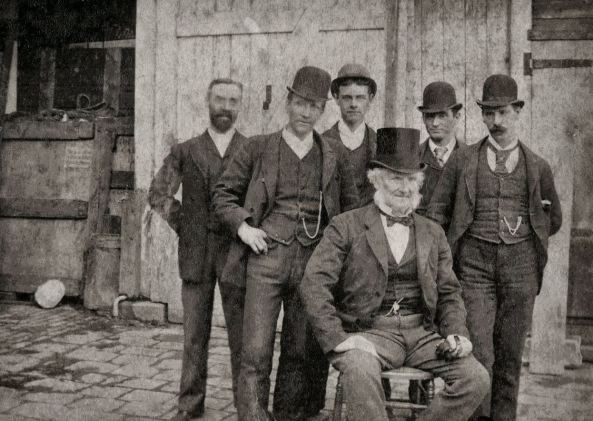
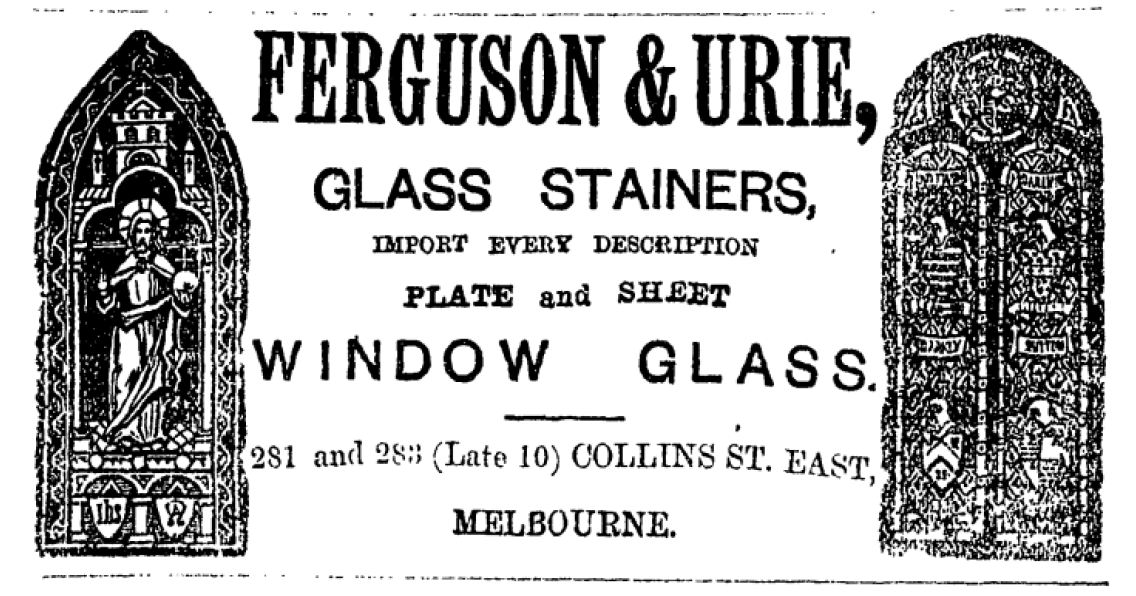
Undoubtedly the Colonist who was the driving force behind the success of the Ferguson & Urie stained glass company was James Urie.
His business acumen and enthusiasm made Ferguson & Urie the most successful commercial stained glass company in Australian Colonial history.
The Argus, Melbourne, 23rd July 1890, page 1.
“URIE – On the 21st inst, at his late residence, Wellington-street, Flemington, James, the beloved husband of Grace Urie (and of the firm Ferguson and Urie, Collins-street), aged 62.”
The memorial photos were taken at the Melbourne General Cemetery, 27th Dec 2009.
This slideshow requires JavaScript.
James Urie (1828-1890) was born in Kilmarnock, Ayrshire, Scotland on the 14th May 1828, to William Urie and Jane Ferguson.
On the night of the Scottish census record of March 1851, James Urie (age 22), was indicated as being a visitor to James Ferguson’s (age 33) home at John Street Wallacetown in Ayr. Their professions were listed as Slater and Glaziers. As James Ferguson was 11 years older than Urie, the age difference leads me to believe that he may have formerly been an apprentice of James Ferguson or James Ferguson Snr.
Was the night of the census a meeting to discuss their bold plans to emigrate to Australia? Who knows! What we do know is that that their decision would cement them firmly in history as the founders of Australia’s most prolific and talented stained glass studio.
By late 1852 their decision had been made and they would set sail for Australia. James Urie departed first and was followed a day later by James & David Ferguson. Which ship James Urie departed on has not been established but James & David Ferguson departed Greenock on the 12th Dec 1852 aboard the ‘Tamerlane’. In a speech at the Company dinner held in North Melbourne in 1886, James Urie stated: “..it was just 34 years since he left the old country for the colony and Mr. Ferguson left a day after him”.
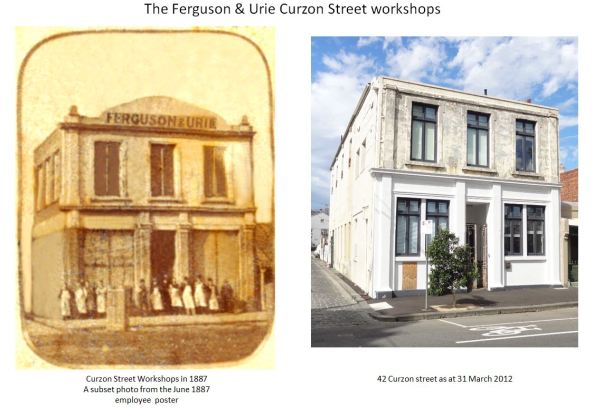
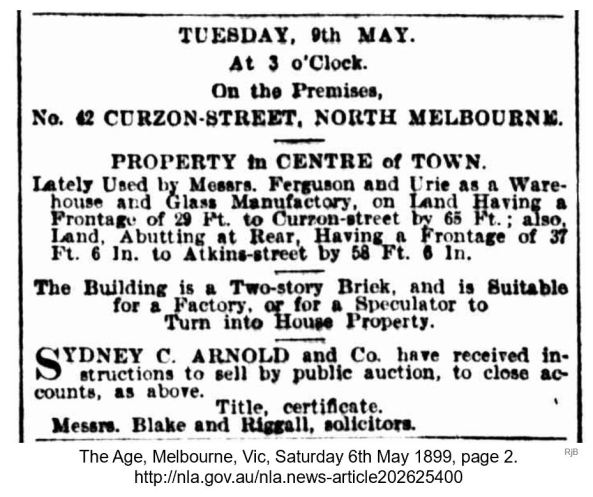
On arrival in Melbourne the men set about establishing their business as Plumbers, Slaters and Glaziers from premises in Curzon street North Melbourne. For a short time James Urie took up residence at the Tam O’Shanter Hotel in North Melbourne, whilst James Ferguson and his brother David found cottage accommodation in Little Curzon street.
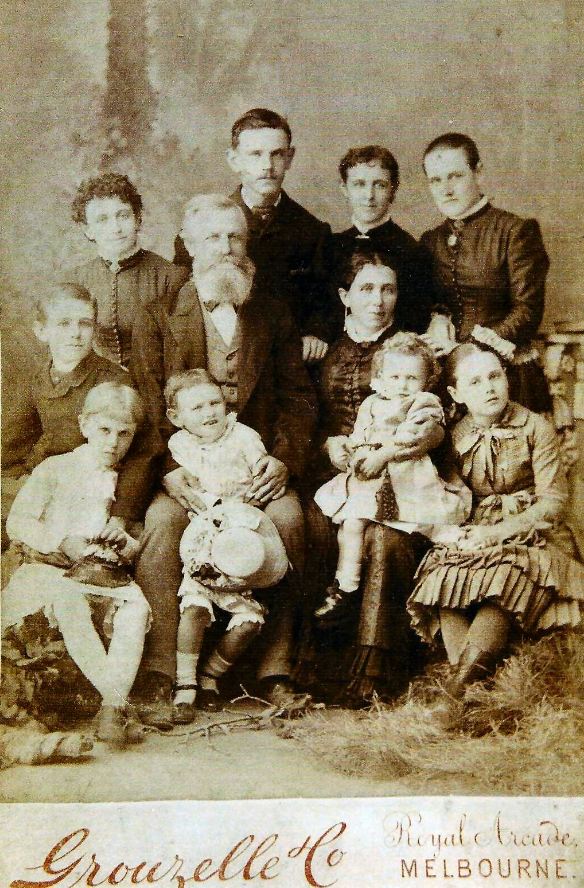
On the 31st August 1855 James Urie married ‘Grace Hardie Young’ at the first Curzon Street Presbyterian church in North Melbourne and they took up residence in a small cottage at 28 Curzon Street North Melbourne, only a short distance from the Ferguson brothers and the business’s workshop. Between 1856 and 1882 James and Grace had fourteen children, five of whom unfortunately died as infants.
After the initial pioneering hard work of establishing the business and transforming the business to stained glass production in 1861, James took the lead as the enterprising salesman of the business and traveled far and wide to the eastern states as far north as Queensland, west to South Australia and as far south as Tasmania and possibly New Zealand to establish the company name “Ferguson & Urie” as Australia’s premier colonial stained glass firm. James was an an astute business man and had an inventive streak as well. On the 24th of October 1865 he registered a patent for “An invention of an improved and cheap method of converting Basaltic Rock into Street Flagging and other pavement”. By 1888 he had established a substantial two storey family home in Wellington Street Flemington named “Glencairn” after the name of “Glencairn Square” near his family home back in Kilmarnock, Scotland.
Outside of the business James actively participated in public life. He was a Justice of the Peace as well as a Councillor of Flemington and Kensington from August 1886 to August 1888, and Mayor of the Borough from August 1887 to August 1888.
On the afternoon of Monday 25th June 1888 he laid the foundation stone of the Presbyterian Church in Norwood Street Flemington.
On the 21st of July 1890, after a brief illness, James Urie died at the age of 62.
On Thursday the 28th August 1890 the Mayor and members of the Flemington council visited his wife Grace at their house “Glencairn” in Wellington Street and presented Grace Urie with an illuminated letter of condolence.
James Urie’s funeral was one of the largest ever seen in Flemington:
“…the procession being the most imposing seen in the borough. The employės of Messrs Ferguson & Urie marched in front of the hearse, then came four mourning coaches and upward of fifty vehicles. Immediately following the mourning coaches came a hansom, in which the Hon Alfred Deakin was seated, then next in order a buggy containing the deceased gentleman’s council colleagues…”.
The Honorable Alfred Deakin (later to be the second, fifth and seventh Prime Minister of Australia) played the part as a pall bearer at the grave site.
James Urie was buried at the Melbourne General Cemetery with the five children who died as infants, and his wife Grace who died in 1899.
Table Talk, Melbourne, Vic, Friday 12th September 1890, page 8.
“James Urie, formerly of Curzon-street, North Melbourne, but latterly of Wellington-street, Flemington, one of the partners of the firm of Messrs. Fergusson [sic] and Urie glass importers, Collins-street East, Melbourne, by his will dated, November 24, 1870, and presented for probate by, Messrs. Madden and Butler, solicitors, appointed his wife, Grace Hardie, executrix. He gave her a life interest in his estate as long as she remains his widow; on her death or re-marriage the estate passes to his children in equal shares. ‘The testator died July 21, 1890, and his will was sworn at 34,808 real and £12,798 personal. Total, £47,606.”
In 2013, more than 120 years after his death, a lane-way between 17 and 19 Waltham Street in Flemington was named in honor of James Urie [See: Photo | Map]. The lane-way is less than one hundred meters down Waltham street from James Urie’s home ‘Glencairn‘ (now St Brendan’s Presbytery) on the corner of Waltham and Wellington Street.
Related posts: 21-11-1865 >19-02-1874 > 18-09-1885 > 25-07-1890 > 29-08-1890 > 20-07-1899
Short link to this page: http://wp.me/p28nLD-GV
© Copyright
0.000000
0.000000
 Ferguson and Urie