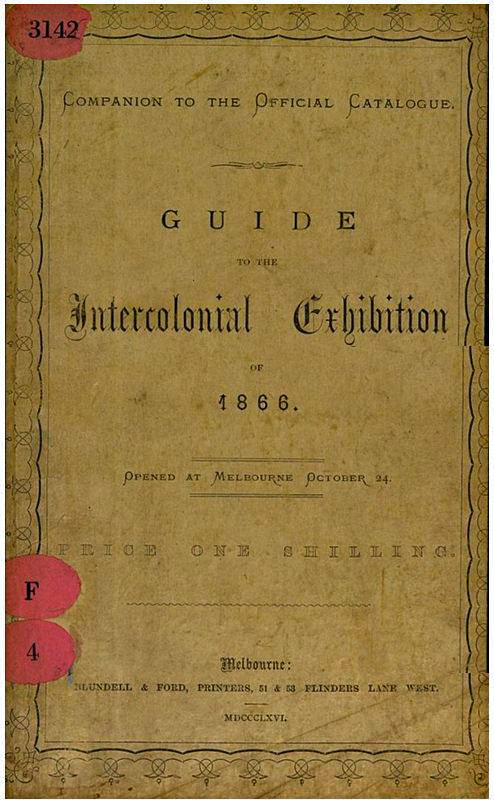
24-10-1866: Guide to the Intercolonial Exhibition of 1866, Melbourne, Victoria.

The Ferguson & Urie stained glass company displayed examples of their workmanship at many exhibitions over a forty year period from 1853.

The 1866 exhibition stands out as the most unique in the company history as being the one that gave them their greatest exposure on the eastern side of Australia and even into New Zealand.

An entire “Medieval Court” was constructed at the 1866 exhibition which included a detailed reconstruction of a church chancel decorated by Ferguson & Urie which was complete with stained glass windows. The idea for the medieval court was based on Augustus Welby Pugin’s Medieval Court, which was first shown at London’s International Exhibition of 1851 and then at the Crystal Palace, Sydenham, between 1852 and 1866. This medieval court reconstruction at the 1866 Melbourne exhibition was the first of its kind seen in the Australian colony and drew and extraordinary crowd.

The most remarkable of the historical artifacts in the medieval court were Ferguson & Urie’s set of five single light stained glass windows depicting the Nativity, Passion, Crucifixion, Resurrection and Ascension. After the exhibition these windows were installed in the chancel of Christ Church at Casterton in Western Victoria and are still in place to this day, although there is a small mysterious anomaly as the the order the windows were installed!

“GUIDE TO THE INTERCOLONIAL EXHIBITION OF 1866”.

“THE MAIN HALL”.

“ON entering this hall from Latrobe-street, visitors who put themselves under our guidance will find, by turning immediately to the left before arriving at the fur trophy, which faces them, that they have come upon perhaps the last thing one might expect to encounter in an exhibition of the products and manufactures of a new colony – to wit, a Mediaeval Court, the whole of the decorations and contents of which are the work of two Melbourne houses, the one that of Mr. John Young, contractor, and the other that of Messrs. Ferguson, Urie and Lyon, glass-stainers, &c. The excellence of this court consists not more in the beauty of the various articles it contains than in the admirable tone of all the decorations, giving to the place that “dim, religious light” befitting the character it assumes. The stained-glass windows let into the partitions surrounding the court are mainly instrumental in producing this effect. The court is filled with statuary, fonts, and elaborately-ornamented wrought-iron articles, suitable for mediaeval church purposes. One of the statues represents the Madonna and Child; others personify St. John, St. Thomas, and St. Theresa. Attached to the walls near the roof are several of the quaintly-carved figures which catch the eye in old churches. These are intended for St. Patrick’s Cathedral, now in course of erection on the Eastern Hill. To complete the ingenious effect of this court as a complete work of art, Messrs. Ferguson, Urie and Lyon have constructed at the side opposite the entrance a recess representing an early English chancel, the decorations of which are most complete. The furniture of the chancel consists of an altar table, an illuminated oil painting of the last Supper, and illuminated tablets of the commandments, creed, and Lord’s Prayer. The light admitted to the chancel pours through five stained-glass windows, representing respectively the nativity, Passion, Crucifixion, Resurrection, and Ascension. These are designed for the Episcopalian Church at Casterton. The walls are also artistically decorated, and altogether this chancel, with the court leading to it, make up one of the most remarkable objects of the Exhibition”.
Related posts: 10-06-1867 > 25-10-1865 > 03-11-1866 > 20-12-1866


Shortlink to this page: https://wp.me/p28nLD-1os

© Copyright

22-09-1870: The 1870 Sydney Intercolonial Exhibition.

At the 1870 Sydney Intercolonial Exhibition, Ferguson & Urie were recommended for a bronze medal for their samples of stained glass, but the judges inquire as to some authenticity that the work was actually crafted in the Victorian Colony.

The Argus, Melbourne, Thursday 22 September 1870, page 6.

 “… Messrs. Ferguson, Urie, and Lyon have been recommended for a bronze medal for their very beautiful samples of stained glass. But there are two Sydney competitors in the same line, and the judges have intimated a wish that some sort of certificate had been forwarded guaranteeing that the alleged Victorian work was really done in Victoria. They have instituted a very close inquiry to ascertain whether the Sydney exhibits were really produced in New South Wales, but they have no means of prosecuting similar inquiries about the exhibits from other colonies…”

Evening News, Sydney, NSW, Tuesday 27th September 1870, page 4.

Exhibit “1471 Samples stained glass, Ferguson, Urie, and Lyon, Melbourne.”


External links:

Example of a Bronze medal at the 1875 exhibition presented to Lyon & Cottier.

17-04-1869: An Art Treasures Exhibition is held at the hall of the Public Library Melbourne.

The South Australian Register, Saturday 17th April 1869, page 3.

 “[…] Several additions have been made to the Exhibition, and among the most remarkable is a painted window, illustrative of the seasons, the work of Messrs. Ferguson, Urie & Lyon, glass-stainers of Hotham[…].”

 Note: This refers to the window for John Wilson’s mansion “Woodlands” near Ararat in western Victoria.

Related posts: 13-04-1869 > 1868

20-12-1866: The Medieval Court at the 1866 Melbourne Exhibition

The Chancel windows of Christ Church Anglican at Casterton in Western Victoria were displayed at the 1866 Melbourne Exhibition.

The Ferguson & Urie stained glass company created and decorated an entire chancel for the Exhibitions ‘Medieval Court’ display and the stained glass windows were the central exhibit before being installed in the Casterton Church. Who was actually contracted to install them is still a mystery as the first two windows were installed out of sequence with the ‘Passion’ preceding the ‘Nativity’. Also of note is that Joseph does not appear in the Nativity scene.

The coloured photos were taken 8th January 2011.

This slideshow requires JavaScript.

The Australian News for Home Readers, Vic, Thursday 20th December 1866, page 8.

“MEDIEVAL COURT”

“One would scarcely expect to find a Medieval Court in an exhibition of the products, of a new colony; but such a court there is, intended to illustrate portions of ecclesiastical architecture; and it constitutes, perhaps, the most pictorially effective part of the whole building. Messrs Ferguson, Urie and Lyon, glass stainers, Curzon-street, North Melbourne, exhibit a decorated chancel, the ceiling of which has for a centrepiece the Agnus Dei, surrounded with scriptural texts and gothic clouds. The other portion of the ceiling is divided into twelve compartments, having the emblems of the twelve Apostles. The walls are diapered with simple but chaste pattern. It is lighted with five stained glass windows, the subjects of which are the Nativity, Passion, Crucifixion, Resurrection and Ascension. These windows are made for the chancel of the church at Casterton, and are exhibited by permission of the Rev. Dr. Russell. At the altar are two richly illuminated tablets of the commandment, Lords prayer and creed; also an illuminated painting of the Last Supper. A considerable quantity of stained glass is exhibited, consisting of ecclesiastical and domestic styles; also, numerous samples of stained and embossed borders and small subjects. On the right hand side of the court is a carved baptismal font in Caen stone, designed and executed by Mr John Young, contractor, Melbourne. It is all colonial workmanship. The upper portion is octagonal, representing the four Evangelists. At the top of the shaft are masses of carved foliage with heads interspersed, while at each angle of the shaft, which is double, are buttresses wreathed and moulded. The outer one has got headed open panels cut entirely through showing the centre shaft of the interior. In the splays of he base are clusters of foliage carved from real flowers and leaves, but Gothicised after the decorated period. The base represents evil spirits in the form of dragons, emblematical of the Sacrament of baptism casting them down. The lid of the font is of carved colonial blackwood, polished, ornamented with wrought iron to suit the general workmanship of the whole. In this department are also some highly ornate water fonts, sculptured by Mr. F. Utyco; a number of figures carved in wood for the internal decoration of St. Patrick’s cathedral, an altar and fittings, some hand rails, and several statues of saints.”

The 1866 Melbourne Intercolonial Exhibition was held in a specially built ‘Great Hall’ on a site behind the State Library’s Queens Hall in Swanston Street Melbourne.

Casterton Christ Church 99A


Short link to this post: https://wp.me/p28nLD-6V

© Copyright

03-11-1866: The 1866 Intercolonial Exhibition.

The Brisbane Courier, QLD, Saturday 3rd November 1866, page 6.

“VICTORIA”

“Our files from Melbourne are October 25. The Age of that date contains the following description of the Intercolonial Exhibition opened on that date:- […]”

“[…] In class 4- the manufacturers and the useful arts- special and deserved mention must be made of the exhibits of Messrs. Ferguson, Urie, and Lyon, glass-stainers, North Melbourne. This firm were exhibitors in 1854, but have evidently made great strides during the last twelve years. Their display is unique, and will form one of the attractions of the Exhibition, particularly during the evening, when the illuminated paintings and stained glass windows have their effects brought into prominence by a profuse display of gas light. […]”

07-12-1861: The 1861 Melbourne Industrial Exhibition.

The 1861 Melbourne Industrial Exhibition is recognised as the event that changed the course of the Ferguson & Urie Company history. This exhibition is where the Scottish Stained Glass Artist, John Lamb Lyon would have undoubtedly been convinced to join the firm in late 1861.

Ferguson & Urie received an honorable mention for ornamental glazing, and John Lamb Lyon, for a design for stained glass. Lyon joined the firm a short time after this exhibition and between 1866-1873 was installed as a partner in the firm.

The 1861 Exhibition was almost exclusively Victorian. The poorly constructed exhibition building was erected in William Street and was prone to leaking. The glass roof, supposedy copied from the London’s Crystal Palace, was painted white during 1857–58. The Exhibition Building was the main concert venue for the Melbourne Philharmonic Society from 1854 to 1866 and also served as an interim lecture theatre for the university (1855) and as the venue for Temperance League rallies in 1857. The last function to be held there was Governor Darling’s Vice-Regal Ball of 1864 and it was demolished in the late 1860s, and the existing Mint building erected on the site during 1871–72. [1]

The Argus, Melbourne, Saturday 7th December 1861, page 7.

“THE EXHIBITION. LIST OF AWARDS”.

“The following completes the list of awards in connexion with the Industrial Exhibition …”.

“HONOURABLE MENTION …”

“Fergusson [sic] and Urie – Ornamental glazing”

“Lyon, J.N [sic] – Design for stained glass …”

Exhibition building 1861 latrobe-56-009a

Melbourne’s first exhibition building photographed during the
1861 Melbourne Exhibition (Source SLV I.TAF 451)

The 1872 Mint Building which now stands on the site of the first Exhibition Building

The Mint Building built in 1872 in William Street, which now stands on the site of the first Exhibition Building

Foot notes:

[1] The Latrobe Journal, No 56, Spring 1995.