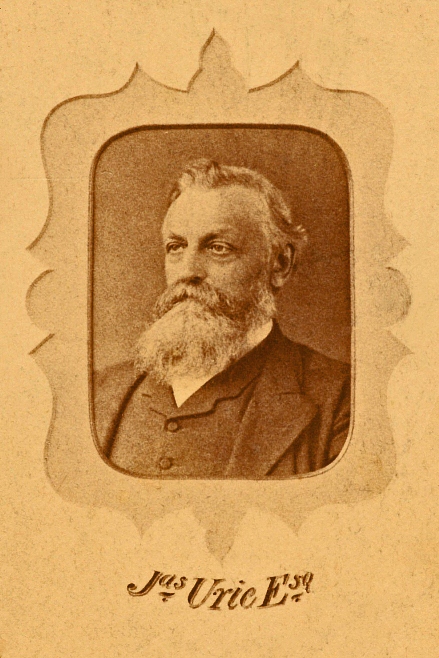
23-07-1890: James Urie (1828-1890)


Undoubtedly the Colonist who was the driving force behind the success of the Ferguson & Urie stained glass company was James Urie.

His business acumen and enthusiasm made Ferguson & Urie the most successful commercial stained glass company in Australian Colonial history.

The Argus, Melbourne, 23rd July 1890, page 1.

“URIE – On the 21st inst, at his late residence, Wellington-street, Flemington, James, the beloved husband of Grace Urie (and of the firm Ferguson and Urie, Collins-street), aged 62.”

The memorial photos were taken at the Melbourne General Cemetery, 27th Dec 2009.

This slideshow requires JavaScript.

James Urie (1828-1890) was born in Kilmarnock, Ayrshire, Scotland on the 14th May 1828, to William Urie and Jane Ferguson.

On the night of the Scottish census record of March 1851, James Urie (age 22), was indicated as being a visitor to James Ferguson’s (age 33) home at John Street Wallacetown in Ayr. Their professions were listed as Slater and Glaziers. As James Ferguson was 11 years older than Urie, the age difference leads me to believe that he may have formerly been an apprentice of James Ferguson or James Ferguson Snr.

Was the night of the census a meeting to discuss their bold plans to emigrate to Australia? Who knows! What we do know is that that their decision would cement them firmly in history as the founders of Australia’s most prolific and talented stained glass studio.

By late 1852 their decision had been made and they would set sail for Australia.  James Urie departed first and was followed a day later by James & David Ferguson. Which ship James Urie departed on  has not been established but James & David Ferguson departed Greenock on the 12th Dec 1852 aboard the ‘Tamerlane’. In a speech at the Company dinner held in North Melbourne in 1886, James Urie stated: “..it was just 34 years since he left the old country for the colony and Mr. Ferguson left a day after him”.

On arrival in Melbourne the men set about establishing their business as Plumbers, Slaters and Glaziers from premises in Curzon street North Melbourne. For a short time James Urie took up residence at the Tam O’Shanter Hotel in North Melbourne, whilst James Ferguson and his brother David found cottage accommodation in Little Curzon street.

On the 31st August 1855 James Urie married ‘Grace Hardie Young’ at the first Curzon Street Presbyterian church in North Melbourne and they took up residence in a small cottage at 28 Curzon Street North Melbourne, only a short distance from the Ferguson brothers and the business’s workshop. Between 1856 and 1882 James and Grace had fourteen children, five of whom unfortunately died as infants.

After the initial pioneering hard work of establishing the business and transforming the business to stained glass production in 1861, James took the lead as the enterprising salesman of the business and traveled far and wide to the eastern states as far north as Queensland, west to South Australia and as far south as Tasmania and possibly New Zealand to establish the company name “Ferguson & Urie” as Australia’s premier colonial stained glass firm. James was an an astute business man and had an inventive streak as well. On the 24th of October 1865 he registered a patent for “An invention of an improved and cheap method of converting Basaltic Rock into Street Flagging and other pavement”. By 1888 he had established a substantial two storey family home in Wellington Street Flemington named “Glencairn” after the name of “Glencairn Square” near his family home back in Kilmarnock, Scotland.

Outside of the business James actively participated in public life. He was a Justice of the Peace as well as a Councillor of Flemington and Kensington from August 1886 to August 1888, and Mayor of the Borough from August 1887 to August 1888.

On the afternoon of Monday 25th June 1888 he laid the foundation stone of the Presbyterian Church in Norwood Street Flemington.

On the 21st of July 1890, after a brief illness, James Urie died at the age of 62.

On Thursday the 28th August 1890 the Mayor and members of the Flemington council visited his wife Grace at their houseGlencairnin Wellington Street and presented Grace Urie with an illuminated letter of condolence.

James Urie’s funeral was one of the largest ever seen in Flemington:

“…the procession being the most imposing seen in the borough. The employės of Messrs Ferguson & Urie marched in front of the hearse, then came four mourning coaches and upward of fifty vehicles. Immediately following the mourning coaches came a hansom, in which the Hon Alfred Deakin was seated, then next in order a buggy containing the deceased gentleman’s council colleagues…”.

The Honorable Alfred Deakin (later to be the second, fifth and seventh Prime Minister of Australia) played the part as a pall bearer at the grave site.

James Urie was buried at the Melbourne General Cemetery with the five children who died as infants, and his wife Grace who died in 1899.

Table Talk, Melbourne, Vic, Friday 12th September 1890, page 8.

“James Urie, formerly of Curzon-street, North Melbourne, but latterly of Wellington-street, Flemington, one of the partners of the firm of Messrs. Fergusson [sic] and Urie glass importers, Collins-street East, Melbourne, by his will dated, November 24, 1870, and presented for probate by, Messrs. Madden and Butler, solicitors, appointed his wife, Grace Hardie, executrix. He gave her a life interest in his estate as long as she remains his widow; on her death or re-marriage the estate passes to his children in equal shares. ‘The testator died July 21, 1890, and his will was sworn at 34,808 real and £12,798 personal. Total, £47,606.”

In 2013, more than 120 years after his death, a lane-way between 17 and 19 Waltham Street in Flemington was  named in honor of James Urie [See: Photo | Map]. The lane-way is less than one hundred meters down Waltham street from James Urie’s homeGlencairn(now St Brendan’s Presbytery) on the corner of Waltham and Wellington Street.

Related posts: 21-11-1865 >19-02-1874 > 18-09-1885  > 25-07-1890 > 29-08-1890 > 20-07-1899


Short link to this page: http://wp.me/p28nLD-GV
© Copyright

25-07-1890: The late Councillor Urie, Flemington, Victoria.


The North Melbourne Advertiser, Friday 25th July 1890, page 2

“THE LATE COUNCILLOR URIE”

“Councillor James Urie died at his residence, Wellington Street, Flemington, on Monday evening, after an illness which barely extended over a week and which, in its first appearance, gave no indication or warning of fatal termination. The family of the deceased gentleman – and never was there a family more united or more affectionate – were led to expect the worst only a day or so before the end came, but it needed the exercise of true Christian resignation to enable them to bear up under the dreadful visitation. The people of Flemington and Kensington received the announcement of Cr Urie’s death with unfeigned sorrow. Outside the municipality the sad item of intelligence was discussed in terms that gave indubitable evidence of the general esteem in which the deceased was held. By the removal of a prominent public man such as Cr Urie the borough and district have sustained a grievous loss. Relatives, friends, and acquaintances have just cause to deplore the demise of one endeared to them by reason of innumerable good qualities, kindly disposition, and upright character. In commercial circles too, where his unswerving rectitude and sterling honesty in all matters of business were well known, the deceased merchant will be greatly missed.

            Mr Urie came to the colony from Scotland (his native land) early in the fifties and, after ‘roughing it’ in the usual pioneer fashion, started in trade in Curzon street, North Melbourne, and, by dint of genuine hard work, laid the foundation of the flourishing  Collins street firm of Ferguson and Urie. Some 17 years ago Mr Urie purchased the land in Wellington Street, on which his late residence now stands, and erected thereon a house for his mother. On the death of the old lady he enlarged the house, removed there with his family, and continued to reside there for the remainder of his days. The deceased took deep interest in the progress of the borough, and when the agitation for the removal of the cattle yards was begun he joined in the crusade with all the ardour of an enthusiast. For six years he occupied a seat in the Borough Council, and once held the position of Mayor. As a councillor he performed his duties without fear or favour, bringing with him to the Council table the same honesty of mind and singleness of purpose which characterised all his actions outside, His return at the head of the poll at the last municipal election may be taken as evidence of the popularity of the deceased gentlemen. CR Urie was a staunch supporter of the present member for the district, Mr Deakin, and at the general elections last year acted as chairman of the committee for the Flemington district. The deceased was a leading member of the Presbyterian Church and chiefly to his exertions and assistance is due the presence of ‘the Kirk’ in Norwood Street. In private life Mr Urie was distinguished for his imperturbable good humour, his lack of ostentation, and for general all-round ‘goodness’.

            The funeral left Wellington Street about half-past three on Wednesday afternoon, the procession being the most imposing seen in the borough. The employės of Messrs Ferguson & Urie marched in front of the hearse, then came four mourning coaches and upward of fifty vehicles. Immediately following the mourning coaches came a hansom, in which the Hon Alfred Deakin was seated, then next in order a buggy containing the deceased gentleman’s council colleagues. Crs Millar (mayor) and Barrett. The other members of the council, Mr Cattanach (town clerk), Mr McIver (surveyor), Mr Elmslie (valuer), Mr Glyn (foreman of works), Mr Ryan (borough inspector), were also in attendance. Essendon Council was represented by the Mayor and Cr Hanna, and North Melbourne Council by Cr Fogarty. Rev J. Thomson, minister, and the adherents of the Presbyterian Church, the president and leading members of the Australian Natives Association, the business people of the borough, and a number of private citizens also followed the remains to the cemetery. The funeral arrangements were conducted by Mr A. Allison, of Victoria street, in his usual efficient manner.

            Deceased was interred in the Presbyterian section of the Melbourne Cemetery, the pall bearers being Messrs James and William Urie, Ferguson, Yeaman, G. Young, Cr Millar, and the Hon A. Deakin. Rev J. Thompson delivered a brief address at the grave.”

This photo is a portion of the Ferguson & Urie employee poster kindly provided by Mrs Noelle Nathan via Mrs Valma Jean McPhail, April 2011.

James Urie, June 1887

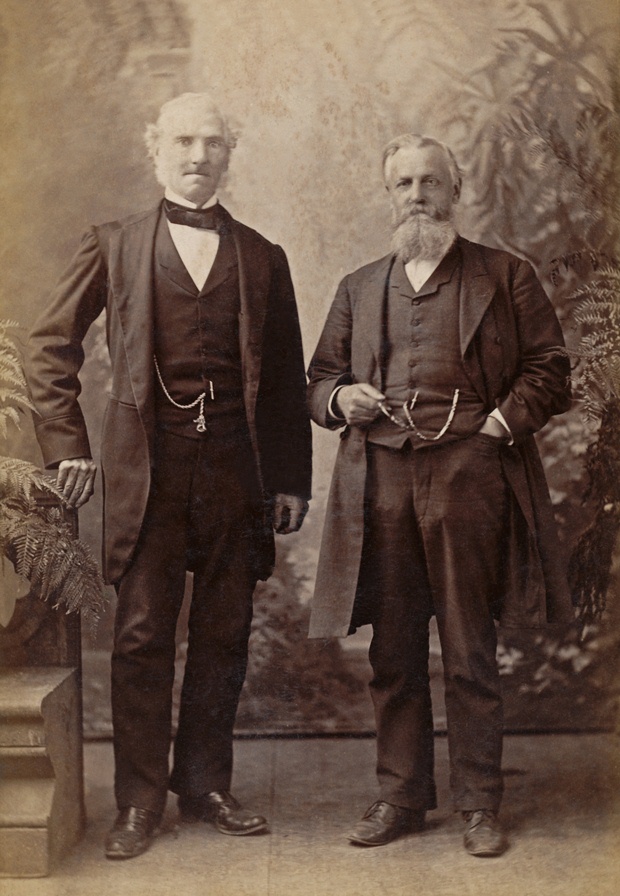
The photo below is from my family history collection and shows James Ferguson and James Urie in a portrait taken specifically for the occasion of the company dinner held at the North Melbourne Mechanic’s Institute on the evening of the 22nd June 1887.

James Ferguson & James Urie 1887


Related posts:

31-08-1855: James Urie marries Grace Hardie Young.

23-07-1890: James Urie, principal partner in the firm Ferguson & Urie dies.

29-08-1890: Letter of Condolence from the Borough Council to Grace Urie.

External links:

‘Urie, James (1828–1890)’, Obituaries Australia, National Centre of Biography, Australian National University, http://oa.anu.edu.au/obituary/urie-james-14449/text2553.
(Transcription originally submitted by Ray Brown – Feb 2012)

Short link to this page: https://wp.me/p28nLD-GX

© Copyright

07-11-1889: The Ross Portable Fire Escape Demonstration.

Thomas Ross of Sydney, New South Wales, invented the “Ross Patent Portable Fire Escape”. In Victoria it was filed as patent No 6650 on the 2nd of April 1889 and in the US was filed as US patent 434888 dated August 19, 1890.

Why the Ferguson & Urie premises at 10 Collins Street was selected for the demonstration is a mystery.

The Argus, Melbourne, 7th November 1889, page 11.

“THE ROSS PATENT PORTABLE FIRE ESCAPE. A PUBLIC EXHIBITION Of the above will be given at Messrs. Ferguson and Urie’s Buildings, Collins-street east, TODAY, At 11 a.m. Sole Agents – BARNETT BROS. 407 Collins-street.”

Goulburn Herald, NSW, Tuesday 12th November 1889, page 4.

“New FIRE-ESCAPE.-A public exhibition of a new fire-escape, known as “The Ross Portable Fire-escape,” was given recently at Messrs. Fergusson and Urie’s establishment in Collins-street, Melbourne. The appliance consists simply of a moderately stout asbestos or fire-proof rope, which is fixed to the upper windows of a building by an ordinary staple. The rope is wound round a drum or reel provided for the purpose, and as soon as a fire originates this is thrown out into the street. Attached to the rope, and running along it, is a metal brake fitted with antifrictional grooves. This brake carries a broad sling, which is passed under the armpits of the person desiring to escape. Then by holding the rope gently in the hand, he can regulate the speed with which he descends to the ground. No fewer than three descents were made by Mr. Thos. Ross, the inventor. He left the top story, which is about 70 ft. in height, and showed how simply the invention worked by stopping himself several times in his descent, and by decreasing and increasing his speed at will. Other advantages claimed for the patent are that it is oheap and easily port able, and that it can be fixed in position in a few moments. – Melbourne Argus.”

Ross Portable Fire Escape (click to see complete Patent file)

Ross Portable Fire Escape Patent US434888

03-09-1889: St. Paul’s Church, Warragul, Victoria.

St Paul’s Anglican Church at Warragul is the home to two historic stained glass windows that were formerly in the old St Paul’s church in Melbourne.

The old St Paul’s, known as the Pro-Cathedral, was located on the corner of Flinders and Swanston Streets and was demolished in 1885 to make way for the new St. Paul’s Cathedral. Two single light stained glass windows, depicting St Peter and St Paul, were removed in mid 1885 just prior to its demolition. The whereabouts of the windows remained a mystery for the next four years.

Both windows were made by Ferguson & Urie of  North Melbourne and they resurfaced again in 1889 when the Gippsland tabloids wrote that Mr. James Burston had purchased them from the cathedral authorities and subsequently gifted them to the Warragul Church .

The windows were unveiled in St Paul’s church at Warragul on Sunday 6th October 1889, but again this would not be their last move. The Warragul church was originally a small timber building dating from circa 1881 and was replaced by the current brick building, the foundation stone having been laid by the Hon. William Pearson M.L.C. on the 29th July 1908.

The two windows were again saved and were re-erected in the new church either side of the chancel where they reside to this day.

Photos taken 4th December 2011.

This slideshow requires JavaScript.

[View larger images]

Warragul Guardian and Buln Buln and Narracan Shire Advocate, Friday 13th September 1889, p3.

A very valuable gift has been made to St. Paul’s church, Warragul during the past week by James Burston Esq., of Melbourne, of two handsome stained glass windows representing St. Peter and St. Paul.  They were formerly in St. Paul’s Pro-Cathedral, Melbourne and were purchased by the donor from the Cathedral authorities.  It is expected that the ceremony of unveiling them will shortly be performed by one of the prominent Melbourne clergy, when special services will be held.  A useful addition has also recently been made of a beautifully worked blackwood pulpit, the handiwork of Mr. J. K.. Keen, now of Mildura.  The workmanship is remarkably good, and it would be a difficult matter, even in the city, to surpass it.”

Warragul Guardian and Buln Buln and Narracan Shire Advocate, Friday 4th October 1889, p2.

“The stained glass windows recently donated to St. Paul’s Church, Warragul, of which we gave a description, will be unveiled on Sunday next”

Warragul Guardian and Buln Buln and Narracan Shire Advocate, Tuesday 8th October 1889, p3.

“The stained glass windows which we recently noticed as having been presented to St. Paul’s Church, Warragul, by Mr. James Burston, of Melbourne, were unveiled on Sunday morning by the Rev. F. W. Willcox. As the coverings were removed their remarkable beauty was revealed to the public for the first time. St. Peter is represented with the usual key in his hands and St. Paul with the sword and the mellow and harmonious colorings were the subject of much comment at the conclusion of the service. The church committee may be congratulated upon the acquisition of what are really works of art, and it is hoped that before long some of the generously-minded will further beautify the church by adding stained glass to the centre window of the chancel”.

There were a number of other Ferguson & Urie windows in the old St Paul’s church in Flinders St, one of which was the three light chancel window dedicated to  the “Prince Consort”, which found its home in St. John’s at Sorrento.

Related posts:

27-07-1885: St Paul’s Pro Cathedral, Flinders St, Melbourne, Victoria.


Short link to this page: https://wp.me/p28nLD-FZ

© Copyright

05-01-1889: St John’s Anglican Church, Port Fairy, Victoria, Australia.

St John’s Anglican Church in Port Fairy was designed by Nathaniel Billing and was built of bluestone between 1854‐1856. It was supposedly the first church in Victoria with a full chancel. The two largest stained glass windows were made by Ferguson & Urie of North Melbourne.

Photos were taken 7th Jan 2011.

This slideshow requires JavaScript.

Australian Town and Country Journal, NSW, Saturday 5th January 1889, page 26.

“… the Anglican Church, with its ivy-clad walls, presents a picturesque appearance. The interior is beautified by a splendid stained glass memorial window, representing Faith, Hope, and Charity. This was presented by Mr. A. H. Knight, of Koorongah, in memory of his wife, who died in England in 1886. The chancel window displays most artistic workmanship, and was the gift of Mr. Lydiard. The church is substantially constructed of bluestone, and was erected as a cost of £14,000…”

The Lydiard memorial window:

The three light chancel window is a memorial to Cecilia Lydiard (nee Wooldridge 1848-1871). She was the daughter of Henry Wooldridge and Sarah Anne Buckland and died at the age of 31 in Belfast (Port Fairy) in 1871. The centre light of the stained glass chancel window has the memorial text:  “IN MEMORY OF CECILIA WIFE OF G. LYDIARD”.

George Fletcher Lydiard (1833-1925) was the son of Admiral George William Charles Lydiard (R.N) and Mary Sturt. After Cecilia’s death George married Adelaide Frances Campbell (1856-1901) on the 2nd August 1877[1]. In 1877 George Lydiard was unanimously elected as president of the shire of Belfast (Port Fairy)[2] and re-elected in 1878[3]. He was also appointed Vice President of Belfast Farmers Union 11th October 1879[4]. Lydiard was also a long-time friend and business partner of Andrew Halley Knight (see below) in the Koorongah Estate sheep station and in 1881 it was Knight, whilst in England, who relayed to Lydiard his findings, for a cure of Lungworm in Sheep and subsequently the estate was one of the first in Victoria to install a Carbolic acid fumigating room for the treatment[5]. G. F. Lydiard died at Euroa in 1925[6] aged 93.

The Knight Memorial window: c.1887.

The three light stained glass window of Faith Hope & Charity is a memorial to Elizabeth Hawkins Knight (nee Grylls, 1827-1886) and possibly made c. 1887.

The lower edge of the window can’t be seen to ascertain if there is any text but the subject of the memorial was Elizabeth Hawkins Knight (nee Grylls, 1827-1886) who was the daughter of the Rev John Crouch Grylls of Sydney and Sarah Richards. She married Andrew Halley Knight at St James Cathedral in Melbourne on 22 Aug 1848[7]. Her husband, Andrew Halley Knight (1813-1904), had arrived in Port Phillip from Edinburgh in 1838 and started business as ‘Alison & Knight’ merchants in Collins Street Melbourne. He owned extensive sheep runs around Kalkallo and Koorongah Estate near Port Fairly. After Elizabeth died in England in December 1886 he then married Ada Jane Atwood (1847-1941)[8] in Sussex in 1888.  A. H. Knight died at Croydon on the 6th July 1904.

Footnotes:

[6] Victorian Births, Deaths & Marriages (Vic BDM): 5153/1925

[7] The Maitland Mercury & Hunter River General Advertiser, NSW, Saturday 9 September 1848, page3.

[8] Vic BDM: 8703/1941, Ada Jane Halley Knight, died Toorak, age 94 in 1941.


Short link to this page: http://wp.me/p28nLD-FI

© Copyright

10-03-1888: The 1888 Ferguson & Urie Employee Dinner.

North Melbourne Advertiser, Saturday 10th March 1888, page 2

“Messrs. Ferguson and Urie gave their Annual Dinner to their employės in the North Melbourne Town Hall, last evening, when a most enjoyable time was spent, and a number of songs and recitations were indulged in. One of he principal toasts was the health of Mr. William Urie, who with his uncle, Mr, John Yeaman, leaves by the R.M.S. Victoria to-day, on a nine months trip to the old country. A full report will appear in our next issue.”


Related pages: (Full transcriptions of the dinners).

The 1886 Employee Dinner
The 1887 Employee Dinner
The 1888 Employee Dinner

31-01-1888: The fire at the Ferguson & Urie Yarra Bank workshops.

In the early hours of the 31st of January 1888 a fire broke out at the rear of Glover & Co’s foundry in Normanby-road, Yarra Bank (now South Melbourne) which in turn destroyed the adjoining Ferguson & Urie glass store. Reports of the fire were published in the Brisbane Courier, Sydney Morning Herald and Hobart Mercury tabloids. Despite the building being insured the company decided not to re-build the workshop and no longer had any presence in South Melbourne.

The Argus, Melbourne, Tuesday 31st January 1888, page 7.

“FIRE AT YARRA BANK SOUTH”.

“A destructive fire broke out early this morning in the factory of Messrs. Ferguson and Urie, glass stainers and importers of plate and sheet window-glass, Normanby-road, Yarra-bank south, which resulted in the destruction of the greater part of the premises. The flames also extended to the premises of Messrs. Wm. Glover and Co, iron-founders, where a considerable amount of damage was caused. The boats were removed from the yard of Mr. James Cowan, shipwright, but no damage was done to the buildings. At two o’clock the fire had got a firm hold of Ferguson and Urie’s, and the rear portion of the premises was completely gutted. Several fire brigades had arrived on the scene, and were playing freely on the burning buildings. It is not at present known how the fire began. Shortly after half-past 2 o’clock a second fire engine was brought to the scene, and the fire, although still burning, was thought to be in no danger of spreading further”.

The image of the Yarra Bank workshop below is a subset taken from the June 1887 company dinner photos.

Ferguson & Urie Yarra Bank Store 1887

Ferguson & Urie Yarra Bank Store, June 1887

The Argus, Melbourne, 1st February 1888, page 8 & The Mercury, Hobart, Friday 3rd February 1888.

“SERIOUS FIRE ON YARRA BANK SOUTH, DAMAGE ESTIMATED AT £8,500.

“No explanation has yet been found for the origin of the fire which occurred early on Tuesday morning at the store of Messrs. Ferguson and Urie, Normanby-road, on Yarra bank, and a report of which appeared in a late edition of The Argus yesterday. It is believed by some persons, including members of the fire brigade, that it originated in the rear corner of Messrs. Glover and Co.’s foundry adjoining the glass store. But, on the other hand, Messrs. Glover and Co. state that a watchman was on their premises who declares that the fire was burning in Messrs. Ferguson and Urie’s store.”


Short link to this page: http://wp.me/p28nLD-F2

© Copyright

01-01-1888: The Ferguson Clan at Ayr Cottage, Parkville.

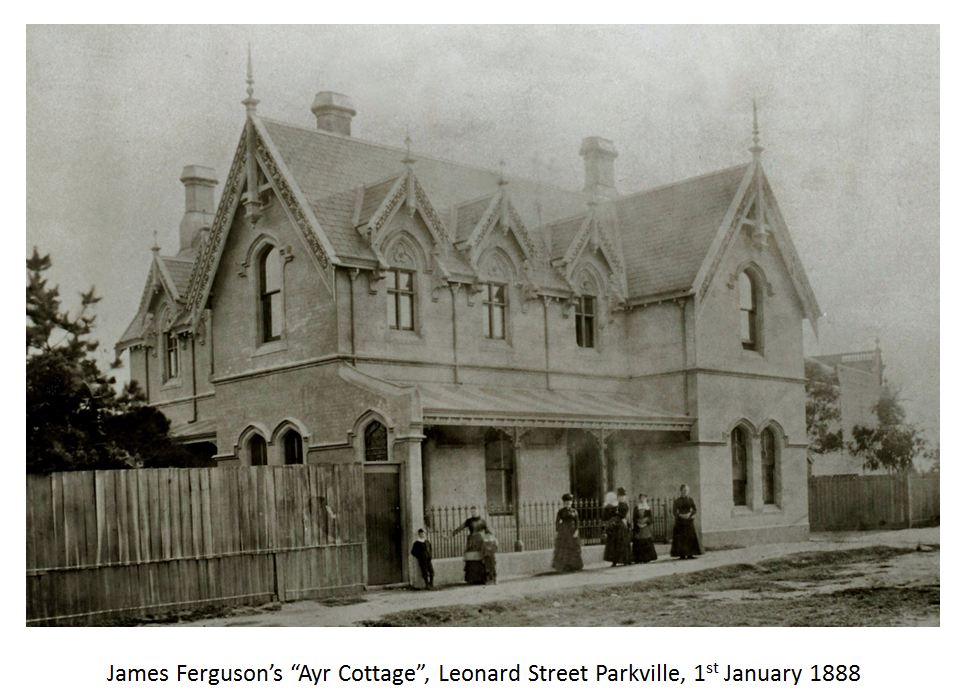
On the new years day in 1888 the Ferguson family clan assembled at James Ferguson’s ‘Ayr Cottage’ in Leonard street Royal Park (now Parkville) for festivities and a family photo.

The first photo shows the front of the house from Leonard street with eight of the family members out front and the second photos is of of the entire family on the east side of the house with James Ferguson in the centre with grey hair and bow tie.

The family photo was kindly contributed by Errol Vincent from New Zealand and he and his wife Ann also assisted with the extensive identification of all the family members in the photo.

This slideshow requires JavaScript.

Related posts:

1886: The History of ‘Ayr’ Cottage, 1 Leonard St. Parkville, Melbourne, Victoria.

08-10-1887: ‘Ayr Cottage’, 1 Leonard Street, Parkville, Melbourne, Victoria.

18-04-1894: James Ferguson (1818-1894)

04-07-1901: The sale of Ayr Cottage, Parkville, Melbourne.


Short link to this page: https://wp.me/p28nLD-EU

© Copyright

08-10-1887: ‘Ayr Cottage’, 1 Leonard Street, Parkville, Melbourne, Victoria.

The North Melbourne Advertiser, Saturday 8th October 1887, page 2.

“Mr. Harry Lording the well known local architect and builder, announces in our advertising columns that he has removed to a more central office at 18 Errol street near Victoria street. Mr. Lording’s works are characterized by good taste and boldness of design, one of his best efforts being the residence of Mr. James Ferguson at Royal Park. The Pavilion at the Recreation Reserve is another construction that will bear inspection, and proves the architect possesses considerable ability as a good designer and economical arranger.”

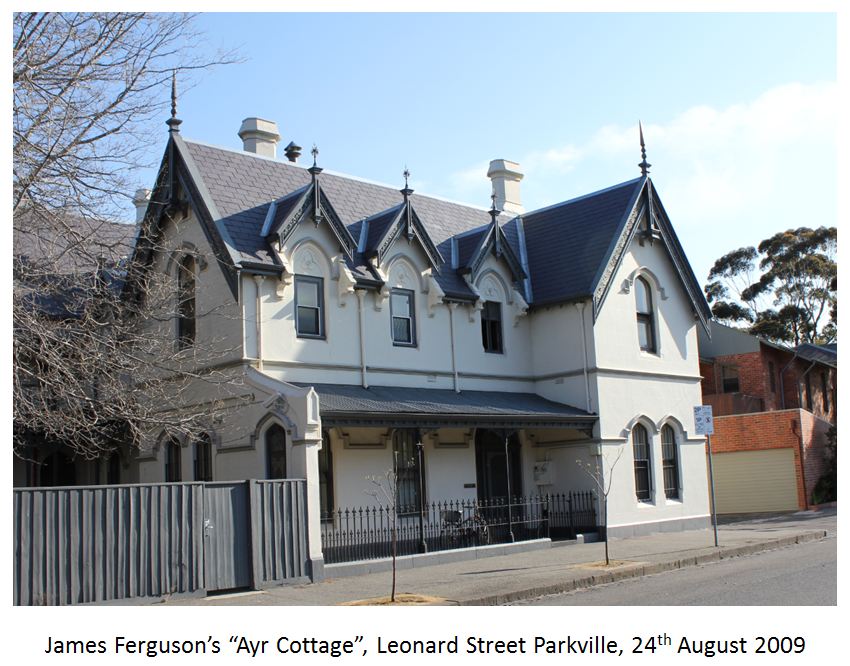
James Ferguson’s home “Ayr Cottage” at 1 Leonard Street Parkville (formerly Royal Park) still exists to this day. In 1901 it was purchased by the Victorian Children’s Aid Society and in 1966 changed into the hands of International House, the University of Melbourne, who still own it as at 2014.

Coincidentally, the architect/builder of ‘Ayr Cottage’, Harry Lording, had a son named Frank Clifford Lording (1860-1944) who was an apprentice of the Ferguson & Urie stained glass company.

Significant research detail on the history of Ayr Cottage can be seen via the links at the bottom of this page.

Ayr Cottage, 1st January 1888, Royal Park, Melbourne.

Ayr Cottage 2009

Related posts:

1886: The History of ‘Ayr’ Cottage, 1 Leonard St. Parkville, Melbourne, Victoria.

01-01-1888: The Ferguson Clan at Ayr Cottage, Parkville.

20-04-1894: James Ferguson (1818-1894)


Short link to this page: https://wp.me/p28nLD-EG

© Copyright

25-06-1887: The 1887 Ferguson & Urie Employee Dinner.

The North Melbourne Advertiser, Saturday 25th June 1887, Page 3

“MESSRS FERGUSON AND URIE’S DINNER TO THEIR EMPLOYEES.”

The 1887 Employee dinner was probably one of the most significant occasions in the company history as there is some magnificent pictorial evidence. Two significant historical photos were discussed at the beginning of the dinner and copies of both still exist.

The first photo mentioned was the portrait of James Ferguson and James Urie together and the second one was a large poster collage of James Ferguson & James Urie in the centre surrounded by 29 photos of the employees of the time and the three business premises at Collins Street Melbourne, Curzon Street North Melbourne and Yarra Bank South (which burnt down on the 31st Jan 1888).

The full transcription of the evenings proceeds can be seen here: The 1887 Employee Dinner

The magnificent 1887 employee poster was kindly provided via Mrs. Noelle Nathan from the James Urie family line, 17th Apr 2011 and the James Ferguson & James Urie portrait is from my family history collections.

This slideshow requires JavaScript.

Related pages:

1886: The 1886 Employee Dinner
1887: The 1887 Employee Dinner
1888: The 1888 Employee Dinner