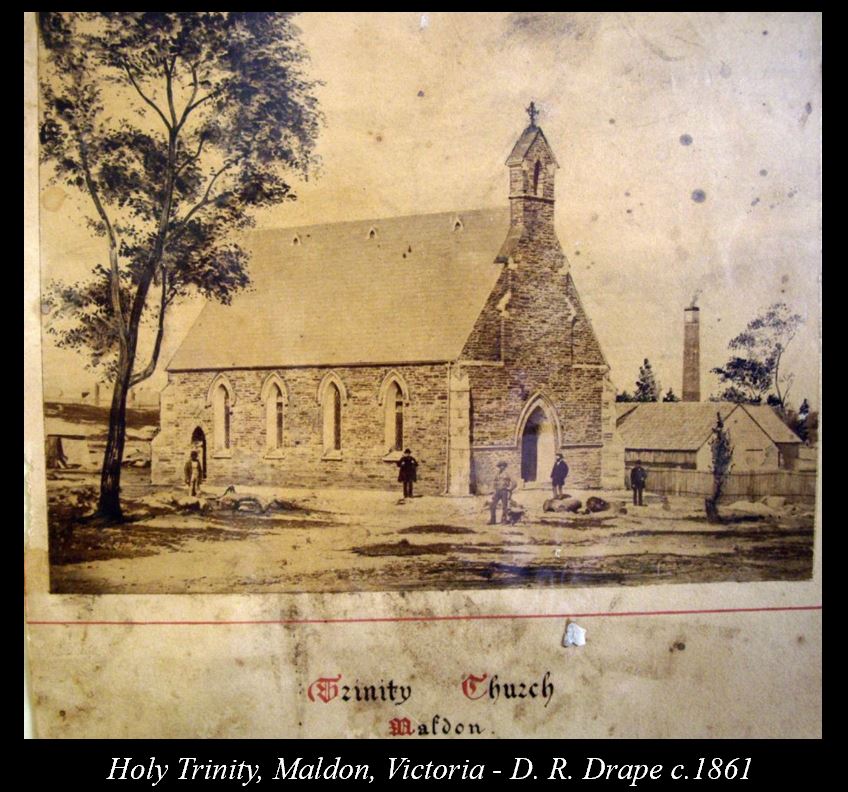
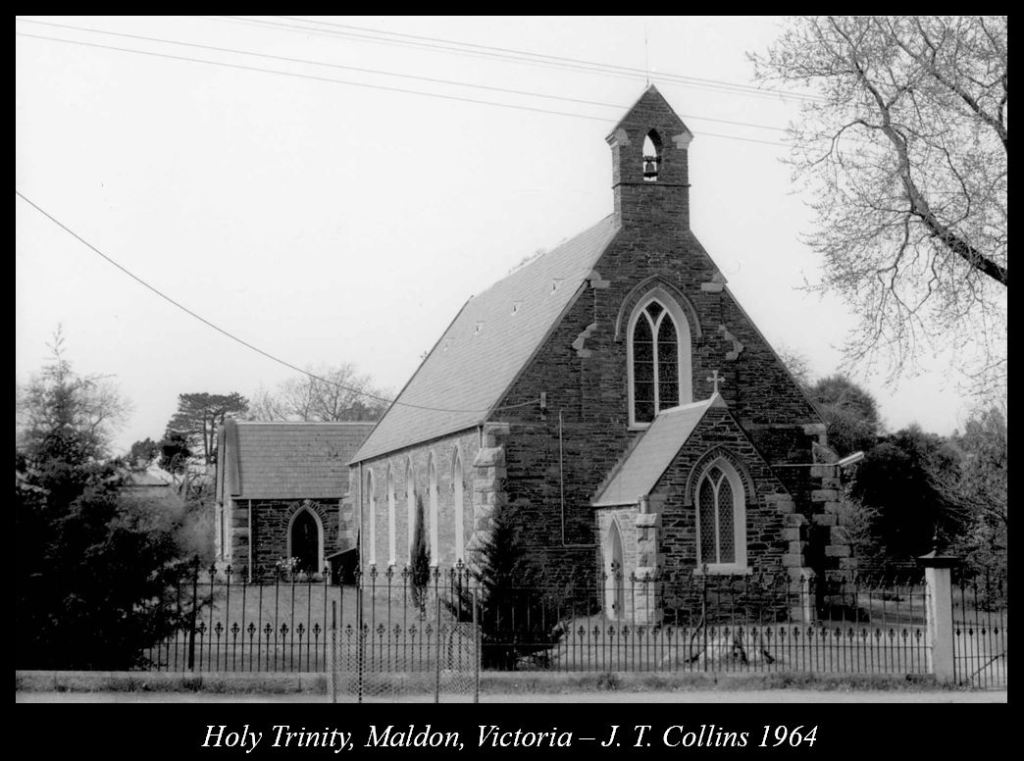
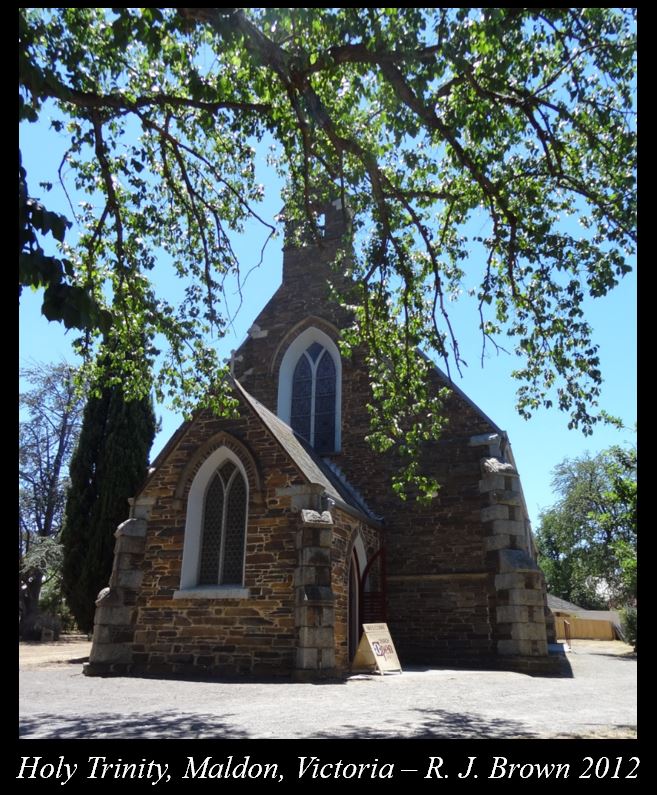
1863: Holy Trinity, Maldon, Victoria

#

The goldfield regions of Victoria are responsible for a lot of our pioneer history. A historic stained-glass window erected at Holy Trinity Anglican Church at Maldon in 1863 tells a significant part but in a historical perspective, a mere fraction of it. The window is now more than a century and a half old, it’s 157 as of 2020, the year of the worldwide COVID-19 virus pandemic.

On the third of May 1861, the Tarrangower Times reported that the £750 tender of Hornsby & Briscoe was accepted for the construction of Holy Trinity Church at Maldon and would be built to the designs of David Relph Drape.[1]

The foundation stone was laid on Wednesday 19th June 1861 by Archdeacon Crawford of Castlemaine [2] and it opened in October of the same year.

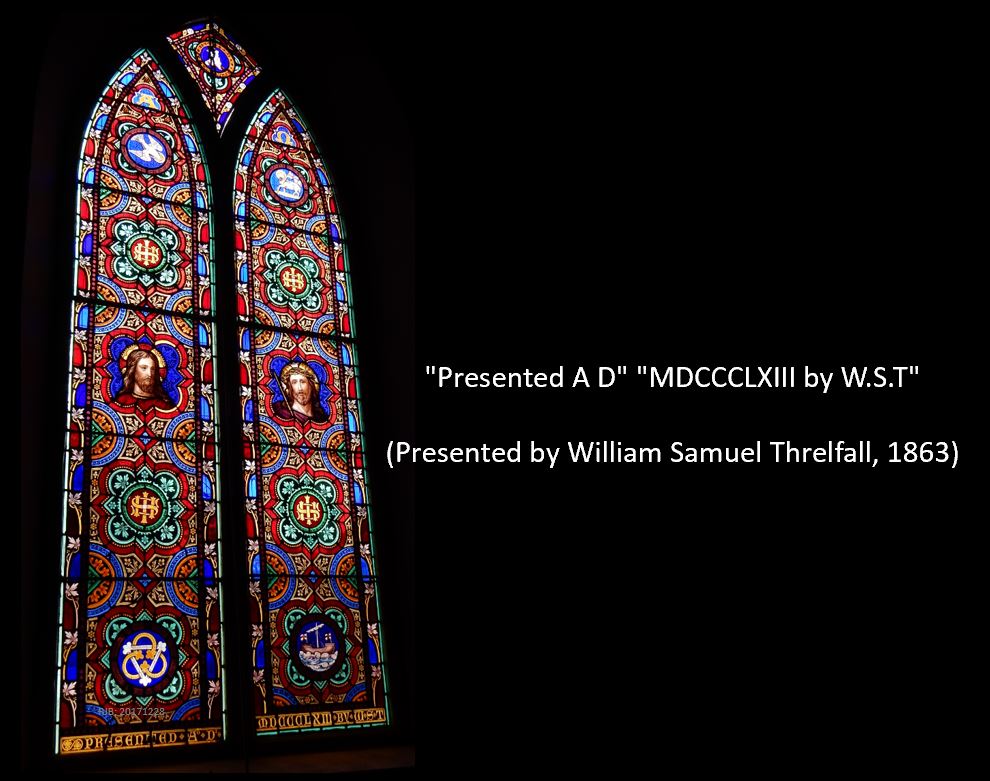
In late 1863, a local mining investor from Maldon named William Samuel Threlfall donated a two-light stained-glass window for the west end of Holy Trinity Church. Given that architect of Holy Trinity David Relph Drape was primarily a stained-glass artist by trade you could be forgiven for thinking that he would have some input in the design of the window or even some hands-on work with it. This may not have been the case.
Five years earlier, in 1858, Drape accepted an offer from James Ferguson of the Ferguson & Urie company of North Melbourne to emigrate to Australia from Carlisle, England, and be the company’s stained-glass artist in their new venture producing locally-made Colonial stained-glass windows. He arrived aboard the ship ‘Morning Light’ on the 20th September 1858 only to find that Ferguson & Urie’s stained-glass workshop in Curzon Street North Melbourne had not been built and there was no employment for him, so he decided to head for the goldfields town of Maldon in Central Victoria.

Why Drape chose Maldon specifically is not known, but there was plenty of demand for his skills there. Back in Carlisle Drape had been well acquainted with the Selby family and coincidentally, John Selby, closely followed by his sister Jane, had migrated to Australia earlier and settled at nearby Castlemaine eighteen kilometers southeast of Maldon. It’s a fair assumption that Drape’s heartstrings for Jane were the reason for many of his trips to Castlemaine, often by foot.[3] He married Jane Selby at the Congregational Church in Melbourne in 1864.

Drape became well known in Maldon in many different pursuits. He was the architect of many local Maldon buildings and his other skills included, draftsmanship, art, painting, illuminated testimonials, tombstone, and memorial tablets. He was also a board member of the Concord Quartz Mining company. There is no record of him designing or fabricating stained-glass windows during his time at Maldon.[4] 

Coincidentally, in April 1861 a Scottish stained-glass artist named John Lamb Lyon arrived in Maldon with his wife Elizabeth. Why they chose Maldon is more obvious as John’s parents James and Janet had migrated to Australia earlier and established themselves as Maldon storekeepers and contractors for the local postal service.

A little over four months after their arrival in Maldon, John was in the process of submitting a design for a stained-glass window for the 1861 Melbourne Industrial Exhibition:

“Works of Art.- Mr John Lyon, lately arrived from England, on a visit to his father, a well-known old resident of this town, is now engaged on an elaborate design for an “Early English” stained glass window. It is intended for the forthcoming Exhibition, and space has been allotted him for that purpose. We consider Mr. Lyon a gentleman of great promise and sterling ability, and we cannot but hope that his work will attract such attention in Melbourne that he will be enabled to pursue his beautiful art in the colony with advantage to himself and the public. We are informed by gentlemen, we believe competent to judge that there is no Ecclesiastical glass painter of equal talent in the colony, at least not publicly known. Architects who in carrying out their designs have felt the want of such decorations will now have an opportunity of judging whether the talent of Mr. Lyon will fill the vacuum” [5]

I suspect that his stained-glass window design may have ended up being used as the design for the two-light window at St Margaret’s Church at Eltham in Nov/Dec 1861. That window is extant and currently the oldest Ferguson & Urie stained-glass window I have found to date. If a linotype or sketch of Lyon’s window for the 1861 exhibition were ever to be found it might solve or deny the mystery.

It would be incredulous not to think that Drape and Lyon did not become acquainted with each other in Maldon. Two stained-glass artists with similar tastes and artistic abilities in the medieval stained-glass craft in a small gold mining town in Australia is an extraordinary coincidence.

By late 1861 Lyon had joined the Ferguson & Urie stained glass company at North Melbourne and started the production of stained-glass from their new workshop in Curzon Street.

Drape had left Maldon by the end of October 1863 and started work alongside Lyon at Ferguson & Urie’s on the precise date of 8th November[6].

In late 1863 the stained-glass window for Holly Trinity had been completed and erected high in the liturgical west end. The exact date is not known. I can only broadly bracket it down to the latter half of 1863.  The first mention of it is in early February 1864. One thing is certain, the window had to have been fabricated at the new Ferguson & Urie workshop in Curzon Street North Melbourne. Ferguson & Urie had the only known stained-glass workshop in Victoria at the time. Lyon was quoted for an interview for the Australian Decorator and Painter in 1909 that their inception was primitive:

“In 1861, Mr. Lyon joined the firm of Ferguson and Urie, Melbourne. Their commencement was on a very primitive scale. They made their own colours and acid, and fired the glass in a colonial camp oven. They, however, soon got properly going, and produced good work under the firm name of Ferguson, Urie and Lyon.” [7][8]

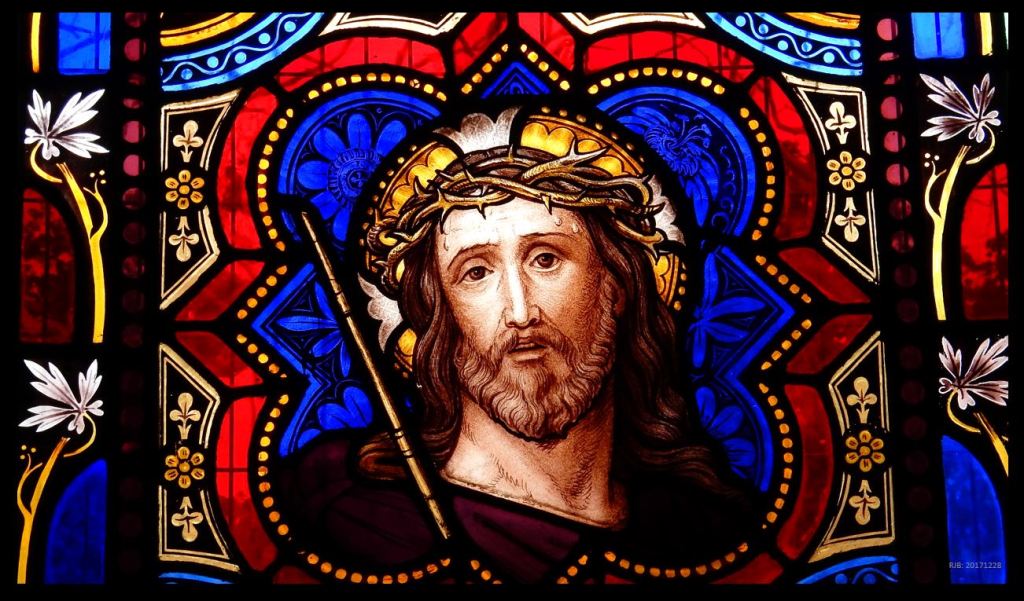
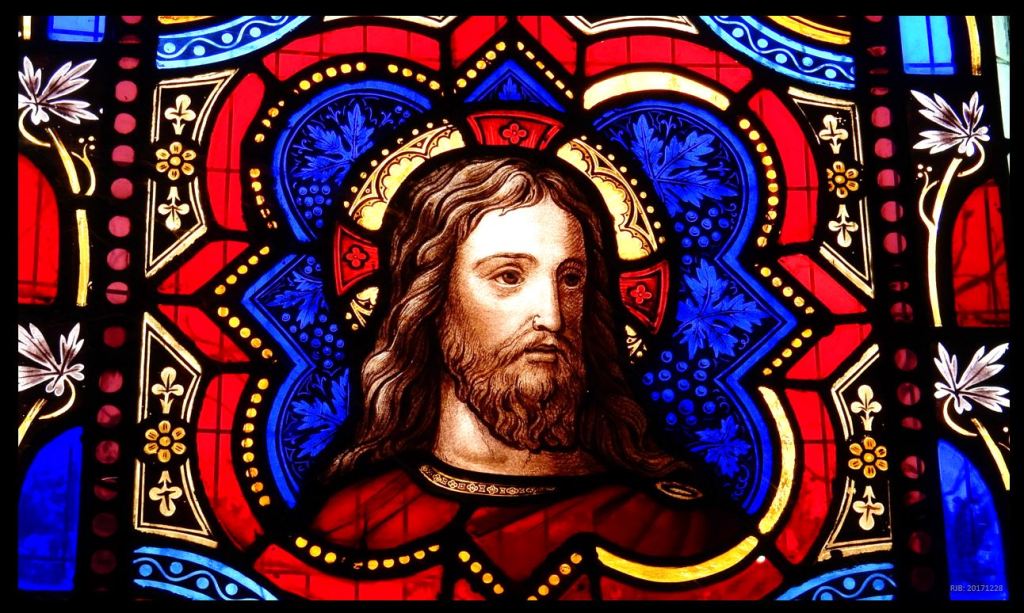
The Maldon window is a two-light in the English style and has the image of  Jesus in the centre of each light. It certainly looks like Lyon’s style and the overall arrangement bears similarities to his other windows at Holy Trinity, Kew, and Christ Church, Kilmore. An article published in the Tarrangower Times in February 1864 states the Maldon window is his work. Whether Drape had any input or hands-on work with Lyon on the window may never be known.

“A great many of our readers will no doubt have observed the very handsome painted window in Trinity Church, presented by W. Threlfall Esq. As regards its intrinsic beauty, and its value as an ornament to what was already considered (we quote the Bishop of Melbourne’s remark, on the occasion of his last visit to Maldon) one of the prettiest little churches out of Melbourne; there can but be one opinion, but perhaps it is not so generally known that this window, reflecting as much credit on the liberal and public spirited donor, may be considered, as in some degree, the work of a Maldon artist; it having been designed, and fabricated, by Mr J. L. Lyon, the son of our respected fellow townsman Mr Lyon, of Main Street”[9]
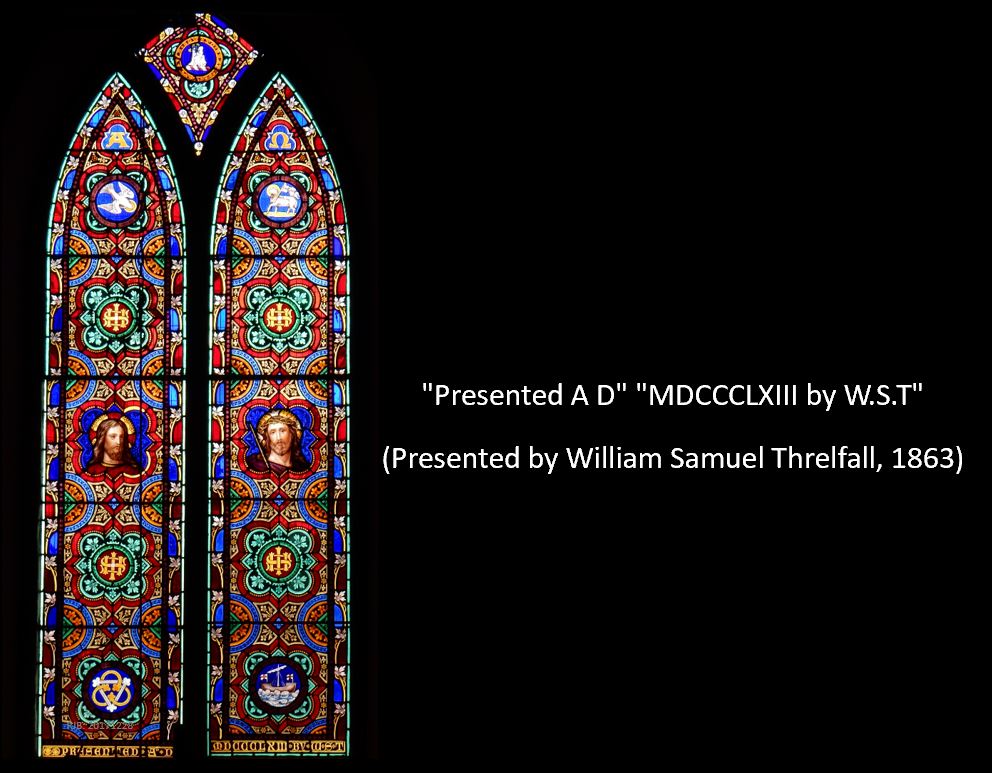
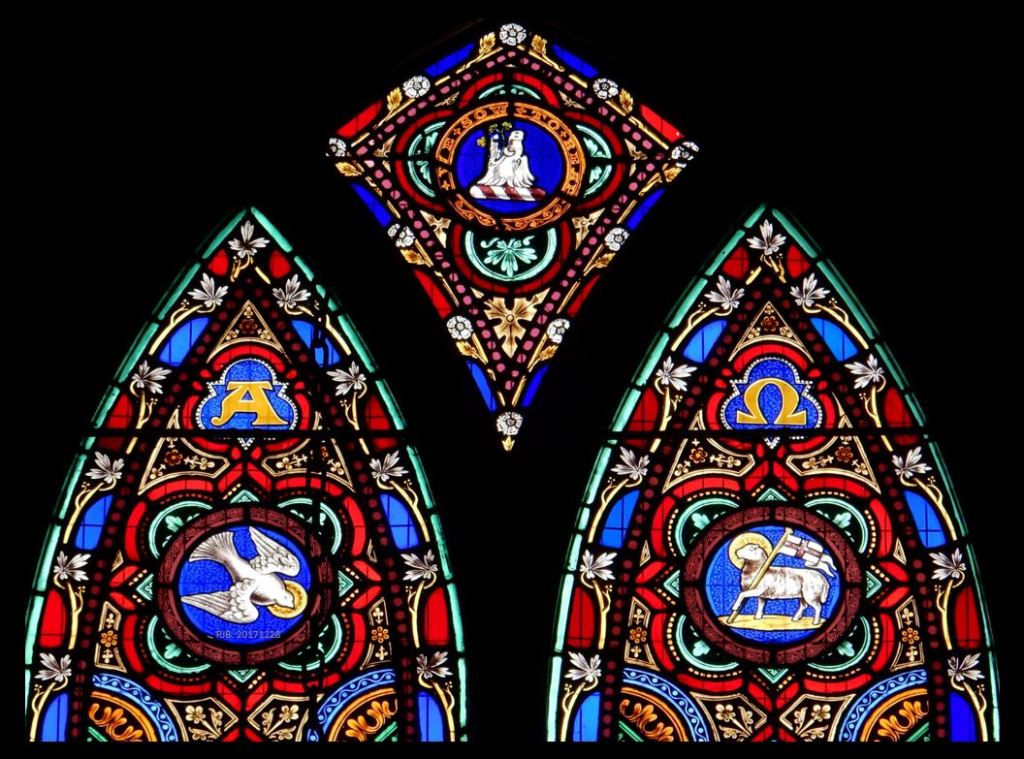
 

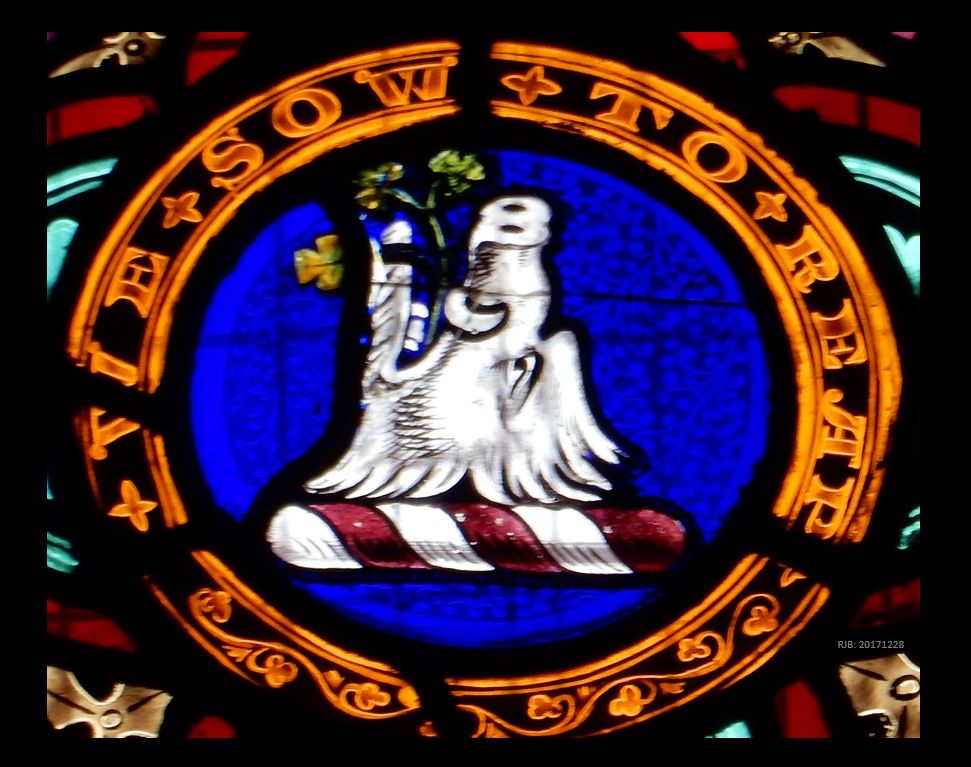
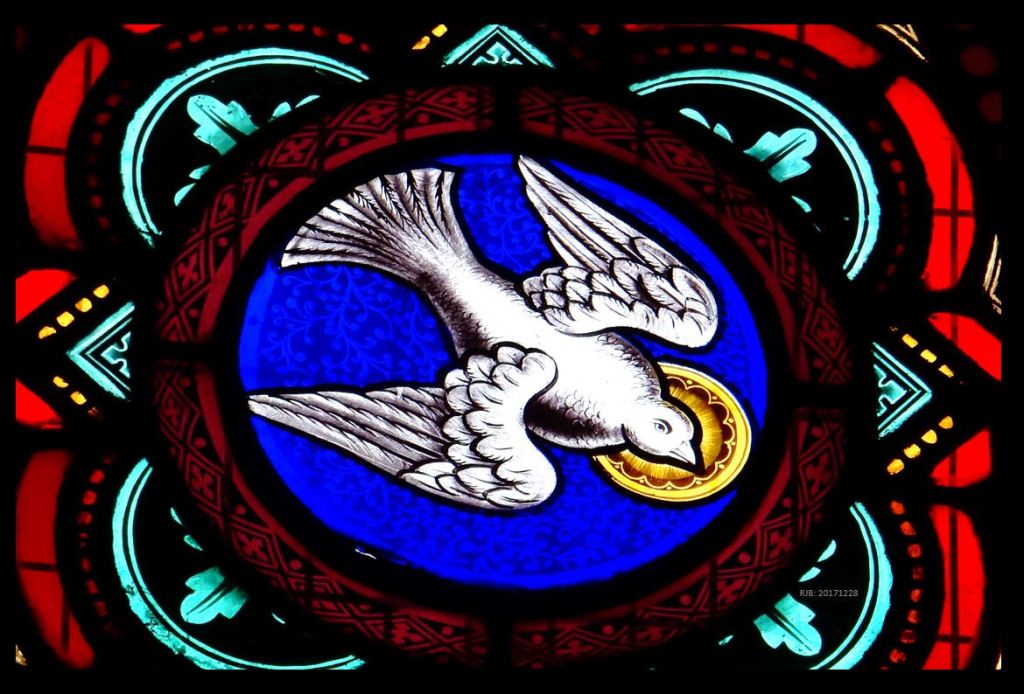
A perplexing thing about the design of the window is a family crest depicting a boar’s head in the apex, presumably that of the donor William Samuel Threlfall. The crest appears above two images of Christ, the Holy Dove and the Lamb of God. The text at the base reads “Presented A.D MDCCCLXIII by W.S.T” (William Samuel Threlfall 1863). It’s not unheard of to see a family crest appear at the top of an ecclesiastical church window, but above the image of Christ or his symbology is extremely rare. Similar instances I have come across during research indicate that where the donor has elevated him/herself above Christ in an ecclesiastical window, it’s usually been met with a very harsh response by the congregation or church committee. The windows were usually forced to be re-made or modified. In extreme cases, a window was summarily sent back to where it came from.

Who was William Samuel Threlfall?

Threlfall was a native of Lancashire, England, and was a small-time mining investor in the Maldon district who had shares in failed gold mining ventures. Many articles of the time paint him as often owing money.

On the 2nd June 1864 at the age of 65, he married the widow Mary Ann Spence[10] at Christ Church, Castlemaine[11]. By November of the following year, he and his wife have disappeared from the Maldon area and dead letters addressed to his wife Mary begin accumulating at the Emerald Hill (South Melbourne) Post Office[12]. Another advertisement in late November 1865 appeals to “Mr. Threlfall, late of Maldon, will put himself (directly or indirectly) in communication with the advertiser, he can receive some beneficial information”[13]. In May 1867 the court ruled that in Threlfall’s mysterious absence his one-eighth share in a quartz-claim at Maldon would be forfeited in favor of the claimants. He is not heard from again.

Related posts:

Biography: John Lamb Lyon (1835-1916)

Biography: David Relph Drape (1821-1882)

Footnotes:

[1] Tarrangower Times, Maldon, Vic, Friday 3rd May 1861, page 4.

[2] Tarrangower Times, Maldon, Vic, Friday 21st June 1861, page 2.

[3] David Relph Drape, Architect, and Glass Stainer; E.M. Bradshaw 1970; Unpublished Manuscript, State Library of Victoria.

[4] Biography: David Relph Drape (1821-1882)

[5] Tarrangower Times, Maldon, Vic, Friday 30th August 1861, page 3.

[6] David Relph Drape, Architect, and Glass Stainer; E.M. Bradshaw 1970; Unpublished Manuscript, State Library of Victoria.

[7] The Australasian Decorator and Painter, August 1st, 1909.

[8] The partnership name of “Ferguson, Urie, and Lyon” did not commence until October 1866.

[9] Tarrangower Times, Maldon, Vic, Tuesday 2nd February 1864, page 2.

[10]  Mount Alexander Mail, Vic, Friday 3rd June 1864, page 2.

[11] Victorian Birth Deaths & Marriages, 398/1864, Christ Church Castlemaine.

[12] The Argus, Melbourne, Vic, Monday 13th November 1865, page 1.

[13] The Argus, Melbourne, Vic, Monday 20th November 1865, page 1.


Short link to this page: https://wp.me/p28nLD-31h

© Copyright

1872: Christ Church Anglican, Geelong, Victoria.

The 25th Anniversary Window.

The second historical Ferguson & Urie stained glass window to be erected in Christ Church at Geelong was a three light Gothic decorated design by the company’s senior stained glass artist and partner John Lamb Lyon. It was erected in the liturgical north side of the nave in Christ Church circa August 1872 which was a year before Lyon departed the firm for his own ventures in Sydney.

The instigator for the erection of this window was the Parish Incumbent, Canon George Goodman, who served as Vicar of Christ Church and other ecclesiastic appointments for 51 years from 1855 to 1906. His wife Margaret is credited with the momentum and collection of subscriptions for the window, which cost £50 with a further £5 required for its wire protection.

The three light window was erected to commemorate the twenty-fifth anniversary of the Melbourne diocese and Prelacy of Bishop Charles Perry [1]. It depicts the biblical images of the alter egos of the four evangelists, with the Agnus Dei or Paschal Lamb in the centre light carrying the victory banner.

All of the text on the window is in Latin and the text at the base loosely translates as:

“Feast of St Peter’s Day (29th of June) 1872. Episcopate of Melbourne’s 25th year”.

Photos were taken between 2010 and 2013.

This slideshow requires JavaScript.

[View larger images]

Geelong Advertiser, Vic, Friday 16th August 1872, page 2.

“A few weeks ago it was mentioned that Mrs. G. Goodman was actively bestirring herself collecting subscriptions for an ornamental window, which it was proposed should take the place of a window on the north side of Christ Church, through which the summer sun occasionally shone too powerfully. In addition to this she is desirous that a memorial window should be placed in the church to commemorate the twenty-fifth anniversary of the Right Rev. Dr. Perry’s prelacy. The sum required was £55, not much in itself, but large when the many calls that are being made upon the congregation are taken into consideration, and unassisted, Mrs Goodman accomplished her task. A window was ordered of Messrs Ferguson, Urie, and Lyon, of Melbourne. The artistic talents of Mr Lyon, who has lately returned from following medieval studies in the various cathedrals of Europe, were called into requisition, and the result was that during the past week a window has been placed in Christ Church that cannot fail to be admired. Many may consider there is a preponderance of green about it, but this colour was deemed the best for the powerful sun to shine through. The window, which is of the early decorated order, consists of three light, with two quatrefoils and a small oblong in the arch. The groundwork is a combination of faint yellow, with passion flowers outlined in black, so as to give a greenish hue, which as before hinted, subdues the glare of the northern sun. In a centre light, in a ruby ground, is the lamb and flag emblem of the Agnus Dei, within a vesica piscis. Four circular medallions with green borders are placed in the centre and side lights, so as to combine with the vesica in a cruciform arrangement, containing emblems of the four evangelists, viz.- the human face for St. Matthew, the lion for St. Mark, the ox for St. Luke, and the eagle for St. John. The wings of these emblematic creatures are of a cold blue, edged with green, to act as a foil to the bright ruby and violet distributed over the window. The inscription intimates that the window is erected in honour of the completion of the 25th year of the diocese of Melbourne, bearing date St. Peter’s Day (June 29th), 1872. The words of the inscription, like those of the evangelists’ names and of the Agnus Dei, are in Latin – “Festo S. Petri, MDCCCLXXII, Episcopatur Melbornsi, XXV annos condito.” The net cost of the window was £50, but £5 more was required for protecting it with wire.”

The instigators for the erection of the window:

Margaret Elizabeth Goodman (nee Mortlock 1821-1901) was former governess for the Marquis of Normanby and married Anglican clergyman George Goodman (1821-1908) in St. Bride’s, Fleet Street, London on the 1st July 1853. Just over three weeks later they departed Bristol for Australia aboard the ‘Corfield’ on the 23rd July 1853 and arrived in December of 1853[2].

Margaret died 26th September 1901 aged 80 and Canon George Goodman died 25th June 1908 at the age of 87. Both were interred in the Geelong Eastern Cemetery along with four of their children [3][4].

Of Christ Church itself, it is the only Church in Victoria designed by architect Edmund Blacket. It was opened and dedicated on the 27 June 1847 and consecrated on 25 October 1859.

Other references:

NLA Obituary: Geelong Advertiser, Vic, Friday 26th June 1908, page 3.

Australian Dictionary of Biography: Canon George Goodman (1821-1908).

Other Ferguson & Urie windows in Christ Church:

Other Ferguson & Urie stained glass windows in Christ Church include the Chancel window (c. Nov 1869) and the ‘John Rendall Morris’ memorial window in the liturgical north transept (c.1873).

Footnotes:

[1] Geelong Advertiser, Vic, Friday 16th August 1872, page 2.

[2] http://www.archerfamily.org.uk/family/goodman.htm (accessed 6 Jul 2014). Note: This reference can not be substantiated from any shipping registers.

[3] Geelong Cemetery Register: 5967, EAS-COE-OLD-A-807-051

[4] Geelong Cemetery Register: 4709, EAS-COE-OLD-A-807-072


© Copyright

1916: John Lamb Lyon, Stained Glass Artist, (1836-1916)

John Lamb Lyon (1835-1916) played an instrumental role in the early success of the Melbourne stained glass firm Ferguson & Urie.

Photos courtesy of John Lyon, Western Australia, 13th September 2012. Painting of Elizabeth aboard the ‘Great Britain’ 13th Feb 1872 courtesy of Phil & Lisa, England, 8th Jan 2015.

This slideshow requires JavaScript.

[View images and detail]

Born in Scotland on the 14th February 1836, to James Lyon and Janet Thorburn, he was apprenticed to the Glasgow stained glass firm of David Kier and then John Cairney & Co and later worked with the London firm of Ward & Hughes for a period of six years.

On the 23rd June 1857 John married Jane Clarke who died childless the following year.

On the 3rd of December 1860 he married Elizabeth Gillespie Pearson and less than a week later they departed Liverpool for Australia aboard the ‘Donald McKay’ on the 9th December 1860. On the 12th March 1861 the ship arrived in Port Phillip Heads, Melbourne, but due to an outbreak of smallpox on-board all passengers and crew were detained at the Port Nepean Quarantine station for fourteen days. The run of bad luck continued when a fresh outbreak occurred in quarantine which forced the Governor., Sir Henry Barkly, to extend the quarantine for another fourteen days from the 18th March 1861. They were officially cleared from quarantine on the 5th April 1861.

John and Elizabeth headed to the goldfields town of Maldon in central Victoria where his parents, James and Janet, had earlier set up as storekeepers.

John’s first known Colonial work in stained glass in Australia was recorded in the Argus of 2nd September 1861:

 “…Amongst the contributions which Tarrengower will forward to the forthcoming Exhibition will be a stained-glass window, in the Early English style, the work of Mr. John Lyon, of Maldon…” [1]

The Melbourne Exhibition list of awards published on the 7th December 1861 includes an “Honourable mention” for a “Design for Stained Glass”. In the same category at the exhibition, the firm of Ferguson & Urie also received an honourable mention for “Ornamental glazing”.

 “…In 1861, Mr. Lyon joined the firm of Ferguson and Urie, Melbourne. Their commencement was on a very primitive scale. They made their own colours and acid, and fired the glass in a colonial camp oven. They, however, soon got properly going, and produced good work under the firm name of Ferguson, Urie and Lyon…” [2]

John’s encounter with James Ferguson and James Urie at the 1861 exhibition would have to the catalyst for him joining the firm, but some prior persuasion may have come from the English artist David Relph Drape, who had been enticed to Australia by James Ferguson as early as 1858. Their first attempt to start the stained glass business had failed due to the gold rush labour shortage and Drape coincidentally ended up living at Maldon at the same time as Lyon.

In March 1862 the first article appeared mentioning Lyon being engaged as an artist with Ferguson & Urie.[3] He was then officially the firms first stained glass artist. Drape returned from Maldon to join Ferguson & Urie on the 8th of November 1863.

“…Messrs. Ferguson and Co, have engaged the services of a competent artist in this difficult and useful art. Mr Lyon, to whom we refer, has not long been in the colony, and has had a lengthened experience in his profession at home and judging from the specimens of his talent now to be seen at Messrs. Ferguson and Urie’s, we should suppose that those who require this description of decoration will find no difficulty in future in carrying out their designs…” [4]

At the Melbourne exhibition [5] in late October 1866, the firm was now mentioned as “Ferguson, Urie, and Lyon”, being the earliest indication he was now a partner in the firm. In February 1867 newspaper advertisements for the company began to include Lyon in the company name.

Between 1870 and 1872 the Lyon family returned to the UK, departing aboard the “George Thompson” on Tuesday 15th Mar 1870 for London and returning to Australia aboard the “Great Britain” which departed Liverpool 17th December 1871 and arrived in Hobson’s Bay, Melbourne on 21st February 1872.

During the return voyage to Australia John completed a portrait of his wife Elizabeth dated 13th February 1872. This painting still exists 143 years later and was purchased by a family at Kingston Upon Hull, UK, circa 1985 and they are still the caretakers of this historical piece of art to this day.

During Lyon’s partnership with Ferguson & Urie he had an active part in the design and execution of many of Melbourne’s finest examples of Colonial stained glass work, some notable works include:

Many other examples of stained glass by Ferguson, Urie, and Lyon can be found all over Victoria, Tasmania, South Australia and rare examples in New South Wales, Queensland, and New Zealand.

In 1873, after just over ten years with Ferguson & Urie, Lyon left the partnership and on the 27th of August he sold [8] his house and contents at Dudley Street, North Melbourne in preparation for his move to Sydney. On the 29th of August a notice was published in the Victorian Government Gazette [9] advising of his official dissolution of the partnership with the firm. Lyon then took up partnership with an old friend, and former fellow apprentice, Daniel Cottier, to become “Lyon, Cottier & Co” in Pitt Street Sydney.

During Lyon’s time with Ferguson & Urie he received many accolades and awards for his work and this continued with him at the helm of Lyon, Cottier & Co during which time he traveled overseas on many occasions, visiting New York, Britain and Europe in his quest for the latest trends in the craft.

The Catholic Press, NSW, Thursday 26th November 1908, page 24.

“AN HISTORIC FIRM OF GLASS STAINERS”

“Mr. John Lamb Lyon, the head of the well known firm of Lyon, Cottier and Co., glass stainers and decorators of 179 Liverpool street, city, has just returned from a six months’ trip to Europe, and comes back full of new ideas, which will no doubt be seen later in many of our Catholic churches. Whilst in England he had the pleasure of hearing encomiums of his window in the Franco-British Exhibition, in which the King in his Coronation robes was the leading subject, and for which the firm received a gold medal. Their window in the New Zealand Exhibition secured a similar honour. This could hardly be surprising to Australians who have had the pleasure of viewing their fin artistic works in the Lismore Cathedral, and in so many of the churches of New South Wales. In Braidwood, Tenterfield, Murrumburrah, Newcastle, Waratah, and other towns, Catholic edifices are adorned by some of Lyon and Cottier’s handsome specimens of the stainer’s art, and in the houses of the Governor-General, the State Governor and the Admiral, the tasteful coats of arms stand as evidence of the artistic workmanship of this historic firm, which has been established for over 40 years, and has no fear of being outrivalled by the stainers and decorators of Europe. All the work is executed in Sydney and on the premises at Liverpool-street visitors will find much to delight the eye, whilst the connoisseur will find criticism silenced.”

He continued an active role in Lyon & Cottier until circa 1914 and maintained an interest in his painting until his death.

John Lamb Lyon died at his Balmain home on the 14th of June 1916 and was buried at the Waverley cemetery [10]. He was survived by his wife, three sons and three daughters.

Related posts:

02-09-1861: Tarrengower Victoria. John Lamb Lyon stained glass.

External links:

Australian Dictionary of Biography – John Lamb Lyon

The stained glass in Lyon’s Birchgrove home in Sydney c.1884

Footnotes:

[1] The Argus, Melbourne, Monday 2nd September 1861, page 5.

[2] The Australasian Decorator and Painter, August 1st, 1909.

[3] The Mercury, Hobart, Wednesday 26th March 1862, page 3

[4] The Mercury, Hobart, Wednesday 26th March 1862, page 3.

[6] The Argus, Melbourne, Thursday 22 September 1870, page 6.

[8] The Argus, Melbourne, Wednesday 27th August 1873, page 2.

[9] Victorian Government Gazette, Friday 29th August 1873, No: 64, page 1553.

[10] Martha Rutledge, ‘Lyon, John Lamb (1835 – 1916), Australian Dictionary of Biography, Volume 10, Melbourne University Press, 1986, pp 182-183


Short link to this page: http://wp.me/p28nLD-1mh

© Copyright

02-09-1861: Tarrengower Victoria. John Lamb Lyon stained glass.

The Argus, Melbourne, Monday 2nd September 1861, page 5.

“Amongst the contributions which Tarrengower will forward to the forthcoming Exhibition will be a stained-glass window, in the Early English style, the work of Mr. John Lyon, of Maldon”.

There is obviously insufficient detail in the article to distinguish the description of this window from many other windows described as of “Early English style” and there have been no other articles of the time to associate it by dates.  The only other extant window from the same period of late 1861,  is the Ferguson & Urie two light chancel window of St Margaret’s Church in Eltham which is the earliest known extant window by the firm with evidence of communication with Ferguson & Urie and the church in November 1861.

Lyon is not known to have joined Ferguson & Urie until late 1861, making this ‘Tarrengower’ window his own work, but collaboration is possible. If he had created the window completely of his own accord it could only have been done on a very small scale, assuming he did not have any commercial sized kiln for firing the glass in the tiny township of Maldon. Interestingly the exhibition list of awards published in December 1861, mentions Lyon’s entry as a ‘design for stained glass’ and not actually a window!

The English stained glass artist David Relph Drape is known to have been in Maldon at the exact same time as Lyon and they are both likely to have collaborated in the design and manufacture of the two light west window of the Holy Trinity church in Maldon in 1863. Drape was also the architect of Holy Trinity and commenced work with Ferguson & Urie as a stained glass artist on the 8th November 1863.

Related posts:

John Lamb Lyon, Stained Glass Artist, (1835-1916)

External links:

Biography: John Lamb Lyon (1835–1916)


Short link to this page: https://wp.me/p28nLD-19t

© Copyright

29-08-1873: Dissolution of Partnership with John Lamb Lyon.

Victorian Government Gazette, Friday 29th August 1873, No: 64, page 1553.

DISSOLUTION OF PARTNERSHIP – THE partnership heretofore subsisting between the undersigned James Ferguson, James Urie and John Lamb Lyon, as stained glass manufacturers, at Curzon street, Hotham, in the colony of Victoria, under the style of “Ferguson; Urie, and Lyon.” Has been this day dissolved by mutual consent, so far as regards the said John Lamb Lyon. All debts owing to and by the said late firm will be paid to and by the said James Ferguson and James Urie. Dated this fifteenth day of August 1873. JAMES FERGUSON, JAMES URIE, JOHN LAMB LYON. Witnesses to all the signatures – Saml Gillett, solicitor, Melbourne; J. C. Stewart, solicitor. No. 3709”

After ten years with the firm, John Lamb Lyon had decided to head to Sydney where he would team up with a long time friend and former fellow apprentice, Daniel Cottier, to form the Sydney stained glass firm “Lyon & Cottier”.

Victoria Government Gazette 64, Friday 29th August 1873 Page 1553

Victoria Government Gazette 64, Friday 29th August 1873 Page 1553

Related posts:

27-08-1873: The sale of Lyon’s Dudley street house.

External links:

♦ Wikipedia: Daniel Cottier

♦ Biography: John Lamb Lyon


Short link to this page: http://wp.me/p28nLD-kZ

© Copyright

27-08-1873: John Lamb Lyon sells his house in Dudley Street West Melbourne.

The Argus, Melbourne, Wednesday 27th August 1873, page 2.

John Lamb Lyon has decided to depart the Ferguson & Urie firm. On the 27th of August 1873 at “twelve o’clock noon”, as reported in the Argus, an auction was conducted for his house and contents at, 38 Dudley street West Melbourne.

Lyon then left for Sydney where he teamed up with a long time friend Daniel Cottier to start the Sydney stained glass firm of Lyon, Cottier & Co.

Related posts:

29-08-1873: Dissolution of partnership with Ferguson & Urie.

1916: John Lamb Lyon, Stained Glass Artist, (1835-1916)

External links:

♦ Powerhouse Museum: Stained glass window by John Lamb Lyon, 1879 – 1889

♦ Wikipedia: Daniel Cottier

♦ Biography: John Lamb Lyon 1835-1916


Short link to this page: https://wp.me/p28nLD-kX

© Copyright

26-03-1862: A NEW BRANCH OF THE ART. John Lamb Lyon joins Ferguson & Urie.

The Mercury, Hobart, Wednesday 26th March 1862, page 3.

“A NEW BRANCH OF THE ART.- As we are always ready to notice the development of colonial industry, we have much pleasure in calling attention to a new branch of art which has been commenced in Melbourne, vis., that of glass staining. Messrs Ferguson and Urie, of Curzon-street, North Melbourne, have the credit of initiating it, and we had the opportunity yesterday of seeing on the premises some beautiful specimens of the art. The expence[sic] of importing stained glass windows, which is augmented by the risk of breakage, may account for the absence, generally speaking, of this kind of decoration in our churches, but this difficulty is obviated by the fact that Messrs. Ferguson and Co, have engaged the services of a competent artist in this difficult and useful art. Mr Lyon, to whom we refer, has not long been in the colony, and has had a lengthened experience in his profession at home and judging from the specimens of his talent now to be seen at Messrs. Ferguson and Urie’s, we should suppose that those who require this description of decoration will find no difficulty in future in carrying out their designs. – Herald.”.

Lyon had  joined Ferguson & Urie in late 1861 or very early 1862 after spending some time in the gold fields near Maldon in central Victoria. By 1866 he was advertised as a partner and the company name began appearing as “Ferguson, Urie, and Lyon”. In 1873 Lyon left the partnership and headed for Sydney where he entered into partnership with Daniel Cottier as “Lyon & Cottier”, Sydney.

Related Posts:

1916: John Lamb Lyon, Stained Glass Artist, (1835-1916)


Short link to this page: http://wp.me/a28nLD-zE

© Copyright