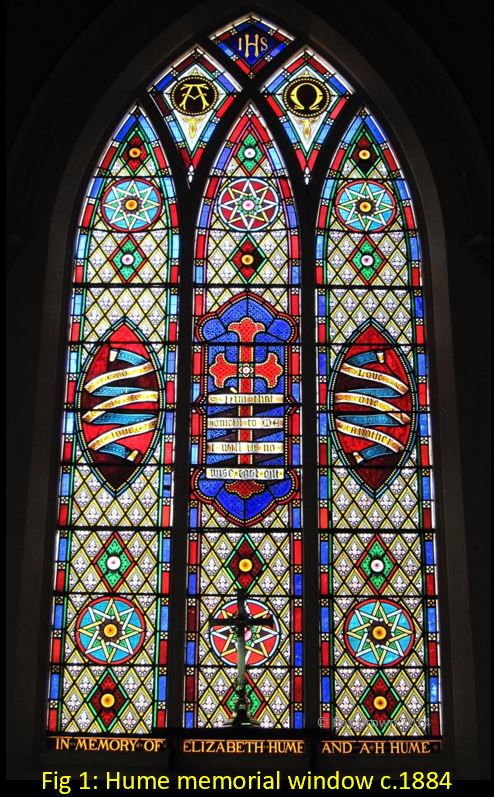
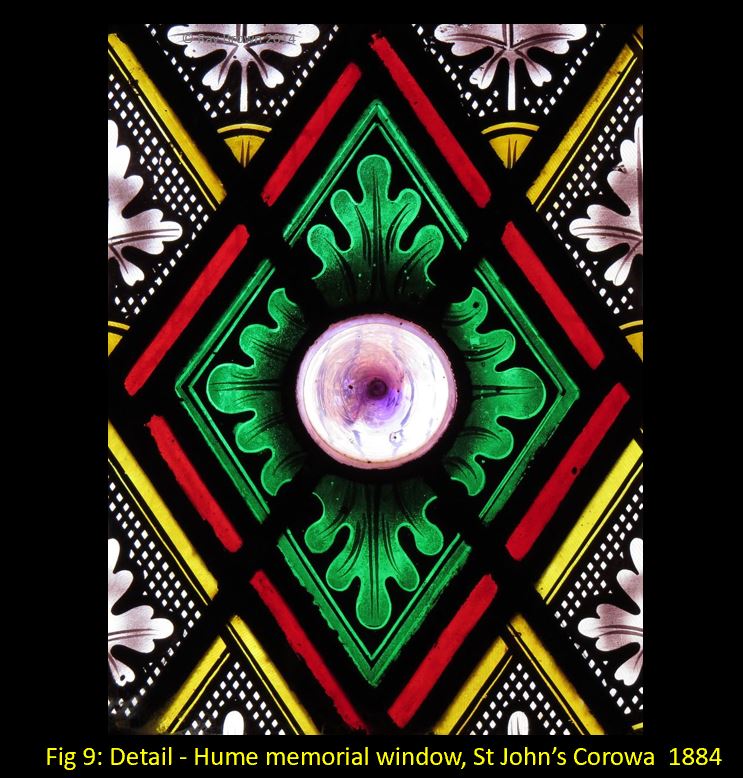
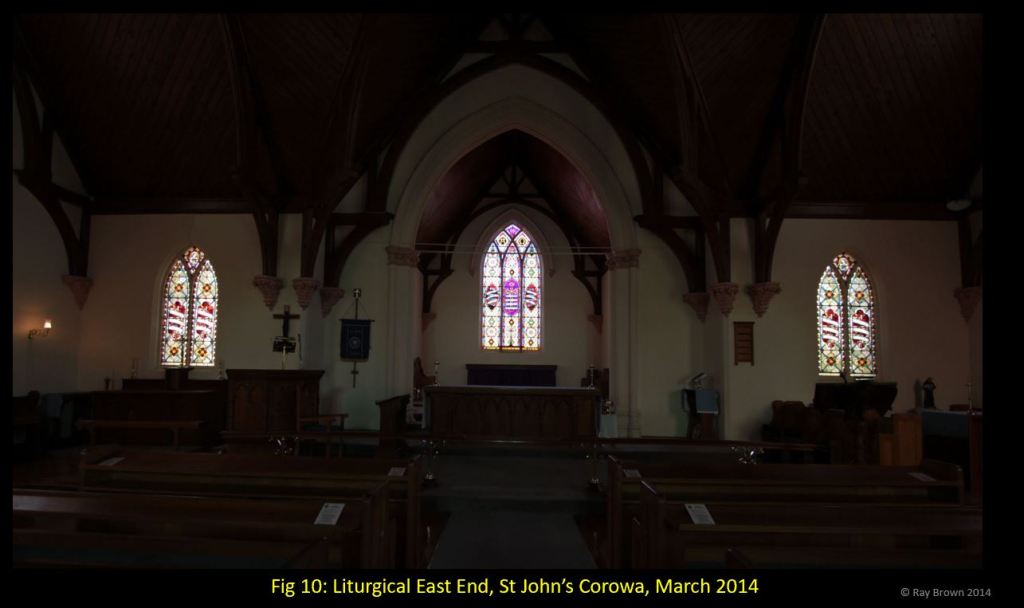
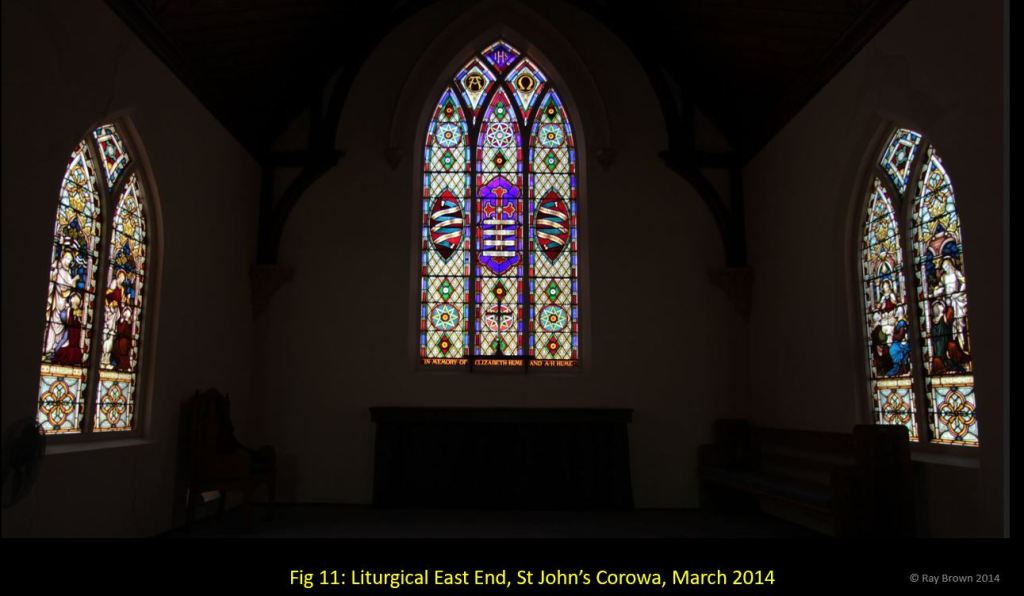
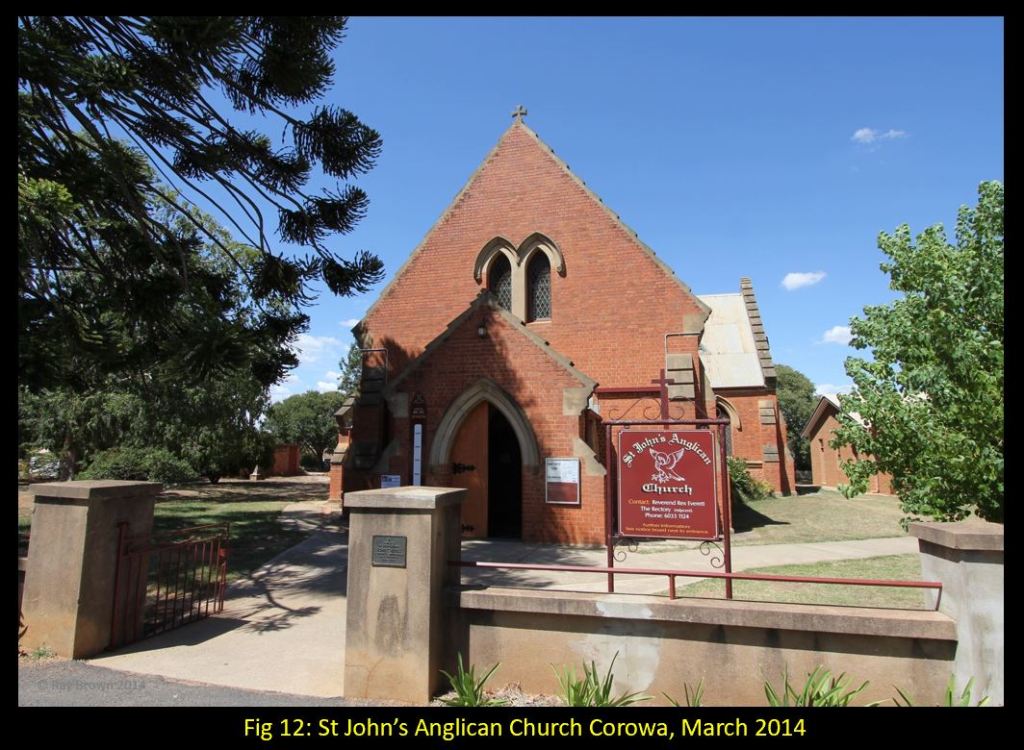
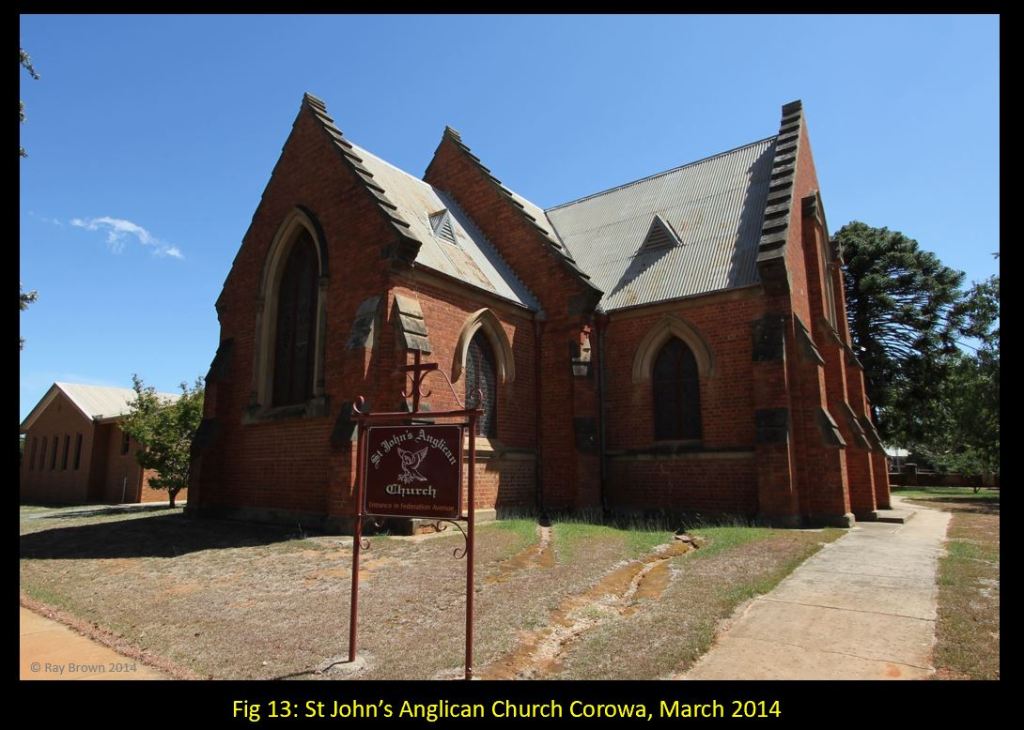
1884 St John’s Anglican Church Corowa, NSW.

In 1863 the first wooden Anglican church was built at Corowa and dedicated as St John’s. The land was donated by John Foord. Circa 1859 the area was known as North Wahgunyah and later changed to Corowa to differentiate it from Wahgunyah on the south side of the river in Victoria.

On the 25th of January 1884, a brief article appeared in the Corowa Free Press about a stained glass window being delivered for the new brick building of St John’s.

“…The memorial window for St. John’s Church, presented by the Misses Hume, has been delivered at Corowa, and its erection will be proceeded with shortly..” [1]

A week later the same tabloid reported that the window had been installed in the church but there were errors in the article:

“MEMORIAL WINDOW.- The window presented to St. John’s Church, in memory of Elizabeth and Andrew E. [sic] Hume, has this week been put into its place by Messrs. Armstrong and Johnson – free of cost. It is a very beautiful piece of workmanship, and was executed to the order of the Misses Hume, by Messrs. Ferguson and Wise [sic], of Melbourne.”[2]

Slide show: Images were taken in March 2014:

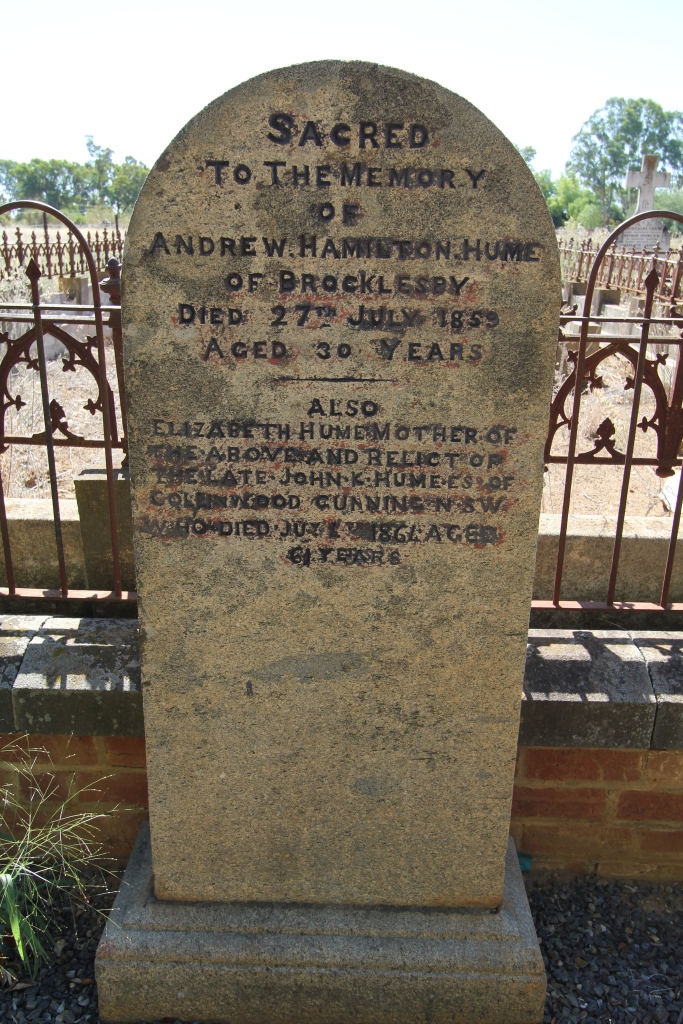
The window was dedicated to Andrew Hamilton Hume (1828-1859) and his mother Elizabeth (nee O’Neill 1802-1864). Andrew’s father was John Kennedy Hume (1800-1840) who was shot by bushrangers at Gunning, NSW, 20th Jan 1840 [3]

The newspaper incorrectly named the stained glass company as ‘Ferguson & Wise’. There was no stained glass company of that name anywhere in Australia. The window is accurately attributed to the ‘Ferguson & Urie’ stained glass company of North Melbourne. This company started out as a plumbing, slating, and glazing business, in Curzon Street North Melbourne in 1853 by Scottish immigrants, James & David Ferguson, and James Urie. In 1861 they transformed the company towards commercial glazing and stained glass production and for the next thirty-nine years, they made ecclesiastical and secular stained-glass windows.

After confirming with Rev Canon Rex Everet at St John’s in March 2014 that the window still existed, A trip to Corowa was next on my ‘To Do’ list.

A tabloid report in August 1896 gives an account of the Church and mentions stained glass windows by other studios from New South Wales:

“…The older portion of the building was erected about twenty-five years ago by Mrs. Bladen Neill in memory of her husband, Lieutenant-Colonel Neill; the newer parts of the structure dating from some eleven years back. The church is cruciform in shape, and has a highly ornamental interior. The roof is of Murray pine diagonally laid, the massive worked principals supporting the same resting on artistically designed corbels. The stained glass windows, mostly presents from various residents, and costing over £250, largely enhanced the solemn beauty of the interior. The windows on each side of the altar, representing four scenes of the resurrection, are from designs supplied by the vicar, the Rev. William Clark Hose, and admirably executed by Messrs. Asher [sic] and Falconer[4], of Sydney. The three-light east window is in memory of Elizabeth and A. H. Hume, old and esteemed residents of the district. In the transept is a large three-light window in memory of Mr. Ross Ramsay, of Narrow Plains Station. Of the four lesser windows, one was presented by the late Bishop Linton; another by the Rev. W. Swindlehurst, of West Maitland, in memory of his deceased wife; and the remaining two by the Sunday School children…”[5]

The Ferguson & Urie window in the chancel follows the company’s decorative style from their 1870s period of geometric patterns and scrolling ribbons with text from the bible. This window wasn’t made by the company’s first two pioneering stained glass artists. The artist who joined the firm in 1861, John Lamb Lyon, had left Ferguson & Urie in 1873 to form the Lyon & Cottier company in Sydney, and David Relph Drape died in 1882. This leaves two of the company’s earliest apprentice glass painters, Charles William Hardess and Frank Clifford Lording as the likely suspects who had a significant role in the window. There is no figurative work depicting any human form in the window, it has been copied faithfully from variations of their catalogue of designs over the previous twenty years, which Hardess and Lording would have been very familiar with producing.

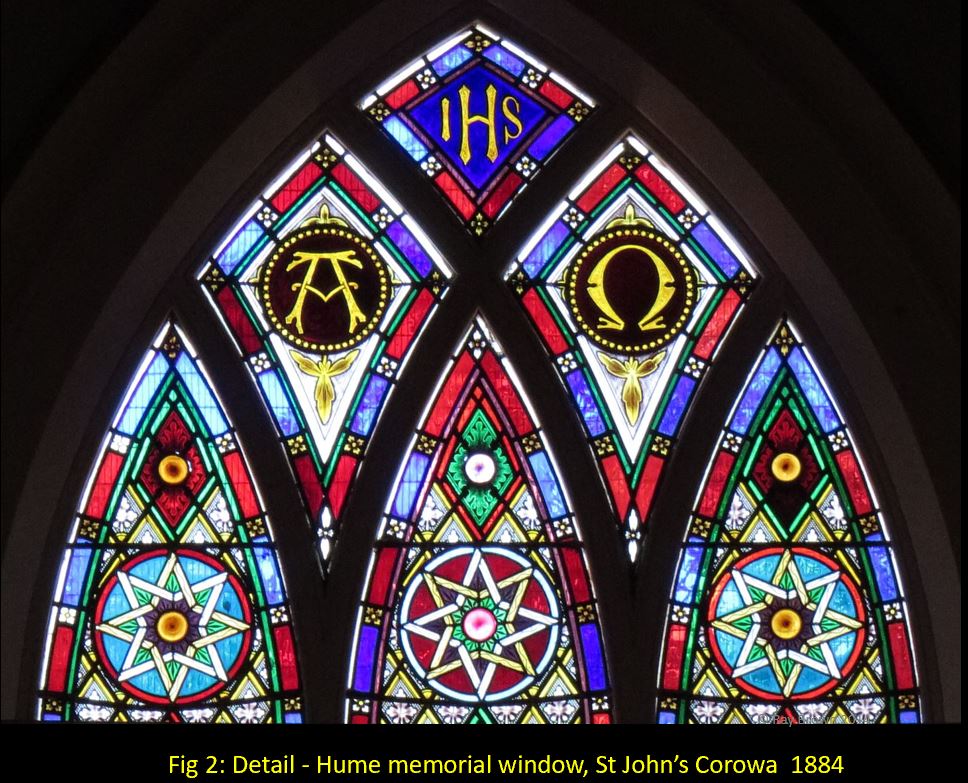
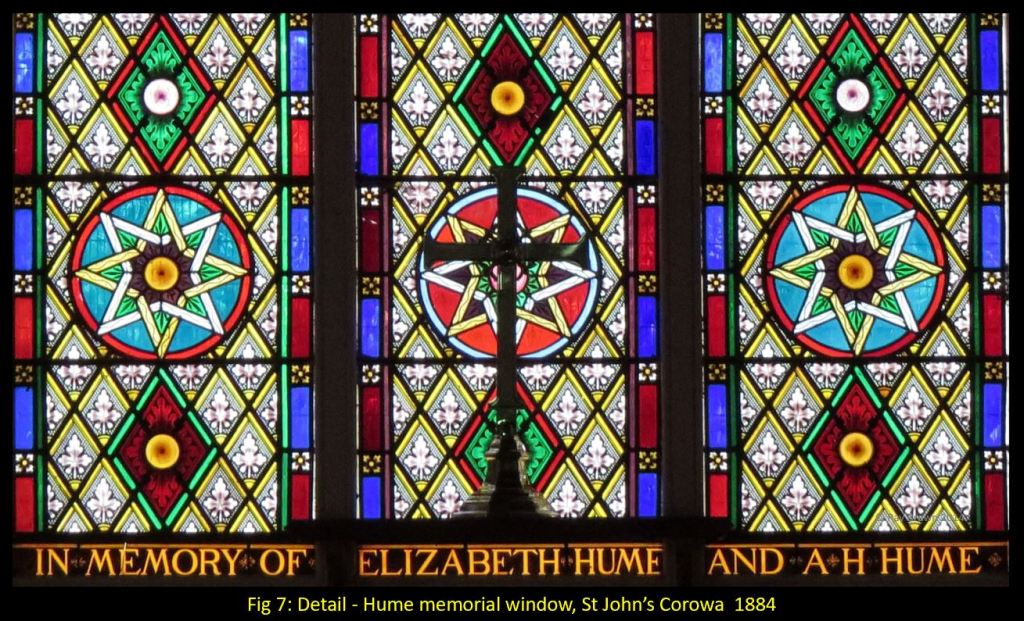
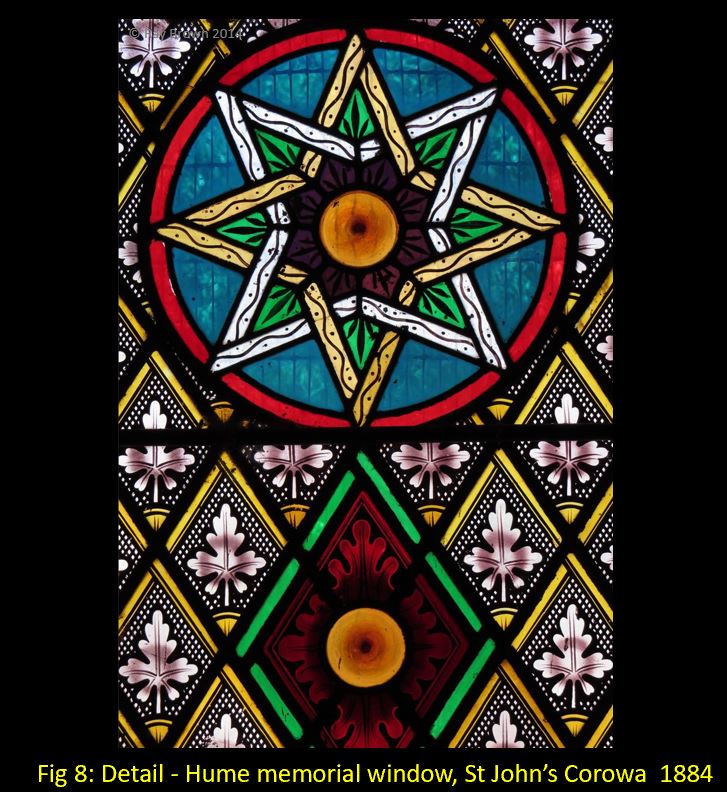
At the top of the window above the three lancets is a window with the letters “I.H.S”, a monogram symbolizing Jesus Christ. Below this are two windows with the Greek Lettering for “A” and “O” representing Alpha and Omega and meaning the Beginning and the End.

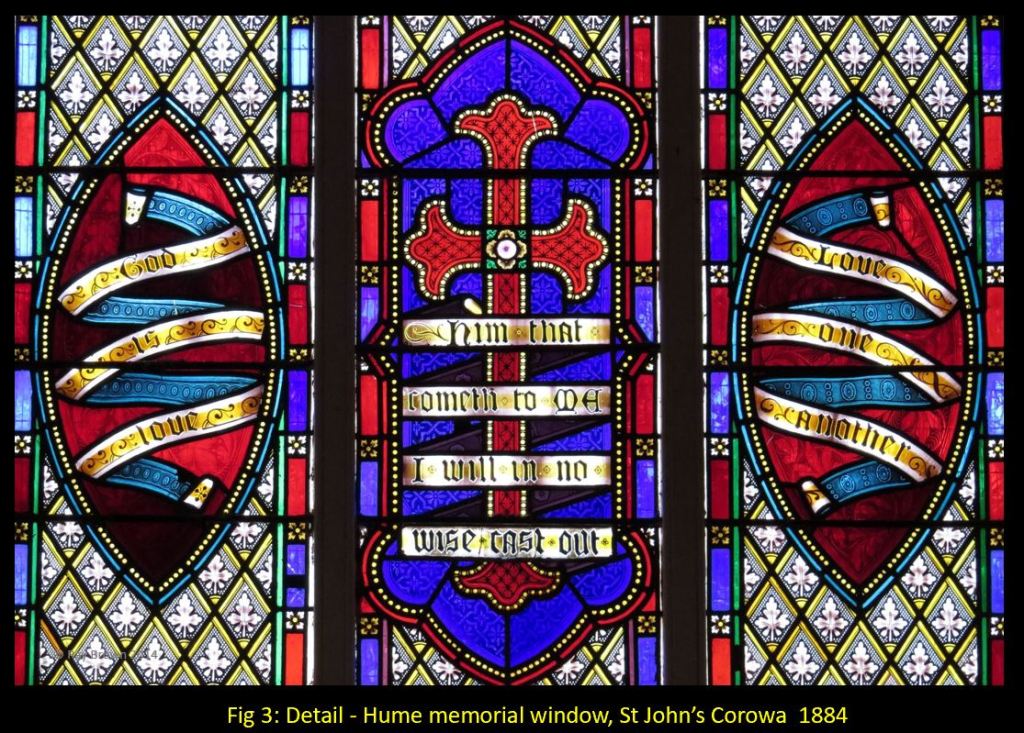
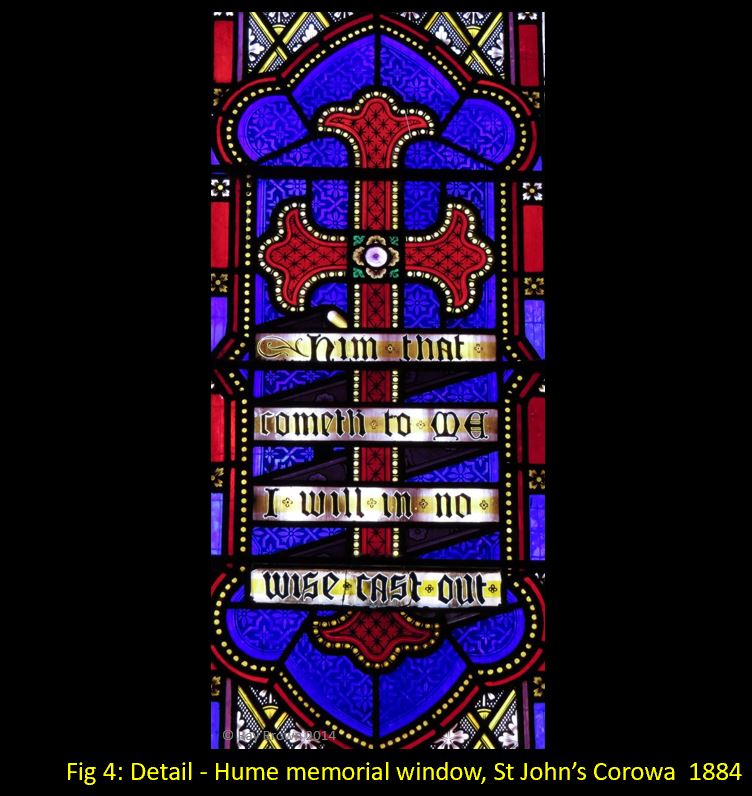
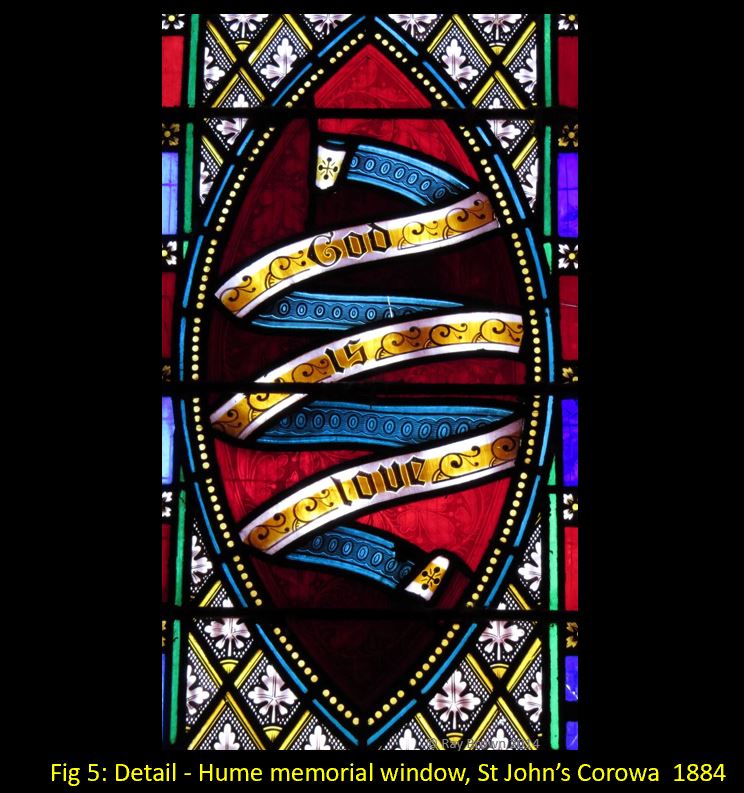
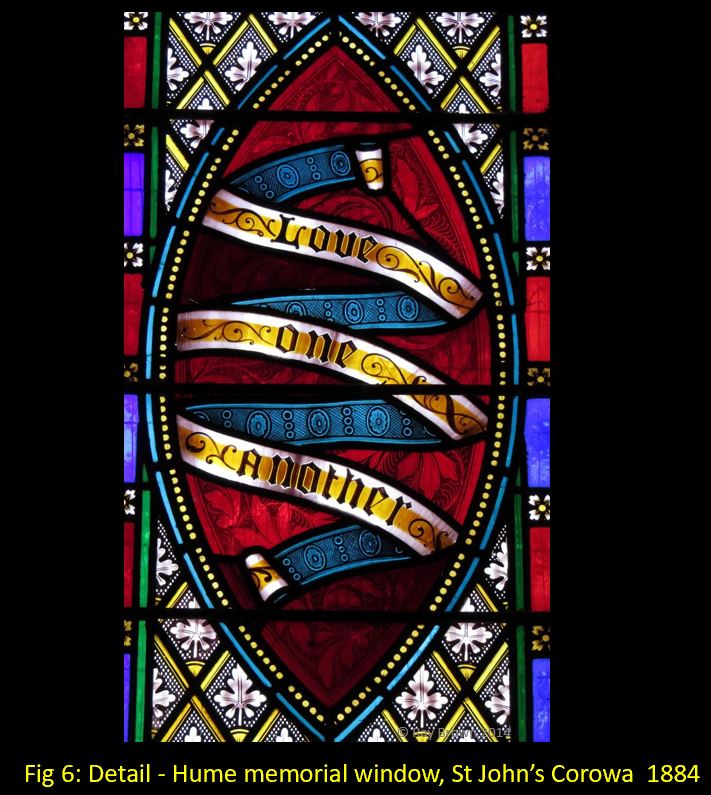
The centre light in the window contains a beautiful gothic decorated crimson cross on a sapphire blue background. The cross and the backgrounds have finely detailed sgraffito work picked out to reveal tiny stars. A ribbon scrolling around the cross has the words “Him that cometh to me I will in no wise cast out”. The left light contains a crimson pointed ellipse with leaves and fronds with a scrolling ribbon with the words “God is Love”. The right light is the same design but has the words on the ribbon “Love one Another”.

The memorial text at the base of the window states: “IN MEMORY OF ELIZABETH HUME AND A.H. HUME”.

The Hume memorial window in the chancel is the only Ferguson & Urie window in the church. The windows flanking it in the chancel were made by the Sydney firm of Ashwin & Falconer and are a distinctively different style. , but in the nave, there are other windows that would trick you into believing they are also Ferguson & Urie windows. They’re not, and the reason these are similar-looking windows is that they are the work of Lyon & Cottier of Sydney. Lyon, mentioned earlier, was the Ferguson & Urie glass painter at North Melbourne between 1861 and 1873.

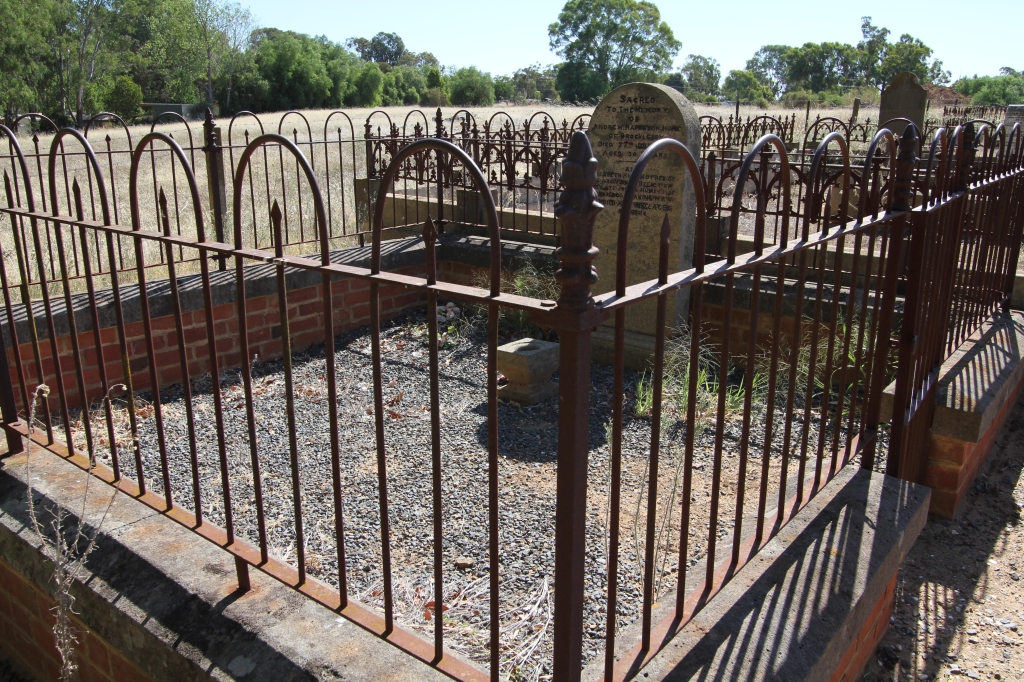
Andrew Hamilton Hume died at his station, Hume River, at age 30, on the 27th of July 1859[6]. His mother, Elizabeth (nee O’Neil 1802-1964) died 4th July 1864 at Yarrawonga in Victoria. Andrew and his mother are buried at the Corowa cemetery.

The Ferguson & Urie window was restored in 2015 at a cost of $25,000.

St John’s has an extraordinarily diverse range of stained glass windows by different artists and studios spanning nearly a century and a half. The windows from the late 1800s and early into the 1900s are by Ferguson & Urie, Ashwin & Falconer, and Lyon & Cottier. The modern-styled windows are by artists such as Bowers & Wilkins and Leonie Le Cornu.


Footnotes:

[1] The Corowa Free Press, NSW, Friday 25th January 1884, page 2.

[2] The Corowa Free Press, NSW, Friday 1st February 1884, page 3.

[3] The Sydney Morning Herald, NSW, Monday 27th January 1840, page 2.

[4] Aswin and Falconer, later Falconer and Ashwin, and F. Ashwin & Co.

[5] Australian Town and Country Journal, NSW, Saturday 8th August 1896, page 27.

[6] The Argus, Melbourne, Vic, Tuesday 9th August 1859, page 4.


Short Link to this page: https://wp.me/p28nLD-39y

© Copyright

1874: St John’s Anglican Church, Ballan, Victoria.

The foundation stone of St John’s Anglican Church in Ballan was laid by Juliet Vivian Lyon (nee Anderson) in 1861. Thirteen years after that historical event Juliet died and in late 1874 a stained glass window was erected in her memory in  the chancel of St John’s. The window was made by the Colonial stained glass craftsmen Ferguson & Urie of North Melbourne.

Photos taken 10th April 2011.

This slideshow requires JavaScript.

[View larger images]

Juliet was born at Norfolk Island on the 10th Feb 1839, the daughter of the decorated army officer Joseph Anderson (1790-1877) and Mary Campbell. Her father Joseph was was stationed as commandant of the Norfolk Island Penal Colony from March 1834 to February 1839. One of his first duties on Norfolk Island was to dispense the punishment for the Norfolk Island Prisoner revolt in 1834 in which thirteen of the twenty-nine convicted prisoners were executed.

Juliet married pastoralist Charles Hugh Lyon (1826-1905)[1] at St Paul’s church in Melbourne on the 30th December 1859[2] . They settled at Hughe’s ‘Ballanee’ estate at Ballan where they had five known children; Clara, Lily Mary, Violet Mary, Vivian Hugh and Charles Gordon.

In 1861 Juliet had the honour of laying the foundation stone of St John’s Anglican Church in Ballan. Very little information is known of this event other than Juliet had laid its foundation stone as mentioned on her memorial stained glass window, and the obscure mention that on the 29th January 1862 the Church was reported as being near completion[3].

Juliet died at her father’s residence ‘Fairlie-house’ in South Yarra on the 16th of March 1874, aged 35[4]. She was buried with her parents, Joseph and Mary Anderson, in the St Kilda cemetery on the 17th March 1874 and her husband Hugh was also buried them in 1905.

The Ferguson & Urie stained glass window was erected to her memory in St John’s, thirteen years after she had laid its foundation stone.

The two-light stained glass window depicts ‘Faith & Hope’;

The left lancet depicts an angel at the top carrying a banner with the words ‘HALLELUJIA’. Below is the depiction of Faith carrying a cross with her right hand held towards heaven. The text below the figure is ‘HAVE FAITH IN GOD’ and below this is another angel carrying a banner with the text; ‘BLESSED ARE THE DEAD’

The right lancet depicts an angel at the top carrying a banner with the words ‘PRAISE THE LORD’. Below is the depiction of Hope with the ships anchor and below this is another angel carrying a banner with the text; ‘WHICH DIE IN THE LORD’

Across the base of both windows is the memorial text:

‘IN MEMORY OF JULIET VIVIAN LYON WHO LAID THE FOUNDATION STONE OF THIS CHURCH IN 1861.’

The Australian News for Home Readers, Vic, Saturday 18th March 1865, page 7.

BALLAN St John's 98c

“EPISCOPAL CHAPEL AT BALLAN,

The neat little building, shown in the engraving, is the newly erected Episcopal Chapel, at Ballan, a distance of about sixty miles from Melbourne. The building has been raised solely by the exertions of the congregation, and is a pleasing instance of the progress of Christianity in the provincial districts of Victoria. The chapel belongs to the Gothic order of architecture, and is commodious enough to meet the requirements of the Episcopalians of Ballan. The nave is 57 feet by 25 feet in extent, and chancel 10 feet 3 inches by 21 feet.”

Juliets’ husband Charles died at ‘Ballanee’ estate at Ballan on the 13th February 1905 aged 79[5].

In the historical engraving depicting St John’s from 1865 it shows  a ‘Pugin’ type bell-cote at the west end and a small side building at the east end which is presumably a vestry. Neither of these exist to this day.

The left lancet of the Ferguson & Urie window which depicts ‘Faith’ is taken from a famous oil painting by Sir Joshua Reynolds (1723-1792) and replicated in a stained glass window by Thomas Jervaise at Holy Trinity, Fareham, Hampshire, England. There are three other known instances of this depiction of ‘Faith’ in Ferguson & Urie windows which are located at All Saints, South Hobart; Christ Church, Hawthorne; St Mark’s, Remuera, New Zealand.

In 1883 another Ferguson & Urie window was erected in St John’s to the memory of Rebecca Mary O’Cock. See: 10-03-1883: St John’s Church, Ballan, Victoria.

Location: Simpson Street Ballan

Footnotes:

1872: St John’s Anglican Church, Raymond Terrace, New South Wales.

In late November 1872 a magnificent three-light stained-glass window was unveiled in St John’s Anglican Church at Raymond Terrace in New South Wales.

“…It is due to the firm of Messrs Furgusson [sic], Urie, and Lyon, of Melbourne, to say that the window is regarded as a beautiful specimen of Australian art, which will favourably compare with works of a similar character executed in England…” [1].

The window was crafted by the North Melbourne stained-glass firm ‘Ferguson, Urie, and Lyon’ for £80 and was erected in the chancel in memory of the district pioneer and geologist William Keene.

Photos were taken October 2013 and have been kindly contributed by Michaela Sorensen. The historic photo of the chancel and window was taken by the Rector of St John’s, the Rev Norman Alfred Pullin (1913-1983), during his incumbency of St John’s circa 1949-52 [2].

This slideshow requires JavaScript.

St John’s Anglican Church is located at Raymond Terrace, 167km North of Sydney and 26km North of Newcastle in New South Wales.

The church was built on land formerly owned by the Cafferay[3] family and was constructed of locally quarried stone to the designs of architect Edmund Blacket for £1500. It was consecrated by the Bishop of Newcastle, William Tyrell, on Thursday the 25th September 1862[4] and the first incumbent was the Rev John Roe Blomfield.

After the death of William Keene in 1872 it was resolved that a memorial stained-glass window should be erected to his memory in St John’s. One of the lead organisers of the creation of the window was Henry Bayes Cotton (1820-1906)[5], a well-known and respected manager of the National Bank of New South Wales at nearby Newcastle.

The craftsmanship of the window was entrusted to the Ferguson, Urie and Lyon[6] Stained-glass Company of North Melbourne in Victoria. The biblical theme represented in the window being, in the centre light, the Nativity, Crucifixion and the Resurrection. The flanking side lights had the inscription beneath each figure being, ‘Teach the Ignorant,’ and ‘Help the Helpless.’

The window was erected in the chancel of St John’s and was unveiled in late November 1872. The ‘Maitland Mercury’ of the 3rd December 1872 provided a detailed description of the historic window;

“…Commencing at the foot of the light, there is the scene of our Saviour’s birth. In the centre of the light is represented the Crucifixion, and this is again surmounted by the Resurrection. These subjects are all taken from the old masters, and are beautifully executed. The intermediate spaces are occupied with chaste and varied medallions, and the sacred monograms, I.H.S. In the right side light there is an admirably designed and well finished group, representing a venerable teacher engaged in instructing those around him; the countenances of this group are peculiarly pleasing. In the left side light is likewise a corresponding group, consisting of a benevolent person, and a female figure of benign aspect, engaged in receiving orphan children…”
“…The inscription at the base of the memorial is, “To the Glory of God, and in memory of William Keene, 1872”
[7]

Just over a century later the chancel of St John’s had to be demolished and the window, now more than a century old, was considered to be in a fragile condition and was subsequently removed and stored in the rectory of St John’s. The repairs to the sanctuary and extensions to the chapel and vestry were completed in 1975 [8] and, later, at the instigation of William Keene’s great granddaughter, Annette Keene Holloway, funds were raised from family members and parishioners of St John’s to repair and re-erect the windows. Because there was no longer a position in the chancel for the windows to be re-erected in their original configuration, they were refashioned into five single lights and re-installed along the south wall of the nave.

“A stained glass window depicting the nativity, Life and Crucifiction [sic] was erected in St. John’s Church in memory of Great Grandfather William Keene. Later I heard it had been removed and the opening cemented up. I wrote to the Rev. Sores and he replied that the window had been in bad repair and in danger of being broken. Raymond Terrace was a poor parish without the money to restore the damage so the windows were stored in the Rectory. I wrote to my cousins who sent money. Other parishioners did too and the windows were re-installed on the side wall of the church where they can still be admired as a link with early colonial days.”[9]

Mr Don Denham, Parish Secretary of St Johns, Raymond Terrace, provides further insight as to the time line of the historical windows:

“In the late 1960’s the original sanctuary/ chancel of the church was demolished and in the 1970’s a new sanctuary/ chancel and side chapel were constructed of modern design. In the new construction there was no east window to house the windows and so they were placed in the five small lancet windows of the southern side of the nave”.

“… the complete east window fitted perfectly into the nave windows and the completed affect is quite pleasing…”

“…The windows have been recently restored and we are planning the rededication service for 20 October this year”.[10]

The most recent conservation work on the windows was carried out in 2011 by Ron Jensen, of Heritage Stained Glass at New Lambton in New South Wales. Only two of the five windows required attention, being the one at the south west corner titled “Teach the ignorant” and the centre window of the five titled “Death” which depicts the Crucifixion.

The five individual windows, from left to right along the south wall are;

“Help the Helpless”, “Birth” (Nativity), “Death” (Crucifixion), “Resurrection” and “Teach the Ignorant.”

Each of the reconstructed windows retains the original 1872 Ferguson & Urie figurative stained glass work depicting the five biblical scenes. Each scene has two of the original decorative quatrefoils below it. These quatrefoils are of varying colours with gothic floral designs of yellow and white flowers in the centre, surrounded by a stylized depiction of the passion flower with the stamen in each of the four lobes.

The background quarries of glass surrounding the figurative scenes and quatrefoils are no-longer original and are now of varying sized rectangular and diamond shapes in soft pastel colours. The monogram described as containing the letters “I.H.S” originally appeared between the nativity and Crucifixion scenes in the centre light of the window but this no longer exists. The memorial inscription at the base of the window now has the year ‘1872’ in the far left light which in its original configuration appeared immediately after William Keene’s name (To the Glory of God, and in memory of William Keene, 1872”).

There are many cases of our historic stained-glass artefacts that no longer exist after more than a century and a half. Some of the historic churches have met their demise by fire, demolition, or have been sold to private enterprise over the last 150 years and in many cases their original artefacts and stained-glass windows have been lost. St John’s church at Raymond Terrace represents a rare example of the dedication of the parishioners and Keene family descendants to save the historic windows so they still have a reminder of their pioneer heritage.

In September 2012 St John’s celebrated its 150 year anniversary and the re-dedication of the Keene memorial stained-glass windows will occur at St John’s on the 20th October 2013.

William Keene (1798 – 1872)

William Keene was born at Bath, in Somersetshire, England, c.1798. His English ancestry associates him with ‘The Bath Journal’ of London, founded in 1742. The tabloid was later known as ‘Keene’s Bath Journal’ circa 1822 which remained in the Keene family until c.1916 before being absorbed by the ‘Bath Herald’.

William Keene initially trained in the medical profession but his interests in geology were his passion and he changed his career to become a geologist and mining and civil engineer. Circa 1822 he left for France where he gained a prestigious appointment with the French government;

“…in connection with some salt mines in the Pyrenees. His services, highly esteemed by that government, brought him an order and a pecuniary grant…[11]

Keene later became a ‘Fellow of the Geological Society’ in London[12] which entitled him to the prestigious post nominal of ‘F.G.S’. On the 13th August 1822 William was married to Sarah Charles Evans (1804-1867) at the British Embassy Chapel in Paris[13] by the Chaplain Edward Forster. The Keene’s had a long association with France where many of their children were born. During their time in France William gained a passion for the French style of wine making which would become an interest for the rest of his life. At the beginning of the French Revolution in 1848 they returned to England[14].

Circa 1852 William migrated to Australia with his family and on the 12th December 1854 he was appointed as Government Examiner of Coal Fields in New South Wales[15] and in 1856 promoted to Government Geologist[16]. His geological interests allowed him to amass a significant collection of mineral specimens and fossils which he displayed in 1858[17] and in August 1859 the collection was on public display at the military barracks in Newcastle[18].

In 1861 William Keene’s extraordinary collection of geological specimens was singled out for particular attention at the Sydney Industrial and Art Exhibition;

“To the collection of Mr. W. Keene, Government examiner of coal fields and mines, it is desirable to invite particular attention. It is on the north side of the upper gallery, and consists of some valuable specimens from our gold, copper, lead, iron, and coal fields, and some remarkable fossils, the whole having been collected by himself, and chiefly in the counties of Hunter and Argyle…”[19]

Over a twenty year period William Keene wrote several papers on the subject of fossils and authored a significant number of Government reports on Colonial mineral wealth and mining.

William Keene was a staunch supporter of the Church of England and in his position as the first acting Registrar of St John’s he read the petition for the consecration of the church, which he had the honour to perform shortly after 11am on Thursday the 25th September 1862[20].

William Keene was a member of the Newcastle Church Diocese, Local School Board, and Founder and Treasurer of the Clergy Widows and Orphan’s Fund[21]. He was elected President of the Newcastle School of Arts in 1869[22] and he laid the foundation stone of that school on the 8th April 1870[23].

Aside from his geological interests he was renowned in the Hunter River area as a viticulturist and vintner, who passionately advocated the French style of vine-growing in the district. He was also an active member of the Hunter River Vineyard Association, of which he was president in 1865-66[24], and also a member of the Agricultural Association[25]. His experience in this field often saw him called upon to act as a wine-judge at the regional exhibitions[26].

William Keene died at his home, ‘Kingsmead House’, in Raymond Terrace on the 2nd February 1872[27] and was buried in the Raymond Terrace Cemetery. His wife Sarah predeceased him on the 2nd of July 1867[28].

Henry Bayes Cotton (1820-1906)

Henry Bayes Cotton is recognised as one of the principal promoters in having the Keen memorial window erected in St John’s in 1872.

“…It cannot fail to give great pleasure to H. B. Cotton, Esq., of Newcastle, who has taken a large amount of trouble and interest in accomplishing the work; and the friends of the deceased must be greatly gratified and comforted when they gaze upon this tribute of respect and affection to their departed relative…”[29]

Henry Bayes Cotton arrived in the Colony circa 1839 and was appointed as the first manager of the Bank of New South Wales at Geelong circa 1854 and in 1863-64, appointed as first manager of the Newcastle branch[30] in New South Wales where he remained until his retirement in early 1888.[31] Although retired he maintained an interest in financial affairs and in 1893 he was appointed a director of the New South Wales ‘de Piété Deposit and Investment Company.’[32]

Like William Keene, he was a staunch supporter of the Church of England and was also for many years a lay reader and active member of the Synod[33].

The association or friendship between Keene and Cotton is not specifically known but it is reasonable to assume that they knew each other well as Cotton was also involved in the establishment of the Newcastle School of Arts[34] with William Keene, who had laid the foundation stone of that school in 1862 and both were parishioners of St John’s at Raymond Terrace with Cotton actively involved in the choir of St. John’s.

Henry Bayes Cotton left Newcastle and retired to the Sydney suburb of Hunters Hill where he died aged 86 at his residence ‘Fig Tree’ on the 15th January 1906[35]. His wife Rachel predeceased him, 18th April 1903, aged 78[36].

The Maitland Mercury & Hunter River Advertiser, NSW, Tuesday 3rd December 1872, page 3.

“MEMORIAL STAINED GLASS WINDOW IN ST. JOHN’S CHURCH, RAYMOND TERRACE, TO THE LATE WILLIAM KEENE, ESQ.- This window was placed in St. John’s Church, Raymond Terrace, Raymond Terrace, last week, and as it is the admiration of all who have viewed it, a short description may be interesting to your readers, whilst it is due to those kind friends who contributed towards the window. It may be as well to state in the first place, that the Church of St. John is a Gothic edifice, pleasantly situated on a spot which affords a view of the Hunter River and of the rich alluvial farms spreading for miles on the opposite side; the churchyard is neatly kept, having been tastefully laid out and planted with choice evergreen trees about six years ago. The east window of the church consists of three lancet lights; the central light is eleven feet high, being admirably adapted for the style and subjects which have been chosen. Commencing at the foot of the light, there is the scene of our Saviour’s birth. In the centre of the light is represented the Crucifixion, and this is again surmounted by the Resurrection. These subjects are all taken from the old masters, and are beautifully executed. The intermediate spaces are occupied with chaste and varied medallions, and the sacred monograms, I.H.S. In the right side light there is an admirably designed and well finished group, representing a venerable teacher engaged in instructing those around him; the countenances of this group are peculiarly pleasing. In the left side light is likewise a corresponding group, consisting of a benevolent person, and a female figure of benign aspect, engaged in receiving orphan children. It is scarcely necessary to say that these subjects are intended to perpetuate the memory of the offices which the deceased gentleman so long and faithfully filled in the Church of the Diocese, as a member of the Local School Board, and Founder and Treasurer of the Clergy Widows’ and Orphans’ Fund. The inscription under these subjects respectively is, ‘Teach the Ignorant,’ ‘Help the Helpless.’ The window adds much to the beauty of the chancel and the church generally. It cannot fail to give great pleasure to H. B. Cotton, Esq., of Newcastle, who has taken a large amount of trouble and interest in accomplishing the work; and the friends of the deceased must be greatly gratified and comforted when they gaze upon this tribute of respect and affection to their departed relative. It is due to the firm of Messrs Furgusson [sic], Urie, and Lyon, of Melbourne, to say that the window is regarded as a beautiful specimen of Australian art, which will favourably compare with works of a similar character executed in England. The cost of the window, with transmission and erection, has been £80. The inscription at the base of the memorial is, “To the Glory of God, and in memory of William Keene, 1872,” –Newcastle Pilot, Nov. 30.”

A comprehensive eleven page document of all the significant historical newspaper transcriptions can be viewed here Raymond_Terrace_St John’s_Transcriptions This document is well worth reading as it gives a more in depth perspective to the history and has much more detail than I have attempted to sumarise in the above article.

Acknowledgements:

Thanks to Don Denham, Jock Keene and Carolyn Wulff, for their much appreciated correspondence and contributions to this article and to Michaela Sorensen for the current photos of the stained glass windows.

Foot notes:

[2] Historic photograph contributed with thanks to Rev Pullin’s daughter, Carolyn Wulff (email 28th Sept 2013)

[6] Stained Glass artist John Lamb Lyon (1835-1916) was and employee of the firm from 1862 and a partner from 1866 to 1873.

[8] newcastleanglican.org, Mission Statement, St John’s, Raymond Terrace, parish profile, page 3. (accessed 18 Sept 2013).

[9] Holloway, Annette Keene, “The Keene family of Raymond Terrace”, Raymond Terrace and District Historical Bulletin, Vol. 5, No. 3, June, 1982, p. 119-122.

[10] Mr Don Denham, Parish Secretary, St John’s Raymond Terrace NSW, email 16th Sept 2013.

[13] Marriages Solemnized in the house of his Excellency, the British Ambassador (Lord Sir Charles Stuart) at the Court of France in the year 1822.

[14] Australian Dictionary of Biography, http://adb.anu.edu.au/biography/keene-william-3931/text6183, accessed 17 September 2013.

[17] David F. Branagan, Geology and Coal Mining in the Hunter Valley, 1791-1861 (Newcastle 1972), p. 72.

[24] Australian Dictionary of Biography, http://adb.anu.edu.au/biography/keene-william-3931/text6183,, accessed 17 September 2013.

1870: St John’s Anglican Church, Diamond Creek, Victoria.

St John’s Anglican Church at Diamond Creek was built to the designs of Charles Maplestone (1809-1878). His wife, Isabella Margaret Maplestone (nee Beale) (1822-1888) laid the foundation stone of St John’s on the 11th of November 1867[1].

A balance sheet from St John’s parish archives, dated 3rd May 1870 contains reference to stained glass windows with costs. One for £18-10s, and second for a side window for £5-5s to Ferguson, Urie, and Lyon[2].

Photos taken: 26th May 2013.

This slideshow requires JavaScript.

Charles Maplestone (1809-1878):

Charles Maplestone was a well-known Victorian Public Works architect and avid Vintner in the Heidelberg area. He was born in 1809 at Beccles, Suffolk, England, and married Sarah Elizabeth Mash (1816-1856)[3] in Suffolk, England in 1837. In early 1853, 16 members of three generations of the Maplestone family departed England aboard the “Strathfieldsaye” and arrived in Victoria in April of 1853[4]. After his wife Sarah died in 1856 he then married Isabella Margaret Nodin (nee Beale) at St Helena, Victoria, on the 15th July 1857[5]. He died at “Ivanhoe Lodge”, Ivanhoe on the 25th May 1878 in his 70th year[6].

Isabella Margaret Maplestone (nee Beale) (1822-1888):

Isabella was a daughter of retired Pay Master, Major Anthony Beale, of the East India Corps and was born on the island of St Helena in 1822. She arrived in Van Diemens Land with her parents and siblings aboard the ‘Cecilia’ on the 29th July 1839[7] and then later to Melbourne in November 1839[8]. She first married Francis Nodin (1805-1856)[9] in Melbourne on the 12th December 1840[10] and after his death in 1856 she married Charles Maplestone on the 15th July 1857 at her father’s property at St Helena, Victoria. She died at Kew, Victoria, on the 15th May 1888 aged 65 [11].

There is also an association to other Ferguson & Urie stained glass windows that were erected in the Beale family chapel at St Katherine’s, St Helena. A single light stained glass window in the south wall of the nave was erected to the memory of Charles Maplestone’s son, Luther Maplestone (his son by his first marriage) who died in 1869. The east window of St Katherine’s, also originally by Ferguson & Urie, was erected to the memory of the pioneers Katherine and Anthony Beale. All the original stained glass windows in St Katherine’s were destroyed in a fire in 1957 and were re-created as replicas by the Melbourne stained glass firm Brooks, Robinson & Co.

On the 8th of August 1897 a memorial window, by stained glass artist William Montgomery was dedicated in St John’s Anglican Church Heidelberg, to the memory of Charles and Isabella Margaret Maplestone[12].

The Argus, Melbourne, Vic, Wednesday 13th November 1867, page 5.

“On Monday the foundation-stone of an Anglican church was laid in the new township of Diamond Creek, by Mrs. Charles Maplestone, the wife of the honorary architect. The Rev. J. Hullis (parochial minister), the Rev. B. S. Walker, and Mr. Watkins, M.L.A., took part in the ceremony…”

The Argus, Melbourne, Vic, Monday 5th October 1868, page 3.

“TENDERS for QUARRYING, Excavating, and Building a portion of the Foundation (labour only) of St. John’s Church, Diamond Creek. Plans and specifications to be seen at the Carlton Club Hotel, Gertrude-street.”

The Argus, Melbourne, Vic, Friday 4th November 1870, page 5.

“On Tuesday last the ceremony of opening St. John’s Church, on the Diamond Creek, in the parish of Millumbik, was performed by the bishop of Melbourne, assisted by the Very Rev. the Dean and the Rev. A. Brown. Service was held in the building, which was crowded to excess. At the conclusion of the address delivered by the Bishop, a collection was made, which realised upwards of 20. In the evening a tea meeting was held, in aid of the building fund, to which some 300 sat down, and an adjournment then took place to the church where, the Dean presiding, addresses were delivered by the Rev. Mr. Walton, a minister of the Primitive Methodist Church; Mr. A. Ross, of the Presbyterian; Mr. Rodda of Queenstown; and Messrs. Billing, Johnson, Maplestone, Bell, Beale, and others. Mr. Christian, to whose exertions is mainly to be attributed the erection of the building, brought up a report, which is a handsome specimen of the Early English style of Gothic architecture, is capable of holding some 200 persons, and will be an ornament and a credit to the district.”

The Argus, Melbourne, Vic, Monday 27th May 1878, page 1.

“MAPLESTONE.- On the 25th inst., at Ivanhoe-lodge, Ivanhoe, Charles Maplestone, in his 70th year.”

The Argus, Melbourne, Vic, Thursday 17th May 1888, page 1.

“MAPLESTONE.- On the 15th inst., at her residence, Kew, Isabella Margaret, widow of the late Charles Maplestone, of Ivanhoe Lodge, Ivanhoe, aged 65 years.”

Advertiser, Hurstbridge, Vic, Friday 3rd December 1937, page 1.

“…The foundation stone was laid on November 11, 1867, in the twenty-first year of the Episcopate of Charles Perry, D.D., Bishop of Melbourne, by Mrs. Charles Maplestone, the wife of the honorary architect. It is curious that the foundation stone cannot be identified as there is no sign or mark to tell which is the stone that was laid by Mrs. Maplestone. Although there are a few residents of the district who were present at the laying of the stone, they are not agreed as to the exact location, or where the ceremony took place. Some say at the east end, others at the north end of the building. Some believe that the historic stone has been hidden by the porch, when the church was renovated in 1927. It is known, however, that the stone is a massive one and is hollowed out for the reception of a hermetically sealed bottle containing an interesting account of church life at that time and the daily papers including “The Advertiser,” and every coin of the realm…”

Rev Jock Ryan & Henry Huggins; email from Mrs Bev Ward, 15th June 2013.

“…the Revd. Jock Ryan has let me know that he and Henry Huggins (a parishioner involved with previous extensions at St. John’s) have searched the parish archives and have found a balance sheet dated 3rd May 1870 which contains reference to a stained glass windows. One window for 18 pounds 10 shillings and second one for a side window for 5 pounds, 5 shillings to Ferguson, Urie, and Lyon. This would confirm the names of the makers of the original windows.”

Footnotes:

[2] Rev Jock Ryan & Henry Huggins; email from Mrs Bev Ward, 15th June 2013.

[4] Index to Unassisted Inward Passenger Lists to Victoria 1852-1923, Fiche 036, Pages 001 & 015.

[5] Vic BDM: 2754/1857.

05-01-1889: St John’s Anglican Church, Port Fairy, Victoria, Australia.

St John’s Anglican Church in Port Fairy was designed by Nathaniel Billing and was built of bluestone between 1854‐1856. It was supposedly the first church in Victoria with a full chancel. The two largest stained glass windows were made by Ferguson & Urie of North Melbourne.

Photos were taken 7th Jan 2011.

This slideshow requires JavaScript.

Australian Town and Country Journal, NSW, Saturday 5th January 1889, page 26.

“… the Anglican Church, with its ivy-clad walls, presents a picturesque appearance. The interior is beautified by a splendid stained glass memorial window, representing Faith, Hope, and Charity. This was presented by Mr. A. H. Knight, of Koorongah, in memory of his wife, who died in England in 1886. The chancel window displays most artistic workmanship, and was the gift of Mr. Lydiard. The church is substantially constructed of bluestone, and was erected as a cost of £14,000…”

The Lydiard memorial window:

The three light chancel window is a memorial to Cecilia Lydiard (nee Wooldridge 1848-1871). She was the daughter of Henry Wooldridge and Sarah Anne Buckland and died at the age of 31 in Belfast (Port Fairy) in 1871. The centre light of the stained glass chancel window has the memorial text:  “IN MEMORY OF CECILIA WIFE OF G. LYDIARD”.

George Fletcher Lydiard (1833-1925) was the son of Admiral George William Charles Lydiard (R.N) and Mary Sturt. After Cecilia’s death George married Adelaide Frances Campbell (1856-1901) on the 2nd August 1877[1]. In 1877 George Lydiard was unanimously elected as president of the shire of Belfast (Port Fairy)[2] and re-elected in 1878[3]. He was also appointed Vice President of Belfast Farmers Union 11th October 1879[4]. Lydiard was also a long-time friend and business partner of Andrew Halley Knight (see below) in the Koorongah Estate sheep station and in 1881 it was Knight, whilst in England, who relayed to Lydiard his findings, for a cure of Lungworm in Sheep and subsequently the estate was one of the first in Victoria to install a Carbolic acid fumigating room for the treatment[5]. G. F. Lydiard died at Euroa in 1925[6] aged 93.

The Knight Memorial window: c.1887.

The three light stained glass window of Faith Hope & Charity is a memorial to Elizabeth Hawkins Knight (nee Grylls, 1827-1886) and possibly made c. 1887.

The lower edge of the window can’t be seen to ascertain if there is any text but the subject of the memorial was Elizabeth Hawkins Knight (nee Grylls, 1827-1886) who was the daughter of the Rev John Crouch Grylls of Sydney and Sarah Richards. She married Andrew Halley Knight at St James Cathedral in Melbourne on 22 Aug 1848[7]. Her husband, Andrew Halley Knight (1813-1904), had arrived in Port Phillip from Edinburgh in 1838 and started business as ‘Alison & Knight’ merchants in Collins Street Melbourne. He owned extensive sheep runs around Kalkallo and Koorongah Estate near Port Fairly. After Elizabeth died in England in December 1886 he then married Ada Jane Atwood (1847-1941)[8] in Sussex in 1888.  A. H. Knight died at Croydon on the 6th July 1904.

Footnotes:

[6] Victorian Births, Deaths & Marriages (Vic BDM): 5153/1925

[7] The Maitland Mercury & Hunter River General Advertiser, NSW, Saturday 9 September 1848, page3.

[8] Vic BDM: 8703/1941, Ada Jane Halley Knight, died Toorak, age 94 in 1941.


Short link to this page: http://wp.me/p28nLD-FI

© Copyright

02-01-1882: Church donations.

The Argus. Melbourne, Monday 2nd January 1882, page 7.

St John’s Anglican Church Toorak, Victoria.

“THE ANGLICAN CATHEDRAL […]”

“The following additional promises and payments have been received at the Diocean Registry:[…]”

“[…]Messrs Ferguson and Urie £3.3[…]”

Over many years Ferguson & Urie made liberal donations to many institutions and churches. Although they were staunch Presbyterians they made no distinction between the faiths when it came to charitable donations.

08-03-1879: St John’s Church, Williamstown, Victoria.

Williamstown Chronicle, Saturday 8th March 1879, page 2.

“The stained glass window to the memory of the late Mr. J. Reid has been placed just opposite the family pew in St John’s Church. It is from the works of Messrs Ferguson & Urie and is a very handsome specimen of the art. We have been requested to state that donations promised and to be made can be paid to the Town Clerk, the mayor, or the Rev. Mr. Scott”.

The window described in the article no longer exists. There are a lot of original windows with plain yellow/amber  diamond quarries and single colour borders by Ferguson & Urie.

There are two small stained glass quatrefoils and a trefoil by Ferguson & Urie in the west and east ends.  At first glance the two quatrefoils above the main west windows look to be the typical Alpha and Omega symbols in rich purple, blue, ruby and yellow but on closer inspection the text symbols are actually “AD” and “1876” which is the year the church was constructed by Crouch & Wilson. The trefoil  window is above a single light near the stairs that lead to the organ loft at the east end.

Photos dated 20th Nov 2011 and 7th Apr 2012.

This slideshow requires JavaScript.

(Post updated updated 7th Apr 2012)

19-12-1864: St. John’s Anglican Church, Digby, Victoria.

The Foundation Stone of St John’s was laid by the Rev. Francis Thomas Cusack Russell on the 19th April 1861 and was consecrated on the 21st January 1888.

Amongst the many historic artifacts in the church is the the three light Gothic stained glass window by Ferguson & Urie erected in 1864.

The Portland Guardian, Monday 19th December 1864, page 2.

I am able to congratulate the township of Digby upon the possession of three very handsome stained windows in St. John’s church The design is very neat and the appearance is peculiarly rich; the centre compartment contains a full length figure of St John and he side windows have the emblems of the Evangelists and also the “Agnus Dei;” the whole is in rich antique glass and was supplied by Messrs. Ferguson and Urie of Melbourne.”

This slideshow requires JavaScript.

[Show larger images]

Portland Guardian and Normanby General Advertiser, Vic, Monday 6th May 1867, page 2.

 “DIGBY”

 “The most prominent feature in the township of Digby is the English Church, St. John’s, and the common school on the same reserve. The church is built of brick and is a remarkably chaste gothic. The interior is beautifully fitted up, and the east window of stained glass, is perhaps the most beautiful in design and execution of any in the Western district. The window is in three compartments, the centre with a well executed figure of the saint in flowing eastern drapery, with a book in one hand and candle-stick and candle in the other, with an eagle at his feet“

Related posts:
1877: Holy Trinity Anglican Church, Coleraine, Victoria.
1867: St Peter’s Anglican Church, Merino, Victoria


Short link to this page: https://wp.me/p28nLD-4V

© Copyright