1873: St Thomas’ Catholic Church, Drysdale, Victoria.

The original St Thomas Catholic Church in Drysdale was built in 1855 to the designs of architect Richard Abraham Dowden (1829-1868).

It was constructed by Simmie & Mclachlan [1] and was officially opened in 1856.

In June 1873, architect Andrew Williams advertised for tenders for the enlargement of St Thomas [2] and by the end of July significant portions of the south end (liturgical east) were removed to make way for a new chancel, transept and vestry [3].

By October of 1873 a new three light window depicting the Crucifixion was erected in the new chancel by the Ferguson & Urie stained glass company of North Melbourne.

On the 8th of October 1873 a Geelong Advertiser reporter going by the name “G.D.P” wrote:

“…I noticed extensive improvements at the Roman Catholic Church, and was told that a splendid new chancel window was being put in by the celebrated firm of Ferguson, Urie and Lyon, of North Melbourne. I had not time to look at it, but a friend at Drysdale told me it was worth a visit…”[4]

Photos taken 19th June 2014.

This slideshow requires JavaScript.

[View larger images]

If  “G.D.P” had actually seen the window for himself in 1873 then it would certainly have been well worth the visit as his friend had stated.

The three light window still exists in remarkably good condition to this day despite some significant paint loss and water damage in the top third of the window. It is an unmistakeable and typical 1870’s Gothic design by the Ferguson & Urie stained glass company of North Melbourne.

The centre light of the window depicts the Crucifixion. The upper region of the window contains the triquetra symbol which is synonymous with the trinity. Beneath this, on the left, is the Pelican in the act of self sacrifice feeding blood from her chest to her young and on the right is the Paschal Lamb or ‘Agnus Dei’ carrying the victory banner.

The left and right lights contain the “Arma Christi” or “Instruments of the Passion” representing the tools and weapons used in Christ’s Crucifixion.

In the left light, at the top, is the scourging or flagellation post and at the bottom are the crown of thorns and the three nails used to affix Christ to the cross.

In the right light, at the top are other tools used to in the Crucifixion, the hammer, pincers, the sponge on the reed, lance, whips and the three dice that the soldiers used to draw lots to see who would gain Christ’s seamless garment. At the bottom of the window is the Holy Chalice.

The centre light contains the figurative scene of Christ being crucified and beneath his feet is the monogram “I.H.S,” being the first three initials for Christ in Greek.

The whole of the arrangement is filled in with a background of Gothic floral designs using the bold primary colours with alternating borders of red and blue separated by a white or yellow flower.

On the 28th of July 2010 the new modern St Thomas Church, in Peninsula Drive, was officially opened by Archbishop Denis Hart.[5]

The original old St Thomas Church in Wyndham Street, Drysdale is now privately owned and forms part of the Drysdale Grove Nursing Home complex.

Significant transcriptions:

Geelong Advertiser, Vic, Wednesday 8th October 1873, page 3.

“FROM GEELONG TO PORTARLINGTON.

On a short journey for health I took my way to one of my old and favourite places of retreat – Portarlington, and send my jottings of men and things as picked up by bits and scraps from conversation and observation. And first I am sure you will be glad to learn that on my whole journey from Geelong through Drysdale the country looked splendid; crops never looked better even in the best seasons of the past; and the roads – some portions are good, very good; some middling, and part execrable – I believe that is the word. Has the Shire Council not funds to metal the plank road – that abomination of travellers. When driving over it on a very dry day you think every bone in your body will be rattled away from the flesh; and the vehicle! it is a trial to coachmakers – springs, bolts, nuts, shafts, and all fixings are tested. Further on, near the Roman Catholic Church there is a jolting quagmire and pits. The metal is good again after this until you get on another spongy piece, and so it is the remainder of the way through this rising township to Portarlington, alternate clay road and stretches of metalling. On nearing Drysdale I was gratified with a sight of that splendid sheet of fresh water, called Lake Lorn, formed by the shire council by throwing up a bank across the outlet and macadamising the top of the bank. Around this inland lake the land has been selected, and the settler’s improvements are progressing rapidly. The margin for about 200 feet around the water has been reserved by Government, and is studded with large eucalypti, rendering the whole not unlike an old park lake of Britain. Drysdale has improved; the cottage building is of a more comfortable and pleasing style than I saw here three years ago. I noticed extensive improvements at the Roman Catholic Church, and was told that a splendid new chancel window was being put in by the celebrated firm of Ferguson, Urie and Lyon, of North Melbourne. I had not time to look at it, but a friend at Drysdale told me it was worth a visit. The shire hall is now civilised looking. The trees and shrubs have grown in a belt, and the old store like appearance has been altered by some additions and pinnacled gables. It is certainly not the wretched thing it was, but it wants renewing – stock, lock, and barrel – to suit the improvements around. The Buck’s Head is improved in appearance, a new orderly-room for the Drysdale Artillery has been erected on a vacant piece of ground, and some new shops have been built. I was greatly pleased with the new English Church, a pretty building with stained glass windows, about a quarter of a mile from the Buck’s Head. This being on the road side, I took a look inside, and was fairly astonished, everything was different to what I had seen in similar places, but suitable. The benches low, with kneeling-board, the book boards under the seats, and the back rails levelled off to rest on during prayer. There is no “wine glass” pulpit but a convenient service stand for the minister; the table is covered with a short fringed cloth; and the front of table, desk front, chancel arch, walls, and window-bays, is hung on painted with texts. The stained window in the chancel has the centre piece, the women at the tomb after the Resurrection, and the words “He is not here, He is risen,” underneath. The nave windows are filled with thick cathedral and colored glass. The whole work is tasty and reflects credit on the congregation. After leaving the church I got on my way to Portarlington again, but as there is a good deal to say about the improvements and appearances here, I will send you the remainder in a day or two, describing the schools, and jetties, &c., and perhaps some rare characters I have met with but who have not yet figured on the boards, till then I hope to sign myself. G.D.P.”


Footnotes:

[1] http://vhd.heritage.vic.gov.au/reports/report_place/21576 (accessed 1 June 2014)

[2] Geelong Advertiser, Vic, Thursday 12th June 1873, page 3.

[3] Geelong Advertiser, Vic, Monday 28th July 1873, page 3.

[4] Geelong Advertiser, Vic, Wednesday 8th October 1873, page 3.

[5] Kairos: Volume 21, Issue 15, 2010.


Short link to this post: https://wp.me/p28nLD-2uj

© Copyright

1872: Christ Church Anglican, Geelong, Victoria.

The 25th Anniversary Window.

The second historical Ferguson & Urie stained glass window to be erected in Christ Church at Geelong was a three light Gothic decorated design by the company’s senior stained glass artist and partner John Lamb Lyon. It was erected in the liturgical north side of the nave in Christ Church circa August 1872 which was a year before Lyon departed the firm for his own ventures in Sydney.

The instigator for the erection of this window was the Parish Incumbent, Canon George Goodman, who served as Vicar of Christ Church and other ecclesiastic appointments for 51 years from 1855 to 1906. His wife Margaret is credited with the momentum and collection of subscriptions for the window, which cost £50 with a further £5 required for its wire protection.

The three light window was erected to commemorate the twenty-fifth anniversary of the Melbourne diocese and Prelacy of Bishop Charles Perry [1]. It depicts the biblical images of the alter egos of the four evangelists, with the Agnus Dei or Paschal Lamb in the centre light carrying the victory banner.

All of the text on the window is in Latin and the text at the base loosely translates as:

“Feast of St Peter’s Day (29th of June) 1872. Episcopate of Melbourne’s 25th year”.

Photos were taken between 2010 and 2013.

This slideshow requires JavaScript.

[View larger images]

Geelong Advertiser, Vic, Friday 16th August 1872, page 2.

“A few weeks ago it was mentioned that Mrs. G. Goodman was actively bestirring herself collecting subscriptions for an ornamental window, which it was proposed should take the place of a window on the north side of Christ Church, through which the summer sun occasionally shone too powerfully. In addition to this she is desirous that a memorial window should be placed in the church to commemorate the twenty-fifth anniversary of the Right Rev. Dr. Perry’s prelacy. The sum required was £55, not much in itself, but large when the many calls that are being made upon the congregation are taken into consideration, and unassisted, Mrs Goodman accomplished her task. A window was ordered of Messrs Ferguson, Urie, and Lyon, of Melbourne. The artistic talents of Mr Lyon, who has lately returned from following medieval studies in the various cathedrals of Europe, were called into requisition, and the result was that during the past week a window has been placed in Christ Church that cannot fail to be admired. Many may consider there is a preponderance of green about it, but this colour was deemed the best for the powerful sun to shine through. The window, which is of the early decorated order, consists of three light, with two quatrefoils and a small oblong in the arch. The groundwork is a combination of faint yellow, with passion flowers outlined in black, so as to give a greenish hue, which as before hinted, subdues the glare of the northern sun. In a centre light, in a ruby ground, is the lamb and flag emblem of the Agnus Dei, within a vesica piscis. Four circular medallions with green borders are placed in the centre and side lights, so as to combine with the vesica in a cruciform arrangement, containing emblems of the four evangelists, viz.- the human face for St. Matthew, the lion for St. Mark, the ox for St. Luke, and the eagle for St. John. The wings of these emblematic creatures are of a cold blue, edged with green, to act as a foil to the bright ruby and violet distributed over the window. The inscription intimates that the window is erected in honour of the completion of the 25th year of the diocese of Melbourne, bearing date St. Peter’s Day (June 29th), 1872. The words of the inscription, like those of the evangelists’ names and of the Agnus Dei, are in Latin – “Festo S. Petri, MDCCCLXXII, Episcopatur Melbornsi, XXV annos condito.” The net cost of the window was £50, but £5 more was required for protecting it with wire.”

The instigators for the erection of the window:

Margaret Elizabeth Goodman (nee Mortlock 1821-1901) was former governess for the Marquis of Normanby and married Anglican clergyman George Goodman (1821-1908) in St. Bride’s, Fleet Street, London on the 1st July 1853. Just over three weeks later they departed Bristol for Australia aboard the ‘Corfield’ on the 23rd July 1853 and arrived in December of 1853[2].

Margaret died 26th September 1901 aged 80 and Canon George Goodman died 25th June 1908 at the age of 87. Both were interred in the Geelong Eastern Cemetery along with four of their children [3][4].

Of Christ Church itself, it is the only Church in Victoria designed by architect Edmund Blacket. It was opened and dedicated on the 27 June 1847 and consecrated on 25 October 1859.

Other references:

NLA Obituary: Geelong Advertiser, Vic, Friday 26th June 1908, page 3.

Australian Dictionary of Biography: Canon George Goodman (1821-1908).

Other Ferguson & Urie windows in Christ Church:

Other Ferguson & Urie stained glass windows in Christ Church include the Chancel window (c. Nov 1869) and the ‘John Rendall Morris’ memorial window in the liturgical north transept (c.1873).

Footnotes:

[1] Geelong Advertiser, Vic, Friday 16th August 1872, page 2.

[2] http://www.archerfamily.org.uk/family/goodman.htm (accessed 6 Jul 2014). Note: This reference can not be substantiated from any shipping registers.

[3] Geelong Cemetery Register: 5967, EAS-COE-OLD-A-807-051

[4] Geelong Cemetery Register: 4709, EAS-COE-OLD-A-807-072


© Copyright

1881: St Michael and All Angel’s, Porangahau, New Zealand.

The ongoing research to find extant Ferguson & Urie stained glass has revealed many of their works of art in remote locations, sometimes thousands of kilometres from the company’s workshops in North Melbourne.

The latest discovery is in the tiny township of Porangahau on the South East coast of New Zealand’s North Island. The Anglican church of St Michael and All Angels in Porangahau is now the sixth location in New Zealand found to contain an historic Ferguson & Urie stained glass window. This window is the only one known to have been created by the company as a memorial to a soldier who died in an armed conflict in the Antipodes.

Photos:  From St Michaels, Porangahau, NZ, Janice Ball, New Zealand 11th March 2014.

This slideshow requires JavaScript.

[See all attached files]

The idea for a memorial stained glass window in St Michael’s was conceived as early as 1878 when the Porangahau congregation began to raise subscriptions to build the church.

On the 22nd of July 1878 it was reported that a local land owner by the name of John Davis Canning had presented £125 towards the cost of a stained glass window to be erected in memory of his brother, Davis Canning, who fell in action at Ruatikuri during the Maori Wars on the 8th August 1868[1].

Two years later, in September 1880, a tabloid correspondent described the progress of the church construction and of the stained glass window they wrote:

“…The effect, seen when sunlight falls on it, is grand, and the chiaroscuro well defined – in fact the whole would do credit to a large old world cathedral, and is, I believe, not equaled in this colony. It is grand – more cannot be said…”[2]

St Michael’s was consecrated on Friday 11th February 1881 by the Bishop of Waiapu and the following Tuesday the Hawke’s Bay Herald described the three light stained glass window in great detail. The Ferguson & Urie stained glass company of Melbourne were explicitly mentioned as the firm who made it;

“…One great feature, internally is a large stained-glass east window, containing three lights and tracery. The subjects are the baptism of our Lord, the Crucifixion, and the Resurrection. The draperies about the figures are of the richest quality of antique glass the colors being so arranged as to blend harmoniously, while all crude or harsh coloring is avoided. The background is light grisailler work, so subdued as to make the subjects stand out prominently. On the lower panels and in the tracery are suitable emblems and monograms. The general effect is exceedingly rich and handsome. Beneath it is a brass plate bearing the following inscription:- “This window is erected by the family, in memory of Davis Canning, gent., who fell in action at Ruatikuri, 8th August, 1868 whilst leading the advanced guard,” The window is from the firm of Ferguson and Urie, Melbourne…” [3]

The precise description of the window given in 1881 matches that of the east window in St Michael’s today. The photographs taken by Janice on the 11th March 2014 leave absolutely no doubt that it is the work of Ferguson & Urie, but there is a strange anomaly with this window that appears to have gone undetected for possibly fifty years or more!

Beneath each of the biblical scenes is a reference to a chapter and verse from St Mark in the King James Bible which would aptly describe the event depicted above but the chapter and verse beneath the first two are under the wrong windows!

The reference under each window is currently shown as;

“Mark c.15 v.25” – (“And it was the third hour, and they crucified him.”) This reference is located under the first window on the left which depicts Jesus being Baptised by John in the River Jordan. Below this is the Lamb of God or ‘Agnus Dei,’

“Mark c.1 v.9” – (“And it came to pass in those days, that Jesus came from Nazareth of Galilee, and was baptised of John in Jordan”). This reference is located under the centre window depicting Christ being crucified. Below this is the Pelican in the act of self-sacrifice feeding its own blood to her young.

“Mark c.16 v.6” – (“And he saith unto them, Be not affrighted: Ye seek Jesus of Nazareth, which was crucified: he is risen; he is not here: behold the place where they laid him”). This reference is, correctly, located under the right window depicting Christ emerging from the tomb in the Resurrection. Below this is the phoenix rising.

Logically, the reference “Mark c.15 v.25” should be under the centre window depicting the Crucifixion and “Mark c.1 c.9” should be under the first window depicting the Baptism.

On the 27th Feb 2014, descendant Davis Canning wrote:

“It [the window] was completely redone (removed, repaired, releaded and reinstalled, rededicated etc) in the early 1960’s I think and was in good condition even then. I was responsible for the complete restoration of the church in 1998 and the east window was in such good condition it did not need any work done on it. I think it is still sound and has an exterior cage over it so it is not damaged by bird strike…”

The 1960’s restoration would seem to be the most likely point in time that the pieces of the window with the bible verses were re-installed in the wrong order. It could be argued as to whether the lower scenes depicting the Lamb and Pelican are also under the wrong scenes, meaning that possibly the entire lower sections of the window have been swapped.

It’s not known whether there had been any other restoration work done on the window prior to the 1960s, but most historical stained glass windows usually require some significant conservation work every fifty years or so depending on their level of exposure to the weather.

There have probably been many events in the last 130 years that could have decided the fate of this historical window. Its most recent miraculous escape from disaster occurred in December 2011 when a fire broke out in the church and destroyed the altar. Fortunately, the fire was contained to the altar space only and there was no reported damage to the window[4].

Every step of the research draws you deeper into the history of the window. It’s not just a remarkable piece of work by the Ferguson & Urie stained glass company, it has a story to tell of its own, apart from the biblical one, such as who was it dedicated to and who was the donor? There is also the remarkable coincidental link to another memorial stained glass window to the Canning brothers on the other side of the world which I’ll explain further on.

John Davis Canning (1822-1883)

John Davis Canning (1822-1883) was the donor of the stained glass window at St Michael’s in Porangahau.

He was born at Ogbourne, St Andrews, Wiltshire, in 1822 and arrived at Port Cooper (Lyttelton), New Zealand aboard the “Cornwall” on the 10th December 1851with another brother, Charles[5]. He later proceeded to Hawke’s Bay circa 1852 where he took up “Oakburne” located between Waipukurau and Porangahau.

On the 1st of July 1863, he was commissioned to the rank of Ensign in the New Zealand militia[6] and on the 4th of May, the following year was promoted to Lieutenant[7].

The years 1868 and 1869 were tumultuous times for John Davis Canning. In November 1867 his mother Elizabeth (nee Tanner) died aged 74 at Weyhill near Andover[8] and in August 1868, at the height of the Maori wars, his younger brother Davis rode off to join Colonel Whitmore’s troops in the hunt for the Hauhaus and was killed at Ruakaturi on the 8th August 1868.

Just over two weeks after the death of his brother he married Elspeth McQueen (1837-1920) at Mangatarata farmstead in the central Hawke’s Bay area.[9]

Between 1869 and 1872 John and Elspeth had three children but Elspeth became ill and was invalided back to Wiltshire for the benefit of her health. In 1881 John began to make arrangements for his return to England to visit Elspeth and in mid-February of 1881, he placed advertisements in the newspapers to sell a number of his short horn cattle, draught horses, and Cotswold rams at public auction[10]. By late March he was temporarily residing at the Hawke’s Bay Club in Napier and on the 28th of March he advertised that was looking for a suitable house in Napier for short-term lease;

“WANTED, in eligible situation, with a good view and a desirable situation on the hills, a Commodious House (furnished), with good garden and grounds, for a period of at least three months. Apply, stating particulars, to John Davis Canning, Hawke’s Bay Club, Napier. 28th March, 1881”[11]

On the 24th of October 1881 he resigned his commission as a Justice of the Peace[12] and shortly after returned to England. His health declined over the following two years and he died at Marlborough on the 20th September 1883 aged 61. [13]

“News has been received by cable of the death of Mr John Davis Canning at Marlborough, England, on Thursday last. Mr Canning was one of our earliest settlers arriving about 1855 [sic]. At one time he was in partnership with Mr John Harding in the Mount Vernon run, and on dissolving the partnership Mr Canning for some time occupied part of Mr Tiffen’s Homewood run, subsequently removing to Wallingford, where he acquired a considerable tract of native land. There he resided until he left for England, about two years ago. Mr Canning was an excellent judge of stock, and his importations, especially of shorthorns and horses, did much to improve the stock of Hawke’s Bay.”[14]

John was buried in the Ogbourne, St Andrew’s Churchyard in Wiltshire. His gravestone still exists and although the memorial text is fading with time it still can be read;

“John Davis CANNING, Who died Sept 20th 1883, Aged 61 years.”
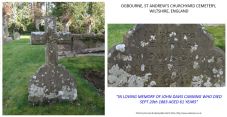
PORANGAHAU Ogbourne St Andrews 01a

(click for full image)

In 1884 his sister Elizabeth commissioned a stained glass window to be erected in St. Andrew’s in Memory of her brothers John and Davis. Legend has it that the window in St Michael’s at Porangahau was a copy of the window in St Andrew’s in Wiltshire:

“The east window at St Michael and All Angels Anglican Church in Porangahau was given by the family in his memory and is a copy of the window in the church at Ogbourne, St Andrews…”[15]

Unfortunately, this legendary tale is not true. The stained glass window at St. Andrews in Wiltshire was erected three years after the window at St Michael’s at Porangahau in New Zealand and it doesn’t follow the same biblical theme, or resemble the figurative work in any way whatsoever.

The memorial text on a brass plaque at the foot of the Canning memorial  window at St Andrew’s church in Wiltshire reads;

“TO THE GLORY OF GOD AND IN LOVING MEMORY OF JOHN DAVIS CANNING WHO DIED SEPT 20th 1883 AGED 61, ALSO DAVIS CANNING WHO DIED AUGUST 8th 1868 AGED 39. THIS WINDOW IS DEDICATED BY THEIR SISTER, ELIZABETH MARY MOORE, A.D. 1884.”
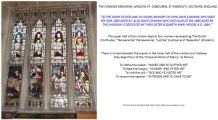
PORANGAHAU Ogbourne St Andrews 02a

(click for full image)

The upper half of the window at St Andrew’s depicts four women representing “Fortitudo” (Fortitude), “Temperantia” (Temperance), “Justitia” (Justice), and “Sapientia” (Wisdom).

The scenes in the lower half of the window depict what I believe are four of the acts from the Corporal Works of Mercy. On the other side of the world, the Ferguson & Urie window at Porangahau in New Zealand depicts Baptism, Crucifixion, and Resurrection.

John’s wife Elspeth eventually made a full recovery in England and in the early 1890s returned to New Zealand where she resided at Napier in good health into her advanced years[16].

Elspeth died in New Zealand in 1920 at the age of 86[17].

Davis Canning (1829-1868)[18]

The Ferguson & Urie stained glass window in St Michael’s is a memorial to Davis Canning, the younger brother of John Davis Canning.

When Davis actually arrived in New Zealand is not known, but can reasonably be assumed to be 1852 or later. His brothers John and Charles arrived aboard the “Cornwall” from England in December 1851 but Davis was not listed as a passenger on the same ship with them.

Davis resided at “Oakburne” near Porangahau with his brother John. At the age of 39 he was described as a “young man full of adventure.”[19] It was probably inevitable that this adventurous spirit would lead him to joining the militia. Sometime in late September or early August 1868 he rode off and joined Colonel Whitmore’s government forces to fight against the Hauhaus led by the Maori rebel “Te Kooti Arikirangi Te Tūruki.”

On the 8th August 1868, during a battle at Ruakituri, Davis Canning and a Captain Oswald Carr were shot dead[20];

“…On the 8th the force was well up the gorge-like valley of the Ruakituri, and the advance-guard led by Mr. Davis Canning, a gallant settler from Hawke’s Bay, was hot on the trail of the Hauhaus, who were heard shooting pigeons in the distance. Early in the afternoon Captain Carr (Hawke’s Bay), who had been an officer in the Royal Artillery, reconnoitered through the bush along the river-bank, and reported that the Hauhaus were halted a short distance up the river. The swift and ice-cold river was forded several times and the European and Maori force advanced to the attack. Captain (afterwards Colonel) Herrick with part of the force moved on to take the Hauhaus in flank and reverse, and when his men were in position Whitmore directed the advance-guard to push forward. It was soon driven back, leaving both Canning and Carr dead on the field. The former was shot dead while gallantly leading the men…”[21]

Ten years later, in July 1878, his older brother John Davis Canning subscribed the amount of £125 towards a stained glass window to be erected in memory of his brother in the yet to be erected St Michael’s Church at Porangahau[22]. In September of the same year the Hawke’s Bay Herald reported something similar but with a differing cost for the window;

“…J. D. Canning, Esq., of Oakbourne, has given a superb stained glass window of the value of £150…”[23]

St Michael’s was consecrated by the Bishop of Waiapu in 1881 and the Ferguson & Urie stained glass window to the memory of Davis Canning still exists to this day.

Beneath the window is a brass plaque inscribed:

“This window is erected by the family, in memory of Davis Canning, gent., who fell in action at Ruakituri, 8th August, 1868 whilst leading the advanced guard.”

Another memorial to Davis appears at Ruakituri Cemetery Reserve near Wairoa. A brass plaque is mounted on a rock cairn in memory of Davis Canning[24] and Canning family lore has it that this plaque went missing after a flood in the late 1800’s and was missing for over a century until being found in the 1980’s-90’s in a creek bed two miles away.

The plaque has the wording:

“IN MEMORY OF DAVIS CANNING, KILLED IN ACTION 8th AUGUST 1868”.
“NE CEDE MALIS SED CONTRA”
[25]

(Latin: “Yield not to misfortunes, but advance all the more boldly against them”)

Significant historical newspaper  transcriptions:

Hawke’s Bay Herald, NZ, Vol 12, Issue 969, 15 August 1868, page 3.

“IMPORTANT FROM THE FRONT. SEVERE ENGAGEMENT BETWEEN FORCES UNDER COL. WHITMORE AND EX PRISONERS…

…We deeply regret to add that among the killed were Capt. Carr of Petane and Mr. Davis Canning, two esteemed settlers of this province…”

Star, NZ, Issue 97, 4th September 1868, page 3.

“…The advance guard, comprising several of the armed constabulary, and led by Captain Carr and Mr. Canning, advanced to the front of the enemy’s lines and were on the eve of carrying the position when the hau-haus poured in a hot fire, which forced them to take cover. The action then commenced hot on both sides; and in another attempt to charge the position, Mr Canning and Captain Carr lost their lives…”

Hawke’s Bay Herald, NZ, Vol XXI, Issue 5133, Monday 22nd July 1878, page 2

“Our Porangahau correspondent writes: – The need of a church has long been felt and numerous gentlemen having promised subscription to the amount of £365, it is hoped that the good work will speedily be accomplished. It is proposed that the sum of £600 be collected for the above purpose, exclusive of the sum of £125 presented by J. D. Canning, Esq., of Oakbourne, for a stained glass window, in memory of his brother, the late Mr Davis Canning. A series of concerts are to be given for the purpose of raising funds to furnish the sum required. The following gentlemen have already subscribed:- J. Nairn, £100; George hunter, £50; J. D. Ormond, £50; Rev S. Williams, £50; A. St. Hill, £10; J. White, £50; T. Spencer, £5; Trust Fund, £50. Total £365.”

Hawkes Bay Herald, NZ, Vol XXI, Issue 5792, 13th September 1880, page 3.

“PORANGAHAU

[FROM AN OCCASSIONAL CORRESPONDENT]

WAINUI, September 10.

By favour I was permitted to see the memorial window which has just been put in at the Porangahau Episcopalian Church, now in course of erection. As I understand, it was presented by Mr John D. Canning, of Oakbourne, in memory that gentleman’s late brother, Mr Davis Canning, and as a work of art it does great credit tothe artist, and as much to the selector of the design. It is in the mediaeval style, Gothic, with teinte brilliante of the Rennaissance. The effect, seen when sunlight falls on it, is grand, and the chiaroscuro well defined – in fact the whole would do credit to a large old world cathedral, and is, I believe, not equalled in this colony. It is grand – more cannot be said.
Although the church is by no means finished, yet, as far as the work has gone, it is a great credit to the contractor, Mr Holt, of Napier, and also to his foreman of works, Mr. Wm. Smith, for, though I am no judge of builder’s work, I profess to distinguish between conscientious, well finished, straight forward labor, and work done in a slovenly style – and the former is the case with the church. As far as it is finished the work is solid, and, what is more, the acoustic properties promise to be good. To sum up, the work, when finished, will be, and ought to be, a credit to so small a place as Porangahau.”

 Hawke’s Bay Herald, Vol XXI, Issue 5906, 15th February 1881, page 3.

 “CONSECRATION OF PORANGHAU CHURCH.

 On Friday last the new church at Porangahau was consecrated by the Right Rev. the Bishop of Waiapu. The design of the building is striking. It consists of a nave, chancel, tower with spire, and a commodious vestry. It is seated for 100 persons, but there is space for additional seating accommodation when required. One great feature, internally is a large stained-glass east window, containing three lights and tracery. The subjects are the baptism of our Lord, the Crucifixion, and the Resurection. The draperies about the figures are of the richest quality of antique glass the colors being so arranged as to blend harmoniously, while all crude or harsh coloring is avoided. The background is light grisailler work, so subdued as to make the subjects stand out prominently. On the lower panels, and in the tracery are suitable emblems and monograms. The general effect is exceedingly rich and handsome. Beneath it is a brass plate bearing the following inscription:- “This window is erected by the family, in memory of Davis Canning, gent., who fell in action at Ruatikuri, 8th August, 1868 whilst leading the advanced guard,” The window is from the firm of Ferguson and Urie, Melbourne. The services on Friday were three in number, those in the morning and evening being attended by the European settlers, that in the afternoon by the Porangahau natives. The Bishop preached in the morning, and the Rev. De Berdt Hovel in the evening. The Revs’ S. Williams, J. Shearman, and F.E.T. Simcox (the incumbent of the parish) were also present and took part in the ceremonies. The offertories amounted to £31. The church, which is dedicated to St. Michael, was designed by Mr B. W. Mountfort, of Christchurch, the contractor for the work being Mr Robert Holt, and the builder Mr W. Smith, of this town. The building reflects great credit on all concerned in its arection, [sic] and is by far the prettiest ecclesiastical edifice to be seen in the country districts of Hawke’s Bay. The furniture is exceedingly good of its kind, the silver fount [sic]having been given by Mr. J. Nairn, of Pourerere, and the embroidered chancel mat by Mr C. A. M. Hirtzel. The site upon which the church stands was presented by Mrs T. Crosse, of Mangamari.”

Dominion, NZ, Vol 4, Issue 1031, 21st January 1911, page 16.

“Oakburne,” the residence of Mr. Davis Canning, is one of the prettiest homesteads on the road between Waipukurau and Porangahau. It lies a few miles past Wallingford, and on an eminence which admits of a splendid view of the surrounding country. At the back of the residence is a fine plantation of pine trees, while farther down is a big orchard of six hundred trees, some of which are over forty years old. The name of Canning is inseparably linked with the agricultural and pastoral history of Hawke’s Bay. Mr. John Davis Canning, father of Mr. Davis Canning, was one of the early stock-breeders in the district when there were few such, and it is he who gave a lead in the system of using nothing but the best stock. He was one of the exhibitors at the first agricultural and pastoral show held at Havelock North, and he specialised not only on Short-horn cattle and sheep, but also in horses, pigs, sporting dogs, and fowls. A man of very broad and enlightened views, and with an earnest sympathy, which endeared him to all who had the good fortune of his acquaintance, John Davis Canning is described by contemporaries as one of the finest types of the pioneer settlers who built their homes out in the wilderness. In his early days he was a colleague of the late John Harding, of Mount Vernon, and was employed by that equally strenuous pioneer some time in the fifties. Mr. Canning came to New Zealand in 1851, in the good ship Cornwall, and he took up “Oakburne,” about half a century ago, and held big Native leasehold sections, which aggregated 40,000 acres. He was married in 1868 to a daughter of Mr. McQueen, of Inverness. A bereavement clouded the happy memories of his first years of married life at “Oakburne,” It was in 1867 or 1868 and the Maori troubles were blazing in their insurrectionary outbursts. Davis Canning, who resided at “Oakburne” with his brother, was a young man full of adventure. He was smitten with the fever, and one evening rode away with a captain’s commission, through to Napier and on to Poverty Bay, where he was shot dead with Captain Carr at Ruakaturi. It appears that both he and Captain Carr were the victims of their own rashness, and in these days of militarism and threatened war it is interesting to record in what a simple manner two lives were thrown away.

Mr. John Davis Canning.

It is interesting to record some further particulars of Mr. John Davis Canning. He was born at “Ogbourne,” St Andrew, Marlborough, Wiltshire, England, in the year 1822, and was the son of the late M. Davis Canning. The Cannings of “Ogbourne” and of “Oakbourne,” in Hawke’s Bay, are a branch of an old English family of which Lord Canning, a former Viceroy of India, was a member. Mr. John Davis Canning was educated in his native place. He landed first at Lyttelton, and then came up to Hawke’s Bay, where he afterwards selected the present fine property. He introduced the Cotswold variety of sheep, and spent lavish sums of money on good stock. Amongst his horse importations was the draught stallion Dugdale, said to be the finest of his class. In 1883 Mr. Canning went to England to see his wife, who had been invalided there, but the trip resulted in his death. It is satisfactory to record in the face of this severe bereavement that Mrs. Canning regained her health some eight years later, that she returned to New Zealand, and that she now resides in Napier, in very good health.

Mr. Davis Canning.

Mr. Davis Canning, the present owner of “Oakburne,” was borne there, but was educated at the Marlborough Grammar School and at Clifton College, where formerly, by the way, Mr. James Allan, M.P., received some of his first instruction. Mr. Canning went to Clifton College in 1885, and left in 1891. He was an enthusiastic out-door sportsman, and got his cap both for football and cricket, and still takes a keen interest in those pastimes. After leaving England he resided for a time at Hastings, “Oakburne” having been leased, but when the lease expired he returned to his home, and took up the study of farming and agricultural matters with the same keen interest which was evidenced in such a marked degree by his father…”

Acknowledgements:

My thanks to:

My cousins Janice and Cleeve Ball for following up on the clues in New Zealand and undertaking the long trip to Porangahau to meet the Canning descendants and photograph the window.

To Davis Canning for the email correspondence and additional clues on the Canning family history in the Hawke’s Bay New Zealand.

To Duncan & Mandy Ball in England for the correspondence and photos from Ogbourne, St Andrew’s, Wiltshire.


Footnotes:

[1] Hawke’s Bay Herald, Vol XXI, Issue 5133, Monday 22nd July 1878, page 2.

[2] Hawkes Bay Herald, Vol XXI, Issue 5792, 13th September 1880, page 3.

[3] Hawke’s Bay Herald, Vol XXI, Issue 5906, 15th February 1881, page 3.

[4] Hawke’s Bay Today, NZ, On-line edition, Saturday 24th December 2011.

[5] Lyttelton Times, NZ, Vol 1, Issue 49, 13th December 1851, page 5.

[6] Hawke’s Bay Herald, NZ, 27th Jul 1863, page 1.

[7] Hawke’s Bay Herald, NZ, Vol 7, Issue 494, 28th May 1864, page 4.

[8] Nelson Evening Mail, Volume III, Issue 27, 1 Feb 1868, page 2.

[9] Evening Post, NZ, Vol IV, Issue 175, 5th September 1868, page 2.

[10] Daily Telegraph, Issue 3009, 16th February 1881, page 3.

[11] Hawke’s Bay Herald, Vol XXI, Issue 5933, 29th March 1881, page 1.

[12] Daily Telegraph, Issue 3219, 24th October 1881, page 2.

[13] Daily Telegraph, Issue 3804, 20th September 1883, page 2.

[14] Hawke’s Bay Herald, Vol XXI, Issue 6662, 25th September 1883, page 2.

[15] Matatoa: Fathers & Sons, Hilary Pederson, Te Hanganui Partnership 2011.

[16] Dominion, NZ, Vol 4, Issue 1031, 21st January 1911, page 16.

[17] NZ BDM record 1920/5550.

[18] Date of birth 11th July 1829: From Canning family bible. (detail from descendant Davis Canning , via email Janice Ball 26 Feb 2014)

[19] Dominion, NZ, Vol 4, Issue 1031, 21st January 1911, page 16.

[20] Hawke’s Bay Herald, Vol 12, Issue 969, 15 August 1868, page 3.

[21] The New Zealand Wars: A History of the Maori Campaigns and the pioneering Period: VoL II: The Hauhau wars, (1864-72), Chapter 25.

[22] Hawke’s Bay Herald, Vol XXI, Issue 5133, Monday 22nd July 1878, page 2.

[23] Hawke’s Bay Herald, Vol XXI, Issue 8192, 30th September 1878, page 2.

[24] http://www.mch.govt.nz/nz-identity-heritage/national-monuments-war-graves/list-historic-graves-and-monuments

[25] http://www.mch.govt.nz/nz-identity-heritage/national-monuments-war-graves/list-historic-graves-and-monuments


Short link to this page: https://wp.me/p28nLD-2nE

© Copyright

1870: The Convent of Mercy, Albury, New South Wales.

The Convent of Mercy at Albury, New South Wales, has remnants of original Ferguson & Urie stained glass. The main entrance doors originally contained the figures of St Bernard and St Bridget with the Virgin and child in the window above the doorway.

The convent was formally opened on the 4th February 1870 by the Bishops of Bathurst and Maitland and the Freemans Journal of 19th February published very a detailed account of the proceedings.

In December 2013 Fr. Joel Wallace sent me some photos of the entrance windows and the stained glass above the doorway appears to be the most intact. The St Bridget window in the right door panel looks to have had multiple fractures over the last 144 years and there is evidence of many additional lead lines introduced to arrest the past damage. The St Patrick window in the left doorway unfortunately no longer exists.

Photos were kindly supplied by Fr. Joel Wallace, 13th December 2013.

This slideshow requires JavaScript.

Freeman’s Journal, Sydney, NSW, Saturday 19th February 1870, page 10.

“OPENING OF THE CONVENT OF MERCY, ALBURY”
(From a Correspondent)

“On Friday, the 4th February, their Lordships the Bishops of Bathurst and Maitland arrived in Albury to formally open and bless the Convent of Mercy…”

“…On Sunday the 6th the ceremony of opening and blessing the Convent took place, an event marking a new era in the Catholic history of this important and fast rising town not soon to be forgotten…”

“…Entering the hall under the verandah arches, the visitor is struck with the magnificent appearance of the stained glass in the upper panel of doors and fanlights over. In the centre of fanlight is a splendid medallion representing the Blessed Virgin and Child; on one side of the medallion the monogram of St. Bernard, on the other I.H.S. In one panel of the doors a full length figure of ‘St. Bridget,” whose name the Convent bears, the other panel the figure of St. Patrick, both in elaborately wrought canopies. The glass is from the manufactory of Messrs. Farguson [sic], Urie, and Lyon, of Melbourne, on whom it reflects great credit…”


Short link to this page: http://wp.me/p28nLD-2m1

© Copyright


1884: Gunsler’s Cafe, Pitt Street, Sydney, New South Wales

Gunsler’s Café in Pitt Street Sydney was built in 1884 to the designs of Melbourne architect Lloyd Tayler and had ornamental stained, coloured, and plate glass decorations supplied by the Ferguson and Urie Stained Glass Company of North Melbourne.

Photos: The historical engravings of Gunsler’s Sydney premises were published in the Illustrated Sydney News, NSW, Tuesday 23rd September 1884 and the Melbourne premises were published by May & Ebsworth in July 1879.

This slideshow requires JavaScript.

Illustrated Sydney News, NSW, Tuesday 23rd September 1884, page 3.

“Gunsler’s Cafe, Pitt Street.
It has always been a source of surprise to visitors, that a city like ours should be so inadequately supplied with first class restaurants. Efforts have been made within the last few years to remedy this want, but it has remained for an enterprising man like Mr. Gunsler, known for years as the leading caterer in Australia, to go into the matter thoroughly, and by long acquired experience, combined with a large expenditure of money, to provide Sydney with an establishment second to none in the southern hemisphere. Mr. Gunsler, encouraged by the patronage received at the temporary establishment in King Street, secured the premises known as 175 Pitt Street, close to the Federal Bank, and having obtained suitable designs from Mr. Lloyd Tayler, of Melbourne, has erected an admirably arranged building…”

“…The shop windows are of plate-glass, the upper compartments of the lights being filled in with coloured glass of various designs. The upper portions of the windows above are similarly treated, and the effect produced by this artistic ornamentation of the frontage is highly pleasing. In the central compartment of the tower is written on glass “Gunsler’s Café,” and the electric light apparatus is fixed up at the back, by means of which establishment will be splendidly advertised over the length and breadth of the city. A clock is inserted in the pediment that forms the central feature of the structure. Above the shop windows in the frieze of the main cornice the words “Gunsler’s Café” are again prominent, standing out clearly in gold lettering on a ground of plate-glass; the light over the main entrance is filled with ground glass bearing the word ‘Café” embossed in gold letters…”

“..The general contractors for the building were Messrs. White and Coghill, of Paddington. The fittings were supplied by Mr. James Aylward, of Redfern; the ornamental coloured-glass and plate-glass by Messrs. Ferguson and Urie. Mr. F. Messenger acted as clerk of works…”

John Ferdinand Gunsler (c.1827-1911).

In April 1873 John Ferdinand Gunsler entered into partnership with Charles James Hughes as “Hughes & Co”, pastry cooks and confectioners, at 29 Collins street Melbourne[1]. By September of the same year the partnership was dissolved by mutual consent[2] and Gunsler brought out Hughes’s share of the business but traded under the same name until early 1874 when he then began trading under his own name.

Having gained special appointment as caterer to the Governor Sir George Ferguson Bowen in September 1874[3], he quickly gained widespread recognition as reputable caterer and restaurateur and for many years was chosen for many significant government, sporting, regal and private events around Melbourne as the preferred caterer for all occasions.

In February 1878 he admitted Henry George Iles (1850-1899), a gold buyer and investor, as a financial partner in the business and then traded under the name of “Gunsler & Co”[4]. In August of the same year they purchased an allotment of dilapidated buildings in Collins Street known as ‘Petty’s block’ from the estate of Mr George Petty[5] and under the direction of architect Lloyd Tayler[6], proceeded to build Café Gunsler which opened in June 1879[7]. In later years the Café was known as the Vienna Café (1890-1915). The Australia Hotel was built on the site c.1940 and is now home to the “Australia on Collins” shopping centre at 260 Collins Street Melbourne.

Gunsler’s reputation as the very best in the catering business allowed him to expand his operations substantially. In October 1879 he brought the lease of the Victoria Club in Melbourne[8] and in May 1881 Gunsler & Co advertised that they had purchased the South Australian Club (Adelaide Club Hotel) at North-Terrace[9] and in 1882 they purchased the former Bank of South Australia building in Adelaide which was converted to a family Hotel[10].

In January 1884 Gunsler ventured into New South Wales and advertised from temporary premises at 110 King Street Sydney[11] and later built the opulent “Gunsler’s Café” at 175 Pitt Street Sydney which had the ornamented windows supplied by the Ferguson & Urie stained glass Company of Melbourne.

Gunsler obviously had a great affection for the architectural work of Melbourne architect Lloyd Tayler, having engaged him to oversee the design and construction of his Melbourne premises and the later Sydney premises. The other choice of having the Ferguson & Urie stained glass company of Melbourne provide the glazing is also unusual, considering that by 1884, a number of local Sydney firms such as Ashwin & Falconer and Lyon & Cottier could have easily undertaken the work. What is most likely is that Lloyd Tayler had chosen Ferguson & Urie to complement his designs which possibly means that Gunsler’s Melbourne restaurant may also have had decorative glazing done by Ferguson & Urie, but there has been no evidence found to support this.

Gunsler’s Café in Pitt Street Sydney burnt down on the 27th January 1889[12].

John Ferdinand Gunsler died in Sydney on the 28th November 1911 aged 84[13].

Footnotes:

[1] The Argus, Melbourne, Vic, Friday 18th April 1873, page 3.

1888: Presbyterian Church, Toorak, Victoria.

In the liturgical south transept of the Toorak Presbyterian Church (Uniting) at Toorak is a two-light Ferguson & Urie stained glass window erected to the memory of Mary Buist Bayles (1856-1888).

Photos taken 21st August 2010.
(Unfortunately these are poor quality with an early Pentax Optio S10 pocket camera).

This slideshow requires JavaScript.

[View all photos]

In the tracery above the two lights is a round window with five lobes (a cinqfoil or pentafoil). The centre of the window depicts the descending dove with the outer ring and scrolls within, containing the scriptural words;

“THE ETERNAL GOD IS THY REFUGE & UNDERNEATH ARE THE EVERLASTING ARMS” (Deuteronomy 33:27)

The outer five lobes of the window contain floral designs with a dotted white border and the two lights below contain biblical scenes with scriptural text below:

“I AM THE RESURRECTION AND THE LIFE, JOHN XI.25” (John 11:25)

The scene in this left light is Jesus meeting the grieving Martha who was the sister of Lazarus. He tells Martha that he is the resurrection and the life and that she should have faith that he will bring Lazarus back to life.

“SHE HAD WROUGHT A GOOD WORK. SHE HATH DONE WHAT SHE COULD” (Mark 14: 6-8)

The right light depicts the “Anointing at Bethany” where Jesus is seen reclining at the table of Simon the Leper and Mary of Bethany is anointing him with expensive perfume from an alabaster jar and then wiping his feet with her long hair.

Across the base of the windows is the memorial text to Mary Bayles;

“IN LOVING MEMORY OF MARY BUIST, DAUGHTER OF WILLIAM AND ISABEL BAYLES, DIED NOVEMBER 24th 1888.”

Mary Buist Bayles (1856-1888).

Mary Buist Bayles was the eldest daughter of William Bayles (1820-1903)[1] and Isabel née Buist (1830-1917)[2].

Her father William had arrived in Van Diemen’s Land (Tasmania) c.1846 and married Isabel Buist at Pituncarty, Maquarie River, on the 11th July 1854[3]. The family later moved to Melbourne where Mary was born at Regent Street, Carlton Gardens, on the 29th December 1855[4].

In 1861 her father entered public life and held many prominent council and political positions including that of Mayor of Melbourne in 1865-66, alderman in 1869 and acting Mayor in 1900[5].

Mary Buist Bayles never married and died aged 33 at her parent’s home, Yar Orrong, Toorak, on the 24th November 1888[6] and was buried in the Bayles family plot at the St Kilda cemetery[7].

The stained glass window was erected in her memory in the Toorak Presbyterian (now Uniting) church, the same church that her father had laid the foundation stone of on the 24th May 1875[8].

The window underwent restoration and conservation work in 2001 by the studio of Geoffrey Wallace at Caulfield.


Significant tabloid transcriptions:

The Argus, Melbourne, Vic, Friday 21st July 1854, page 4.

“On the 11th inst., at Pituncarty, Maquarie River, Van Diemen’s land, by the Rev. Dr. Lillie, William Bayles,  Esq., merchant of this city, to Miss Isabel, youngest daughter of Mrs. Buist.”

The Argus, Melbourne, Vic, Wednesday 2nd January 1856, page 4.

“On Saturday, the 29th ult., Regent-street, Carlton gardens, Mrs. William Bayles, of a daughter.”

The Argus, Melbourne, Vic, Tuesday 25th May 1875, page 7.

“NEW PRESBYTERIAN CHURCH, TOORAK.

The ceremony of laying the memorial stone of a new Presbyterian church, on the Toorak road, took place yesterday morning in the presence of about 100 persons…”

 “…Mr. T. BAILEY, on behalf of the subscribers, presented Mr. W. Bayles, M.L.A., with a silver trowel, and the stone having been lowered, Mr. Bayles declared it to have been well and truly laid…”

The Argus, Melbourne, Vic, Monday 26th November 1888, page 1.

“BAYLES.- On the 24th inst, at Yar Orrong, Toorak, Mary Buist, eldest daughter of William and Isabel Bayles.”

 The Argus, Melbourne, Vic, 26th November 1888, page 1.

 “THE Friends of Mr. WILLIAM BAYLES are informed that the remains of his late daughter, Miss Mary Buist, will be interred in the St. Kilda Cemetery. The funeral is appointed to move from his residence, Yar Orrong, Toorak, THIS DAY (Monday, 26th inst.), at 2 o’clock. ALF. AUG. SLEIGHT, undertaker.”

The Argus, Melbourne, Vic, Friday 9th October 1903, page 6.

“DEATH OF ALDERMAN BAYLES.”

 “The death of alderman Bayles, at the age of 83 years, which took place at his residence, Albany-road, Toorak, yesterday, removes a well-known figure in the commercial, political, and civic life of Melbourne during the last half-century, and a member of the community whose probity and business capacity and excellent qualities of mind and heart won the esteem of all whom he came in contact. He was born in Yorkshire on November 1, 1820, and emigrated to Tasmania in 1846. Crossing to Melbourne in 1852, he commenced business as merchant and ship-owner, first in partnership with Mr. Headlam, under the style of Headlam, Bayles, and Co., and subsequently with Mr. W. H. Melville, under the style of Bayles and Co. He relinquished this business in 1865, on taking up pastoral pursuits on large properties he acquired in the Western district of the state. He was “father of the City Council,” having been elected for Lonsdale Ward on November 4, 1861. A public-spirited man, and given to hospitality, Mr. Bayles elected Mayor for the term 1865-1866, and on July 19, 1869, he was appointed alderman for Gipps Ward. Shortly after his election to the council he was appointed a member of the finance committee, a position he held until his death. As a matter of fact, he presided at the committee meeting on September 10. As chairman of the committee, it is frankly acknowledged, his skilful and careful supervision of the city finances largely conduced to the gratifying financial position of the council on the money market. Mr. Bayles entered active political life in 1864 as a member of the Legislative Assembly for Villiers and Heytsbury, a constituency he subsequently successfully contested on eight successive occasions. He was a staunch member of the constitutional party, and became Commissioner of Trade and Customs in the Sladen Ministry, when held office from May 6 to July 11, 1868. Among the public companies with which Mr. Bayles was identified he was one of the largest shareholders in the old Launceston and Melbourne Steam Navigation Company, and in recent years he was a member of the directorate of the Union Trustees Company. He was a leading member of the Toorak Presbyterian Church, and a generous supporter of its ordinances and work. He also held office for many years on the kirk session and board of management. Mr. Bayles married Miss Buist, a sister of Mrs. James Gibson, of Belle Vue, Tasmania, who survives her husband, and he leaves a family of two daughters and three sons. Alderman Bayles retained comparatively good health until a few months ago, and his death was due to extreme age.”

Related post: 05-03-1882: Presbyterian (Uniting) Church, 603 Toorak Rd. Toorak, Victoria. (The Ormond window by Ferguson & Urie).

External links: Biography: William Bayles (1820-1903).

Footnotes:


Short link to this page: https://wp.me/p28nLD-2jF

© Copyright

1864: The Ship Inn Street Lamp, Port Albert, Victoria

The Ferguson & Urie stained glass Company crafted thousands of Ecclesiastical and Secular stained glass windows but little is known of the company’s diversity in other areas of art which extended to ornamental stained glass screens, lanterns, chancel and altar decorations and many other decorative items such as advertising signage.

In June 1864 the historical seaside town of Port Albert had a decorative gas street lamp installed outside the ‘Ship Inn’ and was reported to have had three colourful stained glass ships painted on it.

Gippsland Guardian, Vic, Friday 1st July 1864, page 2.

“The danger which existed on dark nights at the culverts at the intersection of Bay street with the main road, is much reduced by the excellent lamps at each of the hotels immediately adjoining. That at the Ship Inn deserves passing notice as a very excellent specimen of a new process of painting on glass, patented, we believe by Messrs. Ferguson and Urie of North Melbourne. The execution of the three vessels on the lamp is very good, and the colouring gay, striking and indelible.”

No extant examples of this kind of work on public street lighting by Ferguson & Urie have been found to date, although there are unconfirmed examples of lantern covers/shades at the private estates of Werribee Mansion and Rupertswood at Sunbury which are extremely likely to have been replicas of original designs by the company.

Very early Victorian street lamps were erected by private citizens and businesses and were mostly oil or candle powered. As early as 1847 gas street lighting was being erected by Innkeepers in an attempt to reduce the large number of injuries occurring to their patrons as a result of falling into ditches, gutters and culverts after leaving their establishments late at night. Call me sceptical, but I’m reasonably sure that this was not the root cause!  By the late 1850’s it became law within Victorian municipalities for Publicans and Innkeepers to keep a light burning outside their premises from dark to dawn. The city of Ballarat in Western Victoria took great pains to enforce this law and the weekly ‘cause’ list was regularly filled with publicans fronting the magistrate for “not keeping a proper light burning” outside their premises[1]. Overall public safety was the real reason for the proliferation of public lighting. The streets of early Melbourne were rife with drunkards, thieves and vandals who took every opportunity of the darkness to reap their lawless rewards. Any respectable law abiding citizen would have been taking a gamble with their lives or possessions by venturing out after dark in the early streets of Melbourne. In this day and age we’d probably call it an “Extreme Sport” which could have applied to both the victim and the perpetrator as it was a possible death or serious assault for the victim and an almost certain death sentence if you were found and convicted as the perpetrator.

[Some examples of original gas lamps used in Melbourne and country Victoria]

This slideshow requires JavaScript.

The gas jets for the early street lamps were extremely inefficient and each lamp consumed up to a massive six cubic feet of gas an hour to only provide the mere equivalent light output of three candles[2]. By the late 1880’s electric light was the new up and coming invention that would eventually replace gas but the old gas lighting remained for many years past the turn of the century, thanks to the invention of the Welsbach gas mantle, which both increased light power considerably whilst reducing the amount of gas used at the same time. Many wealthy speculators re-invested heavily in the gas companies based on this new efficiency but it would inevitably succumb to electricity.

Public Street lighting had spread throughout Victoria and the other Colonies and the tiny township of Port Albert was just one of many. What is extraordinary though is that the decorated street lamp outside the ‘Ship Inn’ in Port Albert is only three and a half years after the Ferguson & Urie Company had started creating stained glass art on a commercial basis.

About Port Albert:

Port Albert is one of the earliest seaside townships in Gippsland and was discovered in 1841 as a result of the wreck of the steamer ‘Clonmel’ which struck a sandbar off Wilson Promontory, five kilometres south of Port Albert, in the early hours of January 2nd 1841[3].

Fortunately there was no loss of life but the wreck of the Clonmel is recorded as one of the events which lead to the discovery and establishment of the township of Port Albert a short time later.

When rendering assistance to the survivors, the Harbour Master, Captain Lewis, made some important observations in the vicinity of the wreck of the Clonmel and a location known as Corner Inlet which he deemed to be entirely suitable for shipping to enter[4]. This report was probably followed up via a land expedition by explorer Angus McMillan later in the same year and the first inhabitants settled in Port Albert circa May 1841.

The location where the steamer Clonmel was grounded is today called “Clonmel Island,” located about 5km south of Port Albert. A very detailed account of the grounding of the Clonmel was recorded by a Mr. D. C. Simson in early January 1841 as follows:

The Courier, Hobart, Tas, Tuesday 19th January 1841, page 2-3.

“LOSS OF THE CLONMEL.”
“The following is Mr. D. C. Simson’s narrative, who came up from the wreck in an open whale boat:-
On Wednesday afternoon, the 30th December, I embarked on board the team-ship Clonmel, Lieutenant Tollervey, commander, bound from Sydney to Port Phillip. The passengers and crew consisted of seventy-five individuals. At four P.M., rounded the south head of Port Jackson; wind from southward, blowing fresh. Next morning, 31st, found us off Jarvis’s Bay; wind still adverse with a strong head sea, the vessel progressing at an average of seven knots an hour. At daylight, the 1st January, Cape Howe bore W.S.W. of us; in the course of the morning sighted Ram Head, and took a fresh departure, steering for Wilson’s Promontory. The wind was now fair with smooth sea, and our course S.W. ½ W.; the wind and weather continuing favourable during the day and night. A little after 3 A.M., of 2nd January, all the passengers were startled by the ship striking heavily. On reaching the deck I discovered breakers a-head; the captain, who had been on deck during the whole of the middle watch, giving orders to back astern, and doing all in his power to rescue the ship from her perilous situation. Finding that the engines were of no avail in backing her off the bank on which we now found she had struck, orders were given to lighten her by throwing overboard cargo, &c., but without desired effect, the vessel still surging higher upon the reef. The anchors were then let go, when, after a few more bumps, she swung head to wind, taking the ground with her stern, and bedding herself, with the fall of the tide, upon the sand, rolling hard and striking occasionally. During the whole of this trying scene the most exemplary conduct was shown by the crew in obeying the orders of the captain and officers. Daylight had now made its appearance, and we found ourselves on shore on a sand spit, at the entrance of Corn Inlet, about half a mile from the beach, between which and vessel a heavy surf was rolling. It is necessary here to remark, that the course steered and the distance run, would not have warranted any person in believing us so near the shore as we actually found ourselves. The sea was smooth, the wind fair, and the vessel going at the rate of at least 10 knots an hour, and it was impossible for any navigator to have calculated upon such an inset carrying a vessel, under the circumstances above alluded to, 30 to 40 miles to leeward of her course, in eighteen hours. Captain Tollervey’s conduct had hitherto been that of a careful and watchful commander; he was on deck during the whole of the middle watch, which he himself kept, anxiously on the lookout, and was on the paddle box at the time the vessel struck, but the night proving misty, nothing could be seen beyond the length of the vessel. Had it pleased Providence to have retarded our voyage by half an hour, the calamitous event would have been avoided; but it was otherwise ordained.
Captain T., on finding all attempts to get the vessel off, by running kedges and warps out, throwing overboard cargo, &c., unavailing, and a strong sea rising with the flood tide, turned his attention to the safety of the passengers and crew. After several trips by the whale-boats first, and assisted by the quarter-boats afterwards, every soul was landed in safety by 2 p.m., the captain being the last to leave the vessel. A sufficiency of sails, awnings, and lumber, was brought on shore to rig out tents for all hands; and everybody set to work to form an encampment. In a short time the ladies and females were comfortably housed, having beds placed for them in a weatherproof tent; the male passengers and crew were equally accommodated by means of spair [sic] sails and awnings brought from the ship, and we found ourselves at sundown as well provided for as we under the circumstances could desire. A sufficiency of provisions, consisting of live stock, hams, bread, flour, biscuit, rice, tea, sugar, wines, and beer, had been landed during the forenoon, to keep the whole party for about ten days; water was found in abundance by digging, but was rather brackish to the taste. Captain T. now brought order into the chaotic mass, by establishing watches, previously haranguing the passengers and crew, explaining to them the stronger necessity which existed under their unfortunate circumstances for discipline and punctual obedience of orders, than would have been deemed necessary on board of his noble vessel had she been afloat. Universal assent was given to his exhortation, proper watches appointed, provisions, &c., stowed under a boat turned upside down, to guard them as well from petty depredations as from the weather, sentinels being posted in all directions round the encampment, who were relieved every two hours. When order was thus established and provisions distributed for supper, Captain T. and myself laid down in the tent and talked the events of the day over. The anxiety of mind and fatigue of body which our worthy commander must have undergone during that eventful day, were scarcely visible, either in his manner or appearance, whilst we were now quietly discussing the means of getting assistance brought to us. He agreed with me that is would be desirable for a boat to be sent to Melbourne for relief, and having obtained his consent to head the party, I had no trouble in finding a crew of five volunteers to join me in the undertaking. One of my fellow passengers, Mr. Edwards, of the firm of Messrs Edwards and Hunter, also volunteered to join us, and the next morning, amidst the cheers of our fellow sufferers, we were launched from the beach by them in a whale boat. We proceeded in the first instance to the vessel to lay in a store of provisions, not wishing to deprive those on shore of any portion of their scanty stock. Owing to the very heavy surf which was rolling on the beach, we were nearly two hours before we reached our ill-starred ship, being every moment in danger of swamping. The scene which now opened on ascending the deck, was harassing in the extreme; a few hours before, this stately vessel had been cleaving the waters, buoyant, like its living inmates, with life and hope – now an immovable wreck; her cabins that had a short time before been the picture of cleanliness and order, now one mass of confusion, and strewed with luggage and lumber of all descriptions; however, as our time was short, we supplied ourselves with such provisions as came within our reach, and after hoisting the Union Jack to the main-mast upside down we shoved off an committed ourselves to the care of a merciful Providence. At eight a.m., the 3rd instant, we took our departure outside the bank, steering for Sealer’s Cove. Our boat was manner by five seamen, and besides oars we had a small lug-sail made out of the awning; Mr. Edwards and myself made up the number to seven. Our provisions consisted of biscuit, a ham, a breaker of water, three bottles of wine, 12 of beer, and one of brandy; of the latter article I would not take more, dreading its effects upon the crew; the small quantity I took, however, I found very beneficial administered to them in minute portions.
Shortly after leaving the Clonmel the wind came from the westward; we were obliged to down sail and pull, and after six hours’ vain struggling against the wind to reach the mainland, we were under the necessity of running for one of the seal islands, where we found a snug little cove, which we entered, and after refreshing the crew by a three hours’ rest and hearty meal, we once more pulled for the mainland and reached Sealer’s Cove about midnight, where we landed, cooked our supper, and passed the remainder of the night in the boat which we anchored in deep water. We closed our eyes grateful to the Providence which had that day watched over us. At half past three a.m. on the 4th instant, I started three men on shore to get the breaker filled with water; they had scarcely filled them and brought them down to the beach, when I observed the natives coming down upon us; I hurried them on board and got under weigh, the wind blowing hard from the eastward at the time. After a severe pull of four hours we were at last enabled to weather the southern point of the cove to hoist sail and run for Wilson’s Promontory, which we rounded at 10 a.m., the sea running very high. The crew ever since we left the scene of our shipwreck behaved remarkably well, being perfectly satisfied with the scanty allowance which I put them as well as myself and fellow passenger upon, who in this trying time kept up spirits and assisted me in cheering on the men. At 8 p.m. we brought up in a small bay at the eastern entrance of Western Port; we were glad to get on shore to stretch our wearied limbs. After a refreshing night’s repose on the sandy beach we started the next morning at the break of day, happy in finding ourselves so near the end of our voyage. Having a strong and steady breeze from the eastward we sailed along very fast before it, although we were in imminent danger of being swamped, the sea having risen very considerably and breaking over us repeatedly. At 2 p.m. we were abreast of the Port Phillip Heads, but to our extreme mortification when within a mile of being in a secure harbour we found the strong ebb tide created such a ripple and so much broken water that I did not consider it prudent to run over it. We were, therefore, obliged to keep the boat’s head to winward from that time until the flood-tide would make; we were in this tantalizing situation for four hours, when to our inexpressible relief and joy we saw a cutter making for the heads, and bearing down upon her, found her to be Sisters, Captain Mulhall, to whose hospitable reception I cannot do sufficient justice. He took our boat in tow and ourselves on board, and landed us at William’s Town at 11 p.m.; having thus 63 hours from the time we left the ship to the time we landed at the beach. I cannot conclude this narrative without expressing my high sense of the extreme good conduct of the men who accompanied me on this voyage. Not a murmur escaped them, though continually wet and working hard during the whole passage.
Mr. Edwards, on finding himself in safety, was attacked by a spasmodic affection of the heart, which gave me much uneasiness, but from which I hope, by the kind treatment of his Melbourne friends, he will soon recover. The crew suffered much from over exertion and wet, occasioning in some cases dysentery. I suffered much in my eyes and face from constant exposure to the sun and salt water.
It was so early in the morning when I started, and I was so much hurried in making my arrangement, that I could not bring with me a correct list of the passengers on board; it is, however, satisfactory to know that no lives were lost, or bodily injury sustained whilst I was there. The mails were landed in safety, but I did not consider it prudent to bring them away with me.

Since the above was in type we have ascertained the following additional particulars:- Amongst the passengers were Mr. and Mrs. Walker, (Mrs. W. is daughter of Mr. Blaxland, M.L.C., and the present is the second ship wreck she has suffered;) Mr. Goodwin, (of the firm of Hamilton and Goodwin of this town,) to whom one-half of the cargo belonged; Mr. Robinson, of the Union Bank, having in his charge £3,000 of the banks notes, received at Sydney. The whole has been lost and is supposed to have been stolen – the Bank of course will sustain the loss; Mr. and Mrs. Cashmore, newly married, and bringing a large quantity of goods for the new establishment intended to be immediately opened at the corner of Collins and Elizabeth-streets. There were on board 300 tons of coals and 200 tons general cargo. At the time Mr. Simson [sic] left, her false keel and part of the sheathing was floating about the vessel, but she was not making any water, and he is of the opinion that should the weather continue moderate, she would be got off. When she first struck her rate of speed was upwards of 10 miles an hour. We are very sorry to have to add that the firemen, and some others, acted in a most disgraceful manner. – Port Phillip Herald, Jan 8.”

The Sydney Monitor & Commercial Advertiser, NSW, Monday 25th January 1841, page 2.

“The Revenue Cutter ‘Prince George,’ was dispatched on Friday, to the scene of the ‘Clonmel’s’ disaster, to render assistance towards saving that noble vessel.”

The Sydney Monitor & Commercial Advertiser, NSW, Wednesday 3rd February 1841, page 2.

“THE CLONMEL.- The ‘Sisters’ and ‘Will Watch’ have both returned from the ‘Clonmel’ with the passengers and part of the crew of that ill-fated vessel…”

External Links (about the wreck of the Clonmel):

History of the Clonmel:

http://www.dpcd.vic.gov.au/heritage/maritime/shipwrecks/shipwreck-stories/clonmel

Artefacts recovered from the Clonmel:

http://www.flickr.com/photos/heritage_victoria/sets/72157607371474539/

Footnotes:

[1] The Star, Ballarat, Vic, Wednesday 6th April 1859, page 2.

1874: St John’s Anglican Church, Ballan, Victoria.

The foundation stone of St John’s Anglican Church in Ballan was laid by Juliet Vivian Lyon (nee Anderson) in 1861. Thirteen years after that historical event Juliet died and in late 1874 a stained glass window was erected in her memory in  the chancel of St John’s. The window was made by the Colonial stained glass craftsmen Ferguson & Urie of North Melbourne.

Photos taken 10th April 2011.

This slideshow requires JavaScript.

[View larger images]

Juliet was born at Norfolk Island on the 10th Feb 1839, the daughter of the decorated army officer Joseph Anderson (1790-1877) and Mary Campbell. Her father Joseph was was stationed as commandant of the Norfolk Island Penal Colony from March 1834 to February 1839. One of his first duties on Norfolk Island was to dispense the punishment for the Norfolk Island Prisoner revolt in 1834 in which thirteen of the twenty-nine convicted prisoners were executed.

Juliet married pastoralist Charles Hugh Lyon (1826-1905)[1] at St Paul’s church in Melbourne on the 30th December 1859[2] . They settled at Hughe’s ‘Ballanee’ estate at Ballan where they had five known children; Clara, Lily Mary, Violet Mary, Vivian Hugh and Charles Gordon.

In 1861 Juliet had the honour of laying the foundation stone of St John’s Anglican Church in Ballan. Very little information is known of this event other than Juliet had laid its foundation stone as mentioned on her memorial stained glass window, and the obscure mention that on the 29th January 1862 the Church was reported as being near completion[3].

Juliet died at her father’s residence ‘Fairlie-house’ in South Yarra on the 16th of March 1874, aged 35[4]. She was buried with her parents, Joseph and Mary Anderson, in the St Kilda cemetery on the 17th March 1874 and her husband Hugh was also buried them in 1905.

The Ferguson & Urie stained glass window was erected to her memory in St John’s, thirteen years after she had laid its foundation stone.

The two-light stained glass window depicts ‘Faith & Hope’;

The left lancet depicts an angel at the top carrying a banner with the words ‘HALLELUJIA’. Below is the depiction of Faith carrying a cross with her right hand held towards heaven. The text below the figure is ‘HAVE FAITH IN GOD’ and below this is another angel carrying a banner with the text; ‘BLESSED ARE THE DEAD’

The right lancet depicts an angel at the top carrying a banner with the words ‘PRAISE THE LORD’. Below is the depiction of Hope with the ships anchor and below this is another angel carrying a banner with the text; ‘WHICH DIE IN THE LORD’

Across the base of both windows is the memorial text:

‘IN MEMORY OF JULIET VIVIAN LYON WHO LAID THE FOUNDATION STONE OF THIS CHURCH IN 1861.’

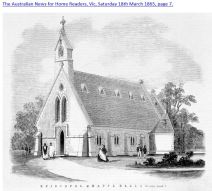
The Australian News for Home Readers, Vic, Saturday 18th March 1865, page 7.

BALLAN St John's 98c

“EPISCOPAL CHAPEL AT BALLAN,

The neat little building, shown in the engraving, is the newly erected Episcopal Chapel, at Ballan, a distance of about sixty miles from Melbourne. The building has been raised solely by the exertions of the congregation, and is a pleasing instance of the progress of Christianity in the provincial districts of Victoria. The chapel belongs to the Gothic order of architecture, and is commodious enough to meet the requirements of the Episcopalians of Ballan. The nave is 57 feet by 25 feet in extent, and chancel 10 feet 3 inches by 21 feet.”

Juliets’ husband Charles died at ‘Ballanee’ estate at Ballan on the 13th February 1905 aged 79[5].

In the historical engraving depicting St John’s from 1865 it shows  a ‘Pugin’ type bell-cote at the west end and a small side building at the east end which is presumably a vestry. Neither of these exist to this day.

The left lancet of the Ferguson & Urie window which depicts ‘Faith’ is taken from a famous oil painting by Sir Joshua Reynolds (1723-1792) and replicated in a stained glass window by Thomas Jervaise at Holy Trinity, Fareham, Hampshire, England. There are three other known instances of this depiction of ‘Faith’ in Ferguson & Urie windows which are located at All Saints, South Hobart; Christ Church, Hawthorne; St Mark’s, Remuera, New Zealand.

In 1883 another Ferguson & Urie window was erected in St John’s to the memory of Rebecca Mary O’Cock. See: 10-03-1883: St John’s Church, Ballan, Victoria.

Location: Simpson Street Ballan

Footnotes:

1870: St Patrick’s Catholic Church, Kilmore, Victoria.

In 1869-70 a large four light stained glass window “considered one of the best specimens that ever left the manufactory of Ferguson and Urie” was erected in the liturgical east wall of St Patrick’s Catholic Church at Kilmore in Victoria. The window was crafted in Curzon Street North Melbourne by the Ferguson & Urie Stained Glass Company and depicts the Nativity, Baptism, Crucifixion and Resurrection.

Construction of St Patrick’s began in 1856 and the foundation stone was laid on the 23rd August 1857 by Bishop James Alipius Goold. The church was built to the designs of brothers Joseph Aloysius Hansom  & Charles Francis Hansom and was completed in 1860. It was dedicated on the 8th July 1860[1] and remaining works were completed by architect William Wardell in 1871.

Photos taken 14th December 2013.

This slideshow requires JavaScript.

[View all images]

GLIMPSES OF NORTH EASTERN VICTORIA, AND ALBURY NEW SOUTH WALES, Rev. William Mason Finn, 1870, page 6.

“..Father Branigan is a native of Drogheda, Ireland, studied in the famous college of Salamanca, and was ordained in Melbourne, June 1858. This rev. gentleman is still the senior priest of Kilmore, and has evinced a warm zeal for the noble people entrusted to his guardianship. During the last twelve months he has added to St. Patrick’s Church a splendid chancel, which contains three altars; over the central, or High Altar, a stained glass window of large dimensions, representing many episodes in the life of our Redeemer, is placed. This window is considered one of the best specimens that ever left the manufactory of Ferguson and Urie, of Melbourne…”

The window depicts four scenes in the life of Christ being: the Nativity, Baptism, Crucifixion and Resurrection. A reference to a chapter and verse from the bible is recorded beneath each of the four scenes:

NATIVITY – “St Luke 2-7”
(And she brought forth her firstborn son, and wrapped him in swaddling clothes, and laid him in a manger; because there was no room for them in the inn)

BAPTISM – “St Mark 1-10”
(And straightway coming up out of the water, he saw the heavens opened, and the Spirit like a dove descending upon him)

CRUCIFIXION – “St John 19-26”
(When Jesus therefore saw his mother, and the disciple standing by, whom he loved, he saith unto his mother, Woman, behold thy son!)

RESURRECTION – “St Matthew 28-6”
(He is not here: for he is risen, as he said. Come, see the place where the Lord lay)

In June 1894 a prolific tabloid writer known as “The Vagabond” gave his own vision of the window:

“…The stained glass window representing scenes in the life of Christ reflects the sun’s rays, which shine on the bowed heads of the daughters of Kilmore…”[2]

Fr. Michael Branigan (1834 – 1870)

The concept for a stained glass window to beautify the east end of the church is reported to have come from the Reverend Michael Branigan, parish priest of Kilmore from 1861 to 1870.

Michael Branigan was born at Oldbridge, on the Boyne, near the town of Drogheda, Ireland, in 1834[3]. At the age of 24 he arrived in Melbourne aboard the “White Star”[4] on the 4th September 1857[5].

He was ordained at St Patrick’s Cathedral in Melbourne on the 20th June in 1858[6] by the Bishop of Melbourne, James Alipius Goold and was appointed parish priest at Kilmore after the death of the Reverend Timothy O’Rourke who died on the 18th January 1861[7].

J. A. Maher 1869-1940, The Tale of a Century – Kilmore 1837-1937, Page 86.

“…In 1856 the movement to build the large and commodious Gothic church (St. Patrick’s of the present day) was inaugurated by Father O’Rourke. The foundation stone was laid on 23rd August, 1857. Beneath the stone was placed a bottle containing on parchment a Latin inscription of which the following is a translation: “The first stone of this church, dedicated to God under the patronage of St. Patrick, in Kilmore, in the province of Victoria, was laid by James Alipius Goold, Bishop of the Diocese, on the 23rd day of August, 1857 in the pontificate of Pope Pius IX, and in the reign of Her Most Gracious Majesty Queen Victoria, and during the administration of this Government by His Excellency Sir Henry Barkly, K.C.B.” The church was dedicated on 8th July, 1860. After Father O’Rourke’s death on the 18th January, 1861, Father Branigan was appointed to the charge of Kilmore. Father Branigan arrived in Australia in 1857. For a time he acted in the capacity of assistant priest at Keilor, later coming to Kilmore as curate under father O’Rourke. Afterwards he was temporarily in charge of the infant parish at McIvor (subsequently Heathcote). Then came the more important appointment as parish priest at Kilmore. This young priest, who did not enjoy robust health, devoted himself unsparingly to the welfare of his flock over what was still a very extensive parish. Various schools were opened and St. Patrick’s Church was practically completed whilst father Branigan was in charge. As a matter of fact the solemn opening ceremony at the church took place in March 1871, just nine months after the death of father Branigan (9th June, 1870).”[8]

A short time after the erection of the Ferguson & Urie window (c.1869-70), the Reverend Branigan became seriously ill and on the 9th of June 1870 the local Kilmore tabloid reported that he was improving:

“We are glad to be able to inform our readers that the Rev M Branigan, who has been dangerously ill for the past eight or nine days, has experienced a change for the better, and hopes are entertained that he will soon be convalescent.”[9]

Unfortunately this was a rather premature report by the Kilmore Free Press as Fr. Branigan died at the Presbytery at 4.30 p.m. on the same day! His last words were reported as having been “Oh, poor Ireland![10] He was only 36 years old.

On the 10th of July 1870 a meeting was held in St Patrick’s school room to discuss the erection of an altar in the church which was to be a joint memorial to Fr. O’Rourke and Fr. Branigan[11]. In March 1873 it was reported that the altar was “…on its way to these shores from the home country…” which I presume was Ireland. The entire cost for the erection of the altar would be in the vicinity of £700[12].

The altar was consecrated on the 31st August 1873 by Bishop James Alipius Goold and in anticipation of a large crowd for the occasion; admission to the church was gained by ticket only[13].

Significant tabloid transcriptions:

The Argus, Melbourne, Vic, Friday 10th June 1870, page 5.

“KILMORE, THURSDAY.

The Rev. Michael Branigan, Roman Catholic clergyman, who, as pastor here for the last nine years, was much respected, died this morning at half-past 4. His remains will be interred in a vault at St. Patrick’s Church, Kilmore, to-morrow.”

Bendigo Advertiser, Vic, Saturday 11th June 1870, page 2.

“DEATH OF THE REV MICHAEL BRANIGAN, OF KILMORE.- From the Kilmore Free Press we learn of the death of the Rev Michael Branigan, of St. Patrick’s, Kilmore, which melancholy event took place at the presbytery this (Thursday) morning, at half-past four o’clock, after having been confined to his bed for a period of eight days. As a gentleman, Father Branigan commanded the respect of those with whom he came in contact, whilst as a clergyman his zeal in the performance of his sacred duties, at all times of a most arduous nature, in consequence of the large circuit under his control, was of a marked character, he being more frequently found at all hours of the day and night seeking out the abodes of those stricken down with sickness or disease, for the purpose of administering the consolations of religion, than attending to the wants of a constitution fast becoming a wreck to fatigue and exposure he was but ill-adapted to endure. His was an existence of self-sacrifice, and his own life was to him as nothing when compared with the eternal salvation of the many souls over which he was appointed guardian. What he gave to the poor, and those who appealed to him for aid, was given with the utmost free will, and his deeds in this respect, though numerous, were never made known by himself, and would die with him had the recipients of his bounty not frequently openly expressed their gratitude. The late Rev Michael Branigan was born in the historic hamlet of Oldbridge, on the Boyne, near the town of Drogheda, in the year 1834, which left him only thirty-six years at the time of his demise. The immediate cause of his death was inflammation of the bowels, brought on by exposure to cold in the discharge of his up-country duties. He died calm and resigned, having been fortified with the sacraments of that church of which in life he was such an ornament. He was to be buried yesterday (Friday) in a vault prepared for him in the church. He was, we understand, left by his will what he possessed to the cause of charity.”

The Bacchus marsh Express, Vic, Saturday 18th June 1870, page 4.

“DEATH OF THE REV. MICHAEL BRANIGAN.- The Kilmore Free Press announces the decease of this clergyman of the Roman Catholic Church, on Thursday morning, from inflammation of the bowels, brought on by exposure to cold in the discharge of his country duties. On the 20th June, 1858, the Rev. M. Branigan was ordained priest in St. Patrick’s Cathedral by the Right Rev, the Bishop of Melbourne. He was then appointed as second priest in Keilor. Here he remained for some time, when he was transferred to Kilmore as junior priest, to act with the late lamented Father O’Rourke. A change of pastors then took place at McIvor, when Father Branigan was nominated to the vacancy. Since he assumed the pastorate of Kilmore many schools have been opened, and the improvements just made at the church speak of his zeal. On Friday, after the Requiem mass, the mortal remains of father Branigan will be interred in a vault already prepared in the church. He has, we understand, left by his will what he possessed to the cause of charity.”

Kilmore Free Press, Vic, Thursday 23rd June 1870, page 3.

“We are informed that the last words spoken by the late Rev M Branigan, of St. Patrick’s Kilmore, were “Oh, poor Ireland!” During life he took a deep interest in all questions connected with the land of his birth, and it is pleasing, as showing a pure spirit of patriotism and love, that his mind during the last solemn moments of his existence, reverted to a country, the welfare of which he had always so much at heart.”

Kilmore Free Press, Vic, Thursday 14th July 1870, page 2.

“A meeting of subscribers to the memorial for the late Rev. M. Branigan was held on the 10th instant in St Patrick’s Schoolroom – the Rev. Robert Meade occupying the chair. A discussion ensued as to the advisability of coupling the name of the late rev. T. O’Rourke with that of the Rev. M. Branigan upon the memorial altar which it is proposed to erect, but nothing definite was arrived at. We are certain that those of the subscribers who had the pleasure of knowing the late Rev. T. O’Rourke would be pleased that the name should be coupled with the memorial, whilst it is evident that many persons subscribed to the undertaking, knowing nothing of Father O’Rourke solely with a view of showing their high appreciation of Father Branigan. Perhaps, if a general meeting of subscribers was called, and expression of opinion could be elicited which would meet with the views of all parties.”

Kilmore Free Press, Vic, Thursday 6th March 1873, page 2.

“We are in a position to state that the memorial altar, subscribed for some time ago, to perpetuate the memories of the late Rev. Fathers O’Rourke and Branigan, is now on its way to these shores from the home country, where it has been constructed. The contract price for what really must be a grand monument was £550, and freight and cost of erection in the church of St. Patrick’s, Kilmore, which it is intended to ornament, will, it is contemplated bring the amount up to £700. The work, however, is one of which people here may be proud, and there could be no more fitting monument to commemorate the zeal and devotion of the reverend gentlemen who did so much for religion in this quarter.”

Points of interest:

In 1868 a very similar window by Ferguson & Urie was erected at St John’s Church in Toorak. See: 26-06-1868: St. John’s Church, Toorak, Melbourne, Victoria.

Fr. Branigan’s successor to the Kilmore Parish was the Rev Michael Farrelly (c.1822-1906). A three light memorial window was erected in his memory on the right side of the east wall in the “St Joseph’s Chapel” in St Patrick’s in 1908. This window was made by Melbourne stained glass craftsman William Montgomery(1850-1927). See: 1908: St Patrick’s Catholic Church, Kilmore, Victoria.

Acknowledgements:

My thanks to the Rev. Grant O’Neill of St Patrick’s Kilmore, 14th Dec 2013.

Footnotes:

[5] Public Record Office Victoria, Fiche 131, Page 013 (surname spelt ‘Brannigan’)

[8] James Alipius Maher 1869-1940, “The Tale of a Century – Kilmore 1837-1937”, Page 86.

1874: Sacred Heart College, Newtown, Geelong, Victoria.

Sacred Heart College at Newtown, Geelong, contains a number of historic stained glass windows created by the Ferguson & Urie Stained Glass Company circa 1874.

Originally established as a Convent and boarding school by the Sisters of Mercy in 1860 it was extended over a number of years and in 1874 a Gothic chapel was built to the designs of Melbourne architect Thomas Anthony Kelly and was formally opened on the 24th of May 1874 [1].

The liturgical east end of the chapel contains one of the most unique stained glass windows produced by the Ferguson & Urie Company and was designed by the firm’s senior artist David Relph Drape (1821-1882). What is probably even more remarkable is that the original design for this window still exists amongst a collection of sketches by Drape at the State Library of Victoria.

“The most outstanding feature of the ornate domed sanctuary is a large stained window on the rear wall above the altar. The window was a gift to the sisters from the families of the early boarders.”[2]

Photos taken: 17th October 2013.

This slideshow requires JavaScript.

The liturgical east window is technically known as a five light window with a series of smaller stained glass windows in the tracery above. The two outer lights depict the fourteen scenes of the Stations of the Cross which represent the significant events Jesus endured in the hours leading to his death.

Each of the fourteen scenes have been intricately designed and painted by Drape to closely represent the scenes as they have been represented in many publications over the centuries.

The scenes are:

1st:  Jesus is condemned to death

2nd: Jesus carries His cross

3rd: Jesus falls the first time

4th: Jesus meets his mother

5th: Simon of Cyrene helps Jesus to carry his cross

6th Veronica wipes the face of Jesus

7th: Jesus falls the second time

8th: Jesus meets the women of Jerusalem

9th: Jesus falls a third time

10th: Jesus clothes are taken away

11th: Jesus is nailed to the cross

12th: Jesus dies on the cross

13th: The body of Jesus is taken down from the cross

14th: Jesus is laid in the tomb

The centre light of the window contains a life size depiction of Jesus and his Sacred Heart and below that is the Pelican in the act of self sacrifice feeding its young with blood from her chest.

The smaller windows in the tracery above contain a quite complex series of biblical symbols which mostly represent some of the Instruments of the Passion. The symbolism represented in the upper tracery of the window are;

The Scourging Post

The Seamless Garment,

The Bread of Life or Holy Sponge?

The Holy Chalice & Host,

The Crown of Thorns with the Three Nails,

The La Salette Crucifix with pincers and hammer on either side.

The four evangelists depicted as their winged biblical representations;

Mathew (the Angel), Mark (the Lion), Luke (the Ox) and John (the Eagle).

The centre of this arrangement of windows in the tracery contains the “Agnus Dei” – Lamb of God carrying the victory banner with cross to represent the risen Christ, triumphant over death.

In the south wall near the east window are another two Ferguson & Urie windows set in rose or wheel shaped tracery. Each window contains three quatrefoils with biblical scenes and smaller windows around the edges contain cherubic angels to give the whole arrangement the appearance of a round window.

The first rose window contains the following three scenes:

1. St Christopher with Jesus on his shoulders – Christopher was known as a man of great strength who devoted himself to Jesus by helping travellers cross a dangerous river. One day a child asked to ride on Christopher’s shoulders across the river, but the child grew heavier and heavier with every step. When they arrived on the other side, the child identified himself as Christ and told Christopher he had just carried the weight of all the sin of the world. St Christopher is best known as the patron saint of travelers!

2. The Presentation of Jesus at the Temple – This event is described in the Gospel of Luke (2:22-40). Mary and Joseph took the baby Jesus to the Temple in Jerusalem to complete Mary’s ritual purification after childbirth and to perform the redemption of the firstborn. Luke explicitly says that Joseph and Mary take the option provided for poor people (those who could not afford a lamb –Leviticus 12:8), by sacrificing a pair of turtledoves, or two young pigeons. One was for the burnt offering and the other for a sin offering.

3. The Flight into Egypt – The Flight into Egypt is described in Matthew (2: 13-23), in which Joseph and Mary fled to Egypt with baby Jesus after learning that King Herod intended to kill all the infants of the area in the hunt for the baby Jesus.

(The Flight into Egypt scene in this window has also been matched to one of the original drawings by Drape located at the State Library).

The second rose window contains the following three scenes:

1. The Nativity – The baby Jesus is shown in the manger with emanating rays of light.

2. The Annunciation – This is described in Luke (1:26-38) where the Angel Gabriel was sent from God to visit the Virgin Mary and told her that she was with child who was the son of God and to name him Jesus.

3. Visit of Mary to Elizabeth – The Visit of Mary to Elizabeth (Luke 1. 39-56).

Outside the chapel, above a door in the hallway, is a round window by Ferguson & Urie depicting the Madonna and Child and at the far end of the hallway at the landing of the first flight of stairs are two single light windows. One depicts the Sacred Heart of Jesus and the other a monogram of the letters “AM” (Auspice Maria).


The founder of Sacred Heart – Mother Mary Cecilia Xavier [Elizabeth Maguire] (c.1819-1879)

Elizabeth Maguire was the eldest daughter of Richard Maguire and Margaret McCann and was born in County Meath Ireland circa 1819 [3].

She entered the Mercy Convent in Baggot St, Dublin, Ireland on the 1st May 1843, took the name Sister Mary Cecilia Xavier and was professed on the 26th November 1845. Three of her younger siblings also followed in her footsteps [4].

On the 25th May 1855 she was elected as Mother Superior of the Baggot Street Convent for a term[5] and in 1859, Archbishop James Alipius Goold of Melbourne, petitioned the Sisters of Mercy in Dublin to establish a community in Australia at Geelong.

Mother Maguire, in the company of five other Sisters of Mercy; Sherlock, Mullally, Lynch, Manly and Ryan, they departed Liverpool in ‘Saloon Class’ aboard the Ocean Chief on the 7th September 1859[6].

On the 28th November 1859, after 83 days at sea, the ship arrived in Hobson’s Bay and the following day the ships passengers penned a testimonial letter of thanks to Captain William Brown of the Ocean Chief to which “The Six Sisters of Mercy” were a signatory to[7].

After a short stay in Melbourne as the guests of Mother Ursula Frayne at the Nicholson Street Convent in Fitzroy, they boarded the train for Geelong and arrived at St Augustine’s Orphanage on the 3rd of December;

 “ARRIVAL OF NUNS.- Amongst the passengers by the Ocean Chief were Mrs. McGuire, the superioress or the principal of Bagot-street convent, Dublin, and five other nuns of the Order of Mercy. Their ministrations will be confined for the present to Geelong, whither they go to-day, and they will assume the control and conduct of the St. Augustine’s Orphanage, and other charities of the town. Ultimately, as the sisters become more intimately acquainted with the district, their sphere of action will be extended.- Herald.”[8].

The Sacred Heart Convent of Mercy began in a house named ‘Sunville’ in the Mercer’s Hill estate at Newtown, Geelong, which was formerly owned by the wealthy Geelong solicitor Joseph William Belcher (1784-1865). As early as January 1855 agents for Belcher, who had returned to Ireland in 1852, had been advertising the property ‘to let’ with the advertisements describing it as;

“…Being a large and commodious House, is very suitable for a Boarding School, or Seminary for young ladies…”[9].

It wasn’t until January 1859 that Sunville was eventually to be used as a boarding school when Mrs Sarah Scales (c.1821-1884) [10], the wife of independent congregational minister Reverend Alfred Scales (c.1814-1893)[11], moved her pupils from their premises in Virginia street[12] to Sunville on the 18th January 1859 [13]. Mrs Scales’s boarding school was still at Sunville as late as July 1859 [14] but within a few months of the arrival of the Sisters of Mercy in December, the Sunville mansion and twelve acres of the surrounding Mercer’s Hill estate would become the home of the Convent of Our Lady of Mercy.

On the 17th of February 1860 the Argus Newspaper reported;

“The house and grounds known as Sunville, on Mercer’s Hill, have been purchased for a convent by the Catholic clergymen here. There are about 12 acres of pleasure-grounds attached to the mansion, which is in every respect well adapted for the purpose. Six ladies of the Order of Mercy, who were sent out from the parent house in Dublin by Mrs. Cecilia Zavier McGuire [sic], have arrived in Geelong, for the purpose of establishing this new institution. Some of these ladies are said to have been in the Crimea on the same holy errand. They will attend the poor, the maimed, the sick, and the dying at their own homes, and in the public hospitals, and will superintend a boarding and day school to be attached to the institution. Mrs. McGuire is the founder of the Mater Miserecordia [sic] Hospital also. The house and grounds of Sunville are beautifully situated for the purpose for which they have been brought.”[15]

In late April 1860 the Sisters advertised for their first boarders and Mother Mary Cecilia Xavier Maguire would be the first Mother Superior of the new institution[16].

The following fourteen years saw the rapid expansion of the convent buildings with the Orphanage building erected in 1864, the boarding school in 1869 and the chapel in 1874.  The construction of the chapel was not without mishap as the newly erected belfry-wall and corridor-gable blew down in a storm on the 19th December 1873[17]. They decided not to continue with the construction of the belfry and within six months the building was ready to be opened.

The official opening occurred on Sunday the 24th May 1874 and the Melbourne Argus reported;

“The new conventual church at Newtown-hill was formally opened this morning, in the presence of about 400 persons. The dedication ceremony was performed by the vicar-general. Previous to this the children of the convent formed a long procession, and marched several times through and around the church. They were all dressed in white. The children of St. Mary’s headed the procession, wearing wreaths of blue flowers and scarfs of the same colour. The children of the Sacred Heart followed, wearing rich crimson regalia. Then came the children of St. Catherine’s, with brilliant green scarfs, followed by the Orphan and Industrial School children. The effect altogether was very striking. After the dedication ceremony, High Mass was celebrated by the Archdeacon Slattery, assisted by the Rev. Fathers Kelly and Hegarty. The Rev. Father Kelly afterwards preached a sermon suitable to the occasion. About £300 was obtained from the collection. During the afternoon two young ladies took the veil.”[18]

On the 30th August 1879 Mother Mary Cecelia Xavier Maguire died at the age of 60 and was interred in the Convent cemetery[19].

Today the historical establishment founded by the Sisters of Mercy in 1860 is known as Sacred Heart College which celebrated its 150th anniversary in April 2010.

Acknowledgements:

Thanks to Claudette Brennan, Archivist of Sacred Heart College, for inviting us to see and photograph the windows and for her very generous time to show us around and impart her extensive knowledge of the history of the College.

Footnotes:

[1] The Argus, Melbourne, Vic, Monday 25th May 1874, page 5.

[2] Mercy Girls, The Story of Sacred Heart College Geelong 1860-2010, Watts, Turnbull, Walsh, 2010, Sacred Heart College 2010. P22.