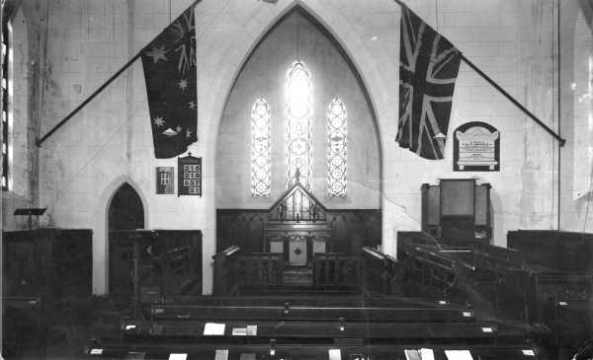
23-07-1883: St James’s Old Cathedral, Melbourne.

The foundation stone of St Jame’s was originally laid in 1839 by the newly appointed Superintendent of the Port Phillip District, Charles La Trobe, later to be Governor of the Colony of Victoria. The Church was opened in 1842 and the first Bishop, Charles Perry, installed in 1848.

In 1883 the church underwent extensive renovations and one of the alterations was the replacement of the plain chancel window with a handsome stained glass window, enriched with scripture textswhich was made by Ferguson & Urie of North Melbourne.

In 1891 St James’s status changed back to that of a Parish church when St Paul’s Cathedral opened in Swanston Street. When the church was condemned in 1913 there were concerns that the parish could not afford the repairs or rebuilding of St James’s on the current site. Considerable funds were subsequently realised for the sale of the land which enabled the church to be dismantled and moved to a new location. Whelan the Wrecker was contracted to perform the move in 1913 and so it was relocated stone by stone to its present site on the corner of King and Batman streets under the direction of Messrs Thomas Watts and Son, architects. The church was re-consecrated by Archbishop Lowther Clark, and opened on the19th of April 1914.

A close inspection of the stained glass window in the chancel clearly shows that it had been shortened from its original height and this would have most likely occurred as a result of the ceiling height being reduced when the church was reconstructed in 1914.

Photos taken 21st August 2010.


This slideshow requires JavaScript.

The Argus, Melbourne, Vic, Monday 23rd July 1883, page 5.

“St. James’s Church, which has recently undergone extensive repairs, was re-opened yesterday morning by the Bishop of Melbourne, assisted by the Dean. There was a very large congregation. The bishop preached the sermon. One of the alterations is the substitution of a handsome stained glass window, enriched with scripture texts, for the plain coloured glass window that was formerly in the chancel. There is also a new altar cloth, in red velvet, beautifully decorated by some young ladies of the congregation, and the drapery of the reading-desk and pulpit is likewise new and of the same material. The bishop’s throne has been re-covered and the chancel has been re-carpeted, and the whole interior of the church has been brightened up. In the renovations the organ has not been neglected. A tablet in memory of the late Rev. M. H. Becher, who was incumbent of the church for 22 years, has been affixed tot he walls by parishioners. A very interesting relic in this church is the marble font which was formerly in St. Catherine’s Church, London, but was secured by the late Governor Latrobe when that church was pulled down in order to make room for docks, and presented to St. James’s. The age of the vessel is not known, but it has been in use in St. James’s for 35 years.”

The Argus, Melbourne, Wednesday 21st May 1913, page 12.

“ST. JAMES’S OLD CATHEDRAL”

“POSSIBLE DEMOLITION”

Those citizens of Melbourne who are interested in the historic landmarks of the city in the shape of old buildings, will regret to hear that St James’s Old Cathedral, situated between William and King streets, in Little Collins street, Melbourne, is marked for destruction. The information was made public by the incumbent of St James’s, the Ven. Archdeacon Hindley, vicar-general of the diocese, during the course of his sermon on Sunday. The Archdeacon stated that the building had been condemned as unsafe, and that the conduct of services therein would have to be discontinued. It appears that recent rains had left pronounced damp stains on the walls of the chancel, and the trouble became so aggravated that an expert architect’s advice was sought. A close inspection of the building disclosed the fact that the chancel was in imminent danger of collapse. The chancel arch was discovered to be not an arch at all, but a lath and plaster screen covering the stone wall, and resting for support upon an Oregon pine girder. This girder in turn was found to rest upon a layer of mortar, which is crumbling away. The girder itself is badly affected with dry rot, and the whole position was found to be so unsatisfactory that the church wardens decided to suspend worship in the church rather than run any risk of accident. The foundation stone of St James’s Church was laid on November 9, 1839, by Governor C. J. Latrobe, and the church at one time filled a very prominent place in the religious life of the city. However, the residential population which might provide a congregation for St James’s has long since ebbed far out from its area. The question of the reconstruction or demolition of St. James’s church is one for the council of the diocese to settle, and that body will probably consider the matter at its next meeting on June 7. It is certain that the present casual congregation could not raise the funds necessary either for the repair or rebuilding of the church. When speaking on the subject yesterday afternoon, the chancellor of the diocese, Mr. McLennan, said that for a long time past a great city mission, under the aegis of the Anglican Church had been talked of, and this projected movement might influence the determinations with regards to St. James’s. He did not speak officially, but his own views were that the St. James’s site might be found of great value in relation to such a scheme, while the church, as a place of worship, was admittedly very near the Cathedral for rebuilding. In any case, great interest attaches to the fate of the historic edifice”.

 Annear, Robyn. 2005: A City Lost & Found: Whelan the Wreckers Melbourne; Black Inc Publisher, Melbourne, pages 21-22.

 “It was Jim Whelan’s task to dismantle the church and cart it in pieces to the new site, less than a mile away. The solid stones of the outer wall were kept – each one carefully numbered for re-erection – but the inner walls, of compacted shells and rubble, were replaced on the new site with reinforced concrete. Changes were made, too, in the old cathedral’s design. The ceiling was lowered, supporting columns omitted, and the tower altered once more, this time to improve the peal of the bells – it was a long time since it had been safe to ring them.

One stone that didn’t make it to the new site was the foundation stone of the old St James’. Charles La Trobe, newly landed Superintendent of the Port Phillip District, had laid the stone in 1839. There being no monumental mason in the town at that time, the foundation stone had gone unmarked. The words that ought to have been inscribed theron were read aloud by La Trobe from a parchment which, along with a few coins, was poked into a bottle and thence into a niche in the foundation stone. Seventy-five years later, neither bottle nor foundation stone came to light. It was supposed that, being unmarked, the stone had simply escaped notice in the course of relocation and its contents lost – or else, that both had been missing since 1850 when the original foundations were replaced. In 1929, however, the then-minister of St James’s claimed to have discovered the truth of the matter.

‘I found that the carter who transferred the material to the new site was responsible for destroying the foundation stone. He accidentally broke it and then threw the parts on the rubbish heap and gave the contents to his friends, keeping the most valuable himself’.

Had the carter unburdened himself, I wonder, or been unburdened on?. Aside from his fee, Jim Whelan didn’t carry much away from the St James’ job. The only lasting trace would be an in-house joke, that ran like this – One of Whelan’s men wrote to his folks in Ireland: “Australia’s a great country. Back home we wreck Protestant churches for nothing; here, they pay you to do it.” Years later, an alleged relic would occupy pride of place at Whelan the Wrecker headquarters. It was a wrecker’s bar with the inscription: “Used for wrecking Protestant churches.”

Related posts:

27-07-1885: St Paul’s Pro Cathedral, Flinders St, Melbourne, Victoria.


Short link to this page: https://wp.me/p28nLD-10V
© Copyright

18-10-1884: The Risby Memorial window, St George’s, Queenscliff, Victoria.

The stained glass window by Ferguson & Urie was erected  to the memory of the St George’s church choir member, Susanna  Lavinia Risby who died at the age of twenty seven on the 29th January 1884. The window was  installed in the west wall of St George’s Anglican Church in Queenscliff in early October 1884. It depicts Saint Cecilia, the patroness of musicians and Church music.

Between the year of the opening of the church in 1864 and the year 1892, all the windows of St George’s were fitted with stained glass window by Ferguson & Urie and a number of these were restored by Bruce Hutton of Almond Glass in 2005. In 1958 a vestry was added to the church and in 1995 two modern stained glass windows were placed in the vestry created by stained glass artist Derek Pearse.

Only the Risby memorial window is displayed here. See bottom of page for other related posts for St George’s stained glass. Photos were taken 25th September 2010.

Queenscliff Sentinel, Saturday 18th October 1884, page 1.

“A beautiful lancet-shaped stained glass light, from the factory of Messrs Ferguson and Urie, of Melbourne, having for its centre figure St Cecilia, the patroness of church music, has this week been placed in the West end of St George’s Church, by her relatives in memory of the late Miss Risby, who was one of the members of the choir”.

This slideshow requires JavaScript.

[View larger images]

The Argus, Melbourne, Thursday 31 January 1884, page 1.

“THE remains of SUSANNAH LAVINIA RISBY, of Queenscliff, youngest daughter of the late Thomas Risby, will be interred in the Melbourne General Cemetery THIS DAY (THURSDAY), 31st January, 1884. The funeral will leave the Spencer-street railway station on the arrival of the 10 o’clock a.m. train from Geelong”.

Susannah was buried with her parents at the Melbourne General Cemetery but her name is not mentioned on the memorial stone.

The Queenscliff Sentinel, Saturday 2nd February 1884, page 2.

“We regret to record the death of a young lady, Miss Risby, who during her residence in our community has shown a quiet example of good works, especially in the choir and in the Sunday school of St. George’s Church. Her cheerful disposition and willingness to oblige made her a great favourite wherever she was known. Great men pass away and are missed; but humble workers, by their unselfishness and little deeds of kindness, help in their own way, to make the world happier and better to live in”.

The Queenscliff Sentinel, Saturday 2nd February 1884, page 2.

“TO THE EDITOR OF THE SENTINEL”

“I desire to return sincere thanks on behalf of myself and the late Miss S. Risby’s sisters, to the numerous kind friends on Queenscliff, who have during her long illness shown such constant,  unremitting attention in every way possible for a neighbour to do. To mention names would be invidious, nay, almost impossible, but the loving services will always be present to our minds in connection with the, to us, sad event, – to her the glorious change.

CHAS.  CURTIS. Neptune Cottage, Jan 30, 1884″.

Related posts: 22-02-186429-01-186613-08-186712-02-1881 07-04-1882 >18-10-1884 > 30-12-1893


Short link to this page: https://wp.me/p28nLD-Xy

© Copyright

1864-67: St Peter’s Anglican Church, Ballarat, Victoria.

St Peters Anglican Church in Sturt Street Ballarat was designed by C. D. Cuthbert circa 1864.  The chancel was added in 1877 along with the stained glass windows in the chancel by Ferguson & Urie. The tower was added in 1891 and Soldiers memorial chapel in 1917.

Photos were taken 19th September 2010 & 17th March 2011

This slideshow requires JavaScript.

[View larger images]

Church of England Messenger, 9th August 1877, page 14.

“The stained-glass window for the chancel of St. Peter’s Church has arrived in Ballaarat, and was placed in position. It is a very good specimen of Messrs. Ferguson and Urie’s art, and it is a matter of congratulation that such excellent workmanship can be produced in the colony. The window is divided into three lights, surmounted by tracery pierced with trefoils. These trefoils are filled with richly-coloured glass, bearing upon a starry background the three emblems of faith, hope, and charity; the heart with the sacred monogram, the cross with the crown of thorns, the anchor with the dove and olive branch. The subject of the central light is the “Ecce Homo.” The side lights, having reference to the pious and charitable lives of the ladies in whose memory the chancel was erected. are illustrations of Mark XIV, 8 (“She hath done what she could’) and Matthew XXV. 40 (“Inasmuch as ye have done it unto one of the least of these My brethren, ye have done it unto Me”). In the central light the Saviour stands forth a solemn and mournful figure. Pilate and a Roman soldier occupying the background. Underneath there is a panel with a small but exceedingly well-drawn picture of Christ’s charge to Peter – “Feed my Sheep.” In the apex of the window is the emblem of the Holy Spirit, the dove, descending with rays of light. The right hand picture of Mary wiping the Saviour’s feet with her hair is remarkable for the beauty of the Saviour’s countenance and the grace of His gesture. In the light upon the left-hand side a female figure is casting a garment around an aged man and a child at her feet. The background of both of these pictures is of a similar character – a low wall decorated with scroll-work, overtopped with trees and flowers, the sky space being filled in with ruby glass in irregular lead-work. Underneath are the old church emblems – the Agnus Dei and the Pelican; and above are the Alpha and Omega. The side window, which can be seen only upon entering the chancel, is the more special memorial window, having the upper part a scroll with the text – “Write, Blessed are the dead which die in the Lord;” and at the bottom, a panel with the memorial inscription. The quarries of which the rest of the window is composed are ornamented with fleurs-de-lys, and the effect of the whole is highly satisfactory. The organ has been inspected on behalf of the church authorities, and is pronounced a first-class instrument. No time will now be lost in erecting it in the church.”

The Chancel window:

This is the main three light chancel window that depicts scenes from: MATT 25-40, JOHN 19-5 and MARK 14-8. The tracery above the three main lights shows three trefoil windows depicting the symbolism of Faith, Hope and Charity. The main lights of the window depict the following:

MATT 25-40: The King James version of Matthew 25-40 reads: “And the King shall answer and say unto them, Verily I say unto you, Inasmuch as ye have done it unto one of the least of these my brethren, ye have done it unto me.”  The figure depicted in the window is of a woman covering a beggar man and his daughter with a cloak to shield them from the cold. The most commonly recognised interpretation of Matthew 25-40 would be the old “Golden Rule”; “Do unto others as you would have them do to you” or “One should treat others as one would like others to treat oneself.” Below the scene is the Pelican feeding its young from blood from its chest, which represents sacrifice.

JOHN 19-5: The King James version of John 19-5 reads: “Then came Jesus forth, wearing the crown of thorns, and the purple robe. And Pilate saith unto them, Behold the man!” The scene depicted in the window is of Jesus wearing the crown of thorns. His hands are bound, he’s wearing the purple robe, and he is flanked by Roman guards. In the hours before Christs crucifixion, he was led through what we would call a ‘kangaroo court’ which has no sense of justice. The Roman Governor, Pontius Pilate, had him whipped and had a crown of thorns placed upon his head and clothed him in a purple robe, mocking some sort of regal adoration. Pilate paraded Jesus before the crowd and exclaimed, “Behold, the man!” Below is the scene of Christ as the Good Shepherd with a ribbon of text which reads: “PETER LOVEST THOU ME, YE LORD THOU KNOWEST THAT I LOVE THE, FEED MY SHEEP.” This refers to John 21-17; “He saith unto him the third time, Simon, son of Jonas, lovest thou me? Peter was grieved because he said unto him the third time, Lovest thou me? And he said unto him, Lord, thou knowest all things; thou knowest that I love thee. Jesus saith unto him, Feed my sheep.”

MARK 14-8: The King James version reads: “She hath done what she could: she is come aforehand to anoint my body to the burying.” The scene in the window depicts Mary Magdalene, the alleged prostitute, drying Christs feet with her hair. Nearby is a small ornate jug which is supposed to have contained an expensive aromatic ointment which was to be used to ‘anoint” him before his death. Below is the image of the Paschal Lamb carrying the St George banner.

The two light window in the nave:

The ‘John Laverick Nunn’ Memorial window is a two light window with the memorial text:

“PLACED BY ELIZA NUNN IN MEMORY OF HER HUSBAND JOHN LAVERICK NUNN DIED 1875 AGED 46. | ALSO HER DAUGHTER HANNAH MARY DIED 1883 AGED 23 AND HER SON JOHN LAVERICK DIED 1884 AGED 22”.

This window was erected in St Peters in January 1886.

The scroll text on the left lancets reads:

“THE LORD GAVE AND THE LORD HATH TAKEN AWAY BLESSED BE THE NAME OF THE LORD” (Job 1:21 – “And said, Naked came I out of my mothers womb, and naked shall I returne thither: the Lord gaue, and the Lord hath taken away, blessed be the Name of the Lord.”) “THEN ALSO WHICH SLEEP IN JESUS WILL GOD BRING WITH HIM”. (1 Thessalonians 4:14 – “For if we believe that Jesus died and rose again, even so them also which sleep in Jesus will God bring with him”.) John Laverick Nunn was born in Whitby, Yorkshire, England, in 1830. He married Eliza Newson in Victoria in 1857 and they settled in the Warrenheip area at Dunnstown, near Ballarat circa 1860 where they became store keepers. John contributed to the Buninyong Presbyterian Church building appeal.  He died on the 22nd of Feb 1875 at Dunnstown. His wife Eliza died on the 17th October 1899 at “Ebor” Hawkesburn, South Yarra.


Short link to this page: http://wp.me/p28nLD-Uv

Some of this article has now been superseded by some new research about the chancel windows and a new article was posted to this web site on 24 Sep 2016 and can be seen at: http://wp.me/p28nLD-2Mv

© Copyright

1864: Christ Church, Anglican, Kilmore, Victoria.

There are two historically significant stained glass windows by Ferguson & Urie at Christ Church, Kilmore, Victoria.

The three light chancel window and the “Clifton” memorial window at the liturgical west end are both by the Ferguson & Urie company circa 1864.

The first stone of Christ Church, Kilmore was laid by Bishop Charles Perry on 19th November 1857 and the first service was held in January 1861. The church was consecrated on Monday 20th May 1867 by Bishop Perry.

Photos were taken on 26th December 2011.

This slideshow requires JavaScript.

Kilmore Free Press & Counties of Bourke & Dalhousie Advertiser, Thursday 23rd May 1867, page 2.

“On Monday Morning His Lordship the Bishop of Melbourne, assisted by the Rev. Mr. Watson, the trustees and church wardens, went through the ceremony of consecrating Christ Church, Kilmore. The affair was conducted in a most solemn manner”.

The following two extracts from the Anglican Church Gazette were kindly provided by Catherine Turnbull, Hon Archivist, Kilmore Anglican Parish, 8th Feb 2011.

The Anglican Church Gazette 1864

“…The chancel windows at once attract attention. The principal devices of the side lights are the ruby crosses on a purple ground, with the leaves and fruit of the vine interspersed, the one having the Scripture words, in Anglo-Saxon letters, “I am the Vine,” the other “Ye are the Branches.” In the centre light, over a beautifully finished head of the Saviour, a dove, emblematic of the Holy Spirit, descends, whilst this is surmounted by the ancient sign of the Trinity, the hexalpha or interlacement of two equilateral triangles. The appearance is very rich and splendid, if not gorgeous, and is highly creditable to the artists, Messrs. Ferguson and Urie. The side windows (seven on each side) are diamond-shaped, lead quarry lights, filled in with muffed glass, the borders being of stained glass of various tints …”

The Anglican Church Gazette, June 16, 1864.

“…A very beautiful Memorial Window has been lately erected in Christ Church, Kilmore. In its general construction it is, as intended, emblematical of sorrow, while a rich golden blue, particularly on a sombre day, pervades it. The centre piece is a light blue cross on a crimson ground, entwined by a wreath, on which is inscribed that well known sentence of the Bible, so comfortable to the Christian, “Blessed are the Dead that die in the Lord.” Over and under this are the family crest and coat of arms, elegantly and conspicuously finished.  Underneath is the following inscription annealed in the glass:- “Erected by Wm. Snow Clifton, in memory of his brother, Henry Clifton, who died June 21, 1853, aged 31 years, and was buried in the Kilmore Cemetery. ” The whole is enclosed by a handsome bordering of purple and crimson alternately, with dark leaves between, connected by golden stalks, which form the inner boundary of the border, the outer one being of green. The design and workmanship do great credit to the contractors , Messrs. Ferguson and Urie…”.

Note: There is no known gravestone for Henry Snow Clifton at the Kilmore General Cemetery.

Kilmore Free Press, Vic, Thursday 3rd March 1932, page 2.

(In reference to Christ church, Kilmore)

“…The first place of worship was a building of brick, but as the population was increasing it was deemed imperative that money should be raised to erect a building of much larger and more pretentious character, and the first incumbent the Rev, John Singleton was soon travelling many miles in interviewing squatters and people in outlying parts to collect the necessary money. Soon sufficient funds were in hand to warrant a start with the building which, it was anticipated, would cost some thousands of pounds stirling. The foundation stone was laid by Lord Bishop Perry on the 19th November 1857. The scarcity of funds, however, held up the work from time to time and it was not till 1864 that the church was finished when the Dean of Melbourne, the Rev. Dean Macartney preached the occasional sermon. A writer in the Church gazette of this day states that Christ Church is on an elevated position on the western hill and the style of architecture is English or Lanie of the latter part of the 12th or beginning of the 13th centuries. The architect was a Mr Rudt[1], who gratuitously gave his services. Later the work was carried out by Mr Flury [sic][2], a well known architect of Kilmore. Entering the church the beautiful stained glass windows erected to the memory of loved ones who sleep in that long last sleep command the attention. One is to William Clifton[3] and his brother Henry, the date on which is 1853. It is adorned with the family crest, and bears the motto “Tenez de Droit” [sic] – Hold the Right[4]. This is a very beautiful work of art, and is emblematic of sorrow. The centre piece is a light blue cross on a crimson ground enclosed by a wreath on which is inscribed and appropriate passage of scripture of scripture, and over and under this is the family crest and coat of arms. The designers were Messrs. Fergurson [sic][5] and Urie[6]. “

kilmore-christ-church-1920

The Chancel of Christ Church, Kilmore c.1920

William Snow Clifton and his brother Henry Clifton took up the “Arcadia” run[7] in 1848 which was an estimated 80,000 acres along the Goulburn River.

Foot notes:

[1] No record of an architect by the name of Rudt. Three architects were involved in Christ Church being W. Z. Perrot, Charles Kingk and James Fleury,

[2] James Fleury – Architect Sydney Street Kilmore.

[3] William Snow Clifton was the donor of the window. Commanding Officer of the Victorian Yeomanry Corps Melbourne circa 1856.

[4] “Tenez le Droit” – French – ‘Uphold the Right’. (The motto used by the Victorian Police Force to this day)

1872: St Paul’s Anglican Church, Avenel, Victoria.

St Paul’s Anglican Church is located in the tiny township of Avenel which lies a couple of kilometers west of the Hume Freeway, and about twenty kilometers north of the township of Semour in central Victoria.

The foundation stone of the first Anglican church in the town was laid on the 26th June 1872 and opened on the 24th November 1872.

From 1872 to 1913 the church was located closer to the Hume Highway, but in 1913 a new red brick church was erected further to the north west of the township and the original stained glass chancel window, made by Ferguson & Urie of North Melbourne, was re-installed in it.

Other windows in the church were made at much later dates (post 1913) and some of the borders in those either side of the chancel windows have been made to complement similar patterns seen in the historical Ferguson & Urie window.  The most recent window in the church was created by ‘Guan Wei’ at ‘Almond Glass’ works in 2008.

Photos taken: 18th December 2011.

This slideshow requires JavaScript.

The Seymour Express, Vic, Friday 10th April 1914, page 3.

“Consecration of St. Paul’s, Avenel. BY BISHOP OF WANGARATTA”.

“If there is one thing more than another of which the residents of Avenel have reason to be proud of it is the handsome and costly structures which they have dedicated to the service of God. The latest addition to these edifices has just been completed by the parishioners of St Paul’s church, and on Wednesday last was solemnly consecrated by the Right Rev. the Lord Bishop of Wangaratta, before a very large assemblage.

THE BUILDING

The church occupies a prominent position in the eastern portion of the town, and is a handsome structure – in the Gothic style of architecture, though very much modernised – of specially selected brick, with Portland cement facings. The foundation stone was laid on Nov 30th, 1913 in the presence of a very large gathering by Mr. E. Plummer J.P., the sermon for the occasion being also preached by the Bishop of Wangaratta. An account of the ceremony on parchment, mentioning the bishop, rector, church wardens and vestry men, was enclosed in a canister and placed under the stone. The eastern stained glass windows and the gable cross were transferred from the old church, which was built over 40 years ago. The lamps in the church were given by the vestry of St. John’s Church, Nagambie. The interior of the building is very handsome without being ornate. The chancel is wide and deep, and is spanned by a magnificent arch. The ventilation of the building has received special attention, there being an open ridge the full length of the building and while the walls are hollow to secure circulation of air and coolness they are fitted with the latest ventilators, which can be closed or shut as desired. The windows are of the very latest cathedral glass of a delicate green tint, and are made to open the full length of the window if necessary…”

Memories of Avenel by Amelia Jane Burgoyne 1958, page 48.

“In 1872, Lloyd Jones gave four acres of land, part of his property, to build an Anglican Church. On that site, in the old town, a pretty little church, St Paul’s was built, and was later beautified with stained-glass windows and some fine pieces of furniture presented by pioneer families in memory of their dear ones. The church was removed, about 1912, to the new town, somewhat to the regret of the older people, who had worshipped at the old site for forty years; but it is still the same pretty little church, though now on a site more convenient for the majority of residents. A recent addition to the interior fittings is the panelling of beautiful wood in the sanctuary, given by Mrs E. J. Shelton in memory of her husband, Captain John Shelton, who made the supreme sacrifice in the First World War”.


Short link to this page: https://wp.me/p28nLD-Qy

© Copyright

19-08-1876: Memorial Church, Brisbane, Queensland.

The Brisbane Courier, Queensland, Saturday 19th August 1876, page 4.

“Several of the Anglican clergy who came down for the Synod are still remaining in town. Of these the Rev. H. J. Hughill, of Leyburn, will preach to-morrow at the Memorial Church, in the morning; and the Rev. E. Moberly, of Gympie, in the evening. The occasion is, we believe, the improvement of the church by various additions, and especially by windows, the gift of an anonymous gentleman, which were ordered specially from Messrs. Ferguson and Urie, of Melbourne, and are highly ornamental.”

14 Oct 2013 – A great clue from Dianne Parker reveals this is the historic wooden church located in the shadow of Suncorp Stadium at Milton…..investigations continue!

03-09-1889: St. Paul’s Church, Warragul, Victoria.

St Paul’s Anglican Church at Warragul is the home to two historic stained glass windows that were formerly in the old St Paul’s church in Melbourne.

The old St Paul’s, known as the Pro-Cathedral, was located on the corner of Flinders and Swanston Streets and was demolished in 1885 to make way for the new St. Paul’s Cathedral. Two single light stained glass windows, depicting St Peter and St Paul, were removed in mid 1885 just prior to its demolition. The whereabouts of the windows remained a mystery for the next four years.

Both windows were made by Ferguson & Urie of  North Melbourne and they resurfaced again in 1889 when the Gippsland tabloids wrote that Mr. James Burston had purchased them from the cathedral authorities and subsequently gifted them to the Warragul Church .

The windows were unveiled in St Paul’s church at Warragul on Sunday 6th October 1889, but again this would not be their last move. The Warragul church was originally a small timber building dating from circa 1881 and was replaced by the current brick building, the foundation stone having been laid by the Hon. William Pearson M.L.C. on the 29th July 1908.

The two windows were again saved and were re-erected in the new church either side of the chancel where they reside to this day.

Photos taken 4th December 2011.

This slideshow requires JavaScript.

[View larger images]

Warragul Guardian and Buln Buln and Narracan Shire Advocate, Friday 13th September 1889, p3.

A very valuable gift has been made to St. Paul’s church, Warragul during the past week by James Burston Esq., of Melbourne, of two handsome stained glass windows representing St. Peter and St. Paul.  They were formerly in St. Paul’s Pro-Cathedral, Melbourne and were purchased by the donor from the Cathedral authorities.  It is expected that the ceremony of unveiling them will shortly be performed by one of the prominent Melbourne clergy, when special services will be held.  A useful addition has also recently been made of a beautifully worked blackwood pulpit, the handiwork of Mr. J. K.. Keen, now of Mildura.  The workmanship is remarkably good, and it would be a difficult matter, even in the city, to surpass it.”

Warragul Guardian and Buln Buln and Narracan Shire Advocate, Friday 4th October 1889, p2.

“The stained glass windows recently donated to St. Paul’s Church, Warragul, of which we gave a description, will be unveiled on Sunday next”

Warragul Guardian and Buln Buln and Narracan Shire Advocate, Tuesday 8th October 1889, p3.

“The stained glass windows which we recently noticed as having been presented to St. Paul’s Church, Warragul, by Mr. James Burston, of Melbourne, were unveiled on Sunday morning by the Rev. F. W. Willcox. As the coverings were removed their remarkable beauty was revealed to the public for the first time. St. Peter is represented with the usual key in his hands and St. Paul with the sword and the mellow and harmonious colorings were the subject of much comment at the conclusion of the service. The church committee may be congratulated upon the acquisition of what are really works of art, and it is hoped that before long some of the generously-minded will further beautify the church by adding stained glass to the centre window of the chancel”.

There were a number of other Ferguson & Urie windows in the old St Paul’s church in Flinders St, one of which was the three light chancel window dedicated to  the “Prince Consort”, which found its home in St. John’s at Sorrento.

Related posts:

27-07-1885: St Paul’s Pro Cathedral, Flinders St, Melbourne, Victoria.


Short link to this page: https://wp.me/p28nLD-FZ

© Copyright

05-01-1889: St John’s Anglican Church, Port Fairy, Victoria, Australia.

St John’s Anglican Church in Port Fairy was designed by Nathaniel Billing and was built of bluestone between 1854‐1856. It was supposedly the first church in Victoria with a full chancel. The two largest stained glass windows were made by Ferguson & Urie of North Melbourne.

Photos were taken 7th Jan 2011.

This slideshow requires JavaScript.

Australian Town and Country Journal, NSW, Saturday 5th January 1889, page 26.

“… the Anglican Church, with its ivy-clad walls, presents a picturesque appearance. The interior is beautified by a splendid stained glass memorial window, representing Faith, Hope, and Charity. This was presented by Mr. A. H. Knight, of Koorongah, in memory of his wife, who died in England in 1886. The chancel window displays most artistic workmanship, and was the gift of Mr. Lydiard. The church is substantially constructed of bluestone, and was erected as a cost of £14,000…”

The Lydiard memorial window:

The three light chancel window is a memorial to Cecilia Lydiard (nee Wooldridge 1848-1871). She was the daughter of Henry Wooldridge and Sarah Anne Buckland and died at the age of 31 in Belfast (Port Fairy) in 1871. The centre light of the stained glass chancel window has the memorial text:  “IN MEMORY OF CECILIA WIFE OF G. LYDIARD”.

George Fletcher Lydiard (1833-1925) was the son of Admiral George William Charles Lydiard (R.N) and Mary Sturt. After Cecilia’s death George married Adelaide Frances Campbell (1856-1901) on the 2nd August 1877[1]. In 1877 George Lydiard was unanimously elected as president of the shire of Belfast (Port Fairy)[2] and re-elected in 1878[3]. He was also appointed Vice President of Belfast Farmers Union 11th October 1879[4]. Lydiard was also a long-time friend and business partner of Andrew Halley Knight (see below) in the Koorongah Estate sheep station and in 1881 it was Knight, whilst in England, who relayed to Lydiard his findings, for a cure of Lungworm in Sheep and subsequently the estate was one of the first in Victoria to install a Carbolic acid fumigating room for the treatment[5]. G. F. Lydiard died at Euroa in 1925[6] aged 93.

The Knight Memorial window: c.1887.

The three light stained glass window of Faith Hope & Charity is a memorial to Elizabeth Hawkins Knight (nee Grylls, 1827-1886) and possibly made c. 1887.

The lower edge of the window can’t be seen to ascertain if there is any text but the subject of the memorial was Elizabeth Hawkins Knight (nee Grylls, 1827-1886) who was the daughter of the Rev John Crouch Grylls of Sydney and Sarah Richards. She married Andrew Halley Knight at St James Cathedral in Melbourne on 22 Aug 1848[7]. Her husband, Andrew Halley Knight (1813-1904), had arrived in Port Phillip from Edinburgh in 1838 and started business as ‘Alison & Knight’ merchants in Collins Street Melbourne. He owned extensive sheep runs around Kalkallo and Koorongah Estate near Port Fairly. After Elizabeth died in England in December 1886 he then married Ada Jane Atwood (1847-1941)[8] in Sussex in 1888.  A. H. Knight died at Croydon on the 6th July 1904.

Footnotes:

[6] Victorian Births, Deaths & Marriages (Vic BDM): 5153/1925

[7] The Maitland Mercury & Hunter River General Advertiser, NSW, Saturday 9 September 1848, page3.

[8] Vic BDM: 8703/1941, Ada Jane Halley Knight, died Toorak, age 94 in 1941.


Short link to this page: http://wp.me/p28nLD-FI

© Copyright

30-12-1893: St Georges Church Queenscliff, Victoria, Australia.

Charles Cheney Simpson (1835-1892) was born in Derbyshire in 1835, the son of Edward Lloyd Simpson and Maria Cade.

He arrived in Melbourne on the Angelsey in December 1856 at the age of 20. He came to Queenscliff in 1859 and in 1861 married Rebecca Jane Vary (1844-1929) at St Paul’s church in Geelong.

He established himself in Queenscliff as a Chemist opposite the current Queenscliff museum in 1862 and was an avid diarist, photographer, Mason, and treasurer of St George’s Anglican Church. He was elected Mayor of Queenscliff for the period 1882-83.

He died at Queenscliff on the 23rd of December 1892 aged 57 and was buried in the Queenscliff cemetery. In late 1893 a stained glass window to his memory was created by Ferguson & Urie Company of North Melbourne and unveiled in the St George the Martyr church in Queenscliff on Sunday 24th December 1893. Their only child Charles Edward died in September 1879 at the age of 17. His wife Rebecca died in July 1929 aged 85.

Photos were taken 25 September 2010.

This slideshow requires JavaScript.

[View larger images]

Queenscliff Sentinel, Drysdale, Portarlington & Sorrento Advertiser, Saturday 30th December 1893, page 1.

“The window representing St. John the Baptist made by Ferguson and Urie appeared in St. George’s Church on Sunday last and was much admired. Many of Mr C C Simpson’s old friends, and some of the Masonic brethren,

(un-readable line here)

preached by the Rev J H Gregory, which alluded to Mr Simpson in the following terms – “The effigy which represents the Herald of Christ appears for the first time in the window of this church today. It is put up in memory of an esteemed member of this community and of this congregation, Charles Simpson, whom I knew well. I may be permitted to say that our excellent friend resembled the Baptist in one particular, in constantly speaking the truth, and, without which speaking the truth is valueless, in doing the truth. He was for many years manager and treasurer of church affairs. In this capacity he displayed untiring industry, and he also manifested an extreme conscientiousness which would not suffer him to let the church promises and engagements remain for a single day unfulfilled. Requiescat in peace.”

 Queenscliff Sentinel, Drysdale, Portarlington & Sorrento Advertiser, Victoria, Saturday 24th December 1892, page 1.

 “Death of Mr Charles C. Simpson.

 It is with deep regret we record the death of Mr. C. C. Simpson. Although he had been ailing for some time, a fatal termination to his illness was not feared, as he had purchased tickets for trip to New Zealand. But within the past few days serious symptoms set in, and yesterday afternoon he closed a life of usefulness in connection with local affairs which will scarcely be replaced. Born in 1835, Mr Simpson was a native of Derby in England. In 1859 he came to Queenscliff, and started in business as a druggist. His ability was soon appreciated, for shortly after his arrival here he was elected a councillor of the borough, which position he held for 20 years. During that time he was made mayor, and interested himself strenuously in the improvement of the Public Reserves. Appointed Justice of the Peace, he unremittingly fulfilled his duty with care and marked intelligence. But Mr. Simpson, whose death we deplore, was an all round man. Whether as a councillor or in any other capacity, Queenscliff was his home and heart. He lived in and for Queenscliff. Whatever he undertook seemed to prosper in his hands – Library, Church, Bowling Green, and anything else, all were successful, if he gave it his attention. Whether on the magisterial bench or at local meetings, in his own business or anything which had for its end the advancement of the town, his energy was never failing. We must make special mention of the unceasing interest he took in the Public Library. In this respect we scarcely know where to look for his successor. But all the public institutions of the borough will miss his intelligent mind and marked business capacity, especially in the matters of finance. In the death of Mr. Charles C. Simpson, Queenscliff has lost an able man, and we trust that his worth may not be wanting in the younger generation”.

The Sentinel, Queenscliff, Saturday, December 31, 1892, page 1.

“The funeral of Mr C. C. Simpson took place on Sunday and was largely attended. A Masonic service was held in the Lodge room, and then the brethren adjourned to St. George’s, where the coffin was laid in the chancel. Here and at the grave the Rev. H. J. Wilkinson conducted the services. As the procession left the church the sight was a very impressive one, the Masons heading the cortege. A large number of Freemasons belonging to Geelong Lodges were present. The funeral procession was one of the largest ever seen on Queenscliff”.

Related posts:
22-02-186429-01-186613-08-186712-02-1881 07-04-1882 >18-10-1884


Short link to this page: https://wp.me/p28nLD-uT

© Copyright

11-06-1877: St. George’s Anglican Church, Gawler, South Australia.

The first St Georges Church was built in 1847. In 1857 it was rebuilt, the foundation stone having been laid by Mrs. Short, wife of the Bishop. In 1909 the tower was completed.

Dr William Hull Lewis 1806-1875, died age 68 at “Yenda”, Gawler, South Australia on the 1st of June 1875. He was memorialised by a stained glass window erected in his memory at St. George’s Church in Gawler, South Australia. The window was crafted by the Melbourne stained glass firm of Ferguson & Urie in 1877.

The South Australian Register, Monday 11th June 1877, page 5.

 “MEMORIAL WINDOW, – We have inspected (states the Bunyip) a very beautiful stained glass window, raised by subscription and just erected in St. George’s Church, Gawler, in affectionate memory of the late Dr. Lewis, J.P. The central figure illustrates the Good Samaritan ministering to the wounded traveller. It is the work of Messrs. Ferguson & Urie, of Melbourne, church decorators, and is an artistic and admirable specimen of the stained-glass painter’s art. It seems to embody in measure Ruskin’s idea – “The true perfection of a painted window is to be serene, intense, brilliant, like flaming jewellery, full of easy, legible, and quaint subjects, and exquisitely subtle, yet simple in its harmonies.” The inscription beneath is – “In memoriam William Hull Lewis, J.P., surgeon, Gawler, Synodsman St. George’s Church 21 years. June 1, 1875.” It is placed next the window bearing Colonel Gawler’s crest and arms.”

The Lewis memorial window depicts “The Good Samaritan” and was restored in 1999. The memorial text at the bottom of the window reads:

‘IN MEMORIAM WILLIAM HULL LEWIS SURGEON GAWLER SYNODSMAN FOR ST GEORGES CHURCH 21 YEARS 1st JUNE 1875’.

Photos courtesy of Kerry Kroehn 19th May 2011.

This slideshow requires JavaScript.

The South Australian Advertiser, Adelaide, Saturday 5th June 1875, page 2.

“During the past week,” writes the Bunyip of June 4. “a severe double bereavement has fallen upon Mr. W.R. Lewis, solicitor, whose wife died on Sunday morning, after a very short illness, and whose father expired only two days after. Both the deceased were most highly esteemed in Gawler, and the deepest sympathy is everywhere expressed for the bereaved husband and son. The remains were interred in the Church of England cemetery – those of Mrs. Lewis on Monday, and Dr. Lewis on Wednesday. In each case there was a very large attendance, although, doubtless, a great many who would have been present were prevented by the bad weather which prevailed. Canon Coombs officiated at each interment, and spoke highly of the virtues of the departed. In consequence of his long membership, the Gawler Lodge of Freemasons followed the remains of Dr. Lewis in procession. Dr. Lewis was born in the city of Cork, Ireland, in 1806, and having decided to follow the medical profession he commenced his studies at Dublin, and completed them in London. In 1830 he went to Queen’s County, where he followed his profession for many years. In 1851, about the time of the great gold discoveries in Victoria, he emigrated to South Australia, and finally settled near Gawler, where he purchased land built Baroma Lodge, so long known as his residence. After his settlement at Gawler Dr. Lewis practised his profession, and also devoted a portion of his time to agricultural pursuits, but his delicate health prevented him from answering all the numerous calls on his professional skill and care. In the comparatively small circle in which he ministered to the sick and needy, he was most highly esteemed, and was constantly called in consultation with professional brethren, both in the town and from Adelaide. His name is fondly cherished as a household word in many homes, the scenes of his skill, where he was truly esteemed as the ‘beloved physician.’ As a magistrate, a gentleman, and a public man, he was a foremost citizen of Gawler, where to the last he always exercised a powerful influence for good, and his high character and thorough conscientiousness always added weight to any course he took.” 

(This transcription above was submitted by me to Obituaries Australia 14/03/2012)

Note: According to information on the web site http://www.gawler.nowandthen.net.au the Ferguson & Urie window was restored in 1999 to the memory of George Alexander Weaver, by his wife Betty and Family.

External Links:

National Library Australia photo c.1995: St Georges Anglican Church, Gawler, SA


Short link to this page: https://wp.me/p28nLD-r7

© Copyright