15-07-1876: St. Thomas’ Church, Port Lincoln, South Australia.

The South Australian Register, Saturday 15th July 1876, page 7.

“CONSECRATION OF ST. THOMAS’S CHURCH PORT LINCOLN”
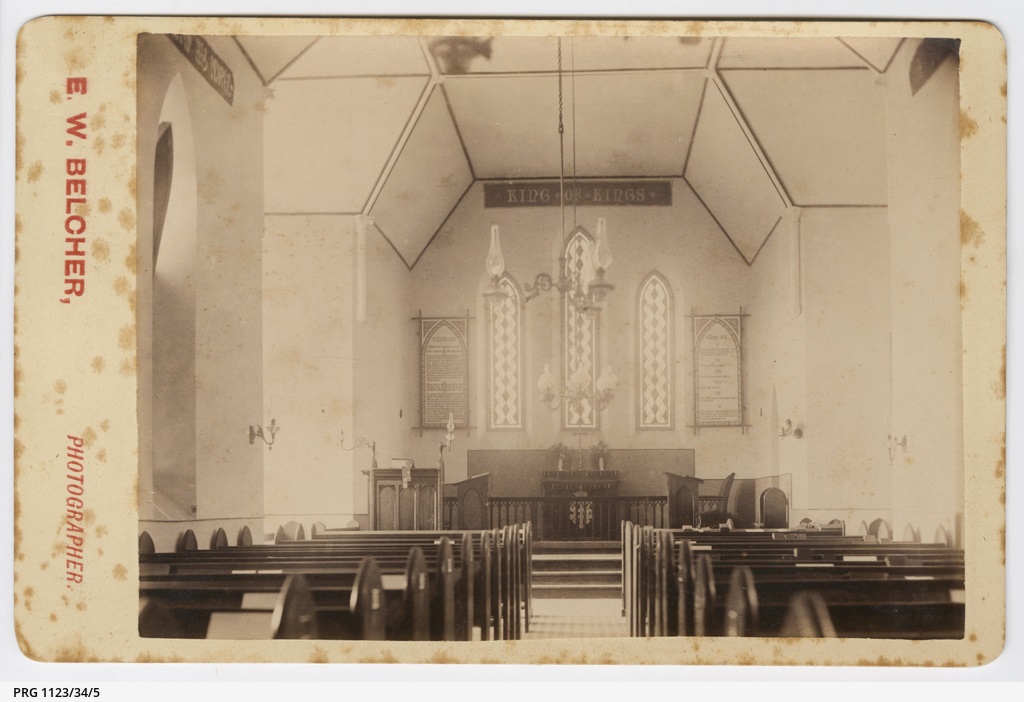
“… Over the communion table in the chancel there are three lancet-headed splay windows fitted with stained glass, and on each side are very chaste tablets of the Commandments, chosen by the Dean of Melbourne, and supplied by Messrs. Ferguson & Urie, of Melbourne …”.

“…The stained windows had been glazed by Mr. Soar, with glass supplied by Messrs. Ferguson and Urie, of Melbourne …”.

The original stained glass and tablets of the Commandments by Ferguson & Urie no longer exist. The tablets were an offering by the company but rarely advertised. These were usually painted in gold or gold leaf with red and black text in old English type lettering. Originals of these decorations are extremely rare to find as they were often painted over or replicated as renovations occurred over the course of time.

The image below shows the chancel of St Thomas’s circa 1885 depicting the original three light stained glass windows flanked by the tablets of the Ten Commandments by Ferguson and Urie.

Source: Collections South Australia: PRG 1123/34/5. Photographer: E. W. Belcher, circa 1885

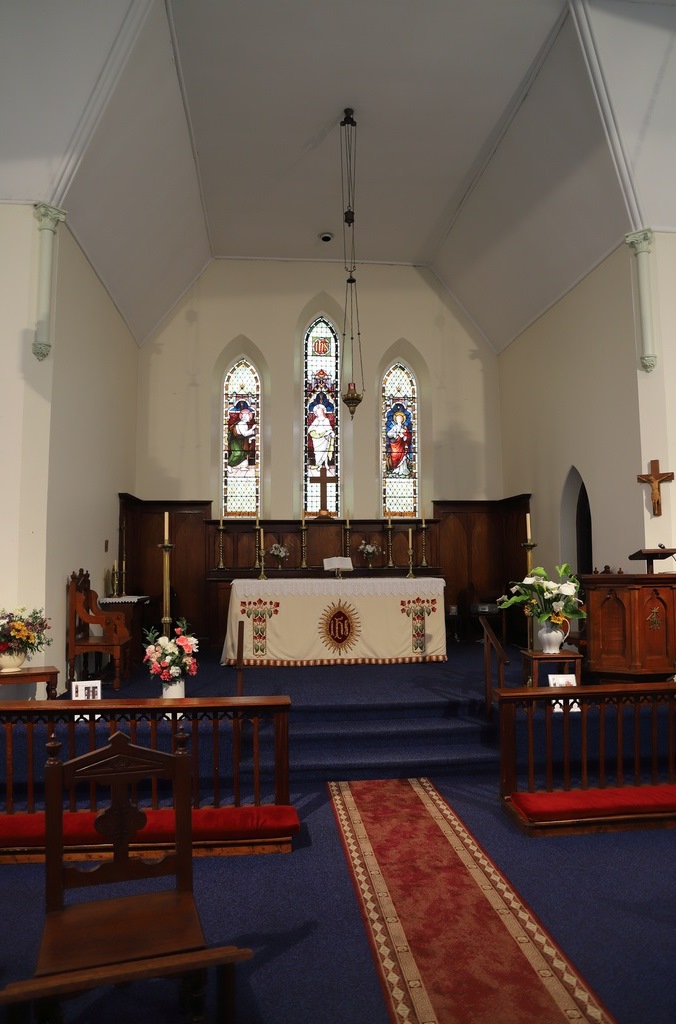
In 1893 the three lights in the chancel were replaced by figurative stained glass from Montgomery & Grimbly and were dedicated to Mr. F. S. Sison. The windows depict Christ flanked by St Thomas and St John.

St Thomas’s Port Lincoln, SA. Stained Glass by Montgomery & Grimbly 1893.
Source: Collections South Australia B77612 Photographer: Jenny Scott 18 Aug 2019

Evening Journal, Adelaide. SA, Tuesday 17th Oct 1893, page 2.

“A MEMORIAL IN STAINED GLASS.- Messrs. Montgomery & Grimbly, stained glass artists, of Waymouth street, have just completed a handsome memorial window to the order of the trustees in the estate of the late Mr. F. S. Sison, one of the founders of the firm of Messrs. Syme & Sison, brewers, and who died at Port Lincoln about two years ago. The window consists of three lights, the height of the central one being 10ft. 6 in., and those of the sides 8ft. each. The subject represented on the panels is the incredulity and conversion of Thomas and the figures portrayed are those of the Saviour, St Thomas, and St John. The figures, drapery, and surroundings are commendably finished, and as a work of art reflect great credit on Messrs. Montgomery & Grimbly. Part of the inscription hereon reads – “In memory of Frederick Samuel Sison, died December 29, 1891.” The window cost L150, and is intended for presentation to St Thomas’s Church, Port Lincoln, where it will be placed in the chancel, and will no doubt be appreciated for the excellence of its design and colouring.”

Updated: 18th July 2021

Short link to this page: http://wp.me/p28nLD-pa

© Copyright

21-11-1873: St. Peter’s Anglican Church, Robe, South Australia.

South Australia Register, Adelaide, Friday 21st November 1873, page 6.

“ROBE, November 18. A movement is on foot in this district for placing a window in St. Peter’s Church in memory of the late George Ormerod. About £100 will be required for the purpose.”

This stained glass window was eventually created. The two light window dedicated to the memory of George Ormerod was created by the Ferguson & Urie stained glass company of Melbourne circa 1874 and depicts the Nativity, Baptism, Resurrection and Ascension.

The Robe church history book supposedly has reference to this window being made by “Ferguson Will and Nyon” which is incorrect from two facets. It obviously should read “Ferguson, Urie and Lyon” but this would also be technically incorrect as the partner in the firm, John Lamb Lyon, officially dissolved his interest in the business with James Ferguson & James Urie on the 29th August 1873 and left for Sydney shortly afterwards. The date of the article above, 21 Nov 1873, is nearly three months after Lyon left the business so the window that was eventually made for Ormerod would have technically been “Ferguson & Urie” and the artist being David Relph Drape.

The former business partner John Lamb Lyon went to Sydney to take up partnership with Daniel Cottier to become Sydney’s premier stained glass studio “Lyon & Cottier”.

Photos kindly contributed by Liz Harfull 19/02/2012.

This slideshow requires JavaScript.

The Overland Telegraph, South Australia, 20th April 1872, page 5.

THE LATE MR. ORMEROD.- Our Guichen Bay correspondent writes:- “As announced previously by telegram, Mr. George Ormerod, of Ormerod & Co., died at his Robe residence on the 10th inst. The death of one so long and intimately connected with this district could not but cause the most painful sensation. For some years past Mr. Ormerod has suffered from general debility and mental malady, the result of an overwrought brain. Frequent rallies had given hope that he might yet live many years; but during the last fortnight alarming symptoms showed themselves. Many far and near have watched anxiously the fluctuations of this last attack, still hoping his great vitality would carry him through; but he expired on the evening of the 10th. Mr Ormerod was a member of a very old Lancashire family, and was born at Rochdale in 1822. He came out to Victoria in 1842, and amongst the pioneer squatters settled at Naracoorte, about 1845 to 1846, on the station known as the Naracoorte Station. About 18 years ago he settled at Guichen Bay, opening up a large business there, which has aided greatly in the development of the South East. Mr. Ormerod shrunk from a public career, and the only public positions he held were those of J.P. and Chairman of the Local Road Board. These were retained as long as health permitted. The funeral took place on Friday afternoon, the body being interred in the Robe Cemetery. The procession was largely attended, some coming over 50 miles to be present. Many residents from Kingston testified their regard by following the remains to the grave. The Rev. H. Howitt, of St. Peter’s, preached a funeral sermon last Sunday, in which Mr. Ormerod’s many good qualities were appropriately alluded to. Mr. Ormerod has made a will, and it is understood that the business will be continued as heretofore for the benefit of his widow and family.”


Short Link: https://wp.me/p28nLD-lr

© Copyright

10-07-1873: St. David’s Cathedral, Hobart, Tasmania.

St David’s Church Hobart Town is being built with the nave, aisles and transepts completed.

The Illustrated Sydney News, 10th June 1873 and  Illustrated Australian News for Home Readers, Melbourne, Friday 10th October 1873, page 170.

“NEW CATHEDRAL OF ST. DAVID, HOBART TOWN”

 “[…] The west elevation consists, in its lower stage, of a porch of no great projection, the front of which exhibits three arched openings. Above this is a noble Gothic window of five lights with decorated tracery in the head. This is filled with plain “cathedral glass” imported from Ferguson, Urie and Co., of Melbourne, as are the windows of the clerestory. Several of the windows of the aisles are filled with stained glass of English manufacture, presented in memoriam by friends of deceased persons.[…]”

The original plain five light west window has been replaced by a modern stained glass window by Joseph Stansfield (date unknown). The plain clerestory windows by Ferguson & Urie are all still original.

Photos taken: 7th Oct 2010 & 12th Aug 2012.

This slideshow requires JavaScript.

External links:

05-02-1872: St Mary of the Angels Basilica, Geelong, Victoria.

The foundation stone of St Mary’s was laid in 1854 but work ceased in 1856 and the partial construction remained an eyesore in Yarra Street Geelong for seventeen years before the newly appointed Archdeacon Slattery resurrected the plan to have the new church built.  In January 1870 Archdeacon Matthew Downing commissioned T.A. Kelly to prepare plans for completion of the church .

Known as St Mary of the Angels Basilica, it was eventually opened by Bishop James Alipius Goold on the 4th of February 1872. 

The large rose or wheel window in the liturgical west end facing Yarra Street is the work of Ferguson & Urie of North Melbourne. The window measures more than three and a half meters in diameter and cost in excess of £300. The Virgin Mary, St. Joseph, St. Patrick, St. Bridget, St. Augustine, and St. Francis Xavier are the six prominent subjects in the window and they are surrounded by angels, crowns and floral emblems. The Agnus Dei, or Paschal Lamb, is carrying the victory banner which takes place in the centre of the whole arrangement.

Geelong Advertiser, Vic, Thursday 14th December 1871, page 2.

“The new cathedral in Yarra-street is rapidly approaching completion, and the workmen for some time past have been busily engaged with the decorative works of the interior. The side and upper roofs of Ceylon pine, have been stained and varnished, and the timber looks very handsome. Above the pillared arches, the blaster work has been very neatly and artistically executed. Instead of £200, as originally contemplated, the memorial window in front is now to cost about £300. The stained glass is being prepared by Messrs Fergus[sic] and Urie, of Melbourne.”

The Argus, Melbourne, Monday 5th February 1872, Page 5.

“The Church of St. Mary, Geelong, the solemn ceremony in connexion with the opening of which was performed yesterday, stands at the upper end of Yarra-street, Geelong, on an eminence which renders it the most conspicuous object in the town…”

 “… a beautiful and elaborate wheel window, 12ft in diameter, considered the most beautiful in the colony, filled in with stained glass, illustrative of the patrol saints of the church with their appropriate devices…”

Photos taken 18th December 2010. (Updated photos from Nov 2013 can be see on Flickr)

This slideshow requires JavaScript.

[View larger images]

In 1855, one of the original architects, Richard Dowden, exhibited some proposed designs for stained glass prepared by Kearney & Co of Glasgow and intended for the church:

Geelong Advertiser and Intelligencer, Vic, Saturday 9th June 1855, page 2.

“…Mr. Dowden also exhibited two very beautiful designs for stained glass windows, sent from home by Messrs Kearney & Co, of Glasgow; one was intended for the front window between the towers in the Yarra-street elevation, and the other for one of the transepts; the first contains the Life of the Redeemer, pourtrayed in 12 elegant medallions; the other had four magnificently colored representations of the Virgin Martyr. He stated that they would cost on average, 500 each, which does not seem at all exorbitant, when we consider the elaborate beauty of the designs. We sincerely hope these designs or similar ones will be adopted, as it is of vast importance to cultivate a true taste for the higher classes of art in this country…”

None of the original 1855 designs for the stained glass windows by Kearney & Co were ever adopted. The west oriel or wheel window was eventually made by the Ferguson & Urie stained glass company of North Melbourne circa 1871 and was dedicated to Rev. Dean Hayes;

James Francis Hogan, “The Irish in Australia” (1887), Project Gutenberg transcription.

“…In after years the original design of the church was considerably modified to suit the altered circumstances, and a portion of the nave was com­pleted, sufficiently large to answer the requirements of the reduced population. Even in this incomplete condition, the building is the most conspicuous, commodious and elegant ecclesiastical edifice in the town. Its facade contains a beautiful circular stained glass window in memory of a popular pastor of the place for many years, the Very Rev. Dean Hayes, who was on a visit to his native Ireland when he died, after having just been designated as the first Bishop of Armidale in New South Wales…”

This article from April 1871 gives insight as to how the window came about!

Geelong Advertiser, Vic, Saturday 15th April 1871, page 2.

“A meeting of the friends and subscribers to the late Very Rev. Dean Hayes’ memorial fund, was held at the Town-hall, on Saturday. The attendance consisted of Mr Johnstone, M.L.A., and Messrs Noonan, Davoren, Mansfield, O’Brien, Kelly, and McGonigal. Mr R. de B. Johnstone was voted to the chair. It was announced that £117 was now lodged to the credit of the memorial fund at the Commercial Bank. The chairman stated that the object of the meeting was to decide in what manner the amount collected should be expended, with the view of perpetuating the memory of a great and good citizen. He referred at considerable length to the career of the late Dean, and the claim his good deeds had established. As the founder of the Catholic orphanages at a time when there were no other institutions in existence for the relief of destitute children, he had proved himself entitled to the gratitude of those who came after him. In a matter of this kind he left religious considerations entirely out of the question, and he was indifferent regarding the form the memorial might take, so long as a fitting tribute of respect was paid the the memory of a great and good townsman. It was then decided on the motion of Mr. Noonan, seconded by Mr Davoren, that the memorial should take the form of a stained window, to be erected in the new Roman Catholic Church, Yarra-street. A plan of the proposed window was exhibited, and certainly if the design is carried out it will be not only an embellishment to the sacred edifice, but a suitable monument to the deceased Dean. Archdeacon Slattery, and Messrs Johnstone and Nonan were appointed a sub-committee to carry out the erection f the memorial window which is to be inserted in the building over the main entrance. Some remarks were made about the erection of a marble tablet at the Catholic Orphanage, after which the meeting closed.”

At this point the actual window has yet to arrive and be installed in the tracery!

Geelong Advertiser, Vic, Monday 17th April 1871, page 3

“While St. Mary’s Roman Catholic Church is rapidly undergoing demolition a large wooden structure at the rear is to escape destruction for the present, having been converted into a temporary place of worship. The altar belonging to the old building has been transferred thither, so that, instead of the schoolhouse, the members of the congregation who are unable to attend the Ashby Church will be able to celebrate early mass in a place set specially apart for the purpose. The construction of the new church is rapidly progressing, and some idea of its architectural beauty may now be formed. The design of the front entrance is elaborate, and the carved stonework has been executed with great care and accuracy. Above the doorway in the centre frame of the memorial window to be erected to the memory of the late Dean Hayes has been so far completed that only the stained glass is wanting to complete the design. The window is circular, and the stonework about it is carved in such a manner as to produce a striking and elegant effect.”

Geelong Advertiser, Vic, Wednesday 30th August 1871, page 2.

“Great progress is being made with the building of St. Mary’s. Nearly all the stonework of the windows has been completed, and sandstone ornamental work is now being placed on the walls. The designs of the windows are a fitting match for the Very Rev. Dean Hayes memorial window, and are very chaste.”

Geelong Advertiser, Vic, Monday 20th November 1871, page 2.

“It will be remembered that some time ago a meeting of the subscribers to the memorial intended to be raised in honour of the late Very Rev. Dean Hayes, was held at the Town Hall. It was then re solved that the money collected for the purpose by Messrs Johnstone and Noonan, amounting to £130, should be applied towards the erection of a memorial window in St. Mary’s Church, and the Rev. Archdeacon Slattery, Messrs R. de B. John stone and W. P. Noonan were appointed trustees of the fund. The whole of the ornamental stonework of the window has been completed, and is ready for the reception of the stained glass, but some additional funds are required to meet the expense. £230 is the estimate for the window, so that £100 has yet to be raised. Under the circumstances Messrs Johnstone and Noonan intend to resume their canvass, and it will be observed that subscriptions are invited.”

St Mary’s was opened on Sunday February 4th 1872 by Bishop Goold and the following article gave a bit of history, the ceremony, and a lengthy description of the church and the memorial window facing Yarra Street. The detail in the article also indicates that the memorial window of stained glass was the only figurative window erected in the church at that time and all other windows contained amber tinted cathedral glass. Today most of the windows are all filled with stained glass by many other stained glass studios but the two large windows in the north and south transepts are still original. The Rev Dean Hayes memorial window by Ferguson & Urie is the oldest stained glass window in the Church.

Geelong Advertiser, Vic, Monday 5th February 1872, page 3.

“…its magnificent wheel window, 12 feet in diameter. This window is filled with flowing tracery, slightly French in its idea, and glazed with stained glass, intended as a memorial to the late Ven Dean Hayes, the subjects represented being the Blessed Virgin, St. Joseph, St. Patrick, St. Bridget, St. Augustine, and St. Francis Xavier, with their corresponding symbols…”


Short link to this page: https://wp.me/p28nLD-hh

© Copyright

03-07-1869: St. John’s Anglican Church, Ross, Tasmania.

St John’s Anglican Church in Ross, Tasmania, was erected to the designs of architect Henry Hunter using some of the sandstone from the original church built in 1835.  The building was completed in 1868 and consecrated the following year on the 14th of May 1869  by the Bishop of Tasmania, Charles Henry Bromby (1814-1907).

Launceston Examiner, Tasmania, Saturday 3rd July 1869, page 4.

“THE NEW CHURCH AT ROSS.- From the Church News..”

 “… The nave is lighted on each side by cusped lancet windows, placed in couplets. The west end has three plain lancets, over which is a circular window filled with geometrical tracery; and a small circular window is placed in the gable of the transept. The east window is of three lights, the head being filled with rich tracery. The masonry throughout is of fine Ross free-stone. The roofs are of high pitch, finished internally with pine boarding, panelled and moulded. All the windows are filled with stained pattern-glass, manufactured by Ferguson & Urie, of Melbourne…”

 “… Everything was done by workmen employed by the chief benefactor of the church, Mr. Kermode, under the general direction of its designer and architect. Mr. Hunter…”

Photos: (updated) taken 12th August 2012. There are also some photos of restoration work, by Gavin Merrington. between June 2006 and Jan 2007. The August 2012 photos were taken during an awesome historical stained glass road trip with Gavin on the 12th Aug 2012.

This slideshow requires JavaScript.

Note: Robert Quayle Kermode (1812-1870) also owned the mansion “Mona Vale” near the town of Ross in Tasmania, and it also contains stained glass windows made by Ferguson & Urie.

The Mercury. Hobart, Tas, Wednesday 12th May 1869, page 2.

“CONSECRATION OF ROSS’ CHURCH.- The Lord Bishop of Tasmania is to consecrate the new church at Ross on Friday, 14th inst., when divine service will be held at 11 o’clock. The clergy are invited to meet in the vestry at half-past ten and to bring their surplices”.


Short link to this page: http://wp.me/p28nLD-cu

© Copyright

1869: St Peter’s Pebble Church, Carapooee, Victoria.

St Peter’s Anglican Church Carapooee.

St Peter’s Church at Carapooee, known as the “Pebble Church”, is about thirteen kilometers south of St Arnaud in western Victoria.

Originally the area was called ‘St Peter’s Diggings’ but known by the local Aborigines as ‘The Carapooee’, (“an earthly paradise”). The church was designed by architect Leonard Terry and Mr. Valentine Nott Mogg of ‘Swanwater Station’ laid its foundation stone in May 1869. The church is constructed of white quartz pebbles in varying sizes which are set in pinkish colored mortar. The pebbles were collected by locals from miners’ claims in the nearby hills. Valentine Mogg’s ‘Swanwater Station’ was also constructed of quartz pebbles in the same manner but there is supposedly no other church in Victoria constructed this like this.

The first service was held in St Peter’s in July 1870 with a formal opening taking place in October 1874.

The simple stained glass windows are of plain diamond quarries with red and blue stained glass borders and were supplied by the Colonial Victorian Stained Glass firm Ferguson & Urie of Melbourne.

Photos taken 11th June 2011.

This slideshow requires JavaScript.

The last service and deconsecration of the Carapooee “Pebble Church” occurred on the 2nd of June 2019.


Short link to this page:https://wp.me/p28nLD-ch

© Copyright


31-08-1868: St. Mary’s Church, Queensberry street, North Melbourne, Victoria.

In 1868 it was reported that the Ferguson & Urie stained glass company had prepared the designs for a 22ft high five light window depicting the Virgin Mary and the Crucifixion for St Mary’s church in Queensberry Street, Hotham, at an estimated cost of £375. The window was never actually created by Ferguson & Urie!

The Argus Melbourne, Monday 31st August 1868, page 6.

ST MARY’S CHURCH, HOTHAM…”

“… One of the noticeable features of this church is its windows. Those in the gables of the transepts are “four-light” windows, and of good size, but the finest of all is that of the chancel, which is the principal window of the church and one of the largest in Melbourne. It is twelve feet wide, and twenty-two feet high, and contains five “lights,” the mullions being of free-stone, beautifully carved. It is intended, when funds permit, to fill this window with stained glass, each “light” or compartment containing a design illustrative of some memorable scriptural incident in the life of the Virgin Mary. The design for the centre light will be the Crucifixion of the Saviour, with the Virgin Mary and St. John at the foot of the cross, and the subjects for the other compartments will include the Annunciation, the Adoration of the Magi, &c. The designs for this window have already been partly prepared by Messrs. Ferguson and Urie, and the estimated cost of carrying them out is £375. The remainder of the windows will be fitted with plain cathedral glass….”

Although it was reported that Ferguson & Urie had ‘prepared’ the designs, the window was never made by them. The window remained as plain cathedral glass for a further twenty years before being made by Smyrk & Rogers of Little-Collins street east in 1888 who were also responsible for most of the others in the church.

St. Mary's, Hotham, Nth Melbourne, Rogers & Co stained glass

St. Mary’s, Hotham, Nth Melbourne, stained glass by Smyrk & Rogers in 1888 (Photo: 12 Dec 2012)

See Stained Glass Australia web site post: 27-10-1888 St Mary’s Anglican Church, North Melbourne, Victoria, Australia.

© Copyright

26-06-1868: St. John’s Anglican Church, Toorak, Melbourne, Victoria.

The liturgical east window of St John’s in Toorak is a memorial to William Crocker Cornish who died in 1859 and his wife Jane (née Rowell), who died in 1867.

The four light window represents the Nativity, Baptism, Crucifixion and Resurrection and was made by Ferguson & Urie of North Melbourne in 1868.

In 2010, the Verger of St. John’s church told me that the window was restored sometime c.1960’s and when it was reinstalled the lower panels of two windows were installed out of sequence. The verse, “John, Chapter, 19, Verse 16” (The Crucifixion) is installed beneath the scene of the Baptism and the verse “Mark, Chapter 1, Verse 10” (The Baptism) is installed beneath the Crucifixion scene.

In 1984 Australia Post issued a prepaid Aerogram envelope for Christmas that depicted the Nativity scene from this window at St. John’s. I obtained a mint specimen of it from a collector in 2010 and a copy is shown in the slide show of photos. In Feb 2013 one of Ferguson & Urie’s original designs was found for this window amongst the State Libraries Collections and a copy of the design is also included along with its comparison to the window as seen in 2010.

Photos – 31st October 2010.

This slideshow requires JavaScript.

[View larger images]

The Cornish family are buried at the Melbourne General Cemetery. Their monument is amongst the more elaborate gravestones in the cemetery and as can be expected it has degraded significantly over nearly a century and a half. Photos of the monument were taken 19th October 2014 and these maybe the last images of it before the spire topples and the memorial text can no longer be read. Hopefully their memorial stained glass window at St John’s in Toorak will be looked after better and last for many more centuries.

Significant transcriptions:

The Argus, Melbourne, Friday 26th June 1868, page 5.

 “MEMORIAL WINDOWS”

 “…The window in the church at Toorak has been raised to the memory of the late Mr. Cornish, by Mr. and Miss Cornish. It is the work of Messrs. Ferguson, Urie, and Lyon, of this city, and does high honour to their skill and art. The architecture of the window, being of the decorated Gothic style, is eminently favourable to the development of a rich and harmonious style of colouring. The design of the stained glass is to illustrate the principal events in our Saviour’s life – the nativity, baptism, crucifixion, and resurrection. In the first, we have the Virgin with the child in her arms, Joseph hanging over her, and the shepherds looking intently at the babe. The second represents the baptism at the Jordan, and the third the crucifixion. The latter is peculiarly well treated, and the figures of St. John at the one side, the Virgin at the other, and Mary Magdalene at the foot of the cross, are full of mingled sorrow and affection. In the last, the resurrection, the Saviour is represented emerging from the tomb, while an astonished soldier falls down before him. The figure is full of majestic dignity, and the folds of the mantle in which he is enveloped hang about him with natural grace. In the top tracery is the ascension witnessed by St. John and the Virgin. The last two are in medallion form, and are exceedingly well executed; the softness and heavenliness of expression in the Virgin’s face almost approaching that of some of the pictures of the Madonna. In the trefoil pieces are signs of the four evangelists, and in other parts of the tracery the “Agnus Dei,” and certain scripture texts. The colours of the picture are exceedingly well chosen; brilliant and effective, as all glass painting ought to be, but at the same time harmoniously and tastefully blended. A process of colouring has been adopted more suitable to the clear light of our atmosphere, and the consequence is that the window possesses a richness of tone, which agrees well with the style of art to which it belongs. We may add, that the chancel of the church in which this window is placed promises to be one of the most richly-decorated in the colony. At each side of the central window are two tablets of the law, in a highly illuminated style of writing; underneath are to be three tablets – one with a Calvary cross, and the other two with texts in scroll work; and the remainder of the space is being covered with an ornamental design in stencilling – the last work being performed by the ladies of the congregation. The side windows are also to be filled with stained glass representations of Faith, Hope, and Charity. A very fine altar-cloth has been recently received, as a present, from Mr. John King. It is made of rich Utrecht velvet, and has a large cross, studded with precious stones, in the centre.”

Illustrated Australian News for Home Readers, Melbourne, Friday 10th October 1873, page 170.

“The Church of St. John the Evangelist, Toorak, is erected on a site given by Mr. Alfred Ross, forming part of the Orrong estate, at the angle formed by the Gardiner’s Creek and Clendon roads. The foundation-stone was laid by Sir Henry Barkly in April, 1860. The designs were made by Mr. W. W. Wardell, architect, presented to Mr. Henry Dauglish, one of the trustees, and carried out by Mr. F. M. White, architect. Messrs. Gosling Brothers were the contractors. The opening services were celebrated on Sunday, 13th July, 1862, by the Rev. Dr. Bromby, who continued as officiating minister during a period fifteen months, until the arrival from England of the Rev. Walter Fellows, B.A., of Christ Church, Oxford, since which time the congregation has steadily increased…”

“…The chancel is 20 feet deep, having a four-light window, enriched with tracery and filled with stained glass representing the Nativity, Baptism, Crucifixion and Resurection of our Lord; also on the north side is a smaller two-light window…” 

The Argus, Melbourne, Vic, Friday 1st April 1859, page 4.

“DEATH of MR. CORNISH. – We announce with great regret the death of Mr. Cornish, of the firm of Cornish and Bruce, the contractors for the Melbourne and Murray River Railway. Mr. Cornish expired yesterday afternoon at his residence, at Brighton, after a lengthened illness, at the age of 44 years. The medical gentlemen in attendance upon him (Drs. Motherwell, Ford, and Brownless) ascribe his death to a complication of maladies, arising from disorganisation of the heart, the liver, and the lungs, and there is no doubt that these have been aggravated to a very considerable extent by the mental harassment and anxiety which are inseparable from the important business responsibilities in which he has been involved. The immediate cause of death, however, is said to be effusion into the pericardium – water on the chest – from which complaint he has for several months been a sufferer. The death of Mr. Cornish, in the midst of the vast undertaking in which he has been actively and successfully engaged, must be regarded as a great calamity, and will excite feelings of deep regret throughout the community. We believe that the funeral will take place on Monday.”

The Argus, Melbourne, Vic, Saturday 2nd April 1859, page 8.

“THE Friends of the Late WILLIAM CROCKER CORNISH, Esq. (of the firm of Cornish and Bruce, railway contractors), are respectfully invited to follow his remains to the place of interment, in the Melbourne General Cemetery. The funeral procession is appointed to move from his late residence, Myrtle Grove (opposite the residence of J. Bignell, Esq.) Brighton, at 1. and pass the Prince’s Bridge about 3 o’clock, on Monday, April 4. JOHN SLEIGHT, undertaker, 71 Collins-street east.”

The Argus, Melbourne, Vic, Tuesday 5th April 1859, page 4.

“FUNERAL OF THE LATE MR. CORNISH. – The remains of this gentleman were yesterday consigned to their resting-place in the New Cemetery, Melbourne. The cortége left the residence of the deceased, at Brighton, at 1 p.m., arriving at Prince’s Bridge shortly after 3 o’clock. At this portion of the route the procession was joined by a large number of friends of the late Mr. Cornish in vehicles and on horseback, also by a party of work- men employed by Messrs. Cornish and Bruce, on foot. The religious services at the place of burial were performed by the Rev. S. L. Chase, the principal mourners being the three sons of the deceased and his late partner, Mr. Bruce.”

The Sydney Morning Herald, NSW, Wednesday 8th May 1867, page 1.

“On the 7th instant, at Petty’s Hotel, of paralysis, JANE, widow of the late W. C. CORNISH, of Melbourne, aged 44 years.”

St John’s – its story for seventy years, 1860-1930, page 23.

“THE EAST WINDOW is an old Melbourne work by Fergusson and Ure [sic], and was erected in memory of William and Jane Cornish, who died in 1859 and 1867 respectively. It represents the leading incidents in the Life of Christ. Like the West Window, it has latterly been “graded” with a tinted glass outside to protect it, and also to lower the primary colouring.”


Short link to this page: http://wp.me/p28nLD-av

© Copyright

21-09-1867: St Paul’s Cathedral, Sale, Gippsland, Victoria, Australia.

The Dr. Floyd Minter Peck memorial stained glass window was created by the Ferguson & Urie stained glass company of North Melbourne and was erected in St Paul’s Anglican Cathedral, Sale, Victoria, in September 1867.

Gippsland Times, Saturday September 21st 1867, page 2.

“During the past week the central lights of the east window in the chancel of St. Paul’s has been filled with stained glass. The window, which is sixteen feet high and three feet wide, has been erected by a few friends as a memorial to Dr. Peck, one of the earliest trustees and an earnest supporter and benefactor of the church. The painful circumstances of his death, in the prime of his manhood, are still fresh in the recollections of the inhabitants of the district. His death was caused by disease in conducting a post-mortem examination, and was justly regarded as a public misfortune. A subscription was initiated to erect a tablet to his memory, but it was afterwards resolved that a testimonial to his worth would be most appropriately placed in the new church, for which he had worked so long and zealously in raising funds; the present form of memorial was then wisely determined on. The general effect is extremely pleasing; the hues are clear, brilliant, and admirably arranged, and give to the church the colour so much needed. It is lancet shaped; the border is of green leaves; the lancet contains a fine scroll, with the words “Blessed are the dead which die in the Lord.” The centre is filled with a large figure of Christ as the Saviour of the world, with a nimbus round the head, and holding and orb typical of sovereignty; underneath are the words “Salvator mundi;” the lower part is filled with grisaille, enclosing a shield with the following inscriptions, in early English characters:- “Erected by subscription, in pious memory of Floyd Minter Peck, surgeon of this town, who died January 17 [sic], 1864.” A bright monogram of the Alpha and Omega shine at the apex of the window. The diapering and tracery generally are, very light and effective, and reflect great credit on the artists who executed them. It is a further subject of congratulation that this splendid window has been designed and chiefly manufactured in the colony by Messrs. Ferguson, Urie, and Lyon, of North Melbourne, who have been for some time past actively engaged on the work, which they have now brought to such a creditable conclusion.”

The centre light of the three windows in the chancel is the Dr. Floyd Minter Peck memorial window by Ferguson & Urie. It originally came from the first church built in Raymond Street Sale. The article above has the date he died incorrect and so does the memorial text on the window. He actually died on the 7th of January 1863. The left light is also by Ferguson & Urie and is a memorial to Edward Crooke, but was created nearly two decades later and erected in September 1886. In 1887 Melbourne stained glass craftsman William Montgomery created the right light depicting the Good Shepherd and is a memorial to Menie Peck, the second wife of Dr. Ffloyd Minter Peck.

This slideshow requires JavaScript.

Geelong Advertiser, Vic, Thursday 26th September 1867, page 2.

“During the past week the central light of the east window in the chancel of St. Paul’s Church, Sale, has been filled with stained glass. A local contemporary explains that the window, which is nineteen feet high and and three feet wide, has been erected by a few friends as a memorial to Dr Peck, one of the earliest trustees and earnest supporter and benefactor of the church, and whose death was caused by disease incurred by conducting a post mortem examination, and was justly regarded as a public misfortune. The general effect of the work is said to be extremely pleasing; the hues are clear, brilliant, and admirably arranged, and give to the church the colour so much needed. It is lancet shaped; the border is of green leaves; the lancet contains a fine scroll, with the words, “Blessed are the dead which die in the Lord.” The centre is filled with a large picture of Christ as the Saviour of the world, with a nimbus round the head, and holding an orb typical of sovereignty; underneath are the words “Salvator maudi;” [sic] the lower part is filled with grisaille, enclosing a shield with the following inscription in early English characters:- “Erected by subscription, in pious memory of Floyd Minter Peck, surgeon, of this town, who died January 17, 1864.” It is a subject of congratulation, as our contemporary remarks, that this splendid window has been designed and chiefly manufactured in the colony by Messrs Ferguson, Urie and Lyon, of North Melbourne.”

Monumental memories : Sale Cemetery / by Glenys Wain, Kylie Rhodes, Linda Barraclough:

"Dr. Floyd Minter Peck (c1818-1861) was the son of a doctor from Newmarket, England. He came to Australia with his brother in law Dr. Hedley, Dr. Reeve of Snakes Ridge and his brother James Peck. Dr. Peck married Anna Maria Robertson (1823-1859) who died in Sale soon after her arrival there, following the birth of her sixth child. Dr. Peck then married Menie Campbell (1820-1884), a sister in law of Robert Thomson. However shortly after their wedding Dr. Peck contacted an infection while performing an autopsy, and died five days later. Dr. Hedley took over his practice afte his sudden death. James Peck (c. 1833-1884) was the younger brother of Dr. Floyd Minter Peck, and lived at "Bowerette" near "Grassdale". He married Ada Minter (C.1846-1918), the daughter of a doctor from Mount Moriac, and became a successful stock agent. Near these two family plots are family plots for the Smith and Minters, who are related. All plots have similar fences, with gateways."

Related posts:

The 1885 Edward Crooke memorial window at St. Paul’s Cathedral, Sale by Ferguson & Urie.

External links:

Paul Saban: “The Medical History of Newmarket”, Ffloyd Minter Peck (1820-1867)

The 1887 Menie Peck memorial window at St Paul’s Cathedral, Sale, by William Montgomery.

Homestead: Grassdale. Home of Floyd Minter Peck


Short link to this page: https://wp.me/p28nLD-9g

© Copyright

20-12-1866: The Medieval Court at the 1866 Melbourne Exhibition

The Chancel windows of Christ Church Anglican at Casterton in Western Victoria were displayed at the 1866 Melbourne Exhibition.

The Ferguson & Urie stained glass company created and decorated an entire chancel for the Exhibitions ‘Medieval Court’ display and the stained glass windows were the central exhibit before being installed in the Casterton Church. Who was actually contracted to install them is still a mystery as the first two windows were installed out of sequence with the ‘Passion’ preceding the ‘Nativity’. Also of note is that Joseph does not appear in the Nativity scene.

The coloured photos were taken 8th January 2011.

This slideshow requires JavaScript.

The Australian News for Home Readers, Vic, Thursday 20th December 1866, page 8.

“MEDIEVAL COURT”

“One would scarcely expect to find a Medieval Court in an exhibition of the products, of a new colony; but such a court there is, intended to illustrate portions of ecclesiastical architecture; and it constitutes, perhaps, the most pictorially effective part of the whole building. Messrs Ferguson, Urie and Lyon, glass stainers, Curzon-street, North Melbourne, exhibit a decorated chancel, the ceiling of which has for a centrepiece the Agnus Dei, surrounded with scriptural texts and gothic clouds. The other portion of the ceiling is divided into twelve compartments, having the emblems of the twelve Apostles. The walls are diapered with simple but chaste pattern. It is lighted with five stained glass windows, the subjects of which are the Nativity, Passion, Crucifixion, Resurrection and Ascension. These windows are made for the chancel of the church at Casterton, and are exhibited by permission of the Rev. Dr. Russell. At the altar are two richly illuminated tablets of the commandment, Lords prayer and creed; also an illuminated painting of the Last Supper. A considerable quantity of stained glass is exhibited, consisting of ecclesiastical and domestic styles; also, numerous samples of stained and embossed borders and small subjects. On the right hand side of the court is a carved baptismal font in Caen stone, designed and executed by Mr John Young, contractor, Melbourne. It is all colonial workmanship. The upper portion is octagonal, representing the four Evangelists. At the top of the shaft are masses of carved foliage with heads interspersed, while at each angle of the shaft, which is double, are buttresses wreathed and moulded. The outer one has got headed open panels cut entirely through showing the centre shaft of the interior. In the splays of he base are clusters of foliage carved from real flowers and leaves, but Gothicised after the decorated period. The base represents evil spirits in the form of dragons, emblematical of the Sacrament of baptism casting them down. The lid of the font is of carved colonial blackwood, polished, ornamented with wrought iron to suit the general workmanship of the whole. In this department are also some highly ornate water fonts, sculptured by Mr. F. Utyco; a number of figures carved in wood for the internal decoration of St. Patrick’s cathedral, an altar and fittings, some hand rails, and several statues of saints.”

The 1866 Melbourne Intercolonial Exhibition was held in a specially built ‘Great Hall’ on a site behind the State Library’s Queens Hall in Swanston Street Melbourne.

Casterton Christ Church 99A


Short link to this post: https://wp.me/p28nLD-6V

© Copyright