The Launceston City Baptist Church (former Prince’s Square Congregational and Christ Church Congregational Church) 11 Frederick Street, Launceston.
Launceston Examiner, Tasmania, Tuesday 20th October 1885, page 3.
“OPENING OF CHRIST CHURCH.”
“A handsome stained glass memorial window has been placed on the eastern side of the church near the north end, by Mr. C. S. Button, of Scottsdale, Mrs. Calvert, of Hobart, and Miss Helen Button, the present organist, in memory of their father, Mr. W. S. Button (first Mayor of Launceston), and their mother. The window was obtained from the firm of Messrs. Ferguson and Urie, Collins-street, Melbourne.”
Photos by Gavin Merrington taken 23rd June 2012.
William Stammers Button (1795-1876) was born in Nayland, Suffolk, England. He arrived in Van Diemens Land (Tasmania) with his brother Thomas and other family members in 1833 aboard the ship “Forth,”[1] and initially starting business as a brewer in partnership with his brother-in-law, Jonathan Stammers Waddell, at Norfolk Plains (later known as Longford), and then at Launceston as “Button & Waddell”[2].
On New Years day in 1853, under much controversy and accusations of collusive fraud, the first elections for Aldermen for the town of Launceston were conducted[3]. Seven men were elected, one of whom was William Stammers Button (as well as his brother Thomas). Prior to the Aldermen retiring to elect the position of Mayor, each took the stand to address the crowd;
“William Williams, alias William Stammers Button advanced amidst a tornado of yells, groans, and hisses, and from what we could hear, we understood him to say – Gentlemen, I shall attend to my duties as well as I can. The public good I shall always endeavour to keep in view, and I will maintain it. The interests of the working man shall occupy my especial attention, and I will do all in my power to find employment – remunerative employment – for the free poor of this town. Gentlemen, I heartily thank you for the honor you have done me. (A voice – ‘much obliged to you – well done ali-ass Mr. Williams,’)” followed by groans and hisses.”
“…The successful candidates then retired to one of the apartments at the back of the court house to elect the mayor, when after the absence of about half an hour, the Sheriff, to the astonishment of every one present, declared William Williams, alias WILLIAM STAMMERS BUTTON, (brewer) first mayor of Launceston.”[4]
The reference to William Stammers Button as being William Williams is shrouded in controversy. Ten years earlier, in 1843, Button successfully won a law suit against a William Lushington Goodwin for “printing and publishing a malicious libel” against him in the Cornwall Chronicle[5], to which Goodwin was convicted and fined. After the election in 1853, further publications appeared to cast aspersions as his origins as the unknown William Williams[6].
William Stammers Button held the position of the Mayor of Launceston for four consecutive years and was universally admired for his efforts in the advancement of Launceston. He held many other public and private positions and in 1856 was elected to represent the Tamar district in the Legislative Council[7]. He was a liberal donor to all deserving institutions, and a served as a deacon of the Congregational church for over 40 years[8].
William Stammers Button died on the 17th September 1876 and was buried in the Mulgrave Square Cemetery in Charles street Launceston. The cemetery was closed for further interments in 1925[9].
In October 1885[10], the surviving children of William Stammers Button erected a stained glass window to his and his wife Marianne’s memory, in the City Baptist Church (former Christ Church Congregational) in Frederick Street, Launceston.
The window was crafted by the Colonial Victorian stained glass firm Ferguson & Urie of Melbourne.
The Mercury, Hobart, Tasmania, Wednesday 21st October 1885, page 3
“…On each side of the organ alcove there are round openings in the end wall, filled with geometrical designs on stained glass. There is also a stained glass window with a tablet, marked, “In loving memory of William Stammers Button, M.L.C, for nearly 40 years deacon of this church, also the first Mayor of Launceston, and Marianne, his wife, this window is dedicated.” The window, which bears the inscriptions on stained glass, “Blessed are the dead who die in the Lord,” and “Honour thy father and thy mother,” has been erected by Mr. C. S. Button, of Scottsdale, Mrs. Calvert, of Hobart, and Miss Helen Button, the organist of the church, the children of the deceased deacon.…”
The Mercury, Hobart, Saturday 26th January 1907, page 8.
“…There are some interesting, and indeed historic, memorials in Christ Church. A marble tablet perpetuates the memory of Mr. West, the historian of Tasmania, and a stained-glass window is a memorial of Mr. William Stammers Button, the first Mayor of Launceston…”
“…The window to the memory of the first Mayor bears this inscription:- “In loving memory of William Stammers Button, M.L.C., for nearly 40 years deacon of this church, also the first mayor of Launceston, and Marianne, his wife, this window is dedicated.” There is also a stained-glass window to the memory of another mayor of Launceston, Mr. Landon Fairthorne, who died in 1890…”
The Mercury, Hobart, TAS, Saturday 7th March 1953, page 20.
“MR. WILLIAM STAMMERS BUTTON, who was Launceston’s first mayor, and held office from 1853 to 1856. Mr. Button was associated with the beginnings of the Princes Square Independent Church, now Christ Church, where a memorial window honours his name.”
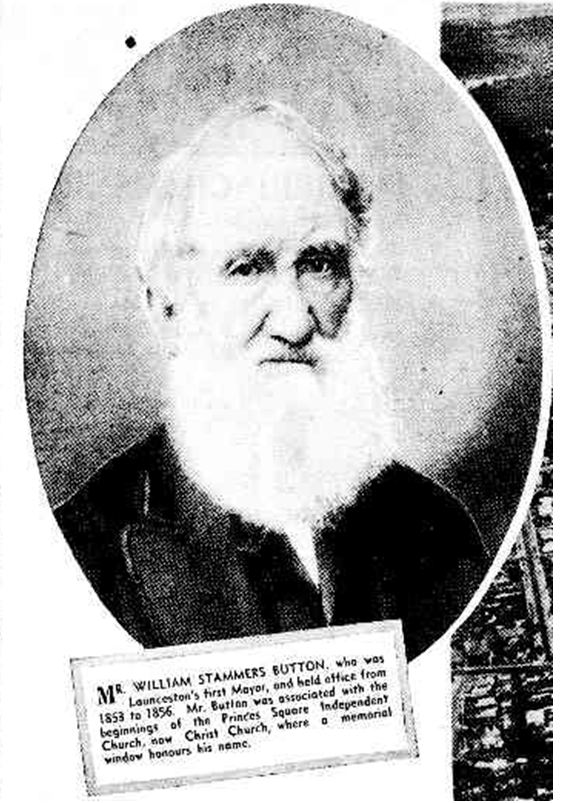
The Mercury, Hobart, TAS, Saturday 7th March 1953, page 20.
Launceston Examiner, Tasmania, Tuesday 19th September 1876, page 2.
“THE LATE MR W.S. BUTTON. (1876, September 19). Launceston
One more old colonist has finished his course. Mr. W. Button died peacefully at his residence, St. John-street, at a quarter-past eight on Sunday morning, aged 80 years, having lived in Tasmania 43 years. He was born at Nayland, in Suffolk, in the year 1795, where his early boyhood was spent, removing to Sudbury, in the same county, while yet young, in which place he was associated in business with his uncle, in whose service he frequently travelled to various parts of England, visiting also France and Flanders, when travelling by land and sea was attended by numerous perils. He was wont to recount to some of his friends the incidents of his wintry voyages and long journeys by coach, contrasting them with modern methods of conveyance. From his retentive memory he would sometimes recall the state of England in his youthful days during the awful struggles of the Peninsular war, and describe with the graphic power of a keen observer those days of dear bread, iron rule, and wearing anxiety. On his marriage he removed to Long Melford, a place historically famous like the other towns where he had lived. While there, he took an active part in politics, working hard on the liberal side, and especially seeking with others the repeal of “The Test and Corporation Acts,” which was happily accomplished in the year 1828. In 1833 he came to this colony in the ship Forth, bound to Circular Head and Launceston. He was accompanied by his brother Mr Thomas Button, Mr J. S. Waddell, and other members of his family. He first took up his residence at Norfolk Plains, removing to Launceston for business purposes. During his 40 years residence in Launceston he has been one of our most prominent and useful citizens. He was from the beginning one of the chief members of the Anti-Transportation League, giving cheerfully of his time and money. He was among the earliest promoters of the Cornwall Insurance Company in 1842, one of its first Directors, for many years Chairman of the Company, and to the last was warmly devoted to its interests. When Launceston was declared a municipality he was elected a member of the first Council and its first Mayor on January 1st, 1853. He filled the office by successive elections for four years, and during his mayoralty the chief portion of the work was done in supplying the town with water – a work that took up much of his time, yet by some strange oversight no notice is taken of his efforts on the commemorative fountain in Prince’s Square or on the pillar at St. Patrick’s River. Mr Button was appointed a justice of the peace in 1855, and has rendered good service in that capacity, his clear judicial mind eminently fitting him for the post. In October, 1856, he was elected a member of the Legislative Council for Tamar, and served in that capacity for six years. In the Council he was looked upon as a valuable member. His unobtrusive manners, wide experience, and extensive knowledge made him a man of power; he was firm and fearless – an independent member, one courteous and true. With the Launceston and Western Railway Mr Button was connected from the very beginning. Anxious to see the colony advance he gave labour and money to aid in improving our means of transit. For a while he was chairman of the Railway Company, till increasing years compelled him to retire. As one of the early shareholders of the Gas Company and a Director from its formation until his death, he took great interest in its working, and read carefully to qualify himself for his duties. Mr Button was also one of the chief agents in establishing the Launceston Examiner, though he never took an active part in the management; and was also one of the founders of the Launceston Mechanics’ Institute, of which he was subsequently President. It may be safely said that few men have ever striven more zealously and unselfishly than Mr Button did to advance the interests of our town, district, and colony. It cannot be expected that all his public actions will have secured the approval of all men, but there are none who will not admit that his integrity of purpose, his resolute method of work, his general wisdom, and his hearty sympathy with all onwards movements, were beyond question. Those who knew Mr Button best were most aware that he was distinguished for his religious zeal: he was a man who feared God, and sought to serve his day and generation as one who must give account at last. No notice of his life amongst us, even in a public newspaper like this, would be complete that passed over this aspect of his life. As a friend and fellow-worker of the late Rev. J. West, he greatly aided in the building and support of the Prince’s Square Independent Church. From the formation of the congregation until within a recent period he had served the church faithfully as Treasurer, for a short time was Superintendent of the Sunday school, and at his death was senior deacon. He also for many years acted as Treasurer of the Northern Branch of the Congregational Home Mission, and had taken an active interest in the working of the mission on the N.W. Coast. In his death the Bible Society loses an attached friend. As a working member of it’s local committee, and subsequently President for years, until failing health compelled him to resign, he gave one of the many proofs of the catholic nature of his religious principles and life. We have been given to understand that not withstanding the conservatism natural to old age, Mr Button had very considerable acquaintance and sympathy with many liberal forms of modern thought on religious matters. Mr Button’s family life is not a theme to dwell upon in a newspaper, but it may be mentioned that a few months ago his golden wedding was appropriately honored by a few friends, on which occasion he ascribed much of his public usefulness to his happy home life. He has left many sincere friends, who will cherish his memory to the very last. His interest in al things relating to colonial life was as fresh and strong as in his days of robust strength and willing work.
Though old, he still retained
His manly sense and energy of mind;
Virtuous and wise he was, but not severe,
He still remembered that once he was young.
Most of places of business wee partially closed yesterday as a mark of respect for the deceased gentleman, and the Municipal Council adjourned immediately after meeting for the same reason. The funeral will take place this afternoon, friends assembling at Prince’s Square Congregational Church at half-past three”.
The Mercury, Hobart, TAS, Tuesday 19th September 1876, page 3.
“OUR LAUNCESTON LETTER.
[From our own correspondent.]
LAUNCESTON, Monday morning.
“I regret to have to record the death, at about a quarter past eight o’clock on Sunday morning, at his residence St. John-street, of Mr. William Stammers Button, at the ripe age of 81 years. Mr. Button is a very old colonist, having arrived in the colony in 1832. He first settled in Longford, where he entered into partnership with a brother-in=law, the late Mr. William Waddell, in the establishment of a brewery on that township. After carrying on the business for some three years at Longford the firm removed to Launceston, taking the premises then known as Barnes’ brewery, opposite the gaol, and in this business Mr. Button continued til 1853. Up to this time he had been very active in taking part in all matters calculated to promote the advancement of the town, and initiating schemes of public utility. When municipal institutions were established in 1853, Mr. Button was one of the first members, and the first mayor elected. The election of mayor at that time was for two years, and Mr. Button was elected twice in succession, holding the office for four years. He then retired from the municipal council. In Oct., 1856 he was elected a representative of the Tamar in the Legislative Council, and filled that position til 1862. He had always been considered an industrious and energetic patron of Agricultural and Horticultural pursuits, and a liberal contributor to any institution calculated to improve the condition of his fellow townspeople. In public life he has taken a very active part. He was one of the founders of the Cornwall Insurance Company established in 1842, and has been connected with it ever since having occupied the position of chairman of directors till within a short time of his death. He was also one of the founders of the Mechanics’ Institute, established in the same year, and has ever since evinced a lively interest in its rise and progress. In the initiatory stages of the agitation for a water supply to the town he took a prominent part, and it was mainly through his instrumentality that the great boon of a waterworks was obtained. In the establishment of the Launceston Steam Navigation Company, which is now incorporated in the Tasmanian Steam Navigation Company, and in the support given to the Launceston Gas Company, of which he was for many years a director, he contributed greatly to their success. In all religious and philanthropic efforts Mr. Button was always to the fore, and amongst other positions he held for some time was that of the President of the Bible Society. He was connected with the Congregational denomination, and attended the Prince’s Square Church, of which the Rev. Wm. Law is the pastor. To the erection of this handsome and commodious edifice the deceased gentleman contributed largely, and continued his liberality up to the time of his death. He was generally esteemed by the townspeople as an honourable and upright man, and a steadfast friend, and his decease is universally regretted. Although the deceased gentleman’s health and strength had been visibly declining some time, it was not till a few days ago that any serious consequences were anticipated by his friends. He attended divine service on Sunday the 10th inst., and was working in his garden on Thursday last. On Thursday night, however, serious symptoms manifested themselves, and he then sank rapidly up to the time of his death, which took place on Sunday morning. The pastor of Prince’s Square Church, the Rev. Wm. Law, in his morning service, both in his prayer and sermon, alluded in feeling terms to the long connection of Mr. Button with the church, and his many excellent qualities, and then announced that the funeral service would take place on Tuesday afternoon, at three o’clock, at the church; and that on the following Sunday evening he should preach a memorial sermon.”
The Mercury, Hobart, TAS, Thursday 21st September 1876, page 3.
“The funeral of Mr. William Stammers Button left his late residence, St. John-street, at 25 minutes past 3 this afternoon, arriving at the Prince’s Square Congregational Church about half-past 3. During the passing of the funeral cortege to the church, the bell of St. Andrew’s Church was tolled. The funeral service was conducted by the Rev. J. Lindsay and the Rev. C. Price, after which the Rev. W. Law delivered a funeral oration in which he commented at length on the many estimable qualities of the deceased, and his long and useful career. The funeral was largely attended, and after leaving the church the procession was formed in the following order:- The Revs. W. Law, J. Lindsay, and C. Price; next Drs. Miller and Hardy; then the hearse with the following gentlemen acting as pall bearers:- Messrs. E. L. Diteham, H. Dowling, E. Dickens, J. Kemp, F.L. Fyah and J. Steer, senr. Alderman C. S. Button, son of the deceased gentleman, followed, and with him the other near relations and connections of the deceased. The Mayor, the Town Clerk, the members of the corporation and those of eh Maritime board cam next, and then followed a long procession, there being some 200 persons present. The remains were conveyed to their last resting place the cemetery in Mulgrave Square.”
The Cornwall Chronicle, Launceston, TAS, Monday 2nd October 1876, page 4.
“THE LATE MR. W. S. BUTTON
Mr. William Stammers Button died at his residence, St. John street, Launceston, on the morning of Sunday, 17th September, a little after eight o’clock. His illness had been a very short one. He was about as usual on the 13th September, was taken unwell in the course of the evening, gradually sank into a comatose state, and passed quietly away. Mr. Button came to the colony 43 years ago, and after a short residence at Norfolk Plains came to Launceston, where he won for himself a large measure of general respect and confidence. His active public life has brought him into connection with most local objects. As the first mayor of Launceston from 1st January, 1853, to 31st December, 1857, Mr Button had a great amount of work to perform, and during his mayoralty the chief difficulties connected with the water supply of Launceston overcome. He was for some years a member of the Legislative Council of this Colony, in which capacity his services were highly valued. Mr Button was one of the promoters of the Launceston and Western Railway, for a long time chairman of the company, and was ever ready to aid in all public works. His devotion to the interests of the Cornwall Insurance Company was well known; as its chairman for many years, he was one of he most trusted counsellors. He was a director of the Launceston gas Company. We believe that few men amongst us were more zealous and useful in public life than the subject of our notice. All our local societies of a philanthropic and religious kind shared in his gifts and labors [sic]. Mr Button was also well known in association with Prince’s Square Independent Church, of which he had been a member and officer from its formation til the time of his death, and was always a liberal supporter of its funds. He was a man who early in life had received a good education, was gifted with considerable natural powers, and had always been a great reader. Mixed up as Mr Button had been in many questions in which considerable diversity of opinion prevailed, it cannot be expected that he always in his public life pleased everyone; but he was recognised throughout his long career as a man whose wish was to do good, and one who had fully identified himself with the land of his adoption. In private life Mr Button was an intelligent companion – a kind and faithful friend. He lived to reach the age of eighty years.”
The Mercury, Hobart, TAS, Tuesday 26th September 1876, page 3.
“At the Prince’s Square Congregational Church on Sunday evening, the Rev. Wm. Law delivered a memorial sermon on the death of the late Mr. William Stammers Button, choosing his text from Acts, xiii., 36. “For David after he had served his own generation by the will of God fell on sleep.” Both the body of the church and the galleries were filled. The rev. gentleman made the text the basis of an appropriate and impressive sermon, and concluded with an enumeration of the many acts of philanthropic and Christian usefulness, which had marked the long and honoured life of their departed townsman.”
Launceston Examiner, TAS, Saturday 14th January 1843, page 7.
“SUPREME COURT, CRIMINAL SITTINGS.
THURSDAY, JANUARY 12.
The Queen, at the instance of W. S. Button, v. W. L. Goodwin, for printing and publishing a malicious libel…”
On the 16th of April, William Lushington Goodwin published in the Cornwall Chronicle the following malicious libel against William Stammers Button:-
“In all transactions let us honest be,
And honour give to strict integrity,
Let bolters by their creditors be scouted,
And their professions afterwards be doubted;
In whatsoever clime they take their fight
Let them be doomed to everlasting night,
And honest men with them all business shun,
Fearful they might again up stick and run!
For Button may once more design,
For the same reason choose to cross the line,
Which once he crossed. God knows the reason –
Whether for highway robbery or treason.
But true it is, as Williams he did fly
He’s Button now – though folks say ‘tis a lie’;
Some day the truth will out, if not too late.
And that the bolter will not ‘scape his fate’;
Perhaps the hulks – perhaps a halter –
Exhibited to public gaze – this malster,
Newspaper-man, hypocrite and bolter.”
Goodwin was found guilty of the libelous slander against Button and ordered to pay a fine to the Queen of £30 and be imprisoned until it was paid. He paid it immediately!
Footnotes:
[4] The Cornwall Chronicle, Launceston, TAS, Wednesday 5© Copyrightth January 1853, page 4.

 Ferguson and Urie