1890: DEATH OF AN AYRSHIRE MAN IN AUSTRALIA

It’s been a long-running joke that there may have been a family relationship connection between my third Great Grandfather James Ferguson, and James Urie, who were business partners in the historic Ferguson and Urie stained-glass company in North Melbourne between 1853-1899.
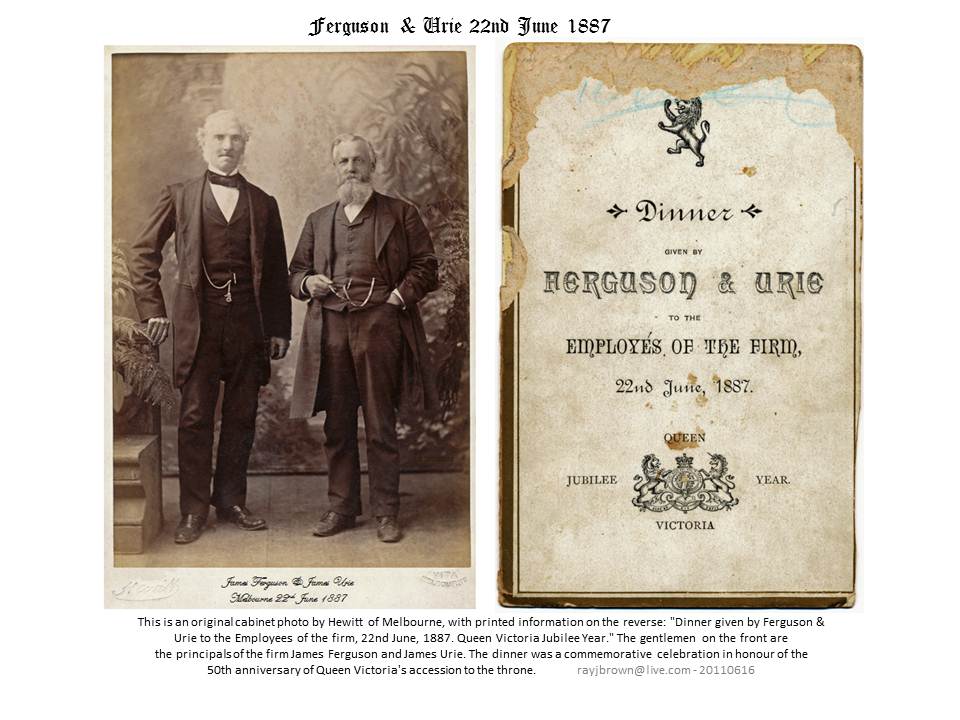
Some years ago I started a family tree for James Urie to assist me with writing up his biography and one of the coincidental curiosities I found was that his mother’s maiden name was Jean Ferguson who married William Urie at Kilmarnock, Scotland, in 1814. During my research it felt like every second person in Scotland was named Ferguson, so I dismissed it very early as there was no other credible information or family links to join the dots.

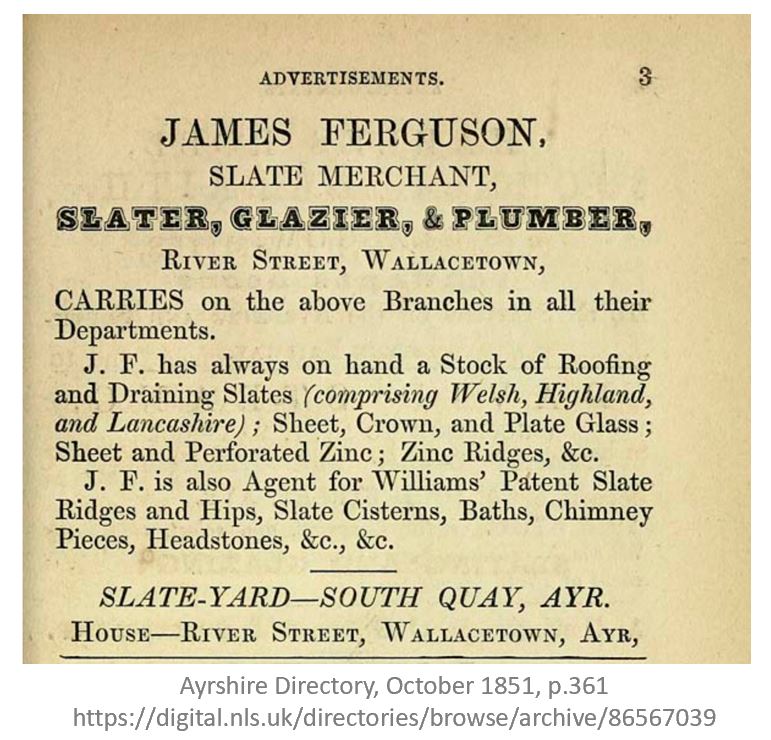
On my own family tree research I found a curiosity in the March 1851 Scotland Census, where James Urie was listed as a visitor at James Ferguson’s house in John Street, Wallacetown, Ayr, on the evening the census was conducted. Their professions were listed as Slater & Glaziers and my reasonable assumption was that James Ferguson and James Urie worked for, and had been apprentices of, James’ father, James Ferguson Snr (1777-1886) who had a significant slating and glazing business in Wallacetown and a large slate yard along the river between the Old Bridge and New Bridge.
In 2015 I was looking for research material to post an article about James Urie’s house named ‘Glencairn‘ which was built in Wellington Street, Flemington in 1885. Knowing that many of the old colonists were prolific at naming their houses in Australia after a town or landmark near their place of birth, Kilmarnock was the obvious target area to focus on.

It didn’t take long to find a place in the middle of Kilmarnock named ‘Glencairn Square’ at the intersection of Glencairn and Shaw Streets East and West. This seemed to be a reasonable clue as to the vicinity of where James Urie grew up. The second lucky find was an old map I found online (undated) which not only showed Glencairn Square but also the names of the householders along the streets. Seven houses south of Glencairn Square on the east side of Glencairn Street was the name “Ferguson & Urie”.
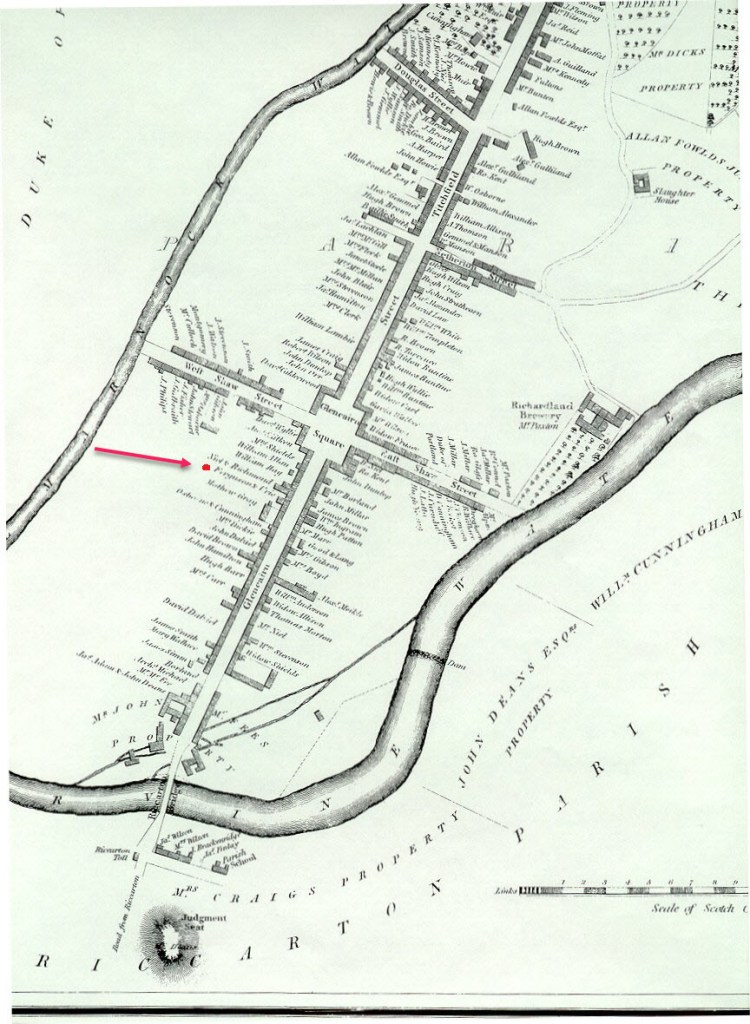
Kilmarnock map circa 1828

This resurrected the credibility of the old relationship joke, but it still didn’t prove anything. It seemed credible that this was where the Urie family must have lived in Kilmarnock but the coincidental name combination of “Ferguson & Urie” on the old map was way ahead of its time. When James and David Ferguson and James Urie arrived in North Melbourne in April 1853 they logically named their plumbing, slating, and glazing firm “Ferguson & Urie”.

There were no other clues to make any positive family tree connection but in May 2021 something remarkable surfaced in the British Newspaper Archives. Here was an article in the Ayr Advertiser in September 1890 titled “Death of an Ayrshire man in Australia” squarely claiming that the men were cousins:

“…It states that Mr Urie was born in Kilmarnock, Ayrshire, in May, 1828, so that at the time of his death he was 62 years of age. Early in 1853 he came out to Victoria, with his cousins, the Messrs Ferguson, and other. Mr Urie and Mr James and David Ferguson [sons of the late Mr James Ferguson, slater and glazier, River Street Ayr,] entered into partnership under the title of Ferguson and Urie, commencing business as plumbers and glaziers…”

A jackpot? Not quite.

Despite all the clues and this astonishing article claiming James & David Ferguson and James Urie were cousins, I still haven’t been able to find out how. The first assumption was they were first cousins, but despite my best efforts I haven’t established that James & David’s father, James Ferguson Snr, had a sister named Jean Ferguson, and no luck looking in other directions to find relationships via any second or third cousins relationships either.

The mystery continues.

Ayr Advertiser Thursday 5th September 1890, page 4.

“DEATH OF AN AYRSHIRE MAN IN AUSTRALIA”

“THE ‘West Bourke (Victoria) Times” [1] of July 25 contains a long obituary notice of Councillor James Urie [2], who died their (sic) after a short illness, on Monday the 21st of July. It states that Mr Urie was born in Kilmarnock, Ayrshire, in May, 1828, [3] so that at the time of his death he was 62 years of age. Early in 1853 he came out to Victoria, with his cousins, the Messrs Ferguson, and others. Mr Urie and Messrs James [4] and David Ferguson[5] [sons of the late Mr James Ferguson, slater and glazier, River Street Ayr,] [6] entered into partnership under the title of Ferguson and Urie, commencing business as plumbers and glaziers in Curzon-street, Hotham[7]. In course of time their business assumed very large proportions and a palatial factory was erected. [8] Mr Urie entered the municipal arena about five years ago. In the discharge of his public duties. Mr Urie displayed most commendable zeal, and much ability. He won the esteem of his fellow councillors, as he had won the respect of the rate payers by the amiability of his disposition, the uprightness of his character, and a tendency to speak with candour, and judge with impartiality. After being a councilor for two years, he was elected mayor, and performed arduous duties appertaining to that position intelligently, zealously, and ably. When deputation after deputation waited upon the Premier, the well-known form of Mayor Urie was always to the fore, and his gentlemanly bearing and quiet earnestness of manner never failed to exert a beneficial influence. When his term of office as councilor expired, he sought re-election and was triumphantly returned at the top of the poll. His popularity never waned, and the confidence placed in him has never been shaken. His efforts for the welfare of the people of his borough will long be remembered with gratitude. He was a gentleman whom any community could ill-afford to lose. When he was mayor he laid the foundation stone of the Flemington Presbyterian Church [9], of which he was a member, and greatly assisted in the work of its erection. He was never backward in lending a helping hand in every deserving cause. He was Justice of the Peace, a member of the Kensington Masonic Lodge, and also an Oddfellow. His cheering voice, pleas and smile, and kindly presence will be greatly missed by a large circle of friends and acquaintances. He leaves a wife and nine children – three sons and six daughters. The funeral took place on Wednesday afternoon, and the procession was one of the largest ever seen in the borough.” [10]

Footnotes:


[1] As at 20210530, the West Bourke Times tabloid has not been included in the Australian National Archives ‘Trove’ Collection.

[2] Biography: James Urie (1828-1890)

[3] James Urie was born in Kilmarnock 14th May 1828, to William Urie and Jane Ferguson.

[4] Biography: James Ferguson (1818-1894)

[5] Biography: David Ferguson (1825-1872)

[6] Sons of James Ferguson Snr (1777 – 1866) & Janet Kay (1791-1860)

[7] Later to be known as North Melbourne

[8] See https://fergusonandurie.wordpress.com

[9] James Urie laid the Presbyterian Church foundation in 1888

[10] The late Councillor Urie, 25th July 1890

Other related posts:

23-07-1890: James Urie (1828-1890)

1890: DEATH OF AN AYRSHIRE MAN IN AUSTRALIA

18-09-1885: James Urie’s house “Glencairn”, Wellington Street, Flemington.


Short link to this page: https://wp.me/p28nLD-37O

© Copyright

09-01-1885: Elm Street Hall, North Melbourne, Victoria.

The North Melbourne Presbyterian Church was initially founded in 1854 with the first services being conducted in a Blacksmiths shop near the site of the North Melbourne Town Hall. A temporary iron building was first erected for the congregation in Curzon street, and only a few years later a new bluestone church was erected, the foundation of which was laid by Sir Henry Barkly on Friday the 8th of April 1859[1].

In less than twenty years this church was deemed too small for the growing congregation and in the 1870’s plans were afoot to erect a new one. The designs of local Brunswick architect Evander McIver were chosen and the foundation stone for the new Union Memorial Church was laid on the corner of Curzon & Elm Streets North Melbourne by the Hon James MacBain, M.L.A, on the afternoon of Tuesday 14th January 1879[2]. In less than eight months the new Church was completed and was officially opened on Sunday 31st August 1879[3].

At the same time as the new church was to be erected, the old one was dismantled and, using most of the original building material, was re-erected about fifty meters to the rear of the site and would later become known as the Elm Street Hall. In May 1889 the Sabbath School was erected[4] to the rear of the church and the Elm Street Hall.

The Elm Street hall has a series of four single lancet stained glass windows that are a memorial to David Howat (1814-1885), the father[5] of the Sabbath School Superintendent William Howat (1850-1935). William was most likely the one who commissioned Ferguson & Urie to create the memorial windows to his father and it’s possible that these windows may have been originally erected in the Sabbath School at the time of it’s erection in 1889 and later moved to the Elm Street Hall where they exist to this day in the liturgical south wall.

Photos taken: 21st July 2012.

This slideshow requires JavaScript.

The four windows are in very poor condition and there are many pieces of modern uncomplimentary glass used to fill the gaps where pieces were broken at various times during their history. Three of the four pieces of text that describe the figurative depictions in each window are missing altogether and the memorial text at the base of each window is also missing a number of pieces. The only memorial text that can be ascertained at the base of each window is:

1.  “TO THE GLORY OF GOD AND IN MEMORY OF”
Depicts possibly someone as the teacher? A woman or apostle seated with an open book and two children either side. The text below the figure, which may explain the precise depiction, is missing.

2. “(missing piece) HOWAT (missing piece)”
Depicts a child kneeling in prayer at the foot of an apostle? The text below the figure, which may explain the precise depiction, is missing.

3. “WHO DIED 9th JAN 1885 AGED 71”.
This window has the well known figurative depiction of Christ as the Good Shepherd. It has the partial text “The Good Shepherd”, holding a lamb in one arm and his crook in the other with sheep at his feet, so I presume the missing word are “I Am” and “The” to make up “I Am The Good Shepherd”.

4. “(All the memorial text is missing from this window)”.
This window appears to have the figurative depiction usually associated with “Suffer Little Children To Come Unto Me.” But, below the figure is the partial text “…Remember Now Creator…”. This is most likely from Ecclesiastes 12-1 which says “Remember now thy Creator in the days of thy youth, while the evil days come not, nor the years draw nigh, when thou shalt say, I have no pleasure in them”.

The windows were a memorial to David Howat, at one time a session clerk of St. Andrew’s Presbyterian Church of Carlton. He was elected in 1872[6] and held office for more than twelve years until his death in 1885. He died at his residence at 180 William-street Melbourne on the 9th of January 1885 [7], in his 71st year. He was buried in the Melbourne General Cemetery on the 12th of January 1885 [8] and many other family members, including his wife Sarah, infant son David, only daughter Mary and son William are buried in the same family plot.

The Union Memorial Sabbath School and William Howat.

North Melbourne Advertiser, Vic, Saturday 18th May 1889, page 3.

“AN INTERESTING CEREMONY”
“Last Saturday afternoon a large number of ladies and gentlemen interested in the Sabbath school work, met by invitation to celebrate the opening of the new infant school, erected in connection with the Union Memorial denomination, North Melbourne…”
“…Owing to the energy of their superintendent who had not an equal in the colony – in fact there was no superintendent like him, his heart and soul were in the glorious work – they were as a school able to declare the building completed, seated, and opened free of debt…”

The stained glass windows in the Sabbath School were described in the newspapers as:

“It is lighted with ornamental cathedral lancet lights of stained glass, which when finally completed will give a softened and effective tone to the interior…”

The much revered Superintendent of the Sabbath School was William Howat (1850-1935), the son of David Howat (1814-1885) and Sarah Robertson (1814-1891). He was born in Ayrshire Scotland and arrived in Australia with his parents and elder siblings, George and Mary, aboard the Lady Octavia from Greenock on the 31st December 1855 [9][10].

He had been associated with the Y.M.C.A and the Sunday School Union movement from his early 30’s and had for more than 70 years, a long business association with four generations of the wealthy Clarke family of pastoralists[11].

He was first involved with the establishment of a Sabbath School in connection with St Andrew’s Presbyterian Church of Carlton (now zoned in Brunswick) which was opened in August 1884[12] and his efforts in that area made him well qualified to exert himself in the cause for a Sabbath School in North Melbourne.

Apart from being the revered Superintendant of the Union Memorial Sabbath School, William Howat was an avid and eclectic antiques collector and over a 65 year period had amassed an extraordinary collection of books and all manner of curios from all over the world[13]. His love of books also extended to the Sabbath School where he donated the vast majority of the books to its library. At the opening of the Sabbath School in 1889 it was described:

“The library is a model. It contains some 1800 volumes, mostly the gift the superintendent. The teacher’s library is a collection of the best works extant…”[14]

William Howat died unmarried on the 1st of August 1935[15], at his home ‘Glaisnock’ in William Street West Melbourne aged 85. He left an estate reported to be worth £9,912[16] and apart from many bequests to relatives and friends, and charitable institutions, he bequeathed a life interest in most of his estate to his housekeeper.

The William Howat collection of books, art, and curios, was put up for auction in November 1935[17] which consisted of over 20,000 volumes of rare old editions and modern works on all branches of literature as well as a collection of native weapons, Chinese artworks and curios[18]. It was described in the papers as “one of the Greatest Sales ever held in Melbourne[19].

Other References:

http://vhd.heritage.vic.gov.au/#detail_places;884

http://www.cv.vic.gov.au/stories/sound-in-space/12225/elm-street-hall-north-melbourne/

Foot notes:

[1] The Argus, Melbourne, Vic, Saturday 9th April 1859, page 5.

[5] Vic Births Deaths & Marriages No: 6681/1935. William Howat, son of David Howat and Sarah Robertson.

[9] Prov.vic.gov.au (Fiche 084 page 002)

Short link to this page: http://wp.me/p28nLD-1sO

© Copyright

1890: Curzon Street, Ferguson & Urie Employees circa 1890.

This is a magnificent historical photo of James Ferguson and five of the Ferguson & Urie employees circa 1890. I would guess this photo may have been taken at the rear of the Curzon street workshops North Melbourne which was their first workshops when they started business in 1853. They advertised from the site as early as 1853 but the workshop building wasn’t erected until after 1858 as indicated in the diaries of stained glass artist David Relph Drape. The building still exists as at 2012 but the interior has been converted to individual apartments and only the shell and facade remain as it appeared in the Ferguson & Urie employee photos of June 1887.

The only two positively identified men in the photo are, James Urie Jnr,  James Ferguson Snr and James Ferguson Jnr. The other identifications are based on a likeness from the 1887 employees photos that were taken for the company dinner held on the 22nd January 1887.

CURZON Street Photos 01a

1.D. Morris, 2. unknown, 3. James Urie Jnr (1870-1896), 4. James Ferguson Snr (1818-1894), 5. J. M. Gilligan, 6. James Ferguson Jnr (1861-1945). Photo kindly contributed by my 3rd cousin Errol Vincent from New Zealand 2010.

CURZON Street Photos 02a

The Curzon Street workshop building as it appeared in June 1887 and photo taken 2012.

When the building was being converted to apartments in 2012 the sales brochures indicated that the building had been “remodeled circa 1875 to become the North Melbourne Masonic Lodge”. This incorrect. Ferguson & Urie retained the building as their workshops until the company demise in 1899.

18990506

In May 1899 an advertisement was placed in the Melbourne Age advertising the auction of their stained glass workshops at 42 Curzon Street would occur at 3p.m. on the 9th of May 1899.

The first tabloid article indicating the building had become the North Melbourne Masonic Lodge appeared in the North Melbourne Courier & West Melbourne Advertiser in September 1902 and it remained in their possession until 2008 when it was put up for auction and sold for $1.3m.

20081014 Curzon

Related posts:

1887 Ferguson & Urie Company Dinner


Short link to this page: https://wp.me/p28nLD-1aP

© Copyright

19-11-1886: Auction of the Curzon Street Cottages.

By the mid 1880’s James Ferguson & James Urie had built their substantial new homes in Parkville and Flemington and their humble cottages in Curzon street near their workshop were obviously no longer required.  James Urie’s cottage was at 28 Curzon Street and  James Ferguson’s at No 24 Curzon street. The company’s first business premises was situated in very close proximity to the two cottages and was diagonally opposite the Union Memorial Presbyterian Church in Curzon Street.

In todays terms (2018) the address is 42 Curzon Street and the majority of the facade of the original building still exists.

In November 1886 they placed their cottages in the hands of Barrett & Co Auctioneers.

The Argus, Melbourne, Friday 19th November 1886, page 3.In

“SATURDAY, NOVEMBER 20. At Three O’Clock.

On the Premises, Little Curzon-street, Hotham. 2 BRICK COTTAGES. By Order of Messrs. Ferguson and Urie.

BARRETT and Co. will SELL by AUCTION, on the premises, as above, land having frontage of 55ft. to Little Curzon-street by a good depth, on which is erected two brick cottages, containing six rooms, outhouses, &c. Terms at sale.

The auctioneers would call special attention to this sale the property being well-built, near the omnibus and cab route, and within a few minutes’ walk of the city. Barrett and Co., auctioneers, corner of Queensberry and Abbotsford street, Hotham, and Racecourse-road, Newmarket”.

The partial municipal map below from 1878 shows the three key addresses in Curzon & Little Curzon street in North Melbourne.

Curzon St map [1878] [c1]

Curzon Street Municipal plans 1878


Short link to this page: https://wp.me/p28nLD-P8

© Copyright