1884-George Francis Smith (1870-1927)


The cameo image of a young George Francis Smith appears amongst thirty-one images of employees in a portrait collage for the Ferguson & Urie stained glass company[1] dinner in 1887.

George Francis Smith (1870-1927)

The historic collage of photos was commissioned by the employees as a gift to the founders of the company, James Ferguson[2] and James Urie[3]. It was presented at the company dinner held at the Mechanics Institute within the North Melbourne Town Hall on the 22nd of June 1887.[4] A large copy was on display in the foyer on the night and many smaller copies about 8×10 size were created and given to each employee, as well as a reporter from the North Melbourne Advertiser who had been invited to chronicle the evening’s proceedings.

Ferguson & Urie employees 22 June 1887

It can only be surmised that George was apprenticed to Ferguson & Urie as a glass-cutter around the time he turned fourteen in 1884. His father had died at Castlemain in 1882 and his mother and younger siblings moved to North Melbourne in close proximity to his elder siblings. His mother’s house, in Errol Street North Melbourne, was within walking distance to the Ferguson & Urie workshop in Curzon Street.

Other than George’s image in the poster collage, not much is known of his time with Ferguson & Urie but it turns out that he was not very lucky in life.

George Francis Smith was the son of David Samuel Smith and Alicia Carey. He was born in 1870 in the tiny town of Vaughan, fifteen kilometers south of Castlemaine in Victoria.

In 1894 George married Elizabeth Jane Bence in North Melbourne. George and Elizabeth took up residence in a tiny cottage at 49 Percy-street in West Brunswick. The following year Elizabeth became seriously ill and died of enteric pneumonia fever at the Melbourne Hospital on the 27th of December 1895. She was only twenty-two years old and they had no children. Elizabeth was buried at the Melbourne General Cemetery on the 29th of December.

At the end of 1899, the Ferguson & Urie stained glass company closed its doors and the employees were scattered to the winds. Many sought employment at other glazing, stained glass, plumbing, and masonry firms. George had spent sixteen years with Ferguson and Urie and he had now been a widower for the last five years.

In 1907 George married thirty-seven-year-old Emma Valice Deacon at Prahran, and there were no children from this marriage either.  By 1912 George & Emma were residing at 46 Nicholson Street in South Yarra. The electoral roll of the time still recorded George’s profession as a glass cutter.

Outside of his employment as a glass-cutter at Ferguson & Urie, he was a member of the Stanhope I.O.O.F. at Malvern and the Captain of their lawn bowls team.

By 1917 George and Emma were living at “Albert Villa” on Balaclava Road, Caufield East. Emma died there on the 16th of March 1917. She was fifty-three years old.

George was now a widower for the second time. He never married again. His last run of bad luck would be his own demise a decade later when he attempted to board a moving train at Flinders street station in Melbourne on the 24th of October 1927.

“FATAL DASH FOR TRAIN. Body Badly Mutilated
MELBOURNE, Nov. 7. In making an attempt to board a moving train on October 24, George Francis Smith, 56, glazier, residing at Caulfield, missed his footing and fell between the train and the platform. He was dragged some yards before the train was stopped. The accident proved fatal. At the inquest to-day Albert Francis Brown, railway porter, said he saw deceased dart across the platform and attempt to board the train, which was travelling at about 15 miles per hour. The deceased missed his footing and fell under the train, which was then stopped. His body was badly mutilated. The Coroner, Mr. Berriman, found death to be due to being crushed by a train.” [5]

Melbourne General Cemetery, CofE, T-757

Melbourne General Cemetery, CofE, T-757

George was buried with his wives Elizabeth and Emma at the Melbourne General Cemetery on the 29th October 1927 – Melbourne General Cemetery, CofE, T-757. His probate was granted on 2nd December 1927.


Footnotes:

[1] Ferguson & Urie: Colonial Victoria’s Historic Stained Glass Craftsmen 1853-1899.

[2] Biography: James Ferguson (1818-1894)

[3] Biography: James Urie (1828-1890)

[4] North Melbourne Advertiser, Saturday 25th June 1887, Page 3.

[5] Geelong Advertiser, Vic, Tuesday 8th November 1927, page 5.


Short link to this page: https://wp.me/p28nLD-3cX

© Copyright

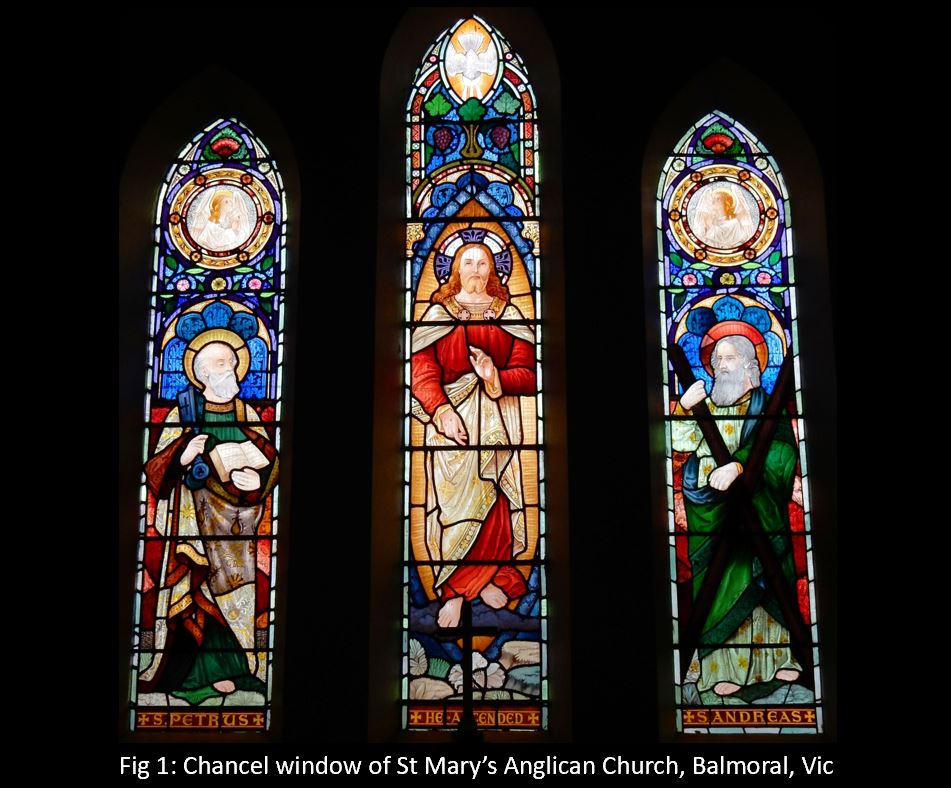
1894: St Mary’s Anglican Church, Balmoral, Victoria.

After 1894, finding extant stained-glass windows created by the historic stained-glass firm Ferguson & Urie of North Melbourne is rare. A mention of one of their windows at St Mary’s Anglican Church in the tiny township of Balmoral is a significant bonus for my research of the company.

Balmoral is a tiny town 73km northeast of Casterton and 80km South of Horsham in Western Victoria. It was settled in the early 1850s and today its population is under 300.

Caroline Armytage[1], the wife of Charles Henry Armytage laid the foundation stone of St Mary’s Anglican Church at Balmoral on the 27th of September 1894 [2] and the Bishop of Ballarat officially opened it on the 24th of January 1895. An account of the church furnishings and fittings was chronicled in detail but there was only a brief mention of the stained-glass window in the chancel;

“… a chancel in early English style, with handsome triple east window (presented by the Armytage family in memory of the late C. Armytage, Esq., of Fulham), by Ferguson and Urie…” [3]

There was no indication of what the window depicted so that just left me a mystery and enough curiosity to undertake a 260-kilometer trip to see if it still existed and if so, what was in it?

The date of the tabloid article indicates the window was likely made in late 1894. The Ferguson & Urie company closed in late December 1899, so finding extant examples of their stained glass in this period their final decade is rare.

At the time the Balmoral window was made, the original founders of the company had died. James Urie, in 1890 and James Ferguson, in 1894. The company was then in the hands of their sons, James Ferguson Jnr and William Urie. Neither founders nor their sons were stained-glass artists in the company, so at this late stage in the company’s history, identifying which of the firm’s remaining stained-glass artists who may have had a hand in the design and painting of the windows becomes vague.

We visited Balmoral in August 2017 to see the window at St Mary’s. The three-light window is the only stained glass in the church, others are generic lead-light.

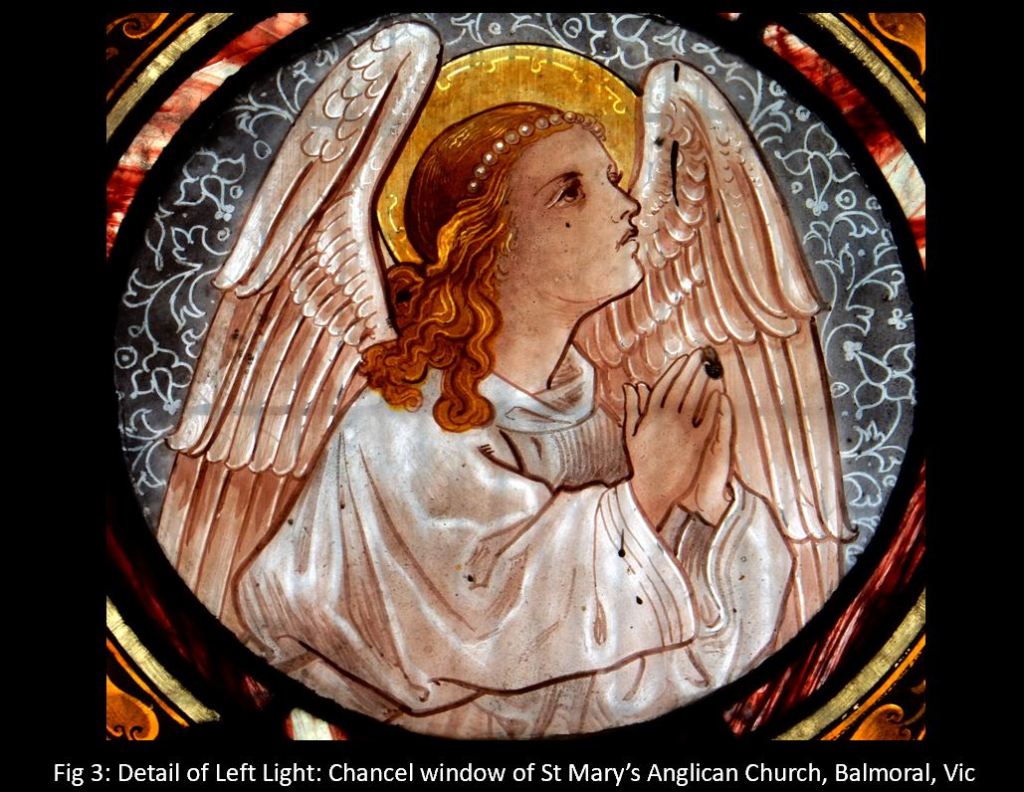
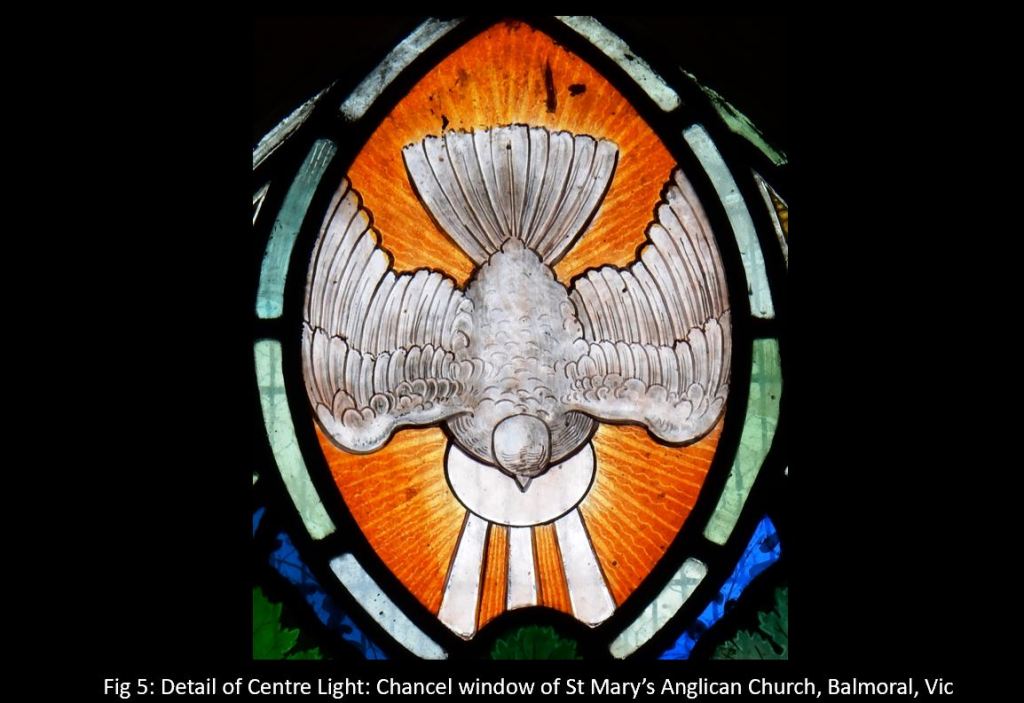
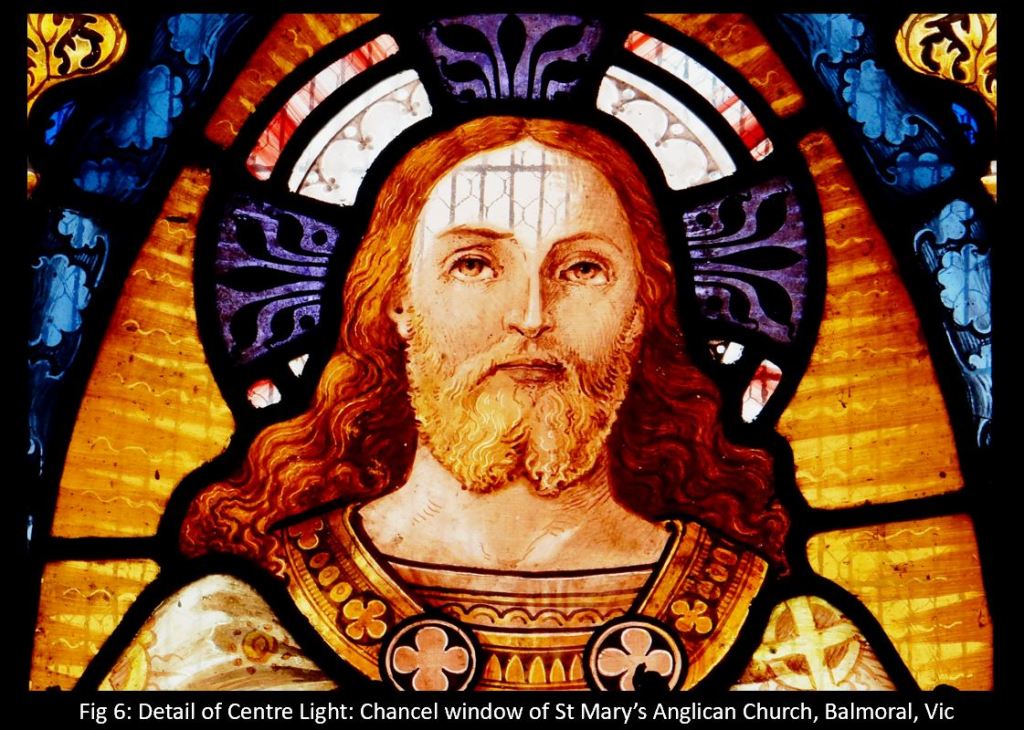
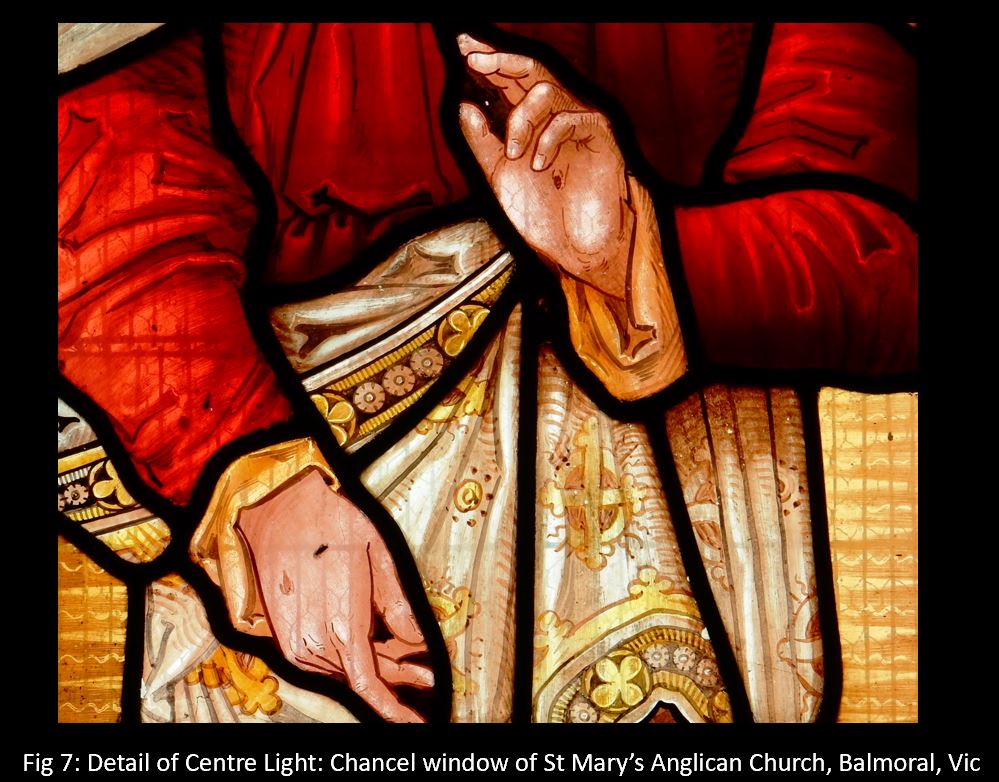
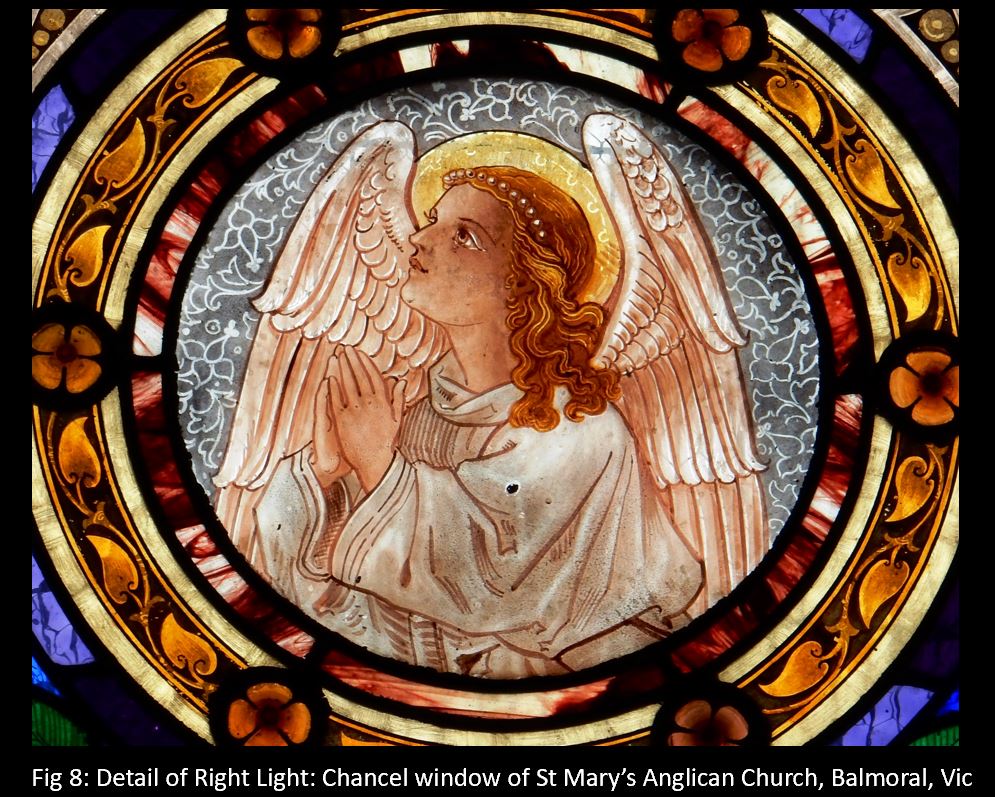
From left to right the window depicts St Peter, Christ, and St Andrew. There is no doubt it was a Ferguson & Urie window, but the figurative depictions of St Peter, Christ, and St Andrew were very different.  

The company’s early figurative style is easily recognisable in the period of their first two stained-glass artists with the company, John Lamb Lyon [4] (from 1861 to 1873), and David Relph Drape [5] (from 1863 until his death 1882). Windows made after Drape’s death in 1882 leave some mystery as to who the artists may have been.

Dr. Bronwyn Hughes OAM proposed that the Balmoral window could be the work of stained glass artist Herbert Moesbury Smyrk [6].

Whilst many parts of the window are typical of Ferguson & Urie’s company style, the figurative work in the faces of St Peter, Christ, and St Andrew are quite different. Smyrk’s painting style is very delicate and he was quite prolific at using the traditional silver stain to create varying shades from light yellow to deep gold. Some parts of his figurative images let through a lot of light which wasn’t prevalent in early Ferguson & Urie windows created in the Lyon and Drape era. A further study of my photo collection of stained glass windows in this same period has now revealed more of Smyrk’s style under the guise of Ferguson & Urie, and many other windows created during his time with Ferguson & Urie are now attributed to him. 

Positive evidence of Smyrk’s association with Ferguson & Urie is revealed in February 1896 when a memorial stained-glass window, dedicated to Councillor William Ievers MLA, was erected in St George’s church (now part of Corpus Christie) at Carlton. The window was executed by Ferguson & Urie and Smyrk was named as the designer [7]. The church was gutted by fire in 1924 and none of the original windows survived [8]

An obscure article in May 1896 provides further evidence of Smyrk’s connection to Ferguson & Urie when he writes to the editor of The Herald about the rules of Cricket. He signs off as; “H. Smyrk. 100 Franklin Street, 2nd May”. That address was the Ferguson & Urie Franklin Street Warehouse which they occupied in mid-1891.[9]

The window at St Mary’s, Balmoral has no memorial inscription on it but a nearby brass plaque records that it is dedicated to Charles Henry Armytage:

“In Loving Memory of Charles Henry Armytage, Died 26th April 1876”.

The Armytage family name is probably more well known to Melburnians for their period of ownership of the heritage-listed “Como House” in South Yarra where Charles died in 1876 [10]. It’s likely that his wife Caroline would have been the instigator for the erection of the stained-glass window at St Mary’s at Balmoral. It was also the first church to be built in the district.

Charles’ estate of £120,000 was left to his wife Caroline[11] with other complex divisions and trusts for his children. As was usual of the time, his will included archaic conditions that if Caroline remarried, her future husband could have no control of any of her estate, and nor would Caroline be liable for any future husband’s debts.

Image gallery:

Stained Glass Artists – Herbert Moesbury Smyrk 1861-1947:

Smyrk, seems to have passed through nearly every major Stained glass company in Australia between 1884 and 1947. His prolific association with so many companies makes attribution to his work very difficult.

Smyrk was born in Guildford, Surrey, England. At the age of fourteen was selected from hundreds of art students to be apprenticed to Powell and Shellard[12] as a stained glass artist and designer. [13]

On completion of his apprenticeship circa 1881, Smyrk stowed away on the ship ‘Queen’ at St Catherine’s docks in London which was bound for America. He began designing and painting windows for firms in New York and San Francisco. In 1884 he came out to Australia where he joined Brooks, Robinson & Co., in Melbourne.[14]

By March 1886 he was a partner of the Smyrk & Rogers stained glass company in Melbourne with Charles Rogers. That partnership was dissolved in September 1888 [15] and he returned to London to work with William Morris & Co.[16]

In later years, between many trips back to England, and America, and some years living a nomadic life in Tahiti, he returned to Australia where he designed and painted for Australian firms such as Ferguson & Urie in North Melbourne, E. F. Troy in Adelaide, Barnett Bros in Perth, R. S. Exton in Brisbane, James Sandy & Co in Sydney, and Frank G. O’Brien Ltd., at Waterloo in Sydney.

Herbert Moesbury Smyrk died at Woollahra, Sydney, in 1947 at the age of 85.

A more extensive biography of Herbert Moesbury Smyrk is in progress.

Acknowledgements:

My thanks to Helen Curkpatrick, the human history dynamo from the Wimmera National Trust, Ross & Pam from Longerenong, Denize Raggatt from the Balmoral Historical Society, Bronwyn & David Hughes for joining me on the Hamilton & Balmoral trip, and ABC Radio Horsham.

Footnotes:


[1] Caroline Morrell (nee Tuckwell), whom he married in 1856.

[2] Hamilton Spectator, Vic, Saturday 22nd September 1894, page 3.

[3] Hamilton Spectator, Vic, Saturday 26th January 1895, page 3.

[4] Biography: John Lamb Lyon (1835-1916)

[5] Biography: David Relph Drape (1821-1882)

[6] News, Adelaide, SA, Tuesday 3rd November 1925, page 8.

[7] Advocate, Melbourne, Vic, Saturday 15th February 1896, page 16.

[8] St. George’s Church, Carlton, Victoria 1896

[9] The Herald, Melbourne, Vic, Monday 4th May 1896, page 3.

[10] The Argus, Melbourne, Vic, Thursday 27th April 1876, page 1.

[11] Biography: Charles Henry Armytage (1824-1876)

[12] I believe this to be incorrect. The name of “Shellard & Powell” doesn’t exist.

[13] The Catholic Press, Sydney, NSW, Thursday 28th February 1935, page 24.

[14] News, Adelaide, SA, Tuesday 3rd November 1925, page 8.

[15] The Argus, Melbourne, Vic, Friday 21st September 1888, page 5.

[16] Building & Real Estate, Vol 15, No 86. 12th October 1914, page 3.


Short link to this page: https://wp.me/p28nLD-3bF

© Copyright


1891: James Ferguson Williams (1877-1959)

James Ferguson Williams (1877-1959), Stained Glass Artist and former member of the Ferguson & Urie stained glass company of North Melbourne circa 1891-1898.

James Ferguson Williams is recognised as a member of the historic Ferguson & Urie stained glass company of North Melbourne circa 1891 – 1898.

In my early research of South Australian stained glass I had seen many references to a stained-glass artist named “J. F. Williams” in relation to the H. L. Vosz and later the Clarkson Ltd stained-glass company, but it never occurred to me at the time that he was the grandson of James Ferguson (1918-1894) from the historic North Melbourne stained-glass firm Ferguson & Urie.

The key to this family history revelation was found by pure chance in the guest book of St George’s Anglican Church at Queenscliff in Victoria. I had taken an Aunt & Uncle there to see the magnificent cycle of stained glass windows by our ancestor James Ferguson of the Colonial Victorian stained glass company Ferguson & Urie 1853-1899.

I had been to St Georges many times, and also signed the guest book. On this occasion, my aunt had been looking at the names further back in the book and found a vital clue. On the 13th of March 2014 there was an entry by visitors named Marion Ferguson Cullen and Gavin MacSwiney from London:

“…we were tracing James Ferguson my great-great grandfathers’ history, knowing about his stained glass window business & were incredibly fortunate that Wendy gave us access to this magnificent church with the best exposition if his windows. Stunning beauty – & wonderful to have this link with my g-g-gfa. Marion F. Cullen”[1]

My first question was, who is this? I have been researching the family tree for more than a decade and this name hadn’t been revealed to me in any branch. Could this visitor hold some more clues to the Ferguson & Urie company?

A snail mail address was supplied in the guest book but no email and so I began the long slow process of written communication via the traditional post. By the time I had packaged up my parcel for the UK it was quite an epistle.

Nearly a year passed before I received a reply. Marion & Gavin had been traveling the world and their mail had been piling up at their home in London.

Amongst Marion’s first correspondence was this significant clue as to where James Ferguson Williams gained his experience in the stained-glass business:

“I had known about the stained-glass business from an early age as my mother had told me family stories, although some of them were a little vague or inaccurate as family memories passed on tend to be. I was unaware that there was a partner Urie[2], until some years later. Although James Ferguson was my Gt Gt Grandfather, he always seemed a familiar person to me as my maternal grandfather James Williams had moved to live with him when his father, Edward Williams, died.  Edward’s widow, Marion (nee Ferguson), who lived in Royal Parade Parkville, was left fairly destitute and the story we were told was that the lawyers handling the estate disappeared with all the money. She and all her six children moved to live with her father in “Ayr Cottage” Parkville.  I was told there were other cousins also living there but don’t know any more about this.  I am not sure how old my Grandfather was when he moved, as currently I don’t have the date of death of his father Edward, but he spoke warmly of being there, and developed a life- long interest in stained glass.  He studied at the Melbourne School of Art and specialised in design and stained glass in particular.  For most of his career he worked as a designer and then a director for Clarkson[3], a specialist leadlight company in Adelaide.” [4]

On the 20th March 1889 Edward Williams[5] died at Inglewood Victoria leaving his wife Marion with no further financial means. Marion’s six children were Edward Sydney (c.1875-1946), James Ferguson (1877-1859), Jane Grant, (1872-1908), Annie (1873-1948), Elsie Marion (1882-1966), and Percy Alexander (1883-1952). A seventh child, Francis died in infancy in 1884.

Edward was buried in the family plot at the Melbourne General Cemetery. His wife Marion and the children moved back to Melbourne to live with their grandfather James Ferguson at his home “Ayr Cottage” at Leonard Street in Parkville.

The two eldest Williams boys, Edward and James, were apprenticed to their grand-fathers stained glass firm, Ferguson & Urie. James had the artistic talent to become a stained-glass artist in the firm. His elder brother Edward’s trade in the company is not known at this stage but in later years at Adelaide, he was specified as a “Glass Estimator”.

In 1894 their grandfather James Ferguson had died and it was now increasingly obvious that the Ferguson & Urie Stained Glass company was in decline. In mid-1898 Edward and James Williams left Melbourne and headed for Adelaide in South Australia where James enrolled as a student at the Adelaide School of Design to continue his art education.

At the Students Exhibition in September 1898, attended by the Governor of South Australia, he received accolades in the Figure Detail and Anatomy section as well as the Charcoal art section. He was also mentioned alongside another, soon-to-be-famous, art student named Hans Heyson. [6]

Adelaide’s “Century Exhibition”, held in March 1899, gives the first indication that James, and presumably his brother Edward, had joined the H. L. Vosz firm in Adelaide.

“…The first two entries in the catalogue – embossed glass, and painted and fired glass, by Mr. J. F. Williams, are to be found in Mr. H. L. Vosz’s stand. From point of merit they justify the position they take in the catalogue, and they do much to make Mr. Vosz’s stand the artistic exhibit that it is. A portion of the wall has been removed to show the stained glass and lead lights off to advantage, and one cannot but notice the fine effect that has been produced. The large leadlight window that has been formed is most brilliantly coloured. The principal panel represents a figure on horseback, clad in ancient picturesque costume, leaving his home, with two hounds running alongside the horse. For a bright piece of work the colours chosen are most suitable, and these, as well as the designing and drawing, reflect great credit on the taste and ability of Mr. Williams, the firm’s artist. Below this is a picture of St. Patrick driving snakes out of Ireland, a cathedral showing in the distance. Two other excellent panels are charming landscape pictures, and show to what a high degree the art of glass-staining has been brought…” [7]

A tabloid article published in August 1915[8] indicates the year 1898 is likely to be the accurate year as to when the Williams brothers were engaged by the Vosz company. James is credited with starting up the new stained-glass department of the business where he became the chief designer and glass painter.  Given the very close timeframe from when they left Melbourne and joined H. L. Vosz, it seems likely that they may have arranged their employment via correspondence with the firm before they left Melbourne.

James was still studying art at the Adelaide School of Design whilst simultaneously running the stained-glass department for H. L. Vosz. In April 1899 one of his stained-glass window designs was selected as the best in the art section. [9]

In April 1900, James was awarded a Silver Medal for his “stained glass, painted and fired glass, and Lead Lights”. Controversially, one of the judges in this section at the exhibition was E. F. Troy, an Adelaide artist, and decorator with his own firm producing stained-glass windows in competition with H. L. Vosz. [10]

Two months later In June the H. L. Vosz company took advantage of their accolades and prizes awarded at the Century Exhibition by shining a light on the skills of the employees;

“My Employes Secured Three First and Three Second Prizes at the late Century Exhibition for LEADED LIGHTS AND STAINED GLASS, also First and Second Prize for BEVELLED GLASS…” [11]

These accolades were the kickstart the Stained-Glass department required, and the business began receiving significant commissions. The stained glass designs of J. F. Williams began appearing in Churches and private homes all over South Australia.

At the age of 28 James married Nellie Clark Burgess on the 25th of March 1905 at the Pirie-street Methodist Church in Adelaide[12]. They had three children, Jack Corbin in 1906, Jean Ferguson in 1908, and Marion Ruth in 1913. Jean was the one that had artistic talents like her father and her daughter Marion recalled:

“…She won a scholarship to the Adelaide School of Art…She did not pursue a career in art for very long, although she told me she spent some time in stained glass window design…She completed nursing training and spent 6 years abroad with the Australian nursing forces in WW2, and later in life returned to her first love of painting and drawing[13]

Nothing more is known about Jean’s return to her love of painting and drawing after WW2.

Some of the significant windows in South Australia by J. F. Williams during the H. L. Vosz period include:

1902: St Bede’s, Semaphore. H. L. Vosz Ltd. Depiction of St Bede by J. F. Williams.

1903: Good Shepherd, Bowden, Adelaide. Trooper Horsfall Boer War memorial window, H. L. Vosz Ltd by J. F. Williams.

1903: Adelaide School of Mines. Depicts the Armorial bearings of Sir Langton Bonython, the Marquis of Linlithgow (Earl of Hopetown), Lord Tennyson, and the Lieut-Governor (Sir Samuel Way). Other depict the images of Watt, Newton, Stephenson Bessemer, Lord Kelvin, Faraday and Wren. H. L. Vosz Ltd by J. F. Williams.

1906: Immaculate Conception, Port Adelaide.  H. L. Vosz Ltd, twelve windows designed & executed by J. F. Williams.

1908: St Albans, Gladstone.  H. L. Vosz Ltd, three light window executed by J. F. Williams. 

1909: St Raphael’s, Parkside. H. L. Vosz Ltd, designed by J. F. Williams (also other works at same church).

1909: Methodist ladies College, Wayville. H. L. Vosz Ltd. Four windows depicting Literature, Art, Poetry and Music under supervision of J. F. Williams.

1909: All Saint’s, Hindmarsh. H. L. Vosz Ltd under supervision J. F. Williams. Three light Window depicting the Nativity, Crucifixion and Ascension.

1910: Methodist Church, Kent Town. H. L. Vosz Ltd, under supervision of J. F. Williams. The “Lathlean” family memorial window depicting the enthroned Christ holding the Globus Cruciger.

1911: St Raphael’s, Parkside. St Patrick & St Bridgid windows by H. L. Vosz Ltd under the supervision of J. F. Williams 1911.

1912: St Laurence’s, North Adelaide. H. L. Vosz Ltd, under the supervision of J. F. Williams. The Rev Bannon & MacLean memorial windows.

1913: St Raphael’s, Parkside. Two windows depicting Archangel St Raphael and Gabriel.  St Laurence, North Adelaide. Six Sanctuary windows depicting St. Catherine of Sienna, St Catherine De Ricci, St Rose, St Vincent, St Thomas, and St Dominic.

Under increasing anti-German sentiment in the lead-up to WW1 it was decided to change the name of the Vosz company. In August 1915 an Extraordinary General Meeting was held and it was resolved to change the company name to that of the Managing Director, Mr. Alfred Ernest Clarkson, and trade under the name Clarkson Ltd.[14]

“BRITISH NAME PREFERRED. CLARKSON INSTEAD OF VOSZ… A smoke social was held at Bricknell’s Cafe on Friday night to celebrate the changing of the name of the firm to H. L. Vosz, Limited, to Clarkson, limited. There was a large gathering of shareholders and employees, and the chairman of directors (Mr Alfred Wilkinson) presided… Mr. J. F. Williams, an employee of the firm for 17 years. also spoke to the toast…” [15]

From circa September 1915, all the stained-glass windows produced by the Vosz company would then be recognised under the name of Clarkson Ltd.

Some of the stained-glass windows made under the Clarkson Ltd company name include:

1918: Adelaide Tourist Bureau Windows

1920: Malvern Methodist Church, Soldiers Memorial window.

1920: The Honour Roll at the Peace Exhibition containing flags, laurels, and wreaths.

Outside of the stained-glass business, James was a keen Lawn Bowler like his brother Edward. A few months after the company name changed to Clarkson Ltd, the Governor of South Australia and his select team played bowls at the Sturt club against a team Captained by J. F. Williams. The Governor’s crack team supposedly gave them a thorough flogging on the rink [16]

James was still the head of the stained-glass department in 1915 and in 1922 another change in the company structure occurred which meant a significant promotion for James:

“In a recent re-adjustment of the directorate of Clarkson, Limited, Mr. J. F. Williams, of the Wallpaper and leaded light departments, was appointed to the board, which now comprises Messrs, A. E. Clarkson (Chairman), W. Douglas Ure, Robert Weymiss, and J. F. Williams.” [17]

The following year, in January 1923 Clarkson Ltd celebrated the 75th Anniversary of the firm:

“The directors of Clarkson, Limited, of Adelaide, entertained employees and other guests at the Arcadia Cafe on Friday night in a celebration of the seventy-fifth anniversary of the firm…” [18]

In the first quarter of 1924 James and A. E. Clarkson did a world tour to discover the emerging trends in decoration, wallpapers, and stained glass;

Mr. A. E. Clarkson and Mr. J. F. Williams, who are on a world tour, had an exceptionally good time in America, and were overwhelmed with invitations to dinners and receptions. They are now touring England.”[19]

In September 1927 James was appointed to the Industrial Board for Glass Workers[20]. Less than a decade later, on the 26th April 1936, tragedy struck the Clarkson family and in turn everyone at Clarkson Ltd;

“Mr. A. E. Clarkson, managing director of Clarkson Ltd., disappeared from the deck of the motor ship Moonta in the early hours of yesterday morning while the vessel was at sea on its way to Port Lincoln…” [21]

Albert Clarkson’s cruise was supposed to be a convalescent holiday voyage to recover from a recent bout of double pneumonia. Two weeks earlier he had celebrated his 60th birthday. At 04:30am on April 26th, 1936, he was last seen on the deck of the ship Moonta in his dressing gown and afterward never seen again.

Two months after the tragedy the Clarkson board convened;

Sir Wallace Bruce was appointed chairman of directors of Clarkson Limited, and Mr. L. S. Clarkson has been made managing director in succession to his late father (Mr. A. E. Clarkson). Other directors are Messrs W. D. Ure, J. F. Williams, and Robert Wemyss.” [22]

On the 27th of May 1946, James’ brother Edward died. Edward had been in a car accident on the 22nd of April and suffered a significant but not life-threatening injury to his leg (at the time). His cause of death a month later was later specified as heart failure. His role in his department at Clarkson was “Glass Estimator” but his original trade when at Ferguson & Urie is not known.

In 1948 Clarkson’s celebrated their Centenary Year. In the photo below, James Ferguson Williams sits prominently in the center of the photo in the lighter grey suit.

Strangely enough the famous cricketer Sir Donald Bradman was a director of the firm in 1952.

On the 24th of July 1959, James Ferguson Williams died of a heart attack whilst visiting his daughter Jean at Glen Iris in Victoria[23]. He was 82 years old.

James was cremated, and his ashes were interred at the Adelaide Centennial Park cemetery in South Australia [24] next to his wife Nellie Clarke (nee Burgess) who pre-deceased him a year earlier in 1958.

It’s quite remarkable to think that James Ferguson Williams began his career in stained glass with his grandfather’s historical firm, Ferguson & Urie, in North Melbourne.

Ferguson & Urie was the oldest recorded commercial stained-glass company in Australia. James took his skills with him to South Australia and continued his art education and started up the Stained-Glass department of H. L. Vosz which later evolved into Clarkson Ltd where he became a director.

James was not only an enthusiastic pioneer in his stained-glass craft, but he can also rightly be attributed with paving the way for women to enter the medieval craft. A young aspiring artist named Nora Burden (1908-1992) was amongst the earliest South Australian female artists to have been accepted into the field of stained glass at Clarkson’s. In turn, Nora mentored Vanessa Rose Smith 1907-2005 (nee Lambe) as an artist at Clarkson. Another talented young lady named Nola Collins started her career at Clarkson’s and by 1929 was the principal stained glass artist for Barrenger & Lansdell at Hobart, Tasmania. This may never have occurred if not for James Ferguson Williams.

Clarkson Ltd closed in 1960.


Footnotes:

[1] Guest Book, St George’s Anglican Church, Queenscliff, Victoria, 13th March 2014

[2] In reference to James Urie of the Ferguson & Urie stained glass company of North Melbourne.

[3] The E. L. Vosz company became Clarkson’s in 1915.

[4] Marion Ferguson Cullen – via email 20170602

[5] Edward Williams (1843-1889). Came to Australia from Northern Wales circa 1854 aged 11.

[6] The Advertiser, Adelaide, SA, Thursday 8th September 1898, page 8

[7] The Advertiser, Adelaide, SA, Wednesday 21st March 1900, page 6.

[8] The Advertiser, Adelaide, SA, Saturday 14th August 1915, page 19.

[9] The Express & Telegraph, Adelaide, SA, Monday 10th April 1899, page 2.

[10] The Adelaide ‘Century Exhibition’ Chronicle, Adelaide, SA, Saturday 14th April 1900, page 19.

[11] The Advertiser, Adelaide, SA, Saturday 2nd June 1900, page 2.

[12] Chronicle, Adelaide, SA, Saturday 11th March 1905, page 50.

[13] Email from Marion Ferguson Cullen to Ray Brown 20190304

[14] The Advertiser, Adelaide, SA, Thursday 5th August 1915, page 2

[15] The Advertiser, Adelaide, SA, Saturday 14th August 1915, page 19.

[16] The Advertiser, Adelaide, SA, Wednesday 8th December 1915, page 10

[17] The Register, Adelaide, SA, Saturday 9th December 1922, page 8

[18] The Register, Adelaide, SA, Saturday 20th January 1923, page 13.

[19] Adelaide, SA, Wednesday 12th March 1924, page 16

[20] The Advertiser, Adelaide, SA, Tuesday 27th September 1927, page 21.

[21] The Advertiser, Adelaide, SA, Monday 27th April 1936, page 15.

[22] The Advertiser, Adelaide, SA, Wednesday 10th June 1936, page 20.

[23] 4 Hortense St, Glen Iris, Victoria (then listed as Burwood).

[24] Centenial Park, East Area, Rose Bed N7, Position 011. (tenure expired 31st July 2009).


Short link to this page: https://wp.me/p28nLD-3aH

© Copyright

1867: St Patrick’s Catholic Church Port Fairy

St Patrick’s Catholic Church, Port Fairy, Victoria.

There are many mysteries to be unraveled in historic Ferguson & Urie stained glass windows. This one at Port Fairy in Western Victoria is yet another that I needed to pick to pieces.

The foundation stone of St Patrick’s Catholic Church at Port Fairy (then known as Belfast) was laid on the 30th July 1857 by Bishop James Alipius Goold. The land was donated by one of Port Fairy’s earliest settlers James Atkinson.[1]

The church was built to the designs of London architect Charles Francis Hansom[2] and officially dedicated by Bishop Goold on Thursday 17th January 1861.

In August/September 1868, some stained-glass windows for St Patrick’s were ordered by the Rev James Parle[3] from the Ferguson, Urie & Lyon [4]stained-glass company of North Melbourne. A pair of small two-light windows were the first to be completed and installed on the liturgical south side of the chancel.

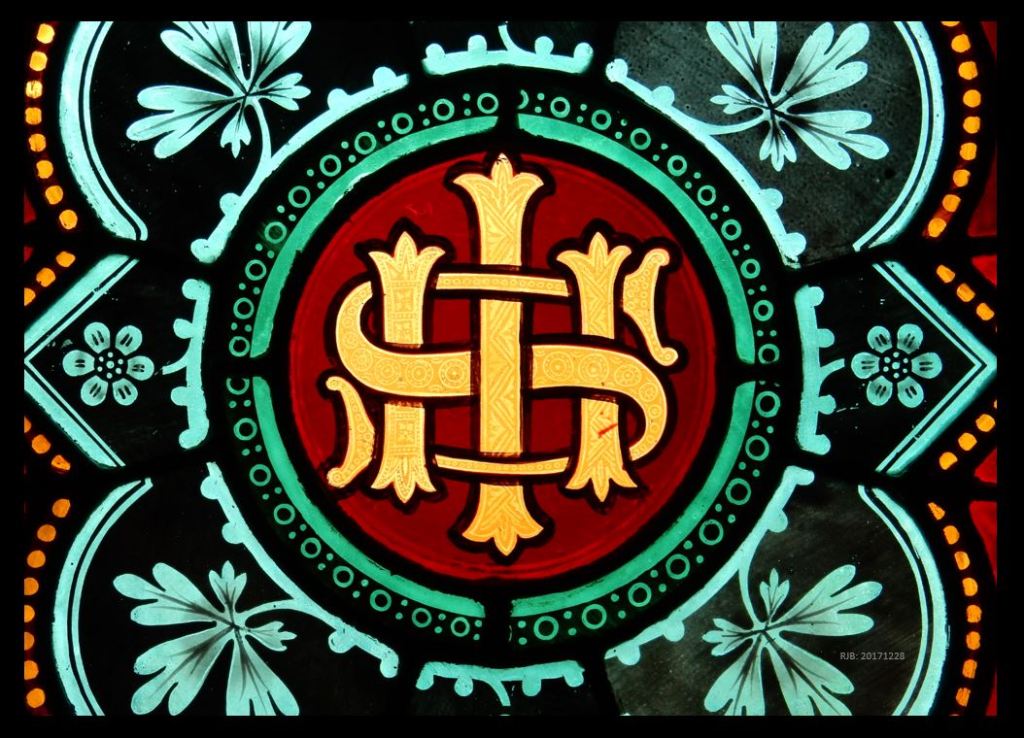
The symbolism in the first pair of windows depicts the fleur-de-lis with a crown and the Chi-Rho.

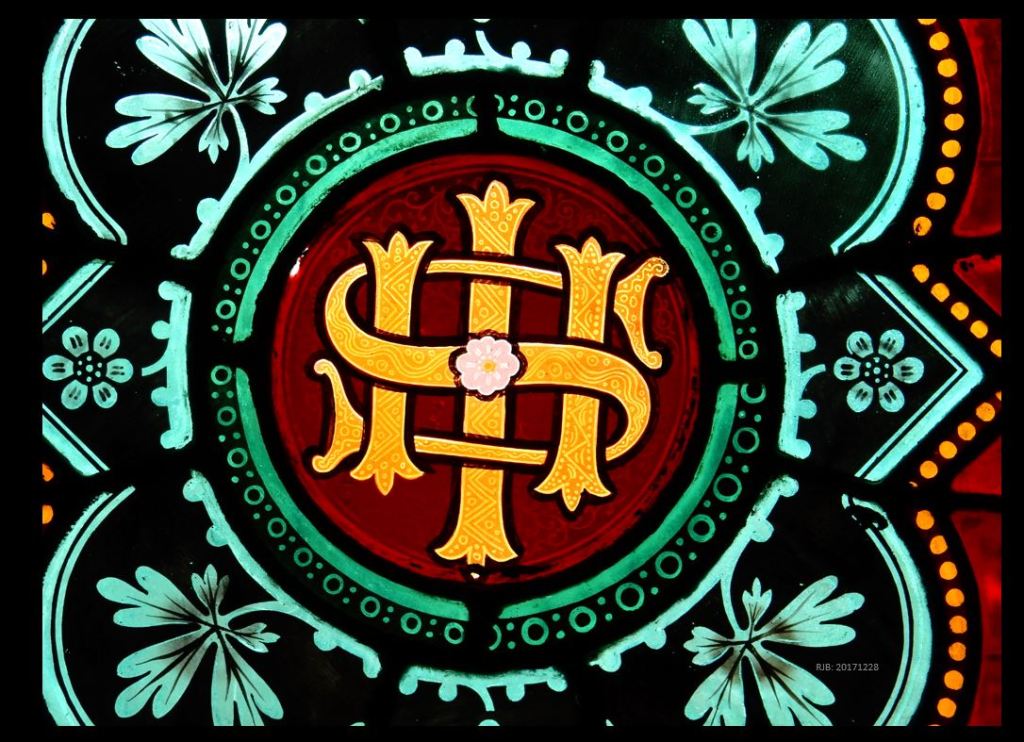
The second pair contains the monogram letters “I.H.C”[5] incorporated with a gold crown and a monogram for the Virgin Mary also with a gold crown. Each of the lancets has the recognisable Ferguson & Urie border design of alternating red and blue glass separated by a flower. The diamond quarries contain repeating patterns of the fleur-de-lis. A quatrefoil in matching colours appears above each pair of windows.

In 2015 master stained-glass craftsman Geoffrey Wallace mentioned some elements in the Ferguson & Urie glass that impressed him, in particular, the ruby red sgraffito rose decoration, in the background of the window depicting the “I.H.C” monogram.

“…There are also two, 2 lancet geometric windows that have the most wonderful sgraffito decoration, particularly the roses…”[6]

The detail of the sgraffito work in the roses is extraordinary, and this level of detail is a highlight of the company’s early stained glass work. St George’s Anglican Church at Queenscliff in Victoria is another example of this detailed sgraffito work in their twelve apostle windows.

The stained glass windows for the main four lights at the liturgical east end of St Patrick’s were originally supposed to depict the Nativity, Baptism, Crucifixion, and Resurrection but these were never ordered by the Rev Parle.

In late September 1867 it was reported;

“…The chancel and spire of the Belfast [Port Fairy] church has been completed. Two very beautiful stained glass windows light the chancel from the northern side, but the great chancel window has not yet been ordered, the estimate of Messrs Ferguson and Co, for which is £250…” [7] – The Age 30th Sept 1867

Almost a year had passed before Rev Parle placed the order for the chancel windows but on the 29th of March 1870 he died, and this would likely be the reason why further progress on the windows was put on hold.

In August 1868 the Melbourne Age reported on the stained-glass for the tracery windows and that temporary windows would be inserted in the lower portions:

“A MAGNIFICENT STAINED GLASS WINDOW has been ordered by the Rev. Mr Parle, for the chancel of St. Patrick’s R.C. Church, Belfast, from Messrs Ferguson, Urie and Lyon, of Melbourne. The design for the four lower or principal openings consists of the nativity, baptism, death and resurrection of our Saviour. In the large circular opening in the upper portion of the tracery the Ascension is the subject, and in the intermediate openings, other scenes in the life of our Saviour are represented. The upper portion is complete, but temporary windows of plain cathedral glass will be inserted in the lower portions. The cost when completed will be £280.” [8] – The Age, Victoria 15th Aug 1868

On the 5th of September further information was reported with a detailed description of the figures that appear in the upper tracery windows:

“ST. PATRICK’S CHURCH, BELFAST.- A new stained glass window has been erected in this church. The lower compartments have been temporarily glazed with plain cathedral glass, but hereafter will be filled in with designs of the Nativity, Baptism, Death, and Resurrection of our Saviour. The tracery about these portions is completed; and in the four trefoils immediately above them are representations of the four Evangelists. In the central and uppermost opening is the Ascension, and in those on either side the Annunciation, and the descent of the Holy Ghost on the Apostles; the various interstices being filled with appropriate emblems. The coloring is very beautiful, and, both in design and execution, this window is a very creditable production of colonial art. It is, we believe, from the establishment of Messrs. Ferguson, Urie, and Lyon, Curzon street, North Melbourne.”[9] – Advocate, Victoria 5th Sep 1868

Starting from the top of the arrangement in the tracery windows is the Ascension. Directly below this is the Paschal Lamb or Lamb of God with Victory Banner. On the left is the Annunciation of Mary and on the right is the Descent of the Holy Ghost. The lower row of four windows depicts the four evangelists as their alter egos, St Mathew as the Winged Man, St Mark as the Winged Lion, St Luke as the Winged Bull, and St John as the Eagle.

Reports of the stained glass windows for St Patrick’s even made it across the globe to Ireland.

“The Builder informs us that “a stained-glass window has been ordered by the Rev. Mr. Parle, for the chancel of St. Patricks (R. C.) Church, Belfast, from Messrs. Ferguson, Urie, and Lyon, of Melbourne”!! Was there not a possibility of the reverend gentleman procuring a window somewhat nearer home?”[10]

The writer from the ‘Dublin Builder’ of November 1868 has me perplexed with this quip. I’m not sure if it was meant to be a joke or whether he was truly oblivious to the ‘Belfast’ he refers to being in Australia and not Ireland.

The temporary cathedral glass that was installed in the four lancets below the Ferguson, Urie and Lyon tracery windows remained an uninspiring bland feature of the chancel of St Patrick’s for more than half a century. They were eventually completed by the Melbourne stained glass of firm Brooks, Robinson & Co circa 1920, but they didn’t depict the scenes originally intended. The scenes in each of the four lights now depict the Agony in the Garden, Christ bearing the Cross, Crucifixion, and the Ascension. 

The depiction of Christ in the window at the top of the tracery had at some point in time been removed for repair or conservation and unfortunately, it was re-installed back to front, which means the delicately painted side was outside and exposed to the weather, which significantly damaged that window. In May 2015, Geoffrey Wallace indicated:

“…The East window has the tracery section done by F&U while the lancets below are by Brooks Robinson.  At the top is an image of God the Father…Unfortunately, someone has installed this panel back to front and most of the paint has washed off…”[11]

A historic black and white photo of the chancel of St Patrick’s dated circa 1920 reveals that the image of Christ in the tracery window is facing to the right which means that it had been installed back to front before 1920. The Lamb carrying the banner below was also facing the wrong way.

In 2017 stained glass craftsman Robert Rusev[12] from Melbourne was commissioned to do some conservation work on the four lancets made by Brooks, Robinson & Co. In addition to that, Rob indicated the following:

“I rectified that situation of the Ascension window being installed painted side out, but I’m afraid I was too late. Almost all of the painted detail has been lost.” [13]

Robert also rectified the reverse installation of the Lamb with Banner window below Christ. 

Rob also wrote:

“… You may have also noticed that the St. Mark roundel is not original. Whilst working I bumped into the old fellow that broke it and all those years later he was still very upset on out it…” [14]

The History of Port Fairy:

Circa 1828, Captain Henry Wishart steered his cutter, the “Fairy,” to shelter from a storm in a little bay off the southwest coast of Victoria. He named the inlet “Port Fairy” after his vessel and it later became the site of a busy whaling station. In less than twelve years unsustainable fishing practices had decimated the whale population in that area and by1840 it was closed as a whaling station. After more than 175 years the fragile whale population is still recovering.

In 1843 the Government wanted a township established in the area and began selling significant parcels of land at very cheap prices. These land sales had a special condition attached to encourage settlers to establish a township. James Atkinson[15], in partnership with William Rutledge and others, purchased 5120 acres from the Crown and Atkinson named the area “Belfast” after his birthplace. The sale to Atkinson was published in the Government Gazette on the 19th Sep 1843[16] but the concept was flawed. Atkinson’s sizeable land holding was considered more of a threat and eventually meant the establishment of the town would stall.

In 1887 the residents of Belfast petitioned the Victorian Government to rename the township back to its original name “Port Fairy” and in May 1887 the Governor of Victoria, Sir Henry Brougham Loch, officially proclaimed the name change[17].

In 2012, nearly 185 years after the inlet had been discovered; Port Fairy was bestowed with the honor of being the world’s most liveable town.[18].

Another church at Port Fairy that has extant stained glass windows by Ferguson & Urie is St John’s Anglican Church.

Acknowledgements:

My thanks to Geoffrey Wallace and Robert Rusev for their contribution of photographs and quotes for this article, and for all the fantastic conservation and replica work they have done and continue to do on the historic Ferguson & Urie and other historic stained glass windows.

Foot notes:


[1] James Atkinson 1804-1864, proprietor of the “Special Survey” for land at Port Fairy in 1843.

[2] Charles Francis Hansom (1817 – 1888)

[3] The Rev James Parle (1811-1870) also instigated the Ferguson & Urie windows for the Infant Jesus Catholic Church at Koroit, Victoria, in November 1870.

[4] John Lamb Lyon became a partner with Ferguson & Urie between 1866 and 1873 at which time the company name was known as Ferguson, Urie and Lyon.

[5] IHC or IHS is a monogram contraction of the Greek word for Jesus.

[6] Geoffrey Wallace email to Ray Brown 14th May 2015.

[7] The Age, Melbourne, Vic, Monday 30th September 1867, page 6.

[8] The Age, Melbourne, Vic, Saturday 15th August 1868, page 3.

[9] Advocate, Melbourne, Vic, Saturday 5th September 1868, page 11.

[10] The Dublin Builder, Ireland, Sunday 1st November 1868, page 9.

[11] Geoffrey Wallace, May 2015.

[12] Robert Rusev was formerly an apprentice to Master Glass Craftsman Geoffrey Wallace.

[13] Robert Rusev email 12th June 2022.

[14]  Robert Rusev email 14th June 2022.

[15]  James Atkinson died in Sydney on the 17th of December 1864.

[16] Victorian Govt Gazette, No.78, Tuesday 19th September 1843, page 1209

[17] Victorian Govt Gazette, No.46, Friday 27th May 1887, page 1388.

[18] The Standard, Vic, 28th November 2012.  (on-line accessed 18 Oct 2020)


Short link to this page: https://wp.me/p28nLD-3af

© Copyright

2022-10-20 Presentation at the Presbyterian Church St Kilda.

In conjunction with GlassInc and the International Year of Glass, I’ll be doing a presentation on the historic Ferguson & Urie stained glass company and some of their stained-glass windows with a focus on the St Kilda area.

Students from GlaasInc (Prahran) will display some of their modern glass work, plus talks etc. It’s a free event but a mere gold coin donation is appreciated by the church. Refreshments are provided too! My friend Dr. Bronwyn Hughes O.A.M will also present a talk about the other stained glass in the church made by Napier Waller, E. R. Suffling, Brooks Robinson & Co, and Mathieson & Gibson.

If you’re early or late and just hungry, there is “Dear Liza” cafe 100m down the corner on Alma Rd. (I DO NOT do paid adverts, personal opinion, yes…!)

1890: DEATH OF AN AYRSHIRE MAN IN AUSTRALIA

It’s been a long-running joke that there may have been a family relationship connection between my third Great Grandfather James Ferguson, and James Urie, who were business partners in the historic Ferguson and Urie stained-glass company in North Melbourne between 1853-1899.

Some years ago I started a family tree for James Urie to assist me with writing up his biography and one of the coincidental curiosities I found was that his mother’s maiden name was Jean Ferguson who married William Urie at Kilmarnock, Scotland, in 1814. During my research it felt like every second person in Scotland was named Ferguson, so I dismissed it very early as there was no other credible information or family links to join the dots.

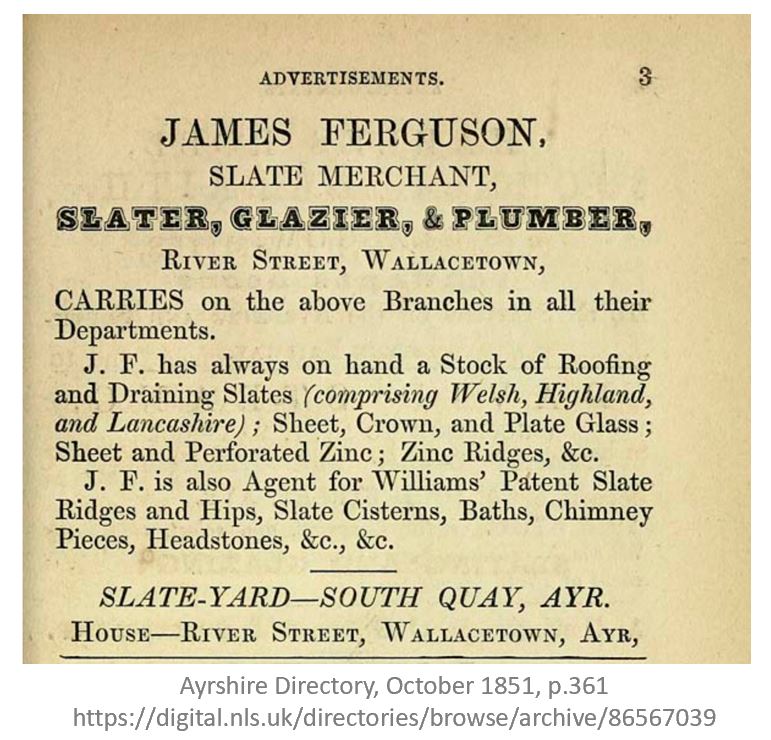
On my own family tree research I found a curiosity in the March 1851 Scotland Census, where James Urie was listed as a visitor at James Ferguson’s house in John Street, Wallacetown, Ayr, on the evening the census was conducted. Their professions were listed as Slater & Glaziers and my reasonable assumption was that James Ferguson and James Urie worked for, and had been apprentices of, James’ father, James Ferguson Snr (1777-1886) who had a significant slating and glazing business in Wallacetown and a large slate yard along the river between the Old Bridge and New Bridge.

In 2015 I was looking for research material to post an article about James Urie’s house named ‘Glencairn‘ which was built in Wellington Street, Flemington in 1885. Knowing that many of the old colonists were prolific at naming their houses in Australia after a town or landmark near their place of birth, Kilmarnock was the obvious target area to focus on.

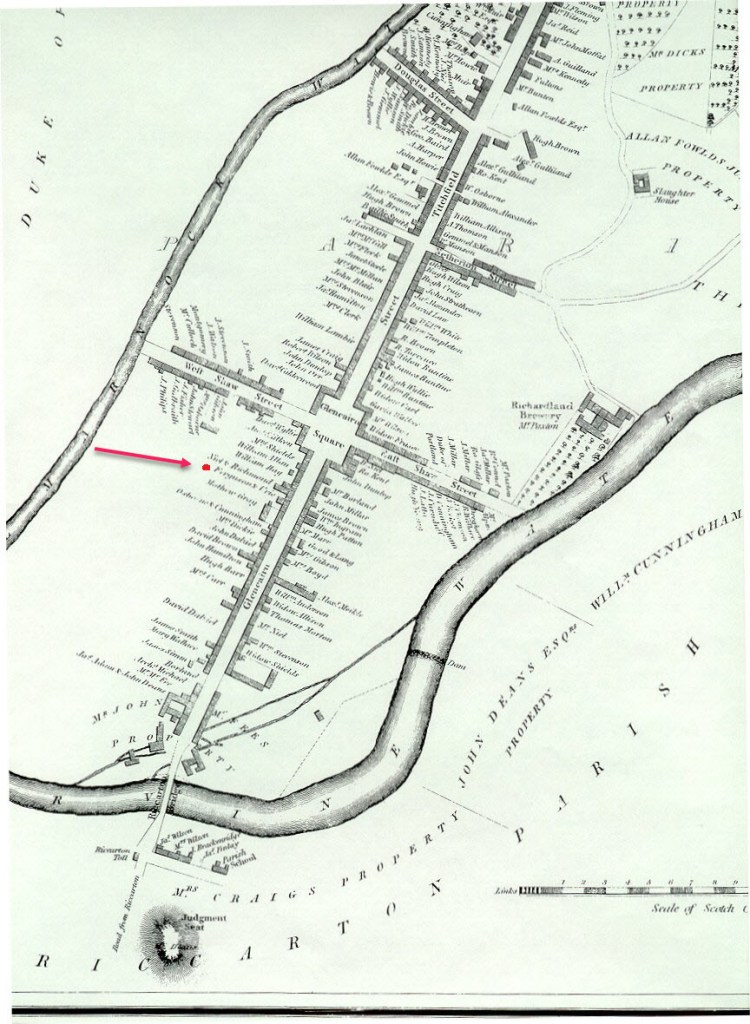
It didn’t take long to find a place in the middle of Kilmarnock named ‘Glencairn Square’ at the intersection of Glencairn and Shaw Streets East and West. This seemed to be a reasonable clue as to the vicinity of where James Urie grew up. The second lucky find was an old map I found online (undated) which not only showed Glencairn Square but also the names of the householders along the streets. Seven houses south of Glencairn Square on the east side of Glencairn Street was the name “Ferguson & Urie”.

Kilmarnock map circa 1828

This resurrected the credibility of the old relationship joke, but it still didn’t prove anything. It seemed credible that this was where the Urie family must have lived in Kilmarnock but the coincidental name combination of “Ferguson & Urie” on the old map was way ahead of its time. When James and David Ferguson and James Urie arrived in North Melbourne in April 1853 they logically named their plumbing, slating, and glazing firm “Ferguson & Urie”.

There were no other clues to make any positive family tree connection but in May 2021 something remarkable surfaced in the British Newspaper Archives. Here was an article in the Ayr Advertiser in September 1890 titled “Death of an Ayrshire man in Australia” squarely claiming that the men were cousins:

“…It states that Mr Urie was born in Kilmarnock, Ayrshire, in May, 1828, so that at the time of his death he was 62 years of age. Early in 1853 he came out to Victoria, with his cousins, the Messrs Ferguson, and other. Mr Urie and Mr James and David Ferguson [sons of the late Mr James Ferguson, slater and glazier, River Street Ayr,] entered into partnership under the title of Ferguson and Urie, commencing business as plumbers and glaziers…”

A jackpot? Not quite.

Despite all the clues and this astonishing article claiming James & David Ferguson and James Urie were cousins, I still haven’t been able to find out how. The first assumption was they were first cousins, but despite my best efforts I haven’t established that James & David’s father, James Ferguson Snr, had a sister named Jean Ferguson, and no luck looking in other directions to find relationships via any second or third cousins relationships either.

The mystery continues.

Ayr Advertiser Thursday 5th September 1890, page 4.

“DEATH OF AN AYRSHIRE MAN IN AUSTRALIA”

“THE ‘West Bourke (Victoria) Times” [1] of July 25 contains a long obituary notice of Councillor James Urie [2], who died their (sic) after a short illness, on Monday the 21st of July. It states that Mr Urie was born in Kilmarnock, Ayrshire, in May, 1828, [3] so that at the time of his death he was 62 years of age. Early in 1853 he came out to Victoria, with his cousins, the Messrs Ferguson, and others. Mr Urie and Messrs James [4] and David Ferguson[5] [sons of the late Mr James Ferguson, slater and glazier, River Street Ayr,] [6] entered into partnership under the title of Ferguson and Urie, commencing business as plumbers and glaziers in Curzon-street, Hotham[7]. In course of time their business assumed very large proportions and a palatial factory was erected. [8] Mr Urie entered the municipal arena about five years ago. In the discharge of his public duties. Mr Urie displayed most commendable zeal, and much ability. He won the esteem of his fellow councillors, as he had won the respect of the rate payers by the amiability of his disposition, the uprightness of his character, and a tendency to speak with candour, and judge with impartiality. After being a councilor for two years, he was elected mayor, and performed arduous duties appertaining to that position intelligently, zealously, and ably. When deputation after deputation waited upon the Premier, the well-known form of Mayor Urie was always to the fore, and his gentlemanly bearing and quiet earnestness of manner never failed to exert a beneficial influence. When his term of office as councilor expired, he sought re-election and was triumphantly returned at the top of the poll. His popularity never waned, and the confidence placed in him has never been shaken. His efforts for the welfare of the people of his borough will long be remembered with gratitude. He was a gentleman whom any community could ill-afford to lose. When he was mayor he laid the foundation stone of the Flemington Presbyterian Church [9], of which he was a member, and greatly assisted in the work of its erection. He was never backward in lending a helping hand in every deserving cause. He was Justice of the Peace, a member of the Kensington Masonic Lodge, and also an Oddfellow. His cheering voice, pleas and smile, and kindly presence will be greatly missed by a large circle of friends and acquaintances. He leaves a wife and nine children – three sons and six daughters. The funeral took place on Wednesday afternoon, and the procession was one of the largest ever seen in the borough.” [10]

Footnotes:


[1] As at 20210530, the West Bourke Times tabloid has not been included in the Australian National Archives ‘Trove’ Collection.

[2] Biography: James Urie (1828-1890)

[3] James Urie was born in Kilmarnock 14th May 1828, to William Urie and Jane Ferguson.

[4] Biography: James Ferguson (1818-1894)

[5] Biography: David Ferguson (1825-1872)

[6] Sons of James Ferguson Snr (1777 – 1866) & Janet Kay (1791-1860)

[7] Later to be known as North Melbourne

[8] See https://fergusonandurie.wordpress.com

[9] James Urie laid the Presbyterian Church foundation in 1888

[10] The late Councillor Urie, 25th July 1890

Other related posts:

23-07-1890: James Urie (1828-1890)

1890: DEATH OF AN AYRSHIRE MAN IN AUSTRALIA

18-09-1885: James Urie’s house “Glencairn”, Wellington Street, Flemington.


Short link to this page: https://wp.me/p28nLD-37O

© Copyright

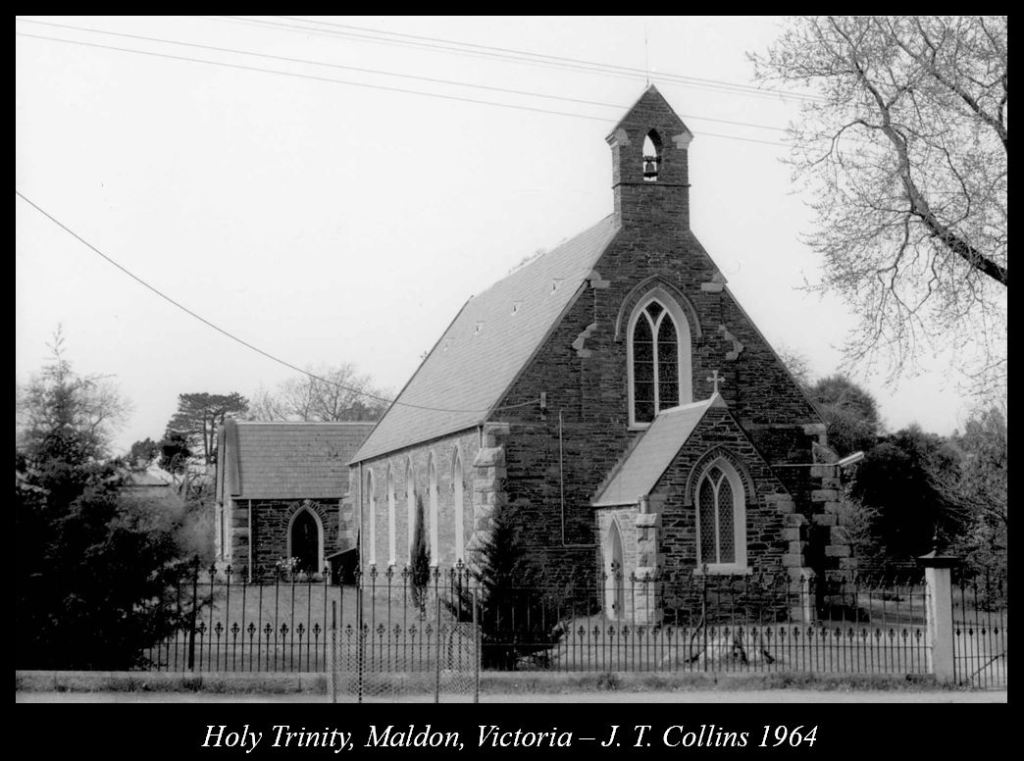
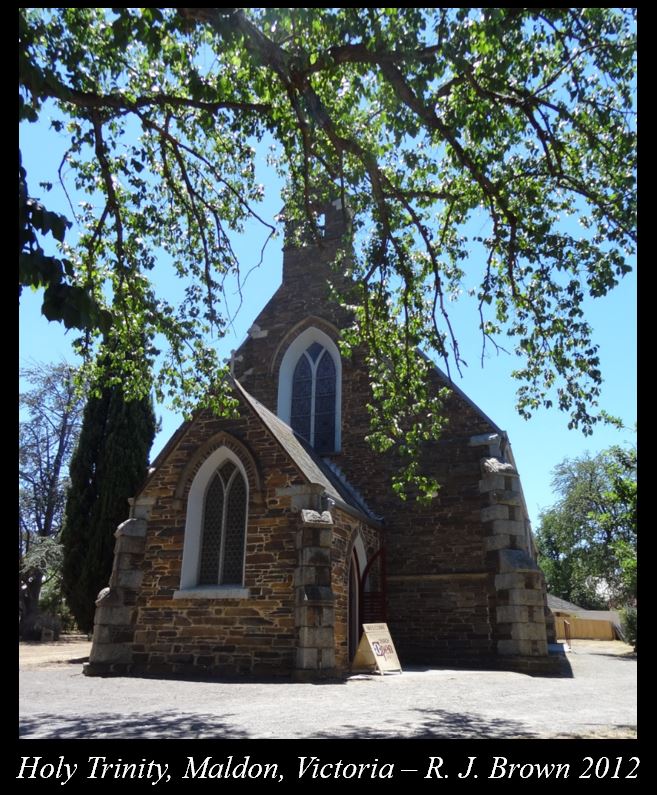
1863: Holy Trinity, Maldon, Victoria

#

The goldfield regions of Victoria are responsible for a lot of our pioneer history. A historic stained-glass window erected at Holy Trinity Anglican Church at Maldon in 1863 tells a significant part but in a historical perspective, a mere fraction of it. The window is now more than a century and a half old, it’s 157 as of 2020, the year of the worldwide COVID-19 virus pandemic.

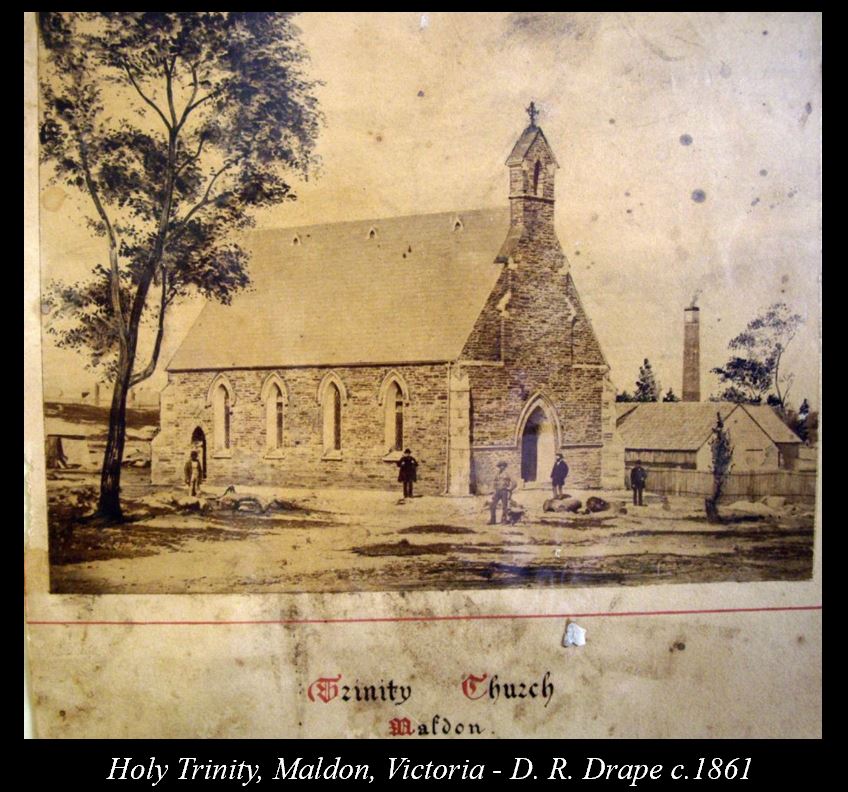
On the third of May 1861, the Tarrangower Times reported that the £750 tender of Hornsby & Briscoe was accepted for the construction of Holy Trinity Church at Maldon and would be built to the designs of David Relph Drape.[1]

The foundation stone was laid on Wednesday 19th June 1861 by Archdeacon Crawford of Castlemaine [2] and it opened in October of the same year.

In late 1863, a local mining investor from Maldon named William Samuel Threlfall donated a two-light stained-glass window for the west end of Holy Trinity Church. Given that architect of Holy Trinity David Relph Drape was primarily a stained-glass artist by trade you could be forgiven for thinking that he would have some input in the design of the window or even some hands-on work with it. This may not have been the case.

Five years earlier, in 1858, Drape accepted an offer from James Ferguson of the Ferguson & Urie company of North Melbourne to emigrate to Australia from Carlisle, England, and be the company’s stained-glass artist in their new venture producing locally-made Colonial stained-glass windows. He arrived aboard the ship ‘Morning Light’ on the 20th September 1858 only to find that Ferguson & Urie’s stained-glass workshop in Curzon Street North Melbourne had not been built and there was no employment for him, so he decided to head for the goldfields town of Maldon in Central Victoria.

Why Drape chose Maldon specifically is not known, but there was plenty of demand for his skills there. Back in Carlisle Drape had been well acquainted with the Selby family and coincidentally, John Selby, closely followed by his sister Jane, had migrated to Australia earlier and settled at nearby Castlemaine eighteen kilometers southeast of Maldon. It’s a fair assumption that Drape’s heartstrings for Jane were the reason for many of his trips to Castlemaine, often by foot.[3] He married Jane Selby at the Congregational Church in Melbourne in 1864.

Drape became well known in Maldon in many different pursuits. He was the architect of many local Maldon buildings and his other skills included, draftsmanship, art, painting, illuminated testimonials, tombstone, and memorial tablets. He was also a board member of the Concord Quartz Mining company. There is no record of him designing or fabricating stained-glass windows during his time at Maldon.[4] 

Coincidentally, in April 1861 a Scottish stained-glass artist named John Lamb Lyon arrived in Maldon with his wife Elizabeth. Why they chose Maldon is more obvious as John’s parents James and Janet had migrated to Australia earlier and established themselves as Maldon storekeepers and contractors for the local postal service.

A little over four months after their arrival in Maldon, John was in the process of submitting a design for a stained-glass window for the 1861 Melbourne Industrial Exhibition:

“Works of Art.- Mr John Lyon, lately arrived from England, on a visit to his father, a well-known old resident of this town, is now engaged on an elaborate design for an “Early English” stained glass window. It is intended for the forthcoming Exhibition, and space has been allotted him for that purpose. We consider Mr. Lyon a gentleman of great promise and sterling ability, and we cannot but hope that his work will attract such attention in Melbourne that he will be enabled to pursue his beautiful art in the colony with advantage to himself and the public. We are informed by gentlemen, we believe competent to judge that there is no Ecclesiastical glass painter of equal talent in the colony, at least not publicly known. Architects who in carrying out their designs have felt the want of such decorations will now have an opportunity of judging whether the talent of Mr. Lyon will fill the vacuum” [5]

I suspect that his stained-glass window design may have ended up being used as the design for the two-light window at St Margaret’s Church at Eltham in Nov/Dec 1861. That window is extant and currently the oldest Ferguson & Urie stained-glass window I have found to date. If a linotype or sketch of Lyon’s window for the 1861 exhibition were ever to be found it might solve or deny the mystery.

It would be incredulous not to think that Drape and Lyon did not become acquainted with each other in Maldon. Two stained-glass artists with similar tastes and artistic abilities in the medieval stained-glass craft in a small gold mining town in Australia is an extraordinary coincidence.

By late 1861 Lyon had joined the Ferguson & Urie stained glass company at North Melbourne and started the production of stained-glass from their new workshop in Curzon Street.

Drape had left Maldon by the end of October 1863 and started work alongside Lyon at Ferguson & Urie’s on the precise date of 8th November[6].

In late 1863 the stained-glass window for Holly Trinity had been completed and erected high in the liturgical west end. The exact date is not known. I can only broadly bracket it down to the latter half of 1863.  The first mention of it is in early February 1864. One thing is certain, the window had to have been fabricated at the new Ferguson & Urie workshop in Curzon Street North Melbourne. Ferguson & Urie had the only known stained-glass workshop in Victoria at the time. Lyon was quoted for an interview for the Australian Decorator and Painter in 1909 that their inception was primitive:

“In 1861, Mr. Lyon joined the firm of Ferguson and Urie, Melbourne. Their commencement was on a very primitive scale. They made their own colours and acid, and fired the glass in a colonial camp oven. They, however, soon got properly going, and produced good work under the firm name of Ferguson, Urie and Lyon.” [7][8]

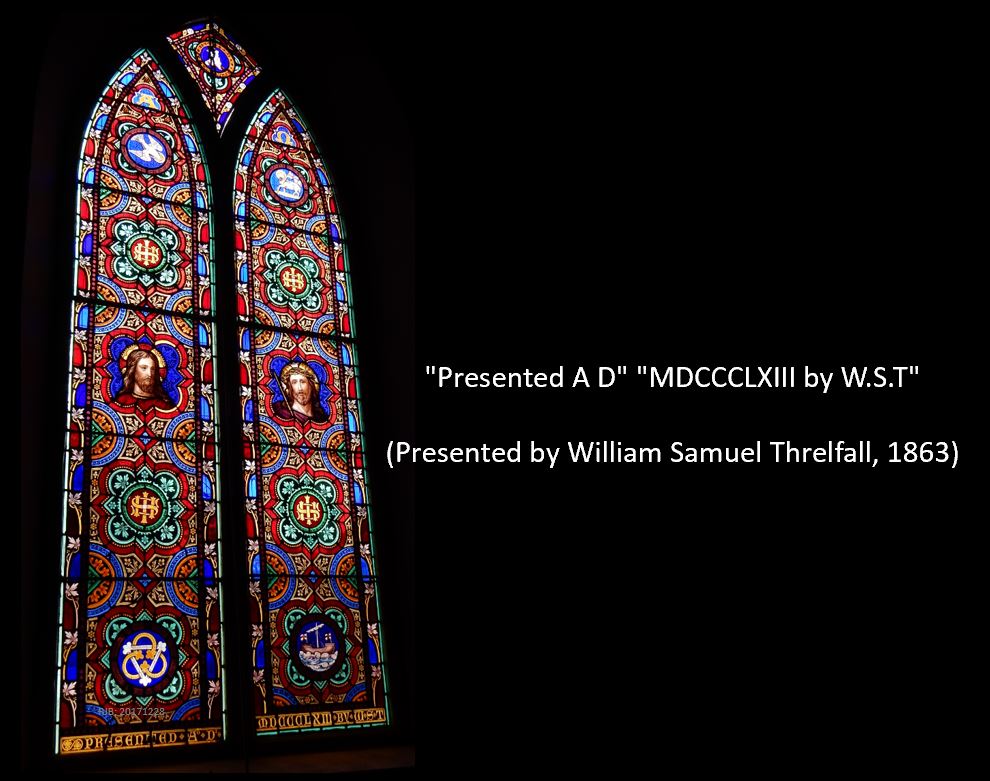
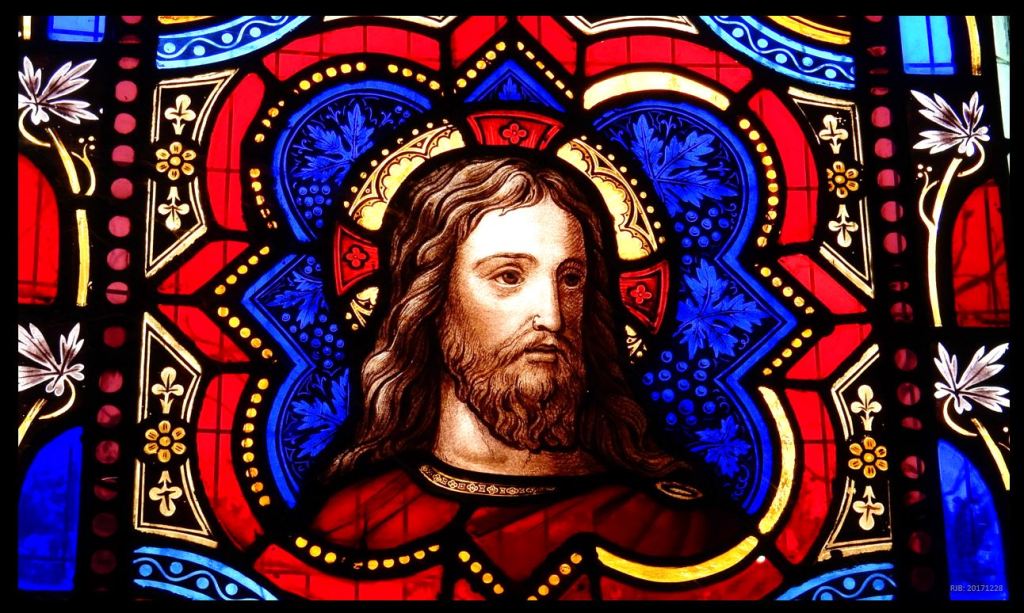
The Maldon window is a two-light in the English style and has the image of  Jesus in the centre of each light. It certainly looks like Lyon’s style and the overall arrangement bears similarities to his other windows at Holy Trinity, Kew, and Christ Church, Kilmore. An article published in the Tarrangower Times in February 1864 states the Maldon window is his work. Whether Drape had any input or hands-on work with Lyon on the window may never be known.

“A great many of our readers will no doubt have observed the very handsome painted window in Trinity Church, presented by W. Threlfall Esq. As regards its intrinsic beauty, and its value as an ornament to what was already considered (we quote the Bishop of Melbourne’s remark, on the occasion of his last visit to Maldon) one of the prettiest little churches out of Melbourne; there can but be one opinion, but perhaps it is not so generally known that this window, reflecting as much credit on the liberal and public spirited donor, may be considered, as in some degree, the work of a Maldon artist; it having been designed, and fabricated, by Mr J. L. Lyon, the son of our respected fellow townsman Mr Lyon, of Main Street”[9]


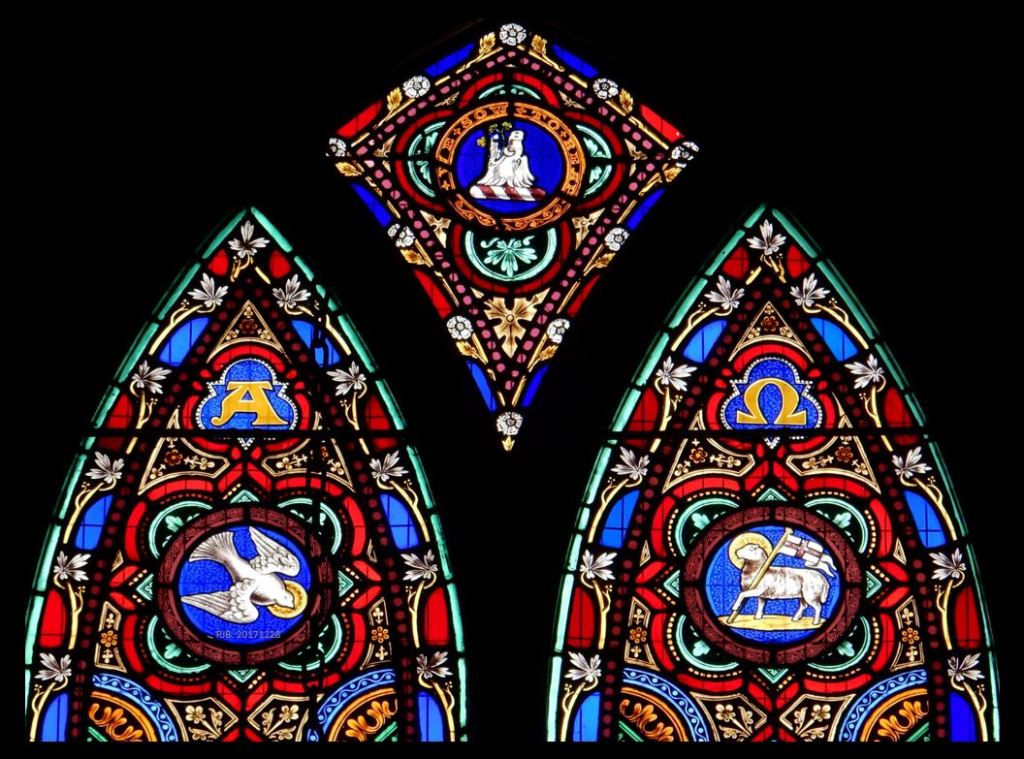
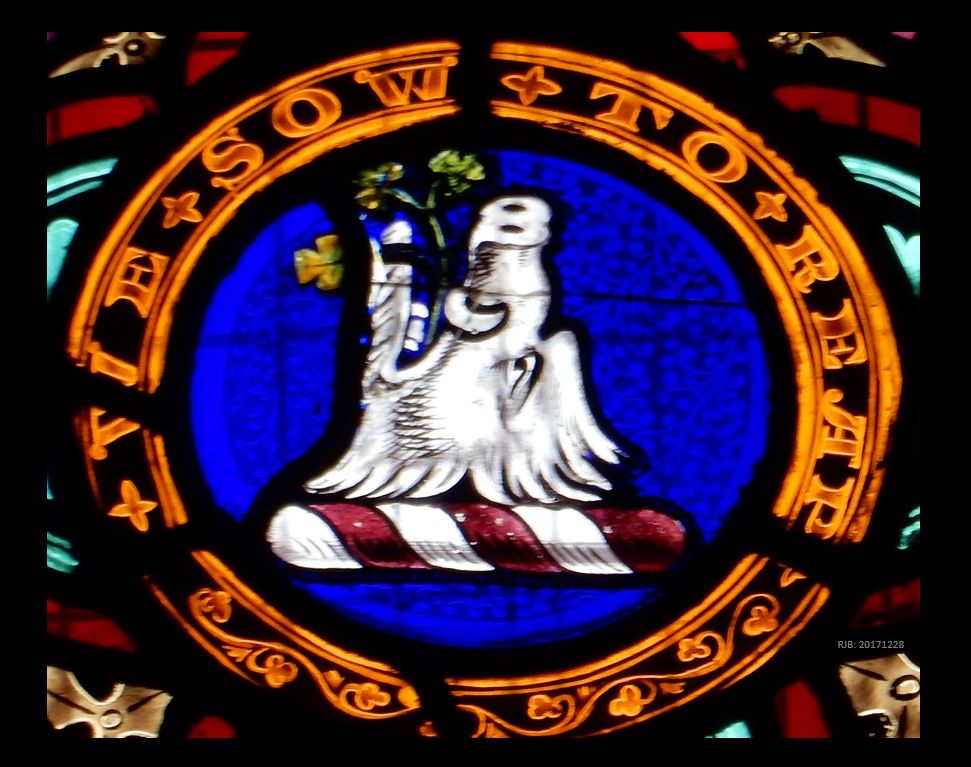
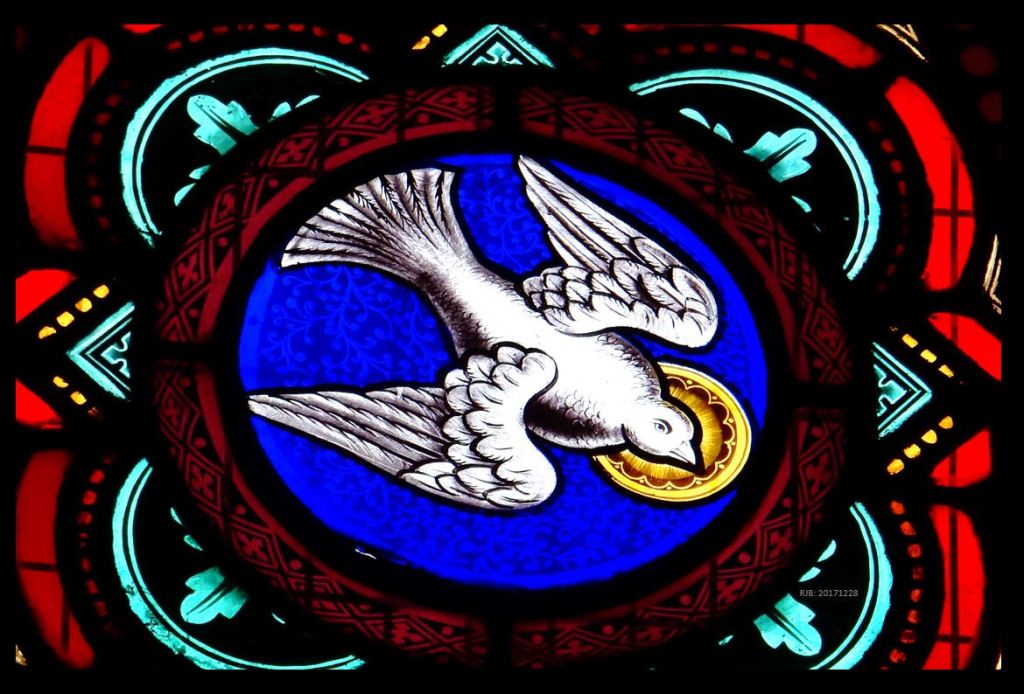
A perplexing thing about the design of the window is a family crest depicting a boar’s head in the apex, presumably that of the donor William Samuel Threlfall. The crest appears above two images of Christ, the Holy Dove and the Lamb of God. The text at the base reads “Presented A.D MDCCCLXIII by W.S.T” (William Samuel Threlfall 1863). It’s not unheard of to see a family crest appear at the top of an ecclesiastical church window, but above the image of Christ or his symbology is extremely rare. Similar instances I have come across during research indicate that where the donor has elevated him/herself above Christ in an ecclesiastical window, it’s usually been met with a very harsh response by the congregation or church committee. The windows were usually forced to be re-made or modified. In extreme cases, a window was summarily sent back to where it came from.

Who was William Samuel Threlfall?

Threlfall was a native of Lancashire, England, and was a small-time mining investor in the Maldon district who had shares in failed gold mining ventures. Many articles of the time paint him as often owing money.

On the 2nd June 1864 at the age of 65, he married the widow Mary Ann Spence[10] at Christ Church, Castlemaine[11]. By November of the following year, he and his wife have disappeared from the Maldon area and dead letters addressed to his wife Mary begin accumulating at the Emerald Hill (South Melbourne) Post Office[12]. Another advertisement in late November 1865 appeals to “Mr. Threlfall, late of Maldon, will put himself (directly or indirectly) in communication with the advertiser, he can receive some beneficial information”[13]. In May 1867 the court ruled that in Threlfall’s mysterious absence his one-eighth share in a quartz-claim at Maldon would be forfeited in favor of the claimants. He is not heard from again.

Related posts:

Biography: John Lamb Lyon (1835-1916)

Biography: David Relph Drape (1821-1882)

Footnotes:

[1] Tarrangower Times, Maldon, Vic, Friday 3rd May 1861, page 4.

[2] Tarrangower Times, Maldon, Vic, Friday 21st June 1861, page 2.

[3] David Relph Drape, Architect, and Glass Stainer; E.M. Bradshaw 1970; Unpublished Manuscript, State Library of Victoria.

[4] Biography: David Relph Drape (1821-1882)

[5] Tarrangower Times, Maldon, Vic, Friday 30th August 1861, page 3.

[6] David Relph Drape, Architect, and Glass Stainer; E.M. Bradshaw 1970; Unpublished Manuscript, State Library of Victoria.

[7] The Australasian Decorator and Painter, August 1st, 1909.

[8] The partnership name of “Ferguson, Urie, and Lyon” did not commence until October 1866.

[9] Tarrangower Times, Maldon, Vic, Tuesday 2nd February 1864, page 2.

[10]  Mount Alexander Mail, Vic, Friday 3rd June 1864, page 2.

[11] Victorian Birth Deaths & Marriages, 398/1864, Christ Church Castlemaine.

[12] The Argus, Melbourne, Vic, Monday 13th November 1865, page 1.

[13] The Argus, Melbourne, Vic, Monday 20th November 1865, page 1.


Short link to this page: https://wp.me/p28nLD-31h

© Copyright

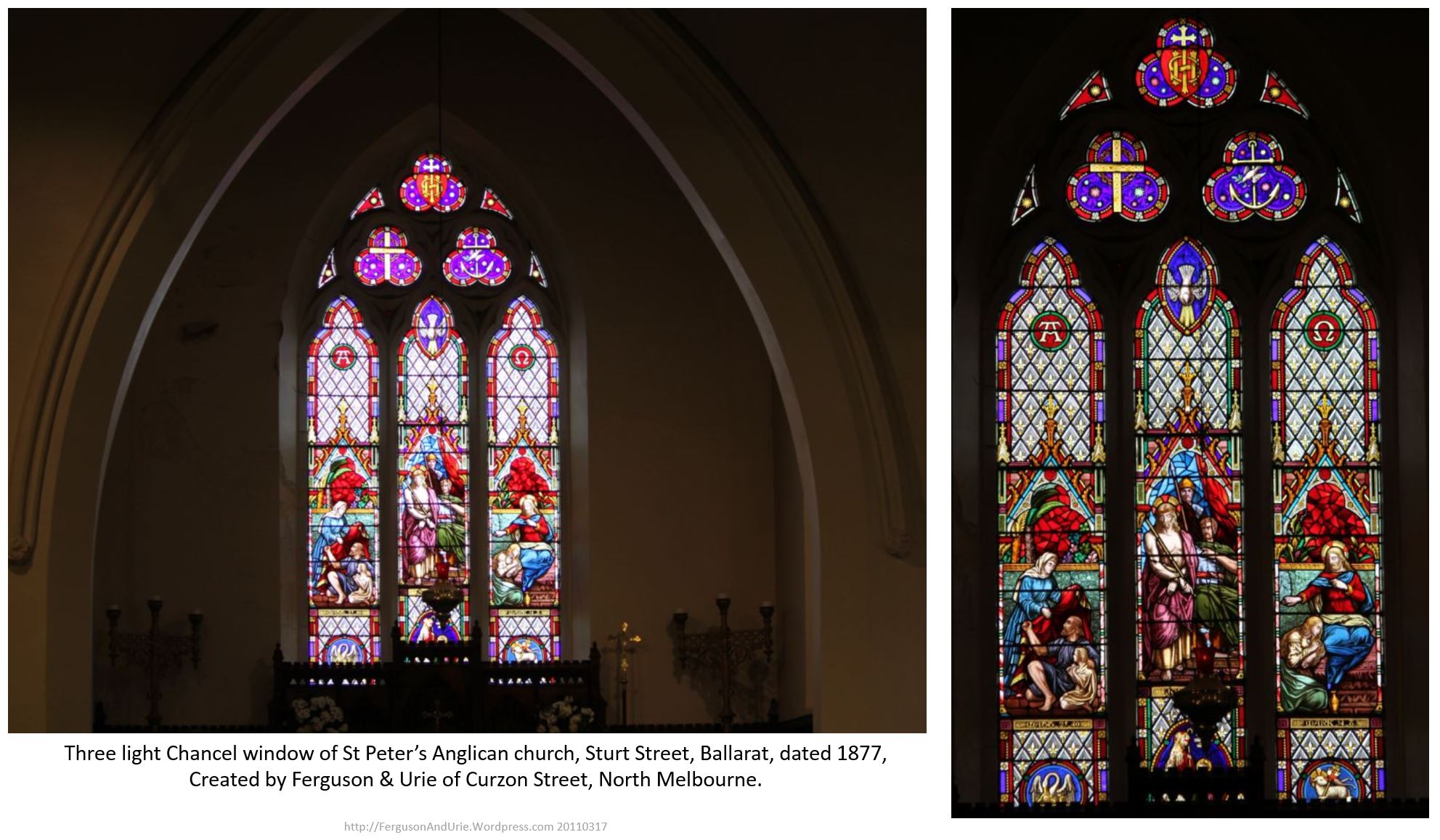
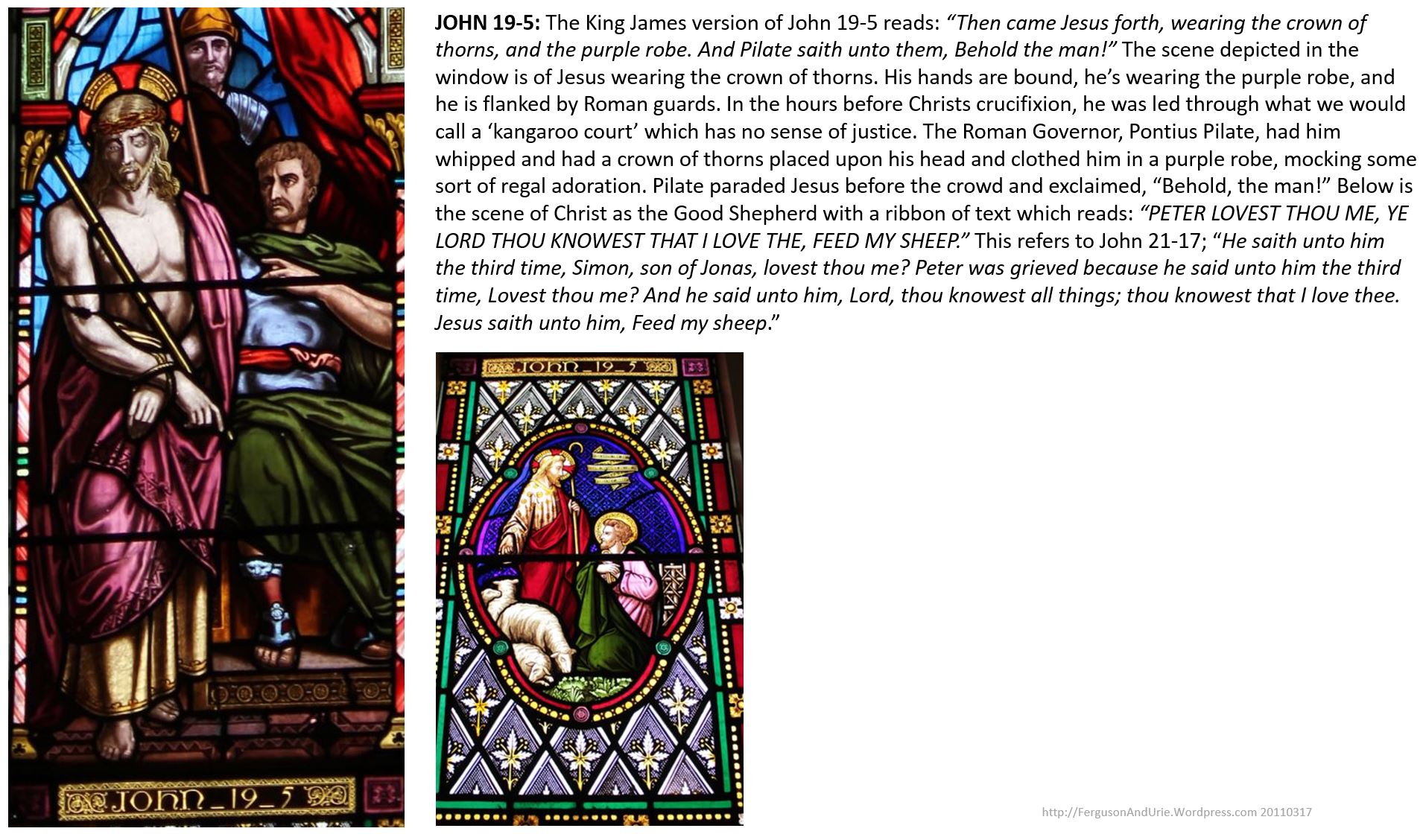
1877: St Peter’s Anglican Church, Sturt Street, Ballarat.

James Fry (1821-1903) is credited as the donor of the historic stained glass windows in the chancel of St Peters Anglican Church in Ballarat.

The windows were made by the Ferguson & Urie stained glass company of North Melbourne in 1877 at the time when extensions and renovations were being made to St Peter’s. Amongst these improvements was the addition of a new chancel complete with the stained glass windows. James Fry donated £500 towards the chancel and windows on the provision that the church raise the additional funds for a parsonage and a new organ and chamber. [1]

The Ballarat Star, Vic, Wednesday 20th June 1877, page 3.

“ADDITIONS TO ST. PETERS CHURCH.

We mentioned recently that some extensive improvements were being made at ST. Peter’s Church, and the approaching completion of the works warrants their being noticed. The church as it stands at present has in use a nave, and on the western side a transept, the original design being for another transept on the east, and an apse at the rear. As regards the apse, Mr Oakden (of Terry and Oakden), Melbourne, altered the design when he was drawing the plans for the western transept, and a chancel was projected instead of the apse. The requirements of the church have now necessitated this plan being carried out, and the work will soon be completed. Messrs James and Creber are superintending the work, and Messrs Llewellyn and Roberts are the contractors. The chancel is built of bluestone, to correspond with body of the church, and the inside measurements are:- Width, 18 feet; depth, 12 feet 6 inches; height of side walls, 20 feet 6 inches. The chancel window is a fine specimen of the stonemason’s art, the tracery being done in Waurn Ponds freestone. Stained glass is now being prepared in Melbourne to fill the window. There will be a small window on each side of the chancel, and a door on the east leads to the vestry. From the floor of the church there will be a step upwards before the chancel arch, and two others within it leading to the altar. An organ chamber is also being built, which will form part of the future eastern transept. The amount of Messrs Llewellyn and Roberts’ contract is about £480, but this amount will be considerably augmented before all the work is done in fitting up the chancel, &c. Mr Fincham, of Melbourne, is building the organ, whose largest pipe will be 16 feet, and the cost of the organ, we understand, will be about £500, so that it will be seen that the church authorities have launched into an expenditure of over £1000, towards which sum, as we mentioned a short time since, Mr. James Fry has contributed the handsome donation of £500. It is expected that all the new works will be finished, and the organ erected, in a little over a month’s time from the present.” 

In early August 1877 the three light stained glass window had arrived from the workshops of the renowned Melbourne stained glass firm of Ferguson & Urie and was erected in the chancel. The Church of England Messenger published a very detailed description of the window:

The Church of England Messenger and Ecclesiastical Gazette for the Diocese of Melbourne and Ballarat, Vic, Thursday 9th August 1877, page 14.

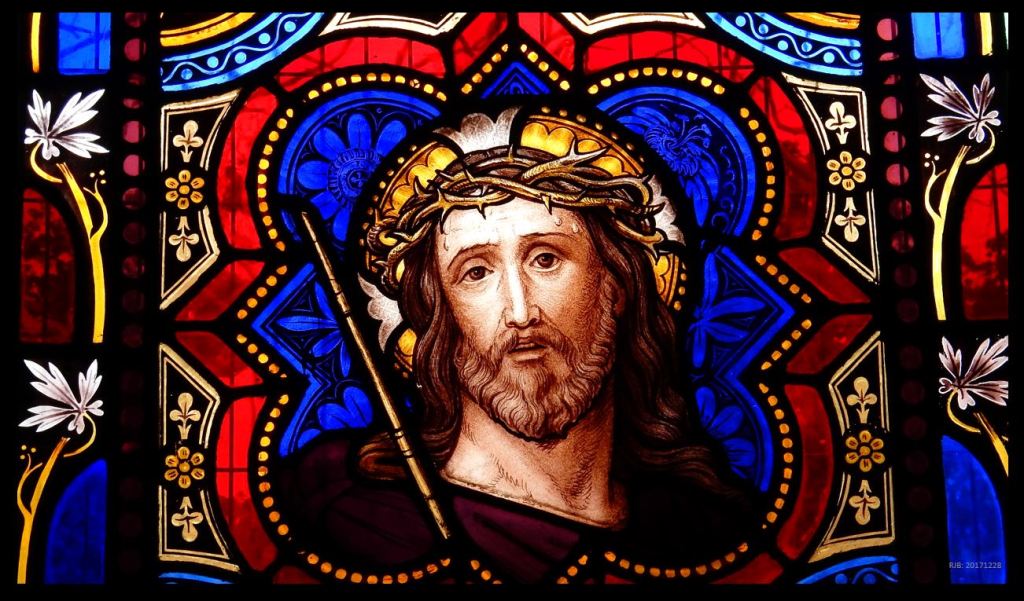
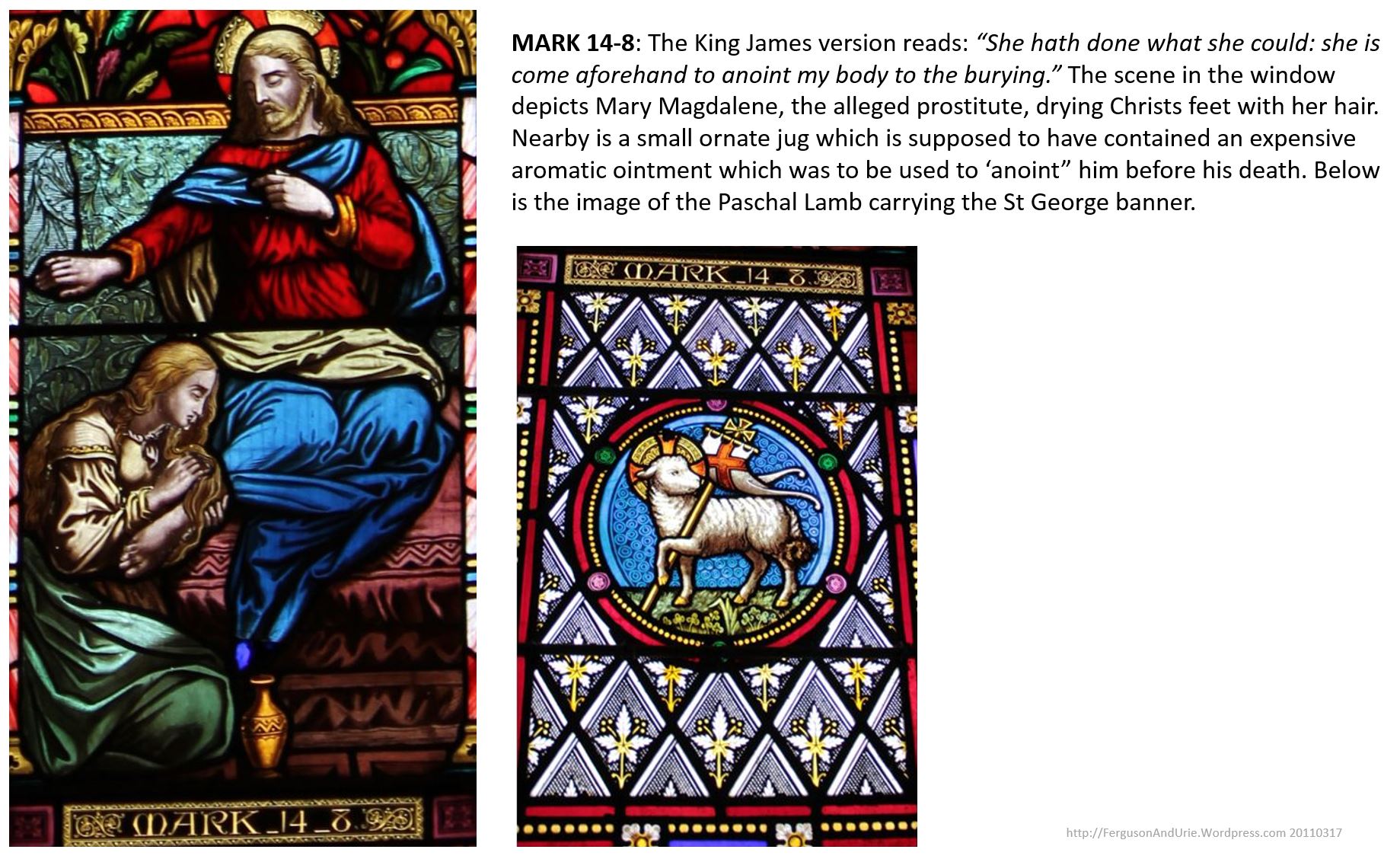
“The stained-glass window for the chancel of St. Peter’s Church has arrived in Ballaarat, and was placed in position. It is a very good specimen of Messrs. Ferguson and Urie’s art, and it is a matter of congratulation that such excellent workmanship can be produced in the colony. The window is divided into three lights, surmounted by tracery pierced with trefoils. These trefoils are filled with richly-coloured glass, bearing upon a starry background the three emblems of faith, hope, and charity; the heart with the sacred monogram, the cross with the crown of thorns, the anchor with the dove and olive branch. The subject of the central light is the “Ecce Homo.” The side lights, having reference to the pious and charitable lives of the ladies in whose memory the chancel was erected. are illustrations of Mark XIV, 8 (“She hath done what she could’) and Matthew XXV. 40 (“Inasmuch as ye have done it unto one of the least of these My brethren, ye have done it unto Me”). In the central light the Saviour stands forth a solemn and mournful figure. Pilate and a Roman soldier occupying the background. Underneath there is a panel with a small but exceedingly well-drawn picture of Christ’s charge to Peter – “Feed my Sheep.” In the apex of the window is the emblem of the Holy Spirit, the dove, descending with rays of light. The right hand picture of Mary wiping the Saviour’s feet with her hair is remarkable for the beauty of the Saviour’s countenance and the grace of His gesture. In the light upon the left-hand side a female figure is casting a garment around an aged man and a child at her feet. The background of both of these pictures is of a similar character – a low wall decorated with scroll-work, overtopped with trees and flowers, the sky space being filled in with ruby glass in irregular lead-work. Underneath are the old church emblems  – the Agnus Dei and the Pelican; and above are the Alpha and Omega. The side window, which can be seen only upon entering the chancel, is the more special memorial window, having the upper part a scroll with the text – “Write, Blessed are the dead which die in the Lord;” and at the bottom, a panel with the memorial inscription. The quarries of which the rest of the window is composed are ornamented with fleurs-de-lys, and the effect of the whole is highly satisfactory. The organ has been inspected on behalf of the church authorities, and is pronounced a first-class instrument. No time will now be lost in erecting it in the church.”

ballarat-st-peters-01a4

ballarat-st-peters-01a5

ballarat-st-peters-01a6

ballarat-st-peters-01a7

The new chancel of St Peter’s was consecrated on Sunday 12th August 1877 [2]

Whilst there were significant descriptions of the three light chancel window in the tabloids, there was only a minor mention of the smaller single light memorial window erected in the liturgical south wall.

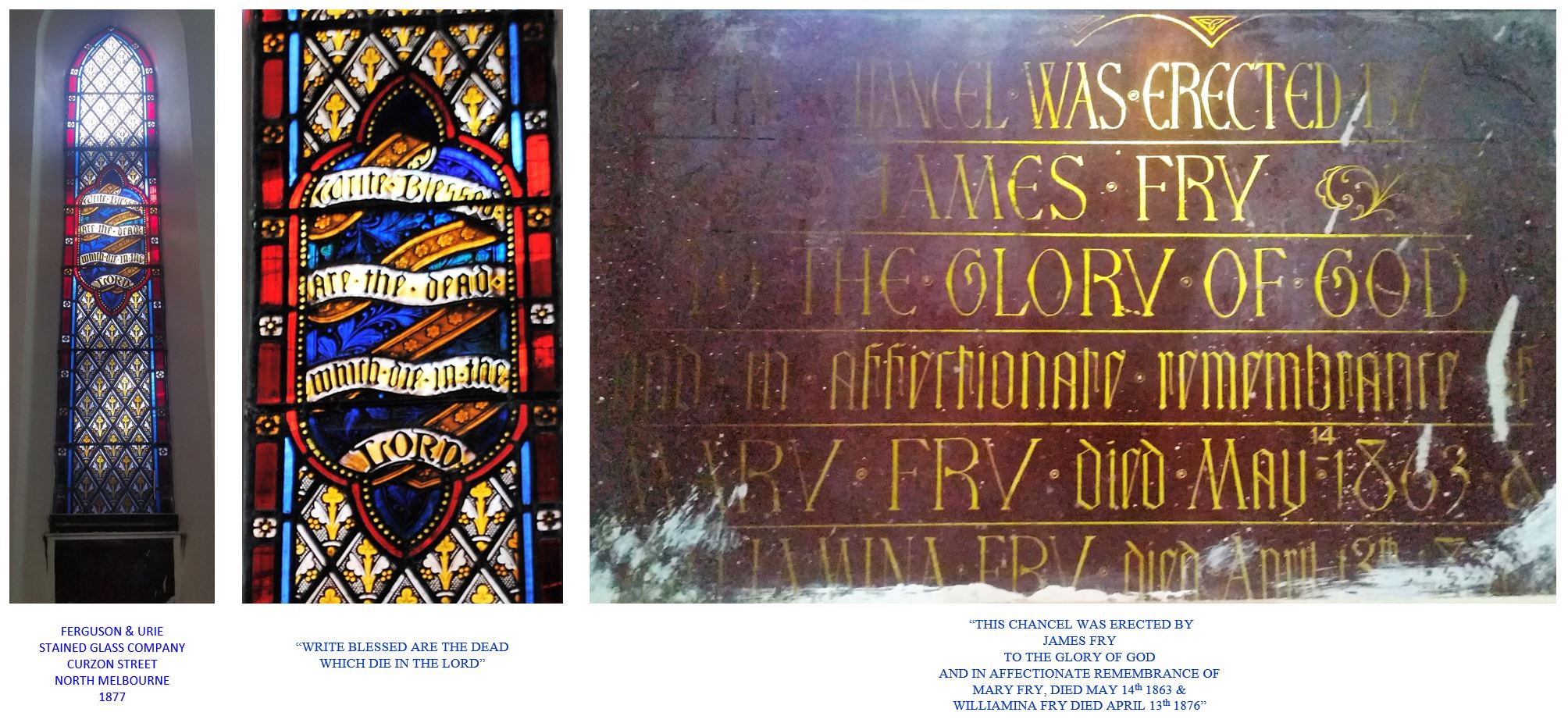
“…The side window, which can be seen only upon entering the chancel, is the more special memorial window, having the upper part a scroll with the text – “Write, Blessed are the dead which die in the Lord;” and at the bottom, a panel with the memorial inscription…”[3]

The memorial text on the lower panel of the window provides the historic clues about the donor, James Fry, and his generosity to the church and the dates of death of his first two wives, Mary & Williamina.. As stated in 1877, unless you are standing in the chancel of St Peter’s you would not know the window was there. The Gothic design is recognisable as the work of Ferguson & Urie which includes a central scrolling ribbon design containing a piece of scripture from the King James Bible, Revelations Chapter 14, verse 13;

“WRITE BLESSED ARE THE DEAD WHICH DIE IN THE LORD”

Unfortunately, the memorial text at the bottom of the window no longer has back lighting from outside so it can only be read when artificially illuminated from behind. I managed to do that via the simple trick of utilising the smart-phone flashlight function and dangling it down the back of the vent which was sufficient to highlight the text enough to be read. There are many unfortunate paint splatters on the window and the fact that the memorial text cannot be read at all unless illuminated from behind gives the impression that it probably hasn’t been seen or known for many years. Probably not known for longer than I have been alive!

“THIS CHANCEL WAS ERECTED BY
JAMES FRY
TO THE GLORY OF GOD
AND IN AFFECTIONATE REMEMBRANCE OF
MARY FRY, DIED MAY 14th 1863 &
WILLIAMINA FRY DIED APRIL 13th 1876”

ballarat-st-peters-03d

James Fry (1821-1903) was a native of Somersetshire in England and he can be credited as a colonial pioneer of Victoria’s grain growing and flour milling in western districts of Victoria.

His official biography[4] records that he came to Australia with his wife Mary in 1854 aboard the ‘Brilliant’ but there is no record of their names on the passenger list.

After successfully pioneering as a grain grower in the Wimmera region in the late 1850’s, he began his own flour milling operations and entered in partnership with Thomas Creed in the Ascot Flour Mills north of Ballarat. In May of 1857 they dissolved their partnership[5] by mutual consent and James became the sole owner. The mill was known for many years as “Fry’s Ascot Mills” and he expanded it in 1860 by erecting a massive five storey bluestone building to the designs of Ballarat architect Henry Richards Caselli.[6]

frys-mill-c1860-01a

In 1857 the first family tragedy struck when his infant daughter, Mary Grimstead Fry, died on the 2nd of July. James obtained a family grave site at the Miners Rest ‘Dowling Forrest’ cemetery, 10km North West of Ballarat, where his daughter was interred. An imposing monument was later erected on the site which would provide an historic record of the family’s tragedies and history.

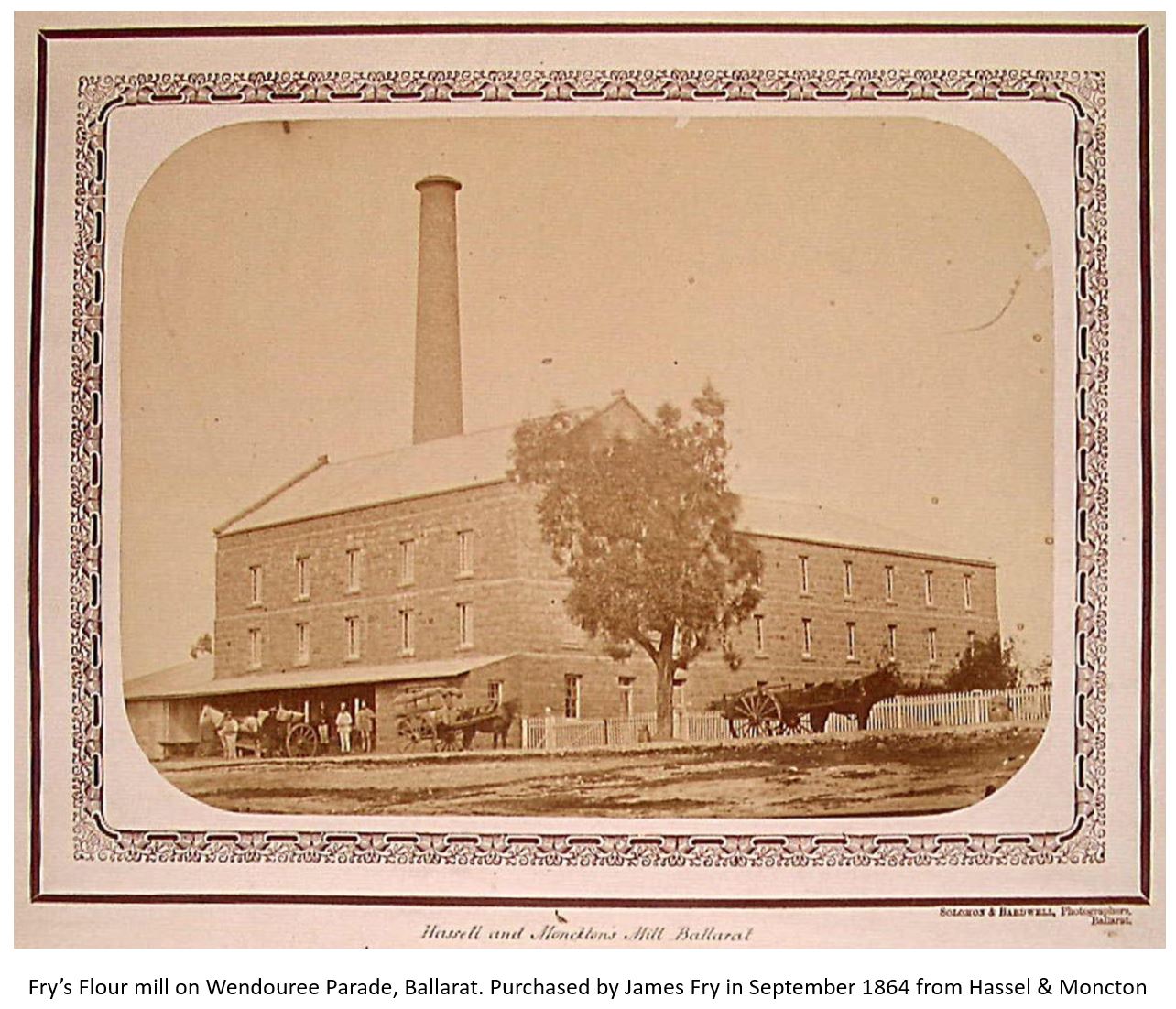
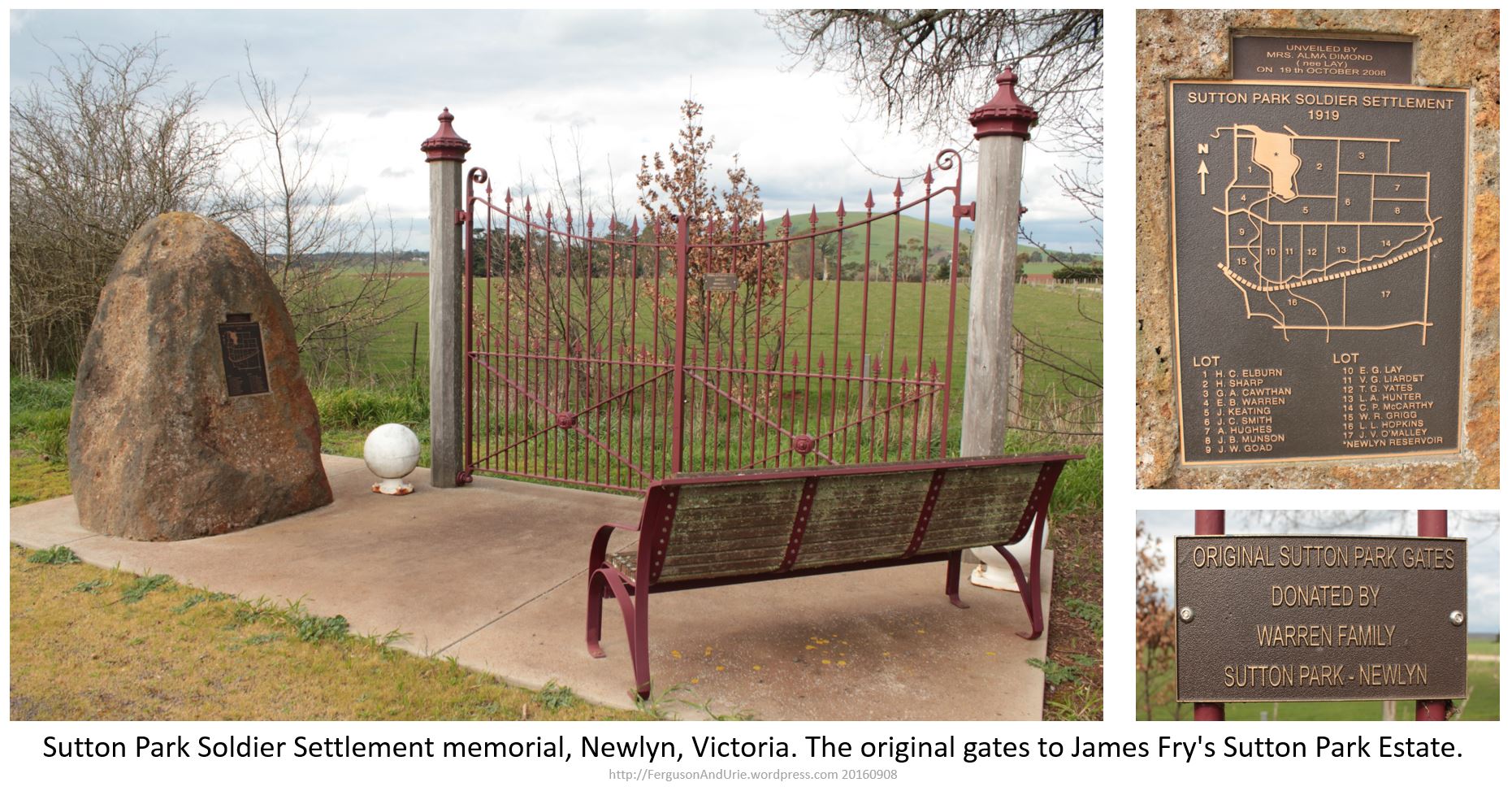
By the early 1860’s James’s milling empire was expanding. In September 1864 he purchased a flour mill at Ballarat opposite Lake Wendouree from “Hassell & Monckton” for £4500 [7]. He expanded the business further via leasing or purchasing mills all over the western districts at Ararat, Donald, St. Arnaud, Horsham, Nhill, Kaniva, Dimboola, and Natimuk[8]. His favoured estate, Sutton Park, at Newlyn near the Ascot mill remained a central hub to all his operations.

Fry’s prize winning ‘Ascot Mills’ flour was exhibited at the International Exhibition in London of 1862[9] and by the 1880’s it became a household staple throughout the colony known as Fry’s “Five Stars Flour”.

On the 14th May 1863 his first wife Mary, nee Gear[10], died at his Sutton Park estate near the Ascot Mills. She was only 45 years old and was interred in the family vault at Miners Rest with their infant daughter Mary Grimstead.

Being a widower was not a part of James’s future plans and he wasted little time in finding a new companion. On the 21st April 1864, at Brompton Cottage in Brighton, Victoria, he married Williamina Smith (nee Hay), the widow of Mungo Park Smith, Engineer and city surveyor of Melbourne[11].

James’s generosity was not just confined to the church. In October 1864 he and Williamina hosted a luncheon for his employees and their families. About 60 people were transported to Lake Burrumbeet in four decorated wagons where the best part of the day was taken up by games and; “At noon, a sumptuous dinner was spread and was partaken of with the best of appetites.” Wine and Spirits were supplied in generous quantities and later in the day, as heavy rain set in, the whole party returned to the Ascot mill where singing and dancing continued to a late hour[12]. This was undoubtedly one of the many occasions that James displayed his generosity towards his employees. Some of them would later join him as partners in his milling operations for many years.

frys-flour-mill-wendouree-ballarat-01a
On the 12th of July 1869 a tragic accident occurred at the Wendouree flour mill. On the Monday at about 7:30am a massive 36ft long boiler exploded at the mill. The sound of the explosion could be heard over three miles away and a huge plume of steam and debris could be seen in the air above the mill for many miles around. James’s nephew, Albert Hill, who was acting superintendent at the time, was unfortunately standing next to the boiler when it exploded. Albert was killed instantly. His mangled near naked and disembowelled body was blown more than one hundred yards away and landed in the Swamp on the other side of Wendouree Parade.

“…The clothing was torn into shreds, while the skull was completely smashed in. Both legs were broken, and besides several other terrible wounds, the body was almost disembowelled…”

When his body was recovered it was taken to Fry’s residence near the mill. Williamina was so traumatised by the horrific scene that she became seriously ill.[13] The inquest on Albert’s body was held the following day at the Wendouree Parade Hotel, where, coincidentally, some small portions of brick had been thrown a few hundred yards from the explosion and had landed in the bar. Albert’s funeral was held on the 14th and he was interred with James’s first wife Mary and their infant daughter Mary Grimstead at the Miners Rest Cemetery.

“The procession started from Mrs Fry’s residence, Wendouree-parade, and consisted of about thirty well-filled mourning coaches, buggies, &c, and several horsemen.”[14]

James’s second wife, Williamina died at his Sutton Park estate on the 13th April 1876. Coincidentally she was also only 45 years of age. Williamina was interred with James’s first wife and his nephew Albert at Miners Rest.  Whether by coincidence or design, some scriptural text from Revelations 14:13 which appears on their memorial stained glass window at St Peter’s in Ballarat is from the same chapter and verse as that on their monument at Miners Rest:

“Blessed are the dead who die in the Lord: even you saith the Spirit that they may rest from their labours.” Rev. XIV:13″

fry-grave-miners-rest-01a
In June of 1877, the year following Williamina’s death, James Fry donated £500 to St Peter’s Church for the construction of a new chancel and the stained glass windows. Shortly after this he departed Victoria aboard the ‘Northumberland’ for London[15]. James had been back to the old country a number of times before but this venture would secure his third wife.

At St. Mary’s, Stoke Newington, London, on the 27th December 1877 he married Louisa Anne Coles[16], the widow of Edward Coles. James and Louisa returned to Melbourne aboard the ‘Chimborazo’[17] in March the following year and she would be his companion for the next twenty three years.

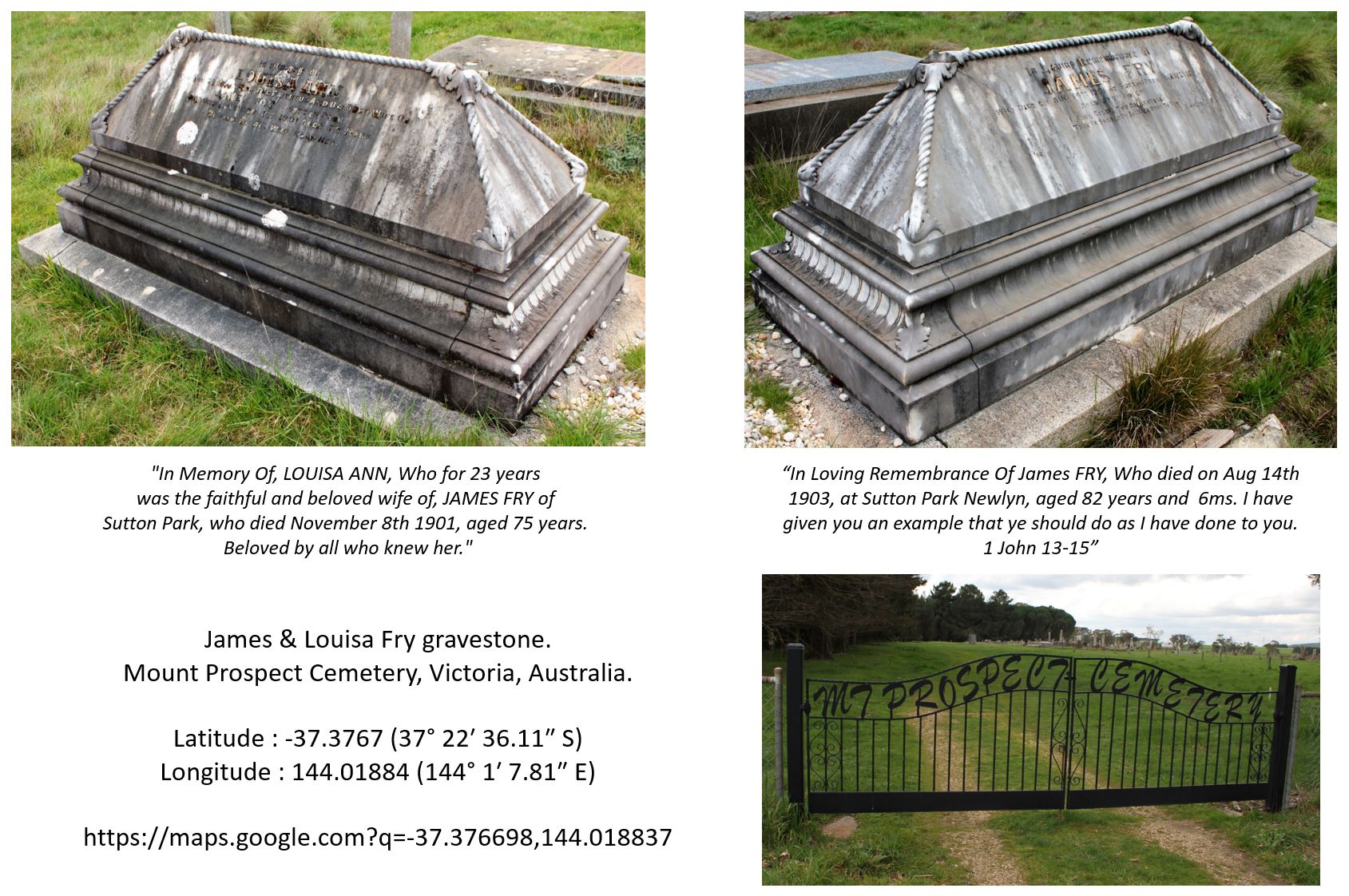
On the 8th November 1901 Louisa died at Sutton Park aged 75. James had now outlived three wives. Louisa was interred at the Mount Prospect cemetery north of Ballarat and a marble casket type grave-stone was erected over the grave. After more than a century most of the lead letters in the inscription have gone and it’s now almost unreadable:

“In Memory Of, LOUISA ANN, Who for 23 years was the faithful and beloved wife of, JAMES FRY of Sutton Park, who died November 8th 1901, aged 75 years. Beloved by all who knew her.”

James was now in his early eighties and had not taken an active interest in the flour milling operations since he floated the company on the stock exchange in 1884. He devoted his time to agricultural pursuits at his estate near Newlyn. On Friday the 14th August 1903 James died there at the age of 82 and was buried with his third wife Louisa at Mount Prospect.

The Ballarat Star, Vic, Monday 17th August 1903, page 1.

“DEATH OF MR. JAMES FRY.

One of the earliest pioneers of the grain trade in Victoria, Mr James Fry, died on Friday at Sutton Park, Newlyn, at the advanced age of 82. Deceased was a native of Somersetshire, and came to the colony in 1854 in the ship Brilliant, settling first at Geelong with his wife and family, where he purchased a property. After various experiences on the Ballarat goldfields, in 1856 he purchased a property at Ascot, and shortly after secured a flour mill near Geelong, which he removed to that point, as the Talbot shire was fast becoming the centre of a large agricultural district. Beginning in a small way, he built up a very extensive business among the various mining townships, and erected plant and machinery at that time considered to be as complete an establishment as then existed in Australia. In 1865 he purchased a mill near Lake Wendouree, Ballarat, from Messrs Hassell and Monkton, and went there to reside. In 1868 he acquired a freehold property in the Wimmera, situated between Glenorchy and Banyena. He was the first to grow wheat to any extent on the Wimmera Plains, and demonstrate that it could be cultivated there at a profit. From Ballarat, as his centre, he followed up the settlement of the selectors on the land, first around Ararat, and then on to Stawell, having business relations with both places. When growers commenced to select on an extensive scale in the Wimmera, he opened at Horsham, in anticipation of the railway line being continued from Stawell to that centre, and intimately to the border, and as the movement spread, extended his operations till they gradually embraced all the centres in that far-reaching territory. In addition to the large grain business, Mr Fry erected, brought or leased flour mills at Ballarat, Ararat, Donald, St. Arnaud, Horsham, Nhill, Kaniva, Dimboola, and Natimuk. In 1884 the grain and milling business having reached large dimensions, with its head office in Melbourne, and branches in all the leading grain growing districts of the Wimmera and other parts of the colony, he decided to float it into a limited company, which was successfully accomplished, and shortly afterwards retired from the active management, devoting most of his time thenceforth to grazing and agricultural pursuits.

            At St. Peter’s Church yesterday, notice was taken of the death of Mr Fry. Mr Fry gave the land on which St. Peter’s Vicarage stands; the chancel, with a stained glass window; the tower and the bells, to St. Peter’s Church. The flag was flown at half-mast throughout the day, and muffled peals were rang on the bells. Before the service in the morning, the rev. Dr Pritchard alluded to the sad event. He reminded the congregation of all the late Mr Fry’s generous gifts, and said that he was a regular and frequent worshipper at ST. Peter’s when resident in the parish. Such a good example of generous help to the house of God should cause his name to be ever held in honored remembrance at St. Peter’s and they should pray that others might emulate such generous deeds. At the evening service similar reference was made, and special music was sung at the offertory. Mr L. Richardson played Mendelssohn’s Funeral March at the close of service.”

On the opposite side of the gravestone to Louisa’s memorial words are his;

“IN LOVING REMEMBRANCE OF JAMES FRY, WHO DIED ON AUG 14th 1903, AT SUTTON PARK NEWLYN, AGED 82 YEARS AND 6ms. I HAVE GIVEN YOU AN EXAMPLE THAT YE SHOULD DO AS I HAVE DONE TO YOU. 1 JOHN 13-15”

fry-grave-mount-prospect-01a

James Fry’s total estate was valued at £128,400 and it was distributed to many family members in Australia and England. It included provisions for his daughter, step daughters, step granddaughters, the Ballarat Church of England, and his surviving son, James Rood Fry. 

The Sutton Park Estate was left to his son James but by 1918 it was under control of the government for soldier settlement purposes.[18]

Today, on a lonely dirt intersection amongst the farmland at Newlyn, you will find the original gates that once framed the entrance to Sutton Park. They now form part of an historic memorial of the district and nearby a stone cairn holds a plaque showing how the estate was divided for soldier settlement.

The gravesites at Miners rest and Mount Prospect, some of the old crumbling mill buildings around the district, the old gates to Sutton Park, and the stained glass windows at St Peter’s Church in Ballarat are the last physical reminders of a Colonial Pioneer and his family who shaped the western district of Victoria.

sutton-park-gates-01a

Footnotes:

[1] The Ballarat Star, Vic, Monday 11th June 1877, page 3

[2] The Ballarat Star, Vic, Monday 13th August 1877, page 3.

[3] The Church of England Messenger and Ecclesiastical Gazette for the Diocese of Melbourne and Ballarat, Vic, Thursday 9th August 1877, page 14.

[4] Australian Dictionary of Biography: Fry, James (1821-1903)

[5] The Star, Ballarat, Vic, Tuesday 26th May 1857, page 4.

[6] The Star, Ballarat, Vic, Tuesday 14th August 1860, page 4.

[7] The Star, Ballarat, Vic, Friday 30th September 1864, page 2.

[8] The Ballarat Star, Vic, Monday 17th August 1903, page 1.

[9] Victorian Govt Gazette, Tuesday 14th April 1863, page 842.

[10] Daughter of John Gear (or Gean) and Jane Grimstead.

[11] The Age, Melbourne, Vic, Monday 25th April 1864, page 4.

[12] The Star, Ballarat, Vic, Saturday 29th October 1864, page 2.

[13] The Ballarat Star, Vic, Tuesday 13th July 1869, page 2.

[14] The Age, Melbourne, Vic, Friday 16th July 1869, page 4.

[15] Geelong Advertiser, Vic, Tuesday 19th June 1877, page 9.

[16] The Bath Chronicle, Somerset, England, Thursday 10th Jan 1878, page 5.

[17] The Argus, Melbourne, Vic, Monday 11th March 1878, page 5.

[18] The Age, Melbourne, Vic, Saturday 24th October 1903, page 11.


Short link to this page: http://wp.me/p28nLD-2Mv

This is a new research article based on new information.
The old article can be seen at: http://wp.me/p28nLD-Uv

© Copyright

1867: South Yarra Presbyterian Church, Victoria

In August 1867 the ‘Hobart Mercury’ newspaper published an article about the travels of Mr James Urie who was a principal partner of the Ferguson & Urie stained glass company of North Melbourne.

James was travelling throughout Tasmania with a portfolio of the company’s stained glass designs to garner commissions for secular and ecclesiastical windows. The tabloids published numerous articles of his “Sojourne” throughout the apple isle;

“STAINED WINDOWS – A few days since we stated that Mr.Urie of the firm of Ferguson, Urie, and Lyon, glass stainers, &c, Melbourne, was on a professional visit to Hobart Town. This gentleman is now in Launceston, and we were much gratified yesterday by inspecting a large portfolio of designs for church and other windows which his firm has executed or has in hand…”[1]

The article briefly mentioned a number of windows the company had recently made and I’ve posted many articles about the ones I have found from those clues. A couple of the windows have eluded me for some time as they merely mentioned names and the location as Melbourne and nothing else such as this obscure one:

…Judge Pohlman’s wife, and wife of Mr Stoddart [sic] both in Melbourne…[2]

Clues to other windows included church names and their locations which have helped to pin point exactly where some of the windows could be found, but the obscure mention of “Melbourne” in relation to the Polman and Stoddart windows was very little to go on.

In our Colonial times, the number of churches that were being erected throughout Melbourne and suburbs was phenomenal. The vast majority of these old churches are still standing but over the course of a century and a half many were burnt to the ground, demolished, moved and re-built, or in recent times, sold to developers. If these Pohlman and Stoddart windows still existed somewhere it was likely to take a long time to locate them whilst concurrently researching the locations of many other Ferguson & Urie stained glass windows. Since finding the historic newspaper article I have visited more than a hundred churches and nothing further has come to light in regards to these particular windows.

The names “Pohlman” and “Stoddart” were significant clues on their own, and in the case of Judge Pohlman it was easy to ascertain that he was Judge Robert Williams Pohlman (1811-1877). But even armed with the knowledge of his faith, being of the Church of England, nothing has been found of his stained glass window.

The name Stoddart presented further challenges, as the newspaper had spelt his name incorrectly on multiple occasions, and so I was looking for the wrong person. The tabloids mentioned that he had been buried in the Melbourne General Cemetery, which seemed like a decent clue, but the cemetery records had nothing for that name. It seems that when I get fixated on a particular direction or clue I miss the obvious things such as misspellings.

By sheer coincidence, a friend recently sent me some photos of the stained glass windows from the South Yarra Presbyterian Church, which, despite me having passed the church numerous times over the years, I had not yet managed to set foot in. Among the photos was a window to the memory of “James Dickson Stodart” (spelt with one letter‘d’).

This was undoubtedly the window that had eluded me for the past few years. Its design and the date of death mentioned for James Dickson Stodart leaves no doubt that it is the original Ferguson & Urie stained glass window from nearly a century and a half ago and not dedicated to Stodart’s wife as the tabloid incorrectly eluded.

[Photos kindly contributed by Paul Danaher, dated Sept 2015]

This slideshow requires JavaScript.

[View larger images]

James Dickson Stodart (c1825-1867)

In late 1867 the congregation of the South Yarra Presbyterian Church resolved to erect a stained glass window to the memory of their esteemed Church committee member and liberal supporter, James Dickson Stodart.

The window is of two lights with a small English red rose in the tracery above. The apexes of the cusp headed lancets feature the images of ‘Faith’, holding the cross, and ‘Hope’ with the anchor. Below these are the words “Post Nubes Lux,” meaning “After Darkness Light” or “Out of Darkness Light,” which is the motto of the Scottish Stodart/Stoddart family.

The memorial text across the central region of each window reads:

“ERECTED BY THE CONGREGATION IN AFFECTIONATE REMEMBRANCE OF”
“JAMES STODART ESQ, WHO DIED 12th JUNE 1867, AGED 42 YEARS”

At the base of each window are angels holding a scroll with the words:

“BLESSED ARE THE DEAD” “WHICH DIE IN THE LORD”

James Dixon Stodart was born in Edinburgh, Scotland c.1825 to merchant Alexander Stodart and Elizabeth Gray.

James married Maria Louisa Margaretha Meincke in Scotland c.1848. He departed Liverpool for Australia on the 17th March 1854 aboard the “Golden Era” which arrived in Hobson’s Bay three months later on the 13th June 1854 [3]. His family would arrive later.

He had been sent out from Scotland to wind up the business affairs of the “famous Mr. Boyd” (Benjamin Boyd) and on completion of the task he accepted the position as finance manager for the infrastructure and railway contracting firm of Cornish & Bruce in Melbourne.

He was active in local political affairs and was elected a Councillor of Prahran between 1858-1860 and 1863-1865 and served as Mayor of the municipality in 1864-65 [4].

His relationship with the principals of the Cornish & Bruce Company must have been very close. In 1861 he even named one of his daughters, “Margaret Vans Agnew Bruce Stodart”, after one of the principals of the firm, John Vans Agnew Bruce. Unfortunately Margaret died as an infant on the 3rd August 1863.

Stodart was a liberal supporter and member of the Scotch Presbyterian Church in Punt Road South Yarra. The foundation stone of this church was laid on a rainy day, 14th November 1865 [5] by Captain Tyler, Aide-De-Camp to the Governor, Sir Charles Darling. The Governor was unavoidably absent on the day and so J. D. Stodart presented Captain Tyler with the silver trowel to lay the foundation stone in the presence of Lady and Miss Darling,

After a long battle with tuberculosis, James Dixon Stodart died at his home “Yarra-Bank” at South Yarra on Wednesday 12th June 1867 [6]. His substantial funeral cortege crossed Melbourne’s iconic Princes Bridge at 2pm on Saturday the 15th to deliver him to his final resting place at the Melbourne General Cemetery [7].

There is no gravestone to be found for James Dickson Stodart and so the stained glass window in the South Yarra Presbyterian Church is the only lasting memorial bearing his name. The window represents a significant reminder of a colonist who contributed much to the history of Victoria and it is a remarkably intact example of Ferguson & Urie stained glass workmanship from our Colonial past.

Significant tabloid transcriptions:

The Age, Melbourne, Vic, Thursday 13th June 1867, page 5.

“We regret to have to announce the death of Mr James Stodart, which took place at ten o’clock last night, at his residence, South Yarra. Mr. Stodart was manager for the firm of Cornish and Bruce, and is understood to have contributed not a little to the success of its operations. His uprightness and amiability secured him many friends, and his somewhat sudden death will be a great grief to them.”

The Argus, Melbourne, Vic, Friday 14th June 1867, page 8.

“THE Friends of the late JAMES D. STODART, Esq., are invited to follow his remains to the place of interment, Melbourne Cemetery.
            Funeral to move from his residence, Yarra bank, South Yarra, on Saturday, 15th inst, at 1 p.m., passing Prince’s-bridge about 2 o’clock.
            JOHN ROMANIS, undertaker, Gardiner’s Creek road, South Yarra.”

The Argus, Melbourne, Vic, Friday 14th June 1867, page 4.

“It is a melancholy duty to record the very sudden death, on Wednesday evening last, at a late hour, of Mr. James Stoddart, who has been for many years past so well known and respected as the financial agent of the firm of Messrs. Cornish and Bruce, railway contractors. Up to a very few days ago Mr. Stoddart had been in the enjoyment of vigorous health. He was in charge, on the part of the firm he represented, of the arbitration now going on between the executors of Messrs. Cornish and Bruce and the Government, as to the balance due to the firm, and he was to have given his evidence before the arbitrators this day. Early in the week, however, he complained of symptoms indicative of internal disease. For a day or two he was confined to his room; but on Wednesday evening, feeling slightly better, he rose from his bed, made a step or two, and dropped down dead. Mr. Stoddart was a native of Edinburgh. Trained to business in a good school, and showing an uncommon capacity for finance, he was selected in 1853 to come out to this colony and wind up the multitudinous affairs of the then famous Mr. Boyd. He accomplished the arduous task successfully, and when Messrs. Cornish and Bruce entered on their gigantic enterprise, Mr. Stoddart was recommended to them by the contracting banks as the ablest man whose services they could retain as their financial agent. His labours in that capacity were most onerous; and he had all but completed successfully what may be called the task of a life, when death overtook him. He was one of the earliest promoters of building societies in the colony, and they owe much to his shrewdness, experience, and sagacity. He was for a season mayor of Prahran, and at the time of his death was a councillor of that borough. He took a very active interest in the affairs of the Scotch Church of the district in which he resided, and to his exertions the congregation are mainly indebted for the beautiful new Scotch Presbyterian Church in South Yarra, in which the Rev. George Mackie officiates as pastor. Many will lament in Mr. Stoddart the sudden and untimely death of an able, warm-hearted, and genial man.”

The Age, Melbourne, Vic, Wednesday 15th November 1865, page 6.

“SOUTH YARRA PRESBYTERIAN CHURCH.

The foundation stone of the above new church was laid yesterday afternoon, on the ground adjacent to the present building. It had been expected that the Governor would be present to perform the ceremony, but his Excellency was prevented from attending by indisposition. Shortly after three o’clock, however, Lady Darling, accompanied by Miss Darling and Captain Tyler, arrived on the ground; but, as it was then raining hard, the company assembled had to adjourn to the church. The proceedings were then commenced by singing and prayer, after which,      
            The Rev. GEORGE MACKIE, pastor of the church remarked that he had much pleasure in stating that they had that day assembled for the purpose of laying the foundation stone of the new building. Rain, which was most propitious for the country, would compel them to perform most of the preliminary part of the proceedings in the old one. He regretted that the absence of his Excellency the Governor, and still more, that he was prevented by disposition from attending. He was, however, happy to be able to say that he was represented by Lady Darling, Miss Darling, and several other members of the family, as well as by Captain Tyler; so that, although he was not himself present, he was with them by deputy. He thought it needless to explain that the members of the church had had great difficulties to overcome. At one time a large debt rested thereon, but through the praiseworthy liberality of their friends, it had now been cleared off. He had no doubt that many, with himself, felt gratified in being spared to witness the laying of the foundation stone of the new building, which would long stand as a memorial of the Christianity and piety which existed amongst the present generation.
            The Rev. Mr McDONALD, of Emerald-hill, then came forward to address the meeting, and during his speech remarked that he had been associated with the congregation of this church since its formation. He then dwelt upon the difficulties that had been overcome, and the advances that had been made in the cause of religion. He was pleased to know that they had missions at home and missions abroad, and that steps were being taken to establish a theological hall. He trusted that all that could be done would be done to bring about a satisfactory state of things, and that they would hereafter see such a revival as would speedily fill the new building as soon as it was erected.
            The Rev. Mr. BROWN, moderator of the presbytery, then delivered a dedicatory prayer; after which the assembly adjourned to the spot where the stone was to be laid.

            On arriving there,
            The Rev. GEORGE MACKIE read the following copy of a memorial record, which had been engrossed on parchment and enclosed in the case which was laid in the cavity of the stone, together with a copy of each of the Melbourne daily papers and Prahran Telegraph, and the various coins of the realm:-
            “Memorial record deposited in the foundation stone of the Presbyterian Church, South Yarra, within the boundary of the corporation of the city of Melbourne, in the colony of Victoria, laid on the fourteenth day of November, in the year of our Lord one thousand eight hundred and sixty-five, and the twenty-ninth year of the reign of her majesty Queen Victoria, by his Excellency Sir Charles Henry Darling, K.C.B., Governor and Commander-in-Chief of the colony. This congregation was organised on the third day of July, one thousand eight hundred and fifty-four, under the Ministry of the reverend George Divorty, A.M. The committee consisted of T. Dickson, J. Thompson Paterson, T. Finlayson, D. Walker, D. Ross, W. Adamson, J. Cameron, and J. Gair; T. Finlayson, secretary; T. Dickson, treasurer. For some time, as a provisional arrangement, the congregation worshipped in a large tent; afterwards, and until now, in a wooden church imported from Scotland, and erected on the present site at a cost of four thousand five hundred pounds, having accommodation for four hundred persons. On the seventh day of April, one thousand eight hundred and fifty-nine, the union of the different sections of the Presbyterian church in this colony took place. The Rev. James Clow was elected moderator of the first general assembly. In the year one thousand eight hundred and sixty-one, the Reverend George Divorty was obliged to resign this charge through failing health, and returned to Scotland. In May, one thousand eight hundred and sixty-two, the Reverend George Mackie was inducted as successor to the Reverend George Divorty. The communion roll at present numbers two hundred and eighty-five, and the church being overcrowded, the congregation resolved to build a more commodious and substantial edifice, of which this is the foundation stone, intended to accommodate eight hundred seat holders. The office bearers of the congregation at this date are as follows:- Minister: The Reverend George Mackie. Trustees: The Rev. George Mackie, David Ross, John Thompson, John Spence Ogilvy. Elders: David Ross, John Spence Ogilvy, John Stevens Miller, George Bell, Charles Anderson. Managers: James Stodart, Robert Mackechney, David J. Moorehead, James Munro, William Stronach, John Reid, James Edwards, Joseph Harris, Francis Bell, Thomas Donaldson, George Espie, John Romanis. Treasurer: John Spence Ogilvy. Secretary: William Stronach. Building committee: The office bearers, J. Brown, junr., W. Coulter, J. McPherson, W. Robb, A. Murray, D. Connacher, J. Drew, W. K. Ross, James Scott, T. J. Connor, A. Anderson, M. Stewart, J. Ferguson. Architect: Lloyd Tayler. Contractor: William Ireland. Moderator of the General Assembly: rev. James Nish, Sandhurst. Moderator of the Presbytery of Melbourne: Rev. Peter Brown, Hawthorn. The motto of the builders is “Jehova Shammah,” and their prayer, that the Lord would make this house the birthplace of many souls. In the name of the Father, the Son, and the Holy Spirit, the one God for ever and ever. Amen.”

            Captain Tyler then came forward and performed the ceremony of laying the foundation stone, a silver trowel having been presented to him by Mr. Stodart.

            The National Anthem was sung by the whole company, and three cheers were then given for Her Majesty the Queen; three for his Excellency the Governor and Lady Darling, and three for the Rev. Mr Mackie, which brought the proceedings to a close.”

Related biographical information:

Biography: James Stodart (1849-1922), Son of James Dickson Stodart.

Footnotes:

[1] The Mercury, Hobart Tasmania, Tuesday13th August 1867, page 5.

[2] Ibid

[3] Public Records Office Victoria, Inwards Unassisted passengers Fiche 68, page 001

[4] The Argus, Melbourne, Vic, Saturday 3 June 1865, page 5.

[5] The Age, Melbourne, Vic, Wednesday 15th November 1865, page 6.

[6] The Argus, Melbourne, Vic, Friday 14th June 1867, page 5.

[7] The Argus, Melbourne, Vic, Friday 14th June 1867, page 8.


Short link to this post: http://wp.me/p28nLD-2I3

© Copyright

1877 James Winter’s ‘Dhurringile’ Mansion, Murchison, Victoria.

In the western district of Victoria is the historic mansion “Dhurringile,” erected for the wealthy Squatter James Winter in 1877.

The mansion still contains a number of secular stained glass windows crafted by the Ferguson & Urie stained glass company of North Melbourne.

“…Many of the windows are of stained glass, and are beautifully ornamented; the principal one in the large hall was made by Messrs. Ferguson and Urie, of Melbourne, a highly creditable example of colonial art…”[1]

Photos by Mrs. Noelle Nathan: (Dated March 2011)

This slideshow requires JavaScript.

[View larger images]

James Winter (1834-1885)

James Winter was born in Edinburgh, Scotland in 1834 and came out to Victoria with his parents John and Janet and his siblings in 1841. In 1857, in partnership with his father and brothers they brought the Colbinabbin station and others in the Rodney district of Victoria at a cost of around £200,000.[2]

On the dissolution of the family partnership in 1868 James retained the Toolamba estate and architects Lloyd Tayler and Frederick Wyatt designed his 68 room mansion “Dhurringile-house” which was built in 1877 for a reported £30,000.

“…In 1870 he was elected president of the shire council of Waranga, of which he had been a member from 1864, and he was made a territorial magistrate by the Kerferd Government…” [3]

On the 27th April 1871, aged 36, he married Caroline Pettett[4], a daughter of former Hawthorn Mayor, William Henry Pettett, who, coincidentally has a stained glass window erected to his memory in Holy Trinity Church at Stawell which depicts St Peter & St Paul and it too was made by Ferguson & Urie circa 1871.

“…At the latter end of 1873 a railway league was formed – of which he was elected president, to bring a railway down the valley of the Goulburn…”[5]

In 1883 he travelled to England via the USA where he selected twenty seven ewes and twenty three American Merino sheep for breeding on his property in Victoria[6]. Shortly before his intended return to Australia in late January 1885 he fell ill died of inflammation of the lungs at Carlisle House, Central Hill, Norwood on the 3rd February 1885 [7][8].

Dhurringile:

Dhurringile remained within ownership of the family for many years. In 1890 Mr. M. Minter was the manager of the Dhurringile estate[9]. His two sons drowned on the property in 1895[10]. The property was eventually sold at auction in March 1902 to J. J. Falconer of the Australian Mortgage, Land, and Finance Company Ltd for £173,527.[11]

In 1910 Thomas Hastie was the manager of Dhurringile station and was appointed a member of the Closer Settlement Board.[12] Two years later in 1912 it was owned or managed by Everard Browne[13].

The property remained vacant for a number of years and was eventually sold to Vincent Hart in 1925,[14] but it still remained unoccupied during his ownership. In 1939 Hart rented the property to the Government for use as an internment camp for German and Italian alien civilians and by 1941 it was being used by the army as a prisoner of war camp for Germans.

In 1947 Dhurringile was purchased by the Presbyterian Church who refurbished the dilapidated property and after a public appeal in 1949 the church raised £15,000[15] to assist with the repairs. The property eventually opened in late 1950 as the “Dhurringile Presbyterian Rural Training Farm”, which was intended for accommodating and training immigrant boys from the UK whose fathers had died during the war. The first twenty nine boys from England and Scotland arrived aboard the ‘Cheshire’ in late December 1950[16].

In 1965 the property was purchased by the Victorian Government for use in the rehabilitation of alcoholic prisoners. The property is still used as a minimum security prison to this day but the mansion itself is only used for administration and as a training centre.

The extant Ferguson & Urie stained glass windows in the mansion, depict the Kangaroo and the Emu, the deities “Flora & Pomona,” a gothic decorated fanlight window and an arched window depicting the seasons which is very similar to the seasons window at Mandeville Hall in Toorak which also has Flora and Pomona windows.

Significant Transcriptions:

The Australasian, Melbourne, Vic, Saturday 24th April 1880, page 25.

“THE TOOLAMBA ESTATE, LOWER GOULBURN.

(BY OUR TRAVELLING REPORTER)

Within some half dozen miles of Murchison, on the Lower Goulburn, and not far from the small township of Toolamba, is the estate of the same name, belonging to Mr. James Winter, and which was casually referred to in one of my previous articles on the North-Eastern and Goulburn Valley districts. The length of the estate from the Goulburn River to the boundary of the Girgarre district is above 12 miles, and its width from the Murchison side to Toolamba between seven and eight miles. It is divided into about 50 paddocks, all of which are securely fenced with post-and-rail and wire fences, and a small portion with wire netting, for keeping the young rams in. Rich, well grassed plains, with soil of chocolate description, constitute the greater portion of the estate, and in places these are heavily timbered with box and gum, while at intervals wide stretches of country intervene which scarcely possess a single tree. No running streams are to be met with, but the whole estate is well watered, there being altogether nearly 100 dams, from which over 100,000 yards of excavation have been taken, and with one or two exceptions they all had a plentiful supply of water during the two recent summers, which have been the most trying for a number of years. On a small sandhill – one of the few elevations on the north side of the estate – the homestead is built. It is called Dhurringile-house – the former word in the native vocabulary signifying “and emu crouching,” the peculiar shape and isolation of the hill, there being none other for miles in every direction around it, having led the aborigines to imagine that it bore a resemblance to a gigantic emu in the act of lying on the plain, and to bestow upon it the appellation it now bears.

            Dhurringile-house is a fine edifice, in fact, there are not many superior to it in the colony; its construction involved a very large amount of time, labour, and expense. The whole of the operations were carried on under the personal supervision of the proprietor, who to a great extent acted as his own architect; and the vast pile of buildings which now towers so proudly above the Emu Plain has been acknowledged by some of the highest professional ability in the colony to be exceptionally well designed, and substantially erected. The house is constructed of red brick, in the rural Italian style of architecture; the frontages on the north and west are ornamented with finely-cemented arcades and pillars. A tower (along which a lightning conductor runs) rises to a height of nearly 100ft above the level of the hill, almost in the centre of the building, which is two stories high, and extends from east to west to a length of 130ft., while the extreme breadth is slightly over 90ft. Every portion of the house is supplied with gas, manufactured on the premises; while, in order to facilitate verbal communications, speaking tubes are fitted throughout the building. Many of the windows are of stained glass, and are beautifully ornamented; the principal one in the large hall was made by Messrs. Ferguson and Urie, of Melbourne, a highly creditable example of colonial art…”

The Argus, Melbourne, Vic, Saturday 29th April 1871, page 4.

WINTER-PETTETT.- On the 27th inst., at Minninnera, by the Rev. Wm. Henderson, James Winter, Esq, Toolamba, second son of John Winter, Esq, of Lauderdale, Ballarat, to Caroline, eldest daughter of the Hon. W. H. Pettett, M.L.C. No cards.”

Morning Post, London, England, Friday 6th February 1885, page 1.

“WINTER.- On the 3d inst., at Carlisle House, Central Hill, Norwood, James Winter, Esq., of Victoria, Australia.”

Croydon Advertiser and East Surrey Reporter, London, England, Saturday 7th February 1885, page 3-4.

“WINTER.- Feb 3rd, at Carlisle House, Central Hill, Norwood, James Winter, Esq., of Dhurringile, Victoria, Australia.”

Evening News, Sydney, NSW, Thursday 5th February 1885, page 4.

“LONDON, February 4 [sic].- Mr. James Winter, formerly a member of the Victorian Legislature, died here to-day from inflammation of the lungs.”

The Argus, Melbourne, Vic, Friday 6th February 1885, page 5.

“DEATH OF MR. JAMES WINTER. LONDON, FEB 4.

The death is announced, in his 51st year, of Mr. James Winter, of Turringili[sic], Toolamba estate, Murchison, the well known Victorian squatter. He died of inflammation of the lungs.”

The Argus, Melbourne, Vic, Friday 6th February 1885, page 5.

“In our cable messages this morning the death is announced of Mr. James Winter, of the firm of Messrs. Winter Brothers, of Turringili[sic], Toolamba estate, Murchison, who was on a visit to England. The deceased gentleman was an old Victorian Colonist, and had large pastoral interests in the colony. He at one time represented the district in which his property was in the Waranga Shire Council, and in 1870 he was elected to the president’s chair. In February, 1883, he left with a party of friends to go, by way of America, to England, partly for the benefit of his health. In passing through America he selected some sheep, which were designed to improve the weight of fleece of Victorian flocks. By the latest advices he had taken his passage, together with several other gentlemen well known in Melbourne, by the R.M.S. Pekin, which was to sail on the 29th ult., and the news of his death has taken his friends quite by surprise. He was greaty respected as a man of business and for his private worth. It is related that when the Toolamba run was selected Mr. Winter supplied the selectors with water from his tanks, without which they would have had to abandon their selections. As showing the energy and liberal outlay with which he improved his land, it may be mentioned that property held by him, and adjudged by arbitration under Duffy’s Act to carry one sheep to five acres, was ultimately made capable of supporting one sheep per acre. In 1857, Colbinabbin station and several others in the Rodney district were bought at a cost of about 200,000, by Mr. Winter and his brothers.”

Bendigo Advertiser, Vic, Monday 9th February 1885, page 2.

“An Argus telegram, republished by us on Saturday, reported the death from inflammation of the lungs of Mr. James Winter, of Turringili[sic], Toolamba Estate, Murchison. The deceased gentleman was a brother of the hon. W. L. Winter, M.L.C. for the northern Province, and was on a visit to England for the benefit of his health. His death, however, was entirely unexpected, in fact it is said he had taken his passage to return to the colony by the R.M.S.S. Pekin, when he was taken ill. We take from ‘Victorian Men of the Time’ the following particulars of the deceased gentleman’s career:-

Winter, James, J.P., for the firm of Winter Brothers, of Turringili[sic], Toolamba Estate, Murchison, is the second son of the late John Winter, Lauderdale, Ballarat; born at Edinburgh, 1834, and came out to Victoria in 1841 as a child with his parents. Educated in Melbourne, and brought up to pastoral pursuits. In 1850 His father purchased the Junction Station, near the Devil’s River, Merton, of Lockhart and Mackenzie. Struggled through the gold-fever period, acting as their own shepherds for a year and a half, until things began to right themselves in 1853-4. In 1857 Colbinabbin Station was brought, and several others in the Rodney district, at a cost of about £200,000, by Mr. Winter and his brothers. They shortly after sold the junction Station for £24,000. After these runs had been for the most part been improved, and a supply of water obtained, that country was cut up under the land Act of 1865, and in 1866 200,000 acres were selected in six months. The firm was obliged to secure a large tract of land on their various runs to preserve their flocks from annihilation, and this land ultimately became freehold. In 1868 the brothers dissolved partnership, in consequence of the properties becoming so detached, and their father, the late Mr. John Winter, arbitrated in the division of the property. The Toolamba Estate became the portion of Mr. James Winter. In 1870 he was elected president of the shire council of Waranga, of which he had been a member from 1864, and he was made a territorial magistrate by the Kerferd Government. In 1873 the rush for the Goulburn valley lands took place, and in about one year the whole of the Toolamba run was selected. Mr. Winter claims to have supplied the selectors with water from his tanks, without which they would have had to abandon their selections. At the latter end of 1873 a railway league was formed – of which he was elected president, to bring a railway down the valley of the Goulburn. His property is all securely fenced and sub-divided into fifty paddocks, with reservoirs in each. The land held by him was adjudged by arbitration under Duffy’s act to carry one sheep to five acres; by improvements he has made the land to carry nearly one sheep to one acre, and if, as the proverb has it, – “The man who makes two blades of grass grow where only one grew before, is a benefactor to mankind,” Mr. Winter claims to have done something in that direction to earn the title. In 1871 he married the daughter of the hon. W. H. Pettitt”
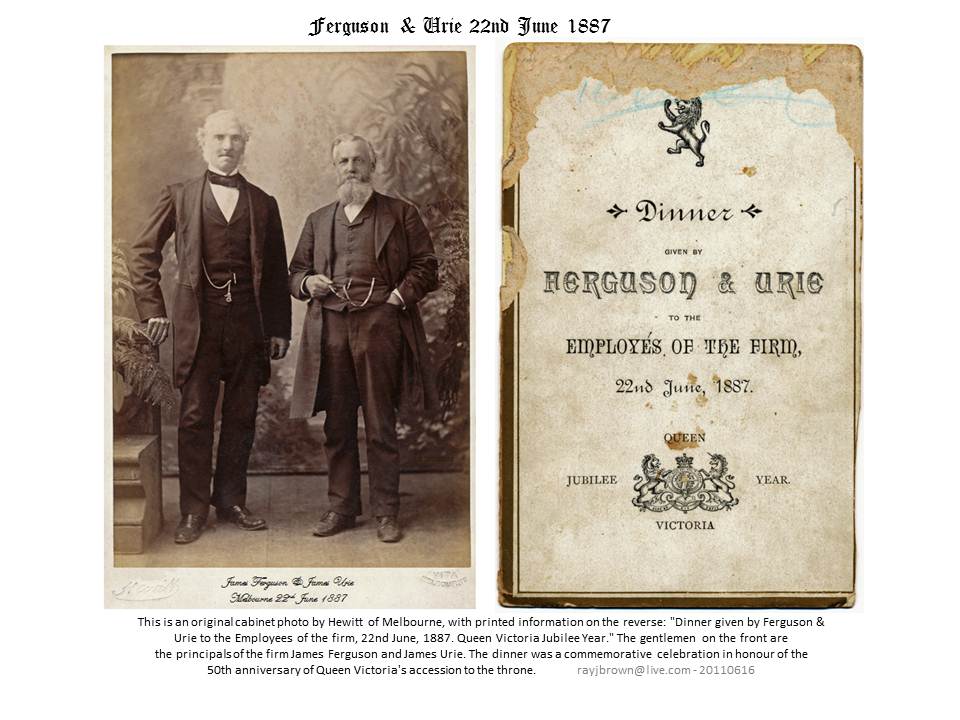
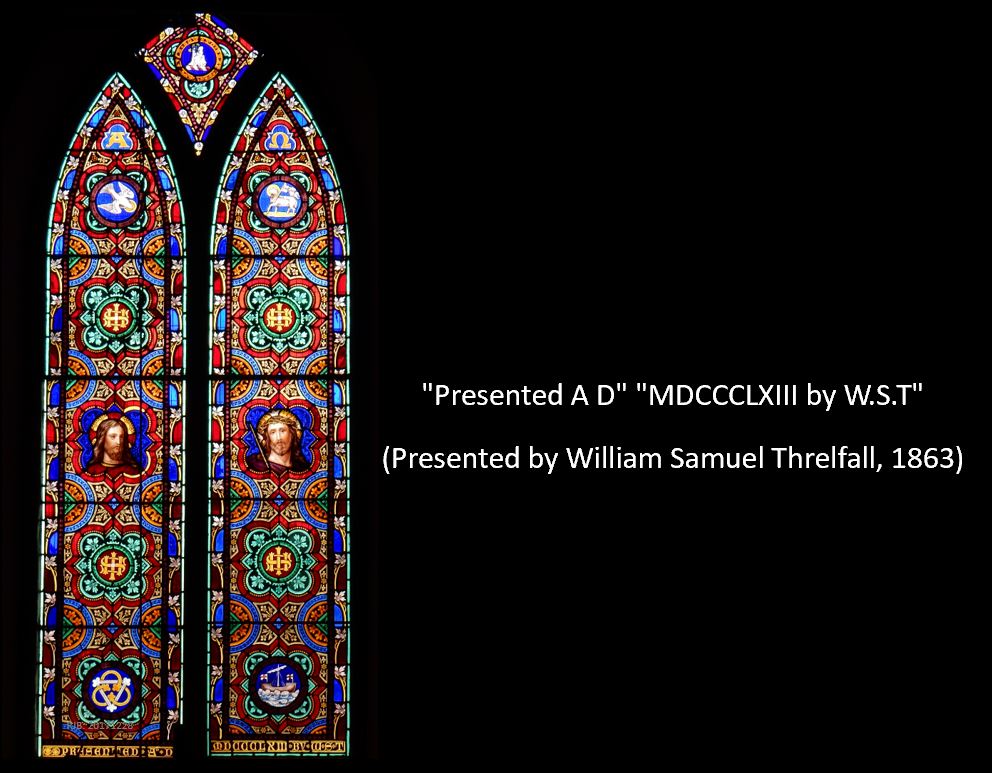
Footnotes:

[1] The Australasian, Melbourne, Vic, Saturday 24th April 1880, page 25.

[2] The Argus, Melbourne, Vic, Friday 6th February 1885, page 5.

[3] Bendigo Advertiser, Vic, Monday 9th February 1885, page 2.

[4] The Argus, Melbourne, Vic, Saturday 29th April 1871, page 4.

[5] The Argus, Melbourne, Vic, Friday 6th February 1885, page 5.

[6] The Australasian, Melbourne, Vic, Saturday 19th June 1886, page 11.

[7] Morning Post, London England, Friday 6th February 1885, page 1.

[8] Croydon Advertiser & East Surry Reporter, London, England, Saturday 7th February 1885, page 3.

[9] Kyabram Union, Vic, Friday 16th May 1890, page 2.

[10] Riverine Herald, Echuca, Vic, Friday 4th January 1895, page 2.

[11] The Sydney Morning Herald, NSW, Saturday 8th March 1902, page 10.

[12] Riverine Herald, Echuca, Vic, Wednesday 16th February 1910, page 4.

[13] The Argus, Melbourne, Vic, Wednesday 3rd April 1912, page 11.

[14] Victorian Heritage Council – report 125244 (accessed 5 Aug 2014)

[15] The Argus, Melbourne, Vic, Saturday 2nd July 1949, page 10.

[16] Riverine Herald, Echuca, Vic, Tuesday 26th December 1950, page 4.


Short link to this article: http://wp.me/p28nLD-2H6

© Copyright